


Fig. 7. Wnt5a interacts with NPC proteins and cholesterol-enriched liposomes.
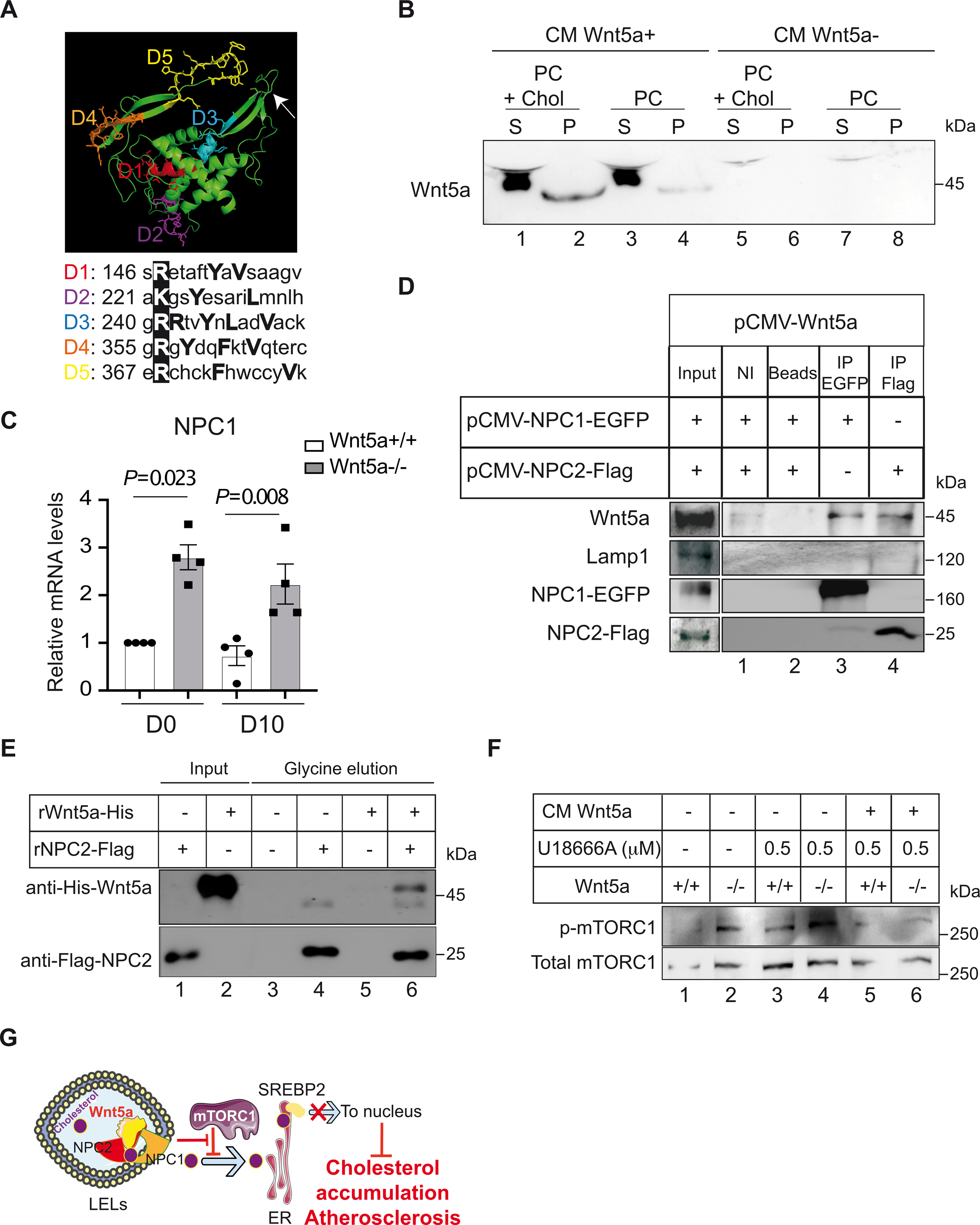
A, Predictive 3D structure of Wnt5a and localization of the CARC motifs. The arrow is showing localization for the palmitoleic acid lipid group. The essential Arg/Lys within the CARC motifs are boxed in dark. B, Conditioned medium enriched in Wnt5a (CM Wnt5a+) or mock medium (CM Wnt5a−) were incubated with liposomes containing 80–85% phosphatidylcholine (PC) or 80–85% phosphatidylcholine + 5% cholesterol (PC + Chol). Liposomes were sedimented, washed and analyzed by immunoblotting for the presence of Wnt5a. Supernatant (S) and pellets (P) were loaded (n=3). C, Relative transcript levels of NPC1 in human VSMC Wnt5a−/− and controls untreated (D0) or treated for cholesterol accumulation during 10 days (D10). GAPDH is taken as internal control. The plot shows individual values with mean±SEM (n=4). D, HEK293 cells were co-transfected with either pCMV-Wnt5a and pCMV-NPC1-EGFP or pCMV-Wnt5a and pCMV-NPC2-Tag expression plasmids. Immunoprecipitations of NPC1 (lane 3) or with NPC2 (lane 4), followed with immunoblotting with Wnt5a show that Wnt5a interacts with both NPC proteins. NI=non-immune antibodies, Beads=empty beads (n=3). E, In vitro direct binding between His-Wnt5a and Flag-NPC2. Recombinant Flag-NPC2 was incubated with Flag-NTA agarose beads allowing NPC2 to bind to the beads. Then 10 μg of human recombinant Wnt5a were added and incubated at room temperature. Complex of proteins was then eluted with a glycine buffer and analyzed by western blotting (n=4). F, Effects of the U18666A compound on the phosphorylation of mTORC1 in presence of control medium (CM Wnt5a−) or Wnt5a enriched condition medium (CM Wnt5a+) in human VSMC Wnt5a−/− and controls (n=3). G, Wnt5a is required for proper lysosomal functions. It promotes cholesterol egress from late endosomes to ER through inhibition of p-mTORC1. In LELs, upon binding to NPC2 and cholesterol, Wnt5a might facilitate cholesterol transfer to NPC1 and to the ER membrane. This suppresses SREBP-2 activity, limits cholesterol accumulation in VSMCs, and protect against atherosclerosis. Statistical analysis was done using a Shapiro-Wilk test followed by one-Way ANOVA and Tukey post hoc analysis for C. C, P=0.023 and P=0.088 indicate significance relative to Wnt5a+/+.