



Abstract
Maternal childhood adversity and trauma may elicit biological changes that impact the next generation through epigenetic responses measured in DNA methylation (DNAm). These epigenetic associations could be modified by the early postnatal environment through protective factors, such as early childhood home visiting (HV) programs that aim to mitigate deleterious intergenerational effects of adversity. In a cohort of 53 mother-child pairs recruited in 2015–2016 for the Pregnancy and Infant Development Study (Cincinnati, Ohio), we examined the association between maternal adverse childhood experiences (ACEs) and neonatal DNAm in the secretogranin V gene (SCG5), which is important in neuroendocrine function. We examined prenatal HV as an effect modifier. Mothers completed a questionnaire on ACEs during pregnancy, and infant buccal samples were collected 1 month postpartum. Multivariable linear regression was used to examine the association between maternal ACEs and neonatal DNAm expressed as M-values averaged across 4 cytosine-phosphate-guanine dinucleotide sites. A higher number of maternal ACEs (>3) was associated with a 5.79–percentage-point lower offspring DNAm (95% confidence interval: −10.44, −1.14), and the association was modified by the number of home visits received during pregnancy. In a population of at-risk mother-child dyads, preliminary evidence suggests that maternal ACEs have a relationship with offspring SCG5 DNAm that differs by the amount of prenatal HV.
Keywords: adverse childhood experiences, DNA methylation, home visiting, SCG5, secretogranin V gene
Abbreviation
- ACE
adverse childhood experience
- CI
confidence interval
- CpG
cytosine-phosphate-guanine
- DNAm
DNA methylation
- HV
home visiting
- PRIDE
Pregnancy and Infant Development
- SCG5
secretogranin V gene
- SNP
single nucleotide polymorphism
Maternal adversity has been associated with offspring health and developmental outcomes (1–6). However, the biological mechanisms by which maternal adversity influences child development are not well understood. One potential mechanism is offspring epigenetic responses to the early environment that alter developmental phenotypes (7, 8).
Briefly, epigenetic mechanisms such as the methylation of cytosine to form 5-methylcytosine, referred to as DNA methylation (DNAm), function to promote or silence the expression of genes. Prenatal exposures to adversity are hypothesized to influence offspring DNAm, with potential functional consequences for development (9, 10). Epigenome-wide association studies and candidate gene studies have demonstrated associations between maternal adversity (psychological distress, poverty, and other hardships) and differential offspring epigenetic profiles (11–16). Although epigenetic studies in this area have greatly increased, more research is warranted to identify which sites on the epigenome are influenced by early adversity and whether interventions can interrupt these epigenetic associations.
Research within the context of behavioral health has suggested that prevention services can alter epigenetic patterns that emerge during early childhood. Parade et al. (17) reported that increased use of social services (namely, home-based services) during early childhood was related to the change in DNAm at an important gene in the regulation of stress response. The findings suggest that prevention services such as early childhood home visiting (HV) could play an important role in buffering children from deleterious biological effects of stress that could undermine development. In particular, the amount of service received prenatally, including early childhood HV, might provide a buffer, supporting caregiver health and adjustment during this critical window of development (18, 19).
HV programs, which serve mother-child dyads throughout early development, aim to establish positive parent-child interactions and secure attachments at sensitive points during early development (birth to age 3 years) (20, 21). These programs typically support child development in the context of poverty and other high-risk environments. There is evidence that an increase in the number and frequency of home visits in these programs is associated with improved parenting and child developmental outcomes (22). In particular, prenatal home visits might provide an important buffer, supporting caregiver health and influencing child development during this critical time window (18, 19). However, it remains unknown whether HV programs can influence early epigenetic responses (e.g., DNAm) to adversity, potentially promoting more resilient phenotypes.
As research continues to elucidate the effects of parental adversity on offspring health and development, it will be important to replicate gene/loci-specific epigenetic findings and to investigate potential protective mechanisms that modify these effects. This work should include further research on genes such as the secretogranin V gene (SCG5), which encodes chaperone proteins important in neuroendocrine function (23). Numerous studies have examined the intergenerational effects of maternal prenatal stress related to an ice storm that occurred in Quebec, Canada, in 1998 and the long-term health outcomes of offspring. Investigators in several of these studies reported an association between maternal exposure to the ice storm during pregnancy and DNAm in offspring at several genes (16, 24–28). A finding related to the SCG5 gene was of special interest, for several reasons: 1) offspring DNAm in the SCG5 gene was highly (negatively) correlated with maternal hardship in an epigenome-wide analysis; 2) the relationship was preserved across multiple tissues and remained significant after correction for multiple comparisons; and 3) expression analyses supported the likely regulatory function of DNAm at these sites (16).
To our knowledge, DNAm of SCG5 has not been identified in other studies examining trauma and adverse childhood experiences (ACEs). Further, there is limited research on potentially modifying effects of prenatal HV services in early-life epigenetic responses to adversity. Therefore, in a pilot study, we aimed to characterize the relationship between maternal ACEs—a measure of life-course hardship—and DNAm in proximity to the SCG5 gene promoter, while also examining the amount of prenatal HV services as an effect modifier. Number of prenatal home visits was hypothesized to modify the relationship between maternal ACEs and offspring SCG5 DNAm.
METHODS
Participants
Participants were recruited from November 2015 to June 2016 during the pilot phase of the Pregnancy and Infant Development (PRIDE) Study in Cincinnati, Ohio. The PRIDE Study is an ongoing longitudinal cohort study of at-risk mother-child dyads that is designed to examine relationships between maternal psychosocial adversity, offspring DNAm, and child development. Eligibility criteria for the PRIDE pilot study included being an English-speaking mother who was at least 18 years of age and between 12 and 35 weeks’ gestation at enrollment. All study participants were enrolled in the Every Child Succeeds HV program in greater Cincinnati, Ohio. All children in the PRIDE pilot study were born from December 2015 through October 2016. Detailed information on referral to and enrollment in the PRIDE pilot study has been published elsewhere (29).
Although participants were recruited during pregnancy from a voluntary HV program, continued participation in HV was not required to participate in the PRIDE Study. Study staff followed study participants independently of the HV program. Home visits were delivered using the Healthy Families America service model (30). Program home visits were scheduled to occur weekly or biweekly during pregnancy, and the number of visits received depended upon gestational age at enrollment and time to birth.
Procedures
Trained study staff collected data at 2 study visits within the home environment. The first study visit occurred prenatally and included measurement of maternal psychological health. During the second study visit (1 month postpartum), infant buccal/saliva samples were collected for DNA extraction and measurement of methylation levels. The study was approved by the institutional review board of Cincinnati Children’s Hospital Medical Center, and all participants provided written informed consent for themselves and their children.
Measures
Data on maternal and child-level characteristics were collected to characterize the population and account for potential confounding in statistical models. Maternal characteristics included race, age, income, education, smoking history, and pregnancy complications. Child-level characteristics included sex and gestational age at birth. The number of prenatal home visits completed was obtained from the Every Child Succeeds program.
ACE questionnaire.
To identify maternal childhood adversity and trauma, an ACE questionnaire was administered to mothers during pregnancy. The ACE questionnaire includes 10 items that represent multiple forms of neglect (i.e., emotional and physical), abuse (i.e., sexual, emotional, physical), and household dysfunction (i.e., intimate partner violence; parental separation; a household member with substance use, mental illness, or incarceration). The total score ranges from 0 to 10, with higher scores indicating more ACEs. For this study, the total score was dichotomized at 3 or more ACEs, a level determined from prior research (5, 6). The measure has good internal consistency (Cronbach’s α = 0.88) and good-to-excellent test-retest reliability (21, 22).
Psychosocial factors.
Maternal depressive symptoms and interpersonal support were measured prenatally to characterize the study population. The Edinburgh Postnatal Depression Scale (31) was used to identify risk for major depressive disorder (intraclass correlation coefficient = 0.92) (32). The Interpersonal Support Evaluation List (33) was used to measure the perceived amount of interpersonal support (34).
Outcome.
The percentage of DNAm was measured at the SCG5 gene. Four cytosine-phosphate-guanine (CpG) dinucleotide sites were the focus of the study (Table 1). These sites were located in proximity to the transcription start site; CpG 2, shown in Table 1, is located on the Illumina Infinium HumanMethylation450 BeadChip and EPIC BeadChip arrays (cg12134633) (Illumina, Inc., San Diego, California). We selected the other 3 CpG sites to replicate those previously identified by Cao-Lei et al. (26) to be highly correlated with maternal prenatal objective hardship and likely to have regulatory significance as indicated by in vitro experiments. The CpG genomic coordinates and the polymerase chain reaction and pyrosequencing primers are given in Table 1.
Table 1.
Bisulfite Pyrosequencing Primers Used to Determine DNA Methylation in the Secretogranin V Gene (SCG5), PRIDE Study, Cincinnati, Ohio, 2015–2016
| Primer/Assay a | Genetic Sequence |
|---|---|
| PCR primer-forward | GGGTTGTTTTTAGGTGAGTATAGTTTTGAT |
| PCR primer-reverse | CTCAATACTCCCTTCCCCTTAC |
| PCR primer-nested forward (same as forward) | GGGTTGTTTTTAGGTGAGTATAGTTTTGAT |
| PCR primer-nested reverse (5′-biotinylated) | AACCTCCACCTCAAAAATTTTAACA |
| Pyrosequencing primer | GGTGAGTATAGTTTTGATG |
Abbreviations: A, adenine; C, cytosine; Chr, chromosome; CpG, cytosine-phosphate-guanine; G, guanine; PCR, polymerase chain reaction; PRIDE, Pregnancy and Infant Development; T, thymine.
a Chr15: 32934005–32934025 (negative strand). Chromosomal coordinates for PCR and sequencing were based on the UCSC Genome Browser (University of California, Santa Cruz (UCSC)) Human Feb. 2009 (GRCh37/hg19) Assembly. Targeted CpG sites on chromosome 15: CpG 1, 3293399; CpG 2, 32934005; CpG 3, 32934008; CpG 4, 32934015. CpG 2 (Chr15: 32934005) is located on the Illumina Infinium HumanMethylation450 BeadChip and EPIC BeadChip arrays (cg12134633) (Illumina, Inc., San Diego, California).
To measure DNAm, we collected buccal/saliva samples from infants at 1 month of age. The process included the collection of 5 sponges designated for DNA extraction and stored in lysate solution (DNA Genotek Oragene OGR-250 saliva kit; DNA Genotek, Ottawa, Ontario, Canada) and 5 sponges designated for cell-type quantification via cytospins and stored in phosphate-buffered saline. We alternated collection of sponges for DNA extraction and sponges for cell spinning. Pyrosequencing was used to quantify DNAm and was previously described by Folger et al. (29). Briefly, the measurement of DNAm was performed by pyrosequencing individual bisulfite-treated DNA samples that were amplified by polymerase chain reaction (35–37). The PyroMark Q96 MD system (QIAGEN Inc., Valencia, California) and Pyro Q-CpG methylation software 1.0 (QIAGEN Inc.) were used to perform quantitative pyrosequencing and to measure DNAm levels at the candidate CpG sites. The process derived β values, interpreted as the percentage of DNAm at each of the 4 CpG sites.
Cell-type heterogeneity.
We estimated the proportion of cell types in our biosamples. Cells were spun onto a glass slide, dried overnight, and stained with Hema 3 fixative following Fisher HealthCare’s PROTOCOL (Thermo Fisher Scientific, Waltham, Massachusetts). Slides were then mounted and examined under a microscope for estimation of cell composition. Nearly 100% of cells were buccal epithelial cells, with a minimal number of leukocytes (1%–2% macrophages). Because of the uniform sample of cells, it was unnecessary to control for cell type in our statistical models.
Genotyping.
We examined the potential effect of genotype on DNAm by genotyping CpG 3, which is located at a known single nucleotide polymorphism (SNP), rs16973398. Pyrosequencing was carried out using PyroMark Gold Q24 reagents with a PyroMark vacuum prep workstation and a PyroMark Q96 MD instrument (QIAGEN Inc.). For SNP detection, standard polymerase chain reaction amplification was performed to amplify the targeted gene fragment at an annealing temperature of 50°C prior to pyrosequencing. The genotype of the interrogated SNP was generated using a PyroMark MD 1.0 instrument (QIAGEN Inc.). Primers used to interrogate SCG5 SNP rs16973398 were as follows: forward primer 5′-TGCCCCTCGGTGAGTACAGT-3′, reverse primer 5′-biotin-AGGACGCCCTCCCACAAC-3′, and sequencing primer 5′-GGCTCGGCCGCCTGC-3′. Genotyping revealed no variation of the allele (C/C) and therefore did not directly contribute to DNAm of CpG 3.
Statistical analysis
Descriptive analyses were conducted to examine the sociodemographic and psychosocial characteristics of the study sample. Associations between maternal characteristics and ACEs were examined using the χ2 test (or Fisher’s exact χ2 test) and t tests based on the variable scale.
Multivariable linear regression was used to regress SCG5 DNAm, expressed as a mean M-value, on the class variable for maternal ACE exposure (≥3 ACEs vs. <3 ACEs). Prior to fitting the model, DNAm was averaged across the 4 CpG sites to obviate the requirement to adjust for multiple comparisons in the initial analysis. The approach used to examine mean DNAm has been used in similar epigenetic studies of candidate genes (29, 38). Because of the preferred statistical properties, we converted DNAm β values to M-values (log2 ratio of methylation percentage) (39). We considered multiple variables for inclusion in the model as potentially confounding factors, illustrated in the directed acyclic graph shown in Figure 1. Maternal race was identified as the only confounding factor for inclusion in the model. We were unable to include maternal early-life household function, identified as a potential confounder (Figure 1). Other variables in descriptive analyses included maternal age, race, education, smoking status, pregnancy complications, and offspring preterm birth. Maternal psychosocial adversity, including prenatal depression and interpersonal support, were only included in descriptive analyses and were identified as mediators of the main effect variable investigated (Figure 1). Hypothesized mediators in the directed acyclic graph were excluded from the final model in order to estimate the association (total estimated effect) between maternal ACEs and offspring DNAm.
Figure 1.
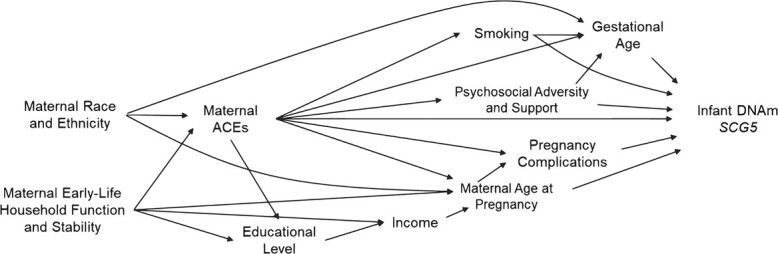
Directed acyclic graph representing the hypothesized causal relationship between maternal adverse childhood experiences (ACEs) and infant DNA methylation (DNAm). SCG5, secretogranin V gene.
Our primary objective was to estimate the association between maternal ACEs and SCG5 DNAm. A multiplicative term was included in the final model to test for an interaction between maternal ACEs and the amount of prenatal HV. HV was classified as a dichotomous variable at a median of 10 prenatal home visits (≥10 visits vs. <10 visits). There were no missing data on the variables selected for model inclusion.
In a secondary analysis, we fitted separate multivariable models for each of the 4 CpG sites. In these models, we applied a false discovery rate adjustment to the P values to account for multiple testing. Analyses were performed in SAS 9.4 (SAS Institute Inc., Cary, North Carolina).
RESULTS
A total of 53 mother-child dyads were included in this study. Over 60% of mothers were Black/African-American (n = 33), and the majority of mothers had psychosocial risk factors such as living in poverty, limited secondary education, and/or elevated levels of depressive symptoms (Table 2). Baseline characteristics by ACE exposure were similar across all measures, except for social support. Mothers who reported exposure to more than 3 ACEs were more likely to report lower social support and elevated depressive symptoms; however, the association with depressive symptoms was nonsignificant. Mothers had a median of 10 prenatal home visits, ranging from 3 visits to 25 visits. The number of home visits during pregnancy varied for several reasons, including time of prenatal enrollment, availability of the mother, and early discharge. Mothers were discharged from the HV program for various reasons, including no longer having time to participate, moving from the service area, and excessive numbers of missed visits.
Table 2.
Characteristics of the Study Sample (n = 53) According to Maternal Number of Adverse Childhood Experiences, PRIDE Study, Cincinnati, Ohio, 2015–2016
| No. of ACEs | |||||||
|---|---|---|---|---|---|---|---|
| Maternal Factor | Baseline | >3 (n = 18) | ≤3 (n = 35) | P Value a | |||
| No. | % | No. | % | No. | % | ||
| Age, yearsb | 21.8 (3.3) | 22.6 (4.5) | 21.3 (2.4) | 0.27 | |||
| No. of prenatal home visitsc | 10.0 (8.0–15.0) | 10.5 (7.0–15.0) | 9.0 (8.0–15.0) | 0.93 | |||
| Race | 0.90 | ||||||
| Black | 33 | 62.3 | 11 | 61.1 | 22 | 62.9 | |
| White/otherd | 20 | 37.7 | 7 | 38.9 | 13 | 37.1 | |
| Education | 0.60 | ||||||
| High school or less | 42 | 79.2 | 15 | 83.3 | 27 | 77.1 | |
| Some college/degree | 11 | 20.8 | 3 | 16.7 | 8 | 22.9 | |
| Annual household income, dollarse | 0.90 | ||||||
| <25,000 | 28 | 54.9 | 9 | 56.3f | 19 | 54.3 | |
| ≥25,000 | 23 | 45.1 | 7 | 43.8f | 16 | 45.7 | |
| Medicaid health insurancee | 49 | 96.1 | 16 | 94.1 | 33 | 97.1 | 0.61 |
| Prenatal smoking | 10 | 18.9 | 4 | 22.2 | 6 | 17.1 | 0.65 |
| Pregnancy complicationsg | 19 | 35.9 | 8 | 44.4 | 11 | 31.4 | 0.35 |
| High level of depressive symptomsh | 22 | 41.5 | 9 | 50.0 | 13 | 37.1 | 0.37 |
| High level of social supporti | 17 | 32.1 | 2 | 11.1 | 15 | 42.9 | 0.02 |
Abbreviations: ACE, adverse childhood experience; PRIDE, Pregnancy and Infant Development; SD, standard deviation.
a P for mothers with >3 ACEs versus mothers with ≤3 ACEs.
b Values are expressed as mean (standard deviation).
c Values are expressed as median (interquartile range).
d Five mothers were of “other” race, and 4 of these mothers were biracial.
e Two records were missing data on household income, and 2 were missing data on insurance type.
f The rounded values of 56.25 and 43.75 sum to more than 100%.
g Self-reported diagnosis of hypertension, gestational diabetes, anemia, and/or placenta previa.
h Depressive symptoms were determined using the Edinburgh Postnatal Depression Scale (31) (high = total score ≥10).
i Social support was determined using the Interpersonal Support Evaluation List (33) (high = total score ≥75th percentile).
Mean SCG5 DNAm
A maternal report of 3 or more ACEs was significantly associated with lower offspring mean DNAm across the CpG sites examined in the SCG5 gene (Table 3). Maternal race was the only covariate included in the final model. There was no effect modification by age, race, or sex. The modeled β value (as opposed to M-value) indicated that a high level of maternal ACEs was associated with a 5.79–percentage-point reduction in the mean percentage of offspring DNAm (95% confidence interval (CI): −10.44, −1.14). Maternal depressive symptoms and interpersonal support were not significantly associated with DNAm.
Table 3.
Models for Estimating the Association Between Maternal Adverse Childhood Experiences and Mean Percentage of Infant SCG5 DNA Methylation, PRIDE Study, Cincinnati, Ohio, 2015–2016
| ACE Level (>3 ACEs vs. ≤3 ACEs) | Regression Coefficient | 95% CI |
|---|---|---|
| M-valuea | −0.70 | −1.22, −0.18 |
| β-valueb | −5.79 | −10.44, −1.14 |
| Black maternal racea | 0.39 | −0.11, 0.90 |
Abbreviations: ACE, adverse childhood experience; CI, confidence interval; PRIDE, Pregnancy and Infant Development; SCG5, secretogranin V gene.
a Parameter estimate was derived from a regression model with an M-value as the outcome; the race regression coefficient, which was also included in the model, was based on the model that used the M-value as the outcome.
b Parameter estimate was derived from a regression model with a β value (percentage of DNA methylation) as the outcome.
In a separate multivariable general linear model, the amount of prenatal HV received was identified as a significant effect modifier for the association between maternal ACEs and offspring SCG5 DNAm (Figure 2). The β value translation for the interaction was a least-squares mean difference in DNAm of 2.76 percentage points (95% CI: −8.38, 2.85) for ≥3 ACEs versus <3 ACEs among mothers who had a higher number of prenatal home visits (i.e., ≥10 visits). This was compared with a least-squares mean difference in DNAm of 11.18 percentage points (95% CI: −17.66, −4.69) for ACE exposure among mothers who had a lower number of prenatal home visits (<10 visits).
Figure 2.
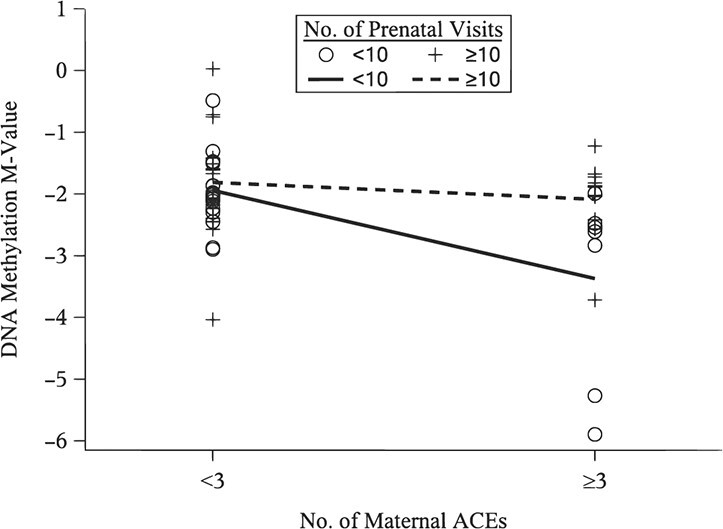
Association between maternal exposure to adverse childhood experiences (ACEs) and offspring SCG5 DNA methylation, according to amount of prenatal home visiting (≥10 visits vs. <10 visits), PRIDE study, Cincinnati, Ohio, 2015–2016. The lines represent differences in mean M-values by maternal ACE exposure level and the amount of prenatal home visiting received. PRIDE, Pregnancy and Infant Development; SCG5, secretogranin V gene.
Site-specific DNAm
There was variation in the percentage of DNAm observed across the 4 CpG sites investigated in the SCG5 gene for this study. Only CpG 3 was statistically significant in the multivariable model (Table 4). This CpG site had the greatest variation in DNAm and had the lowest proportion of participants who were unmethylated (Table 4). However, CpG 3 did not remain significant after false discovery rate adjustment. There was evidence of a significant interaction between maternal ACEs and prenatal home visits at CpG sites 2 and 4, and a similar pattern was observed at CpG 1 (Table 4).
Table 4.
Associations Between Maternal Adverse Childhood Experiences and DNA Methylation of SCG5 CpG Sites, PRIDE Study, Cincinnati, Ohio, 2015–2016
| % of DNAm | No. of Prenatal Home Visits c | ||||||||
|---|---|---|---|---|---|---|---|---|---|
| ≤10 | >10 | ||||||||
| CpG Site | Regression Coefficient a | 95% CI | % Unmethylated b | Range | Interquartile Range | Regression Coefficient | 95% CI | Regression Coefficient | 95% CI |
| 1 | −1.19 | −2.74, 0.36 | 32.1 | 0–98.3 | 0.68–12.3 | −2.12 | −4.50, 0.25 | −0.75 | −2.81, 1.30 |
| 2d,e | −0.45 | −1.83, 0.93 | 18.9 | 0–74.6 | 6.5–21.1 | −2.13f | −4.20, −0.06 | 0.52 | −1.27, 2.31 |
| 3f | −1.37 | −2.68, −0.06 | 3.8 | 0–100 | 33.2–43.9 | −1.24 | −3.30, 0.81 | −1.61 | −3.40, 0.17 |
| 4g | −0.51 | −1.54, 0.53 | 5.7 | 0.92–48.2 | 5.5–22.3 | −2.15f | −3.67, −0.63 | 0.66 | −0.66, 1.97 |
Abbreviations: ACE, adverse childhood experience; CI, confidence interval; DNAm, DNA methylation; CpG, cytosine-phosphate-guanine; PHV, prenatal home visiting; PRIDE, Pregnancy and Infant Development; SCG5, secretogranin V gene.
a DNAm M-values were included in the models; there were no comparisons that survived false discovery rate P value adjustment. See Table 1 for the chromosomal coordinates of CpG sites 1–4.
b DNAm value of <1%.
c PHV-stratified parameter estimates were derived from a model that included the interaction parameter: maternal ACEs × PHV. DNAm M-values were included in the models.
d Illumina CpG site cg12134633 (Illumina, Inc., San Diego, California).
e Maternal ACE × PHV interaction: P < 0.10.
f P < 0.05.
g Maternal ACE × PHV interaction: P < 0.05.
DISCUSSION
In a cohort of women enrolled in an HV program during pregnancy, we aimed to expand evidence of an association between objective maternal stress (e.g., physical hardship, traumatic experiences) during pregnancy and offspring DNAm of the SCG5 gene. We demonstrated that maternal childhood experiences of interpersonal trauma and/or household dysfunction are associated with offspring DNAm in the SCG5 gene, which expresses a protein (7B2) important to neuroendocrine cell function and specifically secretory pathways (23). Further, the amount of prenatal HV services delivered to provide psychosocial support may significantly attenuate this relationship. Therefore, maternal early-life experiences and the type of support received by the mother during pregnancy may have a regulatory impact on the SCG5 gene.
The main effect investigated was similar to that observed in the epigenome-wide study carried out by Cao-Lei et al. (16), who demonstrated that maternal prenatal objective hardship was associated with decreased offspring DNAm at the same CpG sites when the child was 8 and 13 years of age. Our study leveraged the findings of this previous study but instead focused on an exposure of maternal ACEs and examined DNAm during early infancy. The results from both studies support the hypothesis that significant hardship experienced in one generation can have biological effects that manifest in the next generation.
This relationship is important, because early biological effects may shape developmental programming via the epigenome and may have both early-life and life-course implications for behavioral and stress regulation (8, 9, 40, 41). Specifically, during critical windows of fetal brain development, perturbations in the environment such as maternal adversity and psychological distress may elicit changes in DNAm intended to support function in the anticipated environment. However, these epigenetic responses may also have consequences for neuroendocrine function and related social-emotional and behavioral outcomes (29, 41–43). Certain epigenetic responses to the early psychosocial environment may persist into adulthood (40).
The association we observed was the strongest at CpG 3, which also had the most variation in percentage of DNAm, suggesting that this site may be particularly sensitive to parental experiences and the early environment. However, the evidence from this study suggested that similar associations were observed at the other CpG sites—but for only those mothers who received a low amount of prenatal HV. The observed effect estimates were modest in size, aligning with an emerging paradigm characterized by subtle yet important changes in DNAm (<10%) in response to the external environment (44).
Although we did not examine gene expression, previous research provides robust evidence that DNAm at these specific CpG sites likely has a regulatory function (16). The negative direction of the finding suggests that increased maternal life-course stressors could be associated with increased expression of SCG5. One possible explanation for this relationship is that parental adversity elicits a compensatory epigenetic response; however, it is unknown whether this response would be advantageous to behavioral regulation and social-emotional development. Past research has shown that differential DNAm may be protective to certain domains of development, while undermining other domains (42). Further research is required to elucidate the potential functional consequences of this association.
The results from this study also provide new evidence for the potential biological relevance of prevention programs delivered prenatally and during early childhood. HV programs are designed to support high-risk families during these critical windows of brain development. This service can support positive parenting behaviors (e.g., sensitivity, responsiveness) and therefore may buffer infants from the toxic psychobiological effects of early adversity. High maternal sensitivity is known to mitigate the stress response initiated by the hypothalamic-pituitary-adrenal (HPA) axis (45). High maternal sensitivity may also interrupt offspring epigenetic responses (observed in buccal DNAm) to maternal psychopathology at genes related to neuroendocrine function (43). Our findings also build upon research that identified the intensity of social services as a modifier of the relationship between childhood adversity and DNAm at genes involved in stress response (17).
The findings suggest that HV services might play an important role in buffering the deleterious biological effects of adversity. However, we must also consider an alternative explanation: not that the estimated effect was buffered by HV service but rather that those mothers who were more strongly engaged in HV had systematic differences in resiliency and early parenting behaviors. Although we adjusted for baseline characteristics, a larger-scale study is needed that randomizes participants to an amount of HV services and follows participants over time.
This study had several strengths, including an attempt to replicate similar previous DNAm findings in a diverse cohort of mother-child dyads at a younger offspring age, the examination of effect modification by the intensity of prenatal HV services, and the use of a homogeneous cell type that is easily accessible and may reflect certain behavioral risks (46). The use of a more diverse population at a younger age, when certain patterns—advantageous or deleterious—are likely to be established, is an important feature that complements past research. In particular, replication of epigenomic associations across different populations is important to elucidate mechanisms and to support the eventual development of biomarkers (47, 48). We also ensured that variation in genotype at CpG 3 (rs16973398) did not contribute to DNAm variation.
There were also several limitations of the study. First, the small sample size precluded the assessment of mediating factors such as maternal depressive symptoms. Second, although the CpG sites in SCG5 were previously linked to gene expression levels, we did not quantify the relationship in this study, and therefore we were unable to associate DNAm with decreased gene expression. Third, the specific SCG5 hypomethylated epigenotype must be explored further to determine functional relevance to developmental/behavioral phenotypes. Fourth, the amount of HV was not randomized, so we cannot rule out the potential for bias in the reported estimated effects.
In conclusion, the relationship between maternal ACEs and offspring neonatal SCG5 DNAm was significant and differed by the number of home visits received during pregnancy. The evidence suggests that prevention programs such as HV delivered at a high intensity during pregnancy may alter the epigenetic responses elicited by maternal adversity. To our knowledge, this is the first study to have replicated the association between maternal adversity and infant DNAm of SCG5 and to have specifically considered both maternal ACEs and the intensity of prenatal prevention services. Continued research is needed and may have implications for precision approaches, including improved recommendations regarding the optimal timing and level of HV service.
ACKNOWLEDGMENTS
Author affiliations: Division of Biostatistics and Epidemiology, Cincinnati Children’s Hospital Medical Center, Cincinnati, Ohio, United States (Alonzo T. Folger, Nichole Nidey, Lili Ding, Katherine A. Bowers); Department of Pediatrics, College of Medicine, University of Cincinnati, Cincinnati, Ohio, United States (Alonzo T. Folger, Lili Ding, Kimberly Yolton, Robert T. Ammerman, Katherine A. Bowers); Every Child Succeeds, Inc., Cincinnati, Ohio, United States (Alonzo T. Folger, Robert T. Ammerman); Department of Anatomy, Physiology, and Cell Biology, School of Veterinary Medicine, University of California, Davis, Davis, California, United States (Hong Ji); California National Primate Research Center, University of California, Davis, Davis, California, United States (Hong Ji); Division of General and Community Pediatrics, Cincinnati Children’s Hospital Medical Center, Cincinnati, Ohio, United States (Kimberly Yolton); and Division of Behavioral Medicine and Clinical Psychology, Cincinnati Children’s Hospital Medical Center, Cincinnati, Ohio, United States (Robert T. Ammerman).
This work was supported by grants from the National Institute on Minority Health and Health Disparities (grant R56MD013006-01 to A.F. and K.B.) and the Cincinnati Children’s Hospital Research Foundation (Trustee Award to K.B.).
We acknowledge the participation and support of Every Child Succeeds, the United Way of Greater Cincinnati, and Ohio Help Me Grow. We also acknowledge the Cincinnati Children’s Pyrosequencing Core Laboratory for Genomic and Epigenomic Research for assistance in sample processing and data acquisition.
This paper was presented at the 51st Annual Meeting of the Society for Epidemiologic Research, Baltimore, Maryland, June 19–22, 2018.
The views expressed in this article are those of the authors and do not necessarily reflect those of the National Institutes of Health.
Conflict of interest: none declared.
REFERENCES
- 1. Lê-Scherban F, Wang X, Boyle-Steed KH, et al. Intergenerational associations of parent adverse childhood experiences and child health outcomes. Pediatrics. 2018;141(6):e20174274. [DOI] [PubMed] [Google Scholar]
- 2. Smith MV, Gotman N, Yonkers KA. Early childhood adversity and pregnancy outcomes. Matern Child Health J. 2016;20(4):790–798. [DOI] [PMC free article] [PubMed] [Google Scholar]
- 3. Polanska K, Krol A, Merecz-Kot D, et al. Maternal stress during pregnancy and neurodevelopmental outcomes of children during the first 2 years of life. J Paediatr Child Health. 2017;53(3):263–270. [DOI] [PubMed] [Google Scholar]
- 4. Osborne S, Biaggi A, Chua TE, et al. Antenatal depression programs cortisol stress reactivity in offspring through increased maternal inflammation and cortisol in pregnancy: the Psychiatry Research and Motherhood–Depression (PRAM-D) Study. Psychoneuroendocrinology. 2018;98:211–221. [DOI] [PMC free article] [PubMed] [Google Scholar]
- 5. Folger AT, Eismann EA, Stephenson NB, et al. Parental adverse childhood experiences and offspring development at 2 years of age. Pediatrics. 2018;141(4):e20172826. [DOI] [PubMed] [Google Scholar]
- 6. Folger AT, Putnam KT, Putnam FW, et al. Maternal interpersonal trauma and child social-emotional development: an intergenerational effect. Paediatr Perinat Epidemiol. 2017;31(2):99–107. [DOI] [PubMed] [Google Scholar]
- 7. Lester BM, Conradt E, Marsit C. Introduction to the special section on epigenetics. Child Dev. 2016;87(1):29–37. [DOI] [PMC free article] [PubMed] [Google Scholar]
- 8. Szyf M, Tang Y-Y, Hill KG, et al. The dynamic epigenome and its implications for behavioral interventions: a role for epigenetics to inform disorder prevention and health promotion. Transl Behav Med. 2016;6(1):55–62. [DOI] [PMC free article] [PubMed] [Google Scholar]
- 9. Monk C, Spicer J, Champagne FA. Linking prenatal maternal adversity to developmental outcomes in infants: the role of epigenetic pathways. Dev Psychopathol. 2012;24(4):1361–1376. [DOI] [PMC free article] [PubMed] [Google Scholar]
- 10. Cao-Lei L, De Rooij SR, King S, et al. Prenatal stress and epigenetics. Neurosci Biobehav Rev. 2020;117:198–210. [DOI] [PubMed] [Google Scholar]
- 11. Jirtle RL, Skinner MK. Environmental epigenomics and disease susceptibility. Nat Rev Genet. 2007;8(4):253–262. [DOI] [PMC free article] [PubMed] [Google Scholar]
- 12. Capron LE, Ramchandani PG, Glover V. Maternal prenatal stress and placental gene expression of NR3C1 and HSD11B2: the effects of maternal ethnicity. Psychoneuroendocrinology. 2018;87:166–172. [DOI] [PubMed] [Google Scholar]
- 13. Brunst KJ, Tignor N, Just A, et al. Cumulative lifetime maternal stress and epigenome-wide placental DNA methylation in the PRISM cohort. Epigenetics. 2018;13(6):665–681. [DOI] [PMC free article] [PubMed] [Google Scholar]
- 14. Viuff AC, Sharp GC, Rai D, et al. Maternal depression during pregnancy and cord blood DNA methylation: findings from the Avon Longitudinal Study of Parents and Children. Transl Psychiatry. 2018;8(1):244. [DOI] [PMC free article] [PubMed] [Google Scholar]
- 15. Laubach ZM, Perng W, Cardenas A, et al. Socioeconomic status and DNA methylation from birth through mid-childhood: a prospective study in Project Viva. Epigenomics. 2019;11(12):1413–1427. [DOI] [PMC free article] [PubMed] [Google Scholar]
- 16. Cao-Lei L, Massart R, Suderman MJ, et al. DNA methylation signatures triggered by prenatal maternal stress exposure to a natural disaster: Project Ice Storm. PLoS One. 2014;9(9):e107653. [DOI] [PMC free article] [PubMed] [Google Scholar]
- 17. Parade SH, Parent J, Rabemananjara K, et al. Change in FK506 binding protein 5 (FKBP5) methylation over time among preschoolers with adversity. Dev Psychopathol. 2017;29(5):1627–1634. [DOI] [PMC free article] [PubMed] [Google Scholar]
- 18. Goyal NK, Hall ES, Meinzen-Derr JK, et al. Dosage effect of prenatal home visiting on pregnancy outcomes in at-risk, first-time mothers. Pediatrics. 2013;132(suppl 2):S118–S125. [DOI] [PMC free article] [PubMed] [Google Scholar]
- 19. Issel LM, Forrestal SG, Slaughter J, et al. A review of prenatal home-visiting effectiveness for improving birth outcomes. J Obstet Gynecol Neonatal Nurs. 2011;40(2):157–165. [DOI] [PubMed] [Google Scholar]
- 20. Adirim T, Supplee L. Overview of the federal home visiting program. Pediatrics. 2013;132(suppl 2):S59–S64. [DOI] [PubMed] [Google Scholar]
- 21. Sweet MA, Appelbaum MI. Is home visiting an effective strategy? A meta-analytic review of home visiting programs for families with young children. Child Dev. 2004;75(5):1435–1456. [DOI] [PubMed] [Google Scholar]
- 22. Nygren P, Green B, Winters K, et al. What’s happening during home visits? Exploring the relationship of home visiting content and dosage to parenting outcomes. Matern Child Health J. 2018;22(suppl 1):52–61. [DOI] [PMC free article] [PubMed] [Google Scholar]
- 23. Mbikay M, Seidah NG, Chrétien M. Neuroendocrine secretory protein 7B2: structure, expression and functions. Biochem J. 2001;357(2):329–342. [DOI] [PMC free article] [PubMed] [Google Scholar]
- 24. Cao-Lei L, Dancause KN, Elgbeili G, et al. DNA methylation mediates the effect of maternal cognitive appraisal of a disaster in pregnancy on the child’s C-peptide secretion in adolescence: Project Ice Storm. PLoS One. 2018;13(2):e0192199. [DOI] [PMC free article] [PubMed] [Google Scholar]
- 25. Cao-Lei L, Dancause KN, Elgbeili G, et al. DNA methylation mediates the impact of exposure to prenatal maternal stress on BMI and central adiposity in children at age 13 1/2 years: Project Ice Storm. Epigenetics. 2015;10(8):749–761. [DOI] [PMC free article] [PubMed] [Google Scholar]
- 26. Cao-Lei L, Elgbeili G, Massart R, et al. Pregnant women’s cognitive appraisal of a natural disaster affects DNA methylation in their children 13 years later: Project Ice Storm. Transl Psychiatry. 2015;5(2):e515. [DOI] [PMC free article] [PubMed] [Google Scholar]
- 27. Cao-Lei L, Dancause KN, Elgbeili G, et al. Pregnant women’s cognitive appraisal of a natural disaster affects their children’s BMI and central adiposity via DNA methylation: Project Ice Storm. Early Hum Dev. 2016;103:189–192. [DOI] [PubMed] [Google Scholar]
- 28. Cao-Lei L, Elgbeili G, Szyf M, et al. Differential genome-wide DNA methylation patterns in childhood obesity. BMC Res Notes. 2019;12(1):174. [DOI] [PMC free article] [PubMed] [Google Scholar]
- 29. Folger AT, Ding L, Ji H, et al. Neonatal NR3C1 methylation and social-emotional development at 6 and 18 months of age. Front Behav Neurosci. 2019;13:14. [DOI] [PMC free article] [PubMed] [Google Scholar]
- 30. Daro DA, Harding KA. Healthy Families America: using research to enhance practice. Future Child. 1999;9(1):152–176. [PubMed] [Google Scholar]
- 31. Cox JL, Holden JM, Sagovsky R. Detection of postnatal depression. Development of the 10-item Edinburgh Postnatal Depression Scale. Br J Psychiatry. 1987;150(6):782–786. [DOI] [PubMed] [Google Scholar]
- 32. Kernot J, Olds T, Lewis LK, et al. Test-retest reliability of the English version of the Edinburgh Postnatal Depression Scale. Arch Womens Ment Health. 2015;18(2):255–257. [DOI] [PubMed] [Google Scholar]
- 33. Cohen S, Hoberman HM. Positive events and social supports as buffers of life change stress. J Appl Soc Psychol. 1983;13(2):99–125. [Google Scholar]
- 34. Bates DS, Toro PA. Developing measures to assess social support among homeless and poor people. J Community Psychol. 1999;27(2):137–156. [Google Scholar]
- 35. Ji H, Ehrlich LIR, Seita J, et al. Comprehensive methylome map of lineage commitment from haematopoietic progenitors. Nature. 2010;467(7313):338–342. [DOI] [PMC free article] [PubMed] [Google Scholar]
- 36. Zhang X, Ulm A, Somineni HK, et al. DNA methylation dynamics during ex vivo differentiation and maturation of human dendritic cells. Epigenetics Chromatin. 2014;7(1):21. [DOI] [PMC free article] [PubMed] [Google Scholar]
- 37. Ji H, Zhang X, Oh S, et al. Dynamic transcriptional and epigenomic reprogramming from pediatric nasal epithelial cells to induced pluripotent stem cells. J Allergy Clin Immunol. 2015;135(1):236–244. [DOI] [PMC free article] [PubMed] [Google Scholar]
- 38. Parent J, Parade SH, Laumann LE, et al. Dynamic stress-related epigenetic regulation of the glucocorticoid receptor gene promoter during early development: the role of child maltreatment. Dev Psychopathol. 2017;29(5):1635–1648. [DOI] [PMC free article] [PubMed] [Google Scholar]
- 39. Du P, Zhang X, Huang CC, et al. Comparison of beta-value and M-value methods for quantifying methylation levels by microarray analysis. BMC Bioinformatics. 2010;11(1):587. [DOI] [PMC free article] [PubMed] [Google Scholar]
- 40. McGowan PO, Sasaki A, D’Alessio AC, et al. Epigenetic regulation of the glucocorticoid receptor in human brain associates with childhood abuse. Nat Neurosci. 2009;12(3):342–348. [DOI] [PMC free article] [PubMed] [Google Scholar]
- 41. Parade SH, Ridout KK, Seifer R, et al. Methylation of the glucocorticoid receptor gene promoter in preschoolers: links with internalizing behavior problems. Child Dev. 2016;87(1):86–97. [DOI] [PMC free article] [PubMed] [Google Scholar]
- 42. Bromer C, Marsit CJ, Armstrong DA, et al. Genetic and epigenetic variation of the glucocorticoid receptor (NR3C1) in placenta and infant neurobehavior. Dev Psychobiol. 2013;55(7):673–683. [DOI] [PMC free article] [PubMed] [Google Scholar]
- 43. Conradt E, Hawes K, Guerin D, et al. The contributions of maternal sensitivity and maternal depressive symptoms to epigenetic processes and neuroendocrine functioning. Child Dev. 2016;87(1):73–85. [DOI] [PMC free article] [PubMed] [Google Scholar]
- 44. Leenen FA, Muller CP, Turner JD. DNA methylation: conducting the orchestra from exposure to phenotype? Clin Epigenetics. 2016;8(1):1–15. [DOI] [PMC free article] [PubMed] [Google Scholar]
- 45. Hostinar CE, Sullivan RM, Gunnar MR. Psychobiological mechanisms underlying the social buffering of the hypothalamic-pituitary-adrenocortical axis: a review of animal models and human studies across development. Psychol Bull. 2014;140(1):256–282. [DOI] [PMC free article] [PubMed] [Google Scholar]
- 46. Smith AK, Kilaru V, Klengel T, et al. DNA extracted from saliva for methylation studies of psychiatric traits: evidence tissue specificity and relatedness to brain. Am J Med Genet B Neuropsychiatr Genet. 2015;168(1):36–44. [DOI] [PMC free article] [PubMed] [Google Scholar]
- 47. Ryan J, Mansell T, Fransquet P, et al. Does maternal mental well-being in pregnancy impact the early human epigenome? Epigenomics. 2017;9(3):313–332. [DOI] [PubMed] [Google Scholar]
- 48. Kundakovic M, Jaric I. The epigenetic link between prenatal adverse environments and neurodevelopmental disorders. Genes (Basel). 2017;8(3):104. [DOI] [PMC free article] [PubMed] [Google Scholar]