


Fig. 2. Selective tau ablation in excitatory neurons reduces premature mortality, epileptiform activity, and autism-like behaviors in DS mice.
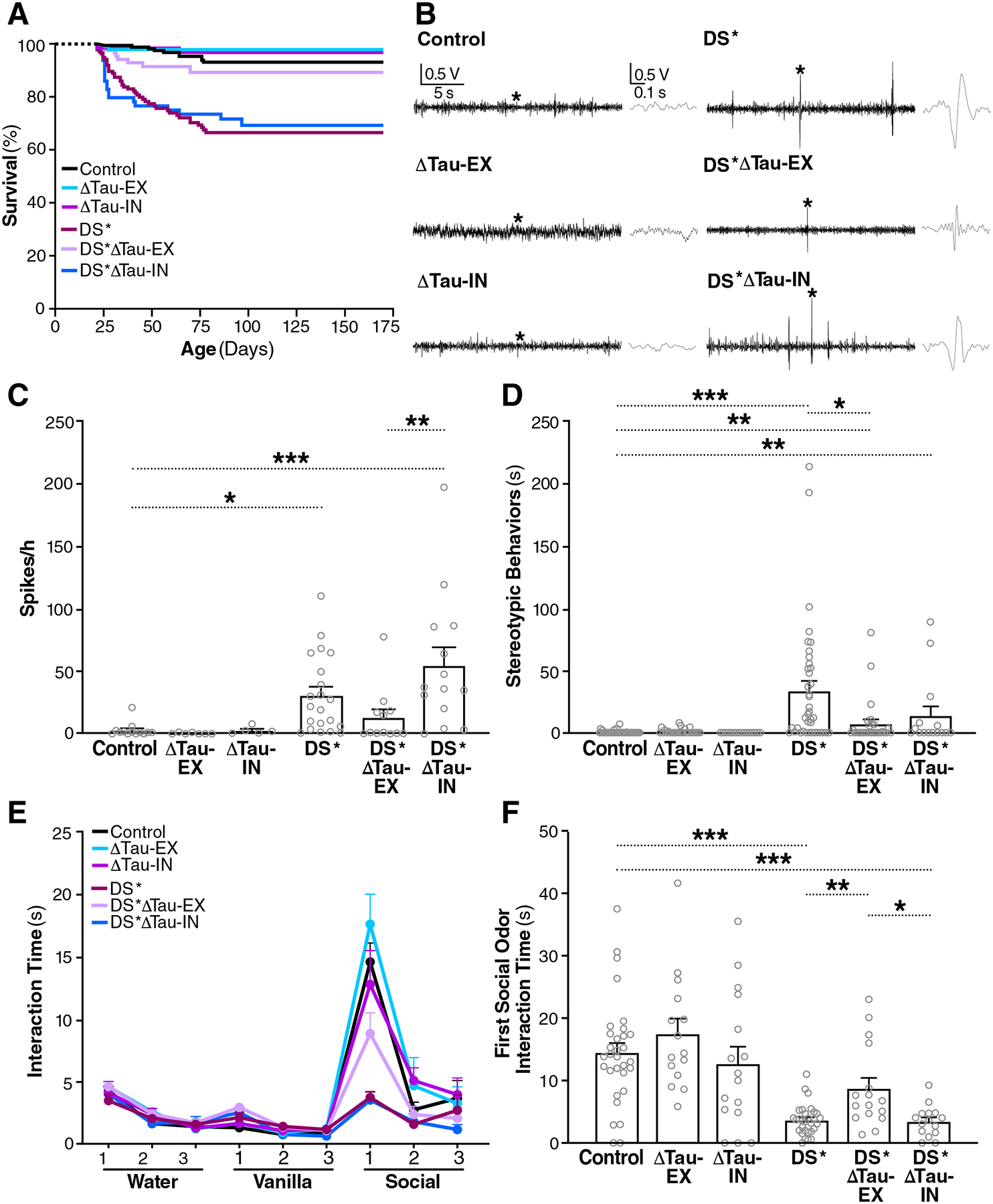
(A) Survival curves of Control, ΔTau-EX, ΔTau-IN, Scn1aRX/+/Maptflox/flox (DS*), Scn1aRX/+/Emx1IRES-cre/+/Maptflox/flox (DS*ΔTau-EX) and Scn1aRX/+/VgatIRES-cre/+/Maptflox/flox (DS*ΔTau-IN) mice. n = 61–168 mice per group at P20, when monitoring began. (B) Representative EEG traces recorded from 2.5-month-old mice of the indicated genotypes. Sections of traces marked with an asterisk are shown on the right at higher time resolution. (C) Frequency of epileptiform spikes quantified at 2.5 months of age. n = 5–21 mice per group. (D) Time mice were engaged in stereotypic (digging-like) behaviors at 6 months of age. n = 15–43 mice per group. (E and F) Olfactory habituation/dishabituation in 8-month-old mice. n = 15–31 mice. (E) Three different olfactory stimuli were presented for 6 min each in the indicated order and the amount of time mice interacted with each stimulus was recorded in three 2-min bins. Mouse bedding was used as the social odor. (F) Stimulus interaction time during the first 2 min of social odor presentation. *P < 0.05, **P < 0.01, and ***P < 0.001 by one-way ANOVA and Holm-Sidak test (C) or permutation test with Holm-Sidak correction (D and F). Gray circles represent data from individual mice. Values in (C) to (F) are means ± SEM.