



Abstract
Healthcare professionals may motivate their patients to exercise to lose weight, but it is unknown how weight-focused motivations influence young peoples’ PA trajectories.
Purpose
To examine if weight-motivated exercise predicts moderate-to-vigorous physical activity (MVPA) from adolescence to adulthood in a population-based sample and if this relationship differs by age and body mass index (BMI).
Methods
Participants (N=1,428; 13–18 years at baseline; 48.6% female; 49.0% White) responded to surveys in the 15-year longitudinal study, Project EAT (Eating and Activity in Teens and Young Adults). Weight-motivated exercise was examined as a predictor of MVPA across the life course at five-year intervals using linear regression generalized estimating equations and adjusting for demographics (age modeled continuously), BMI (modeled continuously), weight-related intentions, and prior MVPA.
Results
Weight-motivated exercise predicted higher subsequent MVPA at five-year intervals among females (B=0.57, 95% CI:0.13, 1.00) but not males (B=0.31, 95% CI:−0.09, 0.72). The association differed by BMI in females (p=.02); weight-motivated exercise was associated with higher subsequent MVPA at lower BMI but lower subsequent MVPA at higher BMI. The association also differed by age in males (p=.008), such that older males who reported weight-motivated exercise had higher subsequent MVPA, whereas this association was not present in younger males.
Conclusion
Weight-motivated exercise may have a deleterious influence on MVPA for females with higher BMI and may have an advantageous influence for older males. Understanding how motivations for exercise may influence PA trajectories can inform PA promotion over the life course by providing more nuanced guidance by age, BMI, and sex.
Keywords: physical activity, exercise, motivation, weight stigma, adolescent
INTRODUCTION
Physical activity (PA) is associated with numerous indicators of better physical and psychosocial health.1–3 Despite the many benefits of regular PA, research suggests that only 20% of adolescents meet PA guidelines and levels of PA tend to decrease across the lifespan.4,5 Evidence has shown that PA behaviors established in adolescence often continue into adulthood.6 To improve and support the maintenance of PA during the transition to adulthood, it is imperative to intervene at an early age and provide effective counseling on sustainable forms of PA.
PA promotion for young people may account for a wide spectrum of both intrinsic and extrinsic motivators.7–9 Motivation drives achievement behaviors identified as part of Self-Determination Theory,10,11 which can influence health behaviors, including PA.12 PA motivators for adolescents include making new friends, having fun, getting in shape, feeling good about themselves, and improving their health,7 though motivators may differ by gender.9 Graham et al. explored adolescent PA attitudes using data from Project EAT and showed that adolescents who cared more about “staying fit and exercising” and “doing well in sports” had 30–40% higher moderate-to-vigorous physical activity (MVPA) five and ten years later.13 Another longitudinal study in college students showed that there were a multitude of motivations for being physically active, and that these motivators changed from freshman year to graduation, but only intrinsic motivators (e.g., exercising for fun or because it feels good) significantly predicted physical activity behavior through their transition into college.14
Promoting exercise as a means for weight control, rather than focusing on these other motivators, has the potential to inadvertently promote body dissatisfaction and send the message to young people that the only purpose of PA is weight control. Moreover, there is evidence that dieting during adolescence has the opposite of the intended effect with “dieting” during this developmental phase predicting future weight gain.15,16 Because of this relationship, it is recommended that, to prevent both obesity and eating disorders in adolescents, healthcare providers should discourage dieting; promote a positive body image; and encourage sustainable, balanced eating, and activity patterns.17,18 Further, weight bias in the fitness and healthcare professions may lead healthcare professionals to use weight loss as a motivator to help their patients or clients become more physically active.19,20 In addition, studies in youth have shown that they do not necessarily want PA counseling or motivation tied to weight, because it would make them feel judged.21 Instead they show a preference for a focus on comprehensive and sustainable physical and mental wellness21,22These sentiments beg the question of how adolescent attitudes towards PA, particularly those that are weight-related, may affect PA levels as individuals develop. It is unclear whether weight-related motivation towards PA is detrimental to PA levels later in life.
The purpose of this study was to examine if weight-motivated exercise predicts PA levels at three 5-year intervals throughout development from adolescence to adulthood. It was hypothesized that weight-motivated exercise at each time point would predict lower PA levels throughout this span of time. Further, this study aimed to examine if the relationship between weight-motivated exercise and PA levels differs by sex, age, or BMI. Based on previous research, these factors are hypothesized to affect both PA levels (i.e., PA tends to decrease with age,23 females’ PA tends to decrease more than males,23 and higher BMI is associated with lower PA24) and PA motivations9 and have the potential for disparate conclusions and implications for practice. This second research question was exploratory in nature given the limited literature on this topic; thus, there was no a priori hypothesis. Additionally, weight-related intentions were controlled for to understand if the presence of the intention to lose weight changed the relationship between weight-motivated exercise and PA.
METHODS
Study Design and Population
The present study used data from participants who completed surveys at four waves of data collection for the population-based Project EAT (Eating and Activity in Teens and Young Adults) study, a 15-year longitudinal investigation of dietary intake, PA, weight control behaviors, weight status, and related factors among young people.25–28 The enrollment for the first wave of data collection (EAT I) in 1999 involved ethically/racially diverse students from 31 public middle schools (6th through 8th grades) and high schools (9th through 12th grades) in the Minneapolis/St Paul metropolitan area of Minnesota. Trained research staff administered the baseline survey measures to all interested students in selected health, physical education, and science classes. Approximately 90% of adolescents present on survey administration days had parental consent and chose to participate. The student sample was similar in terms of ethnic/racial composition to the overall student population within each school district in 1999 based on Minnesota Department of Education data. Given growing research interest in the eating and weight-related health of young people, a decision was made to follow-up at five-year intervals with participants from the original sample who provided sufficient contact information at EAT-I (N=3,672 of 4,746). Follow-up mailed/online assessments were conducted at 5-year intervals in 2003–2004 (EAT-II; ages 18–23 years), 2008–2009 (EAT-III; ages 23–29 years), and 2014–2015 (EAT-IV; ages 27–33 years) to examine changes in eating patterns, weight control behaviors, and weight status as participants progressed through adolescence and young adulthood.27–29 Time 4 surveys were completed by 1455 of the 1902 participants who had previously completed surveys at EAT-I, EAT-II, and EAT-III. The University of Minnesota’s Institutional Review Board Human Subjects Committee approved all protocols used in Project EAT at each time point. Parental consent and written assent from participants were obtained in 1998 and 1999. For the fourth survey wave, participants were mailed a consent form with their paper survey or reviewed a consent form as part of the online survey. Completion of the follow-up survey implied written consent.
Participants with missing data on ethnicity/race (n=1) or parental socioeconomic status (n=5) were excluded, as were participants who provided data on time-varying variables of interest for less than two pairs of consecutive waves (an additional n=21), resulting in an analytic sample of 1,428 participants. Thus, a total of 27 participants (1.9% of those who participated across all four survey waves) were excluded from the present analyses due to missing variable-level data. Sample attrition from EAT-I to EAT-IV did not occur completely at random; therefore, inverse probability weighting (IPW) was used to account for missing data and potential response bias.30 IPW is the recommended method for handling missing data in longitudinal studies, where individuals who do not respond to surveys at various assessment time points have missing values on all variables at those time points.31 This weighting method results in estimates representative of the demographic makeup of the original Project EAT-I sample. Weights were derived as the inverse of the estimated probability that an individual responded at all four time points based on several baseline covariates, including demographics, weight status, parental living situation, and grade in school. Prior to weighting, it was determined that non-completers were more likely to be male, non-white, and of higher weight status at Time 1. After weighting, there were no significant differences between the analytic sample and the original EAT-I sample on demographics or weight status.
Measures
All measures for this study were included on surveys at each timepoint of EAT-I, EAT-II, EAT-III, and EAT-IV. Estimates of item test-retest reliability are reported below and were determined in a separate sample of 66 young adults who completed the EAT-III survey twice within a period of three weeks.32 The EAT-III survey estimates are presented because the independent variable measures for EAT-IV were not used in the present analysis.
Weight-Motivated Exercise.
Participants were asked, “Have you done any of the following things in order to lose weight or keep from gaining weight during the past year?” and “exercise” was included in the list of strategies at each survey wave modified from the Pound of Prevention Survey33,34. At EAT-I and EAT-II, participants were asked to respond yes/no for each strategy. At EAT-III, participants were similarly asked to indicate a frequency for each strategy; engaging in exercise “rarely”, “sometimes”, or “on a regular basis” (versus “never”) was coded as performing weight-motivated exercise (test-retest r=.81).
Moderate-to-Vigorous Physical Activity.
Strenuous, moderate, and light exercise were assessed at each wave using items modified from the Godin-Shephard Leisure-Time Exercise Questionnaire.35 Examples of relevant activities were provided for strenuous exercise (e.g., biking fast, aerobics, soccer), moderate exercise (e.g., walking quickly, easy bicycling, volleyball), and light exercise (e.g., walking slowly, bowling, golf). Each item had six response options ranging from “none” to “6+ hours a week”; items were previously evaluated in relation to accelerometry data in a subsample of participants at EAT-III and were determined appropriate for ranking physical activity at the group level.36 The mid-point of each response option was used to calculate hours per week spent in each intensity category with “6+” calculated as 8.0 hours. MVPA was calculated as the sum of moderate and strenuous hours/week; reliability was assessed in a subsample at EAT-III (test-retest r=.85).36
Sociodemographic Variables.
Sex, structurally racialized categories labelled as ethnicity/race, and adolescent household socioeconomic status (SES) were based on self-report on the original school-based survey at EAT-I and filled in with data from EAT-II if such data were missing at EAT-I. Age, weight, height, and weight-related intentions (i.e., current attempts to lose weight, stay the same weight, or gain weight versus no current attempts to do anything about weight) were self-reported at each wave of data collection. Adolescent household SES was coded in 5 groupings: low, low-middle, middle, upper-middle, and high. SES groupings were based primarily on parental educational level, defined by the higher level of either parent. To prevent the misclassification of participants as high SES based on education if their family had economic stress, an algorithm was developed that took other subsidiary factors (family eligibility for public assistance, eligibility for free or reduced-cost school meals, parental employment status) into account.37,38 Body mass index (BMI, kg/m2) was calculated using self-reported height and weight. Self-reported height and weight were validated in a subsample at EAT-III for whom height and weight measurements were collected by trained research staff; self-reported BMI and measured BMI were strongly correlated in males (r = 0.95) and females (r = 0.98).36,39
Statistical Analysis
All analyses were stratified by sex, weighted to account for missing data due to attrition across survey waves, and conducted using Stata 16.1.40 Missing data at the variable level were not imputed given that the variable-level missing rate was less than 2% and thus considered nominal.41 Univariate descriptive statistics were calculated. Linear regression generalized estimating equations (GEEs) with robust standard errors accounted for repeated measures within individuals. Quasi-likelihood information criterion (QIC) values were compared across independent, autoregressive, exchangeable, and unstructured correlation structures42 and found the lowest QIC with an independence correlation structure in both males and females; therefore an independence correlation structure was used in GEEs for both sexes. In GEEs, weight-motivated exercise was examined as a predictor of MVPA five years later, adjusting for age, ethnicity/race, SES, BMI, weight-related intentions, and prior level of MVPA, where time-varying predictors (weight-motivated exercise, weight-related intentions, age, BMI, and prior level of MVPA) were lagged so that MVPA was modeled as a function of predictors from the previous wave. In fully adjusted GEEs, interactions between weight-motivated exercise and age (modeled continuously) were examined to test for differences across development, and interactions between weight-motivated exercise and BMI (modeled continuously) were also examined. Unstandardized coefficients are reported. Statistical significance was set at p < 0.05.
RESULTS
Characteristics of the sample at baseline are reported in Table 1; 48.6% of the participants were female. Participants were 49.0% non-Hispanic White, 18.8% non-Hispanic Black or African American, 4.9% Hispanic/Latinx, 19.3% Asian, 0.6% Native Hawaiian or Other Pacific Islander, 3.0% Native American, and 4.5% mixed or other category. The distribution of the sample across categories of parental socioeconomic status based primarily on educational attainment was: 18.4% low, 19.7% low-middle, 26.2% middle, 22.8% upper-middle, and 13.0% high. Most participants reported weight-related motivations for exercising at EAT-I (males: 66.8%, females: 78.8%), EAT-II (males: 57.3%, females: 82.3%), and EAT-III (males: 75.7%, females: 92.2%). This study found that weight-motivated exercise was not associated with lower future MVPA for the entire sample. After accounting for prior MVPA, BMI, weight-related intentions, and demographics, female participants who reported weight-motivated exercise reported, on average, 0.57 (95% CI: 0.13, 1.00) more hours of MVPA per week five years later than those who did not (p=.01; Table 2). The interaction between weight-motivated exercise and BMI at the time weight-motivated exercise was assessed was statistically significant (p=.02). Among females with lower BMI, weight-motivated exercise was associated with higher MVPA five years later, whereas among females with higher BMI, weight motivated exercise was associated with lower MVPA five years later (Figure 1). For example, among females with BMI of 20 kg/m2, those who reported weight-motivated exercise had a mean MVPA of 4.0 hours per week five years later, whereas those who did not report weight-motivated exercise had a mean MVPA of 3.3 hours per week five years later. In contrast, among females with BMI of 40 kg/m2, those who reported weight-motivated exercise had a mean MVPA of 3.0 hours per week five years later, whereas those who did not report weight-motivated exercise had a mean MVPA of 4.1 hours per week five years later. The interaction between weight-motivated exercise and age was not statistically significant in females (p=.53).
Table 1.
Baseline characteristics of the sample, by sex
| Males (N = 583) | Females (N = 845) | ||
|---|---|---|---|
|
| |||
| Mean (SD) | |||
|
| |||
| Age (years) | 14.9 (1.6) | 14.8 (1.6) | |
| MVPA (hours/week) | 7.4 (4.8) | 5.9 (4.6) | |
|
| |||
| % (n) | |||
|
| |||
| Ethnicity/race | |||
| White | 49.4 (437) | 48.5 (600) | |
| Black/African American | 19.3 (42) | 18.2 (62) | |
| Hispanic/Latinx | 4.3 (14) | 5.6 (27) | |
| Asian American | 19.9 (74) | 19.9 (120) | |
| Mixed or other | 7.1 (16) | 7.9 (36) | |
| Socioeconomic status | |||
| Low | 18.0 (51) | 18.7 (90) | |
| Low-middle | 20.6 (81) | 18.8 (129) | |
| Middle | 25.8 (131) | 26.6 (206) | |
| High-middle | 23.1 (196) | 22.4 (256) | |
| High | 12.5 (124) | 13.4 (164) | |
| BMI category | |||
| < 15th percentile | 6.4 (36) | 4.7 (38) | |
| 15th–84th percentile | 67.4 (391) | 69.9 (583) | |
| 85th–94th percentile | 13.3 (78) | 17.3 (129) | |
| ≥ 95th percentile | 12.8 (57) | 8.1 (44) | |
| Any weight-related intentions | 60.7 (349) | 79.7 (655) | |
| Weight-motivated exercise | 66.8 (375) | 78.8 (692) | |
Note. SD = standard deviation; MVPA = moderate-to-vigorous physical activity; BMI = body mass index. n’s represent observed counts, while all other statistics are weighted to account for attrition over time and allow for extrapolation to the original population-based sample.
Table 2.
Sex-stratified model results from generalized estimating equations predicting moderate-to-vigorous physical activity (hours/week) five years later
| Males (N = 583) | Females (N = 845) | |
|---|---|---|
|
| ||
| B (95% CI) | ||
|
| ||
| Weight-motivated exercise | 0.31 (−0.09, 0.72) | 0.57 (0.13, 1.00)* |
| Any weight-related intentions | 0.57 (0.18, 0.96)** | 0.72 (0.35, 1.09)*** |
| Age | −0.08 (−0.13, −0.04)*** | 0.00 (−0.04, 0.043) |
| Ethnicity/race | ||
| White | Ref | Ref |
| Black/African American | 1.18 (0.68, 1.68)*** | −0.88 (−1.31, −0.45)*** |
| Hispanic/Latinx | 0.24 (−0.66, 1.14) | −0.95 (−1.62, −0.28)** |
| Asian American | −0.73 (−1.26, −0.21)** | −0.40 (−0.84, 0.04) |
| Mixed or other | 0.08 (−0.66, 0.83) | −0.80 (−1.36, −0.23)** |
| Socioeconomic status | ||
| Low | Ref | Ref |
| Low-middle | −0.41 (−1.00, 0.18) | 0.23 (−0.27, 0.74) |
| Middle | −0.75 (−1.33, −0.17)* | 0.04 (−0.43, 0.51) |
| High-middle | −0.40 (−1.01, 0.22) | 0.46 (−0.05, 0.97) |
| High | 0.11 (−0.60, 0.83) | 0.47 (−0.10, 1.03) |
| Body mass index | −0.12 (−0.16, −0.08)*** | −0.04 (−0.07, −0.01)** |
| Prior level of MVPA | 0.24 (0.20, 0.28)*** | 0.27 (0.23, 0.30)*** |
Note. CI = confidence interval; MVPA = moderate-to-vigorous physical activity. Unstandardized coefficients are reported. All predictors were included in the models simultaneously. Weight-motivated exercise, weight-related intentions, age, body mass index, and prior level of MVPA were included as time-varying predictors assessed five years prior to the outcome.
p < .05
p < .01
p < .001.
Figure 1.

Predicted moderate-to-vigorous activity five years later by weight-motivated exercise and body mass index in females after adjusting for age, ethnicity/race, socioeconomic status, weight-related intentions, and prior level of moderate-to-vigorous activity (error bars represent standard errors)
After accounting for prior MVPA, BMI, weight-related intentions, and demographics, subsequent MVPA was not significantly different between males who reported weight-motivated exercise and those who did not (Table 1). The interaction between weight-motivated exercise and BMI was not statistically significant for males (p=.51). However, the interaction between weight-motivated exercise and age at the time weight-motivated exercise was assessed was statistically significant in males (p=.008). Among younger males, reporting weight-motivated exercise was not associated with MVPA five years later, whereas among older males, reporting weight-motivated exercise was associated with higher MVPA five years later (Figure 2). For example, among 15-year-old males, there was no association between weight-motivated exercise and MVPA five years later. In contrast, among 25-year-old males, participants who reported weight-motivated exercise had a mean MVPA of 5.4 hours per week five years later, whereas those who did not report weight-motivated exercise had a mean MVPA of 4.4 hours per week five years later.
Figure 2.
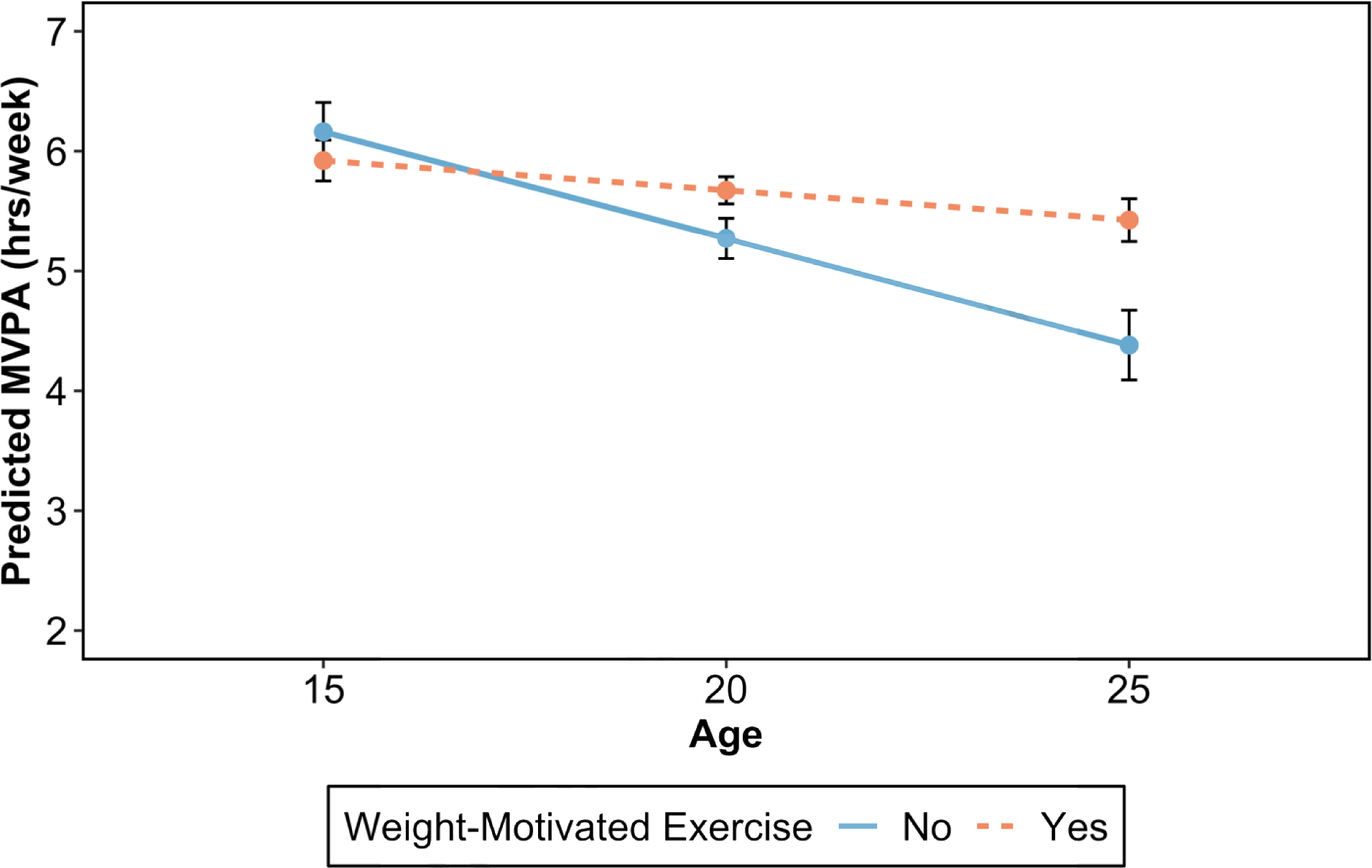
Predicted moderate-to-vigorous activity five years later by weight-motivated exercise and age in males after adjusting for ethnicity/race, socioeconomic status, weight-related intentions, body mass index, and prior level of moderate-to-vigorous activity (error bars represent standard errors)
DISCUSSION
The purpose of this study was to examine if weight-motivated exercise predicts PA levels 5, 10, and 15 years later. In this population-based sample of young people, weight-motivated exercise predicted higher future PA levels throughout development from adolescence to adulthood in females, which was not in line with the hypothesis. Females who reported weight-motivated exercise engaged in an average of over 30 minutes more MVPA five years later. In males, associations were not statistically significant, though those who reported weight-motivated exercise had an average of almost 20 minutes higher MVPA five years later. These results for both males and females can be clinically significant regarding whether an individual meets the recommended amount of PA for health benefits. Additionally, interactions were observed with BMI in females and age in males, indicating that this relationship may not similarly affect all sub-groups of young people.
For females, the association between weight-motivated exercise and MVPA differed by BMI. At lower levels of BMI, females who endorsed weight-motivated exercise reported higher levels of MVPA five years later. Conversely, at higher levels of BMI, those who endorsed weight-motivated exercise tended to report lower MVPA five years later. This difference may be due to use of exercise as a tool to achieve the pervasive thin beauty ideal connected to stereotypical feminine identity, attractiveness, and acceptability.43 Considering that exercise is effective at promoting weight stability and preventing weight gain, but less effective at promoting weight loss,44 females with higher BMIs using exercise to lose weight may not achieve their goals, and as a result may discontinue PA in the long-term. In addition, PA settings can be a source of weight stigma that contributes to physical activity avoidance,45 a phenomenon that may further deter females with higher BMIs from engagement in physical activity. For those with lower BMIs, it is possible that exercise helps them maintain their BMI, thus they continue to engage in PA. While males are not excluded from societal appearance pressures, ideals associated with muscularity tend to be more salient drivers for their body dissatisfaction when compared to the thin beauty ideal,46 which may explain the lack of an observed interaction between weight-motivated exercise and BMI in males.
For males, age was an effect modifier in the relationship between weight-motivated exercise and MVPA such that for younger male participants there was no association between weight-motivated exercise and mean MVPA five years later, whereas for older male participants engaging in weight-motivated exercise was associated with higher mean MVPA five years later. These findings may be explained by changes in the physical activity environment during the transition from adolescence to young adulthood. For example, during adolescence, many opportunities for organized physical activities such as sports are available, and these activities provide non-weight-related motivation for exercise, such as competition, community, fun, a feeling of success or achievement, and a sense of social support from peers.8 As adolescents age into young adulthood, their priorities may shift from physical activity to other responsibilities (e.g., college/university coursework, joining the workforce, becoming a spouse and/or parent, and non-active social time with peers). Furthermore fewer opportunities for organized physical activity exist in young adulthood,14 and those available to this age group may encourage weight-motivated exercise (e.g., gym culture, boot camps). The present findings suggest that males may be vulnerable to these changes in physical activity opportunities during the transition from adolescence to young adulthood. Furthermore, male sports-involvement may play a role in our findings of the lack of association between weight-motivation and MVPA during adolescence, given that significantly more males than females are involved in sports during adolescence (60.2% males compared to 54.6% females).47 Future studies should consider investigating what factors, policies, and programs promote physical activity for adolescents involved in organized PA as they transition into adulthood.
Strengths & Limitations
This study has several strengths. It is the first to our knowledge to track the association between weight-motivated exercise and PA behavior from adolescence to young adulthood and to examine weight-motivated exercise as a predictor of PA. The racial diversity of the sample strengthens the generalizability and relevance of the findings. Finally, the longitudinal design and focus on a transition during a critical period of development of this study are major strengths; assessments from multiple time points across development provide insight into this relationship during a 15-year period in a large population-based sample of adolescents transitioning into adulthood. Despite the strengths, limitations should also be noted. Weight-motivated exercise was assessed as a binary construct in this analysis, and future studies should assess the degree to which participants are motivated by weight.9 Also, generalizability may be limited because all study participants were originally recruited from one geographic area, Minneapolis and St. Paul, Minnesota.
Implications & Conclusions
The main effects analyses in this study found that weight-motivated exercise was not associated with lower future MVPA in the entire sample. However, it should be noted that there was not a comprehensive examination of potential adverse outcomes that could be associated with weight-motivated exercise (e.g., increased use of unhealthy weight control behaviors, binge eating, body dissatisfaction). Therefore, future studies should seek to understand the ways in which weight-motivated exercise is related to indicators of eating disorder risk and excessive PA in addition to general PA behaviors. Additionally, this study found that weight-motivated exercise may have unfavorable associations with MVPA for an important subset of participants – young women with higher BMIs. Future research should consider conducting an in-depth investigation to improve understanding of motivations for exercise that are unrelated to weight control; as they may be protective for females with higher BMIs. There may be nuanced factors at play, so qualitative or mixed methodologies may help inform future study designs and research questions. Furthermore, previous research supports the idea that young people prefer conversations and interventions not focus on weight,21,22 so future studies should emphasize aspects of exercise already known to promote physical and emotional health in young people such as physical activity enjoyment, competition, skill-building, and connection with peers.7
Research that provides a more complete picture of PA motivations may be a powerful tool for healthcare professionals to refer to when encouraging patients and clients to be physically active and developing health promotion messages to encourage PA. The present study’s findings have important implications for those who work with adolescents and young adults and promote PA (e.g., in clinical practices, community interventions). These professionals may imagine that weight control is a good motivator for their patients to exercise. However, findings from this study indicate that while weight-related motivation for exercise is not associated with PA behavior for most, it may be problematic for some, particularly for female patients with higher BMIs. Healthcare professionals should consider other motivators for exercise such as competition, enjoyment, or stress management.9 These strategies are important for all young people but may be particularly important for female patients with higher BMIs.
Implications and Contributions.
Encouraging physical activity for weight loss may not have the intended effect and may hinder physical activity in the future in a population subset, namely young females with a higher BMI. Professionals should keep this potential effect in mind, particularly during times of development when health behaviors are being established.
Acknowledgements:
This work was supported by Grant Number R35HL139853 from the National Heart, Lung, and Blood Institute (PI: Neumark-Sztainer). L.H.’s time was supported by the National Institutes of Health’s National Center for Advancing Translational Sciences, grant numbers TL1R002493 and UL1TR002494. V.H.’s time was supported by Grant Number T32MH082761 from the National Institute of Mental Health (PI: Scott Crow).The content is solely the responsibility of the authors and does not necessarily represent the official views of the National Heart, Lung, and Blood Institute; the National Institute of Mental Health; or the National Institutes of Health.
Footnotes
Publisher's Disclaimer: This is a PDF file of an unedited manuscript that has been accepted for publication. As a service to our customers we are providing this early version of the manuscript. The manuscript will undergo copyediting, typesetting, and review of the resulting proof before it is published in its final form. Please note that during the production process errors may be discovered which could affect the content, and all legal disclaimers that apply to the journal pertain.
REFERENCES
- 1.Stults-Kolehmainen MA, Sinha R. The Effects of Stress on Physical Activity and Exercise. Sports Med. 2014;44(1):81–121. doi: 10.1007/s40279-013-0090-5 [DOI] [PMC free article] [PubMed] [Google Scholar]
- 2.Warburton DER. Health benefits of physical activity: the evidence. Canadian Medical Association Journal. 2006;174(6):801–809. doi: 10.1503/cmaj.051351 [DOI] [PMC free article] [PubMed] [Google Scholar]
- 3.Penedo FJ, Dahn JR. Exercise and well-being: a review of mental and physical health benefits associated with physical activity: Current Opinion in Psychiatry. 2005;18(2):189–193. doi: 10.1097/00001504-200503000-00013 [DOI] [PubMed] [Google Scholar]
- 4.Summary Health Statistics: National Health Interview Survey, 2018.; 2018:Table A-14a, p 1–12. Accessed January 22, 2021. https://ftp.cdc.gov/pub/Health_Statistics/NCHS/NHIS/SHS/2018_SHS_Table_A-14.pdf
- 5.Caspersen CJ, Pereira MA, Curran KM. Changes in physical activity patterns in the United States, by sex and cross-sectional age. In: Center for Disease Control and Prevention.; 2000:1601–1609. [DOI] [PubMed] [Google Scholar]
- 6.Craigie AM, Lake AA, Kelly SA, Adamson AJ, Mathers JC. Tracking of obesity-related behaviours from childhood to adulthood: A systematic review. Maturitas. 2011;70(3):266–284. doi: 10.1016/j.maturitas.2011.08.005 [DOI] [PubMed] [Google Scholar]
- 7.Litt DM, Iannotti RJ, Wang J. Motivations for Adolescent Physical Activity. Journal of Physical Activity & Health. 2011;8:220–226. [DOI] [PubMed] [Google Scholar]
- 8.Weiss MR. Youth Sport Motivation and Participation: Paradigms, Perspectives, and Practicalities. Kinesiology Review. 2019;8(3):162–170. doi: 10.1123/kr.2019-0014 [DOI] [Google Scholar]
- 9.Egli T, Bland HW, Melton BF, Czech DR. Influence of Age, Sex, and Race on College Students’ Exercise Motivation of Physical Activity. Journal of American College Health. 2011;59(5):399–406. doi: 10.1080/07448481.2010.513074 [DOI] [PubMed] [Google Scholar]
- 10.Deci EL, Ryan RM. Intrinsic Motivation and Self-Determination in Human Behavior. Springer Science & Business Media; 1985. [Google Scholar]
- 11.Ryan RM, Deci EL. Self-determination theory and the facilitation of intrinsic motivation, social development, and well-being. American Psychologist. 2000;55(1):68. doi: 10.1037/0003-066X.55.1.68 [DOI] [PubMed] [Google Scholar]
- 12.Teixeira PJ, Carraça EV, Markland D, Silva MN, Ryan RM. Exercise, physical activity, and self-determination theory: A systematic review. International Journal of Behavioral Nutrition and Physical Activity. 2012;9(1):78. [DOI] [PMC free article] [PubMed] [Google Scholar]
- 13.Graham DJ, Sirard JR, Neumark-Sztainer D. Adolescents’ attitudes toward sports, exercise, and fitness predict physical activity 5 and 10years later. Preventive Medicine. 2011;52(2):130–132. doi: 10.1016/j.ypmed.2010.11.013 [DOI] [PMC free article] [PubMed] [Google Scholar]
- 14.Ullrich-French S, Cox AE, Bumpus MF. Physical activity motivation and behavior across the transition to university. Sport, Exercise, and Performance Psychology. 2012November26;2(2):90. doi: 10.1037/a0030632 [DOI] [Google Scholar]
- 15.Neumark-Sztainer D, Butler R, Palti H. Dieting and binge eating: Which dieters are at risk? Journal of the American Dietetic Association. 1995;95(5):587–589. [DOI] [PubMed] [Google Scholar]
- 16.Neumark-Sztainer D, Wall M, Haines J, Story M, Eisenberg ME. Why Does Dieting Predict Weight Gain in Adolescents? Findings from Project EAT-II: A 5-Year Longitudinal Study. Journal of the American Dietetic Association. 2007;107(3):448–455. doi: 10.1016/j.jada.2006.12.013 [DOI] [PubMed] [Google Scholar]
- 17.Golden NH, Schneider M, Wood C. Preventing Obesity and Eating Disorders in Adolescents. Pediatrics. 2016;138(3):e20161649–e20161649. doi: 10.1542/peds.2016-1649 [DOI] [PubMed] [Google Scholar]
- 18.Neumark-Sztainer D Preventing Obesity and Eating Disorders in Adolescents: What Can Health Care Providers Do? Journal of Adolescent Health. 2009;44(3):206–213. doi: 10.1016/j.jadohealth.2008.11.005 [DOI] [PubMed] [Google Scholar]
- 19.Rubino F, Puhl RM, Cummings DE, et al. Joint international consensus statement for ending stigma of obesity. Nature Medicine. 2020;26(4):485–497. doi: 10.1038/s41591-020-0803-x [DOI] [PMC free article] [PubMed] [Google Scholar]
- 20.Schvey NA, Sbrocco T, Bakalar JL, et al. The experience of weight stigma among gym members with overweight and obesity. Stigma and Health. 2016;2(4):292. doi: 10.1037/sah0000062 [DOI] [Google Scholar]
- 21.Lee AM, Szurek SM, Dilip A, et al. Behavioral Weight Loss Intervention Preferences of Adolescents with Overweight/Obesity. Childhood Obesity. Published online March 1, 2021:chi.2020.0296. doi: 10.1089/chi.2020.0296 [DOI] [PMC free article] [PubMed] [Google Scholar]
- 22.Sonneville KR, Mulpuri L, Khreizat I, Nichols LP, Plegue MA, Chang T. Youth Preferences for Weight-Related Conversations. Health Communication. 2020;35(11):1328–1333. doi: 10.1080/10410236.2019.1631566 [DOI] [PubMed] [Google Scholar]
- 23.Butt J, Weinberg RS, Breckon J o., Claytor RR. Adolescent Physical Activity Participation and Motivational Determinants Across Gender, Age, and Race. Journal of Physical Activity & Health. 2011;8(8):1074–1083. [DOI] [PubMed] [Google Scholar]
- 24.Trost SG, Kerr LM, Ward DS, Pate RR. Physical activity and determinants of physical activity in obese and non-obese children. International Journal of Obesity. 2001;25(6):822–829. doi: 10.1038/sj.ijo.0801621 [DOI] [PubMed] [Google Scholar]
- 25.Neumark-Sztainer D, Croll J, Story M, Hannan PJ, French SA, Perry C. Ethnic/racial differences in weight-related concerns and behaviors among adolescent girls and boys: Findings from Project EAT. Journal of Psychosomatic Research. 2002;53(5):963–974. doi: 10.1016/S0022-3999(02)00486-5 [DOI] [PubMed] [Google Scholar]
- 26.Neumark-Sztainer D, Wall M, Perry C, Story M. Correlates of fruit and vegetable intake among adolescents: Findings from Project EAT. Preventive Medicine. 2003;37(3):198–208. doi: 10.1016/S0091-7435(03)00114-2 [DOI] [PubMed] [Google Scholar]
- 27.Neumark-Sztainer D, Wall M, Guo J, Story M, Haines J, Eisenberg M. Obesity, Disordered Eating, and Eating Disorders in a Longitudinal Study of Adolescents: How Do Dieters Fare 5 Years Later? Journal of the American Dietetic Association. 2006;106(4):559–568. doi: 10.1016/j.jada.2006.01.003 [DOI] [PubMed] [Google Scholar]
- 28.Neumark-Sztainer D, Wall M, Larson NI, Eisenberg ME, Loth K. Dieting and Disordered Eating Behaviors from Adolescence to Young Adulthood: Findings from a 10-Year Longitudinal Study. Journal of the American Dietetic Association. 2011;111(7):1004–1011. doi: 10.1016/j.jada.2011.04.012 [DOI] [PMC free article] [PubMed] [Google Scholar]
- 29.Larson N, Neumark-Sztainer D, Harwood EM, Eisenberg ME, Wall MM, Hannan PJ. Do young adults participate in surveys that ‘go green’? Response rates to a web and mailed survey of weight-related health behaviors. Int J Child Health Hum Dev. 2011;4(2):225–231. [PMC free article] [PubMed] [Google Scholar]
- 30.Little RJA. Survey Nonresponse Adjustments for Estimates of Means. International Statistical Review / Revue Internationale de Statistique. 1986;54(2):139–157. doi: 10.2307/1403140 [DOI] [Google Scholar]
- 31.Seaman SR, White IR. Review of inverse probability weighting for dealing with missing data. Stat Methods Med Res. 2013;22(3):278–295. doi: 10.1177/0962280210395740 [DOI] [PubMed] [Google Scholar]
- 32.Larson N, Neumark-Sztainer D, Story M, van den Berg P, Hannan PJ. Identifying Correlates of Young Adults’ Weight Behavior: Survey Development. American Journal of Health Behavior. 2011;35(6):712–725. doi: 10.5993/AJHB.35.6.7 [DOI] [PMC free article] [PubMed] [Google Scholar]
- 33.Sherwood N, Jeffery R, French S, Hannan P, Murray D. Predictors of weight gain in the Pound of Prevention study. Int J Obes. 2000;24(4):395–403. doi: 10.1038/sj.ijo.0801169 [DOI] [PubMed] [Google Scholar]
- 34.Jeffery RW, French SA. Preventing weight gain in adults: the pound of prevention study. American Journal of Public Health. 1971;89(5):747–751. doi: 10.2105/AJPH.89.5.747 [DOI] [PMC free article] [PubMed] [Google Scholar]
- 35.Godin G, Shephard R. A Simple Method to Assess Exercise Behavior in the Community. Canadian Journal of Applied Sport Sciences. 1985;10(3):141–146. [PubMed] [Google Scholar]
- 36.Sirard JR, Hannan P, Cutler GJ, Nuemark-Sztainer D. Evaluation of 2 Self-Report Measures of Physical Activity With Accelerometry in Young Adults. Journal of Physical Activity & Health. 2013;10(1):85–96. [DOI] [PMC free article] [PubMed] [Google Scholar]
- 37.Neumark-Sztainer D, Story M, Hannan PJ, Croll J. Overweight Status and Eating Patterns Among Adolescents: Where Do Youths Stand in Comparison With the Healthy People 2010 Objectives? Am J Public Health. 2002;92(5):844–851. [DOI] [PMC free article] [PubMed] [Google Scholar]
- 38.Sherwood NE, Wall M, Neumark-Sztainer D, Story M. Effect of Socioeconomic Status on Weight Change Patterns in Adolescents. Prev Chronic Dis. 2008;6(1). Accessed October 3, 2020. https://www.ncbi.nlm.nih.gov/pmc/articles/PMC2644606/ [PMC free article] [PubMed] [Google Scholar]
- 39.Quick V, Wall M, Larson N, Haines J, Neumark-Sztainer D. Personal, behavioral and socio-environmental predictors of overweight incidence in young adults: 10-yr longitudinal findings. International Journal of Behavioral Nutrition and Physical Activity. 2013;10(1):37. doi: 10.1186/1479-5868-10-37 [DOI] [PMC free article] [PubMed] [Google Scholar]
- 40.Stata Statistical Software. StataCorp LLC; 2019. [Google Scholar]
- 41.Dong Y, Peng CYJ. Principled missing data methods for researchers. SpringerPlus. 2013;2(1):222. doi: 10.1186/2193-1801-2-222 [DOI] [PMC free article] [PubMed] [Google Scholar]
- 42.Pan W Akaike’s Information Criterion in Generalized Estimating Equations. Biometrics. 2001;57(1):120–125. doi: 10.1111/j.0006-341X.2001.00120.x [DOI] [PubMed] [Google Scholar]
- 43.Emmer C, Bosnjak M, Mata J. The association between weight stigma and mental health: A meta-analysis. Obesity Reviews. 2020;21(1):e12935. doi: 10.1111/obr.12935 [DOI] [PubMed] [Google Scholar]
- 44.Donnely J, Blair S, Jakicic J, Manore M, Rankin J, Smith B. Appropriate Physical Activity Intervention Strategies for Weight Loss and Prevention of Weight Regain for Adults. Medicine and Science in Sports and Exercise - MED SCI SPORT EXERCISE. 2009;41:459–471. doi: 10.1249/MSS.0b013e3181949333 [DOI] [PubMed] [Google Scholar]
- 45.Puhl RM, Luedicke J. Weight-Based Victimization Among Adolescents in the School Setting: Emotional Reactions and Coping Behaviors. J Youth Adolescence. 2012;41(1):27–40. doi: 10.1007/s10964-011-9713-z [DOI] [PubMed] [Google Scholar]
- 46.Karazsia BT, Murnen SK, Tylka TL. Is body dissatisfaction changing across time? A cross-temporal meta-analysis. Psychological Bulletin. 2016November28;143(3):293. doi: 10.1037/bul0000081 [DOI] [PubMed] [Google Scholar]
- 47.Merlo CL, Jones SE, Michael SL, et al. Dietary and Physical Activity Behaviors Among High School Students — Youth Risk Behavior Survey, United States, 2019. 2020;69(1):13. [DOI] [PMC free article] [PubMed] [Google Scholar]