



Abstract
Background.
In Bolivia, monovalent rotavirus vaccine was introduced in 2008 and a previous evaluation reported a vaccine effectiveness (VE) of 77% with 2 doses of vaccine in children aged <3 years. This evaluation sought to determine if rotavirus vaccine provided protection through the second year of life against circulating genotypes.
Methods.
A case-control study was performed in 5 hospitals from April 2013 to March 2014. Among enrolled participants who met study criteria and had rotavirus stool testing performed and vaccine status confirmed, we calculated VE using a logistic regression model. Subgroup analyses were performed among children aged <1 year and those aged ≥1 year, among children with severe diarrhea (Vesikari score ≥11) and very severe diarrhea (Vesikari score ≥15), and among G and P strains with at least 40 specimens.
Results.
A total of 776 children were enrolled. For children <1 year and ≥1 year of age with severe diarrhea, VE for 2 doses was 75% (95% confidence interval [CI], 46%–88%) and 53% (95% CI, 9%–76%), respectively. For children <1 year and ≥1 year of age with very severe diarrhea, VE for 2 doses was 80% (95% CI, 44%–93%) and 74% (95% CI, 35%–90%), respectively. Genotype-specific analysis demonstrated similar VE for the 4 most common G and P types (G3, G9, P[6] and P[8]).
Conclusions.
A monovalent rotavirus vaccine remains effective against a broad range of circulating strains as part of a routine immunization program >5 years after its introduction in Bolivia. Although VE appears to wane in children aged ≥1 year, it still provides significant protection, and does not wane against severe disease.
Keywords: rotavirus, gastroenteritis, childhood mortality, middle-income country, diarrhea
Acute gastroenteritis (AGE) remains one of the top causes of childhood mortality worldwide, and rotavirus is the leading cause of severe childhood AGE [1]. In 2009, the World Health Organization recommended use of rotavirus vaccine in all countries and especially in those countries with high child mortality due to AGE. Currently, 2 live attenuated oral rotavirus vaccines, a human monovalent strain (RV1) (Rotarix, Glaxo SmithKline Biologics) and a pentavalent bovine-human reassortant vaccine (RV5) (RotaTeq, Merck Vaccines) are available for use in routine childhood immunization programs [2].
In high-income countries such as the United States, rotavirus vaccines have demonstrated effectiveness of 70%–92% [3, 4] in preventing hospital admission for AGE in routine use. However, in low- and middle-income countries, where the vaccine is likely to have the most benefit due to the high disease burden, vaccine effectiveness (VE) is modest, ranging from 49% in Nicaragua, to 76% in El Salvador, to 66% in Guatemala in children <5 years old [5-7]. Several Latin American countries, such as Mexico, Honduras, Bolivia, El Salvador, and Venezuela, have documented substantial reductions in all-cause AGE hospital admissions of 20%–64% and reductions in AGE-associated mortality of 5%–46% in children <5 years of age after the introduction of rotavirus vaccination [8, 9].
While the VE and impact of rotavirus vaccine has been well documented, especially in children <1 year old, the duration of protection of rotavirus vaccines in older ages has not been as thoroughly investigated. Bolivia, a low- to middle-income country in South America, introduced RV1 into the routine childhood immunization schedule in August 2008 with doses given at 2 and 4 months of age [10]. In Bolivia, a previous evaluation reported a VE of 77% with 2 doses of the vaccine. A subanalysis of VE in children ≥1 year of age showed a VE of 72%, but this estimate was based on a relatively small number of cases in this age group [11]. With accumulation of additional years of postvaccine data, the objective of this evaluation was to determine if the effectiveness of the monovalent rotavirus vaccine is sustained through the second year of life against a range of circulating genotypes.
METHODS
From April 2013 to March 2014 we conducted a case-control evaluation at 5 hospitals in 4 of the largest cities in Bolivia (La Paz, El Alto, Cochabamba, and Santa Cruz) to assess the effectiveness of rotavirus vaccine under conditions of routine use. These hospitals were selected in accordance with World Health Organization guidelines [12].
This was a case-control study where cases were children who had at least 3 episodes of loose stools in a 24-hour period and who were admitted to the hospital overnight for treatment of AGE. Inclusion criteria were onset of diarrhea <14 days before the hospital visit; stool sample collected during the first 48 hours of admission that tested positive for rotavirus by enzyme immunoassay (EIA); born after 1 June 2008 and at least 8 weeks of age, making them eligible to receive the rotavirus vaccine as part of their routine childhood immunizations. We excluded cases when we were unable to contact a parent or caretaker to obtain consent or verify vaccination status with parental card or vaccination registry. Controls met the exact same criteria as cases except their stool tested negative for rotavirus by EIA (test-negative AGE controls).
To identify cases and controls, we utilized the World Health Organization hospital-based AGE surveillance and enrolled participants from the emergency department and inpatient wards at sentinel hospitals 24 hours a day [12]. Stool specimens were collected within 48 hours of hospital admission and stored at 2°C–8°C before transfer to the national laboratory for EIA testing or to Instituto de Biología Molecular y Biotecnología, Universidad Mayor de San Andrés laboratory for genotyping. Rotavirus testing was done with a commercially available EIA (ProSpecT enzyme-linked immunosorbent assay, Oxoid). Genotyping was performed on all rotavirus-positive stools with sufficient sample as described by Hull et al [13].
After providing written informed consent, caregivers underwent a face-to-face interview during which we collected vaccination history, demographics, socioeconomic factors, breastfeeding history and medical history, and history of present illness. Vaccination history was considered confirmed if the interviewer saw a copy of the vaccination card or a vaccination clinic record. A vaccine dose was considered valid if the child received it ≥14 days prior to admission.
Statistical Analysis
We performed bivariate analyses to assess for differences in demographic and socioeconomic factors comparing rotavirus-positive cases and test-negative controls using Wilcoxon rank-sum or χ2 tests for significance. To estimate adjusted odds ratios, we used an unconditional logistic regression model that included hospital, age in months, and month/year of birth because test-negative controls were unmatched with regard to age and hospital. Socioeconomic factors that reached statistical significance on bivariate analysis (P ≤ .05) were included in the initial model. We used a backward elimination strategy and retained those factors whose removal resulted in a ≥10% change in our primary outcome. We calculated VE as (1 – adjusted odds ratio) × 100%. We did subgroup analyses to assess protection from partial dose vaccination (1 dose of RV1), strain-specific protection, and protection among children aged <1 year and those aged ≥1 year. Strain-specific VE estimates were restricted to those strains for which at least 40 specimens with the stain of interest were collected. Statistical significance was designated as P < .05. We used SAS statistical software (version 9.3) for analyses.
Ethics
This case-control study was approved by the Centers for Disease Control and Prevention, the Pan American Health Organization, and the Bolivian National Bioethics Committee. Surveillance coordinators obtained informed consent from the parents or legal guardian of the child.
RESULTS
Enrollment and Demographics
Nine-hundred fifty-seven children aged <5 years were screened to participate in the study. Ninety-one percent (n = 870) met study eligibility. Of the 401 potential cases and 469 test-negative controls, 49% (n = 197) and 48% (n = 224) were <1 year old, respectively; 51% (n = 204) and 52% (n = 245) were ≥1 year old. Ultimately, 88% (n = 173) and 92% (n = 206) of eligible <1-year-old cases and controls were included in the analyses, respectively. For children ≥1 year old, 90% (n = 183) of eligible cases and 87% (n = 214) of eligible test-negative controls were included in the analyses (Figure 1).
Figure 1.
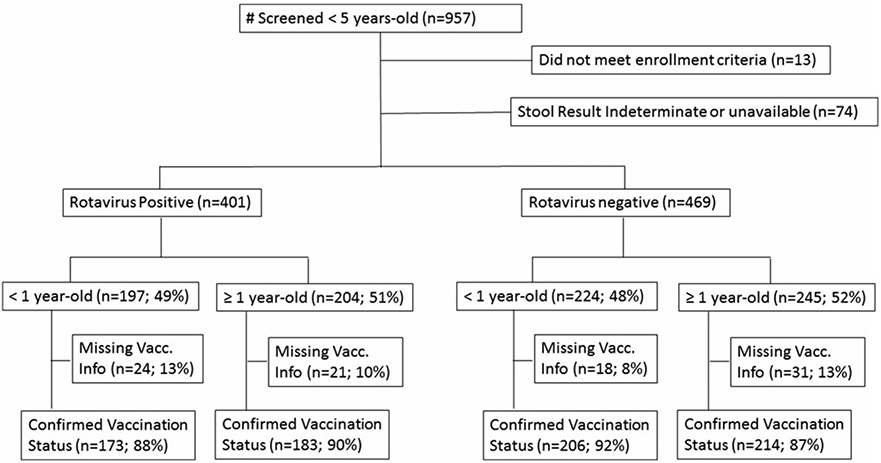
Flow chart depicting enrollment of rotavirus case patients and test-negative controls.
Demographic and socioeconomic factors between cases and test-negative controls were similar, except a lower proportion of cases had Internet in the household (P = .02) and a refrigerator (P = .04), compared with test-negative controls, and a larger proportion of cases had motorcycles compared with controls (P =.01) (Table 1).
Table 1.
Demographic and Socioeconomic Factors of Cases and Test-Negative Controls
| Characteristic | Cases (n = 356) |
Controls (n = 420) |
P Value |
|---|---|---|---|
| Age, mo, median (IQR) | 13 (8–18) | 14 (8–17) | .73 |
| Male sex | 227 (64) | 256 (61) | .42 |
| Chronic medical condition | 5 (19) | 5 (22) | .94 |
| Ever breastfed | 343 (97) | 402 (96) | .48 |
| Daycare within 2 wk | 109 (31) | 129 (31) | .92 |
| No. of children in the home, median (IQR) | 2 (1–3) | 2 (1–3) | .48 |
| Socioeconomic indicators | |||
| Electricity in the home | 353 (99) | 413 (98) | .31 |
| Trash collection | 276 (78) | 349 (83) | .06 |
| Automobile | 103 (29) | 133 (32) | .78 |
| Internet in the household | 47 (13) | 81 (19) | .02a |
| Refrigerator | 213 (60) | 281 (67) | .04a |
| Portable water in the household | 329 (92) | 386 (92) | .79 |
| Sewage at household | 241 (68) | 286 (68) | .54 |
| Radio | 316 (89) | 365 (87) | .43 |
| Television | 348 (98) | 405 (96) | .28 |
| Bicycle | 117 (33) | 142 (34) | .76 |
| Motorcycle | 37 (10) | 69 (16) | .01a |
| Telephone | 82 (23) | 110 (26) | .96 |
| Computer | 87 (24) | 135 (32) | .30 |
| Cell phone | 342 (96) | 408 (97) | .41 |
| Home ownership | 116 (33) | 131 (31) | .68 |
Data are presented as No. (%) unless otherwise specified.
Abbreviation: IQR, interquartile range.
Significant to P < .05.
Diarrhea Severity
Overall, rotavirus-positive cases had a median Vesikari score of 15 (interquartile range [IQR], 13–16) and controls 14 (IQR, 13–16) (P = .12; Table 2). Of children enrolled in the study aged ≥1 year, 94% (162/172) of cases and 89% (n = 171/193) of controls had a Vesikari score ≥11 (P = .06). For enrolled children <1 year of age, significantly more cases 97% (n = 158/163) than controls 91% (n = 174/192) had diarrhea with a Vesikari score ≥11 (P = .02). The same trends held true for Vesikari scores ≥15, with no significant difference between cases and controls in children ≥1 year old (P = .26); however, in children <1 year old, cases were more likely than controls to have a Vesikari score ≥15 (62% vs 51%, respectively; P = .04).
Table 2.
Vesikari Score and Clinical Characteristics Stratified by Cases, Controls, and Children Aged <1 Year and ≥1 Year
| Characteristic | Age <1 Year |
Age ≥1 Year |
||||||
|---|---|---|---|---|---|---|---|---|
| No. | Cases | Controls | P Value | No. | Cases | Controls | P Value | |
| Vesikari score, median (IQR) | 355 | 15 (14–16) | 14 (13–16) | .12 | 365 | 15 (13–16) | 15 (13–16) | .50 |
| No. of days with diarrhea, median (IQR) | 379 | 3 (1 −4) | 3 (1 −4) | .49 | 397 | 2 (2–3) | 2 (2–4) | .001a |
| Maximum No. of diarrhea episodes, median (IQR) | 379 | 8 (6–10) | 7 (5–10) | .03a | 397 | 7 (5–10) | 6 (4–8) | .01a |
| No. of days of vomiting, median (IQR) | 338 | 2 (1–3) | 2 (1–3) | .08 | 354 | 2 (1–3) | 2 (1–3) | .85 |
| Maximum No. of vomiting episodes, median (IQR) | 338 | 5 (3–7) | 5 (3–6) | .86 | 354 | 5 (4–10) | 4 (3–7) | .0001a |
| Vomiting | 378 | 163 (94) | 174 (85) | .004a | 397 | 172 (84) | 182 (85) | .004a |
| Oral rehydration at home | 378 | 79 (46) | 86 (42) | .47 | 396 | 85 (46) | 102 (48) | .78 |
| IV fluids at the hospital | 375 | 169 (98) | 198 (98) | .82 | 396 | 178 (97) | 208 (98) | .67 |
| General condition | ||||||||
| Alert | 377 | 1 (1) | 5 (2) | .24 | 397 | 5 (3) | 9 (4) | .24 |
| Agitated, irritable | 110 (64) | 136 (66) | 119 (65) | 146 (68) | ||||
| Lethargic | 61 (35) | 64 (31) | 59 (32) | 214 (54) | ||||
| Sunken eyes | 377 | 170 (98) | 198 (97) | .45 | 384 | 181 (99) | 203 (95) | .01a |
| Thirst status | ||||||||
| Drinking normally | 377 | 4 (2) | 10 (5) | .04a | 393 | 1 (1) | 12 (6) | .09 |
| Thirsty, drinking | 86 (50) | 117 (57) | 114 (63) | 131 (62) | ||||
| Thirsty, too weak to drink | 82 (48) | 78 (38) | 66 (36) | 212 (54) | ||||
| Skin pinch | ||||||||
| Returns immediately | 377 | 12 (7) | 27 (14) | .17 | 384 | 15 (9) | 44 (21) | .01a |
| Returns 1–2 sec | 104 (63) | 116 (59) | 122 (70) | 128 (61) | ||||
Data are presented as No. (%) unless otherwise specified.
Abbreviations: IQR, interquartile range; IV, intravenous.
Significant to P < .05.
Among children ≥1 year old, controls had a longer duration of diarrhea compared with cases (P = .001), but cases had a higher maximum number of diarrhea episodes in a 24-hour period (P = .01) and higher maximum number of vomiting episodes in a 24-hour period with this illness (P = .0001) compared with controls.
Vaccine Coverage
A significantly lower proportion of rotavirus cases were vaccinated with either 1 or 2 doses of the rotavirus vaccine compared with controls in children <1 year old (P = .001) and those ≥1 year old (P = .01).
Vaccine Effectiveness
For all children with AGE, the adjusted VE of a full series of 2 doses of RV1 against hospital admission for rotavirus was 59% (95% confidence interval [CI], 37%–73%). Rotavirus VE improved with increasing number of doses and increasing severity for all children including children <1 year old and those ≥1 year old (Table 3). Vaccine effectiveness for 2 doses was 76% (95% CI, 50%–89%) for children <1 year old, and 45% (95% CI, 0%–70%) for those ≥1 year old, which were not significantly different (P = .26). Vaccine effectiveness was maintained for children aged <1 year with all disease severity categories and improved with increasing disease severity. In children ≥1 year old, high VE was maintained among children with the most severe disease (Vesikari score ≥15) but waned among children with less severe disease.
Table 3.
Vaccine Effectiveness Stratified by Age, Number of Rotavirus Doses, and Vesikari Score and Adjusted for Age in Months, Month and Year of Birth, and Hospital
| Age and No. of Doses |
All Severity |
Vesikari Score ≥11 |
Vesikari Score ≥15 |
||||||
|---|---|---|---|---|---|---|---|---|---|
| Cases | Controls | Adjusted VE, % (95% CI) |
Cases | Controls | Adjusted VE, % (95% CI) |
Cases | Controls | Adjusted VE, % (95% CI) |
|
| >2 mo–59 mo | |||||||||
| 0 doses | 91 | 64 | ref | 82 | 53 | Ref | 49 | 26 | ref |
| 1 dose | 60 | 57 | 26 (25–58) | 55 | 41 | 16 (−52 to 53) | 40 | 20 | 8 (−100 to 58) |
| 2 doses | 203 | 298 | 59 (37–73) | 181 | 250 | 54 (11–76) | 104 | 145 | 72 (49–85) |
| 2 mo–<1 y of age | |||||||||
| 0 doses | 54 | 36 | ref | 48 | 31 | ref | 26 | 16 | ref |
| 1 dose | 36 | 38 | 45 (−49 to 73) | 32 | 26 | 45 (−30 to 76)a | 27 | 12 | 40 (−100 to 82)a |
| 2 doses | 82 | 131 | 76 (50–89) | 77 | 116 | 75 (46–88) | 48 | 70 | 80 (44–93) |
| ≥1 y of age | |||||||||
| 0 doses | 37 | 28 | ref | 34 | 22 | ref | 23 | 10 | ref |
| 1 dose | 24 | 19 | −2 (−140 to 58) | 23 | 15 | −5 (−187 to 62) | 13 | 8 | 56 (−83 to 89) |
| 2 doses | 182 | 214 | 45 (0–70) | 104 | 134 | 53 (9–76) | 56 | 75 | 74 (35–90) |
Data are presented as No. unless otherwise specified. For children <1 year old and Vesikari score ≥11 and ≥15, VE estimates were adjusted for additional variables.
Abbreviations: CI, confidence interval; ref, reference; VE, vaccine effectiveness.
Adjusted for additional socioeconomic variables trash pick-up, refrigerator, Internet, and motorcycle at the home.
Genotypes
Of the 356 children enrolled in the study, 305 (86%) and 272 (76%) had sufficient sample to identify G and P genotypes, respectively. Single as opposed to mixed genotypes were found for 291 (95%) of G types and 238 (88%) of P types. A total of 4 G types and 4 P types were identified. The most common G types were G9 (n = 186 [64%]), G3 (n = 88 [30%]), and G2 (n = 9 [3%]). P[4] (n = 20 [8%]), P[6] (n = 63 [26%]), and P[8] (n = 154 [65%]) were the most common P types (Table 4). The most common combinations of G and P genotypes were G9P[8] (n = 109) and G3P[8] (n = 53). For genotypes with ≥40 samples, VE for 2 doses of RV1 was G3 (58%; 95% CI, 18%–78%), G9 (60%; 95% CI, 34%–76%), P[6] (57%; 95% CI, 18%–77%), and P[8] (67%; 95% CI, 44%–80%). For the 2 most common G and P combination strains, 2-dose rotavirus VE was 48% (95% CI, −26% to 78%) for G3P[8] and 77% (95% CI, 55%–88%) for G9P[8]. VE increased with increasing Vesikari score for each G and P strain and G and P combination strains. For example, P[6] VE improved to 66% (95% CI, 13%–87%) when calculating VE only for those children with a Vesikari score ≥15.
Table 4.
Genotype Results for Sampled Sequences
| Gentoype | All Vesikari Scores |
Vesikari Score ≥15 |
||||
|---|---|---|---|---|---|---|
| 2 Doses RV Vaccine | 0 Doses RV Vaccine | VE, % (95% CI) | 2 Doses RV Vaccine | 0 Doses RV Vaccine | VE, % (95% CI) | |
| G3a | ||||||
| Cases | 51 | 30 | 58 (18–78) | 23 | 13 | 61 (19–81) |
| Controls | 298 | 121 | … | 145 | 46 | |
| G9b | ||||||
| Cases | 116 | 47 | 60 (34–76) | 59 | 29 | 75 (48–88) |
| Controls | 298 | 121 | 145 | 46 | ||
| P[6]c | ||||||
| Cases | 46 | 25 | 57 (18–77) | 25 | 15 | 66 (13–87) |
| Controls | 298 | 121 | 145 | 46 | ||
| P[8]d | ||||||
| Cases | 88 | 46 | 67 (44–80) | 42 | 24 | 88 (53–90) |
| Controls | 298 | 121 | 145 | 46 | ||
| G3P[8] | ||||||
| Cases | 24 | 14 | 48 (−26 to 78) | 8 | 6 | NA |
| Controls | 298 | 121 | 145 | 46 | ||
| G9P[8] | ||||||
| Cases | 46 | 25 | 77 (55–88) | 27 | 15 | 80 (52–92) |
| Controls | 298 | 121 | 145 | 46 | ||
Data are presented as No. unless otherwise specified. Mixed samples include 2 genotypes.
Abbreviations: CI, confidence interval; NA, not available; RV, rotavirus; VE, vaccine effectiveness.
Includes 7 cases with mixed infection, including 1 G2/G3 and 6 G3/G9.
Includes 14 cases with mixed infection, including 1 G12/G9, 7 G2/G9, and 6 G3/G9.
Includes 20 cases with mixed infection, including 5 P[4]/P[6] and 15 P[6]/P[8].
Includes 17 cases with mixed infection, including 2 P[4]/P[8] and 15 P[6]/P[8].
DISCUSSION
Studies in Latin America have demonstrated VE and reductions in AGE hospital admissions in several countries following rotavirus vaccine introduction into the national immunization program. Rotavirus VE in El Salvador, Nicaragua, and Guatemala in children ≥1 year of age ranges from 33% to 68% [5-7]. In our current study we found that VE waned with age, with lower effectiveness of 45% observed among children ≥1 year of age vs 76% among children <1 year of age, although this difference in effectiveness was not statistically significant. A similar pattern in waning of immunity was observed in El Salvador, where VE also declined when comparing children 6–11 months of age (VE, 83%; 95% CI, 68%–91%) with children 12–24 months (VE, 59%; 95% CI, 27%–77%) (P = .046) [6]. This general trend of RV protectiveness waning in children >12 months was recently shown in a systematic review and meta-analysis from 5 different Latin American countries [14].
Our previous study in Bolivia, conducted approximately 1.5 years after vaccine introduction, demonstrated an overall VE of 69% (95% CI, 54%–79%) for children of all ages and 72% (95% CI, 52%–86%) for children ≥ 1 year old [11]. In the current evaluation, which occurred 5 years after vaccine introduction, more children aged 1–5 years were eligible for the vaccine, providing more time for the vaccine to wane. In contrast, in high-income settings such as the United States, high VE has been maintained into the third and fourth years of life [3, 4]. This difference in duration of immunity between high- and low-income settings may reflect a difference in immune response to the vaccine. In lower-income settings, the short-lived intestinal immune response to the vaccine may predominate and the systemic response may be less robust [15].
Of note, among children with the most severe AGE (Vesikari score ≥15), the effectiveness of the vaccine persisted into the second year of life in Bolivia for both children <1 year of age (75%) and children ≥1 year of age (74%). Similar results were found in a subanalysis of subjects in Nicaragua, where VE for very severe AGE in children aged 8–11 months (39%; 95% CI, 8%–190%) did not differ statistically from the VE found in children aged 12–19 months (13%; 95% CI, 3%–59%) [15]. Thus, although protection may wane against rotavirus AGE of all severity, protection against very severe AGE, for which children are most at risk for dying, may be longer-lasting. This finding is further supported by studies in Mexico and Brazil, which demonstrated significant declines in AGE mortality in all children following the introduction of rotavirus into the national immunization program [9, 16]. Sustained protection in demonstrated declines in AGE mortality provide important information for decision makers in low- and middle-income countries to consider the introduction and continued support of rotavirus vaccination.
In Bolivia, we found that the rotavirus vaccine protected against a range of circulating strains, including heterotypic strains G3P[8] and G9P[8]. Additionally, for strains with sufficient sample size, we found that VE increased with worsening Vesikari score. However, we did not have sufficient power to assess duration of protection, or protection against all strains encountered in genotyping analysis. However, studies in Bolivia, Mexico, and Brazil have also demonstrated heterotypic protection. Our previous study in Bolivia demonstrated VE of 59%–93% in the most commonly detected strains—G2P[4], G3P[8], G9P[6], and G9P[8]—with no significant difference between strains [11]. Furthermore, in Mexico the monovalent rotavirus vaccine was found to have a VE of 94% (95% CI, 16%–100%) against the emergent heterotypic strain G9P[4] in 2010, and in Brazil the rotavirus vaccine demonstrated protection against the fully heterotypic G2P[4] strain in children 6–11 months of age (VE, 77%; 95% CI, 42%–91%) [17, 18]. A large systematic review that analyzed VE in high- and middle-income countries did not demonstrate a significant difference in VE among homotypic and heterotypic strains within each country group [19]. However, a study in Australia enrolling low-income aboriginal infants found a lower VE [20]. Few data are available for low-income countries, and surveillance should expand to those countries and continue to include VE and genotype analysis.
This prospective observational evaluation depends on differences of exposure to vaccination. Vaccination verification occurred for similar proportions of cases and controls. However, if controls with unverified vaccination status were more likely to be vaccinated than cases with unverified vaccine history, we may have overestimated our VE. We attempted to minimize this and other healthcare-seeking behavior biases by enrolling both cases and controls at the same hospital sites, and interviewers were blinded to the case or control status of an individual when following up on the vaccination status so that equal effort was made to verify the vaccination status for all children.
In summary, this study shows good VE of RV1 incorporated into a routine child immunization program in Bolivia, a low- to middle-income country. Although rotavirus infection occurs mostly in young children, this evaluation demonstrates sustained protection in children aged ≥1 year, particularly in children with the most severe AGE symptoms. These data provide compelling evidence favoring broader use of the rotavirus vaccine in low-income settings to reduce the burden of severe and fatal rotavirus AGE in children.
Acknowledgments.
We recognize the study staff who made completion of this paper possible: Ericka Cabrera, Fernando Gil, Carlos Terán, Lidia Astroña, Victor Velasco, Luis Tamayo, Ramiro Bustillo, Angel Quispe, Jaime Rada, Reta Revollo, Lourdes Carrasco, Vilda Pérez, Reyna Haygua, Aleida Nina, and Rodrigo Castedo.
Disclaimer.
The findings and conclusions of this report are those of the authors and do not necessarily represent the official position of the Centers for Disease Control and Prevention (CDC). The views expressed by the authors do not necessarily reflect the views of PATH, the CDC Foundation, the Bill and Melinda Gates Foundation, or GAVI, the Vaccine Alliance.
Financial support.
This work was supported by the Rotavirus Vaccine Initiative Project through the Bill & Melinda Gates Foundation.
Footnotes
Supplement sponsorship. This article appears as part of the supplement “Health Benefits of Rotavirus Vaccination in Developing Countries,” sponsored by PATH and the CDC Foundation through grants from the Bill and Melinda Gates Foundation and GAVI, the Vaccine Alliance.
Potential conflicts of interest. All authors: No reported conflicts. All authors have submitted the ICMJE Form for Disclosure of Potential Conflicts of Interest. Conflicts that the editors consider relevant to the content of the manuscript have been disclosed.
References
- 1.GBD 2013 Mortality and Causes of Death Collaborators. Global, regional, and national age-sex specific all-cause and cause-specific mortality for 240 causes of death, 1990–2013: a systematic analysis for the Global Burden of Disease Study 2013. Lancet 2015; 385:117–71. [DOI] [PMC free article] [PubMed] [Google Scholar]
- 2.World Health Organization. Immunization, vaccines and biologicals. Available at: http://www.who.int/immunization/diseases/rotavirus/en/. Accessed 29 April 2015.
- 3.Payne DC, Boom JA, Staat MA, et al. Effectiveness of pentavalent and monovalent rotavirus vaccines in concurrent use among US children <5 years of age, 2009–2011. Clin Infect Dis 2013; 57:13–20. [DOI] [PMC free article] [PubMed] [Google Scholar]
- 4.Cortese MM, Immergluck LC, Held M, et al. Effectiveness of monovalent and pentavalent rotavirus vaccine. Pediatrics 2013; 132:e25–33. [DOI] [PMC free article] [PubMed] [Google Scholar]
- 5.Patel M, Pedreira C, De Oliveira LH, et al. Association between pentavalent rotavirus vaccine and severe rotavirus diarrhea among children in Nicaragua. JAMA 2009; 301:2243–51. [DOI] [PubMed] [Google Scholar]
- 6.de Palma O, Cruz L, Ramos H, et al. Effectiveness of rotavirus vaccination against childhood diarrhoea in El Salvador: case-control study. BMJ 2010; 340:c2825. [DOI] [PMC free article] [PubMed] [Google Scholar]
- 7.Gastanaduy PA. Effectiveness of rotavirus vaccination against severe childhood diarrhea—Guatemala, 2012. In: Epidemic Intelligence Service Conference, Atlanta, GA, 2014. [Google Scholar]
- 8.De Oliveira LH, Giglio N, Ciapponi A, et al. Temporal trends in diarrhea-related hospitalizations and deaths in children under age 5 before and after the introduction of the rotavirus vaccine in four Latin American countries. Vaccine 2013; 31(suppl 3):C99–108. [DOI] [PubMed] [Google Scholar]
- 9.Richardson V, Parashar U, Patel M. Childhood diarrhea deaths after rotavirus vaccination in Mexico. N Engl J Med 2011; 365:772–3. [DOI] [PubMed] [Google Scholar]
- 10.World Bank. Country and lending groups. Available at: http://data.worldbank.org/about/country-and-lending-groups#Lower_middle_income. Accessed 29 April 2015.
- 11.Patel MM, Patzi M, Pastor D, et al. Effectiveness of monovalent rotavirus vaccine in Bolivia: case-control study. BMJ 2013; 346:f3726. [DOI] [PMC free article] [PubMed] [Google Scholar]
- 12.World Health Organization. Generic protocols for (i) hospital-based surveillance to estimate the burden of rotavirus gastroeteritis in children and (ii) a community-based survey on utilization of health care services for gastroenteritis in children: field test version. Available at: http://www.who.int/immunization/diseases/rotavirus/generic_protocols/en/. Accessed 6 October 2015.
- 13.Hull JJ, Teel EN, Kerin TK, et al. United States rotavirus strain surveillance from 2005 to 2008: genotype prevalence before and after vaccine introduction. Pediatr Infect Dis J 2011; 30(suppl 1):S42–7. [DOI] [PubMed] [Google Scholar]
- 14.de Oliveira LH, Camacho LA, Coutinho ES, Ruiz-Matus C, Leite JP. Rotavirus vaccine effectiveness in Latin American and Caribbean countries: a systematic review and meta-analysis. Vaccine 2015; 33(suppl 1):A248–54. [DOI] [PubMed] [Google Scholar]
- 15.Patel MM, Parashar UD. Assessing the effectiveness and public health impact of rotavirus vaccines after introduction in immunization programs. J Infect Dis 2009; 200(suppl 1):S291–9. [DOI] [PubMed] [Google Scholar]
- 16.do Carmo GM, Yen C, Cortes J, et al. Decline in diarrhea mortality and admissions after routine childhood rotavirus immunization in Brazil: a time-series analysis. PLoS Med 2011; 8:e1001024. [DOI] [PMC free article] [PubMed] [Google Scholar]
- 17.Yen C, Figueroa JR, Uribe ES, et al. Monovalent rotavirus vaccine provides protection against an emerging fully heterotypic G9P[4] rotavirus strain in Mexico. J Infect Dis 2011; 204:783–6. [DOI] [PubMed] [Google Scholar]
- 18.Correia JB, Patel MM, Nakagomi O, et al. Effectiveness of monovalent rotavirus vaccine (Rotarix) against severe diarrhea caused by serotypically unrelated G2P [4] strains in Brazil. J Infect Dis 2010; 201:363–9. [DOI] [PubMed] [Google Scholar]
- 19.Leshem E, Lopman B, Glass R, et al. Distribution of rotavirus strains and strain-specific effectiveness of the rotavirus vaccine after its introduction: a systematic review and meta-analysis. Lancet Infect Dis 2014; 14:847–56. [DOI] [PubMed] [Google Scholar]
- 20.Snelling TL, Schultz R, Graham J, et al. Rotavirus and the indigenous children of the Australian outback: monovalent vaccine effective in a high-burden setting. Clin Infect Dis 2009; 49:428–31. [DOI] [PubMed] [Google Scholar]