



Abstract
Purpose:
The aim of this study was to determine descriptive characteristics of dental students, to investigate their professional expectations, career decision criteria, and related factors; to examine how (if any) seniority in school affects these.
Subjects and methods:
During the period of 2018-2019, all 1-5 grade students (n = 754) of Hacettepe University Dental School were invited to participate and those who accepted had filled under observation a standard questionnaire form of 35 questions (83.4%). In the analysis of the data, descriptive statistics, chi-square, Student's t-test and ANOVA and Odds ratio methods were used.
Results:
In this cross-sectional study, 66% of the group were female, age range was 18-30 (mean±SD= 21.2 ± 1.7). The most common reasons for choosing dentistry were “financial benefits”, “job security” and “professional status”. “Undertake specialist training” (80.2%) was the most common short-term expectation after graduation; two most common long-term expectations were “having a private clinic” (57.9%) and “completing specialization training” (56.0%). The most important factors affecting the post-graduation working plans were work-life balance and economic stability.
Conclusion:
It is recommended to provide adequate counseling and guidance to students about potential career paths to maximize a balanced and widely accessible oral health service delivery across the country with more motivated dentists. Qualitative research may improve our understanding of how dental education can be improved to fulfill students’ expectations from school, and to motivate dental students towards general practitioning in the future.
Keywords: Dental students , future expectations , career choice , influences , Turkiye
Introduction
Dentistry is one of the leading professions offering healthcare services (1). Population growth, ageing and awareness of the importance of oral health have increased the need for the dental profession, imposing establishment of new dental schools. Universal prestige and respectability also appear to be predictors for young people choosing dentistry as a profession.
Dentistry is considered as a popular and profitable profession in many countries (2, 3, 4, 5, 6). Professional choices vary from one society to another, based on various factors such as gender, ethnic group, family and environmental characteristics, and parental educational attainment (2, 7). Professional knowledge, skills and experience gained over dental school years are likely to shape future expectations and career choices of dental students, and their professional satisfaction in years to come (8, 9, 10, 11). Professional motivation of the dentists, together with the quality of the services provided to the society will increase in the ratio of meeting their expectations.
The majority of publications on future expectations and career choices of dentistry students are from developed countries (9, 12, 13, 14, 15). Findings reveal that students’ professional expectations and areas of specialization may vary depending on various factors: including professional, personal, and financial achievements, in short term; and, by professional development, work-life balance, and financial stability expectations for the long term (9, 13, 16). The collection of relevant data before graduation will enable better orientation to education, professional preparation, and will contribute to institutional plans and interventions to train highly motivated and successful dentists.
The aim of this study is to determine descriptive characteristics of dental students attending Hacettepe University Dental School, to investigate their professional expectations, career decision criteria, and related factors; and to further examine how (if any) seniority in school affect these. The long-term goal is to improve educational and professional counseling for dental students, starting early in school, to improve their motivation and satisfaction at school; and to enable them to choose the best practice plans suitable for themselves for their professional years to come.
Subjects and methods
Study population
A cohort study was planned for longitudinal follow-up of all students (n=754) of Hacettepe University, Faculty of Dentistry, Ankara, Turkey, enrolled in any class, as of October 2018. This cross-sectional analytical study provides data obtained at baseline. At the initiation of the study, the total number of enrolled students were 190, 145, 136, 153 and 130 in the 1st, 2nd, 3rd, 4th and 5th grades respectively.
Ethical approval and study questionnaire
Ethical approval was obtained from the Hacettepe University Non-Interventional Research Ethics Committee (24/10/2018 and 16969557-285) and verbal informed consents were obtained from each participant prior to the survey. All students were invited to participate in the study and those who attended the school over the data collection period completed the questionnaires, if they approved to do so. A standardized questionnaire was prepared and the pilot sample was tested on 20 students attending another dental school in the city. Revised questionnaires were distributed to students following/at the start of selected classes and were completed anonymously by participants under observation. No dental school faculty member was present at the time of the survey so that the students did not feel any pressure to participate in the study.
The questionnaire consisted of 35 multiple choice and open-ended questions, with 4 main sections; 12 questions were about sociodemographic characteristics, 8 questions about their vision of dental education, and the final 15 questions were about students’ short-term (next 5 years) and long-term (20 years later) future expectations.
Statistical analysis
Statistical analysis included descriptive statistics (frequency and percent distribution: average/mean, standard deviation/ Q1, and Q3 values). Chi-square, exact chi-square, Student’s t-test, and ANOVA analysis were used for comparison of groups, as appropriate to variable type. Odds ratios (95% confidence intervals) were calculated to evaluate potential associations. All analyses were conducted using SPSS ver. 23 software (SPSS inc. Chicago, IL, USA).
Results
Sociodemographic characteristics
The survey was completed by 83.4 % of the 754 students enrolled in the Faculty of Dentistry in the 2018-2019 academic year. Of these, 414 were women (66%), 618 were single (98.7%) and 605 were Turkish citizens (96.6%). Of all participants, 3.7% were from Iran, Azerbaijan, TRNC, Afghanistan, Albania, Bulgaria, Palestine, Ghana, South Korea, Kenya, Mongolia and Uzbekistan.
The age range of the participants was 18-30 years (mean 21.1, SD 1.7 years). About three fourths of the students knew a second language. The most commonly spoken foreign languages were English 452 (71.9%) and German 55 (8.7%).
About half of the mothers (n=300) and 63.9% of the fathers (n= 399) had university degrees or higher. Sixty-one mothers and 62 fathers, had reportedly a profession in the health sector. The number of students who had a dentist in the immediate environment was 208 (33.2%); and 42.6% of those were relatives. Having a hobby was pretty common (86.9%), yet, only 64.2% (n=400) reported to have enough spare time for their hobbies. Of the several hobbies reported, the most common ones were sports (50.1%), reading books/science/ writing (28.2%), music/singing/playing a musical instrument (26.7%) and going to movies (21.3%) (Table 1).
Table 1.
Descriptive characteristics of dental students.
| Grade | p value | ||||||||||
|---|---|---|---|---|---|---|---|---|---|---|---|
| Characteristic | First | Second | Third | Fourth | Fifth | ||||||
| n | % | n | % | n | % | n | % | n | % | ||
| Gender (n:627) | |||||||||||
| Female | 100 | 61.3 | 74 | 62.2. | 74 | 71.8 | 94 | 65.7 | 72 | 72.7 | 0.206 |
| Male | 63 | 38.7 | 45 | 37.8 | 29 | 28.2 | 49 | 34.3 | 27 | 27.3 | |
| High School (n:626) | |||||||||||
| Anatolian High School | 67 | 41.4 | 51 | 42.9 | 56 | 54.4 | 88 | 61.5 | 67 | 67.7 | less than 0.001 |
| Science High School | 56 | 34.5 | 37 | 31.1 | 19 | 18.4 | 18 | 12.6 | 14 | 14.1 | |
| Regular High School | 39 | 24.1 | 31 | 26.0 | 28 | 27.2 | 37 | 25.9 | 18 | 18.2 | |
| Mothers' education level (n:624) | |||||||||||
| High School or less | 80 | 50.0 | 60 | 50.4 | 53 | 51.5 | 75 | 52.4 | 56 | 56.6 | 0.897 |
| University graduate | 67 | 41.9 | 50 | 42.0 | 42 | 40.8 | 62 | 43.4 | 38 | 38.4 | |
| Postgraduate degree | 13 | 8.1 | 9 | 7.6 | 8 | 7.7 | 6 | 4.2 | 5 | 5.0 | |
| Fathers' education level (n:624) | |||||||||||
| High School or less | 56 | 34.8 | 45 | 37.8 | 38 | 37.3 | 46 | 32.2 | 40 | 40.4 | 0.313 |
| University graduate | 71 | 44.1 | 59 | 49.6 | 49 | 48.0 | 79 | 55.2 | 48 | 48.5 | |
| Postgraduate degree | 34 | 21.1 | 15 | 12.6 | 15 | 14.7 | 18 | 12.6 | 11 | 11.1 | |
| Mothers' occupation (n:623) | |||||||||||
| Health sector | 21 | 13.0 | 10 | 8.5 | 7 | 6.8 | 11 | 7.7 | 13 | 13.1 | 0.089 |
| Other | 61 | 37.9 | 60 | 50.8 | 40 | 38.8 | 69 | 48.6 | 37 | 37.4 | |
| Retired/ Never worked | 79 | 49.1 | 48 | 40.7 | 56 | 54.4 | 62 | 43.7 | 49 | 49.5 | |
| Fathers' occupation (n:623) | |||||||||||
| Health sector | 16 | 10.0 | 13 | 11.0 | 9 | 8.9 | 14 | 9.8 | 8 | 8.1 | 0.088 |
| Other | 101 | 63.1 | 80 | 67.8 | 57 | 56.4 | 89 | 62.2 | 49 | 49.5 | |
| Retired/ Never worked | 43 | 26.9 | 25 | 21.2 | 35 | 34.7 | 40 | 28.0 | 42 | 42.4 | |
| Spare time for hobbies (n:623) | |||||||||||
| Always | 41 | 25.6 | 11 | 9.3 | 16 | 15.5 | 13 | 9.1 | 5 | 5.1 | less than 0.001 |
| Sometimes | 91 | 56.9 | 57 | 48.3 | 53 | 51.5 | 68 | 47.6 | 45 | 45.4 | |
| Rarely | 26 | 16.3 | 42 | 35.6 | 29 | 28.2 | 51 | 35.7 | 44 | 44.4 | |
| Never | 2 | 1.2 | 8 | 6.8 | 5 | 4.8 | 11 | 7.7 | 5 | 5.1 |
Perspective of dental education
In the national university entrance exam, reportedly, dental school was the first choice of 68.2% of dental students, the second or third choice of 12.8% students, and the 4th choice of 13% students. The top three most frequently mentioned reasons for choosing dental school were “financial benefits”, “job security” and “professional status”. Three hundred and ninety-nine (63.6%) participants positively replied to the question “If you had a chance to choose today, would you prefer dentistry again?”; and 106 (16.9%) respondents answered “no” to the same question. The latter students stated the reason for that as “the education is difficult/tiresome/ backbreaking”. Two hundred and seventy-two (43.6%) students had thought at least once about dropping out of school; women were significantly more likely to do so [OR=1.54 (95%CI= 1.09-2.16)]. Just over half of the students (56.9%) stated that the education provided by the school met their professional expectations. And only one-fifth of participants had adequate information about different career paths they would have upon graduation; interestingly, the last year students claimed so, with a rate lower (9.8%) than that in all other classes (Table 2).
Table 2.
Professional choices and related factors.
| Number | Percentage | |
|---|---|---|
| Order of choosing the faculty of dentistry in university exam | ||
| First choice | 426 | 68.2 |
| Other* | 198 | 31.8 |
| Reasons for choosing dentistry | ||
| Financial benefits | 390 | 62.2 |
| Job security/ high levels of demand for dentists | 346 | 55.2 |
| Professional status | 294 | 46.9 |
| Personal interest in dentistry/ ideal | 248 | 39.6 |
| Personal experiences/ Being affected by the dentist during dental treatments | 156 | 24.9 |
| Interest in a healthcare profession and getting score appropriate for dentistry | 109 | 17.4 |
| Family's recommendation | 85 | 13.6 |
| Due to presence of a dentist in the family or in the immediate environment | 64 | 10.2 |
| Other** | 53 | 8.5 |
| Whether they would prefer dentistry again (if there is a chance to choose today) | ||
| Yes | 399 | 63.6 |
| No | 106 | 16.9 |
| Undecided | 122 | 19.5 |
| The reasons for those who would prefer again (n= 338) | ||
| I love / want to do dentistry / I am happy / pleasant | 156 | 46.2 |
| My dream / ideal job | 48 | 14.2 |
| It suits me / it meets my expectations | 47 | 13.9 |
| Other reason | 87 | 25.7 |
| The reasons for those who would not prefer again (n=91) | ||
| Difficult/ Tiresome/ Backbreaking | 41 | 45,1 |
| No comment | 26 | 28.5 |
| Other reason | 24 | 26.4 |
| Presence of a dentist in their immediate environment | ||
| Yes/ I have at least one | 208 | 33.2 |
| No/ I do not have | 418 | 66.8 |
| Proximity state of the dentists for the ones who replied yes to the previous question | ||
| Relative | 89 | 42.6 |
| Family friend | 56 | 26.8 |
| Nuclear family | 38 | 18.2 |
| Other* | 26 | 12.4 |
| To what extent did education at school meet your professional expectations you had when you entered school? | ||
| "Much better than I expected" | 27 | 4.3 |
| "Better than I expected" | 79 | 12.6 |
| "As I expected" | 248 | 40.0 |
| "Worse than I expected" | 160 | 25.7 |
| "Did not meet my expectations | 55 | 8.8 |
| No idea | 41 | 6.6 |
| "More difficult than I expected" | 6 | 1.0 |
| Other* | 6 | 1.0 |
| Have you ever thought about dropping out of school? | ||
| Yes | 272 | 43.6 |
| No | 352 | 56.4 |
Short-term career expectations
About four-fifths of the participants, being higher among women, wanted to continue a specialty training in the next 5 years. Within 5 years, 33.5% wish to work in abroad (33.5%), another 33.0% want to start up a private clinic and 28.8% want to work in a private clinic (28.8%). Women were less likely than men to initiate a private clinic of own [OR= 0.59 (95% CI= 0.42-0.84)]. Having a private clinic of his/her own was the most common among grade 1 students and was about one-fourth (95 CI= 0.14-0.50) of those among grade 5 students (Figure 1).
Figure 1.

Distribution of students’ expectations in the short term (within 5 years) by gender. * Respondents could choose more than one option.
Long-term career expectations
The most common long-term expectations were having a private clinic (57.9%), completing specialization training (56.0%), attaining high economic income (49.3%), and working in a platform where professional skills can be improved (44%, 5). Women wanted to complete their specialization training 1.7 times more than men and 1.6 times more wanted to work in a platform where professional skills can be improved (Figure 2). The wish to have a private clinic was the highest among first-year dental students and decreased significantly from first grade to fifth grade (71.0% -54.1%) (Figure 2).
Figure 2.

Distribution of students' expectations in the long term (after 20 years) by gender. * Respondents could choose more than one option.
Five hundred and thirteen (82.5%) participants found specialization necessary after graduation. Not all wants it for a career but want to get a specialty training to gain further experience in a particular area (76.5%), to continue to work in a more specific area (59.0%) and to get higher income (46.6%). Orthodontics (61.4%), oral and maxillofacial surgery (39.7%), prosthodontics (34.8%), periodontology (30.9%), and pedodontics (27.0%) were the most preferred branches of specialization. Women wanted the restorative dentistry 3 times and pedodontics 2 times than that reported by men.The odds of reporting oral and maxillofacial surgery was 2 times in men than in women. The distribution of the branches of specialization that the students intend to choose varied by grade. Orthodontics was the most preferred specialty program among the first-year students, while this number decreases in the last year students (p <0.001). Endodontics were reported mostly by second- and third-year students, reporting was statistically significantly lower in both the first year and fourth and fifth (p <0.001). Popularity of periodontology increased by the increase in grade, with a significant trend test (p <0.001). Prosthodontics was mostly reported by the first-year students, and its popularity decreases by seniority (Figure 3).
Figure 3.

Distribution of popular specialty branches among students by grade.
Of all the students, 312 wanted to pursue an academic career. By pursuing an academic career, they expect to be in a platform where they can closely follow professional developments (68.5%), to make contributions to science (53.5%), to raise students (43.2%), and to be respected more in the society (23.0%). Students mostly want to practice their profession in a metropolitan city (88.3%) and to work in private sector (75.7%) or university hospitals (47.8%). Figure 4 presents that students preference of the place they want to work in the future vary by grade the students currently attend. Wish to work in a university hospital increases significantly towards graduation and is higher among women; whereas, men want to work in public hospitals more. The popularity of working in private sector is the highest among the firstyear students. (Figure 4). When deciding on the type of institution to work for, participants considered mostly economic opportunities (76.6%) and sufficient professional knowledge and experience (75.2%).
Figure 4.
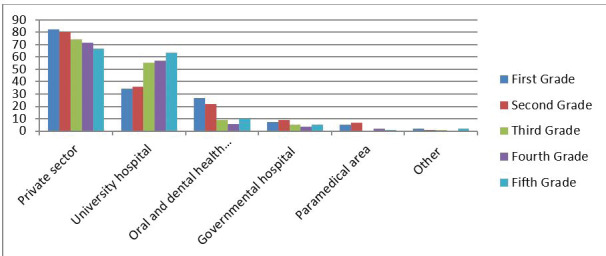
Distribution of the institutions students want to work in the future. * Respondents could choose more than one option.
When deciding on the post-graduate working plan, most of the participants care for the work-to-private life balance (79.7%), economic stability (60.3%) and developing professional skills (57,7%). Women preferred the “work-private life balance” 1.5 times more than men. Considering the working time, 52.8% of the participants wanted to work full time (8 hours) and 22.9% wanted to work part-time.
When asked about the difficulties of the dentistry as a profession; economic difficulties in providing materials (71.0%) was the most frequently mentioned answer. The most challenging aspect of the profession according to students was “satisfying patients with the dental service provided” and it was 1.76 times (95% CI= 1.24-2.48) times more challenging for males. For men, the most compelling aspect of the profession was financial management [1.80 (95% CI=1.28-2.53)]. Communicating with patients was found to be a more challenging part for men participants; the odds was 1.41 times (95% CI=1.00-1.99) than in women. As the best feature of this profession; the most frequent answers listed by students were flexible working hours (65.3%), high-income opportunity (65.2%) and helping patients (64.6%). Most of the female students (68.0%) consider the best feature of dentistry as helping patients, while men cared for the potential for high-income (71.4%).
Discussion
This is the first study from Turkey, which primarily studies the underlying factors for choosing a dental school, whether the students are satisfied with the curriculum and their gainings from dental school and what their future career plans are. There are several studies that focus on these issues and indicate the underlying factors for career decisions in developed countries (2,5,8, 9, 10, 11, 12, 13, 17). However, in developing countries, such as ours, the individual, familial and environmental factors that could be linked with career plans are not so definite. We hope that our study can be informative for other developing countries, as well. Another asset of the study is the ability to compare and contrast students from different levels of classes, which may illustrate a cohort effect (if any). Our findings suggested that rather than a cohort effect, students’ learnings in time about the different skills they need, difficulties and benefits of different specialty branches, conditions of working environments etc. may change their primary expectations at the entrance to school towards graduation. A previous study found that senior students were reported to give more realistic forward-looking answers about choosing an area of specialization (12). This may be an explanation to our finding of differences across grades. We hope to continue following these students, thorough graduation (up to five years), which may clarify the issues that cause differences across grades.
Sociodemographic and familial characteristics of the participants were in line with findings of earlier studies. The vast majority of the participants were female students, which is similar to the studies that determined the increased female ratio (17, 18). It has been reported that women generally prefer dentistry over men because of the flexibility of working hours, which provides the opportunity to allocate time for their families and children (17, 19, 20). The most of the participants come from educated families, similar to findings of earlier studies (3, 14, 15, 19). Our finding of having a dentist in the immediate environment suggest that relatives or role models are likely to have an impact on career selection decision, as it is true in many developing countries (2, 17).
About 70% of all participants reported that dentistry was their first choice during university matriculation examination, which showed a similar result with the study conducted in Ireland. Dentistry was the first choice for 2/3 of dental school students in Ireland (21). Mostly, the positive working conditions of this profession, the desire to help people, and the opportunity of improving patients’ appearances were attractive. In the study, some students (17,4%) stated that they chose dentistry as “they wanted to choose a profession (medicine) related to health and their score was appropriate (for dentistry, that is less than for medicine)”. This is also in line with the findings of earlier studies, suggesting dentistry is chosen as an alternative for medicine (14, 21, 22).
When the reasons for choosing dentistry as a profession are investigated, it is stated that it is chosen mostly due to high income, regular working hours, the prestige of the profession, work-private life balance, quality of life (2, 3, 5, 23). In the findings of this study, it was found that students chose dentistry for almost the same reasons. The most frequently stated reasons were “high income”, “a high chance of finding a job in the future- job security” and “professional status”. However, if there was a chance to choose again, the participants who would consider choosing this profession again are only 63.6%. This result may be related to the intensity of work and taking on early responsibilities in the preclinical and clinical hours throughout the educational process. Findings similar to this result are shown in the study by Gallagher 2008 (5).
The mostly indicated expectation of students for the next 5 years was to become a specialist in a specific area. Earlier we had doctoral programs following dental school, and specialization programs have been initiated recently; this has become popular among dentists to be. The demand for specialists in dentistry is increasing and the fee for the work performed may be higher compared to those performed by the general practitioner dentist. Additionally, there is a desire of dental students to gain experience, to improve knowledge and skills in a certain area by undertaking specialist training. Another short-term expectation of the participants is achieving economic stability in the future. By completing the specialty training, they expect to earn more and have a high income in the future. Similar results have been found in studies in Malaysia, the United Arab Emirates, and Great Britain as well (9, 11, 12).
In the long-term prospects, participants wanted to have a private clinic, to complete their specialist training, and to have high economic income and to work in a platform where they can improve their professional skills. These expectations are mainly focused on economic benefits. This is also supported by the willingness of the participants to work in the private sector (75.7%). Due to the limited number of professional and material options available in public hospitals and the high number of patients examined per day, it is not preferred much (24). Institutions to be worked in the future differ by gender. We think that the reason for this may be the answer “sufficient professional knowledge and experience” 80.4% of female students gave to the question “What do you pay attention to when deciding on the institution you will work for?”. It is possible to see that women give more importance to having professional knowledge and experience and pursue continuing education, thus, want to continue their professional lives in universities.
As a specialty training, orthodontics and oral and maxillofacial surgery have been the most popular areas. The same findings are indicated in another study conducted at a private university in Turkey (10). These two departments are also the most popular in dentistry worldwide, and the reason for this seems to be higher income (25).
The big cities are preferred by almost 90% of the participants to perform their profession. This finding may be due to greater job opportunities in big cities. Besides, students wish to keep the work-private life balance and economic stability. Gallagher et al. (13, 26) explored situations that play a role in career choices of dental students and new graduates in Great Britain and the results are similar. In this study, only one-fifth of the students answered positively to the question “Do you have any information about different career paths after graduation?”. The remaining knew about career paths partially, insufficiently, or not at all. This issue warrants further research.
Conclusion
Students chose dentistry mostly for economic reasons and job security. They expect to complete specialist training and to secure economic stability in the short and long term. Big cities and private sector are highly popular among dental students. These findings suggest a potential for unbalanced distribution of dentists across the country in future years. Therefore, it is recommended to provide adequate counseling/ training and guidance to students about potential career paths, starting from early years in school to maximize a balanced and widely accessible oral health service delivery across the country and to employ more motivated dentists in all sectors. It may also be valuable to inform high school students about the dental education for assisting them with conscious choice of profession. Qualitative research may improve our understanding of how dental education can be improved to fulfill students’ expectations from school, and to motivate dental students towards general practitioning in the future.
Footnotes
Ethics committee approval: Ethical approval was obtained from the Hacettepe University Non-Interventional Research Ethics Committee (24/10/2018 and 16969557-285).
Informed consent:Participants provided informed constent.
Peer review:Externally peer-reviewed.
Author contributions:GB, DY,MBG participated in designing the study. TC, MBG, BC participated in generating the data for the study. GB, TC, HCH, MB participated in gathering the data for the study. GB,TC, HCH, DY, MB, MBG, BC participated in the analysis of the data. GB wrote the majority of the original draft of the paper. GB,TC, HCH participated in writing the paper. GB,TC, DY,MB,BC have had access to all of the raw data of the study. GB, BC have reviewed the pertinent raw data on which the results and conclusions of this study are based. GB, TC, HCH, DY, MB, MBG, BC have approved the final version of this paper. GB guarantees that all individuals who meet the Journal’s authorship criteria are included as authors of this paper.
Conflict of interest:The authors declared no conflict of interest.
Financial disclosure: The authors declared that they have received no financial support.
References
- 1.WHO . The World Health Report 2006 – working together for health.: World Health Organization; 2006.
- 2.Orenuga OO, da Costa OO. Characteristics and study motivation of clinical dental students in Nigerian universities. J Dent Educ. 2006. Sep;70(9):996–1003. 10.1002/j.0022-0337.2006.70.9.tb04171.x [DOI] [PubMed] [Google Scholar]
- 3.M Vigild ES. Characteristics and Study Motivation of Danish Dental Students in a Longitudinal Perspective. Eur J Dent Educ. 2001. Aug;•••:127–33. [DOI] [PubMed] [Google Scholar]
- 4.Khami MR, Murtomaa H, Jafarian M, Vehkalahti MM, Virtanen JI. Study motives and career choices of Iranian dental students. Med Princ Pract. 2008;17(3):221–6. 10.1159/000117796 [DOI] [PubMed] [Google Scholar]
- 5.Gallagher J, Clarke W, Wilson N. Understanding the motivation: a qualitative study of dental students’ choice of professional career. Eur J Dent Educ. 2008. May;12(2):89–98. 10.1111/j.1600-0579.2008.00506.x [DOI] [PubMed] [Google Scholar]
- 6.Brand AA, Chikte UM. Student attitudes to dentistry in South African dental schools. J Dent Assoc S Afr. 1997. Dec;52(12):713–20. [PubMed] [Google Scholar]
- 7.Mugonzibwa EA, Kikwilu EN, Rugarabamu PN, Ntabaye MK. Factors influencing career choice among high school students in Tanzania. J Dent Educ. 2000. Jun;64(6):423–9. 10.1002/j.0022-0337.2000.64.6.tb03361.x [DOI] [PubMed] [Google Scholar]
- 8.Kettler N, Frenzel Baudisch N, Micheelis W, Klingenberger D, Jordan AR. Professional identity, career choices, and working conditions of future and young dentists in Germany - study design and methods of a nationwide comprehensive survey. BMC Oral Health. 2017. Oct;17(1):127. 10.1186/s12903-017-0417-y [DOI] [PMC free article] [PubMed] [Google Scholar]
- 9.Rashid HH, Ghotane SG, Abufanas SH, Gallagher JE. Short and long-term career plans of final year dental students in the United Arab Emirates. BMC Oral Health. 2013. Aug;13(1):39. 10.1186/1472-6831-13-39 [DOI] [PMC free article] [PubMed] [Google Scholar]
- 10.Tanalp J, Ilguy D, Dikbas I, Oktay I. Demographic profile and future expectations of students enrolled in a Turkish private dental school. J Dent Educ. 2012. Jun;76(6):800–9. 10.1002/j.0022-0337.2012.76.6.tb05316.x [DOI] [PubMed] [Google Scholar]
- 11.Che Musa MF, Bernabé E, Gallagher JE. Career expectations and influences among dental students in Malaysia. Int Dent J. 2016. Aug;66(4):229–36. 10.1111/idj.12224 [DOI] [PMC free article] [PubMed] [Google Scholar]
- 12.Gallagher JE, Patel R, Donaldson N, Wilson NH. The emerging dental workforce: why dentistry? A quantitative study of final year dental students’ views on their professional career. BMC Oral Health. 2007. Jun;7(1):7. 10.1186/1472-6831-7-7 [DOI] [PMC free article] [PubMed] [Google Scholar]
- 13.Gallagher JE, Patel R, Wilson NH. The emerging dental workforce: long-term career expectations and influences. A quantitative study of final year dental students’ views on their long-term career from one London Dental School. BMC Oral Health. 2009. Dec;9(1):35. 10.1186/1472-6831-9-35 [DOI] [PMC free article] [PubMed] [Google Scholar]
- 14.Gietzelt D. Social profile of first-year dentistry students at the University of Sydney. Aust Dent J. 1997. Aug;42(4):259–66. 10.1111/j.1834-7819.1997.tb00131.x [DOI] [PubMed] [Google Scholar]
- 15.Bedi R, Gilthorpe MS. Ethnic and gender variations in university applicants to United Kingdom medical and dental schools. Br Dent J. 2000. Aug;189(4):212–5. 10.1038/sj.bdj.4800725 [DOI] [PubMed] [Google Scholar]
- 16.Stewart FM, Drummond JR, Carson L, Hoad Reddick G. The future of the profession—a survey of dental school applicants. Br Dent J. 2004. Nov;197(9):569–73. 10.1038/sj.bdj.4811810 [DOI] [PubMed] [Google Scholar]
- 17.Weaver RG, Haden NK, Valachovic RW. U.S. dental school applicants and enrollees: a ten year perspective. J Dent Educ. 2000. Dec;64(12):867–74. 10.1002/j.0022-0337.2000.64.12.tb03388.x [DOI] [PubMed] [Google Scholar]
- 18.Vahid Dastjerdi M, Mahdian M, Vahid Dastjerdi E, Namdari M. Study motives and career choices of Iranian medical and dental students. Acta Med Iran. 2012;50(6):417–24. [PubMed] [Google Scholar]
- 19.Brand AA, Chikte UM. Choosing dentistry as a career—Part I: A comparison of student motives. J Dent Assoc S Afr. 1992. Nov;47(11):469–73. [PubMed] [Google Scholar]
- 20.Whittaker DK. Reasons for choice of dentistry as a career in applicants to a British dental school. Br Dent J. 1984. Jan;156(1):23–5. 10.1038/sj.bdj.4805258 [DOI] [PubMed] [Google Scholar]
- 21.Hallissey J, Hannigan A, Ray N. Reasons for choosing dentistry as a career—a survey of dental students attending a dental school in Ireland during 1998-99. Eur J Dent Educ. 2000. May;4(2):77–81. 10.1034/j.1600-0579.2000.040205.x [DOI] [PubMed] [Google Scholar]
- 22.Ohaeri JU, Falade GA. Beliefs and attitudes of clinical year students at Ogun State University concerning medical specialties. Niger Med J. 1992;23:15–21. [PubMed] [Google Scholar]
- 23.Crossley ML, Mubarik A. A comparative investigation of dental and medical student’s motivation towards career choice. Br Dent J. 2002. Oct;193(8):471–3. 10.1038/sj.bdj.4801599 [DOI] [PubMed] [Google Scholar]
- 24.Kuusela S, Honkala E, Hausen H, Rwakatema D, Gyua I, Lampiranta M. Opinions of dental students in Dar es Salaam (Tanzania) and in Kuopio (Finland) concerning studies and expectations for future career. Afr Dent J. 1993;7:20–6. [PubMed] [Google Scholar]
- 25.Cordes DW, Doherty N, Lopez R. Assessing the economic return of specializing in orthodontics or oral and maxillofacial surgery. J Am Dent Assoc. 2001. Dec;132(12):1679–84. 10.14219/jada.archive.2001.0120 [DOI] [PubMed] [Google Scholar]
- 26.Gallagher JE, Clarke W, Eaton KA, Wilson NH. Dentistry - a professional contained career in healthcare. A qualitative study of Vocational Dental Practitioners’ professional expectations. BMC Oral Health. 2007. Nov;7(1):16. 10.1186/1472-6831-7-16 [DOI] [PMC free article] [PubMed] [Google Scholar]