



Abstract
As the 21st century unfolds with rapid changes, new challenges in research and development emerge. These new challenges prompted us to repurpose our HPLC–A platform that was previously used in solid phase glycan synthesis to a solution phase batch synthesis described herein. The modular character of HPLC allows for implementing new attachments. To enable sequential synthesis of multiple oligosaccharides with the single press of a button, we supplemented our system with a four-way split valve and an automated fraction collector. This enabled the operator to load all reagents and all reactants in the autosampler, press the button to start the repetitive automation sequence, leave the lab, and upon return find products of multiple reactions ready for purification, analysis, and subsequent application.
Keywords: automation, glycans, glycosylation, oligosaccharides, synthesis
With improved understanding of functions of glycans, the demand for robust methods to produce both natural glycans and their mimetics has increased. Due to significant advances in chemical synthesis, many glycosidic bonds can now be achieved by using both classical methods and novel technologies.[1] Nevertheless, traditional chemical synthesis of glycans remains among the top challenges of synthetic chemistry. Reactions that proceed with high rates, complete conversion, flawless stereoselectivity, and would work with a broad range of substrates remain rare. In addition, carbohydrate synthesis requires relevant training and qualifications, so it is practically impossible to implement these reactions in non-specialized labs. This significantly hampers the development in glycosciences, whereas other biopolymers, peptides[2] and oligonucleotides,[3] can be produced on demand by machines. Efforts to automate solution synthesis of glycans using parallel synthesizers have been reported by Takahashi,[4] Pohl,[5] and Nokami.[6] Being still relatively unexplored, these approaches may offer viable alternatives to automated enzymatic syntheses being developed by Wong,[7] Chen,[8] Wang,[9] and Boons.[10]
Solid-phase synthesis is also automation amenable, which was nicely demonstrated in 2001 by Seeberger who adapted a peptide synthesizer to glycan synthesis.[11] In 2012, Seeberger reported “the first fully automated solid-phase oligosaccharide synthesizer.”[12] This synthesizer was then commercialized as Glyconeer 2.1 in 2014, and an updated version has also recently (2021) emerged. Also in 2012, our labs reported HPLC-based automation (HPLC–A) of solid phase synthesis.[13] The general idea for developing the HPLC–A is that a computer interface coupled with standard HPLC components will allow recording a successful automated sequence as a computer program. This recorded sequence can then be accurately reproduced anywhere by anybody, even non-specialists, who may not have expertise to do conventional synthesis. Although the original HPLC–A (Generation A) offered operational convenience, substantially faster reaction times, UV detector reaction monitoring, it remained largely manual.[13a] Further improvements emerged with the implementation of a standard HPLC autosampler for delivering the promoter for glycosylations (Generation B).[14] Although this set-up was applied to a variety of glycan sequences including branched N-glycan core structure,[15] the semi-manual aspect of the HPLC–A remained because switching between the reaction and discharge modes required continuous operator intervention. To address this, we recently introduced Generation C HPLC–A where we implemented a standard two-way split valve as a mode for complete, “press-of-a-button,” automation.[16] The entire sequence of reactions consisting of glycosylations with Fmoc deprotections in between, followed by the off-resin cleavage was performed by delivering standard HPLC-grade ACS-spec solvents. Depicted in Scheme 1A, this set-up allowed the operator to add all donors, activators, and reagents for deprotection in the autosampler tray, press the button to start the automation sequence, leave the lab for 12 h, and upon return find the synthesized glycan in the collection flask.
Scheme 1.
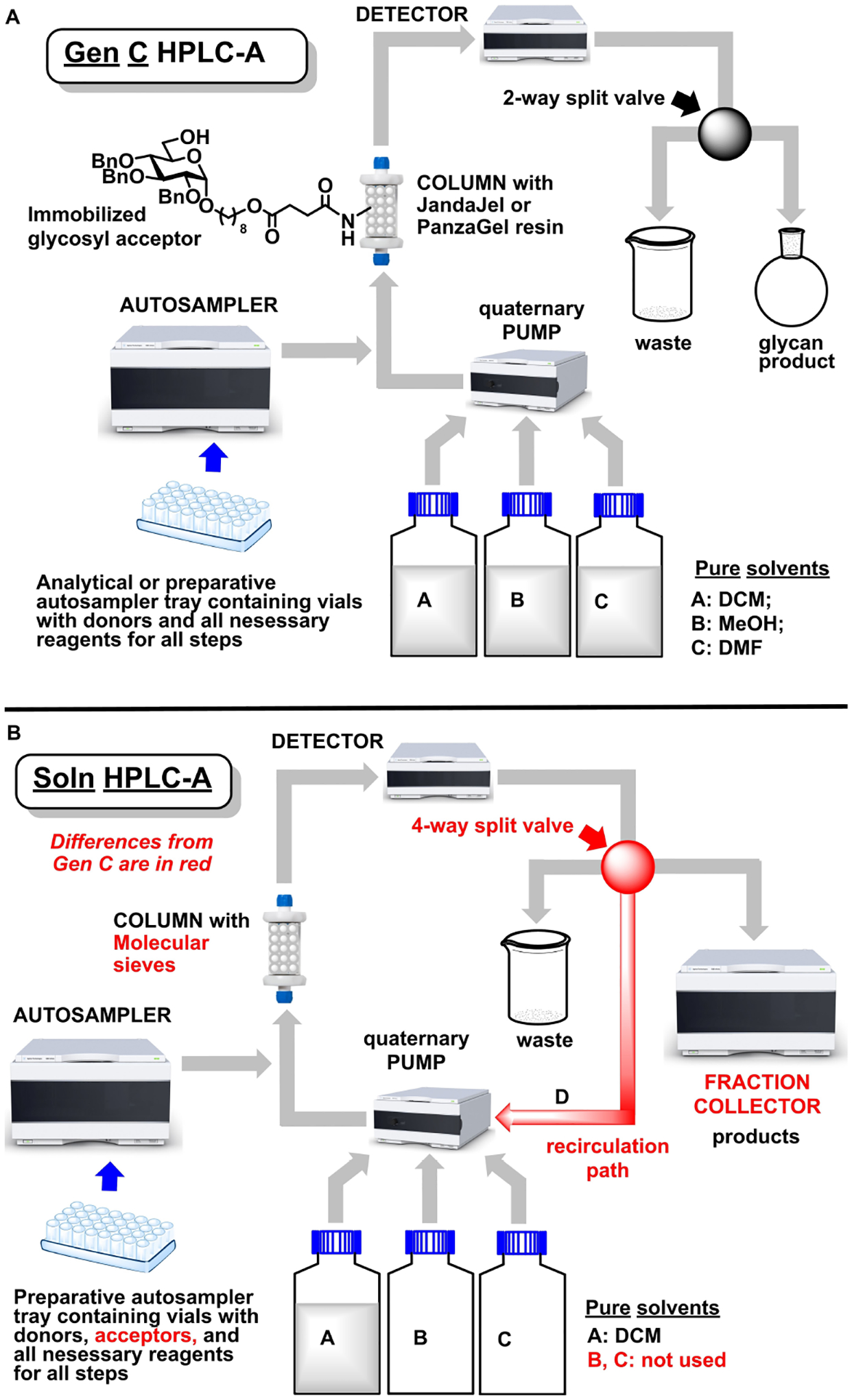
Generation C HPLC–A on solid phase (A) and HPLC–A in solution (B).
As the 21st century unfolds with rapid changes in demographics, ways of learning, computation, and automation, new challenges in research and development emerge. Unexpected pandemic in 2020 revealed our unpreparedness, which resulted in many research labs shutting down completely for many weeks and even months. Even after reopening, many labs were operating using new social distancing, reduced work hours, and time shift protocols. This period was particularly challenging for graduate student researchers who were unable to go to labs, spend as much time as they needed, but still being required to show progress in order to advance and graduate with minimal delays. These challenges persuaded us to repurpose our HPLC–A platform to solution-phase synthesis and extend it to the repetitive batch synthesis.
Like in our previous set-up, the operator adds all reagents, including the glycosyl acceptor, in the autosampler, presses the button to start the repetitive automation sequence, leaves the lab, and upon return finds products of multiple reactions in separate chambers of the fraction collector. The modular character of HPLC allows for implementing new attachments and accessories by using the plug-in approach and modulating the reaction modes by computer programming. We envisaged that to enable multiple glycosylations with the single press of a button, one would require the following adjustments shown in Scheme 1B. Based on equipment used for Generation C HPLC–A,[16] the new system was supplemented by an automated fraction collector. Having the fraction collector would allow for collecting multiple products obtained as a result of a sequence of reactions, as opposed to the single product that was previously collected in the flask. To enable the recirculation mode, along with the waste collection and the product collection modes, we have implemented a new four-way split valve instead of the previously used two-way split valve. Since we were not using solid-phase-based approach in this application, the Omnifit glass chromatography column, which was previously used to hold polymeric resin equipped with the glycosyl acceptor residues, was loaded with activated beads of molecular sieves (3 Å). The column was integrated into the system, pump intake line A was used for delivering standard HPLC-grade ACS-spec solvent DCM needed for glycosylation and washing. To minimize hydrolysis, a common side reaction of glycosylations, activated beads of 3 Å molecular sieves were also added to the DCM solvent bottle prior to application. Pump line D was dedicated to recirculation, and the preparative autosampler was used to deliver all necessary reagents (donors, acceptors, and promoters) to the system. The software was programmed in the way that allowed us to perform a fully automated solution-phase glycosylation with the single press of the software start button (see the Supporting Information for programming details).
With the developed new automation circuit, we started from refining basic glycosylation conditions. This preliminary experimentation was performed with common thioglycoside 1[17] and trichloroacetimidate 2[18] donors and primary glycosyl acceptors 3[19] and 4.[20] To establish a benchmark, we first conducted glycosidation of thioglucoside 1 with glycosyl acceptor 3 using conventional manual approach in the flask. The activation was achieved in the presence of N-iodosuccinimide (NIS, 2.0 equiv) and trifluoromethanesulfonic acid (TfOH, 0.2 equiv), a common promoter system for the activation of thioglycosides, to afford disaccharide 5[21] in 93% yield within 15 min (Table 1, entry 1). When a similar reaction was performed using the automated delivery of all reagents with the autosampler followed by recirculation for 60 min and washing/collection for 15 min, disaccharide 5 was obtained in a disappointing yield of 25% (entry 2). Nevertheless, we were encouraged by this first attempt and turned our attention to refining the reaction conditions. Certainly, moving directly from manual to automated synthesis may not always be straightforward, as previously shown by Pohl and Bennett.[22]
Table 1.
Refinement of basic parameters of HPLC–A glycosylations in solution.

| |||
|---|---|---|---|
| Entry | Donor (equiv.)+Acceptor | Promoter (equiv.), Time | Product, Yield |
| 1a | 1 (1.25)+3 | NIS (2.0)/TfOH (0.2), 15 min | 5, 93% |
| 2 | 1 (1.25)+3 | NIS (2.0)/TfOH (0.2), 60 min | 5, 25% |
| 3 | 1 (1.25)+3 | NIS (2.0)/TfOH (0.3), 60 min | 5, 77% |
| 4 | 1 (1.25)+3 | NIS (2.0)/TfOH (0.5), 60 min | 5, 84% |
| 5 | 1 (1.25)+3 | NIS (2.0)/TfOH (0.5), 30 min | 5, 83% |
| 6 | 1 (1.25)+3 | NIS (2.0)/TfOH (0.5), 10 min | 5, 20% |
| 7 | 1 (1.25)+4 | NIS (2.0)/TfOH (0.5), 60 min | 6, 67% |
| 8 | 1 (2.0)+4 | NIS (2.0)/TfOH (0.5), 60 min | 6, 79% |
| 9 | 1 (3.0)+4 | NIS (2.0)/TfOH (0.5), 60 min | 6, 87% |
| 10b | 2 (3.0)+3 | TMSOTf (0.5), 60 min | 5, 88% |
standard manual glycosylation;
this reaction was repeated three times by an untrained high school student who achieved yields of 84, 86, and 86%.
A notable improvement in the reaction outcome was achieved by increasing the amount of TfOH with all other parameters remaining constant. Thus, when either 0.3 or 0.5 equiv. of TfOH were delivered followed by recirculation for 60 min, disaccharide 5 was obtained in very good yields of 77 or 84%, respectively (entries 3 and 4). On the other hand, decreasing the recirculation time to either 30 or 10 min, while keeping all other reaction parameters constant, led to a decline in the yields of product 5 to 83% and 20%, respectively (entries 5 and 6). When our leading reaction conditions (entry 4) were applied to glycosylation of a less reactive, benzoylated glycosyl acceptor 4, the respective disaccharide 6[23] was obtained in 67% yield (entry 7). This prompted us to conduct further optimization of the reaction conditions. Increasing the excess of glycosyl donor 1 to 2.0 and 3.0 equiv. resulted in an increase of the yield of product 6 to 79 and 87%, respectively (entries 8 and 9). With an ultimate goal of developing universal reaction conditions that would work with all glycosyl donors and all glycosyl acceptors, we decided to perform all of our subsequent glycosylations with 3-fold excess of the donor.
We then investigated glycosidation of trichloroacetimidate 2 with glycosyl acceptor 3 in the presence of trimethylsilyl trifluoromethanesulfonate (TMSOTf, 0.5 equiv). This reaction was smooth and efficient, and the desired product 5 was obtained in 88% yield (entry 10). To ensure transferability of our automated system, a series of glycosylations between glycosyl donor 2 and glycosyl acceptor 3 were performed by an untrained sophomore high school student. The student has managed to reproduce the latter reaction in 84, 86, and 86% yield proving excellent level of reproducibility, not only between different experiments, but also different operators. Note, that the rest of experimentation was performed by a well-trained 5th year doctoral student (SE).
With success of our preliminary experimentation, we extended our approach to investigating other glycosyl acceptors. One of potential advantages of this automated system is the ability to perform several glycosylations with a single “press of a button.” Hence, glycosidation of donor 1 with four selected glycosyl acceptors 7–10[19] was performed in one repetitive automation sequence. All automated glycosylations performed with the single press of a button were successful, and the respective disaccharides 11–14[19,23–24] were obtained in 65–72% yields as depicted in Scheme 2. Overall, the entire sequence comprising four glycosylation reactions was completed within 5 h, and the individual reaction mixtures were separated in individual collection vessels with the appropriately programmed fraction collector attachment.
Scheme 2.

HPLC–A synthesis of multiple disaccharides 11–14 with a single press of a button.resolution is low, providing below a higher resolution image
The scope of our automated glycosylation was further explored with a variety of glycosyl donors and glycosyl acceptors of other series. The summary of these reactions is presented in Table 2. Thus, benzylated (armed) thioglucoside 15[25] showed excellent efficiency in reaction with glycosyl acceptor 3. As a result, disaccharide 16[26] was obtained in 90 % yield (α/β = 2.0/1, entry 1). Per-benzoylated (disarmed) thiogalactoside 17[27] was then glycosidated with acceptor 3 to afford disaccharide 18[28] in 78 % yield (entry 2). This result was on a par with that observed with thioglucoside donor 1 (see Table 1). The automated glycosidation of per-acetylated thiomannoside 19[29] with 6-OH benzoylated glycosyl acceptor 4 afforded product 20[30] in 74 % yield (entry 3). Glycosidation of per-benzylated thiomannoside 21[30] with secondary glycosyl acceptor 7 was also promising and product 22[31] was obtained in 72 % yield (entry 4). Even the recently developed 3-picoloylated mannosyl donor 23,[32] which is capable of stereocontrolling glycosylations via the H-bond-mediated aglycone delivery pathway, showed excellent reactivity and stereoselectivity in the reaction with glycosyl acceptor 4. As a result, disaccharide 24[32] was obtained in a high yield of 95 % with impressive β-manno stereoselectivity (α/β = 1/21, entry 5). In comparison, the manual synthesis reported previously[32] was performed at a low temperature, required much longer reaction time, and resulted in a comparable yield and stereoselectivity.
Table 2.
Broadening the scope of the HPLC–A in solution.This table in the PDF file has no data in the last column, only structures are shown. No compound numbers show when the structure is present.

|

|
We then investigated activation of ethylthio glucoside 25[33] for reaction with glycosyl acceptor 3 under the previously developed regenerative conditions (NIS and HOFox).[34] This approach that allows for thioglycoside activation under neutral reaction conditions afforded product 26[26] in 69 % yield (entry 6). Other classes of thioglyco-sides were also found to be suitable for HPLC–A glycosylations in solution. Both SPh glucoside 27[35] and STol glucoside 28[36] produced a similar outcome in reactions with glycosyl acceptor 3. Thus, disaccharide 5 was obtained in good yields of 86–87 % (entries 7 and 8). S-Benzoxazolyl donor 22[37] was intentionally investigated in the presence of TfOH as the sole activator. Known for its high reactivity in the presence of silver-salts promoters, protic acid-promoted activation was also proven possible and disaccharide 16 was obtained in 51 % with (α/β = 3.0/1, entry 9).
The developed HPLC–A platform was further investigated towards selective activation, wherein trichloroacetimidate donors 2 and 32[38] were selectively activated over thioglycoside acceptors 30[39] and 33.[40] Both automated glycosylations were successful, and the respective products were obtained in good yields: 31[41] (78 %, entry 10), 34[42] (80 %, α/β = 2.1/1, entry 11). Glycosidation of highly reactive OFox imidate 35[38] and allylphenyl glucoside 37[43] with glycosyl acceptor 3 was conducted in the presence of TMSOTf. As a result, the respective disaccharides 36[38] and 16 were obtained in 78–79 % yields with preferential α-stereoselectivity (entries 12–13).
With the universally proven platform for HPLC–A in solution, we endeavored on batch glycosylations of a set of glycosyl acceptors with various glycosyl donors under different reaction conditions, all with the single press of a button. For this study, the autosampler tray was loaded with randomly chosen glycosyl donors 2, 38–41[25,44] equipped with a variety of leaving groups including phosphate and pentenyl as well as disaccharide donor. It should be noted that as a proof of concept, none of these glycosyl donors (except donor 2) were preliminary investigated in the single step HPLC–A glycosylations in solution. Also loaded were glycosyl acceptors 3, 4, 8, 42[45] and all necessary reagents for the activation of all glycosyl donors chosen for this study: NIS, TfOH and TMSOTf. The HPLC–A software was then programmed to perform six sequential glycosylations in one batch. As a result, we obtained disaccharides 12, 43–45[26,46] in 75–88 % yields and trisaccharides 46[47] and 47 in 61–70 % yields (Scheme 3).
Scheme 3.

HPLC–A synthesis of di- and trisaccharides 12, 43–47 by different methods with a single press of a button.resolution is low, providing below a higher resolution image
In addition to the successful batch glycosylations proven by the HPLC–A solution system, we further endeavored on the automated synthesis of trisaccharides present in human milk oligosaccharides (HMO), Lacto-N-triose (LNTri II) and 3’–Galactosyllactose (ß3’-GL).[48] The overall design for the automated synthesis of these HMO is depicted in Scheme 4. The autosampler tray was loaded with glucosamine-SEt donor 48[49] and galactose-SEt donor 51.[50] Also loaded was glycosyl acceptor 49, which was coupled with both donors in a 1 + 2 fashion, and the necessary promoters. Applying the standard reaction conditions (NIS 2.0 equiv, TfOH0.5 equiv) resulted in low yields of the corresponding trisaccharides. However, when we increased the amount of NIS and TfOH to 2.5 equiv. and 1.0 equiv, respectively, the protected HMOs 50 and 52 were obtained in good yields of 60 % and 43 %, respectively.
Scheme 4.

HPLC–A synthesis of protected HMOs LNTri II and ß3’-GL with a single press of a button.
In conclusion, a new solution-phase automation set-up based on HPLC has been developed. A variety of glycosyl donors and acceptors were investigated for glycosylation. Multiple glycosylations were successfully performed with the “press of a button” mode. We also showcased how the new automated method can be accurately reproduced by non-specialists (untrained high school student). A very promising result achieved in the HAD directed β-mannosylation may open exciting new directions for further developments. Moreover, automated syntheses of two core trisaccharides present in HMO, LNTri II and ß3’-GL, were successfully achieved. This, in turn, will enhance the access to HMO that are of a great current interest to the glycoscience community. It is expected that the developed automated platform with complement other automation approaches and strategues.[1,9c,51]
Supplementary Material
Acknowledgements
This work was supported by a grant from the NIGMS (GM111835). SE is indebted to the SACM for providing her with the graduate fellowship. We thank Paolo A. Demchenko (high school sophomore student) for experimental assistance.
Footnotes
Supporting Information: Additional experimental details and NMR spectra for all compounds.
Supporting information for this article is available on the WWW under https://doi.org/10.1002/chem.202201180
Conflict of Interest
The authors declare no conflict of interest.
Data Availability Statement
The data that support the findings of this study are available in the supplementary material of this article.
References
- [1].Panza M, Pistorio SG, Stine KJ, Demchenko AV, Chem. Rev 2018, 118, 8105–8150. [DOI] [PMC free article] [PubMed] [Google Scholar]
- [2].a) Merrifield B, Br. Polym. J 1984, 16, 173–178; [Google Scholar]; b) Krishnamurthy VR, Dougherty A, Kamat M, Song X, Cummings RD, Chaikof EL, Carbohydr. Res 2010, 345, 1541–1547. [DOI] [PMC free article] [PubMed] [Google Scholar]
- [3].Toy PH, Lam Y in Solid-phase organic synthesis, Vol. John Wiley & Sons, Inc., Hoboken, 2012. [Google Scholar]
- [4].a) Tanaka H, Matoba N, Tsukamoto H, Takimoto H, Yamada H, Takahashi T, Synlett 2005, 824–828; [Google Scholar]; b) Machida K, Hirose Y, Fuse S, Sugawara T, Takahashi T, Chem. Pharm. Bull 2010, 58, 87–93. [DOI] [PubMed] [Google Scholar]
- [5].a) Jaipuri FA, Pohl NL, Org. Biomol. Chem 2008, 6, 2686–2691; [DOI] [PubMed] [Google Scholar]; b) Tang S-L, Linz LB, Bonning BC, Pohl NLB, J. Org. Chem 2015, 80, 10482–10489; [DOI] [PMC free article] [PubMed] [Google Scholar]; c) Tang S-L, Pohl NLB, Org. Lett 2015, 17, 2642–2645; [DOI] [PMC free article] [PubMed] [Google Scholar]; d) Nagy G, Peng T, Kabotso DEK, Novotny MV, Pohl NLB, Chem. Commun 2016, 52, 13253–13256; [DOI] [PMC free article] [PubMed] [Google Scholar]; e) Tang S-L, Pohl NLB, Carbohydr. Res 2016, 430, 8–15. [DOI] [PMC free article] [PubMed] [Google Scholar]
- [6].a) Nokami T, Hayashi R, Saigusa Y, Shimizu A, Liu C-Y, Mong K-KT, Yoshida J.-i., Org. Lett 2013, 15, 4520–4523; [DOI] [PubMed] [Google Scholar]; b) Nokami T, Isoda Y, Sasaki N, Takaiso A, Hayase S, Itoh T, Hayashi R, Shimizu A, Yoshida J.-i., Org. Lett 2015, 17, 1525–1528; [DOI] [PubMed] [Google Scholar]; c) Isoda Y, Sasaki N, Kitamura K, Takahashi S, Manmode S, Takeda-Okuda N, Tamura JI, Nokami T, Itoh T, Beilstein J Org. Chem 2017, 13, 919–924; [DOI] [PMC free article] [PubMed] [Google Scholar]; d) Manmode S, Sato T, Sasaki N, Notsu I, Hayase S, Nokami T, Itoh T, Carbohydr. Res 2017, 450, 44–48. [DOI] [PubMed] [Google Scholar]
- [7].a) Sears P, Wong CH, Science 2001, 291, 2344–2350; [DOI] [PubMed] [Google Scholar]; b) Hsu CH, Hung SC, Wu CY, Wong CH, Angew. Chem. Int. Ed 2011, 50, 11872–11923; [DOI] [PubMed] [Google Scholar]; Angew. Chem 2011, 123, 12076–12129. [Google Scholar]
- [8].a) Chen Y, Thon V, Li Y, Yu H, Ding L, Lau K, Qu J, Hie L, Chen X, Chem. Commun 2011, 47, 10815–10817; [DOI] [PMC free article] [PubMed] [Google Scholar]; b) Muthana MM, Qu J, Li Y, Zhang L, Yu H, Ding L, Malekan H, Chen X, Chem. Commun 2012, 48, 2728–2730; [DOI] [PubMed] [Google Scholar]; c) Chen C, Zhang Y, Xue M, Liu XW, Li Y, Chen X, Wang PG, Wang F, Cao H, Chem. Commun 2015, 51, 7689–7692; [DOI] [PubMed] [Google Scholar]; d) Yu H, Zeng J, Li Y, Thon V, Shi B, Chen X, Org. Biomol. Chem 2016, 14, 8586–8597; [DOI] [PMC free article] [PubMed] [Google Scholar]; e) Zhao C, Wu Y, Yu H, Shah IM, Li Y, Zeng J, Liu B, Mills DA, Chen X, Chem. Commun 2016, 52, 3899–3902. [DOI] [PMC free article] [PubMed] [Google Scholar]
- [9].a) Li L, Liu Y, Ma C, Qu J, Calderon AD, Wu B, Wei N, Wang X, Guo Y, Xiao Z, Song J, Sugiarto G, Li Y, Yu H, Chen X, Wang PG, Chem. Sci 2015, 6, 5652–5661; [DOI] [PMC free article] [PubMed] [Google Scholar]; b) Xiao Z, Guo Y, Liu Y, Li L, Zhang Q, Wen L, Wang X, Kondengaden SM, Wu Z, Zhou J, Cao X, Li X, Ma C, Wang PG, J. Org. Chem 2016, 81, 5851–5865; [DOI] [PMC free article] [PubMed] [Google Scholar]; c) Wen L, Edmunds G, Gibbons C, Zhang J, Gadi MR, Zhu H, Fang J, Liu X, Kong Y, Wang PG, Chem. Rev 2018, 118, 8151–8187; [DOI] [PubMed] [Google Scholar]; d) Zhang J, Chen C, Gadi MR, Gibbons C, Guo Y, Cao X, Edmunds G, Wang S, Liu D, Yu J, Wen L, Wang PG, Angew. Chem. Int. Ed. Engl 2018, 57, 16638–16642. [DOI] [PMC free article] [PubMed] [Google Scholar]
- [10].Li T, Liu L, Wei N, Yang J-Y, Chapla DG, Moremen KW, Boons G-J, Nat. Chem 2019, 11, 229–236. [DOI] [PMC free article] [PubMed] [Google Scholar]
- [11].a) Plante OJ, Palmacci ER, Seeberger PH, Science 2001, 291, 1523–1527; [DOI] [PubMed] [Google Scholar]; b) Seeberger PH, Chem. Soc. Rev 2008, 37, 19–28; [DOI] [PubMed] [Google Scholar]; c) Plante OJ, Palmacci ER, Seeberger PH, Adv. Carbohydr. Chem. Biochem 2003, 58, 35–54; [DOI] [PubMed] [Google Scholar]; d) Seeberger PH, Acc. Chem. Res 2015, 48, 1450–1463. [DOI] [PubMed] [Google Scholar]
- [12].Krock L, Esposito D, Castagner B, Wang C-C, Bindschadler P, Seeberger PH, Chem. Sci 2012, 3, 1617–1622. [Google Scholar]
- [13].a) Vijaya Ganesh N, Fujikawa K, Tan YH, Stine KJ, Demchenko AV, Org. Lett 2012, 14, 3036–3039; [DOI] [PMC free article] [PubMed] [Google Scholar]; b) Shadrick M, Panza M, Vijaya Ganesh N, Pistorio SG, Stine KJ, Demchenko AV in HPLC-Based automated oligosaccharide synthesis, 2021, pp. 623–636. [Google Scholar]
- [14].Pistorio SG, Nigudkar SS, Stine KJ, Demchenko AV, J. Org. Chem 2016, 81, 8796–8805. [DOI] [PMC free article] [PubMed] [Google Scholar]
- [15].Pistorio SG, Geringer SA, Stine KJ, Demchenko AV, J. Org. Chem 2019, 84, 6576–6588. [DOI] [PMC free article] [PubMed] [Google Scholar]
- [16].a) Panza M, Neupane D, Stine KJ, Demchenko AV, Chem. Commun 2020, 56, 10568–10571; [DOI] [PMC free article] [PubMed] [Google Scholar]; b) Panza M, Stine KJ, Demchenko AV, Chem. Commun 2020, 56, 1333–1336. [DOI] [PMC free article] [PubMed] [Google Scholar]
- [17].Sail D, Kovac P, Carbohydr. Res 2012, 357, 47–52. [DOI] [PMC free article] [PubMed] [Google Scholar]
- [18].Nigudkar SS, Parameswar AR, Pornsuriyasak P, Stine KJ, Demchenko AV, Org. Biomol. Chem 2013, 11, 4068–4076. [DOI] [PubMed] [Google Scholar]
- [19].Ranade SC, Kaeothip S, Demchenko AV, Org. Lett 2010, 12, 5628–5631. [DOI] [PMC free article] [PubMed] [Google Scholar]
- [20].Stévenin A, Boyer F-D, Beau J-M, J. Org. Chem 2010, 75, 1783–1786. [DOI] [PubMed] [Google Scholar]
- [21].Garcia BA, Gin DY, J. Am. Chem. Soc 2000, 122, 4269–4279. [Google Scholar]
- [22].Saliba RC, Wooke ZJ, Nieves GA, Chu AA, Bennett CS, Pohl NLB, Org. Lett 2018, 20, 800–803. [DOI] [PMC free article] [PubMed] [Google Scholar]
- [23].Carthy CM, Tacke M, Zhu X, Eur. J. Org. Chem 2019, 2729–2734. [Google Scholar]
- [24].Pornsuriyasak P, Demchenko AV, Chem. Eur. J 2006, 12, 6630–6646. [DOI] [PubMed] [Google Scholar]
- [25].Chatterjee S, Moon S, Hentschel F, Gilmore K, Seeberger PH, J. Am. Chem. Soc 2018, 140, 11942–11953. [DOI] [PubMed] [Google Scholar]
- [26].Nguyen HM, Chen YN, Duron SG, Gin DY, J. Am. Chem. Soc 2001, 123, 8766–8772. [DOI] [PubMed] [Google Scholar]
- [27].Dondoni A, Marra A, Scherrmann M-C, Casnati A, Sansone F, Ungaro R, Chem. Eur. J 1997, 3, 1774–1782. [Google Scholar]
- [28].Tatai J, Fugedi P, Org. Lett 2007, 9, 4647–4650. [DOI] [PubMed] [Google Scholar]
- [29].Escopy S, Singh Y, Demchenko AV, Org. Biomol. Chem 2019, 17, 8379–8383. [DOI] [PubMed] [Google Scholar]
- [30].Chittela S, Reddy TR, Krishna PR, Kashyap S, RSC Adv 2014, 4, 46327–46331. [Google Scholar]
- [31].Singh Y, Wang T, Geringer SA, Stine KJ, Demchenko AV, J. Org. Chem 2018, 83, 374–381. [DOI] [PMC free article] [PubMed] [Google Scholar]
- [32].Alex C, Visansirikul S, Demchenko AV, Org. Biomol. Chem 2020, 18, 6682–6695. [DOI] [PubMed] [Google Scholar]
- [33].Ekelof K, Oscarson S, J. Org. Chem 1996, 61, 7711–7718. [DOI] [PubMed] [Google Scholar]
- [34].Escopy S, Singh Y, Stine KJ, Demchenko AV, Chem. Eur. J 2021, 27, 354–361. [DOI] [PMC free article] [PubMed] [Google Scholar]
- [35].Yuan X, Kou Y, Yu L, Zhang Z-X, Xue W, Org. Chem. Front 2015, 2, 1604–1607. [Google Scholar]
- [36].Liu GJ, Zhang XT, Xing GW, Chem. Commun 2015, 51, 12803–12806. [DOI] [PubMed] [Google Scholar]
- [37].Kamat MN, Demchenko AV, Org. Lett 2005, 7, 3215–3218. [DOI] [PubMed] [Google Scholar]
- [38].Nigudkar SS, Wang T, Pistorio SG, Yasomanee JP, Stine KJ, Demchenko AV, Org. Biomol. Chem 2017, 15, 348–359. [DOI] [PMC free article] [PubMed] [Google Scholar]
- [39].Birberg W, Lonn H, Tetrahedron Lett 1991, 32, 7453–7456. [Google Scholar]
- [40].Huang X, Huang L, Wang H, Ye XS, Angew. Chem. Int. Ed 2004, 43, 5221–5224; [DOI] [PubMed] [Google Scholar]; Angew. Chem 2004, 116, 5333–5336. [Google Scholar]
- [41].Pornsuriyasak P, Demchenko AV, Tetrahedron: Asymmetry 2005, 16, 433–439. [Google Scholar]
- [42].Escopy S, Singh Y, Demchenko AV, Org. Biomol. Chem 2021, 19, 2044–2054. [DOI] [PMC free article] [PubMed] [Google Scholar]
- [43].Premathilake HD, Demchenko AV, Beilstein J. Org. Chem 2012, 8, 597–605. [DOI] [PMC free article] [PubMed] [Google Scholar]
- [44].a) Mach M, Schlueter U, Mathew F, Fraser-Reid B, Hazen KC, Tetrahedron 2002, 58, 7345–7354; [Google Scholar]; b) Calin O, Eller S, Seeberger PH, Angew. Chem. Int. Ed 2013, 52, 5862–5865; [DOI] [PubMed] [Google Scholar]; Angew. Chem 2013, 125, 5974–5977; [Google Scholar]; c) Sandbhor MS, Soya N, Albohy A, Zheng RB, Cartmell J, Bundle DR, Klassen JS, Cairo CW, Biochemistry 2011, 50, 6753–6762. [DOI] [PubMed] [Google Scholar]
- [45].Agoston K, Kroeger L, Dekany G, Thiem J, J. Carbohydr. Chem 2007, 26, 513–525. [Google Scholar]
- [46].Yang J, Cooper-Vanosdell C, Mensah EA, Nguyen HM, J. Org. Chem 2008, 73, 794–800. [DOI] [PubMed] [Google Scholar]
- [47].Zhang Y, Wang P, Song N, Li M, Carbohydr. Res 2013, 381, 101–111. [DOI] [PubMed] [Google Scholar]
- [48].Urashima T, Hirabayashi J, Sato S, Kobata A, Trends Glycosci. Glycotechnol 2018, 30, SE51–SE65. [Google Scholar]
- [49].Bandara MD, Stine KJ, Demchenko AV, Carbohydr. Res 2019, 486, 107824. [DOI] [PMC free article] [PubMed] [Google Scholar]
- [50].Grube M, Lee B-Y, Garg M, Michel D, Vilotijević I, Malik A, Seeberger PH, Varón Silva D, Chem. Eur. J 2018, 24, 3271–3282. [DOI] [PubMed] [Google Scholar]
- [51].a) Yalamanchili S, Nguyen TA, Zsikla A, Stamper G, DeYong AE, Florek J, Vasquez O, Pohl NLB, Bennett CS, Angew. Chem. Int. Ed. Engl 2021, 60, 23171–23175; [DOI] [PMC free article] [PubMed] [Google Scholar]; b) Kern MK, Pohl NLB, Org. Lett 2020, 22, 4156–4159; [DOI] [PMC free article] [PubMed] [Google Scholar]; c) Chatterjee S, Guidi M, Seeberger PH, Gilmore K, Nature 2020, 579, 379–384; [DOI] [PubMed] [Google Scholar]; d) Guberman M, Seeberger PH, J. Am. Chem. Soc 2019, 141, 5581–5592; [DOI] [PMC free article] [PubMed] [Google Scholar]; e) Trobe M, Burke MD, Angew. Chem. Int. Ed 2018, 57, 4192–4214; [DOI] [PMC free article] [PubMed] [Google Scholar]; Angew. Chem 2018, 130, 4266–4288. [Google Scholar]
Associated Data
This section collects any data citations, data availability statements, or supplementary materials included in this article.
Supplementary Materials
Data Availability Statement
The data that support the findings of this study are available in the supplementary material of this article.