



Abstract
Prurigo nodularis (PN), or chronic prurigo, is a distinct disease characterized by the presence of chronic pruritus and multiple localized or generalized pruriginous lesions. While there are few epidemiologic studies describing the prevalence of PN, it is thought to be relatively rare, but is likely underdiagnosed and underrecognized. Management of PN is challenging, and there are no approved drugs that can relieve the distress as well as signs and symptoms caused by PN and its pruritus. Improved understanding of the neuroimmune pathways involved in management of PN have led to discovery and trial of emerging treatments for PN. This publication provides an overview of PN and discusses several of the most promising treatments that are undergoing evaluation.
Keywords: Interleukin, Interleukin-31, Nemolizumab, Prurigo nodularis, Inflammatory skin disease, Treatment, Nodular prurigo, Pruritus, IL-31RA
Key Summary Points
| Prurigo nodularis (PN), or chronic prurigo, is a distinct disease characterized by the presence of chronic pruritus and multiple localized or generalized pruriginous lesions. |
| Improved understanding of the pathophysiology of prurigo nodularis is translating into new therapeutic candidates. |
| IL-31 blockade is a very promising potential treatment approach for prurigo nodularis. |
Introduction
Skin conditions may have a negative effect on emotional and psychological well-being, which are exacerbated in chronic diseases [1, 2]. Clinical experience has shown that the negative impact of skin disease can be particularly important when lesions and symptoms such as itch are present [3, 4]. Prurigo nodularis (PN)—also known as chronic nodular prurigo—is an inflammatory skin disease characterized by chronic itch, firm pruritic nodular lesions, signs/history of repeated scratching such as excoriation, and lichenification [1, 2]. As discussed in more detail below, PN can have a variable disease presentation, particularly across different racial groups, and can present in popular, nodular, plaque, or umbilicated subtypes [2–5]. Regardless of the clinical presentation, PN often has a detrimental effect on patients’ psychosocial well-being, in part because the majority of patients report that their PN symptoms are present either all or most of the time and because of the severity of itch [6–8]. In addition, psychosocial stress may cause and/or exacerbate the condition [6–8].
There are currently no treatments for PN approved by regulatory bodies [7, 9]. In the absence of approved medications, a number of treatments have been used off label in an attempt to alleviate patients’ signs and symptoms and distress; these include topical corticosteroids, intralesional corticosteroid, neuroleptics, antidepressants, thalidomide, biologics, phototherapy, and systemic immunosuppressants [7]. However, these treatments have had variable targets and regimens and, in general, have limited efficacy and/or safety issues [7]. Clinically meaningful reduction in pruritus and lesions are the major treatment goals in PN. As with other skin diseases in recent years—notably psoriasis and atopic dermatitis—increased understanding of neuroimmune-inflammatory pathways in the skin has led to valuable discoveries in not just the pathogenesis of PN but also potential treatment targets. There is now hope that the development of more targeted treatments that interact with specific pathways in the immune system will soon lead to better management strategies for PN. This article is based on previously conducted studies and does not contain any new studies with human participants or animals performed by any of the authors.
Insights into Prurigo Nodularis
High Burden and Unmet Medical Needs
Epidemiology
Much about PN remains to be better defined, including the epidemiology and pathogenesis [7]. It is thought that PN is a rare condition, affecting approximately 170,000 adults in the USA [9]. Recent data have shown that, in England, the prevalence of PN is 3.27 per 10,000, equating to 18,471 patients living with the disease [10]. However, some PN experts believe that the prevalence of the disease is underestimated owing to lack of disease awareness and underdiagnosis [7, 9, 11]. Although PN can occur in patients of all ages and races, it is most commonly diagnosed in patients beyond their fifth decade of life. A recent cross-sectional study of patients seen at Johns Hopkins Health System found that Black individuals are 3.4 times more likely to develop PN than white individuals [6].
Associated Medical Conditions
PN has been associated with a variety of associated medical conditions, including kidney and liver diseases, chronic obstructive pulmonary disease, diabetes, congestive heart failure, high blood pressure, and associated mental health problems such as anxiety and depression [4, 6, 10]. PN can also coexist with other inflammatory dermatoses, such as atopic dermatitis, plaque psoriasis, lichen planus, or dermatitis herpetiformis [7, 9].
Clinical Features
As shown in Fig. 1, the clinical presentation of PN can vary between different racial groups [3, 5]; in patients with darker skin types, hyper- or hypopigmentation is not infrequent, while in lighter-skinned patients erythema or redness is more prominent [5]. The nodular lesions of PN are intensely itchy, with 51.2% of patients reporting severe or very severe pruritus in one study [8]. Lesions are also heterogeneous, ranging in size from a few millimeters to 2 cm in diameter and varying in terms of appearance and location; usually—but not always—lesions are located on body areas that can be reached by the patient’s hands [12, 13]. Often, PN lesions are symmetrically distributed on limbs, with the extensor surfaces most commonly affected; palms, soles of feet, and facial skin are typically spared [9, 13].
Fig. 1.

Examples of the variable presentation of PN. A–C Images from Derm101 Image library; D and E images reprinted from Kwon et al. [5]
In 2020, Pereira et al. reported 71% of patients with PN said they experience an “intractable” itch all or most of the time, with an intensity in the moderate to severe range [8]. The same group found that 53.1% of patients reported a negative impact on their daily life and 42.5% had sleep impairment [8]. Although perhaps less well known, moderate to severe pain is also common in PN; in a study of pain in patients with dermatologic conditions, 80% of those with prurigo reported moderate or severe pain/discomfort [14]. It has been hypothesized that pruritus, sleep disturbance, and depression may have a common system-based etiology [15]. Overall, PN has a significant negative impact on quality of life (QOL) and mental health, with some patients reporting self-harm and suicidal ideation [16].
Pathogenesis
It has been theorized that the pathogenesis of PN involves neuronal sensitization, inflammation, and pruritus [9]. Histopathologic changes include increased hypervascularization, epidermal hyperkeratosis, and dermal fibrosis [17]. Itch is created by inflammatory responses in the skin that are mediated by interleukin-31 (IL-31), and other cytokines or neuropeptides. IL-31 has been found at dramatically higher levels (50-fold) in PN lesions compared with skin from healthy individuals, and it seems to be involved in the crosstalk between sensory nerve fibers, epidermal keratinocytes, fibroblasts, and immune cells together with eosinophils [13, 18]. Additionally, neuroanatomical changes have been observed with increased dermal innervation and decreased epidermal nerve fiber density but increased epidermal neuronal branching in patients with chronic pruritus and PN [17, 19, 20]. Dysregulation of neuropeptides—with increases in calcitonin gene-related peptide and substance P—have also been shown in dermal PN skin [17]. Fowler et al. speculate that “these changes may be secondary to repeated mechanical scratching” but also maintain the pruritic cycle by upregulating inflammatory and neuroimmune cells [17]. Central nervous system involvement is necessary for transmitting itch from the skin, and research has shown that both IL-31 and IL-4 receptors are expressed on sensory neurons in the dorsal root ganglia [17].
Diagnosis
The diagnosis of PN is clinical, and relies upon a thorough evaluation of history and clinical presentation [9]. Overall PN activity can be assessed by number and appearance of nodules (that is, whether they are excoriated, are bleeding/crusting, and have signs of scratch behavior and itch severity) [9]. Two formal tools are available to help with assessment, and include the prurigo activity score devised by Pölking et al. and the investigator global assessment described by Ständer et al. [21, 22]. These tools can also be helpful to monitor the effectiveness of treatments [9]. In addition, the healthcare professional should probe QOL [Dermatology Life Quality Index and sleep quality (Pittsburgh Sleep Quality Index)] and presence of mental illnesses such as anxiety or depression [23, 24].
Treatment of PN: Focus on IL-31/IL-31RA and Emerging Potential Therapies
The current therapeutic landscape for PN has variable and unpredictable benefits; topical corticosteroids and calcineurin inhibitors can provide relief but are typically not effective enough for patients with moderate to severe disease [9]. Systemic therapies that may be tried include immunosuppressants, gabapentinoids, thalidomide, and antidepressants, but they do not target the disease’s main pathophysiological mechanisms holistically [9]. Ultraviolet (UV) phototherapy may be helpful in older patients who have multiple comorbidities and are on various medications; options include psoralen plus long-wave ultraviolet A (UVA), UVA, and narrow-band short-wave ultraviolet B (UVB) [9, 20]. There is no established standard treatment in PN; however, a stepwise treatment ladder has been created by Ständer et al. [25] (Fig. 2). Antihistamines are generally not effective for PN [9]. A number of off-label treatments are used, but there is extensive variability among treatment regimens, therapeutic targets, and efficacy/safety [9]. Although itch reduction is often the primary goal of patients to break the itch–scratch cycle, healing of the lesions is desirable [9, 26]. It is important to address both the neurological and immunological aspects of PN, targeting the key aspects of pathogenesis [9]. Because PN is a heterogeneous disease, individualizing therapy is appropriate and several treatment modalities may be required [9].
Fig. 2.

2020 treatment ladder for PN.
Adapted from Ständer et al. [25]
Emerging Treatments
Targeting IL-31 and its receptor IL-31RA has yielded promising data, and nemolizumab, a humanized monoclonal antibody against IL-31RA, is under active investigation in treatment of PN. Ständer et al. reported results from a 12-week, randomized, double-blinded phase-2 study of patients with moderate to severe PN (n = 70) [27]. Patients had 20 or more nodules with a mean pruritus score of at least 7 (scale 0–10) for worst daily intensity of itch, and were randomized to receive either subcutaneous injection of nemolizumab 0.5 mg/kg or placebo at baseline, week 4, and week 8 [27]. At 4 weeks, the peak pruritus numerical rating scale (PP NRS) was reduced from 8.4 to 3.9, a reduction of 53.0%; in comparison, PP NRS in the placebo group was 8.4 at baseline and 6.7 at week 4, a reduction of 20.2%, P < 0.001) [27]. Further, there was statistical separation between groups in favor of nemolizumab in reduction of pruritus scores as soon as week 1 after administration [27]. Greater improvements in sleep quality, investigator global assessment, and Dermatology Life Quality Index, as well as reductions in the mean number of lesions, were also reported with nemolizumab compared with placebo [27]. Nemolizumab was well tolerated with an acceptable safety profile. On the basis of the promise of these results, the FDA granted nemolizumab Breakthrough Therapy status in PN to expedite the development and approval process [28].
Dupilumab, an anti-IL-4RA monoclonal antibody, is also being studied in PN, in part owing to its ability to improve pruritus in patients with Atopic Dermatitis (AD) [29]. Like IL-31, IL-4 is also thought to be an important player in the neural pathways of pruritus [30]. Case reports initially suggested the efficacy of dupilumab in PN, showing that dupilumab treatment resulted in reductions in pruritus and number of lesions at 3 months [31–35].
Opioid antagonists and cannabinoids are also being studied as potential therapies for PN [9]. An imbalance of mu and kappa opioid activity may have a role in generalized itch, generating interest in studying agents that target opioid receptors to determine activity against neuronal sensitization [17]. In a phase 2 study, nalbuphine, a mixed agonist/antagonist of the mu receptor and partial kappa agonist, significantly reduced itch intensity in patients with PN compared with placebo [36]. Naloxone and naltrexone, mu opioid receptor antagonists, may also reduce pruritus in some patients with PN [17]. Early data suggest that further studies of these agents are warranted [17]. Cannabinoids are either agonists or antagonists of cannabinoid 1 and 2 receptors, which are expressed on nerve fibers and contribute to itch signaling. In a systematic review of cannabinoids for chronic pruritus, these agents reduced itch intensity [17].
Conclusions
The field of dermatology has witnessed many exciting changes in the past decade. There is new hope for patients and new targeted treatments for many chronic diseases that have been traditionally hard to manage, with some on the horizon for PN. The prevalence of PN is likely higher than once thought, owing to limited disease awareness. Pruritus, visibility, and bleeding of skin lesions contribute to a high burden of disease. Further, PN has been linked with a variety of systemic, psychological, and cardiovascular conditions. The current development of new biologics and small molecules for the treatment of patients with PN has been promising. Early data in PN suggest a very rapid and profound effect of blocking the IL-31 pathway via inhibiting IL-31RA. More clinical data from rigorous clinical trials are coming, and will be welcomed by dermatologists and patients alike.
Understanding of Immunology in Prurigo Nodularis.
Emerging insights are providing a new understanding of the mechanisms that underlie pruritic inflammation and, in turn, are likely to soon offer novel therapeutic opportunities. While much remains unclear about the pathogenesis of PN, it seems clear that pruritic inflammation is a key driver of the disease. Evaluation of the histopathology of PN shows severe epidermal changes with barrier disruption and trauma of the epidermal compartment [37]. PN histology also reveals an inflammatory infiltrate that further exacerbates pruritic inflammation in the condition [37]. There is pronounced tissue remodeling within the dermal compartment accompanied by deposition of extracellular matrix and collagen fibers. Recent advances in neuroanatomy have shown that the sensory neuronal network within PN is enhanced. Specific itch-conducting C fibers show increased frequency and branching within the skin of patients with PN. Additionally, recent omics analyses have shown that PN is characterized by systemic and skin signature related to Th17/Th22 immunity, with the most upregulated cytokine genes in skin lesions being IL-1α, IL-1β, IL-36, and IL-22 [38, 39].
Recent literature and scientific studies have identified a variety of mediators and modulators of pruritus (Fig. 3) [40]. As shown, there are several groups of receptors that have key roles, including interleukin (IL) receptors, toll-like receptors, protease-activated receptors, and others [40]. Other mediators that may be potential future therapeutic targets include protease receptors, bradykinin receptors, serotonin receptors, and substance P [40].
Fig. 3.
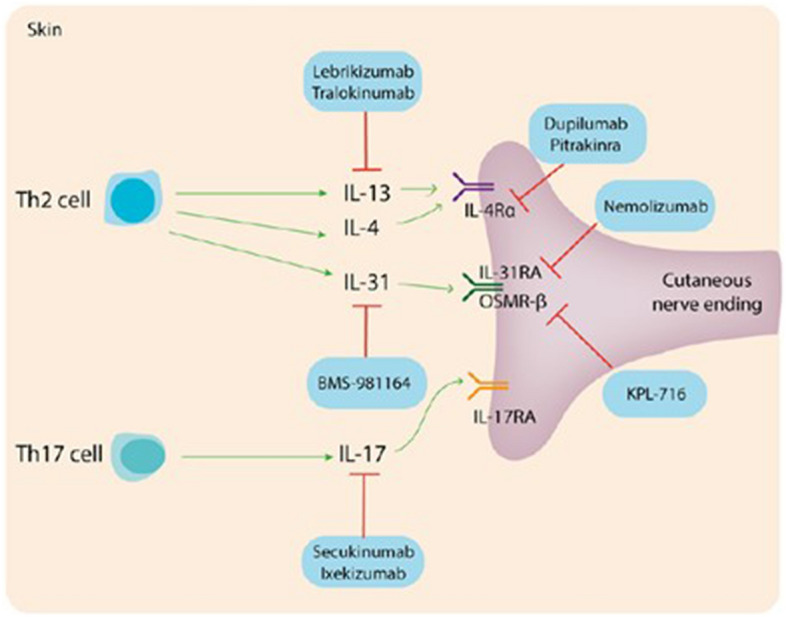
Mediators and modulators of pruritus currently relevant to PN.
From Fowler et al. https://www.medicaljournals.se/acta/content/html/10.2340/00015555-3347
IL-31 and its receptor (IL-31RA) are important mediators of pruritus, among others shown in Fig. 3. IL-31 is produced predominantly by Th2 cells and other innate immune cells. IL-31 can directly engage and activate itch-conducting sensory neurons via its heterodimeric receptor that is expressed on C fibers within the skin [40, 41]. IL-31 and its receptor complex activate TRPA1 and TRPV1 to transmit itch signals to the CNS. IL-31 also stimulates neuronal branching and sprouting to increase the neuronal network. Further, IL-31 can activate basophils, eosinophils, and dendritic cells to enhance pruritic inflammation. IL-31 stimulation of epidermal keratinocytes leads to downregulation of barrier genes and proteins, exacerbating barrier dysfunction. Finally, IL-31 interacts with activated fibroblasts, inducing tissue remodeling and deposition of collagen within the dermal compartment. IL-31 receptor signaling interferes with many different aspects that are important in the pathogenesis of PN: neuronal growth, inflammation, pruritus, barrier disruption, and tissue remodeling (Fig. 4) [41].
Fig. 4.
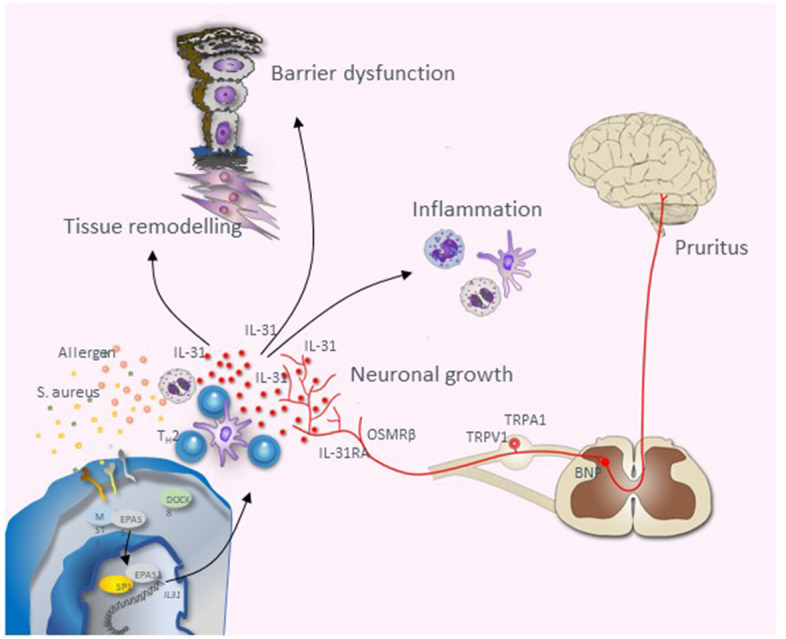
IL-31 plays a key role in PN pathogenesis.
From Nemmer et al. [41]
Acknowledgements
Funding
Funding for editorial support and Rapid Service Fee were provided by Galderma SA and Galderma UK. The authors did not receive honoraria for conduct of the review.
Editorial Assistance
The authors wish to thank Valerie Sanders of Sanders Medical Writing for editorial assistance in developing this manuscript. Support for this assistance was provided by Galderma SA.
Authorship
All named authors meet the International Committee of Medical Journal Editors (ICMJE) criteria for authorship for this article, take responsibility for the integrity of the work as a whole, and have given their approval for this version to be published.
Author Contributions
All authors contributed to the manuscript conception and design, commented on previous versions of the manuscript, and read and approved the final manuscript.
Disclosures
Anthony Bewley has served as a consultant to Abbvie, Almirall, Celgene, Galderma, Janssen, Leo Pharma, Eli Lilly, Novartis, Sanofi, and UCB, as an advisor to the Psoriasis Association, Changing Faces, ISG, and NES, and has received travel grants from Janssen, Leo, and Almirall; Bernard Homey has served as an advisor/consultant/speaker/investigator for Novartis, Galderma, Regeneron/Sanofi, ALK-Abello, Celgene, AbbVie, Janssen-Cilag, Eli Lilly, and Boehringer Ingelheim; Andrew Pink has served as an advisor/consultant/speaker/investigator for AbbVie, Pfizer, Leo, Sanofi, Eli Lilly, Amgen, Novartis, Almirall, Galderma, Bristol-Myers Squibb, La Roche Posay, UCB, and Janssen.
Compliance with Ethics Guidelines
This article is based on previously conducted studies and does not contain any new studies with human participants or animals performed by any of the authors.
Data Availability
Data sharing is not applicable to this article as no datasets were generated or analyzed during the current study.
References
- 1.Pereira MP, Steinke S, Zeidler C, et al. European academy of dermatology and venereology European prurigo project: expert consensus on the definition, classification and terminology of chronic prurigo. J Eur Acad Dermatol Venereol. 2018;32:1059–1065. doi: 10.1111/jdv.14570. [DOI] [PubMed] [Google Scholar]
- 2.All Party Parliamentary Group on Skin. Mental health and skin disease. 2020. http://www.appgs.co.uk/wp-content/uploads/2020/09/Mental_Health_and_Skin_Disease2020.pdf. Accessed 1 Jan 2022
- 3.Tessari G, Dalle Vedove C, Loschiavo C, et al. The impact of pruritus on the quality of life of patients undergoing dialysis: a single centre cohort study. J Nephrol. 2009;22:241–248. [PubMed] [Google Scholar]
- 4.Weisshaar E, Apfelbacher C, Jager G, et al. Pruritus as a leading symptom: clinical characteristics and quality of life in German and Ugandan patients. Br J Dermatol. 2006;155:957–964. doi: 10.1111/j.1365-2133.2006.07430.x. [DOI] [PubMed] [Google Scholar]
- 5.Kwon CD, Khanna R, Williams KA, et al. Diagnostic workup and evaluation of patients with prurigo nodularis. Medicines (Basel) 2019;6:97. doi: 10.3390/medicines6040097. [DOI] [PMC free article] [PubMed] [Google Scholar]
- 6.Boozalis E, Tang O, Patel S, et al. Ethnic differences and comorbidities of 909 prurigo nodularis patients. J Am Acad Dermatol. 2018;79:714–719. doi: 10.1016/j.jaad.2018.04.047. [DOI] [PMC free article] [PubMed] [Google Scholar]
- 7.Zeidler C, Pereira MP, Dugas M, et al. The burden in chronic prurigo: patients with chronic prurigo suffer more than patients with chronic pruritus on non-lesional skin: a comparative, retrospective, explorative statistical analysis of 4484 patients in a real-world cohort. J Eur Acad Dermatol Venereol. 2021;35:738–743. doi: 10.1111/jdv.16929. [DOI] [PubMed] [Google Scholar]
- 8.Pereira MP, Hoffmann V, Weisshaar E, et al. Chronic nodular prurigo: clinical profile and burden. A European cross-sectional study. J Eur Acad Dermatol Venereol. 2020;34:2373–2383. doi: 10.1111/jdv.16309. [DOI] [PubMed] [Google Scholar]
- 9.Williams KA, Roh YS, Brown I, et al. Pathophysiology, diagnosis, and pharmacological treatment of prurigo nodularis. Expert Rev Clin Pharmacol. 2021;14:67–77. doi: 10.1080/17512433.2021.1852080. [DOI] [PubMed] [Google Scholar]
- 10.Morgan CL, Thomas M, Stander S, et al. Epidemiology of prurigo nodularis in England: a retrospective database analysis. Br J Dermatol. 2022;187:188–195. [DOI] [PMC free article] [PubMed]
- 11.Whang KA, Mahadevan V, Bakhshi PR, et al. Prevalence of prurigo nodularis in the United States. J Allergy Clin Immunol Pract. 2020;8:3240–3241. doi: 10.1016/j.jaip.2020.05.051. [DOI] [PubMed] [Google Scholar]
- 12.Bewely A, Lepping P, Taylor RE, editors. Psychodermatology in clinical practice. Springer Nature: Charm; 2021. [Google Scholar]
- 13.Huang AH, Williams KA, Kwatra SG. Prurigo nodularis: epidemiology and clinical features. J Am Acad Dermatol. 2020;83:1559–1565. doi: 10.1016/j.jaad.2020.04.183. [DOI] [PubMed] [Google Scholar]
- 14.Sampogna F, Abeni D, Gieler U, et al. Exploring the EQ-5D dimension of pain/discomfort in dermatology outpatients from a multicentre study in 13 European countries. Acta Dermatovenereol. 2020;100:adv00120. doi: 10.2340/00015555-3477. [DOI] [PMC free article] [PubMed] [Google Scholar]
- 15.Konda D, Chandrashekar L, Rajappa M, et al. Serotonin and interleukin-6: association with pruritus severity, sleep quality and depression severity in Prurigo Nodularis. Asian J Psychiatr. 2015;17:24–28. doi: 10.1016/j.ajp.2015.07.010. [DOI] [PubMed] [Google Scholar]
- 16.Huang AH, Canner JK, Khanna R, et al. Real-world prevalence of prurigo nodularis and burden of associated diseases. J Investig Dermatol. 2020;140(480–3):e4. doi: 10.1016/j.jid.2020.05.011. [DOI] [PubMed] [Google Scholar]
- 17.Fowler E, Yosipovitch G. A new generation of treatments for itch. Acta Dermatovenereol. 2020;100:adv00027. doi: 10.2340/00015555-3347. [DOI] [PMC free article] [PubMed] [Google Scholar]
- 18.Sonkoly E, Muller A, Lauerma AI, et al. IL-31: a new link between T cells and pruritus in atopic skin inflammation. J Allergy Clin Immunol. 2006;117:411–417. doi: 10.1016/j.jaci.2005.10.033. [DOI] [PubMed] [Google Scholar]
- 19.Haas S, Capellino S, Phan NQ, et al. Low density of sympathetic nerve fibers relative to substance P-positive nerve fibers in lesional skin of chronic pruritus and prurigo nodularis. J Dermatol Sci. 2010;58:193–197. doi: 10.1016/j.jdermsci.2010.03.020. [DOI] [PubMed] [Google Scholar]
- 20.Pereira MP, Muhl S, Pogatzki-Zahn EM, et al. Intraepidermal nerve fiber density: diagnostic and therapeutic relevance in the management of chronic pruritus: a review. Dermatol Ther (Heidelb) 2016;6:509–517. doi: 10.1007/s13555-016-0146-1. [DOI] [PMC free article] [PubMed] [Google Scholar]
- 21.Polking J, Zeidler C, Schedel F, et al. Prurigo Activity Score (PAS): validity and reliability of a new instrument to monitor chronic prurigo. J Eur Acad Dermatol Venereol. 2018;32:1754–1760. doi: 10.1111/jdv.15040. [DOI] [PubMed] [Google Scholar]
- 22.Stander HF, Elmariah S, Zeidler C, et al. Diagnostic and treatment algorithm for chronic nodular prurigo. J Am Acad Dermatol. 2020;82:460–468. doi: 10.1016/j.jaad.2019.07.022. [DOI] [PubMed] [Google Scholar]
- 23.Finlay AY, Basra MKA, Piguet V, et al. Dermatology life quality index (DLQI): a paradigm shift to patient-centered outcomes. J Investig Dermatol. 2012;132:2464–2465. doi: 10.1038/jid.2012.147. [DOI] [PubMed] [Google Scholar]
- 24.Buysse DJ, Reynolds CF, 3rd, Monk TH, et al. The Pittsburgh Sleep Quality Index: a new instrument for psychiatric practice and research. Psychiatry Res. 1989;28:193–213. doi: 10.1016/0165-1781(89)90047-4. [DOI] [PubMed] [Google Scholar]
- 25.Stander S, Pereira M, Berger T, et al. IFSI-guideline on chronic prurigo including prurigo nodularis. ITCH. 2020;5:42. doi: 10.1097/itx.0000000000000042. [DOI] [Google Scholar]
- 26.Pereira MP, Zeidler C, Wallengren J, et al. Chronic nodular prurigo: a European cross-sectional study of patient perspectives on therapeutic goals and satisfaction. Acta Derm Venereol. 2021;101:adv00403. doi: 10.2340/00015555-3726. [DOI] [PMC free article] [PubMed] [Google Scholar]
- 27.Stander S, Yosipovitch G, Legat FJ, et al. Trial of nemolizumab in moderate-to-severe prurigo nodularis. N Engl J Med. 2020;382:706–716. doi: 10.1056/NEJMoa1908316. [DOI] [PubMed] [Google Scholar]
- 28.Park B. Nemolizumab gets breakthrough therapy status for prurigo nodularis empr.com. 2019. https://www.empr.com/home/news/nemolizumab-gets-breakthrough-therapy-status-for-prurigo-nodularis/. Accessed Apr 2021.
- 29.Zhai LL, Savage KT, Qiu CC, et al. Chronic pruritus responding to dupilumab—a case series. Medicines. 2019;6:72. doi: 10.3390/medicines6030072. [DOI] [PMC free article] [PubMed] [Google Scholar]
- 30.Leis M, Fleming P, Lynde CW. Prurigo nodularis: review and emerging treatments. Skin Ther Lett. 2021;26:5–8. [PubMed] [Google Scholar]
- 31.Mollanazar NK, Elgash M, Weaver L, et al. Reduced itch associated with dupilumab treatment in 4 patients with prurigo nodularis. JAMA Dermatol. 2019;155:121–122. doi: 10.1001/jamadermatol.2018.3906. [DOI] [PubMed] [Google Scholar]
- 32.Beck KM, Yang EJ, Sekhon S, et al. Dupilumab treatment for generalized prurigo nodularis. JAMA Dermatol. 2019;155:118–120. doi: 10.1001/jamadermatol.2018.3912. [DOI] [PubMed] [Google Scholar]
- 33.Napolitano M, Fabbrocini G, Scalvenzi M, et al. Effectiveness of dupilumab for the treatment of generalized prurigo nodularis phenotype of adult atopic dermatitis. Dermatitis. 2020;31:81–84. doi: 10.1097/DER.0000000000000517. [DOI] [PubMed] [Google Scholar]
- 34.Rambhia PH, Levitt JO. Recalcitrant prurigo nodularis treated successfully with dupilumab. JAAD Case Rep. 2019;5:471–473. doi: 10.1016/j.jdcr.2019.03.016. [DOI] [PMC free article] [PubMed] [Google Scholar]
- 35.Calugareanu A, Jachiet M, Tauber M, et al. Effectiveness and safety of dupilumab for the treatment of prurigo nodularis in a French multicenter adult cohort of 16 patients. J Eur Acad Dermatol Venereol. 2020;34:e74–e76. doi: 10.1111/jdv.15957. [DOI] [PubMed] [Google Scholar]
- 36.Brophy L. Trevi therapeutics announces positive result from phase 2 trial in prurigo nodularis. 2016.
- 37.Folster-Holst R, Reimer R, Neumann C, et al. Comparison of epidermal barrier integrity in adults with classic atopic dermatitis, atopic prurigo and non-atopic prurigo nodularis. Biology (Basel) 2021;10:1008. doi: 10.3390/biology10101008. [DOI] [PMC free article] [PubMed] [Google Scholar]
- 38.Tsoi LC, Hacini-Rachinel F, Fogel P, et al. Transcriptomic characterization of prurigo nodularis and the therapeutic response to nemolizumab. J Allergy Clin Immunol. 2022;149:1329–1339. doi: 10.1016/j.jaci.2021.10.004. [DOI] [PMC free article] [PubMed] [Google Scholar]
- 39.Belzberg M, Alphonse MP, Brown I, et al. Prurigo nodularis is characterized by systemic and cutaneous T helper 22 immune polarization. J Invest Dermatol. 2021;141:2208–2218. doi: 10.1016/j.jid.2021.02.749. [DOI] [PMC free article] [PubMed] [Google Scholar]
- 40.Kahremany S, Hofmann L, Gruzman A, et al. Advances in understanding the initial steps of pruritoceptive itch: how the itch hits the switch. Int J Mol Sci. 2020;21:4883. doi: 10.3390/ijms21144883. [DOI] [PMC free article] [PubMed] [Google Scholar]
- 41.Nemmer JM, Kuchner M, Datsi A, et al. Interleukin-31 signaling bridges the gap between immune cells, the nervous system and epithelial tissues. Front Med (Lausanne) 2021;8:639097. doi: 10.3389/fmed.2021.639097. [DOI] [PMC free article] [PubMed] [Google Scholar]
Associated Data
This section collects any data citations, data availability statements, or supplementary materials included in this article.
Data Availability Statement
Data sharing is not applicable to this article as no datasets were generated or analyzed during the current study.