



Abstract
Objectives
This study prospectively examined change in waist circumference (WC) as a function of daily social rhythms and sleep in the aftermath of involuntary job loss. It was hypothesized that disrupted social rhythms and fragmented/short sleep after job loss would independently predict gains in WC over 18 months and that resiliency to WC gain would be conferred by the converse.
Methods
Eligible participants (n = 191) completed six visits that included standardized measurements of WC. At the baseline visit, participants completed the Social Rhythm Metric and Daily Sleep Diary and wore an actigraph on their nondominant wrist each day for a period of two weeks.
Results
When controlling for obesity and other covariates, WC trajectories decreased for individuals with more consistent social rhythms, more activities in their social rhythms, and higher sleep quality after job loss. WC trajectories did not change for individuals with lower scores on these indicators.
Conclusions
The frequency and consistency of social rhythms after job loss play a key role in WC loss. These findings support the implementation of social rhythm interventions after job loss, a potentially sensitive time for the establishment of new daily routines that have an impact on metabolic health.
Keywords: abdominal obesity, waist circumference, social rhythms, sleep, biological rhythms, unemployment, job loss
INTRODUCTION
Abdominal adiposity is a particularly negative form of high-risk obesity strongly associated with all-cause and cardiometabolic mortality and morbidity, including high blood pressure (1). Waist circumference (WC), a measure of visceral fat, provides both unique and additional information to Body Mass Index (BMI) that is thought to identify a high-risk obesity phenotype (2). Compared to BMI, substantially fewer studies have examined the effects of lifestyle behaviors on WC. However, randomized controlled trials have shown that visceral adipose tissue may be uniquely responsive to engagement in physical activity (3), independent of exercise intensity or changes in body mass (4).
Exercise is one element of a daily routine, which is defined as a consistent repetition of behaviors that do not require conscious effort or thought and are important for developing structure throughout the day (5). Although few studies have tested changes in the timing and volume of daily routine on WC specifically, daily routine is considered an important factor for obesity (6). Inconsistent elements of a daily routine (e.g., eating breakfast) have been associated with higher WC (7). Daily routine is similar in concept to social rhythms, which are the patterns of an individual’s daily behaviors that may impact circadian rhythms through external environmental cues, such as light exposure (8). Social rhythms are operationalized as both the volume and daily variability in the timing of habitual daily activities, including work, social activities, meals, exercise, TV, and retiring to bed. Our group recently demonstrated that less consistent social rhythms were cross-sectionally associated with higher WC in nondepressed, unemployed individuals (9). These findings are consistent with research showing that the loss of daily social rhythms in children may be a significant factor for weight gain over summer breaks (10), when students often lose daytime routine and structure.
Along with social rhythm inconsistency, the accumulation of fat in the abdomen may be partially explained by the result of a chronic, long term stress reaction and increased cortisol secretion (11). Cortisol is a stress hormone commonly expressed in excess after exposure to stressful life events (11). Previous research has shown that social rhythms also change after exposure to stressful life events. For example, individuals have disruptions in social rhythms after the loss of a loved one (12) and with the birth of a baby (13). Sleep is also negatively impacted by stressful life events (14). Stressful life events that disrupt social rhythms are more likely to disrupt sleep than stressful events that do not disrupt social rhythms in vulnerable populations (e.g., depressed individuals) (15).
The purpose of the current project is to prospectively examine WC as a function of daily social rhythms and sleep in the aftermath of a stressful life event – involuntary job loss. We hypothesized that initial high levels of disrupted social rhythms and disturbed/short sleep in this stress-exposed sample will independently predict increases in WC over 18 months, when controlling for obesity status (BMI ≥ 30; vulnerability). Conversely, we also hypothesized that initial low levels of disrupted social rhythms and disturbed/short sleep will predict stable or reduced WC trajectories (resiliency).
METHODS
Study population
The Assessing Daily Activity Patterns through occupational Transitions (ADAPT) Study is an 18-month longitudinal observational study that examined daily routine and sleep as predictors of weight gain after involuntary job loss. The study was approved by the University of Arizona’s Human Subjects Protection Program.
All individuals who applied for unemployment insurance (UI) in Tucson, Arizona, USA, between October 2015 and December 2018 received recruitment letters with their UI intake packets. Individuals who were interested in participating contacted study staff and exclusion criteria were evaluated via phone screening; those who met initial criteria were scheduled for a comprehensive in-person screening. During the screening visit, participants provided written consent as well as information on their demographics, employment, sleep, and medical history. Eligible participants completed an at-home screening to assess for sleep apnea utilizing the ApneaLink Plus,™ ResMed, U.S. (16).
As previously described (17), participants were eligible if they were between the ages of 25 and 60 years, had experienced an involuntary job loss within 90 days of enrollment, and were currently employed less than five hours per week. Participants were excluded for moderate to severe sleep, psychiatric, and medical disorders. They were also excluded if they had history of bariatric surgery or were currently using weight loss medications and/or programs. The top reasons for exclusion at the screening visit (V0) were moderate or greater sleep disordered breathing (n = 59) and a job offer of > 5 hours per week (n = 44).
A total of 191 individuals were eligible for participation and completed a baseline visit. Mean age was 41.03 years (SD = 10.25 years). Other descriptive statistics are reported in Table 1.
Table 1.
Participant characteristics at baseline visit (n = 191)
| Variable | N | % |
|---|---|---|
| Sex | ||
| Female | 116 | 60.7% |
| Male | 75 | 39.3% |
| Ethnicity | ||
| Hispanic or Latino | 63 | 33.0% |
| Not Hispanic or Latino | 128 | 67.0% |
| Race | ||
| Unknown or not reported | 10 | 5.2% |
| American Indian or Alaskan Native | 7 | 3.7% |
| Asian | 1 | 0.5% |
| Black or African American | 11 | 5.8% |
| Native Hawaiian or Other Pacific Islander | 1 | 0.5% |
| White | 133 | 69.6% |
| Other | 13 | 6.8% |
| More than one race | 15 | 7.9% |
| Level of Education | ||
| Some/full college | 162 | 84.8% |
| No college | 29 | 15.2% |
| Obese (Body Mass Index ≥ 30)a | ||
| Yes | 135 | 70.7% |
| No | 55 | 28.8% |
n = 190 for Obese
Data collection
Participants were instructed to complete six visits over the course of their 18-month enrollment period (M = 4.36 visits, SD = 1.95 visits). See Figure 1 for the STROBE Diagram representing enrollment at various phases of the study.
Figure 1. Study Flowchart.

Waist circumference and BMI were collected by trained study staff at each visit using protocol-driven measurements. At baseline, participants completed a series of self-assessments and interviews followed by a two-week, at-home data collection period during which participants completed electronic daily sleep diaries (DSD; (18)) and the social rhythm metric (SRM;(19)). They also wore a research grade actigraph on their nondominant wrist to objectively measure sleep. Measurements are described in more detail below.
To compensate for their time participating in the study, participants were provided with cash or gift cards (17). They were also provided referrals in the event of positive screening for sleep disordered breathing.
Measures
Waist circumference (WC, cm).
Waist circumference was measured using a Gulick II Tape Measure (FitnessMart, Gays Mills, WI, USA) and standard measurement protocol at the level of the umbilicus. When the umbilicus was not readily identifiable, the iliac crest was used to ensure proper positioning (20). Two measurements were taken; if the difference between readings was > 0.5 cm, a third measurement was taken and averaged for a final score. Participants who were unable to attend in-person visits (e.g., due to the COVID-19 pandemic) collected their own WC data (33 visits, n = 24 participants) with real-time guidance and observation from study staff via video teleconferencing.
Waist circumference (WC; cm) remains one of the most reliable indicators of obesity-related health outcomes (1) and especially when controlling for BMI (21).
Social Rhythm Metric (SRM).
The SRM is a valid and reliable (19) self-report instrument that measures daily habitual behaviors and interactions. For the duration of the two-week, at-home data collection period, participants completed the SRM each evening by recording information about the time 17 routine activities were completed. Two variables of interest were derived for each complete week (i.e., at least 4 days of data): the social rhythm index (SRM index, range 0–7) and the activity level index (ALI, range 0–119); the two weeks were then averaged consistent with scoring protocol (19). The SRM index represents the regularity of an individual’s life while the ALI examines the volume of activities performed. On average, participants completed the SRM 13.63 days (SD = 1.58 days).
Daily Sleep Diary (DSD).
The primary measure of sleep is the research consensus DSD (18) a valid and reliable assessment of total sleep time (TST), sleep efficiency (SE), wake time after sleep onset (WASO), and sleep quality. Each morning of the two-week data collection period, participants completed an electronic diary responding to questions regarding their sleep the previous night. On average, participants completed the DSD for 15.64 days (SD = 2.39 days).
Actigraphy.
The secondary measure of sleep is the Actiwatch Spectrum Plus® (Phillips Respironics), a wrist-worn, research-grade monitor that measures activity via a solid-state piezo-electric accelerometer and scores sleep using the Actiware software program. Actigraphy was employed as a secondary measure to verify DSD results, since it does not correspond well to polysomnography for WASO or SE in adults with insomnia (22). Participants wore the Actiwatch for an average of 12.70 days (SD = 2.37 days).
Covariates.
Age, sex, race, ethnicity, and socioeconomic status (assessed via level of education) were self-reported by participants during the screening interview. Employment status (1 = working 30h per week or more; 0 = working less than 30h per week) was evaluated at all study visits. Obesity was coded as a dichotomous variable based on a BMI of 30 kilograms per meter-squared or greater. Body mass index was measured using standardized protocols with digital bioelectrical impedance analysis (BIA) using the InBody 270 (InBody, USA) scale for weight to nearest 0.1 kilograms and fixed stadiometer for height to nearest 0.1 cm at the baseline visit. Participants who were unable to attend in-person visits collected and reported their own weight data from personal noncalibrated (18 visits, n = 7 participants) or calibrated (14 visits, n = 14 participants) scales. Inspection of these scores yielded no change in obesity status from adjacent in-person InBody measurements for each of the 21 total participants.
Data Analysis
The current dataset was imbalanced with the time variable representing months since job loss. The independent variables were grand mean centered to facilitate interpretation (23). Covariates were chosen based on prior documented associations with WC (24); they included: age (25), gender (25), race/ethnicity (26), socioeconomic status (27), and obesity [BMI ≥ 30, (1)]. Given the low numbers of underrepresented racial minorities in the Southwest region of the U.S., race and ethnicity were collapsed into a dichotomous variable operationalized as underrepresented minorities (1 = not white or Hispanic; 0 = white and Not Hispanic). In addition, we examined whether changes in employment status were associated with changes in WC trajectories.
A series of univariate analyses examined whether missingness was associated with observed values of WC and covariates at the baseline visit, as well as reemployment at visit 2 (V2), since it is theoretically plausible that reemployed individuals may be less likely to take time off work to attend the study visit.
Mixed effects modeling was employed using the mixed procedure in IBM SPSS 27.0. Participant intercept, rate (participant x time since job loss interaction), and curvature (participant x time since job loss2 interaction) were included as random effects, making it a random coefficient model. All models were fit using full maximum likelihood estimation and an unstructured variance structure. Model fit was compared through the use of −2LL, Akaike Information Criteria (AIC) and Bayesian Information Criteria (BIC). A preliminary model evaluated the fixed effects of all covariates (Model A). Covariates were retained if they were significant at the level of p < .10. The final, best-fitting covariate model (Model B) was then compared to the hypothesized models. The first hypothesized model (Model C) examined the moderating effect of the SRM index at baseline on WC over time (SRM index x months since job loss). The second hypothesized model (Model D) substituted the SRM index with the ALI to examine the moderating effect of ALI at baseline on WC over time. The final group of models separately examined the daily sleep diary indices of sleep quality (Model E), TST (Model F), WASO (Model G), sleep efficiency (Models H) in place of the ALI. Sensitivity analyses were conducted substituting DSD indices in Models F-H with the corresponding Actigraphy indices. All significant interactions were probed using a simple slopes estimation utility for HLM 2-way interactions (28) examining the relationship between months since job loss and WC at low (−1 SD), moderate (mean), and high (+1 SD) values of the moderator.
RESULTS
Preliminary Analyses, Covariate Selection
Preliminary one-way comparisons between individuals who completed the study (n = 127) versus those who dropped (n = 64) revealed no significant differences (p < .10) on WC, covariates, or predictor variables assessed at baseline. Further, no effects were found for attrition and reemployment at V2, χ2 (1, N = 141) = .23, p = .64, suggesting that reemployment is an unlikely reason for attrition. A majority of participants assessed (n = 70/124, 56%) were reemployed by V3, which was 8.11 months post-job loss for participants on average (SD = .78 months). At V6, 70% of participants were reemployed (n = 89/127). The failure to detect significant relationships between missingness and theorized variables supports the credibility of the Missingness at Random (MAR) assumption.
In the final imbalanced dataset, no primary variables contained 5% or more missing values. The majority of missing values were for the SRM (n = 11/833, 1.3%); nine cases (1.1%) were missing WC measurements. Actigraphy results from the sensitivity analysis should be qualified by a larger proportion of missing data (n = 75/833, 9%). Linear mixed effects modeling addresses missing data through the use of maximum likelihood estimation.
Results for covariate Models A and B are represented in Table 2. As expected, main effects and interactions for obesity status were retained; the estimated adjusted differential in initial WC between obese and non-obese individuals is −12.42 cm (95% CI [−14.83, −10.00]). Further, non-obese individuals had an increase of 0.68 cm in WC at the time of job loss, but this rate decelerates over time consistent with a concave trajectory. The stationary point (i.e., peak where slope momentary goes to zero prior to reversing effect) is estimated to occur at approximately 8.5 months post job-loss.
Table 2.
Results of multilevel models examining social rhythm indices and change in waist circumference (cm) since job loss (n = 191).
| Model A | Model B | Model C | Model D | |||||
|---|---|---|---|---|---|---|---|---|
|
| ||||||||
| Fixed Effects | Estimate | SE | Estimate | SE | Estimate | SE | Estimate | SE |
| Intercept | 104.99*** | 2.22 | 107.53*** | 1.32 | 107.57*** | 1.34 | 107.80*** | 1.33 |
| Sex, female | 0.16 | 2.12 | ||||||
| Age, yrs | −0.06 | 0.11 | ||||||
| Not-White or Hispanic | 1.19 | 2.11 | ||||||
| Not Obese (BMI < 30) | −8.93*** | 1.00 | −12.42*** | 1.23 | −12.20*** | 1.24 | −12.61*** | 1.24 |
| Months since job loss, rate | 0.16 | 0.09 | −0.23 | 0.14 | −0.24 | 0.13 | −0.25 | 0.14 |
| Months since job loss, curvaturee−3 | −6.47 | 4.19 | 7.96 | 5.91 | 8.69 | 5.86 | 9.16 | 5.89 |
| Reemployment x Mo since job loss, rate | −0.06 | 0.10 | ||||||
| Reemployment x Mo since job loss, curvaturee−3 | 5.50 | 6.04 | ||||||
| Not Obese x Mo since job loss, rate | 0.68*** | 0.17 | 0.71*** | 0.17 | 0.73*** | 0.17 | ||
| Not Obese x Mo since job loss, curvaturee−3 | −23.48** | 7.56 | −24.60** | 7.56 | 25.22** | 7.51 | ||
| Social Rhythm Index (SRM index) | -1.98 | 1.29 | ||||||
| SRM Index x Mo since job loss, rate | −0.22* | 0.11 | ||||||
| SRM Index x Mo since job loss, curvaturee−3 | 9.32* | 4.57 | ||||||
| Activity Level Index (ALI) | −0.17 | 0.09 | ||||||
| ALI x Mo since job loss, rate | −0.01** | 0.00 | ||||||
| Variance Components | ||||||||
| Level 1: Within Person | 9.46*** | 0.74 | 9.45*** | 0.73 | 9.43*** | 0.74 | 9.45*** | 0.74 |
| Level 2: Intercept | 254.91*** | 30.78 | 224.09*** | 28.37 | 224.31*** | 28.66 | 219.23*** | 28.00 |
| Level 2: Rate of Change | 0.42** | 0.15 | 0.50** | 0.17 | 0.44** | 0.16 | 0.50** | 0.17 |
| Level 2: Curvaturee−3 | 0.62* | 0.27 | 0.79* | 0.32 | 0.69* | 0.31 | 0.80* | 0.33 |
| Level 2: Intercept x Rate of Change | 1.71 | 1.60 | 4.78** | 1.77 | 4.39* | 1.75 | 4.83** | 1.74 |
| Level 2: Intercept x Curvature | −0.16* | 0.07 | −0.26** | 0.08 | −0.25** | 0.08 | −0.27*** | 0.08 |
| Level 2: Rate of Change x Curvaturee−3 | −13.47* | 6.10 | −17.33* | 7.19 | −14.83* | 6.87 | −17.68* | 7.23 |
| Goodness of Fit | ||||||||
| -2LL | 5287.01 | 5278.79 | 5190.48 | 5180.12 | ||||
| AIC | 5319.01 | 5304.79 | 5222.48 | 5210.12 | ||||
| BIC | 5394.39 | 5366.04 | 5297.65 | 5280.60 | ||||
p < .05
p < .01
p < .001.
Parameters displayed in scientific notation, value x 10-3.
Note. Values of age, SRM, and ALI are grand mean centered. BMI stands for Body Mass Index. Model A tests proposed covariates. Model B is the best-fitting covariate model. Model C tests the first hypothesis examining whether the SRM index at baseline moderates an increase in waist circumference (WC). Model D tests the second hypothesis examining whether ALI at baseline moderates an increase in WC.
No other covariates were statistically significant. Goodness of fit indices that account for the number of parameters in the model (AIC) and sample size (BIC) were lower for Model B than Model A, providing support for the superiority of Model B as the final covariate model.
Main Analyses
Social Rhythm Metric Variables
Results from the adjusted growth models for the SRM are reported in Table 2 (Model C and D). Interaction fixed effects for SRM x Time (Model C) indicated that a one point increase on the SRM led to monthly decrease of .22 cm WC immediately after job loss, but that this rate decelerated over time consistent with a quadratic effect. The stationary point was computed to occur at approximately 11.7 months post job loss. For the purpose of visualization, the quadratic effect was graphed examining the same centered SRM variable dichotomized by sign (higher vs lower than the mean; see Figure 2). Results of this analysis were largely consistent with effects reported in Model C. As compared to individuals with higher SRM scores, individuals with lower SRM scores had a lower instantaneous rate of change in WC over time and greater reversal in rate. These findings were confirmed by simple slopes analysis of the linear effect, which found that the rate of reduction in WC was significant only for individuals with high SRM scores (+1 SD), z = −2.53, p = .01, although a trend was present for mean scores (+0 SD), z = −1.78, p = .08. The rate of change in WC for individuals with low SRM scores (−1 SD) was negligible.
Figure 2. Changes in Predicted Waist Circumference (WC) over Time by Initial Social Rhythm Metric (SRM) Scores when Controlling for Obesity Effects (BMI > 30).

Higher SRM scores are initial SRM scores that are higher than the initial mean; higher scores mean more consistent social rhythms. Lower SRM scores are initial SRM scores that are lower than the initial mean; lower scores mean less consistent social rhythms. Individuals with lower SRM scores had a lower instantaneous rate of change in WC over time and greater reversal in rate around Month 11.
A linear effect was significant for ALI x months since job loss (see Table 2). Simple slope analyses confirmed that WC reduced over time in individuals with high levels of ALI (+1 SD, z = −2.54, p = .01). The rate of change in WC for individuals with moderate and low ALI scores were not significantly different from zero, although a trend was apparent for moderate ALI Scores (0 SD, z = −1.84, p = .07). See Figure 3.
Figure 3. Changes in Waist Circumference (WC) over Time by Low (−1 SD), Moderate (Mean), and High (+1 SD) Initial Activity Level Index (ALI) Scores when Controlling for Obesity Effects (BMI > 30).
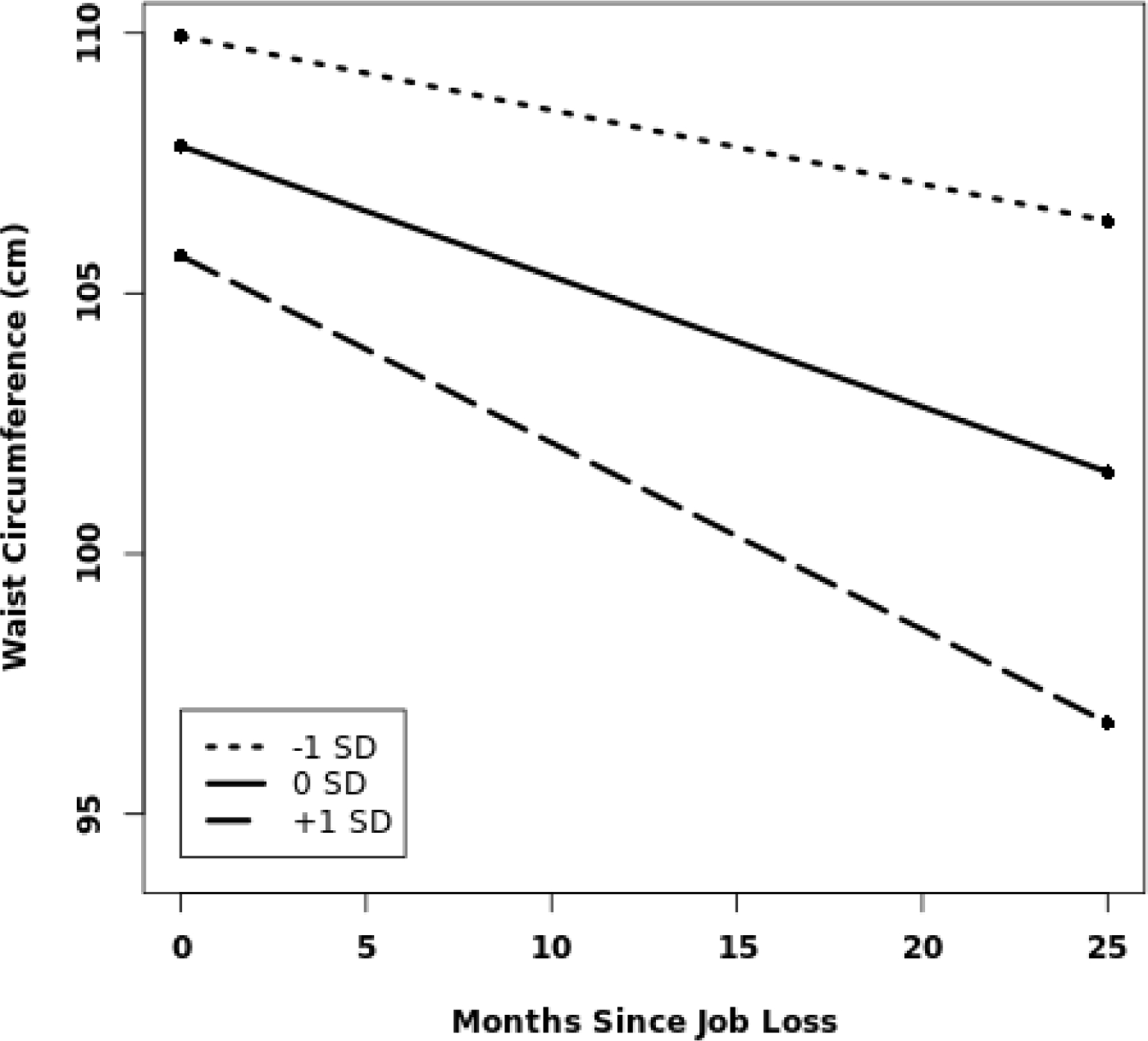
The probing of simple slope effects demonstrated that WC significantly reduces over time in individuals with high, initial levels of activities in their daily routine (+1 SD, dashed line); a similar trend (p = .07) was apparent among those with moderate, initial ALI scores (0 SD, solid line). Individuals with low, initial levels of activities in their daily routine (−1 SD, dotted line) experienced negligible changes in WC over time.
Daily Sleep Diary Variables
Results from the adjusted growth models for the DSD are reported in Table 3. A linear interaction effect indicated that higher sleep quality ratings were associated with greater decrease in WC over time when controlling for obesity trajectories (Model E). Simple slope analyses demonstrated negligible reductions in WC for low or moderate sleep quality ratings. A trend emerged for high levels of sleep quality (+1 SD; z = −1.89, p =.06). See Figure 4.
Table 3.
Results of multilevel models examining daily sleep diary indices and change in waist circumference (cm) since job loss (n = 191).
| Model E | Model F | Model G | Model H | |||||
|---|---|---|---|---|---|---|---|---|
|
| ||||||||
| Fixed Effects | Estimate | SE | Estimate | SE | Estimate | SE | Estimate | SE |
| Intercept | 107.38*** | 1.33 | 107.59*** | 1.33 | 107.44*** | 1.34 | 107.52*** | 1.34 |
| Not Obese (BMI < 30) | −12.16*** | 1.24 | −12.48*** | 1.24 | −12.17*** | 1.24 | −12.27*** | 1.24 |
| Months since job loss, rate | −0.19 | 0.13 | −0.22 | 0.14 | −0.20 | 0.14 | −0.21 | 0.14 |
| Months since job loss, curvaturee−3 | 6.15 | 5.91 | 7.69 | 5.90 | 7.42 | 5.91 | 7.45 | 5.91 |
| Not Obese x Mo since job loss, rate | 0.62*** | 0.17 | 0.69*** | 0.17 | 0.66*** | 0.17 | 0.67*** | 0.17 |
| Not Obese x Mo since job loss, curvaturee−3 | −20.23** | 7.62 | −23.54** | 7.57 | −23.09*** | 7.59 | −23.17** | 7.58 |
| Sleep Quality | −4.60* | 1.97 | ||||||
| Sleep Quality x Mo since job loss, rate | −.14* | 0.06 | ||||||
| Total sleep time, min | −0.01 | 0.02 | ||||||
| TST x Mo since job loss, ratee−3 | 0.85 | 0.54 | ||||||
| Wake time after sleep onset (WASO), min | 0.01 | 0.07 | ||||||
| WASO x Mo since job loss, ratee−3 | 2.08 | 1.97 | ||||||
| Sleep efficiency (SE), % | −14.17 | 17.68 | ||||||
| SE x Mo since job loss, rate | −0.10 | 0.53 | ||||||
| Variance Components | ||||||||
| Level 1: Within Person | 9.45*** | 0.73 | 9.48*** | 0.74 | 9.45*** | 0.73 | 9.45*** | 0.74 |
| Level 2: Intercept | 220.14*** | 28.01 | 225.12*** | 28.78 | 227.81*** | 29.14 | 225.95*** | 28.98 |
| Level 2: Rate of Change | 0.44** | 0.16 | 0.49** | 0.17 | 0.48** | 0.17 | 0.48** | 0.17 |
| Level 2: Curvaturee−3 | 0.74* | 0.31 | 0.78* | 0.32 | .78* | 0.32 | 0.77* | 0.32 |
| Level 2: Intercept x Rate of Change | 3.75* | 1.74 | 4.52* | 1.79 | 4.46* | 1.80 | 4.48* | 1.80 |
| Level 2: Intercept x Curvature | −0.22** | 0.08 | −0.25** | 0.08 | −0.25** | 0.08 | −0.25** | 0.08 |
| Level 2: Rate of Change x Curvaturee−3 | −15.54* | 6.81 | −16.92* | 7.13 | −16.74* | 7.10 | −16.70* | 7.10 |
| Goodness of Fit | ||||||||
| -2LL | 5218.84 | 5229.91 | 5231.13 | 5231.65 | ||||
| AIC | 5248.84 | 5259.91 | 5261.13 | 5261.65 | ||||
| BIC | 5319.41 | 5330.48 | 5331.7 | 5332.22 | ||||
p < .05
p < .01
p < .001.
Parameters displayed in scientific notation, value x 10-3.
Note. Values of sleep quality, total sleep time, wake time after sleep onset, and sleep efficiency are grand mean centered. BMI stands for Body Mass Index. Model E tests whether sleep quality at baseline moderates an increase in waist circumference (WC). Model F tests whether total sleep time at baseline moderates an increase in WC. Model G tests whether wake time after sleep onset at baseline moderates an increase in WC. Model H tests whether sleep efficiency at baseline moderates an increase in WC.
Figure 4. Changes in Waist Circumference over Time by Low (−1 SD), Moderate (Mean), and High (+1 SD) Daily Sleep Diary (DSD) Sleep Quality Ratings when Controlling for Obesity Effects (BMI > 30).

The probing of simple slope effects demonstrated negligible reductions in WC for low (−1 SD, dotted line) or moderate (0 SD, solid line) initial sleep quality ratings. An initial high level of sleep quality (+1 SD, dashed line) was associated (p = .06) with a reduction in WC over time.
No interactions or main effects were statistically significant for baseline DSD values of TST (Model F), WASO (Model G), or sleep efficiency (Model H).
Actigraphy
Sensitivity results from the adjusted growth models for the Actiwatch are reported in Table S1. A significant WASO x months since job loss interaction indicated that baseline levels of WASO moderated a reduction in WC over time. Simple slope analyses confirmed that WC reduced over time in individuals with low levels of WASO (−1 SD, z = −2.04, p = .04) only. The rate of change in WC for individuals with moderate and high WASO scores were not significantly different from zero. No interactions or main effects were statistically significant for baseline TST (Model G) or sleep efficiency (Model H). See Figure S1.
DISCUSSION
This study examined the relationship between social rhythms, daily sleep, and changes in waist circumference over 18-months in a sample of individuals who experienced involuntary job loss. We hypothesized that disrupted or lower social rhythms and disturbed/short sleep, occurring within 90 days of job loss, would independently predict vulnerability to WC gain. We also hypothesized that higher social rhythms and less disturbed sleep after job loss would predict resiliency to WC gain.
Results from this study supported the resiliency hypothesis but not the vulnerability hypothesis. Individuals with more activities in their social rhythm after job loss experienced a reduction in WC over the next 18 months, and individuals with more consistent social rhythms after job loss experienced a reduction in WC over the next 11 months. However, individuals with disrupted or lower social rhythms had no changes in WC over time. Each of these findings were robust in the presence of covariates, such as obesity and reemployment status.
Previous research demonstrated that a 1 cm increase in WC is associated with a 2% increase risk of a future cardiovascular event (29). At the stationary point of 11.7 months, each one-point increase on the SRM was associated with WC reduction of 1.28 cm, suggesting that increased consistency of social rhythms has the potential to mitigate obesity-related health risk immediately after job loss. Unfortunately, this effect did not sustain over time. Future research is necessary to investigate whether individuals with initial high levels of SRM post job-loss are able to maintain highly structured routines over time, as social rhythms are substantially influenced by disrupting life events (15). Job loss often leads to cascade of stressful life events known to disrupt routines, including financial, housing, and employment crises (30).
This study failed to find consistent relationships between WC and sleep indices. Neither sleep quantity nor sleep efficiency at baseline correlated with current or later WC. Higher sleep quality ratings after job loss were associated with decreased WC at baseline and over time, suggesting that the perception of quality sleep may be particularly important in conferring resiliency to WC gain. Sleep quality ratings frequently correlate with daily stress, negative emotions (31) and often do not correspond to insomnia (32) or objectively assessed sleep (33), suggesting that the sleep quality may overlap conceptually with stress perception.
The failure to find an effect for sleep duration is consistent with at least one prospective study (34) but inconsistent with others (35). One reason for these inconsistent results may be differences in sleep assessment methodology. Population-based studies assessing short sleep often rely on global questions about typical amounts of sleep received. In contrast to daily diaries, global sleep duration ratings are problematic in that they rely on a longer timeframe and are therefore subject to substantial recall bias (36). Global questions about sleep duration also correlate highly with emotional stress (37) and often do not correspond to objective or diary-assessed sleep duration (38).
Results were mixed by assessment modality for sleep continuity. On the DSD, WASO had no effect on changes in WC over time. On actigraphy, less WASO at baseline was associated with a greater reduction in WC. Actigraphic WASO does not correlate well with in-lab sleep assessment (22). Future research in similar, stressed populations is necessary to examine WASO, as well as its potential correspondence to subjective ratings of stress and sleep quality.
The current study is unique for the assessment of sleep and WC in a sample exposed to involuntary job loss, a severe life event. Previously, we reported high levels of insomnia disorder in this sample (39). Indeed, 31% of the sample (n = 60) reported requiring more than 30 minutes to fall asleep on average over the two weeks. Taken together, these data suggest that participant’s sleep disruption after job loss may not predict long term central adiposity and obesity, potentially due to the relatively high level of stress-related sleep disruption experienced.
Strengths of the study include the prospective design that allows for an assessment of temporal precedence of sleep/social rhythms, administration of gold standard daily diary assessments with corresponding actigraphy over a period of two weeks, and objective standardized assessment of obesity measures. In addition, the design employed strong control of involuntary job loss, a construct unique from unemployment, in that it represents a discrete, stressful life event that often cascades into a variety of long-term negative outcomes, including large declines in psychological and physical well-being (30). Furthermore, results of the study have high generalizability to the population of individuals who experienced job loss in the U.S. Southwest region; approximately one-third of the sample identified as Hispanic, consistent with the local census. A significant number of individuals in this study were excluded for undetected sleep apnea (40) limiting the generalizability of these findings to individuals without this sleep disorder.
One limitation of the study is that the primary outcome was measured using anthropometry rather than imaging that could have differentiated the deposition of subcutaneous versus visceral fat. Although WC may be less precise than other measures of obesity, the reliability of WC is supported by the observed relationships with laboratory-measured obesity status at baseline and over time in all models, as well as the use of standardized measurement protocol (20).
Recent work has highlighted the importance of sleep and circadian rhythm timing in dietary intake (41, 42). Sleep timing was not included in the current analysis, since sleep indices were chosen based on their theoretical association with stress response and hyperarousal (17). Future research is necessary examining sleep timing, obesity, and stress, more specifically. Despite the absence of data on sleep timing, this study contributes important information about several understudied sleep dimensions, such as WASO. It also highlights a need for more obesity studies examining social rhythms and sleep regularity.
Findings from this study have a number of public health implications. First, results suggest that the first 90 days after job loss could be a sensitive period for the implementation of active, consistent social rhythms that may protect people from later abdominal fat deposition after job loss. Data from this study support the employment of social rhythm interventions, which teach individuals how to develop and sustain new, active daily routines after major life events. Public health interventionists could partner with unemployment insurance agencies to provide health promotion interventions targeting this sensitive timeframe.
This study is one of the first to prospectively describe the relationships between social rhythms and waist circumference controlling for obesity status. Results suggest that daily routine activities, such as getting out of bed, going outside for the first time, coming home from work/school, play a key role in the development of abdominal adiposity. Abdominal adiposity is strongly and positively associated with all-cause mortality independent of BMI (1, 21, 43). Thus, findings from this study demonstrate that the frequency and regularity of daily, routine activities, activities beyond meals and exercise that are hypothesized to anchor a daily, circadian rhythm, are key factors in long-term health for individuals exposed to recent job loss.
Supplementary Material
Figure S1. Changes in Waist Circumference over Time by Low (−1 SD), Moderate (Mean), and High (+1 SD) Levels of Actigraphic Wake time After Sleep Onset (WASO) when Controlling for Obesity Effects (BMI > 30). The probing of simple slope effects demonstrated that WC significantly reduces over time in individuals with low, initial levels of WASO (−1 SD, dotted line, p = .04). Individuals with moderate (0 SD, solid line) and high, initial levels of WASO (+1 SD, dashed line) experienced negligible changes in WC over time.
Study Importance.
What is already known?
Job loss can initiate economic hardship, and economic hardship is associated with obesity. Job loss also confers a loss in time structure, or disruption in social rhythms.
Social rhythms are intricately linked to light exposure and the expression of other biological rhythms, such as sleep.
No studies have prospectively examined the relationship between social rhythms and waist circumference, a highly sensitive measure of metabolic health.
What are the new findings?
Individuals with lower and more inconsistent social rhythms after job loss had no changes in waist circumference trajectories over the next 18 months.
Individuals with higher and more consistent social rhythms after job loss had a reduction in waist circumference over time.
Sleep quality was the only primary sleep index to predict later changes in waist circumference.
Each of these findings was robust in the presence of covariates, such as obesity and reemployment status.
How might results change the direction of research?
The benefits of chronobiological health on central obesity extend beyond sleep. The frequency and consistency of routine activities that constitute the structure of an individual’s social rhythm confer resiliency to waist circumference gain.
Data from this study support the employment of social rhythm interventions for the prevention of central obesity. Social rhythm interventions teach individuals how to develop and sustain new, active daily routines after stressful life events.
ACKNOWLEDGMENTS
We gratefully acknowledge the assistance of Jesi Post, Efreim ‘Joe’ Morales, Mia Bottcher, Iva Skobic, Rebecca Wolf, Melissa Gates, Eleza Valente, Sady Dorris, Gabby Apolinar, and Caitlin Fung. We acknowledge the support of the University of Arizona Collaboratory for Metabolic Disease Prevention and Treatment.
Funding:
This work is supported by the US National Institute of Health, National Heart, Lung, and Blood Institute (NHLBI,1R01HL117995–01A1).
Footnotes
Disclosure: Drs. Haynes, Howe, Quan, and Glickenstein report grants from National Institutes of Health (NIH), during the conduct of the study. Dr. Glickenstein also reports grants from the National Science Foundation, during the conduct of the study. Dr. Quan reports personal fees and other from Whispersom, grants from Bryte Foundation, grants from DR Capital, other from Jazz Pharmaceuticals, from Teledoc, outside the submitted work. Dr. Rojo-Wissar reports grants from Eunice Kennedy Shriver National Institute of Child Health & Human Development’s Training Program in Childhood Stress, Trauma, & Resilience (T32HD101392; PIs: Stroud, Laura & Tyrka, Audrey) during the conduct of the study. Ms. Mayer reports personal fees from Arizona Baptist Children’s Services, outside the submitted work. Ms. Ortega (nee Gengler) reports personal fees from Cigna, outside the submitted work. The other authors declared no conflict of interest.
REFERENCES
- 1.Ross R, Neeland IJ, Yamashita S, Shai I, Seidell J, Magni P, et al. Waist circumference as a vital sign in clinical practice: a Consensus Statement from the IAS and ICCR Working Group on Visceral Obesity. Nature Reviews Endocrinology 2020;16: 177–189. [DOI] [PMC free article] [PubMed] [Google Scholar]
- 2.Dalvand S, Koohpayehzadeh J, Karimlou M, Asgari F, Rafei A, Seifi B, et al. Assessing Factors Related to Waist Circumference and Obesity: Application of a Latent Variable Model. Journal of Environmental and Public Health 2015;2015: 1–9. [DOI] [PMC free article] [PubMed] [Google Scholar]
- 3.Gepner Y, Shelef I, Schwarzfuchs D, Zelicha H, Tene L, Yaskolka Meir A, et al. Effect of Distinct Lifestyle Interventions on Mobilization of Fat Storage Pools: CENTRAL Magnetic Resonance Imaging Randomized Controlled Trial. Circulation 2018;137: 1143–1157. [DOI] [PubMed] [Google Scholar]
- 4.Wewege M, van den Berg R, Ward RE, Keech A. The effects of high-intensity interval training vs. moderate-intensity continuous training on body composition in overweight and obese adults: a systematic review and meta-analysis. Obesity reviews : an official journal of the International Association for the Study of Obesity 2017;18: 635–646. [DOI] [PubMed] [Google Scholar]
- 5.Fiese BH, Tomcho TJ, Douglas M, Josephs K, Poltrock S, Baker T. A review of 50 years of research on naturally occurring family routines and rituals: cause for celebration? J Fam Psychol 2003;16: 381–390. [DOI] [PubMed] [Google Scholar]
- 6.Scheer FA, Shea SA. Basics of sleep guide Sleep Research Society: Westchester, IL, 2009. [Google Scholar]
- 7.Sakurai M, Yoshita K, Nakamura K, Miura K, Takamura T, Nagasawa SY, et al. Skipping breakfast and 5-year changes in body mass index and waist circumference in Japanese men and women. Obesity Science & Practice 2017;3: 162–170. [DOI] [PMC free article] [PubMed] [Google Scholar]
- 8.Haynes PL, Ancoli‐Israel S, McQuaid J. Illuminating the Impact of Habitual Behaviors in Depression. Chronobiology International 2005;22: 279–297. [DOI] [PubMed] [Google Scholar]
- 9.Haynes PL, Apolinar GR, Mayer C, Kobayashi U, Silva GE, Glickenstein DA, et al. Inconsistent social rhythms are associated with abdominal adiposity after involuntary job loss: An observational study. Obesity Science & Practice 2021. [DOI] [PMC free article] [PubMed] [Google Scholar]
- 10.Moreno JP, Crowley SJ, Alfano CA, Hannay KM, Thompson D, Baranowski T. Potential circadian and circannual rhythm contributions to the obesity epidemic in elementary school age children. International Journal of Behavioral Nutrition and Physical Activity 2019;16. [DOI] [PMC free article] [PubMed] [Google Scholar]
- 11.Bjorntorp P. Do stress reactions cause abdominal obesity and comorbidities? Obesity Reviews 2001;2: 73–86. [DOI] [PubMed] [Google Scholar]
- 12.Monk TH, Begley AE, Billy BD, Fletcher ME, Germain A, Mazumdar S, et al. Sleep and Circadian Rhythms in Spousally Bereaved Seniors. Chronobiology International 2008;25: 83–98. [DOI] [PMC free article] [PubMed] [Google Scholar]
- 13.Monk TH, Essex MJ, Smider NA, Klein MH, Kupfer DJ. The Impact of the Birth of a Baby on the Time Structure and Social Mixture of a Couple’s Daily Life and Its Consequences for Well-Being1. Journal of Applied Social Psychology 1996;26: 1237–1258. [Google Scholar]
- 14.Li Y, Gu S, Wang Z, Li H, Xu X, Zhu H, et al. Relationship Between Stressful Life Events and Sleep Quality: Rumination as a Mediator and Resilience as a Moderator. Frontiers in Psychiatry 2019;10. [DOI] [PMC free article] [PubMed] [Google Scholar]
- 15.Haynes PL, McQuaid JR, Ancoli-Israel S, Martin JL. Disrupting life events and the sleep-wake cycle in depression. Psychological Medicine 2006;36: 1363–1373. [DOI] [PubMed] [Google Scholar]
- 16.Nigro CA, Serrano F, Aimaretti S, González S, Codinardo C, Rhodius E. Utility of ApneaLink for the diagnosis of sleep apnea-hypopnea syndrome. Medicina (B Aires) 2010;70: 53–59. [PubMed] [Google Scholar]
- 17.Haynes PL, Silva GE, Howe GW, Thomson CA, Butler EA, Quan SF, et al. Longitudinal assessment of daily activity patterns on weight change after involuntary job loss: the ADAPT study protocol. BMC public health 2017;17: 1–793. [DOI] [PMC free article] [PubMed] [Google Scholar]
- 18.Buysse DJ, Ancoli-Lsrael S, Edinger JD, Lichstein KL, Morin CM. Recommendations for a standard research assessment of insomnia. Sleep (New York, NY) 2006;29: 1155–1173. [DOI] [PubMed] [Google Scholar]
- 19.Monk TH, Kupfer DJ, Frank E, Ritenour AM. The social rhythm metric (SRM): Measuring daily social rhythms over 12 weeks. Psychiatry research 1991;36: 195–207. [DOI] [PubMed] [Google Scholar]
- 20.Bosy-Westphal A, Booke C-A, Blocker T, Kossel E, Goele K, Later W, et al. Measurement Site for Waist Circumference Affects Its Accuracy As an Index of Visceral and Abdominal Subcutaneous Fat in a Caucasian Population. The Journal of nutrition 2010;140: 954–961. [DOI] [PubMed] [Google Scholar]
- 21.Cuilin Z, Rexrode KM, Van Dam RM, Li TY, Hu FB. Abdominal Obesity and the Risk of All-Cause, Cardiovascular, and Cancer Mortality Sixteen Years of Follow-Up in US Women. Circulation (New York, NY) 2008;117: 1658–1667. [DOI] [PubMed] [Google Scholar]
- 22.Smith MT, McCrae CS, Cheung J, Martin JL, Harrod CG, Heald JL, et al. Use of Actigraphy for the Evaluation of Sleep Disorders and Circadian Rhythm Sleep-Wake Disorders: An American Academy of Sleep Medicine Systematic Review, Meta-Analysis, and GRADE Assessment. J Clin Sleep Med 2018;14: 1209–1230. [DOI] [PMC free article] [PubMed] [Google Scholar]
- 23.Hayes AF. Mediation, moderation, and conditional process analysis. Introduction to Mediation, Moderation, and Conditional Process Analysis: A Regression-Based Approach edn New York: Guilford Publications; 2013: 1–20. [Google Scholar]
- 24.Finucane MM, Stevens GA, Cowan MJ, Danaei G, Lin JK, Paciorek CJ, et al. National, regional, and global trends in body-mass index since 1980: systematic analysis of health examination surveys and epidemiological studies with 960 country-years and 9· 1 million participants. The lancet 2011;377: 557–567. [DOI] [PMC free article] [PubMed] [Google Scholar]
- 25.Stevens J, Katz EG, Huxley RR. Associations between gender, age and waist circumference. European Journal of Clinical Nutrition 2010;64: 6–15. [DOI] [PMC free article] [PubMed] [Google Scholar]
- 26.Camhi SM, Bray GA, Bouchard C, Greenway FL, Johnson WD, Newton RL, et al. The Relationship of Waist Circumference and BMI to Visceral, Subcutaneous, and Total Body Fat: Sex and Race Differences. Obesity 2011;19: 402–408. [DOI] [PMC free article] [PubMed] [Google Scholar]
- 27.Newton S, Braithwaite D, Akinyemiju TF. Socio-economic status over the life course and obesity: Systematic review and meta-analysis. PLOS ONE 2017;12: e0177151. [DOI] [PMC free article] [PubMed] [Google Scholar]
- 28.Preacher KJ, Curran PJ, Bauer DJ. Computational Tools for Probing Interactions in Multiple Linear Regression, Multilevel Modeling, and Latent Curve Analysis. Journal of Educational and Behavioral Statistics 2006;31: 437–448. [Google Scholar]
- 29.de Koning L, Merchant AT, Pogue J, Anand SS. Waist circumference and waist-to-hip ratio as predictors of cardiovascular events: meta-regression analysis of prospective studies. European Heart Journal 2007;28: 850–856. [DOI] [PubMed] [Google Scholar]
- 30.Brand JE. The Far-Reaching Impact of Job Loss and Unemployment. Annu Rev Sociol 2015;41: 359–375. [DOI] [PMC free article] [PubMed] [Google Scholar]
- 31.Lischetzke T, Schemer L, Glombiewski JA, In-Albon T, Karbach J, Könen T. Negative Emotion Differentiation Attenuates the Within-Person Indirect Effect of Daily Stress on Nightly Sleep Quality Through Calmness. Frontiers in psychology 2021;12: 684117. [DOI] [PMC free article] [PubMed] [Google Scholar]
- 32.Harvey AG, Stinson K, Whitaker KL, Moskovitz D, Virk H. The subjective meaning of sleep quality: a comparison of individuals with and without insomnia. Sleep 2008;31: 383–393. [DOI] [PMC free article] [PubMed] [Google Scholar]
- 33.Kaplan KA, Hirshman J, Hernandez B, Stefanick ML, Hoffman AR, Redline S, et al. When a gold standard isn’t so golden: Lack of prediction of subjective sleep quality from sleep polysomnography. Biol Psychol 2017;123: 37–46. [DOI] [PMC free article] [PubMed] [Google Scholar]
- 34.Stranges S, Cappuccio FP, Kandala N-B, Miller MA, Taggart FM, Kumari M, et al. Cross-sectional versus prospective associations of sleep duration with changes in relative weight and body fat distribution 2008;167: 321–329. [DOI] [PMC free article] [PubMed] [Google Scholar]
- 35.Bacaro V, Ballesio A, Cerolini S, Vacca M, Poggiogalle E, Donini LM, et al. Sleep duration and obesity in adulthood: An updated systematic review and meta-analysis. Obesity Research & Clinical Practice 2020;14: 301–309. [DOI] [PubMed] [Google Scholar]
- 36.Stull DE, Leidy NK, Parasuraman B, Chassany O. Optimal recall periods for patient-reported outcomes: challenges and potential solutions. Current medical research and opinion 2009;25: 929–942. [DOI] [PubMed] [Google Scholar]
- 37.Vgontzas AN, Pejovic S, Calhoun S, Bixler EO. Obesity and self-reported short sleep duration: a marker of sleep complaints and chronic psychosocial stress. Sleep Medicine Clinics 2009;4: 65–75. [Google Scholar]
- 38.Lauderdale DS, Knutson KL, Rathouz PJ, Yan LL, Hulley SB, Liu K. Cross-sectional and longitudinal associations between objectively measured sleep duration and body mass index: the CARDIA Sleep Study. Am J Epidemiol 2009;170: 805–813. [DOI] [PMC free article] [PubMed] [Google Scholar]
- 39.Haynes PL, Wolf RL, Howe GW, Kelly MR. Unemployed Individuals Reporting Hindrance Work Stress at Previous Job Have Increased Likelihood of Insomnia Disorder. International journal of behavioral medicine 2021;28: 39–47. [DOI] [PMC free article] [PubMed] [Google Scholar]
- 40.Silva GE, Quan SF, McMorrow T, Bautista R, Bell ML, Haynes PL. Association between obstructive sleep apnea and multiple involuntary job loss history among recently unemployed adults. Sleep Health 2021;7: 118–122. [DOI] [PMC free article] [PubMed] [Google Scholar]
- 41.Baron KG, Reid KJ, Kern AS, Zee PC. Role of sleep timing in caloric intake and BMI. Obesity (Silver Spring, Md) 2011;19: 1374–1381. [DOI] [PubMed] [Google Scholar]
- 42.Baron KG, Reid KJ, Kim T, Van Horn L, Attarian H, Wolfe L, et al. Circadian timing and alignment in healthy adults: associations with BMI, body fat, caloric intake and physical activity. International journal of obesity (2005) 2017;41: 203–209. [DOI] [PMC free article] [PubMed] [Google Scholar]
- 43.Jacobs EJ, Newton CC, Wang Y, Patel AV, McCullough ML, Campbell PT, et al. Waist circumference and all-cause mortality in a large US cohort. Archives of internal medicine 2010;170: 1293–1301. [DOI] [PubMed] [Google Scholar]
Associated Data
This section collects any data citations, data availability statements, or supplementary materials included in this article.
Supplementary Materials
Figure S1. Changes in Waist Circumference over Time by Low (−1 SD), Moderate (Mean), and High (+1 SD) Levels of Actigraphic Wake time After Sleep Onset (WASO) when Controlling for Obesity Effects (BMI > 30). The probing of simple slope effects demonstrated that WC significantly reduces over time in individuals with low, initial levels of WASO (−1 SD, dotted line, p = .04). Individuals with moderate (0 SD, solid line) and high, initial levels of WASO (+1 SD, dashed line) experienced negligible changes in WC over time.