



Abstract
Mental imagery is a powerful capability that engages similar neurophysiological processes that underlie real sensory and motor experiences. Previous studies show that motor cortical excitability can increase during mental imagery of actions. In this study, we focused on possible inhibitory effects of mental imagery on motor functions. We assessed whether imagined arm paralysis modulates motor cortical excitability in healthy participants, as measured by motor evoked potentials (MEPs) of the hand induced by near‐threshold transcranial magnetic stimulation (TMS) over the primary motor cortex hand area. We found lower MEP amplitudes during imagined arm paralysis when compared to imagined leg paralysis or baseline stimulation without paralysis imagery. These results show that purely imagined bodily constraints can selectively inhibit basic motor corticospinal functions. The results are discussed in the context of motoric embodiment/disembodiment.
Keywords: cortical excitability, mental imagery, MEP amplitude, motor evoked potential (MEP), paralysis, TMS
Short abstract
In this study we investigated whether imagining a specific motor impairment has a physiological effect on motor corticospinal function in healthy participants. We found that imagined hand (but not leg) paralysis reduced TMS induced MEPs of the hand muscle. While previous research mainly focused on excitatory effects of mental imagery, our results point to possible inhibitory effects on motor functions. The results may have relevance in the context of (dis)embodiment research and physiological rehabilitation.
1. INTRODUCTION
Neuroimaging research on mental imagery has shown that visual and motor mental imagery systematically activate sensory and motor brain areas, respectively (e.g., Decety, 1996; Jeannerod, 1995; Kosslyn et al., 1993), suggesting that mental imagery can have neurophysiological consequence similar to those during real sensory and motor experiences. While the exact mechanisms underlying mental imagery are still open to debate (Foglia & O'Regan, 2016; Pearson & Kosslyn, 2015), mental imagery has widely been used as a tool to improve cognitive and motor skills in various disciplines (e.g., Schuster et al., 2011). For example, motor imagery is used to improve athletes' performances (e.g., Guillot et al., 2012; Hall et al., 1990), and also to support rehabilitation in patients suffering from motor deficits (e.g., Grabherr et al., 2015; Jackson et al., 2001; Stevens & Stoykov, 2003). Furthermore, some studies have reported an increase in muscular strength through mental imagery training (e.g., Lebon et al., 2010; Ranganathan et al., 2004; Yue & Cole, 1992). Taken together, these studies demonstrate powerful modulations of physiological processes by mental imagery.
The research described so far has focused on excitatory effects of mental imagery on the motor system. However, another line of research has established the reverse effect: motor dysfunctions can inhibit mental imagery. For example, patients suffering from motor constraints show selective impairments in visual processing and mental rotation of body stimuli when the stimulus corresponds to their affected body part (Amick et al., 2006; Dominey et al., 1995; Fiorio et al., 2007; Nico et al., 2004; Pernigo et al., 2012). Similar results have also been reported in healthy participants when motor constraints were experimentally induced, for example by short‐term limb immobilization (Bläsing et al., 2013; Meugnot et al., 2014; Meugnot et al., 2016).
In a similar vein, we previously investigated whether motor imagery can be hampered by a purely imagined motor constraint in healthy participants (Hartmann et al., 2011). Participants performed a mental rotation task of whole‐body stimuli while imagining that their legs were paralyzed. The task involved a leg laterality judgment (e.g., “Is the left or right leg bent?”), which assumingly leads to a covert imitation of the posture of the stimulus (i.e., the “motoric embodiment” process; see Amorim et al., 2006; Grush, 2004; Parsons, 1994). During imagined paralysis, participants required more time to judge the laterality of the legs (Hartmann et al., 2011). The effect was selective for imitable (vs. non‐imitable) postures, suggesting that imagined paralysis selectively impairs motor imagery processes of the “paralyzed” body parts. A possible explanation for this result is that paralysis imagery inhibits the neural activity in the motor areas involved in the motoric embodiment process. Given that our previous study was a behavioral investigation, it was not possible to draw firm conclusions about the underlying neural mechanisms involved in paralysis imagery. In the current study, we wanted to investigate these results further by assessing whether imagined paralysis influences the cortical excitability of motor neurons.
Previous studies have shown that motor cortical excitability can be increased during action observation and mental imagery of actions (Cavallo et al., 2011; Fadiga et al., 1995; Fadiga et al., 1998; Kasai et al., 1997; Maeda et al., 2002; Pelgrims et al., 2005; Stinear et al., 2006; Urgesi et al., 2006; Urgesi et al., 2010; Vargas et al., 2004). A reduction of cortical excitability has also been reported, although much less frequently, for example, in the presence of pain (e.g., Avenanti et al., 2005; Parker et al., 2016) or when experiencing illusory loss of body parts (Kilteni et al., 2016). Relatedly, it has recently been shown that imagined paralysis of the leg influences the processing of somatosensory evoked potentials by tibial nerve stimulation (Palluel et al., 2020). However, to our knowledge, no study has yet investigated whether cortical excitability of motor neurons is reduced by mentally imagining a specific impairment of motor abilities. In order to test this hypothesis, we measured the amplitude of motor evoked potentials (MEPs) from participants' hands elicited by near‐threshold transcranial magnetic stimulation (TMS) over the primary motor cortex (M1) hand area. Near‐threshold TMS was chosen in order to minimize hand twitches, which might disrupt the mental imagery process and the feeling of paralysis (see also Pelgrims et al., 2011). This approach allowed us to analyze not only the size of MEP amplitudes, but also the number of elicited MEPs (cf. Kaelin‐Lang et al., 2010). Izumi et al. (1995) found an increased MEP response rate when participants imagined movements, suggesting that both the MEP amplitude and the number of MEPs are malleable via motor imagery (see also Kiers et al., 1997). Finally, in order to assess the specificity of the effect of mental imagery, we also measured hand MEPs while participants imagined leg paralysis. Specifically, this allows to test whether hand MEPs are selectively influenced by imagined paralysis of the hand. Alternatively, it is possible that imagined paralysis exerts a rather unspecific effect that is not tied to any body part.
2. MATERIAL AND METHOD
2.1. Participants
Twelve right‐handed undergraduate students from the University of Bern (mean age = 22.2, 10 female) participated in this study in return for course credit. The study was approved by the Ethics Committee of the Canton of Bern, and all participants gave informed consent prior to the study. Participants had no history of epilepsy, brain surgery, mental and motor problems, and were not taking medication.
2.2. Apparatus and procedure
The general procedure of the study is summarized in Table 1. Each step is described in detail in the following sections.
TABLE 1.
General procedure of the study
| Step | Description |
|---|---|
| 1. | Attachment of FDI electrode |
| 2. | Determination of stimulation position and resting motor threshold |
| 3. | Paralysis induction phase:
|
| 4. | Preparation of recording session and reinforcement of imagery instruction |
| 5. | TMS application (60 pulses) |
| 6. | Filling out of arm‐ and leg‐related questionnaires |
Note: Step 3 to 6 was repeated for each condition (arm paralysis, leg paralysis, baseline). For the baseline condition, Step 3 was replaced by a break of 5 min. The order of the three conditions was counterbalanced across participants.
2.2.1. Step 1 and 2: Electromyography, determination of stimulation position, and motor threshold
Hand MEPs were measured using electromyography (EMG) with a sampling rate of 5 kHz. Silver‐silver chloride electrodes were attached to the first dorsal interosseous (FDI) of the right hand over the muscle belly for the active electrode and over the associated joint for the reference electrode. For the determination of the resting motor threshold, single, monophasic TMS pulses were delivered to the left motor cortex through a custom‐made, figure‐of‐8‐shaped coil (diameter 5 cm, maximal field strength 2.89 T; see Z'Graggen et al., 2009) connected to a Magstim 200 device (Magstim, Whitland, UK). The TMS coil was placed over the left motor cortex tangentially to the scalp with the intersection of both wings at 45° angle with the midline, to optimally activate the corticospinal system trans‐synaptically (Brasil‐Neto et al., 1992). The optimal position was found by continuously shifting the coil within the motor hand area in steps of 0.5 cm and recording the corresponding amplitude of the FDI MEPs (see Conforto et al., 2004). The position eliciting the highest amplitudes was set as the optimal position (“hot spot”). The position was marked with a skin‐friendly marker on the participants' scalp, and motor threshold was determined from this position. Motor threshold was defined as the lowest stimulus intensity that triggers 5 of 10 MEPs with a minimal amplitude of 50 μV (Rossini et al., 2015). The EMG signal was pre‐amplified and band‐pass filtered (1 Hz to 1 kHz) with a Neurodata Amplifier System that was connected to an IPS230 Power System (Grass‐Telefactor, Braintree, MA, USA). Input was fed into a computerized data acquisition system built with the LabVIEW graphical programming language (Kaelin‐Lang & Cohen, 2000).
2.2.2. Steps 3 to 6: Paralysis imagery and TMS session
In the next step, arm and leg paralysis imagery was induced by means of guided mental imagery and an immersion task. In the guided mental imagery phase, participants were instructed to imagine that either their arm or leg (depending on the condition) was paralyzed. The instruction was as follows: “Imagine that your arm/leg is paralyzed. Imagine how it would feel if you could not move your arm/leg even if you wanted to. Try to imagine that your arm/leg feels weak, heavy and useless. Try to imagine how your everyday life would be changed if you could no longer move your arm/leg.”. Each of these instruction sentences were followed by a pause of about 30 s in which participants focused on each of those instructions. This phase lasted approximately 2–3 min. Next, the imagination of paralysis was supported by an additional immersion task. In case of the imagined arm paralysis condition, participants were asked to write down their name on a sheet of paper by moving a pen that they were holding in their mouth (i.e., without using their hands). In case of the imagined leg paralysis condition, participants were placed in a wheelchair and asked to wheel around without moving their legs for 2 min (for a similar procedure see Hartmann et al., 2011; Palluel et al., 2020). These additional tasks were used to enhance the vividness of imagined paralysis and strengthen the adopted constrained body representation. Upon completion of the immersion tasks, the recording session was prepared. This included starting the data acquisition within the LabVIEW interface, or the re‐connection of the electrode plugs to the EMG recording device (they required unplugging for the wheelchair immersion task). Since this process lasted several minutes (1–2 min) in which participants could potentially lose their focus on paralysis imagery, the first three sentences of the paralysis imagery instructions were repeated, and participants were asked to say “ok” when they feel that they comply to the imagery instructions. Following this, the TMS coil was placed above the “hot spot” and the TMS application started. Stimulation intensity was set to 95% of individual motor threshold (cf. Kaelin‐Lang et al., 2010). Sixty single TMS pulses were applied with a random inter‐pulse interval of 6–10s. We considered 60 pulses as an optimal compromise between having as much data as possible for the statistical analysis and keeping recording time as short as possible in order to avoid fluctuation and variability of corticomotoneuronal excitability due to change in arousal and vigilance (see also Kaelin‐Lang et al., 2005). We were able to demonstrate in previous work that it is possible to obtain an accurate statistical distribution with n = 40 pulses at threshold intensities (Kaelin‐Lang et al., 2010).
Importantly, we took care that the experimenter who applied TMS (A. K.‐L. or F. W. M) was blind to the paralysis imagery condition. Specifically, the experimenter who applied TMS left the room after determining the motor threshold and re‐entered the room only after the paralysis induction phase was completed, the recording session was prepared, and the mental imagery instructions were re‐enforced (all by the second experimenter). For the baseline condition, the paralysis induction phase (Step 3) was replaced with a break of 5 min so that the timing was comparable across the three conditions.
Each participant underwent three TMS sessions preceded by the specific task instructions for imagined arm and leg paralysis, or the 5‐min break without paralysis imagery for the baseline condition. Hand posture of the right hand was identical in all three conditions, and participants were instructed not to move their arms and legs during the recording sessions. The order of the three sessions was fully counterbalanced across participants, and the sessions were separated by breaks of 10 min.
After each recording session, participants filled out a self‐report questionnaire (Step 6) regarding seven arm‐ and leg‐related items, such as: “During the experiment, my legs/arm felt paralyzed,”, “During the experiment, I had the impression that I could not use my legs the way I'm usually used to,”, or “During the experiment, my arm/leg felt strange, as if they did not belong to my body.” The full item list can be found in Hartmann et al. (2011). Each item was accompanied by a 7‐point Likert scale (1 = “strongly disagree”; 7 = “strongly agree”).
2.3. Definition of MEPs and data analysis
2.3.1. Definition of MEPs
We have previously shown that using subthreshold stimulation demonstrates the stochastic nature of MEP generation with usually easily identifiable MEP signals even at low amplitude (“all or nothing pattern”; Kaelin‐Lang et al., 2010). The peak‐to‐peak amplitude was automatically calculated by custom LabVIEW software and was defined as max–min volt change in the critical time window between 20 and 40 ms after TMS pulse. The software also automatically computes the peak amplitude during the pre‐trigger‐time period before the TMS pulse, reflecting background noise (see Kaelin‐Lang & Cohen, 2000 for more details). Trials were classified as MEP trials when the peak‐to‐peak amplitude during the critical time interval (20–40 ms after TMS pulse) was at least three times higher than that of the background noise. There is, however, still the need to check visually all trials in order to exclude any artifacts (<3% of trials) since there is no general consent about how to automatically detect an MEP pattern. This was done by an investigator blinded to the experimental condition.
2.3.2. Preliminary analysis: Reliability and order effects
Before the effect of imagined paralysis on the amplitude and proportion of MEPs was assessed, some preliminary analyses were conducted. In a first step, the reliability of MEPs within each recording session was assessed by means of the intraclass correlation coefficient (ICC) for the amplitude and proportion of MEPs. Regarding the amplitude of MEPs, we followed the procedure established in previous MEP studies (Carroll et al., 2001; Christie et al., 2007; Hashemirad et al., 2017; Kamen, 2004). Specifically, previous studies suggest that using a mean of five MEP responses result in good reliability of amplitudes (Kamen, 2004). We therefore computed for each participant and recording session the mean MEP amplitude of the first and last five MEPs (Christie et al., 2007). In case there were less than five MEPs in the first or last half of a recording session, the mean was based on the available values in each session half. Similarly, the proportion of MEPs was computed for the first and second half of a recording session for each participant. ICC values were obtained by computing an analysis of variance (ANOVA) for each condition with the repeated measurement variable session half (first vs. second). ICCs are calculated by dividing the variance explained by the participants by the total variance, thus reflecting the proportion of variance explained by participants (Haggard, 1958). Consequently, low ICC values would indicate a high variability of MEP amplitude or proportion within a recording session.
In a second step, we explored whether there were some order effects across the three recording sessions. To this end, we computed another ANOVA on the mean amplitudes and proportion of MEPs (obtained from the entire recording session) with the repeated measurement variable order (1, 2, 3).
MEP amplitudes showed the typical logistic distribution (e.g., Borgomaneri et al., 2015; Coxon et al., 2006; Kilteni et al., 2016; Wassermann, 2002). Therefore, for these preliminary analyses, the means of log‐transformed raw data were used for the ANOVAs, and back‐transformed for descriptive reports.
2.3.3. Main analysis: Effect of imagined paralysis on amplitude and proportion of MEPs
In this study, an effect of imagined paralysis on both the MEP amplitudes and the MEP probability was analyzed. Using a traditional data analysis approach would require aggregation of amplitude values per participant and condition for all MEP trials, and then compute analysis of variance for the mean amplitudes. However, due to the near‐threshold stimulation, the number of MEP trials per participant and condition was limited, and averaging would potentially lead to loss of information. We therefore decided to analyze non‐aggregated data for the main analysis by means of a Bayesian hierarchical regression approach. Condition (imagined arm paralysis, imagined leg paralysis, baseline) was used as a fixed effect predictor. In order to account for the repeated measurement design and for the individual differences in the effect of mental imagery on MEPs, participant identity was used as a random intercept effect, and a random slope of condition by participant was added (Barr et al., 2013). Due to the logistic distribution of MEP amplitudes (e.g., Borgomaneri et al., 2015; Coxon et al., 2006; Kilteni et al., 2016; Wassermann, 2002), we used a log‐normal function for the analysis of raw MEP amplitudes. For the analysis of MEP probability, a Bernoulli distribution with a logit link function was used, which is appropriate for binominal responses for non‐aggregated data. Analyses were performed using the brms‐package in R (Bürkner, 2017) and weakly informative priors were used, as suggested by brms default settings (Bürkner, 2017).
A contrast coding scheme was used so that the effects of interest (arm paralysis imagery vs. baseline, arm paralysis imagery vs. leg paralysis imagery, and leg paralysis imagery vs. baseline) are directly reflected in the estimates of the coding variables for the fixed effect of condition. Specifically, the models were run with the baseline as reference category [0,0], so that the estimate of the intercept reflects the baseline, and more importantly, the estimate of the first coding variable [1,0; b_arm] reflects the difference between arm paralysis imagery and the baseline (arm vs. baseline in Figure 1), and analogously, the estimate of the second coding variable [0,1; b_leg] reflects the difference between leg paralysis imagery and the baseline (leg vs. baseline in Figure 1). In order to also obtain an estimate for the difference between arm and leg paralysis imagery, the models were re‐run with arm paralysis imagery as reference group, so that the estimate of the corresponding coding variable now reflects the difference between arm and leg paralysis imagery (arm vs. leg in Figure 1). In Bayesian statistics, a meaningful effect is indicated when zero is not included in the 95% credible interval (i.e., Bayesian confidence interval) of the estimated posterior distribution of the relevant parameters (arm vs. baseline, leg vs. baseline, arm vs. leg). Each model was run with 10,000 iterations and 5000 warmup‐samples. Model diagnostics (posterior predictive checks, pareto‐k diagnostics) confirmed good model fit and indicated that there were no misspecifications or overly influential data points (outliers) that distorted the model fits.
FIGURE 1.
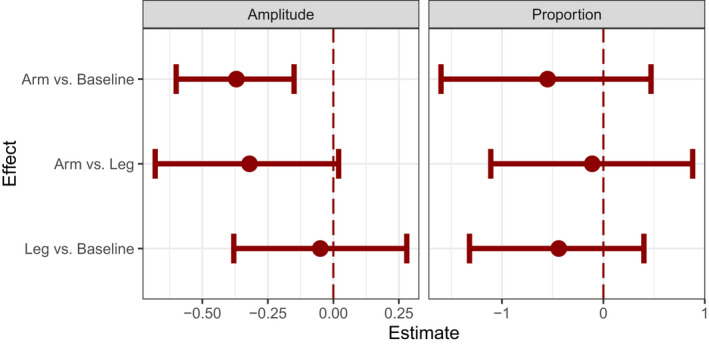
Estimates of the Bayesian hierarchical regression model parameters that represent the effects of interest (arm paralysis imagery vs. baseline, arm paralysis imagery vs. leg paralysis imagery, and leg paralysis imagery vs. baseline). For MEP amplitudes, the estimate of the 95% credibility interval for arm paralysis imagery versus baseline did not include zero, showing that MEP amplitudes were substantially lower during arm paralysis imagery when compared to the baseline. Estimates represent log values for differences in MEP amplitudes, and logit values for differences in probability of MEPs
3. RESULTS
The mean resting motor threshold was 41.8 (SD = 7), and the mean stimulation intensity was 40.6 (SD = 7; 95% of resting motor threshold; see Table 2 for individual values). In one recording session (participant number 4, leg paralysis imagery), the experiment had to be stopped after 34 TMS pulses for technical reasons. Given that a reasonable number of MEP trials were recorded in this session (24 MEP trials; see Table 2), the data from this session were included in the analyses. In all conditions, at least five MEP trials have been detected (see Table 2), which has been shown to result in good to high reliability of amplitude measure in healthy participants (Kamen, 2004).
TABLE 2.
The number of MEP trials for each participant and condition
| Participant | Stimulation intensity | Number of MEP trials | ||
|---|---|---|---|---|
| Baseline | Arm | Leg | ||
| 1 | 33 | 50 | 6 | 23 |
| 2 | 38 | 9 | 11 | 5 |
| 3 | 37 | 9 | 11 | 6 |
| 4 | 33 | 12 | 22 | 24 |
| 5 | 36 | 38 | 20 | 34 |
| 6 | 50 | 32 | 12 | 35 |
| 7 | 33 | 48 | 21 | 27 |
| 8 | 38 | 23 | 17 | 15 |
| 9 | 40 | 25 | 27 | 7 |
| 10 | 55 | 31 | 11 | 22 |
| 11 | 41 | 18 | 46 | 9 |
| 12 | 38 | 12 | 18 | 39 |
3.1. Questionnaire
Mean arm and leg scores were computed for each participant and condition based on the seven items from the questionnaire, and the mean scores of leg and arm were compared for each condition by means of paired t tests. In the arm paralysis imagery condition, all participants had higher arm (M = 5.3, SD = 0.8) than leg (M = 2.6, SD = 1.1) scores, t(11) = 6.86, p < .001. Conversely, in the leg paralysis imagery condition, all participants had higher leg (M = 5.2, SD = 0.9) than arm (M = 2.9, SD = 1.2) scores, t(11) = 7.32, p < .001, showing that participants were following imagery instructions. Not surprisingly, arm (M = 2.3, SD = 0.9) and leg (M = 2.12, SD = 0.9) scores did not differ in the baseline condition, t(11) = 1.41, p = .187.
3.2. MEP analysis
3.2.1. Preliminary analysis: Reliability and order effects
Regarding MEP amplitudes, the ICC was 0.55 during arm paralysis imagery, 0.76 during leg paralysis imagery, and 0.54 during the baseline condition. These values are comparable to that reported in previous studies (e.g., FDI amplitude ICC values ranged from 0.50 to 0.53 in Carroll et al., 2001; and from 0.60 to 0.81 in Kamen, 2004). Regarding the proportion of MEPs, the ICC was 0.69 during arm paralysis imagery, 0.51 during leg paralysis imagery, and 0.84 during the baseline condition.
The ANOVA revealed that the repeated measure variable session half (first vs. second) was not significant (ps > .10 in all conditions), showing that there was no systematic increase or decrease in amplitude or proportion of MEPs from the first to the second half within a recording session.
Regarding order effects across the three sessions, the ANOVA with the repeated measurement variable order (1, 2, 3) revealed no significant effect, neither for the amplitude, F(2, 22) = 0.66, p = .527, nor for the proportion of MEPs, F(2, 22) = 0.29, p = .749. These analyses confirm (1) the reliability of our measurement, (2) the absence of a time effect within a session, and (3) the absence of any order effects across the three recording sessions.
3.2.2. Effect of paralysis imagery on amplitude and probability of MEP
The mean MEP amplitude was 0.21 mV (SEM = 0.02) during arm paralysis imagery, 0.31 mV (SEM = 0.04) during leg paralysis imagery, and 0.32 mV (SEM = 0.05) during the baseline condition. The Bayesian hierarchical regression analyses revealed that zero was well outside of the 95% CI for the difference between arm paralysis imagery and the baseline, and also close to the boundary for the difference between arm and leg paralysis imagery (see Figure 1). Figure 2 shows the individual differences of the 12 participants. Eleven of the 12 participants showed lower MEP amplitudes during arm paralysis imagery when compared to the baseline (solid lines), confirming a systematic reduction of MEP amplitudes due to paralysis imagery of the arm. Moreover, 10 of the 12 participants showed lower MEP amplitudes during arm when compared to leg paralysis imagery. In contrast, about half of participants (n = 7) showed lower MEP amplitudes during leg paralysis imagery when compared to the baseline, confirming that there was no systematic difference between these two conditions.
FIGURE 2.

Amplitudes of TMS‐induced MEPs of FDI hand muscle (mV) for all conditions (baseline, arm, and leg paralysis imagery). Black lines represent individual participants (N = 12), and the thick gray line represents the mean. Solid lines indicate MEP amplitudes that were lower during arm paralysis imagery versus baseline (n = 11) or during arm versus. leg paralysis imagery (n = 10), and conversely, the dotted lines indicate higher values during arm paralysis imagery
The number of MEP trials for each participant is summarized in Table 2. The mean proportion of MEPs was 0.33 (SEM = 0.05) during arm paralysis imagery, 0.37 (SEM = 0.07) during leg paralysis imagery and 0.45 (SEM = 0.07) during the baseline condition. The Bayesian linear regression analysis revealed that zero was included in the 95% CI of all estimates of the differences, showing that there was no effect of condition on the proportion of MEPs (see Figure 1).
In a final analysis, we assessed whether the effect of imagined arm paralysis on MEP amplitude of FDI was associated with the self‐reported strength of experienced arm paralysis. To this end, we subtracted for each participant the arm questionnaire score of the baseline from the arm questionnaire score of the arm paralysis imagery condition. This difference value reflects the selective effect of imagined arm paralysis on the experienced paralysis during TMS, with higher values reflecting greater experienced paralysis. Analogously, we subtracted for each participant the mean MEP amplitude of the arm paralysis imagery condition from the mean MEP amplitude of the baseline condition. This value reflects the selective effect of imagined arm paralysis on the change in MEP amplitude (vs. baseline), with higher values indicating greater reduction of MEP amplitude. The association between these two values was tested by means of a nonparametric correlation test (Spearman). There was a nonsignificant but positive correlation, r Spearman = .501, p = .097, showing that higher subjective experienced arm paralysis tended to be associated with a greater reduction of TMS‐induced MEP amplitude of FDI (see Figure 3). In contrast, no such trend was found when the analog correlation was computed between the strength of self‐reported leg paralysis and the reduction of MEP amplitude during leg paralysis imagery, r Spearman = .274, p = .389. The absence of the latter correlation is in line with the main result that only imagined hand, and not leg, paralysis had an effect on MEP amplitude of FDI.
FIGURE 3.

Correlation between the increase in self‐reported experienced arm paralysis and the reduction of MEP amplitudes. Black dots represent values of individual participants (N = 12), and the solid line illustrates the linear fit
4. DISCUSSION
The aim of this study was to investigate whether an imagined motor constraint, in the form of arm paralysis, could modulate motor cortical excitability in healthy participants. We found that hand MEP amplitudes were lower when participants imagined that their arm was paralyzed, compared to when they imagined that their legs were paralyzed or during a baseline condition with no mental imagery instruction. The results of this study highlight the power of mental imagery, and show that even basic neurophysiological processes can be selectively modulated by top‐down mechanisms. Particularly, our results are the first to demonstrate inhibitory effects of mental imagery on the excitability of the motor cortex. Imagined paralysis has previously been shown to impair mental spatial transformations of body parts (Hartmann et al., 2011). Here, we extend these behavioral results by showing that imagined paralysis inhibits motor corticospinal functions, which might be responsible for the hampered bodily related cognitive processes (e.g., motoric embodiment) found in previous studies (Hartmann et al., 2011).
A similar reduction in cortical excitability has recently been reported when participants experience an illusory loss of body parts (della Gatta et al., 2016; Kilteni et al., 2016). della Gatta et al. (2016) used the well‐established rubber‐hand illusion (RHI) to temporarily “disembody” the real hand. In the RHI, the participant's real hand is placed out of view and a fake hand is placed in view, in a physically plausible position in relation to the body. Both the fake and the real (occluded) hand are then synchronously stroked. The resulting visuo‐tactile conflict is resolved in most participants by accepting the fake hand, to some extent, as their own hand (Botvinick & Cohen, 1998). In a similar approach using a virtual reality technique, Kilteni et al. (2016) provided participants with an avatar body that was missing a hand. In both cases, hand MEP amplitudes were substantially reduced, suggesting that alterations of the body schema as a consequence of implied hand loss/immobilization reduces cortical excitability.
Gallese and Sinigaglia (2010) suggested a possible mechanism accounting for these findings. Accordingly, the bodily self is primarily and originally constructed in terms of motor potentiality for actions. Under the impression that the hand no longer belongs to one's body (i.e., disembodied), the hand is no longer ready to use, and consequently the activity of the motor system is down‐regulated (della Gatta et al., 2016). Reduced availability to perform hand actions can be induced deliberately by imagined paralysis. It is thus conceivable that the reduction of MEP amplitudes under imagined paralysis is based on similar mechanisms found under “disembodiment.”
Given that we tested healthy participants and used an inhibitory approach of cortical excitability, our results might not have direct clinical implications. Nevertheless, imagined paralysis can be related to some forms of motor dysfunctions such as conversion disorder. Conversion disorder is diagnosed when physiological manifestations of a disorder (i.e., symptoms affecting the patient's senses or voluntary movements) are incompatible with the neurologic disease pathology. A specific form of conversion disorder is conversion paralysis. For these patients, the motor deficits cannot be explained by neurological factors, suggesting that psychological factors are responsible for the inhibition of the motor system (Cojan, Waber, Carruzzo, & Vuilleumier, 2009; de Vignemont, 2009). It is possible that the non‐intentional suppressive mechanism in these patients is based on similar mechanisms leading to the reduced cortical excitability induced by the volitional mental imagery of motor constraints found in this study. In line with this idea, it has recently been shown that brain activity of patients suffering from conversion paralysis is similar, but not identical, to that of healthy participants feigning hand paresis. Particularly, brain activity during motor stimulation (e.g., passive flexion–extension movements) of the affected hand in patients was mediated by motor‐inhibition related neural activity in the inferior frontal gyri, which was also involved in inhibition processes in healthy participants (Hassa et al., 2016). Another study showed that both patients and feign controls activated the motor cortex contralateral to the “affected” limb less strongly and more diffusely compared to the ipsilateral activation (Stone et al., 2007; Van Beilen et al., 2011). Future research is needed to better understand the potential shared mechanisms between conversion paralysis and voluntary motor inhibition, such as during paralysis imagery. Finally, even though we focused on motor inhibition, our results might nevertheless give rise to the use of mental imagery as a promising tool for treatment of motor dysfunction and rehabilitation (see Slimani et al., 2016, for a review).
In this study, we used low, near‐threshold TMS intensities which are not inducing twitching movements and are thus not disrupting the mental imagery process. At these low intensities, MEP generation is a variable stochastic process (Kaelin‐Lang et al., 2010) and their analysis requires specific statistical methods. Our study demonstrates the feasibility of this approach. It was, however, not possible to record MEP from a leg muscle since the TMS intensity needed would have been much higher, inducing movement in other, unwanted muscles.
The finding that imagined paralysis changed MEP amplitudes but not the number of evoked MEPs shows limitations of the top‐down modulation of neuronal processes. Changes in MEP amplitude size have been used as the primary quantifier of modulated cortical excitability by mental imagery (e.g., Fadiga et al., 1998; Helm et al., 2015; Kasai et al., 1997; Liepert & Neveling, 2009; Stinear et al., 2006). However, Izumi et al. (1995) also found an increased MEP response rate when participants imagined movements, suggesting that both the MEP amplitude and the number of MEPs can be malleable via motor imagery. The absence of an effect of paralysis imagery on the number of evoked MEPs might reflect the relative consistency of MEP thresholds among the different test conditions. This suggests that basic transmission of neuronal signals from cortex to effectors remains intact (although reduced) even when the motor system is under suppressive voluntary top‐down influence. This is also in line with preserved motor intentions found in motor cortex under hypnotic paralysis (Cojan, Waber, Schwartz, et al., 2009). More research is needed in order to define the conditions under which the amplitude or the number (or both) of MEPs is changed.
A limitation of this study is the number of participants, which was relatively small (n = 12), although not unusual in this field of research (Fadiga et al., 1998; Foysal & Baker, 2020; Pitcher et al., 2005; Yahagi & Kasai, 1998). Nevertheless, given the high consistency in the individual patterns (note that 11 of 12 participants followed the pattern of the main result that imagined paralysis of the arm reduced MEP amplitudes compared to baseline), together with the reliability of our measurement and the Bayesian hierarchical regression analysis approach, we think that our results are robust and make a valid contribution to the field. Yet, it is important that our results are replicated in order to validate the reported effects. An important step for future research would also be to include both an excitatory (e.g., imagining arm/hand movements) and inhibitory (e.g., paralysis imagery, disembodiment) condition within the same individuals to better understand the relative strength of these opposite forms of interventions on motor functions. Furthermore, in this study, we assessed the impact of paralysis imagery on subjective experience of arms and legs, but there was no measurement of experienced discomfort or arousal during paralysis imagery. Previous studies have shown that higher levels of arousal or distress is associated with increased motor cortex excitability (Borgomaneri et al., 2021; Hajcak et al., 2007). Further studies might therefore include additional subjective measurements (e.g., aversion, arousal) in order to better understand individual variance in MEPs.
To conclude, our results add to the growing list of mental imagery effects on cortical excitability. While previous studies focused on imagery‐induced circuit engagement in different contexts (e.g., basic motor functions, stroke, depression; Cicinelli et al., 2006; Clark et al., 2004; Fadiga et al., 1998; Foysal & Baker, 2020; Volz et al., 2015), we provide evidence for inhibitory processes. We argue that the up‐ and downregulation of neurophysiological activity by means of mental imagery may underlie similar mechanisms that are also responsible for the related phenomena of disembodiment, feigned paralysis, and possibly also conversion disorder. Our results will hopefully stimulate more research examining possible common mechanisms underlying these different forms of disembodiment and motor dysfunctions, and to develop interventions that make optimal use of mental imagery.
CONFLICT OF INTEREST
We have no conflicts of interest to declare.
AUTHOR CONTRIBUTIONS
Matthias Hartmann: Conceptualization; data curation; formal analysis; investigation; methodology; visualization; writing – original draft. Caroline J. Falconer: Conceptualization; methodology; writing – review and editing. Alain Kaelin‐Lang: Investigation; methodology; resources; software; supervision; validation; writing – review and editing. René M Müri: Investigation; methodology; resources; supervision; validation; writing – review and editing. Fred Mast: Conceptualization; funding acquisition; investigation; methodology; project administration; resources; supervision; validation; writing – review and editing.
ACKNOWLEDGMENTS
We thank Alvin Chesham for assistance in data collection. Open Access Funding provided by Universitat Bern. [Correction added on 20 May 2022, after first online publication: CSAL funding statement has been added.]
Hartmann, M. , Falconer, C. J. , Kaelin‐Lang, A. , Müri, R. M. & Mast, F. W. (2022). Imagined paralysis reduces motor cortex excitability. Psychophysiology, 59, e14069. 10.1111/psyp.14069
[Correction added on May 15, 2022, after first online publication: CSAL funding statement has been added.]
REFERENCES
- Amick, M. M. , Schendan, H. E. , Ganis, G. , & Cronin‐Golomb, A. (2006). Frontostriatal circuits are necessary for visuomotor transformation: Mental rotation in Parkinson's disease. Neuropsychologia, 44(3), 339–349. 10.1016/j.neuropsychologia.2005.06.002 [DOI] [PubMed] [Google Scholar]
- Amorim, M. A. , Isableu, B. , & Jarraya, M. (2006). Embodied spatial transformations: “Body analogy” for the mental rotation of objects. Journal of Experimental Psychology: General, 135(3), 327–347. 10.1037/0096-3445.135.3.327 [DOI] [PubMed] [Google Scholar]
- Avenanti, A. , Bueti, D. , Galati, G. , & Aglioti, S. M. (2005). Transcranial magnetic stimulation highlights the sensorimotor side of empathy for pain. Nature Neuroscience, 8(7), 955–960. 10.1038/nn1481 [DOI] [PubMed] [Google Scholar]
- Barr, D. J. , Levy, R. , Scheepers, C. , & Tily, H. J. (2013). Random effects structure for confirmatory hypothesis testing: Keep it maximal. Journal of Memory and Language, 68(3), 255–278. 10.1016/j.jml.2012.11.001 [DOI] [PMC free article] [PubMed] [Google Scholar]
- Bläsing, B. , Brugger, P. , Weigelt, M. , & Schack, T. (2013). Does thumb posture influence the mental rotation of hands? Neuroscience Letters, 534, 139–144. 10.1016/j.neulet.2012.11.034 [DOI] [PubMed] [Google Scholar]
- Borgomaneri, S. , Vitale, F. , & Avenanti, A. (2015). Early changes in corticospinal excitability when seeing fearful body expressions. Scientific Reports, 5(1), 14122. 10.1038/srep14122 [DOI] [PMC free article] [PubMed] [Google Scholar]
- Borgomaneri, S. , Vitale, F. , Battaglia, S. , & Avenanti, A. (2021). Early right motor cortex response to happy and fearful facial expressions: A TMS motor‐evoked potential study. Brain Sciences, 11(9), 1203. 10.3390/brainsci11091203 [DOI] [PMC free article] [PubMed] [Google Scholar]
- Botvinick, M. , & Cohen, J. (1998). Rubber hands “feel” touch that eyes see. Nature, 391(6669), 756. 10.1038/35784 [DOI] [PubMed] [Google Scholar]
- Brasil‐Neto, J. P. , Cohen, L. G. , Panizza, M. , Nilsson, J. , Roth, B. J. , & Hallett, M. (1992). Optimal focal transcranial magnetic activation of the human motor cortex: Effects of coil orientation, shape of the induced current pulse, and stimulus intensity. Journal of Clinical Neurophysiology, 9(1), 132–136. 10.1097/00004691-199201000-00014 [DOI] [PubMed] [Google Scholar]
- Bürkner, P.‐C. (2017). Brms: An R package for Bayesian multilevel models using Stan. Journal of Statistical Software, 80(1), 1–28. 10.18637/jss.v080.i01 [DOI] [Google Scholar]
- Carroll, T. J. , Riek, S. , & Carson, R. G. (2001). Reliability of the input–output properties of the cortico‐spinal pathway obtained from transcranial magnetic and electrical stimulation. Journal of Neuroscience Methods, 112(2), 193–202. 10.1016/S0165-0270(01)00468-X [DOI] [PubMed] [Google Scholar]
- Cavallo, A. , Becchio, C. , Sartori, L. , Bucchioni, G. , & Castiello, U. (2011). Grasping with tools: Corticospinal excitability reflects observed hand movements. Cerebral Cortex, 22, 710–716. 10.1093/cercor/bhr157 [DOI] [PubMed] [Google Scholar]
- Christie, A. , Fling, B. , Crews, R. T. , Mulwitz, L. A. , & Kamen, G. (2007). Reliability of motor‐evoked potentials in the ADM muscle of older adults. Journal of Neuroscience Methods, 164(2), 320–324. 10.1016/j.jneumeth.2007.05.011 [DOI] [PubMed] [Google Scholar]
- Cicinelli, P. , Marconi, B. , Zaccagnini, M. , Pasqualetti, P. , Filippi, M. M. , & Rossini, P. M. (2006). Imagery‐induced cortical excitability changes in stroke: A transcranial magnetic stimulation study. Cerebral Cortex, 16(2), 247–253. 10.1093/cercor/bhi103 [DOI] [PubMed] [Google Scholar]
- Clark, S. , Tremblay, F. , & Ste‐Marie, D. (2004). Differential modulation of corticospinal excitability during observation, mental imagery and imitation of hand actions. Neuropsychologia, 42(1), 105–112. 10.1016/S0028-3932(03)00144-1 [DOI] [PubMed] [Google Scholar]
- Cojan, Y. , Waber, L. , Carruzzo, A. , & Vuilleumier, P. (2009). Motor inhibition in hysterical conversion paralysis. NeuroImage, 47(3), 1026–1037. 10.1016/j.neuroimage.2009.05.023 [DOI] [PubMed] [Google Scholar]
- Cojan, Y. , Waber, L. , Schwartz, S. , Rossier, L. , Forster, A. , & Vuilleumier, P. (2009). The brain under self‐control: Modulation of inhibitory and monitoring cortical networks during hypnotic paralysis. Neuron, 62(6), 862–875. 10.1016/j.neuron.2009.05.021 [DOI] [PubMed] [Google Scholar]
- Conforto, A. B. , Z'Graggen, W. J. , Kohl, A. S. , Rösler, K. M. , & Kaelin‐Lang, A. (2004). Impact of coil position and electrophysiological monitoring on determination of motor thresholds to transcranial magnetic stimulation. Clinical Neurophysiology, 115(4), 812–819. 10.1016/j.clinph.2003.11.010 [DOI] [PubMed] [Google Scholar]
- Coxon, J. P. , Stinear, C. M. , & Byblow, W. D. (2006). Intracortical inhibition during volitional inhibition of prepared action. Journal of Neurophysiology, 95(6), 3371–3383. 10.1152/jn.01334.2005 [DOI] [PubMed] [Google Scholar]
- de Vignemont, F. (2009). Hysterical conversion: The reverse of anosognosia? In Bayne T. & Fernandez J. (Eds.), Delusions and self‐deception: Affective influences on belief‐formation (pp. 241–260). Psychology Press. [Google Scholar]
- Decety, J. (1996). Do imagined and executed actions share the same neural substrate? Cognitive Brain Research, 3(2), 87–93. 10.1016/0926-6410(95)00033-X [DOI] [PubMed] [Google Scholar]
- della Gatta, F. , Garbarini, F. , Puglisi, G. , Leonetti, A. , Berti, A. , & Borroni, P. (2016). Decreased motor cortex excitability mirrors own hand disembodiment during the rubber hand illusion. eLife, 5, e14972. 10.7554/eLife.14972 [DOI] [PMC free article] [PubMed] [Google Scholar]
- Dominey, P. , Decety, J. , Broussolle, E. , Chazot, G. , & Jeannerod, M. (1995). Motor imagery of a lateralized sequential task is asymmetrically slowed in hemi‐Parkinson's patients. Neuropsychologia, 33(6), 727–741. 10.1016/0028-3932(95)00008-Q [DOI] [PubMed] [Google Scholar]
- Fadiga, L. , Buccino, G. , Craighero, L. , Fogassi, L. , Gallese, V. , & Pavesi, G. (1998). Corticospinal excitability is specifically modulated by motor imagery: A magnetic stimulation study. Neuropsychologia, 37(2), 147–158. 10.1016/S0028-3932(98)00089-X [DOI] [PubMed] [Google Scholar]
- Fadiga, L. , Fogassi, L. , Pavesi, G. , & Rizzolatti, G. (1995). Motor facilitation during action observation: A magnetic stimulation study. Journal of Neurophysiology, 73(6), 2608–2611. 10.1152/jn.1995.73.6.2608 [DOI] [PubMed] [Google Scholar]
- Fiorio, M. , Tinazzi, M. , Ionta, S. , Fiaschi, A. , Moretto, G. , Edwards, M. J. , Bhatia, K. P. , & Aglioti, S. M. (2007). Mental rotation of body parts and non‐corporeal objects in patients with idiopathic cervical dystonia. Neuropsychologia, 45(10), 2346–2354. 10.1016/j.neuropsychologia.2007.02.005 [DOI] [PubMed] [Google Scholar]
- Foglia, L. , & O'Regan, J. K. (2016). A new imagery debate: Enactive and sensorimotor accounts. Review of Philosophy and Psychology, 7(1), 181–196. 10.1007/s13164-015-0269-9 [DOI] [Google Scholar]
- Foysal, K. M. R. , & Baker, S. N. (2020). Induction of plasticity in the human motor system by motor imagery and transcranial magnetic stimulation. The Journal of Physiology, 598(12), 2385–2396. 10.1113/JP279794 [DOI] [PubMed] [Google Scholar]
- Gallese, V. , & Sinigaglia, C. (2010). The bodily self as power for action. Neuropsychologia, 48(3), 746–755. 10.1016/j.neuropsychologia.2009.09.038 [DOI] [PubMed] [Google Scholar]
- Grabherr, L. , Jola, C. , Berra, G. , Theiler, R. , & Mast, F. W. (2015). Motor imagery training improves precision of an upper limb movement in patients with hemiparesis. NeuroRehabilitation, 36(2), 157–166. 10.3233/NRE-151203 [DOI] [PubMed] [Google Scholar]
- Grush, R. (2004). The emulation theory of representation: Motor control, imagery, and perception. Behavioral and Brain Sciences, 27(3), 377–396. 10.1017/S0140525X04000093 [DOI] [PubMed] [Google Scholar]
- Guillot, A. , Genevois, C. , Desliens, S. , Saieb, S. , & Rogowski, I. (2012). Motor imagery and “placebo‐racket effects” in tennis serve performance. Psychology of Sport and Exercise, 13(5), 533–540. 10.1016/j.psychsport.2012.03.002 [DOI] [Google Scholar]
- Haggard, E. A. (1958). Intraclass correlation and the analysis of variance. Holt. [Google Scholar]
- Hajcak, G. , Molnar, C. , George, M. S. , Bolger, K. , Koola, J. , & Nahas, Z. (2007). Emotion facilitates action: A transcranial magnetic stimulation study of motor cortex excitability during picture viewing. Psychophysiology, 44(1), 91–97. 10.1111/j.1469-8986.2006.00487.x [DOI] [PubMed] [Google Scholar]
- Hall, C. R. , Rodgers, W. M. , & Barr, K. A. (1990). The use of imagery by athletes in selected sports. The Sport Psychologist, 4(1), 1–10. 10.1123/tsp.4.1.1 [DOI] [Google Scholar]
- Hartmann, M. , Falconer, C. J. , & Mast, F. W. (2011). Imagined paralysis impairs embodied spatial transformations. Cognitive Neuroscience, 2(3–4), 155–162. 10.1080/17588928.2011.594498 [DOI] [PubMed] [Google Scholar]
- Hashemirad, F. , Zoghi, M. , Fitzgerald, P. , & Jaberzadeh, S. (2017). Reliability of motor evoked potentials induced by transcranial magnetic stimulation: The effects of initial motor evoked potentials removal. Basic and Clinical Neuroscience Journal, 8(1), 43–50. 10.15412/J.BCN.03080106 [DOI] [PMC free article] [PubMed] [Google Scholar]
- Hassa, T. , de Jel, E. , Tuescher, O. , Schmidt, R. , & Schoenfeld, M. A. (2016). Functional networks of motor inhibition in conversion disorder patients and feigning subjects. NeuroImage: Clinical, 11, 719–727. 10.1016/j.nicl.2016.05.009 [DOI] [PMC free article] [PubMed] [Google Scholar]
- Helm, F. , Marinovic, W. , Krüger, B. , Munzert, J. , & Riek, S. (2015). Corticospinal excitability during imagined and observed dynamic force production tasks: Effortfulness matters. Neuroscience, 290, 398–405. 10.1016/j.neuroscience.2015.01.050 [DOI] [PubMed] [Google Scholar]
- Izumi, S. , Findley, T. W. , Ikai, T. , Andrews, J. , Daum, M. , & Chino, N. (1995). Facilitatory effect of thinking about movement on motor‐evoked potentials to transcranial magnetic stimulation of the brain. American Journal of Physical Medicine & Rehabilitation/Association of Academic Physiatrists, 74(3), 207–213. 10.1097/00002060-199505000-00005 [DOI] [PubMed] [Google Scholar]
- Jackson, P. L. , Lafleur, M. F. , Malouin, F. , Richards, C. , & Doyon, J. (2001). Potential role of mental practice using motor imagery in neurologic rehabilitation. Archives of Physical Medicine and Rehabilitation, 82(8), 1133–1141. 10.1053/apmr.2001.24286 [DOI] [PubMed] [Google Scholar]
- Jeannerod, M. (1995). Mental imagery in the motor context. Neuropsychologia, 33(11), 1419–1432. 10.1016/0028-3932(95)00073-C [DOI] [PubMed] [Google Scholar]
- Kaelin‐Lang, A. , & Cohen, L. G. (2000). Enhancing the quality of studies using transcranial magnetic and electrical stimulation with a new computer‐controlled system. Journal of Neuroscience Methods, 102(1), 81–89. 10.1016/S0165-0270(00)00284-3 [DOI] [PubMed] [Google Scholar]
- Kaelin‐Lang, A. , Conforto, A. B. , Z'Graggen, W. , & Hess, C. W. (2010). Poisson distribution to analyze near‐threshold motor evoked potentials. Muscle & Nerve, 42(5), 825–827. 10.1002/mus.21818 [DOI] [PubMed] [Google Scholar]
- Kaelin‐Lang, A. , Sawaki, L. , & Cohen, L. G. (2005). Role of voluntary drive in encoding an elementary motor memory. Journal of Neurophysiology, 93(2), 1099–1103. 10.1152/jn.00143.2004 [DOI] [PubMed] [Google Scholar]
- Kamen, G. (2004). Reliability of motor‐evoked potentials during resting and active contraction conditions. Medicine & Science in Sports & Exercise, 36(9), 1574–1579. 10.1249/01.MSS.0000139804.02576.6A [DOI] [PubMed] [Google Scholar]
- Kasai, T. , Kawai, S. , Kawanishi, M. , & Yahagi, S. (1997). Evidence for facilitation of motor evoked potentials (MEPs) induced by motor imagery. Brain Research, 744(1), 147–150. 10.1016/S0006-8993(96)01101-8 [DOI] [PubMed] [Google Scholar]
- Kiers, L. , Fernando, B. , & Tomkins, D. (1997). Facilitatory effect of thinking about movement on magnetic motor‐evoked potentials. Electroencephalography and Clinical Neurophysiology/Electromyography and Motor Control, 105(4), 262–268. 10.1016/S0921-884X(97)00027-1 [DOI] [PubMed] [Google Scholar]
- Kilteni, K. , Grau‐Sánchez, J. , De Las Heras, M. V. , Rodríguez‐Fornells, A. , & Slater, M. (2016). Decreased corticospinal excitability after the illusion of missing part of the arm. Frontiers in Human Neuroscience, 10, 1–12. 10.3389/fnhum.2016.00145 [DOI] [PMC free article] [PubMed] [Google Scholar]
- Kosslyn, S. M. , Alpert, N. M. , Thompson, W. L. , Maljkovic, V. , Weise, S. B. , Chabris, C. F. , Hamilton, S. E. , Rauch, S. L. , & Buonanno, F. S. (1993). Visual mental imagery activates topographically organized visual cortex: PET investigations. Journal of Cognitive Neuroscience, 5(3), 263–287. 10.1162/jocn.1993.5.3.263 [DOI] [PubMed] [Google Scholar]
- Lebon, F. , Collet, C. , & Guillot, A. (2010). Benefits of motor imagery training on muscle strength. The Journal of Strength & Conditioning Research, 24(6), 1680–1687. 10.1519/JSC.0b013e3181d8e936 [DOI] [PubMed] [Google Scholar]
- Liepert, J. , & Neveling, N. (2009). Motor excitability during imagination and observation of foot dorsiflexions. Journal of Neural Transmission, 116(12), 1613–1619. 10.1007/s00702-009-0287-9 [DOI] [PubMed] [Google Scholar]
- Maeda, F. , Kleiner‐Fisman, G. , & Pascual‐Leone, A. (2002). Motor facilitation while observing hand actions: Specificity of the effect and role of observer's orientation. Journal of Neurophysiology, 87(3), 1329–1335. 10.1152/jn.00773.2000 [DOI] [PubMed] [Google Scholar]
- Meugnot, A. , Agbangla, N. F. , & Toussaint, L. (2016). Selective impairment of sensorimotor representations following short‐term upper‐limb immobilization. The Quarterly Journal of Experimental Psychology, 69(9), 1842–1850. 10.1080/17470218.2015.1125376 [DOI] [PubMed] [Google Scholar]
- Meugnot, A. , Almecija, Y. , & Toussaint, L. (2014). The embodied nature of motor imagery processes highlighted by short‐term limb immobilization. Experimental Psychology, 61, 180–186. 10.1027/1618-3169/a000237 [DOI] [PubMed] [Google Scholar]
- Nico, D. , Daprati, E. , Rigal, F. , Parsons, L. , & Sirigu, A. (2004). Left and right hand recognition in upper limb amputees. Brain, 127, 120–132. 10.1093/brain/awh006 [DOI] [PubMed] [Google Scholar]
- Palluel, E. , Falconer, C. J. , Lopez, C. , Marchesotti, S. , Hartmann, M. , Blanke, O. , & Mast, F. W. (2020). Imagined paralysis alters somatosensory evoked‐potentials. Cognitive Neuroscience, 1–11. 10.1080/17588928.2020.1772737 [DOI] [PubMed] [Google Scholar]
- Parker, R. S. , Lewis, G. N. , Rice, D. A. , & McNair, P. J. (2016). Is motor cortical excitability altered in people with chronic pain? A systematic review and meta‐analysis. Brain Stimulation, 9, 488–500. 10.1016/j.brs.2016.03.020 [DOI] [PubMed] [Google Scholar]
- Parsons, L. M. (1994). Temporal and kinematic properties of motor behavior reflected in mentally simulated action. Journal of Experimental Psycholpgy: Human Perception and Performance, 20(4), 709–730. 10.1037/0096-1523.20.4.709 [DOI] [PubMed] [Google Scholar]
- Pearson, J. , & Kosslyn, S. M. (2015). The heterogeneity of mental representation: Ending the imagery debate. Proceedings of the National Academy of Sciences, 112(33), 10089–10092. 10.1073/pnas.1504933112 [DOI] [PMC free article] [PubMed] [Google Scholar]
- Pelgrims, B. , Andres, M. , & Olivier, E. (2005). Motor imagery while judging object–hand interactions. Neuroreport, 16(11), 1193–1196. 10.1097/00001756-200508010-00012 [DOI] [PubMed] [Google Scholar]
- Pelgrims, B. , Michaux, N. , Olivier, E. , & Andres, M. (2011). Contribution of the primary motor cortex to motor imagery: A subthreshold TMS study. Human Brain Mapping, 32(9), 1471–1482. 10.1002/hbm.21121 [DOI] [PMC free article] [PubMed] [Google Scholar]
- Pernigo, S. , Moro, V. , Avesani, R. , Miatello, C. , Urgesi, C. , & Aglioti, S. M. (2012). Massive somatic deafferentation and motor deefferentation of the lower part of the body impair its visual recognition: A psychophysical study of patients with spinal cord injury. European Journal of Neuroscience, 36(11), 3509–3518. 10.1111/j.1460-9568.2012.08266.x [DOI] [PubMed] [Google Scholar]
- Pitcher, J. B. , Robertson, A. L. , Clover, E. C. , & Jaberzadeh, S. (2005). Facilitation of cortically evoked potentials with motor imagery during post‐exercise depression of corticospinal excitability. Experimental Brain Research, 160(4), 409–417. 10.1007/s00221-004-2021-z [DOI] [PubMed] [Google Scholar]
- Ranganathan, V. K. , Siemionow, V. , Liu, J. Z. , Sahgal, V. , & Yue, G. H. (2004). From mental power to muscle power—Gaining strength by using the mind. Neuropsychologia, 42(7), 944–956. 10.1016/j.neuropsychologia.2003.11.018 [DOI] [PubMed] [Google Scholar]
- Rossini, P. M. , Burke, D. , Chen, R. , Cohen, L. G. , Daskalakis, Z. , Di Iorio, R. , Di Lazzaro, V. , Ferreri, F. , Fitzgerald, P. B. , George, M. S. , & Hallett, M. (2015). Non‐invasive electrical and magnetic stimulation of the brain, spinal cord, roots and peripheral nerves: Basic principles and procedures for routine clinical and research application. An updated report from an IFCN committee. Clinical Neurophysiology, 126(6), 1071–1107. 10.1016/j.clinph.2015.02.001 [DOI] [PMC free article] [PubMed] [Google Scholar]
- Schuster, C. , Hilfiker, R. , Amft, O. , Scheidhauer, A. , Andrews, B. , Butler, J. , Kischka, U. , & Ettlin, T. (2011). Best practice for motor imagery: A systematic literature review on motor imagery training elements in five different disciplines. BMC Medicine, 9(1), 1. 10.1186/1741-7015-9-75 [DOI] [PMC free article] [PubMed] [Google Scholar]
- Slimani, M. , Tod, D. , Chaabene, H. , Miarka, B. , & Chamari, K. (2016). Effects of mental imagery on muscular strength in healthy and patient participants: A systematic review. Journal of Sports Science & Medicine, 15(3), 434–450. [PMC free article] [PubMed] [Google Scholar]
- Stevens, J. A. , & Stoykov, M. E. P. (2003). Using motor imagery in the rehabilitation of hemiparesis. Archives of Physical Medicine and Rehabilitation, 84(7), 1090–1092. 10.1016/S0003-9993(03)00042-X [DOI] [PubMed] [Google Scholar]
- Stinear, C. M. , Byblow, W. D. , Steyvers, M. , Levin, O. , & Swinnen, S. P. (2006). Kinesthetic, but not visual, motor imagery modulates corticomotor excitability. Experimental Brain Research, 168(1–2), 157–164. 10.1007/s00221-005-0078-y [DOI] [PubMed] [Google Scholar]
- Stone, J. , Zeman, A. , Simonotto, E. , Meyer, M. , Azuma, R. , Flett, S. , & Sharpe, M. (2007). FMRI in patients with motor conversion symptoms and controls with simulated weakness. Psychosomatic Medicine, 69(9), 961–969. 10.1097/PSY.0b013e31815b6c14 [DOI] [PubMed] [Google Scholar]
- Urgesi, C. , Candidi, M. , Fabbro, F. , Romani, M. , & Aglioti, S. M. (2006). Motor facilitation during action observation: Topographic mapping of the target muscle and influence of the onlooker's posture. The European Journal of Neuroscience, 23(9), 2522–2530. 10.1111/j.1460-9568.2006.04772.x [DOI] [PubMed] [Google Scholar]
- Urgesi, C. , Maieron, M. , Avenanti, A. , Tidoni, E. , Fabbro, F. , & Aglioti, S. M. (2010). Simulating the future of actions in the human corticospinal system. Cerebral Cortex, 20(11), 2511–2521. 10.1093/cercor/bhp292 [DOI] [PubMed] [Google Scholar]
- Van Beilen, M. , De Jong, B. M. , Gieteling, E. W. , Renken, R. , & Leenders, K. L. (2011). Abnormal parietal function in conversion paresis. PLoS ONE, 6(10), e25918. 10.1371/journal.pone.0025918 [DOI] [PMC free article] [PubMed] [Google Scholar]
- Vargas, C. D. , Olivier, E. , Craighero, L. , Fadiga, L. , Duhamel, J. R. , & Sirigu, A. (2004). The influence of hand posture on corticospinal excitability during motor imagery: A transcranial magnetic stimulation study. Cerebral Cortex, 14(11), 1200–1206. 10.1093/cercor/bhh080 [DOI] [PubMed] [Google Scholar]
- Volz, M. S. , Suarez‐Contreras, V. , Portilla, A. L. S. , & Fregni, F. (2015). Mental imagery‐induced attention modulates pain perception and cortical excitability. BMC Neuroscience, 16(1), 15. 10.1186/s12868-015-0146-6 [DOI] [PMC free article] [PubMed] [Google Scholar]
- Wassermann, E. M. (2002). Variation in the response to transcranial magnetic brain stimulation in the general population. Clinical Neurophysiology, 113(7), 1165–1171. 10.1016/S1388-2457(02)00144-X [DOI] [PubMed] [Google Scholar]
- Yahagi, S. , & Kasai, T. (1998). Facilitation of motor evoked potentials (MEPs) in first dorsal interosseous (FDI) muscle is dependent on different motor images. Electroencephalography and Clinical Neurophysiology/Electromyography and Motor Control, 109(5), 409–417. 10.1016/S0924-980X(98)00041-1 [DOI] [PubMed] [Google Scholar]
- Yue, G. , & Cole, K. J. (1992). Strength increases from the motor program: Comparison of training with maximal voluntary and imagined muscle contractions. Journal of Neurophysiology, 67(5), 1114–1123. 10.1152/jn.1992.67.5.1114 [DOI] [PubMed] [Google Scholar]
- Z'Graggen, W. J. , Conforto, A. B. , Wiest, R. , Remonda, L. , Hess, C. W. , & Kaelin‐Lang, A. (2009). Mapping of direction and muscle representation in the human primary motor cortex controlling thumb movements: Direction and muscle representation in the human primary motor cortex. The Journal of Physiology, 587(9), 1977–1987. 10.1113/jphysiol.2009.171066 [DOI] [PMC free article] [PubMed] [Google Scholar]