



Abstract
Social media live streaming, in the form of live video and user stories, is widely used by influencers, organisations and individuals to connect with their audiences. Its popularity is well-established in a range of theoretical and managerial contexts. However, there is a lack of scholarship on the role of this phenomenon on consumer decision-making. Filling this gap in the research is essential due to the importance of consumer decision-making in marketing and brand strategy development in organisations. Therefore, the purpose of this paper is to explore and outline the nature of the influence of live stream on the consumer decision-making. The study was part of a 12-month Netnography consisting of participant observation and social media monitoring of brand pages and branded hashtags on social media platforms, Facebook, YouTube, Twitter and Instagram. A thematic analysis revealed five main themes and a conceptual model is proposed which outlines the social media live stream’s influence on consumer decision-making at each stage.
Keywords: Live stream, Social media, Consumption, Decision-making process, Model, Content analysis, Netnography
Introduction
Extant research has established social media’s influence on human behaviour [1–3]. Projections of global social media use approximate that about 4.41 billion individuals will be members of social networks by 2025, a penetration rate of about 56.7% [4]. This is significant for marketing research since social media’s influence extends to consumer decision-making [5]. Social media is identified as a useful platform for customer relationship management [6, 7] while amplifying marketing communications through integration of user-generated content and electronic word of mouth [8–10]. Research into social media’s influence on consumer decision-making is essential to support development of best practice in marketing and consumer-brand relationship strategies.
While research has widely discussed various elements of social media and its influence on consumer behaviour [11], gaps still exist that need to be filled to support more effective management of consumer-brand relationships. This paper addresses three main research gaps regarding social media’s influence on consumer decision-making. It is essential for academics and practitioners alike to gain insight into these areas since as [12] argues that brand post characteristics influence consumer engagement and action. Firstly, we examine the nature of live stream’s influence on consumer decision-making, which has not been given adequate attention in the literature. This line of investigation is important to situate live stream within an organisation’s social media marketing plan based on insight into its impact on consumer decision-making. Social media’s candid user-generated nature [13] and the dynamism of customer engagement [14] requires the establishment of best practice standards for the effective use of the various forms of content to manage interactions with users. The second gap sees the paper adapt the model of Engel, Kollat and Blackwell [15] to reflect the influence of the live stream within social media on the decision-making process. Applying this model to this form of content is important to establish whether there is practical relevance of this models’ approach of simplifying consumer behaviour to this evolving social media live environment. Thirdly, the study explores the motivations of engagement with live stream and how that influences consumer decision-making.
The purpose of this study is to outline the factors of influence on consumer decision-making exerted by live stream content and user stories on social media to support useful and effective social media marketing strategies. In line with this purpose, the paper makes three main contributions to the consumer research literature. Firstly, we identify the influences of live stream content on consumer-decision-making by categorising its position amongst the situational influences categorised by Engel et al. [16]. Secondly, the study examines live streams characteristics as a form of content (video/user story) and a platform of consumer-brand engagement and how this dual nature influences the consumer decision-making process. Thirdly, we propose a conceptual framework of consumer decision-making as influenced by other users via live stream content designed to inform social media marketing strategies.
This article’s contribution provides insight into consumer decision-making research and the use of social media to manage consumer relationship with a focus on live stream content. We define live stream content as a form of computer-mediated communications, e.g. in video format, with one or more speakers shared in real-time, that expresses user perspectives on a range of topics. This form of content has become widely used by organisations, influencers, celebrities and the average user. Live stream’s interactivity demonstrates brand and consumer-community engagement and its influence on consumer behaviour [17, 18]. This area is increasingly receiving interdisciplinary attention [19, 20]. Therefore, it is relevant to investigate how live stream influences consumer decision-making. This knowledge will support more effective social media marketing plans for organisations and practitioners while giving researchers more insight into human behaviour on social media. This study is significant due to the strategic importance of customer acquisition to an organisation’s social media performance [21] and the brand loyalty and commitment that effective management of a social media brand community endears among brand lovers [22].
The study will utilise a qualitative methodology in the form of Netnography as originally developed by Robert Kozinets [23]. With the support of Participant Observation and Social Media Monitoring, the study investigates the nature of social media’s live content on the consumer decision-making. There are several rationales for using this approach discussed in Sect. 3, but the appropriateness for using online methods of research to explore the influence of an online platform on human behaviour was a major driver of this choice. Its relevance to the platform and the behaviour being observed enhances its effectiveness in fulfilling the purpose of this study. This article is structured as follows: Sect. 2 examines the theoretical background and the research framework guiding the development of the study while Sect. 3 outlines the methodology and its rationale; Sect. 4 shares a summary of the findings and Sect. 5 discusses the various implications of the findings; Sect. 6 concludes the article by showing how the research gaps are filled by the study.
Theoretical background
Modelling consumer decision-making
There are several models of consumer decision-making by academic and industry stakeholders. Engel, Kollat and Blackwell’s (EKB) seminal model [15] has linearly presented phases: (1) problem recognition, (2) information search, (3) evaluation of alternatives, (4) purchase, and (5) post-purchase evaluation. The model’s persistent relevance [24] is evidenced by its multifaceted application across a range of contexts [25, 26]. It has been heavily critiqued in the literature. For instance, Bettman [27] raised concerns about the individualistic approach of the model and Makudza et al. [28] argued that the model made the consumer decision-making unnecessarily complicated. Engel, Blackwell and Miniard [16] addressed some critiques by highlighting the situational influences of the process and adding an outcome of divestment. While Osei and Abenyin [29] argue that the seminal model and its adaptations fail to define the composite variables clearly and does not adequately account for the reasons for the power of the situational influences on decision-making, the current study will investigate its application of the model and the relevance of the concepts to the social media context of live stream content.
Despite Osei and Abenyin’s [29] criticism, subsequent models have built on EKB’s model. For example, the Nicosia Model [30] explains consumer behaviour by illustrating how messages from the company influence the customer motivation [31]. Meanwhile, Howard and Sheth [32] included the situational influences of the decision-making process. Additionally, Fang [33] investigated intentions and purchase behaviour online, exploring the relationship between the company’s online strategies and buyer characteristics. Kim et al. [34] considered the role trust, perceived risks and benefits exert in influencing consumer decisions online. Darley et al. [35] provide further support by discussing the various influences examined by the stages of EKB’s model. Researchers such as Sihi [36] and Martin et al. [26] demonstrate the application of the model to contexts within augmented and virtual reality and smart technologies. These discussions attempt to map the model neatly to the digital context which is not always appropriate due to the dynamic nature of the online space and the behaviour of consumers therein. Karimi et al. [37] argued that such mapping is not feasible within online purchase decision-making processes and proposed five higher-level phases that they claim is more realistic in its depiction of consumer behaviour. These phases: context setting, initial exploration, cognitive exploration, review and refinement and final choice do still show consumer behaviour in a structured process even as the authors demonstrate more complexity than that seen within EKB’s model [15]. The continued application of the model to the range of contexts experienced by current customers and the variance of results of investigations into its appropriateness is a strong reason for this study to determine whether it maps neatly or whether there are any variations to be accounted for in proposed context.
Factors influencing consumer decision-making
The conceptual framework outlined at Sect. 2.5 depicts factors within the social media space that influence consumer decision-making. This framework is important to delineate since the consumer decision-making process has been characterised as a method of risk management regarding choice [9, 38] and understanding the factors of influence will support the development of best practice within marketing management. Researchers have explored factors of influence such as the marketing communications mix [38–40], age and gender [41], motivational cues, personal characteristics, and group influences [42]. With the evolution of technology, research has shown that social media has adopted an influential role in consumer decision-making [43, 44] with its own factors of influence. These are identified herein as engagement, intention, decision and evaluation.
Engagement
Customer engagement (CE) on social media has been given a measure of importance in the literature. CE has been agreed as a multi-dimensional construct [45] with main drivers of trust and satisfaction [46]. Extant literature has conceptualised CE with cognitive, affective and behavioural aspects [45, 47, 48], while discussing its drivers and consequences regarding individuals, brands and the consumer-brand relationship [49, 50]. CE has been studied for its importance to company performance [51–53]. It is defined as the interactivity between stakeholders in online brand communities [54] has varied conceptualisations in the literature. It is a behavioural concept according to Fehrer et al. [47], a psychological state according to France et al. [55] and Lima et al. [56] and collaboratively affective, cognitive and behavioural in nature [48, 57]. The multi-dimensional nature of CE is a critical factor in its influence on consumer decision-making. Wongsansukcharoen [58] show that the various layers of CE boosts relationships with brands and community members and influences intention, purchase and purchase evaluations within consumer decision-making. Similarly, Nikolinakou and Phua [59] posit CE’s influence on consumer decision-making and the success of social media marketing campaigns. As such, engagement is identified as a core element of this study’s conceptual framework, the proposed model in examining live stream’s influence on the consumer decision-making process.
Intention
Within the literature, intention is conceptualised as an essential element in decision-making. The relationship with engagement [60] is crucial to guiding individuals in making decisions to purchase or re-purchase a brand. Researchers link intentions to the persuasiveness of marketing communications [61] and the relationships forged in social media through engagement [62]. While some researchers consider intention as a critical outcome of CE [63, 64], its discussion should not be restricted to purchase intention. Additional intentions include further intentions to engage with brand and community members [48, 65] and intentions to contribute to the positive experience of the community [8, 66]. These are acted on by giving live demonstrations of product/brand use, reviews, tutorials, unboxing videos, troubleshooting and other forms of actions and advocacy in social media especially live streams and user stories. These actions then further produce intentions within the individual and other users [67]. Therefore, intentions and its consequences are identified in this study as essential to the consumer decision-making process.
Decision
Similar to intention, this factor within the conceptual framework is two-pronged including decision to purchase and decision to engage with the community. Live streaming contributes to CE levels by building the perception of usefulness [68, 69], which Dolan et al. [70] argue inspires further co-creation activities within social media. From a different angle, Chen and Lin [71] show that live stream’s entertainment levels are measures of an individual’s decision to engage with these videos. These are powerful aspects of decision, a crucial, named phase of the consumer decision-making process. Marchand et al. [72] contend that user-generated content posted within the release week of a new product inspires an increase in sales demonstrating an influence on the customer decision-making process. Furthermore, Wongkitrungrueng and Assarut [73] in a related study note the effect that live videos have on the trust built between viewer and quality of the product. Marchand et al. [72] argue that the measure of social recognition garnered by posting reviews is an inspiration for users to post on social media. The social recognition and capital [74] influences the decision for further engagement, which can be an indicator of brand loyalty [75], community loyalty [76] or a measure of both. Brand loyalty being a consequence of the evaluation phase of the decision-making process [77]. The decision to engage with the community is motivated by the need to help others avoid the wrong choice [68]. Therefore, in deciding to share live stream content, individuals are helping to remove the risk in decision-making of other users.
Evaluation
Evaluation is another named phase of the consumer decision-making process that is placed within our conceptual framework. Evaluation has been the assessment of consumer experience and product/service quality among several levels e.g. price, utility, hedonic benefits, convenience and self-efficacy among others [78, 79]. Live stream and user stories allows individuals to share their evaluation among these and other factors with other users. Therefore, evaluation is scaled up to influence consumer decision-making among users earlier in the decision-making process than the poster and possibly to influence the evaluation of others in the post-purchase phase. Research argues that this post-purchase evaluation has a greater impact on consumer decision that marketing communications because it shows the real lived experience of the consumers [80] and trusted reviews positively influences purchase intentions [81]. Live videos can provide a real face to the reviewers which breaks what Hajli [82] describes as the anonymity of social media therefore building the trustworthiness needed to influence decision-making [10]. Evaluation allows customers to measure their experience against their pre-purchase expectations [8]. However, there is a gap in the literature regarding the influence of live video stream and user stories on the consumer decision-making process. This gap is necessary to fill, within this study, due to the growing ubiquity of live video and user story among social media users and the financial and reputational benefits of brands effectively integrating this within their social media marketing.
Social media’s influence on consumer decision-making
Brands’ acknowledgement of social media’s influence on consumers’ decisions is reflected in their use of social media marketing within their communications mix [83, 84]. There are several features ascribed to social media’s influence on the consumer decision-making process. Firstly, social media’s interactivity between members is an agreed driver of decision-making [8, 85]. Secondly, social media is self-expressive [86] which is another useful feature in its influence [87, 88]. Thirdly, social media’s ability to nurture consumer-brand relationships influences decision-making [89–91]. Interactivity, self-expression and relationships support the development of brand commitment within individual [92]. Therefore, understanding the nature of social media and its various aspects (e.g. content type or platform) on decision-making is essential to developing and executing effective customer relationships management strategies on social media. The level of brand passion and social identification [90, 93] is a powerful aspect of the influence of social media on consumer decision-making. Furthermore, Zhu et al. [94] argue that the nature of the online community creates the credibility that influences consumer choice. Therefore, the reviews [95], user-generated content [96], and connections [61] within the online community shape the consumer decision process. The conversation about social media’s influence has not, in adequate depth, considered the role of the specific content i.e., the live stream covered within this paper. This is essential to support effective use of this content type by organisations to form sustainable relationships within social media brand communities.
Social media live
Platforms like SnapChat and the defunct Vine and Periscope introduced another evolution within social media, that of the live video stream and user stories. The popularity of these apps and their dynamic form of content which would disappear after twenty-four hours inspired established platforms such as Twitter, Facebook, Instagram, YouTube and LinkedIn to include live stream content within their service provision. The growing ubiquity of live stream and user story content [13, 97] is drawing interdisciplinary research attention. Gensler et al. [98] noted that there are powerful implications of the real-time nature of social media. However, specific attention needs to be given to the effects of live video and user stories on consumer decision-making. While live streaming has been shown to have great potential in reducing industry losses due to travel restrictions in COVID-19 [99] and to influence tourism consumption behaviour more broadly [13], this study considers the need for greater insight into live video’s influence on consumer decision-making.
The nature of communication within social media had already broken the speaker-receiver dyad [100]. Meisner and Ledbetter [19] show the relational aspect of live stream can lead to loyalty among viewers through the connection between creator and viewer. The powerful links between customer-brand relationships, commitment and brand success and consumer decision-making [101] warrants greater investigation into the role of live stream as tools of relationship management to influence consumer decision-making. Research argues that live video provides the engaging audience and discussion which platforms had not previously afforded. Frobenius [102] referred to YouTube videos as monologues whereas Bründl et al. [103] determined that live stream’s synchronous nature enhances the consumer experience on social media. However, this research goes further by exploring the influence of live video and user stories on the consumer decision-making process.
Conceptual framework
This study’s conceptual framework (Fig. 1) maps the inter-related factors of influence (Sect. 2.2) within live video and user story against the consumer decision-making process. Engagement speaks to CE with the community and the brand and is demonstrated in the creation of user-generated activity and responses to brand-generated activity. Engagement, in this case, is linked to the interactivity of social media [104]. This study conceptualises the consumer decision as a process, within the social media environment, that is informed by engagement with brand-related information shared by users and company. The second factor of intention is two pronged: intention to purchase and intention to engage with the community, often by sharing consumption experience or interacting with the content shared by other users. Intention in both prongs is thereby shaped by engagement [105]. Decision, a named stage in the consumer decision-making process, also covers two aspects: the decision to purchase and decision to publicly review or share experience. Evaluation can be scripted or spontaneous, but live video and user story facilitates the public sharing of the individual’s evaluation with the individual’s network and the wider brand community. This public evaluation influences both intention and decision of self and others. These inter-related factors then inform the identification of need (problem recognition), the search for information, the evaluation of alternatives and the purchase decision and what to expect thereby shaping their post-purchase evaluation as well.
Fig. 1.
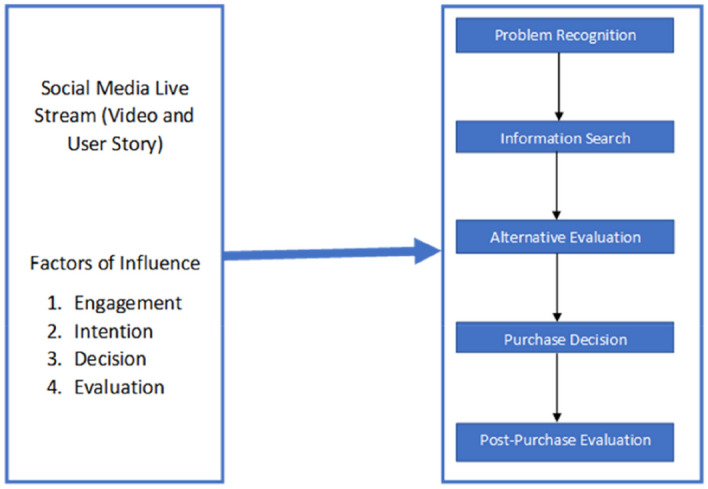
Conceptual framework
Methodology
Research approach and method
This study was part of a twelve-month investigation into social media brand communities and consumer behaviour. The data was collected using Netnography, the qualitative methodology developed by Kozinets [23, 106]. Methods were participant observation and social media monitoring in which posts were mined from brand pages and brand-related hashtags on Twitter, Facebook, YouTube and Instagram. An initial data set of five thousand posts was cleansed to five hundred posts. Data cleansing was applied to add structure to what is considered unstructured, real-time data on social media [107]. The process of data cleansing removed duplicates, all identifying information and unclear language. The types of brands and posts included in the study are described in Table 1. The posts were chosen from live stream videos and user stories on the named social media platforms and includes brand-generated and user-generated content. The sampling method was purposive for posts and brands. The first step was in choosing the brands according to set criteria which were (1) an engaged presence on social media; (2) responsiveness to content i.e. replies to and from the brand and individuals; (3) global appeal of the brand. The brands were selected based on their multiple appearance on Forbes’ list of most influential brands on social media, which is an industry-related and respected chart of social media brand leaders. This methodology enhanced the validity of the study by supporting the “trustworthiness of the research findings” [108] by collecting data in real-time, in the words of the participants, directly from the environment, i.e. social media, under investigation.
Table 1.
Collection process and criteria
| Collection process | Brands | Types of posts | Cleansing criteria |
|---|---|---|---|
|
Participant Observation in brand pages and hashtags in the form of commenting and sharing user-generated reviews of brand use Social media monitoring and mining of posts in brand pages and brand-related hashtags for user-generated and brand-generated posts |
Apple, L’Oréal, Coca Cola Criteria for choosing brands Global appeal Engaged presence on social media Interactivity Multiple appearances on Forbes list of most influential brands on social media |
Brand-generated (30% of sample) and user-generated (70% of sample): live video and user-stories Tutorials, demonstrations, review videos, unboxing, reaction videos Criteria for post inclusion in study: Interactivity and responsiveness Relevance to the brand and the community |
Clarity of meaning, Gained a response, Written in English, About a brand in sample |
Social media monitoring and participant observation
Social media monitoring is a valuable tool in the “medium of the digital age” [109]. Branthwaite and Patterson [110] described the method as scraping media sites for spontaneous opinions about brands. This method was used because it captures participants’ sentiments in their own words. Uncovering influencers’ perspectives as well as the target population [111] helps brand managers understand their audiences’ decision-making process. Hashtag tools SocioViz and TAGboard were used for the collection of the posts. Participant observation’s ability to actively collect data about individuals’ behaviours in a naturalistic environment [112, 113] is the main reason for using the online version of this research technique. Costello et al. [108] argue that the effectiveness of Netnography is directly related to human involvement in the communities being researched. Participant observation, in this case practiced by making posts about brand use, asking for opinions on specific products and replying to others’ posts, was used as well to maintain researcher involvement in the communities under investigation. This human involvement in the process of data collection supports the co-creative process of these communities and keeps the ethos of Netnography as separate from other forms of online data collection [113]. Within this study, the process of participant observation was supported by monitoring and analysing archive data which Kozinets [113] argues is a strength of Netnography.
Data analysis
The data collected via Netnography was analysed through two methods: thematic analysis and content analysis. Using thematic analysis, the posts were analysed using analytical software nVIVO, first through a process of coding, using descriptive and in vivo coding as outlined by Saldaña [114]. The codes were then combined through a process of categorisation, to produce five main themes that outline how the activity of the content form support consumer decision-making. Thematic analysis is a rigorous approach with relevance to this data collection method and research approach [115]. Content analysis was applied to analyse the social media posts and interactions for their meaning [116] and sentiment [117]. The aim for analysing the content in this manner wad to identify the links between the posts and their meanings to the consumer decision-making process. According to Wang et al. [116], content analysis is an appropriate manner of analysing social media content for meaning. Therefore, this research continues the emerging practice of analysing social media posts and profiles for their significance to a particular area of research. The aim of using content analysis in this way is to make valid inferences from the texts [118]. Following the experience of Tsugawa and Kito [117], the content analysis began when the data was cleaned to make sure each post being analysed fits the criteria of being about a brand in the sample, and sentiment analysis determined the positive or negative opinions to the content and the related brands.
Summary of findings
The data set revealed five main themes (Table 2): (1) knowledge and opinion share, (2) information search, (3) credibility development, (4) competitive analysis and (5) community motives. Below is a discussion of each of them and the stages of the consumer decision-making process they influence based on the thematic analysis.
Table 2.
Summary of findings: the key themes
| Themes | Content type |
|---|---|
| Knowledge and opinion share | Review videos, tutorials, demonstrations, unboxing videos, comparative discussions, reaction videos and opinion pieces |
| Information search | GIFs, troubleshooting video requests, comments on videos |
| Credibility development | Live video, user stories, tutorials, demonstrations, reviews, reaction videos, unboxing videos |
| Competitive analysis | Live video, user stories, tutorials, demonstrations, reviews, reaction videos, unboxing videos |
| Community motives | Live video, user stories, tutorials, demonstrations, reviews, reaction videos, unboxing videos |
Knowledge and opinion share
Within this theme in the data set (Table 3), users share their brand experience and knowledge using live stream content (videos and user stories). Posters are new or long-standing customers or industry professionals. Live streaming is used for content such as reviews, tutorials, demonstrations, unboxing videos, comparative discussions, reaction videos and opinion pieces. For example, review videos give an in-depth account of one’s experience with the brand. They share whether the experience met or fell short of expectations and the likelihood of repurchase. The content in this theme addresses the post-purchase evaluation of the reviewer, while influencing the pre-purchase stages of the viewers, which are essential stages of the consumer decision-making process. Reactions to the posts (e.g., comments, likes, shares) reflect their influence, often stating explicitly whether the products will or will not be purchased based on the content. The live nature means that the poster can respond in real-time and in text form, to comments, after filming the video. Therefore, one observes the synchronous and asynchronous influence of the live stream on consumer decision-making.
Table 3.
Knowledge and information share theme
| Theme: knowledge and opinion share | ||
|---|---|---|
| Thematic analysis | Source content | Participant quotes supporting the theme |
| This theme was interpreted based on the engagement within various content types around live video stream. These include live unboxing videos, live demonstrations and troubleshooting videos. The quotes were taken from the captions, comments and content of the various posts. In the content, users share their experience with the brands and the knowledge they have gained with others in the social media community. This knowledge includes sharing why the brand leads competitively, teaching how to install, upgrade or fix hardware or software and demonstrating cool actions that can be taken with the brand’s products. This knowledge share influences purchase intent and the decision to purchase of members of the community. You also see influence due to the comments in the posts that show shared experience or ask follow-up questions | Review videos, tutorials, demonstrations, unboxing videos, comparative discussions, reaction videos and opinion pieces |
“Let’s talk about the iPhone X and why there is only one argument from android users which is about technology” – Live Video Caption “My dream has come true !!Unboxing time! Unveiling my new Macbook pro. This is simply Amazing!”—Live Video Caption “Completed the MacBook Upgrade” – Post Caption “I love my MacBook. I have owned it less than two years without the issues experience of muggle technology. True Wizard tech” – User Story Caption “This is a life-saving new feature on iPhone. Learn more and share.” – Post Caption “I think it is better to hold down power button and volume up button simple way to get the same result.” Live Video Caption “Does this apply to all iPhones or just this model?” – Comment on a live video “Thank you. This is good information you shared”—Comment on a live video “Glad to be unboxing my new iPhone and discussing the new features e.g. wireless charging, new photo effects. Will share whether you'll need a new case” – Live Video Caption “I ordered my wife and my phone yesterday. Glad to finally get it done.” Comment on a live video I share a cool trick on Iphone on how to close your safari tabs instantly Video post caption |
Knowledge and opinion share in these videos is not limited to the original poster. Commenters also share their knowledge and opinions, either disputing or confirming the experience of the original poster. Tutorials and demonstrations are often performed by industry professionals who use the videos (e.g., make-up artists or hair stylists using their professional experience) to show the functionality of the products (e.g. foundation or hair dye). However, the most engaged videos (e.g., hair dye or make-up application) are from average individuals who are relatable to those who may not have need for these products in a professional setting. These videos build the social capital of the posters and influence intent to purchase and decision of viewers.
Unboxing videos, which show user reactions to purchase of new products e.g., technology products, are recurrent in the data. These candid videos show first impressions of the product, demonstrating post-purchase evaluation (on the one hand) and influencing pre-purchase stages (on the other hand). Users post live comparative discussions and reaction video discussing brand developments, e.g., launches and developments, to examine the meaning for the brand and its competitors. This may be a positive evaluation, lauding the brand for its superiority or it may be a negative response to the brand’s competitive positioning.
Each of these knowledge and opinion share facets combine to create the social influences within the platforms that inspires the beliefs, attitudes and intentions toward the brand that lead to purchase while informing post-purchase evaluation or outcomes. Knowledge and information share demonstrates engagement of the original poster as well as commenters while helping to, as seen in the quotes in Table 3, generate intention to buy which leads to the ultimate decision whether to purchase the brand. The knowledge and opinion share also gives posters the opportunity to share their evaluation of the brand publicly. Therefore, this theme relates to all four factors of influence within our research framework.
Information search
Live streams create the opportunity for consumers to search for information that influences their decision-making. The information search may confirm a pre-existing opinion and create solidary with other consumers. Alternatively, they may have no previous experience or opinions regarding the brand. The data set (Table 4) showed that the information required includes utilitarian aspects such as features, usage, capacity and strength as well as hedonic elements such as affective reactions based on the pleasure received from using the brand. Information search is directly related to the problem recognition, search and alternative evaluation within the decision-making process. Users are able to search the social media sites for videos that may already contain the answers to the questions they possess. Therefore, the user is demonstrating initiative even in the act of consuming content that is aimed at passive users of a brand community. The addition of the brand related hashtag is a deliberate act of community search, to ensure that the information gained comes from those with experience of the brand. Information search is a form of engagement with the social media community that reflects our factors of influence in Fig. 1 and research framework. This helps with the alternative evaluation of the individual as well by seeing the post-purchase evaluation of original posters in the form of reviews and videos. As can be seen in Table 4, this information search can be about pre and post purchase elements. The quotes can also show the intention to be influenced by the information received where we see questions regarding choices faced by the participants.
Table 4.
Information search
| Theme: information search | ||
|---|---|---|
| Thematic analysis | Source content | Participant quotes supporting the theme |
| The quotes that support the development of this theme are from live videos and their comments. The content displays individuals searching for information in a variety of contexts. They include showing a fault on a device, asking for and receiving advice. The receipt of advice demonstrates a relationship between information search and knowledge share themes. Individuals also asks about costs for products, reviews of product and brand experience or quality. These searches have consequences for the users who will decide whether to purchase or use the products/brands reviewed | GIFs, troubleshooting video requests, comments on live videos |
“I am deciding between MacBookPro and MacBook Air. I appreciate any advice.” “Those loreal masks are great for my face. I just want to know if I should spend more money on the Glam Glow Ones. Will they do the same job?” User showing live video of a fault on phone purchased received following comments: “You need to restart the phone” “That means you should update the software” “I had this same experience” “Can anyone advise approximately the cost of a laptop screen?” “Can you say more about the graphics and CPU features and its usefulness for designers and players? “Do you know when the new software will be released?” “How much do you think the Macbook weighs?” “Will it charge with the pop socket?” “What is going to be different about the new iPhone?” |
Credibility development
According to the data (Table 5), this theme shows that three main stakeholders gain credibility with live stream, whether videos or stories: the user, the brand and the community. The user develops credibility as an influencer. This credibility leads to social capital, which the user can leverage to aid the brand or to sell their own offerings to the community. On the other hand, the user also gains confidence in decision-making. The brand’s credibility is enhanced or harmed based on the amount of positive or negative reviews within the platform. The brand gains credibility based on its response appropriately to harmful reviews or experiences. The user with the negative review can then be turned into a brand champion based on the brand taking their comment seriously and redressing the harm done to the brand experience. The community gains credibility because its reputation as useful grows in the industry. For instance, organisations such as Forbes and Statista will measure the engagement of the brand community and rank them in comparison to other brands within the same industry and all brands overall. The credibility is supported by increased engagement with that user/poster and positive comments, reactions to their posts. This credibility is related to the factors of influence (Fig. 1) by helping to generate intention and supporting decision making based on their trust of the brand and other members of the social media community.
Table 5.
Credibility development
| Theme: credibility development | ||
|---|---|---|
| Thematic analysis | Source content | Participant quotes supporting the theme |
| The posts that support this theme demonstrate the credibility that users gain from sharing their reviews, knowledge and experience. The quotes display support for opinions or information shared by users. This shows the legitimacy of the community member as a source for information and reflects the level of influence that is exerted on the views and actions of other members in the community | Live video, user stories, tutorials, demonstrations, reviews, reaction videos, unboxing videos |
Below are comments from posts that display engagement but also the theme: “You are rcorrect. They made a mistake with Maps … “ “You are my idol, man!” “You are educating people. This was a good move to invest money in this version.” “Your videos are constantly very useful!” “I enjoy how great you are! “Very good Demo” “You’re the man can’t wait to get mine tomorrow and my Apple Watch!” “You made me happy doing this Live on Facebook” “I love your quick tips keep it up I use them every time you post them thank you!!!” “You're amazing thanks for keeping me up to date!!!” “I love the tips that you share with us. Thank you.” “Thanks a million! Your tips are invaluable!” “Now this is why I love following you” “I just tried it and it's a fabulous tip. Keep the tips coming. Awesome.” “You always come up with the best stuff” |
Community motives
Individuals desire to be a valued part of the brand community on social media, which speaks to the human need to gather with people who share interests. The brand community aids consumer decision-making and brand loyalty. The motivation of membership within a social media consumer community pushes the consumer decision-making process beyond purchase and includes outcomes such as satisfaction or dissatisfaction as well as relationship with the brand and other users. The community motives (Table 6), therefore, are aligned with the themes of knowledge share within the videos but also within the information search and credibility developments observed in the study. Community motives influence search, alternative evaluation and outcomes phases of the consumer decision process. Brands also use live video with the motive to build community. They create their own Facebook or Instagram Live videos with behind-the-scenes interviews and events to keep their fans engaged and connected in the feeling of co-experience. Community motives displayed by participants also reflect an intention to engage with community of similar minded consumers, therefore relating to two factors of influenced outlined in this study’s research framework.
Table 6.
Community motives
| Theme: community motives | ||
|---|---|---|
| Thematic analysis | Source content | Participant quotes supporting the theme |
| This theme shows the motivation of the collective in finding a community that shares similar views on the brand. This is seen in the captions and comments on the posts asking for actions based on agreement and participation in established rituals e.g. unboxing videos, tutorials | Live video, user stories, tutorials, demonstrations, reviews, reaction videos, unboxing videos |
Tag an iPhone user – share if you agree – (Caption on live video) New information on iPhone operating system for my fellow iPhone users – (Caption on live video) Glad to be of help! Remember that this also works with your Mac. (Caption on live video) I am pleased to be joining the @Apple family today with a brand-new #MacBookPro Anybody experiencing the same? #macbookpro #highsierra #apple @AppleSupport Am I the only one who actually *likes* the touch bar on MacBooks? #webdevelopment #MacBookPro Guess who has joined the @Apple family!? ME! I am so happy with my new #MacBookPro |
Competitive analysis
Live stream content and responses in the data show that competitive analysis mediates not only alternative evaluation but also outcomes such as satisfaction, dissatisfaction or relationship development. These videos analyse how brand developments (e.g., events, new releases, marketing communications campaigns) will affect the brand’s positioning in relation to its competitors. Competitive analysis (Table 7) speaks to useful information that can create a perception of the brand that is positive or negative and demonstrates how the brand serves both utilitarian and hedonic motives of the shopper. This information is useful to those in the conversation in real-time and those who will view the information later. Stories that evaporate after twenty-four hours gives the influence a stopwatch. The competitive position of the brand is influenced by the amount and quality of the discussion within this specific theme as users learn specifics about the searched brands and how said brand compares to competing brands. Competitive analysis speaks largely to evaluation within the factors of influence in our research framework, by demonstrating how the brand compares to other alternatives.
Table 7.
Competitive analysis
| Theme: competitive analysis | ||
|---|---|---|
| Thematic analysis | Source content | Participant quotes supporting the theme |
| This theme, displayed in live video, captions and comments shows that individuals use the community to compare their chosen brands with competitors. This could be in terms of actual performance of the company and its brands or predictions of what a new launch will do to the sector (e.g. destroy all phones). Here they also ask what the community thinks about the brand and its competitors and which is better re: certain criteria such as quality and service | Live video, user stories, tutorials, demonstrations, reviews, reaction videos, unboxing videos, comments |
“Some phones! This iPhone destroys all other phones” “The Android is very fragmented. This is true” “ Apple normally washes off Samsung in benchmarks until the next generation is released and even then the next generation does not meet it on single core tasks” “Every killer app ppl use—think Instagram, Uber, Snapchat etc. was released on iOS first for a reason” “When r u going to compare it with Samsung 8 plus” “IPhone 8 + or Note 8? In the market for a new phone. What one do you like between the two?” “Samsung had all these features years ago” “For a moment I thought this was a shared memory of the Samsung s6….. Nope the new apple phone… Old features….” “Which has Better coverage Maybelline or Loreal?” “Which is the better phone Samsung note 8 or iphone 8 tell me please” “Thank you for your review of the new Samsung, I am choosing between the new S8 plus or the iPhone 7 Plus, I appreciate any advice.” “Samsung 8 plus compared to iPhone 7 plus” iPhone was around long before Android and is now learning these features. This is why I will stick with my Samsung’ |
Discussion of findings
Confirming the relevance of the EKB model to the social media community
This article complements researchers such as Hilvert-Bruce et al. [119] and Ashman et al. [24] by investigating the impact of brand-related live stream content on the consumer-decision-making process. We show that live stream content exerts an influence on consumer decision-making which is both synchronous and asynchronous due to the ability to view in real-time and/or later. This research confirms Viswanathan’s [120] work by demonstrating the link between social media content type and consumer decision-making, though we extended the discussion by focusing specifically on live video and user stories. Consequently, our study illustrates that Engel et al. [15] model has relevance to the social media community, while making the adaptations that accommodate for the dynamic nature of the platform. These adaptations are needed to address Osei and Abenyin’s [29] criticism of the failure of the seminal model to successfully define its concepts. In outlining the motives and influences that the content type exerts on individual progress through the consumer decision-making as well as the consequences and actions, this study supports the relevance of the model in line with Ashman et al. [24] use of inter-related phases to account for the linear nature of this traditional model.
Nature of social media environment on the decision-making process
Furthermore, we categorise the nature of the influence exerted by developments within the social media environment and its role at each stage of the consumer decision-making process. We observe that influence of the researched content types is apparent at each stage of the model. We have also identified an additional outcome, i.e., of relationship/commitment to the brand and community. This additional outcome is supports [121] who showed commitment to community is a strong factor of consumer decision-making in digital communities. To extend the insight of their study, we demonstrate that participating in live video and user stories shows a measure of commitment to the brand and community, by ensuring there is useful information to enhance the experience. Similarly, Simon et al. [122] argued that individuals desire to contribute to the positive experience of others in the community. We determined that live videos and user stories are a tangible manner of fulfilling that desire.
Live videos and user stories influence consumer decision-making because they are specific and match, in some circumstances, viewer requests. This increases the relevance and viral potential of the content. Therefore, we argue that communication, relationship, community and virality combine to strengthen social media’s role in consumer decision-making. Live content integrates the factors that influence the consumer decision-making process as outlined by [26, 35]. Within these videos, one learns from one’s reference groups, engages with the marketing mix, and responds according to one’s personal characteristics, an action that builds on the work of Belk [123]. Social media creates a culture that allows customers to develop beliefs, attitudes and intentions [35] and find community. We show that live video allows users to demonstrate input, process and decision phases of the consumption process [26, 35], which helps to influence perceptions and moderate behaviour. Community motives and credibility development motivate the engagement-based themes of knowledge and opinion share. The interconnection of the themes show that the consumer decision-making process is multi-layered and problematic to depict in a logical, straight process. While, these themes support the Darley et al. [35] concept of individual motives, we show that the content types also serves a communal purpose.
Social media live content and the research framework
Live streaming demonstrates the elements of this study’s research framework in several ways. Firstly, live content is evidence of brand and community engagement, displaying a psychological connection with these stakeholders [55]. Secondly, as seen in the data, live content affects the intention to purchase the brand. The reviews can cause either intention to purchase or avoid the brand due to the consistency of experience among users. The development of brand awareness from several sources (brand and user-generated) paints a multi-dimensional vision for the viewers who build intention to purchase for the brand and intention to further engage with the brand. In acts of reciprocity [124], they share their own experience with the community that supported their own decision, which is the third element of the research framework. Finally, in giving reviews and participating in unboxing videos, this content acts as a collective form of post-purchase evaluation, the fourth feature of the research framework.
Conceptual model
The conceptual model (Fig. 2) depicts the progress of consumer decision-making within the social media eco-system. Our study confirms the relevance of Engel et al. [15], an argument supported by Fang [33], Kim et al. [34] and Martín et al. [26] who show that while they recommend changes, they do not repudiate the model. Our conceptual model retains the original phases of the model. However, we have added motives and consequences as nurtured by the social media environment and the actions and consequences related to decision-making and community engagement. The motives and influences section addresses the antecedents of the process and positions the social media community as a reference group that drives community motives and social influences. This section of the model speaks to the motives of actions such as knowledge share in terms of building credibility. These are additions to established motives such as individual characteristics [35] while showing the nature of the online environment such as its quality and experience as motivating factors in progressing through the decision-making process. We also depict within the motives and influences section of the model credibility development, community motives and competitive analysis and their link to the consumer decision-making model.
Fig. 2.

Conceptual model: the effect of live social media content on the consumer decision-making process
The actions and consequences portion of the model demonstrate the results of engagement with the brand community on social media. These include the sense of virtual community as discussed by Blanchard [125], the realisation of that desired social capital and credible voice, continued engagement with and commitment to the community and brand by continuing to share knowledge and use that community as a source of information when searching. These actions include knowledge and opinion share and information searching as seen in the model. These can influence and be influenced by engaging with the consumer decision-making model shown by two way arrows in our conceptual model. Our model supports the uses and gratifications theory [126] because the viewer actively engages with the live content based on desired outcomes.
This model adds the outcome of relationship, whereby satisfaction with the brand experience and the community enhances the consumer-brand and consumer-community relationships. We account for the criticisms of Engel et al. [15] model by demonstrating the inter-relationship of the various influences of consumer decision-making and considering the consequences including the need to start the process again in the event of dissatisfaction. This goes further than Ashman et al. [24] who argued, like this study, that the model is relevant but need some significant adaptations. Their attempt separated the model in sections (Input, process, decisions) and tried to account for the influences. This study proves the phases identified in the EKB [15] model apply within social media. While there are some additions, such as credibility development and community motives due to the expressive nature social media content, the model itself remains applicable in investigating consumer decision-making.
Our findings showed that the factors of influence outlined within the research framework (Fig. 1) of Engagement, Intention, Decision and Evaluation, are displayed within social media brand communities, guiding consumer decision-making of the individuals therein. In participating within knowledge and opinion share and information search themes, participants demonstrated engagement with the brand that helps to guide as discussed under those Sects. (4.1 and 4.2 respectively) their decisions to purchase or not a particular brand. Knowledge and opinion share also links to the evaluation stage of the framework, whereby individuals are able to show publicly their level of satisfaction with the brand, in real-time or on review through unboxing videos and other forms of live video content. The themes of credibility development, competitive analysis and community motives link directly to the intention and evaluation states where these motives are showing an intention to purchase the brand and an intention to engage with the brand’s social media community through hashtag search or on the brand pages. Collectively, these themes speak to the ultimate decision, whether that decision is to purchase the brand or engage with its social media community. These aspects are seen in the motives and influences section of the model (Fig. 2).
Theoretical and practical implications
The findings of this study hold several implications for theory. Firstly, we provide insight into the influence of live stream content on consumer decision-making by positioning this content type among the situational influences named in the Engel, Blackwell and Miniard Model [16]. This insight is vital for academics in supporting student understanding of the social media environment and its influence on consumer behaviour and for academic engagement with industry. Secondly, this study’s categorisation of live video and user story as forms of content and a platform of consumer-brand engagement illustrates the emergence of additional outcomes of relationship and commitment within the consumer decision-making process. Outlining these additional outcomes are useful for academics and practitioners alike to understand the nature of the consumer-brand relationships formed due to engagement with these forms of content. Thirdly, we develop a conceptual model of consumer decision-making, as influenced by live stream content, which demonstrates the motives and power of the consumers in influencing each other’s consumer decision-making process. This framework will inform social media marketing strategies by showing how practitioners can strategically incorporate live stream content especially user-created content within their marketing communications. The power of this content type and engagement platform to influence decisions and establish brand salience in the perceptions of individuals therefore aiding their consumption decisions means that brands and marketers must be proactive in integrating this content type and engagement platform within their marketing and engagement plans. Finally, this paper identifies aspects that are unique to live content, synchronous and asynchronous viewer consumption, as material to its role in influencing the consumer decision-making process.
Conclusion
Summary
The study’s novelty in proposing a framework to demonstrate the influence of live stream social media content on the consumer decision-process was informed specifically by the EKB [15] version, which was linear and the Engel et al. [16] model that introduced the situational influences and additional outcomes. This study had three brands from various industries (technology, cosmetics and beverage) but noted the observed influence across all three product categories. In defining live stream social media content (in this case, live video and user stories) as both content type and engagement platform, we observed influence at each stage of the consumer decision-making process. For instance, the thematic analysis saw themes such as knowledge and opinion share emerge to demonstrate how the actions of experienced consumers in the post-purchase phases can influence other social media users in the pre-purchase stages of consumer decision-making. This study addressed several research gaps. Firstly, we examined the nature of the influence of live streaming on consumer decision-making. Credibility development and community motives are essential influencers consumer decision-making by generating engagement with the social media community and content and driving purchase intentions. Secondly, the conceptual model adapts EKB’s [15] version for the social media environment, exploring how the live content elements of the eco-system supports the motives and influences of the process e.g., making the social media community a reference group and generating the credibility as sources of information. By extending the discussion of this model to the social media’s live content, this study shows that model remains relevant to the current climate. However, the dynamic nature of the platform and changes to consumer behaviour means there are some additional aspects of motives and behaviours as shown by the thematic analysis and the conceptual model in Fig. 2 to be included in discussion of the model. Thirdly, users’ motivations for engagement pre and post purchase via making and commenting (knowledge and opinion sharing) on live videos and user stories, supports the concept of reciprocity to a community that influenced their own decision-making. This speaks to individual and communal motives in the consumer behaviour. The synchronous and asynchronous nature of engagement within this content shows that social media live has a multi-directional and vital influence on consumption decisions and warrants further investigation by researchers and practitioners.
Limitations of the study
While the study has applicability across several industries, due to its sample of brands being sourced from three different sectors, there is a need for further research to consider the universal applicability of the conceptual model. Secondly, there was no accounting for demographic features (e.g., age, nationality or gender) in the study. Finally, this was an exploratory, qualitative study, which often leaves itself open to critiques especially since the sample chosen was immersed within the communities under investigation.
Recommendations for future research
Future studies may want to consider exploring more features and characteristics such as demographic influence on live stream engagement and consumer decision-making. Additional studies could adopt quantitative or mixed methods to investigate the strengths of the relationships in the conceptual model. Further investigation should also consider other forms of digital content, smart technology or AI, and the applicability of the conceptual model to those contexts.
Declaration
Conflict of interest
On behalf of both authors, the corresponding author states that there is no conflict of interest.
Footnotes
Publisher's Note
Springer Nature remains neutral with regard to jurisdictional claims in published maps and institutional affiliations.
Contributor Information
Kathy-Ann Fletcher, Email: k.fletcher@abertay.ac.uk.
Ayantunji Gbadamosi, Email: A.Gbadamosi@uel.ac.uk.
References
- 1.Baccarella CV, Wagner TF, Kietzmann JH, McCarthy IP. Social media? It's serious! Understanding the dark side of social media. European Management Journal. 2018;36(4):431–438. doi: 10.1016/j.emj.2018.07.002. [DOI] [Google Scholar]
- 2.Lin X, Sarker S, Featherman M. Users’ psychological perceptions of information sharing in the context of social media: A comprehensive model. International Journal of Electronic Commerce. 2019;23(4):453–491. doi: 10.1080/10864415.2019.1655210. [DOI] [Google Scholar]
- 3.Demmers J, Weltevreden JW, van Dolen WM. Consumer engagement with brand posts on social media in consecutive stages of the customer journey. International Journal of Electronic Commerce. 2020;24(1):53–77. doi: 10.1080/10864415.2019.1683701. [DOI] [Google Scholar]
- 4.Statista. (2020, July). Number of social network users worldwide from 2017 to 2025.https://www.statista.com/statistics/278414/number-of-worldwide-social-network-users.
- 5.Riaz MU, Guang LX, Zafar M, Shahzad F, Shahbaz M, Lateef M. Consumers’ purchase intention and decision-making process through social networking sites: A social commerce construct. Behaviour & Information Technology. 2021;40(1):99–115. doi: 10.1080/0144929X.2020.1846790. [DOI] [Google Scholar]
- 6.Malthouse EC, Haenlein M, Skiera B, Wege E, Zhang M. Managing customer relationships in the social media era: Introducing the social crm house. Journal of Interactive Marketing. 2013;27(4):270–280. doi: 10.1016/j.intmar.2013.09.008. [DOI] [Google Scholar]
- 7.Agrawal SR. Adoption of WhatsApp for strengthening internal CRM through social network analysis. Journal of Relationship Marketing. 2021;20(4):261–281. doi: 10.1080/15332667.2020.1802643. [DOI] [Google Scholar]
- 8.Wang Y, Yu C. Social interaction-based consumer decision-making model in social commerce: The role of word of mouth and observational learning. International Journal of Information Management. 2017;37(3):179–189. doi: 10.1016/j.ijinfomgt.2015.11.005. [DOI] [Google Scholar]
- 9.Hudson S, Huang L, Roth MS, Madden TJ. The influence of social media interactions on consumer–brand relationships: A three-country study of brand perceptions and marketing behaviours. International Journal of Research in Marketing. 2016;33(1):27–41. doi: 10.1016/j.ijresmar.2015.06.004. [DOI] [Google Scholar]
- 10.Erkan I, Evans C. The influence of eWOM in social media on consumers’ purchase intentions: An extended approach to information adoption. Computers in Human Behavior. 2016;61:47–55. doi: 10.1016/j.chb.2016.03.003. [DOI] [Google Scholar]
- 11.Santos ZR, Cheung CM, Coelho PS, Rita P. Consumer engagement in social media brand communities: A literature review. International Journal of Information Management. 2022;63:102457. doi: 10.1016/j.ijinfomgt.2021.102457. [DOI] [Google Scholar]
- 12.Hamzah ZL, Wahab HA, Waqas M. Unveiling drivers and brand relationship implications of consumer engagement with social media brand posts. Journal of Research in Interactive Marketing. 2021;15(2):336–358. doi: 10.1108/JRIM-05-2020-0113. [DOI] [Google Scholar]
- 13.Huertas A. How live videos and stories in social media influence tourist opinions and behaviour. Information Technology & Tourism. 2018;19(1–4):1–28. doi: 10.1007/s40558-018-0112-0. [DOI] [Google Scholar]
- 14.Shawky S, Kubacki K, Dietrich T, Weaven S. A dynamic framework for managing customer engagement on social media. Journal of Business Research. 2020;121:567–577. doi: 10.1016/j.jbusres.2020.03.030. [DOI] [Google Scholar]
- 15.Engel, J. F., Kollat, D. T., & Blackwell, R. D. (1968) Consumer behavior. Dryden Press.
- 16.Engel, J. F., Blackwell, R. D. & Miniard, P. W. (1986) Consumer behavior. 5th ed. Dryden Press.
- 17.Muzellec L, O'Raghallaigh E. Mobile technology and its impact on the consumer decision-making journey: How brands can capture the mobile-driven “Ubiquitous” moment of truth. Journal of Advertising Research. 2018;58(1):12–15. doi: 10.2501/JAR-2017-058. [DOI] [Google Scholar]
- 18.Schivinski B, Langaro D, Fernandes T, Guzmán F. Social media brand engagement in the context of collaborative consumption: The case of AIRBNB. Journal of Brand Management. 2020;27(6):645–661. doi: 10.1057/s41262-020-00207-5. [DOI] [Google Scholar]
- 19.Meisner C, Ledbetter AM. Participatory branding on social media: The affordances of live streaming for creative labor. New Media & Society. 2020;24(5):1179–1195. doi: 10.1177/1461444820972392. [DOI] [Google Scholar]
- 20.Lin GY, Wang YS, Wang YM, Lee MH. What drives people's intention toward live stream broadcasting. Online Information Review. 2021;45(7):1268–1289. doi: 10.1108/OIR-10-2020-0466. [DOI] [Google Scholar]
- 21.Valos MJ, Mavondo FT, Nyadzayo MW. How do alternative strategic orientations influence social media performance. Journal of Strategic Marketing. 2019;27(1):1–20. doi: 10.1080/0965254X.2017.1384039. [DOI] [Google Scholar]
- 22.Kamboj S, Rahman Z. The influence of user participation in social media-based brand communities on brand loyalty: Age and gender as moderators. Journal of Brand Management. 2016;23(6):679–700. doi: 10.1057/s41262-016-0002-8. [DOI] [Google Scholar]
- 23.Kozinets RV. “I want to believe’’: A netnography of the X-Philes’ subculture of consumption. Advances in Consumer Research. 1997;24:470–475. [Google Scholar]
- 24.Ashman R, Solomon MR, Wolney J. An old model for a new age: Consumer decision making in participatory digital culture. Journal of Customer Behaviour. 2015;14(2):127–146. doi: 10.1362/147539215X14373846805743. [DOI] [Google Scholar]
- 25.Dimitriou CK, AbouElgheit E. Understanding generation Z’s travel social decision-making. Tourism and Hospitality Management. 2019;25(2):311–334. doi: 10.20867/thm.25.2.4. [DOI] [Google Scholar]
- 26.Martín JC, Pagliara F, Román C. The research topics on e-grocery: Trends and existing gaps. Sustainability. 2019;11(2):321. doi: 10.3390/su11020321. [DOI] [Google Scholar]
- 27.Bettman JR. Toward a statistics for consumer decision net models. Journal of Consumer Research. 1974;1(1):71–80. doi: 10.1086/208583. [DOI] [Google Scholar]
- 28.Makudza F, Sandada M, Madzikanda DD. Modelling social commerce buying behaviour: An adaption of the sequential consumer decision making model. Management Research and Practice. 2022;14(1):17–29. [Google Scholar]
- 29.Osei BA, Abenyin AN. Applying the Engell–Kollat–Blackwell model in understanding international tourists’ use of social media for travel decision to Ghana. Information Technology & Tourism. 2016;16(3):265–284. doi: 10.1007/s40558-016-0055-2. [DOI] [Google Scholar]
- 30.Nicosia, F.N. (1966). Consumer decision processes. PrenticeHall.
- 31.Jisana TK. Consumer behaviour models: An overview. Sai Om Journal of Commerce & Management. 2014;1(5):34–43. [Google Scholar]
- 32.Howard, J. A., & Sheth, J. N. (1969). The theory of buyer behaviour. John Willey and sons.
- 33.Fang YH. Does online interactivity matter? Exploring the role of interactivity strategies in consumer decision making. Computers in Human Behavior. 2012;28(5):1790–1804. doi: 10.1016/j.chb.2012.04.019. [DOI] [Google Scholar]
- 34.Kim DJ, Ferrin DL, Rao HR. A trust-based consumer decision-making model in electronic commerce: The role of trust, perceived risk, and their antecedents. Decision Support Systems. 2008;44(2):544–564. doi: 10.1016/j.dss.2007.07.001. [DOI] [Google Scholar]
- 35.Darley WK, Blankson C, Luethge DJ. Toward an integrated framework for online consumer behavior and decision making process: A review. Psychology & Marketing. 2010;27(2):94–116. doi: 10.1002/mar.20322. [DOI] [Google Scholar]
- 36.Sihi D. Home sweet virtual home: The use of virtual and augmented reality technologies in high involvement purchase decisions. Journal of Research in Interactive Marketing. 2018;12(4):398–417. doi: 10.1108/JRIM-01-2018-0019. [DOI] [Google Scholar]
- 37.Karimi S, Holland CP, Papamichail KN. The impact of consumer archetypes on online purchase decision-making processes and outcomes: A behavioural process perspective. Journal of Business Research. 2018;91:71–82. doi: 10.1016/j.jbusres.2018.05.038. [DOI] [Google Scholar]
- 38.Kumar DP, Raju KV. The role of advertising in consumer decision making. IOSR Journal of Business and Management. 2013;14(4):37–45. doi: 10.9790/487X-1443745. [DOI] [Google Scholar]
- 39.Lopes EL, Veiga RT. Increasing purchasing intention of eco-efficient products: The role of the advertising communication strategy and the branding strategy. Journal of Brand Management. 2019;26(5):550–566. doi: 10.1057/s41262-019-00150-0. [DOI] [Google Scholar]
- 40.Goodrich K, de Mooij M. How ‘social’ are social media? A cross-cultural comparison of online and offline purchase decision influences. Journal of Marketing Communications. 2013;20(1–2):103–116. doi: 10.1080/13527266.2013.797773. [DOI] [Google Scholar]
- 41.Fang J, Wen C, George B, Prybutok VR. Consumer heterogeneity, perceived value, and repurchase decision-making in online shopping: The role of gender, age, and shopping motives. Journal of Electronic Commerce Research. 2016;17(2):116–131. [Google Scholar]
- 42.Solomon, M. R., Bamossy, G. J., Askegaard, S. T., & Hogg, M. K. (2016). Consumer Behaviour: A European Perspective. 6th ed. Pearson Education.
- 43.Vázquez S, Muñoz-García Ó, Campanella I, Poch M, Fisas B, Bel N, Andreu G. A classification of user-generated content into consumer decision journey stages. Neural Networks. 2014;58:68–81. doi: 10.1016/j.neunet.2014.05.026. [DOI] [PubMed] [Google Scholar]
- 44.Nash J. Exploring how social media platforms influence fashion consumer decisions in the UK retail sector. Journal of Fashion Marketing and Management. 2019;23(1):82–103. doi: 10.1108/JFMM-01-2018-0012. [DOI] [Google Scholar]
- 45.Ho CI, Chen MC, Shih YW. Customer engagement behaviours in a social media context revisited: using both the formative measurement model and text mining techniques. Journal of Marketing Management. 2021 doi: 10.1080/0267257X.2021.2003421. [DOI] [Google Scholar]
- 46.De Oliveira Santini F, Ladeira WJ, Pinto DC, Herter MM, Sampaio CH, Babin BJ. Customer engagement in social media: A framework and meta-analysis. Journal of the Academy of Marketing Science. 2020;48(6):1211–1228. doi: 10.1007/s11747-020-00731-5. [DOI] [Google Scholar]
- 47.Fehrer JA, Woratschek H, Germelmann CC, Brodie RJ. Dynamics and drivers of customer engagement: Within the dyad and beyond. Journal of Service Management. 2018;29(3):443–467. doi: 10.1108/JOSM-08-2016-0236. [DOI] [Google Scholar]
- 48.Dessart L, Veloutsou C, Morgan-Thomas A. Consumer engagement in online brand communities: A social media perspective. Journal of Product & Brand Management. 2015;24(1):28–42. doi: 10.1108/JPBM-06-2014-0635. [DOI] [Google Scholar]
- 49.Simon F, Tossan V. Does brand-consumer social sharing matter? A relational framework of customer engagement to brand-hosted social media. Journal of Business Research. 2018;85:175–184. doi: 10.1016/j.jbusres.2017.12.050. [DOI] [Google Scholar]
- 50.Islam JU, Rahman Z, Hollebeek LD. Consumer engagement in online brand communities: A solicitation of congruity theory. Internet Research. 2018;28(1):23–45. doi: 10.1108/IntR-09-2016-0279. [DOI] [Google Scholar]
- 51.Heinonen K. Positive and negative valence influencing consumer engagement. Journal of Service Theory and Practice. 2018;28(2):147–169. doi: 10.1108/JSTP-02-2016-0020. [DOI] [Google Scholar]
- 52.Cao D, Meadows M, Wong D, Xia S. Understanding consumers’ social media engagement behaviour: An examination of the moderation effect of social media context. Journal of Business Research. 2021;122:835–846. doi: 10.1016/j.jbusres.2020.06.025. [DOI] [Google Scholar]
- 53.Rahman M, Faroque AR, Sakka G, Ahmed ZU. The impact of negative customer engagement on market-based assets and financial performance. Journal of Business Research. 2022;138:422–435. doi: 10.1016/j.jbusres.2021.08.023. [DOI] [Google Scholar]
- 54.Brodie RJ, Ilic A, Juric B, Hollebeek L. Consumer engagement in a virtual brand community: An exploratory analysis. Journal of Business Research. 2013;66(1):105–114. doi: 10.1016/j.jbusres.2011.07.029. [DOI] [Google Scholar]
- 55.France C, Merrilees B, Miller D. An integrated model of customer-brand engagement: Drivers and consequences. Journal of Brand Management. 2016;23(2):119–136. doi: 10.1057/bm.2016.4. [DOI] [Google Scholar]
- 56.Lima VM, Irigaray HAR, Lourenco C. Consumer engagement on social media: Insights from a virtual brand community. Qualitative Market Research. 2019;22(1):14–32. doi: 10.1108/QMR-02-2017-0059. [DOI] [Google Scholar]
- 57.Patterson, P., Yu, T. & de Ruyter, K. (2006). Understanding customer engagement in services. In Advancing theory, maintaining relevance, Proceedings of ANZMAC 2006 conference, Australia (pp. 4–6).
- 58.Wongsansukcharoen J. Effect of community relationship management, relationship marketing orientation, customer engagement, and brand trust on brand loyalty: The case of a commercial bank in Thailand. Journal of Retailing and Consumer Services. 2022 doi: 10.1016/j.jretconser.2021.102826. [DOI] [Google Scholar]
- 59.Nikolinakou A, Phua J. Do human values matter for promoting brands on social media? How social media users’ values influence valuable brand-related activities such as sharing, content creation, and reviews. Journal of Consumer Behaviour. 2019;19(1):13–23. doi: 10.1002/cb.1790. [DOI] [Google Scholar]
- 60.Hutter K, Hautz J, Dennhardt S, Füller J. The impact of user interactions in social media on brand awareness and purchase intention: The case of MINI on Facebook. Journal of Product & Brand Management. 2013;22(5/6):342–351. doi: 10.1108/JPBM-05-2013-0299. [DOI] [Google Scholar]
- 61.Goh KY, Heng CS, Lin Z. Social media brand community and consumer behavior: Quantifying the relative impact of user-and marketer-generated content. Information Systems Research. 2013;24(1):88–107. doi: 10.1287/isre.1120.0469. [DOI] [Google Scholar]
- 62.Phua J, Jin SV, Kim JJ. Gratifications of using Facebook, Twitter, Instagram, or Snapchat to follow brands: The moderating effect of social comparison, trust, tie strength, and network homophily on brand identification, brand engagement, brand commitment, and membership intention. Telematics and Informatics. 2017;34(1):412–424. doi: 10.1016/j.tele.2016.06.004. [DOI] [Google Scholar]
- 63.Rezaei S. Segmenting consumer decision-making styles (CDMS) toward marketing practice: A partial least squares (PLS) path modeling approach. Journal of Retailing and Consumer Services. 2015;22:1–15. doi: 10.1016/j.jretconser.2014.09.001. [DOI] [Google Scholar]
- 64.Carrington MJ, Neville BA, Whitwell GJ. Lost in translation: Exploring the ethical consumer intention–behavior gap. Journal of Business Research. 2014;67(1):2759–2767. doi: 10.1016/j.jbusres.2012.09.022. [DOI] [Google Scholar]
- 65.Kim YH, Kim DJ, Wachter K. A study of mobile user engagement (MoEN): Engagement motivations, perceived value, satisfaction, and continued engagement intention. Decision Support Systems. 2013;56:361–370. doi: 10.1016/j.dss.2013.07.002. [DOI] [Google Scholar]
- 66.Füller J, Hutter K, Faullant R. Why co-creation experience matters? Creative experience and its impact on the quantity and quality of creative contributions. R&D Management. 2011;41(3):259–273. doi: 10.1111/j.1467-9310.2011.00640.x. [DOI] [Google Scholar]
- 67.Ma L, Gao S, Zhang X. How to use live streaming to improve consumer purchase intentions: Evidence from China. Sustainability. 2022;14(2):1045. doi: 10.3390/su14021045. [DOI] [Google Scholar]
- 68.Bilgihan A, Barreda A, Okumus F, Nusair K. Consumer perception of knowledge-sharing in travel-related online social networks. Tourism Management. 2016;52:287–296. doi: 10.1016/j.tourman.2015.07.002. [DOI] [Google Scholar]
- 69.Kang K, Lu J, Guo L, Li W. The dynamic effect of interactivity on customer engagement behavior through tie strength: Evidence from live streaming commerce platforms. International Journal of Information Management. 2021 doi: 10.1016/j.ijinfomgt.2020.102251. [DOI] [Google Scholar]
- 70.Dolan R, Conduit J, Fahy J, Goodman S. Social media engagement behaviour: A uses and gratifications perspective. Journal of Strategic Marketing. 2016;24(3–4):261–277. doi: 10.1080/0965254X.2015.1095222. [DOI] [Google Scholar]
- 71.Chen CC, Lin YC. What drives live-stream usage intention? The perspectives of flow, entertainment, social interaction, and endorsement. Telematics and Informatics. 2018;35(1):293–303. doi: 10.1016/j.tele.2017.12.003. [DOI] [Google Scholar]
- 72.Marchand A, Hennig-Thurau T, Wiertz C. Not all digital word of mouth is created equal: Understanding the respective impact of consumer reviews and microblogs on new product success. International Journal of Research in Marketing. 2017;34(2):336–354. doi: 10.1016/j.ijresmar.2016.09.003. [DOI] [Google Scholar]
- 73.Wongkitrungrueng A, Assarut N. The role of live streaming in building consumer trust and engagement with social commerce sellers. Journal of Business Research. 2018 doi: 10.1016/j.jbusres.2018.08.032. [DOI] [Google Scholar]
- 74.Ngai EW, Tao SS, Moon KK. Social media research: Theories, constructs, and conceptual frameworks. International journal of information management. 2015;35(1):33–44. doi: 10.1016/j.ijinfomgt.2014.09.004. [DOI] [Google Scholar]
- 75.Marticotte F, Arcand M, Baudry D. The impact of brand evangelism on oppositional referrals towards a rival brand. Journal of Product & Brand Management. 2016;25(6):538–549. doi: 10.1108/JPBM-06-2015-0920. [DOI] [Google Scholar]
- 76.Raïes K, Mühlbacher H, Gavard-Perret ML. Consumption community commitment: Newbies’ and longstanding members’ brand engagement and loyalty. Journal of Business Research. 2015;68(12):2634–2644. doi: 10.1016/j.jbusres.2015.04.007. [DOI] [Google Scholar]
- 77.Zhang H, Zhao L, Gupta S. The role of online product recommendations on customer decision making and loyalty in social shopping communities. International Journal of Information Management. 2018;38(1):150–166. doi: 10.1016/j.ijinfomgt.2017.07.006. [DOI] [Google Scholar]
- 78.Häubl G, Trifts V. Consumer decision making in online shopping environments: The effects of interactive decision aids. Marketing science. 2000;19(1):4–21. doi: 10.1287/mksc.19.1.4.15178. [DOI] [Google Scholar]
- 79.Wu YL, Li EY. Marketing mix, customer value, and customer loyalty in social commerce: A stimulus-organism-response perspective. Internet Research. 2018;28(1):74–104. doi: 10.1108/IntR-08-2016-0250. [DOI] [Google Scholar]
- 80.Liu H, Jayawardhena C, Osburg VS, Babu MM. Do online reviews still matter post-purchase? Internet Research. 2019;30(1):109–139. doi: 10.1108/INTR-07-2018-0331. [DOI] [Google Scholar]
- 81.Ismagilova E, Slade EL, Rana NP, Dwivedi YK. The effect of electronic word of mouth communications on intention to buy: A meta-analysis. Information Systems Frontiers. 2020;22(5):1203–1226. doi: 10.1007/s10796-019-09924-y. [DOI] [Google Scholar]
- 82.Hajli MN. A study of the impact of social media on consumers. International Journal of Market Research. 2014;56(3):387–404. doi: 10.2501/IJMR-2014-025. [DOI] [Google Scholar]
- 83.Menon RV, Sigurdsson V, Larsen NM, Fagerstrøm A, Sørensen H, Marteinsdottir HG, Foxall GR. How to grow brand post engagement on Facebook and Twitter for airlines? An empirical investigation of design and content factors. Journal of Air Transport Management’. 2019 doi: 10.1016/j.jairtraman.2019.05.002. [DOI] [Google Scholar]
- 84.Stubb C, Colliander J. “This is not sponsored content”–The effects of impartiality disclosure and e-commerce landing pages on consumer responses to social media influencer posts. Computers in Human Behavior. 2019;98:210–222. doi: 10.1016/j.chb.2019.04.024. [DOI] [Google Scholar]
- 85.Lee JE, Watkins B. YouTube vloggers' influence on consumer luxury brand perceptions and intentions. Journal of Business Research. 2016;69(12):5753–5760. doi: 10.1016/j.jbusres.2016.04.171. [DOI] [Google Scholar]
- 86.Orehek E, Human LJ. Self-expression on social media: Do tweets present accurate and positive portraits of impulsivity, self-esteem, and attachment style? Personality and Social Psychology Bulletin. 2017;43(1):60–70. doi: 10.1177/0146167216675332. [DOI] [PubMed] [Google Scholar]
- 87.Gao, Y., Wang, F., Luan, H. & Chua. T. (2014). Brand data gathering from live social media streams. In Proceedings of international conference on multimedia retrieval (ICMR 2014). ACM, USA (pp. 169–176). 10.1145/2578726.2578748.
- 88.Wallace E, Torres P, Augusto M, Stefuryn M. Outcomes for self-expressive brands followed on social media: Identifying different paths for inner self-expressive and social self-expressive brands. Journal of Business Research. 2021;135:519–531. doi: 10.1016/j.jbusres.2021.06.058. [DOI] [Google Scholar]
- 89.Balakrishnan BK, Dahnil MI, Yi WJ. The impact of social media marketing medium toward purchase intention and brand loyalty among generation Y. Procedia-Social and Behavioral Sciences. 2014;148:177–185. doi: 10.1016/j.sbspro.2014.07.032. [DOI] [Google Scholar]
- 90.Habibi MR, Laroche M, Richard MO. Testing an extended model of consumer behavior in the context of social media-based brand communities. Computers in Human Behavior. 2016;62:292–302. doi: 10.1016/j.chb.2016.03.079. [DOI] [Google Scholar]
- 91.Kuo YF, Hou JR. Oppositional brand loyalty in online brand communities: Perspectives on social identity theory and consumer-brand relationship. Journal of Electronic Commerce Research. 2017;18(3):254–268. [Google Scholar]
- 92.Kim E, Drumwright M. Engaging consumers and building relationships in social media: How social relatedness influences intrinsic vs. extrinsic consumer motivation. Computers in Human Behavior. 2016;63:970–979. doi: 10.1016/j.chb.2016.06.025. [DOI] [Google Scholar]
- 93.Wakefield K. Using fan passion to predict attendance, media consumption, and social media behaviors. Journal of Sport Management. 2016;30(3):229–247. doi: 10.1123/jsm.2015-0039. [DOI] [Google Scholar]
- 94.Zhu DH, Chang YP, Luo JJ. Understanding the influence of C2C communication on purchase decision in online communities from a perspective of information adoption model. Telematics and Informatics. 2016;33(1):8–16. doi: 10.1016/j.tele.2015.06.001. [DOI] [Google Scholar]
- 95.Zhang M, Guo L, Hu M, Liu W. Influence of customer engagement with company social networks on stickiness: Mediating effect of customer value creation. International Journal of Information Management. 2017;37(3):229–240. doi: 10.1016/j.ijinfomgt.2016.04.010. [DOI] [Google Scholar]
- 96.Kietzmann JH, Hermkens K, McCarthy IP, Silvestre BS. Social media? Get serious! Understanding the functional building blocks of social media. Business Horizons. 2011;54(3):241–251. doi: 10.1016/j.bushor.2011.01.005. [DOI] [Google Scholar]
- 97.Gilbert, M.A. (2019). Strengthening your social media marketing with live streaming video. In Al-Masri, A. & Curran, K. (eds) Smart Technologies and Innovation for a Sustainable Future. Advances in Science, Technology & Innovation (pp. 357–365). Springer. 10.1007/978-3-030-01659-3_42.
- 98.Gensler S, Völckner F, Liu-Thompkins Y, Wiertz C. Managing brands in the social media environment. Journal of Interactive Marketing. 2013;27(4):242–256. doi: 10.1016/j.intmar.2013.09.004. [DOI] [Google Scholar]
- 99.Qiu Q, Zuo Y, Zhang M. Can live streaming save the tourism industry from a pandemic? a study of social media. ISPRS International Journal of Geo-Information. 2021;10(9):595. doi: 10.3390/ijgi10090595. [DOI] [Google Scholar]
- 100.Dynel M. Participation framework underlying YouTube interaction. Journal of Pragmatics. 2014;73:37–52. doi: 10.1016/j.pragma.2014.04.001. [DOI] [Google Scholar]
- 101.Connors S, Khamitov M, Thomson M, Perkins A. They’re just not that into you: How to leverage existing consumer–brand relationships through social psychological distance. Journal of Marketing. 2021;85(5):92–108. doi: 10.1177/0022242920984492. [DOI] [Google Scholar]
- 102.Frobenius M. Audience design in monologues: How vloggers involve their viewers’. Journal of Pragmatics. 2014;72:59–72. doi: 10.1016/j.pragma.2014.02.008. [DOI] [Google Scholar]
- 103.Bründl, S., Matt, C., & Hess, T. (2017). Consumer use of social live streaming services: The influence of co-experience and effectance on enjoyment. In Proceedings of the 25th European conference on information systems (ECIS), Guimarães, Portugal, 1775–1791. https://aisel.aisnet.org/ecis2017_rp/114.
- 104.Kim J, Lee KH. Influence of integration on interactivity in social media luxury brand communities. Journal of Business Research. 2019;99:422–429. doi: 10.1016/j.jbusres.2017.10.001. [DOI] [Google Scholar]
- 105.Ji C, Mieiro S, Huang G. How social media advertising features influence consumption and sharing intentions: The mediation of customer engagement. Journal of Research in Interactive Marketing. 2021;16(1):137–153. doi: 10.1108/JRIM-04-2020-0067. [DOI] [Google Scholar]
- 106.Kozinets, R. V. (2015). Netnography: Redefined.2nd ed. Sage.
- 107.Batrinca B, Treleaven PC. Social media analytics: A survey of techniques, tools and platforms. Ai & Society. 2015;30(1):89–116. doi: 10.1007/s00146-014-0549-4. [DOI] [Google Scholar]
- 108.Costello L, McDermott M-L, Wallace R. Netnography: Range of practices, misperceptions, and missed opportunities. International Journal of Qualitative Methods. 2017;16:1–12. doi: 10.1177/1609406917700647. [DOI] [Google Scholar]
- 109.Berthon P, Pitt L, Desautels P. Unveiling videos: Consumer-generated ads as qualitative inquiry. Psychology and Marketing. 2011;28(10):1044–1060. doi: 10.1002/mar.20427. [DOI] [Google Scholar]
- 110.Branthwaite A, Patterson S. The power of qualitative research in the era of social media. Qualitative Market Research: An International Journal. 2011;14(4):430–440. doi: 10.1108/13522751111163245. [DOI] [Google Scholar]
- 111.Tedeschi, A. & Benedetto, F. (2015). A cloud-based big data sentiment analysis application for enterprises' brand monitoring in social media streams In 2015 IEEE 1st international forum on research and technologies for society and industry leveraging a better tomorrow (RTSI) (pp. 186–191). IEEE. 10.1109/RTSI.2015.7325096.
- 112.Moutinho, L., Goode, M. & Davies, F. (1998). Quantitative analysis in marketing management. John Wiley & Sons Ltd.
- 113.Kozinets, R.V. (2010). Netnography: Doing ethnographic research online. SAGE.
- 114.Saldaña J. The coding manual for qualitative researchers. Sage; 2015. [Google Scholar]
- 115.Braun V, Clarke V. Successful qualitative research: A practical guide for beginners. Sage; 2013. [Google Scholar]
- 116.Wang R, Kim J, Xiao A, Jung YJ. Networked narratives on Humans of New York: A content analysis of social media engagement on Facebook. Computers in Human Behavior. 2017;66:149–153. doi: 10.1016/j.chb.2016.09.042. [DOI] [Google Scholar]
- 117.Tsugawa S, Kito K. Retweets as a Predictor of Relationships among Users on Social Media. PloS one. 2017 doi: 10.1371/journal.pone.0170279. [DOI] [PMC free article] [PubMed] [Google Scholar]
- 118.Graue C. Qualitative data analysis. International Journal of Sales, Retailing & Marketing. 2015;4(9):5–14. [Google Scholar]
- 119.Hilvert-Bruce Z, Neill JT, Sjöblom M, Hamari J. Social motivations of live-streaming viewer engagement on Twitch. Computers in Human Behavior. 2018;84:58–67. doi: 10.1016/j.chb.2018.02.013. [DOI] [Google Scholar]
- 120.Viswanathan V, Malthouse EC, Maslowska E, Hoornaert S, Van den Poel D. Dynamics between social media engagement, firm-generated content, and live and time-shifted TV viewing. Journal of Service Management. 2018;29(3):378–398. doi: 10.1108/JOSM-09-2016-0241. [DOI] [Google Scholar]
- 121.Claffey E, Brady M. An empirical study of the impact of consumer emotional engagement and affective commitment in firm-hosted virtual communities. Journal of Marketing Management. 2019;35(11–12):1047–1079. doi: 10.1080/0267257X.2019.1601125. [DOI] [Google Scholar]
- 122.Simon C, Brexendorf TO, Fassnacht M. The impact of external social and internal personal forces on consumers’ brand community engagement on Facebook. Journal of Product & Brand Management. 2016;25(5):409–423. doi: 10.1108/JPBM-03-2015-0843. [DOI] [Google Scholar]
- 123.Belk RW. Extended self in a digital world. Journal of Consumer Research. 2013;40(3):477–500. doi: 10.1086/671052. [DOI] [Google Scholar]
- 124.Xie L, Poon P, Zhang W. Brand experience and customer citizenship behaviour: The role of brand relationship quality. Journal of Consumer Marketing. 2017;34(3):268–280. doi: 10.1108/JCM-02-2016-1726. [DOI] [Google Scholar]
- 125.Blanchard AL. Developing a sense of virtual community measure. CyberPsychology & Behavior. 2007;10(6):827–830. doi: 10.1089/cpb.2007.9946. [DOI] [PubMed] [Google Scholar]
- 126.Katz, E., Blumler, J. G. & Gurevitch, M. (1974). The uses of mass communications: Current perspectives on gratifications research. Sage publications.