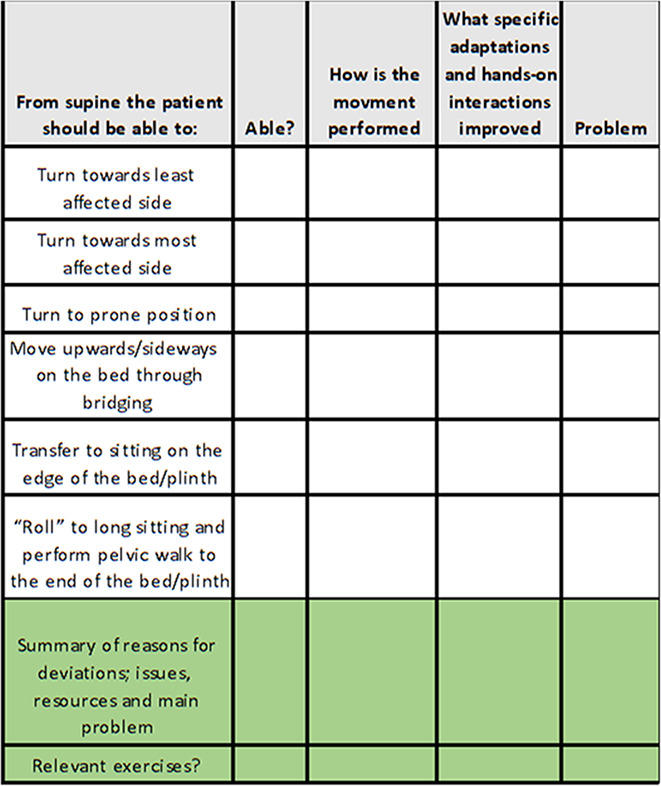
Table 1.
Outline of the I-core DIST intervention.
| Main Features | Assessment | Exercises |
|---|---|---|
| Common features in all exercises are enhancement of dynamic trunk stability and functional movements, combined with the following: Optimized alignment and adaptation to the base of support and often using an unstable reference point for the trunk (therapeutic ball) or the distal body parts. Enhanced somatosensory integration of hands, feet and face, including reduced influence of vision to enhance somatosensory integration.Proximal stability prior to selective task-oriented movement of limbs, head, eyes. Inclusion of dual tasks (motor/motor and motor/cognitive) in exercises and activities such as walking indoors, out-doors and climbing stairs. Specific hands-on interactions or other adaptations to optimize alignment and neuromuscular recruitment. Exercises combining core activation and increase in heart rate: in lying, sitting, standing and walking. |
|
44 exercises, each with five levels of difficulty and choices of starting positions:
All individual exercises have been assigned a color, indicating the main aims: 
|