


Fig. 2. The MHC-II immunopeptidome mirrors the changes observed in the DC proteome.
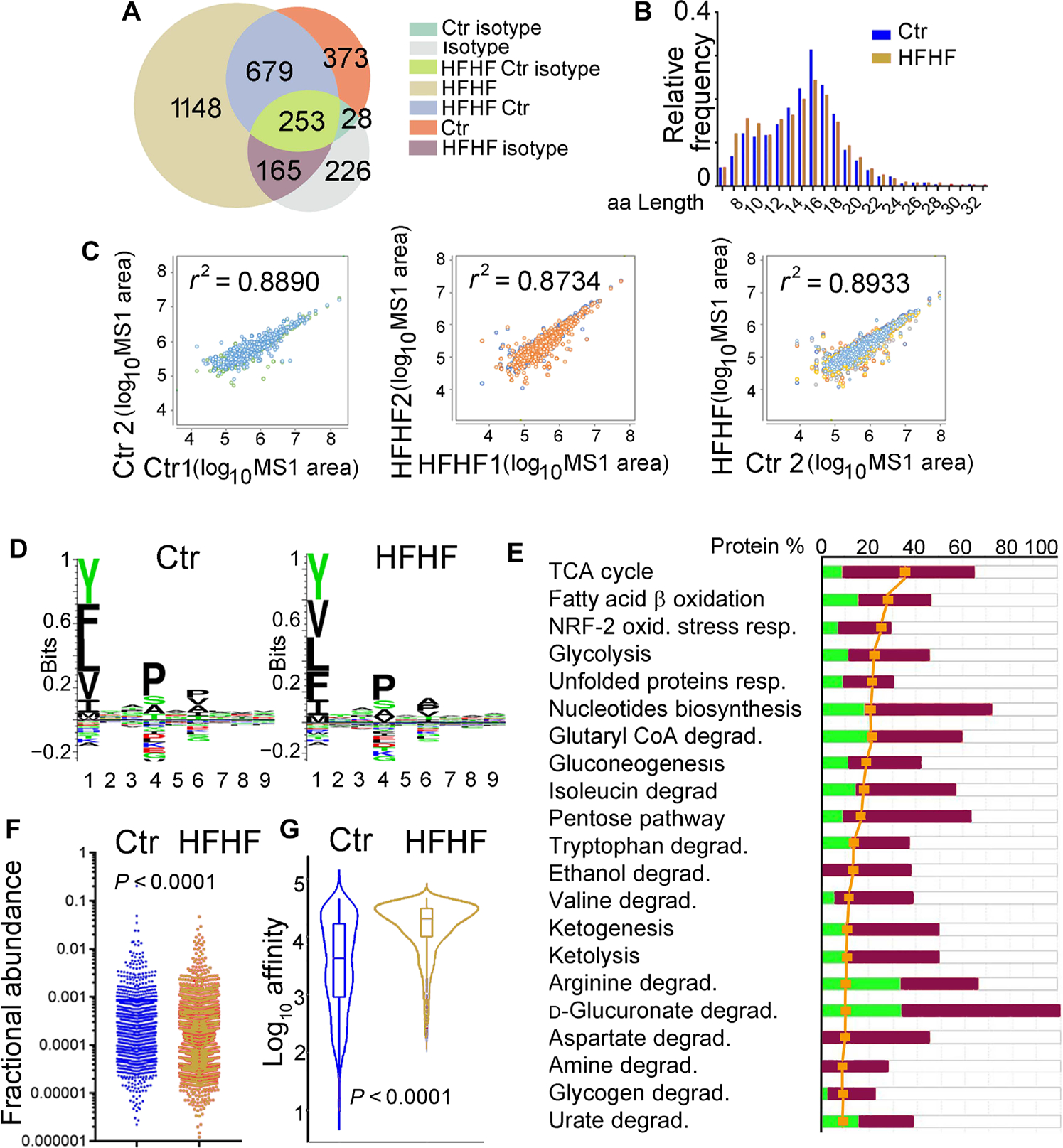
(A) Venn diagram reporting the total number of unique peptides identified by DDA nano-LC-MS/MS in the pooled of biological replicates of the I-Ab–eluted immunopeptidomes (n = 4 for HFHF diet, n = 5 for control diet, n = 2 for isotype control). The complete analysis of I-Ab immunopeptidomes is presented in table S2. (B) Length distribution of I-Ab peptides eluted from control and HFHF was similar, with a median length of ~14 amino acids (aa). (C) Correlation plots of the I-Ab peptides (MS1 area) eluted from HFHF or control mice. Left: Control biological replicates (n = 5). Middle: HFHF biological replicates (n = 4). Right: Combined HFHF versus the control biological replicates. The correlation plots together with the Pearson’s correlation scores are presented in table S2. (D) I-Ab–eluted peptides from control and HFHF DCs were analyzed using GibbsCluster 2.0 Server to identify binding motif and displayed using Seq2Logo. No differences were seen in the binding motives for control versus HFHF mice. (E) Analysis of the pathways associated with the proteins derived from the I-Ab–eluted peptides undergoing significant fold changes in HFHF versus controls. The IPA-mediated quantitative analysis indicates for each pathway the percentage of proteins that are up-regulated (red) or down-regulated (green) in Ob/Ob mice as compared with controls. The yellow symbols indicate the “ratio” corresponding to the number of proteins from the experimental dataset mapped to each pathway divided by the total number of proteins that map to the canonical pathway from the IPA knowledgebase. The ratio is transformed into the significance and scored as −log(P value) from Fisher’s exact test; the significance threshold was set to a value of 1.3 for this dataset. Metabolic and stress pathways are the most affected by the HFHF diet. (F) Fractional abundance for all the unique peptides eluted from control and HFHF mice. (G) Predicted IC50 for the I-Ab–eluted peptides from control and HFHF DCs.