



Abstract
Purpose
Due to its long-term longitudinal design, the National Longitudinal Study of Adolescent to Adult Health (Add Health) has provided numerous valuable insights into adolescent and young adult sexual behavior. Framed by a conceptual model of sexual behavior and health, I review research using Add Health data to study sexual behavior and health.
Methods
I review research examining both predictors (e.g., neighborhood, family, genetic, individual) and health outcomes (e.g., STIs, mental health) of sexual behavior in adolescents and young adults. Where possible, I focus on long-term longitudinal studies that make use of the unique strengths of the Add Health data.
Results
Add Health has provided considerable information about both the predictors and health consequences of adolescent and young adult sexual behavior. Factors ranging from neighborhoods to genetics predict whether adolescent and young adults engage in sexual behaviors. Findings on long-term outcomes of adolescent sexual behavior suggest that early sexual behavior predicts higher rates of sexually transmitted infections and pregnancy in young adulthood, but not long-term changes to mental health.
Conclusions
Unique contributions of Add Health include the ability to examine multidimensional bio-ecological predictors of sexual behavior and to examine long-term effects of sexual behavior and how sexual behaviors and their correlates change across adolescence into adulthood. Future work can leverage these strengths, and in particular the long-term longitudinal nature of the data, to uncover new insights about the developmental course of sexual behavior and health.
Keywords: sexual behavior, adolescent health, review, conceptual framework
Sexual behaviors are developmental, as their prevalence, predictors, and outcomes differ across age.1 In adulthood, sexual behavior is viewed as part of healthy relationships; however, in adolescence, sexual behavior is often viewed from a risk perspective with a focus on negative outcomes.2 Adolescent sexual behavior is viewed as problematic due to perceptions of immaturity rather than inherent risk, making it important to also examine sexual behavior from a normative developmental perspective.3 This approach necessitates the use of long-term longitudinal data. The National Longitudinal Study of Adolescent to Adult Health (Add Health)4 is uniquely suited to understanding sexual development across adolescence into adulthood. Add Health is a nationally-representative U.S. study of individuals recruited from schools in the 7th-12th grades5. It includes five waves of survey data (WI: ages 12–20, 1994–1995; WII: ages 12–20, 1995–1996; WIII: ages 18–26, 2001–2002; WIV: ages 24–32, 2007–2008; and WV: ages 33–43, 2016–2018) as well genetic, biomarker, romantic partner, contextual, and parent data.5,6 It includes measures of sexual behavior, as well as attitudes like perceived benefits and parent disapproval.7 In this paper, I highlight studies from Add Health that demonstrate research on predictors of sexual behaviors and how they are associated with health outcomes in adolescence and young adulthood.
Methods
Papers were selected as part of an unstructured literature review designed to find illustrative examples of the multiple topics and types of data used in studies of sexual behavior in Add Health. I selected papers for the review that fit with the topic areas specified by my model of sexual behavior and health (Figure 1)8 and were relevant to the priorities of this special supplement, such as the role of social context, a bio-social framework, and use of longer-term longitudinal data. Note that this conceptual model is used to identify areas for review; however, the studies may not test all pathways in the exact ways indicated. These studies should not be viewed a comprehensive review of all research using Add Health, but instead were chosen to demonstrate the many ways this data has been used to study sexual behavior and health. Where possible, studies were chosen that made use of long-term longitudinal data, especially how factors from adolescent waves (WI-WII) were associated with outcomes in young adult (WIII-WIV) or adult (WV) waves, to demonstrate the unique potential of the design. However, in cases where only cross-sectional or short-term longitudinal studies (i.e., WI-WII) were available on a topic, these were included.
Figure 1.
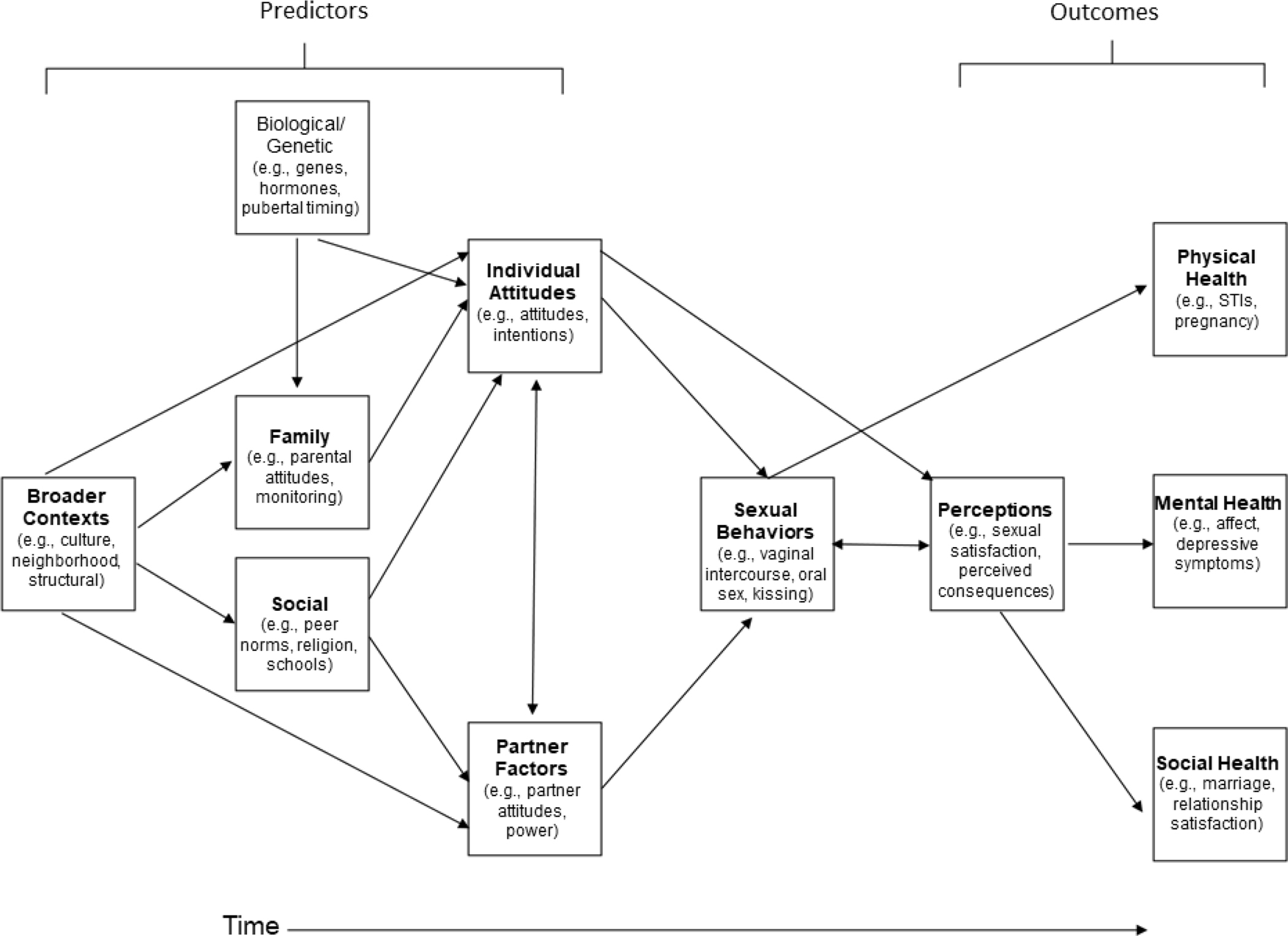
Conceptual model of sexual behavior and health. Adapted from Vasilenko, Lefkowitz, & Welsh, 2014.
Papers discussed here focus on the prevalence of various sexual behaviors, their predictors, and their health outcomes. Several different sexual behaviors are measured in Add Health and used in the research reviewed here. First, many studies examine occurrence of vaginal intercourse, either in the past-year or lifetime. Second, research often focuses on sexual behaviors that carry more risk for STIs, unintended pregnancy, or mental health outcomes, such as sex with multiple past-year partners, early timing of first intercourse, and sex with a non-relationship partner.9,10Third, while not measured for all participants in the adolescent waves, Add Health has some information about non-intercourse sexual behaviors, such as retrospective reports of occurrence and timing of oral and anal sex (WIV) and occurrence of earlier sexual and romantic relationships within relationships (e.g., kissing, touching; WI-WII). Finally, Add Health also contains measures of protective behaviors like condoms and hormonal contraception. All of these types of sexual behaviors are a focus of this review; however, as it is not an exhaustive review, I do not discuss whether each of these types if behaviors has been the focus of a particular area of study, but instead provide illustrative examples of broader concepts as described above.
Prevalence of Sexual Behaviors Across Age
Add Health is one of several national studies of adolescent sexual behavior in the 1990s; estimates of sexual activity differed across studies, with Add Health generally having intermediate prevalence compared to the others.11 These differences may be due to study design; Add Health used an at-home computer-assisted survey for questions about sexual behavior, which may have given adolescents a greater feeling of privacy compared to other surveys which utilized interviews or surveys in classrooms.11 Despite the differences in prevalence estimates, similar patterns by factors like gender and race/ethnicity were found across studies, suggesting commonalities across these data.11 Add Health data shows that sexual behavior prevalence is developmental; only about 10% of individuals engaged in sexual intercourse in the past year at age 14, whereas about 90% did so by their early twenties.2 Rates of sex with multiple past-year partners increased from adolescence through young adulthood, although the percentage of sexually active individuals having multiple partners remained relatively constant.2,12 By WIV (ages 24–32), only 3% of participants reported never engaging in either oral, vaginal, or anal sexual behavior.13 At age 31, the mean number of lifetime sexual partners was 9 for women and 14 for men.14 Although most research focuses on vaginal intercourse, studies using person-centered approaches to uncover patterns of multiple behaviors demonstrate the multidimensionality of sexual behavior. A study of adolescents found that 40% were abstinent, 10% engaged in oral sex only, 25% were sexually active but engaged in relatively low-risk behavior, 12% had multiple partners past-year and a normative age (16 years or later) at first intercourse, and 13% had multiple partners and an early initiation of sexual intercourse.15. Another found about half of individuals followed a pattern of sexual initiation in which they first engaged in vaginal intercourse, followed by initiation of another behavior at least one year later. However, 32% of individuals initiated both vaginal intercourse and another behavior within a year in adolescence, whereas less than 10% of individuals belonged to classes marked by engaging in only vaginal intercourse, delaying sex until young adulthood, or early initiation of sexual behaviors, including oral sex.16
Sexual behaviors differ by demographic subgroup. Male participants were more likely to have multiple past-year partners compared to female participants between ages 25 and 29.12 Until age 20 for males and age 28 for females, Black participants were more likely to engage in past-year intercourse compared to other groups; however, after age 24 White males were most likely.17 Black participants were more likely to have multiple partners at most ages, but more likely to use condoms when sexually active.17 Although Black, White, and Latina young adult women all had patterns of sexual behavior marked by low, moderate, and high-risk sexual behaviors, the behaviors differed by race. Black women in the moderate risk class were unlikely to have oral sex and more likely to use condoms, whereas Latina women in the moderate risk class were monogamous but had high rates of STIs due to partner risk factors.18 Sexual minority adolescents and young adults also follow distinct patterns of initiation, with fewer initiating only vaginal sex and more initiating other behaviors compared to heterosexuals.19
Predictors of Sexual Behavior
Drawing from bioecological models, my model suggests that there are numerous complex, dynamic and interacting multilevel factors that may influence sexual behavior.20,21 In this section, I highlight how Add Health data have informed research on multidimensional predictors of sexual behavior, including broader contextual factors, biological and genetic factors, relationship factors, and individual attitudes.
Broader contextual factors
Broader contexts, such as neighborhoods, influence adolescent sexual behavior. Compared to those in upper middle class White suburbs, adolescents in working class White rural neighborhoods and poor Black rural neighborhoods had a higher likelihood of vaginal intercourse and more sexual partners whereas adolescents from middle class Hispanic/Asian suburbs, working class mixed race urban, and poor Hispanic urban areas had fewer partners by young adulthood.22 Individuals in neighborhoods with more permissive sexual attitudes had more partners than those in areas with less permissive attitudes.22 Neighborhood context also moderates the effect of other factors; for example, parental restriction of activities was associated with a lesser likelihood of initiation for adolescents in disadvantaged neighborhoods but a greater likelihood in advantaged neighborhoods.23 Although Add Health focused primarily on contextual factors directly impacting adolescents than cultural or societal factors, findings from Add Health suggest how structural factors, such as structural racism, may influence sexual behavior. For example, having parents who were incarcerated is associated with sexual risk behaviors and STIs in early adulthood24; due to racial bias in policing and incarceration, these findings suggest a potential structural mechanism for health disparities in STIs.
Family
While most studies examining family factors focused on adolescence, some studies have used long-term longitudinal data to examine whether effects last through young adulthood. Parent-adolescent relationship quality was associated with lower likelihood of initiation of intercourse and unprotected sex in adolescence and STIs in young adulthood.25 Closer relationship to father in adolescence was associated with delay of intercourse in cross-sectional analyses (W1), but was no longer significant in young adulthood (W3).26 However, family closeness and parental behavioral control in adolescence predicted the number of partners in early adulthood, both directly and through early intercourse.27 Perceiving stronger parental disapproval of sex and more family warmth in adolescence predicted fewer partners in adolescence as well as slower growth in the number of partners across young adulthood.28,29
Other Social Influences
Peers and schools.
Add Health studies have suggested that peers and school factors influence adolescent sexual behavior. For example, teacher support was associated with lesser likelihood of sexual initiation among adolescents.30 In addition, a study using the peer network data found that having 10% more friends who have initiated vaginal intercourse was associated with increased probability of vaginal sex initiation and multiple partners.31 However, longer-term longitudinal research suggests that adolescents who were closer to their peers were less likely to engage in sexual intercourse in adolescence, but there were no differences in young adult behavior.26 However, peer norms about sexual behavior may play an important role; one study found that feeling that peers were more accepting of sexual behavior was associated with more partners in adolescence and greater growth in number of partners through young adulthood.28 Individuals who attend a school with a higher percentage of sexually experienced students have more sexual partners, but do not experience greater growth in number of partners through young adulthood.28
Religion.
Greater religiosity predicts a lesser likelihood of adolescent sexual initiation, and this association may be mediated by sexual attitudes.32,33 Religiosity continues to play an important role through adulthood; individuals who attend religious services regularly in adolescence are less likely to have engaged in oral, vaginal, or anal sex by ages 24–32.16 Among Black adults, frequent religious service attendance was associated with fewer lifetime partners, and feeling religion is important was associated with fewer partners and lower sexual frequency.34 A study of patterns of religiosity in adolescence found that nearly half of adolescents endorsed multiple indicators of religiosity, and about one quarter had a primarily private religiosity. A smaller number were not religious, had only an affiliation, or engaged only in public activities.35 Adolescents endorsing multiple dimensions of religiosity had a lower prevalence of non-relationship sex than those with other patterns in both adolescence and young adulthood.35
Partner Influence
Although many social relationships influence sexual behavior, understanding partner or romantic relationship influences is crucial due to the partnered nature of sexual behaviors. Adolescents who are dating or in a romantic relationship are more likely to engage in intercourse than those who are not in a relationship,33 although lifetime non-relationship sex is common.36 Adolescents who were friends with their partner prior to the relationship were less likely to engage in intercourse, more likely to discuss STIs or contraception, and more likely to use birth control consistently with that partner.37 Several studies have used dyadic data to understand how male and female partners’ characteristics predict sexual behavior. For example, dating young adult couples with discordant or low levels of intimacy were more likely to use condoms, and those in relationships with longer duration were more likely to use hormonal contraception.38 Both male and female adolescents’ sexual intentions and female partners’ delinquent behaviors predicted intercourse;39 however, male partners’ contraceptive attitudes played a stronger role in predicting the dyad’s condom use.40 One study categorized types of couples based on multiple factors associated with sexual behavior for male and female partners, and found that the most common pattern was marked by contexts with more permissive sexual attitudes for male compared to female partners. In addition, couples where both partners intended to have sex were more likely to engage in intercourse.41
Biological and genetic factors
Behavioral genetic research suggests that genetically influenced traits predispose some individuals toward early sexual activity.42 Sibling studies have found that genetic factors in pubertal timing predicted age of first vaginal intercourse, but environmental factors related to perceived pubertal timing also played an independent role.43 Similarly, sibling research has suggested heritability in adolescents’ sexual attitudes and young adult sexual behaviors.44 However, genetic influences were stronger among individuals who did not experience adversity like low SES or father absence45. In addition, molecular genetic studies have found genes associated with adolescent sexual behavior, including that the 3R genotype in the DRD4 gene was associated with sexual initiation and the VNTR polymorphism in the DAT1 gene was associated with more sexual partners in white male adolescents.46,47 However, molecular genetic studies also suggest that environmental factors moderate genetic effects, with protective effects of the 9R/9R genotype on number of partners not present in schools with many students initiating early.47
Individual attitudes
Guided by theories of behavior change (e.g., Theory of Planned Behavior; Theory of Reasoned Action48,49), numerous Add Health studies have examined how sexual attitudes are associated with sexual behaviors, commonly utilizing measures of perceived costs and benefits of sex. Although too many to fully review here, considerable Add research has linked adolescent sexual attitudes to adolescent sexual behavior, with those who believe sexual behavior will have more negative consequences less likely to initiate or engage in risker behaviors.e.g 50,51 Less research has examined the role of sexual attitudes into adulthood, but some findings suggest a lasting influence. One study found that men and women who perceived greater benefits of sex as adolescents reported a greater number of lifetime sexual behaviors in young adulthood, while women who perceived more costs of sex had fewer lifetime partners.52
Summary of findings on predictors
Add Health data have demonstrated many factors that predict sexual behavior, allowing for unique contributions that span a breadth of bio-ecological factors and whether adolescent influences extend into young adulthood. A particular contribution of this data on multiple levels of influence is the ability to detect interactions of multiple factors, such as how neighborhoods moderate family effects23 and how environmental factors moderate genetic effects.45
Outcomes of Sexual Behavior
My model focuses on how sexual behaviors are associated with physical, mental, and social health outcomes, drawing from the World Health Organization’s definition of health.8 This includes how sexual behavior may be directly associated with physical outcomes like pregnancy or sexually transmitted infections (STIs) and indirectly associated with mental and social health outcomes through their perceptions of their behavior.
Physical Health
Extensive Add Health research has examined STIs and unintended pregnancy. For example, early initiation and risky behaviors in adolescence are associated with STIs in young adulthood,10,53–55 although other research has not found these associations into young adulthood56. Black and American Indian young adults are more likely to contract STIs, though these disparities are not fully explained by sexual behavior, and may reflect network factors, such as race-specific assortative mating.57,58 In addition, there are differences in young adult STIs by sexual orientation, with bisexual women and bisexual and gay-identified men who have sex with both men and women at particular risk.59 Experiencing more adverse life experiences and having more permissive friend attitudes in adolescence was associated with greater odds of unintended pregnancy by young adulthood.60,61 Rates of unintended pregnancy are generally higher among ethnic minority women.60 Most research on physical consequences has focused on negative outcomes. However, some research has examined prevalence of orgasm, finding that the vast majority of men reported orgasm on all or nearly all occasions of sexual behavior, whereas less than half of women did, and that individuals in more committed relationships reported experiencing orgasm more regularly.62
Perceptions of Sexual Behaviors
My model posits that an individual’s sexual behaviors may impact their mental and relationship health through the way they perceive or feel about their sexual behavior.8 This can include positive and negative feelings, like guilt, shame, or sexual satisfaction. While perceptions have been studied infrequently, some Add Health research has examined sexual enjoyment. One study of young adults found that men reported greater sexual enjoyment compared to women, and that women reported greater sexual enjoyment when they had greater autonomy, higher self-esteem, and more empathy.62 Another found that young adults’ sexual enjoyment was higher for those with more equitable relationships and a higher relationship commitment.63
Mental health
There has been considerable research on early sexual behavior and mental health. Studies of WI-II found that early (before age 16) initiation of sexual intercourse predicts depressive symptoms a year later for adolescent girls, but not boys.64–66 The association between past-year sexual intercourse and depressive symptoms differed across adolescence and young adulthood; intercourse was associated with higher depressive symptoms before age 16 for male and before age 20 for female adolescents.2 However, studies of long-term impacts provide additional nuance. Some research suggests that individuals who initiated vaginal intercourse earlier had higher depressive symptoms in young adulthood; however, this association may be explained by other factors.55,67 For example, a causal inference study did not find associations between early initiation and young adult depressive symptoms.54 Associations between adolescent sexual behavior and depressive symptoms may depend on the relationship with sexual partners. In a study of sibling pairs, the association between adolescent sexual behavior within a romantic relationship and depressive symptoms could be explained by genetic and family environmental confounds, while sex outside of a romantic relationship predicted greater depressive symptoms, even when controlling for these other factors.68
Social/Relationship Health
Because sexual behavior is partnered, sexual behaviors may have implications for romantic relationships. Several studies have examined how adolescent sexual behavior is associated with young adult relationships. Engaging in first intercourse at a later age was associated with a lower likelihood of cohabitation, lower relationship dissatisfaction, and fewer lifetime romantic partners by young adulthood; however, there were no differences in likelihood of marriage.69 Early oral sex was associated with lower relationship satisfaction in young adulthood for women, though this may be due to a higher likelihood of forced sex or STIs.70 Sexual behavior in adolescent romantic relationships was associated with greater odds of both marrying and cohabiting in young adulthood, whereas non-romantic sexual behavior predicted cohabiting only.71 Other studies have examined how patterns of sexual behaviors predict later relationship outcomes. For example, having more lifetime sexual partners was associated with lower sexual satisfaction for individuals with a pattern of sexual initiation in which they first engaged in vaginal intercourse, followed by initiation of another behavior at least one year later, but not other patterns of initiation.72 Adolescents who had relationships that did not include sexual behavior and those who had committed relationships were the most likely to marry by young adulthood compared to other patterns.73
Summary of findings on outcomes
The Add Health data have contributed to the study of health outcomes of sexual behavior. The longitudinal design allows researchers to understand how adolescent behavior is associated with longer-term outcomes. Findings suggest early sexual behavior in is associated with physical health outcomes like STIs; however, there is limited evidence of long-term effects of adolescent behavior on mental health outcomes, and associations with relationship health are complex.
Limitations
Although Add Health has contributed immensely to the study of sexual behavior and health, there are caveats. The adolescent data was collected in the mid-nineties. While such a lag is necessary for long-term longitudinal data, it raises questions about t relevance to adolescents today, as research has suggested declines in prevalence of sexual intercourse among adolescents across the 2010s compared to the 1990s and 2000s.74 In addition, Add Health data may not fully reflect many issues receiving recent attention, including adolescent sexual orientation and gender identity, non-monogamy, and asexuality. It is also difficult to examine non-consensual sex or wantedness of sex, as this information was not available for behaviors like first intercourse, which is a limitations in studies of first intercourse and mental health.64 Thus, although Add Health has made and will continue to make many contributions, it is also important to include measures of sexual behavior in future nationally representative studies, such as the Adolescent Brain and Cognitive Development study.75 Additionally, Add Health only collected data in the U.S. and did not focus on cultural factors; thus the ability to examine the role of culture is limited.
There are other limitations to this paper. First, it is not comprehensive, and should be viewed as a demonstration of the many types of research using Add Health. In addition, there are areas outside of the scope of the paper. Space limitations preclude fully comparing research examining adolescent versus young adult outcomes, or comparing results from Add Health and other data. In addition, space constraints meant that although I present examples of areas in which research has found demographic differences in sexual behavior and its outcomes, I am not able to discuss explicitly whether or not these differences were measured for all topics.
Future Directions
This paper demonstrates the breadth of questions related to sexual behavior and health that have been examined using Add Health. However, given the unique features of the data, there are still many areas that could make use the of the longitudinal nature of this rich dataset.
Prior research has suggested that multilevel factors predict sexual behavior; however, few studies have examined multiple types of risk and protective factors simultaneously. One such study 50 found that individual, family, and neighborhood factors were associated with a cumulative sexual risk index and number of non-romantic partners during adolescence, providing information about which factors have an influence over and above that of others. In addition, one study examining the interaction of parent and neighborhood factors found that the impact of parental restriction of adolescent activities on sexual behavior was different depending on whether the adolescent lived in an advantaged or disadvantaged neighborhood, suggesting the importance of studying these factors together23. Person-centered methods like LCA may be used to identify unique patterns of risk factors, as my collaborator and I have done in a recent paper.76 Seeing how profiles of risk factors are associated with later sexual behavior could help us understand the complex interplay of factors that influence sexual behavior and help to determine which groups of adolescent to target in intervention programs or public health initiatives.
Drawing from a normative developmental perspective,77 it is important to investigate positive outcomes, which have been less commonly studied than risk-focused outcomes. For example, there is a lack of discussion of pleasure in sexual and reproductive health research.78 The young adult interviews in Add Health include topics like sexual enjoyment and satisfaction, liked sexual activities, orgasm and relationship satisfaction. As reviewed above, several studies used these variables; however, there remains much to be understood about positive sexual experiences.
Another important area is understanding how characteristics of romantic relationships influence sexual behavior and physical, mental, and social health outcomes, as sexual behavior typically includes a partner. Research like that reviewed above has shown that relationship factors are important in predicting more positive perceptions and mental health outcomes linked to sexual behavior. Add Health has extensive data about individuals’ romantic partners, including dyadic data from WI and WIII. However, relatively few studies have used these dyadic data to understand the intersections of couple characteristics and sexual behavior. This data is available to researchers who complete the process for obtaining contractual data. In addition, researchers can gain information on using and analyzing dyadic data from a number of sources including books79 and tutorial papers on popular methods like the actor-partner interdependence model80–83 and more novel methods like dyad-centered analyses.41
Some Add Health studies have examined differences in sexual behaviors and their correlates by race and ethnicity. However, it is important expand on this work documenting between-group disparities and better understand heterogeneity within groups. Examining sexual behavior in racial and ethnic minority groups from a normative developmental perspective is of particular importance. One example is a pair of studies by Thorpe in which she and her colleagues have examined normative sexual experiences, such as expectations of pleasure and experiencing orgasm among Black women, a population whose sexuality has often been approached from a perspective of risk or definiciency.84,85 Instead, her work has demonstrated how black women’s sexual relationships are marked by sexual agency and pleasure.
Add Health WV data are available in contractual and public use versions and include data on married, cohabiting, dating, and sexual partners, sexual frequency, sexual satisfaction, and concurrent partnerships. Although these topics have been examined, few datasets have long-term prospective data that can examine early influences on adult sexuality or changes over the lifespan. Analyses that capitalize on repeated measurements over time could offer new insights. For example, I applied the time-varying effect model (TVEM),86 to examine how correlates of sexual behaviors may differ across adolescence and young adulthood, finding that associations between substance use and multiple sexual partners were stronger earlier in adolescence.12 Add Health data are well-suited for this type of analysis because of the continuous coverage across a large age range (12–42). Such findings can inform public health efforts intended to target specific risk factors at different ages.87 Building on this base of multi-wave analysis will allow new insights into the developmental nature of sexual behavior and health.
References
- 1.Vasilenko SA, Linden-Carmichael A, Lanza ST, Patrick ME. Sexual behavior and heavy episodic drinking across the transition to adulthood: Differences by college attendance. J Res Adolesc. 2018;28(2):473–487. doi: 10.1111/jora.12348 [DOI] [PMC free article] [PubMed] [Google Scholar]
- 2.Vasilenko SA. Age-varying associations between nonmarital sexual behavior and depressive symptoms across adolescence and young adulthood. Dev Psychol. 2017;53(2):366–378. doi: 10.1037/dev0000229 [DOI] [PMC free article] [PubMed] [Google Scholar]
- 3.Halpern CT. Reframing research on adolescent sexuality: Healthy sexual development as part of the life course. Perspect Sex Reprod Health. 2010;42(1):6–7. doi: 10.1363/420610 [DOI] [PubMed] [Google Scholar]
- 4.Harris KM, Halpern CT, Whitsel EA, et al. Cohort Profile: The National Longitudinal Study of Adolescent to Adult Health (Add Health). Int J Epidemiol. 2019;48(5):1415–1415k. doi: 10.1093/ije/dyz115 [DOI] [PMC free article] [PubMed] [Google Scholar]
- 5.Introduction to this special supplement.
- 6.Udry JR, Bearman PS. New methods for new research on adolescent sexual behavior. In: Jessor R, ed. New Perspectives on Adolescent Risk Behavior. Cambridge University Press; 1998:241–269. doi: 10.1017/CBO9780511571138.009 [DOI] [Google Scholar]
- 7.Sieving RE, Beuhring T, Resnick MD, et al. Development of Adolescent Self-Report Measures From the National Longitudinal Study of Adolescent Health. J Adolesc Heal. 2001;28(1):73–81. [DOI] [PubMed] [Google Scholar]
- 8.Vasilenko SA, Lefkowitz ES, Welsh DP. Is Sexual Behavior Healthy for Adolescents? A Conceptual Framework for Research on Adolescent Sexual Behavior and Physical, Mental, and Social Health. New Dir Child Adolesc Dev. 2014;2014(144):3–19. doi: 10.1002/cad.20057 [DOI] [PubMed] [Google Scholar]
- 9.Meier AM. Adolescent first sex and subsequent mental health. Am J Sociol. 2007;112(6):1811–1847. doi: 10.1086/512708 [DOI] [Google Scholar]
- 10.Scott ME, Wildsmith E, Welti K, Ryan S, Schelar E, Steward-Streng NR. Risky Adolescent Sexual Behaviors and Reproductive Health in Young Adulthood. Perspect Sex Reprod Health. 2011;43(2):110–118. doi: 10.1363/4311011 [DOI] [PubMed] [Google Scholar]
- 11.Santelli JS, Lindberg LD, Abma J, McNeely CS, Resnick M. Adolescent Sexual Behavior: Estimates and Trends from Four Nationally Representative Surveys. Fam Plann Perspect. 2000;32(4):156. doi: 10.2307/2648232 [DOI] [PubMed] [Google Scholar]
- 12.Vasilenko SA, Lanza ST. Predictors of multiple sexual partners from adolescence through young adulthood. J Adolesc Heal. 2014;55(4). doi: 10.1016/j.jadohealth.2013.12.025 [DOI] [PMC free article] [PubMed] [Google Scholar]
- 13.Haydon AA, Cheng MM, Herring AH, McRee AL, Halpern CT. Prevalence and predictors of sexual inexperience in adulthood. Arch Sex Behav. 2014;43(2):221–230. doi: 10.1007/s10508-013-0164-3 [DOI] [PMC free article] [PubMed] [Google Scholar]
- 14.Mahalik RJ, Levine Coley R, McPherran Lombardi C, Doyle Lynch A, Markowitz JA, Jaffee RS. Changes in Health Risk Behaviors for Males and Females From Early Adolescence Through Early Adulthood. Heal Psychol. 2013;32(6):685–694. doi: 10.1037/a0031658 [DOI] [PubMed] [Google Scholar]
- 15.Vasilenko SA, Kugler KC, Butera NM, Lanza ST. Patterns of adolescent sexual behavior predicting young adult sexually transmitted infections: a latent class analysis approach. Arch Sex Behav. 2015;44(3). doi: 10.1007/s10508-014-0258-6 [DOI] [PMC free article] [PubMed] [Google Scholar]
- 16.Haydon AA, Herring AH, Prinstein MJ, Halpern CT. Beyond age at first sex: Patterns of emerging sexual behavior in adolescence and young adulthood. J Adolesc Heal. 2012;50(5):456–463. doi: 10.1016/j.jadohealth.2011.09.006 [DOI] [PMC free article] [PubMed] [Google Scholar]
- 17.Vasilenko SA, Espinosa-Hernández G, Smith CS, Lanza ST. Disparities in Sexual Behavior by Race/Ethnicity and Gender Across Adolescence and Young Adulthood. 2022;Manuscript. [Google Scholar]
- 18.Pflieger JC, Cook EC, Niccolai LM, Connell CM. Racial/ethnic differences in patterns of sexual risk behavior and rates of sexually transmitted infections among female young adults. Am J Public Health. 2013;103(5):903–909. doi: 10.2105/AJPH.2012.301005 [DOI] [PMC free article] [PubMed] [Google Scholar]
- 19.Goldberg SK, Halpern CT. Sexual initiation patterns of U.S. sexual minority youth: A latent class analysis. Perspect Sex Reprod Health. 2017;49(1). doi: 10.1363/psrh.12020 [DOI] [PMC free article] [PubMed] [Google Scholar]
- 20.Bronfenbrenner U, Morris PA. The Bioecological Model of Human Development. In: Damon W, RM L, eds. Handbook of Child Psychology. Wiley; 2007:793–828. [Google Scholar]
- 21.DiClemente RJ, Salazaar LF, Crosby RA, Salazar LF. A Review of STD/HIV Preventive Interventions for Adolescents: Sustaining Effects Using an Ecological Approach. J Pediatr Psychol. 2007;32(8):888–906. doi: 10.1093/jpepsy/jsm056 [DOI] [PubMed] [Google Scholar]
- 22.Warner TD. Adolescent Sexual Risk Taking: The Distribution of Youth Behaviors and Perceived Peer Attitudes Across Neighborhood Contexts. J Adolesc Heal. 2018;62(2):226–233. doi: 10.1016/j.jadohealth.2017.09.007 [DOI] [PMC free article] [PubMed] [Google Scholar]
- 23.Roche KM, Mekos D, Alexander CS, Astone NM, Bandeen-Roche K, Ensminger ME. Parenting Influences on Early Sex Initiation among Adolescents: How Neighborhood Matters. J Fam Issues. 2005;26(1):32–54. doi: 10.1177/0192513X04265943 [DOI] [Google Scholar]
- 24.Le GT, Deardorff J, Lahiff M, Harley KG. Intergenerational Associations Between Parental Incarceration and Children’s Sexual Risk Taking in Young Adulthood. J Adolesc Heal. 2019;64(3):398–404. doi: 10.1016/j.jadohealth.2018.09.028 [DOI] [PubMed] [Google Scholar]
- 25.Deptula DP, Henry DB, Schoeny ME. How Can Parents Make a Difference? Longitudinal Associations With Adolescent Sexual Behavior. J Fam Psychol. 2010;24(6):731–739. doi: 10.1037/a0021760 [DOI] [PubMed] [Google Scholar]
- 26.Rink E, Tricker R, Harvey SM. Onset of Sexual Intercourse among Female Adolescents: The Influence of Perceptions, Depression, and Ecological Factors. J Adolesc Heal. 2007;41(4):398–406. doi: 10.1016/j.jadohealth.2007.04.017 [DOI] [PubMed] [Google Scholar]
- 27.Roche KM, Ahmed S, Blum RW. Enduring consequences of parenting for risk behaviors from adolescence into early adulthood. Soc Sci Med. 2008;66(9):2023–2034. doi: 10.1016/j.socscimed.2008.01.009 [DOI] [PubMed] [Google Scholar]
- 28.Coley RL, Ph D, Mcpherran C, et al. Sexual partner accumulation from adolescence through early adulthood: The role of family, peer, and school social norms. 2013;53(1):91–97. doi: 10.1016/j.jadohealth.2013.01.005 [DOI] [PMC free article] [PubMed] [Google Scholar]
- 29.Kan ML, Cheng YA, Landale NS, McHale SM. Longitudinal Predictors of Change in Number of Sexual Partners across Adolescence and Early Adulthood. J Adolesc Heal. 2010;46(1):25–31. doi: 10.1016/j.jadohealth.2009.05.002 [DOI] [PMC free article] [PubMed] [Google Scholar]
- 30.McNeely C, Falci C. School Connectedness and the Transition Into and Out of Health-Risk Behavior Among Adolescents: A Comparison of Social Belonging and Teacher Support. J Sch Health. 2004;74(7):284–292. doi: 10.1111/j.1746-1561.2004.tb08285.x [DOI] [PubMed] [Google Scholar]
- 31.Ali MM, Dwyer DS. Estimating peer effects in sexual behavior among adolescents. J Adolesc. 2011;34(1):183–190. doi: 10.1016/j.adolescence.2009.12.008 [DOI] [PubMed] [Google Scholar]
- 32.Hardy SA, Raffaelli M. Adolescent religiosity and sexuality: An investigation of reciprocal influences. J Adolesc. 2003;26(6):731–739. doi: 10.1016/j.adolescence.2003.09.003 [DOI] [PubMed] [Google Scholar]
- 33.Meier AM. Adolescents’ transition to first intercourse, religiosity, and attitudes about sex. Soc Forces. 2003;81(3):1031–1052. doi: 10.1353/sof.2003.0039 [DOI] [Google Scholar]
- 34.Broman CL. American adults religiousness, familial and sexual behavior among African American adults. J Black Sex Relationships. 2022;7(1):35–46. doi: 10.1353/bsr.2020.0010 For [DOI] [Google Scholar]
- 35.Vasilenko SA, Espinosa-Hernández G. Multidimensional profiles of religiosity among adolescents: Associations with sexual behaviors and romantic relationships. J Res Adolesc. 2019;29(2). doi: 10.1111/jora.12444 [DOI] [PMC free article] [PubMed] [Google Scholar]
- 36.Sandberg-Thoma SE, Kamp Dush CM. Casual sexual relationships and mental health in adolescence and emerging adulthood. J Sex Res. 2014;51(2):121–130. doi: 10.1080/00224499.2013.821440 [DOI] [PubMed] [Google Scholar]
- 37.Kaestle CE, Halpern CT. Sexual activity among adolescents in romantic relationships with friends, acquaintances, or strangers. Arch Pediatr Med. 2005;159(9):849–853. [DOI] [PubMed] [Google Scholar]
- 38.Wildsmith E, Manlove J, Steward-Streng N. Relationship Characteristics and Contraceptive Use Among Dating and Cohabiting Young Adult Couples. Perspect Sex Reprod Health. 2015;47(1):27–36. doi: 10.1363/47e2515 [DOI] [PubMed] [Google Scholar]
- 39.Cleveland HH. The influence of female and male risk on the occurrence of sexual intercourse within adolescent relationships. J Res Adolesc. 2003;13(1):81–112. doi: 10.1111/1532-7795.1301003 [DOI] [Google Scholar]
- 40.Vasilenko SA, Kreager DA, Lefkowitz ES. Gender, contraceptive attitudes, and condom use in adolescent romantic relationships: A dyadic approach. J Res Adolesc. 2015;25(1):51–62. doi: 10.1111/jora.12091 [DOI] [PMC free article] [PubMed] [Google Scholar]
- 41.Vasilenko SA. More than the sum of their parts: A dyad-centered approach to understanding adolescent sexual behavior. Sex Res Soc Policy. 2022;19:105–118. doi: 10.1007/s13178-020-00528-9 [DOI] [PMC free article] [PubMed] [Google Scholar]
- 42.Harden KP. A Sex-Positive Framework for Research on Adolescent Sexuality. Perspect Psychol Sci. 2014;9(5):455–469. doi: 10.1177/1745691614535934 [DOI] [PubMed] [Google Scholar]
- 43.Moore SR, Harden KP, Mendle J. Pubertal timing and adolescent sexual behavior in girls. Dev Psychol. 2014;50(6):1734–1745. doi: 10.1037/a0036027 [DOI] [PubMed] [Google Scholar]
- 44.McHale SM, Bissell J, Kim JY. Sibling Relationship, Family, and Genetic Factors in Sibling Similarity in Sexual Risk. J Fam Psychol. 2009;23(4):562–572. doi: 10.1037/a0014982 [DOI] [PubMed] [Google Scholar]
- 45.Carlson MD, Mendle J, Harden KP. Early Adverse Environments and Genetic Influences on Age at First Sex : Evidence for Gene ϫ Environment Interaction. Dev Psychol. 2014;50(5):1532–1542. doi: 10.1037/a0035479 [DOI] [PubMed] [Google Scholar]
- 46.Guo G, Tong Y. Age at first sexual intercourse, genes, and social context: Evidence from twins and the dopamine D4 receptor gene. Demography. 2006;43(4):747–769. doi: 10.1353/dem.2006.0029 [DOI] [PubMed] [Google Scholar]
- 47.Guo G, Tong Y, Cai T. Gene by social-context interactions for number of sexual partners among white male youths: Genetics-informed sociology. Am J Sociol. 2008;114(S1):S36–S66. doi: 10.1086/592207 [DOI] [PMC free article] [PubMed] [Google Scholar]
- 48.Ajzen I The theory of planned behavior. Orgnizational Behav Hum Decis Process. 1991;50(2):179–211. doi: 10.1016/0749-5978(91)90020-T [DOI] [Google Scholar]
- 49.Fishbein M, Ajzen I. Belief, Attitude, Intention and Behavior. Addison-Wesley; 1975. [Google Scholar]
- 50.Chen ACC, Thompson EA, Morrison-Beedy D. Multi-system influences on adolescent risky sexual behavior. ResearchinNursing&Health. 2010;33(6):512–527. doi: 10.1002/nur.20409 [DOI] [PubMed] [Google Scholar]
- 51.Rostosky SS, Regnerus MD, Laurie M, et al. Coital debut : The role of religiosity and sex attitudes in the add health survey Coital Debut: The Role of Religiosity and Sex Attitudes in the Add Health Survey. 2010;40(4):358–367. doi: 10.1080/00224490209552202 [DOI] [PubMed] [Google Scholar]
- 52.Guzzo KB, Ph D, Lang VW, Ph D, Hayford SR, Ph D. Do adolescent sexual and reproductive attitudes and knowledge predict men and women’s adult sexual partnerships? J Adolesc Heal. 2021;68(1):95–102. doi: 10.1016/j.jadohealth.2020.05.035 [DOI] [PMC free article] [PubMed] [Google Scholar]
- 53.Reese BM, Haydon AA, Herring AH, Halpern CT. The association between sequences of sexual initiation and the likelihood of teenage pregnancy. J Adolesc Heal. 2013;52(2):228–233. doi: 10.1016/j.jadohealth.2012.06.005 [DOI] [PMC free article] [PubMed] [Google Scholar]
- 54.Kugler KC, Vasilenko SA, Butera NM, Coffman DL. Long-term consequences of early sexual initiation on young adult health: A causal inference approach. J Early Adolesc. 2017;37(5):662–676. doi: 10.1177/0272431615620666 [DOI] [PMC free article] [PubMed] [Google Scholar]
- 55.Vasilenko SA, Kugler KC, Rice CE. Timing of First Sexual Intercourse and Young Adult Health Outcomes. J Adolesc Heal. 2016;59(3):291–297. doi: 10.1016/j.jadohealth.2016.04.019 [DOI] [PMC free article] [PubMed] [Google Scholar]
- 56.Kaestle CE, Halpern CT, Miller WC, Ford CA. Young age at first sexual intercourse and sexually transmitted infections in adolescents and young adults. Am J Epidemiol. 2005;161(8):774–780. doi: 10.1093/aje/kwi095 [DOI] [PubMed] [Google Scholar]
- 57.Eitle D, Greene K, Eitle TM. American Indians, Substance Use, and Sexual Behavior: Do predictors of Sexually Transmitted Infections explain the Race Gap among Young Adults? Sex Transm Dis. 2016;42(2):64–67. doi: 10.1097/OLQ.0000000000000230. [DOI] [PMC free article] [PubMed] [Google Scholar]
- 58.Morris M, Kurth AE, Hamilton DT, Moody J, Wakefield S. Concurrent partnerships and HIV prevalence disparities by race: Linking science and public health practice. Am J Public Health. 2009;99(6):1023–1031. doi: 10.2105/AJPH.2008.147835 [DOI] [PMC free article] [PubMed] [Google Scholar]
- 59.Everett BG. Sexual orientation disparities in sexually transmitted infections: Examining the intersection between sexual identity and sexual behavior. Arch Sex Behav. 2013;42(2):225–236. doi: 10.1007/s10508-012-9902-1 [DOI] [PMC free article] [PubMed] [Google Scholar]
- 60.Hall KS, Beauregard JL, Rentmeester ST, Livingston M, Harris KM. Adverse life experiences and risk of unintended pregnancy in adolescence and early adulthood: Implications for toxic stress and reproductive health. SSM-Population Heal. 2019;7(December 2018). doi: 10.1016/j.ssmph.2018.100344 [DOI] [PMC free article] [PubMed] [Google Scholar]
- 61.Henry DB, Deptula DP, College FS, Schoeny ME, Hall C. Sexually transmitted infections and unintended pregnancy: A longitudinal analysis of risk transmission through friends and attitudes. Soc Dev. 2012;21(1):195–214. doi: 10.1111/j.1467-9507.2011.00626.x [DOI] [PMC free article] [PubMed] [Google Scholar]
- 62.Galinsky AM, Sonenstein FL. The association between developmental assets and sexual enjoyment among emerging adults. J Adolesc Heal. 2011;48(6):610–615. doi: 10.1016/j.jadohealth.2010.09.008 [DOI] [PMC free article] [PubMed] [Google Scholar]
- 63.Galinsky AM, Lund F. Relationship Commitment, Perceived Equity, and Sexual Enjoyment Among Young Adults in the United States. Published online 2013:93–104. doi: 10.1007/s10508-012-0003-y [DOI] [PubMed] [Google Scholar]
- 64.Madkour AS, Farhat T, Halpern CT, Godeau E, Nic Gabhainn S. Early Adolescent Sexual Initiation and Physical/Psychological Symptoms: A Comparative Analysis of Five Nations. J Youth Adolesc. 2010;39(10):1211–1225. doi: 10.1007/s10964-010-9521-x [DOI] [PMC free article] [PubMed] [Google Scholar]
- 65.Meier AM. Adolescent first sex and subsequent mental health. Am J Sociol. 2007;112(6):1811–1847. doi: 10.1086/512708 [DOI] [Google Scholar]
- 66.Spriggs AL, Halpern CT. Sexual debut timing and depressive symptoms in emerging adulthood. J Youth Adolesc. 2008;37(9):1085–1096. doi: 10.1007/s10964-008-9303-x [DOI] [PMC free article] [PubMed] [Google Scholar]
- 67.Jamieson LK, Wade TJ. Early age of first sexual intercourse and depressive symptomatology among adolescents. J Sex Res. 2011;48(5):450–460. doi: 10.1080/00224499.2010.509892 [DOI] [PubMed] [Google Scholar]
- 68.Mendle J, Ferrero J, Moore SR, Paige Harden K. Depression and adolescent sexual activity in romantic and nonromantic relational contexts: A genetically-informative sibling comparison. J Abnorm Psychol. 2013;122(1):51–63. doi: 10.1037/a0029816 [DOI] [PubMed] [Google Scholar]
- 69.Harden KP. True Love Waits? A Sibling-Comparison Study of Age at First Sexual Intercourse and Romantic Relationships in Young Adulthood. Psychol Sci. 2012;23(11):1324–1336. doi: 10.1177/0956797612442550 [DOI] [PubMed] [Google Scholar]
- 70.Holway GV, Tillman KH. Timing of Sexual Initiation and Relationship Satisfaction in Young Adult Marital and Cohabiting Unions. J Fam Issues. 2017;38(12):1675–1700. doi: 10.1177/0192513X15613826 [DOI] [PMC free article] [PubMed] [Google Scholar]
- 71.Raley RK, Crissey S, Muller C. Of sex and romance: Late adolescent relationships and young adult union formation. J Marriage Fam. 2007;69(5):1210–1226. doi: 10.1111/j.1741-3737.2007.00442.x [DOI] [PMC free article] [PubMed] [Google Scholar]
- 72.Kahn NF, Halpern CT. Associations Between Patterns of Sexual Initiation, Sexual Partnering, and Sexual Health Outcomes from Adolescence to Early Adulthood. Arch Sex Behav. 2018;47(6):1791–1810. doi: 10.1007/s10508-018-1176-9 [DOI] [PMC free article] [PubMed] [Google Scholar]
- 73.Vasilenko SA, Kugler KC, Lanza ST. Latent Classes of Adolescent Sexual and Romantic Relationship Experiences: Implications for Adult Sexual Health and Relationship Outcomes. J Sex Res. 2016;53(7):742–753. doi: 10.1080/00224499.2015.1065952 [DOI] [PMC free article] [PubMed] [Google Scholar]
- 74.Twenge JM, Park H. The Decline in adult activities among U.S. adolescents, 1976 – 2016. Child Dev. 2017;90(2):638–654. doi: 10.1111/cdev.12930 [DOI] [PubMed] [Google Scholar]
- 75.Jernigan TL, Brown SA, Dowling GJ. The Adolescent Brain Cognitive Development Study. J Res Adolesc. 2018;28(1):154–156. doi: 10.1111/jora.12374 [DOI] [PMC free article] [PubMed] [Google Scholar]
- 76.Bayly BL, Vasilenko SA. An ecological latent class model of adolescent risk and protective factors : Implications for substance use and depression prevention. 2021;45(4):355–367. doi: 10.1177/01650254211005567 [DOI] [PMC free article] [PubMed] [Google Scholar]
- 77.Tolman DL, Mcclelland SI. Normative sexuality development in adolescence: A decade in review, 2000–2009. J Res Adolesc. 2011;21(1):242–255. doi: 10.1111/j.1532-7795.2010.00726.x [DOI] [Google Scholar]
- 78.Higgins BJA. The pleasure deficit: Revisiting the “sexuality connection” in reproductive health. Perspect Sex Reprod Heal. 2007;33(3):133–139. [DOI] [PubMed] [Google Scholar]
- 79.Kenny DA, Kashy DA, Cook WL. Dyadic Data Analysis. Guilford Publications; 2020. [Google Scholar]
- 80.Campbell L, Kashy DA. Estimating actor, partner, and interaction effects for dyadic data using PROC MIXED and HLM: A user-friendly guide. Pers Relatsh. 2002;9(3):327–342. doi: 10.1111/1475-6811.00023 [DOI] [Google Scholar]
- 81.Loeys T, Cook W, De Smet O, Wietzker A, Buysse A. The actor-partner interdependence model for categorical dyadic data: A user-friendly guide to GEE. Pers Relatsh. 2014;21(2):225–241. doi: 10.1111/pere.12028 [DOI] [Google Scholar]
- 82.Fitzpatrick J, Gareau A, Lafontaine M-F, Gaudreau P. How to Use the Actor-Partner Interdependence Model (APIM) To Estimate Different Dyadic Patterns in MPLUS: A Step-by-Step Tutorial. Quant Methods Psychol. 2016;12(1):74–86. doi: 10.20982/tqmp.12.1.p074 [DOI] [Google Scholar]
- 83.Stas L, Kenny DA, Mayer A, Loeys T. Giving dyadic data analysis away: A user-friendly app for actor–partner interdependence models. Pers Relatsh. 2018;25(1):103–119. doi: 10.1111/pere.12230 [DOI] [Google Scholar]
- 84.Thorpe S, Nichols TR, Tanner AE, Kuperberg A, Payton E. Relational and partner‑specific factors influencing Black heterosexual women’s initiation of sexual intercourse and orgasm frequency. Sex Cult. 2021;25:503–524. doi: 10.1007/s12119-020-09780-y [DOI] [Google Scholar]
- 85.Thorpe S, Tanner AE, Nichols TR, Kuperberg A, Foh EP. Black female adolescents’ sexuality: Pleasure expectancies, sexual guilt, and age of sexual debut. Am J Sex Educ. 2021;16(2):199–220. doi: 10.1080/15546128.2021.1892005 [DOI] [Google Scholar]
- 86.Tan X, Shiyko MP, Li R, Li Y, Dierker L. A time-varying effect model for intensive longitudinal data. Psychol Methods. 2012;17(1):61–77. doi: 10.1037/a0025814 [DOI] [PMC free article] [PubMed] [Google Scholar]
- 87.Coyle KK, DiClemente RJ. Time-varying risk behaviors among adolescents: Implications for enhancing the effectiveness of sexual risk reduction interventions. J Adolesc Heal. 2014;55(4):465–466. doi: 10.1016/j.jadohealth.2014.07.017 [DOI] [PubMed] [Google Scholar]