



Summary:
Vocal fatigue has remained an elusive construct—despite its significant impact on communication, vocation, and quality of life. Current frameworks define vocal fatigue in the context of vocal demands and vocal demand-responses. However, the impact of factors like individuals’ baseline vocal fitness and perception of the demand are not well understood. What is also not well understood are the effects of specific vocal demand ingredients on an individual’s vocal demand responses. Furthermore, current outcome measures utilized to capture vocal fatigue lack sensitivity and underlying mechanisms are poorly understood. These gaps have led to inconclusive next steps in how to best define, assess, monitor, and manage vocal fatigue. A conceptual framework is needed to study and better understand vocal fatigue constructs. Such a framework should consider the individual’s baseline physiology, psychology, key vocal demand ingredients, and biophysiological mechanisms underlying demand responses. The objective of this paper is to help the reader better understand the complex and heterogeneous nature of vocal fatigue and its impact on reliable assessment and monitoring. Future studies will require better elucidation of vocal demand ingredients, will need more sensitive vocal demand response measures, and will need to take in to account an individual’s baseline physiology and psychological factors.
Keywords: Vocal fatigue, Framework, Vocal demands, Vocal demand-responses, Underlying mechanisms, Clinical metrics
INTRODUCTION TO CURRENT VOCAL FATIGUE FRAMEWORK
Vocal fatigue is a debilitating condition that affects communication, vocation, social functioning and quality of life.1,2 Vocal fatigue has traditionally been characterized by its long list of potential clinical features, including vocal effort, strain, tiredness, weakness, and changes in vocal quality—to name a few. Hunter et al, 2020 recently defined vocal fatigue as either a quantifiable decline in physiologic performance of voice production or a quantifiable decline in perception or altered sensation.2 In this paper, we will use the term vocal fatigue when used as an adjective to characterize patient experiences. Prevalence of vocal fatigue experiences in occupational voice users varies anywhere from 18% to 100% across a wide variety of professions including educators, performers, and the service industry.3,4 Occupational voice users can experience vocal fatigue during activities of daily living or when performing specific vocational tasks (eg, teaching, singing).5,6 The result is often missed work, which can lead to lost income and short-term disability. In addition to vocational impacts, the significance of emotional ramifications of communication difficulties from vocal fatigue is well-established.1 Given the high prevalence, communicative detriments, economic burden, and emotional consequences of vocal fatigue, it is critical to determine how to best identify, assess and monitor this condition.
Current vocal fatigue frameworks used to guide experimental designs and clinical management of vocal fatigue typically conceptualize vocal fatigue in the context of its vocal demands (load) and vocal demand-responses (loading) (see Fujiki et al, 2017 for a systematic review of these concepts).7 Hunter et al, 2020 define vocal demands as the vocal requirements for a given communication scenario, independent of the individual’s physiology, techniques, and perception.2 Vocal ingredients within these demands may vary based on pitch, intensity, range, and quality of vocal productions—to name a few. Demand requirements may also be influenced by extrinsic factors like room size, background noise, and environmental humidity levels.7 Vocal demand ingredients can be acute or recurrent. For example, individuals may experience acute vocal fatigue after one session of heavy voice use. If there are no compounding repetitive vocal demands after this one paroxysmal session, vocal fatigue usually resolves on its own. Studies on vocal fatigue typically focus on acute vocal fatigue by introducing 30-60 minutes of a vocal loading task and then assessing acute changes immediately pre- and postvocal load. Hunter et al, 2020 defines this type of acute fatigue as state fatigue.2
Although acute vocal load is the norm when studying vocal fatigue constructs, the majority of patients with vocal fatigue who seek treatment are dealing with what Hunter et al, 2020 refer to as trait fatigue—typically the result of recurrent or persistent vocal demands. These demands can occur over multiple weeks, months, or even years.2 Experimental studies on chronic vocal fatigue are more challenging because it is difficult to determine which vocal demand ingredients were responsible for adaptive versus maladaptive vocal demand responses from these recurrent vocal demands. Hunter et al, 2020 defines these adaptive or maladaptive vocal demand responses as the reactive voice productions to specific communication scenarios.2 An adaptive response may present in an occupational voice user who is able to meet heavy vocal demands placed on their system. A maladaptive response may result in severe acute fatigue that resolves with sufficient time to recover; it may also result in recurrent, or persistent vocal fatigue, where the individual’s system is unable to meet high vocal demands. The latter likely encompasses patients with vocal fatigue who seek clinical care because symptoms of vocal fatigue do not resolve on their own.
In addition to vocal demand ingredients, the determination of an adaptive or a maladaptive vocal demand response is influenced by the individual’s physiology and psychology.2 No two individuals will respond in the exact same way to the same vocal demand task because of differences in baseline voice physiology and fitness, genetics, previous compounding demands placed on the voice system, and differences in psychological perceptions of those demands across individuals. Studies are needed to understand the impact of vocal ingredients, physiological capabilities, and psychological influencers that result in vocal fatigue recovery versus persistent vocal fatigue dysfunction.
GAPS IN CURRENT UNDERSTANDING OF VOCAL FATIGUE
Studies on acute vocal demands provide a glimpse into the effects of numerous manipulations of vocal demand ingredients on vocal demand-responses. However, methodological implementations of these ingredients vary across studies—with a lack of systematic approaches to determine which ingredients have the greatest impact on the experience of adaptive and maladaptive vocal fatigue. Furthermore, the majority of acoustic and aerodynamic outcome metrics used to infer the onset of vocal fatigue in these studies vary widely across studies. There are no systematic outcome metrics to study vocal fatigue. Even when similar outcomes are utilized across studies, results vary from one study to the next (see Tables 1–3 for details).8–33 Studies listed on Tables 1–3 are representative of vocal fatigue studies that have used various outcome metrics. As demonstrated in these three tables, the majority of studies on vocal demands and vocal fatigue focus on healthy voice users (Table 1) with little consideration for those with recurrent (chronic), debilitating vocal fatigue (Table 2). Inconsistencies in the types of metric outcomes used across studies, which are often used without proper validation of the method itself, require attention. Furthermore, differences in results across studies using similar outcome metrics, suggests that these metrics lack sensitivity and specificity for the study of vocal fatigue.
TABLE 1.
Studies on the Effects of Vocal Demands on Vocal Demand Responses (Vocally Healthy)
| Article | Definition & Symptomology | Outcomes / PrePost Changes (↑ ↓) | Population & Vocal Demands |
|---|---|---|---|
| 1. Whitling, S., Rydell, R., & Lyberg Åhlander, V. (2015). Design of a Clinical Vocal Loading Test With Long-Time Measurement of Voice. Journal of Voice,8 29(2), 261.e13–261.e27. | Symptom-based voice problem, stemming from self-reported increased sense of effort after prolonged phonation. This phenomenon can be neither heard nor seen. |
↑F0 ↑ SPL PTP not usable because metric deemed unstable |
Vocally healthy (6 women, 5 men) read aloud over ambient noise at 85 dB SPL for 30 minutes. |
| 2. Herndon, N. E., Sundarrajan, A., Sivasankar, M. P., & Huber, J. E. (2019). Respiratory and laryngeal function in teachers: Pre-and postvocal loading challenge. Journal of Voice,9 33(3), 302-309. | Defined by symptoms, including vocal effort, reduced pitch, reduced loudness, and reduced control of vocal quality; symptoms worsen before onset of voice rest. |
↑ Visual analog (VAS) ratings ↑ Borg CR-10 = CPP = LHR ↑ SPL ↑ utterance length |
Vocally healthy (14 young, 13 old) read aloud over 70 dB ambient noise for 1 hour. |
| 3. Remacle, A., Finck, C., Roche, A., & Morsomme, D. (2012). Vocal Impact of a Prolonged Reading Task at Two Intensity Levels: Objective Measurements and Subjective Self-Ratings. Journal of Voice,10 26(4), e177–e186. | Tiredness of voice or in the neck muscles |
↑ F0 =Jitter % ↓ shimmer % = NHR = MPT ↑ Lowest frequency ↑ Highest frequency = Frequency range = Lowest and highest intensity level ↓ Vocal quality (self) ↑ Phonation effort (self) = Vocal fatigue (self) ↑ Laryngeal discomfort (self) |
Vocally healthy (15 women) vocal load task at 60-65 dB and another session at 70-75 dB |
| 4. Yiu, E. M. L., Wang, G., Lo, A. C., Chan, K. M. K., Ma, E. P. M., Kong, J., & Barrett, E. A. (2013). Quantitative high-speed laryngoscopic analysis of vocal fold vibration in fatigued voice of young karaoke singers. Journal of Voice,11 27(6), 753-761. | Although no consensus, generally regarded as vocal tiredness after increased vocal demands |
↑ Discomfort (self) ↑Dryness (self) ↑ Effort (self) ↓ Glottal length-to-width ratio index (HSV laryngoscopy) |
Vocally healthy sang karaoke for 95+ minutes without rest at 80 dB SPL with 60 dB background noise |
| 5. Remacle, A., Morsomme, D., Berrué, E., & Finck, C. (2012). Vocal impact of a prolonged reading task in dysphonic versus normophonic female teachers. Journal of Voice,12 26(6), 820-e1. | Not defined |
↑ F0 = NHR ↓ shimmer % ↓ MPT = Mean airflow rate |
16 vocally healthy, 16 with vocal nodules read a novel for 2 hours at vocal intensity 70-75 dB |
| 6. Kagan, L. S., & Heaton, J. T. (2017). The effectiveness of low-level light therapy in attenuating vocal fatigue. Journal of Voice,13 31(3), 384-e15. | Not defined |
↑ PTP ↑ self-perceived measures ↑ RFF |
Vocally healthy subjects with report of vocal fatigue following loud or heavy voice use at least once a month for one or more years read aloud for 1 hour in 15 minute intervals (5 min rest) at > 75 dB |
| 7. Anand, S., Bottalico, P., & Gray, C. (2019). Vocal Fatigue in Prospective Vocal Professionals. Journal of Voice : Official Journal of the Voice Foundation.14 | Negative vocal adaptation as consequence from prolonged voice use |
↑ Effort (self) ↑ Fatigue (self) ↑ SPL ↑ F0 =CPPS |
17 Vocally healthy SLP students 30 minutes VLT (modification of intensity, pitch, and voice quality) |
| 8. Joseph, B., Joseph, A., & Jacob, T. (2018). Vocal Fatigue—Do Young Speech-Language Pathologists Practice What They Preach? Journal of Voice.15 https://doi.org/10.1016/j.jvoice.2018.11.015 | Perception of voice use, manifested as a sense of vocal effort that increases with use and subsides with rest | Those with vocal fatigue reported greater symptoms: ↑ Throat dryness ↑ Tightness in neck and shoulders ↑ Choking sensation ↑ Effortful speech ↑ Pain in the throat |
142 SLPs with vocal fatigue, 50 controls asked to complete a self-reported questionnaire. |
| 9. Boucher VJ, Ahmarani C, & Ayad T. (2006). Physiologic features of vocal fatigue: electromyographic spectral-compression in laryngeal muscles. Laryngoscope,16 116(6), 959–965. | Not defined |
= Intensity (SPL) = F0 Mean percentile frequencies of EMG spectra were highly variable from trial to trial, but did trend towards spectral compression for all subjects across the test period. |
Vocally healthy, read out loud for 3 minutes every 12-15 minutes over a 12-14 h session at >74 dB. EMG conducted at higher pitches |
| 10. Hunter, E., & Banks, R. (2017). Gender Differences in the Reporting of Vocal Fatigue in Teachers as Quantified by the Vocal Fatigue Index. Annals of Otology, Rhinology & Laryngology,17 126(12), 813–818. https://doi.org/10.1177/0003489417738788 | Defined as laryngeal discomfort, increased or elevated vocal or respiratory effort, or poor vocal quality, typically in occupational voice users with high vocal demands. |
↑ x3 Vocal tiredness on VFI ↑ x3 Vocal avoidance on VFI ↑ >x3 Physical discomfort on VFI |
Vocally healthy given VFI to quantify elevated levels of fatigue in teachers. |
| 11. Carroll T, Nix J, Hunter E, Emerich K, Titze I, Abaza M, Carroll, T., Nix, J., Hunter, E., Emerich, K., Titze, I., & Abaza, M. (2006). Objective measurement of vocal fatigue in classical singers: a vocal dosimetry pilot study. Otolaryngology-Head & Neck Surgery,18 135(4), 595–602. | Defined as feeling of laryngeal discomfort along with increased vocal or respiratory effort needed to produce normal tone. |
= F0 = SPL = Average ability to produce soft voice (self-perceptual) Reduced ability to produce soft voice and increased vocal effort reported only postlarge vocally demanding day |
Vocally healthy, typical vocal demands across multiple days recorded with dosimeter and self-perceptual ratings every 2 hours |
| 12. Xue, C., Kang, J., Hedberg, C., Zhang, Y., & Jiang, J. (2019). Dynamically Monitoring Vocal Fatigue and Recovery Using Aerodynamic, Acoustic, and Subjective Self-Rating Measurements. Journal of Voice,19 33(5), 809.e11–809.e18. | Defined as symptoms of laryngeal tiredness, aching or dryness, neck tightness, or weak voice |
↑ PTP ↑ F0 = Jitter = Shimmer = NHR ↑ Effort level (self) ↑ Laryngeal discomfort (self) |
Vocally healthy, 60 minutes of vocal load task, followed by 30 minutes of voice rest |
| 13. Hunter, E., Maxfield, L., & Graetzer, S. (2019). The Effect of Pulmonary Function on the Incidence of Vocal Fatigue Among Teachers. Journal of Voice.20 | Defined as increased vocal effort, loss of endurance, and physiological changes |
= VFI = Pulmonary function parameters No relationships between VFI and pulm measures when normalized. There may be gender differences. |
Vocally healthy teachers; completed VFI and pulmonary function testing |
| 14. Guzmán, M., Malebrán, M. C., Zavala, P., Saldívar, P., & Munoz, D. (2013). Acoustic changes of the voice as signs of vocal fatigue in radio broadcasters: preliminary findings. Acta Otorrinolaringologica (English Edition),21 64(3), 176-183. | Feeling of tiredness of the voice after its prolonged use during speech tasks |
= Cepstrum (nonsignificant decrease) = NHR = Soft phonation index = Energy ratio “Acoustic measurements are not adequate or sensitive enough to detect vocal changes after a prolonged period of voice use, either through reading, as in previous studies, or through speech tasks.” |
Voice samples recorded before and after one session of vocal load |
| 15. Pellicani, A., Ricz, H., & Ricz, L. (2015). Phonatory function after prolonged voice use in brazilian women. CoDAS,22 27(4), 392–399. | Result of phonotrauma, prolonged use, and high vocal intensity. Common signs and symptoms are hoarseness, breathiness, loss of vocal power, difficulty with high pitched sounds, burning sensation, pain during phonation or swallowing, dryness in the larynx and pharynx, increased throat clearing, coughing. Can also be defined as increased strain for phonation followed by a decrease in phonatory skills; intimate relationship between vocal hyperfunction and self-report of increased sensation of strain with prolonged voice use. |
↑ F0 ↑ Low F0 ↑ dysphonia (clinician) ↑ roughness (clinician) ↑ breathiness (clinician) ↑ strain (clinician) ↑ phonatory stability (clinician) ↑ vocal projection (clinician) ↑ pitch (clinician) ↑ loudness (clinician) ↓NHR ↓Soft phonation index |
Vocally healthy women; read standardized text for 1 hr. |
| 16. Chang, A. & Karnell, M. P. (2004). Perceived phonatory effort and phonation threshold pressure across a prolonged voice loading task: A study of vocal fatigue. Journal of Voice,23 18(4), 454–466. | Not defined |
↑ PTP ↑ PPE Good correlation between PTP and PPE |
Vocally healthy; 5 men and 5 women read for 2 hrs at 75-85dB and measures were obtained before, during 30 minutes of load, and15 min, 1hr, 2hr, 24hrs and 72 hours post vocal load. |
| 17. Boucher, V. J. & Ayad, T. (2009). Physiological attributes of vocal fatigue and their acoustic effects: A synthesis of findings for a criterion-based prevention of acquired voice disorders. Journal of Voice,24 24(3), 324-336. | Not defined |
↑ FATr = F0 = Intensity = FFTr |
Vocally healthy; 5 men and 2 women participated in a 12-14 hr protocol with 2 breaks to eat, with and without a vocal loading task. Vocalization task was at modal pitch every 12-15 minutes. |
| 18. Stemple J. C., Stanley, J., & Lee, L. (1995). Objective measures of voice production in normal subjects following prolonged voice use. Journal of Voice,25 9(2), 127-133. | Also identified as laryngeal fatigue; generally defined as tiring of the voice, often has related symptoms of laryngeal aching, throat fullness or thickness, and pharyngeal/laryngeal dryness while talking. |
↑ F0 ↑ effort level (self) ↓ Jitter = Frequency range = MPT = Phonation volume = Flow rate |
10 vocally healthy females read at 75-80 dB for 2 hours with a 5 min break after 1 hour. |
| 19. Laukkanen A. M., Ilomaki, I., Leppanen, K., & Vilkman, E. (2008). Acoustic measures of and self-reports of vocal fatigue by female teachers. Journal of Voice,26 22(3), 283-289. | Not defined |
↑ F0 ↑ SPL ↑ Alpha ratio ↑ tiredness (self) ↓ Jitter ↓ Shimmer |
79 vocally healthy females produced AM and PM recordings of 1 min prose at conversational and loud levels, and sustained /a/ at habitual pitch and loudness. |
Increased.
Decreased.
Stayed the same/non-significant.
TABLE 3.
Summary of Outcome Metrics Across Studies
| Acoustics | Aerodynamics | Self-Perception | Clinician Perception |
|---|---|---|---|
| Fundamental frequency (F0) ↑ ↑ ↑ ↑ ↑ ↑ = = ↑ ↑ | Phonation threshold pressure (PTP) = ↑ ↑ ↑ ↑↑ | Effort ↑ ↑ ↑ ↑ ↑ ↑ ↑ ↑ | Dysphonia ↑ |
| Sound pressure level (SPL) ↑ ↑ ↑ ↑ = = | Mean airflow = = | Vocal quality ↓ | Roughness ↑ |
| Cepstral peak prominence (CPP) = = = ↓ = | Lung volume initiations = | Fatigue = ↑ ↑ ↑ ↑ | Breathiness ↑ |
| Low to high ratio (L/H ratio) = = | Lung volume terminations ↓ | Discomfort ↑ ↑ ↑ ↑ = | Strain ↑ |
| Jitter = = = ↓ ↓ | Phonation volume = | Dryness ↑ ↑ | Phonatory stability ↑ |
| Shimmer ↓↓ = = ↓ | Tightness ↑ | Vocal projection ↑ | |
| Noise to harmonic ratio (NHR) = = = = ↓ = | Choking ↑ | Pitch ↑ | |
| Maximum phonation (MPT) ↑ = ↓ = | Pain ↑ | Loudness ↑ | |
| Lowest frequency ↑ ↑ | Tiredness ↑ | ||
| Highest frequency ↑ ↓ | Avoidance ↑ | ||
| Frequency range = = | Perceived phonatory effort ↑ | ||
| Lowest intensity = = ↓ | |||
| Relative fundamental frequency (RFF) ↑ | |||
| Frequency of amplitude tremor (FATr) ↑ | |||
| Fundamental frequency tremor (FFTr) = | |||
| Alpha ratio ↑ |
Increased.
Decreased.
Stayed the same/non-significant.
TABLE 2.
Studies on the Effects of Vocal Demands on Vocal Demand Responses (Vocally Fatigued)
| Article | Definition & Symptomology | Outcomes / PrePost Changes (↑↓) | Population & Vocal Demands |
|---|---|---|---|
| Porto, V. F. D. A., Bezerra, T. T., Zambon, F., & Behlau, M. (2021, June). Fatigue, effort and vocal discomfort in teachers after teaching activity. In CoDAS27 (Vol. 33). Sociedade Brasileira de Fonoaudiologia. | Perception manifested by increased phonatory effort, usually with increased vocal demand. May result in changes to the larynx. |
↑ VFI =Borg = Vocal tract discomfort = Auditory-perceptual analysis No changes in phonatory effort and in frequency and intensity of discomfort in the vocal tract. The greater the sensation of vocal fatigue, the greater the perception of phonatory effort; more frequent is the sensation of tightness, dryness, sore, sensitive and irritated throat and more intense the sensations of discomfort in the vocal tract: tightness, dryness, itching, sensitive and irritated throat. |
40 teachers with vocal fatigue. VFI measured after a week of heavy voice use. Goal was to validate Brazilian version of VFI |
| Abou-Rafée, M., Zambon, F., Badaró, F., & Behlau, M. (2019, June). Vocal fatigue in dysphonic teachers who seek treatment. In CoDAS28 (Vol. 31). Sociedade Brasileira de Fonoaudiologia. | Negative vocal adaptation, self-reported by the individual due to prolonged voice use (cite 2-4); effort felt with vocal loading which improves with adequate voice rest (1,3,5). Characterized as global symptom including increased effort, laryngeal discomfort, neck and shoulder tension, neck or throat pain loss of flexibility and vocal projection (1,3,5,6) |
Greater sensation of vocal fatigue per VFI in those who obtained treatment
Both groups had mild-moderate vocal deviations |
60 teachers with vocal fatigue (30 received treatment) completed VFI |
| Mahalingam, S., Boominathan, P., Arunachalam, R., Venkatesh, L., & Srinivas, S. (2021). Cepstral measures to analyze vocal fatigue in individuals with hyperfunctional voice disorder. Journal of Voice,29 35(6), 815–821. | Self-perceived symptom as a consequence of maladaptive/altered voicing patterns due to prolonged voice user (1,2) Initial symptom of voice disorder; most common complaint of pts with MTD (3) Primary symptoms include tiredness of voice (4), increased effort and laryngeal dryness when speaking (5); worsen over day and improve with rest (3). Characterized by hoarse/breathy voice, loss of voice, inability to maintain pitch, reduced loudness and pitch range, and increased muscle tension (6). |
↓ CPP/CPPS (vocal hyperfunction) ↑ VFI Moderate to strong negative correlations between VFI and CPP in subjects with vocal hyperfunction who experience vocal fatigue. Measures and their relationships may have more to do with the vocal hyperfunction than vocal fatigue. |
100 subjects (50 with and 50 without vocal fatigue … and vocal hyperfunction). |
| Fujiki, R. B., Huber, J. E., & Sivasankar, M. P. (2021). Mitigating the effects of acute vocal exertion in individuals with vocal fatigue. The Laryngoscope,30 131(12), 2732-2739. | Self-perceptual or physiological deterioration in vocal function following prolonged voice use (1-3). Voice complaint common and may be associated with vocal exertion |
↑ PTP at 80% pitch range ↓ F0 range (reduced max F0) = CPP ↑ Vocal effort (self) = Lung volume initiations ↓ Lung volume terminations |
10 adults with VFI > 24 Part 1 10 minutes of loud, sustained vowels held for maximum phonation time. Vowels were sustained for as long as possible, on one breath, at 50% pitch range (calculated in semitones using pitch glides to highest and lowest pitches sustained for 2 seconds). Target intensity was established by asking participants to produce vowels “twice as loud” as comfortable intensity. If below 80 dB sound pressure level (SPL) (as measured by sound level meter 2400 from the mouth), participants were asked to increase intensity until this threshold was reached |
| Erkan, S. O., & Tuhanioglu, B. (2021). Vocal fatigue in doctors: evaluation with subjective and objective acoustic parameters. Logopedics Phoniatrics Vocology,31 46(1), 35–41. | Local fatigue and weakening of the voice as it is used (3) or as all the negative sensations related to the voice (4). |
= VAS severity of voice problem used (3) or as all the negative sensations (self) ↑ VFI = F0 = Jitter = Shimmer = HNR |
60 doctors |
| Cercal, G. C. S., Paula, A. L. D., Novis, J. M. M., Ribeiro, V. V., & Leite, A. P. D. (2019, December). Vocal fatigue in professors at the beginning and end of the school year. In CoDAS32 (Vol. 32). Sociedade Brasileira de Fonoaudiologia. | Progressive increase in the perception of phonatory effort with decrease in vocal performance (2) Symptoms include tiredness after overuse, reduced projection, increased effort in voicing, strained vocal quality, laryngeal discomfort, throat dryness, loss of voice, worsening of symptoms during voicing and improvement with rest (1,5) |
↑ VFI | 115 professors |
| Bonetti, A., Bonetti, L., & Čipčić, O. (2021). Self-Assessment of Vocal Fatigue in Muscle Tension Dysphonia and Vocal Nodules: A Preliminary Analysis of the Discriminatory Potential of the Croatian Adaptation of the Vocal Fatigue Index (VFI-C). Journal of Voice,33 35(2), 325-e1. | Common consequence of prolonged voice use (5). Symptoms of increased vocal stress, uncomfortable feeling in larynx, tension in neck and shoulders, sore throat, neck pain, lowered vocal pitch, loss of vocal flexibility, decreased vocal strength, and possible periods of aphonia. Negative emotions towards increased vocal effort and difficulties speaking are essential to the definition of VF |
↑ VFI | 69 with voice disorders (MTD, nodules); 50 controls completed Croation adaptation of the VFI. |
Increased.
Decreased.
Stayed the same/non-significant.
Another issue with how we currently study vocal fatigue is that participants all undergo the same vocal demand (vocal load) and their demand responses are then averaged across individuals. However, because vocal demand responses are individualistic—based on each individual’s physiology and psychology34—outcomes will also likely vary from one individual to the next.15 What further confounds the issue is that mean-based statistical approaches are typically used to determine prepost vocal load changes. However, the conventional use of univariate, mean-based approaches implies that individual variability is washed out and heterogeneity treated as statistical error. Furthermore, the use of isolated outcome variables that represent a unidimensional construct (eg, pitch, intensity) will likely lead to missed nuances across the multidimensionality of vocal production, especially in the context of the heterogeneous nature of vocal fatigue and its associated clinical presentations.35
A third issue is that biological mechanisms underlying clinical vocal fatigue presentation have largely been ignored because they are thought to be solely theoretical and lack direct clinical application. However, it is important to understand mechanisms underlying vocal fatigue, especially in the context of identifying reliable and sensitive outcome measures that capture this complex condition. A better understanding of mechanistic and clinical relationships could disentangle variability in standard clinical metrics within and across studies- mentioned previously. For example, rough vocal quality could point to vocal fold tissue cover fatigue while a breathy or asthenic sound quality may point more towards neuromuscular fatigue. Subglottic pressures may be lower in neuromuscular fatigue but higher in vocal cover fatigue. These examples of standard clinical metrics to inference vocal fatigue mechanisms are, of course, hypothetical and require empirical elucidation. However, potential relationships between mechanisms and clinical features are worth cogitating.
Additionally, it is important to identify correlations between standard clinical metrics that represent underlying mechanisms of vocal fatigue to an individual’s experience and perception of vocal fatigue. This is especially important, considering perceptions of vocal effort—a correlate of vocal fatigue—appears to be more reliable and stable than acoustic and aerodynamic metrics (at least in healthy voice users) (see Table 3, Self-perception). Finally, a better understanding of biophysiological mechanisms underlying vocal fatigue would lead to improved precision of vocal fatigue interventions, shifting the focus from reducing vocal fatigue symptoms to treating the underlying etiology.
We propose a conceptual framework for the study of vocal fatigue, taking into consideration (1) different vocal demand ingredients that result in vocal fatigue, (2) influence of individual’s baseline physiology and psychological factors in the development and perpetuation of vocal fatigue, (3) understanding of varied biophysiological mechanisms underlying vocal fatigue, and (4) reliable and sensitive outcome measures that capture acute and chronic vocal demand responses that may lead to different clinical presentations of vocal fatigue and that capture underlying mechanisms of vocal fatigue. The following sections will introduce the conceptual framework from which to study vocal fatigue and further our understanding of its etiology and symptomology.
Proposed conceptual framework to study vocal fatigue
The long-term goal of a conceptual framework is to improve identification, assessment, and management of vocal fatigue. Because so little is known about cause and effect of vocal fatigue, establishing a definitive theoretical vocal fatigue framework is a premature endeavor. However, the development of a conceptual framework from which to work to study vocal fatigue constructs may be fruitful. We propose such a framework with various factors that should be considered when developing studies on vocal fatigue. Similar framework has been proposed in the exercise physiology literature to improve understanding of fatigue in the limb muscles (See Enoka & Duchateau, 201636 for their proposed framework). These other frameworks have been fruitful in improving fundamental understanding of concepts underlying limb fatigue as well as improvements in the diagnosis and management of limb fatigue.
This proposed framework to study vocal fatigue outlines the importance of the complex and heterogeneous nature of vocal fatigue through identification of various factors—including vocal demand ingredients, physiological and psychological influencers, and underlying biophysiological mechanisms. Reliable and sensitive vocal demand response metrics that account for an individual’s physiologic capabilities and psychological influencers are also needed. The end result will be improved systematic investigations and a better understanding of cause and effect of vocal fatigue.
Considerations of systematic vocal demand ingredients and individual responses for the study of vocal fatigue
Manipulations of different vocal demand ingredients can capture varied vocal demand responses across individuals, all of which have implications for onset and perpetuation of vocal fatigue.37 Therefore, it is important to systematically manipulate these ingredients to capture and compare key ingredients or combinations of ingredients that result in either adaptive (eg, no vocal fatigue) or maladaptive (ie, vocal fatigue) vocal demand responses. Common intrinsic vocal demand ingredients include vocal loudness, pitch, duration, speech rate, and vocal quality, all of which can be systematically manipulated in their own way. For example, manipulation of vocal demand loudness may include soft, conversational, or loud vocal intensity. Vocal demand pitch can be modal, increased, decreased, or modulated. Rate of speech can be slow, normal, or fast. Vocal quality may include breathy, strained, or rough qualities. Other vocal ingredients may be the duration of the session—short (5 minutes) or long (8 hours)—and anywhere in between. External ingredients should also be considered in the context of intrinsic factors, especially if one has the potential to influence the other. These external ingredients typically include the individual’s environment, like room acoustics, room size, indoor versus outdoor space, ambient noise levels, humidity, and temperature.2
Investigations need to be designed to systematically manipulate each of these vocal ingredient parameters independently or in combinations of each other. An example of the former may be modal pitch, normal speech rate, and normal vocal quality—but with increased vocal intensity. The latter could be something like normal pitch and speech rate but with increased vocal intensity and increased strained vocal quality. When systematically manipulating these ingredients, one also has to consider the underlying mechanisms that may likely be targeted with the manipulation of these ingredients, thereby influencing the choice of appropriate vocal outcome metrics. It is also important to consider the effect of individuals’ physiology and psychological capabilities when determining factors that could lead to heterogeneous adaptive or maladaptive vocal demand responses. An example of the former is the individual’s baseline fatigue levels; an example of the latter would be the individual’s motivation to engage in a vocally demanding task.
Considerations for cause and effect for the study of vocal fatigue (mechanism)
Varied biophysiological mechanisms across different individuals may underlie vocal fatigue. Differences in these mechanisms may also contribute to the highly individualistic experiences and clinical presentations in vocal fatigue. Mechanisms that could underlie vocal fatigue symptomology and outcome measures sensitive to capture these mechanisms need to be considered when developing experimental designs. Although a comprehensive review of mechanisms is out of the scope of this paper, several mechanisms that underlie vocal fatigue may relate to neuromuscular, vocal fold cover, metabolic, afferent, and central mechanisms.16,23,38–48 Identifying the mechanism (or mechanisms) underlying what patients experience when they adapt or maladapt to a given vocal demand (with its specified ingredients) is beneficial to know how to best manage vocal fatigue performance and vocal fatigue perception.
Considerations of outcome metrics for the study of vocal fatigue
If a specific biophysiological mechanism of vocal fatigue is under investigation, specific outcome metrics that are sensitive and specific to capture changes related to that mechanism need to be identified. For example, if vocal cover fatigue is the mechanism under investigation, subglottic pressure may be a sensitive and specific outcome measure. To account for individualized differences, subglottic pressures would need to be measured not just during the vocal demand (load), but also before and after the vocal demand task. Pressures at baseline can then be compared across individuals to account for varied baseline physiological starting points prior to the onset of the vocal demand. Subglottic measures after the vocal load event can inform how different people adapt and maladapt to the demand and recover from the demand on a temporal scale. Self-perception scales (vocal effort, discomfort, and state fatigue) should also be utilized before, during, and after the vocal demand. This method can be used to determine differences in perceptions of the vocal demand and compare it to baseline starting points for each individual; it can also be used to study how people perceive the speed of their recovery after a challenging vocal demand. Co-varying these outcomes with motivation or temperament scales or chronic (trait) fatigue rating scales—like the Vocal Fatigue Index49—may also be fruitful.
It is also crucial to identify the metrics that can best measure individualized vocal demand responses when specific vocal demand ingredients are manipulated. For example, self-perceptions of vocal effort or state fatigue scales can be used to compare individualized vocal demand responses to a vocal demand intensity task versus a prolonged vocal demand duration task. These self-perception scales can also be coupled with physiologic measures of vocal demand responses such as laryngeal electromyography to measure muscle activation or shear wave ultrasound elastography to measure muscle tension.
FUTURE DIRECTIONS FOR SYSTEMATIC INVESTIGATIONS
In summary, several next steps are needed to improve our understanding of vocal fatigue constructs. First, studies on the effects of specific vocal demand ingredients are needed to better understand variability in vocal demand responses and the heterogeneity of vocal fatigue. Second, the influence of an individual’s baseline physiology and psychological factors need to be factored in when considering the development and perpetuation of vocal fatigue. A shift away from a “one size fits all” approach to more individualistic experimental designs is warranted. Single-subject statistical designs may be a better option for this population than traditional mean-based statistical approaches. Third, a better understanding of varied biophysiological mechanisms underlying vocal fatigue is needed. Interactions between underlying biophysiological mechanisms and their influences on clinical metrics are needed to further understand heterogeneity in vocal fatigue. Fourth, reliable and sensitive outcome metrics that capture acute and chronic vocal demand responses are needed.
Figure 1 is a schematic of the proposed conceptual framework to study vocal fatigue. It represents the interwoven relationships between vocal demand ingredients, individualized psychological influencers and physiologic capabilities, and potential underlying biophysiological mechanisms. These relationships can all lead to heterogeneity in clinical presentations and outcome metrics in vocal demand responses across individuals, including those with chronic vocal fatigue. Figure 2 demonstrates application of the conceptual framework that can be applied to study designs to more systematically study vocal fatigue—using previous work by Nanjundeswaran et al, 201738 as an example to illustrate the concept.
FIGURE 1.
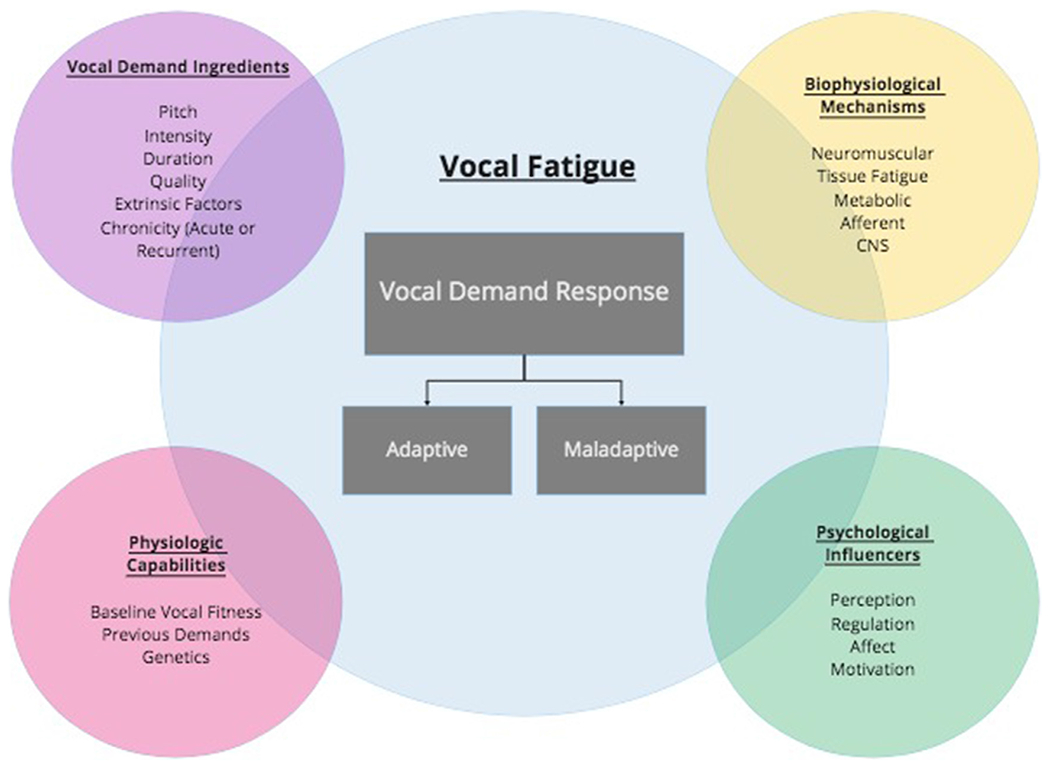
Vocal fatigue conceptual framework.
FIGURE 2.

Example depicting investigation of vocal fatigue.
Finally, it is important to highlight that this conceptual framework is a working framework. The goals are to emphasize the complex, heterogeneous nature of voice and vocal fatigue and highlight various factors that may be involved in vocal demands and vocal demand responses. This framework should be treated as a stepping-stone and as means to guide future research endeavors—to be rigorously tested and updated. Such work will hopefully provide insight into relationships between vocal demands ingredients, individualized differences, underlying mechanisms, and outcome metrics in relation to adaptive versus maladaptive vocal demand responses that can result in debilitating vocal fatigue. We wish to invite dialogue with this framework for improved methods that can better identify, monitor, and manage vocal fatigue. These endeavors will hopefully play a role in reducing the high prevalence, communicative detriments, economic burden, and emotional consequences of this debilitating condition. It will also improve intra- and inter-disciplinary communication across scientific communities and the clinical sphere.
Footnotes
DECLARATION OF COMPETING INTEREST
None.
REFERENCES
- 1.McCabe DJ, Titze IR. Chant therapy for treating vocal fatigue among public school teachers: a preliminary study. Am J Speech Lang Pathol. 2002;11:356. [Google Scholar]
- 2.Hunter Eric J, Cantor-Cutiva Lady Catherine, van Leer Eva, et al. Toward a consensus description of vocal effort, vocal load, vocal loading, and vocal fatigue. J Speech Lang Hear Res. 2020;63:509–532. 10.1044/2019_JSLHR-19-00057. [DOI] [PMC free article] [PubMed] [Google Scholar]
- 3.Sapir S, Keidar A, Mathers—schmidt B. Vocal attrition in teachers: survey findings. Eur J Disord Commun. 1993;28:177–185. [DOI] [PubMed] [Google Scholar]
- 4.Thibeault SL, Merrill RM, Roy N, et al. Occupational risk factors associated with voice disorders among teachers. Ann Epidemiol. 2004;14:786–792. 10.1016/j.annepidem.2004.03.004. [DOI] [PubMed] [Google Scholar]
- 5.Kitch JA, Oates J. The perceptual features of vocal fatigue as self-reported by a group of actors and singers. J Voice. 1994;8:207–214. 10.1016/S0892-1997(05)80291-7. [DOI] [PubMed] [Google Scholar]
- 6.Gotaas C, Starr CD. Vocal fatigue among teachers. FPL. 1993;45:120–129. 10.1159/000266237. [DOI] [PubMed] [Google Scholar]
- 7.Fujiki RB, Chapleau A, Sundarrajan A, et al. The interaction of surface hydration and vocal loading on voice measures. J Voice. 2017;31:211–217. 10.1016/j.jvoice.2016.07.005. [DOI] [PubMed] [Google Scholar]
- 8.Whitling S, Rydell R, Lyberg Åhlander V. Design of a clinical vocal loading test with long-time measurement of voice. J Voice. 2015;29:261.e13–261.e27. [DOI] [PubMed] [Google Scholar]
- 9.Herndon NE, Sundarrajan A, Sivasankar MP, et al. Respiratory and laryngeal function in teachers: pre-and post-vocal loading challenge. J Voice. 2019;33:302–309. [DOI] [PubMed] [Google Scholar]
- 10.Remacle A, Finck C, Roche A, et al. Vocal impact of a prolonged reading task at two intensity levels: objective measurements and subjective self-ratings. J Voice. 2012;26:e177–e186. [DOI] [PubMed] [Google Scholar]
- 11.Yiu EML, Wang G, Lo AC, et al. Quantitative high-speed laryngoscopic analysis of vocal fold vibration in fatigued voice of young karaoke singers. J Voice. 2013;27:753–761. [DOI] [PubMed] [Google Scholar]
- 12.Remacle A, Morsomme D, Berrué E, et al. Vocal impact of a prolonged reading task in dysphonic versus normophonic female teachers. J Voice. 2012;26(6):820.E1–820.E13. [DOI] [PubMed] [Google Scholar]
- 13.Kagan LS, Heaton JT. The effectiveness of low-level light therapy in attenuating vocal fatigue. J Voice. 2017;31(3):384.e15–384.e23. [DOI] [PubMed] [Google Scholar]
- 14.Anand S, Bottalico P, Gray C. Vocal fatigue in prospective vocal professionals. J Voice. 2021;35(2):247–258. [DOI] [PubMed] [Google Scholar]
- 15.Joseph B, Joseph A, Jacob T. Vocal fatigue—do young speech-language pathologists practice what they preach? J Voice. 2018. 10.1016/j.jvoice.2018.11.015. [DOI] [PubMed] [Google Scholar]
- 16.Boucher VJ, Ahmarani C, Ayad T. Physiologic features of vocal fatigue: electromyographic spectral-compression in laryngeal muscles. Laryngoscope. 2006;116:959–965. [DOI] [PubMed] [Google Scholar]
- 17.Hunter E, Banks R. Gender differences in the reporting of vocal fatigue in teachers as quantified by the vocal fatigue index. Anna Otol Rhinol Laryngol. 2017;126:813–818. 10.1177/0003489417738788. [DOI] [PMC free article] [PubMed] [Google Scholar]
- 18.Carroll T, Nix J, Hunter E, et al. Objective measurement of vocal fatigue in classical singers: a vocal dosimetry pilot study. Otolaryngol Head Neck Surg. 2006;135:595–602. [DOI] [PMC free article] [PubMed] [Google Scholar]
- 19.Xue C, Kang J, Hedberg C, et al. Dynamically monitoring vocal fatigue and recovery using aerodynamic, acoustic, and subjective selfrating measurements. J Voice. 2019;33:809.e11–809.e18. [DOI] [PubMed] [Google Scholar]
- 20.Hunter E, Maxfield L, Graetzer S. The effect of pulmonary function on the incidence of vocal fatigue among teachers. J Voice. 2020;34(4):539–546. [DOI] [PMC free article] [PubMed] [Google Scholar]
- 21.Guzmán M, Malebran MC, Zavala P, et al. Acoustic changes of the voice as signs of vocal fatigue in radio broadcasters: preliminary findings. Acta Otorrinolaringol (English Edition). 2013;64:176–183. [DOI] [PubMed] [Google Scholar]
- 22.Pellicani A, Ricz H, Ricz L. Phonatory function after prolonged voice use in brazilian woman. CoDAS. 2015;27:392–399. [DOI] [PubMed] [Google Scholar]
- 23.Chang A, Karnell MP. Perceived phonatory effort and phonation threshold pressure across a prolonged voice loading task: a study of vocal fatigue. J Voice. 2004;18:454–466. [DOI] [PubMed] [Google Scholar]
- 24.Boucher VJ, Ayad T. Physiological attributes of vocal fatigue and their acoustic effects: a synthesis of findings for a criterion-based prevention of acquired voice disorders. J Voice. 2009;24:324–336. [DOI] [PubMed] [Google Scholar]
- 25.Stemple JC, Stanley J, Lee L. Objective measures of voice production in normal subjects following prolonged voice use. J Voice. 1995;9:127–133. [DOI] [PubMed] [Google Scholar]
- 26.Laukkanen AM, Ilomaki I, Leppanen K, et al. Acoustic measures of and self-reports of vocal fatigue by female teachers. J Voice. 2008;22: 283–289. [DOI] [PubMed] [Google Scholar]
- 27.Porto VFDA, Bezerra TT, Zambon F, et al. Fatigue, effort and vocal discomfort in teachers after teaching activity. CoDAS. 33. Brazil: Sociedade Brasileira de Fonoaudiologia; 2021. [DOI] [PubMed] [Google Scholar]
- 28.Abou-Rafée M, Zambon F, Badaró F, et al. Vocal fatigue in dysphonic teachers who seek treatment. CoDAS. 31. Brazil: Sociedade Brasileira de Fonoaudiologia; 2019. [DOI] [PubMed] [Google Scholar]
- 29.Mahalingam S, Boominathan P, Arunachalam R, et al. Cepstral measures to analyze vocal fatigue in individuals with hyperfunctional voice disorder. J Voice. 2021;35:815–821. [DOI] [PubMed] [Google Scholar]
- 30.Fujiki RB, Huber JE, Sivasankar MP. Mitigating the effects of acute vocal exertion in individuals with vocal fatigue. Laryngoscope. 2021;131:2732–2739. [DOI] [PMC free article] [PubMed] [Google Scholar]
- 31.Erkan SO, Tuhanioglu B. Vocal fatigue in doctors: evaluation with subjective and objective acoustic parameters. Logoped Phoniatr Vocol. 2021;46:35–41. [DOI] [PubMed] [Google Scholar]
- 32.Cercal GCS, Paula ALD, Novis JMM, et al. Vocal fatigue in professors at the beginning and end of the school year. CoDAS. 32. Brazil: Sociedade Brasileira de Fonoaudiologia; 2019. [DOI] [PubMed] [Google Scholar]
- 33.Bonetti A, Bonetti L, Čipčić O. Self-assessment of vocal fatigue in muscle tension dysphonia and vocal nodules: a preliminary analysis of the discriminatory potential of the croatian adaptation of the Vocal Fatigue Index (VFI-C). J Voice. 2021;35:325. - e1. [DOI] [PubMed] [Google Scholar]
- 34.Free N, Stemple JC, Smith JA. The impact of a vocal loading task on voice characteristics of female speakers with benign vocal fold lesions. J Voice. 2021. 10.1016/j.jvoice.2021.11.009. Published online. [DOI] [PubMed] [Google Scholar]
- 35.Shembel AC, Lee J, Sacher JR, et al. Characterization of primary muscle tension dysphonia using acoustic and aerodynamic voice metrics. J Voice. 2021. 10.1016/j.jvoice.2021.05.019. Published online. [DOI] [PMC free article] [PubMed] [Google Scholar]
- 36.Enoka M, Duchateau M. Translating fatigue to human performance. Med Sci Sports Exercise. 2016;48:2228–2238. [DOI] [PMC free article] [PubMed] [Google Scholar]
- 37.Hunter EJ, Berardi ML, Whitling S. A semiautomated protocol towards quantifying vocal effort in relation to vocal performance during a vocal loading task. J Voice. 2022. 10.1016/j.jvoice.2022.01.003. Published online. [DOI] [PMC free article] [PubMed] [Google Scholar]
- 38.Nanjundeswaran C, VanSwearingen J, Abbott KV. Metabolic mechanisms of vocal fatigue. J Voice. 2017;31:378.e1–378.e11. 10.1016/j.jvoice.2016.09.014. [DOI] [PubMed] [Google Scholar]
- 39.Sandage MJ, Smith AG. Muscle bioenergetic considerations for intrinsic laryngeal skeletal muscle physiology. J Speech Lang Hear Res. 2017;60:1254–1263. 10.1044/2016_JSLHR-S-16-0192. [DOI] [PubMed] [Google Scholar]
- 40.Chan RW. Ovine vocal fold tissue fatigue response to accumulated, large-amplitude vibration exposure at phonatory frequencies. J Speech Lang Hear Res. 2019;62:4291–4299. 10.1044/2019_JSLHR-S-19-0181. [DOI] [PMC free article] [PubMed] [Google Scholar]
- 41.Hunter EJ, Titze IR. Quantifying vocal fatigue recovery: dynamic vocal recovery trajectories after a vocal loading exercise. Ann Otol Rhinol Laryngol. 2009;118:449–460. 10.1177/000348940911800608. [DOI] [PMC free article] [PubMed] [Google Scholar]
- 42.Pearl Solomon N, Stemmle DiMattia M. Effects of a vocally fatiguing task and systemic hydration on phonation threshold pressure. J Voice. 2000;14:341–362. [DOI] [PubMed] [Google Scholar]
- 43.Gould WJ, Tanabe M. The effect of anesthesia of the internal branch of the superior laryngeal nerve upon phonation: an Aerodynamic Study. Folia Phoniatr Logop. 1975;27:337–349. 10.1159/000264005. [DOI] [PubMed] [Google Scholar]
- 44.Wyke BD. Laryngeal myotatic reflexes and phonation. Folia Phoniatr Logop. 1974;26:249–264. 10.1159/000263784. [DOI] [PubMed] [Google Scholar]
- 45.Rudolph G Spiral nerve-endings (proprioceptors) in the human vocal muscle. Nature. 1961;190:726–727. 10.1038/190726b0. [DOI] [PubMed] [Google Scholar]
- 46.Jürgens U, Hage SR. On the role of the reticular formation in vocal pattern generation. Behav Brain Res. 2007;182:308–314. 10.1016/j.bbr.2006.11.027. [DOI] [PubMed] [Google Scholar]
- 47.Jürgens U Neural pathways underlying vocal control. Neurosci Biobehav Rev. 2002;26:235–258. 10.1016/S0149-7634(01)00068-9. [DOI] [PubMed] [Google Scholar]
- 48.Bailey SP, Davis JM, Ahlborn EN. Neuroendocrine and substrate responses to altered brain 5-HT activity during prolonged exercise to fatigue. J Appl Physiol. 1993;74:3006–3012. 10.1152/jappl.1993.74.6.3006. [DOI] [PubMed] [Google Scholar]
- 49.Nanjundeswaran C, Jacobson BH, Gartner-Schmidt J, et al. Vocal Fatigue Index (VFI): development and validation. J Voice. 2015;29: 433–440. 10.1016/j.jvoice.2014.09.012. [DOI] [PubMed] [Google Scholar]