


Fig. 2.
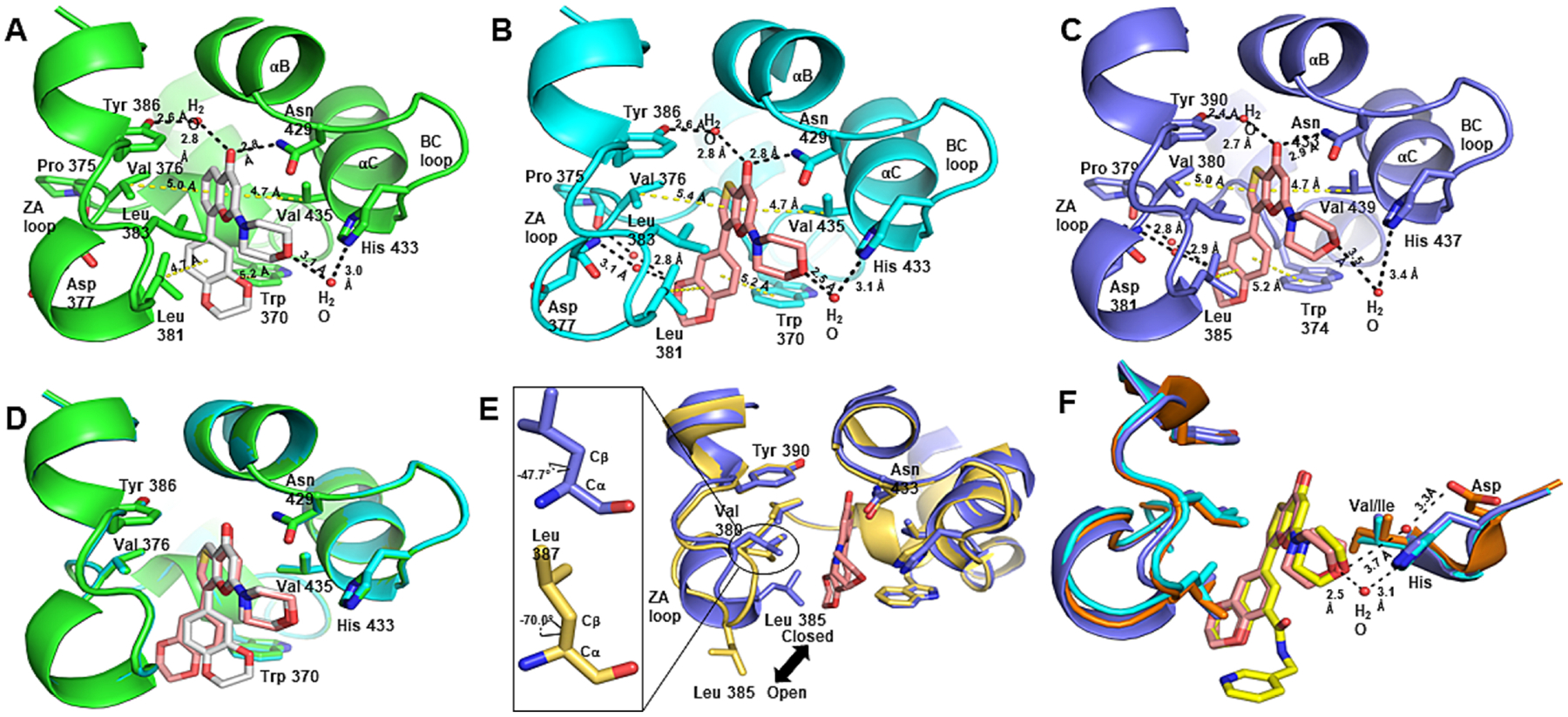
BRD2-BD2/BRD4-BD2 binding interactions with MDP5 and SF2523. A Hydrogen bonded interactions (black dashed bonds) and van der Waals interactions (yellow dashed bonds) formed in the acetyllysine binding pocket of BRD2-BD2 (green carbon atoms) with MDP5 (gray carbon atoms). B Hydrogen bonded interactions (black dashed bonds) and van der Waals interactions (yellow dashed bonds) formed in the acetyllysine binding pocket of BRD2-BD2 (cyan carbon atoms) with SF2523 (pink carbon atoms). C Hydrogen bonded interactions (black dashed bonds) and van der Waals interactions (yellow dashed bonds) formed in the acetyllysine binding pocket of BRD4-BD2 (slate carbon atoms) with SF2523. D Superimposed acetyllysine binding pockets of BRD2-BD2/MPD5 and BRD2-BD2/SF2523 illustrating the difference in benzodioxane binding modes. E Superimposed acetyllysine binding pockets of ligandfree BRD4-BD2 (gold carbon atoms) and BRD4-BD2/SF2523 highlighting the ligandinduced conformational change in BRD4-BD2. F Superimposed acetyllysine binding pockets of the BRD4-BD1 (orange carbon atoms)/SRX3212 (yellow carbon atoms) complex, the BRD2-BD2/SF2523 complex, and the BRD4-BD2/SF2523 complex structures suggesting inclusion of an additional ring off the benzodioxane moiety of MDP5.