


Fig. 4. Complete biosynthetic pathway to azadirone (18) and kihadalactone A (19).
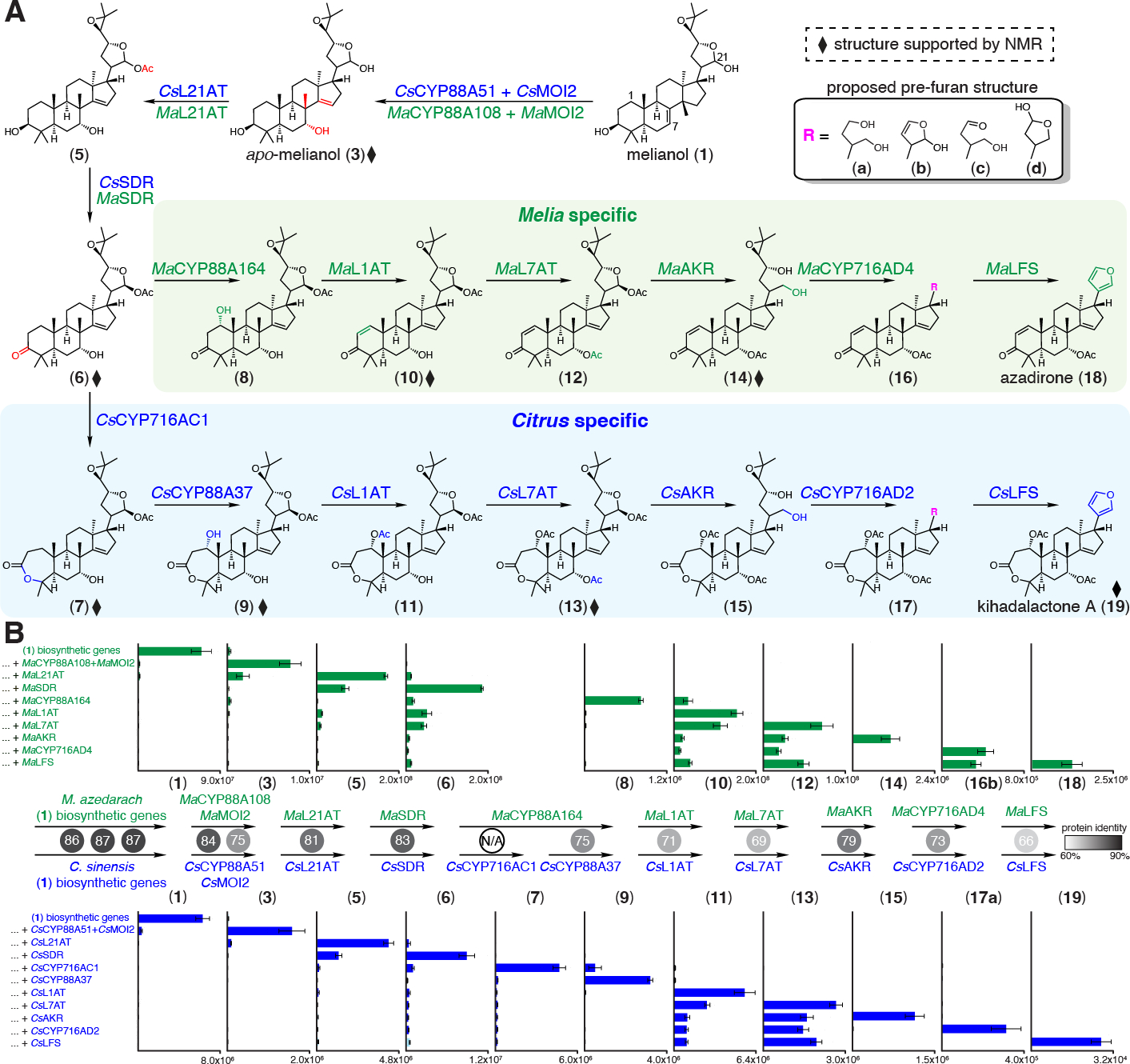
(A) Gene sets that lead to the production of azadirone (18) and kihadalactone A (19) in N. benthamiana leaves. Genes from Citrus are shown in blue and those from Melia are shown in green. The arrow reflects accumulation of the metabolites after addition of the associated enzyme as shown in Panel B rather than true enzymatic substrate-product relationship. In addition, limonoids biosynthesis likely proceeds as a network; other possible reaction sequences are shown in fig S40. Diamonds represent intermediates whose structures were supported either by NMR analysis of the purified product or comparison with an authentic standard (18). (3), (6), (9), (10), (13) and (14) were purified from N. benthamiana leaf extracts expressing the respective biosynthetic gene sets and analyzed by NMR; the structures of (7) and (19) are supported by partial NMR. Additionally, a side product (20), formed in experiments with all pathway enzymes up to and including MaCYP716AD4 but without MaL7AT (fig. S44) was purified and confirmed by NMR (table S20); similar activity was observed for CsCYP716AD2 (fig. S45, supplementary text). Enzymes have been abbreviated as follows: MOI = melianol oxide isomerase; CYP = cytochrome P450; L21AT = limonoid C-21-O-acetyltransferase; SDR = short-chain dehydrogenase; L1AT = limonoid C-1-O-acetyltransferase; L7AT = limonoid C-7-O-acetyltransferase; AKR = aldo-keto reductase; LFS = limonoid furan synthase.
(B) Integrated peak area of extracted ion chromatogram (EIC) for each pathway intermediates produced in N. benthamiana after sequential co-expression of individual enzymes. Values and error bars represent the mean and the standard error of the mean; n=6 biological replicates. Percentage identity between homologous proteins are shown in numbers in the circles and colored in gray scale. (1) biosynthetic genes comprise MaOSC1/CsOSC1, MaCYP71CD2/CsCYP71CD1, and MaCYP71BQ5/CsCYP71BQ4. CsCYP88A37 is a homolog to MaCYP88A164 while CsCYP716AC1 has no Melia homolog.