



Abstract
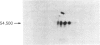
The properties of ornithine decarboxylase (OrnDCase) from mouse epidermis and benign epidermal tumors (papillomas) induced by the initiation-promotion protocol were compared. When crude extracts from each tissue were incubated at 55 degrees C, epidermal OrnDCase was rapidly inactivated, but the papilloma OrnDCase was more heat stable. Each of five individual papilloma extracts contained OrnDCase activity that was considerably more resistant to heat inactivation than was epidermal OrnDCase. Mixing of a papilloma and epidermal extract produced an intermediate heat-inactivation profile, suggesting that the differences in OrnDCase heat stability are not due to non-OrnDCase components of the extracts. Kinetic analyses indicated that the papilloma OrnDCase has an altered affinity for its substrate, L-ornithine, compared to epidermal OrnDCase. The apparent Km for L-ornithine for the epidermal enzyme was 0.07 mM while the Km values for the individual papilloma OrnDCases clustered around two higher values, 0.3 mM and 1.0 mM. The papilloma OrnDCases, but not epidermal OrnDCase, were activated by GTP and to a lesser extent by CTP. Immunoblot analysis showed the existence of multiple forms of OrnDCase in both epidermis and papilloma that differed in isoelectric point but not subunit molecular weight. None of the species of OrnDCase present in the epidermal extract coincided with the species present in papilloma. These results suggest that one consequence of neoplastic transformation in this in vivo system is the presence of an OrnDCase protein in benign tumors that differs structurally and functionally from the OrnDCase present in normal epidermis. The possible mechanisms responsible for these results and their significance for neoplastic development in this tissue are discussed.
Full text
PDF


Images in this article

Selected References
These references are in PubMed. This may not be the complete list of references from this article.
- Alhonen-Hongisto L., Kallio A., Sinervirta R., Jänne O. A., Gahmberg C. G., Jänne J. Tumourigenicity, cell-surface glycoprotein changes and ornithine decarboxylase gene pattern in Ehrlich ascites-carcinoma cells. Biochem J. 1985 Aug 1;229(3):711–715. doi: 10.1042/bj2290711. [DOI] [PMC free article] [PubMed] [Google Scholar]
- Astrup E. G., Boutwell R. K. Ornithine decarboxylase activity in chemically induced mouse skin papillomas. Carcinogenesis. 1982;3(3):303–308. doi: 10.1093/carcin/3.3.303. [DOI] [PubMed] [Google Scholar]
- Balmain A., Ramsden M., Bowden G. T., Smith J. Activation of the mouse cellular Harvey-ras gene in chemically induced benign skin papillomas. Nature. 1984 Feb 16;307(5952):658–660. doi: 10.1038/307658a0. [DOI] [PubMed] [Google Scholar]
- Blumberg P. M. In vitro studies on the mode of action of the phorbol esters, potent tumor promoters, part 2. Crit Rev Toxicol. 1981 Jun;8(3):199–234. doi: 10.3109/10408448109109658. [DOI] [PubMed] [Google Scholar]
- Diamond L., O'Brien T. G., Baird W. M. Tumor promoters and the mechanism of tumor promotion. Adv Cancer Res. 1980;32:1–74. doi: 10.1016/s0065-230x(08)60360-7. [DOI] [PubMed] [Google Scholar]
- Friedman S. J., Halpern K. V., Canellakis E. S. Purification of ornithine decarboxylase from regenerating rat liver. Biochim Biophys Acta. 1972 Jan 28;261(1):181–187. doi: 10.1016/0304-4165(72)90328-5. [DOI] [PubMed] [Google Scholar]
- Gilmour S. K., Aglow E., O'Brien T. G. Heterogeneity of ornithine decarboxylase expression in 12-O-tetradecanoylphorbol-13-acetate-treated mouse skin and in epidermal tumors. Carcinogenesis. 1986 Jun;7(6):943–947. doi: 10.1093/carcin/7.6.943. [DOI] [PubMed] [Google Scholar]
- Kahana C., Nathans D. Isolation of cloned cDNA encoding mammalian ornithine decarboxylase. Proc Natl Acad Sci U S A. 1984 Jun;81(12):3645–3649. doi: 10.1073/pnas.81.12.3645. [DOI] [PMC free article] [PubMed] [Google Scholar]
- Kallio A., McCann P. P. Difluoromethylornithine irreversibly inactivates ornithine decarboxylase of Pseudomonas aeruginosa, but does not inhibit the enzymes of Escherichia coli. Biochem J. 1981 Oct 15;200(1):69–75. doi: 10.1042/bj2000069. [DOI] [PMC free article] [PubMed] [Google Scholar]
- Loeb D., Houben P. W., Bullock L. P. Two forms of ornithine decarboxylase activity in mouse kidney. Mol Cell Endocrinol. 1984 Nov;38(1):67–73. doi: 10.1016/0303-7207(84)90146-1. [DOI] [PubMed] [Google Scholar]
- Mizoguchi Y., Otani S., Matsui I., Morisawa S. Control of ornithine decarboxylase activity by cyclic nucleotides in the phytohemagglutinin induced lymphocyte transformation. Biochem Biophys Res Commun. 1975 Sep 2;66(1):328–335. doi: 10.1016/s0006-291x(75)80332-9. [DOI] [PubMed] [Google Scholar]
- O'Brien T. G., Diamond L. Ornithine decarboxylase induction and DNA synthesis in hamster embryo cell cultures treated with tumor-promoting phorbol diesters. Cancer Res. 1977 Nov;37(11):3895–3900. [PubMed] [Google Scholar]
- O'Brien T. G., Simsiman R. C., Boutwell R. K. Induction of the polyamine-biosynthetic enzymes in mouse epidermis and their specificity for tumor promotion. Cancer Res. 1975 Sep;35(9):2426–2433. [PubMed] [Google Scholar]
- O'Brien T. G., Simsiman R. C., Boutwell R. K. Induction of the polyamine-biosynthetic enzymes in mouse epidermis by tumor-promoting agents. Cancer Res. 1975 Jul;35(7):1662–1670. [PubMed] [Google Scholar]
- O'Brien T. G. The induction of ornithine decarboxylase as an early, possibly obligatory, event in mouse skin carcinogenesis. Cancer Res. 1976 Jul;36(7 Pt 2):2644–2653. [PubMed] [Google Scholar]
- O'Farrell P. H. High resolution two-dimensional electrophoresis of proteins. J Biol Chem. 1975 May 25;250(10):4007–4021. [PMC free article] [PubMed] [Google Scholar]
- Persson L., Seely J. E., Pegg A. E. Investigation of structure and rate of synthesis of ornithine decarboxylase protein in mouse kidney. Biochemistry. 1984 Jul 31;23(16):3777–3783. doi: 10.1021/bi00311a033. [DOI] [PubMed] [Google Scholar]
- Persson L., Seely J. E., Pegg A. E. Investigation of structure and rate of synthesis of ornithine decarboxylase protein in mouse kidney. Biochemistry. 1984 Jul 31;23(16):3777–3783. doi: 10.1021/bi00311a033. [DOI] [PubMed] [Google Scholar]
- Pösö H., Karvonen E., Suomalainen H., Andersson L. C. A human neuroblastoma cell line with an altered ornithine decarboxylase. J Biol Chem. 1984 Oct 25;259(20):12307–12310. [PubMed] [Google Scholar]
- Seely J. E., Persson L., Sertich G. J., Pegg A. E. Comparison of ornithine decarboxylase from rat liver, rat hepatoma and mouse kidney. Biochem J. 1985 Mar 1;226(2):577–586. doi: 10.1042/bj2260577. [DOI] [PMC free article] [PubMed] [Google Scholar]
- Takigawa M., Verma A. K., Simsiman R. C., Boutwell R. K. Polyamine biosynthesis and skin tumor promotion: inhibition of 12-O-tetradecanoylphorbol-13-acetate-promoted mouse skin tumor formation by the irreversible inhibitor of ornithine decarboxylase alpha-difluoromethylornithine. Biochem Biophys Res Commun. 1982 Apr 14;105(3):969–976. doi: 10.1016/0006-291x(82)91065-8. [DOI] [PubMed] [Google Scholar]
- Weeks C. E., Herrmann A. L., Nelson F. R., Slaga T. J. alpha-Difluoromethylornithine, an irreversible inhibitor of ornithine decarboxylase, inhibits tumor promoter-induced polyamine accumulation and carcinogenesis in mouse skin. Proc Natl Acad Sci U S A. 1982 Oct;79(19):6028–6032. doi: 10.1073/pnas.79.19.6028. [DOI] [PMC free article] [PubMed] [Google Scholar]
- Weiner R. A., Byus C. V. Induction of ornithine decarboxylase by 12-O-tetradecanoylphorbol-13 acetate in rat tissues. Biochem Biophys Res Commun. 1980 Dec 31;97(4):1575–1581. doi: 10.1016/s0006-291x(80)80046-5. [DOI] [PubMed] [Google Scholar]
- Yuspa S. H., Lichti U., Ben T., Patterson E., Hennings H., Slaga T. J., Colburn N., Kelsey W. Phorbol esters stimulate DNA synthesis and ornithine decarboxylase activity in mouse epidermal cell cultures. Nature. 1976 Jul 29;262(5567):402–404. doi: 10.1038/262402a0. [DOI] [PubMed] [Google Scholar]