



ABSTRACT
We provide evidence that children sensibly integrate the judgments of different people who disagree according to their confidence. We asked children (ages 5–10 years, N = 92) to make judgments about what happened during unobserved events by relying on two informants who sometimes disagreed. Children integrated the reports of informants and formed novel beliefs endorsed by neither party by 8 years old when the informants reported equal confidence—for example, they selected a monster with six spots when one informant reported seeing one with four spots and another reported seeing one with eight. Unequal confidence across the informants biased children toward the judgment of the more confident party. That children can integrate social confidence judgments with conflicting information—considering and weighing the relative confidence of others to make up their own minds about what is most likely—represents a previously unappreciated mechanism of learning that is crucial to children's development as independent social agents. It allows children to become independent thinkers who can form beliefs that build on the knowledge of others without relying on identical belief adoption of one social agent over another.
Keywords: belief integration, confidence, cue combination
1. Introduction
The ability of humans to share information with one another enables greater breadth of knowledge, more efficient discovery, and better decision‐making (Henrich and Muthukrishna 2023; Legare and Nielsen 2015). Yet, disagreements are common for many reasons, including differences in individuals’ expectations and attentional priorities in the moment (Sterzer et al. 2010; Summerfield and Egner 2009)—even for straightforward visual events. These differing opinions pose a challenge when someone must ascertain the truth. Children may need to rely on the words of others more often than adults due to their more limited ability to act directly on the world and their limited experience. Thus, even young humans who learn from humans need ways to resolve disagreements.
One strategy to resolve disagreements is to trust opinions with higher perceived reliability (e.g., Koenig and Harris 2005). If one informant has been previously accurate or is highly confident but the other informant is not, for instance, it might be reasonable to infer that they are correct in this instance as well. Children are sensitive to the uncertainty of others in certain contexts. When asked to choose between two answers provided by disagreeing informants (in what is known as the “Selective Social Learning paradigm”), young children are more likely to trust answers given with high confidence than answers given with low confidence (Birch et al. 2010, 2020; Poulin‐Dubois and Brosseau‐Liard 2016). Children also endorse answers given by informants who were previously accurate, well‐informed, and knowledgeable among many other traits that signal high reliability (Harris and Corriveau 2011; Koenig and Harris 2005; Lane et al. 2013; Sabbagh and Baldwin 2001; for review, see Mills 2013).
Summary
Children endorsed confident informants over hesitant ones when faced with conflicting testimony.
By age 8, children also integrated beliefs into new, unendorsed conclusions when informants were equally confident.
Informants' relative confidence was an essential cue for children to determine whether to imitate or generate new knowledge.
Belief integration in middle childhood supports children's development as independent, rational social agents.
But this strategy ignores the possibility that neither informant is correct; the truth might lie in the unexplored middle ground. For humans to uncover truth and generate new ideas, it is necessary to also consider new answers by integrating beliefs (i.e., answers not mentioned by either informant). Accordingly, a more sophisticated approach is to integrate information in proportion to its uncertainty (Toelch and Dolan 2015). The intuition behind this approach is that a belief held by someone with high certainty should more greatly influence a judgment than a differing belief held by someone else with low certainty, but that both views should still be influential. Imagine we are estimating marbles in a jar, for instance. If person A gives a very confident guess of 45 marbles and person B gives an uncertain guess of 25 marbles, we could integrate those two guesses to reach a final guess of 40 marbles, which is closer to the high confidence guess of 45. We know that adults engage in this type of uncertainty‐weighted information integration. Adults integrate information across their own senses proportional to the uncertainty of each modality (Alais and Burr 2004; Ernst and Banks 2002; Knill 2007). They also integrate inconsistent information across individuals proportional to those individuals’ expressed confidence (Bahrami et al. 2010; Bang et al. 2021; Mahmoodi et al. 2015). This approach is effective at helping people find previously unexplored truths: People who share and integrate different perspectives with one another are more likely to reach the correct conclusion (Bahrami et al. 2010; Surowiecki 2005).
Existing literature shows that children can integrate multiple information sources from some domains in an approximately rational fashion. For example, children integrate across sources when learning about causal events (Schulz et al. 2008; Sobel et al. 2004) and language (Xu and Tenenbaum 2007; see Gopnik and Bonawitz 2015). Children thus might be capable of similarly sensible integration of others’ confidence judgments—but this remains an untested possibility up until now.
We already know that children can use the confidence judgments of themselves and others to inform their own opinions—making it plausible that they can integrate opinions across multiple social agents. For example, 4‐ to 5‐year‐old children override their own judgments under conditions of uncertainty when an independent and knowledgeable informant disagrees (Bridgers et al. 2016; Langenhoff et al. 2023, 2024; Schleihauf et al. 2022). Children who saw a toy activate a machine 100% of the time did not change their belief about how the machine worked when given a conflicting account by any informant (Bridgers et al. 2016). In contrast, children who saw a toy activate the machine 66% of the time were more likely to endorse a conflicting account by a knowledgeable informant than a naive one.
Children in Bridgers et al.’s (2016) study were restricted to choose one of the two conflicting answers—with no option to integrate the two answers and uncover new knowledge. Another study provided children with such an opportunity, but found that children were biased to rely more strongly on their own beliefs (Miosga et al. 2020). In the study, 4‐ to 6‐year‐old children indicated the location of a marker along a line viewed through either a clear or blurry screen. When an informant gave a conflicting response, children only adjusted their estimate of the marker's location if their own screen was blurry and therefore less certain. The quality of the informant's viewpoint did not influence how much they adjusted their estimates. Children appear to overweigh their own beliefs, which makes it challenging to detect whether they can rationally integrate the conflicting beliefs (for similar findings, see Baer and Odic 2022; Blake et al. 2014; Selmeczy and Ghetti 2019).
One recent study bypasses this preference for one's own answers by asking children to integrate answers from two other informants (as is more typical in the Selective Social Learning design), without seeing any direct evidence themselves (Amemiya et al. 2021). This design is commonly used to remove the possibility of children over‐weighing their own perspective, and typically results in success at younger ages (see Blake et al. 2014). Children first saw two informants describe a hidden image (e.g., “it was orange” and “it was pink”). Then they were asked to select which one from a set of images was behind the screen. Somewhat surprisingly, only children over 9 years old reliably selected the item in the set that represented an integrated perspective (e.g., a beige item). This late‐emerging success at integrating the beliefs of others strongly contrasts with the research reviewed above demonstrating an ability in 4‐ to 6‐year‐old children to rationally compare beliefs from disagreeing social agents. It may be that integrating socially communicated beliefs is challenging and therefore late‐developing as a learning strategy (see also Amemiya et al. 2024).
When considering the balance of evidence, we believe that younger children should be capable of integrating conflicting beliefs to form new knowledge, and that they will deploy this strategy when rational based on cues to uncertainty. Here, we test whether children will rationally integrate beliefs in a simplified context where they can choose to adopt an expressed belief or form a novel, integrated one. Specifically, a rational response to multiple opinions would show three characteristics: (1) adopting the beliefs of a high‐confidence informant over a low‐confidence one, (2) integrating beliefs into a new, middle‐ground belief when informants are equally confident, and (3) endorsing a consensus belief (as a control, given that even preschool children are known to follow a consensus; Corriveau and Harris 2010). We test all three predictions in a single paradigm.
We employed a conflicting testimony method similar to that used by Amemiya et al. (2021) to test these predictions. In our design, two informants provide testimony about a matter of high social relevance: identifying a monster criminal. Children must infer the objective truth by selecting one of several possibilities that span a continuum—with both the informants’ judgments and intermediate judgments included in the range. This contrasts with the traditional Selective Social Learning design described above where children are forced to choose one of two answers, giving them the additional option to select an unendorsed middle ground. This way, children can demonstrate that they will integrate beliefs to create new knowledge.
In our study, children must infer the truth about continuous magnitudes such as a monster's ear size or its number of spots. Size and number are readily discriminable by young children (Odic 2018), and are popularly used in belief integration work with adults (Bahrami et al. 2010; Sella et al. 2018), potentially making these easier domains for children to integrate than the abstract ones used by Amemiya et al. (2021). Children hear cues to each informants’ uncertainty to test whether their integration follows the principles of rational cue combination. Children should endorse a confident belief more strongly when one informant is more confident than the other (Different Answer Different Confidence condition). When the informants are equally confident, children should integrate the beliefs and choose the midpoint between them (Different Answer Same Confidence condition). And when both informants share the same belief, children should adopt that belief (Same Answer condition).
2. Methods
2.1. Participants
We tested 92 children aged 5–10 (M = 8;0 years; months, range = 5;0–10;11, 45 girls), a large age range anchored by studies of belief revision which show adaptation to confidence around 5 years and selecting a midpoint around 10 years (Amemiya et al. 2021; Bridgers et al. 2016; Miosga et al. 2020). Children were individually tested at community settings in the San Francisco Bay Area, including zoos, museums, and elementary schools. The population is predominantly White and/or Asian, and upper‐middle class (U.S. Census Bureau n.d.), though specific demographic data were not collected. Sample size and study design were preregistered at https://osf.io/3th8q/.
2.2. Materials and Procedures
Children completed a 15‐min task on a laptop computer guided by a researcher. The task was created using PsychoPy Builder (Peirce et al. 2019). The program is available at https://osf.io/7kbdm.
Children helped a monster detective figure out who broke the monster rules. They saw a lineup of four potential suspects and heard two witness monsters provide their testimony about the perpetrator (see Figure 1). Following the testimony, children indicated which of the four suspects “did it.”
FIGURE 1.

A sample trial featuring a high confidence witness on the left and a low confidence witness on the right (Different Answer Different Confidence condition).
Lineups always featured the same monster but with one property that varied across the four suspects. For instance, the four monsters could have had different numbers of spots on their stomachs: 9, 10, 11, or 12. Items that varied by number always increased by 1 or 2. Items that varied by size always increased by 10 or 20 pixels. Domain (number or size) was manipulated within‐subjects, and was not expected to have a major influence on children's responses. Monsters were always presented in ascending order from left to right to make it easier for children to track the differences, and this was briefly highlighted by the experimenter to help children notice this ordering.
Witness monsters appeared one at a time underneath the monster they endorsed to ensure children linked the testimony with the correct suspect. Testimony was given through an audio clip with either high or low confidence conveyed through several linguistic and paralinguistic cues. For a trial which varied the number of spots, a highly confident witness said “I remember! A monster with this many spots did it. Yeah, I'm really sure. A monster with this many spots did it.” The rate of speech was fairly fast, the volume fairly loud, with descending prosody at the end of sentences (Goupil et al. 2021). An unconfident witness on the same trial said “Hmm, I don't remember. Maybe a monster with this many spots did it? Hmm, I'm not very sure. I guess a monster with this many spots did it?” The rate of speech was slower, the volume quieter, and with raising prosody at the end of sentences. All recordings were completed by a single voice actor.
Each child completed 12 trials featuring different suspect and witness monsters in a randomized order, including 4 trials each from the following 3 conditions.
Different Answer Same Confidence: The two witnesses had the same level of confidence (both high or both low). Witnesses always provided testimony about the first and third suspects, or the second and fourth suspects. This always left one suspect as the midpoint (the second suspect if testimony was given about the first and third), and one suspect that was irrelevant (the fourth). We predicted that children would select the midpoint in this trial type.
Different Answer Different Confidence: One witness had high confidence and the other had low confidence. As with Different Answer Same Confidence trials, there was always a midpoint and irrelevant suspect. We predicted that children would select the suspect identified by the highly confident witness.
Same Answer: Both witnesses identified the same suspect. Witnesses had all confidence combinations (high/high, low/low, high/low, and low/high). We predicted that children would select the consensus suspect.
We created two sets of trials to counterbalance the trials' properties (side of the irrelevant answer, whether the high confidence answer was on the left or right, whether the left or right witness spoke first, and location of the consensus answer).
2.3. Predictions
High confidence evidence carries less uncertainty than low confidence evidence. If children weigh each piece of evidence proportionally to its uncertainty, the resulting distribution should be unimodal: closer to the high‐confidence answer when confidence differs and centered on the midpoint when confidence is equal.
Some contrasting accounts are also possible. Children could be choosing uniformly between the four options, a sign that they are not thinking strategically about this task. A similar prediction is that children could rely on a simple heuristic like “choose the most recent answer” (Sumner et al. 2019). Children could also be choosing randomly between the two endorsed suspects, ignoring the midpoint as a valid option. This would result in a bimodal distribution, rather than a unimodal one. Children might also adopt a fairness approach, choosing the middle option on all trials, regardless of confidence. Because all studies to date asking children to compare answers from confident and hesitant informants have limited their options to only the expressed answers, we do not know how children will react to an available midpoint.
We test these predictions in two ways (note that these analyses are not preregistered, but we provide all data and code for those interested, https://osf.io/qsjyn). First, we examine the qualitative patterns of the distributions of children's answers, looking for evidence of a normal distribution, rather than a uniform or bimodal one. Then, we focus exclusively on children's choice of the midpoint/consensus suspect and the high‐confidence answer, comparing these proportions to one another and against chance.
3. Results
3.1. What Were the Distributions of Children's Choices?
We looked for a specific qualitative distribution of children's choices (e.g., Knill 2007; Toelch and Dolan 2015). Answers should be symmetrically distributed around the midpoint on Same Answer and Different Answer Same Confidence trials, and favor the high confidence answer on Different Answer Different Confidence trials.
We generated histograms of children's choices, centered on the midpoint (or consensus) to permit direct comparison no matter the counterbalanced placement of the midpoint within the lineup (see Figure 2). If children resolved the conflict by endorsing one of the two disagreeing opinions, we should see bimodal response patterns on all trials, but we do not. Likewise, if children resolved the conflict by simply averaging judgments regardless of informants’ confidence, children should select the midpoint on all trials—but they do not. Instead, children's responses were generally centered around the midpoint on Different Answer Same Confidence and Same Answer trials (more clearly for older children than younger children), and favored the higher confidence answer on Different Answer Different Confidence trials. Children were also more likely to choose answers on the right side (59% of trials, SD = 17%, above chance of 50%, t(91) = 5.30, p < 0.001, d = 0.55, BF > 17,329. These distributions match the qualitative patterns predicted if children weighed the relative uncertainty of each answer to integrate the conflicting perspectives.
FIGURE 2.

Histograms of children's choices. Choices are centered on the midpoint (or consensus answer). On Different Answer Same Confidence, older children's choices (b) were centered on the midpoint, while younger children's choices (a) were more uniform. All children's choices on Different Answer Different Confidence trials favored the high confidence answer, and the consensus answer on Same Answer trials. Note that children only saw four options in an individual trial, though due to counterbalancing which side options were presented on, there are more than four options presented above.
3.2. When Did Children Choose the Midpoint, Consensus, and High Confidence Options?
We next examined whether children's tendency to choose the midpoint (or consensus) varied by Condition (dummy‐coded: Same Answer and Different Answer Different Confidence with Different Answer Same Confidence as the reference) or Age (continuous, scaled) in a factorial logistic regression with random intercepts for Participant and Trial. We also computed Bayes Factors for the inclusion of each term using the bayestestR package (Makowski et al. 2024). We additionally report an omnibus test including Gender and Domain in the Supporting Information.
Children were more likely to choose the midpoint in the Different Answer Same Confidence trials compared to the Different Answer Different Confidence trials, b = −0.76, SE = 0.18, p < 0.001, BF < 51,200, and more likely to choose the midpoint in the Same Answer trials compared to the Different Answer Same Confidence trials, b = 0.96, SE = 0.16, p < 0.001, BF < 10,700,000. Older children were more likely to choose the midpoint overall, b = 0.83, SE = 0.14, p < 0.001, BF < 427,000. There was also an interaction between Age and Condition, such that the effect of Age was strongest in the Different Answer Same Confidence condition relative to both the Same Answer, b = −0.50, SE = 0.17, p = 0.003, BF = 5.71, and Different Answer Different Confidence conditions, b = −0.43, SE = 0.19, p = 0.022, BF = 15.99. We follow up on comparisons of interest below, and see Figure 3.
FIGURE 3.

Choice of the midpoint (/consensus) option by condition. Age group is graphed using a median split. Error bars represent 1 standard error.
We next examined whether children's choice of the midpoint/consensus in each condition (averaged per participant across the 4 trials per condition) differed from chance of 25%. Bayes Factors were computed using the BayesFactor package in R (Morey et al. 2024). We performed these tests separately for younger (5–7 years) and older children (8–10 years) because of the significant effect of age in our main model. Tests against chance for all ages combined are presented in Table S1. We also generated predicted probabilities of selecting the midpoint/consensus answer at each age with a logistic regression model including random effects for Participant and Trial. We used this model to pinpoint the age at which children's performance exceeded chance levels (where the 95% confidence interval did not include 25%).
When both witnesses agreed (Same Answer), children largely chose the consensus answer above chance across the four trials: 8‐ to 10‐year‐olds chose the consensus answer on 63% (SD = 29%) of trials, t(44) = 8.74, p = < 0.001, d = 1.30, BF > 266 million, as did 49% (SD = 29%) of 5‐ to 7‐year‐olds, t(46) = 5.57, p < 0.001, d = 0.81, BF > 13,181. The model of predicted probabilities reflected above‐chance performance at all ages (see Figure 4).
FIGURE 4.
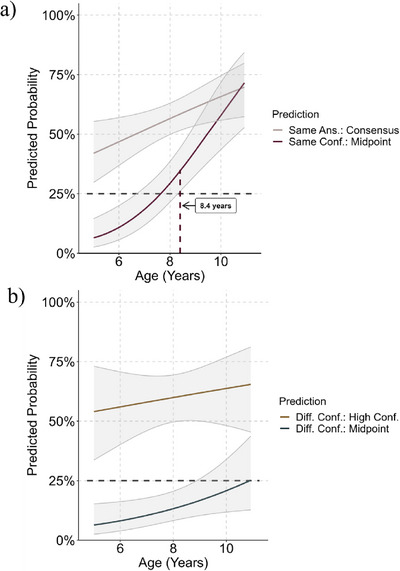
Probability of choosing the target monster in (a) the Same Answer and Different Answer Same Confidence trials (the consensus/midpoint answer), and (b) the Different Answer Different Confidence trials (the high confidence and midpoint answers). Gray bars represent 95% confidence intervals. The vertical line in (a) represents the age at which the confidence interval did not include chance (25%), depicted by the horizontal dark gray line.
When witnesses disagreed with equal confidence (Different Answer Same Confidence), 8‐ to 10‐year‐olds chose the midpoint on 48% (SD = 39%) of trials, above chance of 25%, t(44) = 4.06, p < 0.001, d = 0.60, BF = 125.33. However, 5‐ to 7‐year‐olds chose the midpoint on only 23% (SD = 25%) of trials, not different from chance, t(46) = −0.44, p = 0.660, d = 0.06, BF = 0.17. Performance was above chance by 8.4 years (see Figure 4).
When witnesses disagreed with unequal confidence (Different Answer Different Confidence), children of all ages selected the midpoint infrequently. Eight‐to‐10‐year‐olds chose the midpoint on 26% (SD = 33%) of these trials, not different from chance, t(44) = 0.11, p = 0.911, d = 0.02, BF = 0.16, and significantly different from the Different Answer Same Confidence condition, t(44) = −3.98, p < 0.001, d = 0.63, BF = 101.64. Five‐to‐7‐year‐olds chose the midpoint on 16% (SD = 20%) of these trials, significantly below chance, t(46) = −3.13, p = 0.003, d = 0.46, BF = 0.17, and not significantly different from the Different Answer Same Confidence condition, t(46) = −1.71, p = 0.095, d = 0.33, BF = 0.61. The model of predicted probabilities never reflected above‐chance selection of the midpoint in this condition.
Instead, children of all ages selected the answer with higher confidence in the Different Answer Different Confidence condition, consistent with the prediction that children should place more weight on reliable (confident) testimony. Eight‐to‐10‐year‐olds chose the high confidence answer on 60% (SD = 36%) of these trials, well above chance, t(44) = 6.61, p < 0.001, d = 0.99, BF > 300,000, as did 5‐ to 7‐year‐olds on 54% (SD = 35%) of trials, t(46) = 5.57, p < 0.001, d = 0.81, BF > 13,000. The model of predicted probabilities reflected above‐chance selection of the high‐confidence answer at all ages.
4. Discussion
Children need ways to resolve disagreements to uncover the truth. Here, we find that children integrate beliefs by weighing information relative to their uncertainty. When beliefs were given with different levels of confidence, children endorsed a belief communicated with high confidence over one with low confidence. When beliefs were given with equal levels of confidence, children older than 8 years instead endorsed a midpoint between them, integrating the two beliefs into a new one. Children can go beyond the evidence presented to them and transform conflicting perspectives into new beliefs. Taken together, our results suggest that children by age 8 use confidence as a proxy for uncertainty when integrating conflicting beliefs, consistent with rational models of decision‐making (e.g., Toelch and Dolan 2015).
Children at all ages attended to confidence, a social signal meant to communicate subjective uncertainty (Baer and Kidd 2022), and used it as a metric to compare the relative likelihood of the beliefs. Adults and children use confidence to compare beliefs across diverse cognitive domains (e.g., vision and audition, Baer and Odic 2020; De Gardelle et al. 2016). Adults also use confidence to both compare and integrate beliefs across people (Bahrami et al. 2010). The present study provides the first evidence that this selective integration emerges in middle childhood. In a single paradigm, children endorse high confidence over low confidence answers and endorse a midpoint, selectively deploying these strategies depending on the informants’ relative confidence levels. This flexible pattern rules out the possibility that children indiscriminately resolve conflict by picking a midpoint (when such an option is available), which could explain prior findings (e.g., Amemiya et al. 2021). Instead, children's belief integration is proportional to uncertainty. Future studies should investigate whether children's belief integration follows even more nuanced Bayesian principles (as is hypothesized about adults; Toelch and Dolan 2015) by using multiple midpoints or more than two perspectives.
Another avenue for further exploration is in the “weights” assigned to high and low confidence. In Bayesian cue combination accounts, uncertainty is critical in determining the underlying distribution of a belief (Alais and Burr 2019). As an analogy, we can think about confidence as conveying a standard deviation around an estimate. High confidence would have a smaller standard deviation than low confidence. One interesting possibility that falls out of this analogy is that two answers given with low confidence would very likely have overlapping standard deviations, making the midpoint plausible under both distributions. Two answers given with higher confidence might not, which could lead children to randomly choose between the answers. The weights assigned to high and low confidence may be an individual, contextual, or developmental difference. We leave this open for future research as we do not have prior data about how children select these weights to use for confirmatory analyses here.
Confidence conveys information about uncertainty, but it is not the only cue. Information about prior accuracy or expertise are also informative about uncertainty (Brosseau‐Liard et al. 2014; Koenig and Harris 2005; Lane et al. 2013; Mills 2013; VanderBorght and Jaswal 2009). Our results could therefore also apply to other cues to uncertainty beyond confidence. As a counterpoint though, confidence appears to be a high priority cue for both children and adults. Informants who are confident but not always accurate are trusted over informants who are consistently accurate but hesitant (Birch et al. 2020; Brosseau‐Liard et al. 2014; Sella et al. 2018).
The choice to integrate perspectives and select a midpoint was clearly present by 8 years old in our sample, earlier than previously reported (Amemiya et al. 2021, and see Amemiya et al. 2024). This earlier success may stem from differences in task demands, highlighting potential context sensitivities for belief integration. The current design, which used a socially engaging crime scenario and perceptually salient magnitude differences, may have facilitated belief integration by increasing motivation or decreasing cognitive demands. Even so, children's reasoning follows rational principles at much younger ages in other domains (Gopnik and Bonawitz 2015), and with simpler forced‐choice paradigms (Bridgers et al. 2016; Langenhoff et al. 2023; Schleihauf et al. 2022). This may point to two possibilities. First, children may require additional competencies to endorse a midpoint, including the ability to recognize multiple viewpoints as valid, a competency that develops between 4 and 7 years of age (Beck et al. 2011). Or second, younger children might be capable of rational integration, but fail to demonstrate this competency even in the current paradigm. For instance, children may have overinterpreted the pragmatic demands of the task, assuming that they had to endorse one of the two presented answers. This could mean both that removing or reducing these pragmatic demands could more accurately measure children's competency, but also that children's rational choices factor in pragmatic cues (e.g., Bonawitz et al. 2011, 2020).
These results highlight an important milestone in children's development as independent thinkers. Innovation and imitation in tandem are considered hallmarks of human cultural evolution (Henrich and Muthukrishna 2023; Legare and Nielsen 2015). Children have long been thought of as learners, but considerable recent work also demonstrates their aptitude as creators (for review, see Lew‐Levy and Amir 2024). An essential development is the transition between “learner” and “creator,” and recognizing when each role is best applied. Our work demonstrates that a simple rational strategy of comparing relative confidence could help children determine which role to adopt.
Our findings point to a rational strategy for uncovering truth in contexts of disagreement. Children not only compare the uncertainty of conflicting beliefs (Baer and Odic 2020; Mills 2013), they can use that uncertainty to strategically integrate those beliefs into new knowledge. This reveals a fundamental piece of human nature that allows us to go beyond individual experiences to make rational use of diverse perspectives to uncover truth.
Ethics Statement
Ethical approval for the study was obtained from the Committee for the Protection of Human Subjects at the University of California, Berkeley. A parent or legal guardian of each participant was provided a study description and gave written informed consent; each participant granted assent before taking part in the study.
Conflicts of Interest
The authors declare no conflicts of interest.
Supporting information
Supporting‐Information
Acknowledgments
This work was supported in part by a Social Sciences and Humanities Research Council of Canada Postdoctoral Fellowship to C.B., an NSF CAREER Fellowship to J.E., and by the Hellman Fellows Fund, DARPA Machine Common Sense, the Templeton Foundation, the Jacobs Young Scholars program, the Walton Family Foundation, the Berkeley Center for New Media, and the Human Frontiers Science Program to C.K. Thanks to all the families, museums, and schools that participated, to Remy White and Alex Tam for their help with data collection, and to Hope Hawkins for voice acting.
Funding: This work was supported in part by a Social Sciences and Humanities Research Council of Canada Postdoctoral Fellowship to C.B., an NSF CAREER Fellowship to J.E., and by the Hellman Fellows Fund, DARPA Machine Common Sense, the Templeton Foundation, the Jacobs Young Scholars program, the Walton Family Foundation, the Berkeley Center for New Media, and the Human Frontiers Science Program to C.K.
Data Availability Statement
The data that support the findings of this study are openly available in OSF at https://osf.io/qsjyn/.
References
- Alais, D. , and Burr D.. 2004. “The Ventriloquist Effect Results From Near‐Optimal Bimodal Integration.” Current Biology 14: 257–262. 10.1016/j.cub.2004.01.029. [DOI] [PubMed] [Google Scholar]
- Alais, D. , and Burr D.. 2019. “Cue Combination Within a Bayesian Framework.” In Multisensory Processes, edited by Lee A. K. C., Wallace M. T., Coffin A. B., Popper A. N., and Fay R. R., Vol. 68, 9–31. Springer International Publishing. 10.1007/978-3-030-10461-0_2. [DOI] [Google Scholar]
- Amemiya, J. , Heyman G. D., and Gerstenberg T.. 2024. “Children Use Disagreement to Infer What Happened.” Cognition 250: 105836. 10.1016/j.cognition.2024.105836. [DOI] [PubMed] [Google Scholar]
- Amemiya, J. , Walker C. M., and Heyman G. D.. 2021. “Children's Developing Ability to Resolve Disagreements by Integrating Perspectives.” Child Development 92, no. 6: e1228–e1241. 10.1111/cdev.13603. [DOI] [PubMed] [Google Scholar]
- Baer, C. , and Kidd C.. 2022. “Learning With Certainty in Childhood.” Trends in Cognitive Sciences 26, no. 10: 887–896. 10.1016/j.tics.2022.07.010. [DOI] [PubMed] [Google Scholar]
- Baer, C. , and Odic D.. 2020. “Children Flexibly Compare Their Confidence Within and Across Perceptual Domains.” Developmental Psychology 56: 2095–2101. 10.1037/dev0001100. [DOI] [PubMed] [Google Scholar]
- Baer, C. , and Odic D.. 2022. “Mini Managers: Children Strategically Divide Cognitive Labor Among Collaborators, But With a Self‐Serving Bias.” Child Development 93, no. 2: 437–450. 10.1111/cdev.13692. [DOI] [PubMed] [Google Scholar]
- Bahrami, B. , Olsen K., Latham P. E., Roepstorff A., Rees G., and Frith C. D.. 2010. “Optimally Interacting Minds.” Science (New York, N.Y.) 329: 1081–1085. 10.1126/science.1185718. [DOI] [PMC free article] [PubMed] [Google Scholar]
- Bang, D. , Moran R., Daw N. D., and Fleming S. M.. 2021. “Neurocomputational Mechanisms of Confidence in Self and Others.” BioRxiv 2021.03.05.434065. 10.1101/2021.03.05.434065. [DOI] [PMC free article] [PubMed] [Google Scholar]
- Beck, S. R. , Robinson A. N., Ahmed S., and Abid R.. 2011. “Children's Understanding That Ambiguous Figures Have Multiple Interpretations.” European Journal of Developmental Psychology 8, no. 4: 403–422. 10.1080/17405629.2010.515885. [DOI] [Google Scholar]
- Birch, S. A. J. , Akmal N., and Frampton K. L.. 2010. “Two‐Year‐Olds Are Vigilant of Others' Non‐Verbal Cues to Credibility.” Developmental Science 13, no. 2: 363–369. [DOI] [PubMed] [Google Scholar]
- Birch, S. A. J. , Severson R. L., and Baimel A.. 2020. “Children's Understanding of When a Person's Confidence and Hesitancy Is a Cue to Their Credibility.” PLOS ONE 15, no. 1: e0227026. 10.1371/journal.pone.0227026. [DOI] [PMC free article] [PubMed] [Google Scholar]
- Blake, P. R. , McAuliffe K., and Warneken F.. 2014. “The Developmental Origins of Fairness: The Knowledge–Behavior Gap.” Trends in Cognitive Sciences 18, no. 11: 559–561. 10.1016/j.tics.2014.08.003. [DOI] [PubMed] [Google Scholar]
- Bonawitz, E. , Shafto P., Gweon H., Goodman N. D., Spelke E., and Schulz L.. 2011. “The Double‐Edged Sword of Pedagogy: Instruction Limits Spontaneous Exploration and Discovery.” Cognition 120, no. 3: 322–330. [DOI] [PMC free article] [PubMed] [Google Scholar]
- Bonawitz, E. , Shafto P., Yu Y., Gonzalez A., and Bridgers S.. 2020. “Children Change their Answers in Response to Neutral Follow‐Up Questions by a Knowledgeable Asker.” Cognitive Science, 44, no. 1: e12811. [DOI] [PMC free article] [PubMed] [Google Scholar]
- Bridgers, S. , Buchsbaum D., Seiver E., Griffiths T. L., and Gopnik A.. 2016. “Children's Causal Inferences From Conflicting Testimony and Observations.” Developmental Psychology 52: 9–18. 10.1037/a0039830. [DOI] [PubMed] [Google Scholar]
- Brosseau‐Liard, P. , Cassels T., and Birch S. A. J.. 2014. “You Seem Certain But You Were Wrong Before: Developmental Change in Preschoolers' Relative Trust in Accurate Versus Confident Speakers.” PLOS ONE 9, no. 9: e108308. [DOI] [PMC free article] [PubMed] [Google Scholar]
- Corriveau, K. H. , and Harris P. L.. 2010. “Preschoolers (Sometimes) Defer to the Majority in Making Simple Perceptual Judgments.” Developmental Psychology 46: 437–445. 10.1037/a0017553. [DOI] [PubMed] [Google Scholar]
- De Gardelle, V. , Le Corre F., and Mamassian P.. 2016. “Confidence as a Common Currency Between Vision and Audition.” PLOS ONE 11: e0147901. 10.1371/journal.pone.0147901. [DOI] [PMC free article] [PubMed] [Google Scholar]
- Ernst, M. O. , and Banks M. S.. 2002. “Humans Integrate Visual and Haptic Information in a Statistically Optimal Fashion.” Nature 415: 429–433. 10.1038/415429a. [DOI] [PubMed] [Google Scholar]
- Gopnik, A. , and Bonawitz E.. 2015. “Bayesian Models of Child Development.” Wiley Interdisciplinary Reviews. Cognitive Science 6: 75–86. 10.1002/wcs.1330. [DOI] [PubMed] [Google Scholar]
- Goupil, L. , Ponsot E., Richardson D., Reyes G., and Aucouturier J. J.. 2021. “Listeners' Perceptions of the Certainty and Honesty of a Speaker Are Associated With a Common Prosodic Signature.” Nature Communications 12, no. 1: 861. 10.1038/s41467-020-20649-4. [DOI] [PMC free article] [PubMed] [Google Scholar]
- Harris, P. L. , and Corriveau K. H.. 2011. “Young Children's Selective Trust in Informants.” Philosophical Transactions of the Royal Society of London B: Biological Sciences 366, no. 1567: 1179–1187. [DOI] [PMC free article] [PubMed] [Google Scholar]
- Henrich, J. , and Muthukrishna M.. 2023. “What Makes Us Smart?” Topics in Cognitive Science 16, no. 2: 322–342. 10.1111/tops.12656. [DOI] [PubMed] [Google Scholar]
- Knill, D. C. 2007. “Robust Cue Integration: A Bayesian Model and Evidence From Cue‐Conflict Studies With Stereoscopic and Figure Cues to Slant.” Journal of Vision 7, no. 7: 5–5. 10.1167/7.7.5. [DOI] [PubMed] [Google Scholar]
- Koenig, M. A. , and Harris P. L.. 2005. “Preschoolers Mistrust Ignorant and Inaccurate Speakers.” Child Development 76: 1261–1277. 10.1111/j.1467-8624.2005.00849.x. [DOI] [PubMed] [Google Scholar]
- Lane, J. D. , Wellman H. M., and Gelman S. A.. 2013. “Informants' Traits Weigh Heavily in Young Children's Trust in Testimony and in Their Epistemic Inferences.” Child Development 84, no. 4: 1253–1268. [DOI] [PMC free article] [PubMed] [Google Scholar]
- Langenhoff, A. F. , Engelmann J. M., and Srinivasan M.. 2023. “Children's Developing Ability to Adjust Their Beliefs Reasonably in Light of Disagreement.” Child Development 94, no. 1: 44–59. 10.1111/cdev.13838. [DOI] [PubMed] [Google Scholar]
- Langenhoff, A. F. , Srinivasan M., and Engelmann J. M.. 2024. “Disagreement Reduces Overconfidence and Prompts Exploration in Young Children.” Child Development 95, no. 5: 1616–1627. 10.1111/cdev.14098. [DOI] [PubMed] [Google Scholar]
- Legare, C. H. , and Nielsen M.. 2015. “Imitation and Innovation: The Dual Engines of Cultural Learning.” Trends in Cognitive Sciences 19: 688–699. 10.1016/j.tics.2015.08.005. [DOI] [PubMed] [Google Scholar]
- Lew‐Levy, S. , and Amir D.. 2024. “Children as Agents of Cultural Adaptation.” Behavioral and Brain Sciences 1–68. [DOI] [PubMed] [Google Scholar]
- Mahmoodi, A. , Bang D., Olsen K., et al. 2015. “Equality Bias Impairs Collective Decision‐Making Across Cultures.” Proceedings of the National Academy of Sciences 112: 3835–3840. 10.1073/pnas.1421692112. [DOI] [PMC free article] [PubMed] [Google Scholar]
- Makowski, D. , Lüdecke D., Ben‐Shachar M. S., et al. 2024. bayestestR: Understand and Describe Bayesian Models and Posterior Distributions (Version 0.15.0) [Computer software]. https://cran.r‐project.org/web/packages/bayestestR/index.html.
- Mills, C. M. 2013. “Knowing When to Doubt: Developing a Critical Stance When Learning From Others.” Developmental Psychology 49: 404–418. 10.1037/a0029500. [DOI] [PMC free article] [PubMed] [Google Scholar]
- Miosga, N. , Schultze T., Schulz‐Hardt S., and Rakoczy H.. 2020. “Selective Social Belief Revision in Young Children.” Journal of Cognition and Development 21, no. 4: 513–533. 10.1080/15248372.2020.1781127. [DOI] [Google Scholar]
- Morey, R. D. , Rouder J. N., Jamil T., Urbanek S., Forner K., and Ly A.. 2024. BayesFactor: Computation of Bayes Factors for Common Designs (Version 0.9.12‐4.7) [Computer software]. https://cran.r‐project.org/web/packages/BayesFactor/index.html.
- Odic, D. 2018. “Children's Intuitive Sense of Number Develops Independently of Their Perception of Area, Density, Length, and Time.” Developmental Science 21: e12533. 10.1111/desc.12533. [DOI] [PubMed] [Google Scholar]
- Peirce, J. , Gray J. R., Simpson S., et al. 2019. “PsychoPy2: Experiments in Behavior Made Easy.” Behavior Research Methods 51, no. 1: 195–203. 10.3758/s13428-018-01193-y. [DOI] [PMC free article] [PubMed] [Google Scholar]
- Poulin‐Dubois, D. , and Brosseau‐Liard P.. 2016. “The Developmental origins of Selective Social Learning.” Current Directions in Psychological Science 25, no. 1: 60–64. 10.1177/0963721415613962. [DOI] [PMC free article] [PubMed] [Google Scholar]
- Sabbagh, M. A. , and Baldwin D. A.. 2001. “Learning Words From Knowledgeable Versus Ignorant Speakers: Links Between Preschoolers' Theory of Mind and Semantic Development.” Child Development 72, no. 4: 1054–1070. 10.1111/1467-8624.00334. [DOI] [PubMed] [Google Scholar]
- Schleihauf, H. , Herrmann E., Fischer J., and Engelmann J. M.. 2022. “How Children Revise Their Beliefs in Light of Reasons.” Child Development 93, no. 4: 1072–1089. 10.1111/cdev.13758. [DOI] [PubMed] [Google Scholar]
- Schulz, L. E. , Goodman N. D., Tenenbaum J. B., and Jenkins A. C.. 2008. “Going Beyond the Evidence: Abstract Laws and Preschoolers' Responses to Anomalous Data.” Cognition 109, no. 2: 211–223. 10.1016/j.cognition.2008.07.017. [DOI] [PubMed] [Google Scholar]
- Sella, F. , Blakey R., Bang D., Bahrami B., and Cohen Kadosh R.. 2018. “Who Gains More: Experts or Novices? The Benefits of Interaction Under Numerical Uncertainty.” Journal of Experimental Psychology. Human Perception and Performance 44, no. 8: 1228–1239. 10.1037/xhp0000526. [DOI] [PubMed] [Google Scholar]
- Selmeczy, D. , and Ghetti S.. 2019. “Here Is a Hint! How Children Integrate Reliable Recommendations in Their Memory Decisions.” Journal of Experimental Child Psychology 177: 222–239. 10.1016/j.jecp.2018.08.004. [DOI] [PubMed] [Google Scholar]
- Sobel, D. M. , Tenenbaum J. B., and Gopnik A.. 2004. “Children's Causal Inferences From Indirect Evidence: Backwards Blocking and Bayesian Reasoning in Preschoolers.” Cognitive Science 28, no. 3: 303–333. 10.1207/s15516709cog2803_1. [DOI] [Google Scholar]
- Sterzer, P. , Frith C., and Petrovic P.. 2010. “Believing Is Seeing: Expectations Alter Visual Awareness.” Current Biology 20, no. 21: 1973. 10.1016/j.cub.2010.10.036. [DOI] [PubMed] [Google Scholar]
- Summerfield, C. , and Egner T.. 2009. “Expectation (and Attention) in Visual Cognition.” Trends in Cognitive Sciences 13, no. 9: 403–409. 10.1016/j.tics.2009.06.003. [DOI] [PubMed] [Google Scholar]
- Sumner, E. , DeAngelis E., Hyatt M., Goodman N., and Kidd C.. 2019. “Cake or Broccoli? Recency Biases Children's Verbal Responses.” PLOS ONE 14: e0217207. 10.1371/journal.pone.0217207. [DOI] [PMC free article] [PubMed] [Google Scholar]
- Surowiecki, J. 2005. The Wisdom of Crowds. Knopf Doubleday Publishing Group. [Google Scholar]
- Toelch, U. , and Dolan R. J.. 2015. “Informational and Normative Influences in Conformity From a Neurocomputational Perspective.” Trends in Cognitive Sciences 19, no. 10: 579–589. 10.1016/j.tics.2015.07.007. [DOI] [PubMed] [Google Scholar]
- U.S. Census Bureau . n.d. Race and Hispanic Origin in Oakland City, California and Berkeley City, California . www.census.gov.
- VanderBorght, M. , and Jaswal V. K.. 2009. “Who Knows Best? Preschoolers Sometimes Prefer Child Informants Over Adult Informants.” Infant and Child Development 18, no. 1: 61–71. [DOI] [PMC free article] [PubMed] [Google Scholar]
- Xu, F. , and Tenenbaum J. B.. 2007. “Word Learning as Bayesian Inference.” Psychological Review 114: 245–272. 10.1037/0033-295X.114.2.245. [DOI] [PubMed] [Google Scholar]
Associated Data
This section collects any data citations, data availability statements, or supplementary materials included in this article.
Supplementary Materials
Supporting‐Information
Data Availability Statement
The data that support the findings of this study are openly available in OSF at https://osf.io/qsjyn/.