



Abstract
Background
Herbal tea drinks, different from classical Camellia beverages, are a wide variety of herbal drinks consumed for therapeutic purposes or health promotion. Herbal tea is widely consumed in Guangxi. However, the documentation on the plants for herbal tea and their related health benefits is still limited.
Methods
An ethnobotanical survey was conducted in 52 villages and 21 traditional markets in Guangxi from 2016 to 2021. Semi-structured interviews, key informant interviews, and structured questionnaires were applied to obtain ethnobotanical information of herbal tea, in which 463 informants had participated. Relative frequency of citation (RFC) and cultural food significance index (CFSI) were used to evaluate the most culturally significant herbal tea plants, and informant consensus factor (ICF) was applied to assess the agreement among informants.
Results
This study recorded 155 herbal tea species belonging to 49 families. The most commonly used parts included leaf (27.61%), whole plant (22.09%), branch and leaf (19.02%), and flower (13.50%). The most frequent preparation method of herbal tea was decoction. Herbal tea was very popular in Guangxi, attributing to its therapeutic value, special odor, and good taste. There are 41 health benefits classified into eight categories. Among them, clearing heat was the most medicinal effects. Local people had high consistency in tonic, removing cold and cough, improving blood circulation, and clearing heat away. Based on CFSI values of each species, the most culturally significant herbal tea species were Siraitia grosvenorii (Swingle) C. Jeffrey ex A. M. Lu & Zhi Y. Zhang, Plantago asiatica L., Gynostemma pentaphyllum (Thunb.) Makino, Zingiber officinale Roscoe, Pholidota chinensis Lindl., and Morus alba L.
Conclusion
Herbal tea is a valuable heritage that carries the local people’s traditional knowledge, like health care and religious belief. The recorded herbal tea species in this study possess tremendous potential for local economic development in the future. Further research on efficacy evaluation and product development of herbal tea species is necessary.
Supplementary Information
The online version contains supplementary material available at 10.1186/s13002-023-00579-3.
Keywords: Ethnobotany, Herbal tea, Medicinal effects, Traditional knowledge, Guangxi
Background
Tea (Camellia sinensis (L.) Kuntze) is among the world’s most widely consumed beverages and embodies numerous economic, health, and cultural values [1–3]. Over two-thirds of the world’s population drank tea, and approximately two billion cups of tea are consumed daily [4]. In general, the plant species used to make various tea, including Green Tea, White Tea, Black Tea, and Pu’er Tea, belong to the subgeneric group Thea of the genus Camellia [5, 6]. However, many other plant species, which are not belong to Camellia, have been widely used as herbal tea or substitute tea [7–10].
Herbal tea, defined as water-based infusions/decoctions prepared with herbal ingredients other than Camellia sinensis, is used medicinally by indigenous and local peoples for improved nutrition, prevention, and treatment of health problems [11–13]. Usually, herbal tea may consist of one or several plant species prepared using poach, infusion, or maceration [14]. They are typically made from different plant parts, such as leaves, stems, fruits, flowers, seeds, and barks, intended to achieve a specific purpose, including relaxation, rejuvenation, or relief from a specific condition [15]. Nowadays, herbal tea is becoming increasingly popular worldwide due to their diverse biological properties (e.g., fragrance, taste, antioxidant properties, and so on), cultural and religious principles, and complementary effects [16–18].
China has a long history, rich biodiversity, and diverse ethnic culture. Over the long history, different linguistic groups have accumulated traditional knowledge of using herbal tea to treat diseases [17]. It is estimated that a total of 782 plant species are used as herbal tea in China, and 82% of the total species are used in Southern China [11]. For example, 222 ethno-taxa corresponded to 238 botanical taxa (species, varieties, or subspecies) that were recorded as herbal tea in the Lingnan region of Southern China [17].
Guangxi, an autonomous region of multiethnic groups living together with Zhuang people as the main group, is in the southwest of China. Due to the unique geographical location and superior climatic condition, Guangxi has rich natural resources [18]. Especially for plant species, Guangxi has 8562 known species of wild vascular plants, ranking top three in the country after Yunnan and Sichuan. Herbal tea drinks are popular in Guangxi and play a crucial role in protecting their health during long-term life practices to defend the heat and humidity [19]. Our previous ethnobotanical investigation found that herbal tea in Guangxi is fully popular as a daily practice by local people [20–22]. However, there have been only sporadic reports on the research of herbal tea in Guangxi, and these studies have not investigated the herbal tea comprehensively, especially lack of evaluation methods using quantitative indices [7]. Guangxi herbal tea has a long history, and there are many kinds of herbal tea exhibiting their own characteristics in different regions of Guangxi. These characteristics and traditional knowledge of herbal tea are urgently needed to be protected due to habitat loss, influence from mainstream culture, and modernization [23, 24]. Therefore, ethnobotanical research is necessary to investigate and document the herbal tea in Guangxi to inform conservation efforts of biocultural diversity toward supporting environmental and human well-being. On the other hand, the study and development of those herbal tea may bring new health benefits to human society or make better economic value for local communities.
To record and better understand the traditional knowledge and characteristics of Guangxi herbal tea, we carried out a comprehensive ethnobotanical investigation across Guangxi and conducted systematic evaluation on the plant species, cultural significance, health consistency, regional characteristics, and the challenges of the herbal tea in Guangxi. Given this, the objectives of this study are as follows: (1) How many herbal species have been used traditionally; (2) How and why the local people used the herbal species; (3) How to evaluate the importance of herbal species to local people and which plants are special. Obviously, this study will facilitate the protection and development of Guangxi’s herbal tea.
Methods
Study area
Guangxi Zhuang Autonomous Region is located in the south of China, between 104°28′–112°04′ E and 20°54′–26°23′ N, including 14 prefecture-level cities and 111 county-level administrative regions [20]. It covers an area of 237,600 km2. It is located at low latitude, with the tropic of cancer crossing the central part, the tropical ocean to the south, the Nanling Mountains to the north, and the Yun-Gui Plateau to the west. It is a tropical and subtropical monsoon climate zone. The complex and varied geographical environment and the excellent climate provide suitable conditions for rich biodiversity. Meanwhile, Guangxi is an autonomous region inhabited by many ethnic groups, including Zhuang (31.36%), Yao (3.7%), Miao (1.1%), Dong (0.7%), Mulam (0.4%), and Maonan (0.17%) [25]. They have created an effulgent art and culture, especially the tea culture [19].
In addition, the previous ethnobotanical studies on herbal tea in Chaoshan [26], Fujian [27], and Taiwan [28], were selected for comparison with Guangxi in order to illustrate whether geographical and cultural differences affected the choice and use of herbal tea species in Guangxi. Chaoshan region lies in eastern Guangdong (a province next to Guangxi) and has a subtropical marine climate. Because of its abundant rainfall and sunshine, herbal tea drinks are very popular in this region for clearing heat [26]. Two Han branches (Chaoshanese speaking Chaoshan dialects and Hakka speaking Hakka dialects) are the main populations living in the Chaoshan region [29]. Fujian, which is adjacent to Chaoshan region, is located in southeast China. The sultry and humid subtropical monsoon climate in Fujian contributes its rich biodiversity, including many herbal tea species [27]. The Han Chinese including Hakka people are the main population in Fujian. Taiwan faces Fujian across the sea and has tropical and subtropical monsoon climate, which lead to hot and humid weather in summer, and local people consume herbal tea to clear heat and remove dampness [28]. In Taiwan, the population is composed of Han people (97%, including Hakka), aboriginals (2%), and others (1%) [28, 30].
Ethnobotanical survey and data collection
Field surveys were conducted based on the five surveys between October 2016 and May 2021. The Snowball sampling method was mainly used for the participant selection, and the semi-structured interview was mainly used to collect related information about herbal tea. Before each interview, prior informed consent was requested throughout the study [31]. After obtaining permission, various participants (farmers 23%, vendors 25%, village leaders 12%, religious leaders 4%, and traditional healers 36%) were interviewed. Based on the records from references, suggestions from local government, our knowledge and experience, and the results from snowball interviews, 51 villages and 21 traditional markets in Guangxi were selected as study locations (Fig. 1, Additional file 1: Table S1). A total of 463 informants were interviewed between 21 and 70 years old from these study locations to record plants used for herbal tea and document traditional knowledge of their habitats, used parts, medicinal effects, and preparation methods (Fig. 2), in which the habitats, including cultivated, wild, and cultivated or wild, were defined according to whether or not the plants grown with artificial care. Of the informants, 80% were over 45 years old, most had a low education level, and these informants were almost equally male and female. Product samples and voucher specimens were collected from markets, mountains, forests, and farming fields. In addition, photographs to record all plant species and gathering activities were taken simultaneously. Voucher specimens of all plants available during field investigations were collected and deposited in the herbarium of Guangxi Institute of Traditional (GXMI), Guangxi Academy of Traditional Medical and Pharmaceutical Sciences. Product samples, voucher specimens, and photographs were identified and confirmed referring to Flora of China, Flora of Guangxi, and botanical Web sites (e.g., http://www.tropicos.org/, http://www.cvh.ac.cn/search, http://www.plant.csdb.cn/).The botanical names were listed following Plants of the World Online database (https://powo.science.kew.org). Finally, the identified specimens were confirmed by other taxonomists from GXMI and completed the inventory of plant species consumed as herbal tea.
Fig. 1.

Locations of the ethnobotanic investigation on herbal tea in Guangxi
Fig. 2.
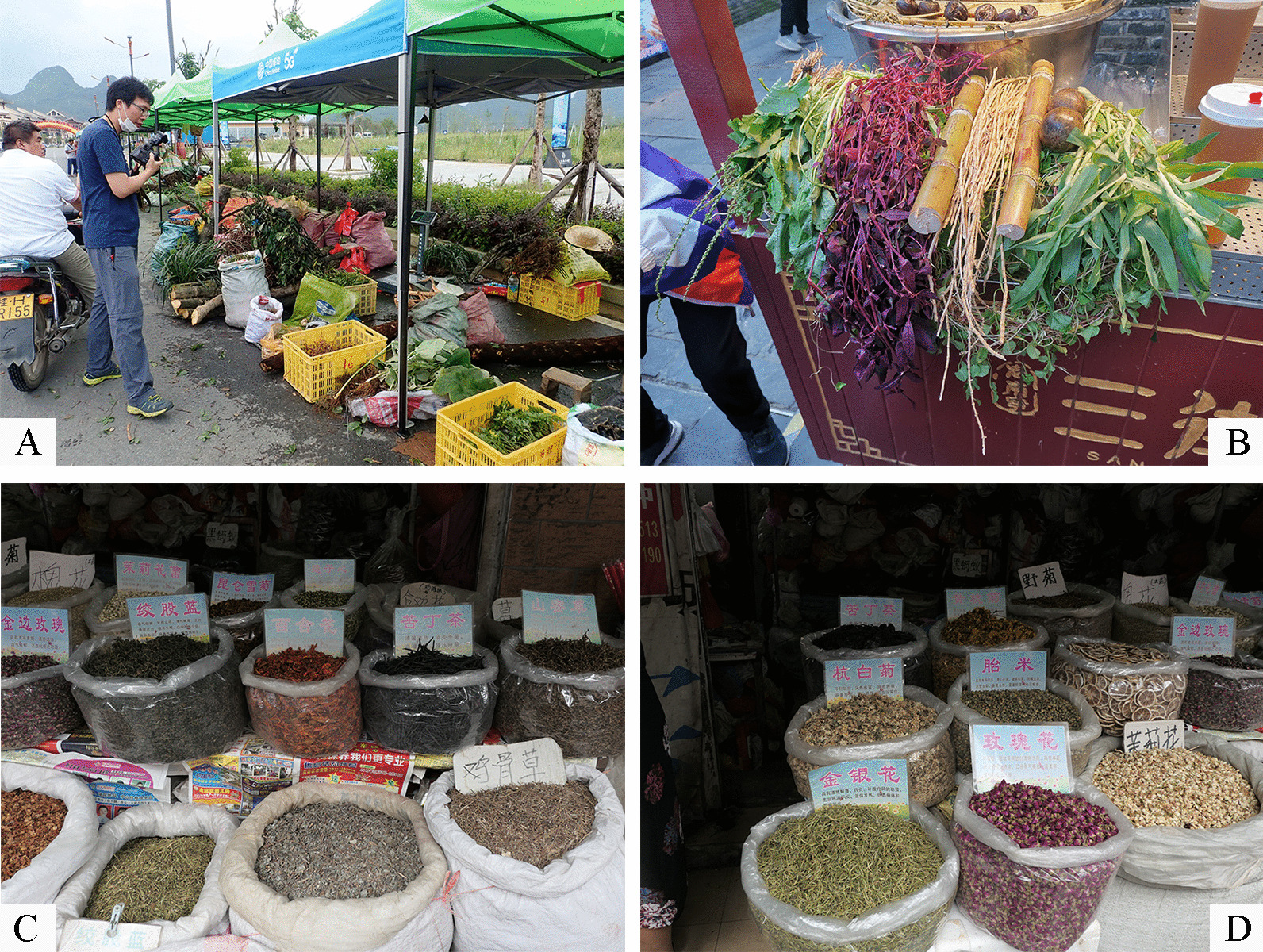
A Ethnobotanical investigation of herbal tea; B–D herbal tea plants in medicinal markets
Data analysis
Data analysis was carried out to evaluate how important and indispensable the herbal tea species are to local healthcare and daily diets. The taxonomic diversity, used parts, preparation methods, and categories of health-promoting were counted and analyzed. Moreover, three indices were applied to furtherly estimate the importance of certain species to the local community, which were named the relative frequency of citation (RFC), the informant consensus factor (ICF), and the cultural food significance index (CFSI).
The RFC was performed to quantify the use frequency of certain species, which was determined using the following formula:
Relative frequency of citation: .
FC refers to the number of respondents who mentioned a particular herbal tea plant, and N represents the number of informants participating in the survey [32, 33].
The ICF was used to measure the agreement among informants on the health-promoting effects of each herbal tea plant. The value was calculated following the formula:
Informant Consensus Factor: .
Nur is the number of informants reporting a certain health-promoting effect, and Nt is the total number of herbal tea plants used for the particular health-promoting effect [34].
The CFSI elaborated to evaluate the cultural significance of herbal tea plants by following the formula:
Cultural food significance index:.
Seven indexes in the formula expressed the frequency of quotation (mention) by informants (QI), the availability of a plant (AI), the frequency of utilization (FUI), the used parts of the plant (PUI), multi-functional food use (MFFI), the taste score appreciation index (TSAI), and the food-medicinal role score (FMRI), respectively [35–37].
Results
Diversity of herbal tea plants in Guangxi
Our investigations showed that 155 plant species were used to make herbal tea in Guangxi. Ethnobotanical information of each species, including family, scientific name, Chinese name, habit, parts used, preparation and uses, habitat, materials status (dry or fresh), health-promoting effects, RFC, CFSI, and voucher number, is listed in Table 1.
Table 1.
Local herbal tea plants in Guangxi Province
| No. | Family | Scientific name | Chinese name | Habit | Part used | Preparation and uses | Habitat | Materials status | Health-promoting effects | RFC | CFSI | Voucher number |
|---|---|---|---|---|---|---|---|---|---|---|---|---|
| 1 | Annonaceae | Alphonsea hainanensis Merr. & Chun |
Hai nan teng chun 海南藤春 |
Tree | Branch and leaf | Decoction | Wild | Dry or Fresh | – | 0.032 | 9.9 | HYF160114002 |
| 2 | Apiaceae | Centella asiatica (L.) Urb |
Ji xue cao 积雪草 |
Herb | Whole plant | Decoction | Wild | Dry or Fresh | Clearing heat away and detoxifying | 0.294 | 1958.4 | HYF1501106010 |
| 3 | Apocynaceae | Melodinus fusiformis Champ. ex Benth |
Cha teng 茶藤 |
Liana | Branch and leaf | Decoction | Wild | Dry | – | 0.006 | 6.8 | HYF180108033 |
| 4 | Apocynaceae | Plumeria rubra L |
Ji dan hua 鸡蛋花 |
Shrub | Flower | Soak | Cultivated | Dry or Fresh | Clearing heat away, moistening lungs and relieving cough | 0.13 | 121.5 | HYF190705016 |
| 5 | Aquifoliaceae | Ilex asprella (Hook. & Arn.) Champ. ex Benth |
Mei ye dong qing 梅叶冬青 |
Shrub | Root and stem | Decoction | Wild | Dry | Clearing heat away and detoxifying | 0.108 | 66 | HYF180201008 |
| 6 | Aquifoliaceae | Ilex hainanensis Merr |
Hai nan dong qing 海南冬青 |
Tree | Leaf | Decoction | Wild | Dry | Relieving summer heat, lower cholesterol | 0.125 | 76.6 | HYF180201010 |
| 7 | Aquifoliaceae | Ilex jingxiensis Y. F. Huang & M. X. Lai |
Jing xi dong qing 靖西冬青 |
Tree | Leaf | Decoction | Wild | Dry | Clearing heat away and detoxifying | 0.022 | 5.9 | HYF170921001 |
| 8 | Aquifoliaceae | Ilex kudingcha C. J. Tseng |
Ku ding cha 苦丁茶 |
Tree | Leaf | Soak | Cultivated and wild | Dry | Clearing heat away and detoxifying | 0.637 | 1380.6 | HYF170921003 |
| 9 | Aquifoliaceae | Ilex pentagona S. K. Chen, Y. X. Feng & C. F. Liang |
Wu leng ku ding cha 五棱苦丁茶 |
Tree | Leaf | Soak | Wild | Dry | Clearing heat away and detoxifying | 0.06 | 32.8 | HYF170921005 |
| 10 | Aquifoliaceae | Ilex pubescens Hook. & Arn |
Mao dong qing 毛冬青 |
Shrub | Leaf | Decoction | Wild | Dry | Clearing heat away and detoxifying | 0.091 | 83.2 | HYF160126011 |
| 11 | Aquifoliaceae | Ilex rotunda Thunb |
Tie dong qing 铁冬青 |
Tree | Bark | Decoction | Wild | Dry | Clearing heat away and detoxifying | 0.359 | 219.1 | HYF160126012 |
| 12 | Araliaceae | Heptapleurum heptaphyllum (L.) Y. F. Deng |
E zhang chai 鹅掌柴 |
Tree | Root | Decoction | Wild | Dry | Clearing heat away and detoxifying | 0.244 | 223.7 | HYF171101003 |
| 13 | Araliaceae | Heptapleurum minutistellatum (Merr. ex H. L. Li) Y. F. Deng |
Xing mao ya jiao mu 星毛鸭脚木 |
Tree | Root | Decoction | Wild | Dry | Clearing heat away and detoxifying | 0.14 | 128.7 | HYF171101004 |
| 14 | Araliaceae | Panax notoginseng (Burkill) F. H. Chen ex C. Chow & W. G. Huang |
San qi 三七 |
Herb | Flower | Soak | Cultivated | Dry | Clearing heat away, detoxification, lowering the blood pressure | 0.112 | 46.8 | HYF221023002 |
| 15 | Asteraceae | Artemisia anomala S. Moore |
Qi hao 奇蒿 |
Herb | Branch and leaf | Decoction | Wild | Dry | Clearing heat away, diuresis, improving blood circulation | 0.05 | 1408.3 | HYF171028005 |
| 16 | Asteraceae | Chrysanthemum indicum L |
Ye ju 野菊 |
Herb | Flower | Soak | Wild | Dry | Clearing heat away and detoxifying, improving eyesight, lowering the blood pressure | 0.704 | 874.8 | HYF181014011 |
| 17 | Asteraceae | Launaea acaulis (Roxb.) Babc. ex Kerr |
Guang jing shuan guo ju 光茎栓果菊 |
Herb | Whole plant | Decoction | Wild | Dry or Fresh | Clearing heat away and detoxifying, moistening lungs and relieving cough | 0.095 | 34.3 | HYF160413016 |
| 18 | Asteraceae | Taraxacum mongolicum Hand.-Mazz |
Pu gong ying 蒲公英 |
Herb | Whole plant | Decoction | Cultivated or wild | Dry or Fresh | Clearing heat away and detoxifying, diuresis | 0.175 | 20.2 | HYF171031002 |
| 19 | Begoniaceae | Begonia fimbristipula Hance |
Zi bei tian kui 紫背天葵 |
Herb | Whole plant | Decoction | Wild | Dry | Detoxification, relieving cough, improving blood circulation, improving immunity | 0.071 | 96.5 | HYF171028007 |
| 20 | Calycanthaceae | Chimonanthus nitens Oliv |
Shan la mei 山蜡梅 |
Shrub | Leaf | Decoction | Wild | Fresh | Clearing heat away and detoxifying | 0.017 | 5.2 | HYF181014010 |
| 21 | Caprifoliaceae | Lonicera confusa DC |
Hua nan ren dong 华南忍冬 |
Liana | Flower | Soak | Cultivated or wild | Dry or Fresh | Clearing heat away and detoxifying | 0.011 | 338.6 | HYF171117003 |
| 22 | Caprifoliaceae | Lonicera hypoglauca Miq |
Gu xian ren dong 菰腺忍冬 |
Liana | Flower | Soak | Cultivated or wild | Dry or Fresh | Clearing heat away and detoxifying | 0.492 | 18.7 | HYF171117007 |
| 23 | Caprifoliaceae | Lonicera macrantha (D. Don) Spreng |
Da hua ren dong 大花忍冬 |
Liana | Flower | Soak | Wild | Dry or Fresh | Clearing heat away and detoxifying | 0.104 | 156.4 | HYF171117005 |
| 24 | Caprifoliaceae | Lonicera macranthoides Hand.-Mazz | Hui zhan mao ren dong 灰毡毛忍冬 | Liana | Flower | Soak | Cultivated or wild | Dry or Fresh | Clearing heat away and detoxifying | 0.341 | 7.3 | HYF171117010 |
| 25 | Chloranthaceae | Sarcandra glabra (Thunb.) Nakai |
Cao shan hu 草珊瑚 |
Shrub | Branch and leaf | Decoction | Wild | Dry | Clearing heat away and detoxifying | 0.38 | 1689.6 | HYF151121016 |
| 26 | Cucurbitaceae | Gynostemma compressum X. X. Chen & D. R. Liang |
Bian guo jiao gu lan 扁果绞股蓝 |
Liana | Whole plant | Decoction | Wild | Dry | Clearing heat away and detoxifying | 0.032 | 35.1 | HYF180112014 |
| 27 | Cucurbitaceae | Gynostemma guangxiense X. X. Chen et D. H. Qin |
Guang xi jiao gu lan 广西绞股蓝 |
Liana | Whole plant | Decoction | Wild | Dry | Clearing heat away and detoxifying | 0.019 | 21.1 | HYF170319007 |
| 28 | Cucurbitaceae | Gynostemma longipes C. Y. Wu |
Chang geng jiao gu lan 长梗绞股蓝 |
Liana | Whole plant | Decoction | Wild | Dry | Clearing heat away and detoxifying | 0.032 | 35.1 | HYF170319010 |
| 29 | Cucurbitaceae | Gynostemma pentaphyllum (Thunb.) Makino |
Jiao gu lan 绞股蓝 |
Liana | Whole plant | Soak | Wild | Dry | Clearing heat away and detoxifying, relieving cough, expectorant | 0.562 | 3244.8 | HYF170319011 |
| 30 | Cucurbitaceae | Gynostemma laxum (Wall.) Cogn |
Guang ye jiao gu lan 光叶绞股蓝 |
Liana | Whole plant | Decoction | Wild | Dry | Clearing heat away and detoxifying | 0.006 | 7 | HYF170319008 |
| 31 | Cucurbitaceae | Momordica charantia L |
Ku gua 苦瓜 |
Liana | Peel | Decoction | Cultivated | Dry | Relieve summer heat, improving eyesight, detoxification | 0.292 | 364.5 | HYF180108040 |
| 32 | Cucurbitaceae | Siraitia grosvenorii (Swingle) C. Jeffrey ex A. M. Lu & Zhi Y. Zhang |
Luo han guo 罗汉果 |
Liana | Fruit, flower | Soak | Cultivated | Dry | Clearing heat away and moistening lungs | 0.773 | 5370 | HYF151019008 |
| 33 | Ebenaceae | Diospyros kaki L.f | Shi 柿 | Tree | Leaf | Decoction | Cultivated | Dry | Aiding digestion | 0.032 | 39.6 | HYF190727001 |
| 34 | Fabaceae | Abrus precatorius L |
Xiang si zi 相思子 |
Liana | Leaf | Soak | Wild | Dry | Moistening lungs, clearing heat away, diuresis | 0.363 | 725.8 | HYF190706006 |
| 35 | Fabaceae | Callerya speciosa (Champ. ex Benth.) J. Compton & Schrire |
Mei li ya dou teng 美丽崖豆藤 |
Liana | Tuber | Decoction | Wild | Dry | Strong body | 0.004 | 5.9 | HYF180211011 |
| 36 | Fabaceae | Chamaecrista mimosoides (L.) Greene |
Han xiu cao jue ming 含羞草决明 |
Herb | Seed | Soak after stir-fry | Cultivated | Dry | Clearing heat away and detoxifying, diuresis, aid digestion | 0.035 | 8.3 | HYF181014008 |
| 37 | Fabaceae | Chamaecrista nictitans (L.) Moench |
Duan ye jue ming 短叶决明 |
Herb | Seed | Soak after stir-fry | Wild | Dry | Clearing liver heat and improving eyesight, aid digestion | 0.026 | 3.1 | HYF181014009 |
| 38 | Fabaceae | Pueraria montana (Lour.) Merr |
Ge 葛 |
Liana | Flower | Decoction | Wild | Dry | Refreshing, alleviate a hangover, alleviate a hangover | 0.328 | 513 | HYF190705023 |
| 39 | Fabaceae | Senna sophera (L.) Roxb |
Huai ye jue ming 槐叶决明 |
Herb | Seed | Soak after stir-fry | Wild | Dry | Clearing liver heat and improving eyesight, aid digestion | 0.048 | 17.2 | HYF151019006 |
| 40 | Fabaceae | Senna tora (L.) Roxb |
Jue ming 决明 |
Herb | Seed | Soak after stir-fry | Cultivated or wild | Dry | Clearing liver heat and improving eyesight, aid digestion | 0.067 | 80.6 | HYF151019007 |
| 41 | Fabaceae | Tadehagi pseudotriquetrum (DC.) H. Ohashi |
Man jing hu lu cha 蔓茎葫芦茶 |
Shrub | Branch and leaf | Decoction | Wild | Dry or Fresh | Relieving cough and reducing sputum | 0.032 | 19.8 | HYF171031005 |
| 42 | Fabaceae | Tadehagi triquetrum (L.) H. Ohashi |
Hu lu cha 葫芦茶 |
Shrub | Branch and leaf | Decoction | Wild | Dry or Fresh | Relieving cough and reducing sputum, diuresis, relieve summer heat | 0.097 | 243 | HYF171031001 |
| 43 | Fagaceae | Lithocarpus litseifolius (Hance) Chun |
Mu jiang ye ke 木姜叶柯 |
Tree | Leaf | Soak | Wild | Dry | Helping produce saliva and slake thirst, relieve summer heat | 0.551 | 1377 | HYF191112022 |
| 44 | Helwingiaceae | Helwingia chinensis Batalin |
Zhong hua qing jia ye 中华青荚叶 |
Shrub | Branch and leaf | Decoction | Wild | Dry | Clearing heat away | 0.006 | 3.1 | HYF180110012 |
| 45 | Hypericaceae | Cratoxylum cochinchinense (Lour.) Blume |
Huang niu mu 黄牛木 |
Tree | Branch and leaf | Soak | Wild | Dry | Heatstroke prevention, clearing away heat | 0.127 | 368.2 | HYF181120018 |
| 46 | Hypericaceae | Cratoxylum formosum subsp. pruniflorum (Kurz) Gogelin |
Hong ya mu 红芽木 |
Tree | Branch and leaf | Soak | Wild | Dry | Clearing heat away, relieve summer heat, anti-diarrhea | 0.335 | 644.8 | HYF181122003 |
| 47 | Hypericaceae | Hypericum japonicum Thunb |
Di er cao 地耳草 |
Herb | Whole plant | Decoction | Wild | Dry or Fresh | Clearing heat away, detoxification | 0.125 | 229.7 | HYF180110017 |
| 48 | Juglandaceae | Cyclocarya paliurus (Batalin) Iljinsk |
Qing qian liu 青钱柳 |
Tree | Branch and leaf | Decoction | Wild | Dry or Fresh | Clearing heat away, lowering the blood pressure | 0.307 | 255.6 | HYF181122012 |
| 49 | Juglandaceae | Engelhardia roxburghiana Lindl |
Huang qi 黄杞 |
Tree | Branch and leaf | Decoction | Wild | Dry | Clearing heat away and detoxifying, help produce saliva and slake thirst, relieve summer heat, decreasing blood glucose | 0.365 | 912.6 | HYF161104003 |
| 50 | Lamiaceae | Agastache rugosa (Fisch. & C. A. Mey.) Kuntze |
Huo xiang 藿香 |
Herb | Branch and leaf | Decoction | Cultivated or wild | Dry or Fresh | Relieving summer heat | 0.123 | 256.5 | HYF190813004 |
| 51 | Lamiaceae | Clerodendrum infortunatum L |
Bai hua deng long 白花灯笼 |
Herb | Root | Decoction | Wild | Dry | Clearing heat away, relieving cough, detoxification, and detumescence | 0.026 | 15.9 | HYF190312032 |
| 52 | Lamiaceae | Elsholtzia ciliata (Thunb.) Hyl |
Xiang ru 香薷 |
Herb | Branch and leaf | Decoction | Wild | Dry or Fresh | Diuresis, clearing heat away, relieve summer heat | 0.048 | 105.6 | HYF161104002 |
| 53 | Lamiaceae | Isodon lophanthoides (Buch.-Ham. ex D. Don) H. Hara |
Xian wen xiang cha cai 线纹香茶菜 |
Herb | Whole plant | Decoction | Wild | Dry or Fresh | Clearing heat away and detoxifying | 0.052 | 64.8 | HYF160413006 |
| 54 | Lamiaceae | Mentha canadensis L |
Bao he 薄荷 |
Herb | Branch and leaf | Soak | Cultivated or wild | Dry | Clearing heat away and detoxifying | 0.039 | 194.4 | HYF180108034 |
| 55 | Lamiaceae | Orthosiphon aristatus (Blume) Miq |
Shen cha 肾茶 |
Herb | Branch and leaf | Decoction | Cultivated | Fresh | Clearing heat away and diuresis | 0.339 | 1017.4 | HYF190312030 |
| 56 | Lamiaceae | Platostoma palustre (Blume) A. J. Paton |
Liang fen cao 凉粉草 |
Herb | Whole plant | Decoction | Cultivated or wild | Dry | Clearing heat away, relieve summer heat, diuresis | 0.149 | 1117.8 | HYF180108036 |
| 57 | Lamiaceae | Premna microphylla Turcz |
Dou fu chai 豆腐柴 |
Shrub | Leaf | Decoction | Wild | Dry or Fresh | Clearing heat away and detoxifying, detumescence | 0.052 | 37.4 | HYF190705019 |
| 58 | Lamiaceae | Prunella vulgaris L |
Xia ku cao 夏枯草 |
Herb | Whole plant | Decoction | Wild | Dry or Fresh | Clearing heat away and diuresis | 0.069 | 249.6 | HYF190705020 |
| 59 | Lamiaceae | Vitex negundo L. var. cannabifolia (Sieb. & Zucc.) Hand.-Mazz |
Mu jing 牡荆 |
Shrub | Branch and leaf | Decoction | Wild | Dry or Fresh | Clearing heat away, aid digestion | 0.032 | 6.6 | HYF180118012 |
| 60 | Lamiaceae | Vitex quinata (Lour.) F. N. Williams |
Shan mu jing 山牡荆 |
Tree | Branch and leaf, fruit | Decoction | Wild | Dry or Fresh | Clearing heat away, lowering the blood pressure | 0.022 | 8.8 | HYF151121013 |
| 61 | Lauraceae | Cinnamomum burmannii (Nees & T. Nees) Blume |
Yin xiang 阴香 |
Tree | Bark | Decoction | Wild | Dry | Expelling wind and removing cold | 0.024 | 39.6 | HYF171028025 |
| 62 | Lauraceae | Cinnamomum jensenianum Hand.-Mazz |
Ye huang gui 野黄桂 |
Tree | Branch and leaf | Decoction | Wild | Dry | Improving blood circulation, removing cold | 0.013 | 10.8 | HYF190312028 |
| 63 | Lauraceae | Neocinnamomum delavayi (Lecomte) H. Liu |
Xin zhang 新樟 |
Tree | Stem | Decoction | Wild | Dry | Anti-diarrhea, headache, protection against the cold | 0.006 | 2.7 | HYF171114011 |
| 64 | Loranthaceae | Helixanthera parasitica Lour |
Li ban ji sheng 离瓣寄生 |
Shrub | Whole plant | Decoction | Wild | Dry or Fresh | Determined by the host plants | 0.048 | 158.4 | HYF180110011 |
| 65 | Loranthaceae | Macrosolen cochinchinensis (Lour.) Tiegh |
Qiao hua 鞘花 |
Shrub | Whole plant | Decoction | Wild | Dry or Fresh | Determined by the host plants | 0.086 | 324 | HYF180111053 |
| 66 | Loranthaceae | Scurrula parasitica L |
Hong hua ji sheng 红花寄生 |
Shrub | Whole plant | Decoction | Wild | Dry or Fresh | Determined by the host plants | 0.011 | 9 | HYF171101006 |
| 67 | Loranthaceae | Taxillus chinensis (DC.) Danser |
Guang ji sheng 广寄生 |
Shrub | Whole plant | Decoction | Wild | Dry or Fresh | Tonifying liver and kidney, strengthening bones and muscles, lowering the blood pressure | 0.032 | 202.5 | HYF171219009 |
| 68 | Loranthaceae | Viscum multinerve (Hayata) Hayata |
Bing guo hu ji sheng 柄果槲寄生 |
Shrub | Whole plant | Decoction | Wild | Dry or Fresh | Tonifying liver and kidney, improving blood circulation, lowering the blood pressure | 0.026 | 32.4 | HYF180118011 |
| 69 | Magnoliaceae | Manglietia aromatica (Dandy) V. S. Kumar |
Xiang mu lian 香木莲 |
Tree | Fruit | Decoction | Wild | Dry | Regulating qi and invigorating consciousness | 0.006 | 3.6 | HYF180108032 |
| 70 | Malvaceae | Helicteres angustifolia L |
Shan zhi ma 山芝麻 |
Shrub | Whole plant | Decoction | Wild | Dry or Fresh | Clearing heat away and detoxifying | 0.065 | 117 | HYF180110009 |
| 71 | Malvaceae | Microcos paniculata L |
Po bu ye 破布叶 |
Tree | Leaf | Decoction | Wild | Dry or Fresh | Clearing heat away and detoxifying, anti-inflammatory, anti-diarrhea | 0.529 | 1293.6 | HYF180108037 |
| 72 | Menispermaceae | Cocculus laurifolius DC |
Zhang ye mu fang ji 樟叶木防己 |
Shrub | Leaf | Decoction | Wild | Dry or Fresh | – | 0.013 | 8.1 | HYF181120016 |
| 73 | Menispermaceae | Cyclea hypoglauca (Schauer) Diels |
Fen ye lun huan teng 粉叶轮环藤 |
Liana | Root | Decoction | Wild | Dry | Detoxifying, Anti-inflammatory | 0.011 | 8.3 | HYF181122004 |
| 74 | Menispermaceae | Pericampylus glaucus (Lam.) Merr |
Xi yuan teng 细圆藤 |
Liana | Leaf | Decoction | Wild | Dry | – | 0.006 | 5.9 | HYF190103019 |
| 75 | Moraceae | Ficus carica L |
Wu hua guo 无花果 |
Shrub | Fruit | Decoction | Cultivated | Dry | Invigorating stomach, aid digestion, detumescence, detoxification | 0.393 | 1474.2 | HYF180109020 |
| 76 | Moraceae | Ficus cyrtophylla (Miq.) Miq |
Wai ye rong 歪叶榕 |
Tree | Leaf | Decoction | Wild | Dry | – | 0.011 | 5 | HYF180109021 |
| 77 | Moraceae | Morus alba L |
Sang 桑 |
Tree | Leaf | Decoction | Cultivated | Dry | Clearing heat away, improving eyesight | 0.592 | 2466 | HYF180108043 |
| 78 | Moraceae | Morus australis Poir | Ji sang 鸡桑 | Shrub | Leaf | Decoction | Wild | Dry | Clearing heat away | 0.119 | 61.9 | HYF180108051 |
| 79 | Myrtaceae | Decaspermum gracilentum (Hance) Merr. & L. M. Perry |
Zi lian shu 子楝树 |
Tree | Leaf | Decoction | Wild | Dry | Diabetes, lowering the blood pressure, Hypolipidemic | 0.022 | 7.8 | HYF181122007 |
| 80 | Myrtaceae | Psidium guajava L |
Fan shi liu 番石榴 |
Tree | Young leaf | Decoction | Cultivated | Fresh | Anti-diarrhea, aid digestion | 0.114 | 143.1 | HYF190705022 |
| 81 | Myrtaceae | Syzygium nervosum A. Cunn. ex DC |
Shui weng pu tao 水翁蒲桃 |
Tree | Flower, young leaf | Decoction | Cultivated | Dry | Clearing heat away | 0.054 | 39 | HYF190507006 |
| 82 | Nymphaeaceae | Nelumbo nucifera Gaertn |
Lian 莲 |
Herb | Leaf | Decoction | Cultivated | Dry or Fresh | Clearing heat away, relieve summer heat | 0.242 | 504 | HYF171114009 |
| 83 | Oleaceae | Jasminum sambac (L.) Aiton |
Mo li hua 茉莉花 |
Liana | Flower | Soak | Cultivated | Dry or Fresh | – | 0.654 | 1636.2 | HYF160413005 |
| 84 | Oleaceae | Ligustrum robustum (Roxb.) Blume |
Cu zhuang nv zhen 粗壮女贞 |
Shrub | Leaf | Soak | Wild | Dry | Refreshing, dispelling wind and eliminating dampness, strengthening bones and muscles, lowering the blood pressure | 0.017 | 5.3 | HYF191112019 |
| 85 | Oleaceae | Ligustrum sinense Lour |
Duo mao xiao la 多毛小蜡 |
Shrub | Young leaf | Soak | Wild | Dry or Fresh | Relieving sore throat | 0.009 | 0.7 | HYF191112020 |
| 86 | Oleaceae | Osmanthus fragrans Lour |
Gui hua 桂花 |
Tree | Flower | Soak | Cultivated or wild | Dry or Fresh | Relieving cough and reducing sputum, improving eyesight | 0.367 | 765 | HYF190103017 |
| 87 | Orchidaceae | Anoectochilus calcareus Aver |
Hui yan jin xian lan 灰岩金线兰 |
Herb | Whole plant | Decoction | Wild | Dry | Clearing heat away, detoxification and detumescence, moistening lungs and relieving cough | 0.114 | 178.9 | HYF18111001 |
| 88 | Orchidaceae | Anoectochilus nandanensis Y. Feng Huang & X. C. Qu |
Nan dan jin xian lan 南丹金线兰 |
Herb | Whole plant | Decoction | Wild | Dry | Clearing heat away, detoxification and detumescence, moistening lungs and relieving cough | 0.017 | 21.6 | HYF18111002 |
| 89 | Orchidaceae | Anoectochilus roxburghii (Wall.) Lindl |
Hua ye kai chun lan 花叶开唇兰 |
Herb | Whole plant | Decoction | Wild | Dry | Clearing heat away, detoxification and detumescence, moistening lungs and relieving cough | 0.32 | 1332 | HYF171028002 |
| 90 | Orchidaceae | Anoectochilus zhejiangensis Z. Wei & Y. B. Chang |
Zhe jiang jin xian lan 浙江金线兰 |
Herb | Whole plant | Decoction | Wild | Dry | Clearing heat away, detoxification and detumescence, moistening lungs and relieving cough | 0.002 | 1.6 | HYF171028004 |
| 91 | Orchidaceae | Bulbophyllum kwangtungense Schltr |
Guang dong shi dou lan 广东石豆兰 |
Herb | Whole plant | Decoction | Wild | Fresh | Moistening lungs, relieving cough and reducing sputum, clearing heat away | 0.099 | 165.6 | HYF180211009 |
| 92 | Orchidaceae | Bulbophyllum odoratissimum (Sm.) Lindl. ex Wall |
Mi hua shi dou lan 密花石豆兰 |
Herb | Whole plant | Decoction | Wild | Fresh | Moistening lungs and resolving phlegm, relaxing tendons and activating collaterals | 0.052 | 43.2 | HYF180211010 |
| 93 | Orchidaceae | Nervilia fordii (Hance) Schltr |
Mao chun yu lan 毛唇芋兰 |
Herb | Whole plant | Decoction | Wild | Dry | Clearing heat away | 0.039 | 52.7 | HYF170413003 |
| 94 | Orchidaceae | Nervilia plicata (Andrews) Schltr |
Mao ye yu lan 毛叶芋兰 |
Herb | Whole plant | Decoction | Wild | Dry | Clearing heat away | 0.009 | 3.1 | HYF170413004 |
| 95 | Orchidaceae | Pholidota chinensis Lindl |
Shi xian tao 石仙桃 |
Herb | Whole plant | Decoction | Wild | Fresh | Moistening lungs, clearing heat away and detoxifying, eliminating dampness, dispersing stasis | 0.616 | 2885.6 | HYF190103022 |
| 96 | Orchidaceae | Pholidota pallida Lindl |
Yun nan shi xian tao 云南石仙桃 |
Herb | Whole plant | Decoction | Wild | Fresh | Clearing heat away, relieving cough and reducing sputum | 0.14 | 438.8 | HYF190103024 |
| 97 | Pentaphylacaceae | Adinandra millettii (Hook. & Arn.) Benth. & Hook. f. ex Hance |
Yang tong 杨桐 |
Shrub | Young leaf | Decoction | Wild | Dry | Anti-inflammatory, clearing heat away | 0.13 | 81 | HYF180201010 |
| 98 | Pentaphylacaceae | Adinandra nitida Merr. ex H. L. Li |
Liang ye yang tong 亮叶杨桐 |
Tree | Young leaf, flower | Soak | Wild | Dry | Detoxification, lowering the blood pressure, clearing heat away, health care | 0.335 | 302.3 | HYF180201012 |
| 99 | Pentaphylacaceae | Eurya chinensis R. Br |
Mi sui hua 米碎花 |
Shrub | Young leaf | Decoction | Wild | Dry or Fresh | Clearing heat away and detoxifying, preventing influenza | 0.017 | 9.4 | HYF180111002 |
| 100 | Pentaphylacaceae | Eurya patentipila Chun |
Chang mao ling 长毛柃 |
Shrub | Young leaf | Decoction | Wild | Dry or Fresh | – | 0.013 | 2.3 | HYF180109019 |
| 101 | Phyllanthaceae | Glochidion sphaerogynum (Müll. Arg.) Kurz |
Yuan guo suan pan zi 圆果算盘子 |
Shrub | Leaf | Decoction | Wild | Fresh | – | 0.009 | 1.3 | HYF180112013 |
| 102 | Phyllanthaceae | Phyllanthus emblica L |
Yu gan zi 余甘子 |
Tree | Fruit | Soak | Cultivated or wild | Fresh | Helping produce saliva and slake thirst, moistening lungs and resolving phlegm | 0.212 | 496.1 | HYF190103026 |
| 103 | Pinaceae | Pinus massoniana Lamb |
Ma wei song 马尾松 |
Tree | Leaf | Decoction | Wild | Dry | Improving blood circulation | 0.194 | 273.4 | HYF190103031 |
| 104 | Plantaginaceae | Plantago asiatica L |
Che qian 车前 |
Herb | Whole plant | Decoction | Wild | Fresh | Diuresis, relieving cough | 0.646 | 4664.4 | HYF190103033 |
| 105 | Plantaginaceae | Scoparia dulcis L |
Ye gan cao 野甘草 |
Herb | Whole plant | Decoction | Wild | Dry or Fresh | Decreasing blood glucose, lowering the blood pressure, antiviral and antitumor | 0.259 | 1296 | HYF171101005 |
| 106 | Poaceae | Bambusa chungii McClure |
Fen dan zhu 粉单竹 |
Tree | Young leaf | Decoction | Wild | Dry | – | 0.112 | 79 | HYF171028008 |
| 107 | Poaceae | Cymbopogon mekongensis A. Camus |
Qing xiang mao 青香茅 |
Herb | Leaf | Decoction | Cultivated | Dry | – | 0.335 | 1255.5 | HYF181122006 |
| 108 | Poaceae | Imperata cylindrica (L.) Raeusch |
Bai mao 白茅 |
Herb | Rhizome | Decoction | Wild | Dry or Fresh | Clearing away heat and diuresis | 0.402 | 1674 | HYF160413004 |
| 109 | Poaceae | Lophatherum gracile Brongn |
Dan zhu ye 淡竹叶 |
Herb | Whole plant | Decoction | Wild | Dry or Fresh | Clearing heat away, diuresis | 0.104 | 216 | HYF171117011 |
| 110 | Poaceae | Pogonatherum paniceum (Lam.) Hack |
Jin fa cao 金发草 |
Herb | Branch and leaf | Decoction | Wild | Dry | Clearing heat away and detoxifying | 0.026 | 56.2 | HYF190705017 |
| 111 | Poaceae | Saccharum officinarum L |
Gan zhe 甘蔗 |
Herb | Stem | Decoction | Cultivated | Fresh | Clearing heat away and detoxifying, help produce saliva and slake thirst, antiemetic | 0.071 | 142.6 | HYF151121017 |
| 112 | Polygonaceae | Polygonum chinense (L.) H. Gross |
Huo tan mu 火炭母 |
Herb | Branch and leaf | Decoction | Wild | Dry or Fresh | Clearing heat away, diuresis, detoxification, improving eyesight, improving blood circulation | 0.035 | 56.3 | HYF190705018 |
| 113 | Primulaceae | Maesa japonica (Thunb.) Moritzi & Zoll |
Du jing shan 杜茎山 |
Shrub | Young leaf | Decoction | Wild | Fresh | Clearing heat away and detoxifying | 0.071 | 14.9 | HYF180111054 |
| 114 | Primulaceae | Maesa montana A. DC |
Jin zhu liu 金珠柳 |
Shrub | Young leaf | Decoction | Wild | Fresh | – | 0.091 | 56.7 | HYF180111055 |
| 115 | Primulaceae | Maesa perlaria (Lour.) Merr |
Ji yu dan 鲫鱼胆 |
Shrub | Young leaf | Decoction | Wild | Fresh | – | 0.108 | 22.5 | HYF180111056 |
| 116 | Pteridaceae | Onychium japonicum (Thunb.) Kunze |
Ye zhi wei jin fen jue 野雉尾金粉蕨 |
Herb | Leaf | Decoction | Wild | Dry or Fresh | Detoxification, clearing heat away | 0.147 | 106.1 | HYF190103013 |
| 117 | Rhamnaceae | Berchemia polyphylla Wall. ex M. A. Lawson |
Dong ye gou er cha 多叶勾儿茶 |
Shrub | Branch and leaf | Decoction | Wild | Dry or Fresh | Clearing away the lung-heat | 0.017 | 16.6 | HYF171028008 |
| 118 | Rhamnaceae | Sageretia thea (Osbeck) M. C. Johnst |
Que mei teng 雀梅藤 |
Shrub | Branch and leaf | Decoction | Wild | Dry or Fresh | Clearing heat away and detoxifying | 0.013 | 12.5 | HYF190507003 |
| 119 | Rosaceae | Crataegus scabrifolia (Franch.) Rehder |
Yun nan shan zha 云南山楂 |
Tree | Leaf, fruit | Decoction | Wild | Dry | Aiding digestion | 0.551 | 2151.6 | HYF181120017 |
| 120 | Rosaceae | Docynia doumeri (Bois) C. K. Schneid |
Tai wan hai tang 台湾海棠 |
Tree | Fruit | Decoction | Wild | Dry | Aiding digestion | 0.317 | 529.2 | HYF180108031 |
| 121 | Rosaceae | Eriobotrya japonica (Thunb.) Lindl |
Pi pa 枇杷 |
Tree | Leaf | Decoction | Cultivated | Dry or Fresh | Relieving cough and reducing sputum | 0.43 | 1343.3 | HYF161104004 |
| 122 | Rosaceae | Rubus chingii Hu |
Tian cha 甜茶 |
Shrub | Leaf | Soak | Wild | Dry | Diuresis, lowering the blood pressure | 0.199 | 496.8 | HYF161114014 |
| 123 | Rubiaceae | Dimetia hedyotidea (DC.) T. C. Hsu |
Niu bai teng 牛白藤 |
Herb | Branch and leaf | Decoction | Wild | Dry or Fresh | Clearing heat away and detoxifying | 0.026 | 42.2 | HYF180110006 |
| 124 | Rubiaceae | Hedyotis caudatifolia Merr. & F. P. Metcalf |
Jian ye er cao 剑叶耳草 |
Herb | Branch and leaf | Decoction | Wild | Dry or Fresh | Relieving cough and reducing sputum, aid digestion | 0.125 | 313.2 | HYF180110002 |
| 125 | Rubiaceae | Hedyotis effusa Hance |
Ding hu er cao 鼎湖耳草 |
Herb | Branch and leaf | Decoction | Wild | Dry or Fresh | Clearing heat away and detoxifying | 0.19 | 158.4 | HYF180110004 |
| 126 | Rubiaceae | Hedyotis uncinella Hook. & Arn |
Chang jie er cao 长节耳草 |
Herb | Whole plant | Decoction | Wild | Dry or Fresh | Dispelling wind and eliminating dampness | 0.013 | 18.7 | HYF180110008 |
| 127 | Rubiaceae | Mycetia sinensis (Hemsl.) Craib |
Hua xian e mu 华腺萼木 |
Shrub | Branch and leaf | Decoction | Wild | Dry or Fresh | Help produce saliva and slake thirst | 0.006 | 2.6 | HYF171114008 |
| 128 | Rubiaceae | Uncaria hirsuta Havil |
Mao gou teng 毛钩藤 |
Liana | Flower | Soak | Wild | Fresh | Refreshing | 0.009 | 3.9 | HYF171219010 |
| 129 | Rubiaceae | Uncaria rhynchophylla (Miq.) Miq |
Gou teng 钩藤 |
Liana | Stem nodes with hooks | Decoction | Wild | Dry | Lowering the blood pressure, protection against the cold | 0.013 | 9.4 | HYF171219011 |
| 130 | Rutaceae | Citrus maxima (Burm.) Merr |
You 柚 |
Tree | Peel | Soak | Cultivated | Dry | Invigorating stomach, aid digestion, clearing away the lung-heat | 0.086 | 96 | HYF190312029 |
| 131 | Rutaceae | Micromelum minutum (G. Forst.) Wight & Arn |
Da guan 大管 |
Shrub | Leaf | Decoction | Wild | Dry or Fresh | Improving blood circulation | 0.004 | 3.1 | HYF180108039 |
| 132 | Rutaceae | Murraya tetramera C. C. Huang |
Si shu jiu li xiang 四数九里香 |
Shrub | Branch and leaf | Soak | Wild | Dry or Fresh | Dispelling wind and eliminating dampness | 0.356 | 1782 | HYF191112024 |
| 133 | Santalaceae | Viscum articulatum Burm. f |
Bian zhi hu ji sheng 扁枝槲寄生 |
Shrub | Whole plant | Decoction | Wild | Dry or Fresh | Clearing heat away and diuresis, dispelling wind and eliminating dampness | 0.071 | 133.7 | HYF180118009 |
| 134 | Santalaceae | Viscum liquidambaricola Hayata |
Feng xiang hu ji sheng 枫香槲寄生 |
Shrub | Whole plant | Decoction | Wild | Dry or Fresh | Clearing heat away and diuresis, dispelling wind and eliminating dampness | 0.039 | 162 | HYF180118010 |
| 135 | Sapindaceae | Dimocarpus longan Lour |
Long yan 龙眼 |
Tree | Aril | Soak | Cultivated | Dry | Nourish the brain, calm the nerves | 0.328 | 684 | HYF181122008 |
| 136 | Saururaceae | Houttuynia cordata Thunb |
Ji cai 蕺菜 |
Herb | Leaf | Decoction | Wild | Dry | Clearing heat away and detoxifying, diuresis | 0.067 | 120.9 | HYF180110014 |
| 137 | Schisandraceae | Illicium difengpi B. N. Chang |
Di feng pi 地枫皮 |
Shrub | Bark | Decoction | Wild | Dry | Dispelling wind and eliminating dampness | 0.017 | 2.6 | HYF191112023 |
| 138 | Scrophulariaceae | Buddleja officinalis Maxim |
Mi meng hua 密蒙花 |
Shrub | Flower | Soak | Wild | Dry | Clearing heat away, improving eyesight | 0.162 | 168.8 | HYF180211008 |
| 139 | Theaceae | Camellia euphlebia Merr. ex Sealy |
Xian mai jin hua cha 显脉金花茶 |
Shrub | Young leaf, flower | Soak | Wild | Dry or Fresh | Refreshing, clearing heat away and detoxifying | 0.125 | 26.1 | HYF1501106004 |
| 140 | Theaceae | Camellia flavida Hung T.Chang |
Dan huang jin hua cha 淡黄金花茶 |
Shrub | Flower | Soak | Wild | Dry or Fresh | Decreasing blood glucose, lowering the blood pressure, Hypolipidemic, lower cholesterol | 0.119 | 12.4 | HYF1501106005 |
| 141 | Theaceae | Camellia huana T. L. Ming & W. J. Zhang |
Gui zhou jin hua cha 贵州金花茶 |
Shrub | Flower | Soak | Wild | Dry or Fresh | Decreasing blood glucose, lowering the blood pressure, Hypolipidemic, lower cholesterol | 0.065 | 15.2 | HYF1501106006 |
| 142 | Theaceae | Camellia impressinervis H. T. Chang & S. Ye Liang |
Ao mai jin hua cha 凹脉金花茶 |
Shrub | Flower | Soak | Wild | Dry or Fresh | Decreasing blood glucose, lowering the blood pressure, Hypolipidemic, lower cholesterol | 0.024 | 5.6 | HYF1501106007 |
| 143 | Theaceae | Camellia indochinensis Merr |
Dong xing jin hua cha 东兴金花茶 |
Shrub | Flower | Soak | Wild | Dry or Fresh | Decreasing blood glucose, lowering the blood pressure, hypolipidemic, lower cholesterol | 0.017 | 4.1 | HYF1501106008 |
| 144 | Theaceae | Camellia petelotii (Merr.) Sealy |
Jin hua cha 金花茶 |
Shrub | Flower, young leaf | Soak | Cultivated or wild | Dry or Fresh | Decreasing blood glucose, lowering the blood pressure, hypolipidemic, lower cholesterol | 0.194 | 81 | HYF1501106009 |
| 145 | Theaceae | Camellia pubipetala Y. Wan & S. Z. Huang |
Mao ban jin hua cha 毛瓣金花茶 |
Shrub | Flower | Soak | Wild | Dry or Fresh | Decreasing blood glucose, lowering the blood pressure, hypolipidemic, lower cholesterol | 0.032 | 7.6 | HYF1501107002 |
| 146 | Theaceae | Stewartia sinensis Rehder & E. H. Wilson |
Zi jing 紫茎 |
Tree | Young leaf | Decoction | Wild | Dry or Fresh | Improving blood circulation | 0.011 | 1.7 | HYF190507004 |
| 147 | Theaceae | Stewartia villosa Merr |
Rou mao zi jing 柔毛紫茎 |
Shrub | Young leaf | Decoction | Wild | Dry or Fresh | Improving blood circulation | 0.006 | 1 | HYF190507005 |
| 148 | Urticaceae | Pilea sinofasciata C. J. Chen |
Cu chi leng shui hua 粗齿冷水花 |
Herb | Whole plant | Decoction | Wild | Dry or Fresh | Clearing heat away and detoxifying, regulating qi | 0.175 | 273.4 | HYF190103029 |
| 149 | Vitaceae | Nekemias cantoniensis (Hook. & Arn.) J. Wen & Z. L. Nie |
Guang dong she pu tao 广东蛇葡萄 |
Liana | Branch and leaf | Decoction | Wild | Dry | Clearing heat away, relieve summer heat | 0.017 | 16.6 | HYF160114005 |
| 150 | Vitaceae | Nekemias grossedentata (Hand.-Mazz.) J. Wen & Z. L. Nie |
Xian chi she pu tao 显齿蛇葡萄 |
Liana | Branch and leaf | Soak | Wild | Dry | Clearing heat away and detoxifying, dispelling wind and eliminating dampness | 0.361 | 1202.4 | HYF171012003 |
| 151 | Vitaceae | Vitis flexuosa Thunb |
Ge shu pu tao 葛藟葡萄 |
Liana | Branch and leaf | Decoction | Wild | Dry | – | 0.019 | 7 | HYF151121012 |
| 152 | Vitaceae | Vitis lanceolatifoliosa C. L. Li |
Ji zu pu tao 鸡足葡萄 |
Liana | Branch and leaf | Decoction | Wild | Dry | – | 0.017 | 7.2 | HYF151121014 |
| 153 | Zingiberaceae | Alpinia officinarum Hance |
Gao liang jiang 高良姜 |
Herb | Leaf | Decoction | Wild | Dry | Protection against the cold | 0.013 | 19.4 | HYF160114003 |
| 154 | Zingiberaceae | Alpinia zerumbet (Pers.) B. L. Burtt & R. M. Sm |
Yan shan jiang 艳山姜 |
Herb | Leaf | Decoction | Wild | Dry or Fresh | Expelling wind and removing cold | 0.004 | 5.4 | HYF160114008 |
| 155 | Zingiberaceae | Zingiber officinale Roscoe |
Jiang 姜 |
Herb | Tuber | Decoction | Cultivated | Fresh | Clearing heat away, antiemetic, relieving cough | 0.745 | 3105 | HYF151121015 |
Family distribution
The most frequently used families were Lamiaceae (11 species), Orchidaceae (10 species), Theaceae (9 species), Fabaceae (9 species), Rubiaceae (7 species), Cucurbitaceae (7 species), Aquifoliaceae (7 species), Poaceae (6 species), Loranthaceae (5 species), and other 40 families contributing 84 species are represented mainly by four or fewer entities (Fig. 3A).
Fig. 3.

A Family distribution of herbal tea species; B Life form of herbal tea species; C Use parts of herbal tea species; D Preparation methods of herbal tea species
Habit and habitat of herbal tea
For the habit of 155 herbal tea species, the most frequent species were herbs, represented by 49 species, followed by shrubs with 46 species, trees with 36 species, and lianas with 24 species (Fig. 3B). In addition, most of them (124 species, 80%) were obtained from wild habitats, whereas only 20 (12.9%) species were cultivated, and 11 (7.09%) species were wild or cultivated. Similar findings were reported by other studies from China [11, 23]. Local people believe that wild plants are healthier than cultivated ones. In addition, they prefer dry materials because they believe that it would taste better than fresh ones. Also, dry materials are easier to store and more readily available when guests visiting.
Parts used
Local people in Guangxi use different plant parts to prepare herbal tea, and two parts can be used in some species for tea preparing (Table 1). The leaf was the most commonly used part, represented by 45 species, followed by whole plant with 36 species, branch and leaf 31 species, flower 22 species, and fruit 7 species (Fig. 3C). Other plant parts, including seed, root, bark, tuber, peel, and rhizome, are used less frequently. Leaves are more accessible in people’s daily lives. They are more likely to be tested by humans for the first time and learn from other animals’ behavior. Some herbal tea varieties were made from young leaves because they are similar in shape to Camellia sinensis, such as Adinandra nitida, Eurya chinensis, and Maesa japonica. This is one of the reasons for leaves was the most commonly used plant part of herbal tea [11, 22].
Preparation methods and materials status of herbal tea
Different plant parts may subject to different preparation methods for herbal tea drinks make. Three different modes of preparation were documented in this study. Decoction was the most commonly used processing method, represented by 115 species, followed by soak with 36 species. Four species (Chamaecrista mimosoides, Chamaecrista nictitans, Senna sophera, and Senna tora) were used soak after stir-fry (Fig. 3D). Some parts like stems, whole plants, barks, and old leaves are often processed by decoction, but young leaves and flowers are preferable to soak. The decoction is widely used in rural areas, while urban populations prefer the soak. Some herbal tea, especially cooling tea, can be served with sugar by urban people. Conversely, rural inhabitants prefer to drink the herbal tea without adding anything else. Most herbal tea preparations involved using single plant species or a single plant part, such as the stems of Neocinnamomum delavayi was cooked as herbal tea to prevent cold and cure infantile diarrhea, treat most distinguished guest, and ceremony festival by Zhuang people in Napo County, western Guangxi, while other parts of this species were not used as herbal tea in this area. According to our investigation and documentation, only a few herbal tea varieties were used to mix with traditional tea (Camellia sinensis), such as Jasminum sambac, Zingiber officinale, and Osmanthus fragrans, to obtain special aroma and taste. In the UK, Ireland, Canada, and India, milk is typically added into tea, while it is more common to take tea with lemon and honey in Eastern Europe. Several studies have shown that preparation conditions greatly affect the amount of extracted bioactive compounds such as polyphenols [38, 39].
Health-promoting effects and ICF of herbal tea
Various health-promoting effects of herbal tea consumption have historically been recognized by Chinese people [40]. Based on our investigation, a total of 141 herbal tea species have auxiliary efficacy, which is over ninety percent of our reported herbal tea in this study. Clearing heat away was the most common auxiliary efficacy, followed by detoxifying, improving blood circulation, cold and cough, tonic, and aid digestion (Table 2). Moreover, other auxiliary efficacies were expressed in a few numbers of herbal tea, such as alleviating a hangover, anti-inflammatory, antiviral, antitumor, calming the nerves, refreshing, anti-diabetes, treating headache, helping saliva producing and slake thirst, regulating qi, relaxing tendons, and activating collaterals (Table 2).
Table 2.
Informant consensus factor by categories of health-promoting effects in the study area
| Category | Specific conditions (number of species) | Nur | Nt | ICF |
|---|---|---|---|---|
| Clearing heat away | Clearing heat away (82), relieving summer heat (11), clearing away the lung-heat (2), clearing liver heat (3), heatstroke prevention (1), expelling wind and removing cold (2) | 101 | 45 | 0.56 |
| Detoxifying | Detoxifying (44), detumescence (7) | 51 | 30 | 0.42 |
| Improving blood circulation | Cholesterol-lowering (7), hypolipidemic (7), decreasing blood glucose (8), lowering the blood pressure (18), dispersing stasis (1) | 39 | 17 | 0.58 |
| Tonic | Health care (1), improving eyesight (9), improving immunity (1), invigorating stomach (2), moistening lungs (12), nourishing the brain (1), protecting against the cold (3), tonifying liver and kidney (2), strengthening bones and muscles (2) | 34 | 10 | 0.73 |
| Removing cold and cough | Removing cold (3), relieving cough (18), resolving phlegm (2), reducing sputum (7), relieving sore throat (1), expectorant (1) | 32 | 11 | 0.68 |
| Eliminating dampness and diuresis | Dispelling wind and eliminating dampness (8) | 8 | 3 | 0.71 |
| Aiding digestion | Anti-diarrhea (4), antiemetic (2) | 6 | 1 | 1.00 |
| Others | Alleviate a hangover (1), anti-inflammatory (3), antiviral and antitumor (1), calm the nerves (1), refreshing (4), diabetes (1), headache (1), help produce saliva and slake thirst (5), regulating qi (1), relaxing tendons and activating collaterals (1) | 19 | 6 | 0.72 |
Forty-one diseases reported by the informant were divided into eight categories. The ICF values for all disease types ranged from 0.42 to 1 (Table 2). The kind of disease with highest in ICF was the aiding digestion (1.00), followed by the tonic (0.73), eliminating dampness and diuresis (0.71), removing cold and cough (0.68), improving blood circulation (0.58), and clearing heat away (0.56). The high value of ICF for aid digestion, tonic, and eliminating dampness and diuresis may be due to the limited number of reports and information. The Nur and Nt of tonic (34, 10), removing cold and cough (32, 11), improving blood circulation (39, 17), and clearing heat away (101, 45) were all relatively high, indicating that local people had high consistency in these health-promoting effects of herbal tea.
Evaluation of herbal tea based on RFC and CFSI values
Relative frequency of citation (RFC) and cultural food significance index (CFSI) were applied to evaluate the important herbal tea in this study (Table 3). RFC reflects the relative importance of certain plants in a particular area. The RFC values of all herbal tea ranged from 0.002 to 0.773, among which the highest one was Siraitia grosvenorii (0.773), followed by Zingiber officinale (0.745) and Chrysanthemum indicum (0.704) (Table 1). The values of the cultural food significance index (CFSI) varied considerably from one species to another, with a minimum of 0.7 and a maximum of 5370.0. The most culturally significant herbal tea species were Siraitia grosvenorii (5370.0), Plantago asiatica (4664.4), Gynostemma pentaphyllum (3244.8), Zingiber officinale (3105.0), Pholidota chinensis (2885.6), and Morus alba (2466.0) (Table 3). Some species used for herbal tea are displayed in Fig. 4, and the details in the calculation of CFSI for each species are provided in Additional file 2: Table S2.
Table 3.
Evaluation of herbal tea plants using CFSI (> 1000) and RFC index
| Species | Indices | Ranking | ||
|---|---|---|---|---|
| CFSI | RFC | CFSI | RFC | |
| Siraitia grosvenorii (Swingle) C. Jeffrey ex A. M. Lu & Zhi Y. Zhang | 5370.0 | 0.773 | 1 | 1 |
| Plantago asiatica L | 4664.4 | 0.646 | 2 | 5 |
| Gynostemma pentaphyllum (Thunb.) Makino | 3244.8 | 0.562 | 3 | 9 |
| Zingiber officinale Roscoe | 3105.0 | 0.745 | 4 | 2 |
| Pholidota chinensis Lindl | 2885.6 | 0.616 | 5 | 7 |
| Morus alba L | 2466.0 | 0.592 | 6 | 8 |
| Crataegus scabrifolia (Franch.) Rehder | 2151.6 | 0.551 | 7 | 10 |
| Centella asiatica (L.) Urb | 1958.4 | 0.294 | 8 | 34 |
| Murraya tetramera C. C. Huang | 1782.0 | 0.356 | 9 | 23 |
| Sarcandra glabra (Thunb.) Nakai | 1689.6 | 0.380 | 10 | 17 |
| Imperata cylindrica (L.) Raeusch | 1674.0 | 0.402 | 11 | 15 |
| Jasminum sambac (L.) Aiton | 1636.2 | 0.654 | 12 | 4 |
| Ficus carica L | 1474.2 | 0.393 | 13 | 16 |
| Artemisia anomala S. Moore | 1408.3 | 0.05 | 14 | 89 |
| Ilex kudingcha C. J. Tseng | 1380.6 | 0.637 | 15 | 6 |
| Lithocarpus litseifolius (Hance) Chun | 1377.0 | 0.551 | 16 | 10 |
| Eriobotrya japonica (Thunb.) Lindl | 1343.3 | 0.430 | 17 | 14 |
| Anoectochilus roxburghii (Wall.) Lindl | 1332.0 | 0.320 | 18 | 31 |
| Scoparia dulcis L | 1296.0 | 0.259 | 19 | 36 |
| Microcos paniculate L | 1293.6 | 0.529 | 20 | 12 |
| Cymbopogon mekongens A. Camus | 1255.5 | 0.335 | 21 | 26 |
| Ampelopsis grossedentata (Hand.-Mazz.) J. Wen & Z. L. Nie | 1202.4 | 0.361 | 22 | 21 |
| Platostoma palustre (Blume) A. J. Paton | 1117.8 | 0.149 | 23 | 47 |
| Orthosiphon aristatus (Blume) Miq | 1017.4 | 0.339 | 24 | 25 |
Fig. 4.

Some herbal tea plants. A Ilex kudingcha; B Sarcandra glabra; C Plantago asiatica; D Centella asiatica; E Gynostemma pentaphyllum; F Siraitia grosvenorii; G Zingiber officinale; H Morus alba; I Lithocarpus litseifolius
Special and representative herbal tea in Guangxi
In addition to the herbal tea plants selected by the index, there are some particular and representative herbal tea plants in Guangxi, such as Adinandra nitida, Neocinnamomum delavayi, and Hedyotis effusa.
The young leaves of A. nitida are commonly used as Shiya tea (石崖茶) among rural communities. However, according to our investigation, some Yao people also collect its flower buds to make herbal tea, with clearing and detoxifying effects, and restraining and sterilizing bacteria. Prices vary enormously from buds to leaves. The flower buds are much more expensive. Currently, the complexity of abstraction and refined productions of buds are rare. The best time for collecting A. nitida is from middle May to early June. The brief preprocessing is as follows: firstly, dry the buds of A. nitida in the sun for one day or so, then bring them out of the direct sunlight for 2 or 3 weeks at a cool, well-ventilated place. It is light yellow color and intense flower fragrance, and a full-flavored palate that is unique yet smooth, with a memorable aftertaste.
The leaves of Neocinnamomum delavayi are common ingredients of Chinese herbal remedies to treat wind–dampness arthralgia syndrome, bruises, and wounds bleeding effectively. For Zhuang people lived in Pingmeng Town, Napo County, western Guangxi, the local people cut the stems into several pieces, then put them in a pan and cook, occasionally stirring, until red and just cooked for 4 to 5 min. This tea is used for a ceremony by the Zhuang people. The gift of hospitality is dedicated to the most distinguished guests. According to the villagers, the tea can prevent from getting cold and cure infantile diarrhea. However, current phytochemical research on N. delavayi is mainly focused on the chemical components of volatiles extracted from leaves. The pharmacological activity of this plant and its role in the human body are ignored.
Hedyotis effusa, also known as a Longgougan, is a medicinal plant in Fangchenggang and Qinzhou, which is easy to find in the variety of medicinal markets. The population of H. effusa once puzzled and fascinated us for a long time. Therefore, an efforted interview with the local people was conducted. According to the interviews, inhabitants are predisposed to get inflamed by the damp and muggy climate, boiling H. effusa for a tasty way to beat every summer’s heat.
Comparison of herbal tea between Guangxi and other neighboring areas
Herbal tea or cooling tea drinks were popular in Southern China and widely used for healthcare due to the damp humidity and heat levels of this area. In addition, rich cultural diversity of Southern China was presented with numerous Chinese minorities distributed in this zone. Therefore, to illustrate whether the geographical and cultural difference affected the choice and use of herbal tea species in Guangxi, we compared the species in our study with previous investigated herbal tea materials in Chaoshan [26], Fujian [27], and Taiwan [28] (Fig. 5A).
Fig. 5.

Comparison of herbal tea species between Guangxi and other areas in China. A The geographic distribution of the compared regions; B Venn diagram for the comparison of the plant species from different regions; C proportions of overlapping plant species used between Guangxi and neighbored regions
A Venn diagram was made to visualize herbal tea species consumed in four places. The results showed that there were 9 species both in Guangxi and Chaoshan, 7 species in Guangxi and Fujian, and 2 species in Guangxi and Taiwan (Fig. 5B). Moreover, there are 6 plant species (Centella asiatica, Houttuynia cordata, Imperata cylindrica, Morus alba, Plantago asiatica, and Prunella vulgaris) used among the four-place comparison (Fig. 5B). It is proposed that these species grow in these compared regions due to the similar natural environment conditions, and benefit to the local people’s health on preventing or treating common diseases in similar environment and climate. Remarkably, 122 (78.71%) of the 155 raw materials were used only in Guangxi (Fig. 5B–C), indicating that Guangxi also has its own special selection of herbal tea raw materials based on the unique composition of ethnic minorities and culture.
Discussion
Healthcare effects and safety of herbal tea consumption in Guangxi
Various health-promoting effects of herbal tea consumption have been historically recognized by Chinese people [40]. In this study, the most frequently mentioned healthcare functions of herbal tea were to clear heat away, represented by 101 species (65.16%). Similar results were found in other studies [3, 9, 21, 22]. “Heat” is an important medical term in Traditional Chinese Medicine (TCM) and various ethnomedical systems in China [41]. It is a pathogenic syndrome in the human body and may lead to a range of human health problems such as influenza, fever, cough, dizziness, and lung abscess [42, 43]. To “clearing heat away and detoxifying” is critical and frequently terms in TCM, which is equally to prevent or treat heat-related symptoms, and to treat infections from viruses and bacteria or the poisoning caused by food, heavy metals, and pesticide. Ilex kudingcha, Gynostemma pentaphyllum, Hypericum japonicum, and Microcos paniculata were widely used as a Liáng chá (“cooling tea” or “cool tisane” in Chinese) in Southern China [21, 44–47]. Herbal tea consumption has been considered an important element of traditional medicine that focuses on preventive therapies and treating sub-health conditions through targeted dietary changes, mood management, and a work rest balance [48, 49]. Herbal tea-drinking habit plays an important role in traditional healthcare system in Guangxi. Forty-one herbal teas could improve blood circulation, thirty-three could be used for tonic, and six could aid digestion. Some studies have reported that herbal tea has great potential in preventing and treating chronic metabolic diseases [50–56].
Herbal tea is often consumed safely by people without any restriction on the dosage that has a long history [11]. Although few adverse events associating with the most frequently mentioned herbal teas were found in our investigation, caution should be taken as “natural” is not always good. Fu et al. reported that some herbal teas' overconsumption might cause negative effects [11]. Other studies also found that some phytochemicals in herbal tea are risky to humans [11, 57–61]. The content and quality of herbal tea products must be controlled under the related legal requirement throughout the supply chain from collection, transportation, processing, production, and storage. New technologies and methods, such as two-dimensional chromatography fingerprinting, molecular identification, and chemical detection, should be developed to detect chemical contaminants and adulterants of herbal tea plant species [62–64]. Policies and administrative management about herbal tea products and the formulation of their quality standard may ensure their manufacture following the legal requirements. Public awareness of potential safety issues associated with herbal tea products must also be improved through propaganda and education programs.
Local cultural differences could affect the choice of herbal tea plants
Herbal tea or cooling tea drinks are popular in Southern China and widely used for healthcare due to the damp humidity and heat levels of this area. Previous ethnobotanical studies have documented the plant materials and related traditional knowledge of herbal tea used in a few areas located in Southern China, such as Chaoshan [26], Fujian [27], and Taiwan [28]. In this study, a comparison of herbal tea between Guangxi and three neighboring areas (Chaoshan, Fujian, and Taiwan) was made. The results indicated that Guangxi has its own unique selection of herbal tea species. However, these compared four places have similar latitude ranges in geographical location (Fig. 5A) and hot/humid subtropical monsoon climate, which should result in similar natural environment conditions among these places. It means the natural environment is not the reason or at least the main reason for the unique choice of herbal tea plants by local people in Guangxi. Given this, the population composition and corresponding specific culture could be proposed as a crucial reason for the choice of herbal tea species.
As an autonomous region, Guangxi has the largest minority population in China. The Zhuang nationality accounts for 83.28% of minority population and 31.36% of the population in Guangxi [25]. In addition, the ethnic groups, including Yao (3.7%), Miao (1.1%), Dong (0.7%), Mulam (0.4%), and Maonan (0.17%), have sizable populations in Guangxi [25]. The Hakka, belonging to Han branch speaking Hakka dialects, has settled down in Chaoshan, Fujian, and Taiwan with a very considerable population [27, 29, 30]. Therefore, based on the above population composition of the compared places, the traditional knowledge of the main ethnic groups such as Zhuang, Yao, and Miao, and their culture on the use of plant resource could be one of the reasons for the differences in herbal tea species used compared to the other three areas, whose selection of herbal tea species may be affect by the traditional knowledge and culture from local communities. Importantly, it is necessary to further investigate how do the local culture affects the choice of herbal tea plants in the future.
Herbal tea is facing increasing opportunities and challenges
In urban areas of Guangxi, small stores run liáng chá was very popular here and there. The liáng chá industry has dramatically grown around Guangxi to meet regional, national, and global demand for herbal tea and dietary supplements for part reason of Guangxi government promotion [65]. This phenomenon is in line with the modern pursuit of health and dietary requirements. This active demand will certainly result in increased herbal tea. On the one hand, the sustainability of the herbal drinks' ethnomedicinal base is threatened with global environmental change, expanded commercialization, policies, and over-harvesting of natural resources. On the other hand, it promotes the cultivation of herbal tea plants to develop better and faster. For example, Camellia petelotii, as an herbal tea, has been listed as one of the most endangered species in China due to its natural population size [66]. Recent pharmacological studies revealed that this plant has good healthcare functions for its rich bioactive components [67]. In the past, it was not used extensively because of restrictions on wild natural resources, and the price was too high (the highest point reaching 30 000 CNY per kilogram) [68]. Advanced technology-based breeding and cultivation made C. petelotii becoming common in recent decades. Similarly, Gynostemma pentaphyllum, Ilex kudingcha, and Adinandra nitida have also begun industrialization for orientating markets on brand extensions.
Conclusions
This study conducted a comprehensive ethnobotanical investigation across Guangxi to document the plant species used as herbal tea, traditional knowledge of the herbal tea including used parts, preparation and treatments, and analysis of the cultural significance, health consistency, and special characteristics of Guangxi herbal tea. Our study recorded 155 herbal tea species in Guangxi. Most of these species were herbaceous plants, most commonly used part was leaf, and the main preparation method was decoction. Moreover, forty-one health benefits were reported from the recorded herbal tea and clearing heat away was the most common health-promoting effect. In total, 122 herbal tea species were only found in Guangxi compared to the herbal tea species reported in neighbored regions; among them, Siraitia grosvenorii, Plantago asiatica, Gynostemma pentaphyllum, Zingiber officinale, Pholidota chinensis, and Morus alba were the most cultural significance herbal tea species in Guangxi.
Our findings revealed that local people have rich traditional knowledge about herbal tea, which plays a vital role in their healthcare. These traditional knowledge and culture could affect the local people to select and use different herbal tea plants. The recorded herbal tea species in this study possess tremendous potential for local economic development in the future. Further research on efficacy evaluation and product development of herbal tea species is necessary.
Supplementary Information
Additional file 1. The information of surveyed villages and markets.
Additional file 2. The detailed values of CFSI for each species.
Acknowledgements
The authors are grateful to the local people in investigation areas in Guangxi, China, who shared valuable information and traditional knowledge about herbal tree plants. The officials from research locations assisting our fieldwork are also appreciated.
Author contributions
TYL, RCH, CGX, QMH, and YFH performed the field work and collected data. TYL, RCH, ZC, and RHG organized the literature, analyzed the data, and wrote the draft manuscript. ZC, QLL, and RHG revised the manuscript. YFH, CLL, and RCH identified the herbal species. YFH, CLL, and RHG conceptualized the study, edited the final version, and funded this study. All authors approved this final version for submission.
Funding
This study was supported by the Guangxi Scientific R & T Development Project (GKN14123006-37), the Natural Science Foundation of Guangxi (2018GXNSFBA281162), Survey and Collection of Germplasm Resources of Woody & Herbaceous Plants in Guangxi (GXFS-2021-34), the National Natural Science Foundation of China (32000264), and Guizhou University Fundings (Gui Da Te Gang He Zi (2020)03, and Gui Da Pei Yu (2019)39).
Availability of data and materials
The data, materials, and information are acquired from the manuscript and supplementary materials. The others out of manuscript and supplementary will be made available upon request to authors.
Declarations
Ethics approval and consent to participate
All informants were asked for their free prior informed consent before interviews were conducted.
Consent for publication
Not applicable.
Competing interests
All authors declared that they have no competing interests.
Footnotes
Publisher's Note
Springer Nature remains neutral with regard to jurisdictional claims in published maps and institutional affiliations.
Contributor Information
Ronghui Gu, Email: rhgu@gzu.edu.cn.
Yunfeng Huang, Email: huangyunfeng2000@126.com.
Chunlin Long, Email: long.chunlin@muc.edu.cn.
References
- 1.Xia E, Tong W, Hou Y, et al. The reference genome of tea plant and resequencing of 81 diverse accessions provide insights into its genome evolution and adaptation. Mol Plant. 2020;13(7):1013–1026. doi: 10.1016/j.molp.2020.04.010. [DOI] [PubMed] [Google Scholar]
- 2.Wang X, Feng H, Chang Y, et al. Population sequencing enhances understanding of tea plant evolution. Nat Commun. 2020;11:4447. doi: 10.1038/s41467-020-18228-8. [DOI] [PMC free article] [PubMed] [Google Scholar]
- 3.Wang Y, Chen F, Ma Y, et al. An ancient whole-genome duplication event and its contribution to flavor compounds in the tea plant (Camellia sinensis) Hortic Res. 2021;8:176. doi: 10.1038/s41438-021-00613-z. [DOI] [PMC free article] [PubMed] [Google Scholar]
- 4.Drew L. Making tea. Nature. 2019;566(7742):S2–S4. doi: 10.1038/d41586-019-00395-4. [DOI] [PubMed] [Google Scholar]
- 5.Chen L, Zhao LP, Gao QK. Generation and analysis of expressed sequence tags from the tender shoots cDNA library of tea plant (Camellia sinensis) Plant Sci. 2005;168(2):359–363. doi: 10.1016/j.plantsci.2004.08.009. [DOI] [Google Scholar]
- 6.Žegarac JP, Šamec D, Piljac A. Herbal teas: A focus on antioxidant properties. In: Folin-Ciocalteu FC, editor. Tea in health and disease prevention. Academic press; 2013. pp. 129–140. [Google Scholar]
- 7.Jin B, Liu YJ, Xie JX, Luo BS, Long CL. Ethnobotanical survey of plant species for herbal tea in a Yao autonomous county (Jianghua, China): results of a 2-year study of traditional medicinal markets on the dragon boat festival. J Ethnobiol Ethnomed. 2018;14(1):1–21. doi: 10.1186/s13002-018-0257-0. [DOI] [PMC free article] [PubMed] [Google Scholar]
- 8.Ren K, Han B, Lv L, et al. Non-camellia tea in China: Traditional usage, phytochemistry, and pharmacology. Chin Herb Med. 2019;11(2):119–131. doi: 10.1016/j.chmed.2019.04.001. [DOI] [Google Scholar]
- 9.Ravikumar C. Review on herbal teas. J Pharm Sci Res. 2014;6(5):236. [Google Scholar]
- 10.Sujarwo W, Keim AP, Savo V, et al. Ethnobotanical study of Loloh: traditional herbal drinks from Bali (Indonesia) J Ethnopharmacol. 2015;169:34–48. doi: 10.1016/j.jep.2015.03.079. [DOI] [PubMed] [Google Scholar]
- 11.Fu Y, Yang JC, Cunningham AB, et al. A billion cups: The diversity, traditional uses, safety issues and potential of Chinese herbal teas. J Ethnopharmacol. 2018;222:217–228. doi: 10.1016/j.jep.2018.04.026. [DOI] [PubMed] [Google Scholar]
- 12.Sõukand R, Quave CL, Pieroni A, et al. Plants used for making recreational tea in Europe: a review based on specific research sites. J Ethnobiol Ethnomed. 2013;9(1):1–13. doi: 10.1186/1746-4269-9-58. [DOI] [PMC free article] [PubMed] [Google Scholar]
- 13.Sõukand R, Kalle R. Where does the border lie: locally grown plants used for making tea for recreation and/or healing, 1970s–1990s Estonia. J Ethnopharmacol. 2013;150(1):162–174. doi: 10.1016/j.jep.2013.08.031. [DOI] [PubMed] [Google Scholar]
- 14.Chan EWC, Lim YY, Chong KL, et al. Antioxidant properties of tropical and temperate herbal teas. J Food Compos Anal. 2010;23(2):185–189. doi: 10.1016/j.jfca.2009.10.002. [DOI] [Google Scholar]
- 15.Aoshima H, Hirata S, Ayabe S. Antioxidative and anti-hydrogen peroxide activities of various herbal teas. Food Chem. 2007;103(2):617–622. doi: 10.1016/j.foodchem.2006.08.032. [DOI] [Google Scholar]
- 16.Naithani V, Nair S, Kakkar P. Decline in antioxidant capacity of Indian herbal teas during storage and its relation to phenolic content. Food Res Int. 2006;39(2):176–181. doi: 10.1016/j.foodres.2005.07.004. [DOI] [Google Scholar]
- 17.Liu YJ, Ahmed S, Long CL. Ethnobotanical survey of cooling herbal drinks from southern China. J Ethnobiol Ethnomed. 2013;9(1):1–8. doi: 10.1186/1746-4269-9-82. [DOI] [PMC free article] [PubMed] [Google Scholar]
- 18.Hong LY, Guo ZY, Huang KH, et al. Ethnobotanical study on medicinal plants used by Maonan people in China. J Ethnobiol Ethnomed. 2015;11(1):1–35. doi: 10.1186/s13002-015-0019-1. [DOI] [PMC free article] [PubMed] [Google Scholar]
- 19.Hu R, Li T, Qin Y, et al. Ethnobotanical study on plants used to dye traditional costumes by the Baiku Yao nationality of China. J Ethnobiol Ethnomed. 2022;18(1):1–16. doi: 10.1186/s13002-021-00497-2. [DOI] [PMC free article] [PubMed] [Google Scholar]
- 20.Hu R, Lin C, Xu W, et al. Ethnobotanical study on medicinal plants used by Mulam people in Guangxi. China J Ethnobiol Ethnomed. 2020;16(1):1–50. doi: 10.1186/s13002-020-00387-z. [DOI] [PMC free article] [PubMed] [Google Scholar]
- 21.Lin CR, Liu Y, Xu WB, et al. Diversity of medicinal plant resources on traditional medicinal market in Jingxi, Guangxi. Lishizhen Med Materia Medica Res. 2010;21(12):3286–3288. [Google Scholar]
- 22.Lin CR, Lu ZC, Liu J, et al. Investigation of medicinal plants on medicinal market during Dragon-Boat Festival in Gongcheng Yao Autonomous County of Guangxi. Mod Chin Med. 2016;18(6):730–736. [Google Scholar]
- 23.Chen MJ. Exploitation and utilization of substituting tea plant resources in Youxi County, Fujian Province. Subtrop Plant Sci. 2013;42(2):153–159. [Google Scholar]
- 24.Lee S, Xiao CJ, Pei SJ. Ethnobotanical survey of medicinal plants at periodic markets of Honghe Prefecture in Yunnan Province. SW China J Ethnopharmacol. 2008;117(2):362–377. doi: 10.1016/j.jep.2008.02.001. [DOI] [PubMed] [Google Scholar]
- 25.The Compilation Committee of Local Chronicles of Guangxi Zhuang Autonomous Region. Available online: http://www.gxdfz.org.cn/flbg/gxgk/minzhu/201611/t20161124_32913.html (accessed on 20 February 2023).
- 26.Li DL, Zheng XL, Duan L, et al. Ethnobotanical survey of herbal tea plants from the traditional markets in Chaoshan, China. J Ethnopharmacol. 2017;205:195–206. doi: 10.1016/j.jep.2017.02.040. [DOI] [PubMed] [Google Scholar]
- 27.Lin RS. Investigation and research on medicinal value and resources of local herbal tea plants in Fujian. Fuzhou: Fujian Agriculture and Forestry University; 2014. [Google Scholar]
- 28.Huang SS, Chen TY, Deng JS, et al. An ethnobotanical study on Qīng-Căo-Chá tea in Taiwan. Front Pharmacol. 2020 doi: 10.3389/fphar.2020.00931/full. [DOI] [PMC free article] [PubMed] [Google Scholar]
- 29.Liu S, Chen G, Huang H, et al. Patrilineal background of the She minority population from Chaoshan Fenghuang Mountain, an isolated mountain region. China Genom. 2017;109(3–4):284–289. doi: 10.1016/j.ygeno.2017.05.002. [DOI] [PubMed] [Google Scholar]
- 30.Guan P. Homology analysis of folk culture of Fujian and Taiwan based on totem. In: 3rd international conference on art studies: science, experience, education (ICASSEE 2019). Atlantis Press, 2019; 326–330.
- 31.International Society of Ethnobiology. International Society of Ethnobiology Code of Ethics (With 2008 Additions). Available online: http://ethnobiology.net/code-of-ethics/ (accessed on 20 April 2022). 2006.
- 32.Geng YF, Hu GX, Ranjitkar S, et al. Prioritizing fodder species based on traditional knowledge: a case study of mithun (Bos frontalis) in Dulongjiang area, Yunnan Province. Southwest China J Ethnobiol Ethnomed. 2017;13(1):1–15. doi: 10.1186/s13002-017-0153-z. [DOI] [PMC free article] [PubMed] [Google Scholar]
- 33.Vitalini S, Iriti M, Puricelli C, et al. Traditional knowledge on medicinal and food plants used in Val San Giacomo (Sondrio, Italy)-An alpine ethnobotanical study. J Ethnopharmacol. 2013;145(2):517–529. doi: 10.1016/j.jep.2012.11.024. [DOI] [PubMed] [Google Scholar]
- 34.Trotter R, Logan M. Informant consensus, a new approach for identifying potentially effective medicinal plants. In: Etkin NL, editor. Plants in indigenous medicine and diet, biobehavioural approaches. Bedford Hills: Redgrave Publishers; 1986. pp. 91–112. [Google Scholar]
- 35.Tardío J, Pardo-de-Santayana M. Cultural importance indices: a comparative analysis based on the useful wild plants of Southern Cantabria (Northern Spain) 1. Econ Bot. 2008;62(1):24–39. doi: 10.1007/s12231-007-9004-5. [DOI] [Google Scholar]
- 36.Pieroni A. Evaluation of the cultural significance of wild food botanicals traditionally consumed in Northwestern Tuscany, Italy. J Ethnobiol. 2001;21:89–104. [Google Scholar]
- 37.Geng YF, Zhang Y, Ranjitkar S, et al. Traditional knowledge and its transmission of wild edibles used by the Naxi in Baidi Village, northwest Yunnan province. J Ethnobiol Ethnomed. 2016;12(1):1–21. doi: 10.1186/s13002-016-0082-2. [DOI] [PMC free article] [PubMed] [Google Scholar]
- 38.Belščak A, Bukovac N, Piljac-Žegarac J. The influence of ascorbic acid and honey addition on the antioxidant properties of fruit tea infusions: antioxidants in fruit tea infusions. J Food Biochem. 2011;35(1):195–212. doi: 10.1111/j.1745-4514.2010.00375.x. [DOI] [Google Scholar]
- 39.Piljac-Žegarac J, Belščak A, Piljac A. Antioxidant capacity and polyphenolic content of blueberry (Vaccinium corymbosum L.) leaf infusions. J Med Food. 2009;12(3):608–614. doi: 10.1089/jmf.2008.0081. [DOI] [PubMed] [Google Scholar]
- 40.Su N. Research on Chinese ancient tea and soup for health care. Beijing: China Academy of Chinese Medical Sciences; 2009.
- 41.Yang SM. Explanations and critical analysis of the medical term "Heat" and "Fire". Chin Arch Tradit Chin Med. 1995;5:10–11. [Google Scholar]
- 42.Li L, Xu LJ, Ma GZ, et al. The large-leaved Kudingcha (Ilex latifolia Thunb and Ilex kudingcha CJ Tseng): a traditional Chinese tea with plentiful secondary metabolites and potential biological activities. J Nat Med. 2013;67(3):425–437. doi: 10.1007/s11418-013-0758-z. [DOI] [PMC free article] [PubMed] [Google Scholar]
- 43.Ma XF. Heat unique pathogen brings on diseases and it′s syndrome and treatment on synopsis of prescriptions of golden chamber. J Tianjin Coll Tradit Chin Med. 2004;23(1):7–9. [Google Scholar]
- 44.Gu J. Investigation, molecular identifieation and systematic relationship of Ku Ding Cha plant resources. Beijing: Peking Union Medical College; 2011.
- 45.Zhang T, Yuan SD. Advances in studies on Gynostemma germplasm resources in China. J Yunnan Agr U. 2009;24(3):459–463. [Google Scholar]
- 46.Tang H, Shi YH, Tu PF, et al. Identification of herbal tea ingredient Microcos paniculata and its adulterants using DNA barcoding. Chin Pharm J. 2015;50(17):1479–1484. [Google Scholar]
- 47.Fu P, Tian HL, Zhang WD. Advances in research on Hypericum japonicum. J Pharm Practice. 2004;22(2):98–101. [Google Scholar]
- 48.Wang Q. Traditional Chinese medicine will make new contributions to mankind in treating sub-health conditions in the 21 century. J Beijing Univ Tradit Chin Med. 2001;24(2):1–4. [Google Scholar]
- 49.Hong L. Theory of "zhiweibing" in traditional Chinese medicine. Chin J Basic Med Tradit Chin Med. 2007;13(2):92–94. [Google Scholar]
- 50.Xie Y, Wang JH. The research progress of the influencing factors of quality of life in patients with type 2 diabetes mellitus. Chin J Soc Med. 2007;24(1):47–49. [Google Scholar]
- 51.Zhang Y, Ning Z, Dong H. Inhibitory potential of trilobatin from Lithocarpus polystachyus Rehd against key enzymes linked to type II diabetes and its antioxidant activity. Food Sci. 2011;32(5):32–35. [Google Scholar]
- 52.Fang RT, Wei TY. Study on the prevention and therapeutic effects of ethanol extract of Ilex hainanensis on Hyperlipidemic in Rats. Northwest Pharm J. 2011;32(5):32–35. [Google Scholar]
- 53.Huang M, Shang GXC, Xu MS, et al. Studies on hypolipemic effect of Cyclocarya paliurus (Batal) Iljinskaja polysaccharide. Acta Agr U Jiangx. 2011;33:157–161. [Google Scholar]
- 54.Sun YX, Lu YX, Wang LY. Study on the mechanism of action of total flavonoids of Litsea coreana for reducing blood glucose level in rat with Type 2 Diabetes Mellitus. Chinese J Integrated Tradit Western Med. 2010;30(6):617–621. [PubMed] [Google Scholar]
- 55.Li P, Zhao LS, Cui SX. Effect of Apocynum venetum tablets on ambulatory blood pressure in elderly hypertensive patients. Chin J Gerontol. 2011;31(16):3153–3154. [Google Scholar]
- 56.Han YB, Yang JF, Zhao P, et al. Laboratory study of concentrated tea of Apocynum venetum leaf on reducing blood lipid in hyperlipemia model. Chinese J Health Lab Technol. 2009;9(19):2154–2156. [Google Scholar]
- 57.Larrey D. Hepatotoxicity of herbal remedies. J Hepatol. 1997;26:47–51. doi: 10.1016/S0168-8278(97)82333-1. [DOI] [PubMed] [Google Scholar]
- 58.Manteiga R, Park DL, Ali SS. Risks associated with consumption of herbal teas. Rev Environ Contam Toxicol. 1997 doi: 10.1007/978-1-4612-2278-1_1. [DOI] [PubMed] [Google Scholar]
- 59.Johanns E, Sijben A, Peters P. An epidemic of epileptic seizures after consumption of herbal tea. Ned Tijdschr Geneesk. 2002;146(17):813–816. [PubMed] [Google Scholar]
- 60.Levi M, Guchelaar HJ, Woerdenbag HJ, et al. Acute hepatitis in a patient using a Chinese herbal tea-a case report. Pharm World Sci. 1998;20(1):43–44. doi: 10.1023/A:1008698811463. [DOI] [PubMed] [Google Scholar]
- 61.Hsu CK, Leo P, Shastry D, et al. Anticholinergic poisoning associated with herbal tea. Arch Intern Med. 1995;155(20):2245–2248. doi: 10.1001/archinte.1995.00430200139017. [DOI] [PubMed] [Google Scholar]
- 62.Xue J, Li H, Liu F, et al. Transfer of difenoconazole and azoxystrobin residues from chrysanthemum flower tea to its infusion. Food Addit Contam A. 2014;31(4):666–675. doi: 10.1080/19440049.2014.882020. [DOI] [PubMed] [Google Scholar]
- 63.Long P, Cui Z, Wang Y, et al. Commercialized non-Camellia tea: traditional function and molecular identification. Acta Pharm Sin B. 2014;4(3):227–237. doi: 10.1016/j.apsb.2014.02.006. [DOI] [PMC free article] [PubMed] [Google Scholar]
- 64.Ding X, Ni Y, Kokot S. Analysis of different Flos Chrysanthemum tea samples with the use of two-dimensional chromatographic fingerprints, which were interpreted by different multivariate methods. Anal Methods. 2015;7(3):961–969. doi: 10.1039/C4AY02115K. [DOI] [Google Scholar]
- 65.Ping L, Jang W, Pan Y. Study on the evolution pattern of tea industry service mode: Focusing on the needs of each generation in Guangxi, China. J Korea Converg Soc. 2021;12(6):65–74. [Google Scholar]
- 66.Bin XY, Tang SQ, Zhou JY, et al. ISSR analysis on genetic diversity of Camellia nitidissima C.W. Chi (Theaceae) in China. Wuhan Bot Res. 2005;23(1):20–26. [Google Scholar]
- 67.He DY, Li XY, Sai X, et al. Camellia nitidissima CW Chi: a review of botany, chemistry, and pharmacology. Phytochem Rev. 2018;17(2):327–349. doi: 10.1007/s11101-017-9537-x. [DOI] [Google Scholar]
- 68.Su KW. Insights into the industrial development of Camellia nitidissima in China. J Guangxi Agric. 2010;25(4):98–100. [Google Scholar]
Associated Data
This section collects any data citations, data availability statements, or supplementary materials included in this article.
Supplementary Materials
Additional file 1. The information of surveyed villages and markets.
Additional file 2. The detailed values of CFSI for each species.
Data Availability Statement
The data, materials, and information are acquired from the manuscript and supplementary materials. The others out of manuscript and supplementary will be made available upon request to authors.