



Abstract
Since January 2024, Italy experiences a pertussis outbreak, primarily affecting neonates and unvaccinated infants at high risk of severe complications and mortality; 11 major paediatric centres noted 108 hospitalisations and three deaths by 10 May. The outbreak reflects increased circulation of Bordetella pertussis and non-adherence to immunisation recommendations during pregnancy. Public health interventions, including maternal immunisation, vaccination of infants as early as possible and post-exposure prophylaxis, are critical for reducing the burden of pertussis and preventing further mortality.
Keywords: Whooping cough, Bordetella pertussis, outbreak, epidemic, newborns, infants, vaccination, maternal immunization, post-exposure prophylaxis
Following the COVID-19 pandemic, the resurgence of pertussis (whooping cough) in Europe since the end of 2023 represents a pressing public health concern. This phenomenon has been observed in the European Union/European Economic Area (EU/EEA) and the United Kingdom (UK), with some countries reporting pertussis-related deaths [1]. Here, we present data on an ongoing pertussis outbreak in Italy, from January up to May 2024, affecting neonates and young infants.
Data sources
All presented data were collected through a paediatric surveillance system established within the network of an EU-funded National Recovery and Resilience Plan (NRRP) project, the One Health Basic and Translational Actions Addressing Unmet Needs on Emerging Infectious Diseases (INF-ACT). This initiative aims to identify infectious threats and investigate emerging and re-emerging infections in the post-COVID-19 era through monthly online meetings involving clinicians from seven Italian reference centres. To monitor epidemic trends, one clinician from each of the seven Italian reference centres and from four additional paediatric/neonatal wards across Italy not included in the INF-ACT network filled out an online form (survey) detailing the number of admitted pertussis cases aged 0–24 months, the vaccination status, the number receiving oxygen or ventilation, intensive care unit (ICU) admissions and any recorded deaths. In addition to the survey, detailed information of hospitalised children was available from three centres located in Naples, Rome and Palermo (referred to as the ‘study cohort’).
Survey results of pertussis cases
A total of 108 children with pertussis were hospitalised at the 11 participating centres from 1 January 2024 to 10 May 2024. Compared with 2022 (n = 5) and 2023 (n = 12), we observed an 800% increase in the number of hospitalised cases within just 4 months of the start of 2024, with a higher number of cases in Naples (n = 49; 45.3%) and Palermo (n = 32; 29.8%), both cities in the south of Italy (Figure 1). All children had a respiratory sample positive for Bordetella pertussis identified by RT-PCR. No cases tested positive for B. parapertussis. Median age was 3 months (interquartile range (IQR): 1.5–4.8). Most were neonates (0–1 month) or young infants 1–4 months of age (n = 74; 68.5%) (Figure 2A). As shown in Figure 2B, most were unvaccinated for pertussis.
Figure 1.
Distribution of hospitalised pertussis cases aged 0–24 months at 11 participating centres, Italy, 1 January–10 May 2024 (n = 108)
The shading of the left bar indicates an increasing gradient of hospitalised cases from the north to the south of Italy.
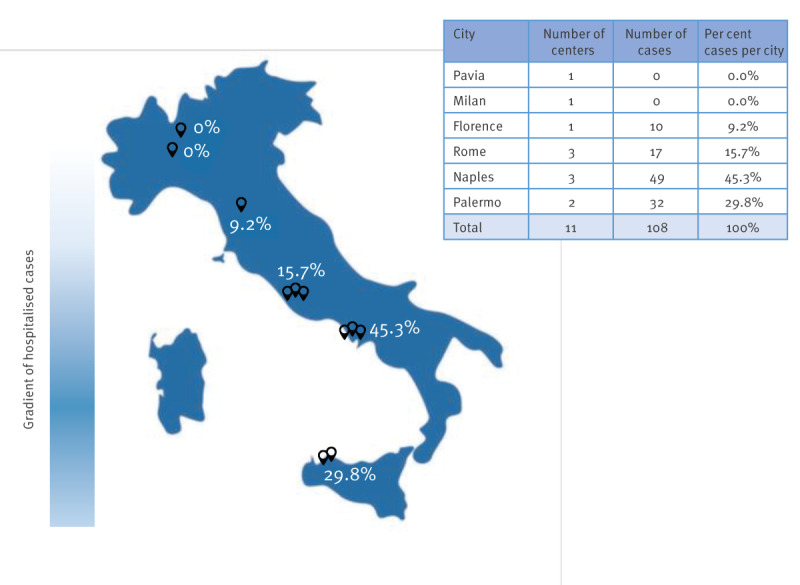
Figure 2.
Characteristics of hospitalised pertussis cases aged 0–24 months, Italy, 1 January–10 May 2024 (n = 108)
Case numbers and per cent of total are provided at the top/end of each bar.
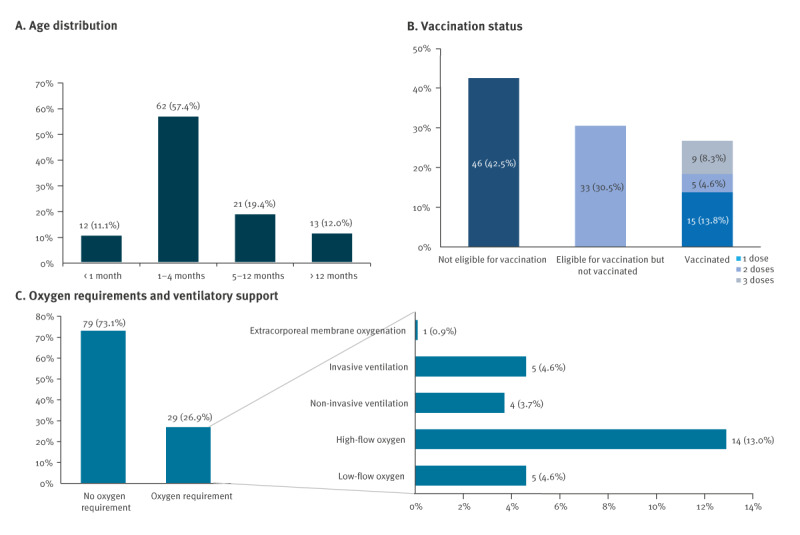
Types of ventilatory support are outlined in Figure 2C. Twelve infants (11.1%) required ICU admission (median age: 2 months, range: 0.5–3). Two children died after complications arising from pertussis: one neonate, aged 25 days, developed pulmonary hypertension necessitating extracorporeal membrane oxygenation (ECMO) and presented coinfection with rhino/enterovirus; the other, aged 30 days, died following a leukaemoid reaction previously treated by exsanguino-transfusion. A third death, involving a 15-day-old neonate, was notified through national daily reporting during the same period by another centre not included in the INF-ACT network.
Study cohort characteristics
Detailed information on demographics, clinical, biochemical parameters, imaging and treatments was collected for a hospitalised cohort of 75 children (median age: 3 months, IQR: 2–4.2) from three centres located in Naples, Rome and Palermo (Table).
Table. Demographic, clinical, laboratory and radiological features and main treatments of the study cohort, Italy, 1 January–10 May 2024 (n = 75).
| Characteristics | Study population (n = 75) | |
|---|---|---|
| n | % | |
| Demographic features | ||
| Male sex | 43 | 57.3 |
| Female sex | 32 | 42.7 |
| Age at admission in months, median (IQR) | 3.0 (2–4.2) | |
| Risk and protective factors | ||
| Mother vaccinated during pregnancy | 3/53 | 5.7 |
| Mother informed about pertussis vaccination | 10/48 | 20.8 |
| At least one pertussis vaccination | 14 | 18.7 |
| Household contacts with respiratory symptoms | 15/50 | 30.0 |
| At least one coinfection | 47 | 62.7 |
| Previous visit to a healthcare setting | 20/42 | 47.6 |
| Clinical features | ||
| Fever | 13 | 17.3 |
| Cough | 75 | 100 |
| Number of cough paroxysms/day, mean (SD) | 13.6 (6.7) | |
| Cyanosis | 45 | 60.0 |
| Rhinorrhoea | 18 | 24.0 |
| Respiratory distress | 20 | 26.7 |
| Vomiting | 13 | 17.3 |
| Length of hospital stay, mean days (SD) | 6.5 (6.1) | |
| Biochemical parameters, mean (SD)a | ||
| Haemoglobin, g/dL | 11.9 (1.4) | |
| WBC, cells/µL | 20,728 (13,684) | |
| Neutrophils, cells/µL | 5,711 (5,263) | |
| Lymphocytes, cells/µL | 13,695 (9,824) | |
| Platelet count, x103 cells/µL | 537.2 (176) | |
| CRP, mg/L | 4.4 (10.6) | |
| Procalcitonin, ng/mL | 0.1 (0.3) | |
| Chest X-ray | ||
| Abnormal findings | 11/22 | 50.0 |
| - Lobar | 7/22 | 31.8 |
| - Interstitial | 4/22 | 18.2 |
| Treatment | ||
| Parenteral rehydration | 29 | 38.7 |
| Oxygen supplementation | 21 | 28.0 |
| Clarithromycinb | 66 | 88.0 |
| Azithromycinc | 6 | 8.0 |
| Trimethoprim-sulfamethoxazoled | 2 | 2.7 |
| Severity [2] | ||
| PSS > 5 | 34 | 45.3 |
CRP: C-reactive protein; PSS: pertussis severity score; SD: standard deviation; WBC: white blood cells.
a Reference values for biochemical parameters (children < 24 months) are haemoglobin: 10.5–13.5 g/dL; WBC: 6.0–17.0 cells/µL; neutrophils: 1.5–8.5 cells/µL; lymphocytes: 4.0–10.5 cells/µL; platelet count: 150–450 cells/µL; CRP: < 5 mg/L; procalcitonin: < 0.5 ng/mL.
b Dose: 15 mg/kg/day in two oral doses for 7 days.
c Dose: 10 mg/kg/day as a single oral dose for 5 days.
d Dose: 8 + 40 mg/kg/day in two oral doses for 14 days.
Denominators are provided where data are available for only a subset of the 75 cases in the study cohort.
A household contact with respiratory symptoms was reported in 15 of 50 cases with available information, and 20 of 42 had visited a healthcare setting (i.e. paediatrician’s office, emergency room, previous hospitalisation) within 21 days before the onset of pertussis symptoms. Only 3 of 53 mothers for whom information was available had received pertussis vaccination during pregnancy, and only 10 of 48 had been informed about the possibility of vaccination during pregnancy (Table).
Paroxysmal cough was present in all 75 cases, cyanosis in 60% (n = 45), and respiratory distress in 26.7% (n = 20). Fever was uncommon (17.3%; n = 13). Children displayed a typical increase in lymphocyte count. Chest radiography was performed in 22 children, of which 11 showed abnormal findings. Clarithromycin was the most common antibiotic therapy (88.8%), and in two cases a second-line therapy was started because of clinical deterioration.
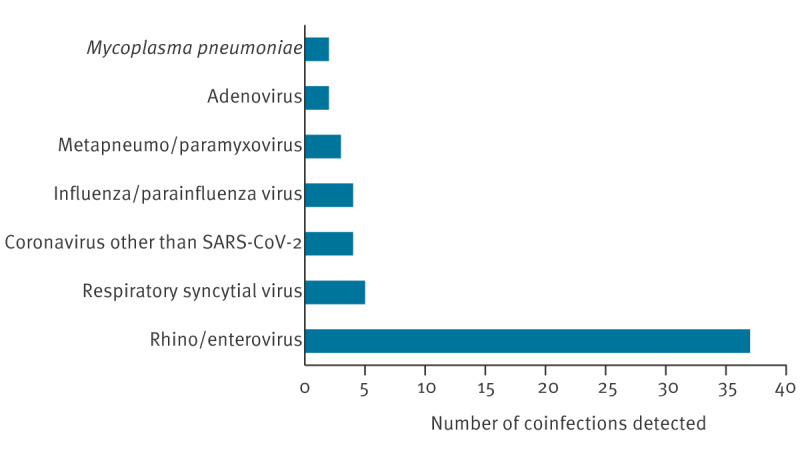
Of the 75 pertussis cases, 47 (62.7%) had a coinfection, predominantly with a virus (Figure 3). No significant differences were found between cases with mono-infection and those with coinfections, except for a tendency to higher oxygen requirements in children infected with a second pathogen (15/47 vs 6/28).
Figure 3.
Distribution of coinfections in the study cohort, Italy, 1 January–10 May 2024 (n = 75)
SARS-CoV-2: severe acute respiratory syndrome coronavirus 2.
Thirty-four patients (45.3%) experienced severe infection, defined by a pertussis severity score (PSS) > 5 [2] (Table). They exhibited a comparable frequency of coinfections (55.9% vs 68.3%; chi-square p = 0.193), but a higher lymphocyte count (16,547 ± 11,558 vs 11,342 ± 7,481; t-test p < 0.05) and C-reactive protein (CRP) values (7.5 ± 13.6 vs 2.0 ± 6.4 mg/L; t-test p < 0.05).
Infants under 4 months of age presented a longer hospital stay (7.3 ± 7.1 vs 5.1 ± 3.5 days; t-test p < 0.05) and duration of fever (2.2 ± 0.8 vs 1.4 ± 0.5 days; t-test p < 0.05), and a higher number of paroxysms per day (15.1 ± 7.5 vs 11 ± 3.9; t-test p < 0.05).
Compared with the study cohort, the three children born to mothers vaccinated during pregnancy exhibited a shorter length of hospital stay (3.7 ± 0.6 days), and none required oxygen supplementation.
Discussion
Since the end of 2023/beginning of 2024, Italy has witnessed a notable increase in hospitalised paediatric pertussis cases. This marks the first surge of pertussis in the post-COVID-19 era and represents the largest whooping cough outbreak in recent decades. The COVID-19 pandemic restrictions, particularly masking and physical distancing measures, disrupted the usual patterns of distribution of common respiratory pathogens such as influenza and RSV [3], and negatively impacted vaccine coverage in many countries. Similarly, COVID-19 mitigation strategies led to a significant decrease in B. pertussis circulation, potentially compromising population immunity [4].
In Italy, the primary immunisation cycle against pertussis consists of three doses given at 3, 5 and 11 months of age, and followed by booster doses in preschool age (at 6 years), in adolescents (12–18 years), and in adults, to be repeated every 10 years. Unlike other countries, the Italian outbreak primarily affects a high proportion of newborns and young infants who are either unvaccinated or incompletely vaccinated. In contrast, the epidemic in Denmark showed the highest incidence among adolescents [5]. This is probably due to different rates of vaccine coverage during pregnancy; while ca 85% of pregnant women in Denmark are vaccinated, vaccination coverage in the Italian population of pregnant women is unknown because of the absence of a national registry for prenatal vaccinations.
Moreover, a remarkable topographical concentration in the number of hospitalised cases was found across the country, with the highest proportions in southern Italy, probably reflecting differences in vaccination rates, although confirmed data for maternal vaccination coverage are lacking. However, as many as 94% of the mothers were unvaccinated, and 80% of them did not receive any information during pregnancy about prenatal vaccination, which underscores the need to implement targeted campaigns. Nevertheless, the lack of data on the vaccination status and awareness regarding maternal vaccination among the general population of pregnant women is a limitation of the study. Future research efforts aimed at addressing this gap are warranted to offer a more comprehensive understanding of the need and the effectiveness of targeted campaigns. Indeed, the priority is to protect infants too young to receive vaccinations, who are at the highest risk of severe complications [6]. During the current outbreak, three pertussis-related deaths were reported. All fatalities involved newborns who underwent a severe course of infection and were therefore too young to start the pertussis vaccine schedule [7]. Case-fatality rates are as high as 1.6% in infants < 2 months and 1.2% in infants 2–11 months of age [8]. In addition, nearly all mortality occurs in infants < 3 months, accounting for 90–100% of total deaths [9]. For this reason, the Global Pertussis Initiative endorsed the administering of the pertussis vaccine during the third trimester of pregnancy to mitigate this risk, preventing infection, hospitalisation and mortality in unvaccinated infants [10-12].
Within our study cohort, three infants born to vaccinated mothers exhibited a milder disease course, as evidenced by low severity score, no oxygen requirement and shorter hospital stays [13]. A Spanish ecological study examining changes in disease severity following the introduction of prenatal vaccination, identified the most significant beneficial effects in infants aged 0–2 months, who experienced an annual reduction in hospitalisation rates of 34% and a decrease in the length of hospital stay by 4 days [14].
Although no differences were observed between patients with mono-infection and those with coinfections, two out of the three children who died were infected with a second pathogen, suggesting the potential role of coinfection in disease severity, as previously reported [2,15].
In our study, 30% of children had symptomatic household contacts. Vaccination or infection does not confer lifelong immunity, leaving adolescents and adults susceptible to infection, and potentially becoming sources of transmission to vulnerable populations.
Furthermore, almost 50% of children had accessed a healthcare setting before the onset of disease, suggesting that potentially one of two pertussis cases could have been detected earlier, thereby preventing potential secondary cases. Therefore, it is essential to identify and isolate cases in healthcare facilities to limit transmission among pairs and recommend post-exposure prophylaxis (PEP) for those at high risk of severe course or in close contact with them [16,17].
Conclusion
To effectively counteract the resurgence of pertussis, several strategies should be considered. These include implementing prenatal vaccination of mothers, vaccinating infants as early as possible, providing antibiotic PEP for contacts and starting vaccination campaigns targeting people who have missed booster doses. Additionally, active screening for individuals with respiratory symptoms should be promoted thus minimising exposure and containing the spread of the infection. The high number of hospitalised infants and reported mortality underscore the urgent need to address this public health concern.
Ethical statement
The study was conducted in accordance with the Declaration of Helsinki and approved by the Ethics Committee for Biomedical Activities, University of Naples Federico II, Naples, Italy (Protocol number 76/2023). Written informed consent to the use of clinical data was obtained from the parents of the children involved in the study.
Funding statement
This research has been supported by EU funding within the NextGenerationEU-MUR PNRR Extended Partnership initiative on Emerging Infectious Diseases (Project no. PE00000007, INF-ACT).
Use of artificial intelligence tools
None declared.
Data availability
Not applicable.
Conflict of interest: None declared.
Authors’ contributions: MP and CM formulated the overarching research goals and aims, provided patients, collected the data, performed the literature review, analysed and critically discussed the results and wrote the first draft of the paper. CA, LP, MM, PM and EV provided patients, collected the data, analysed and critically discussed the results. LP, MC, MDL, DB and IB provided patients and collected the data. ALV and EB formulated the overarching research goals and aims, provided patients, analysed and critically discussed the results. FM, VG and CC provided patients, performed the literature review, analysed and critically discussed the results and the final version of the paper. AG coordinated the study, analysed and critically discussed the results and the final version of the paper. All authors contributed to the article and approved the submitted version.
References
- 1.European Centre for Disease Prevention and Control (ECDC). Increase of pertussis cases in the EU/EEA. Stockholm: ECDC; 2024. Available from: https://www.ecdc.europa.eu/sites/default/files/documents/Increase%20in%20pertussis%20cases%20in%20the%20EU-EEA%20-%20May%202024%20FINAL.pdf
- 2. Marshall H, Clarke M, Rasiah K, Richmond P, Buttery J, Reynolds G, et al. Predictors of disease severity in children hospitalized for pertussis during an epidemic. Pediatr Infect Dis J. 2015;34(4):339-45. 10.1097/INF.0000000000000577 [DOI] [PubMed] [Google Scholar]
- 3. Stein RT, Zar HJ. RSV through the COVID-19 pandemic: burden, shifting epidemiology, and implications for the future. Pediatr Pulmonol. 2023;58(6):1631-9. 10.1002/ppul.26370 [DOI] [PubMed] [Google Scholar]
- 4. Sandoval T, Bisht A, Maurice AS. The impact of COVID-19 and masking practices on pertussis cases at a large academic medical center (2019-2021). Am J Infect Control. 2023;51(7):844-6. 10.1016/j.ajic.2022.11.012 [DOI] [PMC free article] [PubMed] [Google Scholar]
- 5. Nordholm AC, Emborg HD, Nørgaard SK, Nygaard U, Ronayne A, Nielsen LB, et al. Pertussis epidemic in Denmark, August 2023 to February 2024. Euro Surveill. 2024;29(14):2400160. 10.2807/1560-7917.ES.2024.29.14.2400160 [DOI] [PMC free article] [PubMed] [Google Scholar]
- 6. Rocha G, Soares P, Soares H, Pissarra S, Guimarães H. Pertussis in the newborn: certainties and uncertainties in 2014. Paediatr Respir Rev. 2015;16(2):112-8. [DOI] [PubMed] [Google Scholar]
- 7. Nicolai A, Nenna R, Stefanelli P, Carannante A, Schiavariello C, Pierangeli A, et al. Bordetella pertussis in infants hospitalized for acute respiratory symptoms remains a concern. BMC Infect Dis. 2013;13(1):526. 10.1186/1471-2334-13-526 [DOI] [PMC free article] [PubMed] [Google Scholar]
- 8.American Academy of Pediatrics (AAP). Pertussis (whooping cough). In: Kimberlin DW, Barnett ED, Lynfield R, Sawyer MH, eds. Red Book: 2021 Report of the Committee on Infectious Diseases. Itasca, IL: American Academy of Pediatrics; 2021. [Google Scholar]
- 9. Pehlivan T, Dinleyici EC, Kara A, Kurugöl Z, Tezer H, Aksakal NB, et al. The present and future aspects of life-long pertussis prevention: narrative review with regional perspectives for Türkiye. Infect Dis Ther. 2023;12(11):2495-512. 10.1007/s40121-023-00876-0 [DOI] [PMC free article] [PubMed] [Google Scholar]
- 10. Abu-Raya B, Forsyth K, Halperin SA, Maertens K, Jones CE, Heininger U, et al. Vaccination in pregnancy against pertussis: a consensus statement on behalf of the Global Pertussis Initiative. Vaccines (Basel). 2022;10(12):1990. 10.3390/vaccines10121990 [DOI] [PMC free article] [PubMed] [Google Scholar]
- 11. Di Mattia G, Nicolai A, Frassanito A, Petrarca L, Nenna R, Midulla F. Pertussis: new preventive strategies for an old disease. Paediatr Respir Rev. 2019;29:68-73. [DOI] [PubMed] [Google Scholar]
- 12. Marcellini V, Piano Mortari E, Fedele G, Gesualdo F, Pandolfi E, Midulla F, et al. Protection against pertussis in humans correlates to elevated serum antibodies and memory B Cells. Front Immunol. 2017;8:1158. 10.3389/fimmu.2017.01158 [DOI] [PMC free article] [PubMed] [Google Scholar]
- 13. Berger JT, Carcillo JA, Shanley TP, Wessel DL, Clark A, Holubkov R, et al. Critical pertussis illness in children: a multicenter prospective cohort study. Pediatr Crit Care Med. 2013;14(4):356-65. 10.1097/PCC.0b013e31828a70fe [DOI] [PMC free article] [PubMed] [Google Scholar]
- 14. Parisi A, Nuñez O, López-Perea N, Masa-Calles J. Reduced pertussis disease severity in infants following the introduction of pertussis vaccination of pregnant women in Spain, 2015-2019. Vaccine. 2024;42(11):2810-6. 10.1016/j.vaccine.2024.03.028 [DOI] [PubMed] [Google Scholar]
- 15. Frassanito A, Nenna R, Nicolai A, Pierangeli A, Tozzi AE, Stefanelli P, et al. Infants hospitalized for Bordetella pertussis infection commonly have respiratory viral coinfections. BMC Infect Dis. 2017;17(1):492. 10.1186/s12879-017-2567-6 [DOI] [PMC free article] [PubMed] [Google Scholar]
- 16. Fedele G, Carollo M, Palazzo R, Stefanelli P, Pandolfi E, Gesualdo F, et al. Parents as source of pertussis transmission in hospitalized young infants. Infection. 2017;45(2):171-8. 10.1007/s15010-016-0943-6 [DOI] [PubMed] [Google Scholar]
- 17.Centers for Disease Control and Prevention (CDC). Whooping cough (pertussis)- postexposure antimicrobial prophylaxis. Atlanta: CDC. [Accessed: 1 Jun 2024]. Available from: https://www.cdc.gov/pertussis/php/postexposure-prophylaxis/?CDC_AAref_Val=https://www.cdc.gov/pertussis/pep.html