



To the Editor:
The global, randomized, double-blind, placebo-controlled phase 3 KEYNOTE-811 study assessed whether adding pembrolizumab to trastuzumab and chemotherapy improves efficacy compared with trastuzumab and chemotherapy as first-line therapy for unresectable, metastatic, HER2-positive gastric or gastroesophageal junction (mG/GEJ) adenocarcinoma (ClinicalTrials.gov, NCT03615326, see protocol at NEJM.org).1 Data from prior interim analyses showed that addition of pembrolizumab to trastuzumab plus chemotherapy provided superior progression-free survival, and improved the objective response with durable responses versus placebo /trastuzumab and chemotherapy in eligible participants, notably in those with PD-L1 CPS ≥1.1,2 These data supported approval of a new first-line treatment option of pembrolizumab /trastuzumab and chemotherapy for HER2-positive metastatic gastric or gastroesophageal junction with PD-L1 CPS ≥1. We present results of the final analysis of overall survival.
A total of 350 participants were assigned to pembrolizumab and 348 to placebo (Figure S1, available with the full text of this letter at NEJM.org).
At data cut-off (March 20, 2024), the median follow up was 50.2 months (range, 31.1–64.4). Baseline characteristics were well balanced between treatment groups (Table S2). Representativeness of the participant population is shown in Table S3. At final analysis, a significant improvement in overall survival was observed with pembrolizumab versus placebo (median 20.0 versus 16.8 months; hazard ratio [HR] 0.80; 95% CI, 0.67–0.94; p=0.0040 [ɑ=0.0201 for OS significance]). In participants with PD-L1 CPS ≥1, median overall survival was 20.1 versus 15.7 months; HR 0.79; 95% CI, 0.66–0.95; p=0.0062 [nominal]) (Figure 1 and Table S4). The effect in pre-specified subgroups is shown in Figures S2 and S3. The small number of participants with PD-L1 CPS <1 and limited events observed, together with the improvement in overall survival HR at final analysis, reflects the challenge of isolating the precise treatment effect in this subgroup. The overall survival benefit with PD-L1 CPS ≥10 and PD-L1 CPS <10 (Table S4) was consistent with that of the overall population. The progression-free survival benefit was similar to that observed at previous analyses (HR 0.73; 95% CI, 0.61–0.87 [randomized participants]; HR 0.72; 95% CI, 0.60–0.87 [PD-L1 CPS ≥1]) (Figure S4), as was the overall response benefit (Table S5). Grade 3–5 adverse events rates were 59% versus 51% with pembrolizumab versus placebo. No new safety concerns were identified (Table S6).
Figure 1.
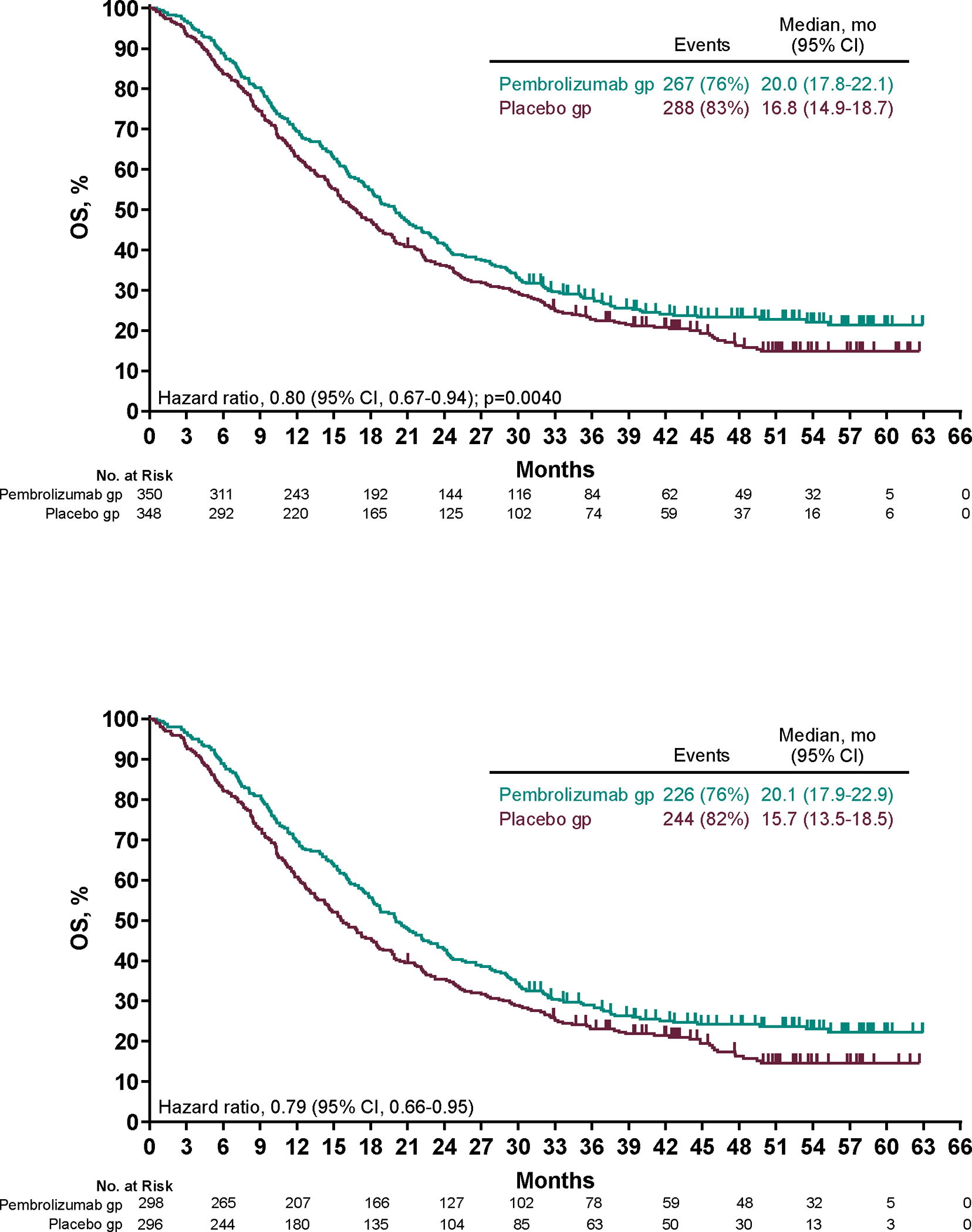
Kaplan-Meier estimates of overall survival in all participants (A) and in participants with PD-L1 CPS ≥1 tumors (B) at final analysis.
Adding pembrolizumab to trastuzumab and chemotherapy provided a statistically significant improvement in overall survival versus trastuzumab and chemotherapy alone as first-line therapy for unresectable or metastatic, HER2-positive gastric or gastroesophageal junction adenocarcinoma in all participants.
Supplementary Material
Acknowledgments
This study was funded by Merck Sharp & Dohme LLC, a subsidiary of Merck & Co., Inc., Rahway, NJ, USA. Yelena Y. Janjigian was additionally supported by Memorial Sloan Kettering Cancer Center National Institutes of Health/National Cancer Institute Cancer Center Support Grant P30 CA008748.
Footnotes
Disclosure forms provided by the authors are available with the full text of this letter at NEJM.org.
COMPLETE LIST OF AUTHORS, FOR PUBLICATION AT NEJM.org:
Yelena Y. Janjigian, M.D. †
Memorial Sloan Kettering Cancer Center
New York, NY
Akihito Kawazoe, M.D., Ph.D.
National Cancer Hospital East
Kashiwa, Japan
Yuxian Bai, M.D.
Harbin Medical University Cancer Hospital
Harbin, China
Jianming Xu, M.D.
The Fifth Medical Center of the PLA
Beijing, China
Sara Lonardi, M.D.
Istituto Oncologico Veneto IOV
Padova, Italy
Jean Phillipe Metges, M.D.
University Hospital of Brest
Brest, France
Patricio Yañez, M.D.
James Lind Cancer Research Center
Temuco, Chile
Lucjan S. Wyrwicz, M.D., Ph.D.
Maria Sklodowska Curie National Cancer Research Institute
Warsaw, Poland
Lin Shen, M.D., Ph.D.
Key Laboratory of Carcinogenesis and Translational Research
Peking, China
Yuriy Ostapenko, M.D.
National Cancer Institute
Kyiv, Ukraine
Mehmet Bilici, M.D.
Atatürk University Faculty of Medicine
Erzurum, Turkey
Hyun Cheol Chung, M.D., Ph.D.
Yonsei Cancer Center
Seoul, Republic of Korea
Kohei Shitara, M.D.
National Cancer Hospital East
Kashiwa, Japan
Shukui Qin, M.D., Ph.D.
Cancer Center of People’s Liberation Army
Nanjing, China
Eric Van Cutsem, M.D., Ph.D.
University Hospitals Gasthuisberg
Leuven, Belgium
Josep Tabernero, M.D., Ph.D.
Vall d’Hebron University Hospital Institute of Oncology (VHIO)
Barcelona, Spain
Suxia Luo, M.D.
Henan Cancer Hospital
Zhengzhou, China
Mauricio Mahave, M.D.
Fundación Arturo López Pérez
Santiago, Chile
Yong Tang, M.D.
Cancer Hospital Affiliated to Xinjiang Medical University
Xinjiang, China
Maeve Lowery, M.D.
Trinity St James Cancer Institute
Dublin, Ireland
Maria M.F. Monteiro, M.D.
Instituto do Cancer do Caera
Caera, Brazil
Linzhi Xu, Ph.D.
Chie-Schin Shih, M.D.
Kanu P. Sharan, M.D.
Pooja Bhagia, M.D.
Merck & Co.
Rahway, NJ
Sun Young Rha, M.D., Ph.D.†
Yonsei Cancer Center
Seoul, Republic of Korea
for the KEYNOTE-811 investigators‡
A complete list of authors is available with the full text of this letter at NEJM.org.
Publisher's Disclaimer: This is an Author Accepted Manuscript, which is the version after external peer review and before publication in the Journal. The publisher’s version of record, which includes all New England Journal of Medicine editing and enhancements, is available at https://www.nejm.org/doi/full/10.1056/NEJMc2408121.
Contributor Information
Yelena Y. Janjigian, Memorial Sloan Kettering Cancer Center, New York, NY.
Sun Young Rha, Yonsei Cancer Center, Seoul, Republic of Korea.
Data Sharing
Merck Sharp & Dohme LLC, a subsidiary of Merck & Co., Inc., Rahway, NJ, USA (MSD) is committed to providing qualified scientific researchers access to anonymized data and clinical study reports from the company’s clinical trials for the purpose of conducting legitimate scientific research. MSD is also obligated to protect the rights and privacy of trial participants and, as such, has a procedure in place for evaluating and fulfilling requests for sharing company clinical trial data with qualified external scientific researchers. The MSD data sharing website (available at: http://engagezone.msd.com/ds_documentation.php) outlines the process and requirements for submitting a data request. Feasible requests will be reviewed by a committee of MSD subject matter experts to assess the scientific validity of the request and the qualifications of the requestors. In line with data privacy legislation, submitters of approved requests must enter into a standard data-sharing agreement with MSD before data access is granted. Data will be made available for request after product approval in the US and EU or after product development is discontinued. There are circumstances that may prevent MSD from sharing requested data, including country or region-specific regulations. If the request is declined, it will be communicated to the investigator. Access to genetic or exploratory biomarker data requires a detailed statistical analysis plan that is collaboratively developed by the requestor and MSD subject matter experts; after approval of the statistical analysis plan and execution of a data-sharing agreement, MSD will either perform the proposed analyses and share the results with the requestor or will construct biomarker covariates and add them to a file with clinical data that is uploaded to a SAS portal so that the requestor can perform the proposed analyses.
References
- 1.Janjigian YY, Kawazoe A, Yanez P, et al. The KEYNOTE-811 trial of dual PD-1 and HER2 blockade in HER2-positive gastric cancer. Nature 2021;600(7890):727–730. DOI: 10.1038/s41586-021-04161-3. [DOI] [PMC free article] [PubMed] [Google Scholar]
- 2.Janjigian YY, Kawazoe A, Bai Y, et al. Pembrolizumab plus trastuzumab and chemotherapy for HER2-positive gastric or gastro-oesophageal junction adenocarcinoma: interim analyses from the phase 3 KEYNOTE-811 randomised placebo-controlled trial. Lancet (London, England) 2023;402(10418):2197–2208. (In eng). DOI: 10.1016/s0140-6736(23)02033-0. [DOI] [PubMed] [Google Scholar]
Associated Data
This section collects any data citations, data availability statements, or supplementary materials included in this article.
Supplementary Materials
Data Availability Statement
Merck Sharp & Dohme LLC, a subsidiary of Merck & Co., Inc., Rahway, NJ, USA (MSD) is committed to providing qualified scientific researchers access to anonymized data and clinical study reports from the company’s clinical trials for the purpose of conducting legitimate scientific research. MSD is also obligated to protect the rights and privacy of trial participants and, as such, has a procedure in place for evaluating and fulfilling requests for sharing company clinical trial data with qualified external scientific researchers. The MSD data sharing website (available at: http://engagezone.msd.com/ds_documentation.php) outlines the process and requirements for submitting a data request. Feasible requests will be reviewed by a committee of MSD subject matter experts to assess the scientific validity of the request and the qualifications of the requestors. In line with data privacy legislation, submitters of approved requests must enter into a standard data-sharing agreement with MSD before data access is granted. Data will be made available for request after product approval in the US and EU or after product development is discontinued. There are circumstances that may prevent MSD from sharing requested data, including country or region-specific regulations. If the request is declined, it will be communicated to the investigator. Access to genetic or exploratory biomarker data requires a detailed statistical analysis plan that is collaboratively developed by the requestor and MSD subject matter experts; after approval of the statistical analysis plan and execution of a data-sharing agreement, MSD will either perform the proposed analyses and share the results with the requestor or will construct biomarker covariates and add them to a file with clinical data that is uploaded to a SAS portal so that the requestor can perform the proposed analyses.