



Summary
Heat stress significantly impacts global rice production, highlighting the critical need to understand the genetic basis of heat resistance in rice. U2AF (U2 snRNP auxiliary factor) is an essential splicing complex with critical roles in recognizing the 3′‐splice site of precursor messenger RNAs (pre‐mRNAs). The U2AF small subunit (U2AF35) can bind to the 3′‐AG intron border and promote U2 snRNP binding to the branch‐point sequences of introns through interaction with the U2AF large subunit (U2AF65). However, the functions of U2AF35 in plants are poorly understood. In this study, we discovered that the OsU2AF35a gene was vigorously induced by heat stress and could positively regulate rice thermotolerance during both the seedling and reproductive growth stages. OsU2AF35a interacts with OsU2AF65a within the nucleus, and both of them can form condensates through liquid–liquid phase separation (LLPS) following heat stress. The intrinsically disordered regions (IDR) are accountable for their LLPS. OsU2AF35a condensation is indispensable for thermotolerance. RNA‐seq analysis disclosed that, subsequent to heat treatment, the expression levels of several genes associated with water deficiency and oxidative stress in osu2af35a‐1 were markedly lower than those in ZH11. In accordance with this, OsU2AF35a is capable of positively regulating the oxidative stress resistance of rice. The pre‐mRNAs of a considerable number of genes in the osu2af35a‐1 mutant exhibited defective splicing, among which was the OsHSA32 gene. Knocking out OsHSA32 significantly reduced the thermotolerance of rice, while overexpressing OsHSA32 could partially rescue the heat sensitivity of osu2af35a‐1. Together, our findings uncovered the essential role of OsU2AF35a in rice heat stress response through protein separation and regulating alternative pre‐mRNA splicing.
Keywords: rice thermotolerance, OsU2AF35a, pre‐mRNA splicing, liquid–liquid phase separation, condensation, OsHSA32
Introduction
Heat stress (HS) is one of the most threatening environmental stresses, which has caused huge loss of crop yield worldwide (Raza et al., 2019). Rice (Oryza sativa), which mainly grows in high‐temperature areas, is the main food source for half of the world's population and provides about 80% of the total daily energy (FAO, 2008). Heat stress not only inhibits rice germination and seedling growth by changing the movement of water, ions and organic solutes between cells, but also adversely affects rice tillering, flowering and grain filling (Fahad et al., 2019). It is reported that 1 °C rise in the minimum temperature during the growing season will lead to a 10% reduction in rice yield (Peng et al., 2004). In order to minimize the loss of rice yield caused by HS, it is necessary to comprehensively understand the response and adaptation of rice to high temperature at the genetic and molecular levels.
Immediately after transcription begins, precursor messenger RNA (pre‐mRNA) undergoes a series of modifications that are essential for their nuclear output, maturation and subsequent translation in eukaryotes (Maniatis and Reed, 2002; Moore and Proudfoot, 2009; Reddy, 2007). Among these modifications, pre‐mRNA splicing is a key step of posttranscriptional processing, which not only affects the abundance of mature mRNAs, but also is closely related to transcription, translation, and downstream metabolism (Black, 2003; Moore and Proudfoot, 2009). Alternative splicing (AS) produces multiple mRNA transcripts from a single gene by selecting and utilizing AS sites in the pre‐mRNA; Therefore, it helps to increase protein diversity from the limited genes in a genome (Braunschweig et al., 2013; Ling et al., 2021; Reddy, 2007; Syed et al., 2012; Zhang et al., 2010). The lack of accuracy in the splicing process will produce abnormal or nonfunctional mRNAs, which is not only a waste caused by the reduction of functional mRNAs, but also lead to the production of harmful proteins, thus interfering with normal cell processes (Braunschweig et al., 2013; Kalyna et al., 2012; Reddy, 2007). Therefore, the efficiency and accuracy of pre‐mRNA splicing are crucial to gene function (Moore and Proudfoot, 2009; Reddy, 2004; Syed et al., 2012).
More and more evidences show that the deletion of some proteins responsible for pre‐mRNA splicing leads to the decline of stress resistance in plants. RCF1 encodes a cold‐inducible DEAD (Asp‐Glu‐Ala‐Asp) box RNA helicase and positively regulates cold tolerance in Arabidopsis. RCF1 does not play a role in mRNA export. Instead, RCF1 functions to maintain proper splicing of pre‐mRNAs; many cold‐responsive genes (positive and negative regulators of CBFs) are mis‐spliced in rcf1‐1 mutant plants under cold stress (Guan et al., 2013). SKIP is a component of spliceosome that interacts with clock gene pre‐mRNAs and is essential for regulating their AS and mRNA maturation. Arabidopsis mutant skip‐1 has a lengthened circadian period due to a defect in the AS of clock genes (Wang et al., 2012). In addition, the skip‐1 plants are hypersensitive to both salt and osmotic stresses, and SKIP is required for the AS and mRNA maturation of several salt‐tolerance genes. A genome‐wide analysis reveals that SKIP mediates the AS of many genes under salt‐stress conditions, and that most of the AS events in skip‐1 involve intron retention and can generate a premature termination codon in the transcribed mRNA (Feng et al., 2015). An Arabidopsis PWI and RRM motif‐containing protein RBM25 negatively regulates ABA responses in early development and controls the splicing of many pre‐mRNAs. The protein phosphatase 2C HAB1, a critical component in ABA signalling, shows a dramatic defect in pre‐mRNA splicing in rbm25 mutants. Ectopic expression of a HAB1 complementary DNA derived from wild‐type mRNAs partially suppresses the rbm25‐2 mutant phenotype (Zhan et al., 2015). Nuclear cyclophilins (CYPs) are accessory proteins in the spliceosome complexes of multicellular eukaryotes. Arabidopsis CYP18‐1 is necessary for the efficient removal of introns that are retained in response to heat stress during germination. The cyp18‐1 mutants are sensitive to heat stress during seed germination (Jo et al., 2022). Hong et al. (2023) reported that the spliceosomal core protein SmEb is essential to salt tolerance in Arabidopsis. SmEb modulates AS of hundreds of pre‐mRNAs in plant response to salt stress and is crucial in maintaining proper ratio of two RCD1 splicing variants important for salt stress response. RNA‐binding protein MAC5A interacts with the 26S proteasome to regulate DNA damage response in Arabidopsis. The intron retention (IR) of several genes required for DNA damage response, such as ATM, RAD51D and RAD54, is remarkably elevated in mac5a‐2 under methyl methanesulfonate (MMS, a DNA damage inducer) treatment, but no significant differences under the control condition. More importantly, IR cannot generate functional proteins in mac5a due to the premature termination codons are found in all these retention introns (Meng et al., 2023). However, whether pre‐mRNA mis‐splicing affects rice thermotolerance is still unknown.
The pre‐mRNA splicing needs a large RNA‐protein assembly called spliceosome, which is composed of five snRNPs (U1, U2, U4, U5, and U6) and associated proteins, including serine/arginine‐rich (SR) proteins (Matera and Wang, 2014). For most introns of pre‐mRNA, the conserved splice‐site sequences include a 5′ GU dinucleotide, and a 3′ AG dinucleotide preceded by a polypyrimidine tract and an upstream branch‐point sequence (Hastings et al., 2007). In the first step of splicing reaction, U1 snRNP is responsible for recognizing the 5 ‘splice site, while U2 snRNP recognizes the 3′ splice site by combining with the branch‐point sequence. In the introns of higher eukaryotes, the branch‐point sequence is quite degenerate. In mammals, the recruitment of U2 snRNP requires a U2 auxiliary factor (U2AF) composed of 65 kDa (U2AF65) and 35 kDa (U2AF35) subunits, while in yeast, only a single subunit Mud2p is required (Shao et al., 2014; Wang et al., 2008). U2AF65 and U2AF35 bind to the polypyrimidine (Py) tract and the 3′ splice site, respectively. U2AF65 contains three RNA‐binding domains, which are also known as RNA recognition motifs (RRMs). Among them, RRM1 and RRM2 in the centre are responsible for identifying the Py tract in the pre‐mRNA, and the third RRM at the C end has special structural characteristics and is mainly involved in the interaction between proteins. The unique RRM of U2AF35 recognizes the AG at the 3′ splice site and binds to U2AF65 (Wahl et al., 2009). The biological functions of U2AF35 in plants are rarely studied. U2AF35 in Arabidopsis contains two members, AtU2AF35a and AtU2AF35b. The transferred DNA (T‐DNA) insertion mutants of AtU2AF35a and the RNA interference or antisense lines of AtU2AF35b shows late flowering phenotypes under long‐ and short‐day conditions. Abnormal splicing patterns of Flowering Control Locus A (FCA) and increased FLC transcripts were detected in these plants (Wang and Brendel, 2006). U2AF35 in rice also contains two members, OsU2AF35a and OsU2AF35b, which can interact with the C‐terminal region of two glycine‐rich RNA‐binding proteins OsGRP3 and OsGRP162. The double mutant of OsGRP3/162 is strikingly more sensitive to heat stress and displays globally reduced expression of heat‐stress responsive genes and increases of mRNA AS dominated by exon‐skipping (Yang et al., 2024). However, it is not clear whether rice U2AF35a is involved in regulating rice thermotolerance.
Biomolecular condensates (supramolecular assemblies of protein, nucleic acid and other biomolecules) are emerging as a central way for cellular compartmentalization (Banani et al., 2017). Many biomolecular condensates are assembled by liquid–liquid phase separation (LLPS) (Shin and Brangwynne, 2017). A typical way to drive LLPS is to rely on multivalent interactions provided by intrinsically disordered regions (IDRs) (Molliex et al., 2015; Patel et al., 2015), which are protein fragments that lack stable three‐dimensional structure but have biological activities (Oldfield and Dunker, 2014). LLPs process is very sensitive to the physical and chemical properties of solvents. Temperature, pH, redox state, molecular crowding and ionic strength promote the formation, dissolution or aging of intracellular biomolecular condensates. In fact, recent studies have highlighted the key role of biomolecular condensates in the response and adaptation of cells to stresses (Alberti and Hyman, 2021). In plants, protein condensation has been shown to be involved in the response to environmental stimuli, such as heat (Bohn et al., 2024; Jung et al., 2020; Tong et al., 2022; Zhu et al., 2022), drought (Wang et al., 2024), cold (Zhu et al., 2021), osmotic stress (Wang et al., 2022), reactive oxygen species (Huang et al., 2021), pathogens (Zavaliev et al., 2020) and hydration (Dorone et al., 2021). Most of these studies are aimed at Arabidopsis, and the mechanism of protein condensation in rice responding to environmental stress is largely unknown.
In this work, we discovered that the OsU2AF35a gene was vigorously induced by heat stress and could positively regulate rice thermotolerance during both the seedling and reproductive growth stages. OsU2AF35a can interact with OsU2AF65a in the nucleus, and form condensates through LLPS under heat stress conditions, in IDR‐dependent manner. OsU2AF35a condensation is indispensable for thermotolerance. Transcriptome analysis indicated that under heat treatment, the pre‐mRNAs of a considerable number of genes in the osu2af35a‐1 mutant exhibited defective splicing, among which was the OsHSA32 gene. Knocking out OsHSA32 significantly reduced the thermotolerance of rice, while overexpressing OsHSA32 could partially rescue the heat sensitivity of osu2af35a‐1. Together, our findings uncovered the essential role of OsU2AF35a in rice heat stress response through protein separation and regulating alternative pre‐mRNA splicing.
Results
OsU2AF35a is induced by heat stress at the transcriptional level
The U2AF gene family in rice comprises four members, including OsU2AF35a/b and OsU2AF65a/b. To explore the responses of rice U2AF genes to heat stress, the RNA samples of wild‐type rice (Zhonghua 11, ZH11) seedlings treated at 45 °C for different durations were subjected to reverse transcription quantitative real‐time polymerase chain reaction (RT‐qPCR). Among the four OsU2AF genes, OsU2AF35a had the highest upregulation induced by heat (about 33.1 folds), and the highest expression was observed after 9 h of heat treatment (Figure 1a). The second was OsU2AF65a (about 12.3 folds), whose expression reached the peak at 6 h after heat stress (Figure 1c). OsU2AF35b and OsU2AF65b had a relatively low degree of thermal induction, which were approximately 6.3 and 6.9 folds, respectively (Figure 1b,d). These results suggest that OsU2AF35a is likely to play an important role in the response of rice to heat stress, so our follow‐up study focused on this gene. To determine whether OsU2AF35a was specifically induced by heat stress, we investigated its responses to various environmental stimuli, including phytohormone (ABA), salt stress (NaCl), osmotic stress (PEG6000), heat stress (45 °C), and cold stress (4 °C). Beside the constitutive expression in the assayed samples, OsU2AF35a was also induced by ABA, NaCl and PEG6000, but the degree of up regulation was far less than that induced by heat. On the contrary, cold stress slightly inhibited the expression of OsU2AF35a (Figure 1e). Samples, including root, shoot, stem, leaf sheath, leaf, young panicle, mature panicle and flag leaf, were prepared from ZH11 plants. The mRNA abundance of OsU2AF35a was detected using RT‐qPCR. OsU2AF35a transcripts were detected in all tissues surveyed and peaked in the leaf (Figure 1f).
Figure 1.

Expression patterns of OsU2AF35a. (a–d) RT‐qPCR analysis of OsU2AFs' expression levels at different time after heat stress (45 °C). The wild‐type ZH11 seedlings at 2.5‐ to 3.5‐leaf stage were used for treatment and the roots were harvested for gene expression detection. (e) Up‐regulation of OsU2AF35a by ABA and abiotic stresses. The wild‐type ZH11 seedlings at 2.5‐ to 3.5‐leaf stage were treated with various stimuli (100 mM ABA; NaCl, 120 mM; PEG6000, 20%; Heat, 45 °C; Cold, 4 °C) and the seedlings were harvested for gene expression detection. (f) Expression analysis of OsU2AF35a in different tissues containing root, shoot, stem, leaf sheath, leaf, young panicle, mature panicle and flag leaf by RT‐qPCR. OsActin1 was used as an internal control. Data represent means ± SE; n = 3. Different letters above the bars indicate differences determined by one‐way ANOVA with Tukey's HSD post‐hoc test at P < 0.05.
OsU2AF35a positively regulates rice thermotolerance at both seedling and reproductive stages
To investigate the potential biological function of OsU2AF35a in rice heat response, two independent mutant lines in the ZH11 background were generated using a clustered regularly interspersed short palindromic repeats (CRISPR)/Cas9 DNA editing system (Ma et al., 2015). The osu2af35a‐1 mutant had 2‐bp deletion (AT) site, resulting in a premature stop codon. The osu2af35a‐2 mutant had 1‐bp deletion (T) site, which also leads to a premature stop codon (Figure S1a,b). Both osu2af35a‐1 and osu2af35a‐2 mutant seedlings grew as normally as ZH11 plants under standard (28 °C) growth temperature conditions (Figure 2a, up). However, when these plants were treated with heat stress (45 °C for 24 h at the 3.5‐ to 4.5‐leaf stage), compared with ZH11 plants, both osu2af35a‐1 and osu2af35a‐2 mutant plants were extremely sensitive to heat stress as reflected by the survival rates after recovery at 28 °C for 7 days. The survival rates for osu2af35a‐1, osu2af35a‐2, and ZH11 were 6.0%, 8.3%, and 92.4%, respectively (Figure 2a,b). Consistently, after heat stress, we found the electrolytic leakage of osu2af35a mutants was significantly higher than that of ZH11 plants (Figure 2c), indicating that the membrane integrity is more affected in these mutants. We concluded that OsU2AF35a is important for thermotolerance in rice seedlings.
Figure 2.

OsU2AF35a positively regulates rice thermotolerance at seedling and reproductive stages. (a) Heat stress phenotypes of the osu2af35a mutants. The seedlings (3.5‐ to 4.5‐leaf stage) of ZH11 and two osu2af35a mutants grown at 28 °C were transferred to 45 °C for 24 h and then photographed after recovering at 28 °C for 7 days. Scale bars = 12.5 cm. (b) Statistical analysis of survival rate in (a) after heat treatment and recovery based on the appearance of newly developed green leaves. (c) Electrolytic leakage in ZH11 and osu2af35a mutant plants before and after heat treatment. Seedlings at 2.5‐ to 3.5‐leaf stage were transferred to 45 °C for 6 h, leaves were harvested for electrolyte measurement. (d) Heat stress phenotypes of the OsU2AF35a‐OE lines. The seedlings (3.5‐ to 4.5‐leaf stage) of ZH11 and two OsU2AF35a‐OE lines grown at 28 °C were transferred to 45 °C for 48 h and then photographed after recovering at 28 °C for 7 days. Scale bars = 12.5 cm. (e) Statistical analysis of survival rate in (d) after heat treatment and recovery based on the appearance of newly developed green leaves. (f) Electrolytic leakage in ZH11 and OsU2AF35a‐OE plants before and after heat treatment. Seedlings at 2.5‐ to 3.5‐leaf stage were transferred to 45 °C for 6 h, leaves were harvested for electrolyte measurements. (g–j) Comparison of thermotolerance among ZH11, osu2af35a mutant, and OsU2AF35a‐OE plants at the reproductive stage in the phytotron. The above‐mentioned plants grown at 28 °C were subjected to heat stress (40 °C in the light for 12 h and 31 °C in the dark for 12 h) at flowering stage for 7 days, and then recovered under normal conditions until seed maturation and panicles were photographed (g), seed setting rate (h), 1000‐grain weight (i), and grain yield per plant (j) were measured. The control plants were constantly placed at normal growth temperature. In (b) and (e), data represent means ± SE, n = 4 (****P < 0.0001, Student's t‐test). In (c), (f), and (h–j), data represent means ± SE, n = 3 or 12. Different letters above the bars indicate differences determined by one‐way ANOVA with Tukey's HSD post‐hoc test at P < 0.05.
To know whether manipulation of OsU2AF35a could increase thermotolerance in rice, we overexpressed the full‐length coding sequence of OsU2AF35a under the control of maize ubiquitin promoter in ZH11 background and generated seven transgenic lines. Two independent lines (OE6‐1 and OE14‐1), in which the OsU2AF35a expression levels were significantly increased approximately 62.3 and 50.8 folds of that in ZH11 (Figure S1c), were selected for thermotolerance testing (45 °C for 48 h at the 3.5‐ to 4.5‐leaf stage). Under normal conditions (28 °C), we did not observe any phenotypic differences between these two OsU2AF35a‐OE lines and ZH11 (Figure 2d, up). Under the heat stress treatment, both OE6‐1 and OE14‐1 were more tolerant than ZH11, which was just opposite to the heat sensitive phenotype of osu2af35a mutant. The survival rates after recovery for OE6‐1, OE14‐1, and ZH11 were 89.4%, 91.1%, and 21.8%, respectively (Figure 2d,e). Consistently, we found that under heat stress, OE6‐1 and OE14‐1 plants had lower electrolytic leakage than ZH11 plants (Figure 2f), indicating that the membrane integrity is less affected in these OE plants.
Rice plant is highly sensitive to high‐temperature stress especially at the reproductive stage (Endo et al., 2009), and improving thermotolerance at the reproductive stage is thus of particular importance to reduce yield loss. Therefore, we performed high‐temperature treatment on the adult plants of mutant, OE, and ZH11 to evaluate OsU2AF35a's role at the reproductive stage in the phytotron. We found that the seed‐setting rates of osu2af35a mutant lines were less than 20% (18.1% for osu2af35a‐1, 18.8% for osu2af35a‐2), the seed‐setting rate of ZH11 was only 43.6%, while that of two OsU2AF35a‐OE lines could exceed 65% (67.2% for OE6‐1, 70.9% for OE14‐1) after treatment at 40 °C for 7 days (Figure 2g,h). The 1000‐grain weight of these materials was not influenced by heat stress, and no significant difference was observed among the various genotypes (Figure 2i). Following heat treatment, the grain yield per plant of the two osu2af35a mutant lines were 6.29 g and 6.35 g respectively, that of ZH11 was 13.35 g, while those of the two OsU2AF35 overexpression lines were 18.52 g and 19.53 g (Figure 2j). This changing trend was consistent with the seed‐setting rate. These results demonstrate that OsU2AF35a plays an important and positive role in rice thermotolerance at both seedling and reproductive stages.
To test if the enhanced thermotolerance of OsU2AF35a‐OE affects rice growth, we assessed key agronomic traits in ZH11, OE6‐1, and OE14‐1 under field conditions. The major yield‐related traits (plant height, tiller number, heading date, grain length, grain width, 1000‐grain weight, and grain yield per plant) were similar across the genotypes (Figure S2). These results indicate that the gain of OsU2AF35a function does not incur a growth penalty in rice. Consequently, OsU2AF35a can serve as a candidate target for cultivating rice varieties with enhanced thermotolerance by means of genetic engineering.
To evaluate whether OsU2AF35a can also function in other species, this gene was heterologously expressed in Arabidopsis (Col‐0). Two independent transgenic lines harbouring EGFP (enhanced green fluorescence protein)‐tagged OsU2AF35a (#3 and #4) were obtained (Figure S3a). The green fluorescence signal was observed in the nucleus, suggesting the nuclear localization of OsU2AF35a (Figure S3b). Then, we subjected seedlings to short‐term strong heat stress treatment (30 min at 45 °C), and then let them recover at normal temperature (22 °C) for 5 days (Figure S3c). Both #3 and #4 lines exhibited significantly higher survival rates compared with Col‐0 and the line expressing EGFP lonely (Figure S3d,e). Consistent with the recovered growth phenotype, we found that both #3 and #4 lines exhibited lower electrolytic leakage compared with Col‐0 after heat treatment (Figure S3f), indicating that the membrane integrity is less affected in these materials. Next, we overexpressed OsU2AF35a (pYES2‐OsU2AF35a) in a BY4741 yeast strain. The yeast transformed into pYES2 empty vector was used as wild‐type. Under normal temperature (30 °C), all yeast exhibited similar growth status (Figure S4, left). However, after heat stress (37 °C, excessive temperature can induce the death of yeast), the pYES2‐OsU2AF35a transgenic yeast cells showed improved viability compared to WT (Figure S4, right). Together, these results suggest that OsU2AF35a is evolutionarily conserved in regulating thermotolerance.
OsU2AF35a interacts with OsU2AF65a in the nucleus
Before explaining how OsU2AF35a affects heat resistance, we first conducted a protein structure analysis using the InterPro website (http://www.ebi.ac.uk/interpro/) and PONDR database (http://www.pondr.com/). The results revealed that the N‐terminus of OsU2AF35a contains two CCCH‐type zinc finger domains (ZnF1 and ZnF2), with an RRM domain situated between these two ZnF domains. Interestingly, the C‐terminus contains one intrinsically disorder region (IDR) (Figure 3a, up), which aids in driving the protein to undergo LLPS (Molliex et al., 2015; Patel et al., 2015). Based on reports that knocking out OsU2AF65a can reduce the thermotolerance of rice (Lu et al., 2021), we also analysed its protein structure. The results show that OsU2AF65a contains three RRMs (RRM1‐3) and one IDR located at the N‐terminus (Figure 3a, down).
Figure 3.
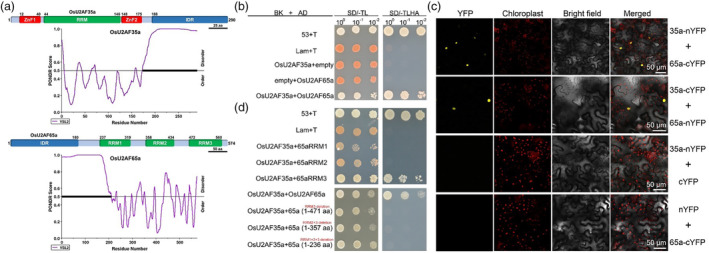
OsU2AF35a interacts with the RRM3 domain of OsU2AF65a. (a) Schematic diagram of protein structure and IDR prediction of OsU2AF35a/65a. (b) Interaction between OsU2AF35a and OsU2AF65a was analysed with Y2H system. Transformants were photographed after 5 days of growth on medium lacking Trp and Leu, or lacking Trp, Leu, His, and Ade. (c) BiFC assay for the interaction of OsU2AF35a and OsU2AF65a. Fluorescence was observed in the nuclear compartment of transformed tobacco (N. benthamiana) cells, resulting from the complementation of OsU2AF35a‐nYFP+OsU2AF65a‐cYFP or OsU2AF35a‐cYFP+OsU2AF65a‐nYFP. No signal was obtained for the negative controls in which OsU2AF35a‐nYFP was co‐expressed with cYFP, or nYFP was co‐expressed OsU2AF65a‐cYFP. YFP signal was detected by confocal microscopy. (d) Interaction test between OsU2AF35a and different truncated OsU2AF65a with specific deletion in yeast. Transformants were photographed after 5 days of growth on medium lacking Trp and Leu, or lacking Trp, Leu, His, and Ade.
In human, U2AF65 and U2AF35 tightly bind together, synergistically regulating the occurrence of AS (Shao et al., 2014). In Arabidopsis, AtU2AF65b interacts with AtU2AF35a/b and functions in ABA‐mediated flowering via regulating pre‐mRNA splicing of ABI5 and FLC (Xiong et al., 2019). The above studies prompted us to confirm the interaction between OsU2AF35a and OsU2AF65a. According to the yeast two‐hybrid (Y2H) assay, we found that OsU2AF35a can indeed interact with OsU2AF65a in yeast cells (Figure 3b). To further investigate where this interaction takes place within plant cells, we performed a bimolecular fluorescence complementation (BiFC) assay in tobacco leaves. The strong YFP signal was visualized mainly from the OsU2AF35a‐nYFP/OsU2AF65a‐cYFP or OsU2AF35a‐cYFP/OsU2AF65a‐nYFP complementation assay in the nucleus of the transformed cells, but not in the control leaves co‐expressing OsU2AF35a‐nYFP/cYFP or nYFP/OsU2AF65a‐cYFP (Figure 3c). Next, a firefly split‐luciferase complementation imaging (LCI) assay was carried out to consolidate the evidence for the interaction between the two. Different fusion protein combinations were transiently co‐expressed in tobacco leaves. A strong fluorescence signal was observed in the leaf regions co‐expressing OsU2AF35a‐nLuc/cLuc‐OsU2AF65a, but not in the regions co‐expressing OsU2AF35a‐nLuc/cLuc (Figure S5a). To identify the exact region of OsU2AF65a necessary for interacting with OsU2AF35a, we fused six truncated OsU2AF65a variants to the Gal4 AD domain, and then examined the interaction between these variants and OsU2AF35a by Y2H analysis. As shown in Figure 3d, the RRM3 domain of OsU2AF65a, rather than RRM1 and RRM2 could directly interact with OsU2AF35a, whereas deleting the 103 C‐terminal residues (containing the RRM3 domain) of OsU2AF35a completely abolished the OsU2AF35a‐OsU2AF65a interaction, as confirmed by LCI experiment (Figure S5b). These results showed that the RRM3 domain of OsU2AF65a is required for its interaction with OsU2AF35a. Additionally, we also detected the interaction between OsU2AF35a and OsU2AF65b in yeast (Figure S6). Based on these results, we hypothesize that LLPS and pre‐mRNA splicing may be involved in the thermotolerance of rice regulated by OsU2AF35a.
OsU2AF35a forms liquid‐like nuclear condensates upon heat stress
We next sought to investigate the underlying mechanism of how OsU2AF35a enhances rice heat resistance. Arabidopsis U1 snRNP U1‐70K is a spliceosome component localized in nucleus (Wang et al., 2012). We transiently co‐expressed OsU2AF35a‐EGFP and U170K‐mCherry in tobacco leaves and found that they are co‐localized (Figure 4a, up), which was consistent with the nuclear localization of OsU2AF35a‐EGFP in transgenic Arabidopsis (Figure S3b) and the location of interaction between OsU2AF35a and OsU2AF65a in BiFC analysis (Figure 3c). Given the C termini of OsU2AF35a (187–290 amino acids) contains one IDR based on predication (Figure 3a, up), so we fused the N‐terminal 187 amino acids of OsU2AF35a and its C‐terminal IDR with EGFP for localization analysis. The results showed that N187aa‐EGFP was also localized in the nucleus (Figure 4a, middle), but IDR‐EGFP was not only localized in the nucleus but also had a significant distribution in the cytoplasm (Figure 4a, down).
Figure 4.

OsU2AF35a undergoes reversible and dynamic condensation in response to heat stress. (a) Subcellular localization of OsU2AF35a‐EGFP, N187aa‐EGFP, and IDR‐EGFP in tobacco leaves. U170K‐mCherry, a spliceosome component marker localized in nucleus. (b) Representative confocal microscopic images of tobacco epidermal cells expressing OsU2AF35a or OsU2AF35a truncations. The tobacco plants were treated with or without 37 °C for 15 min. (c) Representative confocal microscopic images of tobacco epidermal cells expressing OsU2AF35a‐EGFP. The tobacco plants were treated as indicated. (d–e) Representative confocal microscopic images of rice root tip cells expressing OsU2AF35a‐EGFP or N187aa‐EGFP. The transgenic rice seedlings were treated as indicated. (f) FRAP of OsU2AF35a‐EGFP nuclear condensates formed in rice root tips. Time 0 s indicates the time of the photobleaching pulse. (g) Plot showing the time course of the recovery after photobleaching OsU2AF35a nuclear condensates. Data represent means ± SE; n = 3.
A typical way for driving LLPS relies on multivalent interactions provided by IDRs (Molliex et al., 2015; Patel et al., 2015); therefore, we speculated that OsU2AF35a may process the ability of LLPS. At normal temperature, the OsU2AF35a‐EGFP and IDR‐EGFP fluorescence signals were evenly distributed in the cell nucleus or both in the nucleus and cytoplasm. After heat treatment at 37 °C (excessive temperature can induce the death of tobacco), these EGFP fusion proteins formed a large number of condensates (Figure 4b). However, N187aa‐EGFP did not exhibit a similar phenomenon (Figure 4b), suggesting that IDR is essential for condensation of OsU2AF35a under heat stress. OsU2AF35a‐EGFP condensates were sensitive to 1,6‐hexanediol (Figure 4c), a chemical that can disrupt liquid‐like droplets (Wang et al., 2022). Then, we generated transgenic plants expressing OsU2AF35a‐EGFP or N187aa‐EGFP fusion protein under the control of the maize ubiquitin promoter in the osu2af35a‐1 background. After treatment at 45 °C, we observed distinct green condensates in the root nuclei of two OsU2AF35a‐EGFP/osu2af35a‐1 lines (#1 and #2), but not in the two N187aa‐EGFP/osu2af35a‐1 lines (#5 and #6) (Figure 4d). Moreover, the formation of OsU2AF35a‐EGFP‐containing granules is reversible in cells. Placing the heat‐treated seedlings back to normal growth temperature for 10 min significantly reduced the number of granules in the cell (Figure 4e), indicating that the heat‐induced granule‐like structure is dynamically regulated in vivo. The addition of 1,6‐hexanediol still weakened the condensations of OsU2AF35a‐EGFP in OsU2AF35a‐EGFP/osu2af35a‐1 line #1 (Figure 4e). We further assessed the dynamicity of OsU2AF35a condensates in rice roots using fluorescence recovery after photobleaching (FRAP). The spatiotemporal analysis of bleaching events showed that OsU2AF35a‐EGFP redistributed rapidly from the unbleached area to the bleached area (Figure 4f,g). These results indicate that OsU2AF35a can form condensates in vivo in response to heat stress likely via LLPS.
OsU2AF35a undergoes LLPS in vitro
To answer whether OsU2AF35a are capable of undergoing LLPS in vitro, we expressed EGFP‐OsU2AF35a‐6 × His in E. coli and purified the recombinant protein (Figure S5). This fusion protein formed spherical droplets when treated with PEG, even at a protein concentration as low as 2.5 μM (Figure 5a). PEG can simulate the crowded environment in cells (Wegmann et al., 2018). As the protein concentration increases, the number and size of spherical droplets also increase, demonstrating its high phase separation capability (Figure 5a). It was noteworthy that an increase in temperature can also promote the phase separation of OsU2AF35a (Figure 5b). Consistent with the observation that OsU2AF35a form granule‐like structures under heat stress in plant cells (Figure 4), increasing temperature from 28 °C to 45 °C induced the phase separation of OsU2AF35a in vitro. However, addition of 1,6‐hexanediol dissolved most these droplets (Figure 5b). These spherical liquids could fuse or separate, indicative of phase‐separated liquids (Figure 5c,d). We further performed FRAP experiment to probe the mobility of OsU2AF35a within the droplets. The FRAP results showed that the intensity of EGFP‐OsU2AF35a‐6 × His fluorescence signal recovered partially after photobleaching (Figure 5e,f). Together, these results demonstrate that OsU2AF35a exhibits high tendency to undergo phase separation in vitro.
Figure 5.

OsU2AF35a undergoes LLPS in vitro. (a) LLPS of purified EGFP‐OsU2AF35a‐6 × His protein under micromolar protein concentrations. LLPS condition: 120 mM NaCl, pH 7.5 and 15% PEG 8000. (b) Representative confocal microscopic images showing droplet formation of 20 μM EGFP‐OsU2AF35a‐6 × His protein as temperature increases from 28 °C to 45 °C under 120 mM NaCl and pH7.5. Addition of 1 volume of 5% 1,6‐hexanediol solution disrupts OsU2AF35a phase separation, but not the mock (water). (c, d) Fusion (c) and fission (d) of two EGFP‐OsU2AF35a‐6 × His droplets. Time points are indicated in seconds. (e) FRAP of EGFP‐OsU2AF35a‐6 × His droplets. Time 0 s indicates the time of the photobleaching pulse. (f) Plot showing the time course of the recovery after photobleaching EGFP‐OsU2AF35a‐6 × His droplets. Data are presented as the mean ± SE; n = 3.
OsU2AF65a phase separates under heat stress in vivo and in vitro
As OsU2AF65a also encompasses an IDR domain and has been reported to influence the thermotolerance of rice (Lu et al., 2021), we thus wonder whether it can undergo phase separation during heat stress as well. As shown in Figure S8a, under normal conditions, the OsU2AF65a‐EGFP and OsU2AF65aΔIDR‐EGFP were evenly distributed in the nucleus of tobacco epidermal cells. After heat treatment at 37 °C, these OsU2AF65a‐EGFP fusion proteins formed a large number of condensates. However, OsU2AF65aΔIDR‐EGFP did not exhibit a similar phenomenon, suggesting that IDR is essential for condensation of OsU2AF65a under heat stress. OsU2AF65a‐EGFP condensates were also sensitive to 1,6‐hexanediol (Figure S8a). The FRAP assay showed that the OsU2AF65a‐EGFP could rapidly move from the unbleached area to the bleached area, proving that the OsU2AF65a condensate has dynamic properties (Figure S8b).
Next, we expressed OsU2AF65a‐6 × His and OsU2AF65aΔIDR‐6 × His in E. coli and purified the recombinant protein (Figure S8c). When the OsU2AF65a‐6 × His fusion protein (labelled with Alexa Fluor 488 green fluorescent probe) was exposed to PEG, spherical droplets were formed. As the protein concentration rose, both the number and size of the spherical droplets increased, suggesting its highly efficient phase separation capability (Figure S8d). Increasing the temperature from 28 °C to 45 °C induced the aggregation of OsU2AF65a‐6 × His in vitro, which was abolished by the addition of 1,6‐hexanediol (Figure S8e). The results of FRAP demonstrated that the fluorescence signal of OsU2AF65a‐6 × His partially recovered within a short time after photobleaching (Figure S8f). Moreover, when co‐inoculated, neither OsU2AF65a‐6 × His nor OsU2AF65aΔIDR‐6 × His had any impact on the condensation of EGFP‐OsU2AF35a‐6 × His under heat stress (Figure S8g), even though there was an interaction between OsU2AF65a and OsU2AF35a. The aforementioned results suggest that, under heat stress, similar to OsU2AF35a, OsU2AF65 can also undergo LLPS both in vivo and in vitro.
Condensation of OsU2AF35a is essential for its function in heat stress response
To test whether condensation of OsU2AF35a is responsible for its function in protecting rice from heat stress. We utilized the OsU2AF35a‐EGFP/osu2af35a‐1 #1 and N187aa‐EGFP/osu2af35a‐1 #5 lines to investigate the impact of full‐length or truncated IDR of OsU2AF35a on rice thermotolerance. After heat treatment, evident condensates were observed in the #1 line, but not in the #5 line (Figure 4d). Correctly expressed OsU2AF35a‐EGFP and N187aa‐EGFP proteins were detected in both lines (Figure S9).
Afterwards, the full‐length OsU2AF35a complemented line #1, the N187aa complemented line #5, ZH11, and the osu2af35a‐1 mutant were subjected to heat stress (45 °C for 24 h at the 3.5‐ to 4.5‐leaf stage). As expected, OsU2AF35a‐EGFP fully restored the heat sensitivity of the osu2af35–1 mutant to the level of ZH11 (Figure 6a, left), as reflected in the survival rates after recovery at 28 °C for 7 days. The survival rates of ZH11, line #1, and osu2af35a‐1 were 89.1%, 87.8%, and 17.4%, respectively (Figure 6b). However, under the same treatment conditions, OsU2AF35a lacking IDR could not rescue the hypersensitivity of osu2af35a‐1 to heat stress (Figure 6a, right). There was no significant difference in survival rate between the #5 line and the osu2af35a‐1 mutant (Figure 6b). In addition, after heat treatment, the electrical leakage rate of line #1 was similar to that of ZH11, but significantly lower than that of the osu2af35a‐1 mutant (Figure 6c, up); the electrical leakage rate of line #5 was comparable to that of the osu2af35a‐1 mutant, but significantly higher than that of ZH11 (Figure 6c, down), indicating that OsU2AF35a repaired the membrane damage in osu2af35a‐1, but N187aa did not. Taken together, these results indicate that OsU2AF35a is required for rice thermotolerance, and the condensation of OsU2AF35a is crucial for its function in rice responding to heat stress.
Figure 6.

OsU2AF35a condensation indispensable for heat stress tolerance. (a) The heat stress phenotypes of indicated genotypes. The seedlings (3.5‐ to 4.5‐leaf stage) of all genotypes grown at 28 °C were transferred to 45 °C for 24 h and then photographed after recovering at 28 °C for 7 days. Scale bars = 12.5 cm. (b) Statistical analysis of survival rate in (A) after heat treatment and recovery based on the appearance of newly developed green leaves. (c) Electrolytic leakage of indicated genotypes before and after heat treatment. Seedlings at 2.5‐ to 3.5‐leaf stage were transferred to 45 °C for 6 h, leaves were harvested for electrolyte measurements. In (b, c), data represent means ± SE, n = 3. Different letters above the bars indicate differences determined by one‐way ANOVA with Tukey's HSD post‐hoc test at P < 0.05.
The mutation of OsU2AF35a alters transcript accumulation profiles
We performed RNA‐seq experiments to determine whether the OsU2AF35a mutation affects transcript accumulation profiles and whether altered transcript accumulation profiles may help explain the increased sensitivity of osu2af35a‐1 mutant to heat treatment. We used the Illumina NovaSeq 6000 System to sequence mRNA‐seq libraries prepared from ZH11 and osu2af35a‐1 seedlings with three biological replicates and obtained a minimum of 47.3 million of clean paired‐reads (Table S1). Principal component analysis (PCA) revealed the heat‐induced changes in global gene expression between ZH11 and osu2af35a‐1 (Figure S10). Compared with those in ZH11, 139 genes displayed higher transcript levels (by at least 2‐fold and with P < 0.05), while 34 genes showed lower transcript levels in osu2af35a‐1 under control conditions (Figure 7a,b; Table S1). The RNA‐seq analysis also revealed that 731 genes displayed at least a 2‐fold increase in transcript levels (relative to ZH11 with P < 0.05), while 646 genes showed at least a 2‐fold decrease in transcript levels under 45 °C treatment for 9 h (Figure 7a,b; Table S1). Furthermore, we found that there are 96 genes whose transcript levels are up regulated in osu2af35a‐1 plants under control and heat treatment conditions (Figure 7a; Table S1). Additionally, there are 6 genes whose transcript levels are down regulated in osu2af35a‐1 plants under control and heat treatment conditions (Figure 7a; Table S1).
Figure 7.

The osu2af35a‐1 mutation causes disrupted gene expression as determined in RNA‐seq experiments. (a) Summary of differentially expressed genes in osu2af35a‐1. Criteria for differential expression were set as q ≤ 0.05, fold change (FC) ≥ 2 for upregulation or FC ≤0.5 for down‐regulation. (b) Heat map of differentially expressed genes in osu2af35a‐1. Samples (rows) and genes (column) are hierarchically clustered via Pearson correlation. (c) GO term distribution of differentially expressed genes in osu2af35a‐1. (d) Validation of differential gene expression portion of the RNA‐seq results by RT‐qPCR analysis. The ZH11 and osu2af35a‐1 mutant plants at 2.5‐ to 3.5‐leaf stage were treated at 45 °C for 9 h, and total RNA was extracted for RT‐qPCR. OsActin1 was used as an internal control. Data represent means ± SE; n = 3 (*P < 0.05, **P < 0.01, ***P < 0.001, n.s., not significant at P < 0.05; Student's t‐test).
The differentially expressed genes in osu2af35a‐1 encode proteins with diverse functions, and a substantial number of these proteins have predicted functions in stimulus responses (Figure 7c; Table S1). For example, under heat treatment, 80 genes with annotated functions associated with response to abiotic or biotic stimulus showed decreased transcript levels in osu2af35a‐1 mutant seedlings (Table S1, sheet 5). This observation of large and preferential change in the expression of stress‐related genes is consistent with the obviously more sensitive appearance of the mutant plants under heat treatment (Figures 2a and 6a) as a result of their impaired ability to cope with heat treatment. We selected some stimulus‐responsive genes for RT‐qPCR to verify the results of RNA‐seq. After heat treatment, the expression levels of seven oxidative stress‐responsive genes (Table S1, sheet 5), Os01g0929100 (encoding NAD(P)H dehydrogenase), Os03g0234900 (encoding peroxidase), Os03g0339300 (encoding peroxidase), Os04g0423800 (encoding peroxidase), Os07g0676900 (encoding peroxidase), Os07g0677200 (encoding peroxidase; Yang et al., 2021), and Os08g0522400 (encoding ascorbate peroxidase), were significantly lower in the osu2af35a‐1 mutant compared to ZH11 (Figure 7d). Similarly, after heat treatment, the transcript levels of five water deprivation‐response genes (Table S1, sheet 5), Os02g0814200 (controlling wax accumulation; Islam et al., 2009), Os02g0823100 (encoding aquaporin protein OsPIP1;3; Liu et al., 2020a), Os03g0273200 (encoding laccase precursor), Os04g0521100 (encoding aquaporin protein OsPIP2;3, Sun et al., 2021), and Os07g0448100 (encoding aquaporin protein OsPIP2;4), were obviously down regulated in the osu2af35a‐1 mutant compared with ZH11 (Figure 7d).
Considering that knockout of OsU2AF35a reduces the expression of oxidative stress response genes under heat treatment conditions, we also tested the resistance of the OsU2AF35a transgenic lines to methyl viologen (MV)‐induced oxidative stress. Under mock conditions, there was no difference in growth between osu2af35a, OsU2AF35a‐OE, and ZH11 plants. After being treated in a nutrient solution containing 2 μM MV for 7 days, the growth of the osu2af35a mutants were more significantly inhibited, with a shorter shoot length (Figure S11a,b). After being treated with 2 μM MV for 9 days, the growth inhibition of the OsU2AF35a‐OE lines was relatively weaker compared to ZH11, with a longer shoot length (Figure S11a,b). These results suggest that OsUAF35a also positively regulates the capacity of rice to resist oxidative stress (induced by MV) to a certain extent, which may contribute to its function in responding to heat stress.
OsU2AF35a regulates the splicing of pre‐mRNAs
To ascertain whether OsU2AF35a genuinely functions in pre‐mRNA splicing, we examined our RNA‐seq data sets to look for potential effects of osu2af35a‐1 mutation on pre‐mRNA splicing. The analysis revealed that 426 genes have splicing defects in untreated osu2af35a‐1, while 1769 genes display splicing defects in heat‐treated osu2af35a‐1 (Figure 8a; Table S2). Defects in gene transcript splicing were categorized into five types, with skipped exons (SE) and retained introns (RI) being the most prevalent, followed by alternative 3′ splice sites (A3SS), alternative 5′ splice sites (A5SS), and mutually exclusive exons (MXE). This order was unaffected by heat treatment (Figure 8b; Table S2). Gene ontology (GO) enrichment analysis identified that these splicing defective genes encode proteins with diverse functions, some of which were enriched in response to stimulus (Figure 8c).
Figure 8.

The osu2af35a‐1 mutation causes defects in alternative splicing of gene transcripts. (a) Summary of genes whose transcripts were abnormally spliced in osu2af35a‐1 as determined by RNA‐seq experiments. (b) Genes with defects in different types of alternative splicing patterns in osu2af35a‐1 as determined by RNA‐seq experiments. (c) GO term distribution of abnormally spliced genes in osu2af35a‐1. (d) Validation of intron‐retention and exon‐skipping events in ZH11, osu2af35a‐1, and osu2af35a‐2 plants as determined by RT‐qPCR analysis. Red font indicates the bands that appear after mis‐splicing. (e) The retention of intron 1 causes the premature occurrence of the stop codon in OsHSA32. The green sequences represent exon 1 and exon 2, the black sequence indicates intron 1, and the red sequence denotes the stop codon. (f) Validation of intron 1 retention of OsHSA32 transcripts in the indicated lines through RT‐PCR analysis. Red font represents the bands that appear after mis‐splicing.
Furthermore, through IGV (integrative genomics viewer) assay, we found that intron retaining in the osu2af35a‐1 mutant under heat stress was more noticeable in the following seven genes (Figure S12). Two introns (1 and 9) of ClpBm exhibited a phenomenon of retention, and this gene encodes an ATPase that can revert the thermotolerant yeast mutant ScΔhsp104 (Singh et al., 2010). Mgst3 encodes microsomal glutathione S‐transferase 3, with its introns 1 and 2 exhibiting retention. The intron 11 of ERH1, which encodes phosphatidic acid phosphatase, exhibited retention. The intron 3 of the β‐amylase encoding gene BYM4 was retained. bHLH57 (retaining intron 1) regulates drought tolerance in rice (Liu et al., 2022a). Sultr3 (retaining intron 1) encodes sulfate transporter. The HEAT STRESS‐ASSOCIATED 32‐KD protein encoded by HSA32 (with intron 1 retained) interacts with HSP101 to regulate the fundamental thermotolerance of rice seeds (Lin et al., 2014). We designed primers unique to the intron of these genes that are retained in the osu2af35a‐1 plants and carried out semi RT‐PCR to validate the IR events. In the two osu2af35a mutants, the retention of introns was clearly observed in all seven genes, regardless of whether heat treatment was conducted. In contrast, ZH11 exhibited intron retention only after heat treatment, but the extent was significantly less than that observed in the osu2af35a mutants (Figure 8d). Thus, the RT‐PCR results confirmed the RNA‐seq data of IR events in osu2af35a‐1. Interestingly, premature termination codons were found in all these retention introns, suggesting IR could not generate functional proteins in osu2af35a. It was also discovered that under heat stress, the phenomenon of exon skipping in four genes is more pronounced in the osu2af35a‐1 mutant (Figure S13). There is a skipping event in exon 6 of ClpBm. FLO2 (exon 12 skipping) plays a key role in regulating rice grain size and starch quality and may be involved in thermotolerance in seed development (She et al., 2010). The protein encoded by OsbZIP50 (exon 2 skipping) is a key transcription factor that specifically responds to endoplasmic reticulum stress (Yang et al., 2022). The protein encoded by HSP70 (exon 3 skipping) belongs to the DnaK family. According to the semi RT‐PCR results, after heat treatment, the extent of exon skipping of these four genes detected in osu2af35 mutants was significantly higher than that in ZH11 (Figure 8d), supporting that the RNA‐seq data is dependable. Taken together, our data suggest that the altered AS may contribute to the defects of osu2af35a against high temperature.
OsU2AF35a confers rice thermotolerance partially through OsHSA32
Among the ten splicing defective genes (Figure 8d), only OsHSA32 has been reported to be required for rice seeds' basal thermotolerance and seedlings' long‐term acquired thermotolerance (Lin et al., 2014). As shown in Figure 8e, the retention of intron 1 caused the premature occurrence of the stop codon in OsHSA32. Therefore, we used semi RT‐PCR to further verify the AS of OsHSA32 (intron 1 retention) in complementation (OsU2AF35a‐EGFP/osu2af35a‐1 #1 and N187aa‐EGFP/osu2af35a‐1 #5) and OsU2AF35a‐OE lines. Whether heat treatment or not, complementation of OsU2AF35a could restore the retention of intron 1 in osu2af35a‐1 to a similar level as ZH11, while complementation of N187aa had no effect. Overexpressing OsU2AF35a completely eliminated the lower degree of intron 1 retention after heat treatment (Figure 8f). To test whether OsHSA32 is also required for basal thermotolerance of rice seedlings, two independent mutant lines in the ZH11 background were generated using CRISPR/Cas9 DNA editing system (Ma et al., 2015). The oshsa32‐1 mutant had 40‐bp deletion site, resulting in a premature stop codon. The oshsa32‐2 mutant had 2‐bp deletion (CT) site, which also leads to a premature stop (Figure S14). Both oshsa32‐1 and oshsa32‐2 mutant seedlings grew as normally as ZH11 plants under standard (28 °C) growth temperature conditions (Figure 9a, left). However, when these plants were treated with heat stress (45 °C for 24 h at the 3.5‐ to 4.5‐leaf stage), compared with ZH11 plants, both oshsa32‐1 and oshsa32‐2 mutant plants were extremely sensitive to heat stress as reflected by the survival rates after recovery at 28 °C for 7 days. The survival rates for oshsa32‐1, oshsa32‐2, and ZH11 were 17.4%, 8.4%, and 81.3%, respectively (Figure 9a,b). Consistently, after heat stress, we found the electrolytic leakage of oshsa32 mutants was significantly higher than that of ZH11 plants (Figure 9c), indicating that the membrane integrity is more affected in these mutants. We concluded that OsHSA32 is necessary for basal thermotolerance in rice seedlings.
Figure 9.

Overexpressing OsHSA32 partially rescues the heat sensitivity of osu2af35a mutant. (a) Heat stress phenotypes of the oshsa32 mutants. The seedlings (3.5‐ to 4.5‐leaf stage) of ZH11 and two oshsa32 mutants grown at 28 °C were transferred to 45 °C for 24 h and then photographed after recovering at 28 °C for 7 days. Scale bars = 12.5 cm. (b) Statistical analysis of survival rate in (a) after heat treatment and recovery based on the appearance of newly developed green leaves. Data represent means ± SE; n = 3 (****P < 0.0001; Student's t‐test). (c) Electrolytic leakage in ZH11 and oshsa32 mutant plants before and after heat treatment. Seedlings at 2.5‐ to 3.5‐leaf stage were transferred to 45 °C for 9 h, leaves were harvested for electrolyte measurements. (d) RT‐qPCR analysis of OsHSA32 expression in osu2af35a‐1 and two OsHSA32/osu2af35a‐1 (#7 and #8) lines. OsActin1 gene was used as an internal control. Data represent means ± SE; n = 3. (e) Heat stress phenotypes of the OsHSA32/osu2af35a‐1 lines. The seedlings (3.5‐ to 4.5‐leaf stage) of ZH11, osu2af35a‐1, and two OsHSA32/osu2af35a‐1 lines grown at 28 °C were transferred to 45 °C for 24 h and then photographed after recovering at 28 °C for 7 days. Scale bars = 12.5 cm. (f) Statistical analysis of survival rate in (e) after heat treatment and recovery based on the appearance of newly developed green leaves. In (c, d) and (f), data represent means ± SE, n = 3. Different letters above the bars indicate differences determined by one‐way ANOVA with Tukey's HSD post‐hoc test at P < 0.05.
To confirm that the thermosensitive phenotype of osu2af35a mutant is dependent on the correct splicing of OsHSA32, we overexpressed OsHSA32 in osu2af35a‐1 plants (OsHSA32/osu2af35a‐1). Two independent lines (#7 and #8) were selected for thermotolerance testing (45 °C for 24 h at the 3.5‐ to 4.5‐leaf stage). RT‐qPCR using primers spanning intron 1 revealed that the transcript levels of OsHSA32 in #7 and #8 lines were increased to 26.6 and 40.4 times, respectively, compared with ZH11. While the OsHSA32 expression in osu2af35a‐1 mutant was only about 14% of that in ZH11 (Figure 9d). Under normal conditions (28 °C), we did not observe any obvious phenotypic differences among OsHSA32/osu2af35a‐1, ZH11, and osu2af35a‐1 mutant plants (Figure 9e, top). Under the heat stress treatment, the OsHSA32/osu2af35a‐1 lines were more tolerant than osu2af35a‐1 mutant, and more sensitive than ZH11. The survival rates after recovery for ZH11, osu2af35a‐1, #7, and #8 were 94.4%, 5.6%, 58.3%, and 52.8%, respectively (Figure 9e,f). The results show that overexpressing OsHSA32 can partially rescue the heat sensitivity of osu2af35a‐1 mutant, and the thermotolerance of rice given by OsU2AF35a is not entirely dependent on OsHSA32.
Discussion
With global warming and climate change, understanding how plants respond to high‐temperature stress and breeding thermotolerance crops are urgently needed for sustainable agriculture. However, few thermotolerance‐related genes have so far been identified and characterized. In eukaryotic cells, alternative splicing enriching the proteome and diversifying protein functions is an important molecular process mediated by the spliceosome, a large complex assembly consisting of five U‐rich small nuclear RNAs and several protein components (Syed et al., 2012). The recruitment of U2 snRNP requires a U2 auxiliary factor (U2AF) composed of 65 kDa (U2AF65) and 35 kDa (U2AF35) subunits, while in yeast, only a single subunit Mud2p is required (Shao et al., 2014; Wang et al., 2008). In this study, we found that OsU2AF35a positively regulates rice thermotolerance by promoting the correct pre‐mRNA splicing of OsHSA32, and the liquid–liquid phase separation (LLPS) of OsU2AF35a is essential for this process.
The mammal U2AF heterodimer, consisting of U2AF35 and U2AF65, plays a role in defining functional 3′ splice sites in pre‐mRNA splicing (Shao et al., 2014). In Arabidopsis, AtU2AF65b interacts with AtU2AF35a/b in nuclear speckles and functions in ABA‐mediated flowering via regulating the pre‐mRNA splicing of ABI5 and FLC (Xiong et al., 2019). There are four members of the U2AF gene family in rice, among which OsU2AF35a is the most highly induced by heat, followed by OsU2AF65a (Figure 1a,c). Our results confirm that OsU2AF35a interacts with OsU2AF65a in the nucleus and positively regulates the thermotolerance of rice at the seedling and reproductive stages (Figures 2, 3 and S5), while a recent study shows that the U2AF65a gene mutation in both rice and Arabidopsis can lead to a decrease in the thermotolerance (Lu et al., 2021). Whether heat treatment or not, the deletion of OsU2AF35a leads to splicing defects in a large number of genes (Figures 8, S12 and S13; Table S2), indicating that the U2AF heterodimer does exist in rice and is involved in the 3′ splice site determination. It is notable that overexpression of OsU2AF35a exerted no influence on plant height, heading date and yield‐related traits of rice (Figure S2). Consequently, OsU2AF35a could serve as a candidate target for cultivating rice varieties with enhanced thermotolerance by means of genetic engineering.
The balance between the two human U2AF subunits and their availability in nuclear speckles is important for the accurate selection of the 3′ splice site (Chen et al., 2017; Kralovicova and Vorechovsky, 2010). Depleting human U2AF35 (U2AF1) causes an increase in the abundance of the U2AF65 (U2AF2) transcripts (Kralovicova et al., 2015). In addition, both overexpressing U2AF65 and deleting U2AF35 result in activation of the same cryptic 3′ splice site, suggesting that stoichiometry of the two subunits is important for 3′ splice site selection (Kralovicova and Vorechovsky, 2010). Suppressing AtU2AF35a/b leads to the generation of novel FCA splicing isoforms and increased expression of FLC, causing flowering delay (Wang and Brendel, 2006). The retention of ABI5 introns in the atu2af65b mutant was increased, the accumulation of FLC transcripts was overall reduced, and flowering was advanced. While FCA and ABI5 happen to act as inhibitor and activator of FLC, respectively (Xiong et al., 2019). Since mutations in OsU2AF35a or OsU2AF65a both increase the heat sensitivity of rice, it is reasonable to assume that, unlike in human cells or Arabidopsis flowering, the balance between OsU2AF35 and OsU2AF65 may be less important in regulating thermotolerance in rice, and they may participate in pre‐mRNA splicing of the same targets and regulate the heat stress response in rice in a consistent manner. Under heat stress, OsU2AF35a and OsU2AF65a, as key factors in the splicing process, the interaction between them may assist the spliceosome in precisely recognizing and binding to the branch site and functional 3′‐splicing site of pre‐mRNA, which is a critical step in the splicing process (Shao et al., 2014). Simultaneously, their interaction might also influence the interactions of other proteins and RNA within the spliceosome, thereby further regulating the advancement of the splicing process. This regulatory effect is of paramount importance for guaranteeing the accuracy and efficiency of the splicing process and is also conducive to maintaining the normal gene expression patterns of plants under environmental stresses such as high‐temperature stress (Ling et al., 2021). Owing to the diverse high‐temperature treatment approaches and the background of transgenic materials, it is impossible for us to judge which of OsU2AF35a and OsU2AF65a makes a greater contribution to the thermotolerance of rice.
The loss‐of‐function of OsU2AF35a seems to completely abolish thermotolerance of ZH11 at the seedling stage, but not to the same extent at the reproductive stage, only partially eliminating it (Figure 2). Existing studies have indicated that both OsU2AF35a and OsU2AF35b can interact with OsGRP3/162. These two glycine‐rich RNA‐binding proteins are necessary for the thermotolerance of rice (Yang et al., 2024), suggesting that OsU2AF35b is very likely to be involved in this process as well. Thus, we speculate that in response to heat stress, OsU2AF35a plays a more significant role at the seedling stage, while OsU2AF35b may play a more prominent role at the reproductive stage. Furthermore, it has been demonstrated that the knockout of OsU2AF65a merely partially reduced but seemingly did not completely eliminate the thermotolerance of rice at the seedling stage (Lu et al., 2021). Then, it might exert a more substantial role during the reproductive growth period. Conducting thermotolerance identification of the osu2af35b and osu2af65a mutants under the same ZH11 background in the reproductive growth stage will help to clarify this issue.
The rbm25 mutant exhibits no morphological differences from the wild‐type under standard conditions; however, the number of genes with splicing defects in the mutant significantly increase following ABA treatment, showing heightened sensitivity to ABA (Zhan et al., 2015). The smeb mutants are defective in the splicing of alternatively spliced genes and more differential alternative splicing events occur in the smeb mutants under salt stress than under normal condition (Hong et al., 2023). Although the Sm proteins contribute to both constitutive and alternative pre‐mRNA splicing (Wang and Brendel, 2004). The conditional phenotype (that is, under heat treatment only) of the osu2af35a mutants implies that OsU2AF35a maybe not essential for splicing for all or most plant genes. However, there are some splicing defects in osu2af35a mutant plants even under control conditions, but the splicing defects become more severe under heat treatment (Figure 8; Table S2). Because the osu2af35a mutants lack obvious growth and developmental defects under normal conditions, but have severe phenotypic defects in the presence of heat (Figure 2), we proposed that rice may have a particular requirement for splicing in the presence of heat. Indeed, this splicing factor (OsU2AF35a) shows increased expression under heat treatment (Figure 1a), which is consistent with the notion of an exaggerated requirement for splicing in the presence of high temperature.
Intron‐retained transcripts in osu2af35a‐1 mutant tend to include premature stop codons and therefore produce truncated or even inactive forms of proteins. In addition, many IR events may lead to the generation of nonsense‐mediated decay substrates so that the overall level of the transcript would decrease, and no translation would take place (Meng et al., 2023; Zhang et al., 2010). Other abnormal, alternatively spliced transcripts in osu2af35a‐1 mutant probably produce nonfunctional proteins, and such splicing events were seldom detected in wild‐type plants in our RNA‐seq experiments. Two previous studies in Arabidopsis have shown that mutants with altered sensitivity to heat are affected in pre‐mRNA splicing. The cyp18‐1 mutants are sensitive to heat stress during seed germination. Heat stress triggers an interaction between CYP18‐1 and splicing factors in nuclear speckles. CYP18‐1 regulates the splicing efficiency of retention‐prone introns under heat stress (Jo et al., 2022). The AtCYP18‐2 loss‐of‐function allele cyp18‐2 exhibits a hypersensitive phenotype to heat stress relative to the wild‐type. Moreover, global transcriptome profiling shows that the cyp18‐2 mutation affects alternative splicing of heat stress‐responsive genes under heat stress conditions, particularly IR (Lee et al., 2023). However, the published work did not link the mis‐splicing of a particular gene(s) to the mutant phenotypes. In our study, detailed analysis of differential alternative splicing genes in osu2af35a‐1 mutant further identified a previously studied gene OsHSA32, which is required for rice seeds' basal thermotolerance and seedlings' long‐term acquired thermotolerance (Lin et al., 2014). Our findings indicate that the basal heat resistance of the oshsa32 mutant significantly diminished during the seedling stage (Figure 9a–c). Under heat treatment, the intron 1 retention of OsHSA32 in the osu2af35a mutant was markedly more pronounced than in both wild‐type ZH11 and the complementation line of osu2af35a‐1, whereas overexpression of OsU2AF35a effectively abolished intron 1 retention (Figures 8d,f, and S12). More importantly, overexpression of OsHSA32 partially restored the increased thermosensitivity of the osu2af35a‐1 mutant (Figure 9d–f). These results suggest that OsHSA32 is involved in OsU2AF35a‐mediated heat stress as a downstream component, and that the mis‐splicing of OsHSA32 is a key factor leading to the mutant phenotype, and the mis‐splicing of many other genes should also contribute to this.
The LLPS of transcriptional regulator SEUSS (SEU) is indispensable for osmotic stress tolerance, and loss of SEU dramatically compromises the expression of stress tolerance genes (Wang et al., 2022). Similar to SEU, the LLPS of OsU2AF35a and OsU2AF65a relies on their intrinsic IDRs (Figures 4, 5, and S8), and the LLPS is of vital importance for OsU2AF35a to confer thermotolerance to rice (Figure 6). But the interaction between OsU2AF65a and OsU2AF35a may not affect the LLPS of OsU2AF35a under heat stress (Figure 8g). Recently, several RNA‐binding proteins (RBPs) have been reported to regulate plant resistance to heat or drought stress through LLPS. Two RBPs, RBGD2 and RBGD4, function redundantly to improve heat resistance in Arabidopsis. RBGD2 and RBGD4 undergo LLPS in vitro and condense into heat‐induced stress granules (SGs) in vivo via tyrosine residue array (TRA). Importantly, disrupting LLPS by mutating TRA abolishes RBGD2/4 condensation in SGs and impairs their protective function against HS. Heat‐induced LLPS of RBGD2/4 facilitates the assembly of heat‐responsive SG components and heat‐induced transcripts into SGs to promote HS response (Zhu et al., 2022). Three RBPs, ALBA4, ALBA5 and ALBA6, which phase separate into SGs and processing bodies (PBs) under heat stress, directly bind selected messenger RNAs, including HSF mRNAs, and recruit them into SGs and PBs to protect them from degradation under heat stress in Arabidopsis. The alba456 triple mutants display pleiotropic developmental defects and hypersensitivity to heat stress (Tong et al., 2022). Natural variations in DROUGHT RESISTANCE GENE 9 (DRG9), encoding a double‐stranded RBP, contribute to drought resistance. Under drought stress, DRG9 condenses into SGs through LLPS via a crucial α‐helix. DRG9 recruits the mRNAs of OsNCED4, a key gene for the biosynthesis of abscisic acid, into SGs and protects them from degradation (Wang et al., 2024). OsU2AF35a, as a splicing co‐factor that binds to pre‐mRNA, is primarily localized in the nucleus (Figures 4a–f and S3b). Although it can also form aggregates after heat treatment in vivo (Figure 4b–f), it may not be a component of SGs or PBs, as these two membraneless organelles are mainly found in the cytoplasm (Weber et al., 2008).
Numerous studies have demonstrated that various proteins influence plant development (Cai et al., 2022; Liu et al., 2022b; Xiong et al., 2019, 2022) and stress resistance (Jo et al., 2022; Lu et al., 2020; Park et al., 2020) by modulating pre‐mRNA splicing. These proteins are localized in nuclear speckles, resembling condensates formed through phase separation, under normal growth conditions or stress treatment. However, the actual LLPS properties of these proteins require further validation. HRLP, a hitherto unknown RNA binding protein, forms phase‐separated nuclear condensates with liquid‐like properties, which is essential for HRLP function in regulating FLC (a key floral repressor gene) splicing (Zhang et al., 2022). OsU2AF65a also possesses an IDR domain and exhibit LLPS properties in vivo and in vitro (Figures 3a and S8), additionally playing a positive role in enhancing the thermotolerance of rice (Lu et al., 2021). According to these reports, we contend that the condensates formed by phase separation can markedly increase the local concentration of specific molecules. In the pre‐mRNA splicing process, the spliceosome is a large protein‐RNA complex tasked with removing the introns from pre‐mRNA and concatenating the exons. Through phase separation, the components of the spliceosome can be concentrated within specific regions, thereby enhancing the efficiency of the splicing reaction. The condensates formed by phase separation exhibit dynamic characteristics and can respond rapidly to alterations in the intracellular and extracellular milieu. This dynamic property enables the phase‐separated condensates to flexibly adjust their composition and functionality under diverse conditions, thereby adapting to varying splicing requirements. The condensates formed by phase separation can facilitate the interactions among different molecules. In the pre‐mRNA splicing process, the spliceosome needs to interact with various other molecules (such as RNA‐binding proteins and small RNAs, etc.) for proper functioning. Through phase separation, these molecules can interact efficiently within the condensate, thereby promoting the smooth advancement of the splicing reaction.
Based on our findings and previous studies, we proposed a potential working model for OsU2AF35a during heat response (Figure 10). Under normal growth condition, OsU2AF35a is diffused in the nucleus. When rice is subjected to high temperature stress, OsU2AF35a protein forms aggregates through LLPS. Post‐phase separation, OsU2AF35a can more effectively promote the accurate splicing of the pre‐mRNA of OsHSA32 gene, ultimately improving the thermotolerance of rice. As for how OsU2AF35a senses high temperature signals to induce phase separation, and the impact of this phase separation on pre‐mRNA splicing, especially why the IDR domain is so important for OsU2AF35a's phase separation, these questions still need further in‐depth research.
Figure 10.

A potential working model for OsU2AF35a during heat response. Under normal growth condition, OsU2AF35a is diffused in the nucleus. When rice is subjected to high temperature stress, OsU2AF35a protein forms aggregates through LLPS. Post‐phase separation, OsU2AF35a can more effectively promote the accurate splicing of the pre‐mRNA of OsHSA32 gene, ultimately improving the thermotolerance of rice.
Materials and methods
Plant materials and stress treatments
The osu2af35a and oshsa32 CRISPR/Cas9 mutants, as well as the OsU2AF35a‐OE transgenic plants, were generated in the background of Oryza sativa ssp. japonica cv. Zhonghua11 (ZH11). The OsU2AF35a‐EGFP/osu2af35a‐1 and N187aa‐EGFP/osu2af35a‐1 transgenic plants were obtained from the overexpression of OsU2AF35a‐EGFP or N187aa‐EGFP coding sequence in the background of osu2af35a‐1. The OsHSA32/osu2af35–1 transgenic plants were obtained from the overexpression of OsHSA32 in the background of osu2af35a‐1. The transgenic Arabidopsis plants expressing OsU2AF35a‐EGFP or EGFP were generated in the background of Col‐0.
To check the expression of the OsU2AF genes under heat stress treatment, cv ZH11 rice plants were grown in Kimura B nutrient solution under normal conditions. The seedlings at the 2.5‐ to 3.5‐leaf stage were treated with heat stress (exposing plants to 45 °C), followed by sampling at the designated times. The roots were harvested for RNA extraction and subsequent gene expression analysis. To check the expression level of the OsU2AF35a gene under various abiotic stresses or phytohormone treatment, the rice seedlings described above were treated with 100 mM ABA, 120 mM NaCl, 20% PEG6000, heat (45 °C), and cold (4 °C), followed by sampling at 9 h after treatment. The shoots were harvested for RNA extraction and subsequent gene expression analysis. The primers used are listed in Table S3.
Thermotolerance assay in rice
For high‐temperature treatment at the seedling stage, the healthy seeds were surface‐sterilized with 3% sodium hypochlorite for 25 min, soaked at 35 °C for 3 days. Germinating seeds were sowed into black 96‐well plates without bottoms, and then each plate was placed on a black box filled with Kimura B nutrient solution, which was then cultured in the growth chamber (SAIFU) with 14 h light (28 °C)/10 h dark (28 °C), 65%–70% relative humidity, and 150 μmol m−2 s−1 photon flux density. In another same growth chamber, seedlings at the 3.5‐ to 4.5‐leaf stage were treated at 45 °C for a given time (other growth conditions remained the same), and then recovered under normal conditions for 7 days. The survival rate was calculated as the ratio of the number of seedlings with new green leaves to the total number of treated seedlings.
Heat stress treatment at the reproductive stage was performed as previously described with some modifications (Xu et al., 2020), germinating seeds were sowed on April 20, April 30, and May 10, respectively, and the seedlings of 5.5‐leaf stage were transplanted into pots (22 × 22 × 34 cm) filled with the same amount of paddy soil, each pot with three plants, and cultivated under natural growth conditions. The tillers at the microsporocyte meiosis stage were tagged and transferred into the phytotron (PERCIVAL), with the photon flux density of 500 μmol m−2 s−1 and relative humidity of 75%–80%. High‐temperature treatment was performed under 40 °C during the day (07:00–19:00) and 31 °C at night (19:00–07:00) for 7 days, respectively, and the plants were then recovered under normal growth conditions until seed maturation. The control plants were constantly placed at normal growth temperature. The panicles were photographed. Seed‐setting rate, 1000‐grain weight, and grain yield per plant were calculated.
Thermotolerance assay in Arabidopsis
For the thermotolerance assay in Arabidopsis, the coding sequence of OsU2AF35a fused in‐frame to a C‐terminal EGFP epitope tag (driven by the 35S promoter). The OsU2AF35a‐EGFP and empty EGFP constructs were then transformed into Col‐0 using a floral‐dip method by A. tumefaciens strain GV3101. Positive transgenic plants were screened on 1/2 MS agar medium containing hygromycin and identified by RT‐qPCR. Seven‐day‐old seedlings of T3 homozygous transformants and Col‐0 plants grown on 1/2 MS medium under normal conditions were incubated in a water bath at 45 °C for 30 min, and survival rates were calculated after 7 days of recovery.
Thermotolerance assay in yeast
The thermotolerance assay in yeast was performed as previously described (Tian et al., 2022). The coding sequence of OsU2AF35a was recombined into yeast expression vector pYES2 (driven by the T7 promoter). The recombinant plasmids and the empty pYES2 control plasmid were then transformed into Saccharomyces cerevisiae strain BY4741 using the lithium acetate method according to the manufacturer's instructions. Three single positive clones of the transgenic yeast lines were shaken cultivated in synthetic dropout (SD) liquid medium lacking uracil (SD/‐Ura) at 30 °C for 12 h. Next, the cultures were resuspended and diluted to an OD600 of 0.4 using inducible nitrogen base liquid medium containing 2% galactose and 1% raffinose but lacking uracil (IN/‐Ura). After induction culture at 30 °C for 20 h, the yeast cell densities were redetected and unified. Then, 10 μL of 10‐fold serial dilutions was dotted on SD/‐Ura plates and incubated at 30 °C or 37 °C for 2 days.
Expression constructs and their transformation in plants
The coding sequence of OsU2AF35a (873 bp) or OsHSA32 (909 bp) was cloned into the modified pCAMBIA1300 vector (target gene driven by the maize ubiquitin gene promoter) to generate overexpression constructs. The coding sequence of full‐length OsU2AF35a or N‐terminal 1–187 amino acids of OsU2AF35a was fused to EGFP driven by 35S promoter. The guide RNA constructs used for CRISPR/Cas9‐mediated knockout of OsU2AF35a or OsHSA32 were generated as described previously (Ma et al., 2015). The resulting constructs were transformed into ZH11, osu2af35a‐1 mutant, or Col‐0 by Agrobacterium‐mediated transformation. The transformants were screened by PCR amplification using primers specific for the hygromycin phosphotransferase (HPT) gene. The primers used are listed in Table S3.
RNA extraction and RT‐qPCR analysis
RNA extraction and RT‐qPCR analysis were performed as previously described (Liu et al., 2021). Briefly, fresh plant tissues were harvested and immediately ground into a fine powder in liquid nitrogen. Total RNA was extracted using TRIzol reagent (Invitrogen) according to the manufacturer's instructions. The DNase‐treated RNA was reverse transcribed using SuperScript III reverse transcriptase (Invitrogen) according to the manufacturer's instructions. RT‐qPCR was performed in an optical 96‐well plate using SYBR Premix Ex Taq (TaKaRa) and the CFX96 Real‐Time PCR Detection System (Bio‐Rad). The PCR thermal cycling protocol was 95 °C for 10 s, followed by 40 cycles at 95 °C for 5 s and 60 °C for 30 s. OsActin1 gene was used as the internal reference, and data analyses were performed using the 2−ddCt method. The primers used are listed in Table S3.
Electrolytic leakage assay
The electrolytic leakage assay was performed as described previously (Liu et al., 2020b). Briefly, rice leaves with or without heat treatment were placed in 20 mL of deionized water in a beaker for 2 h at room temperature, and the initial conductivity (R1) was recorded using a microprocessor‐based conductivity meter (Model 1601, ESICO). The beaker was then placed on electromagnetic oven for boiling for 10 min to release all the electrolytes into the solution, cooled to room temperature and the final conductivity (R2) was recorded. The electrolytic leakage was calculated as the ratio of conductivity before boiling to that after boiling (R1/R2).
Observation of subcellular localization and condensation in tobacco or rice
Subcellular localization assay was performed as described previously (Liu et al., 2021). Briefly, the coding sequences of full‐length OsU2AF35a, N‐terminal 1–187 amino acids of OsU2AF35a, IDR of OsU2AF35a, OsU2AF65 or OsU2AF65aΔIDR were fused to EGFP driven by 35S promoter (OsU2AF35a‐EGFP, N187aa‐EGFP, IDR‐EGFP, OsU2AF65a‐EGFP, OsU2AF65aΔIDR‐EGFP). Cultures of the Agrobacterium strain GV3101 harbouring the above constructs with or without U170K‐mCherry plasmid were used to infect the healthy leaves of tobacco (N. benthamiana, 4 weeks old), and the infected tobacco was cultured for 2–3 days. For the observation of condensation, one part of the infected tobacco plants was transferred to 37 °C for 15 min (excessive heat can result in the death of tobacco), while another part was injected with 5% hexanediol before being treated in the same manner. For the observation of condensation in rice, the seedlings of OsU2AF35a‐EGFP/osu2af35a‐1 and N187aa‐EGFP/osu2af35a‐1 transgenic lines were transferred to 45 °C for 10 min. The root tips of treated and untreated transgenic rice plants were used for fluorescence observation. The GFP fluorescence was detected with a 488 nm laser (Zeiss LSM880). The primers used are listed in Table S3.
Y2H assay
Yeast two‐hybrid (Y2H) assay was performed as described previously (Liu et al., 2021). The full‐length CDS of OsU2AF35a was fused to pGBKT7 (Clontech) to generate bait vectors (BK‐OsU2AF35a) that contain the Gal4 DNA‐binding domain. Full‐length CDS of OsU2AF65a/b or RRM1‐3 domains of OsU2AF65a were inserted into pGADT7 to produce prey vector (AD‐OsU2AF65a/b and AD‐65aRRM1‐3) with the Gal4 activation domain. To identify specific regions critical for the OsU2AF35a‐OsU2AF65a interaction, multiple truncated OsU2AF65a CDS were ligated with pGADT7. The bait and prey vectors were co‐transformed into yeast strain AH109 and physical interactions were indicated by the ability of cells to grow on a dropout medium lacing Leu, Trp, His, and Ade for 5 days after plating. The primers used for the yeast constructs are listed in Table S3.
BiFC assay
The bimolecular fluorescence complementation assay was performed as previously described (Liu et al., 2021). To produce a fusion with either the N‐ or the C‐terminal fragment of YFP, OsU2AF35a and OsU2AF65a were subcloned into the pCAMBIA1300‐nYFP or pCAMBIA1300‐cYFP vectors, respectively. Corresponding BiFC plasmids and negative controls were co‐expressed in tobacco leaves (N. benthamiana, 4 weeks old). After infection for 2 days, the YFP fluorescence was detected with a 514 nm laser (Zeiss LSM880). The primers used are listed in Table S3.
LCI assay
The luciferase complementation imaging assay was performed as previously described (Chen et al., 2008; Liu et al., 2021). The pCAMBIA1300‐nLuc and pCAMBIA1300‐cLuc vectors were used for this analysis. The OsU2AF35a‐nLuc and cLuc‐OsU2AF65a/OsU2AF65a1‐471aa constructs were obtained by enzyme digestion and ligation or by seamless cloning. Different pairs of constructs were co‐transformed into wild‐type tobacco (N. benthamiana, 4 weeks old) leaves by Agrobacterium infiltration. After infection for 2 days, 1 mM precooled luciferin was sprayed on to the leaves, and then the samples were incubated in the dark for 5–10 min. The images were captured using a cooled charge‐coupled device imaging apparatus. The primers used are listed in Table S3.
Western blotting analysis
Total protein of OsU2AF35a‐EGFP/osu2af35a‐1, N187aa‐EGFP/osu2af35a‐1, and ZH11 seedlings (3.5‐leaf stage) was extracted with extraction buffer (50 mM Tris–HCl (pH 7.5), 100 mM NaCl, 1 mM EDTA, 10 mM NaF, 5 mM Na3VO4, 0.25% Triton X‐100, 0.25% NP‐40, 1 mM PMSF, 1 × protease inhibitor cocktail). Protein samples were separated on SDS‐PAGE gels and transferred to PVDF membranes. Antibody against GFP (mouse monoclonal) were used as primary antibodies. After the primary antibody incubation, horseradish peroxidase‐conjugated secondary antibody (goat anti‐mouse) was used for protein detection by chemiluminescence (Thermo Scientific, 34095).
RNA sequencing and data analysis
Approximately 14 days after germination, ZH11 and osu2af35a‐1 seedlings were transferred to 45 °C or kept at 28 °C. After 9 h, seedlings were collected for each of the three replicates and immediately frozen in liquid nitrogen. Total RNA was extracted with TRIZOL (Invitrogen). Sequencing libraries were generated using the NEBNext Ultra RNA Library Prep Kit for Illumina (New England Biolab), followed by the RNA libraries sequenced on the Illumina sequencing platform by Genedenovo Biotechnology Co. Ltd (Guangzhou, China). RNA‐seq reads were aligned to the rice reference genome (https://ensembl.gramene.org/Oryza_sativa/Info/Index) using TopHat after filtering out low‐quality (lowest base score < 20) reads using SeqPrep and Sickle (Trapnell et al., 2012). Gene expression level was calculated and normalized to FPKM (fragments per kilobase of transcript per million mapped reads) with RSEM (Li and Dewey, 2011). Differential gene expression was determined using the R package edgeR (Anders and Huber, 2010; Robinson et al., 2010). The cut‐off for significant differential expression was set as log2 (fold change) ≥1 and false discovery rate <0.05.
The replicate Multivariate Analysis of Transcript Splicing (rMATS) program (Shen et al., 2014) was used to identify the differential splicing events. The raw sequence data reported in this paper have been deposited in the Genome Sequence Archive (GSA: CRA018233) that are publicly accessible at https://ngdc.cncb.ac.cn/gsa.
Intron retention and exon skipping detection
The shoots from rice plants (2.5‐ to 3.5‐leaf stage) grown at 45 °C or 28 °C for 9 h were used to isolate total RNA. The primers used for semi RT‐PCR assay were designed in two adjacent exons (intron retention) or two exons containing one exon in the middle (exon skipping) to ensure specific amplification of spliced RNA and unspliced RNA. The primers used are listed in Table S3.
Recombinant protein expression, purification and identification
To generate the construct for in vitro protein expression, full‐length OsU2AF35a coding sequence was amplified and inserted into a modified pET28a‐EGFP‐6 × His expression vector. The CDS of full‐length OsU2AF65a or OsU2AF65aΔIDR was amplified and inserted into a modified pET28a‐6 × His expression vector. Protein expression and purification were performed as previously described with some modifications (Wang et al., 2022).The EGFP‐OsU2AF35a‐6 × His, OsU2AF65a‐6 × His, or OsU2AF65aΔIDR‐6 × His fusion protein was expressed in E. coli BL21 (DE3) cells (Tiangen) in the presence of 0.5 mM isopropyl β‐d‐1‐thiogalactopyranoside. Cells were induced overnight at 16 °C, collected and resuspended in lysis buffer (40 mM Tris (pH 7.4), 500 mM NaCl, 10% glycerol and 1 mM phenylmethylsulfonyl fluoride). The cells were then lysed using an Ultrasonic homogenizer (JY92‐IIDN) and centrifuged. The supernatants were first purified with Ni‐NTA Sefinose resin (Smart Lifesciences), followed by purification on a Superdex 200 Increase 10/300 column (SD200, GE Healthcare). Proteins were stored in storage buffer (40 mM Tris (pH 7.4), 500 mM NaCl and 1 mM DTT) at −80 °C after being flash‐frozen in liquid nitrogen. Antibody against His (mouse monoclonal) were used as primary antibodies. After the primary antibody incubation, horseradish peroxidase‐conjugated secondary antibody (goat anti‐mouse) was used for protein detection by chemiluminescence (Thermo Scientific).
In vitro LLPS assay
Recombinant protein sample was prepared in LLPS buffers as indicated (120 mM NaCl, pH 7.5 and 15% PEG8000). Regarding temperature‐dependent assays, Recombinant proteins were prepared in a LLPS buffer without crowding effects and incubated in test tubes in a metal bath. The sample was incubated at indicated temperature for at least 5 min before further experiments. The OsU2AF65a‐6 × His and OsU2AF65aΔIDR‐6 × His fusion proteins were marked with a green fluorescent probe (Alexa Fluor 488, Thermo Fisher) when observing the liquid–liquid phase separation (LLPS) in vitro, with an excitation wavelength of 488 nm.
Fluorescence recovery after photobleaching (FRAP) assay
FRAP of condensates in rice root tip cells (OsU2AF35a‐EGFP) or in tobacco epidermal cells (OsU2AF65a‐EGFP) was performed on a Zeiss LSM880 confocal microscope using a 40× objective. A region of condensate (OsU2AF35a‐EGFP or OsU2AF65a‐EGFP) was bleached using a 488‐nm laser pulse (ten iterations, 100% intensity). Fluorescence recovery was recorded every 1.1 s for 24 s after bleaching. Images were acquired using ZEN software. FRAP of EGFP‐OsU2AF35a‐6 × His or OsU2AF65a‐6 × His (labelled by Alexa Fluor 488) droplets was performed on a Zeiss LSM880 confocal microscope using a 40× objective. A small area of a droplet was bleached with a 488‐nm laser pulse (fifteen iterations, 100% intensity). Recovery was recorded every 10 s for 250 s after bleaching. Images were acquired using ZEN software. The background values were subtracted from the fluorescence recovery values, and the resulting values were normalized by the first post‐bleach time point and divided by the maximum point set maximum intensity as 100%.
Accession numbers
Sequence data was obtained from the Oryza sativa Japonica Group (IRGSP‐1.0) database (https://ensembl.gramene.org/Oryza_sativa/Info/Index) according to the following accession numbers:
Os09g0491756 (OsU2AF35a), Os05g0564200 (OsU2AF35b), Os11g0636900 (OsU2AF65a), Os11g0682300 (OsU2AF65b), Os06g0682900 (OsHSA32).
Funding
This study was supported by the National Scientific and Technological Innovation 2030‐Major Project (2023ZD04072), the National Natural Science Foundation of China (32171932), the Natural Science Foundation of Fujian Province (2023 J02010, 2021 J01088), and College Students Innovation and Entrepreneurship Training Program of Fujian Agriculture and Forestry University (202410389292 and X202310389245).
Author contributions
JP.L. and WF.X. designed the project and wrote the manuscript. JP.L., X.L., K.W., T.W., Y.M., Z.P., JL.H., JH.H., XQ.Z., JY.Y., and YX.F. conducted the experiments, organized and analysed the data. FY.X., Q.Z., ZR.W., Y.W., and H.C. contributed to the experimental design and manuscript revision. All authors have read and approved the final manuscript.
Conflict of interest statement
None declared.
Supporting information
Figure S1. Identification of OsU2AF35a knockout and overexpression lines.
Figure S2. The major agronomic traits of the two OsU2AF35a‐OE lines under normal field growth conditions.
Figure S3. OsU2AF35a promotes heat resistance in Arabidopsis.
Figure S4. OsU2AF35a promotes thermotolerance in yeast. Growth of S. cerevisiae strains expressing OsU2AF35a are assessed in response to heat stress by spotting on SG/‐Ura media.
Figure S5. LCI assay shows that the RRM3 domain of OsU2AF65a is required for its interaction with OsU2AF35a.
Figure S6. Interaction between OsU2AF35a and OsU2AF65b was analyzed using Y2H. Transformants were photographed after 5 days of growth on medium lacking Trp and Leu, or lacking Trp, Leu, His, and Ade.
Figure S7. Recombinant EGFP‐OsU2AF35a‐6×His protein expression in vitro. Recombinant EGFP‐OsU2AF35a‐6×His was stained with Coomassie brilliant blue (A) and verified by western blotting (B).
Figure S8. OsU2AF65a undergoes LLPS in vivo and in vitro.
Figure S9. Western blotting identification of OsU2AF35a complemented lines with full‐length or absent IDR.
Figure S10. Principal component analysis (PCA) in the RNA‐seq of ZH11 and osu2af35a‐1.
Figure S11. MV sensitivity test of OsU2AF35a transgenic lines.
Figure S12. Visualization with the integrative genomic viewer (IGV) of some intron‐retention events in ZH11 and osu2af35a‐1 mutant plants. Annotated gene structures are shown (bottom), with blue boxes representing exons and blue lines representing introns. Wiggle plots represent the normalized read coverage on an auto‐scale.
Figure S13.Visualization with the integrative genomic viewer (IGV) of some exon‐skipping events in ZH11 and osu2af35a‐1 mutant plants. Annotated gene structures are shown (bottom), with blue boxes representing exons and blue lines representing introns. Wiggle plots represent the normalized read coverage on an auto‐scale.
Figure S14. Construction of oshsa32 knockout mutant lines.
Table S1. Differentially expressed genes determined by RNA‐seq.
Table S2. Differential splicing events determined by RNA‐seq.
Table S3. Primers used in this study.
Acknowledgements
We thank Prof. Ligeng Ma (College of Life Sciences, Capital Normal University) for kindly providing the U170K‐mCherry plasmid. We thank Prof. Yunying Cao (School of Life Sciences, Nantong University) for providing the plasmid template of OsU2AF65a gene.
Data availability statement
The data that support the findings of this study are openly available in Genome Sequence Archive at https://ngdc.cncb.ac.cn/gsa, reference number CRA018233.
References
- Alberti, S. and Hyman, A.A. (2021) Biomolecular condensates at the nexus of cellular stress, protein aggregation disease and ageing. Nat. Rev. Mol. Cell Biol. 22, 196–213. [DOI] [PubMed] [Google Scholar]
- Anders, S. and Huber, W. (2010) Differential expression analysis for sequence count data. Genome Biol. 11, R106. [DOI] [PMC free article] [PubMed] [Google Scholar]
- Banani, S.F. , Lee, H.O. , Hyman, A.A. and Rosen, M.K. (2017) Biomolecular condensates: organizers of cellular biochemistry. Nat. Rev. Mol. Cell Biol. 18, 285–298. [DOI] [PMC free article] [PubMed] [Google Scholar]
- Black, D.L. (2003) Mechanisms of alternative pre‐messenger RNA splicing. Annu. Rev. Biochem. 72, 291–336. [DOI] [PubMed] [Google Scholar]
- Bohn, L. , Huang, J. , Weidig, S. , Yang, Z.Y. , Heidersberger, C. , Genty, B. , Falter‐Braun, P. et al. (2024) The temperature sensor TWA1 is required for thermotolerance in Arabidopsis . Nature 629, 1126–1132. [DOI] [PMC free article] [PubMed] [Google Scholar]
- Braunschweig, U. , Gueroussov, S. , Plocik, A.M. , Graveley, B.R. and Blencowe, B.J. (2013) Dynamic integration of splicing within gene regulatory pathways. Cell 152, 1252–1269. [DOI] [PMC free article] [PubMed] [Google Scholar]
- Cai, Y. , Zhang, W.W. , Fu, Y.S. , Shan, Z.Z. , Xu, J.H. , Wang, P. , Kong, F. et al. (2022) Du13 encodes a C2H2 zinc‐finger protein that regulates Wx b pre‐mRNA splicing and microRNA biogenesis in rice endosperm. Plant Biotechnol. J. 20, 1387–1401. [DOI] [PMC free article] [PubMed] [Google Scholar]
- Chen, H.M. , Zou, Y. , Shang, Y.L. , Lin, H.Q. , Wang, Y.J. , Cai, R. , Tang, X.Y. et al. (2008) Firefly luciferase complementation imaging assay for protein‐protein interactions in plants. Plant Physiol. 146, 368–376. [DOI] [PMC free article] [PubMed] [Google Scholar]
- Chen, L. , Weinmeister, R. , Kralovicova, J. , Eperon, L.P. , Vorechovsky, I. , Hudson, A.J. and Eperon, I.C. (2017) Stoichiometries of U2AF35, U2AF65 and U2 snRNP reveal new early spliceosome assembly pathways. Nucleic Acids Res. 45, 2051–2067. [DOI] [PMC free article] [PubMed] [Google Scholar]
- Dorone, Y. , Boeynaems, S. , Flores, E. , Jin, B. , Hateley, S. , Bossi, F. , Lazarus, E. et al. (2021) A prion‐like protein regulator of seed germination undergoes hydration‐dependent phase separation. Cell 184, 4284–4298. [DOI] [PMC free article] [PubMed] [Google Scholar]
- Endo, M. , Tsuchiya, T. , Hamada, K. , Kawamura, S. , Yano, K. , Ohshima, M. , Higashitani, A. et al. (2009) High temperatures cause male sterility in rice plants with transcriptional alterations during pollen development. Plant Cell Physiol. 50, 1911–1922. [DOI] [PubMed] [Google Scholar]
- Fahad, S. , Adnan, M. , Hassan, S. , Saud, S. , Hussain, S. , Wu, C. , Wang, D. et al. (2019) Chapter 10 ‐ rice responses and tolerance to high temperature. In Advances in rice research for abiotic stress tolerance( Hasanuzzaman, M. , Fujita, M. , Nahar, K. and Biswas, J.K. , eds), pp. 201–224. Sawston, Cambridge: Woodhead Publishing. [Google Scholar]
- FAO (2008) Food and agriculture statistics global outlook. Rome, Italy: Food and Agricultural Organization of the United Nations. [WWW document] URL https://www. fao.org/3/i0100e/i0100e.pdf [Google Scholar]
- Feng, J.L. , Li, J.J. , Gao, Z.X. , Lu, Y.R. , Yu, J.Y. , Zheng, Q. , Yan, S.N. et al. (2015) SKIP confers osmotic tolerance during salt stress by controlling alternative gene splicing in Arabidopsis . Mol. Plant 8, 1038–1052. [DOI] [PubMed] [Google Scholar]
- Guan, Q.M. , Wu, J.M. , Zhang, Y.Y. , Jiang, C.H. , Liu, R.Y. , Chai, C.L. and Zhu, J.H. (2013) A DEAD box RNA helicase is critical for pre‐mRNA splicing, cold‐responsive gene regulation, and cold tolerance in Arabidopsis . Plant Cell 25, 342–356. [DOI] [PMC free article] [PubMed] [Google Scholar]
- Hastings, M.L. , Allemand, E. , Duelli, D.M. , Myers, M.P. and Krainer, A.R. (2007) Control of pre‐mRNA splicing by the general splicing factors PUF60 and U2AF65 . PLoS One 2, e538. [DOI] [PMC free article] [PubMed] [Google Scholar]
- Hong, Y.C. , Gao, Y. , Pang, J. , Shi, H.Z. , Li, T.T. , Meng, H.Y. , Kong, D.L. et al. (2023) The Sm core protein SmEb regulates salt stress responses through maintaining proper splicing of RCD1 pre‐mRNA in Arabidopsis . J. Integr. Plant Biol. 65, 1383–1393. [DOI] [PubMed] [Google Scholar]
- Huang, X.Z. , Chen, S.D. , Li, W.P. , Tang, L.L. , Zhang, Y.Q. , Yang, N. , Zou, Y.P. et al. (2021) ROS regulated reversible protein phase separation synchronizes plant flowering. Nat. Chem. Biol. 17, 549–557. [DOI] [PubMed] [Google Scholar]
- Islam, M.A. , Du, H. , Ning, J. , Ye, H.Y. and Xiong, L.Z. (2009) Characterization of Glossy1‐homologous genes in rice involved in leaf wax accumulation and drought resistance. Plant Mol. Biol. 70, 443–456. [DOI] [PubMed] [Google Scholar]
- Jo, S.H. , Park, H.J. , Lee, A. , Jung, H. , Park, J.M. , Kwon, S.Y. , Kim, H.S. et al. (2022) The Arabidopsis cyclophilin CYP18‐1 facilitates PRP18 dephosphorylation and the splicing of introns retained under heat stress. Plant Cell 34, 2383–2403. [DOI] [PMC free article] [PubMed] [Google Scholar]
- Jung, J.H. , Barbosa, A.D. , Hutin, S. , Kumita, J.R. , Gao, M.J. , Derwort, D. , Silva, C.S. et al. (2020) A prion‐like domain in ELF3 functions as a thermosensor in Arabidopsis . Nature 585, 256–260. [DOI] [PubMed] [Google Scholar]
- Kalyna, M. , Simpson, C.G. , Syed, N.H. , Lewandowska, D. , Marquez, Y. , Kusenda, B. , Marshall, J. et al. (2012) Alternative splicing and nonsense‐mediated decay modulate expression of important regulatory genes in. Nucleic Acids Res. 40, 2454–2469. [DOI] [PMC free article] [PubMed] [Google Scholar]
- Kralovicova, J. and Vorechovsky, I. (2010) Allele‐specific recognition of the 3′ splice site of INS intron 1. Hum. Genet. 128, 383–400. [DOI] [PMC free article] [PubMed] [Google Scholar]
- Kralovicova, J. , Knut, M. , Cross, N.C.P. and Vorechovsky, I. (2015) Identification of U2AF(35)‐dependent exons by RNA‐Seq reveals a link between 3′ splice‐site organization and activity of U2AF‐related proteins. Nucleic Acids Res. 43, 3747–3763. [DOI] [PMC free article] [PubMed] [Google Scholar]
- Lee, A. , Park, H.J. , Jo, S.H. , Jung, H. , Kim, H.S. , Lee, H.J. , Kim, Y.S. et al. (2023) The spliceophilin CYP18‐2 is mainly involved in the splicing of retained introns under heat stress in Arabidopsis . J. Integr. Plant Biol. 65, 1113–1133. [DOI] [PubMed] [Google Scholar]
- Li, B. and Dewey, C.N. (2011) RSEM: accurate transcript quantification from RNA‐Seq data with or without a reference genome. BMC Bioinformatics 12, 323. [DOI] [PMC free article] [PubMed] [Google Scholar]
- Lin, M.Y. , Chai, K.H. , Ko, S.S. , Kuang, L.Y. , Lur, H.S. and Charng, Y.Y. (2014) A Positive Feedback Loop between HEAT SHOCK PROTEIN101 and HEAT STRESS‐ASSOCIATED 32‐KD PROTEIN Modulates Long‐Term Acquired Thermotolerance Illustrating Diverse Heat Stress Responses in Rice Varieties. Plant Physiol. 164, 2045–2053. [DOI] [PMC free article] [PubMed] [Google Scholar]
- Ling, Y. , Mahfouz, M.M. and Zhou, S.X. (2021) Pre‐mRNA alternative splicing as a modulator for heat stress response in plants. Trends Plant Sci. 26, 1153–1170. [DOI] [PubMed] [Google Scholar]
- Liu, S.Y. , Fukumoto, T. , Gena, P. , Feng, P. , Sun, Q. , Li, Q. , Matsumoto, T. et al. (2020a) Ectopic expression of a rice plasma membrane intrinsic protein (OsPIP1;3) promotes plant growth and water uptake. Plant J. 102, 779–796. [DOI] [PubMed] [Google Scholar]
- Liu, X.H. , Lyu, Y.S. , Yang, W.P. , Yang, Z.T. , Lu, S.J. and Liu, J.X. (2020b) A membrane‐associated NAC transcription factor OsNTL3 is involved in thermotolerance in rice. Plant Biotechnol. J. 18, 1317–1329. [DOI] [PMC free article] [PubMed] [Google Scholar]
- Liu, J.P. , Liao, W.C. , Nie, B. , Zhang, J.H. and Xu, W.F. (2021) OsUEV1B, an Ubc enzyme variant protein, is required for phosphate homeostasis in rice. Plant J. 106, 706–719. [DOI] [PubMed] [Google Scholar]
- Liu, J.Z. , Shen, Y.T. , Cao, H.X. , He, K. , Chu, Z.H. and Li, N. (2022a) OsbHLH057 targets the AATCA cis‐element to regulate disease resistance and drought tolerance in rice. Plant Cell Rep. 41, 1285–1299. [DOI] [PubMed] [Google Scholar]
- Liu, T.Z. , Zhang, X. , Zhang, H. , Cheng, Z.J. , Liu, J. , Zhou, C.L. , Luo, S. et al. (2022b) Dwarf and High Tillering1 represses rice tillering through mediating the splicing of D14 pre‐mRNA. Plant Cell 34, 3301–3318. [DOI] [PMC free article] [PubMed] [Google Scholar]
- Lu, C.A. , Huang, C.K. , Huang, W.S. , Huang, T.S. , Liu, H.Y. and Chen, Y.F. (2020) DEAD‐box RNA helicase 42 plays a critical role in pre‐mRNA splicing under cold stress. Plant Physiol. 182, 255–271. [DOI] [PMC free article] [PubMed] [Google Scholar]
- Lu, S. , Gao, C. , Wang, Y.Z. , He, Y.Y. , Du, J.R. , Chen, M.X. , Zhao, H. et al. (2021) Phylogenetic analysis of the plant U2 snRNP auxiliary factor large subunit a gene family in response to developmental cues and environmental stimuli. Front. Plant Sci. 12, 739671. [DOI] [PMC free article] [PubMed] [Google Scholar]
- Ma, X.L. , Zhang, Q.Y. , Zhu, Q.L. , Liu, W. , Chen, Y. , Qiu, R. , Wang, B. et al. (2015) A robust CRISPR/Cas9 system for convenient, high‐efficiency multiplex genome editing in monocot and dicot plants. Mol. Plant 8, 1274–1284. [DOI] [PubMed] [Google Scholar]
- Maniatis, T. and Reed, R. (2002) An extensive network of coupling among gene expression machines. Nature 416, 499–506. [DOI] [PubMed] [Google Scholar]
- Matera, A.G. and Wang, Z.F. (2014) A day in the life of the spliceosome. Nat. Rev. Mol. Cell Biol. 15, 108–121. [DOI] [PMC free article] [PubMed] [Google Scholar]
- Meng, X.X. , Wang, Q.H. , Hao, R.L. , Li, X.D. , Li, M. , Hu, R.B. , Du, H. et al. (2023) RNA‐binding protein MAC5A interacts with the 26S proteasome to regulate DNA damage response in Arabidopsis . Plant Physiol. 191, 446–462. [DOI] [PMC free article] [PubMed] [Google Scholar]
- Molliex, A. , Temirov, J. , Lee, J. , Coughlin, M. , Kanagaraj, A.P. , Kim, H.J. , Mittag, T. et al. (2015) Phase separation by low complexity domains promotes stress granule assembly and drives pathological fibrillization. Cell 163, 123–133. [DOI] [PMC free article] [PubMed] [Google Scholar]
- Moore, M.J. and Proudfoot, N.J. (2009) Pre‐mRNA processing reaches back to transcription and ahead to translation. Cell 136, 688–700. [DOI] [PubMed] [Google Scholar]
- Oldfield, C.J. and Dunker, A.K. (2014) Intrinsically disordered proteins and intrinsically disordered protein regions. Annu. Rev. Biochem. 83, 553–584. [DOI] [PubMed] [Google Scholar]
- Park, H.J. , You, Y.N. , Lee, A. , Jung, H. , Jo, S.H. , Oh, N. , Kim, H.S. et al. (2020) OsFKBP20‐1b interacts with the splicing factor OsSR45 and participates in the environmental stress response at the post‐transcriptional level in rice. Plant J. 102, 992–1007. [DOI] [PubMed] [Google Scholar]
- Patel, A. , Lee, H.O. , Jawerth, L. , Maharana, S. , Jahnel, M. , Hein, M.Y. , Stoynov, S. et al. (2015) A liquid‐to‐solid phase transition of the ALS protein FUS accelerated by disease mutation. Cell 162, 1066–1077. [DOI] [PubMed] [Google Scholar]
- Peng, S.B. , Huang, J.L. , Sheehy, J.E. , Laza, R.C. , Visperas, R.M. , Zhong, X.H. , Centeno, G.S. et al. (2004) Rice yields decline with higher night temperature from global warming. Proc. Natl. Acad. Sci. U.S.A. 101, 9971–9975. [DOI] [PMC free article] [PubMed] [Google Scholar]
- Raza, A. , Razzaq, A. , Mehmood, S.S. , Zou, X.L. , Zhang, X.K. , Lv, Y. and Xu, J.S. (2019) Impact of climate change on crops adaptation and strategies to tackle its outcome: A review. Plants‐Basel 8, 34. [DOI] [PMC free article] [PubMed] [Google Scholar]
- Reddy, A.S.N. (2004) Plant serine/arginine‐rich proteins and their role in pre‐mRNA splicing. Trends Plant Sci. 9, 541–547. [DOI] [PubMed] [Google Scholar]
- Reddy, A.S.N. (2007) Alternative splicing of pre‐messenger RNAs in plants in the genomic era. Annu. Rev. Plant Biol. 58, 267–294. [DOI] [PubMed] [Google Scholar]
- Robinson, M.D. , McCarthy, D.J. and Smyth, G.K. (2010) edgeR: a Bioconductor package for differential expression analysis of digital gene expression data. Bioinformatics 26, 139–140. [DOI] [PMC free article] [PubMed] [Google Scholar]
- Shao, C.W. , Yang, B. , Wu, T.B. , Huang, J. , Tang, P. , Zhou, Y. , Zhou, J. et al. (2014) Mechanisms for U2AF to define 3′ splice sites and regulate alternative splicing in the human genome. Nat. Struct. Mol. Biol. 21, 997–1005. [DOI] [PMC free article] [PubMed] [Google Scholar]
- She, K.C. , Kusano, H. , Koizumi, K. , Yamakawa, H. , Hakata, M. , Imamura, T. , Fukuda, M. et al. (2010) A novel factor is involved in regulation of rice grain size and starch quality. Plant Cell 22, 3280–3294. [DOI] [PMC free article] [PubMed] [Google Scholar]
- Shen, S.H. , Park, J.W. , Lu, Z.X. , Lin, L. , Henry, M.D. , Wu, Y.N. , Zhou, Q. et al. (2014) rMATS: Robust and flexible detection of differential alternative splicing from replicate RNA‐seq data. Proc. Natl. Acad. Sci. U.S.A. 111, E5593–E5601. [DOI] [PMC free article] [PubMed] [Google Scholar]
- Shin, Y. and Brangwynne, C.P. (2017) Liquid phase condensation in cell physiology and disease. Science 357, 1253. [DOI] [PubMed] [Google Scholar]
- Singh, A. , Singh, U. , Mittal, D. and Grover, A. (2010) Genome‐wide analysis of rice ClpB/HSP100, ClpC and ClpD genes. BMC Genomics 11, 95. [DOI] [PMC free article] [PubMed] [Google Scholar]
- Sun, J.Y. , Liu, X.S. , Khan, I.U. , Wu, X.C. and Yang, Z.M. (2021) OsPIP2;3 as an aquaporin contributes to rice resistance to water deficit but not to salt stress. Environ. Exp. Bot. 183, 104342. [Google Scholar]
- Syed, N.H. , Kalyna, M. , Marquez, Y. , Barta, A. and Brown, J.W.S. (2012) Alternative splicing in plants‐coming of age. Trends Plant Sci. 17, 616–623. [DOI] [PMC free article] [PubMed] [Google Scholar]
- Tian, X.J. , Qin, Z. , Zhao, Y. , Wen, J.J. , Lan, T.Y. , Zhang, L.Y. , Wang, F. et al. (2022) Stress granule‐associated TaMBF1c confers thermotolerance through regulating specific mRNA translation in wheat (Triticum aestivum). New Phytol. 233, 1719–1731. [DOI] [PMC free article] [PubMed] [Google Scholar]
- Tong, J.J. , Ren, Z.T. , Sun, L.H. , Zhou, S.X. , Yuan, W. , Hui, Y.F. , Ci, D. et al. (2022) ALBA proteins confer thermotolerance through stabilizing HSF messenger RNAs in cytoplasmic granules. Nat. Plants 8, 778–791. [DOI] [PubMed] [Google Scholar]
- Trapnell, C. , Roberts, A. , Goff, L. , Pertea, G. , Kim, D. , Kelley, D.R. , Pimentel, H. et al. (2012) Differential gene and transcript expression analysis of RNA‐seq experiments with TopHat and cufflinks. Nat. Protoc. 7, 562–578. [DOI] [PMC free article] [PubMed] [Google Scholar]
- Wahl, M.C. , Will, C.L. and Lührmann, R. (2009) The spliceosome: design principles of a dynamic RNP machine. Cell 136, 701–718. [DOI] [PubMed] [Google Scholar]
- Wang, B.B. and Brendel, V. (2004) The ASRG database: identification and survey of Arabidopsis thaliana genes involved in pre‐mRNA splicing. Genome Biol. 5, R102. [DOI] [PMC free article] [PubMed] [Google Scholar]
- Wang, B.B. and Brendel, V. (2006) Molecular characterization and phylogeny of U2AF homologs in plants. Plant Physiol. 140, 624–636. [DOI] [PMC free article] [PubMed] [Google Scholar]
- Wang, Q. , Zhang, L. , Lynn, B. and Rymond, B.C. (2008) A BBP‐Mud2p heterodimer mediates branchpoint recognition and influences splicing substrate abundance in budding yeast. Nucleic Acids Res. 36, 2787–2798. [DOI] [PMC free article] [PubMed] [Google Scholar]
- Wang, X.X. , Wu, F.M. , Xie, Q.G. , Wang, H.M. , Wang, Y. , Yue, Y.L. , Gahura, O. et al. (2012) SKIP is a component of the spliceosome linking alternative splicing and the circadian clock in Arabidopsis . Plant Cell 24, 3278–3295. [DOI] [PMC free article] [PubMed] [Google Scholar]
- Wang, B.Y. , Zhang, H.H. , Huai, J.L. , Peng, F.Y. , Wu, J. , Lin, R.C. and Fang, X.F. (2022) Condensation of SEUSS promotes hyperosmotic stress tolerance in Arabidopsis . Nat. Chem. Biol. 18, 1361–1369. [DOI] [PubMed] [Google Scholar]
- Wang, H.J. , Ye, T.T. , Guo, Z.L. , Yao, Y.L. , Tu, H.F. , Wang, P.F. , Zhang, Y. et al. (2024) A double‐stranded RNA binding protein enhances drought resistance via protein phase separation in rice. Nat. Commun. 15, 4776. [DOI] [PMC free article] [PubMed] [Google Scholar]
- Weber, C. , Nover, L. and Fauth, M. (2008) Plant stress granules and mRNA processing bodies are distinct from heat stress granules. Plant J. 56, 517–530. [DOI] [PubMed] [Google Scholar]
- Wegmann, S. , Eftekharzadeh, B. , Tepper, K. , Zoltowska, K.M. , Bennett, R.E. , Dujardin, S. , Laskowski, P.R. et al. (2018) Tau protein liquid‐liquid phase separation can initiate tau aggregation. EMBO J. 37, e98049. [DOI] [PMC free article] [PubMed] [Google Scholar]
- Xiong, F. , Ren, J.J. , Yu, Q. , Wang, Y.Y. , Lu, C.C. , Kong, L.J. , Otegui, M.S. et al. (2019) AtU2AF65b functions in abscisic acid mediated flowering via regulating the precursor messenger RNA splicing of ABI5 and FLC in Arabidopsis . New Phytol. 223, 277–292. [DOI] [PubMed] [Google Scholar]
- Xiong, F. , Ren, J.J. , Wang, Y.Y. , Zhou, Z. , Qi, H.D. , Otegui, M.S. and Wang, X.L. (2022) An Arabidopsis Retention and Splicing complex regulates root and embryo development through pre‐mRNA splicing. Plant Physiol. 190, 621–639. [DOI] [PMC free article] [PubMed] [Google Scholar]
- Xu, Y.F. , Zhang, L. , Ou, S.J. , Wang, R.C. , Wang, Y.M. , Chu, C.C. and Yao, S.G. (2020) Natural variations of SLG1 confer high‐temperature tolerance in indica rice. Nat. Commun. 11, 5441. [DOI] [PMC free article] [PubMed] [Google Scholar]
- Yang, D.W. , Li, S.P. , Xiao, Y.P. , Lu, L. , Zheng, Z.C. , Tang, D.Z. and Cui, H.T. (2021) Transcriptome analysis of rice response to blast fungus identified core genes involved in immunity. Plant Cell Environ. 44, 3103–3121. [DOI] [PubMed] [Google Scholar]
- Yang, W.P. , Xu, P.K. , Zhang, J.C. , Zhang, S. , Li, Z.W. , Yang, K. , Chang, X.Y. et al. (2022) OsbZIP60‐mediated unfolded protein response regulates grain chalkiness in rice. J. Genet. Genomics 49, 414–426. [DOI] [PubMed] [Google Scholar]
- Yang, C. , Luo, A.N. , Lu, H.P. , Davis, S.J. and Liu, J.X. (2024) Diurnal regulation of alternative splicing associated with thermotolerance in rice by two glycine‐rich RNA‐binding proteins. Sci. Bull. 69, 59–71. [DOI] [PubMed] [Google Scholar]
- Zavaliev, R. , Mohan, R. , Chen, T.Y. and Dong, X.N. (2020) Formation of NPR1 condensates promotes cell survival during plant immune response. Cell 182, 1093–1108. [DOI] [PMC free article] [PubMed] [Google Scholar]
- Zhan, X.Q. , Qian, B.L. , Cao, F.Q. , Wu, W.W. , Yang, L. , Guan, Q.M. , Gu, X.B. et al. (2015) An Arabidopsis PWI and RRM motif‐containing protein is critical for pre‐mRNA splicing and ABA responses. Nat. Commun. 6, 8139. [DOI] [PMC free article] [PubMed] [Google Scholar]
- Zhang, G.J. , Guo, G.W. , Hu, X.D. , Zhang, Y. , Li, Q.Y. , Li, R.Q. , Zhuang, R.H. et al. (2010) Deep RNA sequencing at single base‐pair resolution reveals high complexity of the rice transcriptome. Genome Res. 20, 646–654. [DOI] [PMC free article] [PubMed] [Google Scholar]
- Zhang, Y. , Fan, S. , Hua, C.M. , Teo, Z.W.N. , Kiang, J.X. , Shen, L.S. and Yu, H. (2022) Phase separation of HRLP regulates flowering time in Arabidopsis . Sci. Adv. 8, eabn5488. [DOI] [PMC free article] [PubMed] [Google Scholar]
- Zhu, P. , Lister, C. and Dean, C. (2021) Cold‐induced Arabidopsis FRIGIDA nuclear condensates for FLC repression. Nature 599, 657–661. [DOI] [PMC free article] [PubMed] [Google Scholar]
- Zhu, S.B. , Gu, J.G. , Yao, J.J. , Li, Y.C. , Zhang, Z.T. , Xia, W.C. , Wang, Z. et al. (2022) Liquid‐liquid phase separation of RBGD2/4 is required for heat stress resistance in Arabidopsis . Dev. Cell 57, 583–597. [DOI] [PubMed] [Google Scholar]
Associated Data
This section collects any data citations, data availability statements, or supplementary materials included in this article.
Supplementary Materials
Figure S1. Identification of OsU2AF35a knockout and overexpression lines.
Figure S2. The major agronomic traits of the two OsU2AF35a‐OE lines under normal field growth conditions.
Figure S3. OsU2AF35a promotes heat resistance in Arabidopsis.
Figure S4. OsU2AF35a promotes thermotolerance in yeast. Growth of S. cerevisiae strains expressing OsU2AF35a are assessed in response to heat stress by spotting on SG/‐Ura media.
Figure S5. LCI assay shows that the RRM3 domain of OsU2AF65a is required for its interaction with OsU2AF35a.
Figure S6. Interaction between OsU2AF35a and OsU2AF65b was analyzed using Y2H. Transformants were photographed after 5 days of growth on medium lacking Trp and Leu, or lacking Trp, Leu, His, and Ade.
Figure S7. Recombinant EGFP‐OsU2AF35a‐6×His protein expression in vitro. Recombinant EGFP‐OsU2AF35a‐6×His was stained with Coomassie brilliant blue (A) and verified by western blotting (B).
Figure S8. OsU2AF65a undergoes LLPS in vivo and in vitro.
Figure S9. Western blotting identification of OsU2AF35a complemented lines with full‐length or absent IDR.
Figure S10. Principal component analysis (PCA) in the RNA‐seq of ZH11 and osu2af35a‐1.
Figure S11. MV sensitivity test of OsU2AF35a transgenic lines.
Figure S12. Visualization with the integrative genomic viewer (IGV) of some intron‐retention events in ZH11 and osu2af35a‐1 mutant plants. Annotated gene structures are shown (bottom), with blue boxes representing exons and blue lines representing introns. Wiggle plots represent the normalized read coverage on an auto‐scale.
Figure S13.Visualization with the integrative genomic viewer (IGV) of some exon‐skipping events in ZH11 and osu2af35a‐1 mutant plants. Annotated gene structures are shown (bottom), with blue boxes representing exons and blue lines representing introns. Wiggle plots represent the normalized read coverage on an auto‐scale.
Figure S14. Construction of oshsa32 knockout mutant lines.
Table S1. Differentially expressed genes determined by RNA‐seq.
Table S2. Differential splicing events determined by RNA‐seq.
Table S3. Primers used in this study.
Data Availability Statement
The data that support the findings of this study are openly available in Genome Sequence Archive at https://ngdc.cncb.ac.cn/gsa, reference number CRA018233.