



Abstract
Background
The incidence of anterior cruciate ligament (ACL) reconstructions among adolescents, particularly those involved in high-risk sports, has increased. Despite surgical advancements, outcomes remain worse than in adults. This study aimed to assess ACL reconstruction outcomes in patients under 16 years and compared to older patients. The prevalence of high pivoting sports in those undergoing revision or contralateral ACL reconstruction was also analyzed. We hypothesized that younger athletes experience poorer outcomes and higher rates of secondary surgeries.
Methods
This study evaluated ACL reconstruction outcomes in patients under 16 years (Group 1) and compared them with those over 16 years (Group 2). A retrospective analysis was conducted on patients who underwent primary arthroscopic ACL reconstruction between 2007 and 2022. Ipsilateral and contralateral surgeries were analyzed in both groups. Patient-reported outcomes (Lysholm score, Knee Injury and Osteoarthritis Outcome Score [KOOS], Tegner Activity Scale, and International Knee Documentation Committee [IKDC] scores) were compared between the two groups. The impact of sports activity level and sex on revision rates was examined. Statistical tests, including two-sample Z tests and two-sample t-tests, were used for analysis. Secondary surgeries were defined as additional procedures after ACL reconstruction, microfracture, hardware removal, and arthrolysis.
Results
Group 1 (average age: 15.2 years) included 70 patients with a follow-up of 6.9 years, and Group 2 (average age: 30.8 years) included 87 patients with a follow-up of 3.66 years. A significant age difference was found (p<0.001). Group 1 had higher rates of contralateral ACL surgeries (18.3% vs. 1.1%, p=0.03), meniscus surgeries (26% vs. 4.6%, p=0.003), and secondary surgeries (44% vs. 21%, p=0.01) compared to Group 2. Female athletes under 16 years had a significantly higher rate of contralateral ACL reconstruction (92% vs. 69%, p=0.020). In Group 1, the KOOS Pain score was significantly higher (95.6 vs. 94.0, p=0.033), but the Symptoms score was significantly lower (75.6 vs. 85.0, p<0.005).
Conclusion
Patients under 16 years undergoing ACL reconstruction had higher rates of both contralateral and ipsilateral ACL surgeries, as well as secondary surgeries, compared to older patients. Female adolescents had a significantly higher incidence of contralateral ACL reconstruction.
Keywords: ACL, Adolescent, Revision surgery, Female, Secondary surgeries
Anterior cruciate ligament (ACL) ruptures are common severe injuries in athletes, with increasing incidence in both adults and adolescents [1–3]. The ACL rupture rate per 1,000 hours ranges between 0.005 and 0.2 across different team sports and it is particularly common in team ball-sports [1, 4–8]. Conservative treatment often results in poor outcomes, such as osteoarthritis, meniscus damage, and poor patient-reported outcome scores [9–11]. For this reason, surgical treatment is definitely recommended, despite the graft rupture rate being high, ranging between 5% and 13% in the literature after ACL reconstruction [12–15]. Many studies have shown that ACL reconstruction tends to have worse outcomes in young patients under 25, with a higher secondary injury rate, particularly among those returning to sport [12–19].
The purpose of this study was to assess the results of ACL reconstruction surgery in patients under 16 years of age and to compare them with data from patients older than 16 years. We also analyzed the prevalence of high pivoting sports among athletes who underwent revision and contralateral ACL reconstruction.
We hypothesized that ACL reconstruction among athletes under 16 years of age results in fewer good outcomes with a higher rate of secondary surgeries, and a greater number of high pivoting athletes who underwent revision or contralateral ACL reconstruction.
Materials and methods
In our retrospective case-control study, we created two groups. In the first group, the patients underwent ACL reconstruction under the age of 16 years (Group 1); in the second group, the patients were older than 16 years at the time of ACL reconstruction (Group 2). The exclusion criteria were (1) multiple-ligament injuries and (2) ICRS grade III-IV osteoarthritis at the time of ACL reconstruction. Concomitant meniscal injury was not an exclusion criterion.
As the first step, the patients completed our self-completion questionnaire, in which we assessed the value of the and International Knee Documentation Committee [IKDC] subjective, Lysholm, Knee Injury and Osteoarthritis Outcome Score [KOOS], and Tegner scores, and we recorded all knee surgeries of the patients since their first ACL reconstruction. During the physical examination, we measured the Range of Motion (ROM); carried out Lachman, anterior drawer and pivot shift tests; and assessed laxity with a KT-1000 arthrometer at 67 and 89 N on both knees. The tests were carried out by two separate orthopedic surgeons. In the case of different measurements, a joint measurement was made.
In the second group (Group 2), we analyzed the Lysholm score, KOOS, Tegner Activity Scale, IKDC scores, as well as the number and types of knee surgeries.
For comparability, the data were standardized for the follow-up time to 4 years to match it to the follow-up time of the second group (Group 2).
Patients in both groups were contacted twice by telephone to take part in the study.
Operation techniques
In patients who underwent ACL reconstruction with hamstring tendons, quadrupled semitendinosus and gracilis tendon grafts were used with an Endobutton suspensory fixation system at the femoral and two spiked staples at the tibial side. The operation technique was precisely described by Kawaguchi et al. [20].
The remaining patients underwent ACL reconstruction with a bone‒patellar tendon‒bone graft. We used an implant-free, double press-fit fixation technique for graft fixation [21, 22]. In surgeries performed with both grafts, the femoral tunnel was created via the transtibial technique. In the case of open growth zones, whenever significant growth was still expected and no other associated injuries were present, we tried to postpone the ACL reconstruction until the onset of closure. If the ACL reconstruction was performed near an open growth zone, then a fixation type bridging the zone (such as an interference screw) was not used. We used a patellar tendon graft when the growth plates had already closed.
Rehabilitation
The patients had the same rehabilitation protocol. The operated knee was fixed at 0° in a postoperative brace. However, during daily physiotherapy sessions, the brace was removed and the knee was mobilized within a 0–40° range to gradually restore range of motion. We initiated isometric muscle strengthening exercises immediately after the surgery. In the first week, full non-weight bearing was applied. We started a full range of movement at the 4th postoperative week. The patients could begin cycling at six weeks, swimming at ten weeks, and running in a straight line at twelve weeks after the operation. Sport-specific exercises were started at week 16. We allowed the patients to return to sports within the ninth postoperative month.
Statistical analysis
We compared the number of surgeries, the types and levels of sports, as well as the sex distribution via the two-sample Z test, whereas the analysis of patient-reported outcomes was carried out via two-sample t tests. The level of significance was set at p<0.05, and the analysis was performed in R software (version: 4.2.2).
Results
There were 289 ACL reconstructions among athletes under 16 years of age (Group 1) between 2007 and 2022 in our Department of Sports Surgery. Owing to multiple changes in hospital software, we only had 194 telephone numbers or email addresses. Since the patients were minors at the time of ACL reconstruction, we only had access to their parents' contact information. In several cases, the patients’ contact details were not provided, so we were only able to reach out to 154 patients. In total, we were able to include 70 patients (45%) who underwent clinical examinations during the follow-up. Due to the characteristics of the Hungarian healthcare system, the doctor–patient relationship tends to be particularly strong in cases requiring surgical intervention. Patients also demonstrate a strong attachment to the institutions where they received their treatment and surgery. Although in many cases the follow-up contact was not made directly by the operating surgeon, the patients generally responded positively to the outreach, largely due to their trust in the institution and satisfaction with their treatment. Furthermore, patients with less favorable surgical outcomes were also motivated to participate in the follow-up examinations, as this provided an opportunity for them to receive updated information regarding the condition of their knee joint. All 70 patients included completed the questionnaire in full. Figure 1.
Fig. 1.
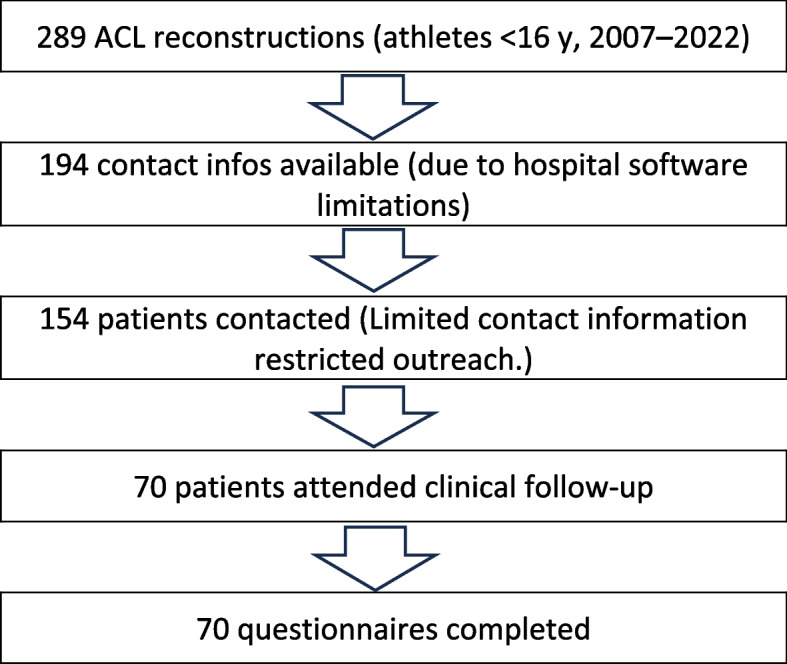
Patient selection flowchart
There were 22 males and 48 females (M/F:22/48; 31%/69%) with a mean chronological age of 15.2 (13.2–15.99 years) years. Sixty-five patients underwent ACL reconstruction with hamstring grafts (semitendinosus and gracilis), and 5 patients underwent patellar tendon grafts. The mean follow-up time was 6.9 years (range: 2–19.3 years), and the mean age at the time of follow-up was 22.1 years (range: 15.2–35.2 years).
We found an improvement in the number of ACL surgeries per year in patients under 16 years of age. The number of operations rose significantly, from 5–6 procedures in the early 2000s to 2025 procedures in the late 2010s (Table 1).
Table 1.
ACLR numbers between 2000 and 2020

Among patients under the age of 16 years, 10 patients underwent revision ACL reconstruction (14.1%), and 13 patients underwent ACL reconstruction on the contralateral side (18.3%). The median time of the revision ACL reconstruction was 28 months (7–66 months), whereas it was 53 months (12–138 months) for the contralateral side. Among the revisions, 70% occurred in the first three years after ACL reconstruction. Three patients (4%) underwent both revision and contralateral ACL reconstruction. A total of 28 meniscal surgeries were required in 22 patients (39.4% of the surgeries, representing 31% of the patients). In three cases, it was necessary to remove the staples (4%). There were only 31 patients (43.6%) who did not have any secondary surgeries.
Fifty-three patients (75%) had an average side-to-side difference of 1.9 mm with the KT-1000 arthrometer at 89 N. With respect to ROM, 19 patients (27%) had an average of 4 degrees less extension, whereas 36 patients (51%) had an average of 9 degrees less flexion.
The patient-reported outcome results were as follows: mean KOOS score 86.7 (48.4–100); IKDC subjective score 87.1 (54–100); and Lysholm score 89.5 (43–100). The results of the KOOS subgroup were as follows: KOOS Pain: 96.0 (75–100); KOOS symptoms: 76.5 (50–100); KOOS Daily: 98.9 (86.8–100); KOOS Sport: 88.4 (10–100); and KOOS QOL: 73.3 (6.25–100). The median Tegner score was 8.0 before and 7.0 after ACL reconstruction.
Types of sports
Of all participants, 74% were athletes in either handball (22 athletes, 31.4%), soccer (17 athletes, 24.3%), or basketball (13 athletes, 18.6%). For simplicity, these sports are grouped under the abbreviation HSB (handball, soccer, basketball). Additionally, one athlete from each of the following sports participated: alpine skiing, acrobatics, riding, fencing, triathlon, orienteering, water polo, dancing, badminton, artistic gymnastics, athletics, karate, and volleyball (Table 2).
Table 2.
Demographic data of the Groups
| Groups | Group1 | Group2 | |
|---|---|---|---|
| Number | 70 | 86 | |
| Sex (F/M) | 48/22 | 33/53 | |
| Age (Years) | 15,2 | 30,8 | |
| Follow-up (years) | 6,9 | 3,66 | |
| Level of sports (C/R) | 60/10 | 35/48 | |
| No sport | 3 | ||
| Type of Sports: | |||
| handball | 22 | 31 | soccer |
| soccer | 17 | 11 | handball |
| basketball | 14 | 7 | alpine skiing, bicycle |
| Volleyball | 3 | 3 | basketball, athletics, artistic gymnastics |
| athletics, karate/combat sport | 2 | 5 | dancing |
| alpine skiing, fencing,water polo, triatlon, orienteering, dancing, riding, badminton, artistic gymnastix, acrobatics | 1 | 2 | volleyball, karate/combat sport, ice hockey, wrestling |
| 1 | badminton, aerobic, rowing, snowboard, auto-motor sports |
Legend: Demographic and sports characteristics of two groups, including age, follow-up time, sex distribution, sports participation level, and types of sports practiced
The percentage of revision was 15% among the three dominant sport types, i.e., team athletes, whereas the revision rate was only 11%-among athletes of other sports. The difference was not statistically significant (P=0,326). A similar pattern was observed in contralateral ACL reconstructions, with a rate of 21% in team athletes compared to 11% in others, although this difference was also not statistically significant (P = 0.173) (Table 3)
Table 3.
Analysis of Revision and Contralateral Anterior Cruciate Ligament Reconstruction (ACLR) Rates According to Sport Type, Activity Level, and Sex
| Type of Sport | Revision ACLR Numbers | Contralateral ACLR | ||||
|---|---|---|---|---|---|---|
| Revision ACLR – No | Revision ACLR – Yes | Total | Revision ACLR – No | Revision ACLR – Yes | Total | |
| Other | 16(89%) | 2(11%) | 18(100%) | 16(89%) | 2(11%) | 18(100%) |
| HSB | 44(85%) | 8(15%) | 52(100%) | 41(79%) | 11(21%) | 52(100%) |
| Total | 60 | 10 | 70 | 57 | 13 | 70 |
| P=0,326 | P=0,173 | |||||
| Level of Sports | Revision ACLR – No | Revision ACLR – Yes | Total | Revision ACLR – No | Revision ACLR – Yes | |
| Recreational | 9(90%) | 1(10%) | 10(100%) | 16(89%) | 2(11%) | 18(100%) |
| Competitive | 51(85%) | 9(15%) | 60(100%) | 49(82%) | 11(18%) | 60(100%) |
| Total | 60 | 10 | 70 | 57 | 13 | 70 |
| P= 0.338 | P= 0.236 | |||||
| Sex | Revision ACLR – No | Revision ACLR – Yes | Total | Revision ACLR – No | Revision ACLR – Yes | Total |
| Male | 20(91%) | 2(9%) | 22(100%) | 21(95%) | 1(5%) | 22(100%) |
| Female | 40(83%) | 8(17%) | 48(100%) | 36(75%) | 12(25%) | 48(100%) |
| Total | 60 | 10 | 70 | 60 | 10 | 70 |
| P=0.200 | P=0.020 | |||||
Legend: This table presents the distribution of patients who underwent revision ACLR and contralateral ACLR based on type of sport, level of sports activity, and sex
Revision ACLR – No / Yes: Indicates the number and percentage of patients who did not (No) or did (Yes) undergo revision ACL reconstruction. Contralateral ACLR – No / Yes: Indicates the number and percentage of patients who did not (No) or did (Yes) undergo ACL reconstruction on the opposite knee. Other: Refers to patients participating in sports other than Handball, Soccer, Basketball (HSB) sports. HSB: Handball, Soccer, Basketball players. Recreational: Patients who play sports casually or for leisure. Competitive: Patients who participate in organized sports at a competitive level. Male / Female: Biological sex of the patients.
Each subgroup shows the number of patients and the percentage (in parentheses) relative to the total in that subgroup. P-values are provided to indicate statistical significance of differences between subgroups. A P-value less than 0.05 is considered statistically significant.
Level of sports
Most of the athletes played sports at a high level; 60 of them did competitive sports (86%), and only 10 patients did recreational sports (14%). There was no statistically significant difference in the proportion of competitive and recreational sports within the revision group (90%) and the contralateral ACL reconstruction group (85%). (revision: P= 0.338; contralateral: P=0.236). (Table 3)
Biological Sex
Eight of the athletes who underwent revision ACL reconstruction were female (80%), whereas the rate was even higher among those who underwent contralateral ACL reconstruction (females: 12 patients 92%; males: 1 patient 8%). The proportion of females was significantly greater in the case of contralateral ACL reconstruction (P=0.020), whereas for revision, the difference was not statistically significant (P=0.200). (Table 3)
Comparison
The second group (Group 2) consisted of 143 patients who underwent ACL reconstruction between 2016 and 2020, all of whom were over 16 years old at the time of surgery. In this group, an online survey was conducted. Altogether, 86 athletes completed our questionnaire (60%). Compared with Group 1, the sex distribution ratio was the opposite (M53:F33). The mean age at ACL reconstruction was 30.8 (16.1–51.5 years) years, and the mean follow-up time was 3.66 (2.1–6.8 years) years. All 86 patients included completed the questionnaire in full.
In the second group (Group 2), 15 patients underwent any operation after primary ACL reconstruction (17%).
We found five revision ACL surgeries (5.8%) in Group 2. Among these five patients, three were under 20 years of age. The mean age of the five patients was 21.9 years. Among the procedures performed following ACL reconstruction, six arthroscopic arthrolysis procedures (6.9%), four meniscus resections (4.6%), and one (1%) meniscal refixation, microfracture, and metal removal procedure were performed. Furthermore, 11 patients underwent multiple operations on the ipsilateral side (12%).
On the contralateral side, four patients (4.6%) required surgery: one ACL reconstruction (1%), two meniscus resections (2.3%) and one meniscus refixation (1%).
The average age of the two groups showed a significant difference (Group1: 14,8 years vs. Group2: 30,8 years; P<0.0001).
A comparison of the groups is shown in Table 4.
Table 4.
Comparison of the groups
| Groups | Group1 (x<16) | Group2 (x>16) |
|---|---|---|
| Number | 45 | 86 |
| follow-up (x<8years) | 3.72 | 3.66 |
| Sex (F/M) | 33:12 | 33:53 |
| Age (Years) | 14.8 | 30.8 |
| Tegner before | 8.0 | 7.8 |
Legend: This table summarizes the baseline characteristics of the two study groups based on age: Group 1 includes patients younger than 16 years, and Group 2 includes patients older than 16 years at the time of surgery
The table shows the number of patients in each group, mean follow-up time (in years), sex distribution (female:male), mean age, and the average Tegner activity level before injury
The number of meniscus surgeries (Group 1: 26% vs. Group 2: 4.6%; P=0.003), contralateral ACL reconstruction (Group 1: 8.8% vs. Group 2: 1.1%; P=0.03) and total number of surgeries (Group 1: 44% vs. Group 2: 21%; P=0.01) were significantly greater among patients under 16 years of age. We also found several cases of revision ACL reconstruction in Group 1, although the difference was no significant (Group 1: 11% vs. Group 2: 5.8%; P=0.293). (Table 5)
Table 5.
Comparison of the groups based on the number of surgeries
| Groups | Group1 (x<16) | Group2 (x>16) | |
|---|---|---|---|
| Revision ACL reconstruction | 5/45 (11%) | 5/86 (5.8%) | P=0.293 |
| Meniscus surgery | 12/45 (26%) | 4/86 (4.6%) | P=0.003 |
| Contralateral ACL reconstruction | 4/45 (8.8%) | 1/86 (1.1%) | P=0.03 |
| Total number of surgeries | 20/45 (44%) | 18/86 (21%) | P=0.01 |
Legend: This table compares the surgical outcomes between Group 1 (patients under 16 years) and Group 2 (patients over 16 years), such as revision ACL reconstruction (p = 0.293), meniscus surgery (p = 0.003), contralateral ACL reconstruction (p = 0.03), and total number of surgeries (p = 0.01), with statistically significant differences observed in all except revision ACL reconstruction
The Lysholm scores (Group 1: 88.3 vs. Group 2: 87.0; P=0.271), IKDC subjective scores (Group 1: 88.4 vs. Group 2: 86.9; P=0.478), mean KOOS scores (Group 1: 86.9 vs. Group 2: 86.5; P=0.498), KOOS QOL scores (Group 1: 75.4 vs. Group 2: 67.4; P=0.064), daily scores (Group 1: 98.6 vs. Group 2: 98.8; P=0.453), and sport scores (Group 1: 89.6 vs. Group 2: 87.3; P=0.324) did not significantly differ, whereas the KOOS symptom scores (Group 1: 75.6 vs. Group 2: 85.0; P<0.005) were significantly lower in Group 1. However, the KOOS pain subscale score was significantly lower in patients over 16 years of age (Group 1: 95.6 vs. Group 2: 94.0; P=0.033). (Table 6)
Table 6.
Comparison of the groups on the basis of patient-reported outcomes
| Under 16 years | 16 years and older | ||
|---|---|---|---|
| IKDC subj. | 88.4 | 86.9 | P=0.478 |
| Lysholm | 88.3 | 87.0 | P=0.271 |
| Mean KOOS | 86.9 | 86.5 | P=0.498 |
| Pain | 95.6 | 94.0 | P=0.033 |
| Sympt. | 75.6 | 85.0 | P<0.005 |
| Daily | 98.6 | 98.8 | P=0.453 |
| Sport | 89.6 | 87.3 | P=0.324 |
| QOL | 75.4 | 67.4 | P=0.064 |
Legend: Comparison of postoperative outcome scores between patients under 16 and those 16 and older. Statistically significant differences were found in KOOS Pain (P=0.033) and KOOS Symptoms (P<0.005)
Discussion
The most important findings of our study were that the rates of contralateral ACL reconstruction (P=0.03), meniscal surgery (P=0.003), and the total number of operations (P=0.01) were significantly higher in patients under 16 years of age compared to those over 16 years. Although ACL revision rates also appeared higher in the younger group, this difference did not reach statistical significance (P=0.293).
The question arises whether the lower contralateral rupture and re-rupture rates in the patients over 16 years could be due to the shorter follow-up period. As the years progress, the occurrence of repeat injuries naturally increases, but we do observe that re-injuries are most common in the first 2–3 years following ACL reconstruction [13, 23]. In our own study, graft re-rupture occurred on average 28 months after ACL reconstruction. Among the 13 cases of contralateral ACL rupture, the injury occurred within 3.6 years after ACL reconstruction in 6 cases, and later than 3.6 years in 7 cases. Given that the vast majority of re-ruptures occur within the first 36 months, we would have observed a higher rate in Group 2 even within the shorter 44-month follow-up period. We believe that the shorter follow-up period does not have a significant impact on the higher rate of revision injuries; however, to eliminate this potential source of bias, we standardized the follow-up period.
During the last three decades, there has been a high increase in the incidence of adolescent ACL rupture [24]. The increased number of young athletes may be responsible for the increased number of injuries, but early sports specialization and increased awareness of these injuries among the public and physicians may also play a role [3, 25]. One other possible reason for the higher rate of ACL graft re-rupture observed in young individuals is the presence of generalized joint hypermobility. This condition is characterized by an inherently more lax ligamentous system, which provides reduced joint stability and may increase the risk of graft failure under physical stress [26]. Return to sport is a well-known risk factor, and an early return to pivoting sports in particular significantly increases the risk of reinjury [27]. Compared with adult patients (83%), skeletally immature athletes have a greater return to sport level (92%), which may further increase the risk of graft re-rupture [28–31].
In our experience, the number of ACL reconstructions has steadily increased between 2000 (5 operations/year) and 2019 (23 operations/year), reflecting a growing trend in surgical treatment among adolescents.
Two well-known and important risk factors for ACL rupture are previous ACL reconstruction, therefore, it is legitimate to question whether we should perform the reconstruction in the case of an anterior cruciate ligament tear [15]. When an adult patient does not experience any symptoms or a locking sensation and does not participate in pivoting sports, conservative treatment may be considered an option [32]. In contrast, nonoperative ACL rupture care has explicitly negative outcomes among adolescents; therefore, we should aim for the earliest possible surgical treatment [10, 11, 33–35]. Nevertheless, not only are the revision rates among adolescents high, with rates ranging from 9–35% but also the contralateral ACL reconstruction rates (13–20%) are high [12, 16, 17, 36, 37, 39, 40]. The surgical results may be affected by the method of graft fixation, which is why Calvo's study is interesting, as he reported similar revision ACL reconstruction rates with the same surgical technique [41]. Calvo et al. used the EndoButton suspensory system with double-staple tibial fixation and reported more than 5 mm tibial translation in 22% of cases with respect to the healthy knee, although there was no statistically significant difference in functional scores between these patients and those with a difference of <5 mm. However, in our study, the rate of tibia translation greater than 5 mm was only 2.8%. Despite the difference in tibial translation, the revision rate was nearly the same (our study: 14.5% vs Calvo: 14,8%).
The double press-fit fixation technique used in patellar tendon reconstruction is relatively uncommon. Pavlik and colleagues investigated the stability of press-fit fixation and found that, at a 60-degree femoral tunnel angle, graft rupture or bony block fracture was more likely to occur. In contrast, at a 15-degree fixation angle, the overall stability was significantly reduced. Compared to data in the literature, these results demonstrated similar and satisfactory biomechanical properties of femoral press-fit fixation [42]. In Hidas’s study, histological analysis revealed adequate ossification by six weeks following the press-fit technique [43]. A major advantage of double press-fit fixation is that, in addition to providing satisfactory clinical outcomes, it eliminates the need for implant placement [22]. As a result, the bony block achieves more than 90% integration on the femoral side, which significantly facilitates the placement of the femoral tunnel in potential revision surgeries [44].
In our sample, 28 patients (39.4%) required meniscus surgery following ACL reconstruction after 6.9 years of follow-up. At a follow-up of 3.66 years, the rate of meniscus injuries was lower, at only 26%, indicating that the rate of meniscus injuries increased over time. However, patients older than 16 years had a significantly lower rate of meniscal tears (P=0.003). Fewer data are available on the rate of meniscal tears following ACL reconstruction than on revision rates. Chan's study reported that 10.7% of meniscal tears occurred after ACL reconstruction, whereas Ichinohe reported that only 4% of cases occurred [45, 46]. Unfortunately, in our study, we found a higher rate in patients under 16 years of age than in those under 16 years of age at both 3.66 and 6.9 years of average follow-up. For patients older than 16 years, the rate was 4.6%, which is in line with the literature.
Among patients who have been followed up, there are twice as many females as males (females: 48, males: 22). Nicholls et al. reported that among the adolescent population, ACL ruptures affect females the most [47]. Hypermobility syndrome (HMS) is a predictive factor for revision and contralateral ACL surgeries and is also more common among females [48]. This may be due to the high number of females in both our groups (revision: 80%, contralateral: 92%). The proportion of females was significantly greater in the case of contralateral ACL reconstruction (P=0.020), whereas for revision, the difference was not statistically significant (P=0.200). Ahldén et al. also reported that young female athletes have a significantly greater incidence of contralateral ALC ruptures when analyzing data from the Swedish Ligament Register [19].
Wiggins et al. reported that returning to sports increases the rate of reinjury [12]. Moreover, it also makes a difference in which sport the athlete returns to. Athletes who play high-pivoting sports (e.g., football) have a greater risk of ACL rerupture [38, 49]. In contrast to ice hockey and basketball, Boch reported higher rates of reinjury among handball and football players [8]. We hypothesized that the rates of revision and contralateral ACL reconstruction would be greater among competitive athletes performing high-pivoting ball sports. We could not prove our theory. The rates of revision and contralateral cruciate ligament reconstruction were not significantly higher among either competitive (revision: recreational (10%) vs. competitive (15%), P=0,337); contralateral (recreational (11%) vs. competitive (18%), P=0,236) or pivoting athletes (revision: other (11%) vs. HSB (15%), P=0,326); contralateral (other (11%) vs. HSB (21%), P=0,173)).
There were no significant differences in patient-reported outcomes, except for the KOOS symptoms score (P < 0.005). Surprisingly, the KOOS pain subscale score was significantly higher in the under 16-year-old athletes (P=0.033).
Our study supports the conclusion that ACL reconstruction performed during adolescence yields less favorable surgical outcomes compared to procedures carried out at an older age, particularly in terms of re-rupture rates and contralateral ACL rupture. Reducing this unfavorable outcome is of paramount importance for orthopedic surgeons, as minimizing re-rupture and contralateral ACL rupture rates is essential to improving long-term functional results in adolescent patients. One of the most promising techniques of the last decade is lateral extra-articular tenodesis (LET). This procedure has shown significant benefits in improving outcomes in ACL reconstruction, particularly for young, high-activity patients. It helps stabilize the knee, reducing re-rupture and graft failure rates among individuals with high sports activity [50–54].
Limitations
This retrospective study has several limitations. First, we did not use a questionnaire before the ACL reconstruction, so we could not measure clinical outcomes.
Second, the follow-up time varied widely (mean 6.9; 2–19 years), so in our study, the follow-up duration was only medium-term. To compare the groups, the follow-up time of the first group had to be reduced, which unfortunately reduced the number of cases as well. Another limitation of the medium-term follow-up is that any subsequent surgeries or re-injuries that may occur later are not documented.
Because of administrative issues, 194 patients were lost to follow-up out of our 289 patients. Following the request, 70 patients were personally involved in our study (36%). Unfortunately, this rate is low; however, Ahldén et al. reported a completion rate of approximately 40% in the Swedish cruciate ligament register at the 5-year follow-up [19].
Another limitation of the study is that we did not analyze the return to different sports or the level of return separately. The level of post-surgery sports activity was only addressed in terms of examining which sports were practiced by patients who underwent revision surgery or contralateral ACL reconstruction, as well as in the comparison of Tegner scores between the groups.
Conclusion
In our study, the total number of surgeries, particularly meniscal procedures was significantly higher among athletes under the age of 16. Revision and contralateral ACL reconstructions were also more frequent in this age group; however, these differences did not reach statistical significance. A significantly higher proportion of females underwent contralateral ACL reconstruction. These findings highlight age and sex as potential factors associated with surgical outcomes following ACL injuries.
Acknowledgments
We would like to thank Kata Alkonyi for her assistance in coordinating the patients.
Authors’ contributions
E.P. was responsible for recruiting the patients into the study. A.K. played a significant role in patient examination, administering the questionnaire, and editing the STROBE guidelines. A.Tatrai performed the statistical analysis. M.T. was a major contributor to the writing of the manuscript. A.P. was the study coordinator and played a significant role in patient recruitment. A.Tallay and T.H. provided expert advice during the research. All the authors read and approved the final manuscript.
Funding
Open access funding provided by Semmelweis University.
Data availability
No datasets were generated or analysed during the current study.
Declarations
All procedures performed in our studies involving human participants were in accordance with the ethical standards of the institutional and national research committees and with the 1964 Helsinki Declaration and its later amendments or comparable ethical standards. The study was approved by the regional ethical committee (No. 15/2019).
The datasets used and analyzed during the current study are available from the corresponding author upon reasonable request.
Competing interest
The authors declare no competing interests.
Footnotes
Publisher’s Note
Springer Nature remains neutral with regard to jurisdictional claims in published maps and institutional affiliations.
References
- 1.Weitz FK, Sillanpää PJ, Mattila VM. The incidence of paediatric ACL injury is increasing in Finland. Knee Surg Sports Traumatol Arthrosc. 2020;28(2):363–8. [DOI] [PMC free article] [PubMed] [Google Scholar]
- 2.Arundale AJH, Silvers-Granelli HJ, Myklebust G. ACL injury prevention: Where have we come from and where are we going? J Orthop Res. 2022;40(1):43–54. [DOI] [PubMed] [Google Scholar]
- 3.Bales CP, Guettler JH, Moorman CT 3rd. Anterior cruciate ligament injuries in children with open physes: evolving strategies of treatment. Am J Sports Med. 2004;32(8):1978–85. [DOI] [PubMed] [Google Scholar]
- 4.Al Attar WSA, Bakhsh JM, Khaledi EH, Ghulam H, Sanders RH. Injury prevention programs that include plyometric exercises reduce the incidence of anterior cruciate ligament injury: a systematic review of cluster randomised trials. J Physiother. 2022;68(4):255–61. [DOI] [PubMed] [Google Scholar]
- 5.Bram JT, Magee LC, Mehta NN, Patel NM, Ganley TJ. Anterior Cruciate Ligament Injury Incidence in Adolescent Athletes: A Systematic Review and Meta-analysis. Am J Sports Med. 2021;49(7):1962–72. [DOI] [PubMed] [Google Scholar]
- 6.Chia L, De Oliveira Silva D, Whalan M, McKay MJ, Sullivan J, Fuller CW, et al. Non-contact Anterior Cruciate Ligament Injury Epidemiology in Team-Ball Sports: A Systematic Review with Meta-analysis by Sex, Age, Sport, Participation Level, and Exposure Type. Sports Med. 2022;52(10):2447–67. [DOI] [PMC free article] [PubMed] [Google Scholar]
- 7.Montalvo AM, Schneider DK, Webster KE, Yut L, Galloway MT, Heidt RS Jr, et al. Anterior Cruciate Ligament Injury Risk in Sport: A Systematic Review and Meta-Analysis of Injury Incidence by Sex and Sport Classification. J Athl Train. 2019;54(5):472–82. [DOI] [PMC free article] [PubMed] [Google Scholar]
- 8.Bloch H, Reinsberger C, Klein C, Luig P, Krutsch W. High revision arthroscopy rate after ACL reconstruction in men’s professional team sports. Knee Surg Sports Traumatol Arthrosc. 2023;31(1):142–51. [DOI] [PubMed] [Google Scholar]
- 9.Dunn KL, Lam KC, Valovich McLeod TC. Early Operative Versus Delayed or Nonoperative Treatment of Anterior Cruciate Ligament Injuries in Pediatric Patients. J Athl Train. 2016;51(5):425–7. [DOI] [PMC free article] [PubMed] [Google Scholar]
- 10.James EW, Dawkins BJ, Schachne JM, Ganley TJ, Kocher MS, Anderson CN, et al. Early Operative Versus Delayed Operative Versus Nonoperative Treatment of Pediatric and Adolescent Anterior Cruciate Ligament Injuries: A Systematic Review and Meta-analysis. Am J Sports Med. 2021;49(14):4008–17. [DOI] [PubMed] [Google Scholar]
- 11.Ramski DE, Kanj WW, Franklin CC, Baldwin KD, Ganley TJ. Anterior cruciate ligament tears in children and adolescents: a meta-analysis of nonoperative versus operative treatment. Am J Sports Med. 2014;42(11):2769–76. [DOI] [PubMed] [Google Scholar]
- 12.Wiggins AJ, Grandhi RK, Schneider DK, Stanfield D, Webster KE, Myer GD. Risk of Secondary Injury in Younger Athletes After Anterior Cruciate Ligament Reconstruction: A Systematic Review and Meta-analysis. Am J Sports Med. 2016;44(7):1861–76. [DOI] [PMC free article] [PubMed] [Google Scholar]
- 13.Ifran NN, Mok YR, Krishna L. Tear Rates of the Ipsilateral ACL Graft and the Contralateral Native ACL Are Similar following ACL Reconstruction. J Knee Surg. 2022;35(3):308–11. [DOI] [PubMed] [Google Scholar]
- 14.Connors JP, Cusano A, Saleet J, Hao KA, Efremov K, Parisien RL, et al. Return to Sport and Graft Failure Rates After Primary Anterior Cruciate Ligament Reconstruction With a Bone-Patellar Tendon-Bone Versus Hamstring Tendon Autograft: A Systematic Review and Meta-analysis. Am J Sports Med. 2025:3635465241295713. [DOI] [PubMed]
- 15.Giannakis P, Zhuang ST, Rosenstadt JL, Marx RG. One-stage revision anterior cruciate ligament reconstruction: Preoperative evaluation, planning and surgical techniques. A review of current concepts. J Exp Orthop. 2025;12(1):e70111. [DOI] [PMC free article] [PubMed] [Google Scholar]
- 16.Astur DC, Cachoeira CM, da Silva Vieira T, Debieux P, Kaleka CC, Cohen M. Increased incidence of anterior cruciate ligament revision surgery in paediatric verses adult population. Knee Surg Sports Traumatol Arthrosc. 2018;26(5):1362–6. [DOI] [PubMed] [Google Scholar]
- 17.Astur DC, Novaretti JV, Cavalcante ELB, Goes A Jr, Kaleka CC, Debieux P, et al. Pediatric Anterior Cruciate Ligament Reruptures Are Related to Lower Functional Scores at the Time of Return to Activity: A Prospective, Midterm Follow-up Study. Orthop J Sports Med. 2019;7(12):2325967119888888. [DOI] [PMC free article] [PubMed] [Google Scholar]
- 18.Thorolfsson B, Svantesson E, Snaebjornsson T, Sansone M, Karlsson J, Samuelsson K, et al. Adolescents Have Twice the Revision Rate of Young Adults After ACL Reconstruction With Hamstring Tendon Autograft: A Study From the Swedish National Knee Ligament Registry. Orthop J Sports Med. 2021;9(10):23259671211038892. [DOI] [PMC free article] [PubMed] [Google Scholar]
- 19.Ahldén M, Samuelsson K, Sernert N, Forssblad M, Karlsson J, Kartus J. The Swedish National Anterior Cruciate Ligament Register: a report on baseline variables and outcomes of surgery for almost 18,000 patients. Am J Sports Med. 2012;40(10):2230–5. [DOI] [PubMed] [Google Scholar]
- 20.Kawaguchi Y, Kondo E, Kitamura N, Kai S, Inoue M, Yasuda K. Comparisons of femoral tunnel enlargement in 169 patients between single-bundle and anatomic double-bundle anterior cruciate ligament reconstructions with hamstring tendon grafts. Knee Surg Sports Traumatol Arthrosc. 2011;19(8):1249–57. [DOI] [PubMed] [Google Scholar]
- 21.Halder AM, Ludwig S, Neumann W. Arthroscopic anterior cruciate ligament reconstruction using the double press- fit technique: an alternative to interference screw fixation. Arthroscopy. 2002;18(9):974–82. [DOI] [PubMed] [Google Scholar]
- 22.Pavlik A, Hidas P, Tállay A, Toman J, Berkes I. Femoral press-fit fixation technique in anterior cruciate ligament reconstruction using bone-patellar tendon-bone graft: a prospective clinical evaluation of 285 patients. Am J Sports Med. 2006;34(2):220–5. [DOI] [PubMed] [Google Scholar]
- 23.Zhao D, Pan JK, Lin FZ, Luo MH, Liang GH, Zeng LF, et al. Risk Factors for Revision or Rerupture After Anterior Cruciate Ligament Reconstruction: A Systematic Review and Meta-analysis. Am J Sports Med. 2023;51(11):3053–75. [DOI] [PubMed] [Google Scholar]
- 24.Perkins CA, Willimon SC. Pediatric Anterior Cruciate Ligament Reconstruction. Orthop Clin North Am. 2020;51(1):55–63. [DOI] [PubMed] [Google Scholar]
- 25.Myer GD, Jayanthi N, Difiori JP, Faigenbaum AD, Kiefer AW, Logerstedt D, et al. Sport Specialization, Part I: Does Early Sports Specialization Increase Negative Outcomes and Reduce the Opportunity for Success in Young Athletes? Sports Health. 2015;7(5):437–42. [DOI] [PMC free article] [PubMed] [Google Scholar]
- 26.Akhtar MA, Bhattacharya R, Keating JF. Generalised ligamentous laxity and revision ACL surgery: Is there a relation? Knee. 2016;23(6):1148–53. [DOI] [PubMed] [Google Scholar]
- 27.Lorange JP, Senécal L, Moisan P, Nault ML. Return to Sport After Pediatric Anterior Cruciate Ligament Reconstruction: A Systematic Review of the Criteria. Am J Sports Med. 2024;52(6):1641–51. [DOI] [PubMed] [Google Scholar]
- 28.Anand BS, Feller JA, Richmond AK, Webster KE. Return-to-Sport Outcomes After Revision Anterior Cruciate Ligament Reconstruction Surgery. Am J Sports Med. 2016;44(3):580–4. [DOI] [PubMed] [Google Scholar]
- 29.Chicorelli AM, Micheli LJ, Kelly M, Zurakowski D, MacDougall R. Return to Sport After Anterior Cruciate Ligament Reconstruction in the Skeletally Immature Athlete. Clin J Sport Med. 2016;26(4):266–71. [DOI] [PubMed] [Google Scholar]
- 30.Kay J, Memon M, Marx RG, Peterson D, Simunovic N, Ayeni OR. Over 90 % of children and adolescents return to sport after anterior cruciate ligament reconstruction: a systematic review and meta-analysis. Knee Surg Sports Traumatol Arthrosc. 2018;26(4):1019–36. [DOI] [PubMed] [Google Scholar]
- 31.Lai CCH, Ardern CL, Feller JA, Webster KE. Eighty-three per cent of elite athletes return to preinjury sport after anterior cruciate ligament reconstruction: a systematic review with meta-analysis of return to sport rates, graft rupture rates and performance outcomes. Br J Sports Med. 2018;52(2):128–38. [DOI] [PubMed] [Google Scholar]
- 32.Delincé P, Ghafil D. Anterior cruciate ligament tears: conservative or surgical treatment? A critical review of the literature. Knee Surg Sports Traumatol Arthrosc. 2012;20(1):48–61. [DOI] [PubMed] [Google Scholar]
- 33.Hawkins RJ, Misamore GW, Merritt TR. Followup of the acute nonoperated isolated anterior cruciate ligament tear. Am J Sports Med. 1986;14(3):205–10. [DOI] [PubMed] [Google Scholar]
- 34.Kannus P, Järvinen M. Knee ligament injuries in adolescents. Eight year follow-up of conservative management. J Bone Joint Surg Br. 1988;70(5):772–6. [DOI] [PubMed] [Google Scholar]
- 35.Mizuta H, Kubota K, Shiraishi M, Otsuka Y, Nagamoto N, Takagi K. The conservative treatment of complete tears of the anterior cruciate ligament in skeletally immature patients. J Bone Joint Surg Br. 1995;77(6):890–4. [PubMed] [Google Scholar]
- 36.Dekker TJ, Godin JA, Dale KM, Garrett WE, Taylor DC, Riboh JC. Return to Sport After Pediatric Anterior Cruciate Ligament Reconstruction and Its Effect on Subsequent Anterior Cruciate Ligament Injury. J Bone Joint Surg Am. 2017;99(11):897–904. [DOI] [PubMed] [Google Scholar]
- 37.Paterno MV, Rauh MJ, Schmitt LC, Ford KR, Hewett TE. Incidence of contralateral and ipsilateral anterior cruciate ligament (ACL) injury after primary ACL reconstruction and return to sport. Clin J Sport Med. 2012;22(2):116–21. [DOI] [PMC free article] [PubMed] [Google Scholar]
- 38.Paterno MV, Rauh MJ, Schmitt LC, Ford KR, Hewett TE. Incidence of Second ACL Injuries 2 Years After Primary ACL Reconstruction and Return to Sport. Am J Sports Med. 2014;42(7):1567–73. [DOI] [PMC free article] [PubMed] [Google Scholar]
- 39.Reid D, Leigh W, Wilkins S, Willis R, Twaddle B, Walsh S. A 10-year Retrospective Review of Functional Outcomes of Adolescent Anterior Cruciate Ligament Reconstruction. J Pediatr Orthop. 2017;37(2):133–7. [DOI] [PubMed] [Google Scholar]
- 40.Maletis GB, Inacio MC, Funahashi TT. Risk factors associated with revision and contralateral anterior cruciate ligament reconstructions in the Kaiser Permanente ACLR registry. Am J Sports Med. 2015;43(3):641–7. [DOI] [PubMed] [Google Scholar]
- 41.Calvo R, Figueroa D, Gili F, Vaisman A, Mocoçain P, Espinosa M, et al. Transphyseal anterior cruciate ligament reconstruction in patients with open physes: 10-year follow-up study. Am J Sports Med. 2015;43(2):289–94. [DOI] [PubMed] [Google Scholar]
- 42.Pavlik A, Hidas P, Czigány T, Berkes I. Biomechanical evaluation of press-fit femoral fixation technique in ACL reconstruction. Knee Surg Sports Traumatol Arthrosc. 2004;12(6):528–33. [DOI] [PubMed] [Google Scholar]
- 43.Hidas P, Illyés G, Pavlik A, Kendik Z, Tállay A, Berkes I. Femoral press-fit fixation in anterior cruciate ligament reconstruction: postoperative histological examination of bone block incorporation in pigs. Orv Hetil. 2005;146(10):471–5. [PubMed] [Google Scholar]
- 44.Tátrai M, Halasi T, Tállay A, Tátrai A, Pavlik A. Low Femoral Tunnel Widening Incidence Rate After ACL Reconstruction Using Patellar Tendon Graft with Press-Fit Fixation. Indian J Orthop. 2023;57(4):596–602. [DOI] [PMC free article] [PubMed] [Google Scholar]
- 45.Chan CX, Silas C, Ifran NN, Mok YR, Krishna L. Risk Factors for New Meniscal Tears following Anterior Cruciate Ligament Reconstruction. J Knee Surg. 2022;35(5):529–33. [DOI] [PubMed] [Google Scholar]
- 46.Ichinohe S, Yoshida M, Murakami H, Takayama H, Izumiyama S, Shimamura T. Meniscal tearing after ACL reconstruction. J Orthop Surg (Hong Kong). 2000;8(1):53–9. [DOI] [PubMed] [Google Scholar]
- 47.Nicholls M, Aspelund T, Ingvarsson T, Briem K. Nationwide study highlights a second peak in ACL tears for women in their early forties. Knee Surg Sports Traumatol Arthrosc. 2018;26(2):648–54. [DOI] [PubMed] [Google Scholar]
- 48.Russek LN, Errico DM. Prevalence, injury rate and symptom frequency in generalized joint laxity and joint hypermobility syndrome in a “healthy” college population. Clin Rheumatol. 2016;35(4):1029–39. [DOI] [PubMed] [Google Scholar]
- 49.Fältström A, Hägglund M, Magnusson H, Forssblad M, Kvist J. Predictors for additional anterior cruciate ligament reconstruction: data from the Swedish national ACL register. Knee Surg Sports Traumatol Arthrosc. 2016;24(3):885–94. [DOI] [PubMed] [Google Scholar]
- 50.Carrozzo A, Monaco E, Saithna A, Annibaldi A, Guy S, Ferreira A, et al. Clinical Outcomes of Combined Anterior Cruciate Ligament Reconstruction and Lateral Extra-articular Tenodesis Procedures in Skeletally Immature Patients: A Systematic Review From the SANTI Study Group. J Pediatr Orthop. 2023;43(1):24–30. [DOI] [PubMed] [Google Scholar]
- 51.Getgood AMJ, Bryant DM, Litchfield R, Heard M, McCormack RG, Rezansoff A, et al. Lateral Extra-articular Tenodesis Reduces Failure of Hamstring Tendon Autograft Anterior Cruciate Ligament Reconstruction: 2-Year Outcomes From the STABILITY Study Randomized Clinical Trial. Am J Sports Med. 2020;48(2):285–97. [DOI] [PubMed] [Google Scholar]
- 52.Green DW, Hidalgo Perea S, Brusalis CM, Chipman DE, Asaro LA, Cordasco FA. A Modified Lemaire Lateral Extra-articular Tenodesis in High-Risk Adolescents Undergoing Anterior Cruciate Ligament Reconstruction With Quadriceps Tendon Autograft: 2-Year Clinical Outcomes. Am J Sports Med. 2023;51(6):1441–6. [DOI] [PubMed] [Google Scholar]
- 53.Monaco E, Carrozzo A, Saithna A, Conteduca F, Annibaldi A, Marzilli F, et al. Isolated ACL Reconstruction Versus ACL Reconstruction Combined With Lateral Extra-articular Tenodesis: A Comparative Study of Clinical Outcomes in Adolescent Patients. Am J Sports Med. 2022;50(12):3244–55. [DOI] [PubMed] [Google Scholar]
- 54.Sonnery-Cottet B, Carrozzo A. Lateral Extra-Articular Tenodesis and Anterolateral Procedures. Clin Sports Med. 2024;43(3):413–31. [DOI] [PubMed] [Google Scholar]
Associated Data
This section collects any data citations, data availability statements, or supplementary materials included in this article.
Data Availability Statement
No datasets were generated or analysed during the current study.