



A 3-month old male child was brought to the Orthopaedics department of Meenakshi Mission Hospital and Research Center, Madurai, Tamil Nadu, India, in October 2012 with complaints of multiple lower limb and upper limb deformities. On clinical examination, bilateral club feet and abnormal prominence in the left thigh were found (Fig. 1). In the upper limbs, the child had lobster-claw shaped hand on both sides. Radiographs confirmed the prominence of left thigh as a ‘bifid femur’ (Fig. 2). Right tibia was partially formed (tibial hemimelia). Absence of central rays of hands was found on both sides (ectrodactyly) (Fig. 3). The child was evaluated and not found to have any visceral and congenital cardiac anomalies.
Fig. 1.
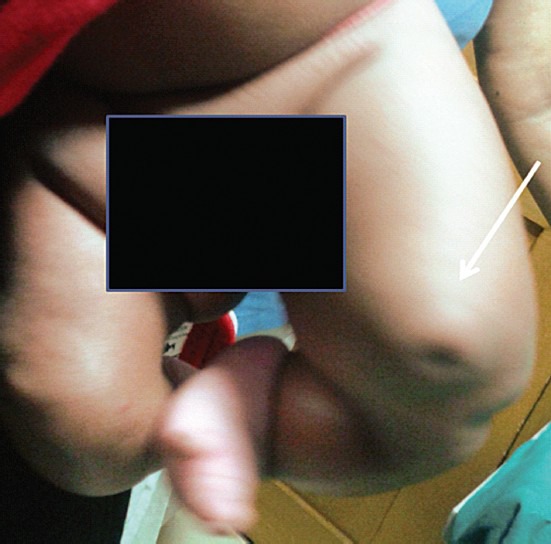
Clinical photograph of the lower limb showing a prominence in the thigh with club foot.
Fig. 2.
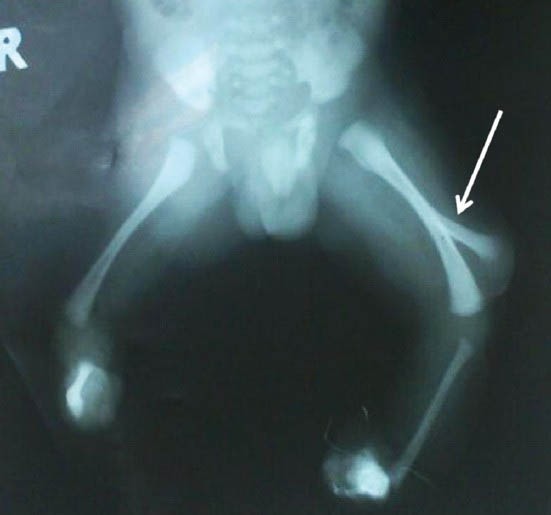
Bifid femur which has duplicated exactly at the mid-diaphyseal level.
Fig. 3.
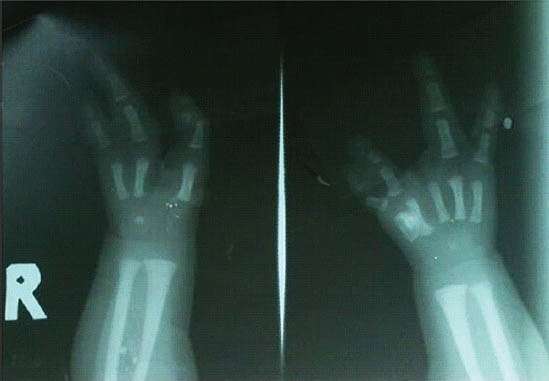
Radiographs of both hands showing absence of central ray (Lobster-claw hand).
The combination of tibial hemimelia, ectrodactyly, bifid-femur and split hand comprises the features of Gollop-Wolfgang complex. Excision of left sided bifurcated femur and right limb knee disarticulation with prosthesis was advised, but the parents of the child refused. The parents revisited the outpatient department in January 2013, but did not give consent for the above treatment.