



Abstract
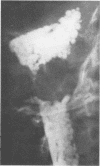
A unique case of dumb-bell neurinoma of the hypoglossal nerve is presented. The importance of hemiatrophy of the tongue is stressed for early diagnosis of the lesion. The myelocisternogram is the single most important contrast study confirming the intracranial extension of the tumour. Total dissection of the tumour capsule may not be feasible in all cases.
Full text
PDF


Images in this article


Selected References
These references are in PubMed. This may not be the complete list of references from this article.
- Ignelzi R. J., Bucy P. C. Intracranial hypoglossal neurofibroma. Case report. J Neurosurg. 1967 Mar;26(3):352–356. doi: 10.3171/jns.1967.26.3.0352. [DOI] [PubMed] [Google Scholar]
- McGREW E. A. Presentation of case. J Am Med Assoc. 1955 May 21;158(3):183–184. doi: 10.1001/jama.1955.02960030033010. [DOI] [PubMed] [Google Scholar]
- Morelli R. J. Intracranial neurilemmoma of the hypoglossal nerve. Review and case report. Neurology. 1966 Jul;16(7):709–713. doi: 10.1212/wnl.16.7.709. [DOI] [PubMed] [Google Scholar]
- RANEY R. B., RANEY A. A., BAYLESS A. E. Tumors of the hypoglossal nerve: report of a case. Bull Los Angel Neuro Soc. 1954 Sep;19(3):160–165. [PubMed] [Google Scholar]
- Valvassori G. E., Kirdani M. A. The abnormal hypoglossal canal. Am J Roentgenol Radium Ther Nucl Med. 1967 Mar;99(3):705–711. doi: 10.2214/ajr.99.3.705. [DOI] [PubMed] [Google Scholar]
- WILLIAMS J. M., FOX J. L. Neurinoma of the intracranial portion of the hypoglossal nerve. Review and case report. J Neurosurg. 1962 Mar;19:248–250. doi: 10.3171/jns.1962.19.3.0248. [DOI] [PubMed] [Google Scholar]