



Summary
The promise of the field of Medical Informatics has been great and its impact has been significant. In 1999, the Yearbook editors of the International Medical Informatics Association (IMIA) - also the authors of the present paper - sought to assess this impact by selecting a number of seminal papers in the field, and asking experts to comment on these articles. In particular, it was requested whether and how the expectations, represented by these papers, had been fulfilled since their publication several decades earlier. Each expert was also invited to comment on what might be expected in the future. In the present paper, these areas are briefly reviewed again. Where did these early papers have an impact and where were they not as successful as originally expected? It should be noted that the extraordinary developments in computer technology observed in the last two decades could not have been foreseen by these early researchers. In closing, some of the possibilities and limitations of research in medical informatics are outlined in the context of a framework that considers six levels of computer applications in medicine and health care. For each level, some predictions are made for the future, concluded with thoughts on fruitful areas for ongoing research in the field.
Keywords: Medical Informatics, history, forecasting, computing methodologies, information systems, electronic health records, clinical decision support
Introduction
The editors of the 1999 edition of the IMIA Yearbook1 (being the authors of the present paper) asked 20 experts in health and medical informatics the following questions: “What early promises in health and medical informatics were made that had a considerable impact on developments in the past 25 to 40 years? What ideas were perhaps innovative, but were never brought into practice? What would be the agenda for the next decade?” The editors had carefully selected a representative sample of 17 early papers considered to be “impact papers”. For each paper, an expert in the field was asked to write a commentary. Three additional colleagues were approached to sketch the promise of medical informatics in three geographical areas where many ideas were brought into practice in the past: the Americas, South-East Asia, and Europe. All 20 commentaries can be found in the 1999 Yearbook. In the present contribution, we restrict ourselves to mentioning the 17 seminal papers and commenting again.
The 1999 Yearbook was named “The Promise of Medical Informatics” based on the considerations given above. In short, in that Yearbook, we wanted to look both into the past and into the future. What were the early expectations and what was the outcome? What could be expected for the next decade? In what way and to what extent could health care benefit from the accomplishments of medical and health informatics? In the present paper we would like to extend our expectations beyond 2016.

1 Van Bemmel JH, McCray AT, editors. Yearbook of Medical Informatics – The promise of medical informatics. Stuttgart: Schattauer Verlag; 1999.
Areas with Early Promises
The 17 papers that were considered in 1999 to have had an impact on the development of medical and health informatics can roughly be grouped into four main categories:
1 Electronic Patient Records
It would be naive to think that research and development (R&D) on computer-based patient records started in the 1990s. On the contrary, very early ideas were developed prior to the 1990s and several papers were written on this topic. For instance, in 1968 by Larry Weed, on medical records for guiding and teaching clinicians [1], by Morrie Collen, in 1970, on the general requirements for a medical information system [2], and by Roger Côté, in 1979, on a most important aspect for all electronic patient records: the systematized nomenclature of medicine (SNOMED) and its predecessor SNOP for pathology [3]. There were also articles in 1979 by Peter Reichertz et al. on a field test of computers for the doctor’s office [4], and by Octo Barnett et al. on his COSTAR system [5], a computer-based medical information system for ambulatory care.
2 Clinical Support Systems
Medical informatics started with many developments, specifically in the domain of clinical support systems. The earliest applications were perhaps laboratory automation and radiotherapy planning systems. However, equally early, papers were published on biosignal processing in a variety of domains, such as cardiology, lung physiology, and neurophysiology. Of even greater importance are nowadays imaging and image processing systems. Because of the limited space available, in 1999 only two papers were selected, one on biosignal processing and one on imaging. In the former area, a very early publication in 1961 of Hubert Pipberger et al. was selected on the automatic screening of normal and abnormal electrocardiograms by means of a computer [6], and in the latter, a representative publication of the early work at the Mayo Clinic by the team of Earl Wood, by Richard Robb et al. on dynamic three-dimensional X-ray computed tomography of the heart, lungs, and circulation, published in 1979 [7].
3 Decision-Support Systems
Starting in the early years of computers in medicine, decision-support systems have attracted many researchers. Developments in this area are still ongoing, and ideas on the role of decision-support systems in health care are continuously being changed and renewed. From the commentaries, provided by experts to the papers selected on this subject, it was clear that also in 1999 we were still facing many challenges ahead. These early papers were the following: Robert Ledley and Lee Lusted’s paper on reasoning foundations for medical diagnosis as early as 1959 [8], Anthony Gorry and Octo Barnett’s publication in 1968 on sequential diagnosis by computer [9], Homer Warner’s work in 1972 on the HELP system, a program for medical decision-making integrated in the hospital information system in Salt Lake City [10], Steven Pauker and Jerome Kassirer’s publication in 1975 on cost-benefit analysis of therapeutic decision-making [11], Tim De Dombal et al. in 1972 on computer-aided diagnosis of acute abdominal pain [12], Clem McDonald’s research on protocol-based computer reminders, the quality of care and the non-perfectibility of man of 1976 [13], in 1976 Ted Shortliffe and Bruce Buchanan’s work on a model of inexact reasoning in medicine, underpinning the root of MYCIN and its successors [14], and Randy Miller, Harry Pople, and Jack Myers’s developments of INTERNIST, published in 1982 under the title: “An experimental computer-based diagnostic consultant for general internal medicine” [15], later succeeded by QMR. All of these articles were leading works that still have an impact on the field and its research.
4 Ethical and Philosophical Aspects
We could not and did not want to avoid including papers on the ethical and philosophical aspects of medical informatics. In this area, many papers had already been published, but two early ones in particular deserved to be mentioned: François Grémy’s paper in 1983 on why teaching information sciences in medicine would contribute to a solution for the present crisis of medicine [16], still a very relevant subject, and Marsden Blois’ chapter on the proper use of men and machine, from his book on Information and Medicine: The Nature of Medical Description in 1984 [17].
These 17 papers and their commentaries in the 1999 Yearbook, along with the three “geographical” assessments formed a representative cross-section of the early developments in medical and health informatics. Together, they offered rich lessons from the past and continue to be guidance for the future. Medical informaticians, who do not know their own history, are condemned to repeat the errors of the past.
Evolution of the Computer
Looking back, expectations of the past did not all come true. This is the case, for example, for computer-based decision support and electronic health record systems (EHRs). In the early times, without the presence of personal computers (PCs) and the Internet, prediction of the future was unrealistic because of the evolution of the computer itself. Most computer users of today have no idea of the history of computers. Within less than half a century, computer technology has drastically changed our modern world. The development in hardware was extremely fast. It started in the 1940’s with large but slow mainframes; nowadays computer technology is small and ubiquitous. Who remembers paper tapes or punched cards, magnetic memories or digital magnetic tapes? We no longer count the speed of computers in kilohertz, but in gigahertz, memory size in terabytes. The number of transistors on smaller and smaller chips has doubled every two years. It is most impressive that Moore’s law appears to be still valid today. Children of our present time easily integrate the new technology in their daily life. Patients expect that their doctors routinely use computers to support health care.
Nobody predicted the advent of the PC in the 1970s, the Internet in the 1990s, or the tablets with touch screens of today. At the time of those early papers, we had no idea of computer viruses or cybercrime that would force us to look for far better rules and measures for confidentiality and data protection. This applies in particular to the medical domain. We became more and more aware that the weak spots of computers in health care were not in the first place the hardware or the software, but people, “peopleware” [18].
Since the last paper of the 17 - the one by Marsden Blois – was published in 1984, we have seen an exponential increase in patient involvement. Patients, in particular the younger generation, have grown up in an age of computers, social media, iPods, and iPads. Before consulting a doctor, patients and their relatives often consult the Internet. Since the National Library of Medicine opened in 1997 its data for the public at large [19], the use of PubMed has grown by more than 50% in the last decade. The growth of health-related data on the Internet was the main reason for Jean-Raoul Scherrer to establish Health-on-the-Net, HON, in Geneva, in order to assess the reliability of medical websites [20].
The computer revolution has had a great impact on health care. A typical hospital now counts thousands of computers, integrated in a hospital network with numerous servers and processors. The computer has invaded all clinical and preclinical departments, and all general practitioners are connected to networks to support primary care. Nevertheless, there still remain some underlying principles for using computers for health care that have proven to be valid over the years and that will likely remain to give guidance for the future as well. Therefore, in discussing the possibilities and limitations of research and education in Medical Informatics, we would like to discuss once more the schema or model of a building that we developed in the early 1970s [21].
Model for Computer Applications in Health Care
The model (Figure 1) can be considered as a building with six floors. On each floor, typical applications of computers in health care are located. From bottom to top, the applications become more complex and increasingly dependent on human involvement. As a rule, a higher level can only be reached after having passed through the lower levels. We will give some examples and discuss the complexity of computer applications in medicine and health care and their dependency on human involvement. Experience over the past 40 years may have taught us some lessons for the future. The model has proven to be valid for all these years and may help to develop a realistic view of the future as well.
Level 1
In the building, different types of computer processing take place. At the lowest level, the ground floor, we find the entrance (input) and the exit (output) of the building. At this level, we find communication between computers to exchange health care data. Data enter the building, are quickly transmitted without being altered, are sometimes coded and decoded, and may leave the building immediately. All social media, the Internet and hospital networks are involved in the applications of this level. They are the most widespread applications of computers, which is also the case in society in general. The key here is data interconnection.
Future.
The crucial issue at this level is the man-machine interface. Since the advent of the touch screen, interaction has gotten much better. Computers integrated in portable devices or robots will increasingly give assistance, e.g., wearable devices and wrist watches. Also voice input will further improve. Nevertheless, the interaction between two persons - think of patients and care providers - is still far better than that between man and machine. Computer support at the lowest level is, nonetheless, very beneficial for health care.
Level 2
At the second level, data that entered via the ground floor are stored temporarily or permanently - on a disk or in the cloud - for later retrieval or further processing at the higher levels. In principle, data at this level remain unaltered, and are stored in such a way that they can be retrieved later on. Here we find the databases of hospital information systems, national databases of drugs, the results from laboratory tests, or thesauri such as ICD or SNOMED [3]. The large literature databases of the NLM are also to be found at this level. Human involvement here concerns the required intelligence behind the structure of the different databases.
Successful applications are the databases for ancillary hospital departments, including those used in laboratories or radiology departments, with their own systems such as picture archiving communication systems (PACs). A hospital is a complex organization, never static, but always in dynamic development. This renders the structure of all hospital information processing systems very challenging. Furthermore, diagnostic and therapeutic methods are continuously changing and evolving, increasing the complexity of data storage. A difficulty remains the interchange between the databases of different clinical departments and the outside world.
At this level, we also find the data contained in electronic health records (EHRs), e.g., entered through general practitioner (GP) systems in primary care. GP systems, too, exchange data with laboratories, pharmacies, hospital departments, health insurance companies, etc. Many of the data are coded and must be protected against illegal use.
A very challenging task is to use the data of patient records for other goals than merely individual patient care. Therefore, electronic health record systems require structured coding of drugs, diagnoses, and therapeutic interventions. Decisions are to be made on these data at the higher levels of the building. EHRs also enable telemedicine and the structuring of longitudinal patient records for the continuity of care. In principle, data are suitable for R&D at the top of the building.
Future.
It can be stated that present health care is unable to maintain its high quality without the proper storage and retrieval of health care data. The main challenge is to develop information systems that are future-proof and are adaptable to ever-changing circumstances in health care. For instance, data transferability from an information system in hospital A to another system in hospital B, or even from department X to department Y within the same hospital, remains a major challenge for medical informatics. Research departments in medical informatics should continue to play a leading role in the development of solutions for these problems.
Level 3
We are now climbing higher up in the building and arrive at level 3, where data are further processed. We repeat that at the ground level, data enter the building, at level 2 they are stored, but in principle remain unchanged, and at level 3, data might be processed according to specified protocols or algorithms. Here, the complexity is much higher, and human insight is required to both characterize the nature of the data and the processes where they have been generated and modified. Applications at this level deal, for instance, with biosignal and image processing, or laboratory automation. We will give some examples.
An early application was the support of patient monitoring in the coronary care unit, the intensive care unit, or open-heart surgery. Here, most physiological functions and biochemical parameters, such as respiration, pH or pCO2, cardiac and lung functions, and temperature, have to be controlled. The overall interpretation of all these data is still done by experienced surgeons, anesthetists, and well-trained nurses. A further application is the processing of biosignals, such as ECGs, EEGs, or spirograms. The outcomes of this analysis are the inputs for decision-making at the next level.
Another application of computer processing is the 4-D reconstruction of the beating heart or the 3-D construction of the human brain from MRI and/or CT scans. Analysis and interpretation of such images, and the quantification of the effect of interventions are still areas of fundamental research. Again, interpretation remains largely a human task and only at the next level of our building may computers give some decision-support.
Future.
Computers are very successful at the third level. High-quality patient monitoring, imaging, and image processing would be unthinkable without the support of computers, often integrated in advanced instruments. In the future, much has to be expected from further miniaturization and the integration of transducers with processors. Again, the interpretation of the results of signal and image processing is still mainly a task of experts, to be done at the next level. In particular, at this level, industry plays a major role, and at present departments of medical informatics are less involved than in the past.
Level 4
We are now climbing to the level that is most essential for medical care: decision-making. Indeed, the field of diagnostics is at the heart of health care delivery. Here, the interaction between patients and care providers is essential. We repeat: data are entered at the ground level, stored at level 2, processed at level 3, and finally interpreted at level 4. Forty years ago, the expectations for computer-assisted decision-making in medicine were sky-high, but results are modest.
The reason why computers are far less successful here is the fact that they require a formalized and generalized approach. When treating individual patients, however, a formalized approach is only achievable in limited circumstances; that is, when such processes can be expressed in terms of mathematics and algorithms. When diagnosing the functioning of a modern car, computer diagnostics are very well applicable; all cars of a certain type are completely identical. Patients, however, are not like cars; they are all for the most part different. Patients show inter- and intra-individual variability; diseases are often dynamically changing and the data required for interpretation are often not obtainable unless we invade the human body. But even then the required data may be unobtainable. This is the reason why decision-support systems, developed in the past, are very seldom in use for clinical practice. This holds for an early system such as MYCIN [22], but also for INTERNIST or QMR [15], ILIAD [10] and many others.
This is even the case for ECG interpretation, into which much research has been invested in the past. Even when using the best systems, computerized ECG interpretation has not been completely accepted by clinicians. However, for screening purposes, serial comparison, epidemiology, and applications in primary care, the benefits have been proven. The development of decision-support systems has taught us that they still have a long way to go before being accepted in routine clinical care - if ever.
Future.
The experience from the past teaches us an important lesson for the future: only processes that can be completely formalized are suitable for computer support. In all other cases, decision support should be done in interaction with medical experts. Therefore, the future of applications on this level lies in interactive systems.
Level 5
What has been said about human involvement and complexity on level 4, applies even more to level 5, where therapy takes place. Except for formal processes in, for instance, patient monitoring, surgery, and drug therapy, computers can rarely be used independently from human involvement. For instance, the use of robots for some branches of minimal invasive surgery requires the interactive control by experts. We already gave an example of monitoring at level 3. Data processing might be fully automated, until results have to be interpreted and action must be taken. Important applications at this level are the assessment of drug prescriptions: interactions and contra-indications are routinely supported by computers.
Future.
For therapeutic support, computers cannot and should not operate without the interaction with human experts. Human responsibility is essential here, and cannot be transferred to computers. This is even more essential here than at level 4. Research departments should play an important role in the optimization of man-machine interactions.
Level 6
At the level of R&D, human involvement is at its highest, since creativity and originality belong to man only and cannot be transferred to machines. Data and interpretations, collected at the lower levels, are the inputs for research at this highest level. Typical applications are induction by statistics, computer modeling, knowledge extraction, and processing, and assessment of the systems from the lower levels.
Future.
This is the area where research departments of medical informatics carry out their R&D, in collaboration with other (clinical) departments. Lessons learned in the past are that models cannot be used outside the domain for which they were originally developed. An exciting challenge on this level is the collaboration with research in bioinformatics.
Summarizing Remarks
In drawing some general conclusions, whether the future can be predicted from the past and what lessons have been learned, we want to make some final and summarizing remarks on the building and its six floors. Levels 1 to 3 deal with the syntactic aspects of information, level 4 with the semantic aspects, and level 5 with the pragmatic aspects. There is thus a parallel with the stages observation, diagnosis, and therapy of medical practice. Level 6 deals with potential improvements of any of the lower levels. Overall conclusions on the future are the following.
At the ground level, we may expect a rapid increase of personalized health information systems in which the patient is personally involved. Patients and their relatives will demand access to medical knowledge in understandable terminology. A new generation of patients and clinicians has grown up for whom computers are as familiar as pencil and paper. However, data reliability, confidentiality, and protection need further fundamental research. The responsibilities and the ownership of the data are not well regulated. Who may have access to all these data?
At the level of data storage, networking requires much more attention than in the past. Only few systems are able to exchange data in a standardized manner. The development of health-care-wide electronic health records still has a long way to go. The realization and acceptance of EHRs was far more complex than was expected 40 years ago. In the future, we will see the development of hospitals without walls. Continuity of care is an ever more important issue when an elderly population is confronted with multiple diseases, requiring longitudinal records, accessible to different care providers.
At the 3rd level, a further integration has to be realized between computer intelligence and instrumentation for data processing. The hardware no longer determines the cost of processing. Industry will play a leading role at this level.
Levels 4 and 5 form the core of health care. Here, many projects were started in the past with high expectations. Many researchers have accepted that in the future we should refrain from developing fully automated decision or therapeutic support systems. We expect no great breakthrough from the independent use of computers or robots. We should not strive for the replacement of care providers by machines but, rather, develop interactive systems that leave human responsibilities intact. There are, however, positive experiences with the integration of alerts in information systems. However, alert fatigue is frequently reported as well.
On the highest level, researchers in medical informatics feel very much at home. In fact, all data collected at the lower levels should be usable for research. In particular, attention should be given to the increasing role of patients. In short: there still remain many challenges ahead for medical informatics.
Fig. 1.
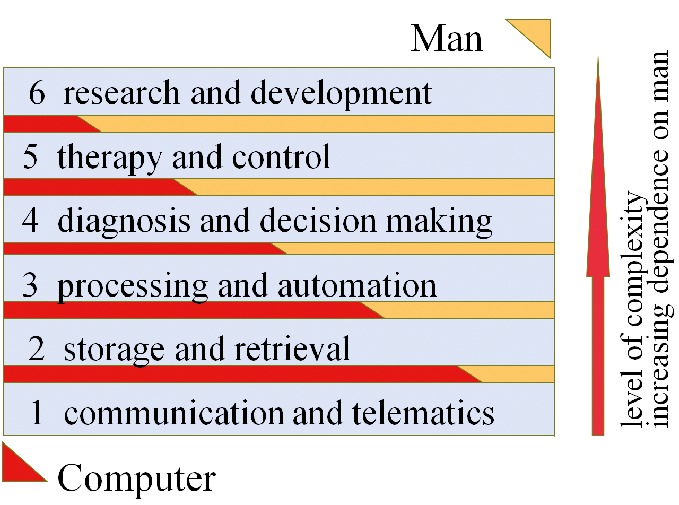
Model of computer applications in medicine and health care.
Seminal Papers from the 1999 Yearbook
- 1.Weed LL. Medical records that guide and teach. N Engl J Med 1968;278:652-7. [DOI] [PubMed] [Google Scholar]
- 2.Collen MF. General requirements for a medical information system. Comp Biomed Res 1970;3:393-406. [DOI] [PubMed] [Google Scholar]
- 3.Côté RA. The SNOP-SNOMED concept: Evolution towards common medical nomenclature and classification. Pathologist 1979;31:383-9. [PubMed] [Google Scholar]
- 4.Reichertz PL, Möhr JR, Schwarz B, Schlatter A, von Gärtner-Holthoff G, Filsinger E. Evaluation of a field test of computers for the doctor’s office. Methods Inf Med 1979;18:61-70. [PubMed] [Google Scholar]
- 5.Barnett GO, Justice NS, Somand ME, Adams BD, Waxman PD, Beaman MS, et al. COSTAR - A computer-based medical information system for ambulatory care. Proc IEEE 1979;67:1226-37. [Google Scholar]
- 6.Pipberger HV, Arms RJ, Stallmann FW. Automatic screening of normal and abnormal electrocardiograms by means of a digital electronic computer. Proc Soc Exp Biol Med 1961;106:130-32. [DOI] [PubMed] [Google Scholar]
- 7.Robb RA, Ritman E, Harris LD, Wood EH. Dynamic three-dimensional X-ray computed tomography of the heart, lungs and circulation. IEEE Trans Nucl Sci 1979;26:1646-60. [Google Scholar]
- 8.Ledley RS, Lusted LB. Reasoning foundations medical diagnosis. Science 1959;130:9-21. [DOI] [PubMed] [Google Scholar]
- 9.Gorry GA. Sequential diagnosis by computer. J Amer Med Ass 1968;205:141-6. [PubMed] [Google Scholar]
- 10.Warner HR. HELP, a program for medical decision making. Comp Biomed Res 1972;5:65-74. [DOI] [PubMed] [Google Scholar]
- 11.Pauker SG, Kassirer JP. Therapeutic decision making: A cost-benefit analysis. N Engl J Med 1975;293:229-34. [DOI] [PubMed] [Google Scholar]
- 12.De Dombal FT, Leaper DJ, Staniland JR, McCann AP, Horrocks JC. Computer-aided diagnosis of acute abdominal pain. BMJ 1972;2:9-13. [DOI] [PMC free article] [PubMed] [Google Scholar]
- 13.McDonald CJ. Protocol-based computer reminders, the quality of care and the non-perfectibility of man. N Engl J Med 1976;295:1351-5. [DOI] [PubMed] [Google Scholar]
- 14.Shortliffe EH, Buchanan BG. A model of inexact reasoning in medicine. Math Biosci 1975;23:351-79. [Google Scholar]
- 15.Miller RA, Pople HE, Myers JD. INTERNIST-1: An experimental computer-based diagnostic consultant for general internal medicine. N Engl J Med 1982;307:468-76. [DOI] [PubMed] [Google Scholar]
- 16.Grémy F. Why teach information sciences in medicine? Will they contribute to a solution in the present crisis of medicine. Methods Inf Med 1983;22:121-3. [PubMed] [Google Scholar]
- 17.Blois MS. On the proper use of men and machine. Information and Medicine. The Nature of Medical Description. University of California Press; 1984. P. 235-55. [Google Scholar]
Other References
- 18.Grémy F. Hardware, software, peopleware, subjectivity. A philosophical promenade. Methods Inf Med 2005;44(3):352-8. [PubMed] [Google Scholar]
- 19.Lindberg DAB, Humphreys BL. Rising expectations: access to biomedical information. Yearb Med Inform 2008:165-72. [PMC free article] [PubMed] [Google Scholar]
- 20.Boyer C, Selby M, Scherrer JR, Appel RD. The Health on the Net Code of Conduct for medical and health Web sites. Comp Biol Med 1998;28:603-10. [DOI] [PubMed] [Google Scholar]
- 21.Van Bemmel JH. A comprehensive model for medical information processing. Methods Inf Med 1983;22:12430. [PubMed] [Google Scholar]
- 22.Shortliffe EH. Computer-Based Medical Consultations: MYCIN. New York: Elsevier; 1976. [Google Scholar]