


Abstract
Background
Listeria monocytogenes (LM) is an important foodborne pathogen affecting animals and humans. Listeriosis outbreaks in humans caused by consumption of unpasteurized dairy products are of serious concern.
Objective
To determine risk factors associated with fecal shedding of LM in family dairy farms.
Animals
Fecal samples were collected from cows and calves on 20 family dairy farms in 2‐week intervals for a period of 1 year.
Methods
Longitudinal study. LM was detected using qPCR. Univariate mixed effect model and multivariate analyses were performed to associate risk factors (dietary change, breed, mastitis, other diseases, antibiotic treatment, other treatments, heat index, and meteorological season) with fecal shedding of LM.
Results
LM was isolated from all farms on at least 1 sampling day. The average yearly prevalence was 18.2% (98/540) and 8.4% (43/511) in cows and calves, respectively. Heat index (P = .05) and meteorological season (P = .04) affected fecal shedding of LM on a farm level. Meteorological season only influenced fecal shedding of LM in cows (P = .04), whereas heat index (P = .01) influenced fecal shedding of LM in calves. Spring season was identified as the major risk factor associated fecal shedding of LM on a farm level (P = .01) and in cows (P = .01). Dietary changes were associated with lower odds for fecal shedding of LM in calves (P < .01).
Conclusions and Clinical Importance
Fecal shedding of LM is associated with environmental temperatures and the meteorological season. Farmers and veterinarians should use this information when implementing strategies to reduce risks for LM dissemination in animals and in the community.
Keywords: cattle, epidemiology, family dairy farms, listeriosis
Abbreviations
- CI
confidence interval
- HI
heat index
- LM
Listeria monocytogenes
- OR
odds ratio
- qPCR
quantitative polymerase chain reaction
1. INTRODUCTION
Listeria monocytogenes (LM) is an important bacterial pathogen, which can affect humans and a wide variety of animal species.1, 2, 3 Clinical signs of the disease include abortions, neurological diseases and septicemia with a high mortality rate.2, 4 Septicemia is more common in neonates.5, 6 The majority of infected ruminants are asymptomatic carriers that shed the bacterium into their environment with feces.1, 7 Especially the contamination of unprocessed food products is of great concern.8, 9
Listeriosis outbreaks remain an important problem globally.10, 11 In the EU, a steady rise in notifications in human cases in the past decade was observed,10, 12 whereas in the United States the incidence of listeriosis has remained stable or even declined since 2003.12, 13 However, the decline in human listeriosis in the United States was not reported in cases related to dairy products.11, 12 Many cases in the United States, however, still remain undetected or unreported.14
In bovine dairy and beef operations a highly variable prevalence of LM was reported (2.7%‐92%).9, 15, 16, 17, 18, 19, 20 Silage, hay, bedding, and water were considered as major sources and possible reservoirs of LM in the agriculture.21, 22, 23, 24, 25, 26, 27 Because of the ability of LM to thrive in many habitats and hosts, eradication of LM from the farm environment is highly unlikely.28 It is, therefore, important to improve our understanding of LM epidemiology to be able to limit its transmission between animals and from animals to humans,2 especially pregnant women and immunocompromised individuals.13
Most studies in cattle investigated the prevalence of LM in large scale intensive production units.9, 16, 18, 20, 29 However, it is important to realize that smaller family farming represents the most prevalent farming model in the EU,30 and that 88% of all United States farms are small family farms.31 Smaller family farming creates 58% of all direct farm sales to consumers in the United States.31 Such epidemiologically rich environment with a tendency for an efficient direct contact with the local consumer can be the source for LM perpetuation between animal and to humans in the community. Therefore, the purpose of this study was to investigate risk factors associated with fecal shedding of LM in small to midsized family operated dairy farms.
2. MATERIALS AND METHODS
2.1. Study design
2.1.1. Longitudinal study
Animal samples
The study was conducted on 20 family run dairy farms in the northern hemisphere in a region with 4 distinct seasons. The average milk yield per year was 6605.2 L milk/cow (3727.32–8876.64 L milk/cow). Farms included had a year round calving. The number of animals sampled was variable throughout the year; the smallest sample size per farm was 17 and the highest was 55. Animals were confined or turned out on the pasture depending on the season. None of the farms were certified organic operations. Diseases present on farms were mostly of metabolic origin, followed by infections of the udder, uterus, lungs, and/or gastrointestinal tract. Diet mainly consisted of fresh grass and silage (19/20 farms); 1 farm fed fresh grass and hay. Most products from these farms were sold directly within the local community.
Fecal samples were collected individually from all cows (n = 10692), and all calves under the age of 6 months (n = 2442), which were present on the farm on the day of sampling in exactly 2 weeks intervals over a period of 1 year (27 sampling days). Samples were taken from the rectum using clean latex gloves (Shield, UK). Cow and calf fecal samples from each farm were pooled in the laboratory within 1 day after collection: 1 g of fecal sample from each individual was used in the pooled sample. Pooled samples were then diluted in a 1 : 3 ratio with a sterile saline solution. The aliquot of 2 mL of every pooled sample were stored (Eppendorf Tubes, Germany) at −70°C for future analysis.
Environmental samples
Environmental samples were collected on every farm during spring (May). Manure, silage/hay, and dirt samples from each farm (n = 60) were collected in sterile 10–50 mL tubes (Sarstedt, Germany).
2.2. Detection of LM
Pooled fecal samples were used for molecular detection of LM gene encoding listeriolysin O (hlyA). Thawed samples were processed in 2 steps.32 First, they were inoculated in an enrichment broth half‐Fraser (1 : 9) and incubated for 1 day at 30°C. Two milliliter of each sample were then used for DNA extraction with the SmartHelix First DNAid kit (IFB, Slovenia).33 Listeria monocytogenes was detected using quantitative PCR (qPCR). Primers and probe were previously described.34 Amplification was performed on AB 7500 Fast (Thermofisher, UK) in a 12.5 µL reaction containing 2× MasterMix (FastStart Universal Probe Master with Ro – Roche, Germany), 900 nM of each primer, 200 nM of probe and 2 µL of DNA. Thermal profile for qPCR was 50°C for 2 minutes, 95°C for 10 minutes, followed by 45 cycles of 95°C for 20 seconds and 60°C for 1 minutes. The specificity of the modified protocol was 100% (LM detected; L. ivanovii, L. innocua, L. seeligeri, L. murrayi, L. welshimeri, and L. grayi undetected), while LOD and LOQ were determined at 4.4 LM cells/g feces and 440 LM cells/g feces, respectively. The cut‐off value was set at 41 C t.
Environmental samples (feed, manure, dirt) were cultured as previously described.35 Samples were inoculated into selective media (half‐Fraser enrichment broth and Fraser enrichment broth), followed by Palcam and ALOA selective agar plates. Characteristic LM colonies were identified based on morphology, Gram stain, catalase activity, motility at 26°C, hemolysis on blood agar, and biochemical API Listeria kit (BioMerieux, France).
2.3. Data collection and statistical analysis
Information regarding feeding regimens, diseases, and treatments were obtained from farmers, farm veterinary services, and the Central Husbandry Register. Heat index36 was obtained from the nearest National Meteorological Service weather station. A mean value for heat index was calculated over the period of 7 days before each sampling day.
The outcome in this study was the presence of LM (present, not present) on the farm, and within the 2 subgroups: (1) cows, (2) calves to up to 6 months of age. Calves older than 6 months (heifers and bull calves) were not included because of higher risks for handlers. The 95% confidence interval (CI) for the prevalence was estimated using the normal approximation with continuity correction.
The following risk factors were included in the analysis: Dietary change (a change from predominantly fresh to conserved forages or vice versa), breed (Holstein–Friesian and Simmental), mastitis, other diseases, antibiotic treatment, other treatment (nonantibiotic treatment prescribed by the veterinarian), heat index, and meteorological season (Tables 1, 2, 3). The absence of a risk factor was considered as a reference category for odds ratio. A reference category for the “breed” was Holstein–Friesian. A reference category for “meteorological season” was winter.
Table 1.
Risk factors associated with LM prevalence on farms
| Univariate analyses | Multivariate analyses | ||||||
|---|---|---|---|---|---|---|---|
| Risk factor | OR | CI, low‐CI, up | P‐value | P‐BH | OR | CI, low‐CI, up | P‐value |
| Dietary change | 1.05 | 0.46‐2.38 | .92 | 0.92 | 1.13 | 0.49‐2.64 | .77 |
| Heat index LRT | .58 | 0.12 | .05 | ||||
| Heat index spline linear | 1.11 | 1.01‐1.22 | .03 | 0.07 | 1.12 | 1.01‐1.23 | .02 |
| Heat index spline nonlinear | 0.89 | 0.81‐0.98 | .02 | 0.56 | 0.89 | 0.8‐1 | .02 |
| Breed | 0.75 | 0.38‐1.47 | .4 | 0.57 | 0.76 | 0.39‐1.51 | .43 |
| Mastitis | 1.05 | 0.57‐1.93 | .88 | 0.92 | 1.18 | 0.53‐2.64 | .68 |
| Other diseases | 1.5 | 0.67‐3.34 | .32 | 0.52 | 1.73 | 0.73‐4.12 | .21 |
| Antibiotics treatment | 0.97 | 0.59‐1.59 | .92 | 0.92 | 0.74 | 0.34‐1.64 | .46 |
| Other treatment | 1.04 | 0.64‐1.7 | .87 | 0.92 | 1.05 | 0.53‐2.08 | .9 |
| Met. Season LRT | <.01 | <0.01 | .04 | ||||
| Met. season‐spring | 5.9 | 2.95‐11.83 | <.01 | <0.01 | 3.23 | 1.33‐7.83 | .01 |
| Met. season‐autumn | 2.89 | 1.43‐5.84 | <.01 | 0.01 | 1.85 | 0.78‐4.42 | .16 |
| Met. season‐summer | 3.55 | 1.77‐7.11 | <.01 | <0.01 | 3.04 | 0.94‐9.82 | .06 |
Abbreviations: CI, 95% confidential intervals; LRT, Likelihood ratio test; Met. season, meteorological season; OR, odds ratio (season adjusted OR in univariate analysis); P‐BH, P‐values adjusted with benjamimi and hochberg method.
Table 2.
Risk factors associated with LM prevalence in cows
| Univariate analyses | Multivariate analyses | ||||||
|---|---|---|---|---|---|---|---|
| Risk factor | OR | CI, low‐CI, up | P‐value | P‐BH | OR | CI, low‐CI, up | P‐value |
| Dietary change | 1.34 | 0.59‐3.05 | .48 | .63 | 1.4 | 0.6‐3.3 | .44 |
| Heat index LRT | .56 | .66 | .6 | ||||
| Heat index spline linear | 1.05 | 0.95‐1.16 | .38 | .61 | 1.05 | 0.95‐1.16 | .38 |
| Heat index spline nonlinear | .98 | 0.88‐1.08 | .63 | .61 | .97 | 0.88‐1.08 | .6 |
| Breed | 1.06 | 0.53‐2.12 | .86 | .86 | 1.06 | 0.52‐2.16 | .87 |
| Mastitis | 1.37 | 0.73‐2.57 | .33 | .61 | 1.33 | 0.58‐3.04 | .49 |
| Other diseases | 1.42 | 0.6‐3.35 | .42 | .61 | 1.45 | 0.58‐3.65 | .43 |
| Antibiotics treatment | 1.25 | 0.74‐2.11 | .4 | .61 | .98 | 0.43‐2.24 | .96 |
| Other treatment | 1.27 | 0.76‐2.12 | .37 | .61 | 1.09 | 0.52‐2.27 | .82 |
| Met. Season LRT | <.01 | <.01 | .03 | ||||
| Met. season‐spring | 5.7 | 2.66‐12.22 | <.01 | <.01 | 3.98 | 1.48‐10.68 | .01 |
| Met. season‐autumn | 3.06 | 1.41‐6.66 | <.01 | .02 | 2.29 | 0.88‐5.95 | .09 |
| Met. season‐summer | 3.22 | 1.48‐6.97 | <.01 | .01 | 1.98 | 0.55‐7.19 | .3 |
Abbreviations: CI, 95% confidential intervals; LRT, likelihood ratio test; Met. season, meteorological season; OR, odds ratio (season adjusted OR in univariate analysis); P‐BH, P‐values adjusted with Benjamimi and Hochberg method.
Table 3.
Risk factors associated with LM prevalence in calves
| Univariate analyses | Multivariate analyses | ||||||
|---|---|---|---|---|---|---|---|
| Risk factor | OR | CI, low‐CI, up | P‐value | P‐BH | OR | CI, low‐CI, up | P‐value |
| Dietary change | 0.493 | 0.49‐0.495 | <.01 | <.01 | 0.57 | 0.12‐2.73 | .48 |
| Heat index LRT | .01 | .03 | .01 | ||||
| Heat index spline linear | 1.23 | 1.02‐1.48 | .03 | .06 | 1.24 | 1.03‐1.5 | .02 |
| Heat index spline nonlinear | 0.77 | 0.64‐0.93 | .01 | .02 | 0.77 | 0.64‐0.93 | .01 |
| Breed | 0.44 | 0.17‐1.1 | .08 | .13 | 0.46 | 0.18‐1.21 | .12 |
| Mastitis | 0.55 | 0.19‐1.58 | .27 | .29 | 1.16 | 0.27‐5.1 | .84 |
| Other diseases | 1.13 | 0.35‐3.67 | .83 | .83 | 1.83 | 0.49‐6.84 | .37 |
| Antibiotics treatment | 0.49 | 0.21‐1.14 | .1 | .14 | 0.4 | 0.1‐1.58 | .19 |
| Other treatment | 0.55 | 0.24‐1.25 | .15 | .18 | 0.76 | 0.26‐2.21 | .61 |
| Met. season LRT | <.01 | .01 | .08 | ||||
| Met. season‐spring | 6.73 | 2.18–20.83 | <.01 | .01 | 2.78 | 0.69‐11.15 | .15 |
| Met. season‐autumn | 2.44 | 0.72‐8.2 | .15 | .18 | 1.16 | 0.27‐5.03 | .85 |
| Met. season‐summer | 3.45 | 1.07–11.11 | .04 | .07 | 4.05 | 0.62‐26.65 | .15 |
Abbreviations: CI, 95% confidential intervals; LRT, Likelihood ratio test; Met. season: Meteorological season; OR, odds ratio (season adjusted OR in univariate analysis); P‐BH: P‐values adjusted with Benjamimi and Hochberg method.
The analysis was performed at the farm level. The season‐adjusted assessment of the association between each risk factor (other than the season itself) and the outcome was performed by means of logistic regression where farm was included as the random effect (random intercept) and season as a fixed effect to adjust for the possible confounding effect of the season. Restricted cubic splines were used to account for the nonlinear effect of the heat index. P‐values were adjusted with Benjamini‐Hochberg method to control the false discovery rate. Significance level was set to 0.05 for adjusted P‐values.
After univariate assessment, multivariate model was built using all risk factors.
Statistical analysis was performed using R language for statistical computing (R version 3.0.1).37
3. RESULTS
3.1. Listeria monocytogenes prevalence
3.1.1. Farm prevalence
Listeria monocytogenes was detected in all fecal samples using qPCR from all farms on at least 1 sampling day per year. Listeria monocytogenes was identified on none (0%), or up to 9 (9/20; 45%) farms per each sampling day. Throughout the year, the overall farm LM prevalence was 22.8%.
3.1.2. Cow prevalence
Ninety‐eight (98/540; 18.2%; 95% CI: 15.0%‐21.7%) pooled cow fecal samples were positive for LM using qPCR. Cows on each farm were positive for LM on 1 to up to 11 sampling days throughout the year (3.7%‐40.7%).
3.1.3. Calf prevalence
Forty‐three (43/511; 8.4%; 95% CI: 6.2%‐11.3%) pooled fecal samples from calves were positive for LM using qPCR. Calves on each farm were positive for LM on none to up to 7 sampling days throughout the year (0%‐25.9%).
3.1.4. Environmental samples
Listeria monocytogenes was cultured from 10 environmental samples (10/60; 16.7%; 95% CI: 8.7%‐29.0%); which included manure (30%; 6/20; 95% CI: 12.8%‐54.3%), dirt (10%; 2/20; 95% CI: 1.7%‐33.1%) and feed samples (maize silage and grass hay; 10%; 2/20; 95% CI: 1.7%‐33.1%).
3.2. Risk factor analysis
3.2.1. Univariate analysis of risk factors
Meteorological season was the only risk factor associated with fecal shedding of LM (P < .01) on a farm level. Fecal shedding of LM was highest during spring season (OR: 5.9; 95% CI: 2.9–11.8; P < .01), followed by summer (OR: 3.5; 95% CI: 1.8‐7.1; P < .01), and autumn (OR: 2.9; 95% CI: 2.2–9.7; P = .01; Table 1). Moderate environmental temperatures (∼50°F‐60°F) were associated with lower odds for fecal shedding of LM (Table 1 and Figure 1).
Figure 1.
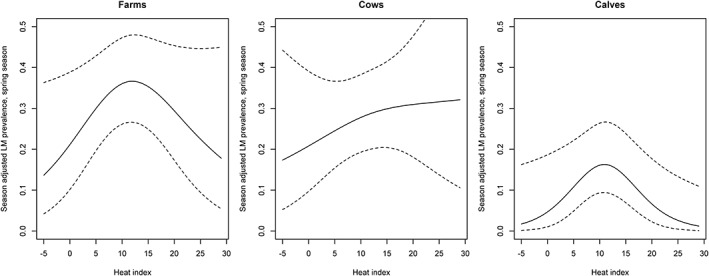
The association between heat index (°C; solid line) and season adjusted LM prevalence (spring season) for farms, cows, and calves. Dashed line is 95% CI
Fecal shedding of LM in cows was associated with the meteorological season (P < .01), with highest prevalence during spring (OR: 5.7; 95% CI: 2.6–12.2; P < .01) followed by summer (OR: 3.2; 95% CI: 1.5–7.0; P = .01) and autumn (OR: 3.0; 95% CI: 1.4–6.6; P = .02; Table 2).
In calves, dietary changes were associated with lower odds for fecal shedding of LM (OR: 0.493; 95% CI: .49‐0.495; P < .01). Heat index (P = .03) and meteorological season (P < .01) were associated with fecal shedding of LM in calves (Table 3). Moderate environmental temperatures (∼50°F‐60°F) were associated with lower odds for fecal shedding of LM in calves (Table 3, Figure 1). Fecal shedding of LM in calves was highest during spring season (OR: 6.7; 95% CI: 2.2–20.8; P < .01; Table 3).
3.2.2. Multivariate analysis of risk factors
Heat index (P = .05) and meteorological season (P = .04) affected fecal shedding of LM on a farm level. Spring season was identified as the risk factor associated with fecal shedding of LM on a farm level (OR: 3.2; 95% CI: 1.3–7.8; P = .01; Table 1).
Only the meteorological season influenced fecal shedding of LM in cows (P = .03), with spring having the most positive influence on fecal shedding of LM (OR: 4.0; 95% CI: 1.5–10.7; P < .01; Table 2).
In calves, only heat index (P = .05) influenced fecal shedding of LM (Table 3).
4. DISCUSSION
Listeria monocytogenes is often found in the microbiota of ruminants, and represents a serious health hazard for the community,2, 38 with dairy and other farm products being the most important vehicles for the transmission of infection.17, 20, 38, 39, 40 This study was performed on small to midsized family operated dairy farms, which are increasingly recognized as a core farming unit in the EU and USA. Strong social and commercial link between these farms and the local community can contribute to efficient distribution of the zoonotic agent from farm animals to humans.40, 41 The important finding of this study is that fecal shedding of LM in dairy cows and calves is highest during meteorological spring (March, April, and May), and is unrelated to the change in diet. Clear comparison between conserved (silage, hay) and fresh forages was not possible because all farms intermittently supplement diet with conserved forages throughout the year.
Several reports considered stress related to changes in diet of cows and calves as being the most important risk factor influencing the prevalence of LM.16, 18, 42, 43 Historically, the most prominent risk factor for LM shedding and clinical listeriosis in ruminants was considered the inclusion of silage in diet.2, 9, 16, 18, 44, 45 Several studies, however, could not identify silage as a significant risk factor for LM shedding,2, 17, 19, 27 which is also consistent with findings of this study. We have even detected a negative association between dietary related changes and fecal shedding of LM in calves. Most farms included in this study had silage included in their diet. One farm fed grass hay only. This farm had fecal samples positive for LM in calves and cows on several sampling days, and had LM present in manure and the grass hay.
Listeria monocytogenes was found on at least 1 sampling day on all farms included in this study. The overall LM prevalence in cows was 18.2%. Other studies reported the prevalence from 2.7 to 92%.9, 15, 16, 17, 18, 19, 20 Calves in our study had a prevalence of 8.4%, which is higher than the prevalence of 3.75% reported previously in cow‐calves and feedlot operations in California.27 The difference in LM prevalence between this and other studies9, 15, 16, 17, 18, 19, 20, 27 can be related to the representing farming model, meteorological season and the longitudinal nature of the study. Because of high day‐to‐day variation in LM shedding in cattle feces, only a continuous long‐term interval sampling, such as in this study, can adequately associate LM prevalence, and its association with appropriate risk factors.9, 16, 18
Meteorological season was previously identified as an important risk factor associated with LM fecal shedding,15, 46 and suggested that LM in cattle has a seasonal pattern with a peak in fecal shedding during the colder months of the year.15, 18, 27 Studies, which associated the prevalence of LM with the meteorological season (winter and/or spring) have proposed that the increase in prevalence would be because of the decaying quality of silage, increased animal density during winter, and/or spring application of manure for fertilization.2, 18, 46 This study showed a significant increase in fecal shedding of LM during the meteorological spring. Nightingale et al reported the highest prevalence during calendar winter and spring.15 However, conclusions were based on comparison between farms with clinical listeriosis and those without recorded cases of clinical listeriosis.15 Listeria monocytogenes multiplies better than most other bacteria at refrigerator temperatures.47 The ability of LM to multiply in colder months may be the main reason for increased shedding during the meteorological spring, which, considering the incubation period in human listeriosis,48 corresponds with increased incidence of listeriosis in humans during summer months.49
This study identified lowest LM shedding patterns at midrange temperatures. However, higher LM fecal shedding was not observed during meteorological autumn, which has similar moderate environmental temperatures to spring meteorological season. It seems that cold environmental temperatures give LM the advantage during the transition from cold to warmer months, with increased growth in biological substrates, and consequently increased fecal shedding and infectibility during meteorological spring. Winter, which was often highly associated with higher LM prevalence, had the lowest association with fecal shedding of LM in this study compared with other seasons.
Our results cannot directly associate silage to fecal shedding of LM and the decaying quality of conserved forages as discussed above. Lower quality of silage is an appropriate medium for LM multiplication and infection, but the bacterium can also be present in concerning numbers in high‐quality silage.50 Other risk factors analyzed in this study, which are often associated with animal stress, did not influence LM fecal shedding. This is in contrast with other reports, which correlated mastitis and abortion,3 antiparasitic treatment,16 mixed breed,3 animal density/herd size,3, 18, 51 and farm management15, 52 with the prevalence of LM. However, these studies are also fundamentally different with regards to climate,3 chronology of sampling,3, 15, 16, 18, 50, 51 time of sampling,3, 15, 16, 18, 50, 51 and the source of samples.51
In conclusion, dietary change from fresh to conserved forage, which was historically associated with listeriosis, was not associated with fecal shedding of LM in this study. Fecal shedding of LM is associated with the meteorological season and environmental temperatures, which is consistent with the biology of LM. The prevalence of LM on midsize family farms is lower than that reported on bigger intensive dairy cattle operations. It is also likely that LM would be detected on any dairy farm or farm animal breeding operation if long‐term sampling and short sampling intervals were applied. Therefore, hygiene remains the most important strategy for the prevention of LM dissemination and listeriosis outbreaks.
Conflict of Interest Declaration
Authors declare no conflict of interest.
Off‐Label Antimicrobial Declaration
Authors declare no off‐label use of antimicrobials.
Institutional Animal Care and Use Committee (IACUC) or Other Approval Declaration
This study was approved by the National Animal Care Committee at the Ministry of Agriculture, Forestry, and Food–Veterinary administration of Slovenia.
ACKNOWLEDGMENTS
Authors appreciate the assistance of Dr France Briski, Alenka Magdalena Usenik, Dr Darja Kusar, mag. Maja Kavalic, Dr Irena Zdovc, and the participating farmers for their collaboration and assistance. The study was conducted on 20 middle‐size family dairy farms located in the southern Prealps. This study was supported by the Slovenian Research Agency (grant nos. J4–2236, J3–4298, P4–0092, P4–0053). Preliminary data from this study were presented as a research report at the 2016 ACVIM Forum, Denver, CO.
Bandelj P, Jamnikar‐Ciglenecki U, Ocepek M, Blagus R, Vengust M. Risk factors associated with fecal shedding of Listeria monocytogenes by dairy cows and calves. J Vet Intern Med. 2018;32:1773–1779. 10.1111/jvim.15234
Funding information Slovenian Research Agency, Grant/Award Numbers: J4‐2236, J3‐4298, P4‐0092, and P4‐0053, J4‐2236, J3‐4298, P4‐0092, P4‐0053
REFERENCES
- 1. Nightingale KK, Schukken YH, Nightingale CR, et al. Ecology and transmission of Listeria monocytogenes infecting ruminants and in the farm environment. Appl Environ Microbiol. 2004;70:4458–4467. [DOI] [PMC free article] [PubMed] [Google Scholar]
- 2. Walland J, Lauper J, Frey J, et al. Listeria monocytogenes infection in ruminants: Is there a link to the environment, food and human health? A review. Schweiz Arch Tierheilkd. 2015;157:319–328. [DOI] [PubMed] [Google Scholar]
- 3. Barkallah M, Gharbi Y, Hmani M, et al. Locked nucleic acid probe‐based real‐time PCR for the diagnosis of Listeria monocytogenes in ruminants. Mol Cell Probes. 2016;30:138–145. [DOI] [PubMed] [Google Scholar]
- 4. Zachary JF andMcGavin MD. Pathologic Basis of Veterinary Disease: Listeriosis. 5th ed St. Louis: Elsevier/Mosby; 2012. [Google Scholar]
- 5. Seimiya Y, Ohshima K, Itoh H, Murakami R. Listeric septicemia with meningitis in a neonatal calf. JVet Med Sci. 1992;54:1205–1207. [DOI] [PubMed] [Google Scholar]
- 6. Pirs T, Zdovc I, Gombac M, Švara T, Juntes P, Vengušt M. Listeria monocytogenes septicaemia in a foal. Slo Vet Res. 2005;42:49–53. [Google Scholar]
- 7. Roberts AJ, Wiedmann M. Pathogen, host and environmental factors contributing to the pathogenesis of listeriosis. Cell Mol Life Sci 2003;60:904–918. [DOI] [PMC free article] [PubMed] [Google Scholar]
- 8. Fugett EB, Schoonmaker‐Bopp D, Dumas NB, Corby J, Wiedmann M. Pulsed‐field gel electrophoresis (PFGE) analysis of temporally matched Listeria monocytogenes isolates from human clinical cases, foods, ruminant farms, and urban and natural environments reveals source‐associated as well as widely distributed PFGE types. JClin Microbiol. 2007;45:865–873. [DOI] [PMC free article] [PubMed] [Google Scholar]
- 9. Ho AJ, Ivanek R, Gröhn YT, Nightingale KK, Wiedmann M. Listeria monocytogenes fecal shedding in dairy cattle shows high levels of day‐to‐day variation and includes outbreaks and sporadic cases of shedding of specific L. monocytogenes subtypes. Prev Vet Med. 2007;80:287–305. [DOI] [PubMed] [Google Scholar]
- 10. EFSA and ECDC (European Food Safety Authority and European Centre for Disease Prevention and Control) . The European Union summary report on trends and sources of zoonoses, zoonotic agents and food‐borne outbreaks in 2013. EFSA J. 2015;13:3991. [DOI] [PMC free article] [PubMed] [Google Scholar]
- 11. Cartwright EJ, Jackson KA, Johnson SD, Graves LM, Silk BJ, Mahon BE. Listeriosis outbreaks and associated food vehicles, United States, 1998–2008. Emerg Infect Dis. 2013;19:1–9. [DOI] [PMC free article] [PubMed] [Google Scholar]
- 12. Buchanan RL, Gorris LGM, Hayman MM, Jackson TC, Whitinge RC. A review of Listeria monocytogenes: An update on outbreaks, virulence, dose‐response, ecology, and risk assessments. Food Control 2017;75:1–13. [Google Scholar]
- 13. Silk BJ, Date KA, Jackson KA, et al. Invasive listeriosis in the Foodborne Diseases Active Surveillance Network (FoodNet), 2004–2009: Further targeted prevention needed for high‐risk groups. Clin Infect Dis. 2012;54:S396–S404. [DOI] [PubMed] [Google Scholar]
- 14. Buzby J, Roberts T. The economics of enteric infections: Human foodborne disease costs. Gastroenerology. 2009;136:1851–1862. [DOI] [PubMed] [Google Scholar]
- 15. Nightingale KK, Fortes ED, Ho AJ, Schukken YH, Grohn YT, Wiedmann M. Evaluation of farm management practices as risk factors for clinical listeriosis and fecal shedding of Listeria monocytogenes in ruminants. JAm Vet Med Assoc. 2005;227:1808–1814. [DOI] [PubMed] [Google Scholar]
- 16. Ivanek R, Gröhn YT, Ho AJ, Wiedmann M. Markov chain approach to analyze the dynamics of pathogen fecal shedding – example of Listeria monocytogenes shedding in a herd of dairy cattle. JTheor Biol. 2007;245:44–58. [DOI] [PubMed] [Google Scholar]
- 17. Vilar MJ, Yus E, Sanjuán ML, Diéguez FJ, Rodríguez‐Otero JL. Prevalence of and risk factors for Listeria species on dairy farms. JDairy Sci. 2007;90:5083–5088. [DOI] [PubMed] [Google Scholar]
- 18. Esteban JI, Oporto B, Aduriz G, Juste RA, Hurtado A. Faecal shedding and strain diversity of Listeria monocytogenes in healthy ruminants and swine in Northern Spain. BMC Vet Res. 2009;5:2. [DOI] [PMC free article] [PubMed] [Google Scholar]
- 19. Bundrant BN, Hutchins T, den Bakker HC, Fortes E, Weidmann M. Listeriosis outbreak in dairy cattle caused by an unusual Listeria monocytogenes serotype 4b strain. JVet Diagn Invest. 2011;23:155–158. [DOI] [PubMed] [Google Scholar]
- 20. Mehmeti I, Bytyqi H, Muji S, Nes IF, Diep DB. The prevalence of Listeria monocytogenes and Staphylococcus aureus and their virulence genes in bulk tank milk in Kosovo. JInfect Dev Ctries. 2017;11:247–254. [DOI] [PubMed] [Google Scholar]
- 21. Ueno H, Yokota K, Arai T, et al. The prevalence of Listeria monocytogenes in the environment of dairy farms. Microbiol Immunol. 1996;40:121–124. [DOI] [PubMed] [Google Scholar]
- 22. Low JC, Donachie W. A review of Listeria monocytogenes and listeriosis. Vet J. 1997;153:9–29. – [DOI] [PubMed] [Google Scholar]
- 23. Hassan L, Mohammed HO, McDonough PL. Farm‐management and milking practices associated with the presence of Listeria monocytogenes in New York state dairy herds. Prev Vet Med. 2001;51:63–73. [DOI] [PubMed] [Google Scholar]
- 24. Borucki MK, Gay CC, Reynolds J, et al. Genetic diversity of Listeria monocytogenes strains from a high‐prevalence dairy farm. Appl Environ Microbiol. 2005;71:5893–5899. [DOI] [PMC free article] [PubMed] [Google Scholar]
- 25. Hutchison ML, Walters LD, Avery SM, Moore A. Decline of zoonotic agents in livestock waste and bedding heaps. JAppl Microbiol. 2005;99:354–362. [DOI] [PubMed] [Google Scholar]
- 26. Lyautey E, Lapen DR, Wilkes G, et al. Distribution and characteristics of Listeria monocytogenes isolates from surface waters of the South Nation River Watershed, Ontario, Canada. Appl Environ Microbiol. 2007;73:5401–5410. [DOI] [PMC free article] [PubMed] [Google Scholar]
- 27. Mohammed HO, Atwill E, Dunbar L, et al. The risk of Listeria monocytogenes infection in beef cattle operations. JAppl Microbiol. 2010;108:349–356. [DOI] [PubMed] [Google Scholar]
- 28. Gandhi M, Chikindas ML. Listeria: A foodborne pathogen that knows how to survive. Int J Food Microbiol. 2007;113:1–15. [DOI] [PubMed] [Google Scholar]
- 29. Klein M, Brown L, Tucker RW, Ashbolt NJ, Stuetz RM, Roser DJ. Diversity and abundance of zoonotic pathogens and indicators in manures of feedlot cattle in Australia. Appl Environ Microbiol. 2010;76:6947–6950. [DOI] [PMC free article] [PubMed] [Google Scholar]
- 30. European commission [internet] . Agriculture and rural development – Family farming; c2015. http://ec.europa.eu/agriculture/family-farming/index_en.htm. Accessed January 11, 2018.
- 31. USDA [internet] . Family farms are the focus of the new agriculture census data. USDA press release No. 0066.15; c2015. [cited]. https://www.usda.gov/media/press-releases/2015/03/17/family-farms-are-focus-new-agriculture-census-data. Accessed January 10, 2018.
- 32. Gasanov U, Hughes D, Hansbro PM. Methods for the isolation and identification of Listeria spp. and Listeria monocytogenes: A review. FEMS Microbiol Rev. 2005;29:851–875. [DOI] [PubMed] [Google Scholar]
- 33. Logar K, Kopinc R, Bandelj P, Starič J, Lapanje A, Ocepek M. Evaluation of combined high‐efficiency DNA extraction and real‐time PCR for detection of Mycobacterium avium subsp. paratuberculosis in subclinically infected dairy cattle: Comparison with faecal culture, milk real‐time PCR and milk ELISA. BMC Vet Res. 2012;8:49. [DOI] [PMC free article] [PubMed] [Google Scholar]
- 34. Nogva HK, Rudi K, Naterstad K, Holck A, Lillehaug D. Application of 5’‐nuclease PCR for quantitative detection of Listeria monocytogenes in pure cultures, water, skim milk, and unpasteurized whole milk. Appl Environ Microbiol. 2000;66:4266–4271. [DOI] [PMC free article] [PubMed] [Google Scholar]
- 35. Zelenik K, Avbersek J, Pate M, et al. Cutaneous listeriosis in a veterinarian with the evidence of zoonotic transmission – a case report. Zoonoses Public Health 2014;61:238–241. [DOI] [PubMed] [Google Scholar]
- 36. Steadman RG. The assessment of sultriness. Part I: A temperature‐humidity index based on human physiology and clothing science. JAppl Meteor. 1979;18:861–873. [Google Scholar]
- 37. R Core Team [internet] . R: A language and environment for statistical computing: c2013. http://www.R-project.org/. January 11, 2018.
- 38. Pyz‐Łukasik R, Paszkiewicz W, Tatara MR, Brodzki P, Bełkot Z. Microbiological quality of milk sold directly from producers to consumers. JDairy Sci. 2015;98:4294–4301. [DOI] [PubMed] [Google Scholar]
- 39. Seyoum ET, Woldetsadik DA, Mekonen TK, Gezahegn HA, Gebreyes WA. Prevalence of Listeria monocytogenes in raw bovine milk and milk products from central highlands of Ethiopia. JInfect Dev Ctries. 2015;9:1204–1209. [DOI] [PubMed] [Google Scholar]
- 40. Martínez‐Gonzáles NE, Martínez‐Chávez L, Cabrera‐Díaz E, Martínez‐Cárdenas C, Gutiérrez‐González P, Castillo A. Use of a novel medium, the polymyxin ceftazidime Oxford medium, for isolation of Listeria monocytogenes from raw or non‐pasteurized foods. Food Microbiol. 2016;55:105–111. [DOI] [PubMed] [Google Scholar]
- 41. Bandelj P, Blagus R, Briski F, et al. Identification of risk factors influencing Clostridium difficile prevalence in middle‐size dairy farms. Vet Res. 2016;47:41. [DOI] [PMC free article] [PubMed] [Google Scholar]
- 42. Bailey GD, Vanselow BA, Hornitzky MA, et al. A study of the foodborne pathogens: Campylobacter, Listeria and Yersinia, in faeces from slaughter‐age cattle and sheep in Australia. Commun Dis Intell Q Rep. 2003;27:249–257. [DOI] [PubMed] [Google Scholar]
- 43. Madden RH, Murray KA, Gilmour A. Carriage of four bacterial pathogens by beef cattle in Northern Ireland at time of slaughter. Lett Appl Microbiol. 2007;44:115–119. [DOI] [PubMed] [Google Scholar]
- 44. Fenlon DR, Wilson J, Donachie W. The incidence and level of Listeria monocytogenes contamination of food sources at primary production and initial processing. JAppl Bacteriol. 1996;81:641–650. [DOI] [PubMed] [Google Scholar]
- 45. García JA, Micheloud JF, Campero CM, Morrell EL, Odriozola ER, Moreira AR. Enteric listeriosis in grazing steers supplemented with spoiled silage. JVet Diagn Invest. 2016;28:65–69. [DOI] [PubMed] [Google Scholar]
- 46. Wilkes G, Edge TA, Gannon VP, et al. Associations among pathogenic bacteria, parasites, and environmental and land use factors in multiple mixed‐use watersheds. Water Res. 2011;45:5807–5825. [DOI] [PubMed] [Google Scholar]
- 47. Bennett L. Listeria monocytogenes In: Mandell G, Bennett J, Dolan R, eds. Mandell, Douglas, and Bennett's principles and practice of infectious diseases. 5th ed Philadelphia: Churchill Livingstone; 2000:2208–2214. [Google Scholar]
- 48. Goulet V, King LA, Vaillant V, de Valk H. What is the incubation period for listeriosis? BMC Infect Dis. 2013;13:11. [DOI] [PMC free article] [PubMed] [Google Scholar]
- 49. Bennion JR, Sorvillo F, Wise ME, Krishna S, Mascola L. Decreasing listeriosis mortality in the United States, 1990–2005. Clin Infect Dis. 2008;47:867–874. [DOI] [PubMed] [Google Scholar]
- 50. Ryser ET, Arimi SM, Donnelly CW. Effects of pH on distribution of Listeria ribotypes in corn, hay, and grass silage. Appl Environ Microbiol. 1997;63:3695–3697. [DOI] [PMC free article] [PubMed] [Google Scholar]
- 51. Biswas S, Pandey PK, Farver TB. Assessing the impacts of temperature and storage on Escherichia coli, Salmonella, and L. monocytogenes decay in dairy manure. Bioprocess Biosyst Eng. 2016;39:901–913. [DOI] [PubMed] [Google Scholar]
- 52. Giacometti F, Bonilauri P, Serraino A, et al. Four‐year monitoring of foodborne pathogens in raw milk sold by vending machines in Italy. JFood Prot. 2013;76:1902–1907. [DOI] [PubMed] [Google Scholar]