



Abstract
Background:
We aimed to focus on the ixodid ticks parasitizing wild mammals and reptiles from Wayanad Wildlife Sanctuary, Western Ghat, southern India.
Methods:
The taxonomic identification of ticks collected from wild mammals and reptiles was performed based on the morphology of adults.
Results:
We revealed eight species of ticks including, Amblyomma integrum, Rhipicephalus (Boophilus) annulatus, Haemaphysalis (Kaiseriana) spinigera, H. (K.) shimoga, H. (K.) bispinosa, H. (Rhipistoma) indica, Rhipicephalus haemaphysaloides and R. sanguineus s.l. collected from nine species of wild mammals while four tick species Ablyomma kraneveldi, A. pattoni, A. gervaisi and A. javanense parasitizing on four species of reptiles. The highest host richness was shown by H. (K.) bispinosa and R. haemaphysaloides parasitizing six and five different host species, respectively. Reports of R. (B.) annulatus on sambar deer, A. javanense and A. kraneveldi on python as well as A. pattoni on Indian rat snake are the new host records from this region.
Conclusion:
Eight species of ticks parasitizing on nine species of wild mammals and four species of parasitizing on four species of reptiles were identified. The highest host richness was shown by H. (K.) bispinosa and R. haemaphysaloides. H. spinigera as the vector of KFD was also identified in this study.
Keywords: Ticks, Wild mammals, Reptiles, Wayanad, South India
Introduction
Ticks (Ixodida) are obligate, non-permanent ectoparasites of terrestrial vertebrates (1). They are exclusively haematophagous in all feeding stages of their life cycle and have considerable medical and veterinary importance (2). Besides, causes great economic losses to the livestock worldwide (3). Currently, 904 valid tick species have been listed throughout the world (4–13). Ticks parasitize a wide range of vertebrate hosts and transmit a variety of pathogenic agents than any other group of arthropods (14, 15). Heavy infestation can cause blood loss, reduced weight gain and lowered milk production, even some tick species downgrade quality of hides (16). It is estimated that 80 per cent of world’s livestock population is suffering from the deleterious effects of ticks (17).
Nearly, 106 Argasid and Ixodid tick species infesting domestic, wild and game animals were documented from India (18). The ixodid tick R. (B.) microplus is the most prevalent and economically important species infesting livestock in India (19). On the global basis the losses incurred by livestock industry due to TTBDs was estimated in the range of 14000 to 18000 million US $ / year (16). The annual cost of control of TTBDs in India has been estimated as US $ 498.7 million (20). From the stand point of global biodiversity conservation, ticks are playing a significant role, as they are able to affect the fitness of wild life species by spill over epizootic outbreaks (21). Moreover, wild animals can act as reservoirs of infectious organisms and ticks can transmit them into domestic animals and humans. Over the last few decades approximately 75 per cent of emerging diseases, including zoonoses, having wildlife origin (22).
Western Ghats or the Sahyadri of southern India with an area of 17,000km2 run parallel to the west coast of peninsular India stretching from Cape Comorin (or Kanyakumari) in the south to the Surat Dangs in Gujarat in the North. Human and livestock population existing as high densities in this region (23, 24). Wayanad Wildlife Sanctuary (76°02′ to 76° 27′ East longitude and 11° 35′ to 11° 51′ North latitude) with an area of 344 sq. km. is set lofty on the majestic Western Ghats with altitude ranging from 650 to 1150m above the sea level. Rich in wild animals biodiversity, the sanctuary is an integral part of the Nilgiri biosphere reserve.
Deadly tick borne viral infections like Kyasanur forest disease (KFD) were reported from humans in Karnataka (25) and Kerala (26–27) with or without mortality and Crimean-Congo haemorrhagic fever (CCHF) from Gujarat while CCHFV-specific antibodies were detected in human samples from Kerala (28). Previous reports on tick vectors of wildlife of southern India are scanty.
Hence, an active surveillance was initiated to document the possible ixodid tick vector species from the free ranging mammals and reptiles of the Western Ghats of Wayanad of Kerala, India.
Materials and Methods
Study area
Study are comprised of the entire Wayanad Wildlife Sanctuary (76° 02′ and 76° 27′ East Longitude and 11° 35′ and 11°51′ North Latitude) and adjoining area in the Wayanad District of Kerala, India.
Animal and tick collection
Wild animals are regularly brought to the College of Veterinary and Animal Sciences, Pookode by the officials of Department of Forest, Kerala for postmortem examination (animals died due to hunterattack, malicious poisoning or trapped), treatment and for health checkup prior to release back into the forest. Dead animals are surveyed in a short-time window (within 24 hoursafter death). A total of 46 wild mammals of 16 different species and 23 reptiles of nine species were included in the present study (Table 1). Body of these animals was examined for the presence of adults and engorged nymphs of tick. Adult ticks were collected in glass tubes and immediately transported to the parasitology laboratory for identification. If identification was not possible on day of collection, the collected ticks were stored for 24h in Boardman’s solution I (17% ethanol, 3% ether and 80% water). Then, for long term storage, they were transferred to solution II (80% ethanol, 15% water, 5% glycerol) to which 1% chlorform is added to prevent the colour change. Engorged live nymphs were immediately placed in BOD incubator at 28 °C and RH 85% for moulting to adults.
Table 1.
Species of ticks detected on the wild mammals and reptiles of Wayanad region of Western Ghats
| No. | Name of wild animal host examined | Number of host examined | Tick Species | No. of tick collected | Life stage (Nymph (N)/Adults(A)) |
|---|---|---|---|---|---|
| 1 | Sambar deer [Cervus unicolor Kerr, 1792] | 11 | Amblyomma integrum Karsch, 1879 | 85 | Adult |
| Rhipicephalus (Boophilus) annulatus Say, 1821 | 36 | Adult | |||
| R. haemaphysaloides Supino, 1897 | 40 | Nymph | |||
| H. (Kaiseriana) bispinosa Neumann, 1897 | 96 | Adult | |||
| Haemaphysalis (Kaiseriana) spinigera Neumann, 1897 | 35 | Adult | |||
| H. (K.) shimoga Hoogstraal and Trapido, 1964 | 27 | Adult | |||
| 10 | Adult | ||||
| 2 | Spotted deer [Axis axis (Erxleben, 1777)] | 2 | R. (B.) annulatus Say, 1821 | 10 | Adult |
| R. haemaphysaloides Supino, 1897 | 14 | Adult | |||
| H.(K.) bispinosa Neumann, 1897 | 26 | Adult | |||
| 3 | Barking deer [Muntiacus muntjak (Zimmermann, 1780)] | 4 | R. (B.) annulatus Say, 1821 | 5 | Adult |
| R. haemaphysaloides Supino, 1897 | 12 | Adult | |||
| H.(K.) bispinosa Neumann, 1897 | 42 | Adult | |||
| 4 | Mouse deer [Moschio-laindica (Gray, 1852)] | 2 | H.(K.) bispinosa Neumann, | 20 | Adult |
| 1897Haemaphysalis (K.) spinigera Neumann, 1897 | 5 | Adult | |||
| 5 | Gour [Bos frontalis Lambert, 1804] | 1 | H. (K.) shimoga Hoogstraal and Trapido, 1964 | 5 | Adult |
| 6 | Wild pig [Sus scrofa Linnaeus, 1758] | 4 | Amblyomma integrum Karsch, 1879 | 10 | Adult |
| R. haemaphysaloides Supino, 1897 | 10 | Adult | |||
| R. sanguineus s.l. Latreille, 1806 | 5 | Adult | |||
| 7 | Tiger [Panthera tigris (Linnaeus, 1758)] | 1 | H. (K.) bispinosa Neumann, 1897 | 48 | Adult |
| 8 | Leopard [Pantherapardus (Linnaeus, 1758)] | 3 | R. haemaphysaloides Supino, 1897 | 8 | Adult |
| H.(K.) bispinosa Neumann, 1897 | 10 | Adult | |||
| H. (Rhipistoma) indica Warburton, 1910 | 5 | Adult | |||
| 9 | Malabar giant squirrel[Ratufa indica (Erxleben, 1777)] | 2 | H. (K.) spinigera Neumann, 1897 | 5 | Adult |
| 10 | Leopard cat [Prionailurus bengalensis (Kerr, 1792)] | 4 | Nil | Nil | Nil |
| 11 | Bonnet macaque [Macaca radiata (Geoffroy Saint-Hilaire, 1812)] | 7 | Nil | Nil | Nil |
| 12 | Slender loris [Loris tardigradus (Linnaeus, 1758)] | 1 | Nil | Nil | Nil |
| 13 | Small Indian civet cat [Viverricula indica (Geoffroy Saint-Hilaire, 1803)] | 1 | Nil | Nil | Nil |
| 14 | Common Palm civet [Paradoxurus hermaphroditus (Pallas, 1777)] | 1 | Nil | Nil | Nil |
| 15 | Indian Giant Flying squirrel [Petaurista philippensis (Elliot, 1839)] | 1 | Nil | Nil | Nil |
| 16 | Indian Grey Mangoose [Herpestes edwardsii (É. Geoffroy Saint-Hilaire, 1818] | 1 | Nil | Nil | Nil |
| 17 | Monitor lizard [Varanus bengalensis bengalensis (Linnaeus 1758)] | 2 | Amblyomma gervaisi Lucas, 1847 | 8 | Adult |
| 18 | Python [Python molurus Linnaeus, 1758] | 5 | A. gervaisi Lucas, 1847 | 5 | Adult |
| A. javanense Supino, 1897 | 4 | Adult | |||
| A. kraneveldi Anastos, 1956 | 3 | Adult | |||
| 19 | Cobra [Naja naja Linnaeus 1758] | 1 | A. gervaisi Lucas, 1847 | 2 | Adult |
| 20 | Indian Rat snake [Ptyas mucosa Linnaeus 1758] | 3 | A. pattoni Neumann, 1910 | 2 | Adult |
| 21 | Russel viper [Daboia russelii Shaw and Nodder 1797] | 1 | Nil | Nil | Nil |
| 22 | Ceylone cat snake [Boiga ceylonensis (Günther, 1858)] | 2 | Nil | Nil | Nil |
| 23 | Montane Trinket Snake [Coelognathus Helena monticollaris (Schulz, 1992)] | 3 | Nil | Nil | Nil |
| 24 | Common Vine Snake [Ahaetulla nasuta Lacépéde 1789] | 3 | Nil | Nil | Nil |
| 25 | Checkered keel back [Xenochrophis piscator Schneider 1799] | 3 | Nil | Nil | Nil |
Tick identification
The taxonomic identification was performed based on the morphology of adult ticks according to standard keys and monographs (29–36).
Results
Out of 46 wild mammals and 23 reptiles, 12 species of ixodid ticks belonging to five genera were identified (Table 1, Fig. 1). Of the 16 mammalian host species, seven were free from any tick infestation. Amongst the identified tick species, Haemaphysalis (Kaiseriana) bispinosa Neumann, 1897 was the most prevalent species while Rhipicephalus sanguineus s.l. Latreille, 1806 was the least. Ticks belonging to the genus Hyalomma, Ixodes and Dermacentor were not identified in the present study.
Fig. 1.
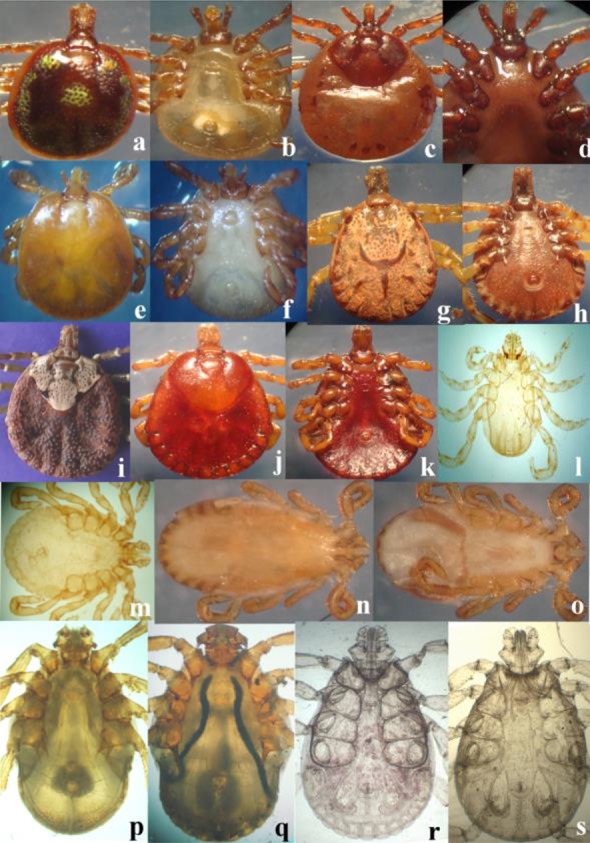
Amblyomma gervaisi Male: dorsal view (a) ventral view(b), A. kraneveldi Female: dorsal view (c) ventral view (d), A. pattoni Male: dorsal view (e) ventral view (f), A. integrum Male: dorsal view (g) ventral view (h), A. integrum Female: dorsal view (i), A. javanense Female: dorsal view (j) ventral view (k), cleared specimen of Rhipicephalus (B.) annulatus Male: dorsal view (l), cleared specimen of Haemaphysalis (Kaiseriana) bispinosa Male: ventral view (m), H. indica- Male: dorsal view (n) ventral view (o), H. shimoga Male: ventral view (p), H. (Kaiseriana) spinigera Male: ventral view (q): R. haemaphysaloides Male: ventral view (r), R. sanguineus s.l. Male: ventral view (s). (Figures not to scale)
Amongst the tick species collected from reptiles, Amblyomma gervaisi Lucas, 1847 was retrieved from three species of pythons, i.e., at a time only one species of tick was collected from each python. Sambar, spotted, barking and mouse deers, wild pig, tiger and leopard were infested with more than one species of tick. A minimum of three species of ticks were retrieved from each of the 11 examined sambar deers, with a total of six species identified in them. All the wild pigs examined were parasitized by A. integrum and R. haemaphysaloides with the exception R. sanguineus s.l. found only in one animal. In all mammalian species, ticks were present throughout the body with more infestation on the external surface of the ear pinna and neck.
In snakes, ticks were attached between and below the scales with no ticks were seen attached to the ventral aspect of the body. Only A. gervaisi Lucas, 1847 could be collected from monitor lizards. Male A. gervaisi was collected from the lateral side of the body, axilla of the left forelimb and the periphery of cloaca / ventral depression just behind cloaca. Female ticks were collected from the axillary region and between the toes of forelimbs.
Discussion
Among the reported species of ticks from India, A. testudinarium, D. auratus, H. bispinosa, H. spinigera, H. intermedia, Hyalomma anatolicum anatolicum, H. marginatum isaaci, H. hussaini, H. detritum, H. kumari, B. microplus, I. acutitarsus, I. ovatus, N. monstrosum, R. haemaphysaloides and R. turanicus are the most widely distributed ticks of cattle, buffalo, sheep and goat (37). Among this species, I. acutitarsus and I. ovatus were reported mainly from eastern and north-eastern states of the country (19). Haemaphysalis bispinosa and R (B.) microplus are prevalent throughout India, while H. spinigera is restricted to southern states, central zones, Orissa and Meghalaya (19). A total of 23 species of ticks were reported in domestic and wild animals from the different parts of Kerala State (19, 38, 39). The species of ixodid ticks reported from Kerala include, R.(B.) annulatus, R.(B.) microplus, R.(B.) decoloratus, R. sanguineus s.l., R. haemaphysaloides, R. turanicus, H. bispinosa, H. intermedia, H. aculeata, H. cuspidata, H. knobigera, H. turturis, H. spinigera, H. anatolicum, H. marginatum isaaci, H. hussaini, A. integrum, N. monstrosum, and N. keralensis (38, 39).
A total of 35 species of ticks were reported from sambar deer throughout its native range and introduced habitats (40) which include 11 species from two extreme ends of India, southern (comprising Karnataka and Kerala states) and the northeastern ends (Assam). The possibility of spreading of ticks from the northeastern states to the southern state is very difficult as there is no practically animal movement practically between these states. Only five species of ticks were recorded from the Karnataka and one (H. sambar) from Kerala (40). In the present study, six species of ticks were recorded on sambar deer from Wayanad, Kerala, none of the specimen was conforming to the morphology of H. sambar. As well as, in the present study, R. (B.) annulatus recorded for the first time on sambar deer showing the status of a new host for this species. Among all the sambar deer examined, at least three species of ticks were observed in each animal, and the presence of A. integrum was a constant feature. In the present study, R. (B.) annulatus, R. haemaphysaloides and H. (K.) bispinosa were also recorded on both spotted deer (Axis axis) and barking deer as previously reported by Miranpuri (41).
The presence of A. integrum, R. haemaphysaloides and R. sanguineus s.l. in wild boars observed in the present study so agrees with the tick-host relationship (41). Less frequency of R. sanguineus s.l. in wild pig in the present study corroborates with previous report (42). Sus scrofa is a major host for adults of D. auratus, which also infests bear, rhinoceros and deer of primary and secondary forests (mostly at altitude below 400m) of India, Sri Lanka, Nepal, Bangladesh, Burma, Thailand, Vietnam, Laos, Peninsular Malaysia, and Sumatra (43). We could not record this species from any wild animals. However, an adult male D. auratus was recently recorded from a man trekking through the forest of Wayanad region (44)
Literature reveals H. (K.) bispinosa was not recorded from leopards and tigers in Western Ghats(45). However, Haemaphysalis sp. was reported in leopard at Nagpur, Maharashtra (46). Similarly, a distinctive small member of the H. (K.) bispinosa group, H. (K) ramachandrai, was recorded on sambar deer, barking deer, chital deer, tiger, leopard, domestic cattle, buffalo and goats from forest lowlands of the Himalayan foothills of India and Nepal. H. bipsinosa is a ubiquitous medically important parasite of domestic animals in India transmitting various diseases in domestic animals (19). The present finding of R. haemaphysaloides and H. (Rhipistoma) indica infestations in leopard corroborated with previous findings (36, 41).
Four species of ticks were collected from four out of the eight species of snakes examined in the present study. Based on the available reports, A. javanense and A. kraneveldi on python and A. pattoni on Indian rat snake are the new records. Recent survey on ticks of snakes in the north Western Ghats recorded only A. gervaisi on two species of snakes viz., Indian rat snake and spectacled cobra. Amblyomma gibsoni, A. varanensis and A. gervaisi were previously reported in monitor lizard (34, 47, 48). However, A. gervaisi was the only tick species observed in monitor lizards in the present study.
The major infectious organisms of ruminants transmitted by common tick species in India are, Theileria annulata (transmitted by Hyalomma anatolicum and H. marginatum isaaci), Babesia bigemina, Anaplasma marginale and Ehrlichia bovis (transmitted by R. (B.) microplus), B. motasi (transmitted by Haemaphysalis spp.) and B. ovis (transmitted by Rhipicephalus spp.) (37). The occurrence of T. annulata and B. bigemina was reported from the whole India while A. marginale, E. bovis and E. phagocytophila is confined to some restricted zones. Hepatozoon canis, Ehrlichia canis, Mycoplasma haemocanis, Anaplasma platys, B. vogeli and B. gibsoni are the TBD pathogens found infecting dogs in India due to the potential tick vectors, Rhipicephalus (most commonly) and/or Haemaphysalis ticks (49).
In humans, Lyme disease, Kyasanur Forest Disease (KFD), Crimean-Congo Hemorrhagic Fever (CCHF) and babesiosis are some of the important tick borne zoonoses reported from India (25, 50). Human babesiosis and CCHF were reported from Gujarat state (50, 51) of northern India. Kyasanur forest disease (KFD) was originally recognized as a febrile illness in the Shimoga district of Karnataka state of India (52). During 2013, only single case of Kyasanur forest disease (KFD) was reported without any mortality in humans from Wayanad, Kerala (26) while eleven confirmed cases, one death and eight suspected cases were already reported in the month of February 2015 (27–29). The principal vector for KFD, H. (K.) spinigera was identified in the present study. Dermacentor auratus reported previously from a human (44) from Wayanad can also act as vector for the disease. Hence, it could be possible that KFD may spread into more and more areas of Kerala in future. Lyme disease in humans was documented from northern and north eastern India (53, 54). Lyme disease was reported recently from Wayanad too (26, 55) even though its tick vector could not be established.
The information gathered in the present study will be useful for public health specialists, medical professionals, zoologists, parasitologists and other professionals for designing tick control strategies for the entire southern India to prevent the possible emergence of newer tick borne diseases especially zoonoses.
Conclusions
Twelve species of ticks from wild mammals and reptiles were recorded from southern India suggesting the contribution of wild life for tick abundance and prevalence in the tick fauna of this region. Haemaphysalis (K.) bispinosa was common among the wild ungulates and the large carnivores. As well as, H. (K.) spinigera, the principal vector for Kyasanur Forest disease (KFD) was identified in the present study. The data presented will be helpful for designing ticks and tick-borne disease control programs in this region of the country.
Acknowledgements
Financial supports from Indian Council of Agricultural Research (NAIP C2066, NFBS FARA/BSA-4004/2013-14, NASF/ABA-6015/2016-17) and Kerala State Council for Science, Technology and Environment (022/YIPB/KBC/2013 and 010/14/SARD/13/CSTE) are thankfully acknowledged. We report no conflict of interests of any kind among the authors.
References
- 1.Sonenshine DE. (1991) Biology of Ticks. Volume 1 Oxford University Press, New York. [Google Scholar]
- 2.Walker DH, Fishbein DB. (1991) Epidemiology of rickettsial diseases. Eur J Epidemiol. 7(3): 237–245. [DOI] [PubMed] [Google Scholar]
- 3.Snelson JT. (1975) Animal ectoparasites and disease vector causing major reduction in world food supplies. FAO Plant Protection Bulletin. 13: 103–114. [Google Scholar]
- 4.Guglielmone AA, Robbins RG, Apanaskevich DA, Petney TN, Estrada-Peña A, Shao R, Barker SC. (2010) The Argasidae, Ixodidae and Nuttalliellidae (Acari: Ixodida) of the world: a list of valid species names. Zootaxa. 2528: 1–28. [Google Scholar]
- 5.Nava S, Venzal JM, Terassini FA, Mangold AJ, Camargo LM, Labruna MB. (2010) Description of a new argasid tick (Acari: Ixodida) from bat caves in Brazilian Amazon. J Parasitol. 96(6): 1089–1101. [DOI] [PubMed] [Google Scholar]
- 6.Apanaskevich DA, Horak IG, Matthee CA, Matthee S. (2011) A new species of Ixodes (Acari: Ixodidae) from South African mammals. J Parasitol. 97(3): 389–398. [DOI] [PubMed] [Google Scholar]
- 7.Mans BJ, De Klerk D, Pienaar R, Latif AA. (2011) Nuttalliella namaqua: a living fossil and closest relative to the ancestral tick lineage: implications for the evolution of blood-feeding in ticks. PloS One. 6(8): e23675. [DOI] [PMC free article] [PubMed] [Google Scholar]
- 8.Dantas-Torres F, Venzal JM, Bernardi LF, Ferreira RL, Onofrio VC, Marcili A, Bermúdez SE, Ribeiro AF, Barros-Battesti DM, Labruna MB. (2012) Description of a new species of bat-associated argasid tick (Acari: Argasidae) from Brazil. J Parasitol. 98(1): 36–45. [DOI] [PubMed] [Google Scholar]
- 9.Estrada-Peña A, Venzal JM, Nava S, Mangold A, Guglielmone AA, Labruna MB, de La Fuente J. (2012) Reinstatement of Rhipicephalus (Boophilus) australis (Acari: Ixodidae) with redescription of the adult and larval stages. J Med Entomol. 49(4): 794–802. [DOI] [PubMed] [Google Scholar]
- 10.Heath AC. (2012) A new species of soft tick (Ixodoidea: Argasidae) from the New Zealand lesser short-tailed bat, Mystacina tuberculata Gray. Tuhinga. 23: 29–37. [Google Scholar]
- 11.Venzal J, Nava S, Mangold A, Mastropaolo M, Casás G, Guglielmone A. (2012) Ornithodoros quilinensis sp. nov. (Acari, Argasidae), a new tick species from the Chacoan region in Argentina. Acta Parasitol. 57(3): 329–336. [DOI] [PubMed] [Google Scholar]
- 12.Apanaskevich DA, Horak IG, Mulumba-Mfumu LK. (2013) A new species of Rhipicephalus (Acari: Ixodidae), a parasite of red river hogs and domestic pigs in the Democratic Republic of Congo. J Med Entomol. 50(3): 479–484. [DOI] [PubMed] [Google Scholar]
- 13.Venzal JM, Nava S, González-Acuña D, Mangold AJ, Muñoz-Leal S, Lado P, Guglielmone AA. (2013) A new species of Ornithodoros (Acari: Argasidae), parasite of Microlophus spp. (Reptilia: Tropiduridae) from northern Chile. Ticks Tick-Borne Dis. 4(1): 128–132. [DOI] [PubMed] [Google Scholar]
- 14.Oliver JH., Jr (1989) Biology and systematics of ticks (Acari: Ixodida). Annu Rev Ecol Syst. 20(1): 397–430. [Google Scholar]
- 15.de la Fuente J, Estrada-Pena A, Venzal JM, Kocan KM, Sonenshine DE. (2008) Overview: Ticks as vectors of pathogens that cause disease in humans and animals. Front Biosci. 13(13): 6938–6946. [DOI] [PubMed] [Google Scholar]
- 16.de Castro JJ. (1997) Sustainable tick and tickborne disease control in livestock improvement in developing countries. Vet Parasitol. 71(2–3): 77–97. [DOI] [PubMed] [Google Scholar]
- 17.FAO (1984) Ticks and ticks borne disease control. A practical field manual. Volume 1 Tick control. F.A.O. Rome. [Google Scholar]
- 18.Geevarghese G, Fernandes S, Kulkarni SM. (1997) A checklist of Indian ticks (Acari: Ixodidae). Indian J Anim Sci. 67(5): 566–574. [Google Scholar]
- 19.Ghosh S, Bansal GC, Gupta SC, Ray D, Khan MQ, Irshad H, Shahiduzzaman M, Seitzer U, Ahmed JS. (2007) Status of tick distribution in Bangladesh, India and Pakistan. Parasitol Res. 101(2): S207–216. [DOI] [PubMed] [Google Scholar]
- 20.Minjauw B, McLeod A. (2003) Tick-borne diseases and poverty. The impact of ticks and tick-bornediseases on the livelihood of small-scale and marginal livestock owners in India and eastern and southern Africa. Research report, DFID Animal Health Programme, Centre for Tropical Veterinary Medicine, University of Edinburgh, UK.
- 21.Daszak P, Cunningham AA, Hyatt AD. (2000) Emerging Infectious Diseases of Wildlife-Threats to Biodiversity and Human Health. Science. 287(5452): 443–449. [DOI] [PubMed] [Google Scholar]
- 22.Bengis RG, Leighton FA, Fischer JR, Artois M, Mörner T, Tate CM. (2004) The role of wildlife in emerging and re-emerging zoonoses. Rev Sci Tech. 23(2): 497–511. [PubMed] [Google Scholar]
- 23.Myers N, Mittermeier RA, Mittermeier CG, Da Fonseca GA, Kent J. (2000) Biodiversity hotspots for conservation priorities. Nature. 403(6772): 853–858. [DOI] [PubMed] [Google Scholar]
- 24.Bawa KS, Das A, Krishnaswamy J. (2007) Ecosystem Profile-Western Ghats and Sri Lanka biodiversity hotspot-Western Ghats Region. Critical Ecosystem Partnership Fund, Arlington, USA. [Google Scholar]
- 25.Mourya DT, Yadav PD, Patil DY. (2014) Highly infectious tick borne viral diseases: Kyasanur forest disease and Crimean-Congo hemorrhagic fever in India. WHO South-East Asia J Public Health. 3(1): 8–21. [DOI] [PubMed] [Google Scholar]
- 26.DHS Kerala (2013) Data on communicable diseases, Kerala state, Directorate of health services, Kerala. Avalable at: http://dhs.kerala.gov.in/docs/spark/cd2013.pdf. [Accessed 15 February 2015]
- 27.DHS Kerala (2015a) Daily Report on Communicable Diseases, Directorate of Health service, Kerala. Available at: http://dhs.kerala.gov.in/docs/transfer/addlph/cdata2015.pdf [Accessed 15 February 2015].
- 28.Shanmugam J, Smirnova SE, Chumakov MP. (1976) Presence of antibodies to arboviruses of the Crimean haemorrhagic fever Congo (CHF-Congo) group in human being and domestic animals in India. Indian J Med Res. 64(10): 1403–1413. [PubMed] [Google Scholar]
- 29.Nuttal GHF, Warburton C. (1915) Ticks: A monograph of Ixodoidea, Part III, The Genus Haemaphysalis. Cambridge University Press, London. [Google Scholar]
- 30.Robinson LE. (1926) Ticks: A monograph of Ixodoidea, Part IV, The Genus Amblyomma Cambridge University Press, London. [Google Scholar]
- 31.Arthur DR. (1960) Ticks: A monograph of the Ixodoidae Part V. On the genera Dermacentor, Anocentor, Cosmiomma, Boophilus and Margaropus, Cambridge University Press, London. [Google Scholar]
- 32.Trapido H, Varma MGR, Rajagopalan PK, Singh KRP, Rebello MJ. (1964) A guide to identification of all stages of the Haemaphysalis ticks of south India. Bull Entomol Res. 55(2): 249–270. [Google Scholar]
- 33.Kaufman TS. (1972) A revision of the genus Aponomma Neumann, 1899 (Acarina: Ixodidae). [Ph.D. Dissertation]. University of Maryland, College Park, Maryland. [Google Scholar]
- 34.Auffenberg W, Auffenberg T. (1990) The reptile tick Aponomma gervaisi (Acarina: Ixodidae) as a parasite of monitor lizard in Pakistan and India. Bull. Florida Museum Natural History Biol. Sci. 35: 1–34. [Google Scholar]
- 35.Voltzit OV, Keirans JE. (2002) A review of Asian Amblyomma species (Acari, Ixodida, Ixodidae). Acarina. 10: 95–136. [Google Scholar]
- 36.Geevarghese G, Mishra AC. (2011) Haemaphysalis ticks of India. Elsevier, London. [Google Scholar]
- 37.Ghosh S, Azhahianambi P, de la Fuente J. (2006) Control of ticks of ruminants, with special emphasis on livestock farming systems in India: present and future possibilities for integrated control-a review. Exp Appl Acarol. 40: 49–66. [DOI] [PubMed] [Google Scholar]
- 38.Rajamohanan K. (1980) Studies on the common ticks affecting livestock in Kerala. [Ph.D. Dissertation]. Kerala Agricultural University, Thrissur. [Google Scholar]
- 39.Prakasan K, Ramani N. (2007) Tick parasites of domestic animals of Kerala, South India. Asian J Anim Vet Adv. 2: 74–80. [Google Scholar]
- 40.Presidente PJA. (1984) Ectoparasites, endoparasites and some diseases reported from sambar deer throughout its native range and in Australia and New Zealand. Deer Refresher Course for Veterinarians, University of Sydney, Proceedings. 72: 543–557. [Google Scholar]
- 41.Miranpuri GS. (1979) Tick taxonomy in India (Ixodoidea: Acarina). A review: Including notes on their biology, ecology, geographical distribution, host relationship, ticks and tick-borne diseases and Key for species identification. Division of Parasitology. Indian Veterinary Research Institute, Izatnagar. [Google Scholar]
- 42.Ruiz-Fons F, Fernandez-de-Mera IG, Acevedo P, Hofle U, Vicente J, de la Fuente J, Gortazár C. (2006) Ixodid ticks parasitizing Iberian red deer (Cervus elaphus hispanicus) and European wild boar (Sus scrofa) from Spain: Geographical and temporal distribution. Vet Parasitol. 140(1): 133–142. [DOI] [PubMed] [Google Scholar]
- 43.Hoogstraal H, Wassef HY. (1985) Dermacentor (indocentor) auratus (Acari: Ixodoidae); host distribution, and medical importance in tropical Asia. J Med Entomol. 22(2): 170–177. [DOI] [PubMed] [Google Scholar]
- 44.Ajithkumar KG, Ravindran R, Ghosh S. (2012) Dermacentor auratus Supino, 1897 (Acarina, Ixodidae) reported from Wayanad, Kerala. Indian J Med Res. 135(3): 435–436. [PMC free article] [PubMed] [Google Scholar]
- 45.Baviskar BS, Gawande PJ, Maske DK, Jayraw AK, Bhandarkar AG. (2007) Occurrence of Haemaphysalis ticks in Leopard (Panthera pardus) Nagpur. Zoos' Print. 22(7): 22. [Google Scholar]
- 44.Pandit P, Bandivdekar R, Geevarghese G, Pandey S, Mandke O. (2011) Tick infestation on the Northern part of Western Ghats of India. J Med Entomol. 48(3): 504–507. [DOI] [PubMed] [Google Scholar]
- 47.Kolonin GV. (2004) Reptiles as host of ticks. Russ J Herpetol. 11: 177–180. [Google Scholar]
- 48.Harakare LJ, Gawande PJ, Baviskar BS, Latha BR, Hippargi R, Jayraw AK, Maske DK. (2007) Infestation of tick Aponomma gibsoni (Acari: Ixodidae) in monitor lizard Varanus bengalensis from Nagpur, Maharashtra. Zoos' Print J. 22: 2898. [Google Scholar]
- 49.Rani PAMA, Irwin PJ, Coleman GT, Gatne M, Traub RJ. (2011) A survey of canine tick-borne diseases in India. Parasit Vectors. 4(1): 141. [DOI] [PMC free article] [PubMed] [Google Scholar]
- 50.Marathe A, Tripathi J, Handa V, Date V. (2005) Human babesiosis-a case report. Indian J Med Microbiol. 23(4): 267–269. [PubMed] [Google Scholar]
- 51.Bajpai S, Nadkar MY. (2011) Crimean Congo Hemorrhagic Fever: requires vigilance and not panic. J Assoc Physicians India. 59: 164–167. [PubMed] [Google Scholar]
- 52.Pattnaik P. (2006) Kyasanur forest disease: an epidemiological view in India. Rev Med Virol. 16(3): 151–165. [DOI] [PubMed] [Google Scholar]
- 53.Praharaj AK, Jetley S, Kalghatgi AT. (2008) Seroprevalence of Borrelia burgdorferi in northeastern India. Med J Armed Forces India. 64(1): 26–28. [DOI] [PMC free article] [PubMed] [Google Scholar]
- 54.Vasudevan B, Chatterjee M. (2013) Lyme borreliosis and skin. Indian J Dermatol. 58(3): 167–174. [DOI] [PMC free article] [PubMed] [Google Scholar]
- 55.Rajeev KR. (2013) Lyme disease outbreak in Wayanad. The Times of India (Newspaper on the Internet). Available at: http://timesofindia.indiatimes.com/city/kozhikode/Lyme-disease-outbreak-in-Wayanad/articleshow/18758675.cms. [Accessed 2 March 2013].