


Abstract
Background
Patients often require a rapid sequence induction (RSI) endotracheal intubation technique during emergencies or electively to protect against aspiration, increased intracranial pressure, or to facilitate intubation. Traditionally succinylcholine has been the most commonly used muscle relaxant for this purpose because of its fast onset and short duration; unfortunately, it can have serious side effects. Rocuronium has been suggested as an alternative to succinylcholine for intubation. This is an update of our Cochrane review published first in 2003 and then updated in 2008 and now in 2015.
Objectives
To determine whether rocuronium creates intubating conditions comparable to those of succinylcholine during RSI intubation.
Search methods
In our initial review we searched all databases until March 2000, followed by an update to June 2007. This latest update included searching the Cochrane Central Register of Controlled Trials (CENTRAL; 2015, Issue 2), MEDLINE (1966 to February Week 2 2015), and EMBASE (1988 to February 14 2015 ) for randomized controlled trials (RCTs) or controlled clinical trials (CCTs) relating to the use of rocuronium and succinylcholine. We included foreign language journals and handsearched the references of identified studies for additional citations.
Selection criteria
We included any RCT or CCT that reported intubating conditions in comparing the use of rocuronium and succinylcholine for RSI or modified RSI in any age group or clinical setting. The dose of rocuronium was at least 0.6 mg/kg and succinylcholine was at least 1 mg/kg.
Data collection and analysis
Two authors (EN and DT) independently extracted data and assessed methodological quality for the 'Risk of bias' tables. We combined the outcomes in Review Manager 5 using a risk ratio (RR) with a random‐effects model.
Main results
The previous update (2008) had identified 53 potential studies and included 37 combined for meta‐analysis. In this latest update we identified a further 13 studies and included 11, summarizing the results of 50 trials including 4151 participants. Overall, succinylcholine was superior to rocuronium for achieving excellent intubating conditions: RR 0.86 (95% confidence interval (CI) 0.81 to 0.92; n = 4151) and clinically acceptable intubation conditions (RR 0.97, 95% CI 0.95 to 0.99; n = 3992, 48 trials). A high incidence of detection bias amongst the trials coupled with significant heterogeneity provides moderate‐quality evidence for these conclusions, which are unchanged from the previous update. Succinylcholine was more likely to produce excellent intubating conditions when using thiopental as the induction agent: RR 0.81 (95% CI: 0.73 to 0.88; n = 2302, 28 trials). In the previous update, we had concluded that propofol was the superior induction agent with succinylcholine. There were no reported incidences of severe adverse outcomes. We found no statistical difference in intubation conditions when succinylcholine was compared to 1.2 mg/kg rocuronium; however, succinylcholine was clinically superior as it has a shorter duration of action.
Authors' conclusions
Succinylcholine created superior intubation conditions to rocuronium in achieving excellent and clinically acceptable intubating conditions.
Keywords: Humans; Androstanols; Androstanols/administration & dosage; Intubation, Intratracheal; Intubation, Intratracheal/methods; Neuromuscular Depolarizing Agents; Neuromuscular Depolarizing Agents/administration & dosage; Neuromuscular Depolarizing Agents/adverse effects; Neuromuscular Nondepolarizing Agents; Neuromuscular Nondepolarizing Agents/administration & dosage; Neuromuscular Nondepolarizing Agents/adverse effects; Propofol; Propofol/administration & dosage; Randomized Controlled Trials as Topic; Rocuronium; Succinylcholine; Succinylcholine/administration & dosage; Succinylcholine/adverse effects
Plain language summary
Comparison of two muscle relaxants, rocuronium and succinylcholine, to facilitate rapid sequence induction intubation
Review question
Which drug (rocuronium or succinylcholine) is better at providing excellent conditions to quickly insert breathing tubes into participants of all ages for elective and emergency situations?
Background
In emergency situations some people need a general anaesthetic with an endotracheal tube (a tube to help them breathe). It is important to have fast‐acting medications to allow physicians to complete this procedure quickly and safely. Currently, the medication used most frequently to relax muscles is succinylcholine. Succinylcholine is fast‐acting and lasts for only a few minutes, which is very desirable in this setting. However, some people cannot use this medication as it can cause serious salt imbalances or reactions, so an equally effective medication without these side effects would be advantageous. One possible alternative medication is rocuronium, a muscle relaxant with fewer side effects but longer duration of action. This review compares the quality of intubation conditions (the ease with which physicians can quickly and safely pass the endotracheal tube) between rocuronium and succinylcholine in all ages and varying clinical situations.
Study characteristics
We included in the review controlled trials from 1966 to February 2015 involving participants of all ages needing rapid intubation using rocuronium and succinylcholine . The minimum dose of rocuronium given was 0.6mg/kg and succinylcholine was 1mg/kg. We have combined the results of 50 trials, with a total of 4151 participants, which compared the effectiveness of succinylcholine versus rocuronium on intubation conditions. No major side effects from use of the drugs were reported.
Key results
We have found that rocuronium is slightly less effective than succinylcholine for creating excellent and acceptable intubation conditions. Rocuronium should therefore only be used as an alternative to succinylcholine when it is known that succinylcholine should not be used and a more prolonged intubation is expected.
Quality of evidence
The level of evidence is of moderate GRADE due to imperfect study designs and varying techniques used across trials .
Summary of findings
Summary of findings for the main comparison. Rocuronium any dose versus succinylcholine for rapid sequence induction intubation.
| Rocuronium any dose versus succinylcholine for rapid sequence induction intubation | ||||||
| Patient or population: People requiring rapid sequence induction intubation Settings: Elective Operating Room, Emergency Room or Intensive Care Unit Intervention: Rocuronium, any dose Comparison: Succinylcholine | ||||||
| Outcomes | Illustrative comparative risks* (95% CI) | Relative effect (95% CI) | No of Participants (studies) | Quality of the evidence (GRADE) | Comments | |
| Assumed risk1 | Corresponding risk | |||||
| Succinylcholine | Rocuronium any dose 2 | |||||
| Excellent versus other intubation conditions | Study population | RR 0.86 (0.81 to 0.92) | 4151 (50 RCTs) | ⊕⊕⊕⊝ MODERATE , |
Risk of bias: 50% of the studies were at high risk for detection bias because the outcome assessor was not blinded to the fasciculations caused by succinylcholine. Inconsistency: High statistical heterogeneity in the studies could not be explained by subgroup analyses. However we did not downgrade because exclusion of trials contributing to heterogeneity did not significantly change the direction or size of effect. |
|
| 76 per 100 | 65 per 100 (61 to 69) | |||||
| *The basis for the assumed risk (e.g. the median control group risk across studies) is provided in footnotes. The corresponding risk (and its 95% confidence interval) is based on the assumed risk in the comparison group and the relative effect of the intervention (and its 95% CI). CI: Confidence interval; RR: risk ratio; RCT: randomized controlled trial | ||||||
| GRADE Working Group grades of evidence High quality: Further research is very unlikely to change our confidence in the estimate of effect. Moderate quality: Further research is likely to have an important impact on our confidence in the estimate of effect and may change the estimate. Low quality: Further research is very likely to have an important impact on our confidence in the estimate of effect and is likely to change the estimate. Very low quality: We are very uncertain about the estimate. | ||||||
1Assumed risk is the average number of excellent intubations with succinylcholine.
2Rocuronium minimum dose 0.6 mg/kg. Succinylcholine minimal dose is 1mg/kg.
Background
Description of the condition
Patients who need endotracheal intubation in the emergency department or the operating room often require a rapid sequence induction (RSI) technique to protect against aspiration of gastric contents or to facilitate urgent airway protection in cases of imminent airway closure, haemodynamic instability, failing gas exchange and urgent surgical emergencies (Huizinga 1992; McCourt 1998; Stollings 2014).
Description of the intervention
The RSI technique involves the rapid sequential administration of medications (including a sedative, induction anaesthetic and a muscle relaxant, with or without narcotic) followed by endotracheal intubation within one minute of administering the muscle relaxant. In emergency situations, intubation is often required in unstable situations with the potential of haemodynamic instability. This frequently requires modification of the rapid sequence induction for the individual patient, with the goal of securing a patent airway as safely and quickly as possible.
How the intervention might work
Succinylcholine, a depolarizing muscle relaxant, is the most common agent used for a RSI technique in both the controlled and emergency settings (Weiss 1997). Succinylcholine has been the preferred muscle relaxant because it has a rapid onset of 40 to 60 seconds and a short duration, lasting only six to 10 minutes (Combs 1994). Succinylcholine's depolarizing action can lead to hyperkalaemia, possibly inducing fatal cardiac arrhythmias (Combs 1994; Schreiber 2005; Sullivan 1994). As a result, It is contraindicated in patients with major burns (beyond 48 hours), major crush injuries (beyond 48 hours), severe abdominal sepsis, denervation syndromes (such as amyotrophic lateral sclerosis or Guillain Barré Syndrome), muscular dystrophy and major nerve or spinal cord injuries (Martyn 2006). It is also contraindicated in patients with known hyperkalaemia, a history of malignant hyperthermia or previous allergic reaction to succinylcholine (Lebowitz 1989). Succinylcholine use has also been associated with variable increases in intracranial pressure (Minton 1986) and to a lesser extent intraocular pressure (Vinik 1999), and should be administered with drugs that help mitigate these side effects.
Alternative agents, among others, include pancuronium, vecuronium, atracurium and cisatracurium; however, none achieve acceptable intubating conditions as rapidly as succinylcholine (Mazurek 1998). Rocuronium is a steroid‐based non‐depolarizing muscle relaxant, which has been proposed for creating intubating conditions similar to those of succinylcholine. The duration of action is longer, lasting 37 to 72 minutes with standard doses (Magorian 1993). The only absolute contraindication to rocuronium is allergy. Care must be taken with people who have myasthenia gravis or myasthenic syndrome, hepatic disease, neuromuscular disease, carcinomatosis, or severe cachexia, as the duration of action may be profoundly increased (Stollings 2014).
Why it is important to do this review
There have been many studies looking at the equivalence of rocuronium and succinylcholine, with conflicting outcomes. It has been suggested that inconsistencies in the use of narcotics, the sedative propofol, or the dose of rocuronium administered may have accounted for these differences (Magorian 1993). No previous systematic review comparing the intubation conditions created by rocuronium and succinylcholine had been published prior to our initial review (Perry 2003). This review allows for subgroup analyses to assess for sources of inconsistency between studies. This latest update is important, given that several additional studies have been published since our last update (Perry 2008).
Objectives
To determine whether rocuronium creates intubating conditions comparable to those of succinylcholine during RSI intubation.
Methods
Criteria for considering studies for this review
Types of studies
We included all randomized clinical trials (RCTs) and controlled clinical trials (CCTs) meeting the following inclusion criteria:
the study reported a score of intubation conditions as one of the main outcomes;
the study compared rocuronium to succinylcholine;
the dose of rocuronium administered was at least 0.6 mg/kg and the dose of succinylcholine was at least 1 mg/kg (Danzl 2000).
Types of participants
We included in the analysis men, women and children of any age who underwent a rapid sequence induction (RSI), or modified RSI, intubation either electively or emergently. We defined a modified RSI as using both a sedative and a muscle relaxant followed by intubation, with either a delay between the administration of the two drugs or a delay of more than 60 seconds between the administration of the muscle relaxant and the intubation attempt, or both.
Types of interventions
All of the trials we included in this review compared rocuronium to succinylcholine for neuromuscular blockade. The sedative used for induction anaesthesia was thiopental, propofol, benzodiazepines, ketamine or etomidate. We accepted trials with or without narcotic agents. Additional medications allowed in this review were the use of pre‐treatment sedatives (e.g. low‐dose benzodiazepines).
Types of outcome measures
We assessed intubating conditions using the Goldberg scale (see Table 2), (Goldberg 1989; Weiss 1997). This is a widely used scale (although not always attributed to Goldberg et al.) that allocates a score for each of: ease of intubation, vocal cord movement, and patient response to intubation (diaphragmatic movement, coughing or bucking). This scale gives a total point value of 12, in which three represents excellent; four to six represents good; seven to nine represents poor, and 10 to 12 represents impossible or inadequate intubation conditions. Excellent intubation conditions had a score of three which means there must have been good conditions recorded by the operator, open vocal cords that were immobile, and no response by the patient to intubation. We converted trials to this scale if this had not been directly reported, but sufficient detail was available to do so. We compared rocuronium with succinylcholine by comparing the proportions of excellent intubation scores and the proportions of clinically acceptable intubation scores (good or excellent).
1. Intubating conditions.
| Score | Ease of laryngoscopy | Vocal cords | Intubation response |
| 1. Excellent | Good | Open | None |
| 2. Good | Fair | Open | Diaphragmatic movement |
| 3. Poor | Difficult | Movement | Moderate coughing |
| 4. Impossible | Poor | Closed | Severe coughing or bucking |
Primary outcomes
The primary outcome assessed was excellent intubation conditions created during RSI (or modified RSI) comparing rocuronium with succinylcholine.
Secondary outcomes
The secondary outcome assessed was clinically acceptable (excellent or good) intubation conditions created during RSI (or modified RSI) comparing rocuronium with succinylcholine.
Search methods for identification of studies
Electronic searches
In our initial systematic review (Perry 2003) we searched all databases until March 2000. We reran the search to 2007 in our first update (Perry 2008). For this latest updated version we searched the Cochrane Central Register of Controlled Trials (CENTRAL; 2015, Issue 2), MEDLINE (1966 to February 14 2015), and EMBASE (1988 to February 14 2015) to identify all clinical trials relating to the use of rocuronium and succinylcholine during RSI. We used the validated RCT filter for the search (Haynes 1994).
Please refer to Appendix 1 (MEDLINE) , Appendix 2 (EMBASE) and Appendix 3 (CENTRAL) for our search strategies.
The local director of our library services reviewed our search strategy.
Searching other resources
We handsearched the references of included trials to add any citations missed by the electronic searches. We did not apply any language restrictions to the search.
Data collection and analysis
We combined all trials using Review Manager 5 software (RevMan 5.3). We produced the 'Summary of findings' table using GRADEpro software (GRADEpro 2015).
Selection of studies
We retrieved studies by searching by title or abstract. Two independent appraisers (JP, JL, VS, EN or DT) reviewed relevant articles using specific criteria defined in 'Types of studies'. We measured Inter‐rater agreement Kappa statistics. We resolved all disagreements by consensus. If we could not reach consensus, then a third author (GW or JP) was available to give a final decision.
Data extraction and management
Two authors (JP, JL, VS, EN, or DT) independently extracted data using standardized data collection forms. We converted intubation conditions to the Goldberg scale (four levels) if required and if adequate information was provided to do so. Rocuronium was compared to succinylcholine by comparing the proportion of excellent intubation scores to non‐excellent scores and the proportion of clinically acceptable scores (good or excellent) to the proportion of non‐clinically acceptable scores (poor or impossible). We resolved disagreements by consensus, with both extractors referring to the original text together, or by consulting a third author (JP). All data presented were from published literature only. Exact numbers for intubating conditions were provided by the authors for Sluga 2005.
Assessment of risk of bias in included studies
In this update, DT and EN reviewed and assessed all trials included in the review using the 'Risk of bias' tool.
Measures of treatment effect
We calculated dichotomous variables as risk ratios (RRs) for both excellent and acceptable intubation conditions, both with 95% confidence intervals (95% CIs) with a random‐effects model.
Unit of analysis issues
The unit of analysis was the intubation scores provided by each of the included trials. Sometimes the distribution of scores was provided only in graphical format, in which case the authors had to extrapolate from the graphs manually. We converted intubations scores when available to the Goldberg scale.
Dealing with missing data
We only included trials if they reported intubating conditions as a scale or in components which could be converted to the Goldberg scale. We performed analysis on an intention‐to‐treat basis. We conducted subgroup analyses for applicable trials and reported details of excluded information in included trials.
Assessment of heterogeneity
We assessed statistical heterogeneity by using the I statistic with thresholds of 25%, 50% and 75% to indicate mild, moderate and high degrees of heterogeneity respectively (Higgins 2003). Visual inspection was performed of the graphic representation of the trials with their 95% CIs. We explored the causes of significant heterogeneity with subgroup analyses and influence analyses.
Assessment of reporting biases
We performed this by visual inspection of a funnel plot of the included trials, to assess for publication bias.
Data synthesis
We conducted a meta‐analysis for the primary outcome of excellent intubation conditions and the secondary outcome of clinically acceptable conditions (where data were available) using Review Manager 5 software (RevMan 5.3). For trials comparing multiple drugs, we used only data points involving succinylcholine and rocuronium with the same induction agents.
Subgroup analysis and investigation of heterogeneity
A priori subgroup analysis for the outcome of excellent intubation conditions compared the following groups: simulated RSI (i.e. the neuromuscular‐blocking agent is administered immediately following the sedative and conditions evaluated within 60 seconds) versus modified RSI; induction agent; use versus non‐use of a narcotic; doses of rocuronium (0.6, 0.9, or 1.2 mg/kg); adult versus paediatric age groups; and emergency intubations (added in the previous update, Perry 2008).
After we completed the assessment of bias, we conducted subgroup analyses according to categorization of blinding of outcome assessment, to further identify the source of heterogeneity.
Sensitivity analysis
In order to assess their impact on the effect direction, size and precision of the summary estimate,we conducted analyses excluding trials in turn that:
contributed most to heterogeneity;
were most heavily weighted;
showed marked differences in intubation sequence (such as very short time between delivery of muscle relaxant and intubation).
Summary of findings table
We imported data from Review Manager 5 into the online GRADEpro software to produce the 'Summary of findings' table. The assumed risk population was set as the average incidence of excellent intubating conditions in the pooled control group. There is one primary outcome for which we assessed the overall quality of evidence using GRADE methodology by starting at a high level of evidence for RCTs and downgrading for serious deficiencies in the categories of study limitations, indirectness, imprecision, inconsistency and publication bias.
Results
Description of studies
Results of the search
In our previous update (Perry 2008) we identified 53 studies and included 37. For this update we identified 13 new studies. All the included studies are RCTs, with the exception of one CCT identified for this update (De Almeida 2009).
Included studies
We include 11 new trials in this review (Abu‐Halaweh 2007; Ali 2008; Belyamani 2008; De Almeida 2009; Iqbal 2013; Kulkarni 2010; Kwon 2013; Marsch 2011; Tripathi 2010; Singh 2011; Sorensen 2012; ) (see table Characteristics of included studies). Two articles identified from the previous update were translated and the results incorporated in this update (Mencke 2005; Türkmen 2004) (Figure 1). The revised search identified 66 studies, of which 52 met the inclusion criteria. Two of these were duplicate publications (Dubois 1991a; Mirakhur 1994a) and were therefore included as secondary references.
1.

Search flow diagram for this update from July 2007 to February 2015
We now include 50 trials incorporating results from 4151 individuals in this updated review.
Rationale for excluded information from included studies
Andrews 1999 and McCourt 1998 are two of the largest trials conducted to date. Both trials had planned to conduct interim analyses at the halfway mark, and in both cases the steering committees decided to drop the lower dose rocuronium, as it was shown to be inferior to the larger dose (Dubois 1995). Neither trial reported the results of the low‐dose control groups. Hence, the data for the low‐dose rocuronium are not included in this meta‐analysis. In addition, Sparr 1996b used four different treatment groups with only one control group. Only one of the four treatment groups using rocuronium was appropriately controlled for, i.e. the succinylcholine group which used thiopentone without alfentanyl. Hence we have not included the rocuronium groups with propofol or alfentanyl in this meta‐analysis (no control group). Belyamani 2008 performed a trial assessing the benefit of ephedrine on intubating conditions when using either succinylcholine or rocuronium. Of the four treatment groups, we used only the data from the two control groups in this analysis. De Almeida 2009 enrolled morbidly obese participants given different doses of muscle relaxant based on ideal body weight versus total body weight. We have included only data for the two groups dosed for total body weight in this analysis, because the ideal body weight groups would have lower drug levels than those specified in the inclusion criteria. The second trial to involve emergency intubations (Marsch 2011), involved either propofol or etomidate as an induction agent. The authors did not provide separate data for the two groups of participants and we therefore did not include this trial in the induction agent analysis. The figures and tables in Türkmen 2004 were unavailable, and we were therefore able to include only data points for excellent intubation conditions.
Excluded studies
We excluded two of the 13 new studies identified in this update (Misiolek 2009; Stourac 2013).
We have excluded a total of 14 studies, for the reasons detailed in the Characteristics of excluded studies
Studies awaiting classification
There are no studies awaiting classification.
Ongoing studies
There are no ongoing studies
Risk of bias in included studies
Figure 2 summarizes the findings in the four domains of random sequence generation, allocation concealment, blinding of outcome assessment and completeness of data.
2.

Risk of bias graph: review authors' judgements about each risk of bias item presented as percentages across all included studies
Allocation
All but one of the trials (De Almeida 2009) was described as a randomized control trial. However, the exact method of randomization was not always described. We rated two of the 50 included trials at high risk of bias for allocation, due to lack of randomization (De Almeida 2009) and randomization by arrival sequence for surgery (Koroglu 2002).
Blinding
The most prevalent area of high risk of bias was blinding of outcome assessment, resulting in downgrading of the quality of evidence to moderate. Although many investigators blinded the intubator to the medication injected, 50% did not blind the assessor to the obvious effects of the drugs (Figure 3). Succinylcholine causes very discernible fasciculations (muscle twitches) that can be observed by the intubator, unblinding the study drug and bias assessment of the primary outcome. Please refer to individual 'Risk of bias' tables for specific details of each trial .
3.

Risk of bias summary: review authors' judgements about each risk of bias item for each included trial
Incomplete outcome data
Completeness of data was almost uniformly low‐risk in the included trials, with the majority of them being complete.
Selective reporting
There were no concerns regarding selective reporting of results, as the outcome data were complete for all randomized participants in all included trials.
Other potential sources of bias
We assessed publication bias with a funnel plot. Visual inspection revealed an equal number of trials on either side of the effect estimate, although there was more scatter to the left indicating a paucity of trials in the lower right quadrant representing small unpublished trials favouring the use of rocuronium (Figure 4).
4.

Funnel plot of comparison: Rocuronium any dose versus succinylcholine, outcome: Excellent versus other intubation conditions.
Effects of interventions
See: Table 1
Primary outcome of excellent intubation conditions
There was a statistically significant risk ratio (RR) favouring succinylcholine in the comparison for the primary outcome of excellent intubating conditions, with a RR 0.86 (95% CI 0.81 to 0.92; participants = 4151; studies = 50; I2 statistic = 72%; Analysis 1.1). The number needed to treat for an additional harmful outcome (NNTH) for this outcome was eight (95% CI 12 to 6). There was heterogeneity present in this comparison, as demonstrated graphically with the 95% CIs for each trial . The Chi² test for heterogeneity was significant (Figure 5). An analysis of the influence on heterogeneity demonstrated that no single trial , regardless of size, significantly altered the I² statistic, with the exception of Kulkarni 2010 for the subgroup of modified RSI. These assessments and the following subgroup analyses were unable to explain the heterogeneity in the trials . However, this did not result in a downgrading of the quality of the evidence because we decided that the sources of heterogeneity were clinical variables which contributed to the generalizability of these results.
1.1. Analysis.

Comparison 1 Rocuronium any dose versus succinylcholine, Outcome 1 Excellent versus other intubation conditions.
5.

Forest plot of comparison: 1 Rocuronium any dose versus succinylcholine, outcome: 1.1 Excellent versus other intubation conditions
Secondary outcome of clinically acceptable intubations
We also found a statistically significant difference using the less stringent endpoint of clinically acceptable conditions (excellent or good, excluding poor or failed) with a RR 0.97 (95% CI 0.95 to 0.99; participants = 3992; studies = 48; I2 statistic = 68%; Analysis 1.2).
1.2. Analysis.

Comparison 1 Rocuronium any dose versus succinylcholine, Outcome 2 Acceptable versus suboptimal intubation conditions.
Subgroup analysis for the primary outcome of excellent intubation conditions: simulated versus modified RSI
The subgroup which used a simulated RSI technique had a statistically significant RR favouring succinylcholine (RR 0.80, 95% CI 0.72 to 0.89; participants = 2535; studies = 23; I2 statistic = 77%). The NNTH for this outcome was eight (95%CI 12 to 6) and there was significant heterogeneity present. The subgroup using modified RSI also had significantly better intubation conditions in the succinylcholine group (RR 0.92, 95% CI 0.85 to 0.99; participants = 1468; studies = 25; I2 statistic = 60%), and an NNTH of eight (95% CI 11 to 5). There was also significant heterogeneity present for this subgroup. The subgroup using mixed simulated and modified RSI now includes two trials with no statistical difference observed.
Subgroup analysis for the primary outcome of excellent intubation conditions: comparing the dose of rocuronium
The subgroup using a dose of rocuronium of 0.6 to 0.7 mg/kg had a RR favouring succinylcholine for excellent conditions (RR 0.80, 95% CI 0.72 to 0.88; participants = 2808; studies = 39; I2 statistic = 77%). The NNTH for this subgroup is six (95% CI 7 to 5). There was significant heterogeneity between the trials. There were no statistical differences for excellent or acceptable intubation conditions in the group that received 0.9 to 1.0 mg/kg of rocuronium or the group that received 1.2 mg/kg of rocuronium. (Analysis 2.1)
2.1. Analysis.

Comparison 2 Rocuronium specific dose versus succinylcholine, Outcome 1 Excellent versus other intubation conditions.
Subgroup analysis for the primary outcome of excellent intubation conditions: induction agents
The thiopental subgroup displayed a statistical difference between succinylcholine and rocuronium for the outcome of excellent intubation conditions (RR 0.81, 95% CI 0.73 to 0.88; participants = 2302; studies = 28; I2 statistic = 81%)(Figure 6). The NNTH for this outcome was six (95% CI 7 to 5). The Chi² test for heterogeneity was significant. Further analysis of the thiopental subgroup compared the effect of thiopental when used with or without a narcotic. Succinylcholine created significantly better outcomes with narcotics ((RR 0.82, 95% CI 0.73 to 0.92; participants = 1300; studies = 17; I2 statistic = 79%; Analysis 4.1) or without narcotics (RR 0.80, 95% CI 0.69 to 0.94; participants = 1002; studies = 12; I2 statistic = 84%; Analysis 5.1) in sequence with thiopental. In a change from our previous update, propofol as an induction agent is no longer associated with better intubating conditions. There were no trials that used benzodiazepines for induction, comparing rocuronium to succinylcholine.
6.

Forest plot of comparison: 3 Rocuronium versus succinylcholine for induction agent, outcome: 3.1 Excellent versus other intubation conditions
4.1. Analysis.

Comparison 4 Rocuronium versus succinylcholine with narcotic, Outcome 1 Excellent versus other intubation outcomes.
5.1. Analysis.

Comparison 5 Rocuronium versus succinylcholine without narcotic, Outcome 1 Excellent versus other intubation conditions.
Subgroup analysis for the primary outcome of excellent intubation conditions: use of narcotics
Succinylcholine provided better intubating conditions with or without opioid use. The subgroup of trials using a narcotic in the sequence favoured the succinylcholine group (RR 0.85, 95% CI 0.78 to 0.93; participants = 2292; studies = 34; I2 statistic = 74%; Analysis 4.1). The NNTH for the subgroup using narcotics was seven (95% CI 10 to 6). The subgroup without a narcotic in sequence also demonstrated a statistically significant difference (RR 0.85, 95% CI 0.76 to 0.95; participants = 1428; studies = 16; I2 statistic = 76%; Analysis 5.1). The NNTH for this subgroup was six (95% CI 9 to 5). There was significant heterogeneity present for both groups.
Subgroup analysis for the primary outcome of excellent intubation conditions: age groups
The paediatric subgroup demonstrated no statistically significant difference between rocuronium and succinylcholine (RR 0.86, 95% CI 0.70 to 1.06; participants = 536; studies = 5; I2 statistic = 81%). There was significant heterogeneity between the five paediatric trials (Figure 6).
Subgroup analysis for the primary outcome of excellent intubation conditions: emergency intubation
For the subgroup comparing rocuronium and succinylcholine in emergency participants, there was a statistically significant RR favouring succinylcholine (RR 0.84, 95% CI 0.73 to 0.98; participants = 1073; studies = 5; I2 statistic = 53%; Analysis 7.1). The NNTH was 12 (95% CI 38 to 7) for this subgroup, and there was no significant heterogeneity between trials .
7.1. Analysis.

Comparison 7 Rocuronium versus succinylcholine in emergency intubation, Outcome 1 Excellent versus other intubation conditions.
Inter‐observer agreement
In the first version of this review (Perry 2003), there was complete agreement between both evaluators regarding article selection (Kappa statistics 1.0). For this most recent update, the Kappa statistic was 0.9 for the articles.
Discussion
Summary of main results
Primary and secondary outcomes
This review summarizes the results of 50 trials in 41521 participants, demonstrating moderate‐quality evidence that succinylcholine creates better intubation conditions than rocuronium for both excellent and clinically acceptable intubation conditions during a rapid sequence induction. This is the same conclusion that we drew in our previous update (Perry 2008). The number of failed intubations was very small, with no clinically or statistically significant difference between rocuronium and succinylcholine.
Subgroup analysis
We have demonstrated that succinylcholine is superior to rocuronium when either a simulated or modified RSI technique is used. There are now two trials (n = 148) with mixed simulated RSI and modified RSI demonstrating no difference between the two muscle relaxants.
An interesting finding in this current update is the conclusion regarding an induction agent used with the muscle relaxant. Thiopental was found to provide superior intubating conditions with or without the use of a narcotic. This is contrary to the conclusions of the last update (Perry 2008). This switch in induction agent of choice was the result of the addition of six trials which used thiopental in this update, representing a total of 800 participants (Abu‐Halaweh 2007; Ali 2008; Iqbal 2013; Kulkarni 2010; Mencke 2005; Tripathi 2010). Unfortunately, this finding will have limited clinical applicability in North America, where the availability of thiopental has become very limited. When propofol was used as an induction agent, we found no significant difference between the two muscle relaxants with or without narcotics. The failure of narcotics to make a difference to the quality of intubation conditions is contrary to research which has reported significantly improved intubation conditions with the addition of a narcotic to the induction sequence (Sparr 1996b). This suggests that narcotics can safely be omitted in patients for whom they are contraindicated.
The dose of rocuronium has been thought to be important in creating intubation conditions equivalent to succinylcholine. This meta‐analysis did not find conclusive evidence that increasing doses of rocuronium led to better intubating conditions. Succinylcholine created significantly more excellent intubation conditions than rocuronium at doses of 0.6 to 0.7 mg/kg. There was no statistically significant difference for the 0.9 to 1.0 mg/kg or 1.2 mg/kg groups, reaffirming the dose of rocuronium used in current practice for RSI when succinylcholine is not clinically indicated. It is difficult to draw conclusions regarding the higher doses of rocuronium, as there are relatively few studies which have examined the higher dose (1.2 mg/kg) of rocuronium (n = 86). It is possible that there may be a benefit to using an increased dose of rocuronium but this meta‐analysis does not support this from the studies conducted to date. However, it should be noted that rocuronium has a longer duration of action compared to succinylcholine, and that increasing the dose of rocuronium increases its duration of action (73 ± 32 minutes for 1.2 mg/kg dose, Magorian 1993) which can result in an increased incidence of adverse outcomes (i.e. increased duration of paralysis in a patient who cannot be successfully intubated).
We include a subgroup analysis for participants undergoing emergency intubation from the last updated version of the review (Perry 2008). We have demonstrated that succinylcholine is superior to rocuronium in creating excellent intubation conditions. This is consistent with our findings in the less than 60‐second time delay subgroup. There was, however, no significant difference between groups for the outcome of clinically acceptable intubation, indicating that in emergency patients for whom succinylcholine is contraindicated, rocuronium can still be used to reliably create acceptable intubating conditions.
The five paediatric trials (Cheng 2002; Kulkarni 2010; Mazurek 1998; Naguib 1997; Stoddart 1998) did not demonstrate a difference in creating excellent intubation conditions between the rocuronium and succinylcholine groups. However, these had very little power to demonstrate any statistically significant difference due to the small sample size (i.e. underpowered for an equivalence trial). In addition, two of the trials (Naguib 1997; Stoddart 1998) used propofol in the sequence, while a third (Mazurek 1998) used a high dose of rocuronium (1.2 mg/kg) which may have confounded the results. This update includes a trial where ketamine was used in addition to a benzodiazepine as a premedication for particularly young children, further confounding the comparison (Kulkarni 2010).
Overall completeness and applicability of evidence
Although the search parameters were designed to identify any articles that could be pertinent to our research question, it is still possible that we have missed research not included in the databases accessible to the English‐speaking community. The inclusion of non‐English articles necessitated translation which, if performed poorly, could be a source of error, especially when assessing the specific domains of risk of bias. For the majority of cases, we pooled data presented in the publications for meta‐analysis. We obtained data from one trial (Sluga 2005) through correspondence with the authors.
This review has identified trials involving participants from a wide age range (one to 77 years) in a variety of clinical settings, including both elective and emergency intubations in the operating room, emergency department and intensive care unit. The funnel plot of the included trials indicates a lack of trials in the right lower quadrant which may represent small unpublished trials favouring the use of rocuronium (Figure 4). However, the reason for such trials not being reported is not evident. Another reason for the asymmetric funnel plot is heterogeneous study effects that can be seen with varying study sizes, intubation sequences and study populations. More effective intubation conditions can be achieved with larger doses of rocuronium, with the drawback of prolonging muscle paralysis and length of intubation. This adverse outcome was not reported in the included trials, although there is a report of tachycardia and coughing. This review is unable to draw conclusions regarding safety.
Quality of the evidence
We found a significant amount of heterogeneity in the analysis of the primary outcome, which we tried to explore with subgroup analyses separating by age, emergencies, doses of rocuronium, timing of muscle relaxant, induction agent and opioid use. The I² statistical value never fell below the 50% thresholds with these sensitivity analyses, nor did the direction or size of the summary estimate. As a result, we did not downgrade the quality of evidence, because unexplored reasons for heterogeneity include:
Different populations (varying from simple elective limb surgery to more complex gastric bypass on morbidly obese patients and emergent intensive care intubations);
Varying clinical settings;
Different medications in induction sequences;
Different timing of intubation.
All of these contribute to the generalizability of our results and to reducing concerns about indirectness.
Assessments of the risk of biases demonstrate that the series of trials included in this review are at low risk of selection and attrition bias . All but one trial was described as a randomized controlled trial, with 11% of trials being at high risk for lack of allocation concealment. The area of most concern was the high incidence of detection bias due to lack of blinding of the outcome assessor, which led to a downgrading of the quality of evidence to moderate. Succinylcholine will cause significant fasciculations, and intubators who are not blinded to this effect may assign biased scores to the intubating conditions. We conducted a subgroup analysis based on the blinding of the outcome assessor which failed to explain the source of the heterogeneity in the meta‐analysis (Analysis 8.1). There were no concerns regarding the precision of the estimate, with more than 4000 participants included in the pooled estimate.
8.1. Analysis.

Comparison 8 Rocuronium versus succinylcholine by blinding of outcome assessment, Outcome 1 Excellent versus other intubation conditions.
Potential biases in the review process
Because the original review was published in 2003 (Perry 2003), this update had to retrospectively formulate 'Risk of bias' tables, a 'Summary of findings' table and GRADE the quality of evidence in accordance with updated Cochrane guidelines. This process may have led to loss of details, now regarded as pertinent, involving inclusions/exclusion decisions made in the previous updates.
With the large number of possible sequences used, multiple testing can result in erroneous conclusions just by chance. This effect was minimized with the use of sensitivity analysis in prespecified subgroups. We conducted an additional subgroup analysis post hoc based on detection bias, to try and account for the heterogeneity observed in the results. At the time of inception of this review, doses of 0 .6 mg/kg of rocuronium were being given for RSI, but higher doses of 1 mg/kg are now favoured, and the subgroup analyses allowed for assessment of these different doses.
Agreements and disagreements with other studies or reviews
A retrospective review of 327 RSI intubations using etomidate with rocuronium or succinylcholine in the emergency department showed equivalent success at first intubation attempts (Patanwala 2011). Median doses for rocuronium were 1.19 mg/kg and 1.5 mg/kg of succinylcholine. Herbstritt 2012 is a short review looking at use of equivalent doses of rocuronium and succinylcholine (1 mg/kg) for RSI. They included seven papers of varying quality (retrospective review, RCT and meta‐analysis), and concluded that there are no differences in intubating conditions between the two. This is consistent with our finding in the 0.9 to 1.0 mg/kg dose range (RR 0.95, 95% CI 0.89 to 1.00; participants = 1458; studies = 16; I2 statistic = 44%). When using doses of 0.6 mg/kg of rocuronium, Larsen 2005 used alfentanil and propofol as their induction agents and found no difference between rocuronium and succinylcholine 1 mg/kg in achieving clinically acceptable intubating conditions. These results are also consistent with those reported in this review for the secondary outcome (RR 0.99, 95% CI 0.96 to 1.02; participants = 952; studies = 16; I2 statistic = 19%).
Authors' conclusions
Implications for practice.
There is moderate‐quality evidence to show that succinylcholine creates excellent intubation conditions more reliably than rocuronium and should still be used as a first‐line muscle relaxant for rapid sequence induction endotracheal intubations. If an alternative agent is required, rocuronium 1 mg/kg can be used to create acceptable intubation conditions but should only be used as a second‐line treatment because the length of paralysis will be significantly prolonged. The introduction of suggamadex to facilitate reversal of non‐depolarizing muscle relaxants may decrease the incidence of this complication, but this drug is not currently widely available (Soto 2015).
Implications for research.
Any further trials comparing succinylcholine should make certain to blind the outcome assessor to the obvious fasciculations triggered by succinylcholine. Most of the included trials assessed intubation conditions using the variables: ease of laryngoscopy, vocal cord motion and diaphragm movement. These measures should be maintained to allow for consistent comparison between trials. Although there are now five trials (Larsen 2005; Marsch 2011; Mazurek 1998; McCourt 1998; McCourt 1998) involving emergency participants, further trials in this patient population may reveal differences in results because etomidate is more often used as an induction agent than in the operating room. There was a lack of reporting of adverse outcomes in the trials, which should be remedied in any trials performed in the future.
What's new
| Date | Event | Description |
|---|---|---|
| 15 October 2015 | New citation required but conclusions have not changed | New authors (DT, EN) joined the team. Conclusions for the study were not changed with inclusion of new citations. Methods now include a 'Risk of bias' table, 'Summary of findings' table and GRADE assessment. |
| 15 October 2015 | New search has been performed | We ran the search to Week 2 of February 2015. We identified 13 new trials , of which 11 were incorporated into the meta‐analysis. Two trials awaiting translation from the previous update were translated and included in this review. |
History
Protocol first published: Issue 4, 2000 Review first published: Issue 1, 2003
| Date | Event | Description |
|---|---|---|
| 20 August 2007 | New citation required and conclusions have changed | Substantive amendment. We reran our searches until June 2007. We found 18 new studies and included 11. The conclusions changed. |
| 19 August 2007 | New search has been performed | The review is substantially updated |
Notes
August 2015: Methods now include a 'Risk of bias' table, a 'Summary of findings' table and GRADE assessment.
Acknowledgements
We would like to thank: Andrew Smith (content editor), Cathal Walsh (statistical editor), and Mary Meyers (consumer referee) for their help and editorial advice during the preparation of this updated systematic review.
We would also like to thank:
Mrs Jessie McGowen who helped generate the initial search strategy. Dr Gina Neto who assessed foreign language articles. Mrs Beverly Shea who assisted with methodology of conducting the meta‐analysis. Mrs Verda Toprak who assessed foreign language articles. Dr Altan Sahin who assessed foreign language articles.
Appendices
Appendix 1. MEDLINE (via OVID) (1966 to February 14 2015)
1. succinylcholine/ or succinylcholine.mp. or suxamethonium.mp. or succinyldicholine.mp. or anectine.mp. or quelicin.mp. or sucostrin.mp. or celocurine.mp. or deliclin.mp. or listenon.mp. or lysthenon.mp. or myorelaxin.mp. or succicuran.mp. 2. rocuronium.af. or zemuron.mp. or org 9426.mp. 3. neuromuscular blocker/ or neuromuscular block$.mp. or rapid sequence induction.mp. or rsi.mp. or intubat$.mp. or anesthesia/ or anesthesia.mp. 4. 1 and 2 and 3
Appendix 2. EMBASE (via OVID) (1988 to February 14 2015)
1. succinylcholine/ or suxamethonium iodide/ or succinylcholine.mp. or suxamethonium.mp. or succinyldicholine.mp. or anectine.mp. or quelicin.mp. or sucostrin.mp. or celocurine.mp. or deliclin.mp. or listenon.mp. or lysthenon.mp. or myorelaxin.mp. or succicuran.mp. 2. rocuronium/ or rocuronium.af. or zemuron.mp. or org 9426.mp. 3 neuromuscular blocking agent/ or neuromuscular block$.mp. or rapid sequence induction.mp. or rsi.mp. or intubat$.mp. or general anesthesia/ or intubation/ or endotracheal intubation/ or rapid sequence induction.mp. or rsi.mp. 4. 1 and 2 and 3 5. (randomized‐controlled‐trial/ or randomization/ or controlled‐study/ or multicenter‐study/ or phase‐3‐clinical‐trial/ or phase‐4‐clinical‐trial/ or double‐blind‐procedure/ or single‐blind‐procedure/ or (random* or cross?over* or factorial* or placebo* or volunteer*).mp. or ((singl* or doubl* or trebl* or tripl*) adj3 (blind* or mask*)).ti,ab.) not (animals not (humans and animals)).sh. 6. 4 and 5
Appendix 3. CENTRAL, the Cochrane Library (February 2015 Issue 2)
#1 MeSH descriptor Succinylcholine explode all trees #2 succinylcholin* or suxamethonium or succinyldicholin* or anectine or quelicin or sucostrin or celocurine or deliclin or listenon or lysthenon or myorelaxin or succicuran #3 (#1 OR #2) #4 rocuronium or zemuron #5 org 9426 #6 (ROCURONIUM) or (ROCURONIUM‐INDUCED) #7 (#4 OR #5 OR #6) #8 MeSH descriptor Neuromuscular Blocking Agents explode all trees #9 MeSH descriptor Neuromuscular Blockade explode all trees #10 neuromuscular near block #11 (#8 OR #9 OR #10) #12 (#3 AND #7 AND #11)
Data and analyses
Comparison 1. Rocuronium any dose versus succinylcholine.
| Outcome or subgroup title | No. of studies | No. of participants | Statistical method | Effect size |
|---|---|---|---|---|
| 1 Excellent versus other intubation conditions | 50 | 4151 | Risk Ratio (M‐H, Random, 95% CI) | 0.86 [0.81, 0.92] |
| 1.1 Simulated RSI | 23 | 2535 | Risk Ratio (M‐H, Random, 95% CI) | 0.80 [0.72, 0.89] |
| 1.2 Modified RSI | 25 | 1468 | Risk Ratio (M‐H, Random, 95% CI) | 0.92 [0.85, 0.99] |
| 1.3 Mixed simulated and modified RSI | 2 | 148 | Risk Ratio (M‐H, Random, 95% CI) | 0.59 [0.33, 1.08] |
| 2 Acceptable versus suboptimal intubation conditions | 48 | 3992 | Risk Ratio (M‐H, Random, 95% CI) | 0.97 [0.95, 0.99] |
| 2.1 Simulated RSI | 22 | 2416 | Risk Ratio (M‐H, Random, 95% CI) | 0.94 [0.90, 0.98] |
| 2.2 Modified RSI | 24 | 1428 | Risk Ratio (M‐H, Random, 95% CI) | 1.00 [0.99, 1.01] |
| 2.3 Mixed simulated and modified RSI | 2 | 148 | Risk Ratio (M‐H, Random, 95% CI) | 0.82 [0.66, 1.01] |
Comparison 2. Rocuronium specific dose versus succinylcholine.
| Outcome or subgroup title | No. of studies | No. of participants | Statistical method | Effect size |
|---|---|---|---|---|
| 1 Excellent versus other intubation conditions | 50 | 4352 | Risk Ratio (M‐H, Random, 95% CI) | 0.86 [0.81, 0.92] |
| 1.1 Rocuronium 0.6 ‐ 0.7mg/kg | 39 | 2808 | Risk Ratio (M‐H, Random, 95% CI) | 0.80 [0.72, 0.88] |
| 1.2 Rocuronium 0.9 ‐ 1.0mg/kg | 16 | 1458 | Risk Ratio (M‐H, Random, 95% CI) | 0.95 [0.89, 1.00] |
| 1.3 Rocuronium 1.2 mg/kg | 3 | 86 | Risk Ratio (M‐H, Random, 95% CI) | 0.93 [0.75, 1.15] |
| 2 Acceptable versus suboptimal intubation conditions | 48 | 4193 | Risk Ratio (M‐H, Random, 95% CI) | 0.98 [0.96, 0.99] |
| 2.1 Rocuronium 0.6 ‐ 0.7mg/kg | 38 | 2768 | Risk Ratio (M‐H, Random, 95% CI) | 0.96 [0.93, 0.99] |
| 2.2 Rocuronium 0.9 ‐ 1.0mg/kg | 15 | 1339 | Risk Ratio (M‐H, Random, 95% CI) | 1.00 [0.98, 1.01] |
| 2.3 Rocuronium 1.2 mg/kg | 3 | 86 | Risk Ratio (M‐H, Random, 95% CI) | 1.0 [0.92, 1.08] |
2.2. Analysis.

Comparison 2 Rocuronium specific dose versus succinylcholine, Outcome 2 Acceptable versus suboptimal intubation conditions.
Comparison 3. Rocuronium versus succinylcholine for induction agent.
| Outcome or subgroup title | No. of studies | No. of participants | Statistical method | Effect size |
|---|---|---|---|---|
| 1 Excellent versus other intubation conditions | 49 | 3750 | Risk Ratio (M‐H, Random, 95% CI) | 0.85 [0.80, 0.91] |
| 1.1 Propofol | 22 | 1448 | Risk Ratio (M‐H, Random, 95% CI) | 0.92 [0.84, 1.01] |
| 1.2 Thiopental | 28 | 2302 | Risk Ratio (M‐H, Random, 95% CI) | 0.81 [0.73, 0.88] |
| 2 Acceptable versus suboptimal intubation conditions | 47 | 3591 | Risk Ratio (M‐H, Random, 95% CI) | 0.97 [0.95, 1.00] |
| 2.1 Propofol | 21 | 1408 | Risk Ratio (M‐H, Random, 95% CI) | 0.99 [0.97, 1.01] |
| 2.2 Thiopental | 27 | 2183 | Risk Ratio (M‐H, Random, 95% CI) | 0.96 [0.92, 0.99] |
3.1. Analysis.

Comparison 3 Rocuronium versus succinylcholine for induction agent, Outcome 1 Excellent versus other intubation conditions.
3.2. Analysis.

Comparison 3 Rocuronium versus succinylcholine for induction agent, Outcome 2 Acceptable versus suboptimal intubation conditions.
Comparison 4. Rocuronium versus succinylcholine with narcotic.
| Outcome or subgroup title | No. of studies | No. of participants | Statistical method | Effect size |
|---|---|---|---|---|
| 1 Excellent versus other intubation outcomes | 34 | 2292 | Risk Ratio (M‐H, Random, 95% CI) | 0.85 [0.78, 0.93] |
| 1.1 Propofol Induction | 17 | 992 | Risk Ratio (M‐H, Random, 95% CI) | 0.89 [0.78, 1.01] |
| 1.2 Thiopental Induction | 17 | 1300 | Risk Ratio (M‐H, Random, 95% CI) | 0.82 [0.73, 0.92] |
| 2 Acceptable versus suboptimal intubation conditions | 32 | 2193 | Risk Ratio (M‐H, Random, 95% CI) | 0.97 [0.94, 1.00] |
| 2.1 Propofol Induction | 16 | 952 | Risk Ratio (M‐H, Random, 95% CI) | 0.99 [0.96, 1.02] |
| 2.2 Thiopental Induction | 16 | 1241 | Risk Ratio (M‐H, Random, 95% CI) | 0.95 [0.90, 1.00] |
4.2. Analysis.

Comparison 4 Rocuronium versus succinylcholine with narcotic, Outcome 2 Acceptable versus suboptimal intubation conditions.
Comparison 5. Rocuronium versus succinylcholine without narcotic.
| Outcome or subgroup title | No. of studies | No. of participants | Statistical method | Effect size |
|---|---|---|---|---|
| 1 Excellent versus other intubation conditions | 15 | 1428 | Risk Ratio (M‐H, Random, 95% CI) | 0.85 [0.76, 0.95] |
| 1.1 Propofol Induction | 4 | 426 | Risk Ratio (M‐H, Random, 95% CI) | 0.95 [0.85, 1.06] |
| 1.2 Thiopental Induction | 12 | 1002 | Risk Ratio (M‐H, Random, 95% CI) | 0.80 [0.69, 0.94] |
| 2 Acceptable versus suboptimal intubation conditions | 14 | 1368 | Risk Ratio (M‐H, Random, 95% CI) | 0.98 [0.95, 1.01] |
| 2.1 Propofol Induction | 4 | 426 | Risk Ratio (M‐H, Random, 95% CI) | 0.98 [0.94, 1.02] |
| 2.2 Thiopental Induction | 11 | 942 | Risk Ratio (M‐H, Random, 95% CI) | 0.98 [0.94, 1.02] |
5.2. Analysis.
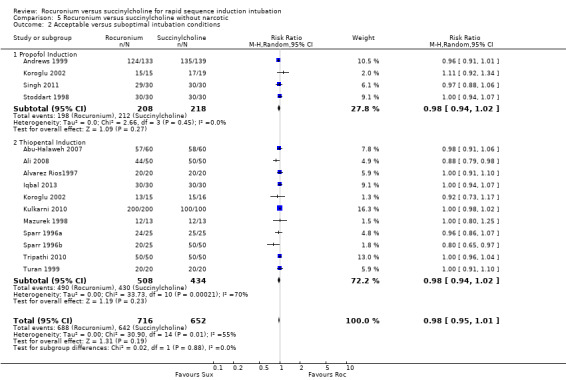
Comparison 5 Rocuronium versus succinylcholine without narcotic, Outcome 2 Acceptable versus suboptimal intubation conditions.
Comparison 6. Comparison of children and adults.
| Outcome or subgroup title | No. of studies | No. of participants | Statistical method | Effect size |
|---|---|---|---|---|
| 1 Excellent versus other intubation conditions | 50 | 4151 | Risk Ratio (M‐H, Random, 95% CI) | 0.86 [0.80, 0.91] |
| 1.1 Adults | 45 | 3615 | Risk Ratio (M‐H, Random, 95% CI) | 0.85 [0.80, 0.92] |
| 1.2 Children | 5 | 536 | Risk Ratio (M‐H, Random, 95% CI) | 0.86 [0.70, 1.06] |
| 2 Acceptable versus suboptimal intubation conditions | 48 | 3992 | Risk Ratio (M‐H, Random, 95% CI) | 0.97 [0.95, 0.99] |
| 2.1 Adults | 43 | 3456 | Risk Ratio (M‐H, Random, 95% CI) | 0.97 [0.95, 0.99] |
| 2.2 Children | 5 | 536 | Risk Ratio (M‐H, Random, 95% CI) | 0.99 [0.97, 1.02] |
6.1. Analysis.

Comparison 6 Comparison of children and adults, Outcome 1 Excellent versus other intubation conditions.
6.2. Analysis.

Comparison 6 Comparison of children and adults, Outcome 2 Acceptable versus suboptimal intubation conditions.
Comparison 7. Rocuronium versus succinylcholine in emergency intubation.
| Outcome or subgroup title | No. of studies | No. of participants | Statistical method | Effect size |
|---|---|---|---|---|
| 1 Excellent versus other intubation conditions | 5 | 1073 | Risk Ratio (M‐H, Random, 95% CI) | 0.84 [0.73, 0.98] |
| 2 Acceptable versus suboptimal intubation conditions | 5 | 1073 | Risk Ratio (M‐H, Random, 95% CI) | 0.98 [0.96, 1.01] |
7.2. Analysis.

Comparison 7 Rocuronium versus succinylcholine in emergency intubation, Outcome 2 Acceptable versus suboptimal intubation conditions.
Comparison 8. Rocuronium versus succinylcholine by blinding of outcome assessment.
| Outcome or subgroup title | No. of studies | No. of participants | Statistical method | Effect size |
|---|---|---|---|---|
| 1 Excellent versus other intubation conditions | 50 | 4151 | Risk Ratio (M‐H, Random, 95% CI) | 0.86 [0.81, 0.92] |
| 1.1 Low Risk | 21 | 1880 | Risk Ratio (M‐H, Random, 95% CI) | 0.83 [0.75, 0.92] |
| 1.2 Unclear Risk | 4 | 229 | Risk Ratio (M‐H, Random, 95% CI) | 0.93 [0.72, 1.18] |
| 1.3 High Risk | 25 | 2042 | Risk Ratio (M‐H, Random, 95% CI) | 0.88 [0.80, 0.96] |
| 2 Acceptable versus suboptimal intubation conditions | 48 | 3992 | Risk Ratio (M‐H, Random, 95% CI) | 0.97 [0.95, 0.99] |
| 2.1 Low Risk | 23 | 1970 | Risk Ratio (M‐H, Random, 95% CI) | 0.97 [0.94, 1.00] |
| 2.2 Unclear Risk | 3 | 110 | Risk Ratio (M‐H, Random, 95% CI) | 0.99 [0.92, 1.07] |
| 2.3 High Risk | 22 | 1912 | Risk Ratio (M‐H, Random, 95% CI) | 0.97 [0.94, 1.00] |
8.2. Analysis.

Comparison 8 Rocuronium versus succinylcholine by blinding of outcome assessment, Outcome 2 Acceptable versus suboptimal intubation conditions.
Characteristics of studies
Characteristics of included studies [ordered by study ID]
Abdulatif 1996.
| Methods | RCT Mixed simulated and modified RSI N = 144 | |
| Participants | ASA I‐II 19 ‐ 57 years Elective OR Baseline comparison information not provided | |
| Interventions | 1. Rocuronium 0.6 mg/kg (n = 24)
2. Succinylcholine 1 mg/kg (n = 24)
3. Atracurium 0.5 mg/kg (n = 24)*
4. above groups with priming dose of Rocuronium (n = 24 each) *
Premedication: diazepam 10 mg po Sequence with: fentanyl 2 mcg/kg, propofol 2.5 ‐ 3.0 mg/kg |
|
| Outcomes | 1. Intubating conditions 60s after muscle relaxant evaluated by blinded observer. Reported as scores (0 ‐ 3) adapted from Fahey et al. Definitions table include vocal cord movement, visualization, participant movement 2. Adductor pollicis response to TOF stimulation |
|
| Adverse events | None reported | |
| Time & Place | Study dates not reported. Article accepted November 1995. King Fahad University Hospital, Al‐Khobar, Saudi Arabia. |
|
| Funding and declarations | Funding source: none declared Declarations of interest: none declared |
|
| Notes | Efficacy analysis | |
| Risk of bias | ||
| Bias | Authors' judgement | Support for judgement |
| Random sequence generation (selection bias) | Low risk | Sealed envelopes |
| Allocation concealment (selection bias) | Low risk | Participants were randomly allocated via closed envelope |
| Blinding of participants and personnel (performance bias) All outcomes | Low risk | Participant asleep and personnel performance does not affect intubating conditions |
| Blinding of outcome assessment (detection bias) All outcomes | High risk | No mention of blinding |
| Incomplete outcome data (attrition bias) All outcomes | Low risk | Data for all participants reported |
| Selective reporting (reporting bias) | Low risk | All outcomes reported |
Abu‐Halaweh 2007.
| Methods | RCT Elective and emergency caesarean section N = 120 |
|
| Participants | ASA I ‐ II Pregnant women Mean age 32 Mean weight 78 kg |
|
| Interventions | 1, Rocuronium 1 mg/kg (n = 60) 2, Succinylcholine 1 mg/kg (n = 60) Sequence with: thiopental 5 mg/kg |
|
| Outcomes | 1. Intubating conditions by senior anaesthetist 60s after muscle relaxant. Reported as excellent, good and poor, as modified Viby‐Mogenson Grading system. Features included jaw relaxation, vocal cord position and diaphragmatic activity | |
| Adverse events | Slight increase in heart rate after 5 mins with rocuronium use. | |
| Time & Place | December 2005 to May 2006 Jordan University Hospital, Jordan |
|
| Funding and declarations | Funding source: none declared Declarations of interest: none declared |
|
| Notes | ||
| Risk of bias | ||
| Bias | Authors' judgement | Support for judgement |
| Random sequence generation (selection bias) | Low risk | Randomly shuffled envelopes, probably adequate |
| Allocation concealment (selection bias) | Low risk | Randomly shuffled sealed envelopes indicating the type of the muscle relaxant to be used for intubation |
| Blinding of participants and personnel (performance bias) All outcomes | Low risk | Participant asleep and personnel performance does not affect intubating conditions |
| Blinding of outcome assessment (detection bias) All outcomes | Low risk | The intubator who was blinded to the type of administered muscle relaxant was called to the theatre 40s after the relaxant administration |
| Incomplete outcome data (attrition bias) All outcomes | Low risk | Data for all participants reported |
| Selective reporting (reporting bias) | Low risk | All outcomes reported |
Alanoglu 2006.
| Methods | RCT Modified RSI N = 119 | |
| Participants | ASA II ‐ III Adult Controlled hypertensive | |
| Interventions | 1. Succinylcholine 1.0 mg/kg with lidocaine (n = 30) 2. Rocuronium 1 mg/kg with lidocaine (n = 30) 3. Succinylcholine 1.0 mg/kg with remifentanil (n = 29) 4. Rocuronium 1.0 mg/kg with remifentanil (n = 30) Sequences with opiate (remifentanil) or no opiate and thiopental | |
| Outcomes | 1. Intubating conditions 60s after muscle relaxant. Reported as excellent, good, poor based on 6 variables (jaw relaxation, resistance to blade, vocal cord position and movement, movement of limbs and coughing) with table of definitions 2. Haemodynamics before inductio, after induction and at intubation | |
| Adverse events | Mild muscle rigidity in 6 participants with the use of remifentanil. | |
| Time & Place | Study dates not reported. Article accepted June 2005 Ankara University, Ankara, Turkey |
|
| Funding and declarations | Funding source: none declared Declarations of interest: none declared |
|
| Notes | ITT analysis | |
| Risk of bias | ||
| Bias | Authors' judgement | Support for judgement |
| Random sequence generation (selection bias) | Low risk | Sealed envelope |
| Allocation concealment (selection bias) | Low risk | Allocated to 4 groups at random by sealed envelope technique |
| Blinding of participants and personnel (performance bias) All outcomes | Low risk | Participant asleep and personnel performance does not affect intubating conditions |
| Blinding of outcome assessment (detection bias) All outcomes | Unclear risk | "Authors performing the intubation and scoring intubation conditions were blinded to the study medications." Unclear if blinded allocation or drug administration |
| Incomplete outcome data (attrition bias) All outcomes | Low risk | Adequately described in detail |
| Selective reporting (reporting bias) | Low risk | All outcomes reported |
Ali 2008.
| Methods | RCT Mixed simulated and modified RSI N = 100 |
|
| Participants | ASA I ‐ II Age 18 ‐ 60 Elective OR |
|
| Interventions | 1. Rocuronium 0.6 mg/kg at 60s (n = 25) 2. Rocuronium 0.6 mg/kg at 90s (n = 25) 3. Succinylcholine 1.5 mg/kg at 60s (n = 25) 4. Succinylcholine 1.5 mg/kg at 90s (n = 25) Sequence with thiopental 5 mg/kg |
|
| Outcomes | Intubation conditions at 60 or 90s after muscle relaxant. Reported as score (0 ‐ 3) based on 3 variables (jaw relaxation, vocal cords and response to intubation) from Cooper et al with definitions table | |
| Adverse events | None reported | |
| Time & Place | Study dates not reported. Article published 2008. Sheri Kashmir Institute of Medical Sciences, Soura, Srinagar, India |
|
| Funding and declarations | Funding source: none declared Declarations of interest: none declared |
|
| Notes | Did not provide results of individuals groups. Used aggregate data, classified as modified RSI | |
| Risk of bias | ||
| Bias | Authors' judgement | Support for judgement |
| Random sequence generation (selection bias) | Unclear risk | "randomized" but did not elaborate |
| Allocation concealment (selection bias) | Unclear risk | Used "double‐blind" fashion |
| Blinding of participants and personnel (performance bias) All outcomes | Low risk | Participant asleep and personnel performance does not affect intubating conditions |
| Blinding of outcome assessment (detection bias) All outcomes | Low risk | Same fully‐trained anaesthetist (Intubator) performed all the intubations, who was called in the study room 45s after the administration of the neuromuscular blocker in group A participants and after 75s in group B participants (to eliminate possible bias because of fasciculations induced by succinylcholine) and intubation was attempted 15s later |
| Incomplete outcome data (attrition bias) All outcomes | Unclear risk | Data were not presented for all 4 groups, aggregated into 2 groups |
| Selective reporting (reporting bias) | Unclear risk | Only aggregate data presented |
Alvarez Rios1997.
| Methods | RCT Modified RSI N = 60 | |
| Participants | ASA I ‐ II Elective OR Mean age 28.5 Mean weight 62.5 kg | |
| Interventions | 1. Rocuronium 0.6 mg/kg (n = 20)
2. Mivacurium 0.25 mg/kg (n = 20)*
3. Succinylcholine 1 mg/kg (n = 20)
Premedication:
midazolam 2 mg Sequence with: no opioid thiopental titrated to response (average 5.3 mg/kg with succinylcholine group and 5.9 mg/kg in rocuronium group) |
|
| Outcomes | 1. Intubating conditions 90s after muscle relaxant. Reported as excellent, good, poor with definitions described for madibular relaxation, vocal cords and participant movement | |
| Adverse events | None reported. | |
| Time & Place | Study dates were not reported. Article published 1997. Mexico |
|
| Funding and declarations | Funding source: none declared Declarations of interest: none declared |
|
| Notes | Efficacy analysis | |
| Risk of bias | ||
| Bias | Authors' judgement | Support for judgement |
| Random sequence generation (selection bias) | Unclear risk | Established groups were formed randomly, but does not state how |
| Allocation concealment (selection bias) | High risk | No comment made |
| Blinding of participants and personnel (performance bias) All outcomes | Low risk | Participant asleep and personnel performance does not affect intubating conditions |
| Blinding of outcome assessment (detection bias) All outcomes | High risk | No statement regarding blinding |
| Incomplete outcome data (attrition bias) All outcomes | Low risk | Data on all participants reported |
| Selective reporting (reporting bias) | Low risk | All outcomes reported |
Andrews 1999.
| Methods | RCT Simulated RSI N = 366 | |
| Participants | ASA I ‐ V 18 ‐ 75 years Elective OR Mean age 47.5 Mean weight 61.5 kg | |
| Interventions | 1. Rocuronium 0.6 mg/kg (n = 48)*
2. Rocuronium 1.0 mg/kg (n = 46)* 3. Rocuronium 1.0 mg/kg (n=133) 4. Succinylcholine 1 mg/kg (n = 139) Sequence with: no opioid, propofol 2.5 mg/kg |
|
| Outcomes | 1. Intubating conditions 50s after muscle relaxant. Reported as excellent, good, poor based on 6 variables (jaw relaxation, resistance to laryngoscope, vocal cord position and movement, limb movement and diaphragmatic activity) with definitions described | |
| Adverse events | None reported. | |
| Time & Place | Study dates not reported. Article accepted September 1998. University of Newcastle‐upon‐Tyne, Turnhout, Belgium |
|
| Funding and declarations | Funding source: Organon Teknika Declarations of interest: none declared |
|
| Notes | Efficacy analysis | |
| Risk of bias | ||
| Bias | Authors' judgement | Support for judgement |
| Random sequence generation (selection bias) | Low risk | States randomly without replacement and stratified for centre |
| Allocation concealment (selection bias) | Low risk | Allocation concealed from investigator performing the randomization |
| Blinding of participants and personnel (performance bias) All outcomes | Low risk | Participant asleep and personnel performance does not affect intubating conditions |
| Blinding of outcome assessment (detection bias) All outcomes | Low risk | "blinding was achieved by concealing patient from the investigator until immediately before laryngoscopy." |
| Incomplete outcome data (attrition bias) All outcomes | Low risk | All participants accounted for |
| Selective reporting (reporting bias) | Low risk | All outcomes reported |
Belyamani 2008.
| Methods | RCT Simulated RSI N = 80 |
|
| Participants | ASA I ‐ II Elective OR Mean age 34 Mean BMI 23.5 |
|
| Interventions | 1. Succinylcholine 1 mg/kg + ephedrine (n = 20)* 2. Rocuronium 0.6 mg/kg + ephedrine (n = 20)* 3. Succinylcholine 1 mg/kg + saline (n = 20) 4. Rocuronium 0.6 mg/kg + saline (n = 20) Premedication: Hydroxyzine 1 mg/kg Sequence with: propofol 2.5 mg/kg, fentanyl 3 mcg/kg |
|
| Outcomes | 1. Intubation conditions 30s after muscle relaxant. Reported as excellent, good, poor based on criteria from the Copenhagen conference. No definitions provided 2. Heart rate, blood pressure |
|
| Adverse events | None reported | |
| Time & Place | Study dates not reported. Article accepted December 2007. Mohammed‐V Military Hospital, Rabat, Maroc |
|
| Funding and declarations | Funding source: none declared Declarations of interest: none declared |
|
| Notes | In French. | |
| Risk of bias | ||
| Bias | Authors' judgement | Support for judgement |
| Random sequence generation (selection bias) | Low risk | Used a randomization table |
| Allocation concealment (selection bias) | Low risk | The participant and the anaesthesiologist were not informed of the contents of the syringes (prepared by a separate individual) |
| Blinding of participants and personnel (performance bias) All outcomes | Low risk | Participant asleep and personnel performance does not affect intubating conditions |
| Blinding of outcome assessment (detection bias) All outcomes | Low risk | 30s after injection of the muscle relaxant, another blinded staff anaesthetist performed intubation of the participant |
| Incomplete outcome data (attrition bias) All outcomes | Low risk | All cases reported |
| Selective reporting (reporting bias) | Low risk | All outcomes reported |
Cheng 2002.
| Methods | RCT Modified RSI N = 120 | |
| Participants | ASA I 1 ‐ 10 years Elective OR | |
| Interventions | 1. Rocuronium 0.6 mg/kg (n = 40) 2. Rocuronium 0.9 mg/kg (n = 40) 3. Succinylcholine 1.5 mg/kg (n = 40) Sequence with: alfentanil 10 mcg/kg, thiopentone 5 mg/kg | |
| Outcomes | 1. Intubating conditions 30s after muscle relaxant. Reported as excellent, good, poor and impossible with table of definitions. Clinical features included: vocal cord movement, participant response to intubation and jaw relaxation | |
| Adverse events | One participant developed bronchospasm during intubation after receiving rocuronium 0.9 mg/kg. This resolved spontaneously. | |
| Time & Place | Study dates not reported. Article published 2002. Prince of Wales Hospital, New Territories, Hong Kong |
|
| Funding and declarations | Funding source: Organon Teknika China Ltd provided rocuronium for study. Declarations of interest: none declared |
|
| Notes | ITT analysis | |
| Risk of bias | ||
| Bias | Authors' judgement | Support for judgement |
| Random sequence generation (selection bias) | Low risk | Randomized by sealed envelopes |
| Allocation concealment (selection bias) | Low risk | "children were randomly assigned by means of opaque, sealed envelopes" |
| Blinding of participants and personnel (performance bias) All outcomes | Low risk | Participant asleep and personnel performance does not affect intubating conditions |
| Blinding of outcome assessment (detection bias) All outcomes | Low risk | "observer had her back turned to the patient during the 30s before attempting to intubate" |
| Incomplete outcome data (attrition bias) All outcomes | Low risk | All cases reported |
| Selective reporting (reporting bias) | Low risk | All outcomes reported |
Chiu 1999.
| Methods | RCT Simulated RSI N = 30 | |
| Participants | ASA I 18 ‐ 50 years Elective OR Mean age 32.4 Mean weight 55.6 kg | |
| Interventions | 1. Rocuronium 0.9 mg/kg (n = 15)
2. Succinylcholine 1 mg/kg (n = 15)
Premedication: midazolam 0.15 mg/kg po Sequence with: fentanyl 2 mcg/kg, propofol 2 mg/kg |
|
| Outcomes | 1. Intraocular pressure, mean arterial pressure, heart rate measured before induction, immediately after induction and every minute after intubation for 5 mins 2. Intubating conditions 60s after muscle relaxant. Reported as a score (1 ‐ 4) described in Methods section. Clinical variables included jaw relaxation, vocal cord movement, diaphragm movement | |
| Adverse events | None reported. | |
| Time & Place | Study dates not reported. Article accepted January 1999. Univeristy of Malaya, Kuala Lumpur, Malaysia |
|
| Funding and declarations | Funding source: Organon Teknika (Malaysia) supplied rocuronium. Kemajuan Abadi Optomedic (Malaysia) supplied Keeler Pulsair air pulse tonometer. Declarations of interest: none declared |
|
| Notes | Efficacy analysis | |
| Risk of bias | ||
| Bias | Authors' judgement | Support for judgement |
| Random sequence generation (selection bias) | Unclear risk | "randomized, double‐blind, controlled study", but does not elaborate |
| Allocation concealment (selection bias) | Low risk | "drugs were administered ...by one anaesthetist (CYW) who was unaware of the drugs administered" |
| Blinding of participants and personnel (performance bias) All outcomes | Low risk | Participant asleep and personnel performance does not affect intubating conditions |
| Blinding of outcome assessment (detection bias) All outcomes | Low risk | "the intubating anesthetist were not allowed to observe injection of the neuromuscular blocking drug or the presence of any fasciculations, by standing initially with their back to the patient. They were then asked to turn round to face the patient, 45 s after injection of either succinylcholine or rocuronium; by then the fasciculations had subsided" |
| Incomplete outcome data (attrition bias) All outcomes | Low risk | All cases reported |
| Selective reporting (reporting bias) | Low risk | All outcomes reported |
Chung 2001.
| Methods | RCT Simulated RSI N = 84 | |
| Participants | ASA I ‐ II Adult Elective OR Mean age 45.8 | |
| Interventions | 1. Rocuronium 0.6 mg/kg and then thiopental 5 mg/kg (n = 28)*
2. Thiopental 5 mg/kg and then succinylcholine 1 mg/kg (n = 29) 3. Thiopental 5 mg/kg and then rocuronium 0.6 mg/kg (n = 27) Sequence with: fentanyl 2 mcg/kg, lidocaine 20 mg |
|
| Outcomes | 1. Intubating conditions 60s after muscle relaxant. Reported as excellent, good and poor from a score (0 ‐ 9) (from Cooper et al ) based on 3 variables (ease of laryngoscopy, condition of vocal cords, response to intubation) and defined in a table 2. Apnea time before laryngoscopy 3. Intubation time 4. Total apnoea time |
|
| Adverse events | 5 participants in Group 1 and 1 in Group 2 had pain in injection. 3 in Group 1 had diminished breathing during induction. 1 in Group 1 had mild desaturation. | |
| Time & Place | Study dates not reported. Article accepted September 2000. Changhua Christian Hospital, Changhau, Taiwan |
|
| Funding and declarations | Funding source: none declared Declarations of interest: none declared |
|
| Notes | Efficacy analysis | |
| Risk of bias | ||
| Bias | Authors' judgement | Support for judgement |
| Random sequence generation (selection bias) | Unclear risk | "patients were randomly allocated", but did not elaborate |
| Allocation concealment (selection bias) | High risk | Not mentioned |
| Blinding of participants and personnel (performance bias) All outcomes | Low risk | Participant asleep and personnel performance does not affect intubating conditions |
| Blinding of outcome assessment (detection bias) All outcomes | High risk | Not mentioned |
| Incomplete outcome data (attrition bias) All outcomes | Low risk | All participants accounted for, 6/90 participants excluded due to "invisible vocal cords after several attempts" |
| Selective reporting (reporting bias) | Low risk | All outcomes reported |
Cooper 1992.
| Methods | RCT Modified RSI N = 80 | |
| Participants | ASA I ‐ II 18 ‐ 65 years Elective OR Mean age 34.5 Mean weight 66.3 kg | |
| Interventions | 1. Rocuronium 0.6 mg/kg (n = 40)
2. Succinylcholine 1 mg/kg (n = 40)
Premedication: temazepam 10 ‐ 20 mg po Sequence with: fentanyl 1 ‐ 3 mcg/kg, thiopentone 3 ‐ 5 mg/kg |
|
| Outcomes | 1. Intubating conditions 60 and 90s after muscle relaxant. Reported as excellent, good and poor from a score (0 ‐ 9) based on 3 variables (jaw relaxation, vocal cords, response to intubation), defined in table | |
| Adverse events | None reported. | |
| Time & Place | Study dates not reported. Article accepted March 1992. Queen's University, Belfast, Britain |
|
| Funding and declarations | Funding source: rocuronium supplied by Organon Teknika, Belgium Declarations of interest: none declared |
|
| Notes | Efficacy analysis | |
| Risk of bias | ||
| Bias | Authors' judgement | Support for judgement |
| Random sequence generation (selection bias) | Unclear risk | "patients were allocated randomly" |
| Allocation concealment (selection bias) | Unclear risk | "patients were allocated randomly" |
| Blinding of participants and personnel (performance bias) All outcomes | Low risk | Participant asleep and personnel performance does not affect intubating conditions |
| Blinding of outcome assessment (detection bias) All outcomes | High risk | No comment on blinding |
| Incomplete outcome data (attrition bias) All outcomes | Low risk | All cases reported |
| Selective reporting (reporting bias) | Low risk | All outcomes reported |
De Almeida 2009.
| Methods | Controlled Trial Simulated RSI N = 80 |
|
| Participants | ASA I ‐ III Elective bariatric surgery Morbidly obese participants BMI ≥ 40 18 ‐ 65 yrs Mean age 39 Mean weight 128 kg |
|
| Interventions | 1. Succinylcholine 1 mg/kg ideal body weight (n = 20)* 2. Succinylcholine 1 mg/kg total body weight (n = 20) 3. Rocuronium 0.6 mg/kg ideal body weight (n = 20)* 4. Rocuronium 0.6 mg/kg total body weight (n = 20) Premedication: midazolam 7.5 mg Sequence with: propofol 2 mg/kg, fentanyl 2 mcg/kg |
|
| Outcomes | Intubation conditions 60s after intubation. Reported as excellent, good, poor based on 5 variables (laryngoscopy, vocal cord position, vocal cord movement, reaction to tube insertion, limb movement with tube insertion) described in a table | |
| Adverse events | None reported. | |
| Time & Place | March 2005 to March 2007. Federal University of Santa Catarina, Santa Catarina, Brazil |
|
| Funding and declarations | Funding source: none declared Declarations of interest: none declared |
|
| Notes | Paper written in Spanish. | |
| Risk of bias | ||
| Bias | Authors' judgement | Support for judgement |
| Random sequence generation (selection bias) | High risk | No mention of randomization |
| Allocation concealment (selection bias) | High risk | No comment made |
| Blinding of participants and personnel (performance bias) All outcomes | Low risk | Participant asleep and personnel performance does not affect intubating conditions. |
| Blinding of outcome assessment (detection bias) All outcomes | High risk | No description or comment on blinding |
| Incomplete outcome data (attrition bias) All outcomes | Low risk | All cases reported |
| Selective reporting (reporting bias) | Low risk | All outcomes reported |
Dubois 1995.
| Methods | RCT Modified RSI N = 24 | |
| Participants | ASA I ‐ II 18 ‐ 65 years Elective OR Baseline information not provided (told groups tested and no difference) | |
| Interventions | 1. Rocuronium 0.6 mg/kg (n = 12)
2. Succinylcholine 1 mg/kg (n = 12)
Premedication: midazolam 2 ‐ 5 mg iv and/or droperidol 1.25 ‐ 5mg iv Sequence with: fentanyl 1 ‐ 10 mcg/kg, thiopentone 3 ‐ 5 mg/kg |
|
| Outcomes | 1. Intubating conditions after 80% first twitch depression of TOF. Reported as excellent good, poor and inadequate based 3 variables (jaw relaxation, vocal cord movement, diaphragm) described in Methods section 2. Heart rate and blood pressure 2. Onset time of muscle relaxant |
|
| Adverse events | 5 participants had fasciculations. 2 had skin rash and one experienced hypersalivation. | |
| Time & Place | Study dates not reported. Article accepted March 1994. Georgetown University Medical Center, Washington, DC, USA. |
|
| Funding and declarations | Funding source: Support of Clinical Project Director Organon Inc. Declarations of interest: none declared |
|
| Notes | Efficacy analysis | |
| Risk of bias | ||
| Bias | Authors' judgement | Support for judgement |
| Random sequence generation (selection bias) | Low risk | Randomly assigned via computer generation |
| Allocation concealment (selection bias) | Low risk | "either R or S in a coded syringe prepared by the pharmacist was given" |
| Blinding of participants and personnel (performance bias) All outcomes | Low risk | Participant asleep and personnel performance does not affect intubating conditions |
| Blinding of outcome assessment (detection bias) All outcomes | Low risk | "the investigator intubator was blinded to the muscle relaxant randomization scheme and not in the operating room for drug administration" |
| Incomplete outcome data (attrition bias) All outcomes | Unclear risk | "The other 6 patients were dropped because of incomplete data retrieval". Did not say why data were missing |
| Selective reporting (reporting bias) | Unclear risk | Outcomes for excluded participants not reported |
Giudice 1998.
| Methods | RCT Modified RSI N = 40 | |
| Participants | ASA I ‐ II Age 18 ‐ 56 Mean age uncertain but told groups homogeneous Mean weight also homogeneous | |
| Interventions | 1. Rocuronium 0.3 mg/kg (n = 10)*
2. Rocuronium 0.6 mg/kg (n = 10)
3. Rocuronium 0.9 mg/kg (n = 10)
4. Succinylcholine 1 mg/kg (n = 10)
Premedication: lorazepam 1 mg po 1 hour prior, atropine 0.08 mg/kg few minutes prior Sequence with: fentanyl prn, propofol 1.5 mg/kg |
|
| Outcomes | 1. Intubating conditions when T1 of TOF ≤ 5%. Reported as a score (0 ‐ 6). Variables not presented for score assessment 2. Recovery of T1 to 25% 3. Intubating time 4. Recovery time |
|
| Adverse events | None reported. | |
| Time & Place | Study dates not reported. Article accepted August 1998. Italy |
|
| Funding and declarations | Funding source: none declared Declarations of interest: none declared |
|
| Notes | Italian | |
| Risk of bias | ||
| Bias | Authors' judgement | Support for judgement |
| Random sequence generation (selection bias) | Unclear risk | "patients were randomly allocated into four groups" |
| Allocation concealment (selection bias) | High risk | Not mentioned |
| Blinding of participants and personnel (performance bias) All outcomes | Low risk | Participant asleep and personnel performance does not affect intubating conditions |
| Blinding of outcome assessment (detection bias) All outcomes | High risk | No comment |
| Incomplete outcome data (attrition bias) All outcomes | Low risk | All cases reported |
| Selective reporting (reporting bias) | Low risk | All outcomes reported |
Iqbal 2013.
| Methods | RCT Simulated RSI N = 60 |
|
| Participants | ASA I ‐ II Adult elective surgery Age 20 ‐ 60 yrs |
|
| Interventions | 1. Rocuronium 0.9 mg/kg (n = 30) 2. Succinylcholine 1.5 mg/kg (n = 30) Sequence with: thiopental 5 mg/kg No premeds |
|
| Outcomes | Intubating conditions 60s after induction drugs. Reported as excellent, good, poor and not possible based on 3 variables (jaw relaxation, vocal cords and response to tube) from modification of Goldberg et and Krieg et al. | |
| Adverse events | None reported. | |
| Time & Place | January to August 2009. Civil Hospital Karachi, Karachi, Pakistan |
|
| Funding and declarations | Funding source: none declared Declarations of interest: none declared |
|
| Notes | ||
| Risk of bias | ||
| Bias | Authors' judgement | Support for judgement |
| Random sequence generation (selection bias) | Unclear risk | "randomized", did not elaborate |
| Allocation concealment (selection bias) | Low risk | "double‐blind manner" |
| Blinding of participants and personnel (performance bias) All outcomes | Low risk | Participant asleep and personnel performance does not affect intubating conditions |
| Blinding of outcome assessment (detection bias) All outcomes | Low risk | "endotracheal intubation was done blinded by standing with the back to the patient." |
| Incomplete outcome data (attrition bias) All outcomes | Low risk | All cases reported |
| Selective reporting (reporting bias) | Low risk | All outcomes reported |
Koroglu 2002.
| Methods | RCT Simulated RSI N = 80 | |
| Participants | ASA I ‐ II Adult women Pregnant | |
| Interventions | 1. Rocuronium 0.6 mg/kg and propofol 2 mg/kg (n = 20)
2. Succinylcholine 1.5 mg/kg and propofol 2 mg/kg (n = 20) 3. Rocuronium 0.6 mg/kg and thiopentone 5 mg/kg (n = 20) 4. Succinylcholine 1.5 mg/kg and thiopentone 5 mg/kg (n = 20) |
|
| Outcomes | 1. Intubations conditions. Started intubation 20s after muscle relaxant, intubated according to clinical conditions. Reported as excellent, good, poor based on 3 variables (jaw relaxation, vocal cord movement, reaction to tube) and score (0 ‐ 9) from Cooper et al. 2. Time to intubations 3. Neuromuscular conduction in musculus adductor pollicis by TOF 3. Umbilical arterial and venous blood gas values |
|
| Adverse events | None reported. | |
| Time & Place | Study dates not reported. Article published 2002. Dokuz Eylul University, Turkey |
|
| Funding and declarations | Funding source: none declared Declarations of interest: none declared |
|
| Notes | Efficacy analysis In Turkish | |
| Risk of bias | ||
| Bias | Authors' judgement | Support for judgement |
| Random sequence generation (selection bias) | High risk | "patients were numbered according to their order of arrival to the surgery" |
| Allocation concealment (selection bias) | High risk | No comment made |
| Blinding of participants and personnel (performance bias) All outcomes | Low risk | Participant asleep and personnel performance does not affect intubating conditions |
| Blinding of outcome assessment (detection bias) All outcomes | High risk | No comment made |
| Incomplete outcome data (attrition bias) All outcomes | Unclear risk | All cases were accounted for |
| Selective reporting (reporting bias) | Low risk | All outcomes reported |
Kulkarni 2010.
| Methods | RCT Modified RSI N = 300 |
|
| Participants | ASA I ‐ II Elective cleft palate repair OR Age 1 ‐ 10 Mean age 4 Mean weight 17 kg Mallampati I ‐ II |
|
| Interventions | 1. Succinylcholine 1.5 mg/kg (n = 100) 2. Rocuronium 0.6 mg/kg (n = 100) 3. Rocuronium 0.9 mg/kg (n = 100) Premedication: glycopyrrolate 0.004 mg/kg IM, midazolam 0.05 mg/kg IM, ketamine 5 mg/kg IM for younger children, tramadol 1 mg/kg iv Sequence with: thiopental 6 ‐ 8 mg/kg |
|
| Outcomes | 1. Intubation conditions at 60s after muscle relaxant. Reported as excellent, good, poor, inadequate according to intubation scoring system as per Mangorian et al. Based on 3 clinical variables: jaw relaxation, vocal cord movement and diaphragmatic movements 2. Intubation time 3. Duration of muscle relaxation with TOF monitoring 4. Clinical recovery |
|
| Adverse events | Tachycardia in all three groups (58‐66%) | |
| Time & Place | October 2003 to September 2008. Lotus Hospital & Research Center, Kolhapur, Maharashtra, India |
|
| Funding and declarations | Funding source: none declared Declarations of interest: none declared |
|
| Notes | used oral RAE tubes | |
| Risk of bias | ||
| Bias | Authors' judgement | Support for judgement |
| Random sequence generation (selection bias) | Unclear risk | "randomly divided in three groups" |
| Allocation concealment (selection bias) | High risk | No comment made |
| Blinding of participants and personnel (performance bias) All outcomes | Low risk | Participant asleep and personnel performance does not affect intubating conditions |
| Blinding of outcome assessment (detection bias) All outcomes | High risk | No comment made |
| Incomplete outcome data (attrition bias) All outcomes | Low risk | All cases presented |
| Selective reporting (reporting bias) | Low risk | All outcomes reported |
Kwon 2013.
| Methods | RCT Modified RSI N = 40 |
|
| Participants | ASA I ‐ II Elective OR Mean age 43 Mean weight 61 kg |
|
| Interventions | 1. Succinylcholine 1.5 mg/kg (n = 20) 2. Rocuronium 0.6 mg/kg (n = 20) Sequence with: lidocaine 60 mg, fentanyl 1.5 mcg/kg, propofol 1.5 mg/kg |
|
| Outcomes | 1. Intubating conditions (with loss of consciousness for rocuronium group and 60s after succinylcholine). Reported as excellent, acceptable and poor based on a score. Variables included: mandibular relaxation, resistance to blade insertion, vocal cord position and movement, limb response, coughing 2. Timing of events 3. Complications of intubation: awareness, respiratory difficulty postoperatively |
|
| Adverse events | 3 participants who received rocuronium complained of injection pain. | |
| Time & Place | Study dates were not reported. Article accepted September 2012 Dankook University, Cheonan, Korea |
|
| Funding and declarations | Funding source: none declared Declarations of interest: none declared |
|
| Notes | ||
| Risk of bias | ||
| Bias | Authors' judgement | Support for judgement |
| Random sequence generation (selection bias) | Unclear risk | "patients were randomly assigned" |
| Allocation concealment (selection bias) | Low risk | "tracheal intubation were performed...by an experienced anesthesiologist who was blinded to the anesthetic drug" |
| Blinding of participants and personnel (performance bias) All outcomes | Low risk | Participant asleep and personnel performance does not affect intubating conditions |
| Blinding of outcome assessment (detection bias) All outcomes | Unclear risk | No blinding mentioned |
| Incomplete outcome data (attrition bias) All outcomes | Low risk | All cases were reported |
| Selective reporting (reporting bias) | Low risk | All outcomes reported |
Lam 2000.
| Methods | RCT Modified RSI N = 30 | |
| Participants | ASA I ‐ II 18 ‐ 65 years Elective OR | |
| Interventions | 1. Rocuronium 0.6 mg/kg (n = 15)
2. Succinylcholine 1 mg/kg (n = 15)
Premedication: midazolam 2 mg Sequence with: fentanyl 2 mcg/kg, propofol 2.5 mg/kg |
|
| Outcomes | 1. Intubating conditions 60s after muscle relaxant. Intubation conditions were reported by the same blinded individual as excellent, good, poor and inadequate based on jaw relaxation, vocal cord position and movement, and diaphragm movement 2. Onset muscle relaxation with TOF 3. Offset muscle relaxation with TOF | |
| Adverse events | None reported. | |
| Time & Place | Study dates not reported. Article accepted August 2000. University of Washington, Seattle, USA |
|
| Funding and declarations | Funding source: Organon West Orange, New Jersey Declarations of interest: none declared |
|
| Notes | Efficacy analysis | |
| Risk of bias | ||
| Bias | Authors' judgement | Support for judgement |
| Random sequence generation (selection bias) | Low risk | Computer generated |
| Allocation concealment (selection bias) | Low risk | Intubator unaware of drug |
| Blinding of participants and personnel (performance bias) All outcomes | Low risk | Participant asleep and personnel performance does not affect intubating conditions |
| Blinding of outcome assessment (detection bias) All outcomes | High risk | "there were no attempts made to blind the individual" |
| Incomplete outcome data (attrition bias) All outcomes | Low risk | Complete data set |
| Selective reporting (reporting bias) | Low risk | All outcomes reported |
Larsen 2005.
| Methods | RCT Simulated RSI N = 209 | |
| Participants | ASA I ‐ III > 17 years Emergency OR | |
| Interventions | 1. Rocuronium 0.6 mg/kg (n = 102)
2. Succinylcholine 1 mg/kg (n = 107)
Premedication: i.m morphine 30 mins prior Sequence with: alfentanil 10 ‐ 20 ug/kg, propofol 2 ‐ 3 mg/kg |
|
| Outcomes | 1. Intubating conditions 60s after muscle relaxant by senior anaesthesiologist. Intubations not achieved in 30s were recorded as failed. Reported as excellent, good, poor and first attempt failed. Based on 5 variables: ease of laryngoscopy, position of vocal cords, movement of vocal cords, movement of limbs and coughing during tracheal intubation 2. Heart rate and blood pressure | |
| Adverse events | 1 participant in Group 2 had atrial fibrillation requiring treatment verapamil and sotalol. Hypotension requiring treatment with ephedrine occurred in 18 Group2 and 17 Group 1. Five participants in Grp 2 and 2 in Group1 reported postoperative muscle pain. | |
| Time & Place | Study dates not reported. Article accepted June 2005. University of Copenhagen, Glostrup, Denmark |
|
| Funding and declarations | Funding source: none declared Declarations of interest: none declared |
|
| Notes | Efficacy analysis | |
| Risk of bias | ||
| Bias | Authors' judgement | Support for judgement |
| Random sequence generation (selection bias) | Low risk | Sealed envelopes |
| Allocation concealment (selection bias) | Low risk | The participant was allocated by the concealed envelope method |
| Blinding of participants and personnel (performance bias) All outcomes | Low risk | Participant asleep and personnel performance does not affect intubating conditions |
| Blinding of outcome assessment (detection bias) All outcomes | Low risk | "anaesthesiologist (a senior member of the study group) blinded to the muscle relaxant and concealed in a room next to the operation theatre until 40 secs after its administration, hereby preventing him from seeing fasciculations after succinylcholine" |
| Incomplete outcome data (attrition bias) All outcomes | Low risk | All cases accounted for |
| Selective reporting (reporting bias) | Low risk | All outcomes reported |
Latorre 1996.
| Methods | RCT Modified RSI N = 40 | |
| Participants | ASA I ‐ III Age 18‐62, mean 44.5 Mean weight 73.5 kg | |
| Interventions | 1. Rocuronium 0.6 mg/kg (n = 20) 2. Succinylcholine 1 mg/kg (n = 20) Sequence with: fentanyl 2 ‐ 3 mcg/kg, propofol 1.5 ‐ 2.0 mg/kg | |
| Outcomes | 1. Intubating conditions 60s after muscle relaxant. Reported as score based on clinical variables: laryngoscopy, vocal cord movement and coughing
2. Onset time
3. Clinical duration of muscle block with EMG recordings on adductor pollicis
4. % blocked at time of intubation 5. Heart rate, blood pressure and arterial oxygen saturation |
|
| Adverse events | None reported. | |
| Time & Place | Study dates not reported. University of Johannes‐Gutenberg, Mainz, Germany |
|
| Funding and declarations | Funding source: none declared Declarations of interest: none declared |
|
| Notes | In German | |
| Risk of bias | ||
| Bias | Authors' judgement | Support for judgement |
| Random sequence generation (selection bias) | Unclear risk | "patients were allocated randomly" |
| Allocation concealment (selection bias) | Low risk | Examiner did not know which drug was injected |
| Blinding of participants and personnel (performance bias) All outcomes | Low risk | Participant asleep and personnel performance does not affect intubating conditions |
| Blinding of outcome assessment (detection bias) All outcomes | High risk | No comment |
| Incomplete outcome data (attrition bias) All outcomes | Low risk | All cases accounted for |
| Selective reporting (reporting bias) | Low risk | All outcomes reported |
Le Corre 1999.
| Methods | RCT Modified RSI N = 150 | |
| Participants | ASA I ‐ II 18 ‐ 75 years Elective OR Mean age 47.5 Mean weight 61.5 kg | |
| Interventions | 1. Rocuronium 0.6 mg/kg (n = 30)
2. Succinylcholine 1 mg/kg (n = 30)
3. Atracurium 0.5 mg/kg (n = 30)*
4. Mivacurium 0.2 mg/kg (n = 30)* 5. Vecuronium 0.08 mg/kg (n = 30)* Premedication: alprazolam 0.5 mg/kg po Sequence with: fentanyl 3 mcg/kg, propofol 2.5 mg/kg |
|
| Outcomes | 1. Time to complete disappearance of response to orbicularis oculi after TOF stimulation 2. Intubation conditions reported as excellent, good, poor and impossible. Scale variables were vocal cord movement and ease of laryngoscopy. | |
| Adverse events | None reported. | |
| Time & Place | Study dates not reported. Article accepted June 1999. Jean Bernard Hospital, Poitiers, France |
|
| Funding and declarations | Funding source: none declared Declarations of interest: none declared |
|
| Notes | Efficacy analysis | |
| Risk of bias | ||
| Bias | Authors' judgement | Support for judgement |
| Random sequence generation (selection bias) | Unclear risk | "random allocation" |
| Allocation concealment (selection bias) | Low risk | "intubation was performed by another physician unaware of muscle relaxant injected" |
| Blinding of participants and personnel (performance bias) All outcomes | Low risk | Participant asleep and personnel performance does not affect intubating conditions |
| Blinding of outcome assessment (detection bias) All outcomes | Low risk | "onset time of neuromuscular blockade ...was estimated by a blinded physician who was not involved in the intubating procedure. When the orbicularis oculi was completely blocked, intubation was performed by another physician " |
| Incomplete outcome data (attrition bias) All outcomes | High risk | Participants were excluded from the final analysis in 2 cases: 1) when the vocal cords were not completely visualized during the laryngoscopy and 2) when onset time was longer than 300s. In participants not fully paralysed after 300s after the administration of the muscle relaxant, intubation was performed after giving a supplemental dose of muscle relaxant |
| Selective reporting (reporting bias) | Unclear risk | due to incomplete outcome data, difficult to assess. |
Magorian 1993.
| Methods | RCT Modified RSI N = 50 | |
| Participants | ASA I III
18 ‐ 70 years
uncertain location
Mean age 36
Mean weight 68 kg Mallampati 1 or 2 airway and no contraindication to RSI |
|
| Interventions | 1. Rocuronium 0.6 mg/kg (n = 10)
2. Rocuronium 0.9 mg/kg (n = 10)
3. Rocuronium 1.2 mg/kg (n = 10)
4. Vecuronium 0.1 mg/kg (n = 10)*
5. Succinylcholine 1 mg/kg (n = 10)
Premedication: midazolam 0.02‐0.05 mg/kg Sequence with: fentanyl (?dose), thiopental 2 ‐ 7 mg/kg |
|
| Outcomes | 1. Ablation of T1 (onset) 2. Return of T1 to 25% of duration 3. Intubation conditions 60s after muscle relaxant. Reported as excellent, good, poor, inadequate based on jaw relaxation, vocal cord movement and diaphragm movement 4. Presence of fasciculations | |
| Adverse events | None reported. | |
| Time & Place | Study dates not reported. Article accepted June 1993 University of California, San Franscisco, USA. |
|
| Funding and declarations | Funding source: none declared Declarations of interest: none declared |
|
| Notes | Efficacy analysis | |
| Risk of bias | ||
| Bias | Authors' judgement | Support for judgement |
| Random sequence generation (selection bias) | Unclear risk | "randomly designated" |
| Allocation concealment (selection bias) | Low risk | "intubation of trachea was attempted by a clinician who was blinded to the muscle relaxant administered" |
| Blinding of participants and personnel (performance bias) All outcomes | Low risk | Participant asleep and personnel performance does not affect intubating conditions |
| Blinding of outcome assessment (detection bias) All outcomes | High risk | "Intubating conditions were judged by each clinician, and the presence or absence of fasciculations was noted" |
| Incomplete outcome data (attrition bias) All outcomes | Low risk | All cases reported |
| Selective reporting (reporting bias) | Low risk | All outcomes reported |
Malik 2004.
| Methods | RCT Simulated RSI N = 60 | |
| Participants | ASA I ‐ II 20 ‐ 50 years Elective non‐ophthalmic surgery | |
| Interventions | 1. Rocuronium 0.9 mg/kg (n = 30) 2. Succinylcholine 1.5mg/kg (n = 30) Sequence with an opiate and thiopental | |
| Outcomes | 1. Intubation conditions 60s after muscle relaxants. Reported as excellent, adequate and poor as per Abbott and Samuel. Variables included jaw relaxation, vocal cord position and cough reflex 2. Heart rate and blood pressure before, just after and 1,3, 5 mins after intubation 3. Intraocular pressure | |
| Adverse events | None reported. | |
| Time & Place | Study dates not reported. Article published 2004. Rohtak, India |
|
| Funding and declarations | Funding source: none declared Declarations of interest: none declared |
|
| Notes | Efficacy analysis | |
| Risk of bias | ||
| Bias | Authors' judgement | Support for judgement |
| Random sequence generation (selection bias) | Unclear risk | "randomly allocated" |
| Allocation concealment (selection bias) | High risk | No comment made |
| Blinding of participants and personnel (performance bias) All outcomes | Low risk | Participant asleep and personnel performance does not affect intubating conditions |
| Blinding of outcome assessment (detection bias) All outcomes | High risk | No comment made |
| Incomplete outcome data (attrition bias) All outcomes | Low risk | All cases reported |
| Selective reporting (reporting bias) | Low risk | All outcomes reported |
Marsch 2011.
| Methods | RCT Simulated RSI N = 401 |
|
| Participants | Emergency ICU Age ≥ 18 yrs Mean age 62 Mean weight 73 kg |
|
| Interventions | 1. Rocuronium 0.6 mg/kg (n = 201) 2. Succinylcholine 1 mg/kg (n = 200) Sequence with: fentanyl 1 mcg/kg, propofol 1 mg/kg or etomidate 0.2 mg/kg |
|
| Outcomes | 1. Incidence of desaturation ≥ 5% by pulse oximetry 2. Duration of intubation sequence 3. Incidence of failed first intubation 4. Intubation conditions after fasciculations stopped or 60s from muscle relaxant injection. Reported as excellent, good and poor based on a score from 6 clinical variables (laryngoscopy, vocal cords position, vocal cord movement and intubation response with regard to coughing and limb movement). 5. Haemodynamic consequences |
|
| Adverse events | None reported | |
| Time & Place | August 2006 to June 2010 University Hospital of Basel, Basel, Switzerland. |
|
| Funding and declarations | Funding source: none declared Declarations of interest: none declared |
|
| Notes | ||
| Risk of bias | ||
| Bias | Authors' judgement | Support for judgement |
| Random sequence generation (selection bias) | Low risk | Stratified randomization by gender was used to ensure a similar distribution of gender in both groups |
| Allocation concealment (selection bias) | Low risk | Using sealed envelopes, participants were randomly allocated by the study physician |
| Blinding of participants and personnel (performance bias) All outcomes | Low risk | Participant asleep and personnel performance does not affect intubating conditions |
| Blinding of outcome assessment (detection bias) All outcomes | High risk | Outcome assessor was unblinded |
| Incomplete outcome data (attrition bias) All outcomes | Low risk | All cases accounted for |
| Selective reporting (reporting bias) | Low risk | All outcomes reported |
Mazurek 1998.
| Methods | RCT Simulated RSI N = 26 | |
| Participants | ASA I ‐ III 2 ‐ 15 years Emergency OR Mean age 6.6 Mean weight 28 kg | |
| Interventions | 1. Rocuronium 1.2 mg/kg (n = 13) 2. Succinylcholine 1.5 mg/kg (n = 13) Sequence with: atropine 0.01 mg/kg, thiopental 5 mg/kg | |
| Outcomes | 1. Onset and quality of muscle paralysis with TOF
2. Intubation conditions 30s after muscle relaxant. Reported excellent, good, fair and poor from a score based on jaw relaxation, vocal cords and response to tube. 3. Onset of apnoea |
|
| Adverse events | Precipitation of thiopental and rocuronium during induction in one case. | |
| Time & Place | Study dates not reported. Article accepted for publication September 1998 Chicago, USA. |
|
| Funding and declarations | Funding source: none declared Declarations of interest: none declared |
|
| Notes | Efficacy analysis | |
| Risk of bias | ||
| Bias | Authors' judgement | Support for judgement |
| Random sequence generation (selection bias) | Low risk | Participants were randomized using a random numbers table |
| Allocation concealment (selection bias) | Low risk | "all investigators except the one designated to dispense the study drug were blinded to choice of muscle relaxant" |
| Blinding of participants and personnel (performance bias) All outcomes | Low risk | Participant asleep and personnel performance does not affect intubating conditions |
| Blinding of outcome assessment (detection bias) All outcomes | Low risk | "The investigators performed the laryngoscopies but were blinded to the relaxant by standing with their back to the patient during the induction so that they could not detect fasciculations." |
| Incomplete outcome data (attrition bias) All outcomes | Low risk | No missing data |
| Selective reporting (reporting bias) | Low risk | All outcomes reported |
McCourt 1998.
| Methods | RCT Simulated RSI N = 318 | |
| Participants | ASA I ‐ IV 18 ‐ 75 years Emergency and elective participants in OR Mean age 41.5 Mean weight 71 kg | |
| Interventions | 1. Rocuronium 0.6 mg/kg (n = 61) 2. Rocuronium 1.0 mg/kg (n = 130) 3. Succinylcholine 1 mg/kg (n = 127) Sequence with: fentanyl 1 ‐ 2 mcg/kg, thiopentone 5 mg/kg | |
| Outcomes | 1. Intubation conditions 60s after muscle relaxant. Reported as excellent, good and poor after Viby‐Mogensen et al. Based on conditions for laryngoscopy, vocal cords and reaction to intubation presented in a table | |
| Adverse events | Erythema occurred in 6 participants who received succinlycholine and 17 who received rocuronium. Bronchospasm occurred once in Group 2. | |
| Time & Place | The Queen's University of Belfast, the Helsinki University Central Hospital UK | |
| Funding and declarations | Funding source: Organon Teknika Declarations of interest: none declared |
|
| Notes | Efficacy analysis | |
| Risk of bias | ||
| Bias | Authors' judgement | Support for judgement |
| Random sequence generation (selection bias) | Low risk | Computer‐generated randomizations |
| Allocation concealment (selection bias) | Low risk | Intubator unaware of drug given |
| Blinding of participants and personnel (performance bias) All outcomes | Low risk | Participant asleep and personnel performance does not affect intubating conditions |
| Blinding of outcome assessment (detection bias) All outcomes | Low risk | "intubation were carried out by an assessor, blinded to the treatment administered, 50s after the end of injection of the neuro‐muscular blocking drug This assessor was not present in the room until about 45s after the neuromuscular blocking drug had been given." |
| Incomplete outcome data (attrition bias) All outcomes | Low risk | Incomplete data were accounted for and well explained |
| Selective reporting (reporting bias) | Low risk | All outcomes reported |
Mencke 2005.
| Methods | RCT Simulated RSI N = 120 |
|
| Participants | ASA I ‐ II Adults Mean age 49.8 Mean weight 75 kg |
|
| Interventions | 1. Rocuronium 0.6 mg/kg (n = 30 men) 2. Rocuronium 0.6 mg/kg (n = 30 women) 3. Succinylcholine 1.0 mg/kg (n = 30 men) 4. Succinylcholine 1.0 mg/kg (n = 30 women) Premed: midazolam 7.5 mg Sequence with: thiopental 5 mg/kg, fentanyl 3 mcg/kg |
|
| Outcomes | 1. Intubation conditions 60s after muscle relaxant. Reported as excellent, good and poor based on laryngoscopy, vocal cord position and reaction to tube 2. Intubation times |
|
| Adverse events | None reported. | |
| Time & Place | Study dates not reported. University of Rostock, Rostock, Germany |
|
| Funding and declarations | Funding source: none declared Declarations of interest: none declared |
|
| Notes | In German. Data aggregated for groups 1 & 2 and groups 3 & 4 | |
| Risk of bias | ||
| Bias | Authors' judgement | Support for judgement |
| Random sequence generation (selection bias) | Low risk | Computerized randomization |
| Allocation concealment (selection bias) | Low risk | Intubation performed by blind operator |
| Blinding of participants and personnel (performance bias) All outcomes | Low risk | Participant asleep and personnel performance does not affect intubating conditions |
| Blinding of outcome assessment (detection bias) All outcomes | High risk | No comment |
| Incomplete outcome data (attrition bias) All outcomes | Low risk | No missing data |
| Selective reporting (reporting bias) | Low risk | All outcomes reported |
Mencke 2006.
| Methods | RCT Simulated RSI N = 150 | |
| Participants | ASA I ‐ II 18 ‐ 77 years Uncertain location | |
| Interventions | 1. Rocuronium 0.6 mg/kg (n = 76) 2. Succinylcholine 1.0 mg/kg (n = 74) Sequence with: fentanyl 3 mcg/kg, thiopental 5.0 mg/kg | |
| Outcomes | 1. Intubation conditions 50s after muscle relaxant by experienced anaesthesiologist. Reported as excellent, good and poor based on laryngoscopy, vocal cord movement and position and reaction to tube insertion or cuff inflation
2. Intubation time 3. Adverse outcomes: Postoperative hoarseness, sore throat, vocal cord injuries |
|
| Adverse events | Thoroughly reported as one of the primary outcomes. | |
| Time & Place | Study dates not reported. Article accepted September 2005. University of Rostock, Rostock, Germany |
|
| Funding and declarations | Funding source: none declared Declarations of interest: none declared |
|
| Notes | Efficacy analysis | |
| Risk of bias | ||
| Bias | Authors' judgement | Support for judgement |
| Random sequence generation (selection bias) | Low risk | Random number draws |
| Allocation concealment (selection bias) | Low risk | "syringes were prepared by an independent investigator" |
| Blinding of participants and personnel (performance bias) All outcomes | Low risk | Participant asleep and personnel performance does not affect intubating conditions |
| Blinding of outcome assessment (detection bias) All outcomes | Low risk | "To prevent the anesthesiologist who performed the tracheal intubation from noting succinylcholine‐induced muscle fasciculations, he was called to enter the study room after 40s" |
| Incomplete outcome data (attrition bias) All outcomes | Low risk | No missing data |
| Selective reporting (reporting bias) | Low risk | All outcomes reported |
Mitra 2001.
| Methods | RCT Modified RSI N = 40 | |
| Participants | ASA I ‐ II
Adult, mean age 40 Mean weight 59.6 kg Elective OR Mallampati 1 or 2 airways |
|
| Interventions | 1. Rocuronium 0.6 mg/kg (n = 20)
2. Succinylcholine 1.5 mg/kg (n = 20)
Premedication: diazepam 5 mg Sequence with: morphine 1 mg/kg, propofol 2.0 mg/kg |
|
| Outcomes | 1. Intraocular pressure 2. Intubating conditions 60s after muscle relaxant. Reported as excellent, good, poor and inadequate | |
| Adverse events | None reported. | |
| Time & Place | Study dates not reported. Government Medical College and Hospital, Chandigarh, India |
|
| Funding and declarations | Funding source: none declared Declarations of interest: none declared |
|
| Notes | Efficacy analysis | |
| Risk of bias | ||
| Bias | Authors' judgement | Support for judgement |
| Random sequence generation (selection bias) | Unclear risk | "randomized" |
| Allocation concealment (selection bias) | Low risk | "all drugs administered into ...infusion by one anaesthetist who was unaware of drug administered" |
| Blinding of participants and personnel (performance bias) All outcomes | Low risk | Participant asleep and personnel performance does not affect intubating conditions |
| Blinding of outcome assessment (detection bias) All outcomes | Low risk | "he intubating anaesthetist were not allowed to observe the injection of the neuromuscular blocking drug or the presence of fasciculation by making them stand with their back to the patient for 45 s after injection of the drug" |
| Incomplete outcome data (attrition bias) All outcomes | Low risk | All cases reported |
| Selective reporting (reporting bias) | Low risk | All outcomes reported |
Naguib 1994.
| Methods | RCT Modified RSI N = 70 | |
| Participants | ASA I ‐ II Elective OR Mean age 33.5 Mean weight 68.4 kg | |
| Interventions | 1. Mivacurium 0.15 mg/kg (n = 10)*
2. Mivacurium 0.015mg/kg then 0.135mg/kg 3 mins later (n = 10)*
3. Rocuronium 0.6 mg/kg (n = 10)
4. Rocuronium 0.06 mg/kg then 0.54mg/kg 3 mins later (n = 10)
5. Mivacurium 0.015 mg/kg then Rocuronium 0.54 mg/kg (n = 10)* 6. Rocuronium 0.06 mg/kg then mivacurium 0.135 mg/kg (n = 10) 7. Succinylcholine 1.0 mg/kg (n = 10) Sequence with: incremental doses of fentanyl, midazolam 0.03 mg/kg, thiopentone 5 ‐ 7 mg/kg |
|
| Outcomes | 1. Onset time after priming of muscle blockade with TOF 2. Intubation conditions with different priming sequences 30s after thiopentone dose. Reported as excellent, good or poor based on jaw relaxation, vocal cord movement and diaphragm movement. 3. Recovery of twitch height to 10% of control |
|
| Adverse events | None reported | |
| Time & Place | Study dates not reported. Article accepted April 1994. King Khalid University Hospital, Riyadh, Sadui Arabia |
|
| Funding and declarations | Funding source: none declared Declarations of interest: none declared |
|
| Notes | Efficacy analysis | |
| Risk of bias | ||
| Bias | Authors' judgement | Support for judgement |
| Random sequence generation (selection bias) | Unclear risk | "patients were randomly assigned to seven groups" |
| Allocation concealment (selection bias) | Low risk | Tracheal intubation was performed after complete neuromuscular block by an experienced anaesthetist who was not involved in the study and was not aware of the muscle relaxant used |
| Blinding of participants and personnel (performance bias) All outcomes | Low risk | Participant asleep and personnel performance does not affect intubating conditions |
| Blinding of outcome assessment (detection bias) All outcomes | Unclear risk | No comment on blinding |
| Incomplete outcome data (attrition bias) All outcomes | Low risk | All cases reported |
| Selective reporting (reporting bias) | Low risk | All outcomes reported |
Naguib 1997.
| Methods | RCT Simulated RSI N = 60 | |
| Participants | ASA I 3 ‐ 10 years weight 12 ‐ 40 kg Elective OR Mean Age 5.0 Mean weight 20.1 kg | |
| Interventions | 1. Succinylcholine 1 mg/kg (n = 10)
2. Mivacurium 0.2 mg/kg (n = 10)*
3. Rocuronium 0.6 mg/kg (n = 10)
4. Rocuronium 0.9 mg/kg (n = 10)
5. Mivacurium 0.2 mg/kg + rocuronium 0.3 mg/kg (n = 10)*
6. Mivacurium 0.1 mg/kg + rocuronium 0.45 mg/kg (n = 10)*
Premedication: trimeprazine 2 mg/kg po Sequence with: fentanyl 2 mcg/kg, propofol 2 mg/kg |
|
| Outcomes | 1. Intubation conditions 60s after muscle relaxant. Reported as excellent, good and poor based on jaw relaxation, vocal cord movement and diaphragm movement. 2. TOF at 60s 3. Pharmacodynamic study (not used) | |
| Adverse events | None reported. | |
| Time & Place | Study dates not reported. Article accepted May 1997. King Khalid University Hospital, Riyadh, Sadui Arabia |
|
| Funding and declarations | Funding source: none declared Declarations of interest: none declared |
|
| Notes | Efficacy analysis | |
| Risk of bias | ||
| Bias | Authors' judgement | Support for judgement |
| Random sequence generation (selection bias) | Unclear risk | "allocated randomly" |
| Allocation concealment (selection bias) | Low risk | To maintain blinding, participants who received a single neuromuscular blocking drug had a simultaneous injection of placebo. 60s after the end of injection the trachea was intubated in all participants by the same anaesthetist who was unaware of the participant’s grouping |
| Blinding of participants and personnel (performance bias) All outcomes | Low risk | Participant asleep and personnel performance does not affect intubating conditions |
| Blinding of outcome assessment (detection bias) All outcomes | High risk | No mention of blinding muscle relaxant used |
| Incomplete outcome data (attrition bias) All outcomes | Low risk | All cases reported |
| Selective reporting (reporting bias) | Low risk | All outcomes reported |
Nelson 1997.
| Methods | RCT Modified RSI N = 42 | |
| Participants | ASA I ‐ II 25 ‐ 77 years Elective OR Mean age 50 Mean weight 73.5 kg | |
| Interventions | 1. Rocuronium 0.6 mg/kg (n = 20)
2. Succinylcholine 1 mg/kg (n = 22)
Premedication: midazolam 0.02 ‐ 0.03 mg/kg Sequence with: fentanyl 2 ‐ 3 mcg/kg, thiopental 4 ‐ 5 mg/kg |
|
| Outcomes | 1. Onset time of neuromuscular blocker 2. Intubation conditions 60s after injection of blinded syringe. Reported as excellent, good, fair or poor based on jaw relaxation, vocal cord movement and cough response | |
| Adverse events | None reported. | |
| Time & Place | Study dates not reported. Article accepted January 1997. The Bowman Gray School of Medicine, Winston‐Salem, USA |
|
| Funding and declarations | Funding source: none declared Declarations of interest: none declared |
|
| Notes | Efficacy analysis | |
| Risk of bias | ||
| Bias | Authors' judgement | Support for judgement |
| Random sequence generation (selection bias) | Low risk | "Patients were randomly assigned, via computer‐generated random numbers table" |
| Allocation concealment (selection bias) | Low risk | Used blinded syringes |
| Blinding of participants and personnel (performance bias) All outcomes | Low risk | Participant asleep and personnel performance does not affect intubating conditions |
| Blinding of outcome assessment (detection bias) All outcomes | Low risk | Laryngoscopy and intubation began 60s after the injection of the contents of the final blinded syringe by an anaesthetist unaware of the treatment group. This individual was not allowed to look at or touch the participant during the period of time in which fasciculations would occur, nor was he or she allowed to look at the polygraph tracing |
| Incomplete outcome data (attrition bias) All outcomes | Unclear risk | Did not explain why 2 participants were excluded from rocuronium group |
Patel 1995.
| Methods | RCT Modified RSI N = 22 | |
| Participants | Uncertain ASA Adult participants Emergency OR Mean age 44.2 Mean weight 74.7 kg | |
| Interventions | 1. Rocuronium 0.6 mg/kg (n = 7) 2. Rocuronium 0.9 mg/kg (n = 8) 3. Succinylcholine 1 mg/kg (n = 7) Sequence with: fentanyl (?dose), thiopental (?dose) | |
| Outcomes | 1. Intubation conditions after visual loss of orbicularis oculi TOF or after 90s. Reported as excellent, good, fair based on jaw relaxation, vocal cord position and coughing | |
| Adverse events | None reported. | |
| Time & Place | Study dates not reported. MetroHealth Medical Center, Cleveland, USA |
|
| Funding and declarations | Funding source: none declared Declarations of interest: none declared |
|
| Notes | Efficacy analysis Abstract only | |
| Risk of bias | ||
| Bias | Authors' judgement | Support for judgement |
| Random sequence generation (selection bias) | Unclear risk | "randomized" |
| Allocation concealment (selection bias) | Low risk | Anaesthesiologist was blinded to relaxant |
| Blinding of participants and personnel (performance bias) All outcomes | Low risk | Participant asleep and personnel performance does not affect intubating conditions |
| Blinding of outcome assessment (detection bias) All outcomes | High risk | No comment on blinding effects of drugs |
| Incomplete outcome data (attrition bias) All outcomes | Low risk | All cases reported |
| Selective reporting (reporting bias) | Low risk | All outcomes reported |
Pühringer 1992.
| Methods | RCT Modified RSI N = 30 | |
| Participants | ASA I ‐ II 18 ‐ 65 years Elective OR Mean age 28.9 Mean weight 66.1 kg | |
| Interventions | 1. Rocuronium 0.6 mg/kg (n = 20)
2. Succinylcholine 1 mg/kg (n = 10)
Premedication: meperidine 1 mg/kg, atropine 0.01 mg/kg Sequence with: afentanyl 25 mcg/kg, propofol up to 2.5 mg/kg |
|
| Outcomes | 1. Intubation conditions 60s after muscle relaxant. Reported as excellent, good, poor and inadequate based on jaw relaxation, vocal cord position and reaction to intubation | |
| Adverse events | None reported. | |
| Time & Place | Study dates not reported. Article accepted February 1992. Univeristy of Innsbruck, Innsbruck, Austria |
|
| Funding and declarations | Funding source: grant from Organon Teknika Declarations of interest: none declared |
|
| Notes | Efficacy analysis | |
| Risk of bias | ||
| Bias | Authors' judgement | Support for judgement |
| Random sequence generation (selection bias) | Low risk | Randomization table |
| Allocation concealment (selection bias) | Low risk | "Unaware of the muscle relaxant used" |
| Blinding of participants and personnel (performance bias) All outcomes | Low risk | Participant asleep and personnel performance does not affect intubating conditions |
| Blinding of outcome assessment (detection bias) All outcomes | Low risk | "This person was unaware of the twitch response at the time of laryngoscopy, unaware of the muscle relaxant used" |
| Incomplete outcome data (attrition bias) All outcomes | Low risk | All cases reported |
| Selective reporting (reporting bias) | Low risk | All outcomes reported |
Singh 2011.
| Methods | RCT Modified RSI N = 90 |
|
| Participants | ASA I ‐ II Major elective surgery in OR 20 ‐ 60 years Mean age 38 Mean weight 53 kg |
|
| Interventions | 1. Succinylcholine 1.5 mg/kg (n = 30) 2. Rocuronium 0.6 mg/kg (n = 30) 3. Vecuronium 0.08 mg/kg (n = 30)* Sequence with propofol 2 ‐ 2.5 mg/kg |
|
| Outcomes | 1. Intubation conditions were assessed as per Cooper et al. Reported as excellent, good, fair and poor from a score of 0 ‐ 9 2. Intubation time |
|
| Adverse events | None reported | |
| Time & Place | Study dates not reported. Regional Institute of Medical Sciences, Imphal, India |
|
| Funding and declarations | Funding source: none declared Declarations of interest: none declared |
|
| Notes | ||
| Risk of bias | ||
| Bias | Authors' judgement | Support for judgement |
| Random sequence generation (selection bias) | Low risk | "Using computer generated randomization" |
| Allocation concealment (selection bias) | High risk | No comment made |
| Blinding of participants and personnel (performance bias) All outcomes | Low risk | Participant asleep and personnel performance does not affect intubating conditions |
| Blinding of outcome assessment (detection bias) All outcomes | High risk | Once the control response had been noted, the neuromuscular blocking agent was injected and the endotracheal intubation was carried out by the same person (unblinded) |
| Incomplete outcome data (attrition bias) All outcomes | Low risk | All cases reported |
| Selective reporting (reporting bias) | Low risk | All outcomes reported |
Sluga 2005.
| Methods | RCT Simulated RSI N = 180 | |
| Participants | ASA I ‐ IV 18 years or older Emergency OR | |
| Interventions | 1. Rocuronium 0.6 mg/kg (n = 90) 2. Succinylcholine 1 mg/kg (n = 90) | |
| Outcomes | 1. Intubation conditions. Reported as excellent, good and poor based on a score that was evaluated from laryngoscopy, vocal cords and response to intubation 2. Intubation time | |
| Adverse events | 5 failure to intubate on first attempt. Desaturations in 5 of 90 in Group 2 and 9 of 90 in Group 1. | |
| Time & Place | Study dates not reported. Article accepted April 2005. Krankenhaus Thusis, Switzerland |
|
| Funding and declarations | Funding source: none declared Declarations of interest: none declared |
|
| Notes | ITT analysis Exact numbers for intubating conditions provided by authors | |
| Risk of bias | ||
| Bias | Authors' judgement | Support for judgement |
| Random sequence generation (selection bias) | Low risk | Sealed envelopes |
| Allocation concealment (selection bias) | Low risk | "Patients were randomly allocated (sealed envelopes)" |
| Blinding of participants and personnel (performance bias) All outcomes | Low risk | Participant asleep and personnel performance does not affect intubating conditions |
| Blinding of outcome assessment (detection bias) All outcomes | High risk | The staff anaesthesiologist was not blinded to the neuromuscular blocking drug used, and the management of difficulties and complications, if any, was left to his discretion |
| Incomplete outcome data (attrition bias) All outcomes | Low risk | Adequately described |
| Selective reporting (reporting bias) | Low risk | All outcomes reported |
Sorensen 2012.
| Methods | RCT Modified RSI N = 55 |
|
| Participants | Elective surgery 18 ‐ 60 years Mean age 51 Mean weight 78 kg |
|
| Interventions | 1. Succinylcholine 1 mg/kg (n = 26) 2. Rocuronium 1 mg/kg (n = 29) Sequence with alfentanil 0.01 mg/kg, propofol 2 mg/kg |
|
| Outcomes | 1. Time from correct placement of endotracheal tube to spontaneous ventilation 2. Duration of action of neuromuscular blocking agent measured on TOF‐WatchSx 3. Intubation difficulty scale 4. Intubation conditions 55s after muscle relaxant administration. Reported as excellent, good and fair |
|
| Adverse events | Tachycardia above 100 beats per minute | |
| Time & Place | Study dates not reported. Copenhagen University Hospital, Copenhagen, Denmark |
|
| Funding and declarations | Funding source: funding supported by Tryg Foundation, Lyngy Denmark Declarations of interest: none declared |
|
| Notes | ||
| Risk of bias | ||
| Bias | Authors' judgement | Support for judgement |
| Random sequence generation (selection bias) | Low risk | Computer‐ generated list |
| Allocation concealment (selection bias) | Low risk | Opaque envelopes |
| Blinding of participants and personnel (performance bias) All outcomes | Low risk | Participant asleep and personnel performance does not affect intubating conditions |
| Blinding of outcome assessment (detection bias) All outcomes | Low risk | The investigator (in all cases, an anaesthesiology consultant) was blinded by only being allowed to enter the operating theatre after correct placement of the tracheal tube had been verified. The personnel doing the statistical evaluations were blinded to the allocation by being presented the allocation list without the key. After statistical evaluation, an abstract and a conclusion were written in 2 copies, 1 for each allocation possibility |
| Incomplete outcome data (attrition bias) All outcomes | Low risk | Adequate description of excluded participants |
| Selective reporting (reporting bias) | Low risk | All outcomes reported |
Sparr 1996a.
| Methods | RCT Simulated RSI N = 50 | |
| Participants | ASA I ‐ II 18 ‐ 65 years Elective OR Mean age 31 Mean weight 75.5 kg | |
| Interventions | 1. Rocuronium 0.6 mg/kg (n = 25)
2. Succinylcholine 1 mg/kg (n = 25) Sequence with: thiopentone 6 mg/kg |
|
| Outcomes | 1. Intubating conditions 45s after administration of muscle relaxant. Reported as excellent, good, fair and poor according to a scoring condition as per Cooper et al. Clinical variables include ease of laryngoscopy, aspect of vocal cords and response of diaphragm 2. Presences of fasciculations 3. Intubation time | |
| Adverse events | One case of bronchospasm and 2 cases of ventricular ectopic beast in Group 2. One case of desaturation in Group 1. | |
| Time & Place | Study dates not reported. Article accepted September 1995 University of Innsbruck, Innsbruck, Austria |
|
| Funding and declarations | Funding source: supported by Organon Teknika NV, Belgium. Declarations of interest: none declared |
|
| Notes | Efficacy analysis | |
| Risk of bias | ||
| Bias | Authors' judgement | Support for judgement |
| Random sequence generation (selection bias) | Unclear risk | Randomly allocated |
| Allocation concealment (selection bias) | Low risk | "The intubator was blinded to the muscle relaxant administered" |
| Blinding of participants and personnel (performance bias) All outcomes | Low risk | Participant asleep and personnel performance does not affect intubating conditions |
| Blinding of outcome assessment (detection bias) All outcomes | High risk | " Forty seconds after the administration of the muscle relaxant, the intubator was called to enter the study room...The occurrence of muscle fasciculations or body movements was noted by both the intubator and the anaesthetist" |
| Incomplete outcome data (attrition bias) All outcomes | Low risk | Accounted for excluded participants |
| Selective reporting (reporting bias) | Low risk | All outcomes reported |
Sparr 1996b.
| Methods | RCT Simulated RSI N = 150 | |
| Participants | ASA I ‐ II 18 ‐ 65 years Elective OR Mean age 34 Mean weight 69 kg | |
| Interventions | 1. Rocuronium 0.6 + thiopentone 5 mg/kg (n = 25) 2. Rocuronium 0.6 mg/kg + propofol 2.5 mg/kg (n = 25)* 3. Rocuronium 0.6 mg/kg + thiopentone 5 mg/kg + alfentanyl 20mcg/kg (n = 25)* 4. Rocuronium 0.6 mg/kg + propofol 2.5 mg/kg + alfentanyl 20mcg/kg (n = 25)* 5. Succinylcholine 1 mg/kg + thiopentone 5 mg/kg (n = 50) Sequence with: as above | |
| Outcomes | 1. Intubating conditions 45s after muscle relaxant administration. Reported as per Cooper et al as excellent, good, fair and poor based on scores evaluating jaw relaxation, vocal cords and response to intubation 2. Intubating time 3. Fasciculations | |
| Adverse events | Nonre reported | |
| Time & Place | Study dates not reported. Article accepted April 1996 University of Innsbruck, Innsbruck, Austria |
|
| Funding and declarations | Funding source: supported by Oganon GmbH, Division of Organon Teknika, Vienna, Austria Declarations of interest: none declared |
|
| Notes | Efficacy analysis | |
| Risk of bias | ||
| Bias | Authors' judgement | Support for judgement |
| Random sequence generation (selection bias) | Unclear risk | "allocated randomly" |
| Allocation concealment (selection bias) | Low risk | "Intubator was blinded to the treatment each patient received" |
| Blinding of participants and personnel (performance bias) All outcomes | Low risk | Participant asleep and personnel performance does not affect intubating conditions. |
| Blinding of outcome assessment (detection bias) All outcomes | Low risk | "In order to prevent the intubator from noting …. muscle fasciculations…. called to enter the study room 40s after the administration of the blocker" |
| Incomplete outcome data (attrition bias) All outcomes | Low risk | All cases accounted for |
| Selective reporting (reporting bias) | Low risk | All outcomes reported |
Stevens 1996.
| Methods | Modified RCT N RSI N = 70 | |
| Participants | ASA I ‐ II 18 ‐ 65 years Elective OR Mean age 37.6 Mean weight 73.9 kg | |
| Interventions | 1. Rocuronium 0.6 mg/kg (n = 30)
2. Succinylcholine 1 mg/kg (n = 10) 3. Mivacurium 0.15mg/kg and rocuronium 0.6mg/kg (n = 30)* Premedication: midazolam 0.02 ‐ 0.05 mg/kg iv Sequence with: fentanyl 3 mcg/kg, thiopental up to 7 mg/kg |
|
| Outcomes | 1. Onset time of neuromuscular blocker 2. Duration of neuromuscular blocker 3. Intubation conditions | |
| Adverse events | None reported. | |
| Time & Place | Study dates not reported. Article accepted November 1995. University of Texas Health Science Center, Texas, USA |
|
| Funding and declarations | Funding source: none declared Declarations of interest: none declared |
|
| Notes | Efficacy analysis | |
| Risk of bias | ||
| Bias | Authors' judgement | Support for judgement |
| Random sequence generation (selection bias) | Low risk | Envelopes |
| Allocation concealment (selection bias) | Low risk | "previously prepared envelopes containing cards assigning patients to one of the three groups". |
| Blinding of participants and personnel (performance bias) All outcomes | Low risk | Participant asleep and personnel performance does not affect intubating conditions |
| Blinding of outcome assessment (detection bias) All outcomes | High risk | "Presence or absence of fasciculations was noted. Laryngoscopy was begun with a Miller 2 blade 45 seconds later, and intubation was completed within 15 seconds. The same experienced anesthesiologist, who was unaware of the status of T₁, performed and graded all the intubations in the investigation" |
| Incomplete outcome data (attrition bias) All outcomes | Low risk | All cases reported |
| Selective reporting (reporting bias) | Low risk | All outcomes reported |
Stoddart 1998.
| Methods | RCT Modified RSI N = 60 | |
| Participants | Uncertain ASA 3 ‐ 15 years Elective OR for tonsillectomy Mean Age 7.5 Mean weight 26.9 kg | |
| Interventions | 1. Rocuronium 0.6 mg/kg (n = 30)
2. Succinylcholine 1 mg/kg (n = 30)
Premedication: paracetamol 20 mg/kg po Sequence with: propofol 3 ‐ 4 mg/kg |
|
| Outcomes | 1. Intubation conditions 1 min after muscle relaxant. Reported as excellent, good, fair or poor based on scores evaluating jaw relaxation, vocal cords and response to intubation 2. Duration of neuromuscular blocker 3. Onset time of neuromuscular blocker | |
| Adverse events | None reported. | |
| Time & Place | Study dates not reported. Bristol Hospital for Sick Children, Bristol, UK |
|
| Funding and declarations | Funding source: rocuronium and TOF guard device was provided by Organon Teknika Ltd, Cambridge UK. Declarations of interest: none declared |
|
| Notes | Efficacy analysis | |
| Risk of bias | ||
| Bias | Authors' judgement | Support for judgement |
| Random sequence generation (selection bias) | Low risk | Sealed envelopes |
| Allocation concealment (selection bias) | Low risk | Sealed envelopes |
| Blinding of participants and personnel (performance bias) All outcomes | Low risk | Participant asleep and personnel performance does not affect intubating conditions |
| Blinding of outcome assessment (detection bias) All outcomes | High risk | Blinded to identity of relaxant but not fasciculations |
| Incomplete outcome data (attrition bias) All outcomes | Low risk | All cases reported |
| Selective reporting (reporting bias) | Low risk | All outcomes reported |
Tang 1996.
| Methods | RCT Modified RSI N = 100 | |
| Participants | Uncertain ASA All women getting elective laparoscopic surgery Mean Age 29.4 Mean weight 70.0 kg | |
| Interventions | 1. Succinylcholine 1 mg/kg + rocuronium boluses (n = 23) 2. Succinylcholine 1mg/kg + mivacurium boluses(n = 25) 3. Mivacurium 0.2 mg/kg (n = 25)* 4. Rocuronium 0.6 mg/kg (n = 27) Sequence with: fentanyl 1.5 mcg/kg, thiopental 4 mg/kg Premedication: midazolam 2 mg iv |
|
| Outcomes | 1. Intubating conditions 90s after dose of muscle relaxant. Reported using a 3‐point scale: excellent, good and poor based on jaw relaxation and movement of vocal cords 2. Neuromuscular effects | |
| Adverse events | 1 in Group 1 and 6 in Group 4 had upper body erythema not requiring treatment. 16% in Group 1+ 2 developed postoperative myalgias. | |
| Time & Place | Study dates not reported. Article accepted January 1996. University of Texas Southwestern Medical Center, Dallas, USA |
|
| Funding and declarations | Funding source: none declared Declarations of interest: none declared |
|
| Notes | Efficacy analysis | |
| Risk of bias | ||
| Bias | Authors' judgement | Support for judgement |
| Random sequence generation (selection bias) | Unclear risk | "randomly assigned" |
| Allocation concealment (selection bias) | High risk | No comment made |
| Blinding of participants and personnel (performance bias) All outcomes | Low risk | Participant asleep and personnel performance does not affect intubating conditions |
| Blinding of outcome assessment (detection bias) All outcomes | Low risk | "laryngoscopy was performed by an anesthesiologist who was unaware of the twitch response" |
| Incomplete outcome data (attrition bias) All outcomes | Low risk | Complete data |
| Selective reporting (reporting bias) | Low risk | All outcomes reported |
Tripathi 2010.
| Methods | RCT Modified RSI N = 100 |
|
| Participants | ASA I ‐ II Elective OR 20 ‐ 60 yrs Mean age 37 Mean weight 51 kg |
|
| Interventions | 1. Rocuronium 0.9 mg/kg (n = 50) 2. Succinylcholine 1.5 mg/kg (n = 50) Premedication: glycopyrrolate 0.004 mg/kg iv, ranitidine 50 mg iv, tramadol 1mg/kg iv, midazolam 0.015 mg/kg iv Sequence with thiopental |
|
| Outcomes | 1. Onset time of neuromuscular blockade 2. Intubation conditions reported as excellent, good, fair and poor. Scores were based on jaw relaxation, vocal cord motion and response to intubation 3. Haemodynamics 4. Complications at time of intubation |
|
| Adverse events | Both groups demonstrated an increase in blood pressure, heart rate, arrhythmias and laryngospasm. No significant difference between the two groups. | |
| Time & Place | Study dates not reported. Government Medical College, Bhavnagar, Gujarat, India |
|
| Funding and declarations | Funding source: none declared Declarations of interest: none declared |
|
| Notes | ||
| Risk of bias | ||
| Bias | Authors' judgement | Support for judgement |
| Random sequence generation (selection bias) | Unclear risk | "sealed envelope" |
| Allocation concealment (selection bias) | Low risk | "opening sealed envelope" |
| Blinding of participants and personnel (performance bias) All outcomes | Low risk | Participant asleep and personnel performance does not affect intubating conditions |
| Blinding of outcome assessment (detection bias) All outcomes | High risk | No mention of blinding to fasciculations |
| Incomplete outcome data (attrition bias) All outcomes | Low risk | Complete data |
| Selective reporting (reporting bias) | Low risk | All outcomes reported |
Tryba 1994.
| Methods | RCT Simulated RSI N = 80 | |
| Participants | ASA I ‐ III Adult participants Elective OR Mean age 31.7 Mean weight 74.5 kg | |
| Interventions | 1. Rocuronium 0.6 mg/kg prior to induction agent (n = 20)
2. Rocuronium 0.6 mg/kg following induction agent (true RSI) (n = 20)
3. Rocuronium 0.56 mg/kg prior to induction agent after rocuronium primer 0.04 mg/kg (n = 20)
4. Succinylcholine 1.5 mg/kg (with rocuronium primer 0.04 mg/kg) (n = 20)
Premedication: lormethazepam 2 ‐ 3 mg po and clorazepate 0.4 mg/kg po Sequence with: fentanyl 2 mcg/kg, thiopental 6 mg/kg |
|
| Outcomes | 1. Intubating conditions 30s after 3rd dose of muscle relaxant. Reported as scores according to scoring system of Damaoal et al and modified by Krieg et al. Factors evaluated include laryngoscopy, severity of coughing and movement of vocal cords | |
| Adverse events | 1 case of severe coughing in Group 1 and 5 in Group 2. | |
| Time & Place | Study dates not reported. University Hospital Bergmannsheil, Bochum, Germany |
|
| Funding and declarations | Funding source: none declared Declarations of interest: none declared |
|
| Notes | ITT analysis | |
| Risk of bias | ||
| Bias | Authors' judgement | Support for judgement |
| Random sequence generation (selection bias) | Unclear risk | "Prospective randomized double blind" |
| Allocation concealment (selection bias) | Low risk | "The investigator preparing the syringes was not involved with the induction" |
| Blinding of participants and personnel (performance bias) All outcomes | Low risk | Participant asleep and personnel performance does not affect intubating conditions |
| Blinding of outcome assessment (detection bias) All outcomes | High risk | No blinding of fasciculations |
| Incomplete outcome data (attrition bias) All outcomes | Low risk | Complete data |
| Selective reporting (reporting bias) | Low risk | All outcomes reported |
Turan 1999.
| Methods | RCT Modified RSI N = 40 | |
| Participants | Uncertain ASA Adult participants Uncertain type of OR Mean age 36.3 years Mean weight 74.5 kg | |
| Interventions | 1. Rocuronium 1.2 mg/kg (n = 20) 2. Succinylcholine 1.0 mg/kg (n = 20) Sequence with: thiopentone 6 mg/kg | |
| Outcomes | 1. Intubation conditions 45s after muscle relaxant reported as excellent, good, poor and inadequate. Evaluated based on Magorian et all and Dubois et all based on jaw relaxation, vocal cords and diaphragm movement 2. SBP | |
| Adverse events | None reported | |
| Time & Place | Study dates not reported. Turkey |
|
| Funding and declarations | Funding source: none declared Declarations of interest: none declared |
|
| Notes | ITT analysis In Turkish |
|
| Risk of bias | ||
| Bias | Authors' judgement | Support for judgement |
| Random sequence generation (selection bias) | Unclear risk | "divided into two groups randomly" |
| Allocation concealment (selection bias) | High risk | No comment |
| Blinding of participants and personnel (performance bias) All outcomes | Low risk | Participant asleep and personnel performance does not affect intubating conditions |
| Blinding of outcome assessment (detection bias) All outcomes | Unclear risk | No comment |
| Incomplete outcome data (attrition bias) All outcomes | Low risk | No missing data |
| Selective reporting (reporting bias) | Low risk | All outcomes reported |
Türkmen 2004.
| Methods | RCT Modified RSI Adult elective surgery N = 60 |
|
| Participants | ASA I ‐ II Age 19 ‐ 73 years (Baseline demographics table unavailable) |
|
| Interventions | 1. Mivacurium 0.25 mg/kg (n = 20)* 2. Rocuronium 0.6 mg/kg (n = 20) 3. Succinylcholine 1 mg/kg (n = 20) Premedication: Midazolam 10 mg im Sequence with: fentanyl 2 mg/kg, propofol 2 mg/kg |
|
| Outcomes | 1. Intubation conditions after full relaxation as measured by TOF monitoring. Reported as excellent, good and bad 2. Haemodaynamics |
|
| Adverse events | None reported. | |
| Time & Place | Study dates not reported. Istanbul Hospital, Istanbul, Turkey |
|
| Funding and declarations | Funding source: none declared Declarations of interest: none declared |
|
| Notes | In Turksih Only data for excellent intubation conditions were available (paper missing tables) |
|
| Risk of bias | ||
| Bias | Authors' judgement | Support for judgement |
| Random sequence generation (selection bias) | Unclear risk | "randomized'" |
| Allocation concealment (selection bias) | Low risk | "intubation was performed by an anesthesiologist who do not know muscle relaxant used" |
| Blinding of participants and personnel (performance bias) All outcomes | Low risk | Participant asleep and personnel performance does not affect intubating conditions |
| Blinding of outcome assessment (detection bias) All outcomes | High risk | No comment made |
| Incomplete outcome data (attrition bias) All outcomes | Unclear risk | Tables unavailable |
Vinik 1999.
| Methods | RCT Modified RSI N = 45 | |
| Participants | ASA I ‐ III 18 ‐ 65 years Elective OR for eye surgery Mean age 41.4 Mean weight 74.5 kg | |
| Interventions | 1. Rocuronium 0.6 mg/kg (n = 15) 2. Succinylcholine 1 ‐ 1.5 mg/kg (n = 15) 3. Atracurium 0.5 mg/kg (n = 15)* Sequence with: alfentanyl 0.025 mg/kg, propofol 1.5 mg/kg, midazolam 0.025 mg/kg | |
| Outcomes | 1. Intraocular pressure 2. Intubating conditions 60s after muscle relaxant administration. Reported as excellent, good, poor and inadequate based on jaw relaxation, vocal cord movement and diaphragm movement | |
| Adverse events | None reported. | |
| Time & Place | Study dates not reported. Article accepted December 1998 Eye Foundation Hospital, Birmingham, USA |
|
| Funding and declarations | Funding source: supported by a grant from Organon, Inc. West Orange NJ. Declarations of interest: none declared |
|
| Notes | Efficacy analysis | |
| Risk of bias | ||
| Bias | Authors' judgement | Support for judgement |
| Random sequence generation (selection bias) | Unclear risk | "Randomized" |
| Allocation concealment (selection bias) | High risk | "Open‐label" |
| Blinding of participants and personnel (performance bias) All outcomes | Low risk | Participant asleep and personnel performance does not affect intubating conditions |
| Blinding of outcome assessment (detection bias) All outcomes | High risk | No attempt at blinding made |
| Incomplete outcome data (attrition bias) All outcomes | Low risk | No missing data |
| Selective reporting (reporting bias) | Low risk | All outcomes reported |
Weiss 1997.
| Methods | RCT Simulated RSI N = 45 | |
| Participants | ASA I ‐ II 18 ‐ 65 years Elective OR Mean age 36.7 Mean weight 73.2 kg | |
| Interventions | 1. Rocuronium 0.7 mg/kg (n = 15) 2. Rocuronium 0.9 mg/kg (n = 16) 3. Succinylcholine 1.5 mg/kg (n = 14) Sequence with: fentanyl 2 mcg/kg, thiopental 4 ‐ 5 mg/kg | |
| Outcomes | 1. Intubating conditions 60s after muscle relaxation. Reported as excellent, good, poor or impossible based on ease of laryngoscopy, vocal cords and response to intubation | |
| Adverse events | None reported. | |
| Time & Place | Study dates not reported. Accepted March 1997. Robert Wood Johnson Medical School at Camden, Camden, USA |
|
| Funding and declarations | Funding source: none declared Declarations of interest: none declared |
|
| Notes | Efficacy analysis | |
| Risk of bias | ||
| Bias | Authors' judgement | Support for judgement |
| Random sequence generation (selection bias) | Low risk | "patients were randomly assigned, via computer‐generated random numbers table" |
| Allocation concealment (selection bias) | Low risk | "Both the patient and the anesthesiologist intubating the patient were blinded to the muscle relaxant used" |
| Blinding of participants and personnel (performance bias) All outcomes | Low risk | Participant asleep and personnel performance does not affect intubating conditions |
| Blinding of outcome assessment (detection bias) All outcomes | Low risk | "anesthesiologist performing the intubation was out of the OR during the induction to avoid witnessing the fasciculations from succinylcholine." |
| Incomplete outcome data (attrition bias) All outcomes | Low risk | No missing data |
| Selective reporting (reporting bias) | Low risk | All outcomes reported |
Yorukoglu 2003.
| Methods | RCT Modified RSI N = 125 | |
| Participants | ASA I ‐ II
Adult
elective OR Excluded expected difficult intubations |
|
| Interventions | 1. Succinylcholine 1 mg/kg intubated 60s(n = 25) 2. Rocuronium 0.6 mg/kg intubated 60s (n = 25) 3. Rocuronium 0.6 mg/kg intubated 60s with lidocaine 1.5mg/kg (n = 25)* 4. Rocuronium 0.6 mg/kg intubated 90s (n = 25)* 5. Rocuronium 0.6 mg/kg intubated 90s with lidocaine 1.5mg/kg (n = 25)* Premedication: atropine 0.5 mg/kg, pethidine 50 mg im Sequence with: alfentanyl 10 mcg/kg, propofol 2 mg/kg |
|
| Outcomes | 1. Intubating conditions 60 or 90s after end of muscle relaxant injection. Reported as excellent, good, poor and inadequate as per Goldberg et al, based on vocal cords and coughing 2. Haemodynamic changes | |
| Adverse events | None reported | |
| Time & Place | Study dates not reported. Article accepted November 2002 University of Ankara, Ankara, Turkey |
|
| Funding and declarations | Funding source: none declared Declarations of interest: none declared |
|
| Notes | Efficacy analysis | |
| Risk of bias | ||
| Bias | Authors' judgement | Support for judgement |
| Random sequence generation (selection bias) | Low risk | "Patients were randomly allocated into five groups using a computer‐generated table of random numbers" |
| Allocation concealment (selection bias) | Low risk | "patients and the intubating anesthetist were blinded to the study solutions administered" |
| Blinding of participants and personnel (performance bias) All outcomes | Low risk | Participant asleep and personnel performance does not affect intubating conditions |
| Blinding of outcome assessment (detection bias) All outcomes | Low risk | 60 or 90secs after the end of the muscle relaxant injection, the intubating anaesthesist was called to enter the study room and the intubating anaesthesist was instructed by an assistant to start laryngoscopy |
| Incomplete outcome data (attrition bias) All outcomes | Low risk | 125 participants were enrolled and all completed the study |
| Selective reporting (reporting bias) | Low risk | All outcomes reported |
* Not used in analysis ASA status: American Society of Anesthesia score I ‐ IV, determined by health (decreased health as score increases) BMI: Body mass index, kg/m² EMG: electromyogram i.m: intramuscular IOP: Intraocular pressure ITT: Intention‐to‐treat iv: intravenous N: number OR: operating room po: per os R: rocuronium RAE: name of endotracheal tube RCT: randomized controlled trial RSI: rapid sequence induction S: succinylcholine s: seconds SBP: systolic blood pressure T₁: first twitch of train of four TOF: train‐of‐four
Characteristics of excluded studies [ordered by study ID]
| Study | Reason for exclusion |
|---|---|
| Dobson 1999 | Only looked at rocuronium with propofol versus rocuronium with thiopental without comparing to succinylcholine |
| Dubois 1992 | No comparison with succinylcholine |
| Hemmerling 2000 | No outcome of intubation conditions |
| Huizinga 1992 | The control group used not only succinylcholine but also gallamine in the sequence which cannot be controlled for when combining studies |
| Lam 1997 | Abstract data only. Unclear what intubation scores were based on results given |
| Martin 1998 | No comparison of single intubating dose of rocuronium versus succinylcholine. Study looks at priming dose of non‐depolarizing muscle relaxants with succinylcholine only |
| Misiolek 2009 | Used double lumen tubes |
| Naguib 1994b | No comparison with succinylcholine |
| Ortiz‐Gómez 2005 | RCT but intubation condition data is presented in graphic form only and cannot be reliably extracted |
| Robertson 2004 | No outcome of intubation conditions |
| Stourac 2013 | Conference abstract only, no data could be abstracted |
| Vianna 1997 | Does not document intubation scores in paper |
| Vincent 1996 | Abstract only. Unable to obtain document from North American source. Will reconsider if able to obtain in future |
| Woolf 1997 | Did not record intubating conditions, measures other parameters only |
RCT = randomized controlled trial RSI: rapid sequence intubation
Differences between protocol and review
We added a subgroup analysis based on detection bias after the meta‐analysis was performed, to try to identify a source for the high statistical heterogeneity.
Contributions of authors
Diem TT Tran (DT), Ethan K Newton (EN), Victoria AH Mount (VM), Jacques S Lee (JL), George A Wells (GW), Jeffrey J Perry (JJP)
Conceiving the review: JJP Co‐ordinating the review: JJP Undertaking manual searches: JJP, VM EN Screening search results: JJP, JL, VM, EN, DT Organizing retrieval of papers: JJP, VM, EN, DT Screening retrieved papers against inclusion criteria: JJP, JL, VM, EN, DT Appraising quality of papers: JJP, JL, VM, EN, DT Abstracting data from papers: JJP, JL, VM, EN, DT Data management for the review: JJP, DT Entering data into Review Manager: JJP, VM, EN, DT Analysis of Data: JJP, JL, VS, GW, DT Interpretation of data: JJP, VS, GW, DT Statistical analysis: JJP, GW, DT Writing the review: JJP, JL, VM, GW, DT Securing funding for the review: JJP Guarantor for the review (one author): JJP Responsible for reading and checking review before submission: JJP, DT
Sources of support
Internal sources
No sources of support supplied
External sources
Canadian Association of Emergency Physicians, Canada.
Declarations of interest
Diem TT Tran: none known Ethan K Newton: none known Victoria AH Mount: none known Jacques S Lee: none known George A Wells: none known Jeffrey J Perry: none known
New search for studies and content updated (no change to conclusions)
References
References to studies included in this review
Abdulatif 1996 {published data only}
- Abdulatif M, al‐Ghamdi A, el‐Sanabary M. Rocuronium priming of atracurium‐induced neuromuscular blockade: the use of short priming intervals. Journal of Clinical Anesthesia 1996;8(5):376‐81. [MEDLINE: ] [DOI] [PubMed] [Google Scholar]
Abu‐Halaweh 2007 {published data only}
- Abu‐Halaweh SA, Massad IM, Abu‐Ali HM, Badran IZ, Barazangi BA, Ramsay MA. Rapid sequence induction and intubation with 1 mg/kg rocuronium bromide in cesarean section, comparison with suxamethonium. Saudi Medical Journal 2007;28(9):1393‐6. [CENTRAL: CN‐00619147] [PubMed] [Google Scholar]
Alanoglu 2006 {published data only}
- Alanoglu Z, Ates Y, Yilmaz AA, Tuzuner F. Is there an ideal approach for rapid‐sequence induction in hypertensive patients?. Journal of Clinical Anesthesia 2006;18(1):34‐40. [MEDLINE: ] [DOI] [PubMed] [Google Scholar]
Ali 2008 {published data only}
- Ali J, Gurckoo SA, Shora A, Qazi S. Intubating conditions of rocuronium bromide and succinylcholine during rapid sequence induction of anaesthesia in unpremedicated adult patients. Journal of Anaesthesiology Clinical Pharmacology 2008;24(3):337‐42. [CENTRAL: CN‐00708388] [Google Scholar]
Alvarez Rios1997 {published data only}
- Alvarez Rios JJ, Hernandez MV, Baez L, Meza G, Higuera E, Gomez B. Analysis of the effects of rocuronium, mivacurium and succinylcholine for endotracheal intubation. [Analisis del comportamiento de rocuronio, mivacurio y succinilcolina en la intubacion endotraqueal]. Revista Mexicana De Anestesiologia 1997;20:122‐6. [EMBASE: 1997330912] [Google Scholar]
Andrews 1999 {published data only}
- Andrews JI, Kumar N, Brom RH, Olkkola KT, Roest GJ, Wright PM. A large simple randomized trial of rocuronium versus succinylcholine in rapid‐sequence induction of anaesthesia along with propofol. Acta Anaesthesiologica Scandinavica 1999;43(1):4‐8. [PUBMED: 9926179] [DOI] [PubMed] [Google Scholar]
Belyamani 2008 {published data only}
- Belyamani L, Azendour A, Elhassouni A, Zidouh S, Atmani M, Kamili. Effect of ephedrine on the intubation conditions using rocuronium versus succinylcholine [Effet de l'éphédrine sur les conditions d'intubation après bloc neuromusculaire par le rocuronium versus succinylcholine]. Annales Français d'Anesthésie et de Réanimation 2008;27:292‐6. [DOI] [PubMed] [Google Scholar]
Cheng 2002 {published data only}
- Cheung CA, Aun CS, Gin T. Comparison of rocuronium and suxamethonium for rapid tracheal intubation in children. Paediatric Anaaesthesia 2002;12(2):140‐5. [MEDLINE: ] [DOI] [PubMed] [Google Scholar]
Chiu 1999 {published data only}
- Chiu CL, Jaais F, Wang CY. Effect of rocuronium compared with succinylcholine on intraocular pressure during rapid sequence induction of anaesthesia. British Journal of Anaesthesia 1999;82(5):757‐60. [MEDLINE: ] [DOI] [PubMed] [Google Scholar]
Chung 2001 {published data only}
- Chung YT, Yeh LT. Effectiveness and safety of rocuronium‐hypnotic sequence for rapid‐sequence induction. Acta Anaesthesiologica Sinica 2001;39(1):3‐9. [MEDLINE: ] [PubMed] [Google Scholar]
Cooper 1992 {published data only}
- Cooper R, Mirakhur RK, Clarke RS, Boules Z. Comparison of intubating conditions after administration of org 9426 (rocuronium) and suxamethonium. British Journal of Anaesthesia 1992;69(3):269‐73. [MEDLINE: ] [DOI] [PubMed] [Google Scholar]
- Mirakhur RK, Cooper AR, Clarke RS. Onset and intubating conditions of rocuronium bromide compared to those of suxamethonium. European Journal of Anesthesiology 1994;11(Suppl. 9):41‐3. [EMBASE: 1994232031] [Google Scholar]
De Almeida 2009 {published data only}
- Almeida MC, Pederneiras SG, Chiaroni S, Souza L, Locks GF. Evaluation of tracheal intubation conditions in morbidly obese patients: a comparison of succinylcholine and rocuronium [Evaluación de las condiciones de intubación traqueal en pacientes obesos mórbidos: succinilcolina frente a rocuronio]. Revista Española de Anestesiología y Reanimación 2009;56(1):3‐8. [CENTRAL: CN‐00681643] [DOI] [PubMed] [Google Scholar]
Dubois 1995 {published data only}
- Dubois M, Lea D, Kataria B, Gadde P, Tran D, Shearrow T. Pharmacodynamics of rocuronium with and without prior administration of succinylcholine. Journal of Clinical Anesthesia 1995;7(1):44‐8. [MEDLINE: ] [DOI] [PubMed] [Google Scholar]
- Dubois MY, Dubois MY, Shearrow T, Tran D, Kataria B, Rever L, Gadde LR. Org 9426 used for endotracheal intubation: a comparison with succinylcholine. Anesthesiology 1991;75(3A):A1066. [Google Scholar]
Giudice 1998 {published data only}
- Giudice G, Tomassini G, Baggianini A, Sagredini R. Speed and ease of endotracheal intubation with the neuromuscular monitoring guide (TOF) after rocuronium doses of various multiples of ED95 and succinylcholine [Tempi e qualita dell'intubazione sulla guida del monitoraggio neuromuscolare (TOF): confronto tra vari multipli della ED95 del rocuronio e succinilcolina]. Acta Anaesthesiologica Italica 1998;49(3):231‐9. [EMBASE: 1999095079] [Google Scholar]
Iqbal 2013 {published data only}
- Iqbal M, Turab SM, Siddiqui MH, Jawad‐Us‐Salam, Majid U, Ali Baloch A, et al. To compare the efficacy of rocuronium bromide and succinylcholine in elective surgery for endotracheal tube. Medical Forum (Monthly) 2013;24(7):38‐41. [EMBASE: 2013630011] [Google Scholar]
Koroglu 2002 {published data only}
- Koroglu N, Iyilikci L, Koroglu L, Atay A, Gokel E. Comparison of rocuronium and succinylcholine for rapid sequence intubation cesarean section [Sezaryen Olgularinda Hizli Endotrokeal Entubasyonda Rokuronyum ve Suksiniklolinin Karsilastmlmasi]. Turk Anesteziyoloji Ve Reanimasyon Cemiyeti Mecmuasi 2002;30:173‐80. [EMBASE: 2002280227] [Google Scholar]
Kulkarni 2010 {published data only}
- Kulkarni K, Patil M, Shirke A. Comparison of intubating conditions of succinylcholine with two doses of rocuronium bromide in children. Journal of Anaesthia Clinical Pharmacology 2010;26(3):323‐8. [EMBASE: 2010533834] [Google Scholar]
Kwon 2013 {published data only}
- Kwon MA, Song J, Kim J‐R. Tracheal intubation with rocuronium using a "modified timing principle". Korean Journal of Anesthesiology 2013;64(3):218‐22. [EMBASE: 2013214600] [DOI] [PMC free article] [PubMed] [Google Scholar]
Lam 2000 {published data only}
- Lam AM, Pavlin EG, Visco E, Taraday J. Rocuronium versus succinylcholine‐atracurium for tracheal Intubation and maintenance relaxation during propofol anesthesia. Jounal of Clinical Anesthesia 2000;12(6):449‐53. [MEDLINE: ] [DOI] [PubMed] [Google Scholar]
Larsen 2005 {published data only}
- Larsen PB, Hansen EG, Jocobsen LS, Wiis J, Holst P, Rottensten H, et al. Intubation conditions after rocuronium or succinylcholine for rapid sequence induction with alfentanil and propofol in the emergency patient. European Journal of Anesthesiology 2005;22(10):748‐53. [MEDLINE: ] [DOI] [PubMed] [Google Scholar]
Latorre 1996 {published data only}
- Latorre F, Stanek A, Gervais HW, Kleemann PP. Intubation requirements after rocuronium and succinylcholine [Intubations bedingungen nach rocuronium und succinylcholin]. Anästhesiologie, Intensivmedizin, Notfallmedizin, Schmerztherapie: AINS 1996;31(8):470‐3. [MEDLINE: ] [DOI] [PubMed] [Google Scholar]
Le Corre 1999 {published data only}
- Corre F, Plaud B, Benhamou E, Debaene B. Visual estimation of onset time at the orbicularis oculi after five muscle relaxants: application to clinical monitoring of tracheal intubation. Anesthesia and Analgesia 1999;89(5):1305‐10. [MEDLINE: ] [PubMed] [Google Scholar]
Magorian 1993 {published data only}
- Magorian T, Flannery KB, Miller RD. Comparison of rocuronium, succinylcholine, and vecuronium for rapid‐sequence induction of anesthesia in adult patients. Anesthesiology 1993;79(5):913‐8. [MEDLINE: ] [DOI] [PubMed] [Google Scholar]
Malik 2004 {published data only}
- Malik P, Rao S, Malhotra N, Chugh JP, Hooda S. Comparative evaluation of effect of rocuronium and succinylcholine on intraocular pressure. Journal of Anaesthesia and Clinical Pharmacology 2004;20(3):255‐61. [EMBASE: 2005146384] [Google Scholar]
Marsch 2011 {published data only}
- Marsch SC, Steiner L, Bucher E, Pargger H, Schumann M, Aebi T, et al. Succinylcholine versus rocuronium for rapid sequence intubation in intensive care: A prospective, randomized controlled trial. Critical Care 2011;15(4):R199. [PUBMED: 21846380] [DOI] [PMC free article] [PubMed] [Google Scholar]
Mazurek 1998 {published data only}
- Mazurek AJ, Rae B, Hann S, Kim JI, Castro B, Cote CJ. Rocuronium versus succinylcholine: are they equally effective during rapid‐sequence induction of anesthesia?. Anesthesia and Analgesia 1998;87(6):1259‐62. [MEDLINE: ] [DOI] [PubMed] [Google Scholar]
McCourt 1998 {published data only}
- McCourt KC, Salmela L, Mirakhur RK, Carroll M, Makinen MT, Kansansho M, et al. Comparison of rocuronium and suxamethonium for use during rapid sequence induction of anaesthesia. Anaesthesia 1998;53(9):867‐71. [MEDLINE: ] [DOI] [PubMed] [Google Scholar]
Mencke 2005 {published data only}
- Mencke T, Scherelber J‐U, Knoll H, Werth M, Grundmann U, Rensing H. Influence of gender on the intubation conditions with rocuronium [Ein fluss des Ges chlechts auf die Int ub at io nsb ed ing ung en nach Ro cu ro ni um]. Der Anaesthesist 2005;54:884‐8. [DOI] [PubMed] [Google Scholar]
Mencke 2006 {published data only}
- Mencke T, Knoll H, Schreiber JU, Echternach M, Klein S, Noeldge‐Schomburg G, et al. Rocuronium is not associated with more vocal cord injuries that succinylcholine after rapid‐sequence induction: a randomized, prospective, controlled trial. Anesthesia and Analgesia 2006;102(3):943‐9. [MEDLINE: ] [DOI] [PubMed] [Google Scholar]
Mitra 2001 {published data only}
- Mitra S, Gombar KK, Gombar S. The effect of rocuronium on intraocular pressure: a comparison wiht succinylcholine. European Journal of Anaesthesiology 2001;18(12):836‐8. [MEDLINE: ] [DOI] [PubMed] [Google Scholar]
Naguib 1994 {published data only}
- Naguib M. Different priming techniques, including mivacurium, accelerate the onset of rocuronium. Canadian Journal of Anaesthesia 1994;41(10):902‐7. [MEDLINE: ] [DOI] [PubMed] [Google Scholar]
Naguib 1997 {published data only}
- Naguib M, Samarkandi AH, Ammar A, Turkistani A. Comparison of suxamethonium and different combinations of rocuronium and mivacurium for rapid tracheal intubation in children. British Journal of Anaesthesia 1997;79(4):450‐5. [PUBMED: 389261 ] [DOI] [PubMed] [Google Scholar]
Nelson 1997 {published data only}
- Nelson JM, Morell RC, Butterworth JF 4th. Rocuronium versus succinylcholine for rapid‐sequence induction using a variation of the timing principle. Journal of Clinical Anesthesia 1997;9(4):317‐20. [MEDLINE: ] [DOI] [PubMed] [Google Scholar]
Patel 1995 {published data only}
- Patel N, Smith CE, Pinchak AC. Emergency surgery and rapid sequence intubation: rocuronium vs succinylcholine. Anesthesiology 1995;83(3A):A914. [Google Scholar]
Pühringer 1992 {published data only}
- Pühringer FK, Khuenl‐Brady KS, Koller J, Mitterschiffthaler G. Evaluation of the endotracheal intubating conditions of rocuronium (org 9426) and succinylcholine in outpatient surgery. Anesthesia and Analgesia 1992;75(1):37‐40. [MEDLINE: ] [PubMed] [Google Scholar]
Singh 2011 {published data only}
- Ratan Singh N, Thangluai T, Laithangbam PKS, Hemjit Singh T, Chaoba Singh L, Shanti Devi RK. Comparison of intubating conditions of succinylcholine, vecuronium and rocuronium in patients undergoing elective surgery ‐ a study. Journal of Medical Society 2011;25(2):54‐8. [EMBASE: 2013558709] [Google Scholar]
Sluga 2005 {published data only}
- Sluga M, Ummenhofer W, Studer W, Siegemund M, Marsch SC. Rocuronium versus succinylcholine for rapid sequence induction of anesthesia and endotracheal intubation: A prospective, randomized trial in emergent cases. Anesthesia and Analgesia 2005;101(5):1356‐61. [MEDLINE: ] [DOI] [PubMed] [Google Scholar]
Sorensen 2012 {published data only}
- Sorensen MK, Bretlau C, Gatke MR, Sorensen AM, Rasmussen LS. Rapid sequence induction and intubation with rocuronium‐sugammadex compared with succinylcholine: a randomized trial. British Journal of Anaesthesia 2012;108(4):682‐9. [PUBMED: 22315329] [DOI] [PubMed] [Google Scholar]
Sparr 1996a {published data only}
- Sparr HJ, Luger TJ, Heidegger T, Putensen‐Himmer G. Comparison of intubating conditions after rocuronium and suxamethonium following "rapid‐sequence induction" with thiopentone in elective cases. Acta Anaesthesiologica Scandinavica 1996;40(4):425‐30. [MEDLINE: ] [DOI] [PubMed] [Google Scholar]
Sparr 1996b {published data only}
- Sparr HJ, Giesinger S, Ulmer H, Hollenstein‐Zache M, Luger TJ. Influence of induction technique on intubating conditions after rocuronium in adults: comparison with rapid‐sequence induction using thiopentone and suxamethonium. British Journal of Anaesthesia 1996;77(3):339‐42. [MEDLINE: ] [DOI] [PubMed] [Google Scholar]
Stevens 1996 {published data only}
- Stevens JB, Shepherd JM, Vories PA, Walker SC, Vescovo MV. A mixture of mivacurinum and rocuronium is comparable in clinical onset to succinylcholine. Journal of Clinical Anesthesia 1996;8(6):486‐90. [MEDLINE: ] [DOI] [PubMed] [Google Scholar]
Stoddart 1998 {published data only}
- Stoddart PA, Mather SJ. Onset of neuromuscular blockade and intubating conditions one minute after the administration of rocuronium in children. Paediatric Anaesthesia 1998;8(1):37‐40. [MEDLINE: ] [DOI] [PubMed] [Google Scholar]
Tang 1996 {published data only}
- Tang J, Joshi GP, White PF. Comparison of rocuronium and mivacurium to succinylcholine during outpatient laparoscopic surgery. Anesthesia and Analgesia 1996;82(5):994‐8. [MEDLINE: ] [DOI] [PubMed] [Google Scholar]
Tripathi 2010 {published data only}
- Tripathi D, Trivedi L, Doshi S, Shah C, Sheth P. Evaluation of onset of action and endotracheal intubating conditions after suxamethonium chloride and rocuronium bromide in adults. Journal of Anaesthesiology Clinical Pharmacology 2010;26(3):350‐4. [EMBASE: 2010533839] [Google Scholar]
Tryba 1994 {published data only}
- Tryba M, Zorn A, Thole H, Zenz, M. Rapid‐sequence orotracheal intubation with rocuronium: a randomized double‐blind comparison with suxamethonium‐preliminary communication. European Journal of Anaesthesiology 1994;11(suppl. 9):44‐8. [MEDLINE: ] [PubMed] [Google Scholar]
Turan 1999 {published data only}
- Turan G, Ozgultekin A, Bafali M, Kasikci M, Senel NA. Is rocuronium an alternative to succinylcholine?. Türk Anesteziyoloji ve Reanimasyon Derne 1999;27(4):193‐7. [EMBASE: 1999190725] [Google Scholar]
Türkmen 2004 {published data only}
- Türkmen A, Altan A, Turgut N, Uluç A, Kutlu F, Üstün H, Kamalı S. Mivacurium in balanced anesthesia, intubation with succinylcholine rocuronium and conditions and clinical effects comparison of time [Dengeli Anestezide Mivakuryumun, Rokuronyum ve Süksinilkolin İle Entübasyon Koşulları ve Klinik Etki Süresi Açısından Karşılaştırılması]. Türk Anesteziyoloji ve Reanimasyon 2004;322:85‐90. [Google Scholar]
Vinik 1999 {published data only}
- Vinik HR. Intraocular pressure changes during rapid sequence induction and intubation: a comparison of rocuronium, atracurium and succinylcholine. Journal of Clinical Anesthesia 1999;11(2):95‐100. [MEDLINE: ] [DOI] [PubMed] [Google Scholar]
Weiss 1997 {published data only}
- Weiss JH, Gratz I, Goldberg ME, Afshar M, Insinga F, Larijani G. Double‐blind comparison of two doses of rocuronium and succinylcholine for rapid‐sequence intubation. Journal of Clinical Anesthesia 1997;9(5):379‐82. [MEDLINE: ] [DOI] [PubMed] [Google Scholar]
Yorukoglu 2003 {published data only}
- Yorukoglu D, Asik Y, Okten F. Rocuronium combined with i.v. lidocaine for rapid tracheal intubation. Acta Anaesthesiologica Scandinavica 2003;47(5):583‐7. [MEDLINE: ] [DOI] [PubMed] [Google Scholar]
References to studies excluded from this review
Dobson 1999 {published data only}
- Dobson AP, McCluskey A, Meakin G, Baker RD. Effective time to satisfactory intubation conditions after administration of rocuronium in adults. Comparison of propofol and thiopentone for rapid sequence induction of anaesthesia. Anaesthesia 1999;54(2):172‐6. [MEDLINE: ] [DOI] [PubMed] [Google Scholar]
Dubois 1992 {published data only}
- Dubois MY, Lapeyre G, Lea D, Tran DQ, Kateria BK. Pharmacodynamic effects of three doses of ORG 9426 used for endotracheal intubation in humans. Journal of Clinical Anesthesia 1992;4(6):472‐5. [MEDLINE: ] [DOI] [PubMed] [Google Scholar]
Hemmerling 2000 {published data only}
- Hemmerling TM, Schmidt J, Wolf T, Klein P, Jacobi K. Comparison of succinylcholine with two doses of rocuronium using a new method of monitoring neuromuscular block at the laryngeal muscles by surface laryngeal electromyography. British Journal of Anaesthesia 2000;85(2):251‐5. [PUBMED: 10992834 ] [DOI] [PubMed] [Google Scholar]
Huizinga 1992 {published data only}
- Huizinga AC, Vandenbrom RH, Wierda JM, Hommes FD, Hennis PJ. Intubating conditions and onset of neuromuscular block of rocuronium (org 9426); a comparison with suxamethonium. Acta Anaesthesiologica Scandinavica 1992;36(5):463‐8. [MEDLINE: ] [DOI] [PubMed] [Google Scholar]
Lam 1997 {published data only}
- Lam AM, Pavlin EG. Rocuronium versus succinylcholine‐atracurium for tracheal intubation and maintenance relaxation. European Journal of Anaesthesiology 1997;14(Suppl. 16):13. [CENTRAL: CN‐00330684] [DOI] [PubMed] [Google Scholar]
Martin 1998 {published data only}
- Martin R, Carrier J, Pirlet M, Claprood Y, Tetrault JP. Rocuronium is the best non‐depolarizing relaxant to prevent succinylcholine fasciculations and myalgia. Canadian Journal of Anaesthesia 1998;45(6):521‐5. [MEDLINE: ] [DOI] [PubMed] [Google Scholar]
Misiolek 2009 {published data only}
- Misiolek H, Tombarkiewicz M, Zajaczkowska‐Druzba K, Rutkowska K. Rocuronium vs atracurium vs suxamethonium for double‐lumen endobronchial tube intubation. Anestezjologia Intensywna Terapia 2009;41(2):68‐72. [CENTRAL: CN‐00719576] [PubMed] [Google Scholar]
Naguib 1994b {published data only}
- Naguib M. Neuromuscular effects of rocuronium bromide and mivacurium chloride administered alone and in combination. Anesthesiology 1994;81(2):388‐95. [MEDLINE: ] [DOI] [PubMed] [Google Scholar]
Ortiz‐Gómez 2005 {published data only}
- Ortiz‐Gómez JR, Carrascosa F, Pérez‐Cajaraville JJ, Percaz‐Bados JA, Añez C. Comparative study of intubating conditions at the first minute with suxamethonium, rocuronium and different priming techniques of rocuronium. European Journal of Anesthesiology 2005;22(4):263‐8. [MEDLINE: ] [DOI] [PubMed] [Google Scholar]
Robertson 2004 {published data only}
- Robertson EN, Driessen JJ, Booij LH. Suxamethonium administration prolongs the duration of action of subsequent rocuronium. European Journal of Anaesthesiology 2004;21(9):734‐7. [MEDLINE: ] [DOI] [PubMed] [Google Scholar]
Stourac 2013 {published data only}
- Stourac P, Adamus M, Seidlova D, Krikava I, Kosinova M, Hejduk K. Use of rocuronium and active reversal of neuromuscular blockade with sugammedex does not shorten operating time during caesarean section in compare to suxamethonium, rocuronium and negostigmine: prospective randomised interventional multicentre trial. European Journal of Anesthesiology 2013;Supplement 51:179‐80. [Google Scholar]
Vianna 1997 {published data only}
- Vianna PT, Castiglia YM, Ganem EM, Takata IH, Braz JR, Curi PR. Onset time and intubating conditions of rocuronium and succinylcholine. Revista Brasileira de Anestesiologia 1997;47(5):401‐7. [EMBASE: 1997304088] [Google Scholar]
Vincent 1996 {published data only}
- Vincent MO, Schippers HC, Lange JJ. Rocuronium versus succinylcholine versus vecuronium. Nederland Tijdschrift voor Aneshesiologie 1996;9:132. [CENTRAL: CN‐00251009] [Google Scholar]
Woolf 1997 {published data only}
- Woolf RL, Crawford MW, Choo SM. Dose‐response of rocuronium bromide in children anesthetized with propofol a comparison with succinylcholine. Anesthesiology 1997;87(6):1368‐72. [MEDLINE: ] [DOI] [PubMed] [Google Scholar]
Additional references
Danzl 2000
- Danzl DF. Tracheal intubation and mechanical ventilation. In: Tintinalli JE, Kelen GD, Stapczynski JS editor(s). Emergency Medicine ‐ A comprehensive study guide. Toronto: McGraw‐Hill, 2000:85‐96. [Google Scholar]
Goldberg 1989
- Goldberg ME, Larijani GE, Azad SS, Sosis M, Seltzer JL, Ascher J, et al. Comparison of tracheal intubating conditions and neuromuscular blocking profiles after intubating doses of mivacurium chloride or succinylcholine in surgical outpatients. Anesthesia and Analgesia 1989;69(1):93‐9. [MEDLINE: ] [PubMed] [Google Scholar]
GRADEpro 2015 [Computer program]
- McMaster Univeristy. GRADEpro. Hamilton: McMaster Univeristy, 2015.
Haynes 1994
- Haynes RB, Wilczynski N, McKibbon KA, Walker CJ, Sinclair JC. Developing optimal search strategies for detecting clinically sound studies in MEDLINE. Journal of the American Medical Informatics Association 1994;1(6):447‐58. [MEDLINE: ] [DOI] [PMC free article] [PubMed] [Google Scholar]
Herbstritt 2012
- Herbstritt A, Amarakone K. Towards evidence‐based emergency medicine: best BETs from the Manchester Royal Infirmary. BET 3: is rocuronium as effective as succinylcholine at facilitating laryngoscopy during rapid sequence intubation?. Emergency Medicine Journal 2012;29(3):256‐8. [PUBMED: 22337834] [DOI] [PubMed] [Google Scholar]
Higgins 2003
- Higgins JPT, Thompson SG, Deeks JJ, Altman DG. Measuring inconsistency in meta‐analyses [Measuring inconsistency in meta‐analyses]. British Medical Journal 2003;327:557‐560. [DOI] [PMC free article] [PubMed] [Google Scholar]
Lebowitz 1989
- Lebowitz PW, Ramsey FM. Muscle relaxants. Clinical Anesthesia 1989;1:344‐6. [Google Scholar]
Martyn 2006
- Martyn JA, Richtsfel M. Succinylcholine‐induced hyperkalemia in acquired pathologic states: etiologic factors and molecular mechanisms. Anesthesiology 2006;104(1):158‐69. [PUBMED: 16394702] [DOI] [PubMed] [Google Scholar]
Minton 1986
- Minton MD, Grosslight K, Stirt JA, Bedford RF. Increases in intracranial pressure from succinylcholine: prevention by prior nondepolarizing blockade. Anesthesiology 1986;65(2):165‐9. [DOI] [PubMed] [Google Scholar]
Patanwala 2011
- Patanwala AE, Stahle SA, Erstad BL. Comparison of succinylcholine and rocuronium for first‐attempt intubation success in the emergency department. Academic Emergency Medicine 2011;18(1):10‐4. [PUBMED: 21182564] [DOI] [PubMed] [Google Scholar]
RevMan 5.3 [Computer program]
- The Cochrane Collaboration. Review Manager (RevMan). Version 5.3. Copenhagen: The Nordic Cochrane Centre: The Cochrane Collaboration, 2014.
Schreiber 2005
- Schreiber JU, Lysakowski C, Fuchs‐Buder T, Tramer MR. Prevention of succinylcholine‐induced fasciculation and myalgia: a meta‐analysis of randomized trials. Anesthesiology 2005;103(4):877‐84. [PUBMED: 16192781] [DOI] [PubMed] [Google Scholar]
Soto 2015
- Soto R, Jahr JS, Pavlin J, Sabo D, Philip BK, Egan TD, et al. Safety and efficacy of rocuronium with sugammadex reversal versus succinylcholine in outpatient surgery ‐ a multicenter, randomized, saftey assessor‐blnded trial. American Journal of Therapeutics 2015;NA:epub ahead of print. [DOI] [PubMed] [Google Scholar]
Stollings 2014
- Stollings JL, Diedrich DA, Oyen LJ, Brown DR. Rapid sequence intubation: A review of the process and considerations when choosing medications. Annals of Pharmacotherapy 2014;48(1):62‐76. [DOI] [PubMed] [Google Scholar]
Sullivan 1994
- Sullivan M, Thompson WK, Hill GS. Succinylcholine induced cardiac arrest in children with undiagnosed myopathy. Canadian Journal of Anaesthesia 1994;41(6):497‐501. [MEDLINE: ] [DOI] [PubMed] [Google Scholar]
References to other published versions of this review
Perry 2002
- Perry JJ, Lee J, Wells G. Are intubation conditions using rocuronium equivalent to those using succinylcholine?. Academic Emergency Medicine 2002;9(8):813‐32. [DOI] [PubMed] [Google Scholar]
Perry 2003
- Perry J, Lee J, Wells G. Rocuronium versus succinylcholine for rapid sequence induction intubation. Cochrane Database of Systematic Reviews 2003, Issue 1. [DOI: 10.1002/14651858.CD002788] [DOI] [PubMed] [Google Scholar]
Perry 2008
- Perry JJ, Lee JS, Silberg VAH, Wells GA. Rocuronium versus succinylcholine for rapid sequence induction intubation. Cochrane Database of Systematic Reviews 2008, Issue 2. [DOI: 10.1002/14651858.CD002788.pub2] [DOI] [PubMed] [Google Scholar]