


Abstract
Objective:
Although stress is a well-known predictor of alcohol use lapses among individuals seeking recovery from alcohol use disorder (AUD), most research has relied on retrospective self-report using conventional questionnaires that explore stress effects at the level of the mean. Ecological momentary assessment (EMA) overcomes many of the shortcomings of questionnaire-based, retrospective self-report by using real-time, in-the-environment evaluations for the acquisition of ecologically valid data that can also capture stress variability. The present investigation used EMA to disentangle stress effects on alcohol lapses among individuals in the first year of an AUD recovery attempt by exploring associations between mean-level stress, stress variability, and subsequent alcohol use.
Method:
Participants (N = 42) completed 6 days of EMA monitoring and were then followed up 90 days later to assess alcohol use. Putative associations were explored using hierarchical regression controlling for demographic factors and pre-baseline alcohol use, with percentage days abstinent from alcohol at follow-up as the outcome variable.
Results:
An interaction effect was observed such that the combination of high mean stress level and high stress variability was associated with the lowest percentage of days abstinent. For those with high mean stress levels, this relationship was attenuated as stress variability decreased.
Conclusions:
The findings support previous research linking stress to alcohol use lapses; however, these results indicate that the stress/alcohol use relationship is more nuanced than previously described. Our findings suggest that stress variability should also be considered in clinical contexts when assessing risk conferred by mean-level stress.
Sustaining abstinence from alcohol and, with it, remission from alcohol use disorder (AUD) is a persistent challenge, even among those with high motivation to recover (Miller et al., 2001; Moos & Moos, 2006). Accordingly, identifying factors that increase AUD relapse vulnerability remains an important objective. Stress—a state of mental strain and homeostatic perturbation driven by demanding circumstances and exacerbated by affective vulnerabilities (Folkman, 1986; Sinha, 2001)—has received research attention because it is known to drive maladaptive behaviors associated with lapses among individuals in AUD recovery (Eddie et al., in press; Eddie et al., 2021; Noone et al., 1999; Sinha, 2007).
Although the experience of stress is a well-known predictor of alcohol lapses among individuals overcoming AUD (Brady & Sonne, 1999; Sinha, 2007), most research has relied on retrospective self-report of stress. A limitation of this approach is that it typically requires stress to be reported as an average over some pre-determined period. Although helpful, this approach lacks granularity and only allows for associations between mean-level stress and outcomes. This is an important limitation given research shows that affective variability may be a greater risk factor for both drinking (Jahng et al., 2011) and AUD symptoms (Simons et al., 2014) compared with overall mean-levels of affect. Thus, clarity around the stress/alcohol use relationship has the potential to inform more targeted AUD relapse prevention efforts.
Ecological momentary assessment (EMA) overcomes many of the shortcomings of retrospective self-report by using repeated, real-time, in-the-environment evaluations delivered via mobile devices for the acquisition of ecologically valid data (Ebner-Priemer & Trull, 2009; Shiffman et al., 2008; Stone et al., 2007). EMA yields data with high temporal sensitivity because the same participants generate data across multiple time points, either through random sampling or event-contingent sampling in which individuals record their responses to specific events as they naturally arise (Ebner-Priemer et al., 2009). Multiple state assessments can be captured and aggregated across time to make reliable trait measures of emotional functioning that are not subject to retrospective recall biases (e.g., Thomas & Diener, 1990). Alternatively, variability indices can be calculated to capture state volatility (e.g., Selby et al., 2015). Ultimately, if aggregate measures of affective states derived from EMA predict distal behavior, they would provide important individual-level information to inform clinical care (Ram & Gerstorf, 2009).
Although one study has successfully used EMA to study affect in individuals transitioning from inpatient to outpatient treatment for substance use disorders (Moore et al., 2014), EMA alcohol research has largely focused on drinking behaviors in social and at-risk drinkers (Kashdan et al., 2010; Morgenstern et al., 2014) and, to a lesser degree, AUD inpatient treatment completers (Lincoln et al., 2011; Litt et al., 1998) and those in outpatient treatment (Wemm & Sinha, 2019). This is unfortunate because EMA has tremendous potential for testing and refining theoretical models of AUD and AUD recovery (Morgenstern et al., 2014; Shiffman, 2009), and because it is deployed in natura, it has great utility for studying affect in this population.
To fill this gap in the stress/AUD literature, the present study examined associations between perceived stress and alcohol use in a sample of individuals in the first year of a current AUD recovery attempt who underwent 6 days of EMA, and a follow-up at 90 days post-EMA that included past-90-day Timeline Followback (TLFB) assessment of alcohol use. Both mean-level stress (i.e., average stress across the EMA period) and stress variability (mean squared successive differences index) were calculated from EMA data. We hypothesized that greater EMA-measured, mean-level stress would independently predict greater alcohol use over 90-day follow-up. However, given the paucity of research studying the relationship between stress variability and alcohol use among individuals in early AUD recovery, this aspect of the study was treated as exploratory. We hypothesized that mean-level stress and stress variability would interact to predict alcohol use over follow-up. Specifically, that the combination of high mean stress and high stress variability would predict greater alcohol use over follow-up in comparison to high mean stress in combination with low stress variability.
Method
Participants
Participants were recruited from the greater Boston area through internal Mass General Brigham hospital group study pool networks, online postings, flyers, handouts, and targeted mail to AUD treatment programs, sober homes, medical facilities, and local psychology departments. Inclusion criteria were (a) meeting Diagnostic and Statistical Manual of Mental Disorders, Fifth Edition (DSM-5; American Psychiatric Association, 2013), AUD criteria; (b) endorsing a current goal of alcohol abstinence; (c) being in the first year of a current AUD recovery attempt; and (d) being engaged in outpatient treatment for AUD (e.g., partial hospital programs), mutual-help programs (e.g., Alcoholics Anonymous), or individual treatment (e.g., therapist). Because the parent study included physiological monitoring, participants were required to have 2 weeks of alcohol and other drug abstinence before enrolling in the study to minimize the influence of physiological withdrawal symptoms.
Procedure
Study eligibility was determined with a phone screen. Eligible participants completed an intake appointment in which they completed baseline questionnaire measures and were oriented to the EMA application on their smartphone. Participants then completed 6 days of EMA monitoring with both random and self-initiated EMA surveys. To encourage random EMA survey completion, participants were given a $30 bonus for completing at least 90% of the surveys. Finally, 90 days following the end of the 6-day EMA monitoring period, participants were remotely assessed for past-90-day alcohol use. This research was approved by the Mass General Brigham Institutional Review Board.
Baseline measures
Alcohol use disorder severity.
Baseline AUD severity was measured using the Alcohol Dependence Scale (ADS; Skinner & Horn, 1984). Scores on the ADS range from 0 to 47.
Percentage days abstinent (PDA).
TLFB (Sobell & Sobell, 1992) was used to record the number of standard alcoholic drinks consumed over the past 30 days before study intake. Baseline PDA was calculated as the percentage of abstinent days in the past 30 days.
EMA measures
Stress.
Perceived stress was measured with a combination of random surveys and self-initiated surveys using the MetricWire EMA smartphone application (MetricWire, 2016). Participants were instructed to report their feelings of stress using a scale ranging from 0 (no stress) to 10 (extreme stress). Prompts cued participants to complete surveys three times randomly within 3-hour blocks each day (e.g., 10 a.m.–1 p.m.). Participants were instructed to self-initiate a survey in moments when they felt high levels of stress, alcohol craving, or felt at risk for alcohol use. Mean stress and stress variability were derived from these data. Stress variability was measured using the mean squared successive difference index, calculated as the sum of differences between consecutive observations squared, then dividing the mean of that sum by two (Von Neumann et al., 1941).
Follow-up measures
Drinking goal over follow-up.
At the 90-day follow-up, participants were asked to describe their alcohol use goal over the majority of the follow-up period. Participants chose from the following options: total abstinence, moderation, no drinking goal, which were dummy coded as 0, 1, 2 respectively.
Follow-up percentage days abstinent.
TLFB (Sobell & Sobell, 1992) was also used to record the number of standard alcoholic drinks over the 90 days following the end of the 6-day EMA monitoring period. The 90-day follow-up was conducted using online forms and, if participants felt they needed additional guidance with the TLFB, a concurrent phone call. Research has shown that the TLFB provides accurate measurements of alcohol consumption over the phone and online (Pedersen et al., 2012; Sobell & Sobell, 1992). Follow-up PDA was calculated as the percentage of days, in the past 90 days, in which no alcohol was consumed.
Results
The sample (N = 42) was 61.90% male and ranged from ages 18 to 65 (M = 41.59, SD = 12.60). Participants were 73.81% White/European American, 19.05% Black/African American, 4.76% Asian, and 2.38% other race/mixed race. In addition, participants had a mean of 84.71 (SD = 99.50) days since their last drink at baseline. Three participants were lost to follow-up.
Descriptive statistics
Descriptive statistics and variable correlations are presented in Table 1. Participants’ mean ADS score was 24.2 (SD = 8.8), indicative of a “substantial level of alcohol dependence” (Skinner & Horn, 1984). The sample had on average 87.78 PDA (SD = 18.5) over the 30 days immediately preceding study enrollment. On average, participants completed 16.3 of 18 random EMA surveys (90.60%) and 5.5 self-initiated EMA surveys over the 6-day monitoring period. Over the 90-day follow-up period, participants averaged 88.91 (SD = 20.50) percentage days abstinent, with 84.62% endorsing a goal of alcohol abstinence over the follow-up period, and 15.38% endorsing a goal of alcohol use moderation. As expected, PDA at baseline and during the follow-up exhibited a strong positive association (r = .62, p < .001). Higher PDA at baseline was associated with lower stress levels (r = -.32, p = .049). Age was inversely associated with both overall stress level (r = -.45, p = .004) and stress variability (r = -.43, p = .007), such that younger individuals exhibited greater stress and stress variability.
Table 1.
Descriptive statistics and correlation matrix

| Variable | M | SD | 1. | 2. | 3. | 4. | 5. | 6. |
|---|---|---|---|---|---|---|---|---|
| 1. Sex | ||||||||
| 2. Age | 41.59 | 12.60 | -.24 | |||||
| 3. Drinking goal | 0.15 | 0.37 | -.05 | .003 | ||||
| 4. Baseline PDA | 87.78 | 18.89 | -.31 | .07 | -.31 | |||
| 5. Follow-up PDA | 88.91 | 20.50 | -.14 | -.10 | -.73*** | .62*** | ||
| 6. Stress variability | 5.94 | 3.22 | .07 | -.43** | -.18 | .08 | .04 | |
| 7. Stress level | 3.36 | 2.08 | .12 | -.45** | -.17 | -.32* | -.24 | .25 |
Notes: Analyses included n = 39, sex (1 = men, 2 = women); drinking goal = drinking goal over 90-day follow-up period (0 = abstinence, 1 = moderation); PDA = percentage days abstinent; stress variability = mean squared successive difference scores; stress level = person-mean aggregate.
p < .05;
p < .01;
p < .001.
Regression analyses
To test the effects of mean stress and stress variability, as well as their potential synergistic effect on subsequent alcohol use, we estimated a set of hierarchical linear regression models in Stata 15 (StataCorp LP, College Station, TX). In these models, predictors were mean centered, and robust standard errors were calculated using Huber-White sandwich estimators to accommodate for heteroscedasticity (Croux et al., 2004). First, we estimated a main-effect-only model of focal variables and hypothesized covariates (i.e., sex, baseline drinking) predicting follow-up PDA, F(6, 32) = 13.88, p < .001, R2 = .77. As shown in Table 2, greater age and endorsing a moderation goal over the follow-up period were both associated with less follow-up PDA. In contrast, baseline PDA was positively associated with follow-up PDA. No other predictors were significant (ps > .05).
Table 2.
Final regression model of percentage days abstinent

| Variable | β | Robust SE | p |
|---|---|---|---|
| Sex | 0.08 | 3.11 | .305 |
| Age | -0.27 | 0.17 | .013 |
| Drinking goal | -0.56 | 7.41 | <.001 |
| Baseline PDA | 0.42 | 0.13 | .001 |
| Stress variability | -0.17 | 0.56 | .060 |
| Stress level | -0.09 | 0.88 | .980 |
| Stress Variability × Stress Level | -0.20 | 0.28 | .042 |
Notes: n = 39; sex (1 = men, 2 = women); drinking goal = drinking goal over 90-day follow-up period (0 = abstinence, 1 = moderation); β = standardized beta coefficient; PDA = percentage days abstinent; stress variability = mean squared successive difference scores; stress level = person-mean aggregate.
Next, a Mean Stress × Stress Variability interaction was added. This was a significant addition to the model, F(1, 31) = 4.50, p = .042, ΔR2 = .04. As depicted in Figure 1, the simple slopes revealed that mean stress had a conditional effect on the follow-up period PDA. As expected, at high levels of stress variability (+1 SD above the mean), mean stress was associated with less PDA, and this effect was attenuated as stress variability decreased (M, -1 SD below the mean). The final model estimates were, F(7, 31) = 14.27, p < .001, R2 = .81.
Figure 1.
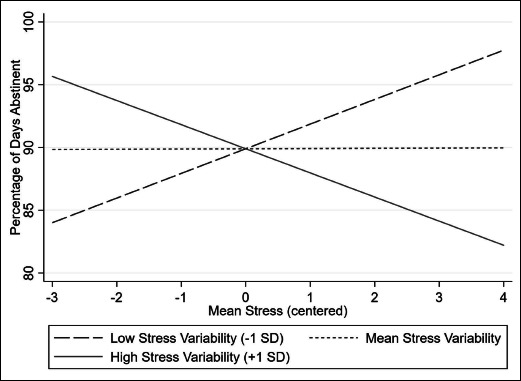
Simple slopes analysis of Mean Stress × Stress Variability interaction on percentage of days abstinent at mean and +/– 1 SD in the stress variability.
Discussion
Existing literature links stress to alcohol use among individuals seeking recovery from AUD (Brady & Sonne, 1999; Sinha, 2007). The present investigation sought to extend work that has largely relied on conventional retrospective self-report of mean-level stress by monitoring real-time perceived stress using EMA, and testing for the individual effects of mean-level stress, stress variability, and their interactive effects on subsequent alcohol use. Although main effects of mean stress and stress variability on alcohol use were not observed, a synergistic effect was found, such that the combination of greater mean-level stress with greater stress variability during the EMA monitoring period was associated with greater alcohol use over a subsequent 90-day follow-up period, after controlling for demographic factors and participants’ alcohol use goal.
Relapse prevention interventions have long emphasized the importance of stress monitoring and effective stress management. These findings support previous research linking stress to alcohol lapses (Wemm & Sinha, 2019). However, our results suggest that this relationship is more nuanced than previously described.
These findings indicate that the interaction between mean stress level and stress variability confers greatest risk. Specifically, those with a high level of mean stress and high stress variability exhibited the greatest proportion of drinking days, and this relationship was attenuated as stress variability decreased. In fact, those with a high mean stress and low stress variability combination appeared to drink the least over the follow-up period. Interestingly, those with low levels of mean stress and low stress variability also exhibited a low proportion of days abstinent, and this was attenuated as stress variability increased. Further, for those with scores close to the sample mean of stress variability, mean stress level appeared to have no effect on drinking, suggesting that stress variability is an important determinant of subsequent alcohol use in this sample. The exact reasons for this pattern of results are unknown. Future research would benefit from attempts to isolate the exact mechanisms at play here.
Although the observed pattern of results is complex and varies across mean levels of stress, these findings highlight the significant role of affective variability in the development and maintenance of AUD (Simons et al., 2014). Affect variability is considered an individual difference characteristic with clear importance for predicting behavioral outcomes (Eid & Diener, 1999; Kuppens et al., 2007; Larsen, 1987). In alcohol research, it is suggested that frequent and intense shifts in affect strengthen the associations between affective arousal and drinking that are conditioned over time through repeated pairings (Gottfredson & Hussong, 2013; Simons et al., 2014). In addition, rapid spikes in emotional arousal can impair deliberative control mechanisms and increase reflexive automatic processes, such as attentional bias (Baker et al., 2004; Lieberman, 2007; McCarthy et al., 2010). As a result, variable emotion sets the stage for drinking that is compulsive and poorly controlled, a hallmark characteristic of AUD. This is, in part, because of alcohol’s ability to dampen physiological and subjective stress reactivity (Buck-man et al., 2015; Greeley & Oei, 1999; Sher et al., 2007). Thus, it makes sense that individuals with both high levels of stress and stress variability would be a greatest risk, and that as variability is reduced, so is risk, such that average or lower levels of stress variability confer little risk and in fact might be beneficial.
What is less clear is how low stress and low variability combine to confer risk. It is possible that this reflects alexithymia (de Haan et al., 2014) or blunted stress reactivity (Lovallo et al., 2019). Despite this, these findings are in line with research underscoring the functional role of stress (Keeley et al., 2008) and suggest that a certain amount of stress may not be detrimental to AUD recovery success. With regard to clinical practice, this suggests clinicians treating AUD and mobile health recovery support tools that use ambulatory monitoring of affect should track stress variability in addition to mean stress levels. Individuals with high mean-level stress in combination with high stress variability may be at greatest risk for return to alcohol use and could potentially benefit most from stress management approaches.
Despite numerous strengths, several limitations in this study should be discussed. First, a subset of participants (n = 6) changed their goal from abstinence to moderation over the 90-day follow-up period, which was associated with greater drinking over follow-up. Although statistically controlled for, this could have influenced the results in unknown ways. In addition, the sample was small, which limited the ability to test more complex models. Last, the EMA protocol was relatively short. Replication over longer sampling periods would be beneficial.
Conclusion and future directions
This is the first study to examine the conditional effects of mean stress and stress variability on alcohol use among individuals seeking recovery from AUD. Results support previous research linking stress to alcohol use lapses; however, the present findings indicate that the stress/alcohol use relationship is more nuanced than previously described. These findings suggest that stress variability should also be considered in clinical contexts when assessing risk conferred by mean-level stress.
Future research would benefit from inclusion of this interaction when studying the effects of stress on behavioral health outcomes. In addition, because direct effects of daily stress on substance use can be nuanced (Burgess-Hull & Epstein, 2021; Wemm & Sinha, 2019), future studies should explore stress effects on day-level substance use while exploring potential mediators like craving.
Footnotes
The authors of this publication were supported by National Institute on Alcohol Abuse and Alcoholism awards F32AA025251, K23AA027577-01A1, L30AA026135, L30AA026135-02, and L30AA027041.
References
- American Psychiatric Association. Diagnostic and statistical manual of mental disorders. 5th ed. Arlington, VA: Author; 2013. [Google Scholar]
- Baker T. B., Piper M. E., McCarthy D. E., Majeskie M. R., Fiore M. C. Addiction motivation reformulated: An affective processing model of negative reinforcement. Psychological Review. 2004;111:33–51. doi: 10.1037/0033-295X.111.1.33. doi:10.1037/0033-295X.111.1.33. [DOI] [PubMed] [Google Scholar]
- Brady K. T., Sonne S. C. The role of stress in alcohol use, alcoholism treatment, and relapse. Alcohol Research & Health. 1999;23:263–271. [PMC free article] [PubMed] [Google Scholar]
- Buckman J. F., Eddie D., Vaschillo E. G., Vaschillo B., Garcia A., Bates M. E. Immediate and complex cardiovascular adaptation to an acute alcohol dose. Alcoholism: Clinical and Experimental Research. 2015;39:2334–2344. doi: 10.1111/acer.12912. doi:10.1111/acer.12912. [DOI] [PMC free article] [PubMed] [Google Scholar]
- Burgess-Hull A., Epstein D. H. Ambulatory assessment methods to examine momentary state-based predictors of opioid use behaviors. Current Addiction Reports. 2021:1–14. doi: 10.1007/s40429-020-00351-7. Advance online publication. doi:10.1007/s40429-020-00351-7. [DOI] [PMC free article] [PubMed] [Google Scholar]
- Croux C., Dhaene G., Hoorelbeke D. Robust standard errors for robust estimators. CES-Discussion paper series (DPS) 03.16. 2004:1–20. Retrieved from https://limo.libis.be/primo-explore/fulldisplay?docid=LIRIAS1824142&context=L&vid=Lirias&search_scope=Lirias&tab=default_tab&lang=en_US&fromSitemap=1. [Google Scholar]
- de Haan H. A., van der Palen J., Wijdeveld T. G. M., Buitelaar J. K., De Jong C. A. J. Alexithymia in patients with substance use disorders: State or trait? Psychiatry Research. 2014;216:137–145. doi: 10.1016/j.psychres.2013.12.047. doi:10.1016/j.psychres.2013.12.047. [DOI] [PubMed] [Google Scholar]
- Ebner-Priemer U. W., Eid M., Kleindienst N., Stabenow S., Trull T. J. Analytic strategies for understanding affective (in) stability and other dynamic processes in psychopathology. Journal of Abnormal Psychology. 2009;118:195–202. doi: 10.1037/a0014868. doi:10.1037/a0014868. [DOI] [PubMed] [Google Scholar]
- Ebner-Priemer U. W., Trull T. J. Ecological momentary assessment of mood disorders and mood dysregulation. Psychological Assessment. 2009;21:463–475. doi: 10.1037/a0017075. doi:10.1037/a0017075. [DOI] [PubMed] [Google Scholar]
- Eddie D., Bates M. E., Buckman J. F. Closing the brain-heart loop: Towards more holistic models of addiction and addiction recovery. Addiction Biology. 2021;e12958 doi: 10.1111/adb.12958. doi:10.1111/adb.12958. [DOI] [PMC free article] [PubMed] [Google Scholar]
- Eddie D., Price J. L., Bates M. E., Buckman J. F. Substance use and addiction affect more than the brain: The promise of neurocardiac interventions. Current Addiction Reports. doi: 10.1007/s40429-021-00379-3. [DOI] [PMC free article] [PubMed] [Google Scholar]
- Eid M., Diener E. Intraindividual variability in affect: Reliability, validity, and personality correlates. Journal of Personality and Social Psychology. 1999;76:662–676. doi:10.1037/0022-3514.76.4.662. [Google Scholar]
- Folkman S. Stress: Appraisal and coping. In: Gellman M. D., Turner R. J., editors. Encyclopedia of behavioral medicine. Vol. 1. New York, NY: Springer; 1986. pp. 1913–1915. [Google Scholar]
- Gottfredson N. C., Hussong A. M. Drinking to dampen affect variability: Findings from a college student sample. Journal of Studies on Alcohol and Drugs. 2013;74:576–583. doi: 10.15288/jsad.2013.74.576. doi:10.15288/jsad.2013.74.576. [DOI] [PMC free article] [PubMed] [Google Scholar]
- Greeley J., Oei T. Alcohol and tension reduction. In: Leonard K. E., Blane H. T., editors. The Guilford substance abuse series.Psychological theories of drinking and alcoholism. New York, NY: Guilford Press; 1999. pp. 14–53. [Google Scholar]
- Jahng S., Solhan M. B., Tomko R. L., Wood P. K., Piasecki T. M., Trull T. J. Affect and alcohol use: An ecological momentary assessment study of outpatients with borderline personality disorder. Journal of Abnormal Psychology. 2011;120:572–584. doi: 10.1037/a0024686. doi:10.1037/a0024686. [DOI] [PMC free article] [PubMed] [Google Scholar]
- Kashdan T. B., Ferssizidis P., Collins R. L., Muraven M. Emotion differentiation as resilience against excessive alcohol use: An ecological momentary assessment in underage social drinkers. Psychological Science. 2010;21:1341–1347. doi: 10.1177/0956797610379863. doi:10.1177/0956797610379863. [DOI] [PubMed] [Google Scholar]
- Keeley J., Zayac R., Correia C. J. Curvilinear relationships between statistics anxiety and performance among undergraduate students: Evidence for optimal anxiety. Statistics Education Research Journal. 2008;7:4–15. [Google Scholar]
- Kuppens P., Van Mechelen I., Nezlek J. B., Dossche D., Timmermans T. Individual differences in core affect variability and their relationship to personality and psychological adjustment. Emotion. 2007;7:262–274. doi: 10.1037/1528-3542.7.2.262. doi:10.1037/1528-3542.7.2.262. [DOI] [PubMed] [Google Scholar]
- Larsen R. J. The stability of mood variability: A spectral analytic approach to daily mood assessments. Journal of Personality and Social Psychology. 1987;52:1195–1204. doi:10.1037/0022-3514.52.6.1195. [Google Scholar]
- Lieberman M. D. Social cognitive neuroscience: A review of core processes. Annual Review of Psychology. 2007;58:259–289. doi: 10.1146/annurev.psych.58.110405.085654. doi:10.1146/annurev.psych.58.110405.085654. [DOI] [PubMed] [Google Scholar]
- Lincoln R., Rosenthal C. F., Malte C. A., Simpson T. A pilot study of memory impairment associated with discrepancies between retrospective and daily recall of alcohol consumption. American Journal on Addictions. 2011;20:568–574. doi: 10.1111/j.1521-0391.2011.00178.x. doi:10.1111/j.1521-0391.2011.00178.x. [DOI] [PubMed] [Google Scholar]
- Litt M. D., Cooney N. L., Morse P. Ecological momentary assessment (EMA) with treated alcoholics: Methodological problems and potential solutions. Health Psychology. 1998;17:48–52. doi: 10.1037//0278-6133.17.1.48. doi:10.1037/0278-6133.17.1.48. [DOI] [PubMed] [Google Scholar]
- Lovallo W. R., Cohoon A. J., Acheson A., Sorocco K. H., Vincent A. S. Blunted stress reactivity reveals vulnerability to early life adversity in young adults with a family history of alcoholism. Addiction. 2019;114:798–806. doi: 10.1111/add.14501. doi:10.1111/add.14501. [DOI] [PMC free article] [PubMed] [Google Scholar]
- McCarthy D. E., Curtin J. J., Piper M. E., Baker T. B. Negative reinforcement: Possible clinical implications of an integrative model. In: Kassel J. D., editor. Substance abuse and emotion. Washington, DC: American Psychological Association; 2010. pp. 15–42. [Google Scholar]
- MetricWire. Toronto, Canada: MetricWire Inc. 2016 Retrieved from https://apps.apple.com/us/app/metricwire/id1117108543. [Google Scholar]
- Miller W. R., Walters S. T., Bennett M. E. How effective is alcoholism treatment in the United States? Journal of Studies on Alcohol. 2001;62:211–220. doi: 10.15288/jsa.2001.62.211. doi:10.15288/jsa.2001.62.211. [DOI] [PubMed] [Google Scholar]
- Moore T. M., Seavey A., Ritter K., McNulty J. K., Gordon K. C., Stuart G. L. Ecological momentary assessment of the effects of craving and affect on risk for relapse during substance abuse treatment. Psychology of Addictive Behaviors. 2014;28:619–624. doi: 10.1037/a0034127. doi:10.1037/a0034127. [DOI] [PubMed] [Google Scholar]
- Moos R. H., Moos B. S. Rates and predictors of relapse after natural and treated remission from alcohol use disorders. Addiction. 2006;101:212–222. doi: 10.1111/j.1360-0443.2006.01310.x. doi:10.1111/j.1360-0443.2006.01310.x. [DOI] [PMC free article] [PubMed] [Google Scholar]
- Morgenstern J., Kuerbis A., Muench F. Ecological momentary assessment and alcohol use disorder treatment. Alcohol Research: Current Reviews. 2014;36:101–109. doi: 10.35946/arcr.v36.1.10. [DOI] [PMC free article] [PubMed] [Google Scholar]
- Noone M., Dua J., Markham R. Stress, cognitive factors, and coping resources as predictors of relapse in alcoholics. Addictive Behaviors. 1999;24:687–693. doi: 10.1016/s0306-4603(98)00087-2. doi:10.1016/S0306-4603(98)00087-2. [DOI] [PubMed] [Google Scholar]
- Pedersen E. R., Grow J., Duncan S., Neighbors C., Larimer M. E. Concurrent validity of an online version of the Timeline Followback assessment. Psychology of Addictive Behaviors. 2012;26:672–677. doi: 10.1037/a0027945. doi:10.1037/a0027945. [DOI] [PMC free article] [PubMed] [Google Scholar]
- Ram N., Gerstorf D. Time-structured and net intraindividual variability: Tools for examining the development of dynamic characteristics and processes. Psychology and Aging. 2009;24:778–791. doi: 10.1037/a0017915. doi:10.1037/a0017915. [DOI] [PMC free article] [PubMed] [Google Scholar]
- Selby E. A., Cornelius T., Fehling K. B., Kranzler A., Panza E. A., Lavender J. M., Le Grange D. A perfect storm: Examining the synergistic effects of negative and positive emotional instability on promoting weight loss activities in anorexia nervosa. Frontiers in Psychology. 2015;6:1260. doi: 10.3389/fpsyg.2015.01260. doi:10.3389/fpsyg.2015.01260. [DOI] [PMC free article] [PubMed] [Google Scholar]
- Sher K. J., Bartholow B. D., Peuser K., Erickson D. J., Wood M. D. Stress-response-dampening effects of alcohol: Attention as a mediator and moderator. Journal of Abnormal Psychology. 2007;116:362–377. doi: 10.1037/0021-843X.116.2.362. doi:10.1037/0021-843X.116.2.362. [DOI] [PMC free article] [PubMed] [Google Scholar]
- Shiffman S. Ecological momentary assessment (EMA) in studies of substance use. Psychological Assessment. 2009;21:486–497. doi: 10.1037/a0017074. doi:10.1037/a0017074. [DOI] [PMC free article] [PubMed] [Google Scholar]
- Shiffman S., Stone A. A., Hufford M. R. Ecological momentary assessment. Annual Review of Clinical Psychology. 2008;4:1–32. doi: 10.1146/annurev.clinpsy.3.022806.091415. doi:10.1146/annurev.clinpsy.3.022806.091415. [DOI] [PubMed] [Google Scholar]
- Simons J. S., Wills T. A., Neal D. J. The many faces of affect: A multilevel model of drinking frequency/quantity and alcohol dependence symptoms among young adults. Journal of Abnormal Psychology. 2014;123:676–694. doi: 10.1037/a0036926. doi:10.1037/a0036926. [DOI] [PMC free article] [PubMed] [Google Scholar]
- Sinha R. How does stress increase risk of drug abuse and relapse? Psychopharmacology. 2001;158:343–359. doi: 10.1007/s002130100917. doi:10.1007/s002130100917. [DOI] [PubMed] [Google Scholar]
- Sinha R. The role of stress in addiction relapse. Current Psychiatry Reports. 2007;9:388–395. doi: 10.1007/s11920-007-0050-6. doi:10.1007/s11920-007-0050-6. [DOI] [PubMed] [Google Scholar]
- Skinner H. A., Horn J. I. Alcohol Dependence Scale: User’s guide. Toronto, Canada: Addiction Research Foundation; 1984. [Google Scholar]
- Sobell L. C., Sobell M. B. Timeline follow-back: A technique for assessing self-reported alcohol consumption. In: Litten R. Z., Allen J. P., editors. Measuring alcohol consumption: Psychosocial and biochemical methods. Totowa, NJ: Humana Press; 1992. pp. 41–69. [Google Scholar]
- Stone A. A., Shiffman S., Atienza A. A., Nebeling A. Historical roots and rationale for ecological momentary assessment. In: Stone A. A., Shiffman S., Atienza A. A., Nebeling A., editors. The science of real-time data capture: Self-reports in health research. New York, NY: Oxford University Press; 2007. pp. 3–10. [Google Scholar]
- Thomas D. L., Diener E. Memory accuracy in the recall of emotions. Journal of Personality and Social Psychology. 1990;59:291–297. doi:10.1037/0022-3514.59.2.291. [Google Scholar]
- Von Neumann J., Kent R. H., Bellinson H. R., Hart B. I. The mean square successive difference. Annals of Mathematical Statistics. 1941;12:153–162. doi:10.1214/aoms/1177731746. [Google Scholar]
- Wemm S. E., Sinha R. Drug-induced stress responses and addiction risk and relapse. Neurobiology of Stress. 2019;10:100148. doi: 10.1016/j.ynstr.2019.100148. doi:10.1016/j.ynstr.2019.100148. [DOI] [PMC free article] [PubMed] [Google Scholar]