



Abstract
This paper reports a Scopus-based systematic literature review of a wide variety of transportation policies and mitigation strategies that have been conducted around the world to minimize COVID-19 contagion risk in transportation systems. The review offers a representative coverage of countries across all continents of the planet, as well as among representative climate regions – as weather is an important factor to consider. The readership interested in policies and mitigation strategies is expected to involve a wide range of actors, each involving a particular application context; hence, the literature is also characterized by key attributes such as: transportation mode; actor (users, operators, government, industry); jurisdiction (national, provincial, city, neighborhood); and area of application (planning, regulation, operations, research, incentives). An in-depth analysis of the surveyed literature is then reported, focusing first on condensing the literature into 151 distinct policies and strategies, which are subsequently categorized into 25 broad categories that are discussed at length. The compendium and discussion of strategies and policies reported not only provide comprehensive guidelines to inform various courses of action for decision-makers, planners, and social communicators, but also emphasize on future work and the potential of some of these strategies to be the precursors of meaningful, more sustainable behavioral changes in future mobility patterns.
Keywords: COVID-19, SARS-CoV-2, Transportation, Policies, Strategies, Risks
Introduction
The Corona Virus Disease (COVID-19) has taken human civilization by storm, and it stands among the deadliest pandemics that humanity has witnessed. Unprecedented worldwide efforts have been triggered for vaccine development, allowing mass production and distribution in record-breaking timeframes. Mass vaccination campaigns are now underway worldwide, in a pursuit of eventually reaching herd immunity.
A study of mitigation strategies for COVID-19 without acknowledging the major role of vaccination (also known as pharmaceutical interventions) would lack background, but challenges remaining must be acknowledged as well. These challenges help frame and scope this paper, by justifying the critical role of transportation policies and mitigation strategies (non-pharmaceutical interventions - NPIs) in fighting the pandemic. Vaccination challenges still remaining are summarized next:
Vaccination rates. While several countries around the globe are achieving high vaccination rates, low-income countries have alarmingly low rates – Africa is expected to reach 70 % of its population vaccinated by August 2024 (US News & World Report, 2021).
Immunity waning. Vaccine immunity is an ongoing research field, yet consensus seems to exist on administering booster doses over 6-month periods (Doria-Rose et al., 2021, Zuo et al., 2021). This exacerbates the abovementioned burden on low-income-countries.
Staggered vaccination. Different countries (and provinces/cities) have deployed vaccination campaigns at different points in time, hence the loss of immunity will be staggered in time for different locations, increasing transmission risk related with inter-province and international travel.
Asymptomatic individuals. Put simply, undetectable virus carriers and transmitters. Research has found that asymptomatic individuals are accountable for 44 % of contagion in Mexico (López Olmedo et al., 2021), and even as high as 79 % in China (Li et al., 2020).
Variants and reinfection. Several COVID-19 variants have been identified so far (Deb et al., 2021), some of which are categorized by the WHO as Variants of Concern (VOC), as they have fundamentally different attributes than the original virus. The effectiveness of current vaccines against some of these variants remains to be determined conclusively and is an active research topic (Deb et al., 2021). For instance, Dejnirattisai et al. (2021) find that vaccines suffer from a substantial loss of neutralization against the latest Omicron variant. In this context of virus mutation and emergence of new VOCs, reinfection cases have been confirmed and remain being a threat.
Herd-immunity threshold. The WHO states that herd immunity can be achieved by surpassing a threshold proportion that depends on several factors. While this threshold is currently uncertain for COVID-19, Zhao et al. (2021) find a 95 % threshold for a small-scale university scenario. Such a threshold seems quite difficult to reach currently, considering the abovementioned key facts.
Antivaccine Groups. Particularly strong in the US, reaching 14 % of the population (Kaiser Family, 2021) – rendering a 95 % threshold out of reach, at least until that 14 % became infected.
Considering that vaccination still faces the critical challenges discussed above, non-pharmaceutical interventions play a vital role in fighting the pandemic. While worldwide consensus suggests that COVID-19 is not a predominantly airborne virus (it does not stay suspended in open air), transportation systems may involve confined environments, making them a special case that plays a critical role in this pandemic. Bare-minimum strategies such as social distancing are not easily transferable to the transportation context; for instance, Tarasi et al. (2021) highlight that a major challenge consists of public transit and shared mobility systems being incompatible with social distancing policies. Analyzing transportation-induced COVID-19 contagion brings forth several complexities, perhaps the most important arises from turbulent air flow dynamics within vehicles, generating risks that depend on the length of co-travel time (shared by passengers within a vehicle), seating arrangements, ventilation, among several other factors. Moreover, mitigation strategies can reach beyond targeting trips made by a given mode or service, and focus on proactive measures such as planning and regulation of transportation systems.
This paper conducts a comprehensive systematic review of academic literature that analyzes, reports, and/or recommends transportation policies and mitigation strategies to minimize COVID-19 contagion risk. The literature covers a wide array of countries around all continents of the globe, it focuses on assessing the efficiency of strategies and policies, presents guidelines for governments and operators, and proposes innovative ways to help reduce the spread of the disease. This paper offers a systematization and further characterization of the vast amount of knowledge generated thus far in research and practice, considering several attributes to address the needs of a wide readership, such as: transportation mode; actor (users, operators, government, industry); jurisdiction (national, provincial, city, neighborhood); and area of application (planning, regulation, operations, research, incentives innovation/technology). A compilation of strategies such as the one provided in this paper can be instrumental in aiding planning, operations, decision-making, and research efforts.
This paper is structured as follows. Section 2 describes the method conducted for a systematic review of the literature. Section 3 describes an overall characterization of the literature reviewed, in terms of coverage and key attributes. Section 4 summarizes and classifies the transportation policies and mitigation strategies surveyed, followed by a discussion of each category. Section 5 summarizes future research directions found in the literature. Section 6 presents the limitations of the study and Section 7 concludes the paper.
Method
This study consists of a qualitative, systematic review of the COVID-19 literature (Grant and Booth, 2009, Snyder, 2019), which identifies research focused on transport policies and mitigation strategies to minimize contagion risk. Results are classified for governments, operators, users, and industry actors, for whom a “What to do?” guide is summarized and discussed. From a research perspective, future research directions proposed in the literature are reported as well.
The review is conducted following the method proposed by Snyder (2019). The first phase defines the rationale for conducting a literature review, which is already explained in the previous paragraph. The second phase consists of defining preliminary search inclusion criteria. Having conducted the first two stages, preliminary criteria are tested and analyzed, to define definitive criteria, as follows:
-
•
Articles published from 2020 to the present (April 2022).
-
•
Articles covering mode-specific strategies to minimize the COVID-19 risks or impacts.
-
•
Articles written in English.
-
•
Articles containing one or more search criteria in either their Title, Abstract, or Keywords.
-
•
Articles related to maritime or air transport modes are out of the scope for this review.
-
•
Only articles published in journals are considered, as research suggests journals as the most relevant means to disseminate and acquire knowledge (Martín-Martín et al., 2018). Other formats, such as conference papers, dissertations, books, etc. may have duplication of knowledge in journals, or report ongoing research in the case of conferences.
The process for article search and selection is conducted by two means:
-
•
Articles identified in bibliographic citation databases. In this study, the Scopus database was selected since a large proportion of the indexed articles are journal articles, which does not occur in Google Scholar (Tong & Li, 2022). Furthermore, research suggests that the coverage of recent articles is more complete than the Web Of Science database (Aghaei Chadegani et al., 2013). Considering that the pandemic began in 2020, Scopus is deemed a suitable choice for this review.
-
•
Relevant articles that are known to the authors of this review from their own experience and research networks, which also meet the inclusion criteria – except for the year of publication.
Search criteria are defined by a combination of two levels. The first one includes transport mode terms along with processes related to their design and operation. The second level consists of combining the first level terms with synonym terms alluding to the pandemic, by the logical expression “AND (COVID* OR Pandemic OR SARS-CoV-2)”. Table 1 presents the search results arising from these criteria.
Table 1.
Search results by search terms.
| first-level search criterion | # Articles |
|---|---|
| “Frequencies setting” | 2 |
| “Demand management” | 32 |
| “Transportation planning” | 72 |
| “Transport Policy” | 61 |
| “Transport strategies” | 7 |
| “Mobility strategies” | 11 |
| Bus | 348 |
| Bike | 120 |
| Tram | 22 |
| Railway | 238 |
| Train | 1318 |
| “Private Vehicle” | 49 |
| “OD Matrix” | 4 |
| Ridesharing | 11 |
| Carsharing | 8 |
| “Transport modes” | 75 |
| “Means of transport” | 42 |
| Risk + Transport | 1424 |
| Walk* | 1832 |
| Transport +”Strategies against” | 14 |
| Total | 5690 |
All first-level terms combine with the second-level criteria: “AND (COVID* OR Pandemic OR SARS-CoV-2)”.
Regarding semantics, special search terms are utilized to cover wording variants. Quotation marks (“”) instruct the search engine to consider multiple words as a single combined. The asterisk character (*) instructs the search engine to consider all variants of the prefix of a word (e.g., COVID* encompasses COVID, COVID-19, COVID19, etc.).
The resulting database of retrieved articles is then depurated by a semi-automatic process as follows:
-
•
Remove articles that are not Journal Papers.
-
•
Remove articles with incomplete data. For example, authors, journals, etc.
-
•
Remove duplicate articles, based on their DOI numbers.
-
•
Remove out-of-scope articles or irrelevant (e.g., transport* often appears in medical literature).
As a last step, 15 articles particular to the authors’ knowledge that were not captured in the search results are added. The final sample consists of 442 articles, all of which are considered for a third, deeper analysis phase, as suggested in Snyder (2019).
For the analysis phase, information and attributes of each article are stored in a matrix of findings, which facilitates various subsequent analyses. Data obtained through the Scopus export tool include: Title; DOI; Keywords; Document type; Source; Authors; and Year of publication.
The analysis process begins with the review of the abstract, methods, and conclusions of each of the studies. Additional attributes that are relevant for characterization are added to the matrix of findings, and filled through a manual process, these attributes are the following:
-
•
Strategies proposed/analyzed.
-
•
Country.
-
•
Transportation mode.
-
•
Actor: Government, Industry, Operators, Users.
-
•
Jurisdiction: International, National, Province/State/Department, City, Neighborhood, University.
-
•
Area of application: Planning, Regulation, Research, Incentives, Innovation/Tech .
-
•
Aims of the paper.
-
•
Future Work.
-
•
Remarks (general notes regarding articles’ conclusions, or specific details to consider).
At last, articles that did not explicitly suggest/analyze COVID-19 strategies or guidelines are excluded from the last stage of analysis. This last depuration yields 134 articles, which are inspected at full detail.
Overall Characterization of the Literature.
This section provides a concise multidimensional overview of the surveyed literature, which already unveils important research gaps remaining. The results are presented as statistical summaries of key categories such as country, year, transportation mode, actors, jurisdiction, and area of application.
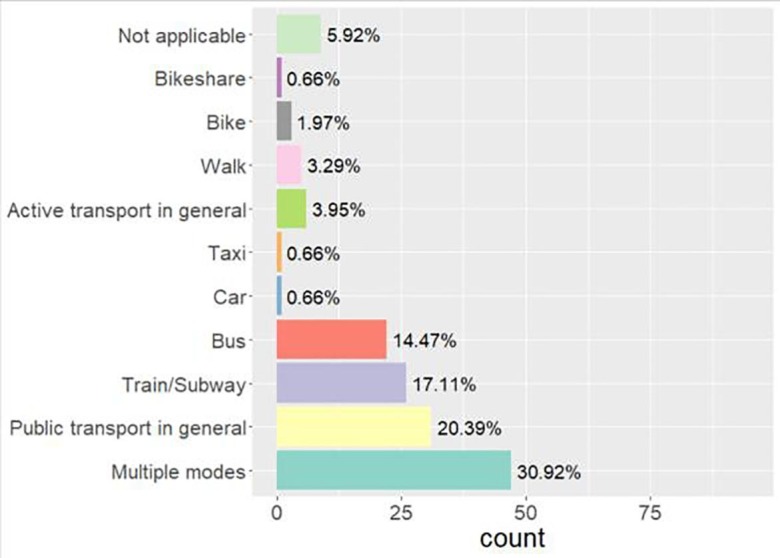
The first attribute subject to discussion is transportation mode. Fig. 1 shows that the most frequent category in the literature is multiple modes of transportation, however, grouping all public transit categories together, this mode predominates (51.97 %). While this trend is expected due to a perceived higher risk within public transit vehicles and infrastructure, it also denotes research gaps in other public-use modes such as ridehailing or taxis.
Fig. 1.
Literature characterization by mode.
If active transportation categories in Fig. 1 are aggregated, these account for 9.87 % of the literature surveyed, which is also expected as these modes are argued to pose the lowest contagion risk – this relatively high percentage denotes an encouraging research direction from the lens of sustainability.
Fig. 1 also unveils a salient research gap regarding motorcycles, which are quite popular in low- to middle-income countries around the globe. The Not applicable category stands for papers which analyzed strategies, but did not explicitly address a transportation mode (e.g., working from home policies).
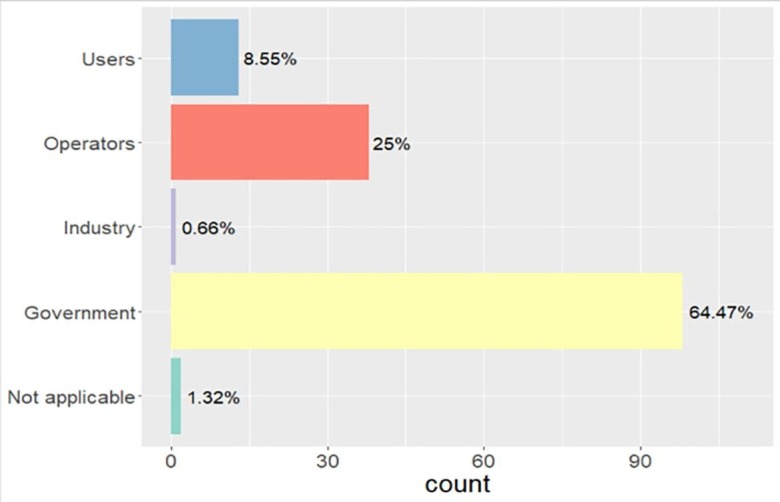
A second attribute that provides an application-oriented perspective is the main actor involved in a given strategy – when multiple actors were involved, the one deemed as the most representative is reported. Fig. 2 evidences a clear predominance of the government actor (64.47 %), which is an expected outcome considering that governmental bodies are in charge of regulation and policy-making. Naturally, the second more frequent category are operators, as these actors are responsible for conducting a variety of biosafety measures for their fleets and passengers. User-oriented strategies appear in a much lower frequency, as this category has been limited to strategies focused explicitly on compliance with measurements enforced by the government and operators. The literature for industry is very limited, with only one article touching upon adjusting standards and developing technological solutions.
Fig. 2.
Literature characterization by actor.
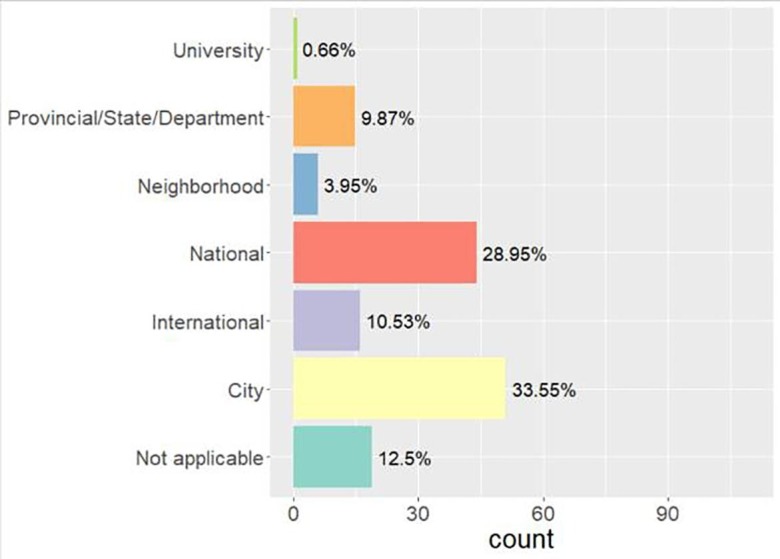
The jurisdiction to which policies and strategies pertain tells an interesting story regarding how different levels of government have taken action thus far. Fig. 3 shows that more strategies have been developed at the city level than other levels, which suggests that case studies have more often focused on cities, and that policy-making has been more often driven by city authorities. International (large-scale) and neighborhood/university (small-scale) levels are expectedly less frequent.
Fig. 3.
Literature characterization by jurisdiction.
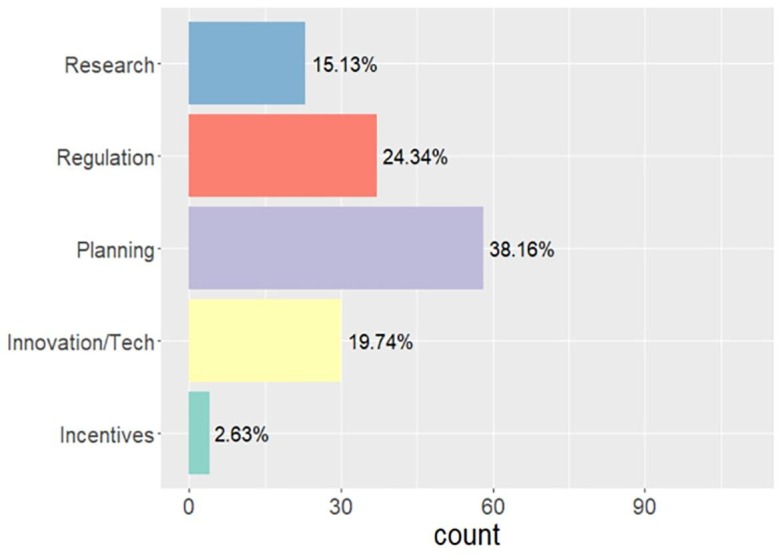
Fig. 4, shows a more balanced distribution according to the application field. Regardless, an expected predominance of planning-oriented strategies can be observed, while a dearth of incentive-oriented strategies highlights a clear research gap that could arguably offer impactful results in managing contagion.
Fig. 4.
Literature characterization by application.
To provide further insights on the relation among categories, Fig. 5 below offers an overall snapshot of the systematic review conducted, though a more complex visualization that classifies the literature by transportation mode, field of application, and actor involved. Specific fields that have received the most attention are unveiled, as well as several fields which should grow in the near future.
Fig. 5.

Characterization of the literature by mode, application field, and color-coded by actor.
As evidenced earlier in Fig. 1, and more evidently now in Fig. 5, public transit modes predominate with respect to car-based and active modes. The Car, Taxi, Walk, Bike and Bikeshare modes have been considerably understudied in comparison to transit, arguably due to their associated lower-risk perception. Further analyzing patterns of public transit modes, a relatively balanced mix of application fields can also be observed.
Another salient pattern of Fig. 5 is a vast predominance of government-led policies and strategies, followed by the operator-led category. Regarding regulation, it is expectedly prominent for government and operator actors, as governments make policies and operators abide or even help enforce them. Users also appear in regulation, as some articles propose auditing their compliance, such as the use of masks.
The spatial distribution of the literature is depicted in Fig. 6 . On a continent-basis, the literature surveyed has a representative representation with one country per populated continent at the very least. Nevertheless, striking differences become evident in research/practice output. North America, Oceania, eastern Asia, Nordic countries, and western Europe all have excellent representation; as opposed to eastern Europe, the Middle East, Africa and South America.
Fig. 6.
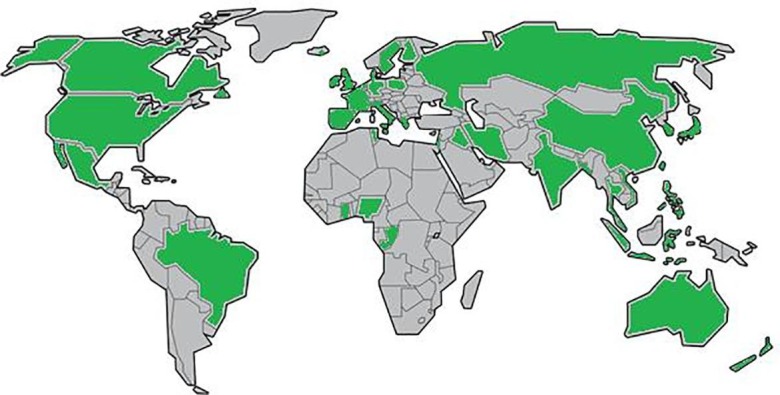
Worldwide coverage of the literature review.
From a climate perspective, weather poses a critical influence on transmission risks, as well as on the applicability of some mitigation strategies. Hence, this paper ensures that the literature is well-represented in each of the five Koppen Classification System climate zones (as evidenced in Fig. 7 ).
Fig. 7.
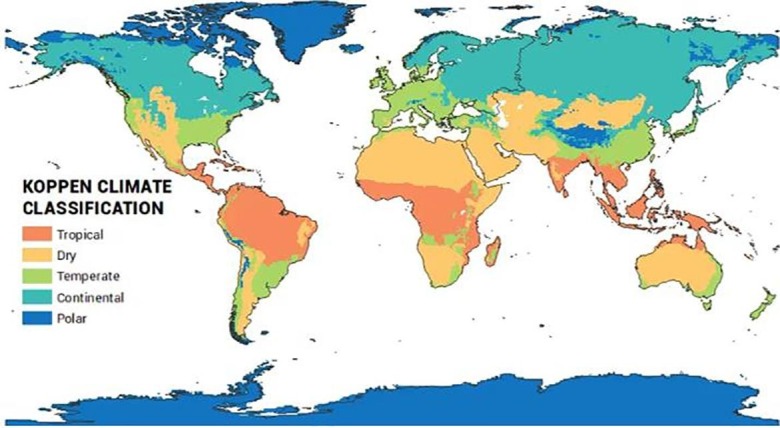
The Koppen Climate Classification System. Retrieved from: https://earthhow.com/ koppen-climate-classification/.
Transportation policies and mitigations strategies
The design of transportation policies and mitigation strategies to curb the spread of COVID-19 naturally derives from identifying and understanding contagion risks and transmission mechanisms. In this context, this section begins with a brief background and general notions regarding how the virus spreads, how contagion may take place, and some important risk factors.
A background on contagion risks and transmission
A fundamental notion governing transportation-related contagion states that risks are higher when people make trips that involve sharing space with other passengers inside an enclosed vehicle or within a given transportation infrastructure, such as a train station or even a crowded bus stop. The study conducted by Hu et al. (2021) analyzes contagion risk by different passenger seating arrangements within vehicles, and finds indeed that closed and crowded environments shared by passengers increase contagion risk.
Within a confined transportation vehicle or infrastructure, the virus can be transmitted by droplets expelled from the mouth or nose of an infected subject. These droplets may either be inhaled by another subject directly, or may land on a surface that can indirectly infect another subject (known as fomite transmission); in fact, van Doremalen et al. (2020) note that the virus can survive up to 3 days, depending on the surface and specific conditions of humidity and temperature.
Much speculation and social unrest has arisen regarding the impacts and contagion risks associated with the transportation system; a situation that has not quite yet been appeased by scientific findings, as research efforts have reached mixed results that vary over a wide spectrum; for example: from “no correlation”, “transportation accounting to only 5 % of cases”, to “transportation posing very high risk”, or “significant and robust relationship between public transportation mobility and daily coronavirus cases” (Benning et al., 2021, Edwards et al., 2021, Hu et al., 2021, Iç et al., 2021, Jenelius and Cebecauer, 2020, Lee et al., 2020, Peng and Jimenez, 2021, Schwartz, 2020).
Despite transportation systems playing an important role in this pandemic, caution must be exercised when establishing causation, as correlating single trips with contagion may overlook all other trips and activities (e.g., work, study, shopping, sports, etc.) performed by people throughout the day. Each of these trips and activities involve a given level of risk depending on a given type of infrastructure (transportation, office, classroom, market, etc.), on a variety of biosafety conditions, and on how space is shared among people. Hence, it cannot be assumed that trips necessarily were the instance where contagion took place. For instance, a safely operated vehicle can pose a lower risk than people at a crowded place. Moreover, trips occupy only but a small portion of time of a person’s daily schedule (see Fig. 8 ). Even when contagion took place while traveling, a subject who utilized several modes in the day and became infected could have been exposed in any of those modes. Hence, studies finding correlations based on aggregate data, or focusing on monitoring users’ contagion, may erroneously determine mode-specific risks. In this context, disaggregated analyses of persons’ full-day activities, and/or disaggregated modeling methods such as agent-based microsimulation approaches may offer appropriate solutions – an example of such methods can be found in Zafarnejad & Griffin 2021), applied for a school closed-environment.
Fig. 8.

Frequency of broad strategies found in the literature.
Table 2 summarizes some risk factors found in the literature. Only a high-level description is provided in this section, as discussions of strategies and policies linked to these risks are offered in Section 4.2.
Table 2.
Key Risks of COVID-19 Contagion.
| RISK | SOURCE | REMARKS |
|---|---|---|
| Proximity In Passengerś Seating In Buses | Hu et al. (2021) | Risks are considerably higher in the same row of a COVID + subject, risk for subsequent rows is much lower. |
| Turbulent Airflow Dynamics Within Vehicles | Edwards et al. (2021) | Leaving windows and doors closed, and not relying on ventilation/filtration systems involves a high risk of contagion. |
| Weather | Wei et al. (2020) | Average temperature, cumulative precipitation, and average wind speed have strong, combined, and non-linear effects on contagion risks. |
| Co-Travel Time (Shared By Passengers Within A Vehicle) | Hu et al. (2021) | The attack rate of the virus increases 0.15 % per hour of co-travel time, and to 1.3 % per hour if passengers are seated adjacently. Even a distance of 2.5 m becomes unsafe after 2 h of co-travel time. |
| Bus Drivers And Assistants | Dzisi and Dei. (2020) | Bus drivers and assistants are exponentially more exposed than the rest of people, hence pose a high risk of being transmission vectors if appropriate precautionary measures are not taken. |
| Passengerś Compliance | Dzisi and Dei. (2020) | This depends largely on the idiosyncrasy of passengers. But, in locations where compliance is low, contagion risks are considerably high. |
| Type Of Mask | Edwards et al., 2021, Dzisi and Dei, 2020 | The level of protection of KN-95 masks is much higher than surgical masks and cloth masks. Contagion risks vary accordingly. |
| Informal Public Transit | Bonful et al. (2020) | Informal services cannot be controlled and monitored for compliance with strategies. |
| Circulating through transportation infrastructure | López Olmedo et al. (2021) | This inevitably creates close contacts, especially in crowded environments. |
| Physical selling of tickets | Mogaji, 2020, Shen et al., 2020a, Shen et al., 2020b | Increases close contact, and implies a high probability of fomite transmission. |
Compendium of strategies and policies
As shown in Section 2, a vast literature exists focusing on the interplay between COVID-19 and transportation. The characterization efforts undertaken in this paper led to the definition of 25 broad strategy categories and 151 focused strategies. Since an output of such magnitude brings forth visualization and reporting challenges, Table 3 below reports the characterization of the 25 strategies at the broad-level categories. A full-fledged characterization of the 151 distinct strategies becomes prohibitively large, hence, it is not reported in this paper, but can be found instead in a publicly-available shared folder 1 managed by the authorś research group.
Table 3.
Broad characterization of strategies, by transport mode, actor, jurisdiction, and application field.
| Broad strategy | Source | Transport mode | Actor | Jurisdiction | Application Field |
|---|---|---|---|---|---|
|
Ventilation within vehicles (doors, windows, AC/HVAC, fans) |
Ho & Binns (2021) | Bus | Operators | City | Research |
| Yao & Liu (2021) | Bus | Operators | N/A | Research | |
| Zhang et al. (2021c) | Bus | Operators | University | Research | |
| Shinohara et al. (2021) | Train/Subway | Operators | N/A | Research | |
| Edwards et al. (2021) | Bus | Operators | City | Research | |
| Querol et al. (2022) | Bus | Operators | City | Regulation | |
| Shinohara et al. (2021) | Train/Subway | Operators | N/A | Research | |
| Edwards et al. (2021) | Bus | Operators | City | Research | |
| Querol et al. (2022) | Bus | Operators | City | Regulation | |
| Zhang et al. (2021c) | Bus | Operators | University | Research | |
| Furuya (2007) | Train/Subway | Operators | National | Research | |
| Lin et al. (2022) | Multiple modes | Operators | National | Research | |
| Shen et al. (2020b) | Bus | Operators | Provincial/State/Department | Research | |
| Moreno et al. (2021) | Multiple modes | Operators | City | Regulation | |
| Matheis et al. (2022) | Multiple modes | Users | N/A | Research | |
| Yu et al. (2020) | Train/Subway | Government | Provincial/State/Department | Planning | |
| Wang et al. (2022) | Train/Subway | Government | National | Research | |
| Querol et al. (2022) | Bus | Operators | City | Regulation | |
| Querol et al. (2022) | Bus | Operators | City | Regulation | |
| Mathai et al. (2022) | Car | Operators | N/A | Innovation/Tech | |
| Mesgarpour et al. (2022) | Public transport in general | Operators | N/A | Research | |
| Ventilation in transportation infrastructure | Clegg et al. (2022) | Train/Subway | Government | Neighborhood | Innovation/Tech |
| Zou and He (2021) | Train/Subway | Government | N/A | Regulation | |
| Air Filters | Lin et al. (2022) | Multiple modes | Operators | National | Research |
| Edwards et al. (2021) | Bus | Operators | City | Research | |
| Hoffman et al. (2022) | Bus | Operators | City | Innovation/Tech | |
| Park and Kim (2021) | Multiple modes | Government | National | Planning | |
| Model-supported, evidence-based planning/ policymaking | Chin & Bouffanais (2020) | Bus | Government | National | Regulation |
| Hamidi & Hamidi (2021) | Train/Subway | Government | Neighborhood | Regulation | |
| Lima et al. (2021) | Walk | Government | Provincial/State/Department | Research | |
| Zanin & Papo (2020) | Multiple modes | Government | City | Planning | |
| Bohman et al. (2021) | Multiple modes | Government | City | Planning | |
| Nikparvar et al. (2021) | Walk | Government | National | Planning | |
| Lima et al. (2021) | Multiple modes | Government | City | Planning | |
| Bian et al. (2021) | Multiple modes | Government | City | Planning | |
| Benning et al. (2021) | Public transport in general | Government | City | Planning | |
| Aragão et al. (2022) | Multiple modes | Government | City | Planning | |
| Wei et al. (2020) | Multiple modes | Operators | National | Research | |
| Mahmud et al. (2021) | Multiple modes | Government | Neighborhood | Innovation/Tech | |
| Seno (2020) | Multiple modes | Government | International | Innovation/Tech | |
| Scott et al. (2021) | Multiple modes | Government | Provincial/State/Department | Innovation/Tech | |
| Doubleday et al. (2021) | Active transport in general | Users | Provincial/State/Department | Innovation/Tech | |
| Douglas et al. (2021) | Multiple modes | Government | International | Innovation/Tech | |
| Walker & Sulyok (2020) | Multiple modes | Government | National | Innovation/Tech | |
| Osorio et al. (2022) | Public transport in general | Government | City | Research | |
| Kumar et al. (2022) | Public transport in general | Government | N/A | Innovation/Tech | |
| Kruszewska et al. (2022) | Public transport in general | Government | N/A | Research | |
| Chen et al. (2021) | Public transport in general | Government | City | Planning | |
| Mesgarpour et al. (2022) | Bus | Operators | N/A | Regulation | |
| Zhang et al. (2021b) | Multiple modes | Government | Provincial/State/Department | Planning | |
| Tiikkaja & Viri (2021) | Public transport in general | Government | City | Planning | |
| Public transit operations – General | Chan and Wen (2021) | Train/Subway | Government | National | Planning |
| Sasidharan et al. (2020) | Public transport in general | Government | City | Regulation | |
| Cooley et al. (2011) | Train/Subway | Government | City | Planning | |
| Shirai Reyna et al. (2021) | Train/Subway | Government | City | Planning | |
| Gkiotsalitis (2021) | Bus | Operators | National | Planning | |
| Kamga et al. (2021) | Multiple modes | Operators | International | Planning | |
| Lucchesi et al. (2022) | Public transport in general | Operators | National | Research | |
| Matheis et al. (2022) | Multiple modes | Users | N/A | Research | |
| Thombre & Agarwal (2021) | Multiple modes | Government | National | Planning | |
| Love et al. (2021) | Public transport in general | Government | National | Planning | |
| Chen et al. (2020) | Multiple modes | Operators | National | Planning | |
| Kushnir et al. (2022) | Multiple modes | Government | National | Regulation | |
| Public transit operations – Crowding management | Cho & Park (2021) | Public transport in general | Government | City | Regulation |
| Furuya (2007) | Train/Subway | Operators | National | Research | |
| Hörcher et al. (2021) | Multiple modes | Operators | International | Planning | |
| Hörcher et al. (2021) | Multiple modes | Operators | International | Planning | |
| Hörcher et al. (2021) | Multiple modes | Operators | International | Planning | |
| Wiseman (2022) | Train/Subway | Operators | National | Innovation/Tech | |
| Naveen & Gurtoo (2022) | Bus | Operators | National | Planning | |
| Zorgati et al. (2021) | Train/Subway | Users | National | Planning | |
| Hörcher et al. (2021) | Multiple modes | Operators | International | Planning | |
| Hörcher et al. (2021) | Multiple modes | Operators | International | Planning | |
| Budd & Ison (2020) | Multiple modes | Government | International | Regulation | |
| Wiseman (2022) | Train/Subway | Operators | National | Innovation/Tech | |
| Cheranchery et al. (2021) | Bus | Users | Provincial/State/Department | Planning | |
| Naveen & Gurtoo (2022) | Bus | Operators | National | Planning | |
| Lucchesi et al. (2022) | Public transport in general | Operators | National | Research | |
| Lima et al. (2021) | Walk | Government | Provincial/State/Department | Research | |
| Yu et al. (2020) | Train/Subway | Government | Provincial/State/Department | Planning | |
| Gkiotsalitis (2021) | Bus | Operators | National | Planning | |
| Bauer et al. (2021) | Public transport in general | Operators | City | Regulation | |
| Park and Kim (2021) | Multiple modes | Government | National | Planning | |
| Lockdown | Xin et al. (2021) | Train/Subway | Government | International | Regulation |
| Parr et al. (2021) | Multiple modes | Government | National | Planning | |
| Fountoulakis et al. (2022) | Walk | Government | City | Regulation | |
| Yu et al. (2020) | Train/Subway | Government | Provincial/State/Department | Planning | |
| Zhang et al. (2020) | Multiple modes | Government | City | Research | |
| Liu et al. (2020) | Train/Subway | Government | Provincial/State/Department | Planning | |
| Thomas et al. (2022) | Public transport in general | Government | City | Planning | |
| Lei & Ozbay (2021) | Multiple modes | Government | National | Innovation/Tech | |
| Kong et al. (2021) | Multiple modes | Government | National | Regulation | |
| Cartenì et al. (2021) | Bus | Government | National | Planning | |
| Mogaji (2020) | Multiple modes | Government | City | Regulation | |
| Zhu & Guo (2021) | Train/Subway | Government | National | Regulation | |
| Ohi et al. (2020) | Multiple modes | Government | N/A | Planning | |
| Murano et al. (2021) | Public transport in general | Government | National | Regulation | |
| Zhang et al. (2021a) | Multiple modes | Government | International | Regulation | |
| Passenger screening | Zhou et al. (2021) | Train/Subway | Government | National | Regulation |
| Melo et al. (2022) | Multiple modes | Government | N/A | Innovation/Tech | |
| Tao et al. (2020) | Multiple modes | Government | Provincial/State/Department | Planning | |
| Driver safety (of public-use vehicles) | Edwards et al. (2021) | Bus | Operators | City | Research |
| Shen et al. (2020a) | Public transport in general | Government | National | Regulation | |
| Bauer et al. (2021) | Public transport in general | Operators | City | Regulation | |
| Kamga et al. (2021) | Multiple modes | Operators | International | Planning | |
| Mobility restrictions | Zanin & Papo (2020) | Multiple modes | Government | City | Planning |
| Bian et al. (2021) | Multiple modes | Government | City | Planning | |
| Parr et al. (2021) | Multiple modes | Government | National | Planning | |
| Thomas et al. (2022) | Public transport in general | Government | City | Planning | |
| Lima et al. (2021) | Multiple modes | Government | City | Planning | |
| Gibbs et al. (2020) | Multiple modes | Government | Provincial/State/Department | Planning | |
| Silent policies | López Olmedo et al. (2021) | Public transport in general | Government | N/A | Regulation |
| Reduce contact points | Budd & Ison (2020) | Multiple modes | Government | International | Regulation |
| Naveen & Gurtoo (2022) | Bus | Operators | National | Planning | |
| Moreno et al. (2021) | Public transport in general | Operators | City | Regulation | |
| Naveen & Gurtoo (2022) | Bus | Operators | National | Planning | |
| Budd & Ison (2020) | Multiple modes | Government | International | Regulation | |
| Abulhassan & Davis (2021) | Bus | Operators | National | Planning | |
| Sun et al. (2021a) | Train/Subway | Operators | City | Research | |
| Naveen & Gurtoo (2022) | Bus | Operators | National | Planning | |
| Sidorchuk et al. (2020) | Train/Subway | Operators | City | Planning | |
| Zorgati et al. (2021) | Train/Subway | Users | National | Planning | |
| Changes in activity/mobility patterns | Parr et al. (2021) | Multiple modes | Government | National | Planning |
| Thomas et al. (2022) | Public transport in general | Government | City | Planning | |
| Zhang & Zhang (2021) | Multiple modes | Government | City | Planning | |
| Duren et al. (2021) | Multiple modes | Users | National | Planning | |
| Marsden & Docherty (2021) | Multiple modes | Government | International | Planning | |
| Moreno et al. (2021) | Public transport in general | Operators | City | Regulation | |
| Mogaji et al. (2022) | Multiple modes | Government | City | Planning | |
| Al-Habaibeh et al. (2021) | Multiple modes | Users | City | Incentives | |
| Beck & Hensher (2022) | Multiple modes | Users | National | Planning | |
| Eregowda et al. (2021) | Multiple modes | Government | National | Regulation | |
| Thomas et al. (2022) | Public transport in general | Government | City | Planning | |
| Thombre & Agarwal (2021) | Multiple modes | Government | National | Planning | |
| Thomas et al. (2022) | Public transport in general | Government | City | Planning | |
| Duren et al. (2021) | Multiple modes | Users | National | Planning | |
| Bohman et al. (2021) | Multiple modes | Government | City | Planning | |
| Mogaji et al. (2022) | Multiple modes | Government | City | Planning | |
| Moreno et al. (2021) | Public transport in general | Operators | City | Regulation | |
| Thombre & Agarwal (2021) | Multiple modes | Government | National | Planning | |
| Thomas et al. (2022) | Public transport in general | Government | City | Planning | |
| Zhang & Zhang (2021) | Multiple modes | Government | City | Planning | |
| Duren et al. (2021) | Multiple modes | Users | National | Planning | |
| Marsden & Docherty (2021) | Multiple modes | Government | International | Planning | |
| Bohman et al. (2021) | Multiple modes | Government | City | Planning | |
| Thombre & Agarwal (2021) | Multiple modes | Government | National | Planning | |
| Rajput et al. (2022) | Public transport in general | Government | Provincial/State/Department | Innovation/Tech | |
| Paiva et al. (2022) | Multiple modes | Government | International | Innovation/Tech | |
| Social distancing | Zou and He (2021) | Train/Subway | Government | N/A | Regulation |
| Lee et al. (2020) | Multiple modes | Government | National | Regulation | |
| Aghdam et al. (2021) | Multiple modes | Users | City | Regulation | |
| Liu et al. (2020) | Train/Subway | Government | Provincial/State/Department | Planning | |
| Zhang et al. (2020) | Multiple modes | Government | City | Research | |
| Bilde et al. (2021) | Multiple modes | Government | City | Regulation | |
| Wang et al. (2022) | Train/Subway | Government | National | Research | |
| Kamga et al. (2021) | Multiple modes | Operators | International | Planning | |
| Yu et al. (2020) | Train/Subway | Government | Provincial/State/Department | Planning | |
| Thomas et al. (2022) | Multiple modes | Government | City | Planning | |
| Kamga et al. (2021) | Multiple modes | Government | City | Planning | |
| Mohammed Salih and Hussein (2021) | Active transport in general | Government | Neighborhood | Planning | |
| Talavera-Garcia and Pérez-Campaña (2021) | Walk | Government | Neighborhood | Regulation | |
| Manage seating in public-use vehicles | Edwards et al. (2021) | Bus | Operators | City | Research |
| Hu et al. (2021) | Train/Subway | Operators | National | Research | |
| Duren et al. (2021) | Multiple modes | Users | National | Planning | |
| Kamga et al. (2021) | Multiple modes | Operators | International | Planning | |
| Budd & Ison (2020) | Multiple modes | Government | International | Regulation | |
| Setiyo & Waluyo (2021) | Bus | Industry | National | Innovation/Tech | |
| Abulhassan & Davis (2021) | Bus | Operators | National | Planning | |
| Passenger disinfection | Budd & Ison (2020) | Multiple modes | Government | International | Regulation |
| Zhang et al. (2020) | Multiple modes | Government | City | Research | |
| Liu et al. (2020) | Train/Subway | Government | Provincial/State/Department | Planning | |
| Moreno et al. (2021) | Multiple modes | Operators | City | Regulation | |
| Vehicle disinfection | Caggiano et al., 2021 | Bus | Operators | Provincial/State/Department | Research |
| Shen et al. (2020a) | Public transport in general | Government | National | Regulation | |
| Moreno et al. (2021) | Multiple modes | Operators | City | Regulation | |
| Lucchesi et al. (2022) | Public transport in general | Operators | National | Research | |
| Yu et al. (2020) | Train/Subway | Government | Provincial/State/Department | Planning | |
| Falcó et al. (2021) | Public transport in general | Operators | City | Innovation/Tech | |
| Baldelli et al. (2022) | Train/Subway | Operators | N/A | Innovation/Tech | |
| Contact tracing | Mogaji et al. (2022) | Multiple modes | Government | City | Planning |
| Mogaji et al. (2022) | Multiple modes | Government | City | Planning | |
| Auad et al. (2021) | Multiple modes | Government | City | Planning | |
| Naveen & Gurtoo (2022) | Bus | Operators | National | Planning | |
| Sidorchuk et al. (2020) | Train/Subway | Operators | City | Planning | |
| Zorgati et al. (2021) | Train/Subway | Users | National | Planning | |
| Ng et al. (2022) | Multiple modes | Users | N/A | Innovation/Tech | |
| Cartenì et al. (2020) | Multiple modes | Government | National | Innovation/Tech | |
| Compliance audits | Abulhassan & Davis (2021) | Bus | Operators | National | Planning |
| Bonful et al. (2020) | Public transport in general | Users | City | Regulation | |
| Wearing mask | Duren et al. (2021) | Multiple modes | Users | National | Planning |
| Mogaji et al. (2022) | Multiple modes | Government | City | Planning | |
| Fountoulakis et al. (2022) | Walk | Government | City | Regulation | |
| Lucchesi et al. (2022) | Public transport in general | Operators | National | Research | |
| Zhang et al. (2020) | Multiple modes | Government | City | Research | |
| Matheis et al. (2022) | Multiple modes | Users | N/A | Research | |
| Wang et al. (2022) | Train/Subway | Government | National | Research | |
| Liu et al. (2020) | Train/Subway | Government | Provincial/State/Department | Planning | |
| Aghdam et al. (2021) | Multiple modes | Users | City | Regulation | |
| Bauer et al. (2021) | Public transport in general | Operators | City | Regulation | |
| Zhang et al. (2021c) | Bus | Operators | University | Research | |
| Lin et al. (2022) | Multiple modes | Operators | National | Research | |
| Edwards et al. (2021) | Bus | Operators | City | Research | |
| Furuya (2007) | Train/Subway | Operators | National | Research | |
| Duren et al. (2021) | Multiple modes | Users | National | Planning | |
| Dzisi & Dei (2020) | Bus | Operators | City | Regulation | |
| Liu et al. (2020) | Train/Subway | Government | Provincial/State/Department | Planning | |
| Liu & Zhang (2020) | Bus | Users | City | Regulation | |
| Abulhassan & Davis (2021) | Bus | Operators | National | Planning | |
| Regain social support for public transit | Sunio & Mateo-Babiano (2022) | Multiple modes | Government | City | Planning |
| Liu et al. (2020) | Train/Subway | Government | Provincial/State/Department | Planning | |
| Rothengatter et al. (2021) | Multiple modes | Government | International | Planning | |
| Dai et al. (2021) | Train/Subway | Government | City | Incentives | |
| Thombre & Agarwal (2021) | Multiple modes | Government | National | Planning | |
| Mogaji et al. (2022) | Multiple modes | Government | City | Planning | |
| Mogaji et al. (2022) | Multiple modes | Government | City | Planning | |
| Mogaji et al. (2022) | Multiple modes | Government | City | Planning | |
| Torbacki (2021) | Multiple modes | Government | City | Planning | |
| Mogaji et al. (2022) | Multiple modes | Government | City | Planning | |
| Zorgati et al. (2021) | Train/Subway | Users | National | Planning | |
| Liu et al. (2020) | Train/Subway | Government | Provincial/State/Department | Planning | |
| Naveen & Gurtoo (2022) | Bus | Operators | National | Planning | |
| Dzisi & Dei (2020) | Bus | Operators | City | Regulation | |
| Boosting active transportation | Duren et al. (2021) | Multiple modes | Users | National | Planning |
| Nikitas et al. (2021) | Bike | Government | International | Regulation | |
| Combs & Pardo (2021) | Multiple modes | Government | International | Planning | |
| Combs & Pardo (2021) | Multiple modes | Government | International | Planning | |
| Kraus & Koch (2021) | Bike | Government | International | Planning | |
| Combs & Pardo (2021) | Multiple modes | Government | International | Planning | |
| Budd & Ison (2020) | Multiple modes | Government | International | Regulation | |
| Nikitas et al. (2021) | Bike | Government | International | Regulation | |
| Thombre & Agarwal (2021) | Multiple modes | Government | National | Planning | |
| Nikitas et al. (2021) | Bike | Government | International | Regulation | |
| Nikitas et al. (2021) | Bike | Government | International | Regulation | |
| Liu et al. (2021) | Multiple modes | Government | Neighborhood | Planning | |
| Duren et al. (2021) | Multiple modes | Users | National | Planning | |
| Maltese et al. (2021) | Multiple modes | Government | National | Regulation | |
| Marsden & Docherty (2021) | Multiple modes | Government | International | Planning | |
| Mogaji et al. (2022) | Multiple modes | Government | City | Planning | |
| Sunio & Mateo-Babiano (2022) | Multiple modes | Government | City | Planning | |
| Sun et al. (2021b) | Multiple modes | Government | City | Incentives | |
| Nikitas et al. (2021) | Bike | Government | International | Regulation | |
| Combs & Pardo (2021) | Multiple modes | Government | International | Planning | |
| Nikitas et al. (2021) | Bike | Government | International | Regulation | |
| Nikitas et al. (2021) | Bike | Government | International | Regulation | |
| Nikitas et al. (2021) | Bike | Government | International | Regulation | |
| Bohman et al. (2021) | Multiple modes | Government | City | Planning | |
| Valente et al. (2021) | Multiple modes | Government | Provincial/State/Department | Innovation/Tech | |
| Mohammad et al. (2021) | Multiple modes | Government | Provincial/State/Department | Research | |
| Barbarossa (2020) | Active transport in general | Government | National | Regulation | |
| Boosting sustainable mobility | Torbacki (2021) | Multiple modes | Government | City | Planning |
| Mogaji et al. (2022) | Multiple modes | Government | City | Planning | |
| Torbacki (2021) | Multiple modes | Government | City | Planning | |
| Mogaji et al. (2022) | Multiple modes | Government | City | Planning | |
| Dzisi & Dei (2020) | Bus | Operators | City | Regulation | |
| Rothengatter et al. (2021) | Multiple modes | Government | International | Planning | |
| Sunio & Mateo-Babiano (2022) | Multiple modes | Government | City | Planning | |
| New technologies in transport sector | Basu & Ferreira (2021) | Multiple modes | Government | City | Innovation/Tech |
| Sunio & Mateo-Babiano (2022) | Multiple modes | Government | City | Planning | |
| Ceder & Jiang (2020) | Public transport in general | Operators | National | Planning | |
| Anandkumar et al. (2022) | Public transport in general | Operators | n/a | Innovation/Tech | |
| New ways of leading, organizing or operating transport | Amit & Kafy (2022) | Multiple modes | Government | International | Innovation/Tech |
| Wang et al. (2021) | Train/Subway | Government | National | Regulation | |
| Glaser & Krizek (2021) | Multiple modes | Government | National | Planning | |
| Cartenì et al. (2022) | Multiple modes | Government | Provincial/State/Department | Planning | |
| Vickerman (2021) | Multiple modes | Government | National | Planning | |
| Molin & Kroesen (2022) | Train/Subway | Government | City | Planning | |
| Krysiński & Uss-Lik (2022) | Public transport in general | Government | National | Incentives | |
| Ramirez et al. (2021) | Bus | Operators | City | Regulation |
Table 3 characterizes broad strategies by the main attributes that have been defined in this study: transportation mode, actor, jurisdiction, and application field. The table is complemented by some key visualizations presented in Fig. 8, Fig. 9 , which shed light into particular patterns of the reviewed literature, but also help readers and actors in easily identifying a particular strategy of interest. Last, in-depth discussions of these broad strategies are provided, tailored for each type of actor.
Fig. 9.

Broad strategies classified by actor.
The frequency of each of the 25 broad strategies found in the literature is shown in Fig. 8. As expected, most of the attention has been drawn to the promotion of active mobility and changes in activity/mobility patterns. Even before the onset of the pandemic, several countries began making efforts to stimulate active mobility as a strategy to discourage motorization and achieve objectives proposed in the Paris Agenda as well as Sustainable Development Goals. Mobility restrictions and social distancing measures imposed by the pandemic strengthened and accelerated active mobility promotion.
The broad strategies are classified by actor in Fig. 9. Most of the strategies are oriented towards the government, which is expected since it has competencies regarding basic services such as health and transportation, but also because the government establishes norms that industry, operators and users must comply with to safeguard life and well-being of the population. It is noteworthy that there is a dearth of research reporting compliance audits conducted by the government, leaving this task to operators. Similarly, there is no research focusing user-oriented strategies related with lockdown, mobility restrictions, passenger disinfection, passenger screening and silent policies, yet it would be useful to understand users’ compliance as well as their perceptions.
Discussion of government-oriented strategies
This section offers a focused discussion of government-oriented strategies, which has been found to be the most extensive branch of the surveyed literature, covering 24 out of the 25 categories shown in Table 3.
From the government, several strategies can be designed, to later become regulatory measures that operators must abide to. In this sense, ventilation systems include the recirculation of air inside the units (Yu et al., 2020; Z. Wang et al., 2022) and in related services such as stations (Clegg et al., 2022, Zou and He, 2021). Yu et al. (2020) highlight that transportation has a certain role in promoting the spread of the epidemic, thus, measures such as isolation and reducing passenger occupancy to avoid the contact between passengers can effectively reduce the infection risk of passengers, and the effect is significantly better than the ventilation and disinfection measure. Zou and He (2021) show that the wind and its power to spread the virus inside a train could mean that measures such as the distance of 2 m between passengers are not enough. Park and Kim (2021) note that the ventilation system in the units should be equipped with a virus filter.
Strategies regarding model-supported, evidence-based planning/policymaking are based on models and simulations that show the level of transmission of the virus in transport systems. The literature suggests that governments should: include differential policies for super spreader and super susceptible locations (Chin & Bouffanais, 2020); focus policymaking on crowding at stations and households, rather than population density (Hamidi & Hamidi, 2021); establish correlation among walkability, population density, and population size on COVID-19 spread (Lima et al., 2021); generate spatially differentiated travel restriction policies (Zanin & Papo; 2020). Moreover, Chin & Bouffanais (2020) conclude that busy peripheral bus interchanges are riskier places than crowded central train stations.
Other authors examine the relationship between modes of transportation and the level of contagion (Lima et al., 2021, Zhang et al., 2021b, Tiikkaja and Viri, 2021). In this regard, Lima et al. (2021) conclude that urban immunity can be achieved through urban reorganization of the built environment and promotion of hyper pedestrian-oriented development – both being within the government course of action. Zhang et al., 2021a, Zhang et al., 2021b, Zhang et al., 2021c highlight that, developing countries are equally active in implementing measures to control the spread of the virus by managing the crowding in the transport system as developed countries.
Several findings from research focused on modelling can be utilized by governments for better, evidence-based decision-making. Nikparvar et al., 2021, Aragão et al., 2022, Benning et al., 2021, Seno, 2020, Aragão et al., 2022 use prediction models with some peculiarities such as including the effect of active mobility, weather, and contact among people. Aragão et al. (2022) find a correlation between humidity, temperature, and air quality with the number of COVID-19 deaths. Some authors model the effect of mobility restrictions on the decrease in the number of infections (Bian et al., 2021, Lima et al., 2021) and the crowding of people in stations (Hamidi and Hamidi, 2021, Mahmud et al., 2021, Scott et al., 2021). Hamidi & Hamidi (2021) note that there is no evidence that subway ridership is related to the COVID-19 infection rates, and show that racial and socioeconomic compositions are identified among the most significant predictors of spatial variation of the spread of the virus.
Bohman et al., (2021) propose the use of open spaces for holding events that require the attendance of many people. Other studies analyze the effect and compliance with government impositions in transportation systems such as the use of the mask (Kumar et al., 2022) and the disinfection of units (Kruszewska et al., 2022). F. Chen et al. (2021) analyze alternatives for the boarding and disembarking of passengers, and propose an interdisciplinary framework to manage strategic visions, to implement systems to improve urban quality of life, and to inform managers and citizens about the spread of the virus. The areas included in the framework were urban design, planning, engineering, environmental science, and data science.
Other authors address the use of cell phones to determine the movement of people and relate this information to levels of contagion (Douglas et al., 2021, Walker and Sulyok, 2020). Results suggest an association between mobility and case occurrence. Finally, (Osorio et al., 2022) analyze the effect of discounts and promotional activities within public transport and show that the socio-demographic characteristics of passengers directly influence the evolution of the pandemic.
Strategies regarding public transit operations focus mainly on the analysis of service reduction to decrease the number of infections (Chan and Wen, 2021, Sasidharan et al., 2020, Cooley et al., 2011, Shirai Reyna et al., 2021, Kushnir et al., 2022). Sasidharan et al. (2020) find a strong correlation (R2 > 0.7) between increases in air pollution and increases in the risk of COVID-19 transmission within London boroughs, while Cooley et al. (2011) find a relevant percentage (4 %) of transmissions in New York City have taken place in the subway. Chan and Wen (2021) show that transfer activities can be a crucial risk factor as they increase the probability of interpersonal transmission. On the other hand, Thombre and Agarwal, 2021, Love et al., 2021 highlight that planning for the public transport system must be resilient and should be shared with the state in order to face disasters such as the pandemic.
Strategies regarding public transit operations - crowding management focus on planning and informing the user about the operation of the public transport system (Cho and Park, 2021, Budd and Ison, 2020, Lima et al., 2021, Yu et al., 2020, Park and Kim, 2021). In this regard, Cho & Park (2021) rely on crowding multipliers to compare passengers' behavioral differences before and after the pandemic, results suggest that crowding impedances after the pandemic are about 1.04 to 1.23 times higher than before. Kushnir et al. (2022) note that governments have made different decisions based on the same indicators.
Governments around the world have established the lockdown as a strategy to stop the transmission of the virus. In this sense, Xin et al., 2021, Parr et al., 2021, Fountoulakis et al., 2022, Yu et al., 2020, Zhang et al., 2020, Liu et al., 2020, Thomas et al., 2022, Lei and Ozbay, 2021, Zhang et al., 2021a analyzed the required lockdown duration to stop the transmission of the virus, while Cartenì et al., 2021, Kong et al., 2021, Mogaji, 2020 focused on the effect of lockdown on virus transmission. Zhu & Guo (2021) perform the analysis on high-speed rail and Murano et al. (2021) analyze the convenience of restricting air travel instead of issuing lockdown. Ohi et al. (2020) uses an agent-based model to analyze the duration of lockdowns. Xin et al. (2021) and X. Zhang et al., 2020 agree that ridership reduction is influenced by the severity and duration of lockdowns. According to X. Zhang et al. (2020) a combination of cyclic lockdowns and short length lockdowns halve the resurgence of the disease; however, lockdowns may be ineffective in states with high population density, poor transportation infrastructure and a large informal economy. The study of Liu et al., 2021 highlights the opportunity brought by the COVID-19 pandemic to promote sustainable transportation systems. As evidenced, this strategy has been widely covered, and the summary provided offers a comprehensive starting point for government officials seeking guidance on the matter.
Another strategy implemented by some governments consists of passenger screening. Pre-travel testing is studied by Zhou et al. (2021) with an emphasis on reducing the risk of contagion. The study demonstrates how testing 3 days before traveling could significantly reduce the risk of transmission, and it is more economical and efficient than testing for all passengers. The study also finds that people without access to private vehicles and the elderly face disadvantages in accessibility to testing sites, even in urban areas. A notable exception is related to black and low-income population groups, which are disproportionately concentrated in neighborhoods with above-average accessibility in terms of a close proximity to testing sites. The equality in accessibility to testing sites is also studied by Tao et al. (2020). On the other hand, Melo et al. (2022) applied an AI-based model to detect the temperature and mask usage of de passengers, and Shen et al. (2020a) analyze the importance of personal protection, environmental cleaning, ventilation, disinfection, and health education on driver safety of public-use vehicles.
With respect to mobility restrictions, studies focusing on government assess spatially differentiated travel restriction policies, determine policy lag for mobility restrictions, and travel restrictions around epicenters and their immediate geographic surroundings (Zanin and Papo, 2020, Bian et al., 2021, Parr et al., 2021, Thomas et al., 2022, Lima et al., 2021, Gibbs et al., 2020). Zanin & Papo (2020) conclude that allowing individuals to move from regions of high to low infection rates may have a positive effect on the aggregate, although such positive effect is nevertheless reduced if a bidirectional flow is allowed. Bian et al. (2021) demonstrate that The National Declaration of Emergency in the US had immediate effects on mobility; stay-at-home and reopening policies even had a lead effect because the public responded early. Parr et al. (2021) find that public behavioral response, viral spread mechanisms, and health outcomes are not as closely linked as it is thought.
López Olmedo et al., (2021) studied the effect of silent policies in the public transport system and highlighted that an inappropriate deployment of vehicle disinfection poses health risks for workers. With respect to reducing contact points in the transport system, Budd & Ison (2020) analyze the use of contactless door sensors and clear screens between seats.
Many governments have promoted change in activity/mobility patterns within the community, a strategy that has received much attention within the scientific community. To generate this change, measures such as work from home (telework) have been imposed (Parr et al., 2021, Thomas et al., 2022; R. Zhang and Zhang, 2021, Marsden and Docherty, 2021, Mogaji et al., 2022).; Eregowda et al., 2021), flexible work arrangements (Thomas et al., 2022, Thombre and Agarwal, 2021), staggered working, school, services and organizations hours to eliminate peak commuting hours (Thomas et al., 2022, Bohman et al., 2021, Mogaji et al., 2022, Thombre and Agarwal, 2021), use of online/door-to-door services (Thomas et al., 2022, Zhang and Zhang, 2021, Marsden and Docherty, 2021). Bohman et al. (2021) present a study about adjusting ticketing pricing and policies to meet new travel patterns, while Rajput et al. (2022) study the impact of curfew in restaurants and bars. Thombre & Agarwal (2021) analyze how to encourage self-sustainable neighborhoods and Paiva et al. (2022) highlight the importance that cities become more pedestrian friendly. In the analysis, authors find that age has a strong influence on changes in mobility. In Spain, groups with a higher mean age show a lower reduction in mobility, while the opposite is found in Portugal, which is why the findings and related policies or strategies cannot be generalized from one region to another.
Regarding the social distancing strategy, Zou and He (2021) reviews social distancing while waiting at stations for train-induced wind. Lee et al. (2020) analyzes the total social distancing when returning to activity. Other authors analyze the physical distance in public transportation vehicles (Liu et al., 2020, Zhang et al., 2020, Bilde et al., 2021, Wang et al., 2022, Yu et al., 2020, Thomas et al., 2022, Kamga et al., 2021). Mohammed Salih and Hussein (2021) analyze the effect of social distance on walking and cycling, and indicate that social distance can act as what they label an “Urban Antigen” to any epidemic. Talavera-Garcia and Pérez-Campaña, 2021 analyze the effect of tactical urbanism to maintain the social distance on walking.
Budd & Ison (2020) addresses the study of manage seating in public-use vehicles, proposing an internal reconfiguration of seats that complies with social distancing and optimizes the internal capacity of the units. On another area, Shen et al., 2020a, Yu et al., 2020 address vehicle disinfection. The authors analyze the effect of disinfection on different surfaces such as handrails, stop request buttons, seat handles, door open/close buttons, tables, and toilet handles, with the transmission of the virus.
Another government strategy is contact tracing. Studies in this area focus on recommending the use of smartcard-based contact tracing (Mogaji et al., 2022), operator-controlled contact tracing (Mogaji et al., 2022, Auad et al., 2021), and on the definition and estimation of positivity detection time and its correlation with mobility patterns. Regarding the latter, Cartenì et al. (2020) find that the standard two-week quarantine period may be insufficient as a containment strategy, since COVID + cases suspected of having been infected on public transport are associated with trips made 22 days before identifying infection.
Many governments have set wearing mask regulations in open and closed places, with special attention within public transport systems (Mogaji et al., 2022, Zhang et al., 2020, Wang et al., 2022, Liu et al., 2020). The study by Fountoulakis et al. (2022) focuses on the use of masks among pedestrians, and Liu et al. (2020) analyze the production and distribution of affordable/reusable face masks for citizens.
The widespread news and recommendations from many governments to restrict the use of public transport to avoid contagion hit this sector deeply. Therefore, an important strategy promulgated by governments focuses on regaining social support for public transit. The studies analyzed include: how to motivate social support for transport (Sunio and Mateo-Babiano, 2022, Liu et al., 2020, Rothengatter et al., 2021); effective communication and public fear mitigation (Liu et al., 2020, Mogaji et al., 2022, Torbacki, 2021); fare-free policies to lure passengers back to public transport (Dai et al., 2021); and reducing public transport fares (Thombre & Agarwal, 2021). Other authors have focused on achieving equity within public transport by analyzing or proposing subsidies for the most vulnerable groups of the population such as the older people, less abled people and children (Mogaji et al. 2022).
The strategy that has received the most attention within governments is undoubtedly boosting active transportation. As a whole, these strategies aim at encouraging active mobility as a measure to stop the spread of the virus, but also aim at enabling people to continue with their daily activities in a safer way. Some studies focus on instate traffic calming measures (Nikitas et al., 2021, Combs and Pardo, 2021, Barbarossa, 2020). In this regard, Nikitas et al. (2021) note that bicycles, as a mode that favors social distancing, should be redefined and accompanied by policies to promote a more bicycle-centric future. Combs and Pardo, 2021, Kraus and Koch, 2021 recommend putting pedestrian walk signals on recall.
The first concern in boosting active transportation is ensuring user safety. Therefore, the greatest amount of effort is directed towards the construction and improvement of infrastructure for cyclists and pedestrians. Combs and Pardo, 2021, Budd and Ison, 2020, Nikitas et al., 2021, Thombre and Agarwal, 2021 analyze the reconfiguration of road space to stimulate active mobility (pedestrians, cyclists, e-scooter users), from the construction of pop-up cycle lanes, bicycle superhighways, cycling parking and bike storage, and even e-bike charging stations. Other studies such as those by Liu et al., 2021, Maltese et al., 2021, Marsden and Docherty, 2021, Mogaji et al., 2022, Sunio and Mateo-Babiano, 2022 focus on promoting active mobility on low-traffic corridors. Some stimuli for active mobility are heat mitigation by planting trees on active routes (Sun et al., 2021b), subsidizing bike sharing (Combs & Pardo, 2021), subsidizing e-bikes, grant 30-minutes free bike -share use, and providing workplace showers (Nikitas et al., 2021). Other authors emphasize: access to education in active mobility (Bohman et al., 2021); the benefits of active mobility in the environment (Valente et al., 2021); and setting incentives for the recreational use of the bicycle (Mohammad et al., 2021). Mohammad et al. (2021) demonstrate how improving the frequency of transport services contributes to reducing the relative risk of viral infection by avoiding crowds.
In addition to the scientific production regarding the encouragement that governments should give to active mobility, some studies were also identified regarding the more general objective of boosting sustainable mobility. An insightful perspective in the literature focuses on banning informal transportation to enable control of mitigation strategies (Torbacki, 2021), while some studies encourage a change from inefficient, wasteful and motorized means of traveling to cleaner, greener, healthier and more economical means such as walking, cycling and public transportation (Mogaji et al., 2022, Rothengatter et al., 2021, Sunio and Mateo-Babiano, 2022, Torbacki, 2021).
Governments must also be concerned with implementing new technologies in the transport sector. Within this strategy, studies focus on the promotion and encouragement of Mobility as a Service, MaaS, programs (Basu and Ferreira, 2021, Sunio and Mateo-Babiano, 2022).
At last, governments can consider new ways of leading, organizing or operating transport. Scientific production includes studies regarding support for shared economic activities (Amit & Kafy, 2022), evaluating trade-offs for different reopening policies (D. Wang et al., 2021), installing guideposts to transition to an alternative type of street (Glaser & Krizek, 2021), cognitive and participative decision-making models (Cartenì et al., 2022), a national road pricing scheme (Vickerman, 2021), assessing safety perceptions of and support for policy measures (Molin & Kroesen, 2022), and innovative business models (Krysiński & Uss-Lik, 2022). In this regard, Krysiński & Uss-Lik (2022) highlight the importance of maintaining public transport attractiveness post-Covid, to allow for a recovery of investments in this sector.
Discussion of operator-oriented strategies
Among the literature that has addressed public transport (which is predominant, as previously shown in Fig. 5), only 9 out of the 25 broad strategies defined pertain to public transport service operators. It is worth noting that many government-oriented strategies have a direct application through operators, especially regarding regulation. Hence, the discussion provided below touches upon some strategies already discussed, yet now from the viewpoint of operators. An important distinction to make is related to public versus private operation of transport/mobility services, since public operation allows for complete control, whereas private operation brings forth challenges in regulation and control.
Every broad strategy directed to operators is to some extent related to decreasing contagion risks within vehicles, which is reflected in a predominance of the broad strategy ventilation within vehicles, followed by the study of air filters. Naturally, strategies related with safety measures for passengers and drivers are also reported for operators (social distancing, disinfection, driver safety), in the sense of what they can do to enforce or nudge compliance.
The area of application related to ventilation within vehicles is divided mainly between Research and Regulations, which is a promising combination encompassing a diversity of regulatory strategies coupled with formal scientific studies focused on modeling the problem – such a mix can contribute to finding more robust solutions. Scientific production focusing on ventilation within vehicles aims at regulating the use of air conditioning and windows (opening/closing), and subsequently measuring their influence on contagion risk within vehicles. The literature is mixed regarding window opening/closing, and has not reached consensus on an optimal configuration, although most studies considering factors such as speed, the specific seating location of infected passengers, the number of users, etc. agree on the potential of this strategy to reduce in-vehicle concentration of the virus (Ho and Binns, 2021, Shinohara et al., 2021, Yao and Liu, 2021). Door opening/closing at stops, as a ventilation mechanism for public transit vehicles is also proposed in (Edwards et al., 2021, Ho and Binns, 2021, Querol et al., 2022). Operators can enact protocols establishing how, when, and for how long doors are opened during fleet operations.
Inadequate usage of air conditioning systems could increase the spread of the virus within vehicles, or result in particular locations with high virus concentrations (Zhang et al., 2021c). Therefore, service operators must carefully assess air conditioning settings, and should consider acquiring technological tools to monitor and self-regulate this type of systems. Operators should also implement air filters in vehicles, even if this strategy is not enough to prevent contagion on its own. In fact, its effectiveness has only been proven when applied concurrently with social distancing (Gkiotsalitis, 2021, Lucchesi et al., 2022, Naveen and Gurtoo, 2022). Some strategies suggested in the literature that enhance social distancing focus on reducing passenger crowding by increasing the number of wagons (Kamga & Eickemeyer, 2021), or increasing the number of routes and their frequencies (Bauer et al., 2021).
Ventilation protocols in general (doors and windows, A/C, filters, etc.) can be complemented by CO2 measurements and monitoring contagion rates, which would provide data for future research leading to efficient and standardized solutions.
Naturally, driver safety inherently falls within operators’ duties, yet it can also be enforced through government regulations. Drivers must have a safe work environment and should avoid contact with users to limit potential virus transmission. Strategies suggest installing fans to increase airflow in the driver's area, coupled with separating drivers from users by of walls made of plastic or other materials (Edwards et al., 2021). Furthermore, operators should avoid relying on payment/ticketing transactions that require drivers interacting with users, and should provide sanitization material (Naveen & Gurtoo, 2022).
Operators can implement social distancing through management and control of seat restrictions in public-use vehicles; clearly, the default vehicle seating layout of public transport vehicles does not meet with safe social distancing. The broad strategy of managing seats in vehicles for public use follows two tendencies in the literature: restricting strategically located seats, and modifying vehicle layout. While the first trend is fully within service operators’ reach, the second trend depends on industrial production operators of vehicles meeting biosecurity standards. Anandkumar et al. (2022) suggest passenger temperature screenings before boarding as a way to reduce the need for restricted seating; for such screenings, Kumar et al. (2022) recommend using IoT-enabled sensors, GSM and GPS modules with LCD display. These technological strategies are suggested in the above-mentioned literature because the risk of contagion has been shown high variation with respect to co-travel time and seat location.
Vehicle disinfection stands as the most commonly applied biosecurity measure for public transport, as its operations involve high passenger turnover. In this sense, several disinfection mechanisms have been tested on surfaces of various materials (Caggiano et al., 2021, Lucchesi et al., 2022, Moreno et al., 2021). To a certain extent, studies have found evidence of disinfection having a positive effect in reducing virus transmission, yet more research is needed to establish conclusive evidence. The use of ozone as a disinfectant is studied by Falcó et al. (2021), who find that ozone concentrations must be monitored and kept at specific levels required to eliminate viral infectivity. Moreover, the literature proposes innovative alternatives such as relying on UV-C LEDs and continuous sanitation air systems (CSAs) based on ionizers (Baldelli et al., 2022). Regardless of the alternative chosen, operators must embrace vehicle disinfection as a compulsory practice, whereby the best method should will depend on expected benefits and resources required. Moreover, operators might consider requesting support from health authorities for provision of biosafety supplies. From a user perspective, yet in the context of operators, increasing user awareness of safety and bio-protocols can be a beneficial tool to maintain regular service demand.
All considered, any strategy applied must be monitored for compliance, especially those established as mandatory requirements in public or private policies. An operator-oriented implementation example of compliance audits suggests incorporating a bus monitor in school buses (Abulhassan & Davis, 2021). Regarding ventilation best practices, service operators must not only keep regularly updated about how the pandemic is evolving, but also about new mitigation strategies, and should make every effort to collect data about activity within their units to assess which strategy is the most appropriate to implement.
Discussion of user-oriented and industry-oriented strategies
Strategies oriented towards users amount to 12 out of the 25 broad strategies identified in this paper. It is worth noting that every strategy pertaining to users should be understood from the perspectives of: compliance with recommended measures by operators and government actors; and/or commitment to travel and activity behavior changes incentivized by the government. In this sense, the role that users play regarding strategies can be considered to be derived from the actions conducted by the other two actors.
In terms of ventilation within vehicles, research has found that turbulent airflow is quite complex and dynamically changing, and that opening doors/windows and the usage of HVAC and fans should be carefully studied according to local conditions (Edwards et al., 2021, Ho and Binns, 2021, Wang et al., 2022, Yao and Liu, 2021). Hence, users must abide with instructions on keeping doors/windows opened strictly according to the established patterns. In locations where passengers are subject to inclement weather, they can contribute by preparing and dressing accordingly.
The most well-known strategy that pertain to users consists of mask wearing, hence, adequate mask usage must be fully understood by users. Improving using awareness can be achieved by communicating research findings to the general public; some key findings worth spreading are reported next. Zhang et al., 2021a, Zhang et al., 2021b, Zhang et al., 2021c note that well-fitted surgical masks worn by infected and susceptible subjects nearly eliminate transmission. In terms of effectiveness, some studies assume a surgical mask effectiveness of 90 %, whereas handmade masks are assumed to block only 30 % of particles (Zhang et al., 2021c). Complex studies of computational fluid dynamics find that wearing masks reduced particle dispersion distances by several feet, as well as the overall particle count released into the bus decreased by an average of 50 % or more (depending on mask quality) (Edwards et al., 2021). From an equity perspective, (Dzisi & Dei, 2020) note that users in low-income countries often wear fabric masks due to their economic constraints, and urge governments to provide good-quality masks to the general public. For general guidelines of mask usage, refer to (Abulhassan & Davis, 2021; X. Liu & Zhang, 2020).
Clearly, an important user strategy is social distancing when traversing transportation infrastructure and riding vehicles – the latter in the form of users abiding to regulated seating arrangements within vehicles. Edwards et al. (2021) suggest that, in the absence of seating data, adjacent seating should only be allowed for household family members. In a study of passengers waiting at subway stations, (Zou and He, 2021) find that the default 2-meters social distancing guideline may not be enough due to train-induced wind; in contraposition, (Kamga & Eickemeyer, 2021) suggest reducing social distancing by 10 % to reduce operational burden; while (Kamga et al., 2021) suggest a 1-meter social distancing combined with mandatory mask-wearing, floor and seats stickers, and off-board fare collection to avoid the 2-meter distancing. Related to this category, the only industry-oriented strategy found in the literature proposes changes in bus layouts, reducing the seats in the vehicles from 32 to 24 units (Setiyo & Waluyo, 2021). Still in relation to social distancing, but classified under another strategy, the literature does suggest reducing userś stay time within stations, by efficient operation of public transit systems (Zanin & Papo, 2020).
The incidence of model-supported, evidence-based planning in users can be viewed from the lens of the effects that policies can have on user travel behavior. Namely, the literature includes a strategy suggesting spatially differentiated travel restriction policies according to COVID-19 hotspots and coldspots in a city (Zanin & Papo, 2020).
Crowding management, as part of public transit operations, is an instrumental strategy that inherently intertwines with user behavior. This interaction is often achieved through technology, in the form of app-based and web-based services such as capacity reservation with advance booking, online ticket purchase, and e-ticketing (Zorgati et al., 2021); as well as real-time mobile phone apps for travel routes and crowding levels (Cheranchery et al., 2021). Crowding management holds great relationship with the broader strategy of reducing contact points, specifically through contactless transactions. Similarly, the technological component involved implies a strong linkage between crowding management and contact tracing. The literature on contact tracing that pertains to users covers aspects of app-based user-fed tracing (Zorgati et al., 2021), and an interesting innovation application of contact tracing through passengerś clothing (Ng et al., 2022). A third strategy that can be discussed in the context of information provision consists of regaining social support for public transit, through communication and fear mitigation campaigns (which can certainly benefit from real-time crowding information) (Zorgati et al., 2021).
A relevant strategy that has not received much attention in the literature consists of conducting audits of userś compliance to guidelines and measures. Applications found in this review include the case of Ghana, where compliance was found to be very low for mask usage (Bonful et al., 2020), and the already mentioned implementation of a bus monitor in school buses (Abulhassan & Davis, 2021).
Finally, popular strategies about boosting active transportation include traffic calming measures, and promoting active mobility on low-traffic corridors. While these policies pertain to governments, they also depend heavily on users' willingness to embrace these changes and to shift their mobility patterns.
Future research recommended in the literature
As a last analysis, this paper classifies future work trends suggested in the literature. This adds a relevant dimension to a literature review in general, but particularly more so in the case of COVID-19 literature, given the ever-changing nature and constant evolution of the pandemic.
Future work directions found in the literature are summarized in Fig. 10 , classified by area of application and by the research/work direction proposed. For all application areas, the literature seems to agree on the need for inclusion/disaggregation of new data and conducting additional studies. Moreover, the need for calibration, validation and replication model results appears in all areas, and is particularly important when transferring findings or model results to other contexts. In the same sense, another research direction suggests implementation of models in similar contexts, for validation purposes.
Fig. 10.

Classification of future work directions by category.
Some key propositions are also worth mentioning. In the area of innovation and technology, some authors emphasize the need to collect data on app response and readiness for adoption related to contact tracing, travel information sharing, detours, congested infrastructure, etc. In the area of planning, it is important to include and complement data from different sources (e.g., smartphones, surveys, transit cards, etc.) to obtain a more representative and realistic sample. An interesting proposition for planning and regulation consists of seizing the post COVID-19 opportunity to adopt innovative forms of transportation.
Finally, on a more general note, research directions highlight the need of additional studies to complement the existing knowledge base and evidence; but also emphasize on the importance of improving computational efficiency of modeling efforts through optimization and more efficient algorithms.
Limitations
The method applied in this systematic review paper has some limitations, which are acknowledged next. First, the article retrieval conducted in Scopus only searched the key terms that appear in titles, keywords or abstracts. Therefore, articles in which search terms figure in other sections, or perhaps use alternative terms, are omitted. The only exception consists of relevant articles manually added by the authors.
Second, the scope of this review may have been limited due to the search being restricted to the Scopus bibliographic citation database only; nonetheless, this decision is justified in Section 2. Third, articles written in a language other than English are excluded, consequently, the amount of scientific production on the subject in countries with official languages other than English may be reduced. Last, the analysis phase conducted in this paper relies on a matrix of findings, which includes categories defined based on the authors' knowledge of the subject. This matrix could be improved to provide more detailed categorization to broaden the scope of the discussion.
Conclusions
The wide variety of transportation policies and mitigation strategies that have been designed to control the spread of COVID-19 have profoundly impacted the transport sector, especially for the case of mass transportation services. Meanwhile, widespread vaccination campaigns continuously increase the percentage of immunized people, which offers an opportunity for transport services to return to adjusted operations, although constrained by several policies and strategies (non-pharmaceutical interventions). Recent times seem to indicate that the pandemic might finally provide an opportunity to return to business-as-usual conditions, hence, lessons learned thus far by the transport sector must be disseminated as extensively as possible – which stands as the main objective and contribution of this paper. Further, the profound behavioral and operational changes that have been triggered should motivate governments, operators, industry and users to think, plan and embrace new transportation and mobility paradigms.
A compendium of strategies against COVID-19 are reported, as found in the literature until April 2022, yielding 134 articles selected through a systematic approach. The final selection considered includes articles that either analyze, design, propose, test and recommend transportation policies and strategies. A multidimensional categorization is then conducted, defining broad strategies that offer guidance to different actors, seeking to implement mode-specific strategies at different jurisdictions, and application fields. The most important findings of this paper provide comprehensive What to do? guides for each type of actor, yet main lessons for each actor can be summarized as follows:
Governments: the broad strategies provide guidance to international, national and local authorities. A large number of studies focus on providing data on vehicle ventilation mechanisms, modeling the use of different modes of transport, simulating risk situations, recommending new ways of managing transport infrastructures, reducing user crowding, regulating the use of seats within vehicles, analyze proposals for measures such as lockdown, promote health education programs, analyze social distancing policies, etc. Governments can resort to a wide range of studies to support their decisions to face this pandemic and implement strategies and regulations to prevent similar situations in the future.
Operators: the broad strategies include recommendations for transport and mobility service operators. Operators could, based on the scientific evidence reported in this study, decide which strategies to apply in their fleet daily operations, including: ventilation door/window settings, air filtering, ensuring biosafe environments for their drivers, adjusting their service operation (frequencies, lines, schedules), disinfection of vehicles and passengers, and control mechanisms for compliance with the strategies adopted. Operators must work closely alongside governments to reach adequate implementations of regulations and subsidies.
Industry: only 1 out of the 25 broad strategies captured in this review refers to the industry, which encourages on proposing new vehicle designs to facilitate in-vehicle social distancing, as well as incorporating new technologies for ventilation and air filtering. The contribution of the industry in mitigating the effects of a health crisis should not be limited to what is currently reported; rather, the industry should work together with researchers to produce innovative solutions, and then with the government to implement new solutions – through regulation and perhaps even subsidies in cases involving cutting-edge technology.
Users: according to the broad strategies, users are encouraged to reassess the way in which they address their mobility needs with modes of transport. Every user for which active transportation is a feasible option should make a concerted effort to utilize such modes, not only for societies’ sake, but to minimize personal risk as well. Whenever feasible, users should also shift their activity patterns through strategies such as teleworking – this clearly depends on organizations’ policies and goodwill, even involving government action in the case of the public sector. Users must also adopt biosafe behavior during trips, through the correct use of masks, proper sanitization, social distancing at stations, abiding with seating restrictions, and even silent policies in some cases. Finally, users are encouraged and expected to embrace and support campaigns proposed by the authorities, while abiding with imposed regulations and mobility restrictions.
Regarding transportation modes, this literature review unveiled a predominance of public transit modes (understandably so, due to crowding), and a much lower representation for the automobile, and even walk, and bicycle modes. This research gap could be addressed by future research. More importantly, a dearth exists for studies covering taxis, ridehailing, motorcycles, and e-scooters. While parallels may be drawn from other modes to address this gap, specific research covering these omitted modes would be desirable.
Regarding the jurisdiction involved in designing/implementing strategies, the literature shows that cities have “taken the steering wheel” in the fight against the pandemic, as this jurisdictional level predominates. Clearly, this pattern largely depends on the government model of the country in question, whereby decentralization and autonomy favor the role of cities; as opposed to centralized state-led governments. Regardless of the government model, well-articulated government tiers are fundamental for taking coordinated actions and should facilitate policy-making and subsequent implementation.
Another research gap found in the literature that denotes a pressing need relates to industry-oriented strategies – only one found in this review. This stands as a particularly surprising fact, considering that a great number of research articles have focused on studying seating arrangements, vehicle layout, HVAC systems, air filtering, etc. In this context, this finding denotes a common disconnection among academia, government, and industry; especially in low-income and developing countries. In pandemic times, establishing better linkages among these actors becomes particularly important.
A final remark regarding research gaps identified relates to the lack of incentive-oriented strategies. Incentives can be expected to inflict high impact in terms of modal shifts toward active transportation, activity timing shifts, or teleworking; all of which can offer profound beneficial effects to curb the pandemic. This rationale is intimately related to a methodological limitation of the literature identified in this paper, which consists of overlooking the overall context of daily activity and mobility of the population (several activities are conducted every day besides trip-making, as well as several modes can be utilized within a typical day). An instructive example offered argues that a safely operated vehicle can pose a lower risk than people at a crowded place (an elevator, a bar, a dining room, or even an office).
Overcoming a pandemic is a global effort that first and foremost depends on reaching high vaccination rates worldwide, yet all-encompassing vaccination is a challenging feat to achieve in a world with stark economic differences. In the meantime, non-pharmaceutical interventions play a critical role as palliative measures in this long-standing fight, whereby research focusing on mitigation strategies and policies must be continuously updated to keep improving our understanding of associated benefits and limitations. All considered, this review provides a systematic compendium and a guide on which strategies and policies are currently proposed to mitigate contagion risks, and presents a discussion of where future studies should focus. The policies and strategies designed today will not only help curb the impacts of pandemics, but could also lead to a renewed perception of the benefits of active transportation, sustainable use of land and the built environment, and patterns of activity redesigned as teleworking or flexible work schedules. Throughout history, profound changes have always been difficult to inflict, if not now, when?
Note
Francisco Calderón Peralvo, Patricia Cazorla Vanegas, and Elina Avila-Ordóñez contributed equally for this paper.
Declaration of Competing Interest
The authors declare that they have no known competing financial interests or personal relationships that could have appeared to influence the work reported in this paper.
Acknowledgements
We would like to acknowledge the “Vicerrectorado de Investigación de la Universidad de Cuenca” (VIUC), for the call for research projects “XVIII CONCURSO UNIVERSITARIO DE PROYECTOS DE INVESTIGACIÓN”, within which, our project “Parámetros que influyen en la adhesión y permanencia a un sistema de viaje compartido en una comunidad universitaria.” was granted funding.
Footnotes
Supplementary data to this article can be found online at https://doi.org/10.1016/j.trip.2022.100653.
Appendix A. Supplementary data
The following are the Supplementary data to this article:
References
- Abulhassan Y., Davis G.A. Considerations for the transportation of school aged children amid the Coronavirus pandemic. Transp. Res. Interdiscip. Perspect. 2021;9 doi: 10.1016/J.TRIP.2020.100290. [DOI] [PMC free article] [PubMed] [Google Scholar]
- Aghaei Chadegani A., Salehi H., Md Yunus M.M., Farhadi H., Fooladi M., Farhadi M., Ale Ebrahim N. A comparison between two main academic literature collections: web of science and scopus databases. Asian Soc. Sci. 2013;9 doi: 10.5539/ASS.V9N5P18. [DOI] [Google Scholar]
- Aghdam F.B., Sadeghi-Bazargani H., Shahsavarinia K., Jafari F., Jahangiry L., Gilani N. Investigating the COVID-19 related behaviors in the public transport system. Arch. Public Health. 2021;79:1–8. doi: 10.1186/S13690-021-00702-4/TABLES/4. [DOI] [PMC free article] [PubMed] [Google Scholar]
- Al-Habaibeh A., Watkins M., Waried K., Javareshk M.B. Challenges and opportunities of remotely working from home during Covid-19 pandemic. Glob. Transit. 2021;3:99–108. doi: 10.1016/J.GLT.2021.11.001. [DOI] [PMC free article] [PubMed] [Google Scholar]
- Amit S., Kafy A.A. A content-based analysis to identify the influence of COVID-19 on sharing economy activities. Spat. Inf. Res. 2022;30:321–333. doi: 10.1007/S41324-022-00433-W/TABLES/5. [DOI] [Google Scholar]
- Anandkumar A., Dinakaran K., Mani T. IoT enabled smart bus for COVID-19. Microw. Opt. Technol. Lett. 2022;64:639–642. doi: 10.1002/MOP.33161. [DOI] [PMC free article] [PubMed] [Google Scholar]
- Aragão D.P., Oliveira E.V., Bezerra A.A., dos Santos D.H., da Silva Junior A.G., Pereira I.G., Piscitelli P., Miani A., Distante C., Cuno J.S., Conci A., Gonçalves L.M.G. Multivariate data driven prediction of COVID-19 dynamics: Towards new results with temperature, humidity and air quality data. Environ. Res. 2022;204 doi: 10.1016/J.ENVRES.2021.112348. [DOI] [PMC free article] [PubMed] [Google Scholar]
- Auad R., Dalmeijer K., Riley C., Santanam T., Trasatti A., Van Hentenryck P., Zhang H. Resiliency of on-demand multimodal transit systems during a pandemic. Transp. Res. Part C Emerg. Technol. 2021;133 doi: 10.1016/J.TRC.2021.103418. [DOI] [PMC free article] [PubMed] [Google Scholar]
- Baldelli G., Aliano M.P., Amagliani G., Magnani M., Brandi G., Pennino C., Schiavano G.F. Airborne Microorganism Inactivation by a UV-C LED and Ionizer-Based Continuous Sanitation Air (CSA) System in Train Environments. Int. J. Environ. Res. Public Health. 2022;19:1559. doi: 10.3390/ijerph19031559. [DOI] [PMC free article] [PubMed] [Google Scholar]
- Barbarossa L. The Post Pandemic City: Challenges and Opportunities for a Non-Motorized Urban Environment. An Overview of Italian Cases. Sustainability. 2020;12:7172. doi: 10.3390/su12177172. [DOI] [Google Scholar]
- Basu R., Ferreira J. Sustainable mobility in auto-dominated Metro Boston: Challenges and opportunities post-COVID-19. Transp. Policy. 2021;103:197–210. doi: 10.1016/J.TRANPOL.2021.01.006. [DOI] [PMC free article] [PubMed] [Google Scholar]
- Bauer M., Dźwigoń W., Richter M. Personal safety of passengers during the first phase COVID-19 pandemic in the opinion of public transport drivers in Krakow. Arch. Transp. 2021;59:41–55. doi: 10.5604/01.3001.0015.0090. [DOI] [Google Scholar]
- Beck M.J., Hensher D.A. Working from home in Australia in 2020: Positives, negatives and the potential for future benefits to transport and society. Transp. Res. Part Policy Pract. 2022;158:271–284. doi: 10.1016/J.TRA.2022.03.016. [DOI] [PMC free article] [PubMed] [Google Scholar]
- Benning O., Calles J., Kantarci B., Khan S. Transit networks, social contacts and open data meet public transportation plans for post-COVID-19: A Canadian case study. TechRxiv. 2021 [Google Scholar]
- Bian Z., Zuo F., Gao J., Chen Y., Pavuluri Venkata S.S.C., Duran Bernardes S., Ozbay K., Ban X., (Jeff), Wang, J. Time lag effects of COVID-19 policies on transportation systems: A comparative study of New York City and Seattle. Transp. Res. Part Policy Pract. 2021;145:269–283. doi: 10.1016/j.tra.2021.01.019. [DOI] [PMC free article] [PubMed] [Google Scholar]
- Bilde B.A., Andersen M.L., Harrod S. Social distance modeling on the Copenhagen, Denmark. Metro. J. Transp. Eng. Part Syst. 2021;148:04021105. doi: 10.1061/JTEPBS.0000633. [DOI] [Google Scholar]
- Bohman H., Ryan J., Stjernborg V., Nilsson D. A study of changes in everyday mobility during the Covid-19 pandemic: As perceived by people living in Malmö. Sweden. Transp. Policy. 2021;106:109–119. doi: 10.1016/J.TRANPOL.2021.03.013. [DOI] [PMC free article] [PubMed] [Google Scholar]
- Bonful H.A., Addo-Lartey A., Aheto J.M.K., Ganle J.K., Sarfo B., Aryeetey R., Di Gennaro F. Limiting spread of COVID-19 in Ghana: Compliance audit of selected transportation stations in the Greater Accra region of Ghana. PLoS ONE. 2020;15(9):e0238971. doi: 10.1371/journal.pone.0238971. [DOI] [PMC free article] [PubMed] [Google Scholar]
- Budd L., Ison S. Responsible Transport: A post-COVID agenda for transport policy and practice. Transp. Res. Interdiscip. Perspect. 2020;6 doi: 10.1016/J.TRIP.2020.100151. [DOI] [PMC free article] [PubMed] [Google Scholar]
- Caggiano G., Apollonio F., Triggiano F., Diella G., Stefanizzi P., Lopuzzo M., D’Ambrosio M., Bartolomeo N., Barbuti G., Sorrenti G.T., Magarelli P., Sorrenti D.P., Marcotrigiano V., De Giglio O., Montagna M.T. SARS-CoV-2 and Public Transport in Italy. Int. J. Environ. Res. Public Health. 2021;18:11415. doi: 10.3390/ijerph182111415. [DOI] [PMC free article] [PubMed] [Google Scholar]
- Cartenì A., Di Francesco L., Henke I., Marino T.V., Falanga A. The Role of Public Transport during the Second COVID-19 Wave in Italy. Sustainability. 2021;13(21):11905. doi: 10.3390/su132111905. [DOI] [Google Scholar]
- Cartenì A., Di Francesco L., Martino M. How mobility habits influenced the spread of the COVID-19 pandemic: Results from the Italian case study. Sci. Total Environ. 2020;741 doi: 10.1016/J.SCITOTENV.2020.140489. [DOI] [PMC free article] [PubMed] [Google Scholar]
- Cartenì A., Marzano V., Henke I., Cascetta E. A cognitive and participative decision-making model for transportation planning under different uncertainty levels. Transp. Policy. 2022;116:386–398. doi: 10.1016/J.TRANPOL.2021.12.013. [DOI] [Google Scholar]
- Ceder (Avi) A., Jiang Y. Route guidance ranking procedures with human perception consideration for personalized public transport service. Transp. Res. Part C Emerg. Technol. 2020;118 doi: 10.1016/J.TRC.2020.102667. [DOI] [PMC free article] [PubMed] [Google Scholar]
- Chan C.-H., Wen T.-H. Revisiting the Effects of High-Speed Railway Transfers in the Early COVID-19 Cross-Province Transmission in Mainland China. Int. J. Environ. Res. Public Health. 2021;18:6394. doi: 10.3390/ijerph18126394. [DOI] [PMC free article] [PubMed] [Google Scholar]
- Chen F., Peng H., Ding W., Ma X., Tang D., Ye Y. Customized bus passenger boarding and deboarding planning optimization model with the least number of contacts between passengers during COVID-19. Phys. Stat. Mech. Its Appl. 2021;582 doi: 10.1016/J.PHYSA.2021.126244. [DOI] [PMC free article] [PubMed] [Google Scholar]
- Chen Y., Wang Y., Wang H., Hu Z., Hua L. Controlling urban traffic-one of the useful methods to ensure safety in Wuhan based on COVID-19 outbreak. Saf. Sci. 2020;131 doi: 10.1016/J.SSCI.2020.104938. [DOI] [PMC free article] [PubMed] [Google Scholar]
- Cheranchery M.F., Krishnan M.G., Asif Navas K.R., Mohamed Shahid P.A., Suresh R. Investigating the impact of COVID-19 on user perception for deriving policies and intervention areas for urban bus service in India. Case Stud. Transp. Policy. 2021;9:1965–1973. doi: 10.1016/J.CSTP.2021.11.007. [DOI] [PMC free article] [PubMed] [Google Scholar]
- Chin W.C.B., Bouffanais R. Spatial super-spreaders and super-susceptibles in human movement networks. Sci Rep. 2020;10(1) doi: 10.1038/s41598-020-75697-z. [DOI] [PMC free article] [PubMed] [Google Scholar]
- Cho S.H., Park H.C. Exploring the behaviour change of crowding impedance on public transit due to COVID-19 pandemic: before and after comparison. Transp. Lett. 2021;13:367–374. doi: 10.1080/19427867.2021.1897937. [DOI] [Google Scholar]
- Clegg M., Thornes J.E., Banerjee D., Mitsakou C., Quaiyoom A., Delgado-Saborit J.M., Phalkey R. Intervention of an Upgraded Ventilation System and Effects of the COVID-19 Lockdown on Air Quality at Birmingham New Street Railway Station. Int. J. Environ. Res. Public Health. 2022;19:575. doi: 10.3390/ijerph19010575. [DOI] [PMC free article] [PubMed] [Google Scholar]
- Combs T.S., Pardo C.F. Shifting streets COVID-19 mobility data: Findings from a global dataset and a research agenda for transport planning and policy. Transp. Res. Interdiscip. Perspect. 2021;9 doi: 10.1016/J.TRIP.2021.100322. [DOI] [Google Scholar]
- Cooley P., Brown S., Cajka J., Chasteen B., Ganapathi L., Grefenstette J., Hollingsworth C.R., Lee B.Y., Levine B., Wheaton W.D., Wagener D.K. The role of subway travel in an influenza epidemic: A New York City simulation. J. Urban Health. 2011;88:982–995. doi: 10.1007/S11524-011-9603-4. [DOI] [PMC free article] [PubMed] [Google Scholar]
- Dai J., Liu Z., Li R. Improving the subway attraction for the post-COVID-19 era: The role of fare-free public transport policy. Transp. Policy. 2021;103:21–30. doi: 10.1016/J.TRANPOL.2021.01.007. [DOI] [PMC free article] [PubMed] [Google Scholar]
- Deb B., Vilvadrinath R., Goel S. COVID-19 variants that escape vaccine immunity: Global and Indian context—are more vaccines needed? J. Biosci. 2021;46 doi: 10.1007/s12038-021-00226-7. [DOI] [PMC free article] [PubMed] [Google Scholar]
- Dejnirattisai, W., Shaw, R.H., Supasa, P., Liu, C., Stuart, A.S., Pollard, A.J., Liu, X., Lambe, T., Crook, D., Stuart, D.I., Mongkolsapaya, J., Nguyen-Van-Tam, J.S., Snape, M.D., Screaton, G.R., group, the C.-C. study, 2021. Reduced neutralisation of SARS-COV-2 Omicron-B.1.1.529 variant by post-immunisation serum. medRxiv 2021.12.10.21267534. https://doi.org/10.1101/2021.12.10.21267534.
- Doria-Rose N., Suthar M.S., Makowski M., O’Connell S., McDermott A.B., Flach B., Ledgerwood J.E., Mascola J.R., Graham B.S., Lin B.C., O’Dell S., Schmidt S.D., Widge A.T., Edara V.-V., Anderson E.J., Lai L., Floyd K., Rouphael N.G., Zarnitsyna V., Roberts P.C., Makhene M., Buchanan W., Luke C.J., Beigel J.H., Jackson L.A., Neuzil K.M., Bennett H., Leav B., Albert J., Kunwar P. Antibody Persistence through 6 Months after the Second Dose of mRNA-1273 Vaccine for Covid-19. N. Engl. J. Med. 2021;384:2259–2261. doi: 10.1056/nejmc2103916. [DOI] [PMC free article] [PubMed] [Google Scholar]
- Doubleday A., Choe Y., Busch Isaksen T., Miles S., Errett N.A., Stimpson J.P. How did outdoor biking and walking change during COVID-19?: A case study of three U.S. cities. PLoS ONE. 2021;16(1):e0245514. doi: 10.1371/journal.pone.0245514. [DOI] [PMC free article] [PubMed] [Google Scholar]
- Douglas J., Mendes F.K., Bouckaert R., Xie D., Jiménez-Silva C.L., Swanepoel C., de Ligt J., Ren X., Storey M., Hadfield J., Simpson C.R., Geoghegan J.L., Drummond A.J., Welch D. Phylodynamics reveals the role of human travel and contact tracing in controlling the first wave of COVID-19 in four island nations. Virus Evol. 2021;7 doi: 10.1093/VE/VEAB052. [DOI] [PMC free article] [PubMed] [Google Scholar]
- Duren M., Corrigan B., Ehsani J., Michael J. Modeling state preferences for Covid-19 policies: Insights from the first pandemic summer. J. Transp. Health. 2021;23 doi: 10.1016/J.JTH.2021.101284. [DOI] [PMC free article] [PubMed] [Google Scholar]
- Dzisi E.K.J., Dei O.A. Adherence to social distancing and wearing of masks within public transportation during the COVID 19 pandemic. Transp. Res. Interdiscip. Perspect. 2020;7:100191. doi: 10.1016/j.trip.2020.100191. [DOI] [PMC free article] [PubMed] [Google Scholar]
- Edwards, N.J., Widrick, R., Wilmes, J., Breisch, B., Gerschefske, M., Sullivan, J., Potember, R., Espinoza-Calvio, A., 2021. Reducing Covid-19 Airborne Transmission Risks on Public Transportation Buses : An Empirical Study on Aerosol Dispersion and Control. medRxiv. https://doi.org/10.1101/2021.02.25.21252220.
- Eregowda T., Chatterjee P., Pawar D.S. Impact of lockdown associated with COVID19 on air quality and emissions from transportation sector: case study in selected Indian metropolitan cities. Environ. Syst. Decis. 2021;41:401–412. doi: 10.1007/S10669-021-09804-4/TABLES/6. [DOI] [PMC free article] [PubMed] [Google Scholar]
- Falcó I., Randazzo W., Sánchez G., Vilarroig J., Climent J., Chiva S., Chica A., Navarro-Laboulais J. Experimental and CFD evaluation of ozone efficacy against coronavirus and enteric virus contamination on public transport surfaces. J. Environ. Chem. Eng. 2021;9(5):106217. doi: 10.1016/j.jece.2021.106217. [DOI] [PMC free article] [PubMed] [Google Scholar]
- Fountoulakis K.N., Breda J., Arletou M.P., Charalampakis A.I., Karypidou M.G., Kotorli K.S., Koutsoudi C.G., Ladia E.S., Mitkani C.A., Mpouri V.N., Samara A.C., Stravoravdi A.S., Tsiamis I.G., Tzortzi A., Vamvaka M.A., Zacharopoulou C.N., Prezerakos P.E., Koupidis S.A., K. Fountoulakis N., Tsapakis E.M., Konsta A., Theodorakis P.N. Adherence to facemask use in public places during the autumn-winter 2020 COVID-19 lockdown in Greece: observational data. Ann. Gen. Psychiatry. 2022;21(1) doi: 10.1186/S12991-022-00386-2. [DOI] [PMC free article] [PubMed] [Google Scholar]
- Furuya H. Risk of transmission of airborne infection during train commute based on mathematical model. Environ. Health Prev. Med. 2007;12(2):78–83. doi: 10.1007/BF02898153. [DOI] [PMC free article] [PubMed] [Google Scholar]
- Gibbs H., Liu Y., Pearson C.A.B., Jarvis C.I., Grundy C., Quilty B.J., Diamond C., Simons D., Gimma A., Leclerc Q.J., Auzenbergs M., Lowe R., O’Reilly K., Quaife M., Hellewell J., Knight G.M., Jombart T., Klepac P., Procter S.R., Deol A.K., Rees E.M., Flasche S., Kucharski A.J., Abbott S., Sun F.Y., Endo A., Medley G., Munday J.D., Meakin S.R., Bosse N.I., Edmunds W.J., Davies N.G., Prem K., Hué S., Villabona-Arenas C.J., Nightingale E.S., Houben R.M.G.J., Foss A.M., Tully D.C., Emery J.C., van Zandvoort K., Atkins K.E., Rosello A., Funk S., Jit M., Clifford S., Russell T.W., Eggo R.M. Changing travel patterns in China during the early stages of the COVID-19 pandemic. Nat Commun. 2020;11(1) doi: 10.1038/s41467-020-18783-0. [DOI] [PMC free article] [PubMed] [Google Scholar]
- Gkiotsalitis K. A model for modifying the public transport service patterns to account for the imposed COVID-19 capacity. Transp. Res. Interdiscip. Perspect. 2021;9 doi: 10.1016/J.TRIP.2021.100336. [DOI] [Google Scholar]
- Glaser M., Krizek K.J. Can street-focused emergency response measures trigger a transition to new transport systems? Exploring evidence and lessons from 55 US cities. Transp. Policy. 2021;103:146–155. doi: 10.1016/J.TRANPOL.2021.01.015. [DOI] [PMC free article] [PubMed] [Google Scholar]
- Grant M.J., Booth A. A typology of reviews: an analysis of 14 review types and associated methodologies. Health Inf. Libr. J. 2009;26:91–108. doi: 10.1111/J.1471-1842.2009.00848.X. [DOI] [PubMed] [Google Scholar]
- Hamidi S., Hamidi I. Subway Ridership, Crowding, or Population Density: Determinants of COVID-19 Infection Rates in New York City. Am. J. Prev. Med. 2021;60:614–620. doi: 10.1016/J.AMEPRE.2020.11.016/ATTACHMENT/77887F48-3DD9-4B1E-BCC6-809C8360FCF7/MMC1.PDF. [DOI] [PMC free article] [PubMed] [Google Scholar]
- Ho C.K., Binns R. Modeling and mitigating airborne pathogen risk factors in school buses. Int. Commun. Heat Mass Transf. 2021;129 doi: 10.1016/J.ICHEATMASSTRANSFER.2021.105663. [DOI] [Google Scholar]
- Hoffman J.S., Hirano M., Panpradist N., Breda J., Ruth P., Xu Y., Lester J., Nguyen B.H., Ceze L., Patel S.N. Passively sensing SARS-CoV-2 RNA in public transit buses. Sci. Total Environ. 2022;821 doi: 10.1016/J.SCITOTENV.2021.152790. [DOI] [PMC free article] [PubMed] [Google Scholar]
- Hörcher D., Singh R., Graham D.J. Social distancing in public transport: mobilising new technologies for demand management under the Covid-19 crisis. Transportation. 2021;49:735–764. doi: 10.1007/S11116-021-10192-6/FIGURES/2. [DOI] [PMC free article] [PubMed] [Google Scholar]
- Hu M., Lin H., Wang J., Xu C., Tatem A.J., Meng B., Zhang X., Liu Y., Wang P., Wu G., Xie H., Lai S. Risk of Coronavirus Disease 2019 Transmission in Train Passengers: An Epidemiological and Modeling Study. Clin. Infect. Dis. 2021;72:604–610. doi: 10.1093/cid/ciaa1057. [DOI] [PMC free article] [PubMed] [Google Scholar]
- İÇ, B., Atlihan, O., Aydin, B., Gulseven, O., 2021. The Impact of Public Transportation on COVID-19 in the United Kingdom. SSRN Electron. J. https://dx.doi.org/10.2139/ssrn.3766154.
- Jenelius E., Cebecauer M. Impacts of COVID-19 on public transport ridership in Sweden: Analysis of ticket validations, sales and passenger counts. Transp. Res. Interdiscip. Perspect. 2020;8 doi: 10.1016/J.TRIP.2020.100242. [DOI] [PMC free article] [PubMed] [Google Scholar]
- Kaiser Family Foundation., 2021. KFF COVID-19 Vaccine Monitor Dashboard [WWW Document]. URL https://www.kff.org/coronavirus-covid-19/dashboard/kff-covid-19-vaccine-monitor-dashboard/ (accessed 12.21.21).
- Kamga C., Tchamna R., Vicuna P., Mudigonda S., Moghimi B. An estimation of the effects of social distancing measures on transit vehicle capacity and operations. Transp. Res. Interdiscip. Perspect. 2021;10 doi: 10.1016/J.TRIP.2021.100398. [DOI] [PMC free article] [PubMed] [Google Scholar]
- Kong X., Liu F., Wang H., Yang R., Chen D., Wang X., Lu F., Rao H., Chen H. Prevention and control measures significantly curbed the SARS-CoV-2 and influenza epidemics in China. J. Virus Erad. 2021;7(2):100040. doi: 10.1016/j.jve.2021.100040. [DOI] [PMC free article] [PubMed] [Google Scholar]
- Kraus S., Koch N. Provisional COVID-19 infrastructure induces large, rapid increases in cycling. Proc. Natl. Acad. Sci. U. S. A. 2021;118 doi: 10.1073/PNAS.2024399118/SUPPL_FILE/PNAS.2024399118.SAPP.PDF. [DOI] [PMC free article] [PubMed] [Google Scholar]
- Kruszewska E., Czupryna P., Pancewicz S., Martonik D., Bukłaha A., Moniuszko-Malinowska A. Is Peracetic Acid Fumigation Effective in Public Transportation? Int. J. Environ. Res. Public Health. 2022;19:2526. doi: 10.3390/ijerph19052526. [DOI] [PMC free article] [PubMed] [Google Scholar]
- Krysiński D., Uss-Lik A. The role of current transport expenditure in mitigating the risk of modal shift during Covid-19 – Lessons from Polish cities. Case Studies on Transport Policy. 2022;10(2):891–904. doi: 10.1016/j.cstp.2022.03.004. [DOI] [PMC free article] [PubMed] [Google Scholar]
- Kumar T.A., Rajmohan R., Pavithra M., Ajagbe S.A., Hodhod R., Gaber T. Automatic Face Mask Detection System in Public Transportation in Smart Cities Using IoT and Deep Learning. Electronics. 2022;11:904. doi: 10.3390/electronics11060904. [DOI] [Google Scholar]
- Kushnir A., Shkodinsky S., Dianova T., Koryakov A., Makar S. Transport policy in the grip of a moral dilemma: a post-COVID reopening of the Russian borders. Transp. Res. Interdiscip. Perspect. 2022;13 doi: 10.1016/J.TRIP.2022.100549. [DOI] [Google Scholar]
- Lee H., Park S.J., Lee G.R., Kim J.E., Lee J.H., Jung Y., Nam E.W. The relationship between trends in COVID-19 prevalence and traffic levels in South Korea. Int. J. Infect. Dis. 2020;96:399–407. doi: 10.1016/j.ijid.2020.05.031. [DOI] [PMC free article] [PubMed] [Google Scholar]
- Lei Y., Ozbay K. A robust analysis of the impacts of the stay-at-home policy on taxi and Citi Bike usage: A case study of Manhattan. Transp. Policy. 2021;110:487–498. doi: 10.1016/J.TRANPOL.2021.07.003. [DOI] [Google Scholar]
- Li R., Pei S., Chen B., Song Y., Zhang T., Yang W., Shaman J. Substantial undocumented infection facilitates the rapid dissemination of novel coronavirus (SARS-CoV-2) Science. 2020;368:489–493. doi: 10.1126/SCIENCE.ABB3221/SUPPL_FILE/PAPV2.PDF. [DOI] [PMC free article] [PubMed] [Google Scholar]
- Lima L.L., Atman A.P.F., Braunstein L.A. Impact of mobility restriction in COVID-19 superspreading events using agent-based model. PLoS ONE. 2021;16(3):e0248708. doi: 10.1371/journal.pone.0248708. [DOI] [PMC free article] [PubMed] [Google Scholar]
- Lima F.T., Brown N.C., Duarte J.P. Understanding the Impact of Walkability, Population Density, and Population Size on COVID-19 Spread: A Pilot Study of the Early Contagion in the United States. Entropy. 2021;23:1512. doi: 10.3390/e23111512. [DOI] [PMC free article] [PubMed] [Google Scholar]
- Lin N., Du W., Wang J., Yun X., Chen L. The effect of COVID-19 restrictions on particulate matter on different modes of transport in China. Environ. Res. 2022;207 doi: 10.1016/J.ENVRES.2021.112205. [DOI] [PMC free article] [PubMed] [Google Scholar]
- Liu B., Mehrara Molan A., Pande A., Howard J., Alexander S., Luo Z. Microscopic Traffic Simulation as a Decision Support System for Road Diet and Tactical Urbanism Strategies. Sustainability. 2021;13:8076. doi: 10.3390/su13148076. [DOI] [Google Scholar]
- Liu R., Li D., Kaewunruen S. Role of Railway Transportation in the Spread of the Coronavirus: Evidence From Wuhan-Beijing Railway Corridor. Front. Built Environ. 2020;6:190. doi: 10.3389/FBUIL.2020.590146/BIBTEX. [DOI] [Google Scholar]
- Liu X., Zhang S. COVID-19: Face masks and human-to-human transmission. Influenza Other Respir. Viruses. 2020;14:472–473. doi: 10.1111/IRV.12740. [DOI] [PMC free article] [PubMed] [Google Scholar]
- López Olmedo, N., Stern, D., Pérez Ferrer, C., González Morales, R., Canto Osorio, F., Barrientos Gutiérrez, T., 2021. Revisión rápida: probabilidad de contagio por infecciones respiratorias agudas en el transporte público colectivo. Salud Publica Mex. 63, 225–231. https://doi.org/10.21149/12027. [DOI] [PubMed]
- Love P.E.D., Ika L., Matthews J., Fang W. Shared leadership, value and risks in large scale transport projects: Re-calibrating procurement policy for post COVID-19. Res. Transp. Econ. 2021;90 doi: 10.1016/J.RETREC.2020.100999. [DOI] [Google Scholar]
- Lucchesi, S.T., Tavares, V.B., Rocha, M.K., Larranaga, A.M., 2022. Public Transport COVID-19-Safe: New Barriers and Policies to Implement Effective Countermeasures under User’s Safety Perspective. Sustain. 2022 Vol 14 Page 2945 14, 2945. https://doi.org/10.3390/SU14052945.
- Mahmud K.H., Hafsa B., Ahmed R. Role of transport network accessibility in the spread of COVID-19 - a case study in Savar Upazila. Bangladesh. Geospatial Health. 2021;16 doi: 10.4081/gh.2021.954. [DOI] [PubMed] [Google Scholar]
- Maltese I., Gatta V., Marcucci E. Active Travel in Sustainable Urban Mobility Plans. An Italian overview. Res. Transp. Bus. Manag. 2021;40 doi: 10.1016/J.RTBM.2021.100621. [DOI] [Google Scholar]
- Marsden G., Docherty I. Mega-disruptions and policy change: Lessons from the mobility sector in response to the Covid-19 pandemic in the UK. Transp. Policy. 2021;110:86–97. doi: 10.1016/J.TRANPOL.2021.05.015. [DOI] [PMC free article] [PubMed] [Google Scholar]
- Martín-Martín A., Orduna-Malea E., Thelwall M., Delgado López-Cózar E. Google Scholar, Web of Science, and Scopus: A systematic comparison of citations in 252 subject categories. J. Informetr. 2018;12:1160–1177. doi: 10.1016/J.JOI.2018.09.002. [DOI] [Google Scholar]
- Mathai, V., Das, A., Breuer, K., 2022. Aerosol transmission in passenger car cabins: Effects of ventilation configuration and driving speed. Phys. Fluids 34, 021904. https://doi.org/10.1063/5.0079555. [DOI] [PMC free article] [PubMed]
- Matheis C., Norrefeldt V., Will H., Herrmann T., Noethlichs B., Eckhardt M., Stiebritz A., Jansson M., Schön M. Modeling the Airborne Transmission of SARS-CoV-2 in Public Transport. Atmosphere. 2022;13:389. doi: 10.3390/atmos13030389. [DOI] [Google Scholar]
- Melo C., Dixe S., Fonseca J.C., Moreira A.H.J., Borges J. AI Based Monitoring of Different Risk Levels in COVID-19 Context. Sensors. 2022;22:298. doi: 10.3390/s22010298. [DOI] [PMC free article] [PubMed] [Google Scholar]
- Mesgarpour M., Abad J.M.N., Alizadeh R., Wongwises S., Doranehgard M.H., Jowkar S., Karimi N. Predicting the effects of environmental parameters on the spatio-temporal distribution of the droplets carrying coronavirus in public transport – A machine learning approach. Chem. Eng. J. 2022;430 doi: 10.1016/J.CEJ.2021.132761. [DOI] [PMC free article] [PubMed] [Google Scholar]
- Mogaji E. Impact of COVID-19 on transportation in Lagos. Nigeria. Transp. Res. Interdiscip. Perspect. 2020;6 doi: 10.1016/j.trip.2020.100154. [DOI] [PMC free article] [PubMed] [Google Scholar]
- Mogaji E., Adekunle I., Aririguzoh S., Oginni A. Dealing with impact of COVID-19 on transportation in a developing country: Insights and policy recommendations. Transp. Policy. 2022;116:304–314. doi: 10.1016/J.TRANPOL.2021.12.002. [DOI] [PMC free article] [PubMed] [Google Scholar]
- Mohammad M.A., Koul S., Gale C.P., Alfredsson J., James S., Fröbert O., Omerovic E., Erlinge D. The association of mode of location activity and mobility with acute coronary syndrome: a nationwide ecological study. J. Intern. Med. 2021;289:247–254. doi: 10.1111/JOIM.13206. [DOI] [PMC free article] [PubMed] [Google Scholar]
- Mohammed Salih N.M., Hussein S.H. Cities after pandemic: enabling social distancing as a new design standard to achieve urban immunity. Acta Sci. Pol. Adm. Locorum. 2021;20(4):345–360. doi: 10.31648/aspal.6825. [DOI] [Google Scholar]
- Molin E., Kroesen M. Train travel in corona time: Safety perceptions of and support for policy measures. Transp. Res. Part Policy Pract. 2022;158:196–209. doi: 10.1016/J.TRA.2022.03.005. [DOI] [PMC free article] [PubMed] [Google Scholar]
- Moreno T., Pintó R.M., Bosch A., Moreno N., Alastuey A., Minguillón M.C., Anfruns-Estrada E., Guix S., Fuentes C., Buonanno G., Stabile L., Morawska L., Querol X. Tracing surface and airborne SARS-CoV-2 RNA inside public buses and subway trains. Environ. Int. 2021;147 doi: 10.1016/J.ENVINT.2020.106326. [DOI] [PMC free article] [PubMed] [Google Scholar]
- Murano Y., Ueno R., Shi S., Kawashima T., Tanoue Y., Tanaka S., Nomura S., Shoji H., Shimizu T., Nguyen H., Miyata H., Gilmour S., Yoneoka D. Impact of domestic travel restrictions on transmission of COVID-19 infection using public transportation network approach. Sci. Rep. 2021;11:1–9. doi: 10.1038/s41598-021-81806-3. [DOI] [PMC free article] [PubMed] [Google Scholar]
- Naveen B.R., Gurtoo A. Public transport strategy and epidemic prevention framework in the Context of Covid-19. Transp. Policy. 2022;116:165–174. doi: 10.1016/J.TRANPOL.2021.12.005. [DOI] [PMC free article] [PubMed] [Google Scholar]
- Ng P.C., Spachos P., Gregori S., Plataniotis K.N. Epidemic Exposure Tracking With Wearables: A Machine Learning Approach to Contact Tracing. IEEE Access. 2022;10:14134–14148. doi: 10.1109/ACCESS.2022.3148051. [DOI] [Google Scholar]
- Nikitas A., Tsigdinos S., Karolemeas C., Kourmpa E., Bakogiannis E. Cycling in the Era of COVID-19: Lessons Learnt and Best Practice Policy Recommendations for a More Bike-Centric Future. Sustainability. 2021;13:4620. doi: 10.3390/su13094620. [DOI] [Google Scholar]
- Nikparvar B., Rahman M.M., Hatami F., Thill J.-C. Spatio-temporal prediction of the COVID-19 pandemic in US counties: modeling with a deep LSTM neural network. Sci Rep. 2021;11(1) doi: 10.1038/s41598-021-01119-3. [DOI] [PMC free article] [PubMed] [Google Scholar]
- Ohi A.Q., Mridha M.F., Monowar M.M., Hamid M.A. Exploring optimal control of epidemic spread using reinforcement learning. Sci Rep. 2020;10(1) doi: 10.1038/s41598-020-79147-8. [DOI] [PMC free article] [PubMed] [Google Scholar]
- Osorio J., Liu Y., Ouyang Y. Executive orders or public fear: What caused transit ridership to drop in Chicago during COVID-19? Transp. Res. Part Transp. Environ. 2022;105 doi: 10.1016/J.TRD.2022.103226. [DOI] [PMC free article] [PubMed] [Google Scholar]
- Paiva S., Corcoba V., Mourao F., Paneda X.G., Melendi D., Garcia R. Analysis of Mobility Changes Caused by COVID-19 in a Context of Moderate Restrictions Using Data Collected by Mobile Devices. IEEE Access. 2022;10:8906–8915. doi: 10.1109/ACCESS.2022.3141083. [DOI] [Google Scholar]
- Park J., Kim G. Risk of COVID-19 Infection in Public Transportation: The Development of a Model. Int. J. Environ. Res. Public Health. 2021;18:12790. doi: 10.3390/ijerph182312790. [DOI] [PMC free article] [PubMed] [Google Scholar]
- Parr S., Wolshon B., Murray-Tuite P., Asce A.M., Lomax T., Asce F. Multistate Assessment of Roadway Travel, Social Separation, and COVID-19 Cases. J. Transp. Eng. Part Syst. 2021;147:04021012. doi: 10.1061/JTEPBS.0000528. [DOI] [Google Scholar]
- Peng Z., Jimenez J.L. Exhaled CO2as a COVID-19 infection risk proxy for different indoor environments and activities. Environ. Sci. Technol. Lett. 2021;8:392–397. doi: 10.1021/ACS.ESTLETT.1C00183. [DOI] [PubMed] [Google Scholar]
- Querol X., Alastuey A., Moreno N., Minguillón M.C., Moreno T., Karanasiou A., Jimenez J.L., Li Y., Morguí J.A., Felisi J.M. How can ventilation be improved on public transportation buses? Insights from CO2 measurements. Environ. Res. 2022;205 doi: 10.1016/J.ENVRES.2021.112451. [DOI] [PubMed] [Google Scholar]
- Rajput A.A., Li Q., Gao X., Mostafavi A. Revealing Critical Characteristics of Mobility Patterns in New York City During the Onset of COVID-19 Pandemic. Front. Built Environ. 2022;7:180. doi: 10.3389/FBUIL.2021.654409/BIBTEX. [DOI] [Google Scholar]
- Ramirez D.W.E., Klinkhammer M.D., Rowland L.C. COVID-19 Transmission during Transportation of 1st to 12th Grade Students: Experience of an Independent School in Virginia. J. Sch. Health. 2021;91:678–682. doi: 10.1111/JOSH.13058. [DOI] [PMC free article] [PubMed] [Google Scholar]
- Rothengatter W., Zhang J., Hayashi Y., Nosach A., Wang K., Oum T.H. Pandemic waves and the time after Covid-19 – Consequences for the transport sector. Transp. Policy. 2021;110:225–237. doi: 10.1016/J.TRANPOL.2021.06.003. [DOI] [PMC free article] [PubMed] [Google Scholar]
- Sasidharan M., Singh A., Torbaghan M.E., Parlikad A.K. A vulnerability-based approach to human-mobility reduction for countering COVID-19 transmission in London while considering local air quality. Sci. Total Environ. 2020;741 doi: 10.1016/J.SCITOTENV.2020.140515. [DOI] [PMC free article] [PubMed] [Google Scholar]
- Schwartz S. American Public Transportation Association; 2020. Public Transit and COVID-19 Pandemic: Global Research and Best Practices. [Google Scholar]
- Scott N., Palmer A., Delport D., Abeysuriya R., Stuart R.M., Kerr C.C., Mistry D., Klein D.J., Sacks-Davis R., Heath K., Hainsworth S.W., Pedrana A., Stoove M., Wilson D., Hellard M.E. Modelling the impact of relaxing COVID-19 control measures during a period of low viral transmission. Med. J. Aust. 2021;214:79–83. doi: 10.5694/MJA2.50845. [DOI] [PMC free article] [PubMed] [Google Scholar]
- Seno H. An SIS model for the epidemic dynamics with two phases of the human day-to-day activity. J. Math. Biol. 2020;80:2109–2140. doi: 10.1007/S00285-020-01491-0/FIGURES/13. [DOI] [PMC free article] [PubMed] [Google Scholar]
- Setiyo, M., Waluyo, B., 2021. Captain Seat: Smart Solution for Physical Distancing on Buses During the Covid-19 Pandemic. Automot. Exp. 4, 1–4. https://doi.org/10.31603/AE.4383.
- Shen J., Duan H., Zhang B., Wang J., Ji J.S., Wang J., Pan L., Wang X., Zhao K., Ying B.o., Tang S., Zhang J., Liang C., Sun H., Lv Y., Li Y., Li T., Li L.i., Liu H., Zhang L., Wang L., Shi X. Prevention and control of COVID-19 in public transportation: Experience from China. Environ. Pollut. 2020;266 doi: 10.1016/j.envpol.2020.115291. [DOI] [PMC free article] [PubMed] [Google Scholar]
- Shen Y., Li C., Dong H., Wang Z., Martinez L., Sun Z., Handel A., Chen Z., Chen E., Ebell M.H., Wang F., Yi B., Wang H., Wang X., Wang A., Chen B., Qi Y., Liang L., Li Y., Ling F., Chen J., Xu G. Community Outbreak Investigation of SARS-CoV-2 Transmission Among Bus Riders in Eastern China. JAMA Intern. Med. 2020;180:1665–1671. doi: 10.1001/JAMAINTERNMED.2020.5225. [DOI] [PMC free article] [PubMed] [Google Scholar]
- Shinohara N., Sakaguchi J., Kim H., Kagi N., Tatsu K., Mano H., Iwasaki Y., Naito W. Survey of air exchange rates and evaluation of airborne infection risk of COVID-19 on commuter trains. Environ. Int. 2021;157 doi: 10.1016/J.ENVINT.2021.106774. [DOI] [PMC free article] [PubMed] [Google Scholar]
- Shirai Reyna O.S., Flores de la Mota I., Rodríguez Vázquez K. Complex networks analysis: Mexico’s city metro system during the pandemic of COVID-19. Case Stud. Transp. Policy. 2021;9:1459–1466. doi: 10.1016/J.CSTP.2021.07.003. [DOI] [PMC free article] [PubMed] [Google Scholar]
- Sidorchuk R., Lukina A., Markin I., Korobkov S., Ivashkova N., Mkhitaryan S., Skorobogatykh I. Influence of Passenger Flow at the Station Entrances on Passenger Satisfaction Amid COVID-19. J. Open Innov. Technol. Mark. Complex. 2020;6:150. doi: 10.3390/joitmc6040150. [DOI] [Google Scholar]
- Snyder H. Literature review as a research methodology: An overview and guidelines. J. Bus. Res. 2019;104:333–339. doi: 10.1016/J.JBUSRES.2019.07.039. [DOI] [Google Scholar]
- Sun Q., Macleod T., Both A., Hurley J., Butt A., Amati M. A human-centred assessment framework to prioritise heat mitigation efforts for active travel at city scale. Sci. Total Environ. 2021;763:143033. doi: 10.1016/j.scitotenv.2020.143033. [DOI] [PubMed] [Google Scholar]
- Sun L., Yuan G., Yao L., Cui L., Kong D. Study on strategies for alighting and boarding in subway stations. Phys. Stat. Mech. Its Appl. 2021;583 doi: 10.1016/J.PHYSA.2021.126302. [DOI] [PMC free article] [PubMed] [Google Scholar]
- Sunio V., Mateo-Babiano I. Pandemics as ‘windows of opportunity’: Transitioning towards more sustainable and resilient transport systems. Transp. Policy. 2022;116:175–187. doi: 10.1016/J.TRANPOL.2021.12.004. [DOI] [Google Scholar]
- Talavera-Garcia R., Pérez-Campaña R. Applying a Pedestrian Level of Service in the Context of Social Distancing: The Case of the City of Madrid. Int. J. Environ. Res. Public Health. 2021;18:11037. doi: 10.3390/ijerph182111037. [DOI] [PMC free article] [PubMed] [Google Scholar]
- Tao R., Downs J., Beckie T.M., Chen Y., McNelley W. Examining spatial accessibility to COVID-19 testing sites in Florida. 2020;26:319–327. doi: 10.1080/19475683.2020.1833365. [DOI] [Google Scholar]
- Tarasi D., Daras T., Tournaki S., Tsoutsos T. Transportation in the Mediterranean during the COVID-19 pandemic era. Glob. Transit. 2021;3:55–71. doi: 10.1016/j.glt.2020.12.003. [DOI] [PMC free article] [PubMed] [Google Scholar]
- Thomas N., Jana A., Bandyopadhyay S. Physical distancing on public transport in Mumbai, India: Policy and planning implications for unlock and post-pandemic period. Transp. Policy. 2022;116:217–236. doi: 10.1016/J.TRANPOL.2021.12.001. [DOI] [PMC free article] [PubMed] [Google Scholar]
- Thombre A., Agarwal A. A paradigm shift in urban mobility: Policy insights from travel before and after COVID-19 to seize the opportunity. Transp. Policy. 2021;110:335–353. doi: 10.1016/J.TRANPOL.2021.06.010. [DOI] [PMC free article] [PubMed] [Google Scholar]
- Tiikkaja H., Viri R. The effects of COVID-19 epidemic on public transport ridership and frequencies. A case study from Tampere, Finland. Transp. Res. Interdiscip. Perspect. 2021;10 doi: 10.1016/J.TRIP.2021.100348. [DOI] [PMC free article] [PubMed] [Google Scholar]
- Tong S.Y., Li Y. The Changing Landscape of Economic Studies on China: A Scopus-Based Literature Review. Paradigm Shifts Chin. Stud. 2022;65–84 doi: 10.1007/978-981-16-8032-8_4. [DOI] [Google Scholar]
- Torbacki W. Achieving Sustainable Mobility in the Szczecin Metropolitan Area in the Post-COVID-19 Era: The DEMATEL and PROMETHEE II Approach. Sustainability. 2021;13:12672. doi: 10.3390/su132212672. [DOI] [Google Scholar]
- US News & World Report, 2021. WHO: Africa Might Miss 70% Vaccination Goal Until Late 2024 [WWW Document]. URL https://www.usnews.com/news/world/articles/2021-12-14/who-africa-might-miss-70-vaccination-goal-until-late-2024 (accessed 12.17.21).
- Valente R., Mozingo L., Bosco R., Cappelli E., Donadio C. Environmental Regeneration Integrating Soft Mobility and Green Street Networks: A Case Study in the Metropolitan Periphery of Naples. Sustainability. 2021;13:8195. doi: 10.3390/su13158195. [DOI] [Google Scholar]
- van Doremalen N., Bushmaker T., Morris D.H., Holbrook M.G., Gamble A., Williamson B.N., Tamin A., Harcourt J.L., Thornburg N.J., Gerber S.I., Lloyd-Smith J.O., de Wit E., Munster V.J. Aerosol and Surface Stability of SARS-CoV-2 as Compared with SARS-CoV-1. N. Engl. J. Med. 2020;382:1564–1567. doi: 10.1056/NEJMC2004973. [DOI] [PMC free article] [PubMed] [Google Scholar]
- Vickerman R. Will Covid-19 put the public back in public transport? A UK perspective. Transp. Policy. 2021;103:95–102. doi: 10.1016/J.TRANPOL.2021.01.005. [DOI] [PMC free article] [PubMed] [Google Scholar]
- Walker M.D., Sulyok M. The Relationship between Mobility and COVID-19 in Germany: Modeling Case Occurrence using Apple’s Mobility Trends Data. Methods Inf. Med. 2020;59:179–182. doi: 10.1055/S-0041-1726276/ID/JR20050013-12. [DOI] [PubMed] [Google Scholar]
- Wang Z., Galea E.R., Grandison A., Ewer J., Jia F. A coupled Computational Fluid Dynamics and Wells-Riley model to predict COVID-19 infection probability for passengers on long-distance trains. Saf. Sci. 2022;147 doi: 10.1016/J.SSCI.2021.105572. [DOI] [PMC free article] [PubMed] [Google Scholar]
- Wang D., Tayarani M., Yueshuai He B., Gao J., Chow J.Y.J., Oliver Gao H., Ozbay K. Mobility in post-pandemic economic reopening under social distancing guidelines: Congestion, emissions, and contact exposure in public transit. Transp. Res. Part Policy Pract. 2021;153:151–170. doi: 10.1016/J.TRA.2021.09.005. [DOI] [PMC free article] [PubMed] [Google Scholar]
- Wei J.-T., Liu Y.-X., Zhu Y.-C., Qian J., Ye R.-Z., Li C.-Y., Ji X.-K., Li H.-K., Qi C., Wang Y., Yang F., Zhou Y.-H., Yan R., Cui X.-M., Liu Y.-L., Jia N.a., Li S.-X., Li X.-J., Xue F.-Z., Zhao L., Cao W.-C. Impacts of transportation and meteorological factors on the transmission of COVID-19. Int. J. Hyg. Environ. Health. 2020;230:113610. doi: 10.1016/j.ijheh.2020.113610. [DOI] [PMC free article] [PubMed] [Google Scholar]
- Wiseman Y. Intelligent Transportation Systems along with the COVID-19 Pandemic will Significantly Change the Transportation Market. Open Transp. J. 2022;15:11–15. doi: 10.2174/1874447802115010011. [DOI] [Google Scholar]
- Xin M., Shalaby A., Feng S., Zhao H. Impacts of COVID-19 on urban rail transit ridership using the Synthetic Control Method. Transp. Policy. 2021;111:1–16. doi: 10.1016/J.TRANPOL.2021.07.006. [DOI] [PMC free article] [PubMed] [Google Scholar]
- Yao F., Liu X. The effect of opening window position on aerosol transmission in an enclosed bus under windless environment. Phys. Fluids. 2021;33(12):123301. doi: 10.1063/5.0073171. [DOI] [PMC free article] [PubMed] [Google Scholar]
- Yu, Z., Wan-li, T., Zhong-guang, W., Zong-wei, C., Ji, W., Yu, Z., Wan-li, T., Zhong-guang, W., Zong-wei, C., Ji, W., 2020. Transmission mechanism of COVID-19 epidemic along traffic routes based on improved SEIR model. J. Traffic Transp. Eng. 2020 Vol 20 Issue 3 Pages 150-158 20, 150–158. https://doi.org/10.19818/J.CNKI.1671-1637.2020.03.014.
- Zafarnejad R., Griffin P.M. Assessing school-based policy actions for COVID-19: An agent-based analysis of incremental infection risk. Comput. Biol. Med. 2021;134 doi: 10.1016/J.COMPBIOMED.2021.104518. [DOI] [PMC free article] [PubMed] [Google Scholar]
- Zanin M., Papo D. Travel restrictions during pandemics: A useful strategy? Chaos Interdiscip. J. Nonlinear Sci. 2020;30(11):111103. doi: 10.1063/5.0028091. [DOI] [PMC free article] [PubMed] [Google Scholar]
- Y. Zhang N.u. Yu M. Zhang Q. Ye Particulate Matter Exposures under Five Different Transportation Modes during Spring Festival Travel Rush in China Processes 9 7 1133.
- Zhang, Z., Han, T., Yoo, K.H., Capecelatro, J., Boehman, A.L., Maki, K., 2021. Disease transmission through expiratory aerosols on an urban bus. Phys. Fluids 33, 015116. https://doi.org/10.1063/5.0037452. [DOI] [PMC free article] [PubMed]
- Zhang J., Hayashi Y., Frank L.D. COVID-19 and transport: Findings from a world-wide expert survey. Transp. Policy. 2021;103:68–85. doi: 10.1016/J.TRANPOL.2021.01.011. [DOI] [PMC free article] [PubMed] [Google Scholar]
- Zhang X., Ji Z., Zheng Y., Ye X., Li D. Evaluating the effect of city lock-down on controlling COVID-19 propagation through deep learning and network science models. Cities. 2020;107 doi: 10.1016/J.CITIES.2020.102869. [DOI] [PMC free article] [PubMed] [Google Scholar]
- Zhang R., Zhang J. Long-term pathways to deep decarbonization of the transport sector in the post-COVID world. Transp. Policy. 2021;110:28–36. doi: 10.1016/J.TRANPOL.2021.05.018. [DOI] [PMC free article] [PubMed] [Google Scholar]
- Zhao X., Tatapudi H., Corey G., Gopalappa C., Eksin C. Threshold analyses on combinations of testing, population size, and vaccine coverage for COVID-19 control in a university setting. PLoS ONE. 2021;16(8):e0255864. doi: 10.1371/journal.pone.0255864. [DOI] [PMC free article] [PubMed] [Google Scholar]
- Zhou Y.-H., Ma K., Xiao P., Ye R.-Z., Zhao L., Cui X.-M., Cao W.-C. An Optimal Nucleic Acid Testing Strategy for COVID-19 during the Spring Festival Travel Rush in Mainland China: A Modelling Study. Int. J. Environ. Res. Public Health. 2021;18:1788. doi: 10.3390/ijerph18041788. [DOI] [PMC free article] [PubMed] [Google Scholar]
- Zhu P., Guo Y. The role of high-speed rail and air travel in the spread of COVID-19 in China. Travel Med. Infect. Dis. 2021;42 doi: 10.1016/J.TMAID.2021.102097. [DOI] [PMC free article] [PubMed] [Google Scholar]
- Zorgati I., Zorgati H., Zaabi E. Public transportation and service quality management during the COVID-19 outbreak: A case study of Tunisia. Probl. Perspect. Manag. 2021;19:298–308. doi: 10.21511/PPM.19(3).2021.24. [DOI] [Google Scholar]
- Zou S., He X. Effect of Train-Induced Wind on the Transmission of COVID-19: A New Insight into Potential Infectious Risks. Int. J. Environ. Res. Public Health. 2021;18:8164. doi: 10.3390/ijerph18158164. [DOI] [PMC free article] [PubMed] [Google Scholar]
- Zuo J., Dowell A.C., Pearce H., Verma K., Long H.M., Begum J., Aiano F., Amin-Chowdhury Z., Hoschler K., Brooks T., Taylor S., Hewson J., Hallis B., Stapley L., Borrow R., Linley E., Ahmad S., Parker B., Horsley A., Amirthalingam G., Brown K., Ramsay M.E., Ladhani S., Moss P. Robust SARS-CoV-2-specific T cell immunity is maintained at 6 months following primary infection. Nat. Immunol. 2021;22:620–626. doi: 10.1038/s41590-021-00902-8. [DOI] [PMC free article] [PubMed] [Google Scholar]
Associated Data
This section collects any data citations, data availability statements, or supplementary materials included in this article.