



Abstract
Homogenates of synovium from patients with rheumatoid arthritis (RA) and osteoarthritis (OA) were centrifuged on caesium chloride density gradients to obtain isolates of a density similar to that of parvoviruses. Six of 11 RA isolates and none of six OA isolates reacted with an antiserum raised against a rheumatoid associated, parvovirus-like agent (RA-1 virus). An anti-B19 parvovirus antiserum did not react with any of the isolates tested. Electron microscopy of negatively stained preparations of the isolates showed that small particles of diameter 10 nm were abundant in most of the RA isolates (11/13) but absent from all OA isolates. Such particles, whose identification is unknown, were also present in RA-1 positive lysates prepared from cultured RA synovial cells. These results suggest that the RA-1 virus can be directly identified in RA synovial tissue and that the virus appears to be unrelated to the human B19 parvovirus.
Full text
PDF


Images in this article
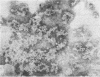
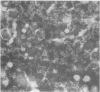
Selected References
These references are in PubMed. This may not be the complete list of references from this article.
- Anderson M. J., Jones S. E., Fisher-Hoch S. P., Lewis E., Hall S. M., Bartlett C. L., Cohen B. J., Mortimer P. P., Pereira M. S. Human parvovirus, the cause of erythema infectiosum (fifth disease)? Lancet. 1983 Jun 18;1(8338):1378–1378. doi: 10.1016/s0140-6736(83)92152-9. [DOI] [PubMed] [Google Scholar]
- Brown K. A. Another viral candidate. Nature. 1984 Jun 14;309(5969):582–582. doi: 10.1038/309582a0. [DOI] [PubMed] [Google Scholar]
- Cossart Y. E., Field A. M., Cant B., Widdows D. Parvovirus-like particles in human sera. Lancet. 1975 Jan 11;1(7898):72–73. doi: 10.1016/s0140-6736(75)91074-0. [DOI] [PubMed] [Google Scholar]
- Dayer J. M., Krane S. M., Russell R. G., Robinson D. R. Production of collagenase and prostaglandins by isolated adherent rheumatoid synovial cells. Proc Natl Acad Sci U S A. 1976 Mar;73(3):945–949. doi: 10.1073/pnas.73.3.945. [DOI] [PMC free article] [PubMed] [Google Scholar]
- Dougados M., Amor B., Lefrere J. J., Courouce A. M. Human parvovirus arthropathy. Arthritis Rheum. 1986 Apr;29(4):575–576. doi: 10.1002/art.1780290422. [DOI] [PubMed] [Google Scholar]
- Pattison J. R., Jones S. E., Hodgson J., Davis L. R., White J. M., Stroud C. E., Murtaza L. Parvovirus infections and hypoplastic crisis in sickle-cell anaemia. Lancet. 1981 Mar 21;1(8221):664–665. doi: 10.1016/s0140-6736(81)91579-8. [DOI] [PubMed] [Google Scholar]
- Simpson R. W., McGinty L., Simon L., Smith C. A., Godzeski C. W., Boyd R. J. Association of parvoviruses with rheumatoid arthritis of humans. Science. 1984 Mar 30;223(4643):1425–1428. doi: 10.1126/science.6701529. [DOI] [PubMed] [Google Scholar]
- Summers J., Jones S. E., Anderson M. J. Characterization of the genome of the agent of erythrocyte aplasia permits its classification as a human parvovirus. J Gen Virol. 1983 Nov;64(Pt 11):2527–2532. doi: 10.1099/0022-1317-64-11-2527. [DOI] [PubMed] [Google Scholar]
- Young N. S., Mortimer P. P., Moore J. G., Humphries R. K. Characterization of a virus that causes transient aplastic crisis. J Clin Invest. 1984 Jan;73(1):224–230. doi: 10.1172/JCI111195. [DOI] [PMC free article] [PubMed] [Google Scholar]