



ABSTRACT
Background:
The Accredited Social Health Activists (ASHAs) and Auxiliary Nurse Midwives (ANMs) are the frontline health staff that provide essential health care services, including diagnosis and treatment of malaria. To support India’s malaria-free goal by 2030, a project known as the Malaria Elimination Demonstration Project (MEDP) in the tribal district of Mandla was initiated. This study assessed the capabilities of ASHAs and ANMs of Mandla district to diagnose and treat malaria.
Methods:
A cross-sectional study was conducted in the 71 sub-centers and their villages where at least one positive malaria case was diagnosed in 2019. Pre-designed and validated tools were used to assess the knowledge, attitude, and practices of ASHAs and ANMs. Analysis was performed using descriptive statistics and multivariate logistic regressions.
Results:
Malaria is the fifth priority of the ASHAs and ANMs of Mandla district. Good level of knowledge regarding malaria etiology, diagnosis, and prevention was found, but the ability to treat a malaria case as per the national drug policy was below expectations. Frequent and prolonged stockouts of drugs and diagnostics were found. Logistic regressions revealed better capacity of ANMs to dispense correct treatment as compared to the ASHAs. Improvement was seen in the ASHAs ability to interpret rapid diagnostic test (RDT) results following trainings by MEDP Mandla.
Conclusion:
There is a need to increase the capabilities of the frontline health staff of Mandla for malaria diagnosis and treatment. Continuous trainings and a robust supply chain management system is required to equip the ASHAs and ANMs to effectively deliver malaria diagnosis and treatment services.
Keywords: ANMs, ASHAs, malaria elimination, supply chain management, tribal malaria
Background
In the year 2020, a total of 241 million cases and 627,000 deaths globally were caused due to malaria. This toll was higher than 2019 with an additional 14 million cases and 69,000 deaths. One of the major reasons for the increase in deaths was attributed to disruption in malaria services due to the COVID-19 pandemic.[1] In the Southeast Asia (SEA) region, three countries contributed to 99.7% of the estimated cases in the region, with India as the largest contributor (82.5%). However, India is the only country amongst the eleven high-burden-to-high-impact (HBHI) nations to register a progressive decline in malaria cases in 2020.[1]
In India, apart from seasonal outbreaks, malaria cases are concentrated primarily in five states, namely, Chhattisgarh, Odisha, Uttar Pradesh, Jharkhand, and Maharashtra. Tribal areas are considered as the heartlands of malaria, and elimination from said heartlands is expected to have national impact. The National Strategic Plan (NSP) 2017–2022 of the National Vector Borne Disease Control Programme outlines a district as the operational unit for malaria elimination.[2] According to the National Health Mission (NHM), one Accredited Social Health Activist (ASHA) is to be placed for every 1000 population, which roughly translates to one ASHA per village. The ASHA is a trained female community health activist who acts as an interface between the community and the public health system.[3,4] There is an Auxiliary Nurse Midwife (ANM) working at the level of a sub-center. Each ANM is supported by four to five ASHAs, depending upon the area covered by the sub-center, which is for a population of 5000 in plains and 3000 in tribal or hilly areas.[5,6] ASHAs are responsible for the diagnosis and treatment of malaria, whereas ANMs are principally involved with the maternal and child health priorities of the NHM.[4,7]
The first touchpoint of the community with a registered medical practitioner is in the form of a primary care physician at the primary health center, which is a two-step higher healthcare institution above the ASHA, who works at the village level and one-step higher above the ANM, who works at the sub-center level. The significance of these cadres becomes very important as they are extensions of the primary care physicians in the public health system of India.
The Malaria Elimination Demonstration Project (MEDP) is a first-of-its-kind public-private partnership between the Indian Council of Medical Research (ICMR) through the National Institute for Research in Tribal Health (NIRTH), Government of Madhya Pradesh (GoMP), and the Foundation for Disease Elimination and Control of India (FDEC-India, established by Sun Pharmaceutical Industries Ltd. as a not-for-profit entity). The goal of MEDP was to demonstrate the elimination of malaria from 1233 villages of Mandla district and use the lessons learnt for eliminating malaria from the rest of Madhya Pradesh and the country.[8]
Methods
Study setting
The data collection for this study was conducted between January 2021 and December 2021 in the Mandla district of Madhya Pradesh in India [Figure 1]. The state is divided into ten administrative divisions. Mandla is a part of the Jabalpur Division and the administrative headquarter of the district. The district has an area of 8771 km², and a population of 1,054,905.[9] The updated population was 1,140,765, as per the latest census done by MEDP in 2018–19.[10] Mandla district has 9 development blocks and 1233 villages. Most of the population is tribal including Gonds. The district lies in the Mahakoshal region, and most of the district lies in the basin of the Narmada River. The district has 314 functioning sub-centers (SC), 31 primary health centers (PHC), 11 community health centers (CHC), 1 sub-district hospital (SHC), and 1 district hospital, making a total of 358 functioning government health facilities.[11]
Figure 1.

A blown-up map of the study district Mandla showing the nine blocks with its location in the state of Madhya Pradesh in central India
Study design
A cross-sectional study was performed using pre-designed and pre-tested open- and close-ended questionnaire tools [Annexures 1 (723KB, pdf) and 2 (723.5KB, pdf) ]. The questionnaire used in this study was based on prior questionnaires developed for the MEDP with some modifications needed for this study.[8,12]
Sampling technique and sample size
From the nine blocks of Mandla district, a list of all sub-centers having malaria cases in 2019 were obtained and included as study units. Malaria cases in 2019 were reported from 71 sub-centers having a total population of 2,75,764. The 71 sub-centers were divided into nine groups corresponding to their nine blocks. A total of 86 villages had positive cases from these sub-centers. Study subjects were to be enrolled from one village from each sub-center. A total of 71 villages having the highest number of positive cases or highest population (in case of same number of positives) were selected for the study. One ASHA from each village and one ANM from each sub-center were selected for the interview [Figure 2]. Each study participant consented to participate and met the age criteria of this study. At the time of the survey, there was an increase in number of these villages due to new villages being formed by the administration. Hence, the total number of ASHAs increased from 71 to 76. For ANMs, sample collection could be completed for 68 out of 71 study subjects as one sub-center had a vacant ANM position and two ANMs were on maternity leave at the time of the survey.
Figure 2.

Sample selection flowchart for the study
Data management and analysis
The data were entered in a data entry software designed on CS-PRO 7.0 platform and the analysis was performed with the Statistical Package for the Social Sciences (SPSS) v25.0 (IBM SPSS Statistics, Armonk, NY: IBM Corp.). The analysis was performed using simple descriptive statistics, comparison of means, and multivariate logistic regressions.
Ethical considerations
This study was cleared by the Institutional Ethical Clearance (IEC) Committee of Hamdard Institute of Medical Sciences and Research (IEC-HIMSR) on February 4, 2021 (reference no. HIMSR/IEC/011/2021). An informed written consent was obtained from all participants.
Results
Sociodemographic characteristics of respondents
The ASHAs and ANMs for this study were recruited from all 71 sub-centers that had reported at least one malaria case in the year 2019. The mean age of the ASHA was 33.96 ± 7.47 and of the ANM was 39.38 ± 9.64. Maximum number of ASHAs (n = 36) and ANMs (n = 24) belonged to the 26–35 age group. Almost half of the ASHAs (48.68%) had studied till the eighth standard and a similar proportion of ANMs (47.06%) had completed graduation level of education (P < 0.001). It was also noted that more than half (57.35%) of ANMs had a diploma or below level of education, but not lesser than 10th standard. The study also revealed that ANMs did not practice any other profession, but 23.68% and 13.16% of the ASHAs reported daily labor and farming as other professions, respectively [Figures 3–5].
Figure 3.

Age distribution of the ASHAs and ANMs of Mandla district
Figure 5.

Other professions of the ASHAs and ANMs of Mandla district
Figure 4.
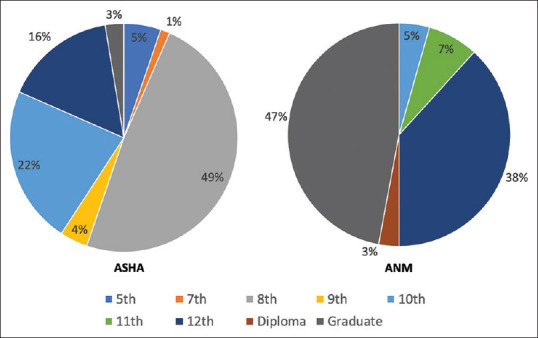
Educational qualifications of the ASHAs and ANMs of Mandla district
Health services delivery
Almost all ASHAs (96.05%) and ANMs (98.53%) reported receiving trainings on malaria diagnosis and treatment. The mean days of malaria training was 0.9 ± 0.49 and 0.91 ± 0.52 out of the total days of training of 5.89 ± 1.56 and 6.38 ± 6.41 for ASHAs and ANMs, respectively [Table 1]. Both groups reported malaria as their fourth priority in delivery of health services, followed only by tuberculosis at the last position. Maternal and child health, family planning, and immunizations were reported as the top three priority commitments by both the ASHAs and ANMs [Table 2]. Both groups used door-to-door campaigns as their chief strategy for community awareness programs, followed by interpersonal communication, and participation through government IEC/BCC camps and activities.
Table 1.
Health services training programs attended by the study participants
| Training Received | Study Group | Chi-square | P | |||
|---|---|---|---|---|---|---|
|
| ||||||
| ASHA | ANM | |||||
|
|
|
|||||
| n | % | n | % | |||
| MCH | 74 | 97.37 | 64 | 94.12 | 0.95 | 0.422 |
| Child Care | 74 | 97.37 | 68 | 100 | 1.81 | 0.498 |
| Family planning | 73 | 96.05 | 67 | 98.53 | 0.815 | 0.622 |
| Immunization | 73 | 96.05 | 68 | 100 | 2.74 | 0.247 |
| Malaria diagnosis and treatment | 73 | 96.05 | 67 | 98.53 | 0.815 | 0.622 |
| TB diagnosis and treatment | 73 | 96.05 | 67 | 98.53 | 0.815 | 0.622 |
| Days of training attended (Mean±SD) | 5.89±1.56 | 6.38±6.41 | ||||
| Days of malaria training attended (Mean±SD) | 0.9±0.49 | 0.91±0.52 | ||||
| Years of work experience (Mean±SD) | 9.98±4.36 | 13.52±9.82 | ||||
Table 2.
Mean ranking of health services as given by the study participants
| Health Program | ASHA | ANM | t test | P | ||||
|---|---|---|---|---|---|---|---|---|
|
|
|
|||||||
| n | Mean | SD | n | Mean | SD | |||
| Maternal and child health (MCH) | 76 | 2.26 | 1.25 | 68 | 2.10 | 1.25 | 0.77 | 0.443 |
| Childcare | 76 | 2.37 | 1.30 | 68 | 2.21 | 1.10 | 0.80 | 0.423 |
| Family planning | 76 | 2.97 | 1.28 | 68 | 3.41 | 1.45 | 1.93 | 0.055 |
| Immunization | 76 | 2.70 | 1.67 | 68 | 2.66 | 1.76 | 1.25 | 0.901 |
| Malaria and other vector-borne disease | 76 | 4.38 | 1.23 | 68 | 4.44 | 1.25 | 0.29 | 0.774 |
| Tuberculosis | 76 | 5.54 | 1.39 | 68 | 5.50 | 1.18 | 0.18 | 0.855 |
Knowledge, attitude and practices (KAP) related to malaria
Mosquito bites as the mode of transmission for malaria was reported by almost all of the ASHAs (93.42%) and ANMs (98.53%). However, a small fraction of the ANMs (2.94%) reported person-to-person contact as the mode of transmission. Another small fraction of the ASHAs (6.58%) reported consumption of contaminated water or food as one of the transmission modes, which was also statistically significant as compared to the ANMs (P < 0.05). Misconceptions regarding the breeding source of malaria mosquito were reported by both the ASHAs and ANMs as fresh running water (5.26% and 4.41%) and garbage (13.16% and 10.29%).
The most common malaria species reported by the ASHAs and ANMs in their respective sub-centers/villages corresponded with each other. The ASHAs reported 40.79% P. vivax, 43.42% P. falciparum, and 15.79% mixed infections, whereas the ANMs reported 47.06% P. vivax, 45.59% P. falciparum, and 7.35% mixed infections. The differences between the two sets of data were not statistically significant. Misinformation regarding high-risk age group, namely, old age and two-to-ten-year-old children was reported by both ASHAs (2.63% and 9.21%) and ANMs (4.41% and 11.76%).
It was noted that correct identification of infants and pregnant women as the high-risk group for malaria was significantly higher by the ANMs (60.29%) as compared to the ASHAs (22.37%) (P < 0.001). Almost all of the ASHAs (97.37%) and ANMs (95.59%) reported mosquito nets as the preventive measure against malaria, followed by further segregation into insecticide-treated nets/long-lasting insecticidal nets (ITN/LLIN) by 14.47% of ASHAs and 11.76% of ANMs. Clearing stagnant water (38.16% and 51.47%), use of insecticides sprays (21.05% and 29.41%) and repellents like coils (21.05% and 25%), covering body with clothes (7.89% and 20.59%), and keeping surroundings clean (51.32% and 60.29%) were also reported by the ASHAs and ANMs.
A large number of respondents also reported burning of cow dung/neem leaves (69.74% of ASHAs and 73.53% of ANMs) and few reported prophylactic medicines (13.16% of ASHAs and 17.65% of ANMs) as acceptable measures for the prevention of malaria. Symptoms of malaria included high fever (97.37% ASHAs and 98.53% ANMs), chills (68.42% ASHAs and 66.18% ANMs), headaches (77.63% ASHAs and 83.82% ANMs), body aches (47.37% ASHAs and 54.41% ANMs), and nausea/vomiting (34.21% ASHAs and 50% ANMs).
Rapid diagnostic tests (RDTs) were reported as the most commonly used method by ASHAs (97.37%) and ANMs (98.53%). Blood smear method was still used by 18.42% of ASHAs and 17.65% of ANMs. None of the respondents reported diagnosing malaria using clinical symptoms. The ideal time of 15 minutes before interpretation of RDT results was followed by only 48.68% of ASHAs and 55.88% of ANMs. Both respondents were given different RDT scenarios to assess their capability to interpret the results. A negative RDT was correctly identified by 93.42% of ASHAs and 85.29% of ANMs (P < 0.001). P. falciparum and P. vivax results were correctly identified by 94.74% of ASHAs and 86.76% of ANMs, respectively. Mixed results were correctly identified by 90.79% of ASHAs and 79.41% of ANMs. Invalid results were correctly identified by 74.34% of ASHAs and 83.08% of ANMs [Table 3].
Table 3.
Assessing malaria diagnosis practices of the study participants
| Study Group | Chi-square | P | ||||
|---|---|---|---|---|---|---|
|
| ||||||
| ASHA | ANM | |||||
|
|
|
|||||
| n | % | n | % | |||
| Methods of diagnosis of Malaria | ||||||
| RDT | 74 | 97.37 | 67 | 98.53 | 0.24 | 0.626 |
| Blood smear | 14 | 18.42 | 12 | 17.65 | 0.01 | 0.904 |
| Clinical symptoms | 0 | 0 | 0 | 0 | 0 | 1 |
| Minimum time required for RDT test results | ||||||
| 5 minutes | 17 | 22.37 | 13 | 19.12 | 1.53 | 0.782 |
| 15 minutes | 37 | 48.68 | 38 | 55.88 | ||
| 30 minutes | 21 | 27.63 | 17 | 25.00 | ||
| 45 minutes | 0 | 0 | 0 | 0 | ||
| 60 minutes | 1 | 1.32 | 0 | 0 | ||
| Interpretation of RDT results | ||||||
| Negative | 71 | 93.42 | 58 | 85.29 | 12.35 | 0.003 |
| P. Falciparum | 72 | 94.74 | 57 | 83.82 | 5.65 | 0.059 |
| P. Vivax | 72 | 94.74 | 59 | 86.76 | 3.19 | 0.178 |
| Mixed | 69 | 90.79 | 54 | 79.41 | 6.65 | 0.116 |
| Invalid | 59 | 74.34 | 58 | 83.08 | 3.97 | 0.301 |
Regarding treatment practices for malaria, ACT blister packs were found to be used by 53.9% of ASHAs and 88.24% of ANMs (P < 0.001), primaquine for the treatment of P. vivax by 40.79% of ASHAs and 83.82% of ANMs (P < 0.001), and for P. falciparum by 39.47% of ASHAs and 80.88% of ANMs (P < 0.001). Significant differences were also noted between the ASHAs and ANMs for P. vivax cases treated with chloroquine (CQ) (28.95% and 75%, P < 0.001), P. vivax cases treated with a 14-day course of primaquine (PQ) (23.68% and 75%, P < 0.001), P. falciparum cases treated with ACT blister packs (28.95% and 70.59%, P < 0.001), and P. falciparum cases treated with a single dose of PQ (15.79% and 67.65%, P < 0.001). Possession of a malaria diagnosis and treatment guide were reported by 40.79% of ASHAs and 73.53% of ANMs (P < 0.001). For queries and confusions regarding malaria diagnosis and treatment, 73.68% of ASHAs relied on their respective ANMs and almost half of the ANMs relied on their respective malaria inspectors (MI) (51.47%) and malaria technical supervisors (MTS) (45.59%).
Operational aspects of malaria diagnosis and treatment
Receipt of incentives for malaria diagnosis and treatment were reported by 56.58% of ASHAs and none by ANMs. However, 22.06% of ANMs reported receiving incentives for non-malaria-related activities (P < 0.001). A majority of the ASHAs (86.96%) reported distribution of mosquito nets around a year ago from the time of the survey. More than half of the ASHAs (63.16%) and ANMs (61.76%) reported any stock-outs within a week to the concerned authorities.
Verification of stock and records revealed that monthly target of fever cases was achieved by 11.42 ± 4.66 ASHAs and 33.97 ± 38.06 ANMs (P < 0.001), and the number of RDTs received per month were 10.51 ± 6.48 by ASHAs and 38.6 ± 30.83 ANMs (P < 0.001). Consistent higher availability of RDTs, ACTs, PQs, and CQs were reported by the ANMs as compared to the ASHAs (P < 0.01). ASHAs and ANMs reported an average of 54.45 ± 27.73 and 39 ± 29.23 days without stocks of anti-malarial drugs and 52.74 ± 37.33 and 29.75 ± 40.34 days without stock of RDTs.
Logistic regression model
Multivariate analysis revealed that ANMs had 10.89 times higher odds than the ASHAs of possessing correct knowledge about high-risk population of malaria (P < 0.001). ANMs also had 6.15 (univariate) and 7.54 (multivariate) times higher odds of possessing knowledge on preventive measures as compared to the ASHAs (P < 0.001). Experience of more than 10 years had a high degree of association with knowledge regarding symptoms of malaria (OR = 3.7) but was not found statistically significant. ANMs performed better than the ASHAs (OR = 3.63) to identify correct interpretation time of 15 minutes for the RDTs (P < 0.05). A significantly high association was also found between ANMs and adherence to the species-specific treatment practices as per the national drug policy (OR = 8.80, P < 0.001), as compared to the corresponding ASHAs.
Discussion
The mean age of the ASHAs in this study complimented the findings of a previous needs-assessment done in 2017 from the same district,[12] Karnataka,[13] Samastipur in Bihar,[14] and Odisha.[15] The mean age of the ANMs in the study was higher than that in findings from Udaipur[16] and lower than ANMs of Begusarai, Darbhanga, and Bhojpur districts of Bihar.[17] As per a systematic review and meta-analysis of studies done across the six continents, a significant variation in the age of ANMs was noted with the mean age being higher than the present study, as well as the studies from Udaipur and Bihar.[18]
The differences between the mean age of ASHAs and ANMs in Mandla can be due to the different selection eligibility criteria for these two positions, where ASHAs may only need to be qualified up to 10th standard,[3] whereas ANMs are required to possess a two year diploma and should be registered with a nursing council.[19] The presence of a secondary income stream for ASHAs can be due to incentive-based income model[3] as compared to regular income model of ANMs,[19] who did not report any sources of secondary income.
Regarding the prioritization of malaria services, this study validated the claims of the previous study from this region,[12] which reported a lower ranking of malaria services by the ASHAs[12] and findings from Fathima et al.[13] in a study conducted in Karnataka. However, it was interesting to note the poor ranking by ANMs, which is plausible as a large portion of their deliverables include an array of maternal and child health services.[20] This may also be the reason for ANMs successfully identifying infant and pregnant women as the high-risk group for malaria. The phenomenon of poor prioritization of malaria services may not be consistent throughout the country as Odisha reported a significantly higher readiness of the ASHAs to deliver malaria services in the state.[15] It is worth mentioning here that the Mandla MEDP and the Durgama Anchalare Malaria Nirakaran (DAMaN) are being hailed as models for malaria elimination.[21–24]
It was noted that neither the ASHAs nor ANMs used clinical symptoms as the method for diagnosis of malaria. This finding is in-line with the national guidelines for diagnosis of malaria where it has been recommended to make all efforts to test a clinically suspected patient with a RDT or microscopy.[25] Good levels of knowledge regarding malaria were noted in the study groups; however, this knowledge translated poorly in the practical aspects of malaria service delivery. The correct waiting time for interpretation of RDTs was reported by almost half of ASHAs and ANMs. This finding was similar to the baseline assessment performed by a prior study.[12]
In this study, high accuracy of interpretation of RDT results was noted as compared to the baseline survey of 2017.[12] Improvement in the knowledge and skills of ASHAs is noteworthy from the perspective of a primary care physician positioned at the level of the primary health center. Accurate diagnosis and treatment by the frontline workers reduces the burden from higher centers and improves the overall health of population catered by the primary health centers.
It has been noted in earlier studies that the presence of malaria cases in the working areas of frontline health staff helps in better retention of knowledge due to better hands-on practice as compared to areas where no malaria cases are reported.[12,26,27] The present study also revealed that educational status did not have a significant impact on knowledge, attitude, and practice indicators of malaria diagnostic and treatment services. Similar phenomenon has been noted in another study conducted in Mandla.[26]
The stark difference between the ASHAs and ANMs toward understanding malaria treatment according to the national drug policy[28] was noted. Better understanding about the drug regimens by the ANMs can be attributed to their advanced qualification and knowledge levels. Similar poor performance of ASHAs in this domain has been noted in Wardha district of Maharashtra and some districts of Assam where none of the ASHAs were trained in malaria diagnosis and treatment.[29,30] However, it is likely that this may not be a true representation of ASHAs’ capabilities, as the present study also showed consistent stock-outs of diagnostic kits and treatment drugs particularly at the level of the ASHAs. Absence of adequate stock will lead to incorrect or incomplete dispensation of malaria services. This issue has been raised throughout the course of work in Mandla through other published studies.[8,12,24,27,31]
Conclusion
The study effectively assessed the capabilities of the ASHAs and ANMs in the tribal district of Mandla in the delivery of malaria services. It was found that both of these groups of frontline health staff are not adequately trained in malaria diagnosis and treatment. Trainings by the MEDP have yielded success in select indicators such as the ability of ASHAs to diagnose malaria; however, the optimal utilization of this skill can be interrupted by frequent and prolonged stock-outs of anti-malaria drugs and diagnostic kits. There is a strong need for continuous training of both the ASHAs and ANMs of Mandla district. This would not only improve diagnosis and treatment services but could also improve supply chain for commodities needed for elimination programs.
Abbreviations
ACT: Artemisinin-based combination therapy; ASHA: Accredited social health activist; CQ: Chloroquine; FDEC: Foundation for Disease Elimination and Control of India; GoMP: Government of Madhya Pradesh; ICMR: Indian Council of Medical Research; IEC: Institutional Ethical Committee; KAP: Knowledge, attitude, and practices; MCH: Maternal and child health; MEDP: Malaria Elimination Demonstration Project; NHM: National Health Mission; NIRTH: National Institute of Research in Tribal Health; NVBDCP: National Vector Borne Disease Control Programme; OBC: Other backward caste; PQ: Primaquine; RDT: Rapid diagnostic test; SC: Scheduled caste; SPSS: Statistical Package for the Social Sciences; ST: Scheduled tribe; WHO: World Health Organization
Contributions
HR, RP, RA, AAL conceptualized the study; HR, RP, RA, VK, FI designed the study protocol; HR carried out the data collection; HR, VK analyzed the data; HR drafted the manuscript; FI, RP, VK, EG, RA, AAL critically reviewed the manuscript. All authors reviewed and approved the final manuscript.
Ethical clearance
This study was cleared by the Institutional Ethical Clearance (IEC) Committee of Hamdard Institute of Medical Sciences and Research (IEC-HIMSR) on February 4, 2021 (reference no. HIMSR/IEC/011/2021). An informed written consent was obtained from all participants.
Declaration of patient consent
The authors certify that they have obtained all appropriate patient consent forms. In the form the patient (s) has/have given his/her/their consent for his/her/their images and other clinical information to be reported in the journal. The patients understand that their names and initials will not be published and due efforts will be made to conceal their identity, but anonymity cannot be guaranteed.
Financial support and sponsorship
Nil.
Conflicts of interest
There are no conflicts of interest.
INTERVIEW TOOL FOR ASHAs
INTERVIEW TOOL FOR ANMs
Acknowledgements
First and foremost, we dedicate this paper to the tribal community of Mandla. We are thankful to Ms. Harshika Singh, District Collector Mandla; Dr. Srinath Singh, Chief Medical and Health Officer Mandla; Sh. Ram Shankar Sahu, District Malaria Officer Mandla; and the ASHAs and ANMs of the district for their cooperation and support. We are also thankful to the Board of FDEC India for supporting this work and the district-staff of MEDP for their day-to-day support.
References
- 1.World Health Organization. World Malaria Report 2021. Geneva: World Health Organization; 2021. [Google Scholar]
- 2.National Strategic Plan for Malaria 2017-2022. New Delhi: National Vector Borne Disease Control Programme, Ministry of Health and Family Welfare, Government of India; [Last accessed on 2022 Aug 16]. Available from:https://nvbdcp.gov.in/WriteReadData/l892s/nsp_2017-2022.pdf . [Google Scholar]
- 3.MoH& FW. [Last accessed on 2022 Aug 16];About Accredited Social Health Activist (ASHA):National Health Mission. 2014 Available from:http://nhm.gov.in/communitisation/asha/about-asha.html . [Google Scholar]
- 4. [Last accessed on 2022 Aug 16];Guidelines for Involvement of ASHAs in VBDs:NVBDCP. Available from:https://nvbdcp.gov.in/WriteReadData/l892s/Guidelines-Involvement-ASHAs.pdf . [Google Scholar]
- 5. [Last accessed on 2022 Aug 16];Rural Health Care System in India:National Health Mission (NHM), Ministry of Health and Family Welfare, Government of India. Available from:https://www.nhm.gov.in/images/pdf/monitoring/rhs/rural-health-care-system-india-final-9-4-2012.pdf . [Google Scholar]
- 6. [Last accessed on 2022 Aug 16];Indian Public Health Standards (IPHS) Guidelines for Sub-Centres:Directorate General of Health Services, Ministry of Health and Family Welfare, Government of India. 2012 Available from:https://web.archive.org/web/20160304074234/http://clinicalestablishments.nic.in/WriteReadData/875.pdf . [Google Scholar]
- 7. [Last accessed on 2022 Aug 16];Training Module for ASHAs on Malariology:National Vector Borne Disease Control Programme, Ministry of Health and Family Welfare, Government of India. Available from:https://nvbdcp.gov.in/WriteReadData/l892s/Revised-ASHA-Training-Module-2014.pdf . [Google Scholar]
- 8.Rajvanshi H, Bharti PK, Nisar S, Jain Y, Jayswar H, Mishra AK, et al. Study design and operational framework for a community-based Malaria Elimination Demonstration Project (MEDP) in 1233 villages of district Mandla, Madhya Pradesh. Malar J. 2020;19:1–12. doi: 10.1186/s12936-020-03458-4. doi:10.1186/s12936-020-03458-4. [DOI] [PMC free article] [PubMed] [Google Scholar]
- 9. [Last accessed on 2022 Aug 16];Mandla District:Census 2011 data:Government of India. 2015 Available from:https://www.census2011.co.in/census/district/321-mandla.html . [Google Scholar]
- 10.Sharma RK, Rajvanshi H, Bharti PK, Nisar S, Jayswar H, Mishra AK, et al. Socio-economic determinants of malaria in tribal dominated Mandla district enrolled in Malaria Elimination Demonstration Project in Madhya Pradesh. Malar J. 2021;20:7. doi: 10.1186/s12936-020-03540-x. [DOI] [PMC free article] [PubMed] [Google Scholar]
- 11. [Last accessed on 2022 Aug 16];Health Management Information System-data reporting status upto district level/2018-19:National Health Mission, Ministry of Health and Family Welfare, Government of India. 2019 Available from:https://nrhm-mis.nic.in/hmisreports/frmstandard_reports.aspx . [Google Scholar]
- 12.Rajvanshi H, Saha KB, Shukla MM, Nisar S, Jayswar H, Mishra AK, et al. Assessment of ASHA for knowledge, diagnosis and treatment on malaria in Mandla district of Madhya Pradesh as part of the malaria elimination demonstration project. Malar J. 2021;20:1–8. doi: 10.1186/s12936-021-03610-8. doi:10.1186/s12936-021-03610-8. [DOI] [PMC free article] [PubMed] [Google Scholar]
- 13.Fathima FN, Raju M, Varadharajan KS, Krishnamurthy A, Ananthkumar S, Mony PK. Assessment of 'accredited social health activists'—A national community health volunteer scheme in Karnataka state, India. J Health Popul Nutr. 2015;33:137–45. [PMC free article] [PubMed] [Google Scholar]
- 14.Swadhin Kumar J. Assessment of accredited social health activist on postnatal care service, Samastipur district, Bihar. Doctoral dissertation. SCTIMST. 2017 [Google Scholar]
- 15.Hussain MA, Dandona L, Schellenberg D. Public health system readiness to treat malaria in Odisha State of India. Malar J. 2013;12:351. doi: 10.1186/1475-2875-12-351. doi:10.1186/1475-2875-12-351. [DOI] [PMC free article] [PubMed] [Google Scholar]
- 16.Mohan P, Iyengar SD, Mohan S, Sen K. Auxiliary Nurse Midwife:What determines her place of residence. J Health Popul Dev Countr. 2003 Available from:http://www.jhpdc.unc/edu . [Google Scholar]
- 17.Kumari S, Mishra R, Roy R, Jha R, Mahapatra S. Role of Auxiliary Nurse Midwives in routine surveillance activities and outbreak response under the Integrated Disease Surveillance Program in Bihar, India. 2020. Available from:https://www.adriindia.org/images/paper/1604474107 Book032020_Ok.pdf . [Google Scholar]
- 18.Schoenaker DA, Jackson CA, Rowlands JV, Mishra GD. Socioeconomic position, lifestyle factors and age at natural menopause:A systematic review and meta-analyses of studies across six continents. Int J Epidemiol. 2014;43:1542–62. doi: 10.1093/ije/dyu094. [DOI] [PMC free article] [PubMed] [Google Scholar]
- 19. [Last accessed on 2022 Aug 16];Guidelines and Selection Process for recruitment of Auxiliary nurse midwife (ANM), National Health Mission, Uttar Pradesh:Uttar Pradesh-tNational Health Mission. 2021 Available from:http://upnrhm.gov.in/uploads/5909075904206376.pdf . [Google Scholar]
- 20.Malik G. Role of auxiliary nurse midwives in national rural health mission. Nurs J India. 2009;100:88. [PubMed] [Google Scholar]
- 21.Bal M, Das A, Ghosal J, Pradhan MM, Khuntia HK, Pati S, et al. Assessment of effectiveness of DAMaN:A malaria intervention program initiated by Government of Odisha, India. PLoS One. 2020;15:e0238323. doi: 10.1371/journal.pone.0238323. doi:10.1371/journal.pone. 0238323. [DOI] [PMC free article] [PubMed] [Google Scholar]
- 22.Pradhan MM, Meherda P. Malaria elimination drive in Odisha:Hope for halting the transmission. J Vector Borne Dis. 2019;56:53–5. doi: 10.4103/0972-9062.257775. [DOI] [PubMed] [Google Scholar]
- 23.Pradhan S, Pradhan MM, Dutta A, Shah NK, Joshi PL, Pradhan K, et al. Improved access to early diagnosis and complete treatment of malaria in Odisha, India. PloS One. 2019;14:e0208943. doi: 10.1371/journal.pone.0208943. doi:10.1371/journal.pone. 0208943. [DOI] [PMC free article] [PubMed] [Google Scholar]
- 24.Rajvanshi H, Mishra K, Bharti PK, Sandhibigraha D, Nisar S, Jayswar H, et al. Learnings from two independent malaria elimination demonstration projects in India. Trans R Soc Trop Med Hyg. 2021;115:1229–33. doi: 10.1093/trstmh/trab148. [DOI] [PubMed] [Google Scholar]
- 25. [Last accessed on 2022 Aug 16];Guidelines for diagnosis and treatment of malaria in India:National Vector Borne Disease Control Programme, Ministry of Health and Family Welfare, Government of India. 2009 Available from:https://nvbdcp.gov.in/Doc/Guidelines_for_Diagnosis___Treatment.pdf . [Google Scholar]
- 26.Rajvanshi H, Nisar S, Bharti PK, Jayswar H, Mishra AK, Sharma RK, et al. Significance of training, monitoring and assessment of malaria workers in achieving malaria elimination goal of Malaria Elimination Demonstration Project. Malar J. 2021;20:27. doi: 10.1186/s12936-020-03534-9. [DOI] [PMC free article] [PubMed] [Google Scholar]
- 27.Rajvanshi H, Bharti PK, Nisar S, Jayswar H, Mishra AK, Sharma RK, et al. A model for malaria elimination based on learnings from the Malaria Elimination Demonstration Project, Mandla district, Madhya Pradesh. Malar J. 2021;20:1–15. doi: 10.1186/s12936-021-03607-3. doi:10.1186/s12936-021-03607-3. [DOI] [PMC free article] [PubMed] [Google Scholar]
- 28.National Drug Policy on malaria Directorate of National Vector Borne Disease Control Programme. New Delhi: 2013. [Last accessed on 2022 Aug 16]. Availablefrom:https://www.nvbdcp.gov.in/Doc/National-Drug-Policy-2013.pdf . [Google Scholar]
- 29.Gosavi S, Raut A, Deshmukh P, Mehendale A, Garg B. ASHAs awareness and perceptions about their roles and responsibilities:A study from rural Wardha. J Mahatma Gandhi Inst Med Sci. 2011;16:1–8. [Google Scholar]
- 30.Prasad H. Evaluation of malaria control programme in three selected districts of Assam, India. J Vector Borne Dis. 2009;46:280–7. [PubMed] [Google Scholar]
- 31.Rajvanshi H, Jain Y, Kaintura N, Soni C, Chandramohan R, Srinivasan R, et al. A comprehensive mobile application tool for disease surveillance, workforce management and supply chain management for Malaria Elimination Demonstration Project. Malar J. 2021;20:1–9. doi: 10.1186/s12936-021-03623-3. doi:10.1186/s12936-021-03623-3. [DOI] [PMC free article] [PubMed] [Google Scholar]
Associated Data
This section collects any data citations, data availability statements, or supplementary materials included in this article.
Supplementary Materials
INTERVIEW TOOL FOR ASHAs
INTERVIEW TOOL FOR ANMs