



Introduction
The European Society for Paediatric Nephrology (ESPN) together with the International Pediatric Nephrology Association (IPNA) has now conducted the broadest and most successful pediatric nephrology educational program in the world, training more than over 1000 participants from five continents, during the last 10 years.
The IPNA–ESPN Junior Master Class program was launched in 2014 with the main objective of completing and harmonizing the pediatric nephrology activities and education in Europe. It was especially designed for fellows in pediatric nephrology, young pediatric nephrologists, residents in pediatrics, and pediatricians with special interest in pediatric nephrology.
Pediatric kidney care maintains substantial disparities among European countries. Additionally, the requirements for qualification as a pediatric nephrologist vary from country to country [1–3]. Furthermore, a high degree of perceived workforce inadequacy and difficulty in recruiting pediatric nephrology trainees exists in most regions of the world. Lack of interest, financial constraints, complexity of patients with kidney failure, and perceived pediatric nephrology workload are mentioned as dissuading factors by potential pediatric nephrology trainees [4–6]. These factors support the organization of effective training and education programs, both at the undergraduate and postgraduate level, aiming at transfer of knowledge and experience from the most resourced centers, connecting physicians in developing countries with high standard pediatric nephrology training centers, and building novel collaboration between groups of young nephrologists working across Europe and around the globe [3, 7].
Following the pediatric nephrology syllabus [8, 9], approved by the ESPN council and the European Academy of Paediatrics in 2019, the IPNA–ESPN Junior Master Class program comprises the whole pediatric nephrology curriculum over a seven-day course, distributed throughout annual educational sessions, to complete the curriculum in three years.
Since 2014, three courses (nine sessions) have been delivered, educating a total of 1073 participants from 77 different countries, covering five continents, successfully connecting colleagues from middle and low-resourced countries through high-standard pediatric nephrology training centers across Europe and around the world.
The scientific program
The IPNA–ESPN Junior Master Class scientific program is organized tri-annually, covering the complete pediatric nephrology curriculum presented in 50 lectures. Pediatric nephrologists, nephrologists, urologists, radiologists, clinical geneticists, and pathologists, IPNA- and ESPN-certified teachers, are responsible for the lectures, covering all main clinical aspects from basic science to the newest updates in clinical pediatric nephrology, all based on published and systematic reviews and guidelines endorsed by ESPN, IPNA, and other recognized societies.
ESPN holds responsibility for the scientific and local organization of this course, whenever possible located right before the annual ESPN conference, in the same venue, facilitating participation of students from different parts of Europe and allowing both participants and teachers to extend their working days together, and stimulating more effective and fruitful discussions and exchanges. Due to the COVID-19 pandemic, in 2020 and 2021, the courses were held online, and in 2022, a hybrid session was delivered.
Every year, the IPNA–ESPN Junior Master Class program is evaluated by the European Accreditation Council for Continuing Medical Education (EACCME®) and the sessions are granted with a number of European CME credits (ECMEC®s) (Supplementary Table 1). A CME certificate is distributed to the attending participants after each session. Participants who complete the three-year course also receive a master diploma in pediatric nephrology recognized by ESPN and IPNA.
Each IPNA–ESPN Junior Master Class program session runs two to three complete working days, according to the number of modules covered in that session. All lectures are scheduled for 30 min, followed by, at least, 10 min of complementary discussion on each topic. The global philosophy is to combine high-level education on all major topics (international academic speakers) and a session aiming at networking professors and participants from various nations (East–West/North–South connections).
During the first session, fluids and electrolytes, radiology, embryology, antenatal hydronephrosis, CAKUT (congenital anomalies of the kidney and urinary tract), voiding dysfunction, vesicoureteral reflux, urinary tract infection, podocytopathies, Alport syndrome, renal tubular acidosis, mitochondrial kidney diseases, ciliopathies, ADPKD and ARPKD, and kidney involvement in metabolic disorders are reviewed.
The second session is dedicated to nephrocalcinosis and urolithiasis, disorders of calcium and magnesium metabolism, post-infectious glomerulonephritis, IgA vasculitis and IgA nephropathy, nephrotic syndrome, haemolytic uremic syndrome, C3 glomerulopathies, kidney involvement in vasculitis, systemic lupus erythematosus nephritis, cystinosis, Bartter and Gitelman syndromes, and epidemiology of kidney diseases.
The third session reviews the current concepts on diagnosis, management, treatment, and complications related to acute kidney injury, chronic kidney disease, dialysis, and kidney transplantation.
An interactive session on kidney and transplant pathology is included in both the second and the third sessions.
Application procedure
The IPNA–ESPN Junior Master Class educational program is publicized on both IPNA and ESPN websites and newsletters. The participants are invited to submit their application by email, enclosing their brief curriculum vitae. This course attendance is exclusive and free to ESPN active members. Organizational and course expenses are totally covered by IPNA and ESPN, independent from pharmaceutical companies, following an application submitted every year to both societies.
Participants
Since 2014, the IPNA–ESPN Junior Master Class has educated 1073 participants from 77 different countries, a total of 522 unique trainees and young pediatric nephrologists during this time. A hundred and eighty-four participants (35%) from 43 countries have now concluded the 3-year course and accomplished the IPNA–ESPN Master in Pediatric Nephrology Program. Demographic characteristics of the participants are summarized in Table 1.
Table 1.
Demographic characteristics of IPNA–ESPN Junior Master Class participants
| Total participants | Master graduates | |
|---|---|---|
| Total number n | 1073 | 184 |
| Gender M/F (%) | 265/808 (25/75) | 44/140 (24/76) |
| Median age (IQR) | 35 (32–39) | 36 (32–38) |
| Median years of training (IQR) | 3 (2–4) | 3 (3–4) |
| Nationalities n | 77 | 43 |
Due to the COVID-19 pandemic, the third IPNA–ESPN Junior Master Class course was held online (2020 and 2021) and in hybrid format (2022), facilitating the access to this course for a higher number of participants from numerous nationalities, as shown in Fig. 1. The number of participants completing the IPNA–ESPN Junior Master Class program (three-year sessions) and receiving the IPNA–ESPN Master certificate in pediatric nephrology has also increased during this time (Fig. 2). The distribution of participants in the Junior Master Class program is shown in Fig. 3.
Fig. 1.
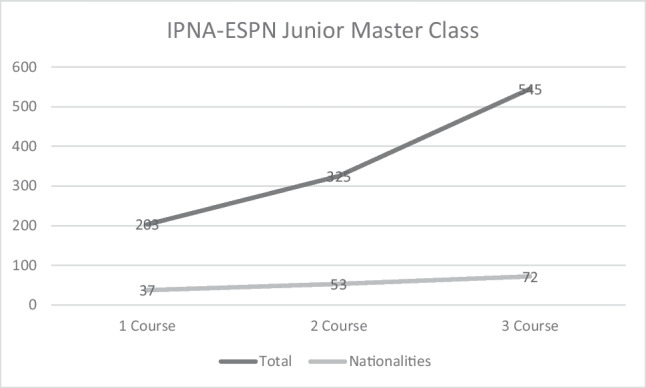
Number of IPNA–ESPN Junior Master Class course participants and sessions completed
Fig. 2.
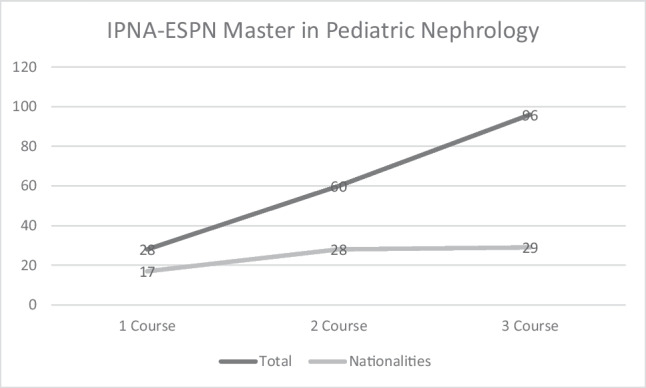
Number of participants receiving the IPNA–ESPN master diploma in pediatric nephrology
Fig. 3.
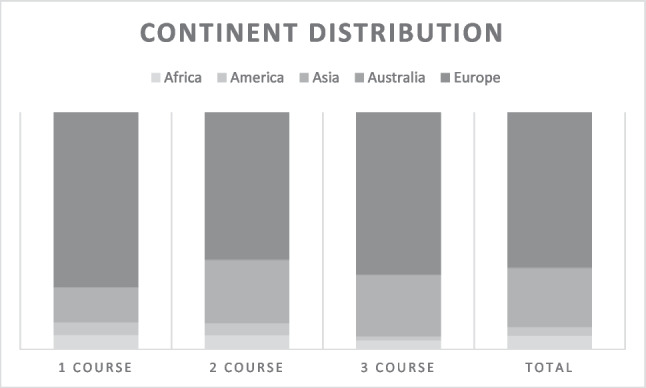
IPNA–ESPN Junior Master Class participants’ continent of origin
After each session, all students complete a multiple-choice written exam evaluating the course content.
Since 2020, the IPNA–ESPN Junior Master participants who completed the three-year course are also invited to complete the ESPN board examination in pediatric nephrology, an online exam, consisting of 100 case-based multiple-choice questions covering all aspects of pediatric nephrology, to earn a new certification and a quality label of theoretical knowledge and adequate clinical thinking in pediatric nephrology, implemented by the ESPN educational committee [10].
Participants’ feedback evaluation
In accordance with the European Accreditation Council for Continuing Medical Education (EACCME®) requirements, each course is appraised by the participants. The participants grade the quality of the speakers, the quality of the course contents, the organization, the impact of this educational activity on their current practice, and the new knowledge acquired. The results are presented on a 0–10 scale with 10 being the highest rating, in Fig. 4. The quality of the speakers, quality of the content, and organization of the course were all rated > 9 by the participants.
Fig. 4.
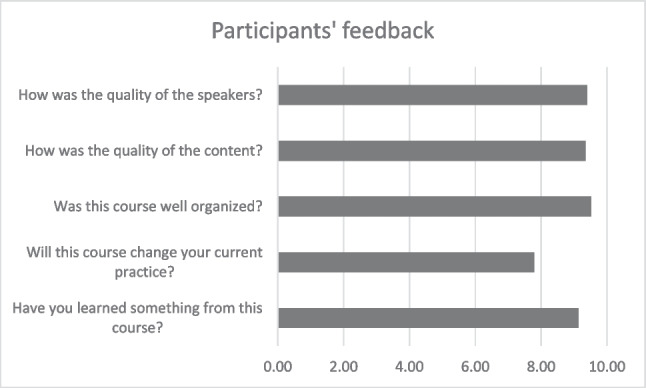
IPNA–ESPN participants’ feedback
Some original comments from various participants are presented in Supplementary Table 2.
Discussion
The IPNA–ESPN Junior Master Class program was designed to provide junior pediatric nephrologists with a comprehensive and structured educational activity that would help to improve training activities in knowledge domains and meet the educational needs of junior pediatric nephrologists in Europe [1, 3].
Considering the importance of the interaction between participants, the first course, in 2014, was originally designed to host a total of 50 participants in each session. The high number of applications, with diverse origins and heterogeneous training backgrounds, encouraged us to increase the number of offered places, enriching the value of the lectures and the importance of the discussions. Moreover, this IPNA–ESPN educational activity has proved to be successful in connecting physicians in developing countries with high standard pediatric nephrology training centers across Europe and around the globe [3].
Interventions to support the growth of the pediatric nephrology workforce include developing and sharing novel teaching methods, strengthening existing trainee relationships, and exposing potential trainees to nephrology early in their education [7]. The IPNA–ESPN Junior Master Class program has been able to successfully train a high number of junior physicians, coming from diverse regions of the globe, to complete the three-year course, and achieve the IPNA–ESPN Master in Pediatric Nephrology certificate.
ESPN prioritizes the harmonization of training curricula in Europe and the development of European recognition criteria for pediatric nephrologists [8, 9]. The European Accreditation Council for Continuing Medical Education (EACCME®) and the number of European CME credits (ECMEC®s) granted indicate the quality of the IPNA–ESPN Junior Master Class program, and underscores its standing as an effective training program, the program’s contribution to addressing global pediatric nephrology workforce needs and the continued high-level of education delivered by the program.
The COVID-19 pandemic had a profound impact on the organization of medical seminars and congresses. Notwithstanding the importance of social and face-to-face interaction, the advent of online and hybrid meetings, with the possibility for live-streaming and recording lectures that are made available for enduring use, increased the number of attendees from different countries after 2020.
The long-term impact of this educational approach still needs to be followed and further investigated.
What is next? IPNA–ESPN Junior Master Class future perspectives
The IPNA–ESPN Junior Master Class program is one of the most important educational activities sponsored by ESPN, continuously growing since 2014. At present, it is the main support for pediatric nephrology continuous education and training for the ESPN board examination [10]. Despite the growing popularity and success, over the next years, IPNA and ESPN can expect various challenges.
First, the balance between the continuation of online format and the interest by learners to return to face-to-face meetings needs to be considered. While in terms of costs and accessibility to participants from different regions, the online format is clearly advantageous; the importance of networking and the direct interaction between the participants and the teachers during face-to-face meetings cannot be neglected. Participants have expressed on the feedback questionnaire a preference for in-person instruction, although approximately one-third favor the online format. To best meet the needs and preferences of the participants, we can best serve them and deliver education to the greatest number of participants through the interactive hybrid format which will provide wider outreach and accessibility, decrease costs for many participants (and the sponsoring organizations), reduce travel time and expenses, and decrease the environmental footprint of air travel by so many.
Second, considering the tremendous scientific developments during the last few years, we may have to expand the number of presentations included in this course, and also work to assure development of the competencies of the practicing pediatric nephrologist in a variety of settings can be aided through the course.
Finally, additional funding methods may be required to provide this first in class education to those participants in need.
Conclusions
The IPNA–ESPN Junior Master Class educational program has significantly contributed to development of the pediatric nephrology workforce in Europe and throughout the world. This program has also improved collaborations between junior pediatric nephrologists around the globe and thereby stimulated additional clinical advances and research opportunities.
The quality of care for children with kidney diseases is dependent on the number of well-trained health care providers, their dedication, and the health care systems they can organize. The IPNA–ESPN Junior Master Class program has provided a major improvement in pediatric nephrology training activities, enabling students to develop better knowledge, attitudes, and clinical skills than they likely would not have gained through their training programs alone. The evident friendly cooperation between groups of nephrologists from different countries, working together to deliver this education, provides a remarkable example to the young pediatric nephrologists who will be caring for patients and families for some time.
Despite the number of challenges, ESPN has made a joint commitment with IPNA to continue this Junior Master Class program in the forthcoming years.
Supplementary Information
Below is the link to the electronic supplementary material.
Acknowledgements
We thank Prof. Yap Hui Kim (former IPNA President), Prof. Franz Schaefer (IPNA President), and Prof. Brad Warady (former IPNA Treasurer) for their enthusiasm and encouragement, facilitating the organization of this IPNA–ESPN joint activity.
We thank all Junior Master Class teachers and participants for their presence and continuous support, enabling the success of this IPNA and ESPN educational activity.
We thank the former ESPN Professional Congress Organizer—Flaptour—for their administrative assistance, accompanying all courses and supporting IT management.
The authors did not receive support from any organization for the submitted work.
The authors have no competing interests to declare that are relevant to the content of this article.
Footnotes
Publisher's note
Springer Nature remains neutral with regard to jurisdictional claims in published maps and institutional affiliations.
References
- 1.Ehrich JHH, Gendi AA, Drukker A, Janda J, Stefanidis C, Verrier- Jones K, Collier J, Katz M. Demography of paediatric renal care in Europe: organization and delivery. Nephrol Dial Transplant. 2005;20:297–305. doi: 10.1093/ndt/gfh299. [DOI] [PubMed] [Google Scholar]
- 2.Bacchetta J, Teixeira A, Levtchenko E, Haffner D, Cochat P, Coppo R. What do European young pediatric nephrologists look like? Toward a young pediatric nephrology network (YPNN) Pediatr Nephrol. 2015;30:1729–1730. [Google Scholar]
- 3.Prikhodina L, Ehrich J, Shroff R, Topaloglu R, Levtchenko E; European Society for Paediatric Nephrology The European Society for Paediatric Nephrology study of pediatric renal care in Europe: comparative analysis 1998–2017. Pediatr Nephrol. 2020;35:103–111. doi: 10.1007/s00467-019-04378-5. [DOI] [PubMed] [Google Scholar]
- 4.Jhaveri KD, Sparks MA, Shah HH, Khan S, Chawla A, Desai T, Iglesia E, Ferris M, Parker MG, Kohan DE. Why not nephrology? A survey of US internal medicine subspecialty fellows. Am J Kidney Dis. 2013;61:540–546. doi: 10.1053/j.ajkd.2012.10.025. [DOI] [PMC free article] [PubMed] [Google Scholar]
- 5.Ferris M, Iglesia E, Ko Z, et al. Wanted pediatric nephrologist. Why trainees are not choosing pediatric nephrology. Ren Fail. 2014;36:40–44. doi: 10.3109/0886022X.2014.937671. [DOI] [PubMed] [Google Scholar]
- 6.Glenn D, Ocegueda S, Nazareth M, Zhong Y, Weinstein A, Primack W, Cochat P, Ferris M. The global pediatric nephrology workforce: a survey of the International Pediatric Nephrology Association. BMC Nephrol. 2016;17:83. doi: 10.1186/s12882-016-0299-2. [DOI] [PMC free article] [PubMed] [Google Scholar]
- 7.Sharif MU, Elsayed ME, Stack AG. The global nephrology workforce: emerging threats and potential solutions! Clin Kidney J. 2016;9:11–22. doi: 10.1093/ckj/sfv111. [DOI] [PMC free article] [PubMed] [Google Scholar]
- 8.ESPN education committee. https://www.espn-online.org/education-committee/. Accessed 1 December 2022
- 9.European Training Requirements for Training in Paediatric Nephrology. https://www.espn-online.org/wp-content/uploads/2020/02/Pediatric-Nephrology-ETR-approved-Dec-2019.pdf. Accessed 1 December 2022
- 10.ESPN Board Examination in Pediatric Nephrology. https://www.espn-online.org/espn-board-examination/. Accessed 1 December 2022
Associated Data
This section collects any data citations, data availability statements, or supplementary materials included in this article.