



Abstract
The reactions between silanols or terminal acetylenes with alkynylgermanes have been accomplished using potassium bis(trimethylsilyl)amide as the catalyst. This strategy has provided an entry point into various organogermanes including germasiloxanes and alkynylgermanes. Remarkably, not only KHMDS but also simple bases such as KOH can serve as efficient catalysts in this process.
Subject terms: Chemistry, Catalysis, Environmental chemistry, Green chemistry, Chemical synthesis
Introduction
Organogermanium compounds are much less studied than their silicon counterparts, but very recently, an impetus to design new synthetic routes to various organogermanes was witnessed and significant contributions were reported1–11. That is not merely a scientific curiosity but primarily, the unique features of germanium compounds are the leading cause of this trend. Moreover, due to their high stability and low toxicity, they can be considered very useful reagents in the synthesis of complex organic molecules4,12. The germanium analogues of siloxanes with Ge–O–Si fragments attract considerable attention owing to their high refractive index, low dielectric constant, and biocompatible properties13–15. This may lead to completely new materials with different properties than their silicon analogs16. There are known several available reaction manifolds to forge Ge–O–Si moieties (Fig. 1). They can be readily accessed via well-developed stoichiometric methods. Here, the germasiloxanes are formed by the condensation of chlorogermanes (or aminogermanes) with silanols or metal silanolates17,18. Moreover, there is also a known reaction between germoxanes and silyl azides19. Because of the inconvenient nature of these processes (e.g., high moisture sensitivity of substrates, generation of corrosive or explosive byproducts, etc.), researchers have tried to develop catalytic alternatives. These methods can be generally divided into approaches involving siloxymethylamines20 (or germyl intermediates14), as well as the reaction of various organosilicons with different germylation agents via dehydrogenative21, dealkylative21, and dealkenative22–27 coupling reactions. Despite several advantages, other features of these processes, especially the need for an expensive catalyst (e.g., [Ru3(CO)12], Sc(OTf)3, B(C6F5)3, etc.) dramatically reduce their potential. On the other hand, unlike alkynylsilanes, alkynylgermanes have just begun to meet the criteria of useful reagents in organic synthesis. Here, the synthetic arsenal for the formation of sp C–Ge bonds mainly relies on the stoichiometric reaction between moisture-sensitive halogermanes with metal acetylides or the use of expensive transition metal complexes (Ru—vinylgermanes/alkynylgermanes28–30, Ir—chlorogermanes/iodo-germanes31,32). Very recently, an outstanding B(C6F5)3-catalyzed cross-dehydrogenative germylation of terminal alkynes with triethylgermanium hydride was reported by the Schoenebeck group33. Considering the drawbacks of previously established methods (e.g., expensive catalysts, the limited availability of hydrogermanes, etc.), it would be fascinating and yet challenging to develop a novel catalytic approach in a more green and sustainable manner. Finally, terminal alkynes can be C–germylated by using 1-trimethylsilyl-2-trimethylgermylacetylene molecule under basic conditions34. To the best of our knowledge, there is only one example of such an atypical synthetic strategy. Notably, this strategy is not without its own disadvantages, including the use of fluoride reagents and expensive crown ethers. Moreover, the authors have reported only two products, with low selectivity and yields (less than 50%).
Figure 1.

Context of the investigation.
Sustainable and eco-friendly synthetic approaches proceeded by the main-group species have gained recent significant attention35–44. Thus, we sought the method leading to versatile germanium compounds that blends the high selectivity of TM-mediated approaches with the practicality of a base-promoted protocol. Based on our recent success in activating silylacetylenes under sustainable catalysis45–49, we reasoned that an appropriate catalytic manifold could provide an efficient platform to generate diversified libraries of organogermanes. In this communication, we report on the catalytic O– and sp C–germylation by using potassium bis(trimethylsilylamide) as the catalyst (Fig. 1d).
Results and discussion
Our optimization studies (for details, see Table S1 in SI) revealed that utilizing triethyl(ethynyl)germane (2a) as the germylating agent, and KHMDS as the catalyst led to the corresponding germasiloxane 3a. Using a mixture of acetonitrile and tetrahydrofuran as the medium (v/v 10:1), this main-group catalytic combination afforded the desired product in 92% yield. Particularly noteworthy is a very good conversion of silanols in the presence of potassium hydroxide (for details, see Table S2 in SI). However, we decided to continue our work with potassium bis(trimethylsilylamide), due to better conversions and yields of final products. The catalyst-free attempt was also carried out and proved the essential role of the main-group catalysis and confirmed no leaching of the alkali species from the glassware, which could act as potential co-catalysts50,51. The reaction can be also performed under an air atmosphere but gave inferior results. Figure 2 demonstrates a product scope for alkynylgermanes coupling with silanols using KHMDS in MeCN/THF mixture. The desired germasiloxanes (3a-3n) were obtained in each case with a very good isolated yield (85–99%). Conversely, in the presence of bulky isopropyl substituents at the germanium atom, the lower conversion and isolated yield were observed (3o, 51%).
Figure 2.

Substrate scope for O-germylation of various silanols.
We were particularly delighted that dialkynylgermanes could be converted to germasiloxanes (3p-3r). In the case of dibutyldiethynylgermane, the reaction can selectively proceed to both mono- and disubstituted products (3q and 3r). This should be treated as another advantage of this germylation method over previously known approaches due to the possibility of further modifications of the untouched ethynyl group (3q). Encouraged by these results, we then investigated the use of alcohols instead of silanols. We were pleased to find that 1-(4-chlorophenyl)ethan-1-ol and isopropanol were successfully germylated under standard conditions (Fig. 2), leading to products 3s and 3t in moderate yields (50–63%). Unfortunately, our attempts to perform analogous S– and N–germylation failed. Benzenethiol and aniline were not reactive even under forcing conditions.
Intrigued by the high efficiency and chemoselectivity of the transformation, we next pursued the development of further applications of our catalytic system. Encouragingly, this strategy enabled the germylation of terminal alkynes. We started to explore the substrate scope with respect to alkynylgermanes, particularly to their self-metathesis reaction (Fig. 3).
Figure 3.

Substrate scope for C–germylation of alkynylgermanes.
Thus, except for bulky triisopropyl(ethynyl)germane (4c; 53%), the reaction smoothly proceeded with remaining alkynylgermanes in good to excellent yields (72–95%). Guided by our previous studies45,48,49, we explored the versatility of our dealkynative coupling of 4a (or 4d) employing a representative set of terminal alkynes (Fig. 4). Although the conversion of phenylacetylene (5a) was also seen with triethyl(ethynyl)germane (2a), we later found that isolated yields were significantly lower than for 4a (Fig. 4; footnotes a, b, and c). Notably, the excess of 4a can be recovered via distillation. However, all actions should be performed exclusively under an argon atmosphere. Otherwise, significant amounts of digermoxane byproduct are formed, thus impeding the isolation process (as well as recovery of 4a). With suitable reaction conditions established (Fig. 4; general conditions), we turned toward the examination of the substrate scope. Coupling reactions of phenylacetylenes substituted with an electron-donating group 5b and electron-withdrawing group 5c provided the corresponding alkynylgermanes 6b and 6c in good yields (61–82%), and the parent phenylacetylene 5a reacted equally well (70%). Next, commercial ene-yne derivative 5d also participated effectively in this reaction (6d, 73% yield), while preserving the ene-functionality untouched. Encouraged by these results, we then investigated the use of N-containing acetylenes 5f-5h, which are biorelevant scaffolds. Our strategy enabled the germylation of one pharmaceutical—pargyline (5f), known as an inhibitor of monoamine-oxidase-B (68%). Importantly, the amine moiety in 5g remained during the reaction, confirming again the high chemoselectivity of our approach. Next, we sought to obtain germylated diyne, which can be subsequently used in polymer chemistry. Using our catalytic system, product 6i was afforded (85% yield). Next, unsymmetrical silyl(germyl)- and bis(germyl)acetylenes were obtained in moderate yields (6j and 6k, 54–61%). It should be noted, that in these particular cases, the products were selectively obtained only for bulky substituted silane (6j) or germane (6k). Otherwise, we observed the mixture of symmetrical and unsymmetrical bis-substituted acetylenes. Finally, we also tested our methodology on bis(dimethylphenylgermyl)acetylene (4d), providing the desired products 6l and 6m in very good yields (78–85%). All these examples highlight both the electronic generality of this method and its tolerance for typically existing organic motifs, showcasing the unique robustness and versatility of our strategy.
Figure 4.

Substrate scope for C–germylation of terminal alkynes.
Based on our experimental results (for details, see SI) and our previous developments in the case of analogues alkynylsilanes, a plausible catalytic cycle is presented for the O–germylation (Fig. 5; the mechanism for sp C–germylation is shown in Fig. 6). Please note (for details please see SI), that both silanol and triethylethynylgermane can undergo the deprotonation. However, we still suggest that “the silanol activation pathway” is dominant for the O–germylation considering the expected higher acidity of silanols compared to alkynylgermanes. In the case of sp C–germylation, 1H NMR analysis confirmed a deprotonation step (no signal for the acetylenic proton, for details please see SI). Subsequently, it is suggested that formed acetylide reacts with bis(triorganogermyl)acetylene to generate pentacoordinated germanium intermediates. This is followed by the addition of another alkyne molecule with simultaneous liberation of the desired product and triorganogermylacetylene. Notably, the latter can also serve as a germylating agent or undergo a self-metathesis reaction, which finally leads to the evolution of gaseous acetylene in both scenarios. In general, all the previous protocols for the base-catalyzed reactions of analogous silylacetylenes were assuming the intermediacy of hypervalent species. In our specific case, it is also the most probable pathway. Thus, a plausible catalytic cycle is presented in Fig. 6.
Figure 5.

Plausible mechanism for the O–germylation.
Figure 6.
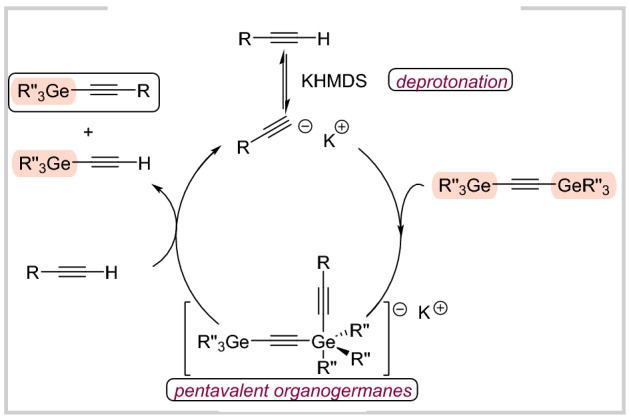
Plausible mechanism for the sp C–germylation.
Conclusions
In summary, we have reported on a very efficient protocol for catalytic O–H and sp C–H germylation of silanols and terminal alkynes in the presence of main-group species. Here, a commercially available KHMDS enabled a dealkynative coupling with ample scope. Considering the combination of desirable features (e.g., operational simplicity, high chemoselectivity, benign reaction conditions, low cost of the reagents, and their commercial availability, etc.), we believe this reaction system offers new perspectives for the synthesis of valuable organogermanium compounds in a sustainable and green manner. Furthermore, we anticipate that the general design principle utilizing alkynyl-substituted metalloids will lead to new reactions that are difficult to achieve with traditional transformations. Thus, further studies on the scope and synthetic application of this methodology are currently underway in our laboratory.
Methods
General Information: Air- and moisture-sensitive reactions were carried out under an argon atmosphere using standard Schlenk techniques or a glove box. Solvents used for all experiments were purchased from Honeyweel or Sigma Aldrich (Merck), dried over calcium hydride (CaH2), and purified by distillation. Tetrahydrofurane was additionally dried over sodium with benzophenone system. All alkali metal compounds (lithium bis(trimethylsilyl)amide, sodium bis(trimethylsilyl)amide, potassium bis(trimethylsilyl)amide, lithium tert-butoxide, sodium tert-butoxide, potassium tert-butoxide, lithium hydroxide, sodium hydroxide, and potassium hydroxide) were purchased in the solid state from Sigma Aldrich (Merck) or StanLab. Additionally, potassium bis(trimethylsilyl)amide was also purchased as a solution in THF from Sigma Aldrich (Merck). Commercially available silanols (e.g., tert-butyldimethylsilanol, tert-butyldiphenylsilanol, tris(tert-butoxy)silanol, triethylsilanol, triisopropylsilanol, triphenylsilanol, etc.) were purchased from Sigma Aldrich (Merck) or AmBeed and used as received. Non-commercially available silanols were prepared by hydrolysis of corresponding chlorosilanes (e.g., chlorotriisobutylsilane, chlorotributylsilane, etc.). Terminal alkynes (e.g., phenylacetylene, 4-ethynylanisole, 4-ethynyl-α,α,α-trifluorotoluene, 1-ethynylcyclohexene, N-methyl-N-propargylbenzylamine, etc.) were purchased from Sigma-Aldrich (Merck) and used as received. Alkynylgermanes (e.g., triethyl(ethynyl)germane, tributyl(ethynyl)germane, ethynyldimethyl(phenyl)germane, ethynyltriisopropylgermane, etc.) were synthesized from corresponding chlorogermanes by well-known procedure using ethynylmagnesium bromide solution in THF (Grignard reagent). The progress of reactions (conversion of alkynylgermane, silanol, alcohol, or alkyne) was monitored by GC chromatography using Bruker Scion 460-GC and Agilent 5977B GC/MSD with Agilent 8860 GC System. The structures of products were determined by NMR spectroscopy and MS spectrometry. The 1H NMR (400 or 600 MHz), 13C NMR (101 or 151 MHz) and 29Si NMR (79 or 119 MHz) spectra were recorded on Bruker Avance III HD NanoBay spectrometer, using chloroform-d1 (CDCl3) or benzene-d6 (C6D6) as the solvents. Deuterated solvents were purchased from respectively Deutero GmbH (CDCl3 99.6 atom% D) and Sigma Aldrich (Merck) (C6D6 99.8 atom% D) and used as received.
Supplementary Information
Acknowledgements
This work was supported by the Adam Mickiewicz University in Poznań (KK-ID-UB project no. 038/04/NŚ/0001; HS-ID-UB project no. 017/02/SNS/0009), and by grant no. POWR.03.02.00-00-I020/17 (HS) co-financed by the European Union through the European Social Fund under the Operational Program Knowledge Education Development. This work was also supported by a National Science Centre Grant UMO-2018/30/E/ST5/00045 (GH).
Author contributions
Methodology, K.K, G.H; Synthesis of Germasiloxanes, H. S.-D., K.K.; Synthesis of Starting Materials—Silanols, E. S.; Synthesis of Starting Materials—Alkynylgermanes, K.B., H. S.-D.; Synthesis of Products—Alkynylgermanes, H. S.-D., M. G., and D. L.; Formal analysis, H. S.-D., K.K., K. B., E. S., M. G., and D. L.; writing—original draft preparation, K.K. and H. S.-D.; visualization, K.K.; supervision, K.K., G.C., and G.H.; funding acquisition, H. S.-D., K.K., and G.H. All authors reviewed the manuscript.
Data availability
The datasets used and/or analyzed during the current study available from the corresponding author on reasonable request.
Competing interests
The authors declare no competing interests.
Footnotes
Publisher's note
Springer Nature remains neutral with regard to jurisdictional claims in published maps and institutional affiliations.
Contributor Information
Krzysztof Kuciński, Email: kucinski.k@amu.edu.pl.
Grzegorz Hreczycho, Email: g.h@amu.edu.pl.
Supplementary Information
The online version contains supplementary material available at 10.1038/s41598-023-32172-9.
References
- 1.Bloux H, et al. Base-mediated radio-iodination of arenes by using organosilane and organogermane as radiolabelling precursors. Chem. Eur. J. 2023 doi: 10.1002/chem.202203366. [DOI] [PubMed] [Google Scholar]
- 2.Selmani A, Schoetz MD, Queen AE, Schoenebeck F. Modularity in the Csp3 space─alkyl germanes as orthogonal molecular handles for chemoselective diversification. ACS Catal. 2022;12:4833–4839. doi: 10.1021/acscatal.2c00852. [DOI] [Google Scholar]
- 3.Kreisel T, et al. Modular generation of (iodinated) polyarenes using triethylgermane as orthogonal masking group. Angew. Chem. Int. Ed. 2022;61:e202201475. doi: 10.1002/anie.202201475. [DOI] [PMC free article] [PubMed] [Google Scholar]
- 4.Dahiya A, Schoenebeck F. Orthogonal and Modular Arylation of Alkynylgermanes. ACS Catal. 2022;12:8048–8054. doi: 10.1021/acscatal.2c02179. [DOI] [Google Scholar]
- 5.Nyga A, et al. Dual-photofunctional organogermanium compound based on donor–acceptor–donor architecture. Chem. Commun. 2022;58:5889–5892. doi: 10.1039/D2CC01568D. [DOI] [PubMed] [Google Scholar]
- 6.Kuciński K, Gruszczyński M, Hreczycho G. Ru-catalyzed formation of thiosilanes and selenosilanes using dichalcogenides as a user-friendly alternative to thiols and selenols. ChemCatChem. 2022;14:e202200961. doi: 10.1002/cctc.202200961. [DOI] [Google Scholar]
- 7.Katir N, Haskouri JE, Amoros P, Kadib AE. Cooperative assembly of redistributed arylgermanium-bearing alkoxysilanes in a mesostructured siloxane network. New J. Chem. 2022;46:15686–15692. doi: 10.1039/D2NJ02868A. [DOI] [Google Scholar]
- 8.Luo Y, Lv L, Li Z. Copper-catalyzed germyl-azidation of alkenes with germanium hydrides and trimethylsilyl azide. Org. Lett. 2022;24:8052–8056. doi: 10.1021/acs.orglett.2c03302. [DOI] [PubMed] [Google Scholar]
- 9.Arii H, et al. Synthesis of germacyclic compounds by cyclization and annulation reactions utilizing in situ generated germyl cations. Organometallics. 2021;40:1363–1370. doi: 10.1021/acs.organomet.1c00141. [DOI] [Google Scholar]
- 10.Sahoo MK, Kim D, Chang S, Park J-W. Regioselective access to α-vinylsilanes and α-vinylgermanes by cobalt-catalyzed migratory hydrofunctionalization of 2-alkynes. ACS Catal. 2021;11:12777–12784. doi: 10.1021/acscatal.1c03769. [DOI] [Google Scholar]
- 11.Zaranek M, Nowicki M, Andruszak P, Hoffmann M, Pawluć P. Hydrogermylation initiated by trialkylborohydrides: A living anionic mechanism. Chem. Commun. 2022;58:13979–13982. doi: 10.1039/D2CC05567H. [DOI] [PubMed] [Google Scholar]
- 12.Xu Q-H, Xiao B. Organogermanium(IV) compounds in photo-induced radical reactions. Org. Chem. Front. 2022;9:7016–7027. doi: 10.1039/D2QO01467J. [DOI] [Google Scholar]
- 13.Murugavel R, Voigt A, Walawalkar MG, Roesky HW. Hetero- and metallasiloxanes derived from silanediols, disilanols, silanetriols, and trisilanols. Chem. Rev. 1996;96:2205–2236. doi: 10.1021/cr9500747. [DOI] [PubMed] [Google Scholar]
- 14.Kamitani M, Fukumoto K, Tada R, Itazaki M, Nakazawa H. Catalytic synthesis of cyclic and linear germoxanes mediated by an iron complex. Organometallics. 2012;31:2957–2960. doi: 10.1021/om3001845. [DOI] [Google Scholar]
- 15.Skoczeń A, et al. New ceramics precursors containing Si and Ge atoms—cubic germasilsesquioxanes—synthesis, thermal decomposition and spectroscopic analysis. Molecules. 2022;27:1441. doi: 10.3390/molecules27041441. [DOI] [PMC free article] [PubMed] [Google Scholar]
- 16.Risen Jr, W. M., Wang, Y. Z. & Honore, A. Germanosiloxane materials and optical components comprising the same. U.S. Patent 6248852B1 (2001). Short note: Germasiloxanes may feature with higher or lower refractive indices, as well as varied electrical and optical properties than analogues siloxanes.
- 17.Schmidbaur H, Hussek H. Präparative und spektroskopische untersuchungen an alkylgermanosiloxanen. J. Organomet. Chem. 1964;1:235–243. doi: 10.1016/S0022-328X(00)85492-3. [DOI] [Google Scholar]
- 18.Puff H, Kök TR, Nauroth P, Schuh W. Ein siebengliedriger germanium–silicium–sauerstoff-ring: 1,1,2,2,4,4,6,6-Octaphenyl-1,2-digerma-4,6-disila-3,5,7-trioxa-cycloheptan. J. Organomet. Chem. 1985;281:141–148. doi: 10.1016/0022-328X(85)87103-5. [DOI] [Google Scholar]
- 19.Zhou Q, Weber WP. Exchange reactions between trimethylsilyl azide and hexamethyldigermoxane. J. Organomet. Chem. 1988;342:291–294. doi: 10.1016/0022-328X(88)83002-X. [DOI] [Google Scholar]
- 20.Arias-Ugarte R, Sharma HK, Morris ALC, Pannell KH. Metal-catalyzed reduction of HCONR’ 2, R’ = Me (DMF), et (DEF), by silanes to produce R’ 2NMe and disiloxanes: A mechanism unraveled. J. Am. Chem. Soc. 2012;134:848–851. doi: 10.1021/ja2101246. [DOI] [PubMed] [Google Scholar]
- 21.Ignatovich L, Muravenko V, Grinberga S, Lukevics E. Novel reactions to form an Si–O–Ge group. Chem. Heterocycl. Compd. 2006;42:268–271. doi: 10.1007/s10593-006-0080-8. [DOI] [Google Scholar]
- 22.Hreczycho G, Frąckowiak D, Pawluć P, Marciniec B. A new catalytic approach to germasiloxanes. Tetrahedron Lett. 2011;52:74–76. doi: 10.1016/j.tetlet.2010.10.153. [DOI] [Google Scholar]
- 23.Hreczycho G, Pawluć P, Marciniec B. A new selective approach to unsymmetrical siloxanes and germasiloxanes via O-metalation of silanols with 2-methylallylsilanes and 2-methylallylgermanes. New J. Chem. 2011;35:2743–2746. doi: 10.1039/c1nj20624a. [DOI] [Google Scholar]
- 24.Hreczycho G, Kuciński K, Pawluć P, Marciniec B. Catalytic synthesis of linear oligosiloxanes and germasiloxanes mediated by scandium trifluoromethanesulfonate. Organometallics. 2013;32:5001–5004. doi: 10.1021/om400581g. [DOI] [Google Scholar]
- 25.Kaźmierczak J, Hreczycho G. Catalytic approach to germanium-functionalized silsesquioxanes and germasilsesquioxanes. Organometallics. 2017;36:3854–3859. doi: 10.1021/acs.organomet.7b00599. [DOI] [Google Scholar]
- 26.Kaźmierczak J, Hreczycho G. Nafion as effective and selective heterogeneous catalytic system in O-metalation of silanols and POSS silanols. J. Catal. 2018;367:95–103. doi: 10.1016/j.jcat.2018.08.024. [DOI] [Google Scholar]
- 27.Kuciński K, Hreczycho G. O-Metalation of silanols and POSS silanols over Amberlyst-15 catalyst: A facile route to unsymmetrical siloxanes, borasiloxanes and germasiloxanes. Inorg. Chim. Acta. 2019;490:261–266. doi: 10.1016/j.ica.2019.03.025. [DOI] [Google Scholar]
- 28.Marciniec B, Ławicka H, Dudziec B. New catalytic route to alkynylgermanes. Organometallics. 2007;26:5188–5192. doi: 10.1021/om700528r. [DOI] [Google Scholar]
- 29.Marciniec B, Ławicka H, Dudziec B. A new catalytic route to synthesis of silylgermylethynes. J. Organomet. Chem. 2008;693:235–240. doi: 10.1016/j.jorganchem.2007.10.039. [DOI] [Google Scholar]
- 30.Rzonsowska M, Dudziec B, Marciniec B. Synthesis of a new class of silsesquioxanes with alkynyl and germyl functionality. Dalton Trans. 2016;45:17187–17194. doi: 10.1039/C6DT03251F. [DOI] [PubMed] [Google Scholar]
- 31.Rzonsowska M, Kownacki I, Dudziec B, Marciniec B. Iridium complex catalyzed germylative coupling reaction between alkynes and iodogermanes—a new route to alkynylgermanium and alkynylgermasilicon compounds. Dalton Trans. 2014;43:16795–16799. doi: 10.1039/C4DT02290D. [DOI] [PubMed] [Google Scholar]
- 32.Rzonsowska M, et al. A simple catalytic route for alkynylgermanes. Eur. J. Inorg. Chem. 2016;2016:339–346. doi: 10.1002/ejic.201501110. [DOI] [Google Scholar]
- 33.Dahiya A, Schoenebeck F. Direct C–H dehydrogenative germylation of terminal alkynes with hydrogermanes. Org. Lett. 2022;24:2728–2732. doi: 10.1021/acs.orglett.2c00840. [DOI] [PubMed] [Google Scholar]
- 34.Lukevics E, et al. Fluoride ion mediated reactions of disubstituted acetylenes Me3SiC=CMMe3 (M=C, Si, Ge, Sn) with terminal acetylenes. J. Organometal. Chem. 2001;634:69–73. doi: 10.1016/S0022-328X(01)01109-3. [DOI] [Google Scholar]
- 35.Leitao EM, Jurca T, Manners I. Catalysis in service of main group chemistry offers a versatile approach to p-block molecules and materials. Nature Chem. 2013;5:817–829. doi: 10.1038/nchem.1749. [DOI] [PubMed] [Google Scholar]
- 36.Melen RL. Dehydrocoupling routes to element–element bonds catalysed by main group compounds. Chem. Soc. Rev. 2016;45:775–788. doi: 10.1039/C5CS00521C. [DOI] [PubMed] [Google Scholar]
- 37.Luo C, Bandar JS. Selective Defluoroallylation of trifluoromethylarenes. J. Am. Chem. Soc. 2019;141:14120–14125. doi: 10.1021/jacs.9b07766. [DOI] [PubMed] [Google Scholar]
- 38.Kuciński K, Hreczycho G. Hydrosilylation and hydroboration in a sustainable manner: From earth-abundant catalysts to catalyst-free solutions. Green Chem. 2020;22:5210–5224. doi: 10.1039/D0GC01430C. [DOI] [Google Scholar]
- 39.Roy MMD, et al. Molecular main group metal hydrides. Chem. Rev. 2021;121:12784–12965. doi: 10.1021/acs.chemrev.1c00278. [DOI] [PubMed] [Google Scholar]
- 40.Reidl TW, Bandar JS. Lewis basic salt-promoted organosilane coupling reactions with aromatic electrophiles. J. Am. Chem. Soc. 2021;143:11939–11945. doi: 10.1021/jacs.1c05764. [DOI] [PMC free article] [PubMed] [Google Scholar]
- 41.Puleo TR, Sujansky SJ, Wright SE, Bandar JS. Organic superbases in recent synthetic methodology research. Chem. Eur. J. 2021;27:4216–4229. doi: 10.1002/chem.202003580. [DOI] [PubMed] [Google Scholar]
- 42.Gao H, Battley A, Leitao EM. The ultimate Lewis acid catalyst: Using tris(pentafluorophenyl) borane to create bespoke siloxane architectures. Chem. Commun. 2022;58:7451–7465. doi: 10.1039/D2CC00441K. [DOI] [PubMed] [Google Scholar]
- 43.Kuciński K, Stachowiak-Dłużyńska H, Hreczycho G. Catalytic silylation of O–nucleophiles via Si–H or Si–C bond cleavage: A route to silyl ethers, silanols and siloxanes. Coord. Chem. Rev. 2022;459:214456. doi: 10.1016/j.ccr.2022.214456. [DOI] [Google Scholar]
- 44.Wright SE, Bandar JS. A base-promoted reductive coupling platform for the divergent defluorofunctionalization of trifluoromethylarenes. J. Am. Chem. Soc. 2022;144:13032–13038. doi: 10.1021/jacs.2c05044. [DOI] [PMC free article] [PubMed] [Google Scholar]
- 45.Kuciński K, Stachowiak H, Hreczycho G. Silylation of alcohols, phenols, and silanols with alkynylsilanes—an efficient route to silyl ethers and unsymmetrical siloxanes. Eur. J. Org. Chem. 2020;2020:4042–4049. doi: 10.1002/ejoc.202000573. [DOI] [Google Scholar]
- 46.Stachowiak H, Kuciński K, Kallmeier F, Kempe R, Hreczycho G. Cobalt-catalyzed dehydrogenative C−H silylation of Alkynylsilanes. Chem. Eur. J. 2022;28:e202103629. doi: 10.1002/chem.202103629. [DOI] [PMC free article] [PubMed] [Google Scholar]
- 47.Lewandowski D, Cytlak T, Kempe R, Hreczycho G. Ligand-controlled cobalt-catalyzed formation of carbon-boron bonds: Hydroboration vs C-H/B–H dehydrocoupling. J. Catal. 2022;413:728–734. doi: 10.1016/j.jcat.2022.07.037. [DOI] [Google Scholar]
- 48.Kuciński K, Hreczycho G. Transition metal-free catalytic C−H silylation of terminal alkynes with bis(trimethylsilyl)acetylene initiated by KHMDS. ChemCatChem. 2022;14:e202200794. doi: 10.1002/cctc.202200794. [DOI] [Google Scholar]
- 49.Kuciński K, Hreczycho G. Silicon-nitrogen bond formation via dealkynative coupling of amines with bis(trimethylsilyl)acetylene mediated by KHMDS. Chem. Commun. 2022;58:11386–11389. doi: 10.1039/D2CC04413G. [DOI] [PubMed] [Google Scholar]
- 50.Pentsak EO, Eremin DB, Gordeev EG, Ananikov VP. Phantom reactivity in organic and catalytic reactions as a consequence of microscale destruction and contamination-trapping effects of magnetic stir bars. ACS Catal. 2019;9:3070–3081. doi: 10.1021/acscatal.9b00294. [DOI] [Google Scholar]
- 51.Sau S, Pramanik M, Bal A, Mal P. Reported catalytic hydrofunctionalizations that proceed in the absence of catalysts: The importance of control experiments. Chem. Rec. 2022;22:e202100208. doi: 10.1002/tcr.202100208. [DOI] [PubMed] [Google Scholar]
Associated Data
This section collects any data citations, data availability statements, or supplementary materials included in this article.
Supplementary Materials
Data Availability Statement
The datasets used and/or analyzed during the current study available from the corresponding author on reasonable request.