



Abstract
Objective:
To explore Head Start teachers’ use and integration of food-based learning (FBL) with science learning in the Head Start classroom.
Design:
Phenomenological approach using in-depth semi-structured telephone interviews.
Setting:
North Carolina Head Start preschools.
Participants:
Thirty-five Head Start lead and assistant teachers.
Phenomenon of Interest:
All interviews were transcribed verbatim. Authors coded interview data for emergent themes.
Analysis:
11 primary themes were identified during analysis and inductively organized using the Systems Thinking Iceberg Model.
Results:
Teachers described most frequently utilizing FBL during mealtimes. Teachers stated they felt successful when children were engaged and willing to try a new food. However, they struggled to connect food to science concepts. Teachers reported several motivators (e.g., improving health) and barriers (e.g., food waste) to integrating FBL. Teachers prioritized preparing children for kindergarten, but most teachers did not see how FBL could help them achieve this goal.
Conclusions and Implications:
Head Start teacher professional development programs could impact all 4 levels of the Systems Thinking Model to improve teachers’ perceptions, underlying structures, and mental models regarding integrative FBL. Additional research is warranted to investigate the adoption, implementation, and potential impact of FBL on academic outcomes.
INTRODUCTION
Food-based Learning (FBL), the use of food as a teaching tool in the classroom, can improve children’s willingness to try and consume healthy foods.1–4 Food-based learning can occur both during mealtime, by creating a positive mealtime environment,5 and outside the mealtime through activities such as gardening, reading books, and conducting science experiments in which food is present.1,2,6–8 The use of healthy foods (e.g., fruits and vegetables) during FBL is ideal since prior research estimates that 30% of preschool-aged (3–5 years) children are considered overweight or obese,9 and less than 20% consume the daily recommended servings of vegetables.10 Children from low-income backgrounds are at higher risk for low fruit and vegetable intake compared to the general population.11,12 Improving dietary behaviors early in childhood can decrease children’s risk for developing obesity, hypertension, type II diabetes, cancer, and cardiovascular disease in adulthood.13–15
While some teachers consider mealtime an opportune time to talk about food, many teachers find mealtime environments to be chaotic, making FBL difficult.16,17 Other research suggests teachers may be tempted to coerce and pressure children to eat healthy foods during meals, which has been associated with negative health outcomes such as obesity.18,19 Therefore, FBL outside mealtime allows children to be exposed to healthy foods in a low-pressure environment and encourages children’s exploration of foods using all 5 senses (sight, sound, smell, touch, taste), which may not be encouraged during mealtime since children’s exploration of food may be perceived as poor table manners (e.g., “playing” with food).20–22 Additionally, while methods for improving vegetable consumption in children, such as flavor-flavor learning,23 flavor-nutrient learning,23 manipulation of portion size,24 and rewards 23,24 have been studied, the strategy of repeated exposure is suggested to be the most effective method for impacting both preference and consumption.7,22 Repeated exposure provides children with the opportunity to experience healthful foods, multiple times, in multiple different forms, to increase familiarity of a food.6,7 Specifically, prior research suggests children need 8–15 exposures to increase their liking of a new food.7,25
While parents and caregivers can serve as positive healthy-eating role models to their children,26–29 achieving the necessary number of repeated exposures to healthy foods in the home environment is often difficult because of preschool children’s neophobia (continual refusal of food) and concerns about food waste in low-resource families.30,31 Exposing children to vegetables can be particularly difficult since vegetables have a bitter taste profile, making them less biologically acceptable than fruits.13 Since preschool children in the US spend more than 30 hours a week and consume half or more of their daily dietary intake at preschool,32 preschool teachers, specifically in Head Start programs, are an important partner in increasing children’s exposure to healthy foods using FBL.33,34
Head Start, the federally funded preschool program, strives to meet the nutritional, social, and academic needs of one million preschoolers from low-income families nationwide.35 To address nutritional needs, Head Start participates in the Child and Adult Care Food Program (CACFP) which guarantees children access to healthy foods, including fruits and vegetables, at school meals and snacks.36 Food-based learning in Head Start programs is important because it has the potential to improve children’s preference for and consumption of fruits and vegetables in an environment where these foods are guaranteed to be available,1,37 compared to children’s home environments which may have limited access to fruits and vegetables.38 While Head Start policy encourages teachers to engage children in activities with healthy foods, Head Start teachers have reported barriers to FBL in the classroom such as limited time,39 competing kindergarten readiness priorities,12,39 and limited FBL professional development.39,40 Head Start teachers and administrators have suggested that these limitations could be overcome by integrating FBL into other learning domains related to kindergarten readiness to simultaneously impact dietary quality and kindergarten readiness outcomes.39
Head Start’s Early Learning Outcomes Framework (ELOF) organizes the skills, behaviors, and knowledge in which children should be proficient prior to entering kindergarten into 5 domains: Approaches to Learning; Social and Emotional Development; Language and Literacy; Cognition; and Perceptual, Motor, and Physical Development.43 The Cognition domain, which includes preschool scientific reasoning, is a key area for FBL integration as science provides a natural foundation for hands-on learning related to living things (e.g., humans, animals, and plants, including vegetables), their relationships with one another, and how to care for our bodies and other living things (e.g., healthy eating, animal/plant life cycle). The science environment can also improve children’s language, literacy, and mathematics skills43 while serving as a platform to expose children to healthy foods through experimentation and exploration (e.g., creating an experiment to see what conditions a spinach plant needs to grow, observing and documenting its changes, then tasting the leaves).1 Additionally, as preschoolers cognitively mature, the skills developed through high-quality science learning will enable them to make positive choices about their personal health and living things in their environment, making science key for kindergarten readiness.20,43,44
To leverage the potential for Head Start teachers’ integration of FBL into routine learning, our team planned to develop the More PEAS Please! Program, a multi-level intervention that focused on improving children’s dietary quality and school readiness through early exposure and access to healthy foods in high-quality science-learning environments. The More PEAS Please! intervention was developed based on the Social Cognitive Theory45 and Interconnected Model of Teacher Professional Growth,46 with the goal of improving the quality of children’s early language and science-learning experiences by supporting teachers’ instructional practices focused on integrating FBL with other learning domains. Our study informed the development of the More PEAS Please! Program by examining the current contextual environment surrounding Head Start teachers’ FBL practices and integration with science. While prior studies have examined the general use of food and nutrition education in Head Start,39 additional research is needed to understand how Head Start teachers are, or are not, integrating FBL with other learning domains. Therefore, the purpose of the present study was to explore the common lived experience of Head Start teachers’ use and integration of FBL with science in the preschool classroom.
METHODS
Study Design
We used a qualitative, transcendental, phenomenological approach to examine North Carolina (NC) Head Start teachers’ shared experiences with the use and integration of FBL with science learning activities in the preschool classroom.47 We collected qualitative data via in-depth, semi-structured interviews. This study was part of a larger mixed-methods cross-sectional study conducted across NC to assess the specific needs, assets, and resources of partner Head Start programs to inform the development of professional development resources for the Preschool Education in Applied Science (PEAS) Institute for Early Childhood Teachers.48 The study underwent an expedited review by the Institutional Review Board at East Carolina University who approved all study protocols and materials (UMCIRB #18–002749). All participants provided written consent for participation.
Participants and Recruitment
We identified 54 NC-funded Head Start agencies using a list published on Head Start’s website in the fall of 2020, excluding 1 agency that primarily served migrant families because it was not open in the winter or spring.49 We attempted contact with each agency’s education managers or program directors via phone. After establishing contact, we provided information about the study and asked for permission to communicate via email with Head Start teachers at each center within that agency. Head Start staff either forwarded our recruitment email to teachers or requested we email teachers directly. By incorporating agencies of varied sizes and locations, we ensured different perspectives. Thirty-five agencies never responded to the initial communication. Head Starts in NC often follow their public-school counterparts’ academic calendars. During the time of this study, many public schools were closed due to COVID-19.50 It is likely Head Start agencies were also closed or providing virtual education to children, making it difficult to communicate with program administrators and staff.51
Data Collection Procedures
Demographic Questionnaire.
After obtaining permission from Head Start agencies, an email was sent to teachers describing the study and asking them to complete a brief questionnaire online. Items on the questionnaire included Head Start center location, size, and demographic data. Teachers self-reported race and ethnicity from a list including White or European American, non-Hispanic; Latino(a), or Spanish; Black or African American, non-Hispanic; Asian or Asian American, non-Hispanic; American Indian or Alaskan Native, non-Hispanic; Middle Eastern or North African; Native Hawaiian or Pacific Islander; Multi-ethnic; or other (specify). Participants were allowed to select multiple responses to accurately reflect individuals’ self-designation. The demographic survey followed the US Office of Management and Budget protocols which guide the collection of race and ethnicity data in the US.52,53 Participants open-endedly self-reported their gender. Demographic data were collected solely to describe the sample of participants. The survey concluded by asking teachers if they were interested in scheduling an individual interview to further discuss their experiences with FBL in Head Start. We used purposive sampling to determine which of the interested teachers to reach out to based-on geographical location and program size. A member of the research team maintained maps charting participants’ locations. Our team met weekly to review maps and discuss the distribution of data. We targeted interviews and recruitment accordingly. For example, if we recently interviewed more than 10 teachers from one geographical region of the state, we would purposefully contact teachers from a different region of the state to diversify the sample. We contacted teachers via email to schedule the phone interview.
Qualitative Interviews.
Three trained graduate students, 2 female (JD and NZ) and 1 male (ZP) with no prior relationship to participants conducted in-depth semi-structured one-on-one telephone interviews between October 2020 and March 2021. We chose semi-structured interviews to allow teachers to comfortably engage with data collectors to share their personal experiences.54,55 Interviews lasted 45–60 minutes and were conducted over the phone. Authors JD, SG, and VS designed the interview guide to address primary research questions using an iterative process over multiple rounds.56 The interview guide consisted of a verbal script, interview questions, and required and optional probes (Table 1). While the interviews occurred during the COVID-19 pandemic, we specifically asked teachers about their experiences before COVID-19 (Table 1), reminding them of this with a prompt at the start of each question. At the end of the interview, teachers had opportunities to share their experiences regarding COVID-19.
Table 1.
Teacher (n = 35) Semistructured Qualitative Interview Guide Questions and Probes Regarding Teachers’ Experiences with Food-based Learning in the Head Start Classroom
| Interview Questions (Pilot-Tested) | Required Probes |
|---|---|
| Can you describe some lessons or activities you have used in the last year, before COVID-19, to teach children about science using food? Remember, nutrition is a science, too, so be sure to consider all the science topics you teach with food. | a. If the activity described appears to be preplanned, ask: Can you give me an example of a time you used food as a teaching tool that was not preplanned? If the activity appears to be unplanned, ask: Can you give me an example of a time you used food as a teaching tool that was planned? b. What are some things that have influenced your ability to use food experiences as a teaching tool in the classroom? c. How did you know when you were doing a good job of incorporating food experiences? d. How did you know when you were struggling to do a good job incorporating food experiences? e. How did your standard determine if you were doing a good job or struggling compared with what your supervisor expected? |
| Can you list things that helped or supported you when you incorporated food experiences in your classroom before COVID-19? This can be people, places, or things. | a. I heard you list [say what they listed as supports]. Are there any others you would like to add? b. Which of these supports you’ve listed do you think helped the most? c. How did having this help or support influence which activities or lessons you did in the classroom? d. Can you give me a detailed example, like a story, about how [list what they said was most helpful], has helped incorporate food experiences in your classroom before COVID-19? |
| Can you list some challenges you faced when incorporating food experiences in your classroom before COVID-19? This can be people, places, or things. | a. I heard you list [say what they listed as challenges]. Are there any others you would like to add? b. Which of these challenges you’ve listed do you think is the biggest? c. How did this challenge affect which science activities and lessons you did in the classroom before COVID- 19? d. Can you give me a detailed example, like a story, about how [list what they said was most challenging] has been challenging for you while you incorporated food experiences with children before COVID-19? |
| In your opinion, what are some reasons you should use food experiences to teach science to preschool children? In what ways has COVID-19 already impacted your current science classroom? |
a. On the contrary, why do you think you should not incorporate food experiences to teach science to preschool children? b. How might COVID-19 impact your use of food experiences? c. How else might COVID-19 impact your classroom as a whole? |
COVID-19 indicates coronavirus disease 2019.
At the start of the interview, the interviewer informed the participant about the researcher’s interest in the topic and read the consent form to the participant to obtain verbal consent. Teachers provided a pseudonym to protect their identities. During the interview, data collectors kept notes of participants responses to each question. At the end of the interview, the interviewer summarized the participant’s response to each question and asked the participant to confirm, modify, or disconfirm their response (member checking).57 Interviewers used the Rev App recorder on university-owned iPads to transcribe the interviews verbatim. Other strategies employed to ensure trustworthiness included: bracketing to identify researchers’ biases prior to the start of data collection; bi-weekly debriefing sessions between data collectors to discuss codes, emergent themes, and address potential biases; reflective commentary; and triangulation of data with Head Start participants.58 Triangulation occurred by sending participants a summary of their individual interview via email which they were asked to confirm, revise, or disconfirm.57 All teachers responded to the request.
Data collection for this study continued until saturation was achieved, defined as the collection of new data not yielding novel information about the phenomenon being studied.58 Prior literature identifies a qualitative sample size of 10 as adequate, especially if saturation is verified.59 Researchers verified saturation using a saturation grid with codes on the vertical axis and interviews on the horizontal axis.60 As interviews progressed, we observed a visual tapering of new codes created. Both primary coders confirmed saturation was achieved when no new codes were developed with the collection of new interview data.58,60
Prior to beginning interview data collection, data collectors completed training in human ethics and qualitative methods using the 5-phase Goodell protocol.61 As part of the training process, data collectors completed 2 cognitive interviews using the interview guide, first with another data collector and second with a local preschool teacher resembling the participant population. Data analysis did not include cognitive interviews; instead, interviewees were asked for feedback to improve data collectors interviewing techniques. Cognitive interviews also served to improve clarity and flow of the interview guide.61 For example, we reorganized the interview guide into 2 distinct sections and removed and/or condensed 5 interview questions to reduce redundancy based on feedback we received from cognitive interviews.
Data Analysis
We used SPSS (version 28.0, IBM Corp, Armonk, NY, 2017) for descriptive statistics. We then used Moustakas’ structured method for inductive data analysis in this phenomenological study.54 The 4 steps of in-depth analysis include: Horizontalization, Reduction of Statements, Categorizing or “Clustering”, and Final Identification and Narrative of Themes. The first author (JD) and a second analyst (NZ), served as primary coders after receiving training.61 Prior to analysis, coders immersed themselves in the data by reading all transcripts twice. Coders re-read transcripts a third time to record preliminary memos and highlight key concepts.47 Coders then began the first step of analysis, horizontalization, by independently reading transcripts, giving equal value and importance to each statement and coding statements with a descriptive label.47 In step 2, coders eliminated statements that were not a horizon of the experience being studied and did not represent details necessary for understanding the participants’ experiences. Research meetings occurred 3 times weekly amongst the 2 coders. At each meeting, coders collectively read each transcript comparing codes to reach 100% verbal consensus.59 When necessary, a third author (VS) served as a tiebreaker. JD and NZ created the codebook which defined codes to aid in analyses of common perceptions among data to construct clusters of meaning.59 Additionally, throughout the analysis process, coders maintained memos of emergent codes, categories, theoretical connections, themes, and questions which served as additional documentation of the evolution of coding throughout the analysis.59 Researchers also condensed codes into overall categories or “clusters” and assigned each category a thematic label. The repetition of this process resulted in the collapsing of all codes into subsequent categories. Lastly, coders derived final themes from the data and confirmed themes by rereading transcripts to ensure themes and codes were consistent with teachers’ expressed words. Final themes described the “what” (textural descriptions) and “how” (structural descriptions) of participants’ experiences, which together represent the overall essence of the phenomenon.47,59
After inductive coding and identification of final themes, we deductively organized themes using the Systems Thinking Iceberg Model after coding was complete.62 The Systems Thinking model allows researchers to rethink how systemic, reoccurring issues occur by examining the interrelationships of individuals and processes in a system.63,64 The Iceberg Model of Systems Thinking visualizes 4 interacting components of a system: Events (What just happened?); Patterns/Trends (What trends have there been over time?); Underlying Structures (What has influenced patterns? What are the relationships between the parts?); and Mental Models (What assumptions, beliefs, and values do people hold about the system? What beliefs keep the system in place?). Prior studies have identified reoccurring barriers and teacher experiences with FBL;1,2,39 thus, understanding the interrelationships between the parts in the FBL system is critical before enacting or expecting a change in the FBL “system” in Head Start.65,66
Results
The final sample included 35 teachers from 16 counties spanning each geographical region of NC (Mountains, Piedmont, and Coastal Plain) (Figure 1). We suspected saturation at interview 31 but conducted 4 additional interviews to ensure saturation was reached. Participants were 94% female and were an average age of 40.8 ± 10.06 years at the time of the interview. Teachers’ races were predominantly White (53%) and Black/African American (44%). Teachers’ ethnicities were non-Hispanic (97%) followed by Hispanic (3%). Many teachers held either a bachelor’s (54%) or an associate’s (20%) degree. Most teachers (83%) had experience working in preschool settings outside of Head Start (Figure 1).
Figure 1.

Teachers (n=35) from North Carolina Counties Participating in Semi-structured Qualitative Interviews Regarding Their Experiences with Food-based Learning and Science in Head Start Classrooms
We identified 11 primary themes related to teachers’ experiences using and integrating FBL in the classroom (Table 2). Figure 2 visually represents the identified themes within the theoretical model.
Table 2.
Themes and Related Concepts Regarding Head Start Teachers’ Use and Integration of Food-based Learning in the Preschool Classroom Aligned with the Systems Thinking Iceberg Model (n = 35)
| Theoretical Category | Theme | Main Concepts | Examples | Quote |
|---|---|---|---|---|
| FBL events in the preschool classroom | Inside mealtime environment | • The primary setting for engaging children in FBL in the classroom | • The teacher discusses food groups during lunch (“peas are a vegetable, peaches are a fruit”) • The teacher encourages children to try at least one bite of each food on their plate • Teachers role model healthy eating by eating foods served, regardless of personal preference, while stating, “this is so yummy”! • The teacher is concerned that children eat food and occasionally uses coercion (“If you don’t try that vegetable, you can’t have more milk”) |
“[At lunch] Let’s all see who liked that [vegetable], who doesn’t like it.” We can make a chart and count. We can actually talk about if it’s crunchy, if it’s soft, if it’s sweet, was it sour. It all goes back to those five senses too. So it kind of builds up off each other.” (Blue) |
| Outside mealtime environment | • The teacher struggles to connect food activities to academic learning leading to disconnected FBL activities that often use food as models or art • Teacher perceives that disconnected FBL activities can still improve children’s knowledge of science |
• The teacher invites the outside visitor to come in and teach the children how to make tortillas from masa • The teacher uses apple slices, peanut butter, and marshmallows to help children create a mouth model for a lesson on brushing teeth • The teacher conducts taste tests with multiple varieties of apples and charts children’s favorite • The teacher grows strawberries, beans, and herbs in the classroom • The teacher builds electricity conductors out of potatoes |
“I guess what we do with food is more honestly artistic. We will make a fire truck out of a Graham Cracker and licorice and carrots. So that would be more food as art. I don’t know, as we do food as science necessarily other than growing sunflower seeds, beans, avocado.” (Tammy) | |
| Patterns and trends of FBL in the preschool classroom | Teachers use of unhealthy foods | • The teacher uses unhealthy foods for taste-testing and FBL activities • Teachers may not consider unhealthy foods to be unhealthy |
• The teacher engages children in making chocolate pudding to demonstrate state changes (liquid, powder, solid). • The teacher uses pepperoni during an activity discussing building muscle by eating protein. • The teacher helps children make model spiders using M&Ms |
“What food does to our bodies, how fats and sugars are used for energy and proteins are used for muscles, and they build their muscles, we do push ups and then we eat a piece of pepperoni and then we do more pushups and see if we’re stronger. So we do that. Yeah, mostly nutrition and also keeping the food in an edible form.” (Tammy) |
| Uncertainty on how to integrate FBL into science | • The teacher understands intuitively that FBL could be integrative with science but is unsure how to do that in the classroom | • The teacher uses graham crackers and Teddy Grahams to build a bears den in a unit on winter-hibernating animals • The teacher states food activities are solely related to nutrition rather than science • The teacher relies on engaging with food solely in the mealtime environment |
“[I would like] new ideas on how to incorporate food with science. I feel like I have simple, simple ideas, but some that will create higher thinking and higher learning.” (Simone) | |
| Feelings of helplessness | • The teacher feels it is difficult to get children to try new, healthy foods | • Teacher describes trying all year to convince a child to try a food before saying they don’t like it, to no available • The teacher concludes she cannot change a child’s food preferences on smoothies • The teacher mentioned cooking a recipe with the class, and the children liked making it but would not attempt to taste it |
“Just if they don’t like it. I mean, but there’s not much I can really change about someone’s sense of taste.” (Mia) | |
| Underlying structures affecting FBL | Food waste | • Teachers recognize that wasting food during FBL is inappropriate • Teachers acknowledge the children they serve come from low-resource backgrounds, so food should be available to eat after activities |
• The teacher completes an FBL activity in the classroom but is distressed when there is still some food left over after the activity that may go to waste • Teachers cut open an apple to examine the seeds inside and then distribute slices to the class for tasting • Teachers recognize they used to waste food in older activities (eg, painting with a potato) but that they no longer do that • Teachers avoid using vegetables or foods that they think children will not be willing to eat during FBL activities to avoid food waste |
“If you’re going to throw it away, then no. Because that child might not have anything to hold it and to eat and I’m playing with the rice or I’m doing something and I’m throwing it away. So, other than that, you should teach him about science not with food, but only if they are allowed to eat it or grow it, but not to throw it away.” (Melissa) |
| Policy | • Teacher receives contradictory communication regarding food policy in Head Start • Teachers’ misconceptions about policy in Head Start perpetuated among conversation of teachers to other teachers |
• The teacher describes the fear of being in noncompliance with Head Start policy on food in the classroom • The teacher compares what she was told by other coworkers (eg, food was not allowed in the classroom) compared with her supervisor (eg, healthy food is allowed in the classroom) |
“I think that the biggest challenge is the limitations that the state has put on us. As far as I know, it’s the state. It’s been the same no matter where I go. And I know some places are stricter than others. Because the state says you can’t have food in it’s edible form in the classroom. But where I’m at now, they’re a lot stricter even than that, you can’t really have it at all. So I have to say that that’s the biggest setback. Because if we were allowed to have it in the classroom, then I think teachers would be encouraged to find ways to adapt to where they could use it for the children and make the germ thing work.” (Alex) | |
| COVID-19 | • COVID-19 further restricts the ability to do food activities in the classroom | • Teacher compares pre-COVID-19, when they were allowed to have children cook together, to current policies (2020) • The teacher is disappointed she cannot have family members come in and prepare special traditional foods for children to try • The teacher is overwhelmed with safety and sanitation regulations |
“I’m going to get by with the one that we’re doing on Friday because I’m just going to shut my classroom door I guess. The kids will wear gloves and they each have their own measuring spoon but that’s just not something that I guess that we can do all the time. They don’t really want us doing a lot of nutrition activity.” (Ashley) | |
| Teachers’ mental models for FBL | Motivators for FBL | • Teachers motivated to do FBL in the classroom for its social, cultural, and health benefits | • The teacher encourages children to cook together to build relationships and communication skills • The teacher believes children can be “agents of change” in their family by encouraging their other family members to purchase and eat healthier foods after being exposed to them at school • Teacher recognizes that incorporating the cultural foods of diverse children in her classroom builds a deeper appreciation of individuals’ differences |
“I think that’s important because I think the more they know about food as they get older, the more they can make their own choices on food. Like I said, it introduces them to new foods. Who knows? That might start somebody on a journey to healthy eating, if they’re familiar with foods from when they’re young.” (Sean) |
| Perceptions of Successful FBL | • The teacher feels successful at FBL when children consume the food | • The teacher feels pressure to ensure children are eating food, both at mealtimes and during FBL activities • The teacher tells the child, “Just put a tiny bit of the green bean on the tip of your tongue to try,” and feels discouraged when the child refuses • The teacher feels good when the child remembers a prior FBL activity they did |
“When the kids were willing to try something they’ve never tried before, maybe. If we can convince them along the way that this is something that we should at least try before we say we don’t like it, makes us think that we’re working our way into a good direction... (but) sometimes it’s hard just because kids are kids and they like what they think they like and that’s it.” (Teri) | |
| Make the connection between FBL and science to promote kindergarten readiness | • Some teachers saw how FBL could be used in the scientific environment • Most teachers did not make the connection between integrating FBL and the science-learning environment to prepare children for kindergarten |
• The teacher feels science can be used to enhance language, critical thinking, and fine motor skills • The teacher states she doesn’t see how to use food to do anything sciencey |
“I think with preschool science and education it would go back to what those developmental milestones are for that age, so of course they’re going to be working on their language and they’re going to be working on their fine motor skills, they’re going to be working on their gross motor skills and all those things can be incorporated.” (Lily) |
COVID-19 indicates coronavirus disease 2019; FBL, food-based learning.
Note: Teachers provided pseudonyms to protect their identities.
Figure 2.
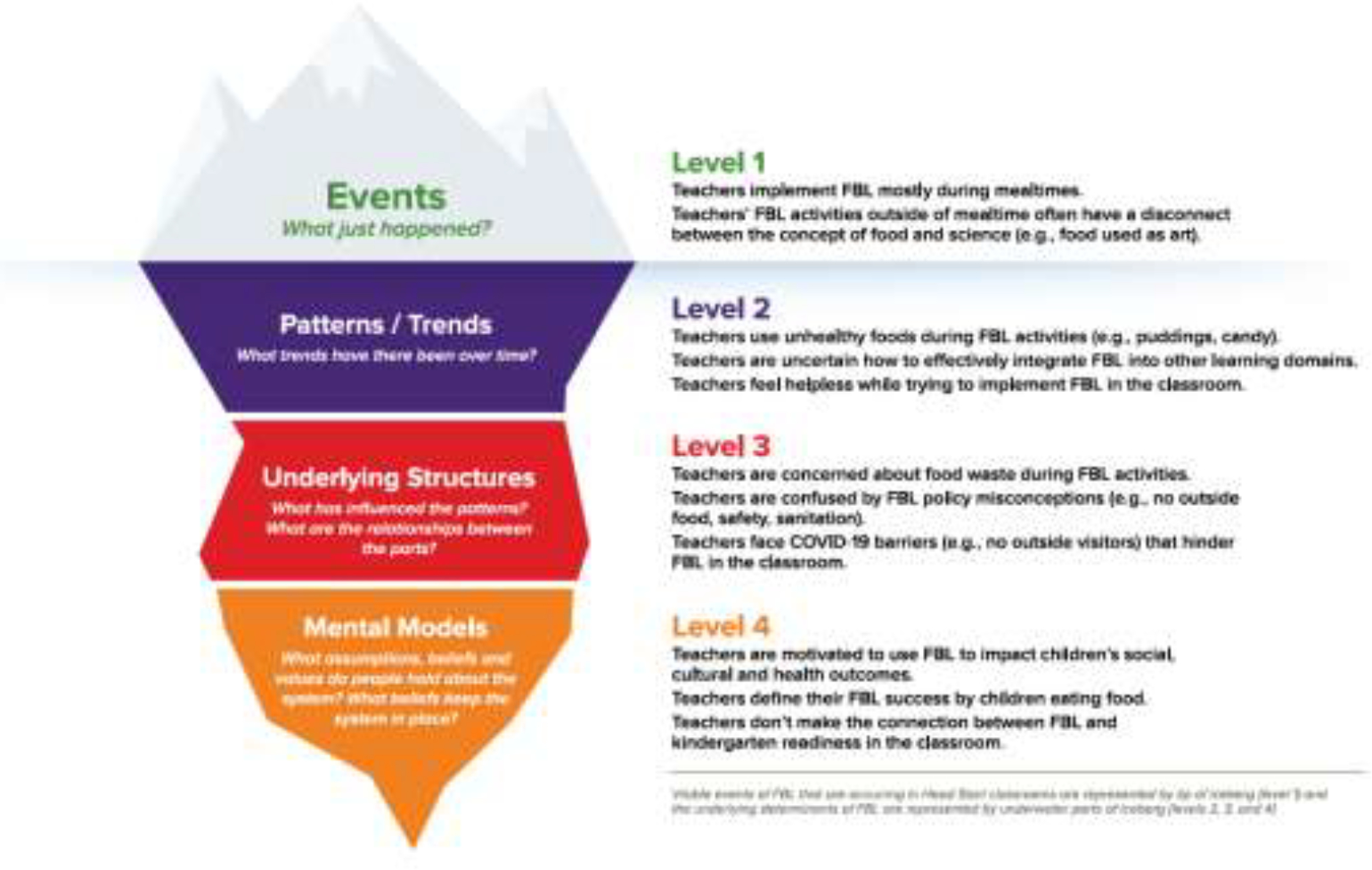
Theoretical Model Presenting Relationship Between Head Start Teachers’ (n=35) experiences with FBL at 4 Different Levels of the Systems Thinking Iceberg Model
Level 1: FBL Events in the Preschool Classroom
Teachers described 2 main events where FBL occurs in the classroom: inside the mealtime and outside the mealtime. Many teachers struggled to envision the possibilities of FBL outside the mealtime environment which led to most FBL events occurring at mealtime. Teachers who did FBL outside the mealtime often did not relate FBL to academic concepts.
Teachers implement FBL mostly during mealtimes.
Teachers described the contexts in which they integrated FBL in the classroom, both inside and outside the mealtime environment. However, many teachers reported that mealtime was the primary location for FBL activities. Teachers described that they used FBL during mealtime to teach children about nutrition concepts (e.g., food groups). A few teachers stated that FBL occurred exclusively in the mealtime environment: “I would say food conversation and experimentation is limited to lunch in investigative conversation while they’re eating” (Tammy). Teachers listed a plethora of strategies they used during mealtime such as encouraging children to try foods before stating they did not like them (e.g., “no thank you bite”), using positive descriptive words to talk about food (e.g., “these peas are so green and fresh”), providing children with physical and verbal rewards, encouraging children to make a “happy plate” (e.g., trying everything on their plate), and role modeling healthy eating behaviors. Teachers’ activities and strategies primarily focused on persuading children to eat food at meals, rather than exploring food through integrated learning outside of meals.
Teachers’ FBL activities outside of mealtime often have a disconnect between the concept of food and science (e.g., food used as art).
Conversely, some teachers described using food outside of mealtime by integrating FBL with other learning domains, such as science. When considering FBL’s role in science, many teachers discussed using healthy food to demonstrate common preschool science concepts (e.g., in a unit about vehicles and wheels, having children create model car wheels out of orange slices). However, the food featured in these activities were often disconnected from the science concept being explored. For example, teachers described using food as art or construction material to illustrate a scientific concept, rather than utilizing food as the scientific concept being studied. Leah described a unit about the lifecycle of a butterfly:
Nutrition is taught alongside with science…One example in specific would be, we were discussing the life cycle of the butterfly… So we used food, healthy food, such as celery, tomatoes, raisins, and created a butterfly out of those vegetables… so that’s kind of how we incorporated food with our science lesson. (Leah)
Few teachers recognized the weak connection between the FBL activity they described (e.g., making a butterfly out of celery) and the science concept (e.g., lifecycle of a butterfly); however, most teachers believed that the FBL activity was beneficial for improving children’s science knowledge. While many teachers recognized that FBL and science could be taught in tandem, teachers struggled to utilize FBL as a scientific concept (e.g., studying celery as an example of a vegetable plant that butterflies pollinate) and rather used food as part of their science units or art (e.g., making butterfly out of celery).
Level 2: Patterns and Trends of FBL in the Preschool Classroom
Teachers’ detailed descriptions of FBL events revealed overarching patterns that define FBL in the classroom including teachers’ use of unhealthy foods in FBL activities, teachers’ uncertainty on how to integrate FBL into science, and teachers’ general feelings of helplessness related to doing FBL in the classroom. These patterns hindered teachers’ ability to implement FBL and/or made FBL less beneficial for children.
Teachers use unhealthy foods during FBL activities.
Teachers frequently described FBL activities that used unhealthy foods (e.g., M&Ms, Cool Whip, pudding). Many teachers indicated that they enjoyed doing taste tests in their classroom to expose children to new food. During these activities, children were often encouraged to try a variety of foods and discuss their preferences. Other teachers created their own FBL activities using unhealthy foods based on thematic units. For example, during an insect unit, Lily explains,
We were making worms in the dirt, because we were talking about insects and so the item included pudding, and gummy worms, and Oreo cookies, so that we have our model, so that the children can understand that there are layers, and that the worms go in and out of those layers to get where they need to.
Many teachers acknowledged that Head Start policy discouraged the use of unhealthy foods in the classroom and did not consider the foods they chose to feature in the activity to be unhealthy.
Teachers are uncertain how to effectively integrate FBL into science.
Teachers indicated uncertainty regarding the integration of FBL and science in the classroom. Teachers more often viewed food solely in the context of mealtime and did not see how food could be integrated into other learning domains. One teacher explicitly stated that she knew, in theory, that FBL could be integrated; however, she didn’t know how to do it:
They’re all exposed to food in our classroom, and you can use food to teach so many things, like language, literacy, math, cultural diversity, different foods. [But] aside from just talking about where food comes from and what it does for our bodies, I’m not really sure how to make that into an activity aside from like our fruit salad… I don’t really know how to incorporate food into a science lesson. (Nicole)
Teachers repeatedly cited that they would like future training to learn how to integrate FBL with other learning domains to reduce the uncertainty that they feel.
Teachers feel helplessness while trying to implement FBL in the classroom.
A common trend in teachers’ perception of FBL in the classroom was feelings of helplessness. Teachers stated that it was difficult to encourage children to try foods during FBL activities and many teachers stated that there was nothing they could do to change a child’s decision not to try a food: “There’s still some things that no kid’s going to like no matter what” (Teri). Teachers expressed children were stuck in their preferences and were not likely to change their minds, regardless of how many times teachers included the food in FBL activities: “he’s not going to try [the new food]. So, it could affect all over, not just one time, but every time you try to do something in that aspect” (Susie). Other teachers emphasized the importance of honoring children’s preferences about food, such that if a child expressed dislike of a certain food, they should not be asked to try it again later. The idea of honoring children’s preferences extended into FBL activities where teachers stated they purposefully chose foods for FBL activities that they knew children would like (e.g., fruits), and avoided foods (e.g., vegetables) that they knew children would not likely eat.
Level 3: Underlying Structures Affecting FBL
Several underlying structures challenged teachers, influencing their use and integration of FBL in the classroom. These underlying structures often presented themselves as barriers to FBL in the classroom and included food waste, policy, and more recently, the impact of COVID-19 on FBL.
Teachers are concerned about food waste during FBL activities.
Teachers were concerned that FBL activities which involved children “playing” with food were detrimental since teachers misperceived that this food could then not be consumed by children. Many teachers emphasized that children in their classroom came from food-insecure homes and that manipulating food such that it could no longer be consumed was inappropriate. Some teachers cited food waste as a primary reason they did not do FBL in their classrooms: “No, we’re not allowed to use food… if we use food that that could have been food that they could have ate. So, we don’t actually get to use any chemistry to teach our children science [using food]” (Lucy).
Teachers are confused by FBL policy misconceptions regarding FBL.
The Head Start FBL policy environment was also a significant underlying structure affecting FBL. Many teachers interpreted their center’s policies as unsupportive of FBL outside of the mealtime environment. Teachers commented that they received contradictory communication from coworkers and administrators about policies regarding FBL:
So, the first year [the supervisor] was discouraged from using food and I heard from other co-workers that we weren’t supposed to use food in our classroom ever, at all, for any reason. And I had to probe and push and ask, and then, communication came out oh no, their policy does allow it. (Natasha)
This contradictory communication was further exemplified in interviews where 2 teachers described the same activity (e.g., making a necklace out of cheerios to practice counting) with one teacher stating the activity was a positive example of a FBL activity and the other stating it was a negative example. Both cited Head Start policies related to FBL.
Teachers also had concerns about the safety of FBL experiences in their classroom citing both sanitation and food allergies. Teachers interpreted Head Start sanitation policy to indicate that the sharing of utensils and children working together were not allowed. Many teachers also mentioned concerns about children’s allergies and hesitation regarding bringing food into the classroom.
Teachers face COVID-19 barriers.
Lastly, teachers described barriers to FBL considering COVID-19. Teachers highlighted that COVID-19 had further limited, or removed, their ability to integrate FBL in the classroom. One teacher described FBL during COVID-19 as a “taboo” subject stating that “after COVID hit, they [administration] don’t want us bringing in any kind of anything that children might touch. So, [FBL] has become very taboo” (Alex). Teachers commented that center- and class-wide changes related to COVID-19 (e.g., social distancing, masks, no outside visitors) have counteracted open exploration, like FBL, in the classroom. Teachers expressed concerns about the up-and-down attendance during COVID-19 which has “thrown everyone’s rhythm off” and prevented children from establishing a sense of normalcy within the classroom. During remote learning, it was not feasible for teachers to assume parents had materials at home to do FBL: “We could talk about food, but we don’t do any type of experiments or anything, because we just don’t want to offend anybody by asking, ‘Do you [parents/children] have this in your home or can you go out and get this’” (Sean).
Level 4: Teachers’ Mental Models for FBL
Most teachers, regardless of the capacity at which they did FBL in their classroom, expressed their beliefs and values about FBL by describing their motivations, their perceptions of themselves as successful and their understanding of FBL’s role in achieving their overall goals. According to the Systems Thinking Iceberg Model, the mental models that teachers have created for FBL keep the current system of FBL in place.39
Teachers are motivated to use FBL to impact children’s social, cultural and health outcomes.
All teachers believed that FBL had value for the children in their classroom. Teachers were motivated by the social, cultural, and health benefits of FBL.
Socially, teachers believed that FBL created connection for children. Many teachers felt that FBL was a beneficial topic because “all kids eat”. Teachers expressed that food is an object that connects children’s home and school lives. Sally explained, “it’s daily life… whether they’re at school or at home at a restaurant, they’re able to make connections with.” Teachers perceived that this unifying characteristic of food, enabled FBL to help children build relationships and social skills with teachers, peers, and families. Alex believed that FBL, specifically cooking, created powerful bonds between children and caregivers: “I think it’s really important to teach children in the scope of relationships…cooking naturally has that relationship aspect to it.”
Teachers were also motivated to include integrative FBL experiences, like cooking, in the classroom because of its benefits in improving children’s cultural awareness. Teachers explained that children may be unaware that different families prepare and eat different foods from their own. Food-based Learning can facilitate learning and appreciating differences among their peers. Teri referenced an instance when “(One child) had hummus. It smelled different than what they were possibly used to. We used that as a tool to say they eat some different foods that maybe you haven’t been exposed to.” Teachers also invited children’s parents to come into the classroom and prepare a traditional dish from their culture to share: “We have a staff person in our program that’s Hmong so we had her to come into our classroom, and show us how to make fried rice in the authentic way, and then let the children taste test it” (Lily).
Teachers also reported being motivated to integrate FBL because of its ability to improve children’s health. Many teachers commented that FBL increased children’s familiarity with healthy foods. Some teachers emphasized that children may not have had exposure to these foods outside of the program so FBL served as an avenue to expose children to new healthy foods: “Once you bring in foods that children maybe have never seen before, to let them try something that they’ve never even heard of” (Valerie).
Teachers also considered FBL as beneficial for impacting the long-term health of children. Teachers expressed concern about childhood obesity and sedentary behaviors of children and stated that this reinforced the necessity of FBL: “We think about the children that I teach are from low-income families. So, one of the things we really talk to them about is nutrition and exercise, so that we don’t have childhood obesity, things like that” (Tasha). Most teachers felt personally responsible for ensuring that children grew up to be healthy and emphasized that the knowledge and experiences children gained from their classroom could positively impact their future lives.
Teachers believed that exposing children have to healthy foods during FBL in their classroom could not only impact children’s health, but the health of their families as well. In this sense, teachers felt children could act as agents of change by advocating for the provision of healthier foods at home. One teacher explained, “[say there is] something that we present to the class, like say, Brussels sprouts or raw broccoli, that, ‘Maybe I didn’t get this at home’, and I can introduce that and let my mom know, ‘Hey, I like this.’ ‘Okay, well, I’ll continue to buy this for you’” (Aaliyah).
Teachers define their FBL success by children eating food.
Teachers believed they were successful at FBL through various indicators, the strongest of which was whether children consumed the presented foods: “[I know I’m doing a good job] when they’re stuffing food in their mouth” (Mia). Some teachers expressed having an active role in helping children try foods by using strategies (e.g., “no thank you bite”) to encourage children to try the food. While many teachers defined their FBL success by children’s willingness to eat the food, teachers simultaneously expressed feelings of helplessness in getting children to try foods due to preschoolers’ unwillingness or hesitancy to try new foods (neophobia). In some cases, teachers described that children may be familiar with a food but did not want to try it when presented in a new form (e.g., raw versus cooked) and emphasized the unpredictable nature of their preferences (e.g., will eat carrots one day but not the next).
Other less frequent perceptions of success were children being engaged in the FBL activity, children facilitating conversations with their parents about the activity, and children retaining or expanding on information from the activity. Children were engaged in an activity if they were paying attention (e.g., not being disruptive) and asking questions. Teachers also emphasized that they felt successful if children told their parents about the FBL activity during pick-up. Lastly, teachers indicated that they perceived themselves to be successful if children retained or expanded on the content of a FBL activity. For example, Mia stated, “Not only are they eating it, but they’re talking about it. They’re making that connection when they go into housekeeping, like ‘Hey, we tried oranges today. Here’s an orange.’”
Teachers don’t make the connection between integrating FBL and science to promote kindergarten readiness.
Teachers stressed the importance of preparing children for kindergarten by focusing on core academic domains such as science, mathematics, and literacy. Many teachers made a connection between the science learning environment and preparing children for kindergarten. Teachers commented that science naturally lent itself to teaching children concepts that are critical for kindergarten readiness. One teacher stated,
I think that it’s (science) a huge skill that kids need to know. Science is a lot of what our world is coming to, like the medical field and technology, all of that is based in science, and science really builds critical thinking skills, which are important in any field of work that they go into, and even just going into kindergarten and elementary school, just building those critical thinking skills (Nicole)
A few teachers made a connection between integrative FBL and kindergarten readiness. One teacher mentioned that integrating FBL could help children learn math concepts, such as measuring: “I think it’s wonderful to teach food experiences in the classroom because children are learning about measurement. They’re learning about food groups and food items. They’re learning about the colors of the food” (Tasha).
However, most of the time, the benefits of FBL were associated with the mealtime environment and health outcomes, such as consuming more fruits and vegetables or growing up healthy, rather than connected to science learning and kindergarten readiness. Although teachers expressed that FBL was beneficial, the connection between FBL and preparing children for kindergarten through science learning was minimal. Teachers expressed that they desire to prepare children for kindergarten, but they did not see how FBL could help them achieve that goal. Teachers detailed other valuable characteristics of FBL that made them want to do FBL in their classroom, but very few of the benefits teachers mentioned were academic.
DISCUSSION
This phenomenological study explored Head Start teachers’ use and integration of FBL with science in the preschool classroom. Exploration with teachers revealed a complex system of events, patterns, underlying structures, and mental models that impact FBL in the classroom. Eleven primary themes were identified and categorized within the 4 levels of the Systems Thinking Iceberg Model.62 Study findings provided unique in-depth insight into teachers’ experiences and perceptions of FBL as acknowledged by teachers themselves.
While teachers reported implementing FBL in the classroom, FBL was limited to mealtimes and teachers presented many barriers which underscore the need for professional development. Specifically, when teachers were implementing FBL during mealtimes, teachers reported using evidence-based, positive feeding practices (e.g., role modeling, descriptive words) to engage children’s senses.67,68 While teachers’ positive feeding practices are praiseworthy, it is concerning that teachers described the intentional use of detrimental feeding practices (e.g., rewards for eating and encouragement to eat beyond satiety for “happy plates”). These behaviors were embedded in teachers’ narratives as intentional and desirable to enhance the mealtime environment; however, research suggests that these practices may lower fruit and vegetable consumption in children.69,70 To support the efficacy of FBL, future training efforts may need to precede FBL curricula for the uptake of evidence-based feeding practices and/or removal of detrimental ones.71
Additionally, many teachers did not utilize FBL outside the mealtime environment. Prior research suggests that exposing children to FBL outside of the mealtime environment has the potential to allow children to freely explore healthy foods with all 5 senses without the added expectation of consuming the food or distracting children from practicing self-regulation.20,21 Food-based learning outside the mealtime environment has also been suggested to improve the liking and consumption of healthy foods in children7,72,73 and may impact kindergarten-readiness outcomes like science, math, and literacy.5,39 Therefore, professional development regarding FBL should highlight these benefits to influence teachers’ mental models regarding FBL implementation.
Furthermore, expanding teachers’ mental models regarding what successful FBL looks like may positively impact teachers’ inherent beliefs and values about FBL. Presently, teachers assumed that to be successful at FBL children must eat the food during an activity. This often causes teachers to experience feelings of helplessness during FBL activities when children consistently reject foods.74,75 Redefining successful FBL as “using healthy foods to impact academic outcomes” would positively impact teacher attitudes toward FBL and also increase children’s exposure to healthy foods.2 Helping teachers redefine these beliefs of FBL is critical because perception is an important determinant in teachers’ commitment to continue to deliver nutrition education in the classroom.54 For example, if teachers’ perspective of success shifted from “I need to make Kaysan eat broccoli so that he will have eaten some vegetables” to “I need to encourage Kaysan to explore broccoli using his sense of sight and touch so he can learn about the science of broccoli’s plant parts (e.g., root, stem, leaf),” teachers would be set up for success rather than failure. Helping teachers redefine their success in terms which are achievable is important as prior research suggests that teachers are motivated by their ability to make a difference in children’s lives.74,76
Additionally, teachers were unsure how to integrate FBL into other learning domains and the majority did not see how to integrate FBL and the science environment. The FBL activities that teachers considered to be integrative, such as building a butterfly with celery and tomatoes, often did not address science learning, and instead used food as art. While the activity exposes children to healthy foods, it often missed the opportunity to support children’s academic learning (e.g., learning about lifecycle of butterflies). Prior literature establishes that FBL and exposure to healthy foods in the preschool environment can improve long-term healthy eating;10 however, the lack of connection between FBL and academic learning in the Head Start classroom is concerning since teachers may consider nutrition a low priority compared to preparing children for kindergarten.39 Prior FBL interventions suggest that FBL can successfully be integrated into preschool learning domains for kindergarten readiness.1,2 For example, Together, We Inspire Smart Eating (WISE), is an 8-month nutrition education curriculum that exposes children to fruits and vegetables through weekly hands-on integrative FBL activities.2 WISE provides teachers with FBL activities that address preschool benchmarks and early learning standards (e.g., learning the mathematical concept of patterns through the organization of tomatoes, spinach, and low-fat mozzarella). These activities teach vocabulary skills (literacy) and observational skills (science) and encourage sensory exploration using all 5 senses.2 Highlighting the promise of FBL to address kindergarten readiness goals, such as science learning, is critical to improve teachers’ attitudes about FBL and increase buy-in.39
While impacting events at the “surface level” (e.g., interventions to teach teachers how to do FBL outside the mealtime environment) is important, the Systems Thinking Iceberg Model proposes that individuals must also work to change the overall system to enact systemic change.65,66 To do this, multi-level collaborations between researchers, nutrition educators, policymakers, and Head Start administrators which focus “beneath the surface” to change the underlying structures and inherent mental models of teachers towards FBL are needed. For example, in the current study, teachers held the mental model that preparing children for kindergarten is important, but teachers did not hold the belief that FBL can help them reach that goal. Teachers’ belief that FBL is unrelated to kindergarten readiness is unsurprising as many nutrition interventions do not discuss academic benefits and solely emphasize health outcomes as primary goals. While the correlation between a healthy diet and improved academic success is not novel,77,78 nutrition professionals and researchers may evaluate the differential value of emphasizing the health benefits of FBL versus FBL’s academic benefits related to kindergarten readiness. Helping teachers make the connection between FBL and preparing children for kindergarten through science learning may increase teacher buy-in to see FBL as a classroom practice that supports rather than deters from their goals.5,79
Lastly, efforts to address the challenges teachers face, such as policy misconnections are critical to improving the integration of FBL in Head Start. Prior research supports the findings of the present study that policy misinterpretation is a significant barrier to FBL.16,54 In 2016, Head Start removed FBL as a requirement in the classroom.80 While programs still support the use of food in the classroom, the lack of direction at the federal level has caused widespread uncertainty.39,55 In one instance, state sanitation policies regarding FBL cooking activities were misinterpreted by local centers to prohibit any cooking activities. Other federal Head Start policies like “no outside food”, intended to prohibit unhealthy food from entering the classroom, has been misinterpreted to prohibit all food, inhibiting FBL such as taste-testing healthy foods.55 These misinterpretations have historically caused lower teacher efficacy and infrequent FBL, hindering teachers’ ability to have an impact on children’s long-term dietary quality.16,55 Consolidation of policies and clearer communication to teachers from both the federal and local level will promote a positive learning environment where teachers feel supported in the use of FBL.39,55
Although teachers interviewed were from a large geographic span of the state, due to the qualitative nature of the study, findings are not generalizable outside the NC Head Start teachers represented in the study. Teachers in this study were also mostly female and primarily White or Black/African American, limiting the gender and ethnic diversity of the findings. However, participants in this study are like the national demographics of Head Start teachers who are 56.30% White and 35.14% Black and a high proportion female.81 Teachers who were more interested in the topics of FBL or science education may have been more likely to participate and may have different perceptions on this topic compared to those who chose not to participate. Nevertheless, convenience sampling is considered best practice when working with community partners.82 Additionally, telephone interviews were utilized in the present study which prohibited researchers from evaluating participants’ nonverbal cues as well as increasing the difficulty of establishing rapport with participants.82 However, telephone interviews have been cited as beneficial when sampling teachers across large geographic areas.84 Further, there has not been evidence that telephone interviews diminish the quality of qualitative data84 and on the contrary, telephone interviews have been identified as an ideal medium to conduct semi-structured qualitative interviews.83 Lastly, social desirability bias may also have impacted study findings as participants may have responded in ways that made their classroom practices appear more favorable or unfavorable. We used strategies to limit this effect such as introducing the study, establishing rapport, and asking follow-up questions.84
IMPLICATIONS FOR RESEARCH AND PRACTICE
This study qualitatively explored teachers’ experiences with FBL in the preschool classroom. Understanding how teachers perceive FBL is critical for changing the overall system to be more supportive of FBL and align with teachers’ goals and values. Integrating FBL into learning domains in the Head Start environment may present a unique opportunity to improve preschoolers’ exposure to healthy foods while preparing children for kindergarten through the science learning environment. However, our distinct themes of teachers primarily implementing FBL during mealtime and teachers being unsure how to integrate FBL into other learning domains suggest the need for a multi-pronged definition of FBL that includes the use of healthy food as a teaching tool by 1) providing repeated exposure to healthy foods for improving children’s dietary behaviors and 2) improving academic learning related to knowledge (e.g., science, mathematics, literacy) and skills (e.g., gross motor, fine, physical). Prior studies in preschool populations indicate that FBL can be integrated into kindergarten readiness outcomes (e.g., science, mathematics, literacy).1,2,39 Additional research is warranted to quantitatively investigate the potential impact of FBL on academic outcomes in preschool populations.
Teacher professional development programs within Head Start programs may be an opportunity to impact all 4 levels of the Systems Thinking Model. Professional development at level 1 (“events”) could focus on expanding teachers’ perceptions of FBL outside the confines of mealtime by teaching teachers how to integrate FBL into academic learning domains and providing guidance for benchmarks of success of FBL beyond food intake. Newly developed professional development may specifically address shortcomings of previous training by comprehensively addressing teachers’ current practices related to FBL.85 Efforts to impact teachers’ beliefs, values, and mental models related to FBL are needed. Dialogue with teachers about FBL could highlight FBL’s potential to prepare children for kindergarten, which is also supportive of teachers’ personal goals and motivations. Finally, future interventions could evaluate the benefit of a focus on impacting underlying structures, such as the policy environment and food purchasing, which presently hinder teachers’ ability to do FBL. For example, local Head Start centers could coordinate with the center’s monthly CACFP ordering such that FBL fruit and vegetable items be ordered alongside other foods. Specifically, pairing the CACFP snack with an FBL activity could reduce teacher out-of-pocket costs for FBL.
However, intervening on areas “underneath the surface” in the Systems Thinking Iceberg Model (levels 2–4) is critical to change the overall FBL system. While teachers have reported feeling happy engaging in common childcare tasks like nurturing children, lunchtime, and interactions with parents, teachers face additional stress over ever-growing pressures to meet ever-increasing state and federal requirements while also caring for the social and emotional needs of children.86,87 In addition to this stress, prior research acknowledges that Head Start staff are generally paid lower wages88 which combined negatively affect teachers’ physical and mental health.88,89 If future FBL interventions occur solely at the surface level (level 1), without addressing the need for overall improved support for teachers, the same underlying factors and mental models that teachers currently hold will continue to dictate the outcome of the system. However, consistent with the Systems Thinking Model, by addressing the underlying structures and mental models affecting teachers, the broader system can be fundamentally changed and a new system, supportive of teachers, supportive of FBL, and aligned with teachers’ inherent values and beliefs, emerges.90
Acknowledgments:
Research reported in this manuscript was supported by the National Institute of General Medical Sciences of the National Institutes of Health under Award Number R25GM132939. The content is solely the responsibility of the authors and does not necessarily represent the official views of the National Institutes of Health.
We would also like to thank Zachary Paramore for his assistance collecting data and Narmin Zeidan for her assistance collecting and analyzing the data. Lastly, we acknowledge out study participants who graciously gave of their time to participate in this study.
Footnotes
Publisher's Disclaimer: This is a PDF file of an unedited manuscript that has been accepted for publication. As a service to our customers we are providing this early version of the manuscript. The manuscript will undergo copyediting, typesetting, and review of the resulting proof before it is published in its final form. Please note that during the production process errors may be discovered which could affect the content, and all legal disclaimers that apply to the journal pertain.
Contributor Information
Jocelyn Dixon, Department of Nutrition Science, College of Allied Health Sciences, East Carolina University.
Archana V. Hegde, Department of Human Development and Family Science, College of Health and Human Performance.
L. Suzanne Goodell, Department of Food, Bioprocessing & Nutrition Sciences, North Carolina State University.
Nicole Arnold, Ohio State University Extension, Family and Consumer Sciences, Department of Food Science and Technology, Ohio State University.
Taren Swindle, Department of Family and Preventative Medicine, University of Arkansas for Medical Sciences.
Dipti Dev, Childhood Health Behaviors Extension Specialist, University of Nebraska-Lincoln.
Lucía Mendez, Department of Communication Sciences and Disorders, University of North Carolina Greensboro.
Valerie McMillan, Department of Family and Consumer Sciences, North Carolina Agricultural and Technical State University.
Tammy Lee, Department of Science Education.
Virginia C. Stage, Director of the Food-based Early Education (FEEd) Lab, Department of Nutrition Science, East Carolina University, Health Sciences Building 2307B, Greenville, NC.
REFERENCES
- 1.Bayles J, Peterson AD, Jilcott-Pitts S, Bian H, Goodell LS, Burkholder S, Hegde AV, Stage VC. Food-based Science, Technology, Engineering, Arts, and Mathematics (STEAM) Learning Activities May Reduce the Decline in Preschoolers’ Skin Carotenoid Status. Journal of Nutrition Education & Behavior. 2020;53:343–351. [DOI] [PMC free article] [PubMed] [Google Scholar]
- 2.Whiteside-Mansell L, Swindle T, Davenport K. Evaluation of “Together, We Inspire Smart Eating” (WISE) nutrition intervention for young children: assessment of fruit and vegetable consumption with parent reports and measurements of skin carotenoids as biomarkers. J Hunger Environ Nutr. 2019;16:235–245. [DOI] [PMC free article] [PubMed] [Google Scholar]
- 3.Carraway-Stage V, Hovland J, Ochab C, Diaz S, Duffrin MW. Food-based Science Curriculum Yields Gains in Nutrition Knowledge. J Sch Health. 2015; 85:231–240. [DOI] [PMC free article] [PubMed] [Google Scholar]
- 4.Johnson SL, Ryan SM, Kroehl M, Moding KJ, Boles RE, Bellows LL. A longitudinal intervention to improve young children’s liking and consumption of new foods: findings from the Colorado LEAP study. Int J Behav Nutr Phys Act. 2019;16:1–15. [DOI] [PMC free article] [PubMed] [Google Scholar]
- 5.Swindle T & Phelps J. How Does Context Relate to Nutrition Promotion and Mealtime Practice in Early Care and Education Settings? A Qualitative Exploration. Academy of Nutrition & Dietetics. 2018; 118:2081–2093. [DOI] [PMC free article] [PubMed] [Google Scholar]
- 6.Cooke L The importance of exposure for healthy eating in childhood: a review. J Hum Nutr Diet. 2007;20:294–301. [DOI] [PubMed] [Google Scholar]
- 7.Sullivan SA, Birch LL. Pass the Sugar, Pass the Salt: Experience Dictates Preference. Dev Psychol. 1990;26:546–551. [Google Scholar]
- 8.Elrakaiby M, Hasnin S, Stage VC, Dev DA. „Read for Nutrition’programme improves preschool children’s liking and consumption of target vegetable. Public Health Nutrition. 2022;25:1346–54. [DOI] [PMC free article] [PubMed] [Google Scholar]
- 9.Ogden C, Carroll MD, & Lawman HG. Trends in Obesity Prevalence Among Children and Adolescents in the United States, 1988–1994 Through 2013–2014. JAMA. 2016;315:2292–2299. [DOI] [PMC free article] [PubMed] [Google Scholar]
- 10.Grimm KA, Kim SA, Yaroch AL, Scanlon KS. Fruit and vegetable intake during infancy and early childhood. Pediatrics. 2014;134(Suppl1):S63–9. [DOI] [PMC free article] [PubMed] [Google Scholar]
- 11.Darmon N, Drewnowski A. Does social class predict diet quality? Am J Clin Nutr 2008;87:1107–17. [DOI] [PubMed] [Google Scholar]
- 12.Hughes C, Gooze RA, Finkelstein DM, Whitaker RC. Barriers to obesity prevention in Head Start. Health Affairs. 2010;29:454–461. [DOI] [PubMed] [Google Scholar]
- 13.Birch LL. Development of food preferences. Annu Rev Nutr. 1999;19:41–62. [DOI] [PubMed] [Google Scholar]
- 14.Dietz WH. Health consequences of obesity in youth: childhood predictors of adult disease. Pediatrics. 1998;101: 518–525 [PubMed] [Google Scholar]
- 15.Raychaudhuri M, Sanyal D. Childhood obesity: Determinants, evaluation, and prevention. Indian J of Endocrinology and Metabolism. 2012;16:S192. [DOI] [PMC free article] [PubMed] [Google Scholar]
- 16.Dev DA, Carraway-Stage V, Schober DJ, McBride BA, Kok CM, Ramsay S. Implementing the Academy of Nutrition and Dietetics benchmarks for nutrition education for children: child-care providers’ perspectives. Journal of the Academy of Nutrition and Dietetics. 2017;117:1963–71. [DOI] [PubMed] [Google Scholar]
- 17.Ramsay SA, Branen LJ, Fletcher J, Price E, Johnson SL, Sigman-Grant M. “Are you done?” Child care providers’ verbal communication at mealtimes that reinforce or hinder children’s internal cues of hunger and satiation. J Nutr Educ Behav. 2010;42:265–70. [DOI] [PubMed] [Google Scholar]
- 18.Dev DA, McBride BA, Fiese BH, Jones BL, Cho, on behalf of the STRONG Kids Research Team H. Risk factors for overweight/obesity in preschool children: an ecological approach. Childhood obesity. 2013;9:399–408. [DOI] [PMC free article] [PubMed] [Google Scholar]
- 19.Ventura AK, Birch LL. Does parenting affect children’s eating and weight status? IJBNPA. 2008;5:1–2. [DOI] [PMC free article] [PubMed] [Google Scholar]
- 20.Carruth BR, Skinner JD. Revisiting the picky eater phenomenon: neophobic behaviors of young children. J Am Coll Nutr. 2000;19:771–80. [DOI] [PubMed] [Google Scholar]
- 21.Orrell-Valente JK, Hill LG, Brechwald WA, Dodge KA, Pettit GS, Bates JE. “Just three more bites”: an observational analysis of parents’ socialization of children’s eating at mealtime. Appetite. 2007;48:37–45. [DOI] [PMC free article] [PubMed] [Google Scholar]
- 22.Nekitsing C, Blundell-Birtill P, Cockroft J, Hetherington M. Systematic review and meta-analysis of strategies to increase vegetable consumption in preschool children aged 2–5 years. Appetite. 2018;127:138–154. [DOI] [PubMed] [Google Scholar]
- 23.Heath P, Houston-Price C, Kennedy OB. Increasing food familiarity without the tears. A role for visual exposure?. Appetite. 2011;57:832–8. [DOI] [PubMed] [Google Scholar]
- 24.Kral TV, Hetherington MM. Variability in children’s eating response to portion size. A biobehavioral perspective. Appetite. 2015;88:5–10. [DOI] [PubMed] [Google Scholar]
- 25.Johnson SL, Bellows L, Beckstrom L, Anderson J. Evaluation of a social marketing campaign targeting preschool children. Am J Health Behav. 2007;31:44–55. [DOI] [PubMed] [Google Scholar]
- 26.Galloway AT, Fiorito L, Lee Y, Birch LL. Parental pressure, dietary patterns, and weight status among girls who are “picky eaters”. J Am Diet Assoc. 2005;105:541–8. [DOI] [PMC free article] [PubMed] [Google Scholar]
- 27.Larson N, Story M. A review of environmental influences on food choices. Ann Behav Med. 2009;38:S56–73. [DOI] [PubMed] [Google Scholar]
- 28.Busick DB, Brooks J, Pernecky S, Dawson R, Petzoldt J. Parent food purchases as a measure of exposure and preschool-aged children’s willingness to identify and taste fruit and vegetables. Appetite. 2008;51:468–73. [DOI] [PubMed] [Google Scholar]
- 29.Bustamante AS, White LJ, Greenfield DB (2017). Approaches to learning and school readiness in Head Start: Applications to preschool science. Learning and Individual Differences, 56, 112–118. [Google Scholar]
- 30.Johnson SL. Developmental and environmental influences on young children’s vegetable preferences and consumption. Adv Nutr 2016;7:220S–231S. [DOI] [PMC free article] [PubMed] [Google Scholar]
- 31.Robert Wood Johnson Healthy Eating Research. Evidence-based Recommendations and Best Practices for Promoting Healthy Eating in Children 2 to 8 Years. Technical Report. https://healthyeatingresearch.org/research/evidence-based-recommendations-and-best-practices-for-promoting-healthy-eating-behaviors-in-children-2-to-8-years/. Accessed October 3, 2022. [Google Scholar]
- 32.Frisvold DE, Lumeng JC. Expanding Exposure. J Hum Resour. 2011;46:373–402. [Google Scholar]
- 33.Burstein N, Layzer JI, Cahill K, Werner A, McGary N. National study of child care for low-income families: Patterns of child care use among low-income families. Washington, DC: US Department of Health and Human Services, Administration for Children and Families, Office of Planning, Research and Evaluation. 2007. [Google Scholar]
- 34.Li J, Hooker NH. Childhood obesity and schools: evidence from the national survey of children’s health. J Sch Health. 2010;80:96–103. [DOI] [PubMed] [Google Scholar]
- 35.Office of Head Start, US Department of Health and Human Services Administration for Children and Families. Head Start Program Performance Standards45 CFR XIII Current through 2015.Washington, DC: US Government Publishing Office; 2014; Accessed September 8, 2022. [Google Scholar]
- 36.Child and Adult Care Food Program. Part 226.20. Requirements for meals. Child and Adult Care Food Program. https://www.ecfr.gov/cgi-bin/text-idx?SID=9c3a6681dbf6aada3632967c4bfeb030&mc=true&node=pt7.4.226&rgn=div5#se7.4.226_120. Accessed September 8, 2022. [Google Scholar]
- 37.Nekitsing C, Hetherington M, Blundell-Birtill P. Developing healthy food preferences in preschool children through taste exposure, sensory learning, and nutrition education. Current Obesity Reports. 2018;7:60–67. [DOI] [PMC free article] [PubMed] [Google Scholar]
- 38.Gooze RA, Hughes CC, Finkelstein DM & Whitaker RC. Peer reviewed: obesity and food insecurity at the same table: how Head Start programs respond. Preventing chronic disease. 2012;9. [DOI] [PMC free article] [PubMed] [Google Scholar]
- 39.Carraway-Stage V, Henson SR, Dipper A, Spangler H, Ash SL, & Goodell LS. Understanding the State of Nutrition Education in the Head Start Classroom: A Qualitative Approach. American Journal of Health Education. 2014;45:52–62. [Google Scholar]
- 40.Cotugna N, Vickeryn C. Educating early childhood teachers about nutrition: A collaborative venture. Childhood Education. 2007;83:194–8. [Google Scholar]
- 41.Head Start Early Learning Outcomes Framework. (2020). https://eclkc.ohs.acf.hhs.gov/school-readiness/article/head-start-early-learning-outcomes-framework. Accessed October 7, 2022.
- 42.Gelman R, Brenneman K, Macdonald G, Roman M. Preschool pathways to science: Facilitating scientific ways of thinking, talking, doing, and understanding. Baltimore: Brookes Publishing; 2009. [Google Scholar]
- 43.Nayfeld I, Brenneman K, Gelman R. Science in the classroom: Finding a balance between autonomous exploration and teacher-led instruction in preschool settings. Early Education and Development. 2011;22, 970–988. [Google Scholar]
- 44.Sigman-Grant M, Byington A, Lindsay AR, Lu M, Mobley AR, Fitzgerald N, Hildebrand D. Preschoolers can distinguish between healthy and unhealthy foods: the all 4 kids study. J Nutr Educ Behav. 2014;46:121–127. [DOI] [PubMed] [Google Scholar]
- 45.Bandura A Health promotion by social cognitive means. Health education & behavior. 2004;31(2):143–64. [DOI] [PubMed] [Google Scholar]
- 46.Clarke D, & Hollingsworth H Elaborating a model of teacher professional growth. Teaching and Teacher Education. 2002;18(8): 947–967. [Google Scholar]
- 47.Moustakas C Phenomenological research methods. Thousand Oaks: Sage; 1994. [Google Scholar]
- 48.More PEAS, Please. https://www.morepeasplease.org. Accessed September 8, 2022.
- 49.Head Start. https://headstartnc.org/agency-locator/. Accessed October 6, 2022.
- 50.Education Week. Map: Coronovirus and school closures in 2019–2020. https://www.edweek.org/leadership/map-coronavirus-and-school-closures-in-2019-2020/2020/03. Accessed September 8, 2022.
- 51.Bauer KW, Chriqui JF, Andreyeva T, Kenney EL, Stage VC, Dev D, Lessard L, Cotwright C, Tovar A. A safety net unraveling: Feeding young children during COVID-19. Am J Public Health. 2021;111:116–120. [DOI] [PMC free article] [PubMed] [Google Scholar]
- 52.Office of Management and Budget. Standards for maintaining, collecting, and presenting federal data on race and ethnicity.https://www.federalregister.gov/documents/2016/09/30/2016-23672/standards-for-maintaining-collecting-and-presenting-federal-data-on-race-and-ethnicity. Accessed September 8, 2022.
- 53.Rios LK, Stage VC, Leak TM, Taylor CA, Reicks M. Collecting, Using, and Reporting Race and Ethnicity Information: Implications for Research in Nutrition Education, Practice, and Policy to Promote Health Equity. J Nutr Educ Behav. 2022;54:582–93. [DOI] [PubMed] [Google Scholar]
- 54.Hall E, Chai W, Albrecht JA. A qualitative phenomenological exploration of teachers’ experience with nutrition education. Am J Health Educ. 2016;47:136–148. [DOI] [PMC free article] [PubMed] [Google Scholar]
- 55.Peterson AD, Goodell LS, Hegde A, Stage VC. Teacher perceptions of multilevel policies and the influence on nutrition education in North Carolina Head Start Preschools. J Nutr Educ Behav. 2017; 49:387–396. [DOI] [PubMed] [Google Scholar]
- 56.Srivastava P, Hopwood N. A practical iterative framework for qualitative data analysis. International journal of qualitative methods. 2009;8:76–84. [Google Scholar]
- 57.Shenton AK. Strategies for ensuring trustworthiness in qualitative research projects. Education for Information. 2004;22:63–75. [Google Scholar]
- 58.Bowen GA. Naturalistic inquiry and the saturation concept: a research note. Qual Res. 2008;8:132–152. [Google Scholar]
- 59.Creswell JW. Qualitative Inquiry & Research Design: Choosing Among Five Approaches. (3rd ed.). Thousand Oaks, CA: Sage; 2013. [Google Scholar]
- 60.Brod M, Tesler LE, Christensen TL. Qualitative research and content validity: developing best practices based on science and experience. Quality of life research. 2009;18:1263–1278. [DOI] [PubMed] [Google Scholar]
- 61.Goodell LS, Stage VC, Cooke NK. Practical Qualitative Research Strategies: Training Interviewers and Coders. J Nutr Educ Behav. 2016;48:578–585. [DOI] [PubMed] [Google Scholar]
- 62.Anderson V, Johnson L. Systems Thinking Basics. From Concepts to Causal Loops. Waltham, Mass: Pegasus Comm., Inc.; 1997. [Google Scholar]
- 63.Monat JP, Gannon TF. What is systems thinking? A review of selected literature plus recommendations. American Journal of Systems Science. 2015;4:11–26. [Google Scholar]
- 64.Linnéusson G, Andersson T, Kjellsdotter A, Holmén M. Using systems thinking to increase understanding of the innovation system of healthcare organisations. Journal of Health Organization and Management. 2022;36:179–95. [DOI] [PMC free article] [PubMed] [Google Scholar]
- 65.Trochim WM, Cabrera DA, Milstein B, Gallagher RS, Leischow SJ. Practical challenges of systems thinking and modeling in public health. Am J Public Health. 2006;96:538–546. [DOI] [PMC free article] [PubMed] [Google Scholar]
- 66.De Savigny D, Adam T. (Eds.). Systems thinking for health systems strengthening. World Health Organization. Alliance for Health Policy and Systems Research. Systems thinking for health systems strengthening. Geneva: Alliance for Health Policy and Systems Research: World Health Organization; 2009. [Google Scholar]
- 67.Dev D, Burton A, McBride BA, Edwards CP & Garcia AS. An Innovative, Cross-Disciplinary Approach to Promoting Child Health: The Reggio Emilia Approach and the Ecological Approach to Family Style Dining Program. Childhood Education. 2019;95:57–63. [Google Scholar]
- 68.Hendy HM, Raudenbush B. Effectiveness of teacher modeling to encourage food acceptance in preschool children. Appetite. 2000;34:61–76. [DOI] [PubMed] [Google Scholar]
- 69.Blissett J Relationships between parenting style, feeding style and feeding practices and fruit and vegetable consumption in early childhood. Appetite. 2011;57:826–831. [DOI] [PubMed] [Google Scholar]
- 70.Kiefner-Burmeister AE, Hoffmann DA, Meers MR, Koball AM, Musher-Eizenman DR. Food consumption by young children: a function of parental feeding goals and practices. Appetite. 2014; 74:6–11. [DOI] [PubMed] [Google Scholar]
- 71.Swindle T, Rutledge JM, Zhang D, Martin J, Johnson SL, Selig JP, Yates AM, Gaulden DT, Curran GM. De-Implementation of Detrimental Feeding Practices in Childcare: Mixed Methods Evaluation of Community Partner Selected Strategies. Nutrients. 2022;14(14):2861. [DOI] [PMC free article] [PubMed] [Google Scholar]
- 72.Hoppu U, Prinz M, Ojansivu P, Laaksonen O, Sandell MA. Impact of sensory-based food education in kindergarten on willingness to eat vegetables and berries. Food & nutrition research. 2015;59:28795. [DOI] [PMC free article] [PubMed] [Google Scholar]
- 73.Dazeley P, Houston-Price Hill C. Should healthy eating programmes incorporate interaction with foods in different sensory modalities? A review of the evidence. British Journal of Nutrition. 2012;108(5):769–777. [DOI] [PubMed] [Google Scholar]
- 74.Stage VC, Jones L, Bayles J, Hegde AV, Dev DA, Goodell LS. Eastern North Carolina Head Start Teachers’ personal and professional experiences with healthy eating and physical activity: a qualitative exploration. Public Health Nutrition. 2020;24:3460–3476. [DOI] [PMC free article] [PubMed] [Google Scholar]
- 75.Mita SC, Li E, Goodell LS. A qualitative investigation of teachers’ information, motivation, and behavioral skills for increasing fruit and vegetable consumption in preschoolers. J Nutr Educ Behav. 2013;45:793–799 [DOI] [PubMed] [Google Scholar]
- 76.Sisson SB, Smith CL, Cheney M. Big impact on small children: child-care providers’ perceptions of their role in early childhood healthy lifestyle behaviours. Child Care Pract. 2017;23:162–180. [Google Scholar]
- 77.Florence MD, Asbridge M, Veugelers PJ. Diet quality and academic performance. J Sch Health. 2008;78:209–215. [DOI] [PubMed] [Google Scholar]
- 78.Rampersaud GC, Pereira MA, Girard BL, Adams J. Metzl JD. Breakfast habits, nutritional status, body weight, and academic performance in children and adolescents. J Am Diet Assoc. 2005;105:743–760. [DOI] [PubMed] [Google Scholar]
- 79.Swindle T, Johnson SL, Davenport K, Whiteside-Mansell L, Thirunavukarasu T, Sadasavin G, Curran GM. A mixed-methods exploration of barriers and facilitators to evidence-based practices for obesity prevention in head start. J Nutr Educ Behav. 2019;51:1067–79. [DOI] [PMC free article] [PubMed] [Google Scholar]
- 80.Office of Head Start, US Department of Health and Human Services Administration for Children and Families. Head Start Program Performance Standards 45 CFR XIII Current through 2015. Washington, DC: US Government Publishing Office; 2016. Retrieved from 2016 Performance Standards. Accessed September 8, 2022. [Google Scholar]
- 81.Office of Head Start. Head Start Enterprise System. https://drive.google.com/file/d/16QHh1yOyuOAIuImvbtc0QLTAPzJRyu1q/view?usp=sharing. Accessed September 8, 2022.
- 82.Green J, Thorogood N. Qualitative methods for health research. Sage; 2018. [Google Scholar]
- 83.Cachia M, Millward L. The telephone medium and semi-structured interviews: a complementary fit. Qualitative Research in Organizations and Management: An International Journal. 2011. [Google Scholar]
- 84.Bergen N, Labonté R. “Everything is perfect, and we have no problems”: detecting and limiting social desirability bias in qualitative research. Qualitative health research. 2020;30:783–792. [DOI] [PubMed] [Google Scholar]
- 85.Swindle TM, Patterson Z, Boden CJ. A qualitative application of the Belsky model to explore early care and education teachers’ mealtime history, beliefs, and interactions. J Nutr Educ Behav. 2017;49:568–578. [DOI] [PMC free article] [PubMed] [Google Scholar]
- 86.Hall-Kenyon KM, Bullough RV, MacKay KL, & Marshall EE (2014). Preschool Teacher Well-Being: A Review of the Literature. Childhood Education Journal, 42, 153–162. [Google Scholar]
- 87.Stipek D (2006). No child left behind comes to preschool. The Elementary School Journal, 106(5), 455–466. [Google Scholar]
- 88.Whitaker RC, Becker BD, Herman AN, & Gooze RA (2013). The Physical and Mental Health of Head Start Staff: The Pennsylvania Head Start Staff Wellness Survey, 2012. Preventing Chronic Disease, 10, 130171. [DOI] [PMC free article] [PubMed] [Google Scholar]
- 89.Nixon AE, Mazzola JJ, Bauer J, Krueger JR, Spector PE. Can work make you sick? A meta-analysis of the relationships between job stressors and physical symptoms. Work Stress 2011;25(1):1–22. [Google Scholar]
- 90.Stroh DP. Systems thinking for social change: A practical guide to solving complex problems, avoiding unintended consequences, and achieving lasting results. Chelsea Green Publishing; 2015. [Google Scholar]