



Summary
We present a method for estimating several prognosis parameters for cancer survivors. The method utilizes the fact that these parameters solve differential equations driven by cumulative hazards. By expressing the parameters as solutions to differential equations, we develop generic estimators that are easy to implement with standard statistical software. We explicitly describe the estimators for prognosis parameters that are often employed in practice, but also for parameters that, to our knowledge, have not been used to evaluate prognosis. We then apply these parameters to assess the prognosis of five common cancers in Norway.
Keywords: Cancer, Cancer survivors, Conditional survival, Prognosis, Survival analysis
1. Introduction
Many cancer patients would like to learn about their prognosis. Therefore, it is crucial that health care providers give adequate predictions about future outcomes that are relevant and intelligible to the patients. For this purpose, summary estimates on the rate scale, such as hazard ratios, are unlikely to be adequate: patients are unlikely to be interested in the rate of events (e.g., death) in infinitesimal intervals, as provided by estimates on the hazard scale. Furthermore, the estimation of hazard ratios typically relies on parametric assumptions on how the hazard ratio varies over time, such as proportional hazards.
The survival function can easily be estimated without imposing these parametric assumptions but does not necessarily help determine the prognosis of patients that have survived a given time after diagnosis. For example, a prostate cancer patient who has survived 3 years after diagnosis may not be interested in the predicted prognosis from the time of diagnosis: the fact that the patient has survived 3 years may be important for future predictions of life expectancy. Thus, parameters that are explicitly based on the cancer survivors at a given time, such as the conditional 5-year survival function, can be more appropriate. Indeed, several studies have used conditional 5-year survival functions for studying the prognosis of cancer survivors (Janssen-Heijnen and others, 2007, 2010; Merrill, 2018; Wancata and others, 2016). Although it is straightforward to formulate many other parameters that target cancer survivors’ prognosis, such parameters are not widely used in practice.
In this article, we consider prognosis parameters for cancer survivors that (i) are easy for patients and doctors to interpret and (ii) can be estimated without relying on excessive parametric assumptions. We consider parameters restricted to the surviving population at each time point, and therefore these parameters are tailored to the patients who have survived up to that time point. We derive generic estimators, and explicitly describe these estimators for each parameter under consideration. The parameters are then used to assess the prognosis of common cancers, using national cohorts from the Cancer Registry of Norway.
The remainder of the article is organized as follows. In Section 2, we introduce different prognosis parameters. In Section 3, we outline the estimation procedure for these parameters. In Section 4.1, we describe the cancer data and the results of our analysis. A discussion is given in Section 5.
2. Parameters of interest
Our objective is to define and estimate parameters reflecting notions of prognosis intelligible to cancer patients who have survived a given time  after being diagnosed. We acquire measures that are tailored for these subjects by conditioning on survival at
  . In Section 2.1, we will define parameters restricted to the cancer population, targeting both all-cause mortality and cause-specific mortality. In Section 2.2, we will suggest prognosis parameters that contrast summary measures from the cancer cohorts and the general population.
2.1. Parameters confined to the cancer population
2.1.1. All-cause mortality parameters
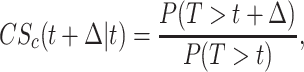
While the survival function provides relevant information about prognosis for subjects at the time of diagnosis, it is less useful for subjects who have survived a given time after diagnosis. However, these cancer survivors may be interested in the conditional  -year survival function, defined as
 |
(1) |
where  is the (possibly censored) time of death in the cancer cohort. It is the probability of surviving until
  , given survival up to
  . If
. If  , and (1) is equal to
  at
at  , then the average subject alive at
  will have a 90% probability of surviving another 5 years.
Some patients prefer thinking about quantities defined on the time scale rather than the probability scale. The restricted mean residual lifetime from  to
to  could be of interest for these patients. It is defined by
 |
(2) |
It can be interpreted as the expected remaining lifetime up to  , given survival up to
  . A closely related parameter is the conditional restricted mean time lost,
  , given by
 |
(3) |
which is the expected number of years lost for the survivors at  in a
in a  -year time horizon. If for example,
  and (2) is equal to
  at
at  , then the cancer subjects alive at
  are expected to live
  out of the coming
  years. Equivalently, the cancer subjects alive at
  are expected to lose
  years of life in a time horizon of 15 years, which means that (3) is equal to
  .
.
2.1.2. Parameters that use the information on causes of death
Patients may be interested in predictions that explicitly target death due to the cancer under study. We can obtain such predictions if the cohort data contain information on the causes of death. Assuming that we can reliably distinguish between causes of death, in particular, death attributed to cancer (e.g., death by cancer or cancer treatment, as stated in a death certificate) and death from causes that are unrelated to cancer, we can define prognosis parameters that distinguish between death due to cancer and death from other causes: if we let  denote death from cancer and
  death from other causes, we can study
 |
(4) |
as a function of  . Moreover, we can contrast the risk of dying due to cancer with risk of dying due to other causes by studying
 |
(5) |
 |
(6) |
Another candidate is
 |
(7) |
The parameter (4) is the risk of death due to cancer in the interval  for the subjects that have survived up to
  , and (5) is the relative risk of dying of cancer versus other causes in a period from
  to
to  among cancer survivors at time
  . Similarly, (6) is the difference between the average
  -year risk of death due to cancer vs death due to other causes among cancer survivors at
  . Finally, (7) is the proportion of deaths from cancer up to
  , among individuals who have survived until
  .
.
2.2. Contrasting cancer cohorts with the general population
Cancer patients may be interested in how their predicted outcomes compare to outcomes in the general population. Contrasts of the  -year survival function (1) in the cohort
  and the general population
  , that is,
 |
(8) |
 |
(9) |
provide such comparisons.
The terms (8) and (9) are the conditional  -year survival ratios and differences at
  . For example, if
  , and (8) is equal to
  at
at  , then the conditional 5-year survival of the cohort is 90 % of the conditional 5-year survival of the general population at
  . Similarly, if
  , and (9) is equal to
  at
at  , then the conditional 5-year survival of the cohort is 10 percentage points worse than the conditional 5-year survival of the general population at
  .
.
Similarly, we can compare restricted mean residual lifetime functions between cancer cohorts and the general population, that is,
 |
(10) |
 |
(11) |
to study the prognosis of the cancer survivors at  .
.
If  and (10) is equal to
  at
at  , then, in the next 5 years, the cancer subjects alive at
  are expected to have 90 % of the expected survival of similar subjects in the general population. If
  and (11) is equal to
  at
at  , then the average cancer subject alive at
  , for the given cohort, is expected to lose 1 year of life compared to the general population in the subsequent 5 years.
3. Estimation
We estimate the parameters in Section 2 by estimating summary measures of the cancer cohort and the general population separately. We describe estimation procedures for summary measures of the cancer cohorts in Section 3.1 and of the general population in Section 3.2.
3.1. Estimating summary measures for the cancer cohorts
A unified framework for modeling survival parameters based on differential equations is described in. A range of summary measures in survival analysis can be formulated as solutions to ordinary differential equation (ODE) systems, that is, they can be written on the form
 |
(12) |
where  is a vector of initial values,
  is a matrix-valued function, and
  is a
is a  -dimensional vector of cumulative hazard coefficients (Ryalen and others, 2018; Stensrud and others, 2019).
We will use the formulation (12) to derive general estimators and estimation results: by replacing  and
and  with consistent estimates
  and
and  we obtain a stochastic differential equation (SDE) plugin estimator for
  ;
;
 |
(13) |
Consistency results for (13) when  is the Nelson–Aalen estimator, or more generally Aalen’s additive hazard estimator has previously been developed (Ryalen and others, 2018). In particular, as
  then is a consistent estimator for
  under the independent censoring assumption (Andersen and others, 1993),
  is also a consistent estimator for
  under independent censoring.
A simple example of a parameter that solves (12) is the survival function  , that is, with
  and
and 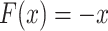 where
where  is the marginal cumulative hazard for death. By using the Nelson–Aalen estimator to obtain the cumulative hazard estimates
  , the estimator (13) yields the Kaplan–Meier estimator expressed as a difference equation. Other examples include the cumulative incidence functions, in which case
  is the vector of cumulative cause-specific hazards. Several other examples can be found in Ryalen and others (2018).
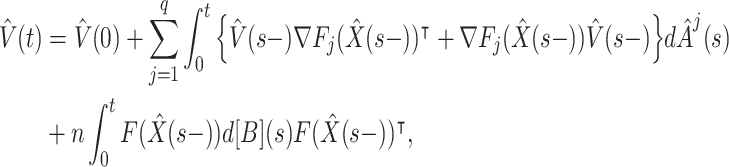
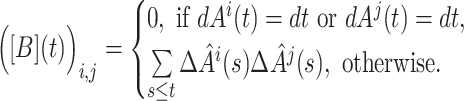
The root  residual limit process solves a linear SDE, and its covariance can be consistently estimated by
 |
(14) |
where  is a matrix defined by
 |
It is easy to estimate  and
and  , for example, using an
  package that is freely available (Ryalen and others, 2018, see
  ]).
]).
We build on theory from Ryalen and others (2018) to express estimators of the cancer cohort summary parameters in 2. To this end, we consider smooth functions  on the form
  , where
  solves (12), and estimators on the form
  where
where  solves (13). In the Supplementary material available at Biostatistics online, we show that the covariance of
  can be estimated by
 |
(15) |
where  is the sample size,
  is given in (14), and where
  solves
 |
(16) |
An argument justifying the consistency of the estimators  , (15) and (16) is given in Section A of the Supplementary material available at Biostatistics online (http://www.biostatistics.oxfordjournals.org). We may summarize our estimation procedure as follows: for a given prognosis parameter
  of interest,
-
a)
Find an
 that can be written on the form (12), and an accompanying
  , such that
  .
. -
b)
Define the plug-in estimator of
 ,
,  , where
  is given by (13).
 -
c)
Estimate the covariance of
 using (15).
We emphasize that the computations in steps a)–c) can be evaluated generically using a computer. We will nevertheless perform each step for obtaining estimators for the conditional  -year survival function in Section 3.1.1. We display the estimators of the remaining parameters from Section 2 in the subsequent sections. Details of the remaining derivations can be found in the Supplementary material available at Biostatistics online.
3.1.1. Conditional  -year survival
The conditional  -year survival function is defined by
  where
where  is the (all-cause) survival function in the cancer cohort. As noted in Section 3.1,
  solves (12), and by introducing
  we get that
  . This completes the above step a). Next, calculate
  , the solution to (13). The estimator defined in step b) is then
 |
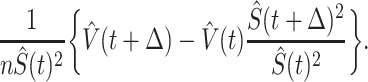
Our estimation procedure yields a ratio of Kaplan–Meier estimators and is therefore equal to the classical estimator for the conditional survival function. Now, for step c), note first that  and
and  . The equation (14) is thus,
 |
(17) |
as  , where
  is the number at risk at time
  and
and  is the Nelson–Aalen estimator. Next, (16) reduces to a recursive equation which, after simplifying, reads
  . Thus, by calculating
  , and inserting the expressions
  and
and  , we find that the covariance estimator (15) reads
 |
(18) |
3.1.2. Restricted mean residual lifetime
We define  . The restricted mean residual lifetime can be written as
  . The estimator for
  thus reads
 |
where  is obtained by numerical integration of the Kaplan–Meier estimator (see eq. (2) in the Supplementary material available at Biostatistics online). The variance estimator (15) of
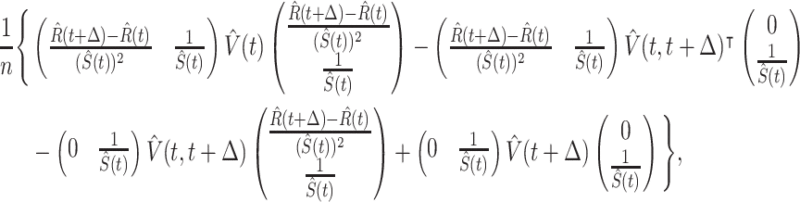
  is
is
 |
(19) |
where the expressions for  and
and  are shown in (3) and (4) in the Supplementary material available at Biostatistics online.
3.1.3. Parameters using cause of death information
The estimator of (4) takes the form
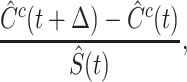 |
where  , and
, and  is the Nelson–Aalen estimator for the cause-specific hazard for death due to cancer. The estimator for (5) reads
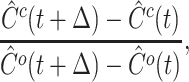 |
where  , with
  being the Nelson–Aalen estimator for the cause-specific hazard for death due to other causes. The estimator for (6) is
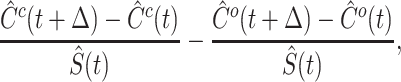 |
and the estimator of (7) is
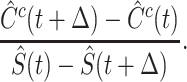 |
The variance estimator for these estimators takes the general form
 |
where, for (4), (5), (6), and (7) respectively,  and
and  are
are
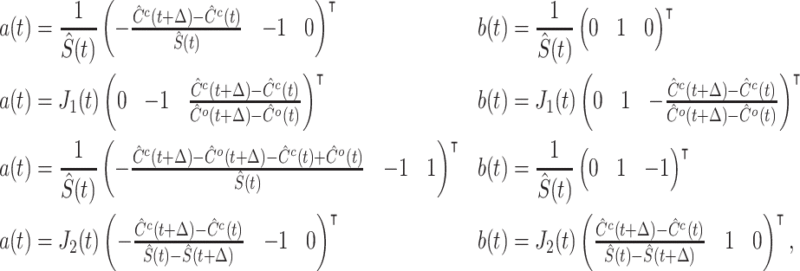 |
and where the expressions for  and
and  can be found in (5) and (6) in the Supplementary material available at Biostatistics online. Here, we have defined
  and
and  .
.
3.2. Obtaining summary measures for the general population
From Statistics Norway, we have access to yearly all-cause mortality rates, or discrete-time hazards, stratified by calendar year, age, and sex for the general Norwegian population. Heuristically, by matching each subject in the cancer cohort with a (fictitious) subject in the general population, we identify a subgroup of the general population with a similar distribution of demographic variables compared to the cancer cohort. We then obtain the marginal hazard of this subgroup using the Ederer I estimator (Ederer and others, 1961), implemented in the  function in the
  package
  (Pohar Perme and Pavlic, 2018). Using the population hazard, we calculate the population parameters
  and
and  , applying numerical integration when necessary.
4. Analysis of five common cancers
4.1. Data
We used data from The Cancer Registry of Norway to consider the five most frequently registered cancers in Norway in 2018: prostate, breast, lung, colon, and melanoma of the skin (Larsen and others, 2019). We had access to data on sex, age, date of diagnosis, date of death, and the cause of death. We restricted the analysis to the subjects who were diagnosed in 2001 or later, and who were younger than 60 years at the time of diagnosis. The subjects were administratively censored on December 31, 2018.
4.2. Results
We plot parameters from Section 2.1 in Figure 1 with  . For prostate and breast cancer,
  and
and  are roughly constant over time, having values around 0.9 and 4.7, respectively. The lung and colon cancer survivors display a more pronounced improvement; the lung cancer patients at the time of diagnosis are expected to live two out of the coming 5 years, but we expect that the survivors at
  years to live 4.5 out of the next 5 years. The melanoma patients have a slight improvement from diagnosis up to 12 years, with a 5-year survival of 0.9 at
  and a conditional 5-year survival over
  at
at  .
.
Fig. 1.

Estimates of the parameters (1), (2), and (4) –(7) (ordered row-wise) with  using the estimators described in Section 3. 95% confidence intervals, obtained using our variance estimator, are indicated with dashed lines. In the uppermost row, we also plotted 95% confidence intervals derived from the Greenwood estimator (dotted lines). Our variance estimates are in close agreement with the classical variance estimates, making the dotted and dashed lines indistinguishable at a glance. This coincides with more extensive comparisons already performed (Stensrud and others, 2019). The five cancers are ordered column-wise, and the ticks at the
  -axes are vertically aligned.
The risk of death due to cancer is relatively constant or moderately declining as time progresses. The proportions of death attributable to cancer and the risk ratios of dying due to cancer versus other deaths are declining more steadily. For instance, the prostate cancer survivors have about a 6% risk of dying due to cancer in a 5-year horizon throughout the study period (from Figure: 95% confidence interval at  is [0.04–0.09]). Still, the 5-year risk ratio (5) declines from almost two at
  to about one at
  . Thus, prostate cancer patients at diagnosis are about twice as likely to die due to cancer within 5 years, but the survivors at
  are equally likely to die of other causes in a 5-year horizon. For the other cancers, the conditional 5-year risk of dying due to cancer decreases more steadily over time. Also, the 5-year risk of dying due to other causes than cancer varies between the cancer types. For instance, melanoma and prostate cancer survivors have about a 6% 5-year risk of dying due to cancer after 4 years (from Figure: both have 95% confidence intervals [0.05–0.07] at
  ), but the prostate cancer subjects have a much higher risk of dying from other causes at that point. This observation is, at least in part, explained by differences in the respective age distributions; for instance, 93% of the prostate cancer subjects considered were over 50 years of age when diagnosed, while only 44% of the patients were older than 50 years at the time of diagnosis in the melanoma cohort.
The parameters from Section 2.2 are plotted in Figure 2. We see that individuals with prostate cancer have a conditional 5-year survival ratio of about  throughout the follow-up period, indicating that the prognosis of the prostate cancer subjects is good, but not improving over time. The prognosis of all the other cancer survivors improves over time, with breast, lung, and colon reaching a stable level 8–10 years after diagnosis. Plots of the conditional 5-year survival ratios and RMRL differences for the selected cancer cohorts are shown in Figure 2.
Fig. 2.

Estimates of the parameters (8)–(11) (ordered row-wise) with  using the estimators described in Section 3. The dashed lines indicate 95% confidence intervals. The five cancers are ordered column-wise. The ticks at the
  -axes are vertically aligned. The alert reader may have noticed that the upper two curves’ shapes and the lower two curves are remarkably similar within each cancer. This similarity is due to the roughly constant survival in the general population throughout the study period, obtained by matching wrt subjects aged
  when diagnosed. A roughly constant population survival yields that (8) and (9), as well as (10) and (11), are approximately proportional.
There is considerable improvement in the prognosis of lung and colon cancer survivors over time; the conditional 5-year survival ratios increase from 0.2 (95% CI within [0.19–0.21]) and 0.65 (95% CI [0.63–0.67]) at  to around 0.87 and 0.97 (95% CI [0.84–0.91] and [0.95–0.98]), respectively, after 8 years of follow-up. After around 13 years, melanoma subjects have an estimated conditional 5-year survival ratio larger than one (95% CI [1.00–1.03]). We cannot give a causal interpretation of these trends. However, one reason may be differences in socioeconomic status: melanoma subjects have disproportionately high socioeconomic status, which in turn is associated with long survival (Idorn and Wulf, 2014). Similarly, subjects with lung cancer have disproportionately low socioeconomic status (Hovanec and others, 2018), which may be a reason why the parameters for the lung cancer cohort stop improving after around 6 years. Another reason may be a frailty phenomenon (Aalen, 1994; Stensrud and others, 2017).
If we assume that the true curves in Figure 2 are monotonically improving, there is a unique point when a given level of prognosis is achieved. In Table 1, we display the time until level of prognosis is reached, as defined by the conditional 5-year survival ratio (8).
Table 1.
Estimates of the time until the desired prognosis  is achieved, where
  is a fraction of the conditional 5-year survival ratio (the 95th percentiles are shown in parentheses)
| Cancer |

|

|

|

|

|

|
|---|---|---|---|---|---|---|
| Prostate | 1 (2.3) | — | ||||
| Breast | 9.7 (10.9) | — | ||||
| Lung | 2 (2.1) | 2.9 (3.1) | 4.5 (5.7) | — | — | — |
| Colon | 0.6 (0.7) | 2 (2.1) | 3.9 (4.1) | 6 (6.9) | — | |
| Melanoma | 0.1 (0.4) | 3.9 (4.6) | 11.2 (12.4) |
The estimates are obtained by reading off the first time the estimates (percentiles) reach the horizontal lines in the second column of Figure 2. The empty entries indicate that the prognosis is achieved at  , while “
 ” indicates that the prognosis is not achieved during the follow-up period. From the table, we see that, for instance, the length of time until the 5-year conditional survival of the lung cancer cohort reached 60% of the 5-year conditional survival of the general population is 2 years, with the 95th percentile at 2.1 years. Prostate and breast cancer patients have a 5-year survival within 90% of the 5-year survival of the general population at the time of diagnosis. However, they differ in that it takes 1 (2.3) years for the prostate cancer subjects to reach 95% of the 5-year survival of the general population. In contrast, it takes as long as 9.7 (10.9) years for breast cancer subjects to reach 95% of the general population’s 5-year survival. The melanoma subjects got a 5-year survival equal to that of the general population after 11.2 (12.4) years.
5. Discussion
We have defined and described time-varying prognosis parameters that are relevant to doctors and patients. Furthermore, we have developed a general analytical variance estimator, which we explicitly express for all the parameters in this article. Importantly, if researchers come up with other parameters that fit into our ODE framework, they can use our method for estimation. We highlight that the covariance estimator can then be used without extra effort.
Our prognosis parameters are either (i) obtained using contrasts between all-cause mortality summary measures of the cancer cohort and the general population or (ii) using the information on cause-specific mortality in cohorts of cancer patients. To calculate the parameters in the first category, we must measure demographic variables associated with death in the general population. In particular, to consider patient-centered predictions, it would be desirable to include detailed demographic and lifestyle variables in both the cancer cohort and the general population. The second category of parameters is obtained without relying on detailed mortality tables. However, several of them require information on the causes of death. Exceptions are the conditional survival function and the restricted mean residual lifetime function, which provide notions of prognosis that do not distinguish between causes of death. In practice, it may be difficult to obtain reliable and detailed mortality tables, and causes of death, but there are exceptions, for example, Norwegian quality registries.
The parameters from Section 2.2 are inspired by previous work on relative survival, which are often used in analyses of cancer registry data (Belot and others, 2019; Mariotto and others, 2014). Previous work has aimed to disentangle the impact of cancer death and other death on survival when the cause of death information is lacking or is unreliable (Belot and others, 2019; Pohar Perme and others, 2012, 2016). Assuming the observed hazard in the cancer cohort decomposes into a population hazard (which depends on the measured demographic variables), and an excess hazard, estimators based on population tables can be derived (Pohar Perme and others, 2012, 2016). However, this decomposition can be invalid in real life, for example, due to lifestyle changes after getting a diagnosis, early detection of other diseases during follow-up, or frailty effects in the surviving cancer population. We do not rely on this decomposition; the parameters in Section 2.2 merely compare predicted outcomes in the cancer cohort with outcomes in a subgroup of the general population with similar demographic characteristics.
We have not targeted patient-centered predictions; such predictions can for example, be obtained by stratifying the parameters (1)–(11) on prognostic variables of interest, such as age, or stage. However, we expect that our predictions are increasingly patient-centered over time, as the survivors get more and more similar concerning prognostic variables over time due to frailty. Thus, time survived is both a prognostic variable and a proxy for all the (possibly unobserved) factors associated with death. Heuristically, by conditioning on survival, we implicitly “model” all such prognostic variables without imposing any modeling assumptions. Stratified analyses based on demographic variables such as age may be more desirable when comparing the cancer survivors with the general population. This is because age could have a different effect on survival in the two groups over time (e.g., due to side effects of cancer/cancer treatment getting more pronounced with increased age), leading to a distorted comparison of the groups over time. The parameters (1)–(7) are not subject to such differences. In applications, we think it is desirable to use several of the parameters considered here at the same time and that they together can provide valuable insight into the prognosis of the cancer patients.
We emphasize that our parameters are meant to give predictive information, and they cannot be interpreted causally, even in ideal randomized experiments. Indeed, the parameters are defined conditional on survival and thus they are prone to selection bias due to conditioning on a collider, analogously to hazard ratios (Aalen and others, 2015; Hernán, 2010). The parameters (1)–(11) should therefore not be understood as effects of cancer/cancer treatment on survival.
Supplementary Material
Contributor Information
Pål C Ryalen, Department of Mathematics, EPFL, Station 8, CH-1015 Lausanne, Switzerland.
Bjørn Møller, Department of Registration, Cancer Registry of Norway, Ullernchausseen 64, 0379 Oslo, Norway.
Christoffer H Laache, Department of Registration, Cancer Registry of Norway, Ullernchausseen 64, 0379 Oslo, Norway, and Department of Biostatistics, University of Oslo, 1122 Blindern, 0317 Oslo, Norway.
Mats J Stensrud, Department of Mathematics, EPFL, Station 8, CH-1015 Lausanne, Switzerland.
Kjetil Røysland, Department of Biostatistics, University of Oslo, 1122 Blindern, 0317 Oslo, Norway.
Software
Software used in Section 4.1 applied to similar simulated data sets can be found in the GitHub repository https://github.com/palryalen/paper-code.
Supplementary material
Supplementary material is available at http://biostatistics.oxfordjournals.org.
Conflict of interest: None declared.
Funding
Norges Forskningsråd ([239956/F20 to P.C.R, M.J.S, and K.R.] and the Big Insight centre project [237718]), and Kreftforeningen.
References
- Aalen, O. (1994). Effects of frailty in survival analysis. Statistical Methods in Medical Research 3, 227–243. [DOI] [PubMed] [Google Scholar]
- Aalen, O., Cook, R. and Røysland, K. (2015). Does cox analysis of a randomized survival study yield a causal treatment effect? Lifetime data analysis 21, 579–593. [DOI] [PubMed] [Google Scholar]
- Andersen, P., Borgan, Ø., Gill, R. and Keiding, N. (1993). Statistical Models Based on Counting Processes. Springer Series in Statistics. New York: Springer. [Google Scholar]
- Belot, A., Ndiaye, A., Luque-Fernandez, M. A., Kipourou, D. K., Maringe, C., Rubio, F. J. and Rachet, B. (2019). Summarizing and communicating on survival data according to the audience: a tutorial on different measures illustrated with population-based cancer registry data. Clinical Epidemiology 11, 53–65. [DOI] [PMC free article] [PubMed] [Google Scholar]
- Ederer, F., Axtell, L. and Cutler, S. (1961). The relative survival rate: a statistical methodology. Journal of National Cancer Institute Monographs 6, 101–121. [PubMed] [Google Scholar]
- Hernán, M. (2010). The hazards of hazard ratios. Epidemiology 21, 13–15. [DOI] [PMC free article] [PubMed] [Google Scholar]
- Hovanec, J., Siemiatycki, J., Conway, D. I., Olsson, A., Stcker, I., Guida, F., Jckel, K., Pohlabeln, H., Ahrens, W., Brske, I., and others. (2018). Lung cancer and socioeconomic status in a pooled analysis of case-control studies. PLoS One 13, 1–18. [DOI] [PMC free article] [PubMed] [Google Scholar]
- Idorn, L. W. and Wulf, H. C. (2014). Socioeconomic status and cutaneous malignant melanoma in Northern Europe. British Journal of Dermatology 170, 787–793. [DOI] [PubMed] [Google Scholar]
- Janssen-Heijnen, M., Gondos, A., Bray, F., Hakulinen, T., Brewster, D. H., Brenner, H. and Coebergh, J. (2010). Clinical relevance of conditional survival of cancer patients in europe: age-specific analyses of 13 cancers. Journal of Clinical Oncology 28, 2520–2528. [DOI] [PubMed] [Google Scholar]
- Janssen-Heijnen, M., Houterman, S., Lemmens, V., Brenner, H., Steyerberg, E. and Coebergh, J. (2007). Prognosis for long-term survivors of cancer. Annals of Oncology 18, 1408–1413. [DOI] [PubMed] [Google Scholar]
- Larsen, I., Møller, K., Johannesen, B., Robsahm, T. B., Grimsrud, T. E., Larønningen, T. K., Jakobsen, S. E. and Ursin, G. (2019). Cancer in Norway 2018 - Cancer incidence, mortality, survival and prevalence in Norway. Oslo: Cancer Registry of Norway. [Google Scholar]
- Mariotto, A. B., Noone, A. M., Howlader, N., Cho, H., Keel, G. E., Garshell, J., Woloshin, S. and Schwartz, L. M. (2014). Cancer survival: an overview of measures, uses, and interpretation. Journal of National Cancer Institute Monographs 2014, 145–186. [DOI] [PMC free article] [PubMed] [Google Scholar]
- Merrill, R. M. (2018). Conditional relative survival among female breast cancer patients in the United States. Breast Journal 24, 435–437. [DOI] [PubMed] [Google Scholar]
- Pohar Perme, M., Esteve, J. and Rachet, B. (2016). Analysing population-based cancer survival - settling the controversies. BMC Cancer 16, 933. [DOI] [PMC free article] [PubMed] [Google Scholar]
- Pohar Perme, M. and Pavlic, K. (2018). Nonparametric relative survival analysis with the r package relsurv. Journal of Statistical Software, Articles 87, 1–27. [Google Scholar]
- Pohar Perme, M., Stare, J. and Esve, J. (2012). On estimation in relative survival. Biometrics 68, 113–120. [DOI] [PubMed] [Google Scholar]
- Ryalen, P. C., Stensrud, M. J. and Rysland, K. (2018). Transforming cumulative hazard estimates. Biometrika 105, 905–916. [Google Scholar]
- Stensrud, M. J., Røysland, K. and Ryalen, P. C. (2019). On null hypotheses in survival analysis. Biometrics 75, 1276–1287. [DOI] [PubMed] [Google Scholar]
- Stensrud, M. J., Valberg, M., Røysland, K. and Aalen, O. O. (2017). Exploring selection bias by causal frailty models: the magnitude matters. Epidemiology 28, 379–386. [DOI] [PubMed] [Google Scholar]
- Wancata, L. M., Banerjee, M., Muenz, D. G., Haymart, M. R. and Wong, S. L. (2016). Conditional survival in advanced colorectal cancer and surgery. Journal of Surgical Research 201, 196 – 201. [DOI] [PMC free article] [PubMed] [Google Scholar]
Associated Data
This section collects any data citations, data availability statements, or supplementary materials included in this article.