



Trigeminal trophic syndrome (TTS) is a rare cause of facial ulceration resulting from self-manipulation of skin following peripheral or central injury to the trigeminal system. The average period between the trigeminal nerve injury and the onset of ulcer varies from several weeks to many years.[1] The syndrome is characterized by a triad of anesthesia, paresthesia, and a secondary persistent or recurrent facial ulceration. The common dermatological causes are Hansen’s disease and herpes zoster.[2,3] Timely recognition of TTS will promote its correct diagnosis and better management. The condition has been reported to be associated with Alzheimer’s disease and meningioma.[4] We describe TTS in a 70-year-old male who was presented with a persistent linear ulcer on the forehead and severe scarring involving the forehead, upper eyelid, and left nose [Figure 1], following an episode of herpes zoster affecting the ophthalmic division of the trigeminal nerve 1 year ago.
Figure 1.
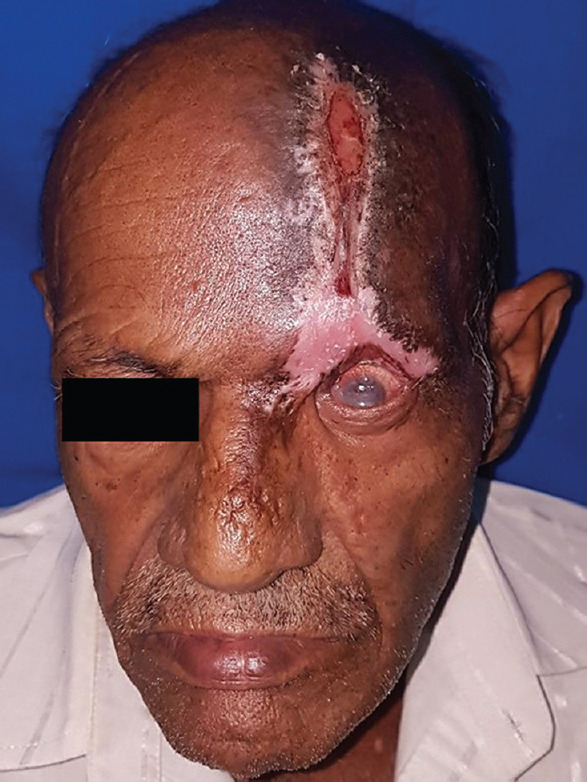
Linear ulcer on the forehead and scarring involving the forehead upper eyelid and left side of the nose
Declaration of patient consent
The authors certify that they have obtained all appropriate patient consent forms. In the form, the patient(s) has/have given his/her/their consent for his/her/their images and other clinical information to be reported in the journal. The patients understand that their names and initials will not be published and due efforts will be made to conceal their identity, but anonymity cannot be guaranteed.
Financial support and sponsorship
Nil.
Conflicts of interest
There are no conflicts of interest.
References
- 1.Gupta LK, Srivastava A, Khare AK, Mittal A, Mehta S, Balai M. Trigeminal trophic syndrome. Indian Dermatol Online J. 2016;7:346–7. doi: 10.4103/2229-5178.185485. [DOI] [PMC free article] [PubMed] [Google Scholar]
- 2.Fredeking AE, Silverman RA. Successful treatment of trigeminal trophic syndrome in a 6-year-old boy with negative pressure wound therapy. Arch Dermatol. 2008;144:984–6. doi: 10.1001/archderm.144.8.984. [DOI] [PubMed] [Google Scholar]
- 3.Lyon CC, Mughal MZ, Muston HL. Herpetic trigeminal trophic syndrome in an infant. J R Soc Med. 2001;94:135–7. doi: 10.1177/014107680109400311. [DOI] [PMC free article] [PubMed] [Google Scholar]
- 4.Khachemoune A, Khan AU. Trigeminal trophic syndrome: An updated review. Int J Dermatol. 2019;58:530–37. doi: 10.1111/ijd.14098. [DOI] [PubMed] [Google Scholar]