



Abstract
Socially assistive robots are being developed and tested to support social interactions and assist with healthcare needs, including in the context of dementia. These technologies bring their share of situations where moral values and principles can be profoundly questioned. Several aspects of these robots affect human relationships and social behavior, i.e., fundamental aspects of human existence and human flourishing. However, the impact of socially assistive robots on human flourishing is not yet well understood in the current state of the literature. We undertook a scoping review to study the literature on human flourishing as it relates to health uses of socially assistive robots. Searches were conducted between March and July 2021 on the following databases: Ovid MEDLINE, PubMed and PsycINFO. Twenty-eight articles were found and analyzed. Results show that no formal evaluation of the impact of socially assistive robots on human flourishing in the context of dementia in any of the articles retained for the literature review although several articles touched on at least one dimension of human flourishing and other related concepts. We submit that participatory methods to evaluate the impact of socially assistive robots on human flourishing could open research to other values at stake, particularly those prioritized by people with dementia which we have less evidence about. Such participatory approaches to human flourishing are congruent with empowerment theory.
Keywords: Dementia, Socially assistive robots, Human flourishing, Artificial intelligence, Ethics
Introduction
Socially assistive robots are being developed and tested to support social interactions and assist with healthcare needs (See Box below for more details on socially assistive robots). These robots could play a variety of roles such as “(a) changing how the person is perceived, (b) enhancing the social behavior of the person, (c) modifying the social behavior of others, (d) providing structure for interactions, and (e) changing how the person feels” [1]. Clinical tools based on artificial intelligence (AI) such as some socially assistive robots made available to patients with dementia have many proven and possible benefits such as providing help with the accomplishment of daily tasks [2] and support for social relations and communication [3]. In a horizon of 5, 10 and 15 years, it is possible to think that this type of technology will be able to significantly support people suffering from neurodegenerative diseases, especially diseases that lead to losses of cognitive and communicational functions [4, 5]. These technologies bring their share of situations where questions regarding key aspects of human wellbeing such as relationships and autonomy are raised. For example, does a robot that talks and interacts with a dementia patient represent an inauthentic relationship based on lying? Can the delegation of dementia management to the robot create a form of social isolation of the person with dementia by reducing human contact with caregivers and family members? Thus, important ethical issues need to be addressed for a responsible development of the use of socially assistive robots in the field of health, including their impact on human flourishing (aka eudaimonia)—a concept that refers to the overall existential well-being of individuals and is highly correlated with both physical and psychological health [6].
The impact of socially assistive robots on human flourishing is not yet well understood in the current state of the literature. Several aspects of these robots affect human relationships and social behavior, i.e., fundamental aspects of human existence. Moreover, the concept of human flourishing emphasizes that living with dementia can be part of a life trajectory and generate meaning for the person and those around them [7]. Without denying the challenges created by this condition, this concept reflects an orientation towards self-actualization and respect of the person with dementia. However, the concept of flourishing can easily become normative, narrow, and directive based on specific understandings of flourishing [8, 9]. Thus, this concept should be envisioned openly in order to understand what represents the interest and preferences of a person with dementia. In fact, this concept may at first appear paradoxical in the context of dementia, a condition which is reputed to take away personhood and notably, the thoughts and memories that people with dementia have about themselves and about their loved ones. There are also behavioral changes in dementia, which can drastically change people [10, 11]. Unsurprisingly, the degenerative aspects of dementia can encourage breaches of respect for people through fear, stigma and discrimination [12, 13]. However, applying the lens of human flourishing to the context of dementia joins several other clinical approaches to improve care for people with dementia, namely those that promote the recognition of personhood in dementia [14–16]. In particular, the use of participatory methods [14, 17–19] to understand the impact of technologies such as socially assistive robots on human flourishing could be an avenue to explore, in order to expand understandings of human flourishing beyond current theories and scales in persons not suffering from dementia. It is increasingly clear that participatory methods are: (1) useful to develop an open and constructive concept of human flourishing [17] and (2) have proven their validity elsewhere in other contexts such as research on social participation [20]. However, the current state of knowledge suggests significant gaps in our knowledge of the state of relevant research.
Accordingly, this paper has two objectives:
Undertake a scoping review to study the literature on human flourishing as it relates to health uses of socially assistive robots to (1) determine whether methods of assessing the impact of socially assistive robots on human flourishing exist in this context and (2) critically assess their strengths and weaknesses.
And, pending studies examining human flourishing or some of its dimensions:
Critically discuss these findings to assess the relevance of using participatory and deliberative methods to address human flourishing in the context of the use of socially assistive robots in dementia based on (1) general literature on human flourishing in the context of new technology, as well as (2) participatory methods to evaluate the impact of socially assistive robots on human flourishing.
Methodology
We undertook a scoping review [33, 34] to study the literature on human flourishing as it relates to health uses of AI with a focus socially assistive robots in the context of dementia. We used an integrative theoretical framework on human flourishing developed by Ryff and Singer [35] to evaluate and assess the literature following the process established by Lanteigne et al. [17]. We also enriched and adapted this framework to seize other considerations that the addressed well-being and flourishing of people with dementia.
Review Question
Initially, this literature review aimed to (1) ascertain whether methods of assessing the impact of socially assistive robots on human flourishing exist and (2) assess them critically for their strengths and weaknesses with an eye to the eventual value of participatory methods to promote human flourishing. To narrow down the scope of the project and find a suitable clinical context of investigation, several searches were done on different databases to determine what kinds of AI technology exist in healthcare and in which contexts they are used. Subsequently, a decision was made by the authors to focus on socially assistive robots in the context of dementia because of the relevance of socially assistive robots in this clinical context and our ability to broker collaborations to build on this topic. Indeed, given the orientation of this project, we constituted an advisory committee composed of caregivers of persons with dementia and experts in biomedical engineering, ethics, and geriatrics. This advisory committee met twice to provide input on (1) the initial design and orientation of the scoping review and (2) the penultimate version of the manuscript, including advanced background, methods, results and draft discussion points.
Article Search
We conducted our search between March and July 2021 on the following databases: Ovid MEDLINE, PubMed and PsycINFO. Search terms were developed in consultation with a research librarian from Université de Montréal to generate an inclusive initial list of references using very general keywords and keyword combinations: 1- Robotics. 2- Psychology.fs. OR pets/OR animals/OR friends. 3- 1 and 2. 4- AIBO.mp. 5- OR/3–4. 6- Exp Dementia. 7- dement* or Alzheimer*.mp. 8- 6 OR 7. 9- 5 AND 8 (for a total of 68 hits as a result). We used the following keywords on Ovid MEDLINE: ((robotics/AND (psychology.fs OR pets/OR animals/OR friends/)) OR AIBO.mp) AND (Exp dementia/OR (dement* OR Alzheimer*.mp). Since “socially assistive robot” does not constitute an established MeSH keyword, we also searched PubMed and PsycINFO with socially assistive robots + dementia. Using human flourishing as a keyword would have yielded no relevant articles but that would have been an unfair result since many papers discuss important dimensions of flourishing such as autonomy and positive relationships with others. Accordingly, we searched for all relevant publications on socially assistive robots in the context of dementia as described above and manually screened through them to find and extract content relevant to human flourishing. Our searches yielded 109 articles which we imported into Covidence.org. After eliminating duplicates (n = 18), there were 91 articles remaining. These were screened by one member of the team (EF). An initial screening was done based on the relevance of titles and abstracts using the inclusion and exclusion criteria specified below. This yielded a total of 61 articles for the next step. After screening for full-text appraisal, we ended up with 28 articles to include in the review. See Fig. 1 for the PRISMA flow diagram.
Fig. 1.
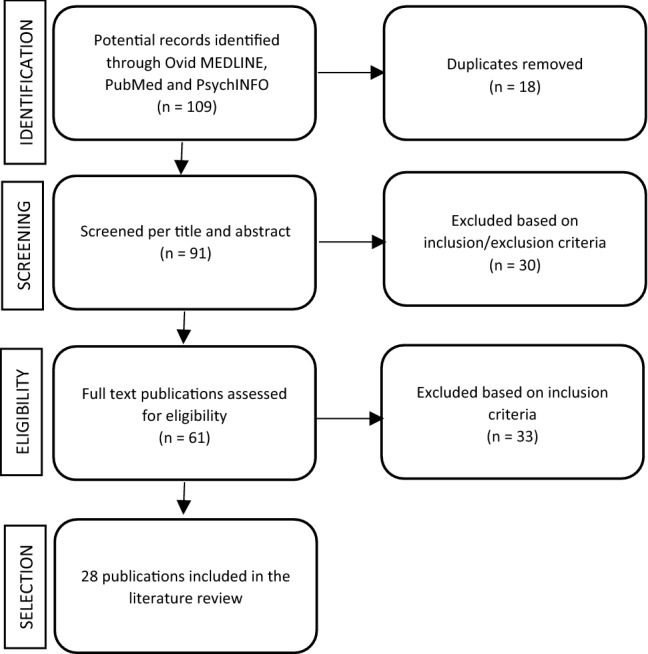
Sampling and screening process for literature review
Inclusion and Exclusion Criteria
To be included, articles had to (1) be published in English or French, (2) concern socially assistive robots, (3) discuss a socially assistive technology involving AI since this is partly the focus of this review (see Box 1), (4) in the context of dementia. We focused our data extraction on qualitative studies because most quantitative studies did not report meaningful data that addressed human flourishing. This yielded a fifth criterion: (5) feature qualitative results. We further excluded opinion papers, open letters, research notes and case reviews.
Data Extraction
Each article was analyzed to extract the following information: (1) author and affiliations, (2) type of socially assistive technology, (3) objectives of the study, (4) study design, (5) methods, (6) content related to human flourishing, (7) participatory nature of the study, (8) sample size, (9) context of the study, (10) main outcomes, (11) main conclusions, and (12) main limitations of the study. Items 1–5 and 7–12 were mainly extracted based on the abstract and complemented with consultation of the full manuscript when needed; items 6 and 7 which are central to this review were extracted based on the analysis of the manuscript. In the tables, content is pasted from original papers with little or very minor changes.
Data Synthesis
Descriptive statistics for simple categories (items 1–5 and 7–12 above) were synthesized in text and tables. Then, we analyzed all the articles to see if there was information relating to human flourishing (item 6), whether falling directly into one of Ryff’s categories (the six dimensions) or pertaining to these dimensions or the concept of human flourishing indirectly and in a larger sense. Components did not have to be explicitly mentioned as a dimension of human flourishing, as we used Ryff and Singer’s framework more liberally considering that no articles used this theory directly. See Table 1 for indications about human flourishing. To standardize the writing and emphasize the role of people with dementia, we have standardized the description of users of socially assistive robots as users or people with dementia (as person-first language) but the terms participants, subjects, and patients were often used.
Table 1.
Dimensions of human flourishing following ryff and singer
| Dimensions of human flourishing | Illustrations of content included (how socially assistive robots contributed to) |
|---|---|
| Self-acceptance: This dimension of flourishing consists in a long-term self-assessment involving a certain level of self-awareness, with the intention of accepting one's own strengths and weaknesses, beyond mere self-esteem. Maintaining a positive attitude towards oneself is a central characteristic of personal maturity and optimal psychological functioning |
Acceptance of health condition Patient’s confidence |
| Positive relations with others: This dimension is related to the capacity for affection, empathy, friendship, and love towards other human beings. These abilities are indicative of good psychological health. Theories about the stages of adult psychosocial development also emphasize the achievement of unions with others (intimacy) and the concern for contribution to society (generativity) |
Improving communication and social engagement Companionship and reduction of loneliness Building community between patients, care givers and families |
| Personal growth: This dimension is the closest to the meaning of Aristotle's Eudaimonia since it explicitly includes the idea of individual self-realization. Personal growth is a continuous process of developing one’s own potential as a human being. Openness to experience, for example, is characteristic of a flourishing person |
Emotional intelligence Enhancing mood Reducing medication dosage |
| Purpose in life: This dimension refers to having goals, intentions, and a sense of direction in one’s own life. Mental health is defined as comprising healthy beliefs that there is a purpose and a meaning to life. Theories of development refer to a variety of changing goals, associated, for example, with productivity and creativity or the achievement of some emotional integration |
Sense of belonging Having something to take care of/look for Sense of responsibility Meaningful pursuits |
| Environmental mastery: This dimension is defined by the management of complex environments through mental or physical activities, in other words, having the ability to act. An individual’s ability to choose or create environments suited to one’s mental conditions is a characteristic of mental health. Maturity also requires participation in a sphere of activity outside oneself. Successful aging is associated with an individual's ability to seize the opportunities of their environment |
Safety (risk prevention, emergency assistance, avoid danger) Comfort Adaptation to environment |
| Autonomy: This dimension revolves around the notions of independence, self-determination, and behavior regulation. A flourishing person is described as having an internal locus of assessment, against which they assess themselves according to personal standards, and do not turn solely to others for approval |
Helping with daily activities and schedule Serving as a mobility aid Increasing independence Upholding patient’s choices and rights |
Table adapted from Lanteigne et al. [17]
Results
Basic Sample Characteristics
Our searches yielded 28 papers published from 2013 to 2019. Studies were mostly from Western European countries [United Kingdom (3), France (2), Norway (1), Sweden (1), Ireland (1), Spain (1), Italy (2), Switzerland (2), Austria (1)], as well as from North America [Canada (3), USA (3), Mexico (1)] and Oceania [Australia (5), New Zealand (2)] (see Table 2). Different socially assistive robots were investigated, the most frequent being PARO, a plush seal [36–45]. Other robots studied were MARIO [46], NAO [47] and JustoCat [48] (See Table 2). These robots are conceived specifically to therapeutically assist users by enhancing their social abilities and be of service in their day-to-day activities. Some, like NAO and MARIO, have more humanoid characteristics, while others are meant to look like animals (PARO and JustoCat).
Table 2.
Basic features and content of sampled literature*
| Author(s) Title Year |
Journal From where? Type of robot |
Objective | Study design | Method | Sample |
|---|---|---|---|---|---|
|
Moyle W, Bramble M, Jones C, Murfield J Care staff perceptions of a social robot called PARO and a look-alike Plush Toy: a descriptive qualitative approach 2018 |
Aging Ment Health Australia PARO |
To explore care staff perceptions of PARO and a look-alike non-robotic animal, including benefits and limitations in dementia care | Qualitative study |
A descriptive qualitative approach, nested within a large cluster-randomized controlled trial Interviewed a subsample of 20 facility care staff, from nine long-term care facilities Thematic analysis of the data, which was inductive and data-driven, undertaken with the assistance of the qualitative software, ATLAS.ti® |
Ten staff from each PARO and plush toy condition |
|
Zuschnegg J, Paletta L, Fellner M, Steiner J, Pansy-Resch S, Jos A, Koini M, Prodromou D, Halfens RJG, Lohrmann C, Schüssler S Humanoid socially assistive robots in dementia care: a qualitative study about expectations of caregivers and dementia trainers 2021 |
Aging Ment Health Austria Humanoid socially assistive robots (HSAR) |
To examine the expectations of informal caregivers, nurses, and dementia trainers regarding the support of (physical and psychosocial) human needs by humanoid social assistive robots in dementia care | Qualitative study |
Study conducted with 11 homogeneous focus groups of informal caregivers, nurses and dementia trainers providing dementia care at home, in adult daycare centers, or in nursing homes A qualitative content analysis was performed using a concept- and data-driven coding frame |
52 participants |
|
Moyle W, Jones C, Murfield J, Thalib L, Beattie E, Shum D, Draper B Using a therapeutic companion robot for dementia symptoms in long-term care: reflections from a cluster-randomised controlled trial 2019 |
Aging Ment Health Australia PARO |
To present issues that can inform the planning and delivery of psychosocial interventions with PARO in real long-term care settings, as well as future research endeavors into PARO’s effectiveness |
A descriptive, qualitative design of a cluster-randomized controlled trial | A descriptive, qualitative design was employed, with participants selected from the PARO intervention arm of the cluster-randomized controlled trial to permit critical reflection and discussion of individual responses to PARO during the 10-week trial, with a view to informing clinical practice and future research | 5 participants |
|
Law M, Sutherland C, Ahn HS, MacDonald BA, Peri K, Johanson DL, Vajsakovic DS, Kerse N, Broadbent E Developing assistive robots for people with mild cognitive impairment and mild dementia: a qualitative study with older adults and experts in aged care 2019 |
BMJ Open New Zealand Silbot robot |
To investigate the perceived usefulness of different daily-care activities for the robot, developed from previous research on needs | Qualitative study |
Qualitative descriptive analysis using semi-structured interviews Two studies were conducted (a) In the first study, participants watched videos of a prototype robot performing daily-care activities; (b) in the second study, participants interacted with the robot itself |
In study 1, participants were nine experts in aged care and nine older adults living in an elderly care facility In study 2, participants were 10 experts in elderly care observing 5 patients |
|
Wangmo T, Lipps M, Kressig RW, Ienca M Ethical concerns with the use of intelligent assistive technology: findings from a qualitative study with professional stakeholders 2019 |
BMC Med Ethics Switzerland Intelligent assistive technology |
To explore and assess the ethical issues that professional stakeholders perceive in the development and use of intelligent assistive technologies in elderly and dementia care | Qualitative study |
Conducted a multi-site study involving semi-structured qualitative interviews with researchers and health professionals Analyzed the interview data using a descriptive thematic analysis to inductively explore relevant ethical challenges |
20 participants |
|
Casey D, Barrett E, Kovacic T, Sancarlo D, Ricciardi F, Murphy K, Koumpis A, Santorelli A, Gallagher N, Whelan S The perceptions of people with dementia and key stakeholders regarding the use and impact of the social robot MARIO 2020 |
Int J Environ Res Public Health Uk, Italy and Ireland MARIO |
To explore the use of the social robot, MARIO, with older people living with dementia as a way of addressing these issues | Descriptive qualitative study |
Semi-structured interviews were held in each location with people with dementia, relatives/carers, formal carers and managers The data were analyzed using qualitative content analysis |
38 participants with dementia, 28 relatives/carers, 28 formal carers and 13 managers |
|
Moyle W, Bramble M, Jones CJ, Murfield JE "She had a smile on her face as wide as the great Australian bite": a qualitative examination of family perceptions of a therapeutic robot and a plush toy 2019 |
Gerontologist Australia PARO and Plush toy |
To explore family members' perceptions of PARO, and a look-alike, nonrobotic plush toy, when used by their relative with dementia | Descriptive qualitative approach, nested within a larger cluster randomized controlled trial |
Convenience sample of 20 family members with relatives in 9 long-term care facilities completed individual semi-structured interviews (telephone or face-to-face) Inductive, data-driven thematic analysis of the data was undertaken with the assistance of the qualitative management software, ATLAS.ti® |
20 family members, 10 each from the PARO and plush toy conditions, with relatives in 9 long-term care facilities |
|
Abbott R, Orr N, McGill P, Whear R, Bethel A, Garside R, Stein K, Thompson-Coon J How do "robopets" impact the health and well-being of residents in care homes? A systematic review of qualitative and quantitative evidence 2019 |
Int J Older People Nurs UK Robopets |
To bring together the evidence of the experiences of staff, residents and family members of interacting with robopets and the effects of robopets on the health and well-being of older people living in care homes | Systematic review of qualitative and quantitative research |
Study selection was undertaken independently by two reviewers Used the Wallace criteria and the Cochrane Risk of Bias tool to assess the quality of the evidence Developed a logic model with stakeholders and used this as a framework to guide data extraction and synthesis Where appropriate, used meta-analysis to combine effect estimates from quantitative studies |
19 studies: 10 qualitative, 2 mixed methods and 7 randomized trials |
|
Pu L, Moyle W, Jones C How people with dementia perceive a therapeutic robot called PARO in relation to their pain and mood: a qualitative study 2020 |
J Clin Nurs Australia PARO |
To explore how people with mild to moderate dementia and chronic pain perceive PARO as an alternative intervention to manage their pain and mood | Descriptive qualitative approach nested within a pilot randomized controlled trial |
Participants with dementia and chronic pain were recruited from three residential aged care facilities Participants interacted with PARO for 30 min, 5 days a week over a 6-week period A sample of 11 participants completed individual semi-structured interviews at the end of the intervention Inductive thematic analysis was undertaken Reporting of findings followed the consolidated criteria for reporting qualitative research checklist |
11 participants with dementia and chronic pain |
|
Jøranson N, Pedersen I, Rokstad AM, Ihlebaek C Change in quality of life in older people with dementia participating in PARO-activity: a cluster-randomized controlled trial 2016 |
J Adv Nurs Norway PARO |
To investigate effects of robot-assisted group activity with PARO on quality of life in older people with dementia | A cluster-randomized controlled trial |
27 participants participated in group activity for 30 min twice a week over 12 weeks, 26 participated in the control group Change in quality of life was assessed by local nurses through the Quality of Life in Late-Stage Dementia scale at baseline, after end of intervention and at 3 months follow-up The scale and regular psychotropic medication were analyzed stratified by dementia severity Analysis using mixed model, one-way ANOVA and linear regression were performed |
27 participants |
|
Lane GW, Noronha D, Rivera A, Craig K, Yee C, Mills B, Villanueva E Effectiveness of a social robot, "PARO," in a VA long-term care setting 2016 |
Psychol Serv California PARO |
To conduct research in the veteran population since studies have been mostly about older adults only | Pilot study |
Clinical staff, including nursing, recreation therapy, and occupational therapy staff, were encouraged to observe and tabulate behavioral observations of veterans across three time periods First was pretreatment, which was approximately 1 h prior to introduction of the device The second was active treatment, when veteran was being actively presented with or was observed to be actively using PARO The third was post treatment, which was considered to be approximately 1 to 2 h postwithdrawal of PARO |
23 veteran residents of a Veterans Affairs geropsychiatric long-term care facility |
|
Kang HS, Makimoto K, Konno R, Koh IS Review of outcome measures in PARO robot intervention studies for dementia care 2020 |
Geriatr Nurs South Korea PARO |
To describe interventions for PARO, as well as the outcomes evaluated and found following use of PARO, and to identify outcome measures in PARO intervention studies for older adults with dementia | Systematic review |
Multiple databases (Web of Science, PubMed, Cumulative Index to Nursing and Allied Health Literature, EMBASE, Cochrane, and Scopus) were searched and eight studies were included in the systematic review Data from the eight studies were extracted using a table based on population, intervention, comparator, and outcomes After data collection, each measure was classified into one of the verified outcomes |
8 studies |
|
Cruz-Sandoval D, Favela J Incorporating conversational strategies in a social robot to interact with people with dementia 2019 |
Dement Geriatr Cogn Disord Mexico Socially assistive robots (SAR) |
To assess the effectiveness of incorporating conversational strategies proposed in the literature for caregivers, during person with dementia-robot interactions |
Experimental protocols Single subject research designs/simple observational studies without a control group. Used an AB design |
Conducted a total of 23 group sessions based on music and conversation therapy, where a socially assistive robot interacted with 12 persons with dementia (mean = 80.25 years) diagnosed with mild to moderate-stage dementia Using a single subject research approach, developed an AB study to assess the effectiveness of the conversational strategies in the persons with dementia-robot interaction Analysis focuses on the direct communication between the people with dementia and the robot, and the perceived enjoyment of persons with dementia |
12 participants aged between 71 and 90 years diagnosed with dementia |
|
Russo A, D'Onofrio G, Gangemi A, Giuliani F, Mongiovi M, Ricciardi F, Greco F, Cavallo F, Dario P, Sancarlo D, Presutti V, Greco A Dialogue systems and conversational agents for patients with dementia: the human–robot interaction 2019 |
Rejuvenation Res Italy Conversational Agents: Chatterbots and Dialogue Systems |
To identify and describe the fundamental characteristics of spoken dialogue systems, and their role in supporting human–robot interaction and enabling the communication between socially assistive robots and patients with dementia | Systematic review |
A keyword-based search strategy defined to identify relevant studies through Google Scholar and accessing the SpringerLink digital library, the IEEE408 Xplore Digital Library, the ACM Digital Library and PubMed 12 articles were selected for the review |
12 articles |
|
Mordoch E, Osterreicher A, Guse L, Roger K, Thompson G Use of social commitment robots in the care of elderly people with dementia: a literature review 2013 |
Maturitas Canada Commitment robots |
To discuss the literature on the use of social commitment robots in the care of elderly people with dementia; the contributions to care that social commitment robots potentially can make and the cautions around their use | Systematic review |
Literature searches for this review were conducted in March, April and May 2012 using databases: PubMed, CINHAL, Ageline, Embase, Scopus, EI Engineering Village, PsychINFO, Cochrane Library, Web of Science, and Google Scholar A total of 21 articles were used in the review |
10 journal articles and 11 proceedings citations |
|
Chu MT, Khosla R, Khaksar SM, Nguyen K Service innovation through social robot engagement to improve dementia care quality 2017 |
Assist Technol Australia Social robots |
To show how the engagement between two social robots and people with dementia in Australian residential care facilities can improve care quality | Observational study |
Observational method adopted to discover behavioral patterns during interactions between robots and persons with dementia Observational study undertaken to explore the improvement arising from: (1) Approaching social baby-face robots, (2) Experiencing pleasure engaging with the robots, (3) Interacting with the robots (4) Interacting with others |
139 participants aged 65–90 years, who suffer from differing levels of dementia |
|
Ienca M, Wangmo T, Jotterand F, Kressig RW, Elger B Ethical design of intelligent assistive technologies for dementia: a descriptive review 2018 |
Sci Eng Ethics Switzerland Intelligent Assistive Technology |
To review the spectrum of intelligent assistive technologies for dementia and investigates the prevalence of ethical considerations in the design of current intelligent assistive technologies | Descriptive review/Systematic literature review |
A systematic literature review performed to retrieve a comprehensive and the up-to-date list of intelligent assistive technologies with application to dementia care Three steps of filtering were performed (Prisma criteria) An in-depth review of full-text articles included in the synthesis |
539 articles |
|
Obayashi K, Kodate N, Masuyama S Measuring the impact of age, gender and dementia on communication-robot interventions in residential care homes 2020 |
Geriatr Gerontol Int Japan Com-robots |
To examine the impact of age, gender and the stage of dementia on the results of an assistive technology intervention that make use of communication robots (com-robots) | Non-randomized, multicenter quasi-experimental intervention study |
Conducted in residential care homes in Japan, two types of com-robots were introduced for 8 weeks after baseline evaluation The World Health Organization's International Classification of Functioning was used for evaluating any changes present after the 8-week intervention The Degree of Daily Life Independence Score for People with Dementia was employed for measuring the stage of dementia |
78 residents: 68 women, 10 men |
|
Arthanat S, Begum M, Gu T, LaRoche DP, Xu D, Zhang N Caregiver perspectives on a smart home-based socially assistive robot for individuals with Alzheimer's disease and related dementia 2020 |
Disabil Rehabil Assist Technol USA Socially assistive robots (SAR) |
To beta-test a novel socially assistive robot with a cohort of Alzheimer's disease and related dementia caregivers and gather their perspectives on its potential integration in the home context | Study protocol conducted using a grounded theory qualitative approach |
Eight caregivers observed the socially assistive robot perform in two care protocols concerning the care recipient's daily routine and home safety, and then participated in a focus group and phone interview The researchers used grounded theory and the Unified Theory of Acceptance and Use of Technology as a framework to gather and analyse the data |
8 caregivers: 2 men and 6 women Four of the female caregivers cared for their husbands, and the other two were caregivers for their mother and father respectively. The two male caregivers cared for their wives. Five caregivers lived with their care recipients and three resided separately. The average age of the care recipients was 78.5 (ranging from 59 to 98). Seven of them were reported to have Alzheimer’s disease and one had Lewy body dementia |
|
Góngora Alonso S, Hamrioui S, de la Torre Díez I, Motta Cruz E, López-Coronado M, Franco M Social robots for people with aging and dementia: a systematic review of literature 2019 |
Telemed J E Health Spain PARO |
To review existing research in the literature, referring to the use of social robots for people with dementia and/or aging | Systematic review of literature |
Academic databases that were used to perform the searches are IEEE Xplore, PubMed, Science Direct, and Google Scholar, taking into account as date of publication the last 10 years, from 2007 to the present Selection process of the articles was done by reading the titles and abstracts and were classified by reading the whole article as well when required Analysis was done to see which gave rise to relevant contributions |
38 articles |
|
Pino M, Boulay M, Jouen F, Rigaud AS "Are we ready for robots that care for us?" Attitudes and opinions of older adults toward socially assistive robots 2015 |
Front Aging Neurosci France Socially assistive robots (SAR) |
To investigate SAR acceptance among three groups of older adults living in the community: persons with Mild Cognitive Impairment, informal caregivers of persons with dementia, and healthy older adults | A mixed-method approach, including a short self-administered questionnaire and a series of focus groups, was used for data collection and analysis |
Participants completed a survey and took part in a focus group A functional robot prototype, a multimedia presentation, and some use-case scenarios provided a base for the discussion Content analysis was carried out based on recorded material from focus groups |
25 participants |
|
Scoglio AA, Reilly ED, Gorman JA, Drebing CE Use of social robots in mental health and well-being research: systematic review 2019 |
Med Internet Res USA Socially assistive robots (SAR) |
To synthesize and describe the nascent empirical literature of SARs in mental health research and identifies strengths, weaknesses, and opportunities for improvement in future research and practice | Systematic review of literature |
Searches in Medline, PsycINFO, PsycARTICLES, PubMed, and IEEE Xplore yielded 12 studies included in the final review after applying inclusion and exclusion criteria Included studies had to report on one or more mental health or psychological well-being outcomes with data collected to measure the robot’s possible relationship with the mood, psychological welfare, or comfort of users |
12 studies |
|
Robaczewski A, Bouchard J, Bouchard K et al Socially assistive robots: The specific case of the NAO 2021 |
Int J of Soc Robotics Canada NAO |
To gather every research that has been done using this robot to see how the NAO can be used and what could be its potential as a social assistive robot | Systematic review |
Articles using the NAO in any situation were found searching PSYCHINFO, Computer & Applied Sciences Complete and ACM Digital Library databases To synthesize the information found, groups were made according to the general theme and population with which the robot was used These categories were decided retrospectively because they offer the better classification system to what was presented in the articles |
51 publications |
|
Gustafsson C, Svanberg C, Müllersdorf M Using a robotic cat in dementia care: a pilot study 2015 |
J Gerontol Nurs Sweden JustoCat |
To explore reactions of individuals with dementia to an interactive robotic cat and their relatives' and professional caregivers' experiences, and to measure usability in developing the care/treatment of individuals with dementia using interactive robotic pets | Pilot study |
An intervention design in a pilot study using mixed methods was conducted in two stages: (a) a quantitative single-case study and (b) a qualitative interview study |
4 quantitative single-case study and 14 qualitative interview study |
|
Darragh M, Ahn HS, MacDonald B, Liang A, Peri K, Kerse N, Broadbent E Homecare robots to improve health and well-being in mild cognitive impairment and early stage dementia: results from a scoping study 2017 |
J Am Med Dir Assoc New Zealand Homecare robot |
To be the first step of a multiphase, international project aimed at designing a homecare robot that can provide functional support, track physical and psychological well-being, and deliver therapeutic intervention specifically for individuals with mild cognitive impairment | Observational requirements gathering study |
Semi-structured interviews (30–60 min) were conducted with 3 participant groups: (1) individuals with memory challenges, mild cognitive impairment, or mild dementia; (2) carers of those with mild cognitive impairment or dementia; and (3) those with expertise in mild cognitive impairment or dementia research, clinical care, or management All participants were asked a similar set of questions, regarding patient needs and how a homecare robot could assist in 4 areas: (1) daily challenges; (2) safety and security; (3) health and well-being; (4) therapeutic intervention |
3 participant groups: 9 individuals with memory challenges, mild cognitive impairment, or mild dementia, 8 carers of those with mild cognitive impairment or dementia, 16 with expertise in mild cognitive impairment or dementia research, clinical care, or management |
|
Demange M, Lenoir H, Pino M, Cantegreil-Kallen I, Rigaud AS, Cristancho-Lacroix V Improving well-being in patients with major neurodegenerative disorders: Differential efficacy of brief social robot-based intervention for 3 neuropsychiatric profiles 2018 |
Clin Interv Aging France PARO |
To examine the impact of short exposure to PARO on the subjective emotional well-being of patients with major neurocognitive disorder as well as its impact on differential effects for 3 behavioral and psychological symptoms of dementia profiles | Pilot Study |
Seventeen patients with major neurocognitive disorder with apathy, depression, and agitation were recruited The intervention was composed of four 15-min individual sessions Exposure occurred without the simultaneous presence of a health care provider A pre-post assessment of emotional well-being was conducted with the International Positive and Negative Affect Schedule Short-Form, which measures positive and negative affectivity |
17 patients with major neurocognitive disorders: 6 with apathy, 7 with depression, and 4 with agitation |
|
Hung L, Liu C, Woldum E, Au-Yeung A, Berndt A, Wallsworth C, Horne N, Gregorio M, Mann J, Chaudhury H The benefits of and barriers to using a social robot PARO in care settings: a scoping review 2019 |
BMC Geriatr Canada PARO |
To map out the empirical evidence on the key benefits of PARO, and to identify barriers that may impede the adoption of this social robot | Scoping review |
Scientific databases and Google Scholar were searched to identify publications published since 2000 The inclusion criteria consisted of older people with dementia, care setting, and social robot PARO The questions guiding this review were: (a) What has been reported in the literature regarding the benefits of PARO in dementia care? (b) What are the barriers to adopting PARO in the care setting? |
29 papers |
|
Bradwell HL, Edwards KJ, Winnington R, Thill S, Jones RB Companion robots for older people: importance of user-centred design demonstrated through observations and focus groups comparing preferences of older people and roboticists in South West England 2019 |
BMJ Open South West England Animal companion robots |
To assess the importance of user-centered design by comparing companion robot design perceptions between older people (end users) and roboticists (developers) |
This study was one of many sub-studies forming a doctoral collaborative action research (CAR) project (observational study with focus groups) |
Older people and roboticists interacted with eight companion robots or alternatives at two separate events in groups of two to four people Interactions were recorded, participants' comments and observations were transcribed, and content was analyzed Subsequently, each group participated in focus groups on perceptions of companion robot design Discussions were recorded and transcribed, and content was analyzed |
17 older persons: 5 male, 12 female, ages 60–99, at a supported living retirement complex, and 18 roboticists: 10 male, 8 female, ages 24–37 at a research center away-day |
| Author(s) Title Year |
Context | Main results/outcomes | Main conclusions | Limitations |
|---|---|---|---|---|
|
Moyle W, Bramble M, Jones C, Murfield J Care staff perceptions of a social robot called PARO and a look-alike Plush Toy: a descriptive qualitative approach 2018 |
Most studies have tended to focus on the perspective of the older person rather than staff, and only one known study has compared PARO with a non-robotic plush toy, control-like equivalent (a lion) |
(1) Main findings suggest that staff are willing to adopt PARO as a companion animal within practice because they perceived PARO had many benefits and found it useful and practical for people with dementia to use (2) PARO, like all psychosocial approaches, should not be used as ‘a one size fits all’ approach to care, (this view is supported by the fact that some residents reacted badly to PARO) |
▪ Staff caring for people with dementia preferred PARO compared to a look-alike plush toy ▪ Staff identified that PARO had the potential to improve quality of life for people with dementia, whereas the plush toy had limitations when compared to PARO ▪ However, participants expressed concern that the cost of PARO could reduce opportunities for use within aged care |
The study findings are limited by the generalizability of the findings The inclusion, by chance, of only animal loving staff in the interviews (missing opposite view) Study on a short period |
|
Zuschnegg J, Paletta L, Fellner M, Steiner J, Pansy-Resch S, Jos A, Koini M, Prodromou D, Halfens RJG, Lohrmann C, Schüssler S Humanoid socially assistive robots in dementia care: a qualitative study about expectations of caregivers and dementia trainers 2021 |
Due to disease-specific symptoms, dementia care presents significant challenges, increasing the caregivers’ stress levels and burden With regard to future care, it is also necessary to consider the declining worldwide availability of healthcare professionals like nurses or informal caregivers |
(1) Participants reported mostly positive expectations and stated that socially assistive robots could offer potential support in all components of human needs, especially in avoiding danger (e.g., recognize danger, organize help), communication/contact with others (e.g., enable telephone calls, provide company), daily activities (e.g. remind of appointments, household obligations), recreational activities (e.g., provide music), eating/drinking (e.g., help cook), and mobility/body posture (e.g., give reminders/instructions for physical exercise) (2) Participants also mentioned some negative expectations in all human needs, predominantly in communication/contact with others (e.g., loss of interpersonal interaction) and avoiding danger (e.g., skepticism regarding emergencies) |
▪ Participants stated that socially assistive robots had great potential to provide assistance in dementia care, especially by reminding, motivating/encouraging and instructing people with dementia Informal caregivers and nurses also considered them as useful supportive devices for themselves ▪ However, participants also mentioned negative expectations, especially in communication/contact with others and avoiding danger ▪ The support caregivers and dementia trainers expect from humanoid socially assistive robots and may contribute to their optimization for dementia care |
One focus group was performed with only two participants due to a dropout on short notice of three people One robot was shown as an example of a humanoid socially assistive robot. (could represent a bias by limiting expectations to this specific robot) No focus group with the people concerned (people with dementia/Alzheimer's disease) |
|
Moyle W, Jones C, Murfield J, Thalib L, Beattie E, Shum D, Draper B Using a therapeutic companion robot for dementia symptoms in long-term care: reflections from a cluster-randomised controlled trial 2019 |
Of the many psychosocial interventions available, PARO, a therapeutic pet-type robot modelled on the features of a baby harp seal, has shown potential to ease behavioral and psychological symptoms of dementia in the few, small-scale clinical trials conducted to date |
(1) A person-centered approach to dementia care planning is essential, as different demographic and clinical profiles, unmet needs and interests and likes, can result in very different responses to the same psychosocial intervention (2) Consistent and ongoing monitoring of the person with dementia’s response to any intervention should form a key part of care planning (3) Undertaking any psychosocial intervention in clinical practice or research with a vulnerable population requires a careful benefit/risk assessment and a consideration of possible ethical issues |
▪ That one approach does not fit all, and that there is considerable variation in responses to PARO | Small sample |
|
Law M, Sutherland C, Ahn HS, MacDonald BA, Peri K, Johanson DL, Vajsakovic DS, Kerse N, Broadbent E Developing assistive robots for people with mild cognitive impairment and mild dementia: a qualitative study with older adults and experts in aged care 2019 |
There is little research investigating the use of assistive robots in older adults with mild cognitive impairment or mild dementia in particular. An assistive robot specifically designed for this population could enable people to live at home for longer, as they do not yet need full-time care like patients with full dementia |
(1) The themes that emerged included aspects of the robot’s interactions, potential benefits, the appearance, actions and humanness of the robot, ways to improve its functionality and technical issues (2) Overall, the activities were perceived as useful, especially the reminders and safety checks, with possible benefits of companionship, reassurance and reduced caregiver burden (3) Suggestions included personalizing the robot to each individual, simplifying the language and adding more activities |
▪ The robot was seen to be potentially useful but needs to be tested with people with mild cognitive impairment |
Short time to interact with the robot Lack of participants with cognitive impairment or informal caregivers |
|
Wangmo T, Lipps M, Kressig RW, Ienca M Ethical concerns with the use of intelligent assistive technology: findings from a qualitative study with professional stakeholders 2019 |
The implementation of intelligent assistive technologies has been observed to be sub-optimal due to a number of barriers in the translation of novel applications from the designing labs to the bedside Furthermore, since these technologies are designed to be used by vulnerable individuals with age- and multi-morbidity-related frailty and cognitive disability, they are perceived to raise important ethical challenges, especially when they involve machine intelligence, collect sensitive data or operate in close proximity to the human body |
(1) Findings indicate that professional stakeholders find issues of patient autonomy and informed consent, quality of data management, distributive justice and human contact as ethical priorities (2) Divergences emerged in relation to how these ethical issues are interpreted, how conflicts between different ethical principles are resolved and what solutions should be implemented to overcome current challenge |
▪ That a general agreement among professional stakeholders on the ethical promises and challenges raised by the use of intelligent assistive technologies among older and disabled users ▪ Notable divergences persist regarding how these ethical challenges can be overcome and what strategies should be implemented for the safe and effective implementation of intelligent assistive technologies |
Small number of experts from three different countries with varying health care systems Other ethical issues critical for this field may have remained undiscussed Did not interview end-users or their families |
|
Casey D, Barrett E, Kovacic T, Sancarlo D, Ricciardi F, Murphy K, Koumpis A, Santorelli A, Gallagher N, Whelan S The perceptions of people with dementia and key stakeholders regarding the use and impact of the social robot MARIO 2020 |
People with dementia often experience loneliness and social isolation This can result in increased cognitive decline which, in turn, has a negative impact on quality of life |
(1) The findings revealed that despite challenges in relation to voice recognition and the practicalities of conducting research involving robots in real-life settings, most participants were positive about MARIO (2) Through the robot’s user-led design and personalized applications, MARIO provided a point of interest, social activities, and cognitive engagement increased (3) However, some formal carers and managers voiced concern that robots might replace care staff |
▪ That the social robot MARIO was an accepted part of social care for people with dementia ▪ That social robots may have an important role to play in combatting loneliness, enhancing autonomy and increasing levels of engagement |
Small sample size Given the absence of a fully autonomous robot and the constant presence of the researcher it is difficult to come to categorical conclusions regarding the impact of MARIO |
|
Moyle W, Bramble M, Jones CJ, Murfield JE "She had a smile on her face as wide as the great Australian bite": a qualitative examination of family perceptions of a therapeutic robot and a plush toy 2019 |
Recent years have seen social robotic pets introduced as a means of treating behavioral and psychological symptoms of dementia, and many show promising potential |
(1) Family members of long-term care residents with dementia expressed positive perceptions of PARO, perceiving that it improved mood, reduced agitation, and provided opportunity for communication for their relative (2) Negative perceptions of the plush toy were given by family members, primarily because of its lack of movement and engagement |
▪ Family members were keen for their older relative with dementia to use a social robot that moved and engaged with them; plush toys that were static and unresponsive were perceived as being ineffective in improving quality of life ▪ Current cost of PARO was identified by family members as a major limitation to use |
Small scale study Short interaction period The disappointment expressed by family members about the plush toy may have been exacerbated because of the random allocation of their relatives’ facility to the plush toy group rather than the PARO group Does not feature the opinion of older people or their families |
|
Abbott R, Orr N, McGill P, Whear R, Bethel A, Garside R, Stein K, Thompson-Coon J How do "robopets" impact the health and well-being of residents in care homes? A systematic review of qualitative and quantitative evidence 2019 |
Robotic animals that mimic living animals and respond to human interaction may offer an alternative therapy Robopets are small animal‐like robots which have the appearance and behavioral characteristics of pets |
(1) Interactions with robopets were described as having a positive impact on aspects of well‐being including loneliness, depression and quality of life by residents and staff, although there was no corresponding statistically significant evidence from meta‐analysis for these outcomes (2) Meta‐analysis showed evidence of a reduction in agitation with the robopet “PARO” compared to control (3) Not everyone had a positive experience of robopets |
▪ Engagement with robopets appears to have beneficial effects on the health and well‐being of older adults living in care homes, but not everyone chose to engage ▪ Whether the benefits can be sustained have yet to be investigated |
Many of the quantitative studies were small, of short duration and with no follow‐up measurements Blinding of participants was often not possible Appropriateness of outcome measures (Qualitative research included in the review was generally of higher quality, although few studies were explicitly aligned to a theoretical perspective for their work) |
|
Pu L, Moyle W, Jones C How people with dementia perceive a therapeutic robot called PARO in relation to their pain and mood: a qualitative study 2020 |
Interacting with social robots, such as the robotic seal PARO, has been shown to improve mood and acute pain for people with dementia Little attention has been paid to the effect of PARO on people with dementia and chronic pain |
(1) Residents with dementia expressed positive attitudes towards the use of PARO and acknowledged the therapeutic benefits of PARO on mood improvement and relaxation for pain relief also mentioned the limitations of its weight, voice and characteristics (2) Residents’ responses could also fluctuate during the intervention process, and individual preferences need to be considered |
▪ The PARO intervention is a promising intervention to improve positive emotion, and there is some anecdotal evidence that pain may be decreased from the perspectives of people living with chronic pain and dementia |
Small sample Not feasible to undertake member checks with people with dementia (but study involved at least two researchers in the data analysis to enhance the analytic findings) The short duration of interviews |
|
Jøranson N, Pedersen I, Rokstad AM, Ihlebaek C Change in quality of life in older people with dementia participating in PARO-activity: a cluster-randomized controlled trial 2016 |
There is restricted knowledge of effects on robot-assisted activity on quality of life Few intervention studies measure quality of life with assessment scales There is a lack of robust design with follow-up measures in studies with robot-assisted interventions |
(1) An effect was found among participants with severe dementia from baseline to follow-up showing stable quality of life in the intervention group compared with a decrease in the control group (2) The intervention explained most of the variance in change in the total scale and in the subscales describing Tension and Well-being for the group with severe dementia (3) The intervention group used significantly less psychotropic medication compared with the control group after end of intervention |
▪ Pleasant and engaging activities facilitated by nursing staff, such as group activity with PARO, could improve quality of life in people with severe dementia |
Small sample size Blinding assessors or participants is not possible in this kind of trial |
|
Lane GW, Noronha D, Rivera A, Craig K, Yee C, Mills B, Villanueva E Effectiveness of a social robot, "PARO," in a VA long-term care setting 2016 |
Advances in the field of social robotics have provided a promising route to deliver animal assisted interventions while avoiding these acceptance obstacles. Although there has been promising initial research on social robotics in older adults, to date there has been no such research conducted with a veteran population |
(1) PARO both reduces negative behavior and mood states and induces increases in indicators of positive states (2) It seems easier to elicit increases in positive mood and behavioral observations via use of PARO versus decreasing negative ones (3) PARO is not particularly useful when offered to a veteran in acute distress or in the midst of a catastrophic reaction, but instead it’s recommended to use PARO for veterans suffering from chronic issues with behavior or mood challenges at the time they are relatively calm and approachable |
▪ PARO is likely an effective nonpharmacological approach for managing dementia-related mood and behavior problems with veterans in VA long term care facilities ▪ PARO is best presented to residents who are relatively calm and approachable, as opposed to actively exhibiting behavior or mood problems |
Inability to distinguish the effects of staff attention from effects of PARO Study was unblinded Samples collected from our population of users may be systematically biased by issues such as observer bias or selection bias |
|
Kang HS, Makimoto K, Konno R, Koh IS Review of outcome measures in PARO robot intervention studies for dementia care 2020 |
Among the variety of social robots available worldwide, PARO is considered the best known and most therapeutic. However, there are gaps in the literature that require further consideration for the development of core parameters for the standardized reporting of effectiveness and comparison of outcomes across studies |
(1) When planning PARO interventions, intervention types (individual or group), group size, and session duration should be considered because of their possible impacts on outcomes (2) There is a strong need for a standardized training protocol for both proxy observation and facilitator for evaluating the effectiveness of PARO intervention (3) Quality of life could be an appropriate indicator to assess the effects of interventions using the PARO robot |
▪ Interventions using PARO can be beneficial for improving quality of life, affect, social interaction, and reducing neuropsychiatric symptoms and psychotropic or pain medication use | Only randomized controlled trials that used PARO, and were published in English and Japanese, were included |
|
Cruz-Sandoval D, Favela J Incorporating conversational strategies in a social robot to interact with people with dementia 2019 |
Establishing verbal communication with a person with dementia is challenging. Thus, several authors have proposed strategies to converse with persons with dementia While these strategies have proved effective at enhancing communication between persons with dementia and their caregivers, they have not been used or tested in the domain of human–robot interaction |
(1) The number of utterances made from a person with dementia to the robot increased significantly when the conversational strategies were included in the robot (2) Persons with dementia engaged in more sustained conversations (3) Persons with dementia enjoyed conversing with the robot Eva, as much as listening to music (4) Results indicate that the use of these conversational strategies is effective at increasing the interaction between person with dementia and a socially assistive robot |
▪ Persons with dementia who participated in the study engaged and enjoyed the interaction with the socially assistive robot ▪ There is evidence of the importance of incorporating appropriate conversational strategies in socially assistive robots that support interventions for the care and social stimulation of persons with dementia |
Results cannot be generalized to all dementia patients |
|
Russo A, D'Onofrio G, Gangemi A, Giuliani F, Mongiovi M, Ricciardi F, Greco F, Cavallo F, Dario P, Sancarlo D, Presutti V, Greco A Dialogue systems and conversational agents for patients with dementia: the human–robot interaction 2019 |
While the overview of spoken dialogue systems relies on existing surveys and reviews, research was conducted to identify existing works in the literature that have investigated the role of conversational agents and dialogue systems for the elderly and people with cognitive impairments |
(1) Explicit confirmation dialogues are an important aspect of the dialogue strategy, and better results are achieved when limited amount of information is presented for confirmation (2) There is a significant difference between the vocabulary used by elderly and those used by non-elderly adults (and used to configure the dialogue system) (3) Some differences were also observed regarding the syntactic structure of the utterances |
▪ The ability of a dialogue system to respond to user needs affects the perceived social abilities of the robot and has thus an impact on the acceptance by the users ▪ The ability of a social robot to convey emotions through the produced speech is still an open research challenge, where further efforts are necessary with multidisciplinary contributions towards socially assistive robots |
None reported |
|
Mordoch E, Osterreicher A, Guse L, Roger K, Thompson G Use of social commitment robots in the care of elderly people with dementia: a literature review 2013 |
A key challenge in dementia care is to assist the person to sustain communication and connection to family, caregivers and the environment The use of social commitment robots in the care of people with dementia has intriguing possibilities to address some of these care needs |
(1) There is emerging evidence that therapeutic robotics are useful in engaging people to interact with each other, producing a calming effect, and providing companionship, motivation and enjoyment (2) There is a need for increased publications in peer reviewed academic journals |
▪ Social assistive robots may provide important and feasible alternatives to some of the care demands ▪ These alternatives must be balanced with cautions to provide quality human contact in this care and to not unnecessarily dilute the important aspect of human compassion in the care of vulnerable populations |
None reported |
|
Chu MT, Khosla R, Khaksar SM, Nguyen K Service innovation through social robot engagement to improve dementia care quality 2017 |
Assistive technologies, such as robots, have proven to be useful in a social context and to improve the quality of life for persons with dementia |
(1) Social robots can improve diversion therapy service value to person with dementia through sensory enrichment, positive social engagement, and entertainment (2) There are several significant and positive effects of using a social robot in group-based activities (3) Social robots are capable of generating positive reactions from persons with dementia and can encourage persons with dementia to actively engage with their community in residential aged care facilities |
▪ These innovative social robots can improve the quality of care for people suffering from dementia |
Staff and participants who attended more than one trial, could have become more familiar with the robots over time, promoting more engagement and positive reactions Small sample size This study is conducted by only participants who felt postive towards the robots deployed in our field trials when it would be important to observe the level of acceptance from people who are not originally inclined towards robots |
|
Ienca M, Wangmo T, Jotterand F, Kressig RW, Elger B Ethical design of intelligent assistive technologies for dementia: a descriptive review 2018 |
With current adoption rates being reportedly low, the potential of intelligent assistive technologies might remain under-expressed as long as the reasons for suboptimal adoption remain unaddressed Among these, ethical and social considerations are critical |
(1) A significant portion of current intelligent assistive technologies is designed in the absence of explicit ethical considerations (2) Several intelligent assistive technologies presented multiple considerations (i.e. more than one ethical theme) (3) Among these, autonomy was by far the most frequent family of ethical considerations, followed by non-maleficence and beneficence. In contrast, justice, interdependence and privacy considerations appeared rare |
▪ That the lack of ethical consideration might be a codeterminant of current structural limitations in the translation of intelligent assistive technologies from designing labs to bedside ▪ Calls for a coordinated effort to proactively incorporate ethical considerations early in the design and development of new products |
It is possible that ethical considerations might be addressed at the level of technology design in an implicit manner, i.e. without being reported in the study protocols or without the use of the explicit terminology The absence of ethically relevant considerations might not be exclusive to intelligent assistive technologies for dementia but common to other trends in medical technology |
|
Obayashi K, Kodate N, Masuyama S Measuring the impact of age, gender and dementia on communication-robot interventions in residential care homes 2020 |
Assistive technologies in care settings are increasingly expected to perform a broader set of functions and roles While there are great expectations for robotics-aided care, which encourage and facilitate social participation and interactions of older people, the use of AI-driven Socially Assistive Robots has remained rare |
(1) Older participants aged ≥ 80 benefited more from the intervention than the younger cohort did (2) Greater improvement was shown among those with a more advanced stage of dementia than those at a less advanced stage, when using Daily Life Independence Score for People with Dementia |
▪ Supports the use of com-robots within the context of a care team for older people with moderate dementia, and those who are aged ≥ 80 years |
Small sample size Unbalanced control size Disproportionate number of female participants (These weaknesses are associated with the challenging environment in care homes) |
|
Arthanat S, Begum M, Gu T, LaRoche DP, Xu D, Zhang N Caregiver perspectives on a smart home-based socially assistive robot for individuals with Alzheimer's disease and related dementia 2020 |
Socially assistive robots, an emerging domain of assistive technology, are projected to have a crucial role in supporting aging-in-place of individuals with Alzheimer’s disease and related dementia |
(1) The caregivers asserted the potential of the socially assistive robot to relieve care burden and envisioned it as a next-generation technology for caregivers (2) Adoption of the socially assistive robot, as an identified theme, was subject to the socially assistive robot’s navigability, care recipient engagement, adaptability, humanoid features, and interface design (3) In contrast, barriers leading to potential rejection were technological complexity, system failure, exasperation of burden, and failure to address digital divide |
▪ Success of socially assistive robots as a home-health technology for Alzheimer's disease and related dementia is reliant on the timing of their integration, commercial viability, funding provisions, and their bonding with the care recipient ▪ Long-term research in the home settings is required to verify the usability and impact of socially assistive robots in mediating aging-in-place of individuals with Alzheimer's disease and related dementia |
Both sources of data, the focus group and follow-up interviews, were derived from a single cohort of caregivers (Data from a second cohort of caregivers would have been helpful to corroborate the findings) Participants were recruited through self-selected sampling as opposed to being chosen purposively on specific demographic or caregiving characteristics |
|
Góngora Alonso S, Hamrioui S, de la Torre Díez I, Motta Cruz E, López-Coronado M, Franco M Social robots for people with aging and dementia: a systematic review of literature 2019 |
Social robots are currently a form of assistive technology for the elderly, healthy, or with cognitive impairment, helping to maintain their independence and improve their well-being |
(1) Healthcare robots in general have the potential to help meet the needs identified by staff and relatives for person with dementia in terms of entertainment, stimulation, and calm, improving lives of staff and residents (2) Participants without cognitive impairment have low intention to use the robot (3) Older people with dementia or some cognitive impairment have more positive acceptance of robots (Pleasant and attractive activities with the use of these robots can improve people’s quality of life, can become a beneficial tool in homecare and rehabilitation services, helping older people stay in their homes for longer, can represent an additional means to facilitate social interaction by creating a support network through a collaborative nursing staff or a relative) |
▪ Use of social robots in elderly people without cognitive impairment and with dementia helps in a positive way to work independently in basic activities and mobility, provide security, and reduce stress ▪ Developers must work with social scientists, health professionals, and people user to meet the anticipated needs and help adopt better technologies |
None reported |
|
Pino M, Boulay M, Jouen F, Rigaud AS "Are we ready for robots that care for us?" Attitudes and opinions of older adults toward socially assistive robots 2015 |
Socially Assistive Robots (SAR) may help improve care delivery at home for older adults with cognitive impairment and reduce the burden of informal caregivers. Examining the views of these stakeholders on SAR is fundamental in order to conceive acceptable and useful SAR for dementia care |
(1) An accurate insight of influential factors for SAR acceptance could be gained by combining quantitative and qualitative methods (2) Participants acknowledged the potential benefits of SAR for supporting care at home for individuals with cognitive impairment (3) In all the three groups, intention to use SAR was found to be lower for the present time than that anticipated for the future (4) However, caregivers and persons with mild cognitive impairment had a higher perceived usefulness and intention to use SAR, at the present time, than healthy older adults, confirming that current needs are strongly related to technology acceptance and should influence SAR design |
▪ A key theme is the importance of customizing SAR appearance, services, and social capabilities ▪ Mismatch between needs and solutions offered by the robot, usability factors, and lack of experience with technology, were seen as the most important barriers for SAR adoption |
Participants were not given the opportunity to suggest their own design solutions There was no direct interaction between participants and SAR Small sample size Involved exclusively people from the Paris region whose needs and views on SAR may not reflect the perspectives and needs of older people living in different environments Persons with a clinical diagnosis of dementia were not included in the sample (Although this choice was made to facilitate recruitment and participation in the focus groups, we could have considered adapting user-research methods for involving people with moderate or severe cognitive impairment in the study |
|
Scoglio AA, Reilly ED, Gorman JA, Drebing CE Use of social robots in mental health and well-being research: systematic review 2019 |
To extend and improve on these platforms, the field of robotics has been increasingly included in conversations of how to deliver technology-assisted, interactive, and responsive mental health and psychological well-being interventions However, little is known about the empirical evidence or utility of using SARs in mental health interventions |
(1) There are 5 distinct SARs used in research to investigate the potential for this technology to address mental health and psychological well-being outcomes (2) Research on mental health applications of SARs focuses largely on elderly dementia patients and relies on usability pilot data with methodological limitations |
▪ The current SARs research in mental health use is limited in generalizability, scope, and measurement of psychological outcomes ▪ Opportunities for expansion of research in this area include diversifying populations studied, SARs used, clinical applications, measures used, and settings for those applications |
Generalizability of these findings is limited Many of the studies had very small sample sizes (which also limits the generalizability of findings) Included studies frequently had very brief interventions with simple pre-post study designs. (which might make it difficult to assess differences in pre and post data and preclude conclusions about the efficacy of the interventions) |
|
Robaczewski A, Bouchard J, Bouchard K et al Socially assistive robots: the specific case of the NAO 2021 |
Numerous studies have investigated the development of robotics, especially socially assistive robots, including the NAO robot This small humanoid robot has a great potential in social assistance |
(1) NAO is easy to use, and it can either be a cognitive trainer or a companion (2) The attitude of the participants towards the robot is mainly positive, but this relation can be modified by the technical errors made by the robot (3) As a therapy assistant, results show that the NAO reduced stress and anxiety in a psychological therapy (4) NAO is also effective in enhancing motivation among participants (but long-term studies are needed to clarify this effect) |
▪ NAO robot has a great potential as a socially assistive robot because of its capability to be adaptative and multifunctional ▪ NAO seems to benefit to both the professionals that would use them and to the users who will interact with it |
Categories developed in the review were reported as subjective by the authors. (These categories were decided retrospectively because they offer the better classification system to what was presented in the articles in order to differentiate the different roles of the robot) Some studies could have been classified in more than one category, but the choice was made according to the main outcomes (the reliability of the categories could be questioned) Small sample sizes |
|
Gustafsson C, Svanberg C, Müllersdorf M Using a robotic cat in dementia care: a pilot study 2015 |
Health and social welfare technology innovations aimed at supporting and offering alternative care and treatment for improvements in health or social care should be scrutinized to prove their impact This approach is even more relevant when new care and treatments are developed for vulnerable populations, such as individuals with dementia |
(1) That the robots bring less agitated behavior and better quality of life for individuals with dementia. Interviews showed positive effects by providing increased interaction, communication, stimulation, relaxation, peace, and comfort to individuals with dementia (2) The tested interactive robotic cat was also considered easy to use |
▪ There is an increased need for alternative/complementary forms of care to meet an increasing number of individuals with dementia ▪ For some individuals with dementia, an interactive robot, such as a robotic cat, can increase well-being and quality of life |
Small scale study The results cannot be generalized but are credible if readers recognize descriptions or interpretations as comparable to their own experiences |
|
Darragh M, Ahn HS, MacDonald B, Liang A, Peri K, Kerse N, Broadbent E Homecare robots to improve health and well-being in mild cognitive impairment and early stage dementia: results from a scoping study 2017 |
Although prior research has investigated the needs of those with mild cognitive impairment and mild dementia and how assistive technologies can meet their needs, little research focuses specifically on how robots might assist the mildly cognitively impaired in the home, and as such, this area is relatively underdeveloped |
2 key recommendations: (1) That a homecare robot deliver a comprehensive schedule that both prompts and engages individuals in therapeutic tasks, as well as provide regular reassurance and reminders. (A homecare robot could be programed with the personal activity preferences and level of support appropriate for the individual’s stage of cognitive impairment) (2) The second recommendation, arising mainly from results of the expert interviews, is several health indices that the robot could monitor, like delirium. (Such indices would provide valuable information about the health and well-being of those with mild cognitive impairment) |
▪ A homecare robot could provide both practical and therapeutic benefit for the mildly cognitively impaired with 2 broad programs providing routine and reassurance; and tracking health and well-being |
Small number of patient participants (but previous research has explored patient needs and this study offers some relatively novel contributions from experts regarding the use of homecare robots to improve outcomes in the mildly cognitively impaired) |
|
Demange M, Lenoir H, Pino M, Cantegreil-Kallen I, Rigaud AS, Cristancho-Lacroix V Improving well-being in patients with major neurodegenerative disorders: differential efficacy of brief social robot-based intervention for 3 neuropsychiatric profiles 2018 |
Behavioral and psychological symptoms of dementia affect patients’ daily life and subjective well-being. International recommendations stress nonpharmacological interventions as first-line treatment While newer psychosocial initiatives adapted to geriatric populations based on social robot therapy have emerged, no studies on differential efficacy depending on behavioral and psychological symptoms of dementia profiles have been conducted yet |
(1) A significant increase of positive affectivity (2) That agitated patients reduced negative affectivity significantly more than depressed patients (3) Results also confirmed users’ overall acceptability of the robot |
▪ Support the usefulness of brief interactive sessions with the PARO robot for elderly patients with major neurocognitive disorder ▪ Encourages further research focused on brief interventions using social robotics, as well as on their specific benefits depending on the behavioral typology of patients with neurocognitive disorders |
Small sample sizes Recruitment was based on pragmatic sampling and included mostly women (80%) Some factors that may affect subjective well-being were not controlled The studies assessing behavioral disorders (e.g., screaming, wandering, etc.) seem warranted after a short exposure to PARO. The choice of the International Positive and Negative Affect Schedule Short-Form scale limited the profile of recruited patients (since it demanded that patients be able to understand questions and produce coherent answers) |
|
Hung L, Liu C, Woldum E, Au-Yeung A, Berndt A, Wallsworth C, Horne N, Gregorio M, Mann J, Chaudhury H The benefits of and barriers to using a social robot PARO in care settings: a scoping review 2019 |
Given the complexity of providing dementia care in hospitals, integrating technology into practice is a high challenge and an important opportunity Although there is a growing demand and interest in using social robots in a variety of care settings to support dementia care, little is known about the impacts of the robotics and their application in care settings, i.e., what worked, in which situations, and how |
(1) Main benefits to the use of PARO include: reducing negative emotion and behavioral symptoms, improving social engagement, and promoting positive mood and quality of care experience (2) Key barriers to the use of PARO are: cost and workload, infection concerns, and stigma and ethical issues (3) 3 research gaps: (a) the users’ needs and experiences remain unexplored, (b) few studies investigate the process of how to use the robot effectively to meet clinical needs (c) theory should be used to guide implementation |
▪ Most interventions conducted have been primarily researcher-focused ▪ Future research should pay more attention to the clinical needs of the patient population and develop strategies to overcome barriers to the adoption of PARO in order to maximize patient benefits |
Literature published in other language was not searched Search strategy may have been biased towards health and sciences Searching other technological databases may have yield additional articles Did not contact experts for checking additional articles we may have missed |
|
Bradwell HL, Edwards KJ, Winnington R, Thill S, Jones RB Companion robots for older people: importance of user-centred design demonstrated through observations and focus groups comparing preferences of older people and roboticists in South West England 2019 |
Some authors suggested a growing need for research on maintaining well-being: while supporting physical functioning is often addressed, the psychological health of the ageing population has received less attention. Assistive robotics, whether rehabilitation or social robots, could help in this respect and alleviate some pressure on health and social care resources |
(1) Significant differences in design preferences between older people and roboticists (2) Older people desired soft, furry, interactive animals that were familiar and realistic, while unfamiliar forms were perceived as infantilizing (3) By contrast, most roboticists eschewed familiar and realistic designs, thinking unfamiliar forms better suited older people (4) Older people also expressed desire for features not seen as important by developers (5) A large difference was seen in attitude towards ability to talk. Older people responded positively towards life-simulation features, eye contact, robot personalization and obeying commands, features undervalued by roboticists |
▪ Observed misalignment of opinion between end users and developers on desirable design features of companion robots demonstrates the need for user-centered design during development |
The short interaction time of 10 min between participants and robots allowed limited time for familiarity with devices Small sample size (although in-depth qualitative analysis does allow for increased confidence in results, and smaller group size may have limited the influence of social desirability bias or group dynamics) |
*When possible, content is pasted from published manuscripts, mainly from abstracts with little or only minor changes in formulations made by the authors to ensure greater readability. Explanatory comments are identified in the content in parentheses in italics
General Content of the Sample
The final sample featured systematic literature reviews (8), qualitative studies (5), qualitative design of cluster-randomized controlled trials (4), pilot studies (4), observational studies (3), experimental protocol/studies (2), scoping reviews (1) and mixed-method approaches (1) (See Table 2). The literature reviews centered on examining, assessing, and discussing previous research on socially assistive robots and intelligent assistive technologies in the context of dementia. Central themes discussed in these reviews were the perceived usefulness of socially assistive robots [49]; ethical issues associated with their use [50, 51] (see also Sect. 3.3.8. below); their potential contribution to care [38, 40, 44, 47, 52, 53]; various cautions regarding their use [52]; and their strengths, weaknesses, as well as opportunities for improvement in future research and practice [53]. As for the trials and the observational, pilot, and experimental studies, the objective was most often to get perspectives, levels of acceptance, and opinions on the socially assistive robots investigated from people with dementia, their caregivers, nurses, and families. There was no participatory study design, although several articles addressed the perceptions and experiences of participants through qualitative methods [42–45, 48, 54, 55]. The outcomes reported for various socially assistive robots were mostly positive. Results typically showed that socially assistive robots can improve mood, social engagement, and communication, while reducing agitation, medical dosage, and negative emotions [39, 41, 44–49, 52, 55–57]. Users were generally willing to adopt the technology, with the consideration that users’ needs and interests should be taken into account when implementing the technology. Unfavorable outcomes included the possibility of losing contact with other humans and being deceived or infantilized by the technology. Limits reported by researchers were most often small sample sizes, lack of generalizability, and challenges in obtaining consent (because of loss of cognitive functions).
Dimensions of Human Flourishing
Twenty-eight articles touched upon at least one element pertaining to human flourishing according to Ryff and Singer’s framework (see Table 3).
Table 3.
Human flourishing in sampled literature*
| Author(s) Title Year |
Self-acceptance | Positive relationships with others | Personal growth | Purpose in life | Environmental mastery | Autonomy | Other dimensions/concepts/views of human flourishing | Participatory research |
|---|---|---|---|---|---|---|---|---|
|
Moyle W, Bramble M, Jones C, Murfield J. Care staff perceptions of a social robot called PARO and a look-alike Plush Toy: a descriptive qualitative approach. 2018 |
Socially assistive robot (SAR) builds up patient's confidence (confidence to talk to other people as it helps them practice and develop social skills). |
SAR most suitable for residents who were not socially active. SAR perceived as being of importance in building a community. SAR can improve loneliness. |
SAR brings sense of belonging and warmness (since it gives patients a space where they feel loved). Patients knew that they needed to look care towards the SAR. |
SAR contributes to safety (i.e., reduce falls by reducing aimless wandering). SAR increases patient's comfort (since it helps them feel safe). |
Residents were often distressed but unable to express what was concerning them, and the SAR offered opportunities to distract residents during these times. SAR improves quality of life (as it reduced agitated behavior). SARs more useful and therapeutic (than plush toy) for agitation, and improving mood states and engagement. SARs, like all psychosocial approaches, should not be used as ‘a one size fits all’ approach to care. It is imperative that staff understand the needs of each resident. |
No, but explores care staff perception. | ||
|
Zuschnegg J, Paletta L, Fellner M, Steiner J, Pansy-Resch S, Jos A, Koini M, Prodromou D, Halfens RJG, Lohrmann C, Schüssler S. Humanoid socially assistive robots in dementia care: a qualitative study about expectations of caregivers and dementia trainers. 2021 |
Humanoid SAR improves communication/contact with others (e.g., enable telephone calls, provide company). Interpersonal relationship established during a conversation should not be lost. |
Humanoid SARs help in avoiding danger (e.g., recognize danger, organize help). |
Humanoid SARs help with daily activities (e.g., remind of appointments, household obligations). Humanoid SARs' ability to help patients with eating/drinking (e.g., help cook). Humanoid SARs aid with mobility/body posture (e.g., give reminders/instructions for physical exercise). Humanoid SARs have positive affect on maintaining patient's independence for as long as possible. The humanoid SAR is valued as “helping people to help themselves”. |
SARs provide entertainment through recreational activities (e.g., provide music). | No, but considers expectations of informal caregivers, nurses, and dementia trainers. | |||
|
Moyle W, Jones C, Murfield J, Thalib L, Beattie E, Shum D, Draper B. Using a therapeutic companion robot for dementia symptoms in long-term care: reflections from a cluster-randomised controlled trial. 2019 |
PARO can increase opportunities for communication |
PARO can be facilitating the person with dementia to make their own choices and, ultimately, to have their rights upheld and respected. PARO can be upholding participants’ freedom of choice. |
SAR can be beneficial and a source of enjoyment. | No. | ||||
|
Law M, Sutherland C, Ahn HS, MacDonald BA, Peri K, Johanson DL, Vajsakovic DS, Kerse N, Broadbent E. Developing assistive robots for people with mild cognitive impairment and mild dementia: a qualitative study with older adults and experts in aged care. 2019 |
The robot provides companionship and reduce loneliness, psychological stress (even stress hormones and blood pressure). The importance of attending human-like aspects of social robots – as it seemed to appeal to participants. |
The robot helps assist with patient's safety (as it augments the ability to care for oneself and can respond to emergencies). |
SAR helps with patient's autonomy because with the help of SAR, older adults are able to live independently in their own homes safely (as people tend to like/want/need to stay in their own homes as long as possible). |
SAR helps monitoring health and well-being. The robot helps with reducing anxiety and providing reassurance with respect to decisions and behaviors (i.e., helps with reorientation and scheduling the day). |
No. | |||
|
Wangmo T, Lipps M, Kressig RW, Ienca M. Ethical concerns with the use of intelligent assistive technology: findings from a qualitative study with professional stakeholders. 2019 |
Intelligent Assistive Technology (IAT) is complementary to human contact and empathy who are critical to provide clinically effective and morally acceptable care. |
Need for safe and effective implementation of IATs. IATs help uphold patient's dignity (how the patient should not be deceived by intelligent assistive technology: the moral importance of preventing deception should be subordinated to the moral obligation to improving the patients’ wellbeing). |
IATs improve patient's autonomy (by increasing their independence and prolonging their independent living primary. Also, preventing harm (non-maleficence) and promoting overall good (beneficence)). IATs must facilitate patient's consent (prioritizing the patient to take the decision first, but since mental capacity can be impaired, then focus on the surrogate being aware of the preferences of the patient). IATs should help to foster patient's privacy (suggesting that data collection should be restricted to what is necessary for clinical purpose and called for clearer conditions for data access and storage). “Knowing older adults’ decisions about intelligent assistive technology use before the progression of their cognitive impairment would be a clinically effective and ethically sound way to empower them and respect their (future) autonomy”. |
No, but adopts a user-centered approach. | ||||
|
Casey D, Barrett E, Kovacic T, Sancarlo D, Ricciardi F, Murphy K, Koumpis A, Santorelli A, Gallagher N, Whelan S. The perceptions of people with dementia and key stakeholders regarding the use and impact of the social robot MARIO. 2020 |
Patients liked that MARIO was non-critical and commented that it helped them forget they had dementia (which in turn made them feel more confident, supported and they enjoyed the experience). |
Social participation is a critical contributing factor to successful and healthy aging. SAR has the potential to enhance human-human relationships in the healthcare context (as it improves social engagement and stimulate conversation). SAR provided companionship, connectivity, and can be a way of combating loneliness, social isolation (bringing entertainment and diversion). |
Patients who use social robots in a patient-centered manner are perceived as having higher emotional intelligence themselves. | Improving the speech recognition and adding monitoring and assessment devices for people with dementia to keep them healthy and safe was an important part of developing SAR. |
SAR increases patient’s autonomy (with an individualized menu that gives the person with dementia the opportunity to select what they wished to do, gave them choices). Autonomy is considered a core attribute of the quality of care of older people. |
Study adopts a user-led design and personalized applications in the development and usage of SAR. | ||
|
Moyle W, Bramble M, Jones CJ, Murfield JE. "She had a smile on her face as wide as the great Australian bite": a qualitative examination of family perceptions of a therapeutic robot and a plush toy. 2019 |
PARO can provide stimulation, comfort and companionship, thus reducing anxiety and improving wellbeing for the resident. | PARO is encouraging residents’ verbal and visual engagement with the object, improving their expressions of pleasure and reducing their neutral affect, and having some effect in reducing agitation. |
The families were impressed with how the animal robot could provide a sense of responsibility and a connection to a familiar pet, such as a dog. (Family description of patient: “She really enjoyed having it there … she was looking forward to it every day. She felt responsible for looking after it”). |
All family members focused their involvement on meaningful activities and mutual experiences to alleviate psychological triggers, to help keep their relative calm, provide stimulation, and something to love. Qualitative design chosen to explore the individual family member’s perception of the PARO robotic seal compared to the plush toy, and his/her experience in relation to behavioral and psychological symptoms of dementia. |
No, but considers family members' perceptions. | |||
|
Abbott R, Orr N, McGill P, Whear R, Bethel A, Garside R, Stein K, Thompson-Coon J. How do "robopets" impact the health and well-being of residents in care homes? A systematic review of qualitative and quantitative evidence. 2019 |
Robopets increase the residents’ confidence. |
Robopets have shown positive benefits in terms of companionship and engagement (since interacting with Robopets induced verbal responses with residents talking to the robopets either directly or with others. Patients considered it a friend). Robopets appeared to awaken memories which increased communication with care staff and family members. The positive resident responses to the Robopet enhanced the care home environment and were perceived by staff as being important in “building a community”. Talking to the Robopet gave residents confidence to talk to others, it served as an “icebreaker” between staff and residents, and staff were overheard joking and laughing. |
Positive behavioral responses were demonstrated through residents touching, petting, stroking, holding and hugging, which brought reductions in depression and improvements in behavioral problems. Residents appeared to be more alert when they participated in activities with the robopet. Staff were concerned that using robopets may have evoked feelings of infantilization for residents. |
Robopets were described as a way of entertaining and diverting residents who were “restless or sad” and that they could provide an opportunity for “humour and play”. | The Robopet's vocal sounds could overstimulate residents and “elevate rather than diminish agitation”. | Robopets brought comfort to residents at the end of life by helping them to verbalize their feelings. |
Robopets provided residents with an opportunity to communicate and confide their innermost thoughts, feelings and even frustrations. Qualitative results report numerous positive aspects, improvements and general appreciation of how Robopet can help residents. Quantitative results focusing on the same/similar concepts showed that there is no significant increase in almost any of the spheres that were analyzed, either compared to regular treatment (no PARO or plush toy) or treatment with the plush toy. |
No, but considers experiences of staff, residents and family members. |
|
Pu L, Moyle W, Jones C. How people with dementia perceive a therapeutic robot called PARO in relation to their pain and mood: a qualitative study. 2020 |
Participants perceived PARO as a friend whom they could talk to, and this helped them to feel relaxed and comforted when holding PARO. PARO could be a companion for residents who were isolated and socially inactive, as they described they felt lonely living in residential aged care facilities. PARO gives them something to talk to and be comfortable about, and not be shy or anxious. PARO was ideal for people who were unable to engage in activities. |
Residents perceived the therapeutic effects of PARO a distraction as it may bring them joy and happiness (modulating their mood as well as assisting in pain reduction). |
PARO gave residents something to care about and look forward to. | Individual preferences of the social robot intervention should be considered for better outcome. | Deception since the fact that it is a robot and not an actual being could be considered a way to trick patients (but it could be argued that improvement in the mood of people with dementia could outweigh the risk). | No, but considers how people with mild to moderate dementia and chronic pain perceive PARO. | ||
|
Jøranson N, Pedersen I, Rokstad AM, Ihlebaek C. Change in quality of life in older people with dementia participating in PARO-activity: a cluster-randomized controlled trial. 2016 |
PARO achieves tactile stimulation through petting which stimulates communication with PARO and other participants. PARO evoked affection and acted as a social mediator. |
The side-effects of psychotropic drugs to be potentially harmful for older people with dementia and are often associated with poorer quality of life, which can be lowered through use of the robot. | Being able to perform activities in daily living in Norwegian nursing homes (NH) is seen as a valuable skill for people with dementia and thus robot helps being more independent. |
The participants’ experiences with PARO produced positive emotions thereby preserving quality of life, despite them having severe dementia. Maintaining relations with others and having control of life are aspects that influence quality of life in dementia (mild to moderate = more independent). Independent living in nursing homes is observed as: being able to move freely, enjoy meals and participate in perceived meaningful activities and the ability to communicate and maintain social contact with other residents, staff and family visitors. |
No. | |||
|
Lane GW, Noronha D, Rivera A, Craig K, Yee C, Mills B, Villanueva E. Effectiveness of a social robot, "PARO," in a VA long-term care setting. 2016 |
The use of PARO resulted in significantly decreased loneliness, and greater active verbal and physical engagement (versus the canine control group). |
Raters observed statistically significant decreases in negative patient behavioral states (as defined by observed anxiety, sadness, yelling behavior, isolative behavior, reports of pain, observations of wandering/pacing behavior) when comparing the sample groups before and after the PARO intervention. There is evidence that use of the PARO robot in both group and individual settings reduces depression and improves cognitive functioning in demented elderly as well as reduces behavioral and psychological symptoms of dementia. |
Getting nursing staff to use such a device may have been a challenge, because of any number of reasons (staffing issues, training issues, organizational issues, technophobia). | No. | ||||
|
Kang HS, Makimoto K, Konno R, Koh IS. Review of outcome measures in PARO robot intervention studies for dementia care. 2020 |
The improvement of cognition might not be a primary goal of short-term PARO or animal-assisted interventions. However, assessing participants’ cognition is necessary to evaluate cognitive impairment and select the scales appropriate for their cognitive function. PARO interventions were effective at bringing about changes, especially in positive affect, including pleasure and smiling. Outcomes of stress and anxiety were evaluated with physiological and biological changes. (The effects of PARO interventions on medication usage showed significant beneficial effects with lesser medication use). |
Effects on quality of life in a PARO group were significant in all three studies, revealing that quality of life may be an appropriate indicator for assessing the effects of PARO interventions. (It is desirable to report the total and subtotal scores of quality of life to capture the global effect and specific changes in the different dimensions of quality of life, since it comprises some sub-factors: tension, well-being, and sadness). When planning PARO interventions, intervention types (individual or group), group size (3 is optimal), and session duration should be considered because of their possible impacts on outcomes. |
No. | |||||
|
Cruz-Sandoval D, Favela J. Incorporating conversational strategies in a social robot to interact with people with dementia. 2019 |
The results provide evidence that the use of conversational strategies is effective to increase the communication between persons with dementia and a social robot (these results support the feasibility of the use of conversational strategies to enhance the person with dementia-robot interaction). |
No. | ||||||
|
Russo A, D'Onofrio G, Gangemi A, Giuliani F, Mongiovi M, Ricciardi F, Greco F, Cavallo F, Dario P, Sancarlo D, Presutti V, Greco A. Dialogue systems and conversational agents for patients with dementia: the human-robot interaction. 2019 |
It is important to examine the role of emotions in social robots, and to identify the need to provide the robot with the ability to perceive, interpret and convey emotions. |
The need to design an interface able to deal with potential problems of human speech, including sentence fragments, interruptions and false starts (identify the vocabulary and syntactic structure that characterize the utterances of people with mild cognitive impairments relatively slow speech rate, closed-ended questions, repetitions and small verification questions, a reduced syntactic complexity and sentences with few clauses). The approach and techniques are adopted for each stage and their effectiveness largely depend on the target domain, the intended users and the specific tasks that the system has to support. |
The goal is to enable a natural, context-aware, adaptive and intelligent interaction: achieving such a complex goal requires a multidisciplinary approach with a contribution from different scientific disciplines (linguistics and cognitive sciences, artificial intelligence and software engineering). | No. |
| Author(s) Title Year |
Self-acceptance | Positive relationships with others | Personal growth | Purpose in life | Environmental mastery | Autonomy | Other dimensions/concepts/views of human flourishing | Participatory research |
|---|---|---|---|---|---|---|---|---|
|
Mordoch E, Osterreicher A, Guse L, Roger K, Thompson G. Use of social commitment robots in the care of elderly people with dementia: a literature review. 2013 |
Therapeutic robotics are useful in engaging people to interact with each other, producing a calming effect, and providing companionship, motivation and enjoyment. The use of commitment robots to meet the companionship needs of elderly people with dementia requires monitoring and careful thought. |
Solutions to the issues related to the management of the symptoms of dementia must be monitored for undue infantilization. | While professional and family caregivers know that symptoms of dementia can be difficult to manage and that innovative solutions are needed, interventions and solutions to these issues must be monitored for deception and tendencies to overly reduce human contact. | No. | ||||
|
Chu MT, Khosla R, Khaksar SM, Nguyen K. Service innovation through social robot engagement to improve dementia care quality. 2017 |
Not only the capacity for verbal conversation is needed between robot and person with dementia, but emotion recognition and body language synthesis are also key in encouraging rich engagement. Social robots make people smile and laugh as well as causing them to be open to talk and interact with robot and/or people around them (maintain person with dementia as socially active). Social robots are capable of generating positive reactions from person with dementia and can encourage person with dementia to actively engage with their community in residential aged care facilities. The findings show significant improvements for interacting with other staff and/or residents as a result of stimulation provided by the robots. |
To identify improvements in caregiving, staff reactions divided into two categories: less involvement in participants’ activities and more attention to monitoring participants’ reactions. Broader goal should not only be to provide older person with dementia with innovative services in a social-technological context, but also to improve the quality of life for person with dementia. |
No. | |||||
|
Ienca M, Wangmo T, Jotterand F, Kressig RW, Elger B. Ethical design of intelligent assistive technologies for dementia: a descriptive review. 2018 |
IATs enable elderly adults with dementia to maintain, restore, reacquire, or support social relations and the capacity to interact with the external social, digital and natural environments. Promoting patient autonomy and reducing caregiver burden through intelligent technology may cause a loss of human contact. |
Care-related principles should be given thought like invasiveness, intrusiveness and obtrusiveness of IATs into the intimate and private sphere. IATs improve safety (i.e., the protection from or reduced likelihood of danger or injury). Affordability/fair access to technology for all should also play a part in the intelligent assistive technology design. |
IATs uphold independence, ageing-in-place, and user-centeredness (“the ability to live in one’s own home and community safely, independently, and comfortably, regardless of age, income, or ability level”). |
The language used to describe the six thematic families was partly grounded in the principles of biomedical ethics and adapted to the specific context of assistive technology for dementia. In addition, since addressing values in design in a principled manner is believed to increase the benefits and reduce the harms of a technology among a stakeholder group, it is possible that the low prevalence of ethical values in intelligent assistive technology design might negatively affect the use of intelligent assistive technologies by people with dementia. IATs could favor the delivery of personalized, adaptive and patient-centered care solutions. (Not only help fulfill the wishes of patients but also empower them and improve their quality of life). Care-related principles such as empathy, dignity and the protection of vulnerability should be given thought. |
No. | |||
|
Obayashi K, Kodate N, Masuyama S. Measuring the impact of age, gender and dementia on communication-robot interventions in residential care homes. 2020 |
Communication robots can facilitate older people’s social activities irrespective of stage of dementia and age. They work effectively, particularly for those with moderate dementia. |
In terms of age, the study found that the older cohorts benefited more and the study found that people with moderate/severe dementia showed greater improvement than those with mild dementia. The introduction of communication robots to older people’s care, in both the facilities and the home environment, can have a positive impact, irrespective of differences between women and men. The results showed much improvement in residents’ quality of life, evaluated by the change of “performance” in five priority care goals, which were selected from the International Classification of Functioning category of “Activities and Participation”. |
No, but discusses value of participation. | |||||
|
Arthanat S, Begum M, Gu T, LaRoche DP, Xu D, Zhang N. Caregiver perspectives on a smart home-based socially assistive robot for individuals with Alzheimer's disease and related dementia. 2020 |
Involving caregivers’ significant others in the process of set up and programming will be crucial for sustainable use. SARs decreased frustration, stress, and relationship strain through increased social interaction. |
SARs are encouraging various meaningful leisure pursuits. |
Providing safety, emergency assistance, and basic reminders were viewed as integral functions. The importance of privacy, reliability and cost (idea to lease instead of buy) in the development and implementation of socially assistive robots. The need to review the set-up of the robot in accordance to the physical layout of the home, driveability of the robot, technical support and training needs. |
SAR enhances autonomy by helping with daily tasks. |
The framework posits that the following constructs are precursors to technology adoption: effort expectancy (ease of use), performance expectancy (perceived benefit of use), facilitating conditions (organizational and technological supports for users), technology anxiety (apprehension about use), social influence (positive opinions of others about technology), perceived trust (security of data), and perceived cost. The technology will have limited scope during the very late or very severe stage of the disease. |
No. | ||
|
Góngora Alonso S, Hamrioui S, de la Torre Díez I, Motta Cruz E, López-Coronado M, Franco M. Social robots for people with aging and dementia: a systematic review of literature. 2019 |
Intervention with PARO has potential to increase willingness of staff members to communicate and work with elderly person with dementia, especially those with mild/moderate dementia, who express their demand of communication more than those with severe dementia. |
Effective for the improvement of cognitive function, particularly executive and memory functions through the different activities and engagement with PARO. There are positive emotional expressions and a tendency to laugh more for person with dementia and their interaction with PARO, improving their moods. |
PARO can be perceived by the user as social entities with communication capabilities designed to facilitate daily activities and, therefore, support independent life = support in home management (maintain personal and domestic supply; monitor and provide ambulatory support; and provide communication and social interaction). |
During the time of connivance with the robot, the saliva cortisol level was decreased, nocturnal sleeping hours tended to increase, and the difficulty in maintaining sleep tended to decrease. Developers must work with social scientists, health professionals, and people user to meet the anticipated needs and help adopt better technologies. |
No. | |||
|
Pino M, Boulay M, Jouen F, Rigaud AS. “Are we ready for robots that care for us?” Attitudes and opinions of older adults toward socially assistive robots. 2015 |
Persons with mild cognitive impairment tended to perceive a robot companion as a distraction, a confidant, and a company for lonely people. One of the most preferred functionalities for SAR was communication services to keep an active social life (e.g., video calls, email). |
One of the challenges of SAR design is to reach a balance between functionality, resulting from the technical configuration, and enjoyment, supported by the physical and “psychological” attributes of the robot (e.g., appearance, voice, social capabilities, personality). One of the most preferred functionalities for SAR was cognitive support applications to compensate cognitive impairment (e.g., locating lost items, task reminding). SARs may increase the risk of infantilization (i.e., disempowering effect associated with the conception of elderly with dementia reverting back to childhood) and deception (i.e., being induced to believe that robots are something that they are not) are issues of concern for older adults. |
The importance of having access to stimulating and meaningful activities adapted to person with dementia, dealing with social withdrawal and apathy of care recipients, which can be achieved with SARs. |
SAR improves safety at home, reducing caregiver’s stress and burden. The importance of cost, privacy, usability and ergonomics in developing assistive robots. Some of the most preferred functionalities for SAR were: risk prevention and healthcare applications (e.g., falls detection, management of critical situations), and applications for supporting everyday tasks (e.g., online grocery shopping, journey planning, simplified Internet access). |
Participants with mild cognitive impairment focused on cognitive and functional support services intended to improve their autonomy. These results confirm findings from previous studies in which healthy elderly persons have expressed their unwillingness to imagine having an assistive robot (when healthy, might not be able to imagine themselves as impaired so just react towards the robot as a symbol of losing their autonomy). The use of a robot would no longer be possible in the most advanced stages of the disease. |
Caregivers and participants with mild cognitive impairment agreed about the fact that the robot should not only be useful, but also pleasant and fun to use. | No, but considers acceptance among three groups of older adults living in the community: persons with mild cognitive impairment, informal caregivers of persons with dementia, and healthy older adults. | |
|
Scoglio AA, Reilly ED, Gorman JA, Drebing CE. Use of social robots in mental health and well-being research: systematic review. 2019 |
The majority of studies focused on providing comfort and companionship to study participants. In particular, the available data indicate that SARs may be a useful tool for increasing socialization and decreasing aggression in dementia populations. |
Interacting with the robot could result in changes in well-being or mental health by alleviating symptoms of dementia. | There can be symptom reduction related to mood and positive quality of life changes after robot interactions. The majority reported positive increases in mood, comfort, or stress reduction. | No. | ||||
|
Robaczewski A, Bouchard J, Bouchard K et al. Socially assistive robots: the specific case of the NAO. 2021 |
Studies presented show a positive impact of the NAO when interacting with people with dementia or mild cognitive impairment. (It is easy to use, and it can either be a cognitive trainer or a companion; increases sociability and decreases loneliness). |
NAO decreased apathy, delusions and irritability. The two studies conclude that a robot-assisted approach would be a great avenue as a non-pharmacological intervention (since it enhances engagement from the users and improves global neuropsychiatric symptoms when a robot is included in therapy sessions). | NAO enhances mood. | No. | ||||
|
Gustafsson C, Svanberg C, Müllersdorf M. Using a robotic cat in dementia care: a pilot study. 2015 |
Justocat awoke the participants’ curiosity and interest in communicating with the world outside the dementia care home. Justocat increased well-being, reduced loneliness, having something/ someone to touch, and dedicated and tolerant love were expressed as benefits of using the robotic cat. Justocat can be prompting dialogue between relatives and the participants, and providing a diversion from usual conversations. |
Justocat can be experienced as “something else to think about,” something that could break the vicious circle of constant repetitive behavior. Users expressed pride, joy, and mutual well-being in the pleasure of using it in their daily lives and care. Justocat is an opportunity for emotional release, enabling the expression of positive emotions towards the robotic cat and engaging in humor and play. There can be a sedative, soothing, and comforting influence of the robotic cat, especially during periods of anxiety. (Can be used instead of sedative medication). |
It is important to think about safety in the development of assistive robots. |
The first stage of the study focused on challenging behaviors and quality of life among the participants. One of the participants may have cared too much about the cat; it became a worry. The robotic cat creating too much responsibility for the participant. For some individuals with dementia, an interactive robot can increase well-being and quality of life. It is easy to use and that it encouraged care. Specific regard should be paid to the risk of ridicule or giving the individual with dementia the impression that the robotic pet is a living pet. |
No, but considers reactions of individuals with dementia and their relatives' and professional caregivers' experiences. | |||
|
Darragh M, Ahn HS, MacDonald B, Liang A, Peri K, Kerse N, Broadbent E. Homecare robots to improve health and well-being in mild cognitive impairment and early stage dementia: results from a scoping study. 2017 |
Activities should be individualized (tailored to preferences or hobbies). Homecare robot could be programed with the personal activity preferences and level of support appropriate for the individual’s stage of cognitive impairment. The importance of home safety in implementation of the robot. |
A broad, recurring theme was help with the daily schedule (provide regular reassurance and reminders). Depression is a noted predictor of functional disability in those with mild cognitive impairment and dementia, and depression and anxiety can be obstacles to autonomy and well-being (and should thus be monitored). |
Delirium can serve as an early warning system as it often manifests before other symptoms of acute illness, and early recognition of physical illness can prompt appropriate treatment, which can all be done with the robot. | No. | ||||
|
Demange M, Lenoir H, Pino M, Cantegreil-Kallen I, Rigaud AS, Cristancho-Lacroix V. Improving well-being in patients with major neurodegenerative disorders: differential efficacy of brief social robot-based intervention for 3 neuropsychiatric profiles. 2018 |
A pleasant experience might increase the subjective perception of well-being by improving positive effects and diminishing negative ones (primary outcome = emotional wellbeing). |
It can be stigmatizing/intrusive for the user to have a robot gathering data in a personal environment. An interview about the patient’s history would be necessary to prevent negative reactions during or after the interaction with PARO. |
Qualitative part of the study: Expression of emotional feelings, Interpretation of PARO’s behavior, triggering memories. Hence, in spite of PARO’s positive impact, its use might be constrained by attitudes towards robots. A pet robot could provide an experience that buffers stress reactions. Targeting the reduction of negative feelings judged to be a useful measure especially in patients in medium- or long-stay facilities, who may suffer from pain or/and other chronic illness. There is a higher impact of the intervention in agitated patients compared to depressed patients. (PARO’s effect on agitated patients was attributed to the acute calming effect of tactile stimulation and to a reduction of cortisol levels). |
No. | ||||
|
Hung L, Liu C, Woldum E, Au-Yeung A, Berndt A, Wallsworth C, Horne N, Gregorio M, Mann J, Chaudhury H. The benefits of and barriers to using a social robot PARO in care settings: a scoping review. 2019 |
PARO has been found to improve social engagement in individuals with dementia, increased activity participation, and promote more spontaneous communication. PARO gave older people with dementia (including males) confidence to talk with others around them: “The men don’t really tend to take with the babies a lot, whereas they did with the seal”. |
PARO provided a sense of belonging and warmness: “when I saw them interacting with it… you saw their loving personality came back”. The intervention group used significantly less psychotropic medication compared with the control group. |
Fair opportunities to access technology use should be an important goal for governments. Key barriers to the adoption of the technology include: cost and workload, infection concerns, and stigma and ethical issues. |
PARO may result in reducing staff stress and caregiver burnout. Benefits in psychological and behavioral symptoms of dementia were more pronounced in those with less cognitive impairment and what is clinically significant (what matters to patients, families, and clinicians) may not be captured by statistical significance. PARO increase quality of life by reducing dementia symptoms. PARO may increase the risk of infantilizing and dehumanizing. |
No. | |||
|
Bradwell HL, Edwards KJ, Winnington R, Thill S, Jones RB. Companion robots for older people: importance of user-centred design demonstrated through observations and focus groups comparing preferences of older people and roboticists in South West England. 2019 |
Older people wanted interactivity for companionship, fun and reduced loneliness through responsiveness. | Older people demonstrated preference for interactive devices over non-interactive alternatives (provided a sense of achievement when a device appeared responsive, such as “I got the cat to roll over!”). |
It is further likely the roboticists appreciated the advanced technical capabilities of PARO, but our study suggests such sophistication may be unnecessary for older people. Participants commented on preferring cats or dogs, as what they had ‘always had’. (Reminiscence, greater relatability). One patient had a experience negative because the robot reminds them of dead cat. In contrast, unfamiliar forms were perceived by older people as ‘a toy’ and more infantilizing. Some roboticists, on the other hand, raised concerns on overstimulating older people. |
No. |
*Content for dimensions of human flourishing extracted based on the reading and analysis of the full manuscript. Content is pasted from original papers with little or no changes. Explanatory comments indicated in italics
Positive Relationship with Others
This was the dimension of human flourishing most often evoked in the sample. Half of the articles emphasized that socially assistive robots are a source of companionship and engagement, while reducing loneliness [41–43, 45–49, 52, 53, 58, 59]. Such benefits are amongst the main purposes of socially assistive robots, as it is supposed to bring a sense of community while helping the user practice and develop social skills they can apply to their human interactions. For example, interacting with robopets induced verbal responses, leading to users to talk more either to the robopets or with other people. Some users even considered the robot to be a friend, not just a robot or an assistive device [58]. The technology brought opportunities for communication with the robot itself [39, 44, 46, 56, 57] but also facilitated and promoted communication with others [38, 54, 60]. Conversing with the robot not only made people smile and laugh but also increased their openness to talk and interact with the robot and/or people around them [56]. One study indicated an improvement in human contact and empathy through the use of the robot [51].
Environmental Mastery
A total of fifteen studies considered matters consistent with environmental mastery. Many of the studies mentioning content related to this dimension focused on how the robot brings safety and comfort to the user [42, 48–51, 54, 55, 61, 62]. This was accomplished in various ways, mostly by helping users navigate their surroundings more easily and providing a trustworthy source of help for users. For example, socially assistive robots can promote risk prevention and provide a certain level of care through components such as fall detection and management of critical situations [42, 46, 48–50, 54, 61]. They can also support everyday tasks like online grocery shopping, journey planning, or simplified internet access, increasing control of the user’s own surroundings [54]. Additionally, socially assistive robots can enhance protection from or reduce the likelihood of danger or injury [50], augmenting the user’s ability to care for themselves [49]. Socially assistive robots were also described as giving their user more control over their life [39]. One concern related to mastering one’s environment is the affordability of the technology [38, 50, 61]: families, nurses, and other people surrounding the person with dementia brought up the need for the technology to be financially accessible for people with less income. Other worries like protection of vulnerability and invasiveness [36, 50] and the consideration that a robot can be a source of overstimulation [58] were taken to be important in development of such technology, as the robot operates in proximity with the person with dementia.
Personal Growth
Matters related to the dimension of personal growth were present in fifteen studies. Different studies reported that interacting with the robot could result in changes in well-being or mental health by alleviating symptoms of dementia [36, 37, 45, 48, 53]. This led to a reduction in depressive symptoms and improvements of cognitive functioning [41, 58]. Decreases in negative behavioral states were also evaluated and observed with respect to anxiety, sadness, yelling behavior, isolative behavior, reports of pain, and wandering/pacing behavior [41, 47]. Moreover, socially assistive robots fostered personal growth insofar as they can improve the user’s expressions of pleasure and have some effect in reducing agitation [43]. People with dementia could then be perceived as having higher emotional intelligence [46]. One of the concerns that pertains to this category is how bringing a robot that looks like a plush toy could lend to feelings of infantilization for residents [52, 58]. Such infantilization could reinforce perceptions from others that could hurt or discourage personal growth and, more generally, infantilization runs counter to the notion of personal growth and development.
Autonomy
Twelve studies assessed the autonomy of persons with dementia. Most studies mentioned how the robot could help with daily activities and maintaining independence as long as possible, as it assists the user in completing different tasks like eating, drinking, and cooking, as well as by reminding them of appointments [37, 39, 42, 49–51, 61, 62]. Maintaining independence can be achieved through the assistive aspect of the robot, helping the person with dementia go through their day, reminding them how to do regular daily tasks. It can be perceived as “helping people to help themselves” [55]. Other concepts like upholding freedom of choice for the user [44] or consent and privacy [51] were reported, since the technology can contribute to having users’ rights upheld and respected by facilitating the person with dementia to make their own choices [44]. Autonomy was also considered a core attribute of quality of care [46] to which socially assistive robots can contribute.
Purpose in Life
A small number of articles (6/28) evaluated the impact of socially assistive robots on issues related to purpose in life. Researchers indicated that the robot can be something to care of and to look forward to [42, 45]. It also gave users a sense of responsibility [43]. Other articles also explored how the robot can facilitate various meaningful leisure pursuits [61], which emphasizes the stated importance of having access to stimulating activities adapted to the person with dementia [54].
Self-Acceptance
Only three studies reported outcomes related to the dimension of self-acceptance. Two of them exemplified how the robot builds up users’ confidence, specifically confidence to talk to other people, as it helps them practice and develop social skills [42, 58]. Socially assistive robots were perceived as being non-critical and helped users forget their dementia, which made them feel more confident and supported [46].
Other Aspects of Human Flourishing
As announced in the methods, certain components relating to human flourishing in a larger sense provided alternative lenses to the six dimensions proposed by Ryff and Singer. Quality of life is a concept that was used to capture aspects such as positive emotions, physical comfort, happiness and enjoying relationships with others, which were mentioned in eight articles. Quality of life was even considered “an appropriate indicator for assessing the effects of PARO interventions” [40], p. 212. For instance, it was found that socially assistive robots had the ability to reduce agitated behavior [42] and bring forward positive emotions [39]. Increasing symptom management [38, 48, 53] was another common lens brought up in 14 articles. For example, people with dementia using the robot PARO benefited from taking less medication related to their agitative state and cognitive disfunctions [38–40, 48], as interventions with the robot improved their general mood state [42]. It also led to reduced anxiety [49], induced a state of calm [43], and reduced stress [36]. Furthermore, users and their families considered the robot easy to use [48], which helped in monitoring the health and well-being of the person with dementia [49] and maintaining their independent living [39].
Challenges of Socially Assistive Robots Posed to Human Flourishing
Seven articles mentioned more negative effects of robot implementation like deception, since it is not an actual living being but is meant to look like one [45, 52]. Pu et al. [45] argued that benefits of the robot could outweigh this risk. Other risks include the possibility of being ridiculed for interacting with a device as if it were a living animal or human [48] or the probability of infantilizing or dehumanizing the user [38, 59]. Certain negative aspects were more sporadically discussed, such as overstimulation, caring too much for the robot, and the reminiscence of a dead animal from the past [48, 59]. Three articles mentioned that interactions with the robot should not be envisioned in a “one size fits all” manner [40, 42, 50]. Personal intervention benefits the person with dementia as it helps them fulfill their wishes and empowers them [50]. For example, an important factor is making sure group size and intervention type in research are based on user needs, because of “their possible impact on outcome” [40], p. 213. Other related issues include the importance of considering robot acceptance by the user with criteria like effort expectancy (ease of use), perceived trust (security of data), facilitating conditions (organizational and technological supports for users), technology anxiety (apprehension about use), performance expectancy (perceived benefit of use), social influence (positive opinions of others about technology), and perceived cost [61]. Articles discussing the importance of personalized care were premised on the initial step of making sure the interventions are oriented towards the wants and needs of the person with dementia, and verifying whether the user is interested in using the technology in the first place [36, 61].
Discussion
The purpose of our project was to undertake a scoping review to study the literature on human flourishing related to the use of socially assistive robots in the context of dementia to (first objective): (1) determine whether methods of assessing the impact of socially assistive robots on human flourishing exist in this context and (2) critically assess their strengths and weaknesses. As a second objective, we also wanted to discuss these findings to assess the relevance of using participatory and deliberative methods to address human flourishing in the context of the use of socially assistive robots in dementia based on (1) general literature on human flourishing in the context of new technology, as well as (2) participatory methods to evaluate the impact of socially assistive robots on human flourishing
Regarding our first objective, the results showed that there was no formal evaluation of the impact of socially assistive robots on human flourishing in the context of dementia in any of the 28 articles selected for the literature review. Although several articles touched on at least one dimension of human flourishing and other related concepts, to our knowledge, no formal investigation of the positive or negative impacts of socially assistive robots on human flourishing has been undertaken, i.e., an investigation using explicitly a scale or the concept of human flourishing such as Ryff’s account of human flourishing. Moreover, a common human flourishing scale to evaluate human flourishing was not used (e.g., the Psychological Wellbeing Scale [63], the Flourish measure [64]) although quality of life was assessed in some studies [65–67]. This could suggest that the broader existential meaningfulness of the technology within the person’s life narrative is overseen beyond more clinically-oriented quality of life measures. Indeed, our analysis of outcome measures suggests that the gaze is predominantly clinical with more limited attention to what actually counts for the person. These observations are supported by a scoping review of instruments developed to assess well-being in people with dementia [68]. Of the 19 instruments identified in this review, none were used to evaluate socially assistive robots. Another recent study on the analysis of two AI-based systems for clinical decision support (Painchek® and IDx-DR) reveals the need for studies to properly establish the link between AI and human flourishing. Paincheck was developed to improve the quality of pain management in non-verbal people, such as those with severe dementia. IDx-DR is an AI-based system for automatic detection of early signs of eye disease in diabetic patients. Both technological applications could be limited by user and public involvement in the development and deployment of AI and socially assistive robots in healthcare and the attention to their impact on relationships in healthcare [69]. The limited attention to the impact of socially assistive robots on the person as a person could be caused by the fact that personhood is seemingly lost in dementia. Thus, flourishing may not be the frame of reference used or considered relevant as often as, for example, quality of life or quality of care, which can be brought to more objective clinical guideposts [70].
Despite the lack of formal use of the concept of human flourishing and of scales measuring it, specific dimensions of human flourishing were commonly tackled, sometimes more implicitly framed under the guise of quality of life. For example, our review shows that articles often touched upon positive relationships with others (25/28), followed by environmental mastery (15/28) and personal growth (15/28), then on autonomy (12/28). Purpose in life (6/28) and self-acceptance (3/28) were less often referenced. This suggests that socially assistive robots are seen as a connector to society insofar as they allow for a perceived social presence and promotion of social connectivity [71]. The impact of this technology on positive relationships can also be seen in children who, with the use of technology, surmount anxiogenic situations or even manage to create networks of friends [72]. Through positive relationships with others, people with dementia can thrive with the support of loved ones who can help them hold onto valued memories [73]. These results help explain our findings that identify positive relationships with others as well as environmental mastery as the dimensions that the articles focus on most. VanderWeele [64] has shown how human flourishing is present in family, work, education, and community, i.e., where the construction of positive relationships take place. Additionally, in older adults, the integration of health technologies can facilitate for the user significant relationships, rewarding activities, spirituality, and physical activity within specific sociocultural contexts [74]. These areas showing the importance of participation and engagement in social activities promote the idea that there is an opportunity to explore participatory methods of understanding and enacting human flourishing in the context of dementia and socially assistive robots.
The discussion around specific dimensions of flourishing (e.g., autonomy, positive relationships with others) certainly represents part of the concerns in the ethics literature, even if seldom framed as such, i.e., as flourishing explicitly. This may be caused by the fact that flourishing might not be the most common frame of reference to evaluate people with dementia and their personhood, but rather quality of life or of care, and more specific concerns related to the impact of socially assistive robots on personal relationships. Despite these limitations, the angle of human flourishing is one which invites further thinking about existential meaning in the context of dementia. It also corresponds to the small but growing literature on flourishing in dementia [66], especially in the context of the use of art-based interventions/therapies such as dance and music [65, 67, 75] and in cultures where the ageing person is valued based on traditions and customs [76]. There are clear clinical and moral implications of the attitude towards people with dementia as persons [15], which could warrant greater attention in the context of the development of technologies intended to facilitate the social life and social interactions of the person with dementia. This is partly the goal of “dignity therapy” in the context of elderly care and dementia [77].
Even if it is not extensively investigated at this point in time, the concept of human flourishing offers an interesting lens through which to understand the person with dementia. However, human flourishing can appear as a boiler plate concept with limited connections to real lived experiences [17]. But could participatory methods support the study and development of human flourishing in people with dementia? Although there are no specific studies on participatory methods on the impact of socially assistive robots on human flourishing in dementia, it is understandable why the articles in our study focus more on certain dimensions such as positive relationships with others, environmental control, personal growth, and autonomy. Nonetheless, participatory approaches to human flourishing are congruent with empowerment theory and interventions [78]; they aim to expand and nurture capabilities [20]. In a semi-participatory study on the impact of the use of robots on clients and care staff in institutions dedicated to older adults, a motivation of older adults to learn was noted, as well as the fact that robots promoted interaction and exercise [79]. Participatory approaches to human flourishing could help explore the possibility of using ethics concepts and theory to further enriching human experiences [17, 80]. However, even if participatory methods are promising when older people are involved, one must be careful that problems related to the respect of their confidentiality be monitored when participating in interventions, based on the implementation of technologies [81]. For successful participation in projects involving people with dementia, importance must be placed on how to obtain consent or inform them of the project, due to their possible memory loss [82]. It is also worth noting that participatory methods can help situate health (in a more biomedical sense) within a more holistic understanding of well-being. Health is not the only element of well-being or the only value sought by people with dementia [83]. Socially assistive robot use in healthcare needs to take this into account to avoid reductionism that demonstrates paternalism, towards people with dementia. Participatory methods to evaluate the impact of socially assistive robots on human flourishing could open research to other values at stake, particularly those prioritized by people with dementia, about which we have less information. Hence, there is an opportunity to explore participatory methods of understanding and enacting human flourishing in the context of dementia and socially assistive robots.
Conclusion
This review set out to survey the literature to understand whether human flourishing—and some of its key dimensions—were considered in investigations and discussions of the impact of socially assistive robots in the context of dementia. Although no formal measure or study of human flourishing has yet been undertaken in this context, specific dimensions of human flourishing were often addressed, such as the impact of socially assistive robots on meaningful and positive human relationships. However, the absence of an integrated existential lens such as human flourishing to capture what is meaningful to the person with dementia may reflect the assumption that people with dementia lose personhood in the course of their illness. Given the possibility that commonly used scales for human flourishing may be ill-adapted to grasp the impact of technology on people with dementia, we suggest that potentially more open-ended investigation (e.g., using participatory and qualitative) approaches could be in order.
Acknowledgements
Special thanks to members of the advisory committee for this review: Bonnie Augier, Stéfanie Blain-Moraes, Marie-Pierre Gagnon, Fabrice Jotterand, Félix Pageau, François Paquette, Julie Robillard. We wish to thank members of the Pragmatic Health Ethics Research Unit for constructive feedback on a previous version of this manuscript. Special thanks to Monique Clar, librarian at the Bibliothèque de la santé de l'Université de Montréal for help in developing the review protocol and to Wren Boehlen and Grace Feeney for editorial assistance. Preparation of this review was partly supported by a pilot project grant from the Observatoire international sur les impacts sociétaux de l’IA et du numérique (OBVIA). ER’s research is supported by a career award from the Fonds de recherche du Québec—Santé (FRQ-S).
Biographies
Erika Fardeau
was a research assistant at the Pragmatic Health Ethics Research unit at the Montreal Clinical Research Institute (IRCM). She graduated from Concordia University with a Bachelor of Arts in religion and cultures and a minor in philosophy and obtained a Bachelor of Science in microbiology and immunology at Université de Montréal. She is now completing a Masters in bioethics. Her interests mostly focus on morally problematic situations in the health domain when personal or religious beliefs and values intersect and/or conflict with principles and foundations of our health system, specifically when it comes to Islam and women.
Abdou Simon Senghor
was a postdoctoral fellowship at the Pragmatic Health Ethics Research Unit based at the IRCM. His work focused on the development of methods and concepts to enrich pragmatic ethics. He is currently a postdoctoral fellow with the PATIENTS program in the department of Practices, Sciences, and Health Outcomes Research (P-SHOR) at University of Maryland Baltimore. He is working on projects to promote the enrollment of African Americans in COVID-19 clinical trial research and to address bioethical issues related to community-engaged research.
Eric Racine
is the Director of the Pragmatic Health Ethics Research Unit at the IRCM, Full Research Professor at IRCM and Université de Montréal, and Adjunct Professor at McGill University. He is a leading international researcher in bioethics with recognized contributions to the development of neuroethics and pragmatic ethics. Inspired by pragmatism, his research aims to bring to the forefront the lived experience of ethically problematic situations by patients and stakeholders and then to resolve them collaboratively through deliberative and evidence-informed processes. He is a Fellow of the Canadian Academy of Health Sciences and board member of the International Neuroethics Society.
Funding
Preparation of this review was partly supported by a pilot project grant from the Observatoire international sur les impacts sociétaux de l’IA et du numérique (OBVIA). ER’s research is supported by a career award from the Fonds de recherche du Québec—Santé (FRQ-S).
Declarations
Conflict of interest
The authors declare no conflict of interests.
Footnotes
Publisher's Note
Springer Nature remains neutral with regard to jurisdictional claims in published maps and institutional affiliations.
Erika Fardeau and Abdou Simon Senghor contributed equally to this work.
Contributor Information
Erika Fardeau, Email: Erika.Fardeau@umontreal.ca.
Abdou Simon Senghor, Email: Abdou.Senghor@ircm.qc.ca.
Eric Racine, Email: eric.racine@ircm.qc.ca.
References
- 1.Chita-Tegmark M, Scheutz M. Assistive robots for the social management of health: a framework for robot design and human–robot interaction research. Int J Soc Robot. 2021;13:197–217. doi: 10.1007/s12369-020-00634-z. [DOI] [PMC free article] [PubMed] [Google Scholar]
- 2.Briggs P, Scheutz M, Tickle-Degnen L (2015) Are robots ready for administering health status surveys? First results from an HRI study with subjects with Parkinson’s disease. In: 2015 10th ACM/IEEE international conference on human-robot interaction (HRI), pp 327–334
- 3.Savage N. Robots rise to meet the challenge of caring for old people. Nature. 2022;601(7893):S8–S10. doi: 10.1038/d41586-022-00072-z. [DOI] [PubMed] [Google Scholar]
- 4.Onyeulo EB, Gandhi V. What makes a social robot good at interacting with humans? Information. 2020;11:43. doi: 10.3390/info11010043. [DOI] [Google Scholar]
- 5.Shibata T, Wada K. Robot therapy: a new approach for mental healthcare of the elderly—a mini-review. Gerontology. 2011;57:378–386. doi: 10.1159/000319015. [DOI] [PubMed] [Google Scholar]
- 6.Ryff CD. Psychological well-being revisited: advances in the science and practice of eudaimonia. Psychother Psychosom. 2014;83(1):10–28. doi: 10.1159/000353263. [DOI] [PMC free article] [PubMed] [Google Scholar]
- 7.Garcia L, Drummond N, McCleary L. Steering through the waves and adjusting to transitions in dementia. In: Garcia LJ, McCleary L, Drummond N, editors. Evidence-informed approaches for managing dementia transitions: riding the waves. Cambridge, MA: Academic Press; 2020. pp. 235–256. [Google Scholar]
- 8.Misselbrook D. Virtue ethics—an old answer to a new dilemma? Part 1. Problems with contemporary medical ethics. J R Soc Med. 2015;108(2):53–56. doi: 10.1177/0141076814563367. [DOI] [PMC free article] [PubMed] [Google Scholar]
- 9.Terzis GN. Human flourishings: a psychological critique of virtue ethics. Am Philos Q. 1994;31(4):333–342. [Google Scholar]
- 10.Campbell N, Maidment ID, Randle E, et al. Preparing care home staff to manage challenging behaviours among residents living with dementia: a mixed-methods evaluation. Health Psychol Open. 2020;7:205510292093306. doi: 10.1177/2055102920933065. [DOI] [PMC free article] [PubMed] [Google Scholar]
- 11.Rankin KP, Baldwin E, Pace-Savitsky C, et al. Self awareness and personality change in dementia. J Neurol Neurosurg Psychiatry. 2005;76:632–639. doi: 10.1136/jnnp.2004.042879. [DOI] [PMC free article] [PubMed] [Google Scholar]
- 12.Low LF, Purwaningrum F. Negative stereotypes, fear and social distance: a systematic review of depictions of dementia in popular culture in the context of stigma. BMC Geriatr. 2020;20:477. doi: 10.1186/s12877-020-01754-x. [DOI] [PMC free article] [PubMed] [Google Scholar]
- 13.Riley RJ, Burgener S, Buckwalter KC. Anxiety and stigma in dementia: a threat to aging in place. Nurs Clin North Am. 2014;49(2):213–231. doi: 10.1016/j.cnur.2014.02.008. [DOI] [PMC free article] [PubMed] [Google Scholar]
- 14.Blain-Moraes S, Racine E, Mashour GA. Consciousness and personhood in medical care. Front Hum Neurosci. 2018;12:306. doi: 10.3389/fnhum.2018.00306. [DOI] [PMC free article] [PubMed] [Google Scholar]
- 15.Hunter PV, Hadjistavropoulos T, Smythe WE, et al. The personhood in dementia questionnaire (PDQ): establishing an association between beliefs about personhood and health providers' approaches to person-centred care. J Aging Stud. 2013;27:276–287. doi: 10.1016/j.jaging.2013.05.003. [DOI] [PubMed] [Google Scholar]
- 16.Walsh S, O'Shea E, Pierse T, et al. Public preferences for home care services for people with dementia: a discrete choice experiment on personhood. Soc Sci Med. 2020;245:112675. doi: 10.1016/j.socscimed.2019.112675. [DOI] [PubMed] [Google Scholar]
- 17.Lanteigne A, Genest M, Racine E. The evaluation of pediatric-adult transition programs: what place for human flourishing? SSM Ment Health. 2021;1:100007. doi: 10.1016/j.ssmmh.2021.100007. [DOI] [Google Scholar]
- 18.Sample M, Aunos M, Blain-Moraes S, et al. Brain-computer interfaces and personhood: interdisciplinary deliberations on neural technology. J Neural Eng. 2019;16:063001. doi: 10.1088/1741-2552/ab39cd. [DOI] [PubMed] [Google Scholar]
- 19.Willen SS. Flourishing and health in critical perspective: an invitation to interdisciplinary dialogue. SSM Ment Health. 2022;2:100045. doi: 10.1016/j.ssmmh.2021.100045. [DOI] [Google Scholar]
- 20.Clark DA, Biggeri M, Frediani AA. The capability approach, empowerment and participation: concepts, methods and applications. London: Palgrave Macmillan; 2019. [Google Scholar]
- 21.Bedaf S, Gelderblom GJ, De Witte L. Overview and categorization of robots supporting independent living of elderly people: what activities do they support and how far have they developed. Assist Technol. 2015;27(2):88–100. doi: 10.1080/10400435.2014.978916. [DOI] [PubMed] [Google Scholar]
- 22.van der Putte D, Boumans R, Neerincx M et al (2019) A social robot for autonomous health data acquisition among hospitalized patients: an exploratory field study. In: 2019 14th ACM/IEEE international conference on human-robot interaction (HRI), pp 658–659
- 23.Wilson JR, Tickle-Degnen L, Scheutz M (2016) Designing a social robot to assist in medication sorting. In: Proceedings of the 8th international conference on social robotics, Nov 1–3; Kansas City, MO, pp 211–221
- 24.Kim GH, Jeon S, Im K, et al. Structural brain changes after robot-assisted cognitive training in the elderly: a single-blind randomized controlled trial. Alzheimers Dement. 2013;9:P476–P477. doi: 10.1371/journal.pone.0123251. [DOI] [Google Scholar]
- 25.Banks MR, Willoughby LM, Banks WA. Animal-assisted therapy and loneliness in nursing homes: use of robotic versus living dogs. J Am Med Dir Assoc. 2008;9(3):173–177. doi: 10.1016/j.jamda.2007.11.007. [DOI] [PubMed] [Google Scholar]
- 26.Takayanagi K, Kirita T, Shibata T. Comparison of verbal and emotional responses of elderly people with mild/moderate dementia and those with severe dementia in responses to seal robot. PARO Front Aging Neurosci. 2014;6:257. doi: 10.3389/fnagi.2014.00257. [DOI] [PMC free article] [PubMed] [Google Scholar]
- 27.Arkin RC, Scheutz M, Tickle-Degnen L (2014) Preserving dignity in patient caregiver relationships using moral emotions and robots. In: 2014 IEEE international symposium on ethics in science, technology and engineering, IEEE 2014, pp 1-5
- 28.Wada K, Shibata T (2007) Social effects of robot therapy in a care house - change of social network of the residents for two months. In: Proceedings 2007 IEEE international conference on robotics and automation, pp 1250–1255
- 29.Łukasik S, Tobis S, Kropińska S, et al. Role of assistive robots in the care of older people: survey study among medical and nursing students. J Med Internet Res. 2020;22:e18003. doi: 10.2196/18003. [DOI] [PMC free article] [PubMed] [Google Scholar]
- 30.Wada K, Ikeda Y, Inoue K et al (2010) Development and preliminary evaluation of a caregiver's manual for robot therapy using the therapeutic seal robot Paro. In: 19th International symposium in robot and human interactive communication IEEE 2010, pp 533–538
- 31.Zhao S. Humanoid social robots as a medium of communication. New Media Soc. 2006;8(3):401–419. doi: 10.1177/1461444806061951. [DOI] [Google Scholar]
- 32.Wiederhold BK. The ascent of social robots. Cyberpsychol Behav Soc Netw. 2021;24(5):289–290. doi: 10.1089/cyber.2021.29213.editorial. [DOI] [PubMed] [Google Scholar]
- 33.Arksey H, O'Malley L. Scoping studies: towards a methodological framework. Int J Soc Res Methodol. 2005;8:19–32. doi: 10.1080/1364557032000119616. [DOI] [Google Scholar]
- 34.Levac D, Colquhoun H, O'Brien KK. Scoping studies: advancing the methodology. Implement Sci. 2010;5(1):69. doi: 10.1186/1748-5908-5-69. [DOI] [PMC free article] [PubMed] [Google Scholar]
- 35.Ryff CD, Singer BH. Know thyself and become what you are: a eudaimonic approach to psychological well-being. J Happiness Stud. 2008;9:13–39. doi: 10.1007/s10902-006-9019-0. [DOI] [Google Scholar]
- 36.Demange M, Lenoir H, Pino M, et al. Improving well-being in patients with major neurodegenerative disorders: differential efficacy of brief social robot-based intervention for 3 neuropsychiatric profiles. Clin Interv Aging. 2018;13:1303–1311. doi: 10.2147/CIA.S152561. [DOI] [PMC free article] [PubMed] [Google Scholar]
- 37.Góngora Alonso S, Hamrioui S, de la Torre DI, et al. Social robots for people with aging and dementia: a systematic review of literature. Telemed J e-Health. 2019;25:533–540. doi: 10.1089/tmj.2018.0051. [DOI] [PubMed] [Google Scholar]
- 38.Hung L, Liu C, Woldum E, et al. The benefits of and barriers to using a social robot PARO in care settings: a scoping review. BMC Geriatr. 2019;19:232. doi: 10.1186/s12877-019-1244-6. [DOI] [PMC free article] [PubMed] [Google Scholar]
- 39.Jøranson N, Pedersen I, Rokstad AMM, et al. Change in quality of life in older people with dementia participating in Paro-activity: a cluster-randomized controlled trial. J Adv Nurs. 2016;72:3020–3033. doi: 10.1111/jan.13076. [DOI] [PubMed] [Google Scholar]
- 40.Kang HS, Makimoto K, Konno R, et al. Review of outcome measures in PARO robot intervention studies for dementia care. Geriatr Nurs. 2020;41:207–214. doi: 10.1016/j.gerinurse.2019.09.003. [DOI] [PubMed] [Google Scholar]
- 41.Lane GW, Noronha D, Rivera A, et al. Effectiveness of a social robot, "Paro," in a VA long-term care setting. Psychol Serv. 2016;13:292–299. doi: 10.1037/ser0000080. [DOI] [PubMed] [Google Scholar]
- 42.Moyle W, Bramble M, Jones C, et al. Care staff perceptions of a social robot called Paro and a look-alike plush toy: a descriptive qualitative approach. Aging Ment Health. 2018;22:330–335. doi: 10.1080/13607863.2016.1262820. [DOI] [PubMed] [Google Scholar]
- 43.Moyle W, Bramble M, Jones CJ, et al. “She had a smile on her face as wide as the great Australian bite”: a qualitative examination of family perceptions of a therapeutic robot and a plush toy. Gerontologist. 2019;59:177–185. doi: 10.1093/geront/gnx180. [DOI] [PubMed] [Google Scholar]
- 44.Moyle W, Jones C, Murfield J, et al. Using a therapeutic companion robot for dementia symptoms in long-term care: reflections from a cluster-RCT. Aging Ment Health. 2019;23:329–336. doi: 10.1080/13607863.2017.1421617. [DOI] [PubMed] [Google Scholar]
- 45.Pu L, Moyle W, Jones C. How people with dementia perceive a therapeutic robot called PARO in relation to their pain and mood: a qualitative study. J Clin Nurs. 2020;29(3–4):437–446. doi: 10.1111/jocn.15104. [DOI] [PubMed] [Google Scholar]
- 46.Casey D, Barrett E, Kovacic T, et al. The perceptions of people with dementia and key stakeholders regarding the use and impact of the social robot MARIO. Int J Environ Res Public Health. 2020;17:8621. doi: 10.3390/ijerph17228621. [DOI] [PMC free article] [PubMed] [Google Scholar]
- 47.Robaczewski A, Bouchard J, Bouchard K, et al. Socially assistive robots: the specific case of the NAO. Int J Soc Robot. 2021;13:795–831. doi: 10.1007/s12369-020-00664-7. [DOI] [Google Scholar]
- 48.Gustafsson C, Svanberg C, Müllersdorf M. Using a robotic cat in dementia care: a pilot study. J Gerontol Nurs. 2015;41(10):46–56. doi: 10.3928/00989134-20150806-44. [DOI] [PubMed] [Google Scholar]
- 49.Law M, Sutherland C, Ahn HS, et al. Developing assistive robots for people with mild cognitive impairment and mild dementia: a qualitative study with older adults and experts in aged care. BMJ Open. 2019;9:e031937. doi: 10.1136/bmjopen-2019-031937. [DOI] [PMC free article] [PubMed] [Google Scholar]
- 50.Ienca M, Wangmo T, Jotterand F, et al. Ethical design of intelligent assistive technologies for dementia: a descriptive review. Sci Eng Ethics. 2018;24:1035–1055. doi: 10.1007/s11948-017-9976-1. [DOI] [PubMed] [Google Scholar]
- 51.Wangmo T, Lipps M, Kressig RW, et al. Ethical concerns with the use of intelligent assistive technology: findings from a qualitative study with professional stakeholders. BMC Med Ethics. 2019;20:98. doi: 10.1186/s12910-019-0437-z. [DOI] [PMC free article] [PubMed] [Google Scholar]
- 52.Mordoch E, Osterreicher A, Guse L, et al. Use of social commitment robots in the care of elderly people with dementia: a literature review. Maturitas. 2013;74:14–20. doi: 10.1016/j.maturitas.2012.10.015. [DOI] [PubMed] [Google Scholar]
- 53.Scoglio AA, Reilly ED, Gorman JA, et al. Use of social robots in mental health and well-being research: systematic review. J Med Internet Res. 2019;21:e13322. doi: 10.2196/1332254. [DOI] [PMC free article] [PubMed] [Google Scholar]
- 54.Pino M, Boulay M, Jouen F, et al. “Are we ready for robots that care for us?” Attitudes and opinions of older adults toward socially assistive robots. Front Aging Neurosci. 2015;7:141. doi: 10.3389/fnagi.2015.00141. [DOI] [PMC free article] [PubMed] [Google Scholar]
- 55.Zuschnegg J, Paletta L, Fellner M, et al. Humanoid socially assistive robots in dementia care: a qualitative study about expectations of caregivers and dementia trainers. Aging Ment Health. 2021;26(6):1–11. doi: 10.1080/13607863.2021.1913476. [DOI] [PubMed] [Google Scholar]
- 56.Chu M-T, Khosla R, Khaksar SMS, et al. Service innovation through social robot engagement to improve dementia care quality. Assist Technol. 2017;29(1):8–18. doi: 10.1080/10400435.2016.1171807. [DOI] [PubMed] [Google Scholar]
- 57.Cruz-Sandoval D, Favela J. Incorporating conversational strategies in a social robot to interact with people with dementia. Dement Geriatr Cogn Disord. 2019;47:140–148. doi: 10.1159/000497801. [DOI] [PubMed] [Google Scholar]
- 58.Abbott R, Orr N, McGill P, et al. How do “Robopets” impact the health and well-being of residents in care homes? A systematic review of qualitative and quantitative evidence. Int J Older People Nurs. 2019;14(3):e12239. doi: 10.1111/opn.12239. [DOI] [PMC free article] [PubMed] [Google Scholar]
- 59.Bradwell HL, Edwards KJ, Winnington R, et al. Companion robots for older people: importance of user-centred design demonstrated through observations and focus groups comparing preferences of older people and roboticists in South West England. BMJ Open. 2019;9(9):e032468. doi: 10.1136/bmjopen-2019-032468. [DOI] [PMC free article] [PubMed] [Google Scholar]
- 60.Obayashi K, Kodate N, Masuyama S. Measuring the impact of age, gender and dementia on communication-robot interventions in residential care homes. Geriatr Gerontol Int. 2020;20(4):373–378. doi: 10.1111/ggi.13890. [DOI] [PubMed] [Google Scholar]
- 61.Arthanat S, Begum M, Gu T, et al. Caregiver perspectives on a smart home-based socially assistive robot for individuals with Alzheimer’s disease and related dementia. Disabil Rehabil Assist Technol. 2020;15(7):789–798. doi: 10.1080/17483107.2020.1753831. [DOI] [PubMed] [Google Scholar]
- 62.Darragh M, Ahn HS, MacDonald B, et al. Homecare robots to improve health and well-being in mild cognitive impairment and early stage dementia: results from a scoping study. J Am Med Dir Assoc. 2017;18(12):1099.e1–1099.e4. doi: 10.1016/j.jamda.2017.08.019. [DOI] [PubMed] [Google Scholar]
- 63.Ryff CD, Almeida DM, Ayanian JZ et al (2021) Midlife in the United States (MIDUS 2), 2004–2006. Ann-Arbor (MI): inter-university consortium for political and social research [distributor]. https://www.icpsr.umich.edu/web/NACDA/studies/4652/publications
- 64.VanderWeele TJ. On the promotion of human flourishing. Proc Natl Acad Sci U S A. 2017;114(31):8148–8156. doi: 10.1073/pnas.1702996114. [DOI] [PMC free article] [PubMed] [Google Scholar]
- 65.Kontos P, Grigorovich A. Integrating citizenship, embodiment, and relationality: towards a reconceptualization of dance and dementia in long-term care. J Law Med Ethics. 2018;46(3):717–723. doi: 10.1177/1073110518804233. [DOI] [PubMed] [Google Scholar]
- 66.Kontos P, Radnofsky ML, Fehr P, et al. Separate and unequal: a time to reimagine dementia. J Alzheimers Dis. 2021;80(4):1395–1399. doi: 10.3233/JAD-210057. [DOI] [PubMed] [Google Scholar]
- 67.Pavlicevic M, Tsiris G, Wood S, et al. The ‘ripple effect’: towards researching improvisational music therapy in dementia care homes. Dementia. 2015;14(5):659–679. doi: 10.1177/1471301213514419. [DOI] [PubMed] [Google Scholar]
- 68.Clarke C, Woods B, Moniz-Cook E, et al. Measuring the well-being of people with dementia: a conceptual scoping review. Health Qual Life Outcomes. 2020;18:249. doi: 10.1186/s12955-020-01440-x. [DOI] [PMC free article] [PubMed] [Google Scholar]
- 69.Rogers WA, Draper H, Carter SM. Evaluation of artificial intelligence clinical applications: detailed case analyses show value of healthcare ethics approach in identifying patient care issues. Bioethics. 2021;35(7):623–633. doi: 10.1111/bioe.12885. [DOI] [PubMed] [Google Scholar]
- 70.Burckhardt CS, Anderson KL. The quality of life scale (QOLS): reliability, validity, and utilization. Health Qual Life Outcomes. 2003;1:60. doi: 10.1186/1477-7525-1-60. [DOI] [PMC free article] [PubMed] [Google Scholar]
- 71.Christoforakos L, Feicht N, Hinkofer S, et al. Connect with me. Exploring influencing factors in a human-technology relationship based on regular chatbot use. Front Digit Health. 2021;3:689999. doi: 10.3389/fdgth.2021.689999. [DOI] [PMC free article] [PubMed] [Google Scholar]
- 72.Wilson S. Digital technologies, children and young people's relationships and self-care. Child Geogr. 2016;14(3):282–294. doi: 10.1080/14733285.2015.1040726. [DOI] [Google Scholar]
- 73.McFadden SH, McFadden JT. Aging together: dementia, friendship, and flourishing communities. Baltimore: Johns Hopkins University Press; 2011. [Google Scholar]
- 74.Von Humboldt S, Mendoza-Ruvalcaba NM, Arias-Merino ED, et al. Smart technology and the meaning in life of older adults during the Covid-19 public health emergency period: a cross-cultural qualitative study. Int Rev Psychiatry. 2020;32(7–8):713–722. doi: 10.1080/09540261.2020.1810643. [DOI] [PubMed] [Google Scholar]
- 75.Tamplin J, Clark IN, Lee Y-EC, et al. Remini-sing: a feasibility study of therapeutic group singing to support relationship quality and wellbeing for community-dwelling people living with dementia and their family caregivers. Front Med. 2018;5:245. doi: 10.3389/fmed.2018.00245. [DOI] [PMC free article] [PubMed] [Google Scholar]
- 76.Lau WYT, Stoner C, Wong GH-Y, et al. New horizons in understanding the experience of Chinese people living with dementia: a positive psychology approach. Age Ageing. 2021;50(5):1493–1498. doi: 10.1093/ageing/afab097. [DOI] [PubMed] [Google Scholar]
- 77.Johnston B, Lawton S, McCaw C, et al. Living well with dementia: enhancing dignity and quality of life, using a novel intervention, dignity therapy. Int J Older People Nurs. 2016;11(2):107–120. doi: 10.1111/opn.12103. [DOI] [PubMed] [Google Scholar]
- 78.Perkins DD, Zimmerman MA. Empowerment theory, research, and application. Am J Community Psychol. 1995;23:569–579. doi: 10.1007/BF02506982. [DOI] [PubMed] [Google Scholar]
- 79.Melkas H, Hennala L, Pekkarinen S, et al. Impacts of robot implementation on care personnel and clients in elderly-care institutions. Int J Med Inform. 2020;134:104041. doi: 10.1016/j.ijmedinf.2019.10404180. [DOI] [PubMed] [Google Scholar]
- 80.Racine E, Cascio MA, Montreuil M, et al. Instrumentalist analyses of the functions of ethics concept-principles: a proposal for synergetic empirical and conceptual enrichment. Theor Med Bioeth. 2019;40:253–278. doi: 10.1007/s11017-019-09502-y. [DOI] [PubMed] [Google Scholar]
- 81.van Zaalen Y, McDonnell M, Mikołajczyk B, et al. Technology implementation in delivery of healthcare to older people: how can the least voiced in society be heard? J Enabling Technol. 2018;12(2):76–90. doi: 10.1108/JET-10-2017-0041. [DOI] [Google Scholar]
- 82.Hampson C, Morris K. Research into the experience of dementia: methodological and ethical challenges. J Soc Sci Humanit. 2018;1(1):15–19. [Google Scholar]
- 83.Kühler M. Exploring the phenomenon and ethical issues of AI paternalism in health apps. Bioethics. 2022;36(2):194–200. doi: 10.1111/bioe.12886. [DOI] [PubMed] [Google Scholar]