



Abstract
PURPOSE:
Integrating genomic data into the electronic health record (EHR) is key to optimally delivering genomic medicine.
METHODS:
The PennChart Genomics Initiative (PGI) at the University of Pennsylvania is a multidisciplinary collaborative that has successfully linked orders and results from genetic testing laboratories with discrete genetic data in the EHR. We quantified usage of the genomic data within the EHR, performed a time study with genetic counselors, and conducted key informant interviews with PGI members to evaluate the impact of the PGI’s efforts on genetics care delivery.
RESULTS:
The PGI has interfaced with four genetic testing laboratories, resulting in the creation of 420 unique computerized genetic testing orders that have been used 4,073 times to date. In a time study of 96 genetic testing activities, EHR utilization was associated with significant reductions in time spent ordering (2 vs 8 minutes, p<0.001) and managing (1 vs 5 minutes, p<0.001) genetic results compared to the use of online laboratory-specific portals. In key informant interviews, multidisciplinary collaboration and institutional buy-in were identified as key ingredients for the PGI’s success.
CONCLUSION:
The PGI’s efforts to integrate genomic medicine into the EHR have substantially streamlined the delivery of genomic medicine.
Keywords: genomics, electronic health record, integration
INTRODUCTION
The field of genomic medicine is rapidly advancing, with genetic testing permeating nearly every aspect of health care. Genetic testing is recommended to evaluate for cancer predisposition syndromes1,2, fetal chromosomal abnormalities3, pharmacogenetics-based drug sensitivity4,5, and in a host of other settings. Fully integrating genomic medicine into patient care requires an infrastructure supporting each step of genetic delivery including patient identification, test ordering, result delivery, clinical decision support (CDS), and billing/reimbursement6. It is well recognized that building this infrastructure requires informatics-based approaches, and much of this emphasis has been placed on the electronic health record (EHR) given its ubiquity in clinical care7.
Over the last several decades, numerous technical desiderata have been published to guide the integration of genomic medicine into the EHR8–12, with common features surrounding data management, CDS, and interoperability across systems. More recently, the American College of Medical Genetics and Genomics (ACMG) issued a Points to Consider Statement that provided an additional framework for defining the scope of genetic data in the EHR; entry, placement, and usage of those data; patient and provider access; and considerations around genetic exceptionalism13. As institutions around the world seek to move from the research setting to “real-world” clinical integration of genetic data into the EHR, it is of utmost importance that these implementation experiences be shared with the broader genomic medicine community.
The PennChart Genomics Initiative (PGI) at the University of Pennsylvania is a multidisciplinary collaborative that aims to optimize the electronic health record (EHR) for the delivery of genomic medicine. We previously described our initial efforts to link our EHR (PennChart) directly with clinical testing laboratories, integrate discrete genetic data, link to CDS, and enhance patient access to their own genetic testing results14. In this manuscript, we aim to provide more detailed insight into the PGI’s efforts and describe its impact on genetics care delivery by 1) quantifying the usage of genomic data within the EHR; 2) comparing the amount of time required to manage genetic test orders and results within versus external to the EHR; and 3) eliciting PGI team member perspectives on the lessons learned from this initiative thus far, with the goal of informing the efforts of other institutions interested in establishing processes to support genetics and genomics within their EHRs.
THE PENNCHART GENOMICS INITIATIVE
Electronic Health Record Infrastructure
The majority of Penn Medicine, including five hospitals (Hospital of the University of Pennsylvania, Penn Presbyterian Medical Center, Pennsylvania Hospital, Chester County Hospital, and Princeton Health) and their affiliated outpatient practices, shares a single EHR. The Penn Medicine EHR suite, PennChart, is built within Epic® (Verona, WI) and consolidates and cross-references patients using distinct medical record numbers that align with the identifiers used in all of Penn Medicine’s research registry, biobank, clinical trial management, and laboratory information management systems. The system has consistent clinical definitions, formularies, CDS, and other features across the health system, thanks to recent efforts to map EHR-generated data to national standards such as SNOMED® and LOINC®. This rapidly growing, data-rich, and powerful EHR currently supports over 8,000 clinicians, 114,000 inpatient hospitalizations, and 4.5 million outpatient visits per year and serves as the foundation for the implementation of genomic medicine at Penn Medicine.
Team Structure
The PGI is a collaborative effort between Penn Medicine Information Services (IS) and representatives from multiple groups at Penn Medicine, including all clinical genetics programs (i.e., medical genetics, oncology, cardiology, neurology, and reproductive/prenatal), the Penn Center for Precision Medicine (e.g., pharmacogenetics), Department of Pathology and Laboratory Medicine (e.g., anatomic pathology, precision and computational diagnostics), Office of General Counsel, and Office of Audit, Compliance and Privacy (Supplementary File 1). Team oversight is provided by a combination of physician and IS leadership in conjunction with dedicated project management support. Due to the novel and innovative nature of the PGI’s overarching goals, technical development was initially led by members of the Penn Medicine Clinical Research IS team and transitioned to the Corporate IS team to support maintenance and further expansion. The PGI meets regularly as a group to align on current and future initiatives, with more frequent, focused meetings by dedicated inherited/somatic genetics and pharmacogenetics working groups to support project execution. The PGI’s three primary clinician members devote approximately one to three hours per week providing subject matter expertise to the project team as well as education to end-users whose clinical workflows are impacted by these efforts. The PGI’s two primary IS analysts devote 18–24 hours per week executing the technical build, adding new functionality over time, and facilitating dissemination efforts among clinician teams, laboratory vendors, and representatives from Epic.
Timeline of EHR Integration Efforts
The first phase of EHR integration started in the mid-2010s and involved the standardization of nomenclature for the naming and labeling of genetic test reports in PennChart by all clinical genetics providers. We then custom built the PennChart Precision Medicine Tab as a centralized location in the EHR to enable easy visualization of all genetic data in one place and minimize the risk that they were overlooked amid the large volumes of laboratory results reported over a patient’s lifetime. Together with the development of a dedicated ‘Genetic Results’ document type, our pre-implementation efforts enabled us to effectively filter all current and most legacy genetic data, either scanned or imported, into the Precision Medicine tab using a Health Level 7 (HL7) interface. These efforts also facilitated the ability to segregate genetic results from other EHR data for privacy purposes; for example, genetic results can be removed from EHR data to prevent them from being shared with health information exchanges.
The PGI was formally launched in 2019 (Figure 1). The Genomics Module functionality in Epic served as a starting point for our efforts, but multiple components needed to be custom built to allow EHR integration of genetics. First, all the Genomics Module’s computerized orders, test result components, Genomic Indicators, and clinical decision support needed to be set up and populated, each component of which required the development of its own logic and end-user interface in the EHR and/or patient portal. These efforts were greatly facilitated by the development of standard operating procedures (SOPs) for variant reporting that aligned with HGVS and PharmVar standards (Supplementary Files 2–3). Second, enabling PennChart to communicate with outside genetic testing laboratories required the creation of a novel HL7 template specific to genetic testing as well as mapping of Logical Observation Identifiers Names and Codes (LOINC®) for each discrete variant result component transmitted into PennChart (Supplementary File 4). We employed a phased approach to import these external test results into PennChart, first with unstructured PDF documents followed by discrete genetic testing results.
Figure 1.

Timeline of PennChart Genomics Initiative activities. CPOE = computerized provider order entry.
Our first set of genetic testing use cases was launched with Ambry Genetics (Aliso Viejo, CA) in January 2020. Since then, we have taken an analogous approach to expanding our efforts to three additional commercial genetic testing laboratories: Invitae (San Francisco, CA), OneOme (Minneapolis, MN), and GeneDx (Gaithersburg, MD). Genetic tests from other companies that have not yet been integrated into PennChart still require manual entry of patient demographic, clinical, and genetic test order information into online laboratory-specific portals, followed by manual result retrieval and scanning of physical PDF documents into the Precision Medicine Tab, followed by manual entry of genetic testing results into the Genomics Module. These same procedures were also followed for genetic tests from Ambry Genetics, Invitae, OneOme, and GeneDx prior to integration.
EHR Integration Efforts to Date
The PGI has built a robust infrastructure to support and streamline the entire genetic testing process14. Initial computerized provider order entry (CPOE) takes place directly in PennChart, with orders comprised of a series of default options that can be further customized based on individual patient needs (Figure 2A–B). The orders are then transmitted to the genetic testing laboratory for processing, after which all detected variant results are returned to PennChart in discrete format using HGVS nomenclature along with the transcript, genome build, chromosome, genomic location, and overall interpretation (e.g., positive, negative, or variant of uncertain significance) (Figure 2C–E). Pharmacogenetic results are reported as diplotypes using PharmVar star allele definitions along with phenotypic descriptions of metabolizer status (Figure 2F). The discrete result reporting screen also includes a link to the PDF report and documentation of whether the patient has seen the result in the electronic patient portal. Results are automatically imported from the genetic testing laboratory into the EHR both at the time of initial testing and if variant reclassification occurs at that testing laboratory. When results return, ordering providers and their care teams receive notifications prompting them to review these results, which they can access in the Precision Medicine Tab or the standard results view in PennChart. The same automated notification procedures are followed whenever reports are amended to reflect variant reclassifications. All discrete variants imported into the EHR are then processed by the Genomic Translational Engine in Epic to link pathogenic/likely pathogenic or medically actionable variants to Genomic Indicators to indicate potential disease risk or drug response phenotypes (e.g., metabolizer status). These Genomic Indicators are displayed on the SnapShot (front) page of the patient chart and leveraged to facilitate downstream CDS. Currently, patient-directed CDS is comprised of patient-friendly educational materials in the Genetic Profile section of the electronic patient portal, whereas clinician-directed CDS is comprised of drug dosing recommendations based on pharmacogenetic test results. Additional CDS tools are being developed to support more expansive use cases such as the provision of cancer risk management guidance for patients diagnosed with inherited cancer syndromes.
Figure 2A.

Example screen shot for computerized provider order entry of a cancer predisposition panel.
Figure 2B.
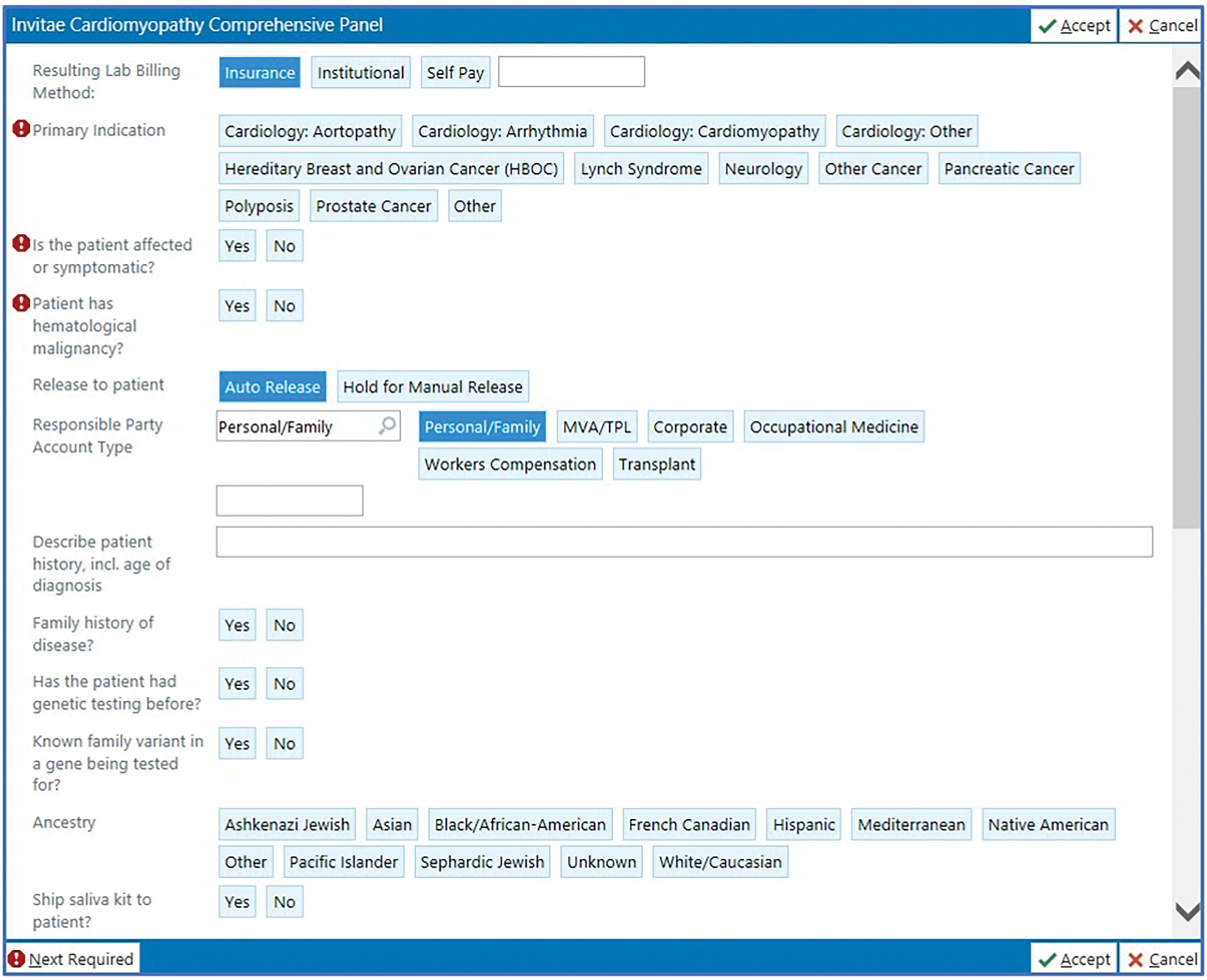
Example screen shot for computerized provider order entry of a cardiomyopathy panel.
Figure 2C.

Example screen shot for discrete reporting of a likely pathogenic genetic test result.
Figure 2E.

Example screen shot for discrete reporting of a negative genetic test result.
Figure 2F.

Example screen shot for discrete reporting of a pharmacogenetic test result.
Over the course of the PGI’s efforts, we have received constructive feedback both internally from PGI members and externally from end users across Penn Medicine that has informed further refinements and enhancements to our genetic testing features. For instance, the recognition that our HL7 integration could facilitate the transfer of all EHR-derived data, not simply genetic test results, led our team to develop a feature by which clinicians could transmit their clinical documentation directly to genetic testing laboratories with a single click to assist with insurance claims processing. In addition, the need to minimize in-person visits during the COVID-19 pandemic prompted the addition of an option in the CPOE interface to transmit requests to genetic testing laboratories instructing them to mail saliva specimen collection kits directly to patients. Finally, our team has collaborated closely with Epic to provide feedback on how its Genomics Module may be further refined to include complex genetic results, such as for mosaicism.
MATERIALS AND METHODS
To evaluate the impact of the PGI’s efforts on genetics care delivery, we took a multifaceted approach involving 1) the abstraction of EHR usage data; 2) a time study with genetic counselors; and 3) key informant interviews with PGI team members.
EHR Usage
We abstracted all EHR usage data, including the total number of views and associated providers, for the Precision Medicine Tab between June 2020 and May 2022. We also tabulated the total number of computerized genetic test orders that were placed in the EHR between February 2020 and May 2022 and plotted these data over time. Genetic tests from laboratories that have not yet been integrated into PennChart were excluded from this analysis because they are manually ordered from online portals external to the EHR.
Time Study
We invited all genetic counselors from our Medical Genetics and Cancer Risk Evaluation Programs to participate in a time study; genetic counselors with primary administrative roles were excluded. Participants self-reported the approximate number of minutes spent managing all consecutive genetic tests ordered and resulted over the course of one month for tests handled both within and external to PennChart. So as not to disrupt clinical workflows, time study participants were permitted to track their genetic testing activities either in real-time or at the conclusion of a clinic session. Data were compared using Wilcoxon rank-sum tests using STATA version 17 (College Station, TX).
Key Informant Interviews
We conducted key informant interviews with PGI members across disciplines to characterize their perspectives on the lessons learned from this initiative thus far. Census sampling was used to identify all three genetic counselors and five IS analysts involved with the PGI. A semi-structured interview guide was developed after the PGI’s efforts were under way and included open-ended questions about each participant’s role in the PGI, challenges faced, and lessons learned (Supplementary File 5). Interviews were performed via videoconference over approximately 30 minutes and were recorded with respondent permission, transcribed verbatim, and uploaded into NVivo (QSR International, Melbourne, Australia) to support coding and analysis using a combination of deductive and inductive approaches15. The initial codebook followed a deductive framework informed by the interview guide questions and challenges that had been anticipated at the initiative’s outset related to the project’s scope, technical builds, “language barriers” between team members, vendor relationships, and privacy concerns. Interview transcripts were then coded by K.S.L. to identify unforeseen challenges and other themes that emerged with notable frequency or depth. Team meetings were then held between K.S.L. and K.L.N. to reach consensus on emerging topics and refine the codebook to be used in the final analysis.
RESULTS
EHR Usage
As of May 2022, we have integrated over 17,500 legacy genetic testing results into the PennChart Precision Medicine Tab, which has been viewed 211,475 times in the last 24 months by 18,398 unique providers. The PGI has expanded to interface with four commercial genetic testing laboratories for CPOE and discrete result reporting, resulting in the creation of 420 unique genetic testing orders, of which 154 have been used to date. As of May 31, 2022, a total of 4,073 orders have been placed as a part of routine patient care by 154 different providers, 125 of whom are non-genetics clinicians, with an increasing number of orders placed per month (Figure 3). We have built 45 disease-associated and 63 pharmacogenetic Genomic Indicators and have begun implementing both clinician- and patient-facing CDS for multiple use cases, including cancer risk management for patients with inherited cancer syndromes and pharmacogenetic-driven dosing recommendations at the time of medication prescribing.
Figure 3.

Trends in computerized genetic test orders placed in the electronic health record (EHR) over time.
Time Study
Thirteen genetic counselors were invited to participate in our time study, of whom eight (62%) tracked 96 unique genetic testing activities from six different laboratory vendors over the course of one month. A total of 67 genetic testing orders were placed, of which 46 were placed in PennChart and 21 were placed online in laboratory-specific portals. The median time spent on order entry was two minutes (range 1–5 minutes) in the EHR compared to eight minutes (range 4–20 minutes) using laboratory-specific portals (p <0.001, Figure 4A). The remaining genetic testing activities included 29 results that were managed after patient disclosure, of which 16 were handled entirely in PennChart and 13 interfaced with external laboratory-specific portals. The median time spent on result management was one minute (range 0–3 minutes) in the EHR compared to five minutes (range 2–11 minutes) using online laboratory-specific portals (p <0.001). These differences in time spent on genetic testing activities remained statistically significant in a stratified analysis limited to tests ordered and resulted from Ambry Genetics (Figure 4B). In total, 84 genetic testing activities involved one of the four commercial laboratory partners whose tests were integrated into PennChart by the time of the study, but only 62 (73.8%) were fully handled in the EHR. In the remaining 22 (26.2%) cases, genetic counselors opted to revert to manual workflows largely because the genetic test of interest had not yet been integrated into PennChart.
Figure 4A.

Time spent on order entry and result management for genetic tests handled within the electronic health record (EHR) compared to online laboratory-specific portals for all genetic testing activities.
Figure 4B.

Time spent on order entry and result management for genetic tests handled within the electronic health record (EHR) compared to online laboratory-specific portals for genetic tests ordered and resulted from Ambry Genetics.
Key Informant Interviews
We invited three genetic counselors and five IS analysts from the PGI to participate in key informant interviews, all (100%) of whom agreed to share their perspectives on the lessons learned from this initiative. Respondents reported being initially motivated to join this initiative due to its potential to optimize clinical workflows and improve patient care. Since then, they have been generally pleased with the PGI’s success – one genetic counselor shared that the EHR integration efforts have been “life changing” in clinical practice (Supplementary File 6).
However, the PGI’s efforts have not been without challenges, both anticipated and unforeseen (Table 1). When the project was launched, deliberate efforts were made to address anticipated challenges surrounding the project’s scope, technical builds, “language barriers” between genetic counselors and IS analysts, relationship building with genetic testing laboratory vendors, and privacy concerns. The team decided to start its EHR integration efforts with a single commercial genetic testing laboratory partner (Ambry Genetics) and two defined Genomic Indicator use cases (SDHB and DPYD) so that our initial learnings could inform subsequent larger-scale efforts. Fulfilling the technical requirements for this initial work was greatly facilitated by the detailed standard operating procedures (SOPs) that were developed at the project’s outset; these SOPs have continued to provide consistent standards as the project’s scope has expanded. Finally, building strong relationships not only between PGI members but also with external genetic testing laboratory partners was recognized early on as a key to successfully bridging the different areas of expertise that each individual team member contributed to the project. Whether achieving mutual understanding between genetics clinicians and IS analysts, maintaining consistent HL7 integration and data display standards across laboratory vendors, or ensuring that our efforts complied with broader-reaching legal and privacy regulations, open and consistent communication proved to be essential.
Table 1.
Quotations describing challenges and solutions for the integration of genomic medicine into the electronic health record (EHR).
| CHALLENGES | SOLUTIONS | |
|---|---|---|
| ANTICIPATED CHALLENGES | ||
| Project Scope | “What do we focus on first? What’s most important? Because if we try to build it all, it will never go live.” [IS3] | “If you recall, we started with two very small, very specific disease and drug gene interaction [Genomic Indicator use cases]… Sometimes you need a win, right? You need an early success to prove that you can get bigger successes.” [IS4] |
| Technical Build | “I think one of the biggest struggles was developing standards of practice for, how do we enter this data? How do we preserve data integrity, and knowing that what you set up is going to have to persist for new changes that come?” [IS1] | “One of the brilliant things that [our project leader] did in the very beginning was making the SOP [standard operating procedure] for the genomic documentation saying, “these are our standards for Penn and how we need to see the results come in, the pieces of information that we need.” I think that was really, really helpful.” [GC1] |
| Language Barriers | “Sometimes it’s a language barrier, meaning that the genetics people are saying one thing and the IS people are interpreting it as another thing. There were a couple phone calls where I was like, I feel like we’re all saying the same things, we’re just using our own respective language for how to say it. And that was probably one of the more frustrating aspects of this whole project.” [GC2] | “It’s not an IT project. It’s not a physician project. It’s not a genetic counselor project…It’s not something that’s going to get done by one or two people. You’re going to need a team, and the team has to work well together. I mean, we have built a lot of relationships, which I think is key.” [IS4] |
| Vendor Relationships | “The biggest challenge has been having the [genetic testing laboratory] vendors meet our needs but also meeting the needs of the vendors. So, what I mean by that is, you know PennChart or Penn Medicine as a whole has an expectation for the data that they should expect to see in [the EHR] based on the interfacing we’re doing. Not every vendor can provide the same information.” [IS3] | “[The representative from one laboratory vendor] was so responsive, so helpful all the time to the point that they thought he worked for Penn, and that just made our life so much easier because as soon as there was an issue, we emailed [the representative]. He took care of it like right away or he gave us an answer right away… So many other labs haven’t been as responsive and haven’t been as clear with their responses.” [GC2] |
| Privacy Concerns | “Once you start putting information into an electronic format, it’s now available for a lot of people. And that was something that we knew was a concern…but I don’t know that we necessarily understood how large of a concern it would be. Some of the things that came out as we were working on [the electronic patient portal] result release and some changes to policies about result release to patients, also presented challenges to the teams.” [IS1] | “It goes back to the team, like we had privacy [representatives] in these discussions, and we had legal in these discussions… We can’t afford to get this wrong.” [IS4] |
| UNFORESEEN CHALLENGES | ||
| Project Cadence | “I think one of the challenges of our project has been just working with multiple vendors simultaneously. At one point, we had meetings with three different vendors going on, and some of those meetings would take place in the same day, definitely within the same week. The rapid pace and the number of vendors that we wanted to take live and in such rapid succession made things a little more challenging to just keep everything straight…because there’s so many little intricacies with each vendor, they’re all a little bit different. So, to work on projects all at the same time for different vendors just made things a little bit more difficult.” [IS3] | “I think it’s hard to also say what the right cadence is... There might be periods of time where it’s easier to put out more use cases at a time, and there might be times where you’re working on a lab integration and then a lot of the resources are spent doing the lab integration. It’s harder to do the use cases. So, I think that’s where it’s really kind of something that has to be, I think, approached in the moment…” [IS1] |
| Different Stakeholder Needs | “I was engaged late, so [my area] had its own set of concerns, like genetics isn’t the same across the system. How it’s ordered, how it’s utilized, so you know, I have several [colleagues] that just order some of their own testing themselves, and they’re still scanning under media [the previous EHR integration workflow].” [GC3] | “I think the expectation of having representation from all the different genetics groups has been really helpful. We’ve been lucky that we have a lot of really interested parties.” [GC1] |
| Impact on Clinical Workflows | “It’s just getting people to change. There are some people who just don’t like change and so it takes them a long time to try something new, even if I tell them until I’m blue in the face, ‘This is so much easier, like please try it this way.’” [GC2] | “Until we can streamline [the EHR integration process], I don’t know that it’s ready for prime time for everybody. But just because there’s so many different players.” [GC3] |
| Knowledge Dissemination | “The number of people and individuals that want this information and need this information was a lot larger than I expected.” [IS4] | “I think the tip sheets were really helpful. I would recommend those tip sheets for other places if they’re if they’re implementing this kind of thing.” [GC2] “I’m actually working on creating a central repository for all of our tip sheets that will live on our PennChart website…” [IS3] |
GC = Genetic Counselor. IS = Information Services Analyst.
As the project progressed, additional challenges emerged. First, the PGI’s scope rapidly expanded such that there were instances when it became difficult to balance progress with the time and resources needed to meet project goals. At one point, our team found itself working with three different laboratory vendors simultaneously, making it difficult to stay abreast of each vendor’s capabilities and needs. We learned to evaluate current and future PGI initiatives on a regular basis so that they could be prioritized in real time rather than adhering to a fixed project cadence. Second, despite the PGI’s efforts to build a multidisciplinary team with broad clinical genetics representation, some programs were engaged later in the course of the project than others. Over time, it became apparent that each genetics program has unique needs and concerns that would have been better addressed had all the key stakeholders been engaged at the outset. Third, changing existing clinical workflows to include new EHR-based genetic testing procedures has proven to be challenging. The PGI has disseminated educational “tip sheets” to clinician end-users and provided live demonstrations of the EHR’s evolving functionality during regularly scheduled clinical conferences. Throughout this process, making the EHR integration process as user-friendly as possible and eliciting end-user feedback have proven to be of utmost importance. Finally, our team did not anticipate the degree to which we would be asked by individuals outside of the PGI’s immediate project team to disseminate our work and lessons learned. As a result, we have developed a publicly available website (https://ibi.med.upenn.edu/pgi) containing our documentation and instructional materials, in addition to posting our content on the Epic Community Library (https://comlib.epic.com/), presenting our work at conferences, and providing in-depth demonstrations to interested parties.
All in all, buy-in across the health system, particularly from clinical and IS leadership, was cited as the single most important tool for overcoming the challenges faced by the PGI. Future efforts will involve iterative improvements to our existing EHR infrastructure, further optimization of clinical workflows, expansion of our existing genetic testing compendium, development of more sophisticated CDS for additional use cases, and contributions to national and international efforts to develop data standards in genomic medicine. After all, one IS analyst shared that “this isn’t a project where you have a start and stop date. You have a start date, but this is just going to keep going and growing.”
DISCUSSION
In this manuscript, we provide detailed insight into the PGI’s efforts and describe its positive impact on genetics care delivery. However, our experiences have not been without challenges, both anticipated and unforeseen. Multidisciplinary collaboration and institutional buy-in have been key ingredients for the PGI’s success.
Successful integration of genomic medicine into clinical care is a lofty endeavor, and there is skepticism that today’s EHRs are well suited to handle genomic data in the absence of external solutions such as middleware and application programming interfaces (APIs)16,17. However, EHRs remain the gold standard of interoperability between clinical practices and institutions, thereby justifying the human, time, and financial resources needed to support genomic integration efforts. By following established frameworks set forth by others at the intersection of genomic medicine and clinical informatics11,13,18, we have demonstrated that integrating genomic medicine into the EHR is not only feasible, but also streamlines genetics care delivery, saving time so that genetics providers can operate at top of scope.
The PGI’s experience has highlighted that the integration of genomic data into the EHR requires team-based collaboration and leadership engagement. Our experiences are not unlike those of others who have sought to integrate other aspects of genomic medicine into the EHR. Kawamoto et al. recently cited “establishing a world-class team” with a unified mission and vision as a key strategy that facilitated the establishment of the University of Utah’s ReImagine EHR initiative to develop digital innovations to optimize patient care19. Similarly, Caraballo and colleagues recognized the development of unified standards by multidisciplinary team members as an important step needed to scale efforts to integrate pharmacogenomics into the EHR20. The collective input from networks such as the NHGRI’s Genomic Medicine Working Group and Implementing Genomics in Practice (IGNITE) Consortium also has been instrumental in underscoring the importance of leadership engagement in these types of efforts21,22. We, too, have benefited tremendously from the commitment and buy-in from Penn Medicine leadership to support and sustain the PGI’s efforts.
Integrating genomic data into the EHR has its challenges. We describe the experience of our single health system which has benefited from significant leadership support and financial investment that may not be feasible at other institutions. As such, we are committed to sharing our SOPs, decision process algorithms, and lessons learned to support similar efforts within the broader genomic medicine community. We have developed a publicly available website (https://ibi.med.upenn.edu/pgi) with links to instructional videos for clinicians and IS analysts, SOPs, tip sheets, and verbiage for Genomic Indicators and patient-facing data. We also are continually uploading our build files to the Epic Community Library (https://comlib.epic.com/) and remain committed to providing in-depth demonstrations to interested parties upon request, as we have already done with multiple institutions around the world. Second, our time study was limited by the potential for recall bias, particularly because participants were not required to track their genetic testing activities in real-time. Despite this limitation, we observed a significant negative association between EHR utilization and the amount of time required to order and manage genetic testing results, though some genetic counselors still reported using manual workflows to interface with genetic testing laboratory vendors that have already been integrated into the EHR. Ongoing efforts are focused on obtaining feedback from these stakeholder groups so that the EHR can better suit the needs of these individuals’ workflows. Finally, although we detailed the impact that the PGI’s efforts have had on genetics care delivery, data are still lacking on downstream patient outcomes. We are actively building and implementing patient- and clinician-facing CDS with specific plans to evaluate the effect of these tools on patient outcomes.
The PGI has made significant strides in integrating genomic medicine into the EHR for the optimization of clinical care. More work is needed to further refine and expand upon on our initial efforts, further optimize clinical workflows, and achieve broader-reaching goals such as unifying data standards, supporting variant reclassifications over time, and ensuring equitable access and usability of genomic medicine for all patients. We hope that our experience to date may inform ongoing efforts to harness the power of the EHR to deliver genomic medicine both at our institution and beyond.
Supplementary Material
Figure 2D.

Example screen shot for discrete reporting of a variant of uncertain significance.
Acknowledgement:
We acknowledge the efforts of the many individuals involved in moving the PennChart Genomics Initiative forward, including from Penn Medicine Information Services; Pathology and Laboratory Medicine; and the Clinical Genetics Services at Penn Medicine, including the Cancer Risk Evaluation Program, Medical Genetics, Center for Inherited Cardiovascular Disease, Neurogenetics, Reproductive Genetics, and Pharmacogenetics. We acknowledge the support of Michael Restuccia and the leadership of Penn Medicine IS without which these efforts could not have moved forward. We also thank Steven Joffe for his helpful comments during the writing of this manuscript.
Funding:
K.S.L. is supported by National Institutes of Health (NIH) grant T32 HG009495. A.R. and K.L.N. are supported by NIH grant U01 CA232836. S.T. is supported by NIH grant K23 HL143161 and the Penn Center for Precision Medicine. S.M.D. and K.L.N. are supported by the Basser Center for BRCA and the Breast Cancer Research Foundation. M.D.R is supported by NIH grant U24 HG010862.
Footnotes
Conflict of Interest Statement
Employment:
Dr. Lau-Min has an immediate family member who is employed by GlaxoSmithKline.
All remaining authors declare no potential conflict of interest.
Ethics Declaration: The PennChart Genomics Initiative’s EHR integration efforts did not constitute human subjects research and as such, did not quality for submission to the Institutional Review Board at the University of Pennsylvania.
Data Availability:
The data that support the findings in this manuscript are available on request from the corresponding author, K.L.N.
REFERENCES
- 1.National Comprehensive Cancer Network. Genetic/Familial High-Risk Assessment: Breast, Ovarian, and Pancreatic. 2020.
- 2.National Comprehensive Cancer Network. Genetic/Familial High-Risk Assessment: Colorectal. 2020.
- 3.Bianchi DW, Chiu RWK. Sequencing of Circulating Cell-free DNA during Pregnancy. N Engl J Med. 2018;379(5):464–473. [DOI] [PMC free article] [PubMed] [Google Scholar]
- 4.Scott SA, Sangkuhl K, Stein CM, et al. Clinical Pharmacogenetics Implementation Consortium guidelines for CYP2C19 genotype and clopidogrel therapy: 2013 update. Clin Pharmacol Ther. 2013;94(3):317–323. [DOI] [PMC free article] [PubMed] [Google Scholar]
- 5.Relling MV, McDonagh EM, Chang T, et al. Clinical Pharmacogenetics Implementation Consortium (CPIC) guidelines for rasburicase therapy in the context of G6PD deficiency genotype. Clin Pharmacol Ther. 2014;96(2):169–174. [DOI] [PMC free article] [PubMed] [Google Scholar]
- 6.Hooker GW. Building an infrastructure to enable delivery of genomic medicine. Am J Med Genet C Semin Med Genet. 2021;187(1):95–99. [DOI] [PMC free article] [PubMed] [Google Scholar]
- 7.Green ED, Gunter C, Biesecker LG, et al. Strategic vision for improving human health at The Forefront of Genomics. Nature. 2020;586(7831):683–692. [DOI] [PMC free article] [PubMed] [Google Scholar]
- 8.Hoffman MA. The genome-enabled electronic medical record. Journal of Biomedical Informatics. 2007;40(1):44–46. [DOI] [PubMed] [Google Scholar]
- 9.Scheuner MT, Myrie K, Peredo J, et al. Integrating Germline Genetics Into Precision Oncology Practice in the Veterans Health Administration: Challenges and Opportunities. Fed Pract. 2020;37(Suppl 4):S82–s88. [DOI] [PMC free article] [PubMed] [Google Scholar]
- 10.Masys DR, Jarvik GP, Abernethy NF, et al. Technical desiderata for the integration of genomic data into Electronic Health Records. Journal of Biomedical Informatics. 2012;45(3):419–422. [DOI] [PMC free article] [PubMed] [Google Scholar]
- 11.Marsolo K, Spooner SA. Clinical genomics in the world of the electronic health record. Genetics in Medicine. 2013;15(10):786–791. [DOI] [PMC free article] [PubMed] [Google Scholar]
- 12.Wiley K, Findley L, Goldrich M, et al. A research agenda to support the development and implementation of genomics-based clinical informatics tools and resources. Journal of the American Medical Informatics Association. 2022. [DOI] [PMC free article] [PubMed] [Google Scholar]
- 13.Grebe TA, Khushf G, Chen M, et al. The interface of genomic information with the electronic health record: a points to consider statement of the American College of Medical Genetics and Genomics (ACMG). Genetics in Medicine. 2020. [DOI] [PubMed] [Google Scholar]
- 14.Lau-Min KS, Asher SB, Chen J, et al. Real-world integration of genomic data into the electronic health record: the PennChart Genomics Initiative. Genetics in Medicine. 2020. [DOI] [PMC free article] [PubMed] [Google Scholar]
- 15.Creswell JWP, Cheryl N. Qualitative Inquiry & Research Design: Choosing Among Five Approaches. 4th ed. Thousand Oaks, California: SAGE Publications, Inc; 2017. [Google Scholar]
- 16.Warner JL, Jain SK, Levy MA. Integrating cancer genomic data into electronic health records. Genome Medicine. 2016;8(1). [DOI] [PMC free article] [PubMed] [Google Scholar]
- 17.Conway JR, Warner JL, Rubinstein WS, Miller RS. Next-Generation Sequencing and the Clinical Oncology Workflow: Data Challenges, Proposed Solutions, and a Call to Action. JCO Precis Oncol. 2019;3. [DOI] [PMC free article] [PubMed] [Google Scholar]
- 18.Dexter P, Ong H, Elsey A, et al. Development of a Genomic Data Flow Framework: Results of a Survey Administered to NIH-NHGRI IGNITE and eMERGE Consortia Participants. AMIA Annu Symp Proc. 2019;2019:363–370. [PMC free article] [PubMed] [Google Scholar]
- 19.Kawamoto K, Kukhareva PV, Weir C, et al. Establishing a multidisciplinary initiative for interoperable electronic health record innovations at an academic medical center. JAMIA Open. 2021;4(3):ooab041. [DOI] [PMC free article] [PubMed] [Google Scholar]
- 20.Caraballo PJ, Sutton JA, Giri J, et al. Integrating pharmacogenomics into the electronic health record by implementing genomic indicators. Journal of the American Medical Informatics Association. 2020;27(1):154–158. [DOI] [PMC free article] [PubMed] [Google Scholar]
- 21.Williams MS. Genomic medicine implementation: learning by example. Am J Med Genet C Semin Med Genet. 2014;166c(1):8–14. [DOI] [PubMed] [Google Scholar]
- 22.Zebrowski AM, Ellis DE, Barg FK, et al. Qualitative study of system-level factors related to genomic implementation. Genetics in medicine : official journal of the American College of Medical Genetics. 2019;21(7):1534–1540. [DOI] [PMC free article] [PubMed] [Google Scholar]
Associated Data
This section collects any data citations, data availability statements, or supplementary materials included in this article.
Supplementary Materials
Data Availability Statement
The data that support the findings in this manuscript are available on request from the corresponding author, K.L.N.