



Abstract
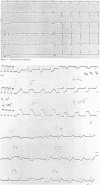
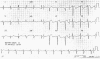
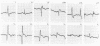
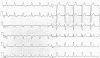
OBJECTIVE--To assess, in the context of their possible role in prehospital thrombolysis, the ability of general practitioners to recognise acute transmural myocardial ischaemia/infarction on an electrocardiogram. DESIGN--150 doctors (every fifth name) were selected from the alphabetical list of 750 on Merseyside general practitioner register and without prior warning were asked to interpret a series of six 12 lead electrocardiograms. Three of these showed acute transmural ischaemia/infarction, one was normal, and two showed non-acute abnormalities. Details of doctors' ages, postgraduate training, and clinical practice were sought. SETTING--General practitioners' surgeries and postgraduate centres within the Merseyside area. PARTICIPANTS--106 general practitioners (mean age 45 years) agreed to participate. MAIN OUTCOME MEASURE--Accuracy of general practitioners' interpretations of the six electrocardiograms. RESULTS--82% of general practitioners correctly recognised a normal electrocardiogram. Recognition of acute abnormalities was less reliable. Between 33% and 61% correctly identified acute transmural ischaemia/infarction depending on the specific trace presented. Accurate localisation of the site of the infarct was achieved only by between 8% and 30% of participants, while between 22% and 25% correctly interpreted non-acute abnormalities. Neither routine use of electrocardiography nor postgraduate hospital experience in general medicine was associated with significantly greater expertise. CONCLUSION--The current level of proficiency of a sample of general practitioners in the Merseyside area in recognising acute transmural ischaemia/infarction on an electrocardiogram suggests that refresher training is needed if general practitioners are to give prehospital thrombolysis.
Full text
PDF


Images in this article
Selected References
These references are in PubMed. This may not be the complete list of references from this article.
- Colquhoun M. C. General practitioners' use of electrocardiography: relevance to early thrombolytic treatment. BMJ. 1989 Aug 12;299(6696):433–433. doi: 10.1136/bmj.299.6696.433. [DOI] [PMC free article] [PubMed] [Google Scholar]
- Koren G., Weiss A. T., Hasin Y., Appelbaum D., Welber S., Rozenman Y., Lotan C., Mosseri M., Sapoznikov D., Luria M. H. Prevention of myocardial damage in acute myocardial ischemia by early treatment with intravenous streptokinase. N Engl J Med. 1985 Nov 28;313(22):1384–1389. doi: 10.1056/NEJM198511283132204. [DOI] [PubMed] [Google Scholar]
- Macallan D. C., Bell J. A., Braddick M., Endersby K., Rizzo-Naudi J. The electrocardiogram in general practice: its use and its interpretation. J R Soc Med. 1990 Sep;83(9):559–562. doi: 10.1177/014107689008300909. [DOI] [PMC free article] [PubMed] [Google Scholar]
- Rawles J. M. General practitioners' management of acute myocardial infarction and cardiac arrest: relevance to thrombolytic treatment. Br Med J (Clin Res Ed) 1987 Sep 12;295(6599):639–640. doi: 10.1136/bmj.295.6599.639. [DOI] [PMC free article] [PubMed] [Google Scholar]
- Rawles J. M., Haites N. E. Patient and general practitioner delays in acute myocardial infarction. Br Med J (Clin Res Ed) 1988 Mar 26;296(6626):882–884. doi: 10.1136/bmj.296.6626.882. [DOI] [PMC free article] [PubMed] [Google Scholar]
- Van de Werf F., Arnold A. E. Intravenous tissue plasminogen activator and size of infarct, left ventricular function, and survival in acute myocardial infarction. BMJ. 1988 Nov 26;297(6660):1374–1379. doi: 10.1136/bmj.297.6660.1374. [DOI] [PMC free article] [PubMed] [Google Scholar]
- Wilcox R. G., von der Lippe G., Olsson C. G., Jensen G., Skene A. M., Hampton J. R. Trial of tissue plasminogen activator for mortality reduction in acute myocardial infarction. Anglo-Scandinavian Study of Early Thrombolysis (ASSET). Lancet. 1988 Sep 3;2(8610):525–530. doi: 10.1016/s0140-6736(88)92656-6. [DOI] [PubMed] [Google Scholar]