



Abstract
Renewable energy projects are at the crux of all Chinese-funded investment in sub-Saharan Africa, which accounts for some 56% of all Chinese-led investments globally. However, the prevailing problem is that about 568 million people were still without electricity access in 2019 across urban and rural areas in sub-Saharan Africa, which does not commensurate with the United Nations Sustainable Development Goal (SDG7) of ensuring affordable and clean energy for all. Previous studies have assessed and improved the efficiency of integrated power generation systems often combined on three levels, power plant, solar panel, and fuel cells, and integrated into national grids or off-grid systems for a sustainable supply of power. This study has included a lithium-ion storage system as a key component in a hybridized renewable energy generation system for the first time that has proven to be efficient and investment worthy. The study also examines the operational parameters of Chinese-funded power plant projects in sub-Saharan Africa and their effectiveness in achieving SDG-7. The novelty of this study is evident in the proposed integrated multi-level hybrid technology model of solid oxide fuel cells, temperature point sensors, and lithium batteries powered by a solar system and embedded in thermal power plants as an alternative electrical energy system for domestic and industrial use in sub-Saharan Africa. Performance analysis of the proposed power generation model indicates its complementary capacity of generating additional energy output with thermodynamics energy and exergy efficiencies of 88.2% and 67.0% respectively. The outcome of this study draws the attention of Chinese investors, governments in sub-Saharan African countries, and top industry players to the following: to consider refocusing their energy sector policy initiatives and strategies towards exploring the lithium resource base in Africa, optimizing energy generation cost, recouping optimal profit from their renewable energy technology investments, and making electricity supply clean, sustainable, and affordable for use in sub-Saharan Africa.
Keywords: Fuel cell, Lithium-ion battery, Electric energy, Sensor technology, Solar technology, Alternative energy
Introduction
The critical role of electricity in engineering the modernization of the chemical industry, nurturing the development of internal combustion engines, propelling mass production systems, and facilitating economic growth and development dates back to the first and second industrial revolutions (Zhanga et al., 2017; Abokyi et al., 2018). By 2014, China had installed about 378 gigawatts (GW) of renewable power energy derived from water, wind, and sun (Mathews, 2016). In Malaysia, an empirical study revealed that manufacturing output growth was highly sensitive to electricity consumption rates only in the short run but not in the long run (Husaini and Lean, 2015).
The mainstay of generating electrical energy for use in the global economy is burning fossil fuels, especially petroleum and natural gas. However, fossil fuels have outlived their usefulness over the years as these fuel sources have significantly influenced the increasing trend of operational costs and had negative environmental ramifications. Foster and Elzinga (2020) projected over 80% demand for fossil fuels globally translates into over 60% share of global carbon dioxide emissions, which is likely to double in the next 30 years and cause a drastic increase in global average temperature. In essence, it is necessary to ensure the accessible, reliable, affordable, and sustainable use of technology-powered renewable energy for socioeconomic growth (United Nations, 2015).
Developed countries have long considered the use of non-dispensable alternative energy sources and means of generating electricity such as fuel cells and solar technology. For instance, standalone power backup fuel cell systems are progressively leveraged in American multinational technology firms to minimize the use of diesel engines for seamless and cheap electricity power supply (Staffell et al., 2019). Karakaya et al. (2015) identify hydropower, wind energy, bio-waste and biomass energy, geothermal energy, and solar, tidal, and wave energy as the major renewable energy sources globally, with hydropower being dominantly used over about 83% and the least used is tidal and wave energy representing only 1%.
In sub-Saharan Africa, renewable energy technology adoption for energy generation is mainly evident in South Africa (9715 MW), Nigeria (2079 MW), Ghana (1603 MW), and Cameroun (614.63 MW), derived dominantly from solar energy, hydropower, wind energy, and biomass with little emphasis on the wave and tidal energy (Ibrahim et al., 2021). In 2020, renewable sources represented 9% of all energy generation in Africa, with 6.8% reliance on hydropower (Armstrong, 2022). International support for clean and renewable energy decreased by 35% to reach $14 billion in 2018, with sub-Saharan Africa bearing the brunt of the lowest levels of electricity access (United Nations, 2021). Notwithstanding the abundance of renewable energy resources in Africa, they remain sub-optimally tapped and thus do not contribute substantially to total power generation requirements. Fueled by the COVID-19 pandemic in 2020, the United Nations (2021) revealed that 97 million people in urban areas and 471 million in rural areas were still without electricity access in 2019 in sub-Saharan Africa projected to be 555 million in 2030. Over the years, China has been associated with an enclave characteristics model of investment that encapsulates financing, turnkey project development, and equipment and labor import (Lema et al., 2021) in sub-Saharan Africa’s power sector. Renewable energy projects account for 56% of all Chinese-funded investments and have focused predominantly on hydropower technology (IEA, 2016).
A chunk of previous studies has focused on assessing Chinese hydropower projects (Brautigam & Hwang, 2019) and a few others on solar and wind projects (Chen, 2018) while examining the factors influencing these projects and their cost-benefit analysis (Shen and Power, 2016; Lema et al., 2021). With the United Nations Sustainable Development Goal (SDG7-Affordable and clean energy) as an underpinning driver, this study analyzes Chinese-funded power plant investment projects in sub-Saharan Africa (SSA) detailing types of technology, capacity (MW), financial close, and total investment. Data for the analysis were collected from the UN-SDG portal and the World Bank archives on power plant investments in sub-Saharan Africa that received Chinese funding. Data analysis reveals that just a fraction of countries in Africa have access to the investments made into power generation as a result of poverty and lack of infrastructure. This study, therefore, redirects potential future Chinese investors to focus on sources of power that are very affordable and clean to help actualize SDG-7 faster. To this end, an integrated multi-level hybrid technology model of solid oxide fuel cells, temperature point sensors, and lithium-based solar systems embedded in thermal power plants is proposed as an alternative electrical energy system for domestic and industrial use in sub-Saharan Africa.
Before discussing the significance of this article, it is critical to situate it within the literature to show how distinct it is from extant works. Previous works (Justo et al., 2022; Łukasiewicz et al., 2022; Zhang, 2020) have focused on how to improve power plants and generation systems through off-grid solutions to ensure a stable and sustainable supply of power. Other researchers (Chanchangi et al., 2022; Xie et al., 2022; Jawad et al., 2022) have also explored various power systems like solar panels, solid oxide fuel cells, and their types and how they can help improve access to energy and avoid a cut in energy supplies in huge manufacturing plants: in this sense, the ultimate goal is reliable power supply. The current article is outstanding as it combines various standalone power and energy generation systems to ensure not only reliability and sustainability, which has largely been the focus in previous, but also affordability and cleanness of energy for all. Another critical difference between this article and previous ones is that it develops energy systems directed at better ways of aligning energy investments with the original aim of Chinese investors which is to improve the efficiency of power plants, reduce long-term electricity costs, enhance energy access, optimize manufacturing productivity, and minimize negative ramifications on the environment in sub-Saharan Africa. Other studies (Tomala, et al., 2021; Bishoge et al., 2020) generally identify energy problems in sub-Saharan Africa and recommend more investments leaving out what can be done for Chinese investors to save costs while achieving their goal. Again, this is the first time solid oxide fuel cell, temperature sensors, and lithium-based solar systems are being hybridized for sustainable and affordable renewable energy funded by Chinese investment. This integration of these energy storage systems also represents the brink of a breakthrough for not only energy experts but also for the manufacturing industry as it fills a significant gap in the literature. Also, SOFCs, lithium-based solar panels, and sensor technologies, even though have the goal of energy generation, employ different approaches; hence, putting all three together in one system tackles the challenge of each of them as an alternative source of electric energy that can form a basis of critique for extant works (Shamim et al., 2019; Vijayashankarganth et al., 2022; Wenge et al., 2020). This paper has also drawn the attention of Chinese investors to the availability of lithium in commercial quantities in Ghana’s Volta basin and other sub-Saharan African countries. Chinese investors could leverage this discovery for future investments in Africa’s energy sector. The rest of the paper consists of sections encapsulating an empirical review, research design and strategy, results and discussions, and conclusions and recommendations.
Theoretical and empirical review of literature
Power plant technology application
Power plants are industrial setups that generate electricity from a basic source of energy. They are considered technologies because they involve the application of scientific knowledge and principles in various settings ranging from domestic to industrial (Sheina, Muhsin, and Girya, 2021). Atkins and Escudia (2013) submit that power plants convert mechanical energy into electrical energy that is useful for domestic and commercial activities. Moya, Aldas, and Kaparaju (2018) explored geothermal energy as a power plant technology and its heat applications. They found that power plant technology plays a pivotal role in the tapping and use of low-temperature geothermal resources. Krivova and Shmoilov (2021) applied probabilistic technological methods including probability distribution laws (PDL) and selection of input and output data (SBID) to the design of power plants.
Solid oxide fuel cell (SOFC) technology operation and application
Solid oxide fuel cell (SOFC) exemplifies a device that generates electricity through electrochemical processes of chemical energy conversion at consistently high temperatures ranging between 500 and 1000 °C (Al-Khori et al., 2021). Its innate chemical components present some form of flexibility and edge relative to other types of fuel cells. In that, it can use several fuels such as hydrogen and carbon monoxide, and as well maintain high-level temperatures that are enough to ensure the efficient operation of large facility power plants. This makes it the most efficient option for application in the manufacturing industry, especially suitable for integrating with production and power plants that together emit heat and water, which may serve other purposes. Brandon (2004) estimates an electricity generation of 1 to 30 MW for industries and 1 to 5 kW for domestic purposes. Solid oxide fuel cell (SOFC) can efficiently produce electricity, hydrogen gas, and high-temperature heat (Shen et al., 2021), which can be stored and used to minimize power fluctuations or even avoid building complex component systems to serve the same purpose (Yang et al., 2014). SOFCs ensure a cost-effective electric power generation system that results from its flexibility in integrating effectively into several hybrid systems to perform optimally (Jia et al., 2015). Additionally, a portable SOFC of about 20 kW rated power is capable of generating effective emergency power at a maintenance interval of over 2000 h (Protonex, 2015). Solid oxide fuel cells have however been criticized because their dynamic and unstable operating conditions, especially in the short term, make it difficult to monitor degradation rates (Fardadi et al., 2016, Wu and Gao, 2017).
Solar energy technology operations and application
Timilsina, Kurdgelashvili, and Narbel (2011) emphasize that solar energy has shifted more towards technology in recent times: that is to say, unlike the small-scale photovoltaic (PV) cells, recent forms of solar energy are presented as solar concentrated power (CSP) and as well by large-scale PV systems that can feed into electricity grids. These researchers also noticed a marked reduction in the cost of solar energy over the last 30 years. In theory, it is clear that the resource potential of solar energy is way beyond energy demand across the globe (Kurokawa et al., 2012), but irrespective of this critically important potential and the span of the market, solar energy has not significantly contributed to global energy supply (IEA, 2009). Solar energy is a form of energy that is sourced directly from sunlight or heat generated from sunshine. Solar energy is classified into passive and active, thermal and photovoltaic, and concentrating and non-concentrating. In the view of some solar energy advocates, solar energy will be at the center of meeting future global energy demand through clean and non-invasive energy resources. Various projections of long-term growth (until 2050) of solar energy have been made based on different assumptions. Arvizu et al. (2011) opine that global climate change mitigation scenarios are a critically central part of solar energy expansion. By necessary implication, the deployment of solar energy in 2050 would range from 1 to 12 EJ/year if there are no climate change mitigation policies.
Sensor technology operations and application
The surge in competition in markets across various industries has made it necessary to have a strategy to permanently enhance the quality, reliability, and accessibility of energy. In recent times, sensor technologies have advanced and are powered by high-speed but low-cost power, unique signal processing approaches, and of course advanced manufacturing technologies. Li, Xu, and Zhao (2015) intimate that sensor networks are responsible for tracking activities and can help gather valuable information about a process for improvement. In the view of Sunilkumar and Gopal (2015), the best and ideal type of sensor technology can be identified and applied optimally to solve problems in an industry on the condition that all stakeholder work together. According to Omar et al. (2016), applying an intelligent sensor like the ultrasonic sensor through the Internet of Things (IoT) helps in real-time operation mode and consequently optimizes operation time and cost. According to Omar et al. (2016), the use of an intelligent sensor like the ultrasonic sensor through the Internet of Things (IoT) in many industries like manufacturing, waste management, and vehicle tracking helps to beef up real-time operation mode and consequently optimize operation time and cost.
Lithium-ion battery technology and application
Lithium-ion batteries are widely known as a major approach to energy storage, especially for solar products that are off-grid to leverage the advantages of cost-effectiveness, extensive life cycle, high efficiency, and capacity, as well as no memory effect problems (Dahn and Ehrlich, 2011). Lithium can be extracted from seawater and various industrial wastewater effluents (brine): this is exemplified in the work of Panagopoulos and Giannika (2022a) who established that the extraction of lithium is profitable and cost-effective in commercial operations. In another study by Panagopoulos (2022), it is demonstrated that ions like lithium and rubidium can be found in salt lakes with very high concentrations. Again, a comparative techno-economic and environmental analysis of minimal liquid discharge (MLD) and zero liquid discharge (ZLD) for the desalination of brine water carried out by Panagopoulos and Giannika (2022b) reiterates these positions by affirming that lithium can be extracted from brine in the desalination process. As an evolving storage technology, lithium-ion batteries can boost performance; make control methods clear; and consider safety, testing, and shipping procedures, among others (Yoshino, 2012). A very well-established advantage of Li-ion is its top-notch charging efficiency of 99%: also, lithium-ion batteries are not made of toxic and heavy metals as compared to others like sealed lead acid (SLA) (Placke et al., 2017). It is safe to conclude that lithium-ion batteries have boosted the mobile revolution underpinning a reality that has transformed the world.
Economic and environmental dynamics of electricity consumption
In a study by Abbasi et al. (2020a), the role of electricity consumption by industries, gross domestic product, and prices in Pakistan was analyzed through modified empirical evidence. The study relied on the vector error correction model (VECM) to estimate electricity consumption between 1970 and 2018 in Pakistan to find the correlation between price, electricity consumption, and gross domestic product. Also, the dynamic variance decomposition technique is used to ascertain the overall impact of each variable. A long-run correlation between electricity consumption, price, and GDP in the industrial sector is observed. This finding is a demonstration of the capacity and potential of the industrial sector; hence, the authors recommended that electricity be made affordable to enhance local industrialization and attract more foreign direct investment while adhering to policies. Similarly, Abbasi et al. (2021a) revisited the relationship between electricity consumption, price, and real GDP but, this time, modified the sector it analyzed from 1970 to 2018 in Pakistan with the co-integration test and vector error correction model (VECM). The analysis was carried out in the agriculture, commercial, and residential sectors with the effect of electricity consumption, price, and gross domestic product on each sector being tested. Long-run relationships were found between industrial, residential, and cumulative. Again, long-run relationships were found for the commercial and agriculture sectors with feedback effects observed in EC and EP. The findings of the research are relevant for policy and management decision as it gives details on electricity waste and how price increases.
In another study by Abbasi et al. (2022a), the seriousness of global warming and its impact on our environment was re-echoed. The researchers, therefore, examined China’s renewable energy, fossil fuel energy, and gross domestic product from 1980 to 2018 with the novel dynamic ARDL simulation and frequency domain causality models as the main methods. It was found that significant boosts in CO2 emissions are occasioned by fossil fuel energy both long and short terms. GDP was also found to have a negative short-term impact on China’s environment as it boosts carbon emissions. The authors conclude that the consumption of renewable energy is at the heart of reducing the use of fossil fuels and achieving a sustainable environment.
Again, Abbasi et al. (2021b) sought to find out whether or not the depletion of natural resources and economic growth helps the UK achieve its desired level of carbon neutrality in ways that bring sustainable development. The researchers, therefore, explored the effect of natural resource depletion (NRD), energy use (EU), economic growth (EG), population growth (PG), and industrial value added (IVA) on carbon dioxide emissions between 1970 and 2019 in the UK. After analyzing the autoregressive distributed lag (ARDL) and frequency domain causality (FDC), it was found that economic growth, industrial value added, and natural resource depletion significantly increase carbon dioxide emissions in the short term, while the remaining independent variables increase it in the long run. The need for novel long-term environmental strategies based on the explored variables is proposed.
Abbasi et al. (2022b) also looked at the role of financial development and technology innovation adoption in Pakistan’s sustainable development with a key focus on consumption and territory-based emissions from the first quarter of 1990 to the fourth quarter of 2014 in Pakistan. Dynamic autoregressive distributed lag (ARDL) and frequency domain causality are used to carry out the analysis of data. It was found that in the short and long run, financial and economic development revives consumption and territory-based emission, but energy use only enhances it in the long run. While technology innovation significantly reduces emissions in the long run, economic globalization harms consumption and territory-based emission. This study shows the need to encourage more use of renewable energy sources as it will gravitate towards achieving the Sustainable Development Goal SDG7 which is of interest to the current study.
Abbasi et al. (2020a) in examining the asymmetric relationship between renewable energy consumption, non-renewable energy, and terrorism on Pakistan’s economic growth used nonlinear autoregressive distributed lag modeling (NARDL) for analysis and found positive and negative alterations have a significant long-term asymmetric relationship between renewable energy and terrorism impacting economic growth. A significant negative impact of non-renewable energy consumption on economic growth was observed: indicating the need for specific renewable energy policy interventions to drive economic growth.
Abbasi et al. (2021c) also investigate the impact of energy depletion rate, renewable energy consumption, non-renewable energy depletion rate, and gross domestic product (GDP) on CO2 emissions in Thailand between 1980 and 2018 using ARDL simulation and frequency domain causality test. Results indicate that rate of depletion has a significant negative effect on carbon dioxide emissions in the short and long run while renewable energy also negatively impacts CO2 emissions but only in the short run. In the short and long run, the rate of depletion of non-renewable energy has a significant positive impact on CO2 emission. The authors conclude that, for Thailand to experience a significant decrease in CO2 emissions without incurring high costs, there is a need for a drastic change in economic and energy infrastructure dynamics.
In another study by Abbasi et al. (2021d), the determinants of economic growth in Pakistan between 1972 and 2018 are analyzed using the autoregressive distributed lag (ARDL) to specifically isolate both positive and negative changes observed in energy consumption, industrial growth, carbon emissions, and urbanization. It is found that electricity consumption and industrial value added have both short- and long-run effects on economic growth but carbon emissions and urbanization have positive effects in the short run. They, therefore, concluded that energy consumption, urbanization, industrial growth, and CO2 emissions have positive outcomes for Pakistan’s economic growth.
This empirical review emphasizes the economic and environmental benefits of renewable energy consumption and the need for government policies to be tailored towards alternative sources of electricity that are based on renewable energy for long- and short-term results.
Methodology
Data collection methods and sources
Original research data for this study is collected from two main internationally accepted and credible secondary sources. For Chinese-funded power plant investments, data is collected from the World Bank group on independent power projects in sub-Saharan Africa. Data on energy accessibility, sustainability, affordability, and cleanness in sub-Saharan Africa is also collected from the United Nations Sustainable Development Goal data repository, the international energy agency (IEA), and other sources.
Data analysis, modeling tools, and experimental methods
For an alternative electric power supply backup that serves manufacturing industries and other domestic purposes in Africa, an integrated three-echelon system of indispensable and sustainable energy generation is designed to consist of a solid oxide fuel cell embedded with point sensors, integrated into thermal power plants, and externally connected with solar panels and paralleled lithium-ion batteries. The efficiency of overall energy generation and effectiveness of the proposed system is also assessed using optimization models.
Analyzing the component capacity of thermal power plants
Based on the scientific provisions of the laws of thermodynamics and combustion chambers, Cheddie (2010) proposed a model to analyze the various components of a power plant. This model is adapted for use in this study. First, it is necessary to assess the balance between the mass and energy for each component of the plant, by applying the laws of thermodynamics to find the states of outlet and the level of exergy depletion. The equation is as follows:
| 1 |
To assess the exergy rate of depletion and thermodynamic efficiency, we have:
| 2 |
| 3 |
| 4 |
To determine the sum of the internal energy of the power plant system coupled with the product of its pressure and , as well as the energy that is unavailable for work, where temperature and pressure are represented in Eqs. 5 and 6 as follows:
| 5 |
| 6 |
To configure the combustor, mixer, and heat exchanger components of the power plant, environmental heat losses are considered. A molar balance of methane and hydrogen combustion is configured to determine the outlet component and the combustion outlet temperature. Excess air and heat reactions are assumed to ensure complete combustion.
| 7 |
| 8 |
| 9 |
It is also critical to determine the variations in actual temperatures of both cold and hot fluid using the effectiveness method (NTU). This is configured as a function of the heat exchanger type, effective heat transfer coefficient, and surface area, as shown in the equations below:
| 10 |
| 11 |
| 12 |
| 13 |
| 14 |
| 15 |
Finally, the operating isentropic efficiencies are determined using the compressor and turbine maps as a function of the temperature, pressure, and flow rates as shown below:
| 16 |
Integrating lithium-based solar system with solid oxide fuel cell
To optimize the efficiency and reliability of electricity power generation, solar energy is combined with solid oxide fuel cell. The aim is to leverage more advantages of each of these renewable energy sources over the disadvantages that may be encountered from applying one. First, the fuel cell at a temperature of 500 °C is expected to convert chemical energy to electric power and only less of it is converted into heat that intend balances the operational temperature of the fuel cell. This conversion is achieved by activating ionic conduction, catalyst function process, and electrochemical conversion process. A control valve is also attached to the fuel cell to regulate and stabilize the working temperature of the cell.
In configuring the solar energy application, a dish-type concentrating system is adopted. This is made of silver-coated solar panel surface installed with reflective mirror concentrators on two-dimensional trackers. In essence, solar energy is concentrated on the surface to generate heat to power the solid oxide fuel cell. Furthermore, a refractive lightweight Fresnel condenser is added to the solar panel surfaces to enhance the optical efficiency. Again, to efficiently manage solar and fuel energy generation rates, an optical funnel is installed and sealed with high-temperature glass. Finally, a temperature control unit and power control unit are installed to ensure that power generation requirements are satisfied (see Fig. 1).
Fig. 1.

Control system for the proposed model (a) and dish-type solar panel (b) (Lu et al. 2016)
To complement the solar energy system described above further, a lithium-ion battery is proposed to be integrated with solar panels for storing the solar energy, especially because the solar energy source is not available all year round.
Integrating temperature sensor sensing points into a solid oxide fuel cell
This study also proposes the use of multiple sensor points embedded in the solid oxide fuel cell as presented by Guk et al. (2018). Given the nature of variations in electricity energy demand in Africa, and particularly the unsteady operational temperature changes in SOFCs, it is crucial to have multiple point sensors to monitor and capture at various sensing locations, the heat released, and the swift temperature variations timely and accurately. The sensor design method is based on the Seebeck theory presented by Pollock (2015) as follows:
| 17 |
where Vemf is the Seebeck potential, SA is the alumel thermoelement materials, SB is the chromel thermoelement materials, T1 is the temperature at the junction, and T0 is the temperature at the outside.
Using the spot welding techniques to join wires, a grid configuration of sixteen unique sensing points made up of four (4) alumel and four (4) chromel thermoelements is therefore proposed, taking into account the current (I) to voltage (V) curve (Fig. 2). This is generally to ensure optimal monitoring of temperature variation of an operating SOFC and the consequential degradation and mal-functioning of the cell, as well as the energy generation of the power plant.
Fig. 2.
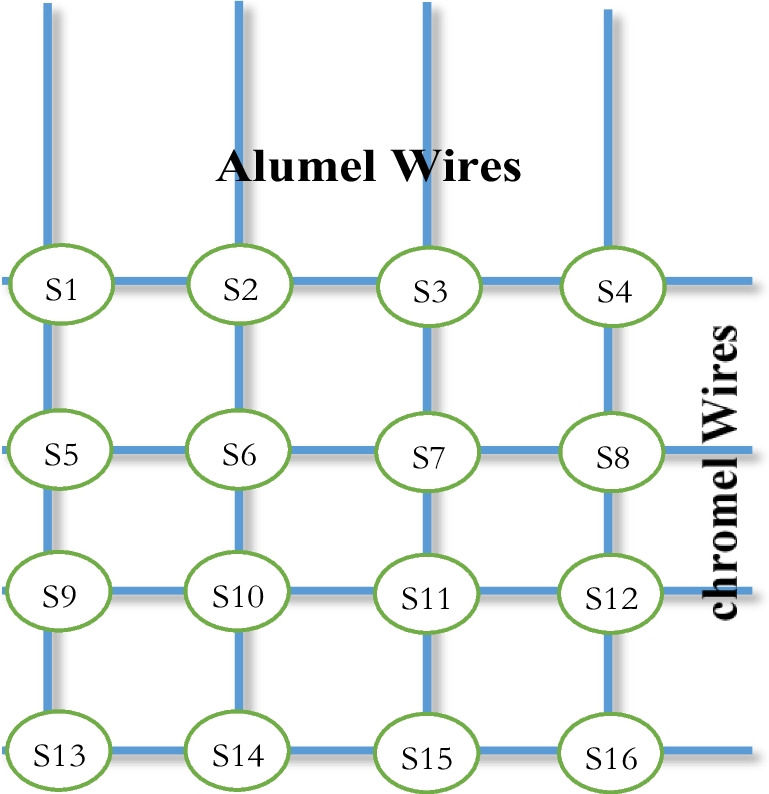
A sixteen-grid sensor sensing points spot welded configuration
Finally, an accurate SOFC and sensor configuration must ensure that all components including the SSPs, fuel and air inlets and outlets, and the two thermoelements are well positioned to avoid electrical interferences (Guk et al., 2018).
Efficiency and optimization analysis models
This study further evaluates the efficiency of the proposed alternative power generation system for sub-Saharan Africa, by first assessing the efficiency of solar thermal energy concentration and the efficiency of fuel cell electricity generation. Lu et al. (2016) presented the following parameters and variables, which are adapted by the study:
ηFC—the efficiency of the fuel cell
∆H—enthalpy change of fuel cell electrochemical reaction
I—the current of the fuel cell (A)
V—the voltage of fuel cell (V)
t—the operation time (S)
ηt—the thermal efficiency of the cell
Qcell—the output quantity of heat of the cell (W)
A—the active area of Fresnel (m2)
G—the radiation of solar (W/m2)
Qfuel—the output quantity of heat from fuel chemical reaction
η—overall efficiency of the system
The following equations, therefore, are constructed to measure the efficiency of each sub-system of the developed power generation system:
| 18 |
| 19 |
| 20 |
A more efficient way to measure the different grades of electric energy and thermal energy in a hybrid power system is to use the exergy method of thermodynamics. This can be derived as follows:
| 21 |
where ηex is the exergy efficiency of the hybrid fuel cell system, Wt is the work of the system, E1 is the input of the value of exergy (solar and fuel), and E2 is the output of the value of exergy.
Furthermore, a leveled cost of energy (LOCE) is applied. This cost competitiveness of the existing power-generating plant is analyzed in juxtaposition with that of the proposed hybrid system (Brankera et al., 2011). In effect, the total life cycle cost (TLCC) of the technology is divided by the energy output as shown in the equation below:
| 22 |
where TLCC is the present value of total life cycle cost, Qn is the energy output in year n, d is the discount rate, and N is the number of years in the analysis period.
In a sub-systemic cost analysis of the total life cycle cost (TLCC), there is a need to consider critical cost centers including the initial investment cost, eventual maintenance costs, and backup power costs as presented below:
| 23 |
where Cn is the cost in year n, d is the discount rate, and N is the number of years in analysis period.
Results and discussion
Analysis of Chinese-funded power plant projects in sub-Saharan Africa
Irrespective of the Sustainable Development Goal 7 which clearly states “before 2030, ensure access to affordable, reliable, sustainable, and modern energy for all,” only a little of two-fifth of sub-Saharan Africa has access to electricity even though demand has increased (Banerjee et al., 2017). Demand for electrical energy in sub-Saharan Africa has increased because of the large drive of urbanization. According to Lall, Henderson, and Venables (2017), 472 million people constitute the urban population in Africa: a number that is expected to double by 2040. The high rate of mobile phone usage and other technological gadgets in sub-Saharan Africa indicates an obvious increase in the demand for electricity as cell phones and gadgets need recharging. Blimpo and Cosgrove-Davies (2019) in a World Bank report on electricity access in sub-Saharan Africa emphatically state that about 59% of households in rural areas have cell phones but met with only 17% access to electricity. Households that are off the grid are finding different ways of recharging cell phones and an estimated US$ 2.4 billion was pumped into it in 2014 (Bloomberg, 2016). This demand and access deficit of electrical energy in sub-Saharan Africa has made it critically important to pay attention to renewable energy (Gielen et al., 2019) to bridge the gap as demand and access constraints range from financial to lack of proper infrastructure.
According to the World Bank (2016), over two decades spanning 1990 to 2013, investments in power in sub-Saharan Africa were very much below the demand as only 15.63 GW net was added across the continent. It is worthy of note that a majority (about 52%) of power plants across sub-Saharan Africa are hydro-based: this is followed by fossil fuels, coal, and renewable with 42%, 5%, and 1% respectively. The IEA (2011) and U.S. EIA (2014) report a total installed capacity of 44 MW per million people in sub-Saharan Africa which is extremely low as compared to 192 MW, 590 MW, and 815 MW per million in India, Latin America, and China respectively.
Aside independent power producers (IPPs), significant boosts in generation capacity in recent decades in sub-Saharan Africa are a result of major Chinese-funded projects littered across 19 countries in the sub-region. Chinese-funded power generation projects have contributed significantly to beefing up capacity in sub-Saharan Africa, and 6.3 GW got to a financial close between 1990 and 2013 (Blimpo, 2018), while another 1.2 GW reached financial close in 2014 (this consisted of 34 projects). A critical analysis of Chinese-funded power projects in sub-Saharan Africa shows thought-provoking patterns: that is to say, there is no clear relationship between the resource wealth of host countries and Chinese-funded projects (World Bank, 2017). Generation in sub-Saharan Africa has been significantly boosted since 2001 with Chinese money. Chinese-funded projects were more than independent power producers (IPPs) in terms of financial close as of 2014: Chinese-funded projects reached $13.4 billion while IPPs stood at $11.5 billion. A large chunk of this funding came from the China Exim Bank, while the China-Africa development fund has in recent times also served as a source of funding for power generation projects in Africa (see Table 1).
Table 1.
Largest Chinese-funded projects in sub-Saharan Africa, by investment and capacity, 2001–2014 (Blimpo and Cosgrove-Davies (2019) published by World Bank)
| Project | Country | Investment ($US million) | Capacity (MW) |
|---|---|---|---|
| Karuma Hydropower Project | Uganda | 1688 | 600 |
| Zungeru Hydropower Project | Nigeria | 1293 | 700 |
| Morupule B Power Station | Botswana | 970 | 600 |
| Omotosho Power Plant II (NIPP) | Nigeria | 660 | 513 |
| Memve’ele Hydropower Project | Cameroon | 637 | 201 |
| Bui Hydropower Project | Ghana | 621 | 400 |
| Soubré Hydropower Project | Côte d’Ivoire | 571 | 270 |
Benazeraf (2016) indicates that the majority of Chinese-funded power plants in sub-Saharan Africa have performed well in boosting the energy sector in a relatively efficient fashion. However, with SDG7 being an overarching aim for these investments, there is still a large population that does not have access to sustainable and clean energy mainly because of cost and location (Lema et al., 2021). A majority of Chinese-funded power plant projects across sub-Saharan Africa are based on hydro technology and little exploits for coal, natural gas, and wind technologies. Meanwhile, there is evidence of an emerging application of solar technology, which has not received relatively much acceptance and adoption over the years. Table 2 shows data on investments funded by Chinese sources in sub-Saharan Africa between 1990 and 2014.
Table 2.
Investments funded by Chinese sources, by country and project: sub-Saharan Africa, 1990–2014 (Blimpo and Cosgrove-Davies (2019) published by World Bank)
| Country | Project | Technology | Capacity (MW) | Financial close | Project status | Total investment (US$, millions) |
|---|---|---|---|---|---|---|
| Angola | CIF Cement | Hydro, large | 35 | 2014 | Operational | 73.4 |
| Botswana | Morupule B Power Station | Coal | 600 | 2009 | Operational/construction | 970.0 |
| Cameroon | Memve’ele Hydropower Project | Hydro | 201.2 | 2011 | Construction | 637.0 |
| Central African Republic | Boali No. 3 Hydropower Plant | Hydro, small | 9.6 | 2011 | Operational | 25.0 |
| Congo, Dem. Rep. | Zongo-II Hydropower Scheme | Hydro, large | 150 | 2011 | Construction | 367.5 |
| Congo, Rep. | Imboulou Dam | Hydro, large | 120 | 2009 | Operational | 341.0 |
| Congo, Rep. | Liouesso Hydropower Station | Hydro, small | 19.2 | 2014 | Construction | 40.3 |
| Côte d’Ivoire | Soubré Hydropower Project | Hydro, large | 270 | 2012 | Construction | 571.0 |
| Equatorial Guinea | Malabo Power Plant Expansion | CCGT + OCGT | 84 | 2010 | Operational | 99.6 |
| Equatorial Guinea | Djiploho Hydropower Project | Hydro, large | 120 | 2010 | Operational | 257.0 |
| Ethiopia | Fan Hydropower Project | Hydro, large | 97 | 2009 | Operational | 186.0 |
| Ethiopia | Adama Wind Farm | Wind, onshore | 50 | 2011 | Operational | 123.0 |
| Ethiopia | Genale (GD-3) Multipurpose | Hydro, large | 245 | 2012 | Construction | 451.0 |
| Ethiopia | Gilgel Gibe III | Hydro, large | 400 | 2012 | Operational | 500.0 |
| Ethiopia | Adama Wind Farm II | Wind, onshore | 100 | 2014 | Operational | 293.3 |
| Ethiopia | Messabo Harrena Wind Farm | Wind, onshore | 51 | 2014 | Construction | 127.0 |
| Gabon | Poubara Hydropower Project | Hydro, large | 160 | 2010 | Operational | 398.0 |
| Ghana | Bui Hydropower Project | Hydro, large | 400 | 2009 | Operational | 621.0 |
| Guinea | Kaleta Hydropower Project | Hydro, large | 240 | 2010 | Construction | 446.2 |
| Mali | Gouina Hydropower Project | Hydro | 147 | 2013 | Construction | 467 |
| Nigeria | Omotosho Power Plant Phase I | OCGT + CCGT | 335 | 2002 | Operational | 361.0 |
| Nigeria | Papalanto Power Gas Turbine Power Plant, in Ogun | OCGT + CCGT | 335 | 2002 | Operational | 359.7 |
| Nigeria | Omotosho Power Plant II (NIPP) | OCGT + CCGT | 513 | 2010 | Operational | 660.0 |
| Nigeria | Zungeru Hydropower Project | Hydro | 700 | 2013 | Construction | 1293.0 |
| Sudan | Al Fulah | Natural gas | 105 | 2001 | Operational | 300.0 |
| Sudan | Garri (Qarre) I & II, at El Gaili | CCGT | 300 | 2005 | Operational | 221.5 |
| Sudan | Hydraulic Works for Merowe Dam and HPP Project | Hydro | 12.5 | 2009 | Operational | 87.0 |
| Togo/Benin | Adjarala | Hydro | 147 | 2014 | 308.0 | |
| Uganda | Isimba Hydropower Project | Hydro | 183 | 2015 | Loan agreement signed | 556.0 |
| Uganda | Karuma Hydropower Project | Hydro | 600 | 2014 | Loan agreement in process | 1688.4 |
| Zambia | Kariba North Bank Power Station Extension Project | Hydro | 360 | 2009 | Operational | 279.0 |
| Zambia | Mazabuka | Coal | 300 | 2014 | Construction, but financing not complete | 560.0 |
| Zambia | Lunzua | Hydro, small | 14.8 | 2014 | Operational | 31.5 |
| Zimbabwe | Kariba South Bank Power Station Extension Project | Hydro | 300 | 2013 | Construction | 89.0 |
CCGT, combined cycle gas turbine; HFO, heavy fuel oil; MW, megawatt; OCGT, open-cycle gas turbine
Component of proposed solid oxide fuel cell
The proposed solid oxide fuel cell (SOFC) is designed to generate additional electrical power using clean natural gas as fuel to virtually replace existing fossil fuels such as diesel. The natural gas fuel is compressed at a pressure that outwits the drops in the system pressure to aid the recycling of SOFC stack anode gas. Forty (40) internally reformed planar and tubular models are incorporated to ensure an appropriate SOFC operating temperature using intermediate expansion (INEX) where the heat of the SOFC module is used to cool the waste air of the sub-module until the final gas turbine delivers the waste gas for the heat exchangers (HEX) to heat the air and fuel (Santin, et al. 2010). In other words, the gas turbine exhaust serves as hot fluid in the heat exchangers. This heat can be trapped to produce a combined heat and power application (CHP). The power generated then provides the inlet temperature of the cathode for the following sub-module. The main fuel for the SOFC system is methane (CH4), supplied at 50 MJ/kg to ensure a balanced reforming, gas shift reaction, and electrochemical equation balance in the anode and cathode. Thus, the fuel is electrochemically oxidized to produce electricity (DC). Moreover, the resulting elevated SOFC operating temperature fosters optimal electrical power generation, balanced plant complexity, and reduced cost (Yousri et al., 2013). The operating solid oxide fuel cell voltage and other component parameters are presented in Table 3.
Table 3.
Estimated value of the SOFC component parameters for the proposed model
| No. | Parameter | Value |
|---|---|---|
| 1 | SOFC inlet temperature | 1400 °C |
| 2 | SOFC outlet temperature | 1600 °C |
| 3 | SOFC inlet temperature | 1050 °C |
| 4 | SOFC outlet temperature | 1250 °C |
| 5 | SOFC fuel utilization coefficient | 75% |
| 6 | Component pressure loss | 1–5% |
| 7 | Component heat loss | 1–4% |
| 8 | Ambient pressure | 1 atm |
| 9 | Ambient temperature | 50 °C |
| 10 | Open circuit voltage | 1.01 V |
| 11 | Slope of Tafel curve | 0.002 V |
| 12 | Specific resistance | 2.0 × 10⁻³ kΩcm2 |
| 13 | m and n are constants | 1.0 × 10⁻⁴ V and 8 × 10⁻³ cm2 mA−1 respectively |
Component of proposed lithium-based solar system
The component part of the solar system for the proposed hybrid power system consists of the solar concentrating and receiver sub-systems. Both the reflective and refractive solar concentrators are combined to heat the SOFC to a required working temperature of over 1000 °C. Specifically, the dish-type concentrating system is combined with a Fresnel condenser to achieve optimal weight, cost, and optical properties. In addition, an optical funnel is designed on the cell coupled with a solar tracking system to be focally set on the cell surface. In the process of heating the fuel cell (FC) to the required temperature, electrical energy is generated from the resulting ionic conduction, catalyst function, and electrochemical conversion. Structurally, the fuel cell is placed at the anode end just below the glass-sealed optical funnel, while the cathode end of the cell is filled by airflow. Furthermore, a commercial lithium-ion battery cell suitable for a stationary storage system as described in Hesse et al. (2017) is proposed for application. The lithium-ion battery cell relies on the intercalation of lithium-ions (Li+) with a carbon-graphite (C) anode and metal-oxide (MOX) cathode, bonded with an organic liquid electrolyte.
Designing the proposed integrated model of solid oxide fuel cell, solar power, and point sensors in thermal power plants
The section presents the holistic functional process of the proposed hybridized alternative energy generation system for consideration by Chinese power plant project investors. The proposed model aims to reconfigure and optimize the thermodynamic efficiency, cost, and generation output performance of Chinese-funded power plants installed in sub-Saharan Africa. The system is set in motion as sunlight is received and concentrated on the surface of the cell or the internal optical funnel surface, and then, methane is released as fuel into the anode section using the controlling valve. Fuels are converted into electricity with their accompanying reactant gases and key control systems including solar trackers, temperature, and power control units. To further complement periods when there is no sunlight, a solar energy storage system is proposed using lithium-ion batteries. A solar panel and lithium-ion battery pairing system are designed, where solar panels transfer electricity to the lithium battery storage system via a chemical reaction of lithium-ion movement and release of electrons in an electrolyte solution. Lithium-ion batteries should be kept at room temperature to avoid explosion and damage. Electric current is discharged from the battery via the backward flow of electricity repeatedly to recharge the battery and supply power to the plant for use.
The remaining processes involve embedding sensor devices into the fuel cell, followed by integrating them into the lithium-based solar energy system, and finally joining both solar- and sensor-based solid oxide fuel cell systems into the thermal power plant. Figure 3 shows a schematic presentation of the proposed clean hybrid model for power generation in sub-Saharan Africa. Preferably, the sensor sensing points should be placed on the anode compartment using a silver mesh and silver paste for the collection of electric current, in a manner that ensures a clear distance of about 3 mm between the sensor sensing points and the cathode electrode. This is also well meshed to cover a total area of about 3 cm2 to maximize the collection of current from the electrode interface and as well increase power output.
Fig. 3.

Proposed alternative hybrid power generation system for sub-Saharan Africa
Once the sensors are effectively embedded, solar energy can now be integrated into the sensor-based SOFC using components including a heat-exchanging unit, compressor, air preheater, combustor, cells, and solar concentrators in a combined heat and power (CHP) generation system. While electricity is generated from the chemical energy propelled by the fuel and oxidant, heat energy is required by the solid oxide fuel cell, which in turn is generated from the electrochemical reactions propelled by the Fresnel and the dish-type concentrating solar system backed up in lithium-ion batteries. The heat generated in the process can be used to power off-grid energy requirements in the quest to optimize fuel sources and productivity. Consequently, the integrated lithium battery-based solar and fuel cell technology is designed to produce three independent sub-systems, where charge controllers control direct current (DC) power to lithium-ion batteries from solar panels and inverter chargers control alternating current (AC) power to ensure a stable and sustainable power generation. In essence, both the solar panels and lithium-ion batteries are connected to a solar charge controller and fused indirectly. This fused power backup system ensures that electric power generation is maintained during the day and night without a power generation load deficit. Finally, an electrolyzed sub-system is added to the fuel cell and solar system to generate hydrogen and oxygen from water. This sub-system is designed to store excess solar energy and serve as a fuel source for the fuel cell to produce electricity in an extended power supply system.
The final stage of the proposed power generation system entails the integration of solar and sensor emended fuel cells with power plants. Essentially, the existing combustion engine is replaced with a relatively efficient solar- and sensor-based solid oxide fuel cell. Using the heat generated from the solar system and fuel (natural gas), all inlet gas streams are pre-heated before they enter the SOFC. Better still, heat exchangers embedded in the SOFC can propel outlet gases to heat inlet gases, towards ensuring an elevated operating temperature for the SOFC and preventing turbine inlet temperature from exceeding 1400 K. The gas turbine exhaust, therefore, serves as hot fluids in heat exchangers. Key assumptions critical to the solar- and sensor-based SOFC hybrid power plant include first a 100% fuel oxidation combustion efficiency, where the loss of heat to the environment is initiated at the combustion device. Again, methane reformation is assumed to occur within the SOFC but hydrogen, carbon dioxide, and water vapor exist in its anode section.
Assessing the performance of the proposed alternative energy model
The performance of the proposed hybridized alternative power systems is assessed using the energy output and efficiency model equations specified in the “Methodology” section. The operating parameter points are specified for the solar- and sensor-based SOFC power plant as follows: cell circuit voltage is 1.01 V, fuel utilization coefficient of 75%, inlet fuel temperature is estimated at 1250 °C, and combustor fuel flow rate is assumed to be 0.05 kg/s with a specific resistance of 2.0 × 10⁻³ kΩcm2.
First, the combined cycle efficiency of the proposed hybrid system is assessed by the compression ratio and the use of natural gas as a fuel for the SOFC. The analysis indicates that the hybrid system efficiency positively varies over different increasing compression ratios, as shown in Fig. 4. The observed increasing compression ratio and increasing efficiency of the proposed hybrid model can be explained by the effect of pressure ratios on energy loss. Increasing the compression ratio typically decreases substantial loss of heat energy in the air compressor system during the power generation system, thus optimizing the total power that will be generated. These results for the proposed hybrid power system are positive signals for adopters in future projects, in that, the avoidance of immense energy losses in air compressors implies that a substantial amount of energy in the methane fuel is preserved for power generation with significantly minimized waste.
Fig. 4.

The efficiency of the proposed SOFC hybrid system at various compression ratios
Again, the power plant efficiency is seen to be increasing with increases in mass inlet flow rate increases (Fig. 5). It is important to manage air compressor work effectively by monitoring air inlet temperature and mass flow rate to minimize heat energy loss in the combustion chamber. The results for the proposed model are again optimal where the observed increasing mass inlet flow rate translates into significant minimization of energy losses in the combustion chamber due to the introduction of coolant air for the combustion process. This tends to enhance the efficiency of energy production, minimize energy waste costs, and improve the performance of the hybridized power system. In the same vein, the overall efficiency of the hybrid system with internal reformation is generally high. A further assessment of the fuel utilization rate indicates an enhanced efficiency of the hybrid system as the rate of fuel utilization coefficient decreases significantly over time (Fig. 6). This implies that the system is sensitive to fuel utilization and the fuel-to-electricity conversion performance of SOFC, which have a direct effect on the hybridized power system efficiency. The hybrid efficiency significantly dwindles with higher fuel utilization coefficients.
Fig. 5.

The efficiency of the proposed SOFC hybrid system relative to the air inlet mass flows
Fig. 6.

The efficiency of the proposed SOFC hybrid system relative to the fuel utilization coefficient
In the quest to optimize the efficiency of existing power plants, the proposed solar- and sensor-based SOFC hybrid power generation system is designed with the objective function of maximizing the effective surface area of the SOFC, the net present value (NPV) of operating the hybrid system, minimizing the overall cost of generating extra power with the hybrid system, and maximizing the total power output of the designed hybrid SOFC power plant. Again, it is also crucial to determine not only the energy performance of the proposed system but also its exergy output to quantify actual energy losses accurately.
The simulated analysis results show that the total power output and plant efficiency and NPV increase as a result of increases in the SOFC surface area. Nevertheless, the NPV is observed to experience a decline at a SOFC surface area of about 10,000 m2. Meanwhile, capital investment cost shows a steady rise along with increases in the surface area of SOFC. Moreover, an abrupt rise in the voltage of SOFC at a surface area between 10,000 and 13,000 m2 and an associated decrease in SOFC temperature are evident. By implication, an optimal SOFC area size for optimal gas turbine efficiency is achieved at 12,000 m2 with an overall SOFC energy generation of an additional 80.5 MW and thermodynamic efficiencies of 88.2% and 67.0% energy and exergies respectively (see Fig. 7). The trend of NPV observed in the results signifies improved cost efficiencies where revenues are exceeding cost as a result of the efficient performance of the component parts combined in this power model. This outcome is reflected in the effective monitoring of compressor inlet temperature, fuel unitization coefficients, and energy waste loss controlled mainly by the SOFC and the Li-ion batteries. This is a positive indication for investors to consider undertaking the project, especially where all NPV values were positive, remained high, and increased consistently across all observations. Practitioners can further assess these energy and exergy efficiency output results to further improve the proposed system. In general, it can be estimated that the hybrid system can complement and improve existing power plant capacities installed by Chinese investors in sub-Saharan Africa, while minimizing the cost of producing power at the same rate as natural gas usage, and as well scoop back the cost of investment within a relatively short period.
Fig. 7.

The optimal efficiency values of the proposed lithium battery and sensor solar-based SOFC hybrid system
Conclusion and practical implications
The sustainable use of clean and renewable alternative energy to power the growing need for industrial and domestic activities in sub-Saharan Africa is particularly crucial amidst the prolonged disruptions of the global oil supply chain attributed to the COVID-19 pandemic and the on-going Russian-Ukraine conflict. Sub-Saharan Africa cannot afford to depend on the international market for the supply of fossil fuel. Thanks to Chinese-funded projects, there has been substantial investment in renewable energy power projects that have undoubtedly closed the power supply and demand gap. That notwithstanding, it is recommended that Chinese-funded power plant projects in sub-Saharan Africa should be refocused to consider a hybrid power model where solid oxide fuel cells, solar technology and point sensor technologies, and lithium-ion battery storage technology are efficiently combined with power plants. This is ultimately aimed at maximizing energy output and efficiency, minimizing the overall cost of power generation, and minimizing the investment payback period. The simulation and analytical optimization results in this study show that an integrated lithium-based solar and sensor system embedded with a solid oxide fuel cell in thermal power plants can potentially enhance and sustain the electricity power supply and consequently increase productivity and economic growth.
The applicability of the findings of this study in sub-Saharan Africa and other developing nations is not far-reaching. The standard deviations generated for the graphs do not show substantial variation in results; thus, the proposed hybridized system can be replicated and generalized for the study population. In Nigeria, South Africa, and Cameroun, for instance, the buoyancy of the manufacturing sector largely thrives on the uninterrupted supply of affordable electricity power. It is also evident that these economies have taken pragmatic steps to adopt renewable energy resources and technologies mainly from solar energy, hydropower, wind energy, and biomass. In addition, preliminary research by government institutions has shown sufficient commercial quantities of lithium and its exploration feasibility. What is essentially lacking is their capacity to design and fund integrated electricity power generation plants to minimize ineffective systematic planning, loss of electricity output, and transmission and distribution losses, while ensuring a sustainable, affordable, clean, and reliable energy generation supply concurrently. Interventions from Chinese investors come in handy to address these pitfalls by identifying the best sources of electricity generation and combining them. Consequently, the proposed hybridized energy generation model in this study can be adopted and implemented by Chinese investors and industry practitioners to complement current government interventions in sub-Saharan Africa towards resolving their energy generation inefficiencies. Moreover, the methods proposed in this study to evaluate the performance of the hybridized model are robust and thus can be applied by practitioners to assess their practical integrated power plant projects globally.
This study sets the agenda to influence policy decisions across various levels of political jurisdictions as well as top industrial practitioners in Africa and the rest of the world. These proposed policy interventions are important to ensure that renewable energy supply projects in sub-Saharan Africa are sustainable, clean, affordable, and profitable for investors. First, it is recommended that Chinese investors should consider assessing the feasibility of other hybrid power generation systems and continually simulate their efficiency, using models proposed in this study. Again, Chinese investors should also begin to explore the rich lithium deposit resource base in the Volta, Western, and Ashanti regions of Ghana, which is an emerging sector in West Africa’s mining industry. This makes it easier to produce lithium-ion batteries in Ghana for the proposed alternative power generation system across sub-Saharan Africa. Consequently, governments in sub-Saharan African countries should refocus their energy sector policy initiatives such as the Africa-European Union Energy Partnership (AEEP), the Union of Producers, Program for Infrastructure Development in Africa (PIDA), and the Union of Producers, Transporters and Distributors of Electric power in Africa (UPDEA), as a matter of urgency. This idea is to fortify their technological capacities, build their lithium mining capacities, and ease industrial taxes to facilitate the adoption and implementation of the proposed hybrid energy framework. Moreover, government institutions in sub-Saharan Africa should provide incentives for medium- and large-sized enterprises to explore the opportunities of investing in off-grid power generation solutions as well as the creation of energy communities to improve their energy capacities of communities to enable them to meet their energy demands. This would minimize the loads on national grid systems. Furthermore, governments in sub-Saharan Africa should leverage the novel initiatives of the African power pools including the South African Power Pool (SAPP), West African Power Pool (WAPP), Central African Power Pool (CAPP), and the East African Power Pool (EAPP) to adopt and implement the proposed hybridized energy system in this study. This will rectify their long-standing challenges of national power generation and transmission investment deficits, coupled with an unstable, unreliable, and high cost of electricity generation and supply. Finally, industry players can review the efficiency of their power plants in comparison with the proposed model and consider remodifying the component integration to enhance energy output efficiency while minimizing cost and increasing profitability.
Limitations and future research direction
Despite all the phenomenal and innovative contributions of this paper, it has a few shortcomings. The entire work is based heavily on secondary data from the World Bank, IEA, and Bloomberg, which sort to understand the standards and capacities of power plants funded by the Chinese over 10 years while assessing their performance and efficiencies. The analysis of performance and efficiency masked up in demand and access dynamics forms the basis of recommending what kind of power plants Chinese investors should focus on going forward to meet the Sustainable Development Goal 7. Future research should analyze these power plants in industrial and domestic settings separately to isolate conclusions on energy access in the sub-region. The study also focuses only on the operation of power plants funded by the Chinese without considering other aspects like maintenance or human-machine interaction and their influence on the performance of the proposed model: future research should look at this as it may have implications for sustainable and clean energy.
Acknowledgments
Data availability
Data used for putting up this manuscript can be found in the following data repositories listed posted below:
Author contribution
The idea of the original draft belongs to Opoku Prince and Huaming Song. Opoku Prince: the introduction, review of literature, methodology, analysis and interpretation of data sections, and compilation of the final draft of this manuscript. Huaming Song: conceptualization, supervision. All authors read and approved the final manuscript.
Declarations
Ethical approval
We confirmed that this manuscript has not been published elsewhere and is not under consideration by another journal. Ethical approval and Informed consent do not apply to this study.
Consent to participate
Not applicable
Consent for publication
Not applicable
Competing interests
The authors declare no competing interests.
Footnotes
Publisher’s note
Springer Nature remains neutral with regard to jurisdictional claims in published maps and institutional affiliations.
Contributor Information
Prince Opoku, Email: Pleromadox@gmail.com.
Huaming Song, Email: Huaming@njust.edu.cn.
References
- Abbasi K, Jiao Z, Shahbaz M, Khan A. Asymmetric Impact of Renewable and Non-Renewable Energy on Economic Growth in Pakistan: New Evidence From a Nonlinear Analysis. Energy Explor Exploit. 2020;38(5):1946–1967. doi: 10.1177/0144598720946496. [DOI] [Google Scholar]
- Abbasi KR, Hussain K, Abbas J, Adedoyin FF, Shaikh PA, Yousaf H, Muhammad F. Analyzing the Role of Industrial Sector's Electricity Consumption, Prices, and GDP: a Modified Evidence from Pakistan. AIMS Energy. 2020;9(1):29–49. doi: 10.3934/energy.2021003. [DOI] [Google Scholar]
- Abbasi KR, Abbas J, Tufail M. Revisiting Electricity Consumption, Price, and Real GDP: a Modified Sectoral Level Analysis from Pakistan. Energy Policy. 2021;149:112087. doi: 10.1016/j.enpol.2020.112087. [DOI] [Google Scholar]
- Abbasi KR, Adedoyin FF, Abbas J, Hussain K. The Impact of Energy Depletion and Renewable Energy on CO2 Emissions in Thailand: Fresh Evidence From the Dynamic ARDL Simulation. Renew Energy. 2021;180:1439. doi: 10.1016/j.renene.2021.08.078. [DOI] [Google Scholar]
- Abbasi KR, Hussain K, Radulescu M, Ozturk I. Does Natural Resources Depletion and Economic Growth Achieve the Carbon Neutrality Development. Resources Policy. 2021;74:102341. doi: 10.1016/j.resourpol.2021.102341. [DOI] [Google Scholar]
- Abbasi KR, Shahbaz M, Jiao Z, Tufail M. How Energy Consumption, Industrial Growth, Urbanization, and CO2 Emissions Affect Economic Growth in Pakistan? a Novel Dynamic ARDL Simulations Approach. Energy. 2021;221:119793. doi: 10.1016/j.energy.2021.119793. [DOI] [Google Scholar]
- Abbasi KR, Hussain K, Haddad AM, Salman A, Ozturk I. The Role of Financial Development and Technological Innovation Towards Sustainable Development in Pakistan: Fresh Insight From Consumption and Territory. Techno Forecast SocChange. 2022;176:121444. doi: 10.1016/j.techfore.2021.121444. [DOI] [Google Scholar]
- Abbasi KR, Shahbaz M, Zhang J, Irfan M, Alvarado R. Analyze the Environmental Sustainabilty Factors of China: the Role of Fossil Fuel Energy and Renewable Energy. Renew Energy. 2022;187:390–402. doi: 10.1016/j.renene.2022.01.066. [DOI] [Google Scholar]
- Abing SLN, Barton MGL, Dumdum MGM, Bongo MF, Ocampo LA. Shapley Value-Based Multi-Objective Data Envelopment Analysis Application, for Assessing Academic Efficiency of University Departments. J Indust Eng Int. 2018;14:733–746. doi: 10.1007/s40092-018-0258-6. [DOI] [Google Scholar]
- Abokyi E, Appiah-Konadu P, Sikayena I, Oteng-Abayie EF (2018) Consumption of electricity and industrial growth in the case Of Ghana. J Energy 1–11. 10.1155/2018/8924835
- Ageron B, Benzidia S, Bourlakis M. Healthcare Logistics and Supply Chain-Issues and Future Challenges. Supp Chain Forum: an Int J. 2018;19:1–3. doi: 10.1080/16258312.2018.1433353. [DOI] [Google Scholar]
- Ahmadi-Javid A, Seyedi P, Syam S. A Survey of Healthcare Facility Location. Comp Op Res. 2017;79:223–263. doi: 10.1016/j.cor.2016.05.018. [DOI] [Google Scholar]
- Ahmed W, Omar M. Drivers of Supply Chain Transparency and its Effects on Performance Measures in the Automotive Industry: Case of a Developing. Int J Serv Operations Manag. 2019;33(2):159–186. doi: 10.1504/IJSOM.2019.100291. [DOI] [Google Scholar]
- Aiken LS, West SG, Reno RR. Multiple Regression: Testing and Interpreting Interactins. Thousand Oaks CA: Sage; 1991. [Google Scholar]
- Al-Khori K, Al-Ghamdi SG, Boulfrad S, Koc M. Life Cycle Assessment for Integration of Solid Oxide Fuel Cells Into Gas Processing Operations. Energies. 2021;14(15):4668. doi: 10.3390/en14154668. [DOI] [Google Scholar]
- Al-Odeh M, Smallwood J. Sustainable Supply Chain Management: Literature Review, Trends, and Framework. Int J Comp Eng Manag. 2012;15(1):85. [Google Scholar]
- Amuzu S. Assessing User's Satisfaction of Medical Logistics Supply Chain System in Ghana-Case of Sandema District Hospital. Eur J Logist, Purch Supp Chain Manag. 2018;6(3):30–52. [Google Scholar]
- Arias-Perez J, Coronado-Medina A, Perdomo-Charry G. Big Data Analytics Capability as a Mediator in the Impact of Open Innovation on Firm Performance. J Strat Manag. 2021;15(1):1. [Google Scholar]
- Arunachalam D, Kumar N, Kawalek J. Understanding Big Data Analytics Capabilities in Supply Chain Management Unravelling the Issues, Challenges and Implications for Practice. Transport Res Part E, Logist Transport Rev. 2018;114:416–436. doi: 10.1016/j.tre.2017.04.001. [DOI] [Google Scholar]
- Arvizu D, Balaya P, et al. Direct Solar Energy in IPCC Special Report Renewable Energy Sources and Climate Change Migration, Cambridge. United Kingdom & New York: Cambridge University Press; 2011. [Google Scholar]
- Bag S, Telukdarie A, Pretorius J, Gupta S. Industry 4.0 and Supply Chain Sustainability: Framework and Future Research Directions. Int J. 2018;28:1410–1450. [Google Scholar]
- Bamel N, Bamel U. Big Data Analytics Based Enablers of Supply Chain Capabilities and Firm Competitiveness: a Fuzzy-TISM Approach. J Enter Inform Manag. 2020;34(1):559. doi: 10.1108/JEIM-02-2020-0080. [DOI] [Google Scholar]
- Banerjee SG, Moreno FA, Sinton JE, Primiani T, Seong J. Regulatory Indicators for Sustainable Energy: a Global Scorecard for Policy Makers. Washington, DC: World Bank; 2017. [Google Scholar]
- Banyai T, Akkad MZ. The Impact of Industry 4.0 on the Future of Green Supply Chain in T. In: Banyai IK, editor. Green Supply Chain Competitiveness and Sustainability. London: IntechOpen; 2021. [Google Scholar]
- Bishoge OK, Kombe GG, Mvile B. Renewable Energy For Sustainable Development in Sub-Saharan African Countries: Challenges and Way Forward. J Renew Sustain Energy. 2020;12(5):052702. doi: 10.1063/5.0009297. [DOI] [Google Scholar]
- Blandine A, Benzidia S, Bourlakis M. Healthcare Logistics and Supply Chain-Issues and Future Challenges. Supp Chain Forum. 2018;19(1):1–3. doi: 10.1080/16258312.2018.1433353. [DOI] [Google Scholar]
- Blimpo MP, Gbenyo K, Meniago C, Mensah JT. Stylized Facts on the Cost of Household Connection to the Electricity Grid in African Countries. Washington, DC: Working Paper, World Bank; 2018. [Google Scholar]
- Bloomberg New Energy Finance and Lighting Global . Off-Grid Solar Market Trends Report. Washington, DC: World Bank; 2016. [Google Scholar]
- Bowen FE, Cousins PD, Lamming RC, Faruk AC. The Role of Supply Management Capabilities in Green Supply. Prod Operations Manag. 2001;10(2):174–189. doi: 10.1111/j.1937-5956.2001.tb00077.x. [DOI] [Google Scholar]
- Brankera K, Pathaka MJM, Pearcea JMP. A review of solar photovoltaic levelized cost of electricity. Renew Sustain Energy Rev. 2011;15(9):4470–4482. doi: 10.1016/j.rser.2011.07.104. [DOI] [Google Scholar]
- Brautigam D, Hwang J. Great Walls Over African Rivers: Chinese Engagement in African Hydropower Projects. Dev Pol Rev. 2019;37(3):313–330. doi: 10.1111/dpr.12350. [DOI] [Google Scholar]
- Broni AO, Aikins I, Asibey O, Duah PA. The Contribution of Transport ( Road) in Healthcare Delivery a Case Study of Mankranso District Hospital in the Ahafo Ano South District of Ashanti Region. Br J Marketing Stud. 2014;2(4):30–51. [Google Scholar]
- Buntak K, Kovacic M, Martincevic I. Impact of Medical Logistics on the Quality of Life of Health Care Users. Proc Eng Sci. 2019;1(2):1052–1032. [Google Scholar]
- Carrion GC, Henseler J, Ringle CM, Roldan JL. Prediction-Oriented Modeling in Business Research by Means of PLS Path Modeling: Introduction to a JBR Special Section. J Business Res. 2016;69(10):4545–4551. doi: 10.1016/j.jbusres.2016.03.048. [DOI] [Google Scholar]
- Chanchangi YN, Adu F, Ghosh A, Sundaram S, Mallick TK. Nigeria's energy review: Focusing on solar energy potential and penetration. Environ, Dev Sustain. 2022;13:1–42. doi: 10.1007/s10668-022-02308-4. [DOI] [PMC free article] [PubMed] [Google Scholar]
- Chang H, Wang C, Hawamdeh S. Emerging Trends in Data Anlytis and Knowledge Management Job Market: Extending KSA Framework. J Knowl Manag. 2018;23(4):664. doi: 10.1108/JKM-02-2018-0088. [DOI] [Google Scholar]
- Cheddie DF. Integration of A Solid Oxide Fuel Cell into A 10 MW Gas Turbine Power Plant. Energies. 2010;3:754–769. doi: 10.3390/en3040754. [DOI] [Google Scholar]
- Chen Y. Comparing North-South Technology Transfer and South-South Technology Transfer Impact of Ehiopian Wind Farms. Energy Policy. 2018;116:1–9. doi: 10.1016/j.enpol.2017.12.051. [DOI] [Google Scholar]
- Chin WW. The Partial Least Squares Approach to Structural Equation Modeling. Mordern Methods Business Res. 1998;295(2):295–336. [Google Scholar]
- Choi TM, Wallace SW, Wang Y. Big Data Analytics in Operations Management. Prod Ops Manag. 2018;27(10):1868–1883. doi: 10.1111/poms.12838. [DOI] [Google Scholar]
- Chotechoei N. Factors Affecting the Efficiency of Logistics Management of Small and Medium Enterprises in Thailand: a CaseStudy of Logistics Service Providers. PSAKU Int J Interdis Res. 2018;7(2):13. [Google Scholar]
- Chun-Hsi VC, Yu-Cheng C. Influence of intellectual capital and integration on operational performance: big data analytical capability perspectives. Chi Manag Stud. 2021;16(3):551–570. doi: 10.1108/CMS-02-2021-0037. [DOI] [Google Scholar]
- Cohen J. Statistical Power Analysis. Curr Direct Psychol Sci. 1992;1:98–101. doi: 10.1111/1467-8721.ep10768783. [DOI] [Google Scholar]
- Davis FD. Perceived Usefulness,Perceived Ease of Use, and User Acceptance of Information Technology. MIS Q. 1989;13:319–340. doi: 10.2307/249008. [DOI] [Google Scholar]
- de Sousa Jabbour ABL, Jabbour CJC, Filho MG, Roubaud D. Industry 4.0 and the Circular Economy: A Proposed Research Agenda and Original Roadmap for Sustainable Operations. Annals Ops Res. 2018;270:273–286. doi: 10.1007/s10479-018-2772-8. [DOI] [Google Scholar]
- Diaz IS, Arguello LP, Levandi A, Mardberg J, Basso R. A Time-Efficiency Study of Medium-Duty Trucks Delivering in Urban Environments. MDPI; 2019. [Google Scholar]
- Dubey R, Altay N, et al. Supply Chain Agility, Adaptability and Alignment: Empirical Evidence from the Indian Auto Components Industry. Int J Ops Prod Manag. 2018;38(1):129–148. doi: 10.1108/IJOPM-04-2016-0173. [DOI] [Google Scholar]
- Dziuban CD, Shirkey FC. When is a Correlation Matrix Appropriate for Factor Analysis? Some Decisions Rules. Psychol Bull. 1974;81(6):358. doi: 10.1037/h0036316. [DOI] [Google Scholar]
- Edwards KD, Konold TR. Moderated mediation analysis: a review and application to school climate research. Prac Assess , Res Eval. 2020;25(1):5. [Google Scholar]
- Farahani R, Asgari N, Davarzani H. Supply Chain and Logistics in National, International and Governmental Environment Concepts and Models. New York: Heidelberg,S.V.B; 2009. [Google Scholar]
- Fardadi M, Mclarty D, Jabbari F. Investigation of Thermal Control for Different Sofc Flow Geometries. Appl Ener. 2016;178:43–55. doi: 10.1016/j.apenergy.2016.06.015. [DOI] [Google Scholar]
- Farooq MU, Hussain A, Masood T, Habib MS. Supply Chain Operations Management in Pandemics: a State-Of-The-ArtReview Inspired By Covid-19. Sustainability. 2021;13(5):2504. doi: 10.3390/su13052504. [DOI] [Google Scholar]
- Fornell C, Larcker DF. Evaluating Structural Equation Models With Unobservable Variables and Measurement Error. J Marketing Res. 1981;18:39–50. doi: 10.1177/002224378101800104. [DOI] [Google Scholar]
- Fu J, Jenelius E. Transport Efficiency of off-Peak Urban Goods Deliveries: a Stockholm Pilot Study., s.l. Submitted to Case Studies on Transport Policy; 2017. [Google Scholar]
- Fugar FDK, Agyakwah-Baah AB. Delays in building construction projects in Ghana. Aust J Const Econ Build. 2010;10(1/2):103–116. [Google Scholar]
- Gacuru W, Kabre K. Factor Affecting Efficiency in Logistics Performance of Trading and Distribution Firms Based in Jomo Kenyatta International Airport Area. Int Acad J Procure Suppl Chain Manag. 2015;1(5):50–71. [Google Scholar]
- Gezikol B, Tunahan H, Ozsoy S. Determinants of Freight and Efficiency in Transportation and Storage Sector. Sci J Logis. 2020;16(3):385–396. [Google Scholar]
- Ghahremanloo M, Hasani A, Amiri M, Hashemi-Tabatabaei M, Keshavarz-Ghorabaee M, Ustinovičius L. A Novel DEA Model for Hospital Performance Evaluation Based on the Measurement of Efficiency,Effectiveness, and Productivity. Eng Manag Prod Serv. 2020;12(1):7–19. [Google Scholar]
- Ghosh SK. Green Supply Chain Management in Production Sectors and its Impact on Firm Reputation. J New Theory. 2017;18:53–63. [Google Scholar]
- Gielen D, Boshell F, Saygin D, Morgan DB, Wagner N, Gorini R. The Role of Renewable Energy in the Global Energy Transformation. Energy Strat Rev. 2019;24:38–50. doi: 10.1016/j.esr.2019.01.006. [DOI] [Google Scholar]
- Goodchild A, Toy J. Delivery by Drone: an Evaluation of Unmanned Aerial Vehicle Technology in Reducing CO2 Emissions in the Delivery Service Industry. Transp Res Part D Transp Environ. 2018;61:58–67. doi: 10.1016/j.trd.2017.02.017. [DOI] [Google Scholar]
- Gorecka AK, Pavlic Skender H, Zaninovic PA. Assessing the Effects of Logistics Performance on Energy. Energies. 2022;15:191. doi: 10.3390/en15010191. [DOI] [Google Scholar]
- Gray K, Wegner DM. Six Guidelines for Interesting Research. Persp Psychol Sci. 2013;8(5):549–553. doi: 10.1177/1745691613497967. [DOI] [PubMed] [Google Scholar]
- Gray K, Wegner DM. Six Guidelines for Interesting Research. Persp Psychol Sci. 2013;8(5):549–553. doi: 10.1177/1745691613497967. [DOI] [PubMed] [Google Scholar]
- Green J, Kenneth W, Pamela J, Zelbst JM, Vikram SB. Green Supply Chain Management Practices: Impact on Performance. Supply Chain Manag Int J. 2012;17:290–305. doi: 10.1108/13598541211227126. [DOI] [Google Scholar]
- Guk E, Kim J, Ranaweera M, Venkatesana V, Jackson L. In-Situ Monitoring Of Temperature Distribution In Operating Solid Oxide Fuel Cell Cathode Using Proprietary Sensory Techniques Versus Commercial Thermocouples. Applied Energy. 2018;230:551–562. doi: 10.1016/j.apenergy.2018.08.120. [DOI] [Google Scholar]
- Hair F, et al. Essentials of Business Research Methods. 2. New York: Routledge; 2015. [Google Scholar]
- Hair JF, Risher Jeffery J, Sarstedt M, Ringle CM. When to Use and Hoe to Report Results of PLS-SEM. Eur Business Rev. 2019;31(1):2–24. doi: 10.1108/EBR-11-2018-0203. [DOI] [Google Scholar]
- Hajjar STE, Alkhanaizi MS. Exploring the Factors That Affect Employee Training Effectiveness: A Case Study in Bahrain. SAGE Open - Research Paper; 2018. [Google Scholar]
- Halldorsson A, Kovacs G. The Sustainable Agender and Energy Efficiency: Logistics Solutions and Supply Chains in Time of Climate Change. Int J Phys Distrib Log Manag. 2010;40:5–13. doi: 10.1108/09600031011018019. [DOI] [Google Scholar]
- Hamid MRAB, Sami W, Sidek MHM. Discrimination Validity Assessment: Use of Fornell & Larcker Criterion Versus HTMT Criterion. J Phys Conf Series. 2017;890(1):012163. doi: 10.1088/1742-6596/890/1/012163. [DOI] [Google Scholar]
- Hammad MA, Elgazzar S, Sternad MA. A Conceptual Framework to Establish and Operate a Global Logistics Energy Hub. Sustainability. 2021;13:10976. doi: 10.3390/su131910976. [DOI] [Google Scholar]
- Harriet T, et al. Proceedings 3rd International Conference on City Logistics Institute for City Logistics. 2013. Visions for City Logistics; pp. 3–17. [Google Scholar]
- Harvey SK, Abor J. Determinants of inward foreign direct investment in the Ghanaian manufacturing sector. Global Business Econ Rev. 2009;11(12):180–197. doi: 10.1504/GBER.2009.028983. [DOI] [Google Scholar]
- Henseler J, Ringle CM, Sarstedt M. A New Criterion for Assessing Discriminant Validity in Variance-Based Structural Equation Modeling. J Acad Marketing Sci. 2015;43(1):115–135. doi: 10.1007/s11747-014-0403-8. [DOI] [Google Scholar]
- Hesse HC, Schimpe M, Kucevic D, Jossen A. Lithium-Ion Battery Storage for the Grid: A Review of Stationary Battery Storage System Design Tailored for Applications in Modern Power Grids. Energies: MDPI. 2017;10:2107. doi: 10.3390/en10122107. [DOI] [Google Scholar]
- Hofmann E, Reusch M. Industry 4.0 and the Current Status as Well as Future Prospects on Logistics. Comp Indus. 2017;89:23–34. doi: 10.1016/j.compind.2017.04.002. [DOI] [Google Scholar]
- Hsu C, Liao Y. Bridging user perception and stickiness in business microblog contexts: a moderated mediation model. Future Int. 2019;11(6):134. doi: 10.3390/fi11060134. [DOI] [Google Scholar]
- Hua W, Jing Z. An Empirical Study on E-commerce Logistics Service Quality and Customer Satisfaction. WHICEB Proc. 2015;60:269–275. [Google Scholar]
- Husaini DH, Lean HH. Does electricity drive the development of manufacturing sector in Malaysia? Front Energy Res. 2015;3:18. [Google Scholar]
- Hye AKM, Miraz MH, Sharif KIM, Hassan MG. Factors Affecting Logistics Supply Chain Performance: Mediating Role of Block Chain Adoption. Test Eng Manag. 2020;82:9338–9348. [Google Scholar]
- Ibrahim ID, Hamam Y, Alayli Y, Jamiru T, Sadiku ER, Kupolati J, Ndambuki M, Eze AA. A Review on Africa Energy Supply Through Renewable Energy Production: Nigeria, Cameroon, Ghana and South Africa as a case Study. Energy Strat Rev. 2021;38:100740. doi: 10.1016/j.esr.2021.100740. [DOI] [Google Scholar]
- IEA . Boosting the Power Sector in Sub-Saharan Africa: China's Involvement. Paris: International Energy Agency; 2016. [Google Scholar]
- International Energy Agency (IEA) Africa Energy Outlook 2019 : World Energy Outlook Special Report, s.l. IEA; 2019. [Google Scholar]
- Jawad NH, Yahya AA, Al-Shathr AR, Salih HG, Rashid KT, Al-Saadi S, AbdulRazak AA, Salih IK, Zrelli A, Alsalhy QF. Fuel Cell Types, Properties of Membrane and Operating Conditions: a Review. Sustainability. 2022;14:14653. doi: 10.3390/su142114653. [DOI] [Google Scholar]
- Jha AK, Agi MAN, Ngai EWT. A Note on Big Data Analytics Capability Development in Supply Chain. Dec Support Syst. 2020;138:113382. doi: 10.1016/j.dss.2020.113382. [DOI] [Google Scholar]
- Jia Z, Sun J, Dobbs H, King J. Feasibility Study of Solid Oxide Fuel CellEnergies Interated with Spinter Gas Turbine: Modeling, Design and Control. J Power Sour. 2015;275:111–125. doi: 10.1016/j.jpowsour.2014.10.203. [DOI] [Google Scholar]
- Jiang X, Chen Y. The Potential of Absorbing Foreign Agricultural Investment to Improve Food Security in Developing Countries. Sustainability. 2020;12:2481. doi: 10.3390/su12062481. [DOI] [Google Scholar]
- Justo CD, Tafula JE, Moura P. Planning Sustainable Energy Systems in the Southern African Development Community: a Review of Power Systems Planning Approaches. Energies. 2022;15:7860. doi: 10.3390/en15217860. [DOI] [Google Scholar]
- Karakaya E, Hildalgo A, Nurr C. Motivators for Adoption of Photovoltaic Systems at Grid Parity : A Case Study from Suthern Germany. Renew Sustain Energy Rev. 2015;43:1090–1098. doi: 10.1016/j.rser.2014.11.077. [DOI] [Google Scholar]
- Khan NU, Anwar MM, Li S. Intellectual Capital, Financial Resources, and Green Supply Chain Management as Predictors of Financial and Environmental Performance. Environ Sci Pollit Res. 2021;28:19755–19767. doi: 10.1007/s11356-020-12243-4. [DOI] [PubMed] [Google Scholar]
- Khan S, Singh R, Haleem A, Dsilva J, Ali SS. Exploration of Critical Success Factor of Logistics 4.0: a Dematel Approach. Logistics. 2022;13:6. [Google Scholar]
- Khanuja A, Jain RK. Supply Chain Integration: A Review of Enablers, Dimensions and Performance. Benchmarking: An Int J. 2020;27(1):264–301. doi: 10.1108/BIJ-07-2018-0217. [DOI] [Google Scholar]
- Kiel D, Muller JM, Arnold C, Voigt KI. Sustainable Industrial Value Creation: Benefits and Challenges of Industry 4.0. Int J Innov Manag. 2017;21(8):1740015. doi: 10.1142/S1363919617400151. [DOI] [Google Scholar]
- Krivova LV, Shmoilv AV. IOP Conference Series: Materials Science and Engineering. IOP Publishing; 2021. Application of the Probabilistic Technologies to Power Plant Design. [Google Scholar]
- Kumar CG, Murugaiyan P, Madanmohan G. Agri-Food Supply Chain Management Literature Review. Intell Ing Manag. 2017;9:68–96. [Google Scholar]
- Kumurya AS. Supply Chain Management of Health Commodities and Logistics: Fundamental Components of Booming Medical Laboratory Services. Eur J Logist, Purchasing Supply Chain Manag. 2015;3(4):62–72. [Google Scholar]
- Lall SV, Henderson VJ, Venables AJ. Africa's Cities: Opening Doors to the World. Washington DC: World Bank; 2017. [Google Scholar]
- Lee I, Mangalaraj G. Big Data Analytics in Supply Chain Management: a Systematic Literature Review and Research Directions. Big Data Cogn Comput. 2022;17:6. [Google Scholar]
- Lema R, Bhamidipati PL, Gregersen C, Hansen UE, Kirchherr J. China's Investment in Renewable Energy in AFrica: Creating Co-Benefits or just Cashing-in? World Dev. 2021;141:105365. doi: 10.1016/j.worlddev.2020.105365. [DOI] [Google Scholar]
- Li H. Study on Green Transportation System of International Metropolises. Proc Eng. 2016;137:762–771. doi: 10.1016/j.proeng.2016.01.314. [DOI] [Google Scholar]
- Li S, Xu LD, Zhao S. THe Internet of Things: a Survey. Inf Syst Front. 2015;17:243–259. doi: 10.1007/s10796-014-9492-7. [DOI] [Google Scholar]
- Lin C. Exploring Big Data Capabilities: Drivers and Impact on Supply Chain Performance. Toledo, OH: University of Toledo; 2016. [Google Scholar]
- Lin S-C. A Fuzzy Algorithm to Evaluate Competitive Locationsfor International Transport Logistics System. J Marine Sci Technol. 2016;24(2):125–134. [Google Scholar]
- Lukasiewickz K, Pietrzak P, Kraciuk J, Kacperska E, Cieciora M. Sustainable Energy Development- a Systematic Literature Review. Energies. 2022;15:8284. doi: 10.3390/en15218284. [DOI] [Google Scholar]
- Luptak V, Gasparik J, Chovancova M. Proposal for Evaluating a Connection Quality Within Transport Networks. MATEC Web of Conf. 2017;134(3):00033. doi: 10.1051/matecconf/201713400033. [DOI] [Google Scholar]
- Lynch T. Writing Up Your PHD (Qualitative Research) Independent Study Version. Edinburgh: Eglish Language Teaching Centre; 2014. [Google Scholar]
- Maarouf M. The Buyer-Supplier Relationship in Industry 4.0. Netherlands: University of Twente; 2018. [Google Scholar]
- Madhani PM. Resource Based View ( RBV) of Competitive Advantage : an Overview. Hyderabad: Lefai University Press; 2010. [Google Scholar]
- Mandal S. The Influence of Big Data Analytics Management Capabilities on Supply Chain Preparedness, Alertness and Agility: an Empirical Investigation. Inform Technol People. 2018;32(2):297. doi: 10.1108/ITP-11-2017-0386. [DOI] [Google Scholar]
- Matyushenko I, Sergly B, Tatyana S, Grigorova-Brenda L. Logistics and Transport in Industry 4.0: Perspective for Ukraine. Kharkiv, V.N: Karazin Kharkiv National University; 2019. [Google Scholar]
- Mills C, Akyea DO. Challenges of Outsourcing Transport Logistics. Afr J Procure Logistics Suppl Chain Manag. 2019;1(10):38–49. [Google Scholar]
- Miraz MH, Habib M. An Association Between Supply Chain Management and ICT. Open J Adv Business Manag(OJABM) 2016;1(1):01–10. [Google Scholar]
- Miraz MH, Saleheen F, Habib M. Assessing SCM: a Procedure Based on a Theoritical Model. ICBM Conference; 2017. p. 21. [Google Scholar]
- Miraz MH, Kabir A, Habib M, Alam MM. The Proceedings of the 2nd International Conference on Business and Management. 2019. Blockchain Technology in Transport Industries in Malaysia; pp. 340–344. [Google Scholar]
- Monezka H, Trent P, Handfield K. An Online Survey on the Structure-Conduct-Performance Perspective of how Strategic Supply Chain Integration Affects Firm Performance in Florida. Int J Ops Prod Manag. 2015;6(17):47. [Google Scholar]
- Moya D, Aldas C, Kaparaju P. Geothermal Energy: Power Plant Technology and Direct Heat Applications. Renew Sustain Energy Rev. 2018;94:889–901. doi: 10.1016/j.rser.2018.06.047. [DOI] [Google Scholar]
- Mrugalska B, Wyrwicka MK. Towards Lean Production Industry. Proc Eng. 2017;182:466–473. doi: 10.1016/j.proeng.2017.03.135. [DOI] [Google Scholar]
- Muller JM, Veile JW, Kai-Ingo V. Hamburg International Conference of Logistics. epubli; 2018. Supplier Integration in Industry 4.0- Requirements and Strategies. [Google Scholar]
- Mweru MC, Muya MT. Features of Resources Based View Theory: Effective Strategy in Outsourcing. Int J Manag Commerce Innov. 2016;3(2):215–218. [Google Scholar]
- Oatawneh LA, Abdallah AAA, Zalloum SSZ. Six Sigma Application in Healthcare Logistics: a Case Study. J Healthcare Eng. 2019;2019:9691568. doi: 10.1155/2019/9691568. [DOI] [PMC free article] [PubMed] [Google Scholar]
- Odoom D, Kyeremeh C, Afram KOAO, Tawiah S. Transportation Management Challenges in Ghana: a Study of Three Selected Companies in the Sekondi-Takoradi Metropolis. Am J Econ. 2020;10(3):138–143. [Google Scholar]
- Omar MF, Termizi AAA, Zanal D, Wahap NA, Ismail NM, Ahmed N. IOP conference series: Earth and environmental science. IOP Publishing; 2016. Implementation of spatial smart waste management system in Malaysia; p. 012059. [Google Scholar]
- Omrani H, Shafaat K, Emrouznejad A. An Integrated Fuzzy Clustering Cooperative Game Data Envelopement Analysis Model With Application in Hospital Efficiency. Expert Systems With Application. 2018;114:615–628. doi: 10.1016/j.eswa.2018.07.074. [DOI] [Google Scholar]
- Panagopoulos A. Brine Management (Saline Water & Wasterwater Effluents): Sustainable Ultilization and Resources Recovery Strategy Through Minimal and Zero Liquid Discharge (MLD & ZLD) Desalination Systems. Chem Eng Proc- Proc Intens. 2022;176:108944. doi: 10.1016/j.cep.2022.108944. [DOI] [Google Scholar]
- Panagopoulos A, Giannika V. Comparative Techno-Economic and Environmental Analysis of Minimal Liquid Discharge for Seawater Brine Treatment and Valorization. Sustain Energy Technol Assess. 2022;53:102477. [Google Scholar]
- Panagopoulos A, Giannika V. Decarbonized and Circular Brine Management / Valorization for Water & Valuable Resource Recovery Via Minimal / Zero Liquid Discharge (MLD/ ZLD) Strategies. J Environ Manag. 2022;324:102477. doi: 10.1016/j.jenvman.2022.116239. [DOI] [PubMed] [Google Scholar]
- Paprocki W. How Transport and Logistics Operators Can Implement the Solutions of Industry 4.0. s.l. TranSopot Conference; 2017. [Google Scholar]
- Park I, Kim D, Moon J, Kim S, Kang Y, Bae S. Searching for New Technology Acceptance Model under Social Context: Analyzing the Determinants of Acceptance of Intelligent Information Technology in Digital Transformation and Implications for the Requisites of Digital Sustainability. Sustainability. 2022;14:579. doi: 10.3390/su14010579. [DOI] [Google Scholar]
- Peceny L, Mesko P, Kampf R, Gasparik J. Optimisation in Transport and Logistics Processes. Transport Res Proc. 2020;44:15–22. doi: 10.1016/j.trpro.2020.02.003. [DOI] [Google Scholar]
- Pike W. Creative Training Techniques Handbook. Tips, Tactics and How To's for Delivering Effective Training. 3. New York: Lakewood Publications; 2003. [Google Scholar]
- Placke T, Kloepsch R, Duhnen S, Winter M. Lithium Metal, and Alternative Rechargeable Battery Technologies: the Odeyssey for High Energy Density. J. Solid State Electrochem. 2017;21(7):1939–1964. doi: 10.1007/s10008-017-3610-7. [DOI] [Google Scholar]
- Podsakoff PM, Mackenzie SB, Loe J-Y, Podsakoff NP. Common Method Biases in Behavioral Research: a Critical Review of Literature and RecommendedRemedies. J Appl Psychol. 2003;88(5):879. doi: 10.1037/0021-9010.88.5.879. [DOI] [PubMed] [Google Scholar]
- Qalati SA, Yuan LW, Khan MAS, Anwar F. A Mediated Model on the Adoption of Social Media and SME's Performance in Developing Countries. Technol Soc. 2021;2021:64. [Google Scholar]
- Reddy J, Jagadish C, Praveen MN, Rohith YDS, Kumar SB. Factors Affecting Implementation of Green Supply Chain Management In Tech Manora Packing: a Case Study. Int J Eng Technol. 2018;7(312):171–174. doi: 10.14419/ijet.v7i3.12.15912. [DOI] [Google Scholar]
- Rehman MA, Seth D, Shrivastava RI. Impact of Green Manufacturing Practices on Organizational Performancein India Context: an Empirical Study. J Cleaner Prod. 2016;137:427–448. doi: 10.1016/j.jclepro.2016.07.106. [DOI] [Google Scholar]
- Rezaee MJ, Yousefi S, Hayati J. A multi-Objective Model for Closed-loop Supply Chain Optimization and Efficient Supplier Selection in a Competitive Environment Considering Quantity Discount Policy. Int J Indust Eng. 2017;13:199–213. doi: 10.1007/s40092-016-0178-2. [DOI] [Google Scholar]
- Robson C. Real World Research. 2. Oxford: Balackwell: s.n; 2002. [Google Scholar]
- Rodrigue T, Comotois Y, Slack H. Comparison of the Use of Third-Party Logistics Service by Large American Manufacturers. J Business Logist. 2009;17(1):305–320. [Google Scholar]
- Russo M, Cesarani M. Strategic Alliance Success Factors: a Literature Review in Alliance Lifecycle. Int J Business Admin. 2017;8(3):1. [Google Scholar]
- Santin A, Traverso A, Magistri L, Massardo A. Thermo Economic Analysis of SOFC-GT Hybrid Systems Fed by Liquid Fuels. J Energy. 2010;35(2):1077–1083. doi: 10.1016/j.energy.2009.06.012. [DOI] [Google Scholar]
- Saunders M, Lewis P, Thornhill A. Research Methods for Business Students. 5. England: Pearson Education Limited; 2009. [Google Scholar]
- Saunders MNK, Lewis P, Thornhill A. Understanding Research Philosophies and Approaches. 2009. [Google Scholar]
- Saunders M, Lewis P, Thornhill A. Research Methods for Business Students. 7. England: Pearson Education Limited; 2019. [Google Scholar]
- Shafiee M, Lotfi FH, Saleh H, Ghaderi M. A Mixed Integer Bilevel DEAModel for Bank Branch Performance Evaluation by Stackelberg Approach. Int J Indust Eng. 2016;12:81–91. doi: 10.1007/s40092-015-0131-9. [DOI] [Google Scholar]
- Shamim N, Subburaj AS, Bayne S. Renewable Energy Based Grid Connected Battery Projects Around the World- an Overview. ResearchGate; 2019. [Google Scholar]
- Shang Y, Dunson D, Song JS. Exploiting Big Data in Logistics Risk Assessment Via Bayesian Nonparametrics. Ops Res. 2017;65(6):1574–1588. doi: 10.1287/opre.2017.1612. [DOI] [Google Scholar]
- Sheina S, Muhsin M, Girya L. Application Technology Solar Thermal Power Plant in Al-Kut. E3S Web Conf. 2021;263:05019. doi: 10.1051/e3sconf/202126305019. [DOI] [Google Scholar]
- Shen W, Power M. Africa and the Export of China's clean Energy Revolution. Third W Quart. 2016;6597:1–20. [Google Scholar]
- Shen M, Ai F, Ma H, Xu H, Zhang Y. Process and Prospects of Reversible Solid Oxide Fuel Cell Materials. IScience. 2021;24(12):103–464. doi: 10.1016/j.isci.2021.103464. [DOI] [PMC free article] [PubMed] [Google Scholar]
- Shukla A, Verma R, Sofi A. End of Life Disposal and Sustainable Industrial Waste Management in Industry 4.0. In: T. &. F. Group, editor. Sustainable Manufacturing for Induatry 4.0 an Agumented Approach. Vellore: CRC Press; 2020. pp. 32–64. [Google Scholar]
- Shyam GK, Manvi SS. Modelling Resource Virtualisation Concept in Cloud Computing Environment Using Finite State Machines. Int J Cloud Comp. 2015;4(3):258–278. doi: 10.1504/IJCC.2015.071731. [DOI] [Google Scholar]
- Simoni MD, Kutanoglu E, Claudel CG. Optimization and analysis of a robot-assisted last mile delivery system. Transport Res Part E: Logist Transport Rev. 2020;142:102049. doi: 10.1016/j.tre.2020.102049. [DOI] [Google Scholar]
- Staffell I, Scamman D, Abad AV, Balcombe P, Dodds PE, Ekins P, Shahd N, Warda KR. The Role of Hydrogen and Fuel Cells In The Global Energy System. J Energy Environ Sci. 2019;12(2):463–491. doi: 10.1039/C8EE01157E. [DOI] [Google Scholar]
- Sunil T, Wee HM, Daryanto Y. Big Data Analysis in Supply Chain Management Between 2010 and 2016: Insight to Industries. Comp Industr Eng. 2018;115:319–330. doi: 10.1016/j.cie.2017.11.017. [DOI] [Google Scholar]
- Tamas P. IOP Conference Series Materials Science and Engineering. IOP Publishing; 2016. Waste Reduction Possibilities for Manufacturing Systems in the Industry 4.0. [Google Scholar]
- Tang R, Sae-Lim W. Data Science Programs in US Higher Education: an Exploratory Content Analysis of Program Description, Curriculum Structure, and Course Focus. Ed Inform. 2016;32(3):269–290. doi: 10.3233/EFI-160977. [DOI] [Google Scholar]
- Tanoos JJ. East Asian Trade Cooperation Versus US and EU Protectionist Trends and their Association to Chinese Steel Exports. Asian J Econ Emp Res. 2017;4(1):1–7. [Google Scholar]
- Tawiah S. Examining the Transportation Management Challenges in Ghana: a Study of Three Selected Companies in Sekondi-Takoradi Metropolis. Takoradi: An Unpublished MBA Dissertation, Conventry University/GTUC; 2019. [Google Scholar]
- The Business and Management Review. Khair QA. Factors contributing to quality of training and effecting employee job satisfaction. Business Manag Rev. 2013;3(4):61. [Google Scholar]
- Timilsina GR, Kurdgelashvili L, Narbel PA. A Review of Solar Energy, Markets, Economics and Policies, s.l. Development Research Group Environment and Energy Team; 2011. [Google Scholar]
- Tomala J, Mierzejewski M, Urbaniec M, Martinez S. Towards Sustainable Energy Development in Sub-Saharan Africa: Challenges and Opportunities. Energies. 2021;14:6037. doi: 10.3390/en14196037. [DOI] [Google Scholar]
- Topolsek D, Ciziuniene K, Ojstersek TC. Defining Transport Logistics: a Literature Review and Practitioner Opinion Based Approach. Transport. 2018;33(5):1196–1203. doi: 10.3846/transport.2018.6965. [DOI] [Google Scholar]
- Umar M, Khan SAR, Yusliza MY, Ali S, Yu Z. Industry 4.0 and Green Supply: An Empirical Study. Int J Prod Perform Manag. 2021;71(3):814. doi: 10.1108/IJPPM-12-2020-0633. [DOI] [Google Scholar]
- Vijayashankarganth R, Kumar SS, Meenakumari R, Gobinath T, Vinoth K, Sekhar GGR, Sankoh M. Autonomous Multiport Solar Power Plant With Lithium Ion Battery Stroage Using a Voltage Source Inverter for Automotive Applications. Adv Mater Sci Eng. 2022;2022:3669513. doi: 10.1155/2022/3669513. [DOI] [Google Scholar]
- Walker H, Di Sisto L, McBain D. Driversv and Barriers to Environmental Supply Chain Management Practices: Lessons from the Public and Private Sectors. J Purchas Suppl Chain Mang. 2008;14(1):69–85. doi: 10.1016/j.pursup.2008.01.007. [DOI] [Google Scholar]
- Walker H, Chicksand D, Radnor Z, Watson G. Theoritical Perspectives in Operations Management: an Analysis of the Literature. Int J Ops Prod Manag. 2015;35(8):1182–1206. doi: 10.1108/IJOPM-02-2014-0089. [DOI] [Google Scholar]
- Wamba SF, Gunasekaran A, Akter S, Ji-Fan Ren S, Dubey R, Childe SJ. Big Data Analytics and Firm Performance: Effects of Dynamic Capabilities. J Business Res. 2017;70:356–365. doi: 10.1016/j.jbusres.2016.08.009. [DOI] [Google Scholar]
- Wang C. Integrating Data Analytics & Knowledge Management: A Conceptual Model. Issues Inform Syst. 2018;19(2):208–216. [Google Scholar]
- wehner, J. Energy Efficiency in Logistics: an Interactive Approach to Capacity Ultilisation. Sustainablity. 2018;10(6):1727. doi: 10.3390/su10061727. [DOI] [Google Scholar]
- Wenge C, Pietracho R, Balischewski S, Arendarski B, Lombardi P, Komarnicki P, Kasprzyk L. Multi Usage Applications of Li-Ion Battery Storage in a Large Photovoltaic Plant: a Practical Experience. Energies. 2020;13(18):4590. doi: 10.3390/en13184590. [DOI] [Google Scholar]
- Wong CY, Wong CW, Boon-Itt S. Integrating Environmental Management into Supply Chains. Int J Phys Distrib Logist Manag. 2015;45(1):43–68. doi: 10.1108/IJPDLM-05-2013-0110. [DOI] [Google Scholar]
- World Bank . Regulatory Indicators for Sustainable Energy: a Global Scorecard to Policy Makers. Washington, DC: World Bank; 2017. [Google Scholar]
- World Bank Group . Investment Promotion: A Guide to Investor Targeting in Agribusiness. 1818 H Street N.W., Washington D.C., 20433: The World Bank Group, FIAS partners and USAID; 2014. [Google Scholar]
- World Health Organization . Organization for Economic Co-operation and Cevelopment, and the World Bank. Geneva: Delivering Quality Health Services: a Global Imperative for Universal Health Coverage; 2018. [Google Scholar]
- Wu X, Gao D. Fault Tolerance Control of SOFC System Based on Nonlinear Model Predictive Control. Int J Hydr Energy. 2017;42:2288–2308. doi: 10.1016/j.ijhydene.2016.09.203. [DOI] [Google Scholar]
- Xie R, Wang S, Wang K, Wang M, Chen B, Wang Z, Tan T. Improved Energy Efficiency in Microbial Fuel Cells by Bioethanol and Electricity Co-Generation. Biotechnol Biofuels Bioprod. 2022;15:84. doi: 10.1186/s13068-022-02180-4. [DOI] [PMC free article] [PubMed] [Google Scholar]
- Yadav G, Luthra S, Jakhar SK, Mangla SK, Rai DP. A Framework to Overcome Sustainable Supply Chain Challenges Through Solution Measures of Industry 4.0 and Circular Economy: an Automotive Case. J Clean Prod. 2020;254:120112. doi: 10.1016/j.jclepro.2020.120112. [DOI] [Google Scholar]
- Yang W, Zhao Y, Liso V, Brandon N. Optimal Design and Operation of a Syngas-Fuelled SOFC Micro-CHP System for Residential Applications in Different Climate Zones in China. Enery Buid. 2014;80:613–622. [Google Scholar]
- Yornu IK, Ackah D. A Study of the Supply Management System in Ridge Hospital, Accra. Int Peer Rev Ref J Index J Platforms. 2020;2(3):21–37. [Google Scholar]
- Yoshino A. The Birth of the Lithium-Ion Battery. Angew Chem Int Ed. 2012;51:5798–5800. doi: 10.1002/anie.201105006. [DOI] [PubMed] [Google Scholar]
- Yousri MA, Welaya A, Mosleh M, Ammar NR. Thermodynamic Analysis of a Combined Gas Turbine Power Plant with a Solid Oxide Fuel Cell for Marine Applications. Int J Nav Archit Ocean Eng. 2013;5(4):529. doi: 10.2478/IJNAOE-2013-0151. [DOI] [Google Scholar]
- Zare H, Tavana M, Mardani A, Masoudian S, Kamali SM. A Hybrid Data Envelopment Analysis and Game Theory Model for Performance Measurement in Healthcare. Health Care Manag Sci. 2018;22:475. doi: 10.1007/s10729-018-9456-4. [DOI] [PubMed] [Google Scholar]
- Zhang T. Methods of Improving the Effieciency of Thermal Power Plants. J Phys Conf Ser. 2020;1449:012001. doi: 10.1088/1742-6596/1449/1/012001. [DOI] [Google Scholar]
- Zhanga C, Zhoua K, Yanga S, Shaoa Z. On electricity consumption and economic growth in China. Renew Sustain Energy Rev. 2017;76:353–368. doi: 10.1016/j.rser.2017.03.071. [DOI] [Google Scholar]
- Akkad, M.Z. and Banyai, T., 2020. Applying Sustainable Logistics in Industry 4.0 Era, s.l.: Lecture Note in Mechanical Engineering.
- Armstrong, M., 2022. Renewable Energy in Africa, s.l.: Statista Data.
- Batran, A., Erben, A., Schulz, R. and Sperl, F., 2017. Procurement 4.0: a Survival Guide in a Digital , Disruptive World: Campus Verlag, s.l.: s.n.
- Benazeraf, D., 2016. Boosting the Power Sector in Sub-Saharan: Africa China's Involvement. International Energy Agency (IEA): Partner Country Series.
- Blimpo, M.P., & Cosgrove-Davies, M., 2019. Electricity Access in Sub-Saharan Africa Uptake, Reliability, and Complementary Factors for Economic Impact, s.l.: Africa Development Forum, World Bank Group, AFD..
- Carter C, Carter J (1998) Interoganizational Determinants of Environmental Purchasing: Initial Evidence from the Consumer Products Industries. Dec Sci:659–685
- Castenedo, J., Pesquera, M.A., Hontanon, P.C., Millan. P.C., & Borissov, V., 2014. Efficient Route of Freight Transport by Road, Evaluated with Innotransmer.. Procedia- Social and Behavioral Sciences..
- Davenport, T.H. and Harris, J.G., 2007. Competing on Analytics: the New Science of Winning: H. s.l.:Harvard Business Press.
- Foster, S., & Elzinga, D., 2020. The Role of Fossil Fuels in a Sustainable Energy System.. [Online] Available at: https://www.un.org/en/chronicle/article/role-fossil-fuels-sustainable-energy-system
- International Energy Agency (IEA)Database ., 2009. (a) Energy Balances of Non-OECD Member Countries; (b) Energy Balances of OECD Member Countries, s.l.: International Energy Agency (IEA).
- Kechagias, E., Ponis, S.T., Konstantakopoulos, G.D., Gayialis, S.P., & Papadopoulos. G.A., 2018. City Logistics: Analysis of Factors Affecting the Development of an Intelligent Freight Transportation System.. Chania, An Advanced Routing and Scheduling System for Urban Freight Transportation(SMARTRANS)..
- Kulkarni AJ, Krishnasamy G, Abraham A (2017) Introduction to Optimization. Cohort Intell Soc-Insp Opt Method:1–7
- Kurokwa, K., Komoto, K., Vieuten, P.V.D., & Faiman, D., 2012. Energy from the Desert: Practical Proposals for Very Large Scale Photovolic Systems. s.l.:Earthscan Publishing.
- Lechuga GP (2018) Optimal Logistics Strategy to Distribute Medicines in Clinics and Hospitals. J Mathematics Indust 8(1). 10.1186/s13362-018-0044-5
- Lokhande PE, Pawar K, Chavan US (2018) Chemically Deposited Ultrathin Alpha- Ni (OH)2 Nanoshot Using Surfactant on Ni Foam for High Performance Supercapacitation Application. Mater Sci Energy Technol:166–170
- Lu Y, Zhu B, Wang J, Zhang Y, Li J (2016) Hybrid Power Generation System Of Solar Energy And Fuel Cells. Inter J Energy Res
- Markgraf, B., 2016. Tools to Measure Training Effectiveness Analyzing Training Effectiveness. [Online] Available at: http://smallbusiness.chron.com/tools-measure-training-effectiveness-52691.html Accessed Mrach 2022].
- Mathews, J.A., 2016. Developing Countries and The Renewable Energy Revolution. OECD.
- Meixell C, Norbis T (2009) Analysis of Linkages Between Logistics Information System and Logistics Performance Management Under Uncertainty. Eur J Business Manag 4(9)
- Ministry of Health , 2021.
- Moore, A.W., Anderson, B., Das, K. and Wong, W., 2006. Chapter 15 - Combining Multiple Signals for Biosurveillance. In: Handbook of Biosurveillance. s.l.:Elsevier, pp. 235-242.
- Morgane MCF (2019) Sustainable Supply Chain Management. Respons Consump Prod:1–14
- Mozafari, M. and Tafazzoli, S., 2012. Integration in Supply Chain Management. United Sates of America: Business Science Reference (an imprint of IGI Global.
- Nutburn, M., 2019. Five Benefit of a Sustainable Supply Chain. [Online] Available at: http://www.cips.org/supply-management/opinion/2019/july/five-benefits-of-a-sustainable-supply-chain/ [Accessed 29 July 2019].
- Odoom D, Kyeremeh C, Afram KOAO, Afram O (2020a) Transportation Management Challenges in Ghana: A Study of Three Selected Companies in the Sekondi-Takoradi Metropolis. 10(3):138–148
- Organization for Economic Co-orperation and Development (OECD), 2021. FDI stocks (indicator). [Online] Available at: https://data.oecd.org/fdi/fdi-stocks.htm#indicator-chart[Accessed 2021].
- Protonex, D., 2015. Protonex Early Access to New Propane SOFC Remote Power System , s.l.: Fuel Cells Bull.
- Rantakari, L., 2010. Governance in Business Process Outsourcing : Case Study on Call Outsourcing , s.l.: Aalto University School of Economics.
- SHSvibes, 2021. How Many Senior High Schools are in Ghana?. [Online] Available at: http://shsvibes.com/post/how-many-senior-high-schools-are-in-ghana[Accessed March 2022].
- Silverman, J., 2015. The Key to an Effective Employee Training Plan Schedule. [Online] Available at: http://trainingstation.walkme.com/[Accessed March 2022].
- United Nations, 2015. United Nations Resolution Adopted by the General Assembly on 25 2015: Transforming our world: the 2030 Agenda for Sustainable Development., s.l.: s.n.
- United Nations, 2021. Goal 7: Affordable and Clean Energy- Ensure Access to Affordable, Reliable, Sustainable and Mordern Energy for all, s.l.: Investing in Data.
- Velenyi E.V., 2016. Health Care Spending and Economic Growth.. In: In: World Scientific Handbook of Global Health Economics and Public Policy. . s.l.:s.n., pp. 1-154.
- Vitorino Filho VA, Moori RG (2020) RBV in a Context of Supply Chain Management. Gestao & Producao 27(4). 10.1590/0104-530X4731-20
- World Bank Group, 2017. Creating Markets in Ghana: Country Private Sector Diagnostic, s.l.: The World Bank and International Finance Corporation.
- World Bank, 2020. Agriculture and Food: Overview. [Online] Available at: https://www.worldbank.org/en/topic/agriculture/overview[Accessed January 2021].
- Xiang L (2014) Operations Management of Supply Chain: Issues and Directions. Discrete Dyn Nat Soc. 10.1155/2014/701938
- Zhang A (2019) Drivers of Industry 4.0-Enabled Smart Waste Management in Supply Operations: a Circular Economy Perspective in China. Prod Plan Control
Associated Data
This section collects any data citations, data availability statements, or supplementary materials included in this article.
Data Availability Statement
Data used for putting up this manuscript can be found in the following data repositories listed posted below: