



Abstract
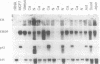
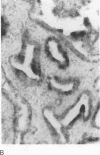
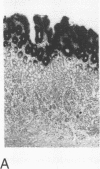
BACKGROUND: Evidence exists for a role for oestrogen in gastric cancer. The incidence of gastric cancer is much higher in men than in woman, and a similar sex difference is also seen in a rat experimental model of gastric cancer. AIMS: Evidence for a functional oestrogen receptor in normal gastric mucosa and cancer has been sought. METHODS: Oestrogen receptor and the oestrogen inducible genes pS2 and ERD5 were sought by northern blot analysis and in situ hybridisation and immunohistochemistry. Oestrogen receptor protein was studied by enzyme immunoassay. RESULTS: mRNA for oestrogen receptor was detected in cancer and normal gastric mucosa. Enzyme immunoassay for oestrogen receptor showed a mean of 1.8 fmol/mg protein in cancer and 13.7 fmol/mg in paired normal mucosa. The oestrogen inducible genes pS2 and ERD5 were also detected in both cancer and normal mucosa, with expression localised to epithelium. Expression of pS2 was lower in cancer compared with normal mucosa, whereas ERD5 expression was higher in cancer. CONCLUSIONS: Significant amounts of oestrogen receptor were expressed in gastric mucosa with a lower amount in cancer. Oestrogen inducible genes were also expressed differentially but were not found to correlate closely with oestrogen receptor. Oestrogen receptor functionality remains to be demonstrated in the stomach.
Full text
PDF


Images in this article
Selected References
These references are in PubMed. This may not be the complete list of references from this article.
- Berry M., Nunez A. M., Chambon P. Estrogen-responsive element of the human pS2 gene is an imperfectly palindromic sequence. Proc Natl Acad Sci U S A. 1989 Feb;86(4):1218–1222. doi: 10.1073/pnas.86.4.1218. [DOI] [PMC free article] [PubMed] [Google Scholar]
- Bradford M. M. A rapid and sensitive method for the quantitation of microgram quantities of protein utilizing the principle of protein-dye binding. Anal Biochem. 1976 May 7;72:248–254. doi: 10.1016/0003-2697(76)90527-3. [DOI] [PubMed] [Google Scholar]
- Cano A., Coffer A. I., Adatia R., Millis R. R., Rubens R. D., King R. J. Histochemical studies with an estrogen receptor-related protein in human breast tumors. Cancer Res. 1986 Dec;46(12 Pt 1):6475–6480. [PubMed] [Google Scholar]
- Chan Y. L., Gutell R., Noller H. F., Wool I. G. The nucleotide sequence of a rat 18 S ribosomal ribonucleic acid gene and a proposal for the secondary structure of 18 S ribosomal ribonucleic acid. J Biol Chem. 1984 Jan 10;259(1):224–230. [PubMed] [Google Scholar]
- Chomczynski P., Sacchi N. Single-step method of RNA isolation by acid guanidinium thiocyanate-phenol-chloroform extraction. Anal Biochem. 1987 Apr;162(1):156–159. doi: 10.1006/abio.1987.9999. [DOI] [PubMed] [Google Scholar]
- Coffer A. I., Lewis K. M., Brockas A. J., King R. J. Monoclonal antibodies against a component related to soluble estrogen receptor. Cancer Res. 1985 Aug;45(8):3686–3693. [PubMed] [Google Scholar]
- Coffer A. I., Spiller G. H., Lewis K. M., King R. J. Immunoradiometric studies with monoclonal antibody against a component related to human estrogen receptor. Cancer Res. 1985 Aug;45(8):3694–3698. [PubMed] [Google Scholar]
- Edwards D. P., Adams D. J., McGuire W. L. Estradiol stimulates synthesis of a major intracellular protein in a human breast cancer cell line (MCF-7). Breast Cancer Res Treat. 1981;1(3):209–223. doi: 10.1007/BF01806261. [DOI] [PubMed] [Google Scholar]
- Furukawa H., Iwanaga T., Koyama H., Taniguchi H. Effect of sex hormones on carcinogenesis in the stomachs of rats. Cancer Res. 1982 Dec;42(12):5181–5182. [PubMed] [Google Scholar]
- Green S., Walter P., Kumar V., Krust A., Bornert J. M., Argos P., Chambon P. Human oestrogen receptor cDNA: sequence, expression and homology to v-erb-A. Nature. 1986 Mar 13;320(6058):134–139. doi: 10.1038/320134a0. [DOI] [PubMed] [Google Scholar]
- Harrison J. D., Jones J. A., Ellis I. O., Morris D. L. Oestrogen receptor D5 antibody is an independent negative prognostic factor in gastric cancer. Br J Surg. 1991 Mar;78(3):334–336. doi: 10.1002/bjs.1800780321. [DOI] [PubMed] [Google Scholar]
- Harrison J. D., Morris D. L., Ellis I. O., Jones J. A., Jackson I. The effect of tamoxifen and estrogen receptor status on survival in gastric carcinoma. Cancer. 1989 Sep 1;64(5):1007–1010. doi: 10.1002/1097-0142(19890901)64:5<1007::aid-cncr2820640506>3.0.co;2-u. [DOI] [PubMed] [Google Scholar]
- Henry J. A., Nicholson S., Hennessy C., Lennard T. W., May F. E., Westley B. R. Expression of the oestrogen regulated pNR-2 mRNA in human breast cancer: relation to oestrogen receptor mRNA levels and response to tamoxifen therapy. Br J Cancer. 1990 Jan;61(1):32–38. doi: 10.1038/bjc.1990.8. [DOI] [PMC free article] [PubMed] [Google Scholar]
- Kitaoka H. [Sex hormone dependency and endocrine therapy in diffuse carcinoma of the stomach]. Gan To Kagaku Ryoho. 1983 Dec;10(12):2453–2460. [PubMed] [Google Scholar]
- Kittas C., Xynos E., Neonakis E., Fountos A., Aroni K., Vassilakis J. S. Sex related differences in serum gastrin concentrations and G- and D-cell populations of the gastric mucosa in guinea-pigs (experimental RIA and immunocytochemical study). Br J Exp Pathol. 1986 Apr;67(2):229–233. [PMC free article] [PubMed] [Google Scholar]
- Kojima O., Takahashi T., Kawakami S., Uehara Y., Matsui M. Localization of estrogen receptors in gastric cancer using immunohistochemical staining of monoclonal antibody. Cancer. 1991 May 1;67(9):2401–2406. doi: 10.1002/1097-0142(19910501)67:9<2401::aid-cncr2820670931>3.0.co;2-h. [DOI] [PubMed] [Google Scholar]
- Kojima O., Takahashi T. [Endocrine therapy of scirrhous carcinoma of the stomach]. Gan To Kagaku Ryoho. 1986 Aug;13(8):2526–2531. [PubMed] [Google Scholar]
- Lichtenberger L. M., Nance D. M., Gorski R. A., Grossman M. I. Sex-related difference in antral and serum gastrin levels in the rat. Proc Soc Exp Biol Med. 1976 Apr;151(4):785–788. doi: 10.3181/00379727-151-39307. [DOI] [PubMed] [Google Scholar]
- Luqmani Y., Bennett C., Paterson I., Corbishley C. M., Rio M. C., Chambon P., Ryall G. Expression of the pS2 gene in normal, benign and neoplastic human stomach. Int J Cancer. 1989 Nov 15;44(5):806–812. doi: 10.1002/ijc.2910440510. [DOI] [PubMed] [Google Scholar]
- Markopoulos C., Berger U., Wilson P., Gazet J. C., Coombes R. C. Oestrogen receptor content of normal breast cells and breast carcinomas throughout the menstrual cycle. Br Med J (Clin Res Ed) 1988 May 14;296(6633):1349–1351. doi: 10.1136/bmj.296.6633.1349. [DOI] [PMC free article] [PubMed] [Google Scholar]
- Masiakowski P., Breathnach R., Bloch J., Gannon F., Krust A., Chambon P. Cloning of cDNA sequences of hormone-regulated genes from the MCF-7 human breast cancer cell line. Nucleic Acids Res. 1982 Dec 20;10(24):7895–7903. doi: 10.1093/nar/10.24.7895. [DOI] [PMC free article] [PubMed] [Google Scholar]
- Mendelsohn M. E., Zhu Y., O'Neill S. The 29-kDa proteins phosphorylated in thrombin-activated human platelets are forms of the estrogen receptor-related 27-kDa heat shock protein. Proc Natl Acad Sci U S A. 1991 Dec 15;88(24):11212–11216. doi: 10.1073/pnas.88.24.11212. [DOI] [PMC free article] [PubMed] [Google Scholar]
- Müller W., Borchard F. pS2 protein in gastric carcinoma and normal gastric mucosa: association with clincopathological parameters and patient survival. J Pathol. 1993 Dec;171(4):263–269. doi: 10.1002/path.1711710406. [DOI] [PubMed] [Google Scholar]
- Nunez A. M., Berry M., Imler J. L., Chambon P. The 5' flanking region of the pS2 gene contains a complex enhancer region responsive to oestrogens, epidermal growth factor, a tumour promoter (TPA), the c-Ha-ras oncoprotein and the c-jun protein. EMBO J. 1989 Mar;8(3):823–829. doi: 10.1002/j.1460-2075.1989.tb03443.x. [DOI] [PMC free article] [PubMed] [Google Scholar]
- Palli D., Cipriani F., Decarli A., Galli M., Saieva C., Fraumeni J. F., Jr, Blot W. J., Buiatti E. Reproductive history and gastric cancer among post-menopausal women. Int J Cancer. 1994 Mar 15;56(6):812–815. doi: 10.1002/ijc.2910560609. [DOI] [PubMed] [Google Scholar]
- Rio M. C., Bellocq J. P., Gairard B., Rasmussen U. B., Krust A., Koehl C., Calderoli H., Schiff V., Renaud R., Chambon P. Specific expression of the pS2 gene in subclasses of breast cancers in comparison with expression of the estrogen and progesterone receptors and the oncogene ERBB2. Proc Natl Acad Sci U S A. 1987 Dec;84(24):9243–9247. doi: 10.1073/pnas.84.24.9243. [DOI] [PMC free article] [PubMed] [Google Scholar]
- TRUELOVE S. C. Stilboestrol, phenobarbitone, and diet in chronic duodenal ulcer. A factorial therapeutic trial. Br Med J. 1960 Aug 20;2(5198):559–566. doi: 10.1136/bmj.2.5198.559. [DOI] [PMC free article] [PubMed] [Google Scholar]
- Tønnesen H., Knigge U., Bülow S., Damm P., Fischerman K., Hesselfeldt P., Hjortrup A., Pedersen I. K., Pedersen V. M., Siemssen O. J. Effect of cimetidine on survival after gastric cancer. Lancet. 1988 Oct 29;2(8618):990–992. doi: 10.1016/s0140-6736(88)90743-x. [DOI] [PubMed] [Google Scholar]
- Wu C. W., Chang H. M., Kao H. L., Lui W. Y., P'eng F. K., Chi C. W. The nontransformed progesterone and estrogen receptors in gastric cancer. Gastroenterology. 1992 May;102(5):1639–1646. doi: 10.1016/0016-5085(92)91724-i. [DOI] [PubMed] [Google Scholar]