



Abstract
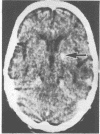
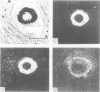
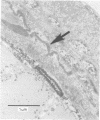
Three patients presented with encephalopathies: an undiagnosed degenerative disease of the brain, a degenerative cerebral disease in a patient with a myeloma but without a myelomatous deposit in the CNS and a malignant astrocytoma. Perivascular pallidal deposits (vascular siderosis) containing chromium, phosphorus and calcium plus sometimes traces of other elements were present in the three cases. Such deposits were present in the pallidal parenchyma and around vessels in the cerebellum in one case. Calcium and phosphorus are always present in any CNS calcification but the presence of chromium has not been reported. Chromium and its compounds (ingested, injected or inhaled) are toxic to humans and animals in trace doses. Approximately 900 cases of chromium intoxication have been reported and usually have had dermatological or pulmonary lesions (including cancer) but there is no report of involvement of the CNS. Sublethal doses of chromium nitrate injected intraperitoneally in rats and rabbits results in the presence of chromium in the brain. A thorough investigation was made to find the source of the chromium in these patients. Chromium was found to be present in trace amounts in the radiological contrast agents administered to these patients and in the KCl replacement solution and in mylanta, an antacid, given to one case. The evidence that chromium induced pathological changes in these three brains is circumstantial but shows that chromium can penetrate the human brain. This study indicates that vascular siderosis found in the brains of the majority of middle-aged and elderly humans is not simply an anecdotal pathological curiosity, but that it can serve as a route of entry for toxic products into the brain.
Full text
PDF


Images in this article
Selected References
These references are in PubMed. This may not be the complete list of references from this article.
- Burchiel K. J. Ectopic impulse generation in demyelinated axons: effects of PaCO2, pH, and disodium edetate. Ann Neurol. 1981 Apr;9(4):378–383. doi: 10.1002/ana.410090411. [DOI] [PubMed] [Google Scholar]
- Duckett S., Galle P., Kradin R. The relationship between Parkinson syndrome and vascular siderosis: an electron microprobe study. Ann Neurol. 1977 Sep;2(3):225–229. doi: 10.1002/ana.410020308. [DOI] [PubMed] [Google Scholar]
- Gooddy W., Hamilton E. I., Williams T. R. Spark-source mass spectrometry in the investigation of neurological disease. II. Element levels in brain, cerebrospinal fluid and blood: some observations on their abundance and significance. Brain. 1975 Mar;98(1):65–70. doi: 10.1093/brain/98.1.65. [DOI] [PubMed] [Google Scholar]
- Jeejeebhoy K. N., Chu R. C., Marliss E. B., Greenberg G. R., Bruce-Robertson A. Chromium deficiency, glucose intolerance, and neuropathy reversed by chromium supplementation, in a patient receiving long-term total parenteral nutrition. Am J Clin Nutr. 1977 Apr;30(4):531–538. doi: 10.1093/ajcn/30.4.531. [DOI] [PubMed] [Google Scholar]
- Junck L., Marshall W. H. Neurotoxicity of radiological contrast agents. Ann Neurol. 1983 May;13(5):469–484. doi: 10.1002/ana.410130502. [DOI] [PubMed] [Google Scholar]
- Tandon S. K., Behari J. R., Kachru D. N. Distribution of chromium in poisoned rats. Toxicology. 1979 May;13(1):29–34. [PubMed] [Google Scholar]