



Abstract
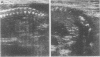
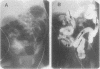
The pathophysiological significance of fetal echogenic gut (FEG) is unknown. Our aim was prospectively to evaluate FEG in infants with intrauterine growth retardation (IUGR) and absent umbilical artery end diastolic flow velocities. Over a 15 month period, nine infants with FEG met these criteria. Nine infants who, on antenatal assessment, had demonstrated IURG and absent umbilical artery end diastolic flow velocities, but no evidence of FEG, were selected as case-controls. Gastrointestinal function was then prospectively evaluated in both groups after delivery. All liveborn infants received nasogastric feeds of breast milk by 8 days of age. All in the FEG group developed marked abdominal distension, large, bile stained, nasogastric aspirates, and constipation requiring rectal washouts. This led to a discontinuation of enteral feeds on one or more occasions. Two patients in the FEG group required water soluble contrast enemas in order to relieve intestinal obstruction. In the control group, 3/9 patients had abdominal distension, but no rectal washouts were given and enteral feeds were not interrupted. The median (range) time to tolerate full enteral feeds was 15 (7-32) days in the FEG group, compared with 4 (1-8) days in the control group. In the FEG group 5/6 patients required parenteral nutrition for 5-27 days. In the control group one patient required parenteral nutrition over a period of four days only. No child had necrotising enterocolitis or cystic fibrosis. When FEG is observed in the fetus with IUGR, problems with enteral feeding should be anticipated.
Full text
PDF


Images in this article
Selected References
These references are in PubMed. This may not be the complete list of references from this article.
- Blott M., Greenough A., Gamsu H. R., Nicolaides K., Campbell S. Antenatal factors associated with obstruction of the gastrointestinal tract by meconium. Br Med J (Clin Res Ed) 1988 Jan 23;296(6617):250–250. doi: 10.1136/bmj.296.6617.250. [DOI] [PMC free article] [PubMed] [Google Scholar]
- Commey J. O., Fitzhardinge P. M. Handicap in the preterm small-for-gestational age infant. J Pediatr. 1979 May;94(5):779–786. doi: 10.1016/s0022-3476(79)80156-0. [DOI] [PubMed] [Google Scholar]
- Dobson P. C., Abell D. A., Beischer N. A. Mortality and morbidity of fetal growth retardation. Aust N Z J Obstet Gynaecol. 1981 May;21(2):69–72. doi: 10.1111/j.1479-828x.1981.tb00781.x. [DOI] [PubMed] [Google Scholar]
- Erskine R. L., Ritchie J. W. Umbilical artery blood flow characteristics in normal and growth-retarded fetuses. Br J Obstet Gynaecol. 1985 Jun;92(6):605–610. doi: 10.1111/j.1471-0528.1985.tb01399.x. [DOI] [PubMed] [Google Scholar]
- Fleischer A., Schulman H., Farmakides G., Bracero L., Blattner P., Randolph G. Umbilical artery velocity waveforms and intrauterine growth retardation. Am J Obstet Gynecol. 1985 Feb 15;151(4):502–505. doi: 10.1016/0002-9378(85)90278-9. [DOI] [PubMed] [Google Scholar]
- Foster M. A., Nyberg D. A., Mahony B. S., Mack L. A., Marks W. M., Raabe R. D. Meconium peritonitis: prenatal sonographic findings and their clinical significance. Radiology. 1987 Dec;165(3):661–665. doi: 10.1148/radiology.165.3.3317498. [DOI] [PubMed] [Google Scholar]
- Giles W. B., Trudinger B. J., Baird P. J. Fetal umbilical artery flow velocity waveforms and placental resistance: pathological correlation. Br J Obstet Gynaecol. 1985 Jan;92(1):31–38. doi: 10.1111/j.1471-0528.1985.tb01045.x. [DOI] [PubMed] [Google Scholar]
- Hackett G. A., Campbell S., Gamsu H., Cohen-Overbeek T., Pearce J. M. Doppler studies in the growth retarded fetus and prediction of neonatal necrotising enterocolitis, haemorrhage, and neonatal morbidity. Br Med J (Clin Res Ed) 1987 Jan 3;294(6563):13–16. doi: 10.1136/bmj.294.6563.13. [DOI] [PMC free article] [PubMed] [Google Scholar]
- Malcolm G., Ellwood D., Devonald K., Beilby R., Henderson-Smart D. Absent or reversed end diastolic flow velocity in the umbilical artery and necrotising enterocolitis. Arch Dis Child. 1991 Jul;66(7 Spec No):805–807. doi: 10.1136/adc.66.7_spec_no.805. [DOI] [PMC free article] [PubMed] [Google Scholar]
- Reuwer P. J., Bruinse H. W., Stoutenbeek P., Haspels A. A. Doppler assessment of the fetoplacental circulation in normal and growth-retarded fetuses. Eur J Obstet Gynecol Reprod Biol. 1984 Nov;18(4):199–205. doi: 10.1016/0028-2243(84)90117-5. [DOI] [PubMed] [Google Scholar]
- Tejani N., Mann L. I. Diagnosis and management of the small-for-gestational-age fetus. Clin Obstet Gynecol. 1977 Dec;20(4):943–955. doi: 10.1097/00003081-197712000-00016. [DOI] [PubMed] [Google Scholar]
- Trudinger B. J., Giles W. B., Cook C. M., Bombardieri J., Collins L. Fetal umbilical artery flow velocity waveforms and placental resistance: clinical significance. Br J Obstet Gynaecol. 1985 Jan;92(1):23–30. doi: 10.1111/j.1471-0528.1985.tb01044.x. [DOI] [PubMed] [Google Scholar]
- Wladimiroff J. W., Noordam M. J., van den Wijngaard J. A., Hop W. C. Fetal internal carotid and umbilical artery blood flow velocity waveforms as a measure of fetal well-being in intrauterine growth retardation. Pediatr Res. 1988 Nov;24(5):609–612. doi: 10.1203/00006450-198811000-00014. [DOI] [PubMed] [Google Scholar]
- Wladimiroff J. W., vd Wijngaard J. A., Degani S., Noordam M. J., van Eyck J., Tonge H. M. Cerebral and umbilical arterial blood flow velocity waveforms in normal and growth-retarded pregnancies. Obstet Gynecol. 1987 May;69(5):705–709. [PubMed] [Google Scholar]