



Abstract
Thoracic esophagectomy is a particularly invasive and complicated surgical procedure, with a reconstruction of the gastrointestinal tract, such as the stomach, jejunum, or colon. The posterior mediastinal, retrosternal, and subcutaneous routes are the three possible esophageal reconstruction routes. Each route has advantages and disadvantages, and the optimal reconstruction route after esophagectomy remains controversial. Additionally, the best anastomotic techniques after esophagectomy in terms of location (Ivor Lewis or McKeown) and suturing (manual or mechanical) are debatable. Our meta‐analysis investigating postoperative complications after esophagectomy between the posterior mediastinal and retrosternal routes revealed that the posterior mediastinal route was associated with a significantly lower anastomotic leakage rate than the retrosternal route (odds ratio = 0.78, 95% confidence interval: 0.70–0.87, p < 0.0001). Conversely, pulmonary complications (odds ratio = 0.80, 95% confidence interval: 0.58–1.11, p = 0.19) and mortality between the posterior mediastinal and retrosternal routes (odds ratio = 0.79, 95% confidence interval: 0.56–1.12, p = 0.19) were not significantly different. However, the incidence of pneumonia may be lower when using the retrosternal route rather than the posterior mediastinal route for performing minimally invasive esophagectomy. The McKeown procedure is oncologically necessary for tumors located above the carina to dissect upper mediastinal and cervical lymph nodes; however, the Ivor Lewis procedure offers perioperative and oncological safety for tumors located under the carina. An individualized treatment strategy for selecting the optimal reconstruction procedure can be proposed in future studies based on oncological and patient risk factors considering mid‐ to long‐term quality of life.
Keywords: esophageal reconstruction, esophagectomy, Ivor Lewis, McKeown, posterior mediastinal route, retrosternal route, subcutaneous route
Anastomotic leakage was significantly less in the posterior mediastinal route, and the incidence of pneumonia was significantly lower in the retrosternal route in MIE. In the future, an individualized treatment strategy for selecting the optimal reconstruction procedure can be proposed based on oncological and patient risk factors considering mid‐ to long‐term QOL.

1. INTRODUCTION
Esophageal cancer is the sixth leading cause of cancer‐related mortality worldwide because of its high malignant potential and poor prognosis. 1 Esophagectomy remains the most effective treatment option, although chemoradiotherapy may effectively treat esophageal cancer. The vast majority of esophageal cancers in the Asia‐Pacific region, including Japan, are squamous cell carcinomas (SCCs) located in the upper to lower portions of the thoracic segment of the esophagus. 2 Subtotal esophagectomy, two‐or three‐field lymphadenectomy, and reconstruction using organs, such as a gastric tube, whole stomach, colon, or jejunum, are common surgical treatments for thoracic esophageal SCC. 2 , 3 Despite advances in extended lymph node dissection and perioperative management of esophagectomy, these procedures remain highly invasive and are associated with severe morbidities, such as anastomotic leaks, pulmonary complications, and cardiac events. 4
Transthoracic esophagectomy can be performed via intrathoracic or cervical anastomosis. In East Asia, thoracic esophageal SCC is predominant, for which the McKeown procedure (cervical anastomosis) is typically used; conversely, in western countries, esophagogastric junctional adenocarcinoma is predominant, for which the Ivor Lewis procedure (intrathoracic anastomosis) is typically used. 5 Regional preferences differ depending on the predominant tumor location; thus, the superior procedure (Ivor Lewis vs. McKeown) remains controversial.
The posterior mediastinal, retrosternal, and subcutaneous routes are the three possible esophageal reconstruction routes. Each route has advantages and disadvantages, and the optimal reconstruction route after esophagectomy remains controversial. 6 The first‐choice route for reconstruction after esophagectomy in clinical practice depends on institutional policy or surgeon preference. 7 However, the final reconstruction route might differ depending on the tumor stage and patient comorbidities. 7 The retrosternal route is often selected for patients who are at high risk of postoperative local recurrence because irradiating the posterior mediastinum is easier. Conversely, the posterior mediastinal route is frequently selected for patients with a history of cardiac surgery because constructing the retrosternal route through the front of the heart is difficult.
Recently, the stomach has been the most common first choice for esophageal replacement, with the jejunum or colonic interposition being the conduit of choice when the stomach is not available. 8 The use of the jejunum or colon depends on institutional policy or surgeon preference, and the superior organ (jejunum vs. colon) remains controversial.
Currently, the mainstream anastomotic techniques include manual suturing, circular stapling, side‐to‐side linear stapling (also known as Collard and T‐sharp anastomoses), and triangulating stapling. 9 Because of the lack of large‐scale randomized controlled trials (RCTs), there is no conclusive evidence regarding these anastomotic techniques. Thus, the anastomotic technique is currently not standardized and depends on institutional policy or surgeon preference.
This review describes the optimal reconstruction procedures after esophagectomy, considering the reconstructed routes; reconstructed organs; anastomotic technique in terms of location and suturing; and short‐term outcomes, such as postoperative complications, mortality, or postoperative quality of life (QOL).
2. CURRENT STATUS OF RECONSTRUCTION AFTER ESOPHAGECTOMY IN JAPAN
The latest National Clinical Database (NCD), which is a nationwide, web‐based, data entry system in Japan, reported 4916 and 6111 esophagectomies with a 90‐day mortality rate of 3.2% in 2011 and 1.5% in 2020, respectively. 10 NCD revealed the increasing incidence of esophagectomy and decreasing mortality in Japan. The incidence of endoscopic surgery, such as thoracoscopic esophagectomy, was 31.0% in 2011, which increased to 71.3% in 2020, indicating the rapidly increasing incidence of endoscopic surgery in esophagectomy. 10 Since 2018 when robotic esophagectomy was covered by health insurance, its use has spread rapidly, and robotic esophagectomy will likely account for most endoscopic surgeries during esophagectomy in the future.
The comprehensive registry of esophageal cancer in Japan reported 5172 reconstruction cases after esophagectomy in 2015, in which the retrosternal route was the most common in 2383 (46.1%) cases, followed by the posterior mediastinal route in 1977 (38.2%) cases, accounting for 85% of the two routes. 2 Additionally, 319 (6.2%) and 317 (6.1%) reconstructions were performed via the subcutaneous and intrathoracic routes, respectively. Of the total 5276 organs, gastric conduits accounted for the majority in 4504 (85.4%) cases, whole stomach in 212 (4.0%), jejunum in 210 (4.0%), and colon in 158 (3.0%) cases. The comparison of the theoretical advantages of gastric conduit and other organs revealed inherent easy access, rich submucosal vasculature, and elasticity in the stomach. Therefore, the stomach is the most common first choice for esophageal replacement. 8 The jejunum and colon are the conduits of choice when the stomach is unavailable for esophageal replacement. 11 This review describes the optimal reconstruction procedures after esophagectomy.
3. COMPARISON OF THE LENGTHS OF THE POSTERIOR MEDIASTINAL, RETROSTERNAL, AND SUBCUTANEOUS ROUTES
When the reconstructed organ is mobilized, straightened, and pulled up to the neck, the feeding blood vessels are sacrificed to prioritize long distances, resulting in decreased blood flow to the tip of the reconstructed organ (Figure 1). 6 Poor blood flow to the anastomosis is considered a major cause of anastomotic leakage. 12 A reasonable strategy to prevent anastomotic leakage is to pull up the reconstructed organs through the shortest route because the blood flow worsens when approaching the tip of the reconstructed organ. 6
FIGURE 1.
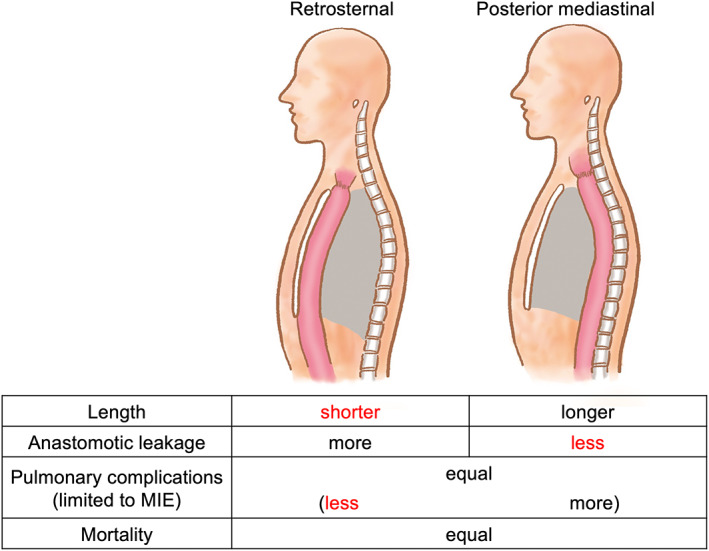
Illustration comparing the retrosternal and posterior mediastinal routes.
To date, several studies have compared the lengths of the three reconstruction routes (Table 1). 6 , 13 , 14 , 15 , 16 , 17 , 18 The subcutaneous route is longer than the posterior mediastinal and retrosternal routes. 6 Some reports have revealed that the posterior mediastinal route is shorter than the retrosternal route. 13 , 14 , 15 , 17 Conversely, other reports have indicated that the retrosternal route is shorter than the posterior mediastinal route 6 , 16 , 17 , 18 ; thus, no consensus has been reached yet. There are two possible explanations for the lack of consistent findings in the studies that aimed to identify the shortest reconstruction route. 6 One is whether the study was performed in cadavers or living patients and the other is the difference in the reference points used for measurement. All three studies that obtained measurements intraoperatively in living subjects concluded that the retrosternal route is the shortest, 6 , 16 , 18 which may be true. A surgical reconstruction route may not be accurately reproduced in a cadaver. With regard to differences in the reference points used for measurement, most studies have used the left inferior border of the cricoid cartilage as the proximal reference point, which is extremely close to the endpoint of reconstruction; hence, it can be regarded as the optimum measurement point. 6 Conversely, the distal reference point differs among reports. Some studies have set the pyloric ring as the distal reference point; however, the pyloric ring moves during gastric conduit pull‐up and is considered inappropriate as the distal reference point. Considering that the point that limits gastric conduit elevation is optimal as a distal reference point, the gastroduodenal artery or the boundary between the first and second parts of the duodenum is an appropriate distal reference point. 6
TABLE 1.
Comparison of the lengths of the posterior mediastinal and retrosternal routes.
| References | No. of cases | Subjects | Proximal reference point | Distal reference point | Length of PM (cm) | Length of RS (cm) | Difference (PM–RS) (cm) |
|---|---|---|---|---|---|---|---|
| Orringer et al. 13 | 10 | Cadaver | Unknown | Unknown | Unknown | Unknown | PM < RS |
| Ngan et al. 14 | 20 | Cadaver | Cricoid cartilage | Celiac axis | 30.3 ± 2.1 | 32.2 ± 2.6 | −1.9 |
| Coral et al. 15 | 50 | Cadaver | Cricoid cartilage | GDA | 32.44 ± 4.2 | 34.95 ± 3.1 | −2.51 |
| Celiac axis | 30.82 ± 3.5 | 36.13 ± 3.2 | −5.31 | ||||
| Chen et al. 16 | 60 | Living patients | Cricoid cartilage | Pyloric ring | 35.5 ± 2.9 | 32.7 ± 2.7 | +2.8 |
| Hu et al. 17 | 20 | Cadaver | Cricoid cartilage | GDA | 36.7 ± 2.7 | 35.4 ± 2.6 | +1.3 |
| Celiac axis | 32.4 ± 2.3 | 34.9 ± 2.5 | −2.5 | ||||
| Pyloric ring | 36.4 ± 2.9 | 34.9 ± 2.8 | +1.5 | ||||
| Yang et al. 18 | 103 | Living patients | Suprasternal notch | Intersection point of the lesser curvature and pyloric channel | 30.18 ± 1.43 | 27.69 ± 1.35 | +2.49 |
| Yasuda et al. 6 | 112 | Living patients | Cricoid cartilage | Superior border of the duodenum arising from the head of the pancreas | 34.7 ± 2.37 | 32.4 ± 2.24 | +2.31 |
Abbreviations: GDA, gastroduodenal artery; PM, posterior mediastinal route; RS, retrosternal route.
Therefore, the retrosternal route was shorter than the posterior mediastinal route in all studies using appropriate distal references in living patients. The retrosternal route is optimal based on the length of the reconstruction routes; however, the optimal reconstruction route cannot be determined only by the length of the reconstruction route.
4. COMPARISON OF POSTOPERATIVE COMPLICATIONS BETWEEN THE POSTERIOR MEDIASTINAL AND RETROSTERNAL ROUTES
Among the three different reconstruction routes, the posterior mediastinal and retrosternal routes constitute the vast majority because of their advantages over the subcutaneous route, such as shorter reconstruction routes and fewer cosmetic changes after esophagectomy (Figure 1). 7 Currently, the subcutaneous route is an option only in high‐risk patients or when gastric conduit is unavailable. Therefore, this chapter compares the incidence of postoperative complications after esophagectomy between the posterior mediastinal and retrosternal routes using gastric conduits. Two important studies compared the posterior mediastinal and retrosternal routes after esophagectomy (Table 2). 7 , 19 The first is a high‐quality meta‐analysis of 19 articles, including eight RCTs and 11 case–control trials. 19 The second is a large‐scale nationwide retrospective study on NCD data in Japan. 7 Because the search period for the previous meta‐analysis was until March 2020, we manually searched for appropriate articles after the search period, added a study analyzing NCDs 7 and a retrospective study, 20 and performed another meta‐analysis that included data from the previous meta‐analysis. 19
TABLE 2.
Comparison of postoperative complications and mortality of the posterior mediastinal and retrosternal routes.
| Study type | Reconstruction route | Anastomotic leakage | Pulmonary complications | Mortality | |||
|---|---|---|---|---|---|---|---|
| Ratio | p‐Value | Ratio | p‐Value | Ratio | p‐Value | ||
| Meta‐analysis among RCTs 19 | Posterior mediastinal | 15.6% (30/192) | 0.33 | 24.8% (31/125) | 0.26 | 4.8% (6/125) | 0.10 |
| Retrosternal | 18.9% (32/169) | 30.2% (39/129) | 10.9% (14/129) | ||||
| Meta‐analysis among case–control trials 19 | Posterior mediastinal | 11.1% (105/948) | <0.0001 | 25.4% (168/661) | 0.002 | 6.9% (32/464) | 0.31 |
| Retrosternal | 18.0% (216/1198) | 27.3% (202/740) | 4.0% (17/424) | ||||
| NCD data analysis 7 | Posterior mediastinal | 11.7% (408/3478) | 0.005 | 13.7% (475/3478) | 0.040 | 0.9% (33/3478) | 0.835 |
| Retrosternal | 13.8% (868/6308) | 12.2% (769/6308) | 1.0% (64/6308) | ||||
| Our meta‐analysis | Posterior mediastinal | 11.8% (550/4649) | <0.0001 | 15.9% (683/4295) | 0.19 | 1.7% (71/4067) | 0.19 |
| Retrosternal | 14.6% (1121/7703) | 14.0% (1012/7205) | 1.4% (95/6861) | ||||
Abbreviations: NCD, National Clinical Database; RCT, randomized controlled trial.
Review Manager Software® (Rev Man 5.3, Cochrane Collaboration) was used for analyses. A Mantel–Haenszel model was used for pooled analysis, and values were reported as odds ratios (ORs) with 95% confidence intervals (CIs). The significance of pooled ORs was determined using the Z‐test. A p‐value of <0.05 was considered to indicate statistical significance.
Cochran's chi‐square statistic was used to assess the statistical heterogeneity for each pooled estimate, which was quantified using Ι 2 statistic. An Ι 2 value of >50% was considered to indicate heterogeneity. A random‐effect model was employed if heterogeneity was detected, and a fixed‐effect model was used in other cases.
4.1. Anastomotic leakage
The anastomotic leakage rate in patients undergoing esophageal reconstruction was high at 13.3%. 21 This rate is higher than that associated with other major abdominal surgeries, including total gastrectomy, rectal resection, and pancreaticoduodenectomy. 6
Our meta‐analysis evaluated the impact of reconstruction routes on anastomotic leakage in six RCTs including 192 posterior mediastinal and 169 retrosternal cases, 19 , 22 , 23 , 24 , 25 , 26 , 27 12 case–control trials comprising 979 posterior mediastinal and 1226 retrosternal cases, 18 , 19 , 20 , 28 , 29 , 30 , 31 , 32 , 33 , 34 , 35 , 36 , 37 and NCD analysis including 3478 posterior mediastinal and 6308 retrosternal cases 7 (Figure 2A). Our meta‐analysis showed that the posterior mediastinal route was significantly associated with a lower anastomotic leakage rate than the retrosternal route (OR = 0.78, 95% CI: 0.70–0.87, p < 0.0001).
FIGURE 2.
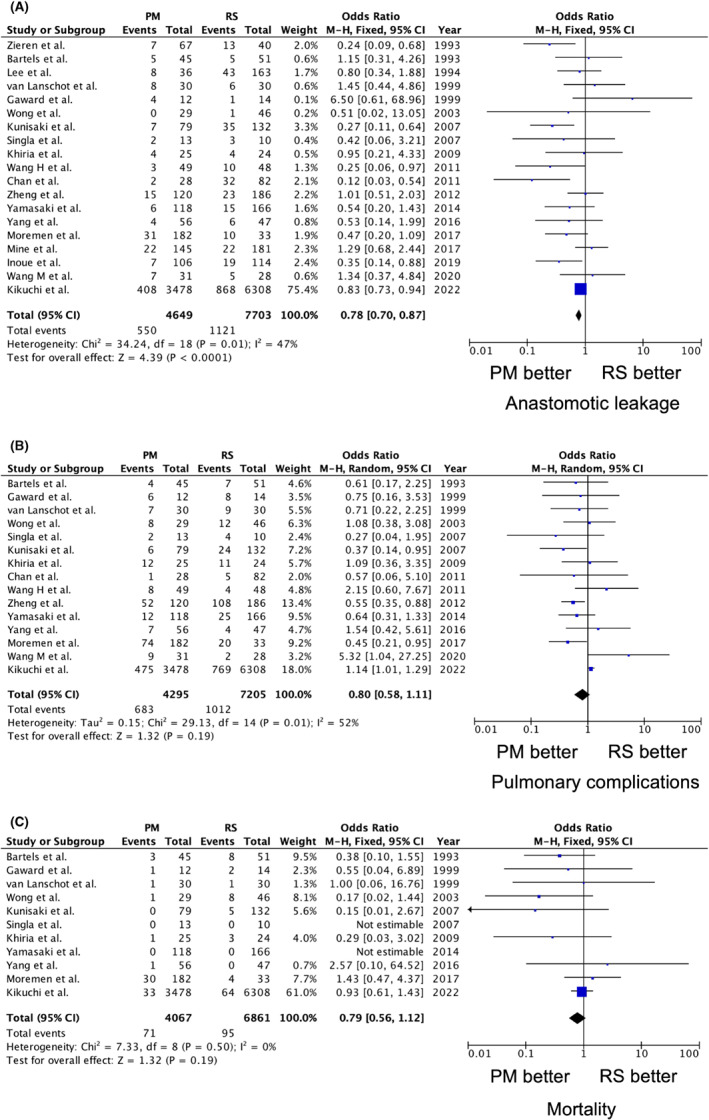
Forest plots comparing the effects of reconstruction routes after esophagectomy on anastomotic leakage (A), pulmonary complications (B), and mortality (C). The Mantel–Haenszel random‐effect model (B) or fixed‐effect model (A, C) was used for the meta‐analysis. Odds ratios are shown with 95% confidence intervals. PM, posterior mediastinal; RS, retrosternal.
Similarly, our meta‐analysis and NCD analysis revealed that the posterior mediastinal route had significantly less anastomotic leakage after esophagectomy than the retrosternal route. These results may provide strong evidence for less anastomotic leakage in the posterior mediastinal route than in the retrosternal route.
Blood flow and tension are important risk factors for anastomotic leakage. Compared with the posterior mediastinal route, the sternal stalk is compressed in the retrosternal route, which may cause tension in the gastric conduit. 19 Based on the previous chapter review, the retrosternal route was believed to be shorter than the posterior mediastinal route, and the difference between the two routes was 2.3 cm according to Yasuda et al. 6 Although the posterior mediastinal route is longer than the retrosternal route, the anastomosis may receive sufficient blood flow through both routes and may not contribute to anastomotic leakage. Therefore, compression has a greater impact on anastomotic leakage than blood flow in gastric conduit reconstruction after esophagectomy.
4.2. Pulmonary complications
Pulmonary complications are the most frequent nonsurgical complications (approximately 15%), 21 , 38 and we previously reported that pulmonary complications have a significant negative effect on overall survival after esophagectomy. 39 , 40 , 41
Our meta‐analysis evaluated the impact of reconstruction routes on pulmonary complications in five RCTs comprising 125 posterior mediastinal and 129 retrosternal cases, 19 , 22 , 23 , 24 , 25 , 26 nine case–control trials including 692 posterior mediastinal and 768 retrosternal case, 19 , 20 , 28 , 30 , 33 , 34 , 35 , 36 , 37 and NCD analysis involving 3478 posterior mediastinal and 6308 retrosternal cases (Figure 2B). Our meta‐analysis revealed no significant difference in pulmonary complications between the posterior mediastinal and retrosternal groups (OR = 0.80, 95% CI: 0.58–1.11, p = 0.19).
However, NCD data in Japan revealed that the incidence of pneumonia was significantly lower in the retrosternal group than in the posterior mediastinal group (12.2% vs. 13.7%; p = 0.040). 7 A latest case–control study revealed a significantly lower incidence of pneumonia in reconstruction cases after thoracoscopic and laparoscopic esophagectomies via the retrosternal route than via the posterior mediastinal route (7.1% vs. 29.0%, p = 0.036). 20 A feature of this case–control study is that minimally invasive esophagectomy (MIE) was performed in all cases, whereas MIE was performed in 85.9% of posterior mediastinal and 74.4% of retrosternal cases in NCD analysis. 7 In contrast, our meta‐analysis covered studies from 1993 to 2022 and revealed a considerably lower rate of MIE. The incidence of pneumonia may be lower when performing MIE through the retrosternal route than through the posterior mediastinal route. The posterior mediastinum could be occupied by gastric tube and omentum in the posterior mediastinal route, which may compress the trachea and bronchus and cause pulmonary atelectasis and pneumonia. 7 However, further cases, particularly MIE cases, should be accumulated and analyzed as this is a controversial topic.
4.3. Mortality
NCD revealed a decreasing trend in mortality rate for esophagectomy from 3.2% in 2011 to 1.5% in 2020, which is similar to the mortality rate for total gastrectomy. 10
Our meta‐analysis evaluated the effect of reconstruction routes on mortality in five RCTs including 125 posterior mediastinal and 129 retrosternal cases, 19 , 22 , 23 , 24 , 25 , 26 five case–control trials comprising 464 posterior mediastinal and 424 retrosternal cases, 18 , 19 , 30 , 33 , 35 , 36 and NCD analysis involving 3478 posterior mediastinal and 6308 retrosternal cases 7 (Figure 2C). Similar to NCD analysis, our meta‐analysis revealed no significant difference in mortality between the posterior mediastinal and retrosternal groups (OR = 0.79, 95% CI: 0.56–1.12, p = 0.19).
These results may provide strong evidence for the same safety offered by the posterior mediastinal and retrosternal routes. Recently, the introduction of MIE and improvement in perioperative management after esophagectomy have reduced the mortality rate, and both the posterior mediastinal and retrosternal routes are considered safe.
5. COMPARISON OF QOL BETWEEN THE POSTERIOR MEDIASTINAL AND RETROSTERNAL ROUTES
The interest in QOL has increased because of the increased number of long‐term survivors after esophagectomy; however, only a few studies have compared QOL between the posterior mediastinal and retrosternal groups after esophagectomy (Figure 3). Wang et al. 34 compared QOL in 97 patients with regard to reconstruction routes after esophagectomy. They suggested that the retrosternal route is related to better QOL because the retrosternal group presented with fewer symptoms of dyspnea and reflux than the posterior mediastinal group at 12 and 24 weeks postoperatively. Recently, Park et al. 42 revealed similar results. The QOL functional scales based on the reconstruction route revealed no differences at 2 years after esophagectomy, although differences were noted in early periods. Among the various symptom scales and single items of OES‐18, dysphagia and esophageal pain may be more severe in the retrosternal route than in the posterior mediastinal route; however, the functional symptoms did not differ between the two routes. This result suggested that the choice of reconstruction route after esophagectomy can be determined based on the oncological status of each patient or risk of postoperative complications, without considering functional outcomes or QOL. 42
FIGURE 3.
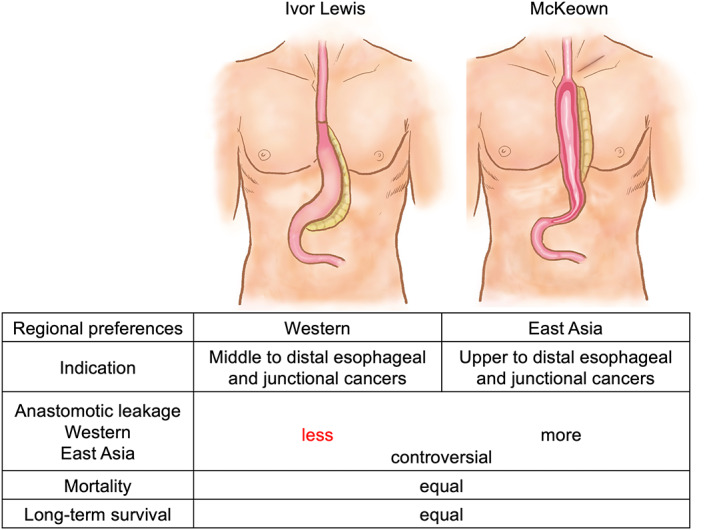
Illustration comparing the Ivor Lewis and McKeown procedures.
6. COMPARISON OF IVOR LEWIS AND MCKEOWN PROCEDURE
Transthoracic esophagectomy, which can be performed with either intrathoracic or cervical anastomoses, is preferred by many surgeons because it allows for adequate thoracic lymph node dissection (Figure 3). 43 Intrathoracic anastomosis after esophagectomy is defined as the Ivor Lewis procedure, whereas cervical anastomosis after esophagectomy is defined as the McKeown procedure. Initially, performing intrathoracic anastomosis was technically difficult in thoracoscopic esophagectomy; however, it has recently become relatively safe. 44 , 45 In general, the McKeown procedure is indicated for upper to distal esophageal and junctional cancers, whereas the Ivor Lewis procedure is indicated for middle to distal esophageal and junctional cancers. In general, the Ivor Lewis procedure is believed to be superior to the McKeown procedure as it is associated with a lower incidence of anastomotic leak and better cosmetic effect in patients undergoing open esophagectomy with two‐field lymphadenectomy. 44 However, most recent esophagectomies are minimally invasive, and reports of the Ivor Lewis procedure via MIE are increasing. 43
Two important reports were recently published, and the superior approach (Ivor Lewis vs. McKeown) remains controversial. 43 , 46 One is an RCT conducted in the Netherlands, which was limited to MIE, 46 and the other is a meta‐analysis focusing on cases reported in the past decades. 43 The RCT revealed that the Ivor Lewis procedure was associated with a significantly lower anastomotic leak rate than the McKeown procedure (12.3% vs. 34.1%; p < 0.001). 46 Further, the meta‐analysis reported that the McKeown procedure was associated with significantly higher grades of anastomotic leakage and recurrent laryngeal nerve palsy than the Ivor Lewis procedure. 43 Therefore, the anastomotic leakage rate was higher in the McKeown procedure; however, the RCT reported that the anastomotic leakage rate in the McKeown procedure was 34.1%, 43 which was considerably higher than that reported in NCD data in Japan. 21 Poor blood flow to the tip of the gastric tube and gastric tube compression by the thoracic outlet may lead to a higher incidence of anastomotic leakage in the McKeown procedure than in the Ivor Lewis procedure. The posterior mediastinal and retrosternal routes are generally longer in individuals from western countries than in those from Asian countries regardless of the reconstructed route because of racial differences, and the blood flow to the tip of the gastric tube is poor, which may lead to a higher incidence of anastomotic leakage in the McKeown procedure in individuals from western countries. The comprehensive registry of esophageal cancer in Japan revealed that the Ivor Lewis procedure was performed only in 6.1% of patients, 2 and the rate of anastomotic leakage in NCD (13.4%) appears similar to that in the McKeown procedure. Both procedures require a learning curve, and the McKeown and Ivor Lewis procedures have similar rates of anastomotic leakage when performed at experienced institutions. Compared with intrathoracic anastomotic leakage, it is easier to manage cervical anastomotic leakage to prevent the worsening of the condition. The McKeown procedure is safer than the Ivor Lewis procedure even with same anastomotic leakage rates because intrathoracic anastomotic leakage is more severe than cervical anastomotic leakage. The RCT reported no significant difference between the McKeown and Ivor Lewis procedures in terms of gastric tube necrosis, which is a more serious complication of poor blood flow. 46
The McKeown procedure has the advantages of cervical lymph node dissection and more proximal resection margins in terms of oncologic efficacy; however, no difference was observed in the total lymph nodes retrieved during surgery and R0 resection rates between the two procedures in the meta‐analysis. 43 These results indicate that all studies included in the meta‐analysis enrolled patients with middle to distal thoracic esophageal or gastroesophageal junction cancer, in whom cervical lymph node dissection is not required; thus, both procedures are oncologically feasible. 43 Therefore, Ivor Lewis esophagectomy offers perioperative and oncological safety for tumors located under the carina. Recently, a propensity score‐matched analysis using data from the Netherlands Cancer Registry and a Population‐based Nationwide Study in Finland both reported no statistically significant difference in long‐term survival between the Ivor Lewis and McKeown procedures. 47 , 48
McKeown procedure is suitable for tumors located above the carina. As many esophageal cancers in individuals from East Asia are located above the carina, they must undergo McKeown procedure. In contrast, Ivor Lewis procedure is considered useful for tumors located below the carina. However, unifying both procedures into one is considered safer because each procedure requires a separate learning curve. In Japan, the anastomotic leak rate of Ivor Lewis procedure equivalent to that in western countries was achieved by unifying both procedures, thereby achieving the oncological advantages of three‐field lymphadenectomy.
7. SHAPE AND SIZE OF THE GASTRIC CONDUIT
When using the stomach as a reconstructed organ, the gastric tube is categorized into whole stomach, subtotal stomach, and narrow gastric tube. Several studies have shown the superiority of the whole stomach approach over the narrow gastric tube approach because the former approach can confer greater submucosal vascular protection and slightly increase gastric volume. 49 Furthermore, blood perfusion is significantly reduced after tubular gastric surgery. In contrast, other studies have revealed a more consistent anatomy of the narrow gastric tube with physiological needs, and the lower anastomotic tension associated with this technique can reduce the incidence of postoperative complications. 50 Another advantage of narrow gastric tubes is that longer gastric tubes can be created compared with whole or subtotal stomach. In 2015, the comprehensive registry of esophageal cancer in Japan reported 4504 (85.4%) and 212 (4.0%) cases with gastric tube and whole stomach as a reconstructed organ, respectively, 2 indicating that the use of gastric tube is overwhelmingly more common in Japan. When the whole stomach is used as a reconstructed organ, lymph node dissection of lesser curvature might be insufficient; thus, its indication is limited.
Zhang et al. 51 conducted a meta‐analysis including 1571 patients (826 in the narrow gastric tube group and 745 in the whole stomach group). Compared with the whole stomach approach, the narrow gastric tube approach was associated with a lower incidence of reflux esophagitis (95% CI: 0.16–0.81, p = 0.01) and thoracic stomach syndrome (95% CI: 0.17–0.55, p < 0.0001). The rates of anastomotic leakage and anastomotic stenosis as well as incidence of pneumonia and delayed gastric emptying did not differ significantly between the two groups. This meta‐analysis concluded that the narrow gastric tube approach is superior to the whole stomach approach because the former approach is associated with a lower incidence of postoperative reflux esophagitis and thoracic stomach syndrome.
Recently, Yoshida et al. 52 reported excellent results of low anastomotic leakage rate (0.67%) and incidence of pneumonia (3.0%) via the subtotal stomach approach. The rate of anastomotic leakage and incidence of pneumonia were both lower than those reported in NCD data in Japan. 10 , 52 The subtotal stomach approach has also been reported to maintain good QOL with less postoperative reflux. The anastomotic technique in this study was performed manually in all cases, with the posterior mediastinal route as the reconstruction route in 83.7% of cases. The excellent low anastomotic leakage rate can be attributed to the subtotal stomach approach as well as other factors such as anastomotic technique or reconstruction route; however, the superiority of the subtotal stomach approach over the narrow gastric tube approach should be verified in large‐scale RCTs.
8. BEST ANASTOMOTIC TECHNIQUE FOR CERVICAL ESOPHAGOGASTRIC ANASTOMOSIS
Anastomotic techniques after esophagectomy have been extensively investigated in terms of suturing (manual or mechanical) and type (end‐to‐end, side‐to‐side, or end‐to‐side). Despite extensive research, the best anastomosis technique remains controversial. Some meta‐analyses have compared manual suturing, circular stapling, linear stapling, and triangulating stapling after esophagectomy. In 2014, Honda et al. 53 reported that circular stapling is associated with a higher risk of anastomotic strictures than manual suturing in esophagogastric anastomosis. In 2015, Deng et al. 54 reported that linear stapling is associated with a lower rate of leakage and risk of stricture than circular stapling. In 2020, Hua et al. 55 reported that triangulating stapling is associated with a lower incidence of anastomotic stricture and postoperative lung complications than circular stapling in cervical anastomosis.
Recently, a Bayesian network meta‐analysis comparing manual suturing, circular stapling, linear stapling, and triangulating stapling for cervical esophagogastric anastomosis has been published. 9 The meta‐analysis revealed that triangulating stapling is associated with a lower incidence of anastomotic leakage than manual suturing and circular stapling (triangulating stapling vs. manual suturing: OR = 0.32, 95% CI: 0.1–0.9; triangulating stapling vs. circular stapling: OR = 0.37, 95% CI: 0.13–1.0); moreover, it is associated with a lower incidence of anastomotic stricture than manual suturing and circular stapling (triangulating stapling vs. manual suturing: OR = 0.32, 95% CI: 0.11–0.86; triangulating stapling vs. circular stapling: OR = 0.23, 95% CI: 0.08–0.58). 9 Triangulating stapling is considered the best suturing technique in terms of anastomotic leakage, pulmonary complication, anastomotic stricture, and reflux esophagitis. 9 However, a network meta‐analysis revealed fewer patients in the triangulating stapling group (n = 220) than in the manual suturing (n = 2172), circular stapling (n = 915), and linear stapling (n = 1713) groups; moreover, most triangulating stapling cases have been reported recently; thus, careful attention is needed when interpreting the results. Moreover, the best anastomosis technique for each reconstruction route is controversial because this network meta‐analysis did not consider the reconstruction route. In the future, the best anastomotic technique should be demonstrated in a large‐scale RCT that considers the reconstruction route.
9. INDOCYANINE GREEN FLUORESCENCE IMAGING FOR EVALUATING BLOOD FLOW IN THE RECONSTRUCTED CONDUIT
Near‐infrared fluorescence imaging with indocyanine green (ICG) has been used as a real‐time navigation tool in various surgical fields. 56 , 57 ICG fluorescence imaging provides high sensitivity and clear contrast because of its low inherent autofluorescence background and high tissue penetration. 58 Koyanagi et al. 59 conducted a meta‐analysis investigating six studies that compared the incidence of anastomotic leakage in the ICG and control groups and revealed a lower incidence of anastomotic leakage in the ICG group (8.4%) than in the control group (18.5%). Additionally, they revealed a high incidence of anastomotic leakage of 43.1% and 24% in patients who did not undergo and those who underwent any intraoperative intervention for poor blood flow. 59 ICG fluorescence imaging allowed surgeons to objectively identify the most appropriate anastomosis site and perform intraoperative interventions, as needed, to improve blood perfusion at the anastomosis site. ICG fluorescence imaging is not affected by blood pressure level, intraoperative blood loss, hemoglobin concentration, or ICG injection volume, making it a feasible technique for assessing blood perfusion in the gastric conduit during reconstruction after esophagectomy. 60 ICG fluorescence imaging could be an important adjunctive tool for reducing anastomotic leakage after esophagectomy, suggesting that it should be performed during esophageal reconstruction.
10. OPTIMAL RECONSTRUCTION ROUTE FOR THE JEJUNUM AND COLON AFTER ESOPHAGECTOMY
The conduit of choice when the stomach is not available for esophageal replacement is the jejunum or colonic interposition. The comprehensive registry of esophageal cancer in Japan reported a slightly higher ratio of the use of the jejunum (4.0%) than that of the colon (3.0%); however, the ratio is similar. 2 The use of the jejunum or colon depends on institutional policy or surgeon preference. When using a pedicled jejunum as conduit, the need to “supercharge” the conduit with a microvascular anastomosis limited the reconstruction route options to the subcutaneous route. 61
Brown et al. 8 reported a meta‐analysis of the optimal conduit route according to the colonic interposition after esophagectomy. The overall pooled morbidity, mortality, and anastomotic leak rates were 18.9% (95% CI: 15.27–22.43, p < 0.001), 7% (95% CI: 5.18–8.82, p < 0.001), and 17.6% (95% CI: 11.21–23.89, p < 0.001) in the posterior mediastinal route; 9.2% (95% CI: 6.48–11.99, p < 0.001), 4.8% (95% CI: 3.74–5.89, p < 0.001), and 8.4% (95% CI: 6.04–10.82, p < 0.001) in the retrosternal route; and 17.2% (95% CI: 13.01–21.38, p < 0.001), 9.3% (95% CI: 9.20–9.40, p < 0.001), and 16.8% (95% CI: 13.43–20.17, p < 0.001) in the subcutaneous route, respectively. Compared with the posterior mediastinal and subcutaneous routes, the retrosternal route was associated with the lowest overall pooled morbidity, mortality, and anastomotic leak rates. This meta‐analysis revealed that the left colonic conduit was associated with lower overall pooled morbidity, mortality, and anastomotic leakage than the right colonic conduit and concluded that left colonic conduits placed in the retrosternal route were the safest. 8
Some institutions prefer cologastrostomy with remnant stomach preservation after esophagectomy with extended lymphadenectomy. 62 , 63 Kitadani et al. 62 reported that cologastrostomy with remnant stomach preservation showed benefits in terms of surgical outcomes and postoperative nutritional status. Colonic interposition would be beneficial even when the gastric conduit is available for esophageal replacement.
11. CONCLUSION
This review revealed no difference in mortality between the retrosternal and posterior mediastinal routes in gastric conduit reconstruction after esophagectomy, demonstrating that both routes are safe and effective; however, there is still a lack of evidence regarding mid‐ to long‐term comparison of QOL, and this is a future issue. Anastomotic leakage was significantly less in the posterior mediastinal route, and the incidence of pneumonia was significantly lower in the retrosternal route in MIE. Therefore, the reconstruction route can be selected according to the risk factors of each complication. Patients at risk for anastomotic leakages, such as diabetes, might select the posterior mediastinal route, whereas those at risk for pneumonia, such as a history of smoking or pulmonary disease, might select the retrosternal route. Triangulating stapling is considered the best suturing technique from a network meta‐analysis; however, the best anastomosis technique should be investigated for each reconstruction route. Due to the difference in the tumor location, Ivor Lewis procedure is preferred in western countries and McKeown procedure is preferred in East Asia. Ivor Lewis procedure was associated with a significantly lower anastomotic leak rate than the McKeown procedure in western countries, however controversial in East Asia. The comparison of superiority between the subtotal stomach approach and the narrow gastric tube approach should be verified in large‐scale RCTs. In the future, an individualized treatment strategy for selecting the optimal reconstruction procedure can be proposed based on oncological and patient risk factors considering mid‐ to long‐term QOL.
AUTHOR CONTRIBUTIONS
Eisuke Booka and Hiroya Takeuchi devised the project, main conceptual ideas, and proof outline. Eisuke Booka selected and reviewed the references and wrote the manuscript's initial draft. Hiroya Takeuchi contributed to the review of the references and assisted with the presentation of the manuscript. All authors have reviewed the manuscript.
FUNDING INFORMATION
The present study was not funded by any organization.
CONFLICT OF INTEREST STATEMENT
Authors declare no conflict of interests for this article. Hiroya Takeuchi is an editorial board member of Annals of Gastroenterological Surgery.
ETHICS STATEMENT
Approval of the research protocol: N/A.
Registry and the registration No. of the study/trial: N/A.
Animal studies: N/A.
Booka E, Takeuchi H, Morita Y, Hiramatsu Y, Kikuchi H. What is the best reconstruction procedure after esophagectomy? A meta‐analysis comparing posterior mediastinal and retrosternal approaches. Ann Gastroenterol Surg. 2023;7:553–564. 10.1002/ags3.12685
REFERENCES
- 1. Sung H, Ferlay J, Siegel RL, Laversanne M, Soerjomataram I, Jemal A, et al. Global cancer statistics 2020: GLOBOCAN estimates of incidence and mortality worldwide for 36 cancers in 185 countries. CA Cancer J Clin. 2021;71(3):209–49. [DOI] [PubMed] [Google Scholar]
- 2. Watanabe M, Toh Y, Ishihara R, Kono K, Matsubara H, Miyazaki T, et al. Comprehensive registry of esophageal cancer in Japan, 2015. Esophagus. 2023;20(1):1–28. [DOI] [PMC free article] [PubMed] [Google Scholar]
- 3. Ando N, Ozawa S, Kitagawa Y, Shinozawa Y, Kitajima M. Improvement in the results of surgical treatment of advanced squamous esophageal carcinoma during 15 consecutive years. Ann Surg. 2000;232(2):225–32. [DOI] [PMC free article] [PubMed] [Google Scholar]
- 4. Booka E, Kikuchi H, Hiramatsu Y, Takeuchi H. The impact of infectious complications after esophagectomy for esophageal cancer on cancer prognosis and treatment strategy. J Clin Med. 2021;10(19):4614. [DOI] [PMC free article] [PubMed] [Google Scholar]
- 5. Booka E, Takeuchi H, Kikuchi H, Hiramatsu Y, Kamiya K, Kawakubo H, et al. Recent advances in thoracoscopic esophagectomy for esophageal cancer. Asian J Endosc Surg. 2019;12(1):19–29. [DOI] [PubMed] [Google Scholar]
- 6. Yasuda T, Shiraishi O, Kato H, Hiraki Y, Momose K, Yasuda A, et al. A comparative study of the lengths of different reconstruction routes used after thoracic esophagectomy. Esophagus. 2021;18(3):468–74. [DOI] [PubMed] [Google Scholar]
- 7. Kikuchi H, Endo H, Yamamoto H, Ozawa S, Miyata H, Kakeji Y, et al. Impact of reconstruction route on postoperative morbidity after esophagectomy: analysis of esophagectomies in the Japanese National Clinical Database. Ann Gastroenterol Surg. 2022;6(1):46–53. [DOI] [PMC free article] [PubMed] [Google Scholar]
- 8. Brown J, Lewis WG, Foliaki A, Clark GWB, Blackshaw GRJC, Chan DSY. Colonic interposition after adult oesophagectomy: systematic review and meta‐analysis of conduit choice and outcome. J Gastrointest Surg. 2018;22(6):1104–11. [DOI] [PubMed] [Google Scholar]
- 9. Chen B, Xia P, Tang W, Huang S. Which anastomotic techniques is the best choice for cervical esophagogastric anastomosis in esophagectomy? A Bayesian network meta‐analysis. J Gastrointest Surg. 2022;27(2):422–32. [DOI] [PubMed] [Google Scholar]
- 10. Kajiwara Y, Takahashi A, Ueno H, Kakeji Y, Hasegawa H, Eguchi S, et al. The National Clinical Database. Annual report on National Clinical Database 2020 for gastroenterological surgery in Japan. Ann Gastroenterol Surg. 2023:1–40. 10.1002/ags3.12662 [DOI] [PMC free article] [PubMed] [Google Scholar]
- 11. Sanchez MV, Alicuben ET, Luketich JD, Sarkaria IS. Colon interposition for esophageal cancer. Thorac Surg Clin. 2022;32(4):511–27. [DOI] [PubMed] [Google Scholar]
- 12. Ishii K, Tsubosa Y, Nakao J, Haneda R, Ishii Y, Booka E, et al. Utility of the evaluation of blood flow of remnant esophagus with indocyanine green in esophagectomy with jejunum reconstruction: case series. Ann Med Surg (Lond). 2021;62:21–5. [DOI] [PMC free article] [PubMed] [Google Scholar]
- 13. Orringer MB, Sloan H. Substernal gastric bypass of the excluded thoracic esophagus for palliation of esophageal carcinoma. J Thorac Cardiovasc Surg. 1975;70(5):836–51. [PubMed] [Google Scholar]
- 14. Ngan SY, Wong J. Lengths of different routes for esophageal replacement. J Thorac Cardiovasc Surg. 1986;91(5):790–2. [PubMed] [Google Scholar]
- 15. Coral RP, Constant‐Neto M, Silva IS, Kalil AN, Boose R, Beduschi T, et al. Comparative anatomical study of the anterior and posterior mediastinum as access routes after esophagectomy. Dis Esophagus. 2003;16(3):236–8. [DOI] [PubMed] [Google Scholar]
- 16. Chen H, Lu JJ, Zhou J, Zhou X, Luo X, Liu Q, et al. Anterior versus posterior routes of reconstruction after esophagectomy: a comparative anatomic study. Ann Thorac Surg. 2009;87(2):400–4. [DOI] [PubMed] [Google Scholar]
- 17. Hu H, Ye T, Tan D, Li H, Chen H. Is anterior mediastinum route a shorter choice for esophageal reconstruction? A comparative anatomic study. Eur J Cardiothorac Surg. 2011;40(6):1466–9. [DOI] [PubMed] [Google Scholar]
- 18. Yang J, Xu C, Lian D, Ye S, Zeng Z, Liu D, et al. Esophageal reconstruction: posterior mediastinal or retrosternal route. J Surg Res. 2016;201(2):364–9. [DOI] [PubMed] [Google Scholar]
- 19. Yan D, Zheng H, Wang P, Yin Y, Zhang Q, Zhang L, et al. Surgical outcomes of two different reconstruction routes for esophagectomy in esophageal cancer patients: a meta‐analysis. Dis Esophagus. 2022;35(8):doab070. [DOI] [PubMed] [Google Scholar]
- 20. Wang M, Jin Y, Sun G, Zhao X, Xue L. The complications between different routes of reconstruction after esophagectomy. Thorac Cardiovasc Surg. 2021;69(3):211–5. [DOI] [PubMed] [Google Scholar]
- 21. Takeuchi H, Miyata H, Gotoh M, Kitagawa Y, Baba H, Kimura W, et al. A risk model for esophagectomy using data of 5354 patients included in a Japanese nationwide web‐based database. Ann Surg. 2014;260(2):259–66. [DOI] [PubMed] [Google Scholar]
- 22. Bartels H, Thorban S, Siewert JR. Anterior versus posterior reconstruction after transhiatal oesophagectomy: a randomized controlled trial. Br J Surg. 1993;80(9):1141–4. [DOI] [PubMed] [Google Scholar]
- 23. Gawad KA, Hosch SB, Bumann D, Lübeck M, Moneke LC, Bloechle C, et al. How important is the route of reconstruction after esophagectomy: a prospective randomized study. Am J Gastroenterol. 1999;94(6):1490–6. [DOI] [PubMed] [Google Scholar]
- 24. Khiria LS, Pal S, Peush S, Chattopadhyay TK, Deval M. Impact on outcome of the route of conduit transposition after transhiatal oesophagectomy: a randomized controlled trial. Dig Liver Dis. 2009;41(10):711–6. [DOI] [PubMed] [Google Scholar]
- 25. Singla N, Kaman L, Singh R. Anterior route reconstruction after transhiatal esophagectomy is comparable with posterior route reconstruction. Indian J Gastroenterol. 2007;26(3):143–5. [PubMed] [Google Scholar]
- 26. van Lanschot JJ, van Blankenstein M, Oei HY, Tilanus HW. Randomized comparison of prevertebral and retrosternal gastric tube reconstruction after resection of oesophageal carcinoma. Br J Surg. 1999;86(1):102–8. [DOI] [PubMed] [Google Scholar]
- 27. Zieren HU, Müller JM, Pichlmaier H. Prospective randomized study of one‐ or two‐layer anastomosis following oesophageal resection and cervical oesophagogastrostomy. Br J Surg. 1993;80(5):608–11. [DOI] [PubMed] [Google Scholar]
- 28. Chan ML, Hsieh CC, Wang CW, Huang MH, Hsu WH, Hsu HS. Reconstruction after esophagectomy for esophageal cancer: retrosternal or posterior mediastinal route? J Chin Med Assoc. 2011;74(11):505–10. [DOI] [PubMed] [Google Scholar]
- 29. Inoue S, Yoshida T, Nishino T, Goto M, Furukita Y, Yamamoto Y, et al. The sterno‐tracheal distance is an important factor of anastomotic leakage of retrosternal gastric tube reconstruction after esophagectomy. Esophagus. 2020;17(3):264–9. [DOI] [PubMed] [Google Scholar]
- 30. Kunisaki C, Makino H, Otsuka Y, Kojima Y, Takagawa R, Kosaka T, et al. Appropriate routes of reconstruction following transthoracic esophagectomy. Hepatogastroenterology. 2007;54(79):1997–2002. [PubMed] [Google Scholar]
- 31. Lee Y, Fujita H, Yamana H, Kakegawa T. Factors affecting leakage following esophageal anastomosis. Surg Today. 1994;24(1):24–9. [DOI] [PubMed] [Google Scholar]
- 32. Mine S, Watanabe M, Okamura A, Imamura Y, Kajiyama Y, Sano T. Superior thoracic aperture size is significantly associated with cervical anastomotic leakage after esophagectomy. World J Surg. 2017;41(10):2598–604. [DOI] [PubMed] [Google Scholar]
- 33. Moremen JR, Ceppa DP, Rieger KM, Birdas TJ. Substernal reconstruction following esophagectomy: operation of last resort? J Thorac Dis. 2017;9(12):5040–5. [DOI] [PMC free article] [PubMed] [Google Scholar]
- 34. Wang H, Tan L, Feng M, Zhang Y, Wang Q. Comparison of the short‐term health‐related quality of life in patients with esophageal cancer with different routes of gastric tube reconstruction after minimally invasive esophagectomy. Qual Life Res. 2011;20(2):179–89. [DOI] [PubMed] [Google Scholar]
- 35. Wong AC, Law S, Wong J. Influence of the route of reconstruction on morbidity, mortality and local recurrence after esophagectomy for cancer. Dig Surg. 2003;20(3):209–14. [DOI] [PubMed] [Google Scholar]
- 36. Yamasaki M, Miyata H, Yasuda T, Shiraishi O, Takahashi T, Motoori M, et al. Impact of the route of reconstruction on post‐operative morbidity and malnutrition after esophagectomy: a multicenter cohort study. World J Surg. 2015;39(2):433–40. [DOI] [PubMed] [Google Scholar]
- 37. Zheng YZ, Dai SQ, Li W, Cao X, Wang X, Fu JH, et al. Comparison between different reconstruction routes in esophageal squamous cell carcinoma. World J Gastroenterol. 2012;18(39):5616–21. [DOI] [PMC free article] [PubMed] [Google Scholar]
- 38. Ohkura Y, Miyata H, Konno H, Udagawa H, Ueno M, Shindoh J, et al. Development of a model predicting the risk of eight major postoperative complications after esophagectomy based on 10 826 cases in the Japan National Clinical Database. J Surg Oncol. 2020;121(2):313–21. [DOI] [PubMed] [Google Scholar]
- 39. Booka E, Takeuchi H, Nishi T, Matsuda S, Kaburagi T, Fukuda K, et al. The impact of postoperative complications on survivals after esophagectomy for esophageal cancer. Medicine (Baltimore). 2015;94(33):e1369. [DOI] [PMC free article] [PubMed] [Google Scholar]
- 40. Booka E, Takeuchi H, Suda K, Fukuda K, Nakamura R, Wada N, et al. Meta‐analysis of the impact of postoperative complications on survival after oesophagectomy for cancer. BJS Open. 2018;2(5):276–84. [DOI] [PMC free article] [PubMed] [Google Scholar]
- 41. Kataoka K, Takeuchi H, Mizusawa J, Igaki H, Ozawa S, Abe T, et al. Prognostic impact of postoperative morbidity after esophagectomy for esophageal cancer: exploratory analysis of JCOG9907. Ann Surg. 2017;265(6):1152–7. [DOI] [PubMed] [Google Scholar]
- 42. Park SY, Jung I, Heo SJ, Byun GE, Lee EY, Kim DJ. Comparison of QoL between substernal and posterior mediastinal routes in esophagogastrostomy. J Gastrointest Surg. 2021;25(3):635–40. [DOI] [PubMed] [Google Scholar]
- 43. Xing H, Hu M, Wang Z, Jiang Y. Short‐term outcomes of Ivor Lewis vs. McKeown esophagectomy: a meta‐analysis. Front Surg. 2022;9:950108. [DOI] [PMC free article] [PubMed] [Google Scholar]
- 44. Takeuchi H, Oyama T, Saikawa Y, Kitagawa Y. Novel thoracoscopic intrathoracic esophagogastric anastomosis technique for patients with esophageal cancer. J Laparoendosc Adv Surg Tech A. 2012;22(1):88–92. [DOI] [PubMed] [Google Scholar]
- 45. Okabe H, Tanaka E, Tsunoda S, Obama K, Sakai Y. Intrathoracic esophagogastric anastomosis using a linear stapler following minimally invasive esophagectomy in the prone position. J Gastrointest Surg. 2013;17(2):397–402. [DOI] [PubMed] [Google Scholar]
- 46. van Workum F, Verstegen MHP, Klarenbeek BR, Bouwense SAW, van Berge Henegouwen MI, Daams F, et al. Intrathoracic vs cervical anastomosis after totally or hybrid minimally invasive esophagectomy for esophageal cancer: a randomized clinical trial. JAMA Surg. 2021;156(7):601–10. [DOI] [PMC free article] [PubMed] [Google Scholar]
- 47. Luijten J, Verstegen MHP, van Workum F, Nieuwenhuijzen GAP, van Berge Henegouwen MI, Gisbertz SS, et al. Survival after Ivor Lewis versus McKeown esophagectomy for cancer: propensity score matched analysis. Dis Esophagus. 2023:doac100. 10.1093/dote/doac100 [DOI] [PubMed] [Google Scholar]
- 48. Junttila A, Helminen O, Helmiö M, Huhta H, Kallio R, Koivukangas V, et al. Five‐year survival after McKeown compared to Ivor‐Lewis esophagectomy for esophageal cancer: a population‐based nationwide study in Finland. Ann Surg. 2022. 10.1097/SLA.0000000000005437. Epub ahead of print. [DOI] [PubMed] [Google Scholar]
- 49. Collard JM, Tinton N, Malaise J, Romagnoli R, Otte JB, Kestens PJ. Esophageal replacement: gastric tube or whole stomach? Ann Thorac Surg. 1995;60(2):261–6. [DOI] [PubMed] [Google Scholar]
- 50. Shu YS, Sun C, Shi WP, Shi HC, Lu SC, Wang K. Tubular stomach or whole stomach for esophagectomy through cervico‐thoraco‐abdominal approach: a comparative clinical study on anastomotic leakage. Ir J Med Sci. 2013;182(3):477–80. [DOI] [PubMed] [Google Scholar]
- 51. Zhang W, Yu D, Peng J, Xu J, Wei Y. Gastric‐tube versus whole‐stomach esophagectomy for esophageal cancer: a systematic review and meta‐analysis. PLoS One. 2017;12(3):e0173416. [DOI] [PMC free article] [PubMed] [Google Scholar]
- 52. Yoshida K, Tanaka Y, Imai T, Sato Y, Hatanaka Y, Suetsugu T, et al. Subtotal stomach in esophageal reconstruction surgery achieves an anastomotic leakage rate of less than 1%. Ann Gastroenterol Surg. 2020;4(4):422–32. [DOI] [PMC free article] [PubMed] [Google Scholar]
- 53. Honda M, Kuriyama A, Noma H, Nunobe S, Furukawa TA. Hand‐sewn versus mechanical esophagogastric anastomosis after esophagectomy: a systematic review and meta‐analysis. Ann Surg. 2013;257(2):238–48. [DOI] [PubMed] [Google Scholar]
- 54. Deng XF, Liu QX, Zhou D, Min JX, Dai JG. Hand‐sewn vs linearly stapled esophagogastric anastomosis for esophageal cancer: a meta‐analysis. World J Gastroenterol. 2015;21(15):4757–64. [DOI] [PMC free article] [PubMed] [Google Scholar]
- 55. Hua XY, Dong SY, Zhang SG. Meta‐analysis of two different methods for cervical Esophagogastric anastomosis: triangulating versus circular stapling. J Laparoendosc Adv Surg Tech A. 2020;30(11):1143–9. [DOI] [PubMed] [Google Scholar]
- 56. Schaafsma BE, Mieog JS, Hutteman M, van der Vorst JR, Kuppen PJ, Löwik CW, et al. The clinical use of indocyanine green as a near‐infrared fluorescent contrast agent for image‐guided oncologic surgery. J Surg Oncol. 2011;104(3):323–32. [DOI] [PMC free article] [PubMed] [Google Scholar]
- 57. Namikawa T, Sato T, Hanazaki K. Recent advances in near‐infrared fluorescence‐guided imaging surgery using indocyanine green. Surg Today. 2015;45(12):1467–74. [DOI] [PubMed] [Google Scholar]
- 58. Frangioni JV. New technologies for human cancer imaging. J Clin Oncol. 2008;26(24):4012–21. [DOI] [PMC free article] [PubMed] [Google Scholar]
- 59. Koyanagi K, Ozawa S, Ninomiya Y, Yatabe K, Higuchi T, Yamamoto M, et al. Indocyanine green fluorescence imaging for evaluating blood flow in the reconstructed conduit after esophageal cancer surgery. Surg Today. 2022;52(3):369–76. [DOI] [PubMed] [Google Scholar]
- 60. Koyanagi K, Ozawa S, Oguma J, Kazuno A, Yamazaki Y, Ninomiya Y, et al. Blood flow speed of the gastric conduit assessed by indocyanine green fluorescence: new predictive evaluation of anastomotic leakage after esophagectomy. Medicine (Baltimore). 2016;95(30):e4386. [DOI] [PMC free article] [PubMed] [Google Scholar]
- 61. Soriano C, Wee J. Advances in conduits and anastomotic techniques employed in esophageal cancer resections: a review. J Surg Oncol. 2023;127(2):228–32. [DOI] [PubMed] [Google Scholar]
- 62. Kitadani J, Ojima T, Hayata K, Goda T, Takeuchi A, Katsuda M, et al. Nutritional benefit of remnant gastric preservation in patients with esophageal cancer undergoing radical esophagectomy and ileo‐colon interposition. BMC Surg. 2022;22(1):255. [DOI] [PMC free article] [PubMed] [Google Scholar]
- 63. Mine S, Udagawa H, Tsutsumi K, Kinoshita Y, Ueno M, Ehara K, et al. Colon interposition after esophagectomy with extended lymphadenectomy for esophageal cancer. Ann Thorac Surg. 2009;88(5):1647–53. [DOI] [PubMed] [Google Scholar]