



Abstract
Recent research applied the United States Environmental Protection Agency's Chemical Speciation Network and Interagency Monitoring of Protected Visual Environments monitoring stations and observed that mean concentrations of atmospheric lead (Pb) in highly segregated counties are a factor of 5 higher than in well‐integrated counties and argument is made that regulation of existing airborne Pb emissions will reduce children's Pb exposure. We argue that one of the main sources of children's current Pb exposure is from resuspension of legacy Pb in soil dust and that the racial disparity of Pb exposure is associated with Pb‐contaminated community soils.
Keywords: soil, lead, blood, resuspension, race, black
Key Points
Legacy sources of soil metal toxicants are underrecognized
Soil lead, blood lead, and Race are inextricably associated
Environmental inequities impact the disparities in racial health and life expectancy
1. Introduction
Legacy sources of lead (Pb) contaminants in soils are underrecognized as a potential source of ongoing airborne Pb exposure to human populations. This is particularly critical to issues of environmental justice, as many urban and near‐urban communities have received past soil‐Pb contamination, and residences in these areas, particular rental units, may have poor landscape quality allowing soil Pb contamination to readily become resuspended as airborne dust during dry seasons. Focusing on current airborne emissions from facilities as the primary driver of airborne metal exposures underestimates the role of soil Pb. The mischaracterization of the role of legacy sources of metal toxicants improperly influences mitigation efforts because focusing on current sources alone fails to curb the 20th Century history of urban industrial Pb contamination of the soil.
One example of this overly narrow focus is found in a paper by Kodros and colleagues (Kodros et al., 2022). Kodros et al. (2022) acquired surface metals and PM2.5 monitoring measurements from the Environmental Protection Agency's Chemical Speciation Network (CSN) (Solomon et al., 2014) and Interagency Monitoring of Protected Visual Environments (IMPROVE) (Malm & Hand, 2007; Solomon et al., 2014). They observed that the ratio of the mean urban‐to‐nonurban Pb concentration in PM2.5 across the US is 4.3 (95th CI: 3.5–5.3) Furthermore, mean concentrations of atmospheric Pb in highly segregated counties are a factor of 5 (95th CI: 3–8) higher than in well‐integrated counties and a factor of 1.3 (95th CI: 1.0–1.7) higher than in moderately segregated counties. The observations in this paper are important and highlight the continued highly elevated atmospheric Pb exposure in racially segregated areas in the United States. But they mischaracterize the known science of Pb exposure sources in these areas and thus argue for policy avenues to mitigate environmental health disparities that don’t capture the full suite of Pb sources. We contend that atmospheric Pb concentrations and children's exposure in urban racially segregated areas are unnatural, and a portion originates primarily from the resuspension of legacy lead‐contaminated soils; however, we do acknowledge the need to ban leaded avgas use in small piston‐engine planes because of its role in children's elevated blood Pb near general aviation airports where small aircraft use leaded gasoline (Zahran et al., 2023).
Urban soil Pb concentrations are typically highest in the inner cities and decrease with distance away from city centers in a bullseye pattern. Figure 1 illustrates the soil Pb bullseye in New Orleans (Mielke et al., 2019). Other cities such as Chicago (Watson et al., 2022), Indianapolis (Filippelli et al., 2005), Sydney (Laidlaw et al., 2014) and London (British Geological Survey, 2011), have the same Pb bullseye pattern. These inner‐city soils have primarily been contaminated by past roadway Pb emissions from leaded gasoline (Mielke, Laidlaw, & Gonzales, 2011), the deterioration of exterior lead‐based paints (Filippelli et al., 2020), and industrial emissions (Filippelli et al., 2020).
Figure 1.
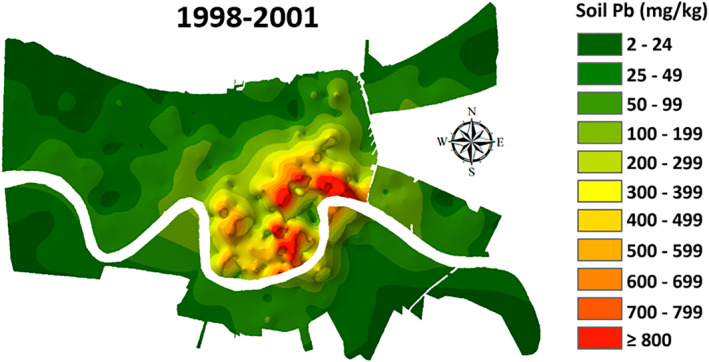
The bullseye pattern of soil Pb in New Orleans appears in other traffic‐congested cities having multiple Pb exposure sources that have accumulated in inner‐city environments. Adopted and revised from the New Orleans mapping project (Mielke et al., 2022).
2. Race, Soil Lead, and Blood Lead
Long‐standing environmental and socioeconomic Pb exposure injustices have positioned Black populations at extreme risk of adverse health consequences. Expected lifespan provides an overview of a communities' health status. Between 1999 and 2020 premature death exposed Black Americans to a loss of over 80 million years of life (Caraballo et al., 2023). Another way of expressing the issue is that Black Americans suffered more than 1.6 million excess deaths compared to their white counterparts (Caraballo et al., 2023). The disproportionate exposure to environmental Pb and environmental injustices within Black Americans and low‐income communities have long been recognized (Lanphear et al., 1996; Leech et al., 2016; Sampson & Winter, 2016; Whitehead & Buchanan, 2019). Two studies were conducted in New Orleans to evaluate blood Pb, race, and income in the context of soil Pb. They illustrate the need for review and new directions to focus actions on urban soil and health (Laidlaw & Filippelli, 2008).
First, Pre‐Katrina New Orleans (2005) soil Pb data collected between 1998 and 2000 is shown in Figure 1. The human geography of the high‐Pb geochemical areas of the city considered race, income, and age in pre‐Katrina New Orleans in the context of Pb in soils (Campanella & Mielke, 2008). In general, the population declined as soil Pb increased, except at soil Pb levels from 200–400 to 400–1,000 mg/kg, and then the population increased. High‐Pb soil was disproportionately located in the inner city, home to New Orleans's largest African American population. Household income indicates that lower economic groups are at risk of higher soil Pb levels. High Pb exposures have numerous negative influences on the health and welfare of the inhabitants of the African American community (Egendorf, Mielke, et al., 2021).
A second, more detailed study of New Orleans soil Pb evaluated the spatiotemporal and racial characteristics of the city. The analysis was centered on matched soil Pb and blood Pb data from 2000–2005 and 2011–2016, or ∼15 years after the first survey (Mielke et al., 2019). Grounded with the community medians for soil Pb, children's blood Pb, racial composition, and household income, the hypothesis tested was whether African Americans of New Orleans were disproportionately exposed to excessive environmental soil Pb and exhibited higher blood Pb levels over the course of two soil Pb and blood Pb surveys (Egendorf, Mielke, et al., 2021). The results indicated that in 2000–2005, the predominantly Black communities living in inner‐city communities had 9.3 times higher median soil Pb than predominantly White communities living in outlying areas of New Orleans. By 2011–2016, the predominantly Black community had 7.5 times higher median soil Pb than the predominantly White community living in outlying areas of New Orleans. In concrete numbers, in 2000–2005 the predominantly majority Black communities inhabited the inner‐city areas where the median soil Pb was 410 mg/kg, whereas the predominantly majority White communities in the outlying areas exist, the median soil Pb was 44 mg/kg (Egendorf, Mielke, et al., 2021). By 2011–2016, the median soil Pb declined from 410 mg/kg to 187 mg/kg in the inner‐city communities, and the soil Pb in the outlying areas declined from 44 mg/kg to 25 mg/kg (Egendorf, Mielke, et al., 2021). The declines in the Pb content of surface soil were surprising and probably a function of the curtailment of Pb additives in gasoline, plus an unidentified dynamic biochemical process operating in the surface soils.
Children's blood Pb results showed that in both the 2000–2005 and the 2011–2016 surveys, children living in Black communities presented with median blood Pb concentrations higher by a factor of ∼2 than children living in the predominantly White areas of New Orleans. The actual numbers show that the contrast is stark. In the 2000–2005 survey, the median blood Pb in the predominantly Black communities was 5.7 μg/dL while the median blood Pb in predominantly White communities was 3.07 μg/dL (Egendorf, Mielke, et al., 2021). The 2011–2016 survey showed a concurrent reduction of children's blood Pb with the decline in soil Pb, and in the Black communities, the median blood Pb declined from 5.7 to 2.1 μg/dL while the median blood Pb of the children living in the predominantly White community decreased from 3.0 μg/dL to 1.0 μg/dL.
Other studies note similar findings between soil Pb, race, and environmental injustices. For example, in Santa Ana, California, where the census tracts with median household income <USD $50,000, had five times higher soil Pb concentrations than high‐income census tracts (Masri et al., 2020).
3. Remobilized Urban Lead Dust From Soil
Dust from Pb‐contaminated soil becomes remobilized during late summer and autumn when evapotranspiration draws out soil moisture and dries them. The Pb dust‐contaminated soil becomes a critical exposure source for children during the process. This has been demonstrated in Detroit, Birmingham, Chicago, and Pittsburgh using data from the USEPA IMPROVE network data (Laidlaw et al., 2012). The results show that the natural logs of atmospheric soil and Pb aerosols were associated in Pittsburgh from April 2004 to July 2005 (R 2 = 0.31, p < 0.01), Detroit from November 2003 to July 2005 (R 2 = 0.49, p < 0.01), Chicago from November 2003 to August 2005 (R 2 = 0.32, p < 0.01), and Birmingham from May 2004 to December 2006 (R 2 = 0.47, p < 0.01). Furthermore, Detroit Michigan (Zahran et al., 2013) used data from the USEPA IMPROVE database (IMPROVE, 2022a, 2022b) and showed that atmospheric soil and Pb exposure follow near‐identical seasonal properties. Resuspended soil was an underlying source of atmospheric Pb. A 1% increase in the amount of resuspended soil resulted in a 0.39% increase in the concentration of Pb in the atmosphere (95% CI, 0.28%–0.50%). To derive atmospheric soil estimates, a mineral equation was used based on the soil elemental composition. Soil composition was derived by the quadratic sum of aluminum (Al), silica (Si), calcium (Ca), iron (Fe), and titanium (Ti) concentrations.
A recent example of the association between atmospheric Pb and soil dust in the PM2.5 fraction was observed in the analysis of data obtained from using the USEPA IMPROVE databases (IMPROVE, 2022a, 2022b). Figure 2 shows the association for Indianapolis for 2018–2020 (R 2 = 0.041, p = 0.001181).
Figure 2.

Atmospheric Pb and atmospheric soil dust in the PM2.5 fraction between 2018 and 2020 in Indianapolis, Indiana (Data set—EPA Chemical Speciation Network, Site Code: 180970078).
Based on these analyses, we argue that the emissions of Pb dust (and other metals) sourced from their deposition in soil are the dominant legacy source of currently elevated urban atmospheric Pb concentrations. Supporting this idea is isotopic research in London where remobilized soil Pb was a significant source of atmospheric Pb (Resongles et al., 2021). The phase‐out of leaded gasoline reduced new additions of Pb to soil, and thus dust, and concurrently, blood Pb is decreasing (Mielke et al., 2019). Regulatory action that focuses only on current emissions will not reduce the bulk of exposures arising from Pb in soil, Pb‐contaminated children's playgrounds, track‐in of Pb‐contaminated soil indoors, and remobilization of Pb‐contaminated soil into the atmosphere. The essential soil Pb‐ human exposure linkage requires attention and remediation. The fundamental issue is to prevent Pb exposure by children in the first place.
4. Applying a Systems Approach to Address Systemic Injustices and Limit the Legacy of Lead
Egendorf, Groffman, et al. (2021) described the systemic interactions of humans and soil Pb at various scales in time and space. They discussed interventions for mitigating soil Pb exposure at each scale and provided examples of applied and participatory experiments to mitigate exposure at different scales currently being conducted in New York City, NY, USA. (Egendorf, Groffman, et al., 2021)” The intervention of Pb‐contaminated soils has received attention from researchers in nations around the world (Laidlaw et al., 2017). Mapping soil Pb is an important first step, for example, Figure 1 (Mielke et al., 2022). While full city mapping of soil Pb and blood Pb provided a refined evaluation of Pb‐contaminated soil and its influence on children's Pb exposure, the surveys are intensive, costly, and time‐consuming. An alternative for demonstrating the soil Pb Bullseye pattern is through a relatively inexpensive project involving the collection and analysis of soil samples along a transect across a city from rural soil through the urban center to the rural soil on the other side of the city (Mielke et al., 1984).
Knowledge about the common bullseye of high Pb community soil reduces the size of the area needing remediation. There are a wide variety of methods available for soil Pb remediation. One method is capping the areas with the most highly contaminated soil with low Pb soil (Egendorf, Groffman, et al., 2021, Laidlaw et al., 2017). Every city has naturally low‐Pb soil source in the outskirts and rural areas away from the traffic‐congested, core of the city. The feasibility of reducing children's exposure to Pb polluted soil was tested at childcare centers in New Orleans (Mielke, Covington, et al., 2011). Soil Pb was determined at a selection of childcare centers in inner‐city and outlying areas. Initially, the median soil Pb was 558 mg/kg (range 14–3,692 mg/kg). Soil Pb intervention was conducted by emplacing geotextile on the original soil surface and then covered by 15 cm of low Pb river alluvium. At the end of the project, soil Pb decreased to a median of 4.1 mg/kg (range 2.2–26.1 mg/kg) (Mielke, Covington, et al., 2011). At a one‐time cost of ∼USD $100 per child, soil Pb, and surface loading were reduced to safer levels within hours, thereby conceptualizing primary prevention intervention of soil‐Pb exposure at children's playgrounds (Mielke, Covington, et al., 2011).
5. Conclusions
The use of Pb in gasoline, paint, and by industry, resulted in significant air Pb emissions that accumulated in the environment and created the legacy of annually exposing millions of children worldwide. Lead in the air and soil is invisible. Urban soil Pb concentrations form a bullseye pattern, highest in the inner cities and decreasing with distance away from city centers. Empirical studies have demonstrated a strong association between soil Pb and blood Pb. Lead dust is a ubiquitous component of urban soil and is more strongly associated with city size and traffic flows than with the age of housing. Detailed soil Pb surveys combined with blood Pb surveys demonstrate the relationship between soil Pb and children's blood Pb. Black children are more highly exposed to Pb than White children. Multiple studies in various cities have demonstrated that soil Pb and blood Pb have a simultaneous bullseye pattern in urban environments.
Soil Pb is remobilized into the atmosphere thereby creating an air Pb, soil Pb, and multiple pathways nexus of human exposure. Long‐standing environmental and socioeconomic Pb exposure injustices have positioned Black Americans at extreme risk of adverse health consequences. The disproportionate environmental injustices within Black and low‐income communities have long been recognized. The racial injustices include environmental Pb as a component of excessive Pb exposure. As a result, racial disparities from Pb exposure play a tragic role in health and expected lifespan. Since 1999, Black Americans suffered more than 1.6 million excess deaths, relative to White Americans. Premature deaths have cost Black Americans over 80 million more lost years of life than White Americans.
Given the strong associations between soil Pb and children's Pb exposure and the connection between racial disparity and environmental Pb, new policies are needed to remedy the health and life expectancy effects of legacy Pb in high Pb bullseye communities. New policies must be designed as primary prevention actions to remedy children's Pb exposure by decreasing legacy Pb within high Pb bullseye urban communities.
Conflict of Interest
The authors declare no conflicts of interest relevant to this study.
Acknowledgments
We would like to thank the reviewers for their very helpful comments and the editor for her assistance.
Laidlaw, M. A. S. , Mielke, H. W. , & Filippelli, G. M. (2023). Assessing unequal airborne exposure to lead associated with race in the USA. GeoHealth, 7, e2023GH000829. 10.1029/2023GH000829
Data Availability Statement
The New Orleans soil lead data can be viewed at https://iupui-earth-science.shinyapps.io/MME_Global/. The Indianapolis atmospheric lead and soil dust data can be viewed at https://doi.org/10.13140/RG.2.2.36810.95680.
References
- British Geological Survey . (2011). London Earth: London soil geochemistry map—Lead (Pb): BGS download. Retrieved from https://www.bgs.ac.uk/download/london-earth-london-soil-geochemistry-map-lead-pb/
- Campanella, R. , & Mielke, H. W. (2008). Human geography of New Orleans' high‐lead geochemical setting. Environmental Geochemistry and Health, 30(6), 531–540. 10.1007/s10653-008-9190-9 [DOI] [PubMed] [Google Scholar]
- Caraballo, C. , Massey, D. S. , Ndumele, C. D. , Haywood, T. , Kaleem, S. , King, T. , et al. (2023). Excess mortality and years of potential life lost among the Black population in the US, 1999–2020. JAMA, 329(19), 1662–1670. 10.1001/jama.2023.7022 [DOI] [PMC free article] [PubMed] [Google Scholar]
- Egendorf, S. P. , Groffman, P. , Cheng, Z. , Menser, M. , Mun, J. , & Mielke, H. (2021). Applying a novel systems approach to address systemic environmental injustices: Constructing soil for limiting the legacy of lead (Pb). Elementa: Science of the Anthropocene, 9(1), 00174. 10.1525/elementa.2020.00174 [DOI] [Google Scholar]
- Egendorf, S. P. , Mielke, H. W. , Castorena‐Gonzalez, J. A. , Powell, E. T. , & Gonzales, C. R. (2021). Soil lead (Pb) in New Orleans: A spatiotemporal and racial analysis. International Journal of Environmental Research and Public Health, 18(3), 1314. 10.3390/ijerph18031314 [DOI] [PMC free article] [PubMed] [Google Scholar]
- Filippelli, G. M. , Anenberg, S. , Taylor, M. , van Geen, A. , & Khreis, H. (2020). New approaches to identifying and reducing the global burden of disease from pollution. GeoHealth, 4(4). 10.1029/2018GH000167 [DOI] [PMC free article] [PubMed] [Google Scholar]
- Filippelli, G. M. , Laidlaw, M. A. , Latimer, J. C. , & Raftis, R. (2005). Urban lead poisoning and medical geology: An unfinished story. Geological Society of America Today, 15(1), 4–11. [DOI] [Google Scholar]
- IMPROVE (Interagency Monitoring of Protected Visual Environments) . (2022a). IMPROVE. Retrieved from http://vista.cira.colostate.edu/Improve/improve-data/
- MPROVE (Interagency Monitoring of Protected Visual Environments) . (2022b). IMPROVE soil estimation calculation. Retrieved from https://vista.cira.colostate.edu/improve/publications/GrayLit/023_SoilEquation/Soil_Eq_Evaluation.pdf
- Kodros, J. K. , Bell, M. L. , Dominici, F. , L'Orange, C. , Godri Pollitt, K. J. , Weichenthal, S. , et al. (2022). Unequal airborne exposure to toxic metals associated with race, ethnicity, and segregation in the USA. Nature Communications, 13(1), 6329. 10.1038/s41467-022-33372-z [DOI] [PMC free article] [PubMed] [Google Scholar]
- Laidlaw, M. A. , & Filippelli, G. M. (2008). Resuspension of urban soils as a persistent source of lead poisoning in children: A review and new directions. Applied Geochemistry, 23(8), 2021–2039. 10.1016/j.apgeochem.2008.05.009 [DOI] [Google Scholar]
- Laidlaw, M. A. , Zahran, S. , Mielke, H. W. , Taylor, M. P. , & Filippelli, G. M. (2012). Re‐suspension of lead contaminated urban soil as a dominant source of atmospheric lead in Birmingham (Vol. 49, pp. 302–310). Atmospheric Environment. [Google Scholar]
- Laidlaw, M. A. S. , Filippelli, G. M. , Brown, S. , Paz‐Ferreiro, J. , Reichman, S. M. , Netherway, P. , et al. (2017). Case studies and evidence‐based approaches to addressing urban soil lead contamination. Applied Geochemistry, 83, 14–30. 10.1016/j.apgeochem.2017.02.015 [DOI] [Google Scholar]
- Laidlaw, M. A. S. , Zahran, S. , Pingitore, N. , Clague, J. , Devlin, G. G. , & Taylor, M. P. (2014). Identification of lead sources in residential environments: Sydney Australia (Vol. 184, pp. 238–246). Environmental pollution. [DOI] [PubMed] [Google Scholar]
- Lanphear, B. P. , Weitzman, M. , & Eberly, S. (1996). Racial differences in urban children's environmental exposures to lead. American Journal of Public Health, 86(10), 1460–1463. 10.2105/ajph.86.10.1460 [DOI] [PMC free article] [PubMed] [Google Scholar]
- Leech, T. G. J. , Adams, E. A. , Weathers, T. D. , Staten, L. K. , & Filippelli, G. M. (2016). Inequitable chronic lead exposure: A dual legacy of social and environmental injustice. Family & Community Health, 39(3), 151–159. 10.1097/fch.0000000000000106 [DOI] [PubMed] [Google Scholar]
- Malm, W. C. , & Hand, J. L. (2007). An examination of the physical and optical properties of aerosols collected in the IMPROVE program. Atmospheric Environment, 41(16), 3407–3427. 10.1016/j.atmosenv.2006.12.012 [DOI] [Google Scholar]
- Masri, S. , LeBrón, A. , Logue, M. , Valencia, E. , Ruiz, A. , Reyes, A. , et al. (2020). Social and spatial distribution of soil lead concentrations in the City of Santa Ana, California: Implications for health inequities. Science of the Total Environment, 743, 140764. 10.1016/j.scitotenv.2020.140764 [DOI] [PMC free article] [PubMed] [Google Scholar]
- Mielke, H. W. , Blake, B. , Burroughs, S. , & Hassinger, N. (1984). Urban lead levels in Minneapolis: The case of the Hmong children. Environmental Research, 34(1), 64–76. 10.1016/0013-9351(84)90076-8 [DOI] [PubMed] [Google Scholar]
- Mielke, H. W. , Covington, T. P. , Mielke, P. W., Jr. , Wolman, F. J. , Powell, E. T. , & Gonzales, C. R. (2011). Soil intervention as a strategy for lead exposure prevention: The New Orleans lead‐safe childcare playground project. Environmental Pollution, 159(8–9), 2071–2077. 10.1016/j.envpol.2010.11.008 [DOI] [PubMed] [Google Scholar]
- Mielke, H. W. , Gonzales, C. R. , Powell, E. T. , Laidlaw, M. A. , Berry, K. J. , Mielke, P. W., Jr. , & Egendorf, S. P. (2019). The concurrent decline of soil lead and children's blood lead in New Orleans. Proceedings of the National Academy of Sciences of the United States of America, 116(44), 22058–22064. 10.1073/pnas.1906092116 [DOI] [PMC free article] [PubMed] [Google Scholar]
- Mielke, H. W. , Gonzales, C. R. , Powell, E. T. , & Egendorf, S. P. (2022). Lead in air, soil, and blood: Pb poisoning in a changing world. International Journal of Environmental Research and Public Health, 19(15), 9500. 10.3390/ijerph19159500 [DOI] [PMC free article] [PubMed] [Google Scholar]
- Mielke, H. W. , Laidlaw, M. A. , & Gonzales, C. R. (2011). Estimation of leaded (Pb) gasoline's continuing material and health impacts on 90 US urbanized areas. Environment International, 37(1), 248–257. 10.1016/j.envint.2010.08.006 [DOI] [PubMed] [Google Scholar]
- Resongles, E. , Dietze, V. , Green, D. C. , Harrison, R. M. , Ochoa‐Gonzalez, R. , Tremper, A. H. , & Weiss, D. J. (2021). Strong evidence for the continued contribution of lead deposited during the 20th century to the atmospheric environment in London of today. Proceedings of the National Academy of Sciences of the United States of America, 118(26). 10.1073/pnas.2102791118 [DOI] [PMC free article] [PubMed] [Google Scholar]
- Sampson, R. J. , & Winter, A. S. (2016). The racial ecology of lead poisoning: Toxic inequality in Chicago neighborhoods, 1995–2013. The Du Bois Review: Social Science Research on Race, 13(2), 261–283. 10.1017/s1742058x16000151 [DOI] [Google Scholar]
- Solomon, P. A. , Crumpler, D. , Flanagan, J. B. , Jayanty, R. , Rickman, E. E. , & McDade, C. E. (2014). U.S. National PM2.5 chemical speciation monitoring Networks—CSN and IMPROVE: Description of networks. Journal of the Air & Waste Management Association, 64(12), 1410–1438. 10.1080/10962247.2014.956904 [DOI] [PubMed] [Google Scholar]
- Watson, G. P. , Martin, N. F. , Grant, Z. B. , Batka, S. C. , & Margenot, A. J. (2022). Soil lead distribution in Chicago, USA. Geoderma Regional, 28, e00480. 10.1016/j.geodrs.2021.e00480 [DOI] [Google Scholar]
- Whitehead, L. S. , & Buchanan, S. D. (2019). Childhood lead poisoning: A perpetual environmental justice issue? Journal of Public Health Management and Practice, 25(1), S115–S120. 10.1097/phh.0000000000000891 [DOI] [PubMed] [Google Scholar]
- Zahran, S. , Keyes, C. , & Lanphear, B. (2023). Leaded aviation gasoline exposure risk and child blood lead levels. PNAS Nexus, 2(1), pgac285. 10.1093/pnasnexus/pgac285 [DOI] [PMC free article] [PubMed] [Google Scholar]
- Zahran, S. , Laidlaw, M. A. , McElmurry, S. P. , Filippelli, G. M. , & Taylor, M. (2013). Linking source and effect: Resuspended soil lead, air lead, and children's blood lead levels in Detroit, Michigan. Environmental Science & Technology, 47(6), 2839–2845. 10.1021/es303854c [DOI] [PubMed] [Google Scholar]
Associated Data
This section collects any data citations, data availability statements, or supplementary materials included in this article.
Data Availability Statement
The New Orleans soil lead data can be viewed at https://iupui-earth-science.shinyapps.io/MME_Global/. The Indianapolis atmospheric lead and soil dust data can be viewed at https://doi.org/10.13140/RG.2.2.36810.95680.