



Abstract
The EFSA Panel on Plant Health performed a pest categorisation of Euzophera semifuneralis (Lepidoptera: Pyralidae), the American plum borer for the EU. This insect is native to North America, reported from the United States, Canada and Mexico. Out of its native range it is only present in Türkiye. It has not been reported in the EU and is not listed in Annex II of Commission Implementing Regulation (EU) 2019/2072. It can complete from one up to three generations per year in its native range and is polyphagous, feeding on 22 genera in 16 plant families. Host plant species commonly found in the EU include black walnut (Juglans nigra), mulberry (Morus alba, M. nigra), olive (Olea europaea), almond (Prunus dulcis), apricot (P. armeniaca), peach (P. persica), plum (P. domestica), sweet cherry (P. avium), apple (Malus domestica), pear (Pyrus communis) and pomegranate (Punica granatum). E. semifuneralis is generally known as pest of trees affected by mechanical injuries, frost or canker diseases. The pest is also known to vector the fungus Ceratocystis fimbriata which is not known to occur in the EU. Climatic conditions and availability of host plants in some EU countries would allow this species to establish and spread. Impact in cultivated hosts including apples, plums, mulberries, almond, olive and ornamental broadleaf trees is anticipated. Phytosanitary measures are available to reduce the likelihood of entry and spread. E. semifuneralis meets the criteria that are within the remit of EFSA to assess for this species to be regarded as a potential Union quarantine pest.
Keywords: pest risk, plant health, plant pest, quarantine, American plum borer
1. Introduction
1.1. Background and Terms of Reference as provided by the requestor
1.1.1. Background
The new Plant Health Regulation (EU) 2016/2031, on the protective measures against pests of plants, is applying from 14 December 2019. Conditions are laid down in this legislation in order for pests to qualify for listing as Union quarantine pests, protected zone quarantine pests or Union regulated non‐quarantine pests. The lists of the EU regulated pests together with the associated import or internal movement requirements of commodities are included in Commission Implementing Regulation (EU) 2019/2072. Additionally, as stipulated in the Commission Implementing Regulation 2018/2019, certain commodities are provisionally prohibited to enter in the EU (high risk plants, HRP). EFSA is performing the risk assessment of the dossiers submitted by exporting to the EU countries of the HRP commodities, as stipulated in Commission Implementing Regulation 2018/2018. Furthermore, EFSA has evaluated a number of requests from exporting to the EU countries for derogations from specific EU import requirements.
In line with the principles of the new plant health law, the European Commission with the Member States are discussing monthly the reports of the interceptions and the outbreaks of pests notified by the Member States. Notifications of an imminent danger from pests that may fulfil the conditions for inclusion in the list of the Union quarantine pest are included. Furthermore, EFSA has been performing horizon scanning of media and literature.
As a follow‐up of the above‐mentioned activities (reporting of interceptions and outbreaks, HRP, derogation requests and horizon scanning), a number of pests of concern have been identified. EFSA is requested to provide scientific opinions for these pests, in view of their potential inclusion by the risk manager in the lists of Commission Implementing Regulation (EU) 2019/2072 and the inclusion of specific import requirements for relevant host commodities, when deemed necessary by the risk manager.
1.1.2. Terms of Reference
EFSA is requested, pursuant to Article 29(1) of Regulation (EC) No 178/2002, to provide scientific opinions in the field of plant health.
EFSA is requested to deliver 53 pest categorisations for the pests listed in Annex 1A, 1B, 1D and 1E (for more details see mandate M‐2021‐00027 on the Open.EFSA portal). Additionally, EFSA is requested to perform pest categorisations for the pests so far not regulated in the EU, identified as pests potentially associated with a commodity in the commodity risk assessments of the HRP dossiers (Annex 1C; for more details see mandate M‐2021‐00027 on the Open.EFSA portal). Such pest categorisations are needed in the case where there are not available risk assessments for the EU.
When the pests of Annex 1A are qualifying as potential Union quarantine pests, EFSA should proceed to phase 2 risk assessment. The opinions should address entry pathways, spread, establishment, impact and include a risk reduction options analysis.
Additionally, EFSA is requested to develop further the quantitative methodology currently followed for risk assessment, in order to have the possibility to deliver an express risk assessment methodology. Such methodological development should take into account the EFSA Plant Health Panel Guidance on quantitative pest risk assessment and the experience obtained during its implementation for the Union candidate priority pests and for the likelihood of pest freedom at entry for the commodity risk assessment of High Risk Plants.
1.2. Interpretation of the Terms of Reference
Euzophera semifuneralis is one of a number of pests listed in Annex 1C to the Terms of Reference (ToR) to be subject to pest categorisation to determine whether it fulfils the criteria of a potential Union quarantine pest for the area of the EU excluding Ceuta, Melilla and the outermost regions of Member States referred to in Article 355(1) of the Treaty on the Functioning of the European Union (TFEU), other than Madeira and the Azores, and so inform EU decision making as to its appropriateness for potential inclusion in the lists of pests of Commission Implementing Regulation (EU) 2019/2072. If a pest fulfils the criteria to be potentially listed as a Union quarantine pest, risk reduction options will be identified.
1.3. Additional information
This pest categorisation was initiated following the commodity risk assessments of Juglans regia, Malus domestica, Prunus persica and P. dulcis plants from Türkiye performed by EFSA (EFSA PLH Panel, 2021, 2022, 2023), in which E. semifuneralis was identified as a relevant non‐regulated EU pest which could potentially enter the EU on J. regia, M. domestica, P. persica and P. dulcis.
2. Data and methodologies
2.1. Data
2.1.1. Literature search
A literature search on E. semifuneralis was conducted at the beginning of the categorisation in the ISI Web of Science bibliographic database, using the scientific name of the pest as search term. Papers relevant for the pest categorisation were reviewed, and further references and information were obtained from experts, as well as from citations within the references and grey literature.
2.1.2. Database search
Pest information, on host(s) and distribution, was retrieved from the European and Mediterranean Plant Protection Organization (EPPO) Global Database (EPPO, online), the CABI databases and scientific literature databases as referred above in Section 2.1.1.
Data about the import of commodity types that could potentially provide a pathway for the pest to enter the EU and about the area of hosts grown in the EU were obtained from EUROSTAT (Statistical Office of the European Communities).
The Europhyt and TRACES databases were consulted for pest‐specific notifications on interceptions and outbreaks. Europhyt is a web‐based network run by the Directorate General for Health and Food Safety (DG SANTÉ) of the European Commission as a subproject of PHYSAN (Phyto‐Sanitary Controls) specifically concerned with plant health information. TRACES is the European Commission's multilingual online platform for sanitary and phytosanitary certification required for the importation of animals, animal products, food and feed of non‐animal origin and plants into the European Union and the intra‐EU trade and EU exports of animals and certain animal products. Up until May 2020, the Europhyt database managed notifications of interceptions of plants or plant products that do not comply with EU legislation, as well as notifications of plant pests detected in the territory of the Member States and the phytosanitary measures taken to eradicate or avoid their spread. The recording of interceptions switched from Europhyt to TRACES in May 2020.
GenBank was searched to determine whether it contained any nucleotide sequences for E. semifuneralis which could be used as reference material for molecular diagnosis. GenBank® (www.ncbi.nlm.nih.gov/genbank/) is a comprehensive publicly available database that as of August 2019 (release version 227) contained over 6.25 trillion base pairs from over 1.6 billion nucleotide sequences for 450,000 formally described species (Sayers et al., 2020).
2.2. Methodologies
The Panel performed the pest categorisation for E. semifuneralis, following guiding principles and steps presented in the EFSA guidance on quantitative pest risk assessment (EFSA PLH Panel, 2018), the EFSA guidance on the use of the weight of evidence approach in scientific assessments (EFSA Scientific Committee, 2017) and the International Standards for Phytosanitary Measures No. 11 (FAO, 2013).
The criteria to be considered when categorising a pest as a potential Union quarantine pest (QP) is given in Regulation (EU) 2016/2031 Article 3 and Annex I, Section 1 of the Regulation. Table 1 presents the Regulation (EU) 2016/2031 pest categorisation criteria on which the Panel bases its conclusions. In judging whether a criterion is met the Panel uses its best professional judgement (EFSA Scientific Committee, 2017) by integrating a range of evidence from a variety of sources (as presented above in Section 2.1) to reach an informed conclusion as to whether or not a criterion is satisfied.
Table 1.
Pest categorisation criteria under evaluation, as derived from Regulation (EU) 2016/2031 on protective measures against pests of plants (the number of the relevant sections of the pest categorisation is shown in brackets in the first column)
| Criterion of pest categorisation | Criterion in Regulation (EU) 2016/2031 regarding Union quarantine pest (article 3) |
|---|---|
| Identity of the pest (Section 3.1 ) | Is the identity of the pest clearly defined, or has it been shown to produce consistent symptoms and to be transmissible? |
| Absence/presence of the pest in the EU territory (Section 3.2 ) |
Is the pest present in the EU territory? If present, is the pest in a limited part of the EU or is it scarce, irregular, isolated or present infrequently? If so, the pest is considered to be not widely distributed. |
| Pest potential for entry, establishment and spread in the EU territory (Section 3.4 ) | Is the pest able to enter into, become established in, and spread within, the EU territory? If yes, briefly list the pathways for entry and spread. |
| Potential for consequences in the EU territory (Section 3.5 ) | Would the pests' introduction have an economic or environmental impact on the EU territory? |
| Available measures (Section 3.6 ) | Are there measures available to prevent pest entry, establishment, spread or impacts? |
| Conclusion of pest categorisation (Section 4 ) | A statement as to whether (1) all criteria assessed by EFSA above for consideration as a potential quarantine pest were met and (2) if not, which one(s) were not met. |
The Panel's conclusions are formulated respecting its remit and particularly with regard to the principle of separation between risk assessment and risk management (EFSA founding regulation (EU) No 178/2002); therefore, instead of determining whether the pest is likely to have an unacceptable impact, deemed to be a risk management decision, the Panel will present a summary of the observed impacts in the areas where the pest occurs, and make a judgement about potential likely impacts in the EU. Whilst the Panel may quote impacts reported from areas where the pest occurs in monetary terms, the Panel will seek to express potential EU impacts in terms of yield and quality losses and not in monetary terms, in agreement with the EFSA guidance on quantitative pest risk assessment (EFSA PLH Panel, 2018). Article 3 (d) of Regulation (EU) 2016/2031 refers to unacceptable social impact as a criterion for quarantine pest status. Assessing social impact is outside the remit of the Panel.
3. Pest categorisation
3.1. Identity and biology of the pest
3.1.1. Identity and taxonomy
Is the identity of the pest clearly defined, or has it been shown to produce consistent symptoms and/or to be transmissible?
Yes, the identity of the pest is established and Euzophera semifuneralis (Walker) is the accepted name.
Euzophera semifuneralis (Walker) is an insect within the order Lepidoptera, family Pyralidae, and is commonly known as American plum borer (EPPO, online). E. semifuneralis was originally described as Nephopteryx semifuneralis by Walker (1863) in 1863 from specimens collected in Colombia, South America.
The EPPO code 1 (Griessinger and Roy, 2015; EPPO, 2019) for this species is: EUZOSE (EPPO, online).
3.1.2. Biology of the pest
E. semifuneralis has four development stages: egg, larva (unknown number of larval instars), pupa and adult (Blakeslee, 1915). It is known to have only a single generation in parts of Canada and up to three generations in southern US and Mexico (Solomon and Payne, 1986; Connell et al., 2005; Biddinger and Leslie, 2014). The adults emerge in April and May. After mating the females lay 12–74 eggs singly on the twigs/young stems, or in small groups in the cracks/crevices of the bark, and in bark with small mechanical or pruning wounds, recent grafts, frost damage or disease cankers. Egg development lasts 8–14 days. The young larvae bore into bark and mine irregular galleries in the cambium, producing large amounts of frass. They feed horizontally girdling the main branches or the entire trunk (Biddinger and Howitt, 1992). In pomegranate, it has been determined that E. semifuneralis generally feeds by opening galleries, especially in the part of the stem close to the root collar of young trees and saplings (Atay and Öztürk, 2010). The moth has also been reported infesting apple trees by entering through burrknots (i.e. aggregations of root initials that can develop on the aboveground portion of all commercial size‐controlling clonal apple rootstocks); indeed, burrknots may mimic wounds providing exposed soft tissue of root initials (Kain et al., 2004). The larval stage lasts 4–6 weeks, then larvae pupate under the bark. The pupal stage lasts 10–18 days in summer and 20–30 days in spring (Blakeslee, 1915; Solomon and Payne, 1986). Due to the overlapping of the 2–3 annual generations in southern US and Mexico, the larvae can be observed at any time during the growing season. E. semifuneralis overwinters as mature larva in a white silken cocoon under the bark. There are no specific data on the flight distance of E. semifuneralis adults, but species belonging to genus Euzophera are commonly considered unable to fly long distances (Korycinska, 2018).
3.1.3. Host range/species affected
E. semifuneralis is a polyphagous pest feeding on 22 genera in 16 plant families of angiosperms (Biddinger and Howitt, 1992; Atay and Öztürk, 2010; Robinson et al., 2010). The main hosts are plum and cherry. A complete list of hosts is reported in Appendix A.
3.1.4. Intraspecific diversity
No intraspecific diversity has been reported for E. semifuneralis.
3.1.5. Detection and identification of the pest
Are detection and identification methods available for the pest?
Yes, visual detection is possible, and morphological identification methods are available.
Symptoms
Symptoms are not specific and may be observed on stems and branches of various sizes but are usually seen in the lower part of the stem (Solomon and Payne, 1986). The main symptom is a remarkable accumulation of frass on the bark. Frass is mostly formed by masses of larval excrement mixed with sap exudates and silky threads. By removing the bark, larval galleries full of frass, larvae and/or white silken cocoons can be easily observed (Solomon and Payne, 1986). In pomegranate, it has been determined that E. semifuneralis generally feeds by opening galleries, sometimes locally and sometimes all around, especially in the part of the stem close to the root collar of young trees and saplings, and under the bark of the trunks and branches of old trees (Atay and Öztürk, 2010). In general, it can be assumed that the symptoms are quite easy to detect.
Detection
For a reliable identification of symptoms due to this moth, visual inspection may not be satisfactory, and careful observation by specialists is needed. The sex pheromone of the species has been identified and is available (Biddinger et al., 1994). Rubber septa containing this pheromone are commercially available and can be used to detect, monitor or even mass trap male moths (Teixeira et al., 2010).
Identification
The identification of E. semifuneralis requires microscopic examination and verification of the presence of key morphological characteristics. Detailed morphological descriptions, illustrations and keys to adult and last larval instar of E. semifuneralis can be found in Neunzig (1990).
GenBank contains gene nucleotide sequences for E. semifuneralis (https://www.ncbi.nlm.nih.gov/nuccore/?term=euzophera%20semifuneralis), though no molecular protocol for species identification has been developed.
Description
Eggs
Tiny (about 0.59 by 0.42 mm), oval and covered with a network of triangular facets. Dirty white when first laid but darken to pink, then deep red, as they mature. Laid singly or in small masses in or near the gummosis on trunk wounds.
Larvae
Greyish‐green to greyish‐purple. Head capsule, prothoracic shield and anal plate are yellow to brown. Body colour varies from dark pink or reddish grey to dusky green (Forbes, 1890; Sanderson, 1901; Blakeslee, 1915; Neunzig, 1990). Prothoracic shield has dark markings on either side. 1st instar larvae are 0.25 mm long; last instar 18–25 mm long.
Pupae
Found among frass under the bark, within silken cocoons; 11–12 mm long; tan to dark brown, with black eyes.
Adults
Wingspread 17–28 mm. Forewing narrow and somewhat triangular; generally reddish brown, marked by wavy black and brown vertical bands about 2/3 of the distance from its base. Hindwing broad and fringed on the trailing edge. Some veins of the hind wing may be darker than the wing.
3.2. Pest distribution
3.2.1. Pest distribution outside the EU
E. semifuneralis is native to North America, reported from the United States, Canada and Mexico. It was recorded from South America (Colombia) but, currently there is no confirmation about the presence of the species further south of Mexico. Out of its native range it is only known to be present in Türkiye, where it has been reported for the provinces of Adana and Osmaniye as a pest of pomegranate (Atay and Öztürk, 2010) (Figure 1).
Figure 1.
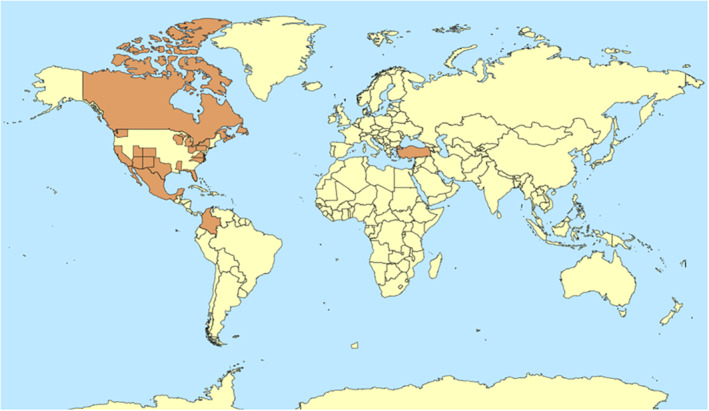
Global distribution of Euzophera semifuneralis (Data source: CABI CPC (CABI, online) accessed on 5 May 2023 and literature)
3.2.2. Pest distribution in the EU
Is the pest present in the EU territory? If present, is the pest in a limited part of the EU or is it scarce, irregular, isolated or present infrequently? If so, the pest is considered to be not widely distributed.
No . E. semifuneralis is not known to occur in the EU territory.
3.3. Regulatory status
3.3.1. Commission Implementing Regulation 2019/2072
E. semifuneralis is not listed in Annex II of Commission Implementing Regulation (EU) 2019/2072, an implementing act of Regulation (EU) 2016/2031, or in any emergency plant health legislation. However, the species is included in the list of pests that are regulated by the Commission Implementing Regulation (EU) 2022/490 as regards certain plants for planting of J. regia L. originating in Türkiye.
3.3.2. Hosts or species affected that are prohibited from entering the Union from third countries
3.3.3. Legislation addressing the organisms vectored by E. semifuneralis (Commission Implementing Regulation 2019/2072)
E. semifuneralis is known to vector Ceratocystis fimbriata Ellis & Halsted (Connell et al., 2005). Although this fungal pathogen is not regulated in the EU, the related species C. platani (J. M. Walter) Engelbr. & T. C. Harr [CERAFP] is regulated by Implementing Regulation 2019/2072 in Annex II (List of Union quarantine pests), Part B (Pests known to occur in the EU), with several requirements on trade of Platanus plants for planting. Recognising that Platanus spp. are also hosts for E. semifuneralis (Appendix A), its potential as a vector of C. platani cannot be excluded.
3.4. Entry, establishment and spread in the EU
3.4.1. Entry
Is the pest able to enter into the EU territory? If yes, identify and list the pathways.
Yes, E. semifuneralis could enter the EU territory. Possible pathways of entry are plants for planting, cut branches, solid wood packaging and wood with bark.
Comment on plants for planting as a pathway.
The pest could enter the EU territory with plants for planting. Although some of the host plants from third countries are prohibited (Table 2), others are not regulated. Plants for planting of Quercus spp., Malus spp., Pyrus spp. and their hybrids cannot be imported from Türkiye, where the pest is known to occur.
Table 2.
List of plants, plant products and other objects that are Euzophera semifuneralis hosts whose introduction into the Union from certain third countries is prohibited (Source: Commission Implementing Regulation (EU) 2019/2072, Annex VI)
| List of plants, plant products and other objects whose introduction into the Union from certain third countries is prohibited | |||
|---|---|---|---|
| Description | CN code | Third country, group of third countries or specific area of third country | |
| 2. | Plants of […] Quercus L., with leaves, other than fruit and seeds | ex 0602 10 90 ex 0602 20 20 ex 0602 20 80 ex 0602 90 41 ex 0602 90 45 ex 0602 90 46 ex 0602 90 48 ex 0602 90 50 ex 0602 90 70 ex 0602 90 99 ex 0604 20 90 ex 1404 90 00 | Third countries other than: Albania, Andorra, Armenia, Azerbaijan, Belarus, Bosnia and Herzegovina, Canary Islands, Faeroe Islands, Georgia, Iceland, Liechtenstein, Moldova, Monaco, Montenegro, North Macedonia, Norway, Russia (only the following parts: Central Federal District (Tsentralny federalny okrug), Northwestern Federal District (Severo‐Zapadny federalny okrug), Southern Federal District (Yuzhny federalny okrug), North Caucasian Federal District (Severo‐Kavkazsky federalny okrug) and Volga Federal District (Privolzhsky federalny okrug)), San Marino, Serbia, Switzerland, Türkiye, Ukraine and the United Kingdom |
| 3. | Plants of Populus L., with leaves, other than fruit and seeds | ex 0602 10 90 ex 0602 20 20 ex 0602 20 80 ex 0602 90 41 ex 0602 90 45 ex 0602 90 46 ex 0602 90 48 ex 0602 90 50 ex 0602 90 70 ex 0602 90 99 ex 0604 20 90 ex 1404 90 00 | Canada, Mexico, United States |
| 5. | Isolated bark of Quercus L., other than Quercus suber L. | ex 1404 90 00 ex 4401 40 90 | Canada, Mexico, United States |
| 7. | Isolated bark of Populus L. | ex 1404 90 00 ex 4401 40 90 | The Americas |
| 8. | Plants for planting of […] Malus Mill., Prunus L., Pyrus L. […] other than dormant plants free from leaves, flowers and fruits | ex 0602 10 90 ex 0602 20 20 ex 0602 20 80 ex 0602 40 00 ex 0602 90 41 ex 0602 90 45 ex 0602 90 46 ex 0602 90 47 ex 0602 90 48 ex 0602 90 50 ex 0602 90 70 ex 0602 90 91 ex 0602 90 99 | Third countries other than: Albania, Andorra, Armenia, Azerbaijan, Belarus, Bosnia and Herzegovina, Canary Islands, Faeroe Islands, Georgia, Iceland, Liechtenstein, Moldova, Monaco, Montenegro, North Macedonia, Norway, Russia (only the following parts: Central Federal District (Tsentralny federalny okrug), Northwestern Federal District (Severo‐Zapadny federalny okrug), Southern Federal District (Yuzhny federalny okrug), North Caucasian Federal District (Severo‐Kavkazsky federalny okrug) and Volga Federal District (Privolzhsky federalny okrug)), San Marino, Serbia, Switzerland, Türkiye, Ukraine and the United Kingdom |
| 9. | Plants for planting of […] Malus Mill., Prunus L. and Pyrus L. and their hybrids, […] other than seeds | ex 0602 10 90 ex 0602 20 20 ex 0602 90 30 ex 0602 90 41 ex 0602 90 45 ex 0602 90 46 ex 0602 90 48 ex 0602 90 50 ex 0602 90 70 ex 0602 90 91 ex 0602 90 99 | Third countries, other than: Albania, Algeria, Andorra, Armenia, Australia, Azerbaijan, Belarus, Bosnia and Herzegovina, Canada, Canary Islands, Egypt, Faeroe Islands, Georgia, Iceland, Israel, Jordan, Lebanon, Libya, Liechtenstein, Moldova, Monaco, Montenegro, Morocco, New Zealand, North Macedonia, Norway, Russia (only the following parts: Central Federal District (Tsentralny federalny okrug), Northwestern Federal District (Severo‐Zapadny federalny okrug), Southern Federal District (Yuzhny federalny okrug), North Caucasian Federal District (Severo‐Kavkazsky federalny okrug) and Volga Federal District (Privolzhsky federalny okrug)), San Marino, Serbia, Switzerland, Syria, Tunisia, Türkiye, Ukraine and United States other than Hawaii |
Potential pathways for E. semifuneralis are presented in Table 3.
Table 3.
Potential pathways for Euzophera semifuneralis into the EU 27
| Pathways (e.g. host/intended use/source) | Life stage | Relevant mitigations [e.g. prohibitions (Annex VI), special requirements (Annex VII) or phytosanitary certificates (Annex XI) within Implementing Regulation 2019/2072] |
|---|---|---|
| Plants for planting | Eggs, larvae, pupae | A list of plants for planting that are hosts of E. semifuneralis and are prohibited to import from third countries (Regulation 2019/2072, Annex VI), is reported in Table 2. |
| Tubers of Ipomoea batata | Larvae | Annex XI, Part A, List of plants, plant products and other objects, as well as the respective third countries of origin or dispatch, for which, (…) phytosanitary certificates are required for their introduction into the Union territory. |
| Solid wood packaging material | Eggs, larvae, pupae, adults | ISPM 15; Implementing Regulation 2019/2072 |
| Woody host plants for planting (excluding seeds), with a diameter > 6 cm | Eggs, larvae, pupae, adults | EU 2018/2019 (High‐risk plants prohibition), phytosanitary certificate |
| Cut branches with diameter > 6 cm | Eggs, larvae, pupae, adults | Implementing Regulation 2019/2072, Annex XI, part A e.g. cut branches of Quercus, Juglans, Prunus from third countries require a phytosanitary certificate |
| Round wood with bark | Eggs, larvae, pupae, adults | Implementing Regulation 2019/2072, Annex VII, e.g. point 83, 87, 90 |
A commodity risk assessment for J. regia plants for planting from Türkiye, indicated with 95% certainty, that between 99.18% and 99.98% of imported plants would be free from E. semifuneralis (EFSA PLH Panel, 2021). E. semifuneralis is included in the list of pests that are regulated by the Commission Implementing Regulation (EU) 2022/490 as regards certain plants for planting of J. regia L. originating in Türkiye. A commodity risk assessment for M. domestica plants for planting from Türkiye, indicated with 95% certainty, that between 99.79% and 99.99% of imported plants would be free from E. semifuneralis (EFSA PLH Panel, 2022). However, no derogation for Malus spp. from Türkiye exist yet.
Recent interceptions (2020) on Tilia and Liriodendron tulipifera from the US are likely referable to wood products (TRACES‐NT, online). Wood with bark is also considered a suitable pathway for E. semifuneralis, as it was associated with the import of Prunus wood with bark from the USA in 2017 (Korycinska, 2018; EUROPHYT, online).
Tables 4 and 5 present import data of commodities that represent potential pathways of the pest into the EU.
Table 4.
Sweet potatoes, fresh, chilled, frozen or dried, whether or not sliced or in the form of pellets (CN Code: 071420) imported (100 kg) into the EU from countries where Euzophera semifuneralis is known to occur (Source: Eurostat accessed on 10 May 2023)
| Country | 2017 | 2018 | 2019 | 2020 | 2021 |
|---|---|---|---|---|---|
| United States | 915,726.98 | 1,029,505.42 | 924,206.76 | 1,045,241.99 | 1,087,567.38 |
| Canada | 1,302.05 | : | : | 3.80 | 0.71 |
| Colombia | 168.30 | : | 325.15 | 196.80 | 1.10 |
| Mexico | : | 5.00 | : | : | 0.00 |
| Türkiye | : | 2.56 | : | 9.15 | 12.92 |
Table 5.
Wood in the rough, whether or not stripped of bark or sapwood, or roughly squared (CN Code: 4403) imported (100 kg) into the EU from countries where Euzophera semifuneralis is known to occur (Source: Eurostat accessed on 5 June 2023)
| Country | 2017 | 2018 | 2019 | 2020 | 2021 |
|---|---|---|---|---|---|
| United States | 662,928.87 | 935,407.63 | 546,679.75 | 491,686.67 | 614,638.86 |
| Canada | 1,234.15 | 2,032.68 | 2,285.14 | 2,728.96 | 9,444.71 |
| Türkiye | 6,986.10 | 5,289.58 | 4,402.52 | 82.41 | 89.64 |
| Mexico | 4,084.73 | 6,029.38 | 7,703.67 | 7,012.45 | 4,712.20 |
| Colombia | 2,829.00 | 1,703.61 | 713.85 | 2,176.62 | 231.40 |
Notifications of interceptions of harmful organisms began to be compiled in Europhyt in May 1994 and in TRACES in May 2020. As at 4 May 2023, there were two records of interception of E. semifuneralis in the Europhyt and TRACES databases. Both interceptions were reported in Italy from imported planting material from the US on Tilia sp. and L. tulipifera on 9 December 2020. The pest was found at larval stage in both consignments. In a Pest Risk Assessment on a congeneric species (i.e. Euzophera bigella), an interception of E. semifuneralis in Italy is reported as associated with the import of Prunus wood with bark from the US (Korycinska, 2018).
3.4.2. Establishment
Is the pest able to become established in the EU territory?
Yes. Following entry on plants for planting, E. semifuneralis could become established in the EU as the hosts are available and the climate is suitable.
Climatic mapping is the principal method for identifying areas that could provide suitable conditions for the establishment of a pest taking key abiotic factors into account (Baker, 2002). Availability of hosts is considered in 3.4.2.1. Climatic factors are considered in 3.4.2.2.
3.4.2.1. EU distribution of main host plants
E. semifuneralis is a polyphagous pest. The main hosts of the pest cultivated in the EU between 2017 and 2021 are shown in Table 6. Among others, plums, cherries, apples, almond, olives are important crops in the EU.
Table 6.
Crop area of Euzophera semifuneralis hosts in the EU in 10,000 ha (Eurostat accessed on 8 May 2023)
| Crop | 2017 | 2018 | 2019 | 2020 | 2021 |
|---|---|---|---|---|---|
| Olives | 5,056.93 | 5,098.62 | 5,071.59 | 5,105.12 | 4,999.89 |
| Almonds | 742.78 | 773.88 | 809.56 | 852.95 | 881.33 |
| Apples | 504.61 | 506.27 | 491.08 | 484.63 | 492.52 |
| Cherries * | 173.37 | 175.49 | 176.30 | 179.07 | 173.37 |
| Peaches | 154.06 | 150.80 | 144.78 | 137.07 | 133.03 |
| Plums | 153.88 | 153.43 | 154.51 | 159.51 | 157.67 |
| Pears | 113.81 | 113.54 | 110.66 | 107.76 | 106.94 |
| Apricots | 72.23 | 72.57 | 73.22 | 76.24 | 73.45 |
Both sweet and sour cherries.
There is a derogation for J. regia plants from Türkiye ((EU) 2022/490). A commodity risk assessment for J. regia plants for planting from Türkiye, indicated with 95% certainty, that between 99.18% and 99.98% of imported plants would be free from E. semifuneralis (EFSA PLH Panel, 2021). A commodity risk assessment for M. domestica plants for planting from Türkiye, indicated with 95% certainty, that between 99.79% and 99.99% of imported plants would be free from E. semifuneralis (EFSA PLH Panel, 2022).
3.4.2.2. Climatic conditions affecting establishment
Some climate types (Kottek et al., 2006) that occur in the EU are also found in countries where E. semifuneralis occurs, for example Cfa (temperate, humid sub‐tropical), Csb (warm‐summer, Mediterranean) and Dfb (warm‐summer, humid continental) (Figure 2).
Figure 2.
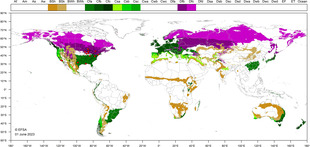
World distribution of 10 Köppen–Geiger climate types that occur in the EU, and which occur in countries where Euzophera semifuneralis has been reported (Red dots indicate point locations where E. semifuneralis was reported)
3.4.3. Spread
Describe how the pest would be able to spread within the EU territory following establishment?
Natural spread by flying adults can occur. All stages can be moved over long distances via infested plant material, specifically plants for planting and also wood with bark.
Comment on plants for planting as a mechanism of spread.
Plants for planting provide a main spread mechanism for E. semifuneralis over long distances.
Although no specific data on the flight distance of E. semifuneralis adults are available, species belonging to genus Euzophera are commonly considered unable to fly long distances (Korycinska, 2018).
3.5. Impacts
Would the pests' introduction have an economic or environmental impact on the EU territory?
Yes, if E. semifuneralis established in the EU, impact in cultivated hosts including apples, plums, mulberries, almond, olive and ornamental broadleaf trees is anticipated.
E. semifuneralis is generally known as pest of trees bearing some sort of wound (Biddinger and Leslie, 2014). These could be mechanical injuries (e.g. caused by orchard mowers or trunk or limb shakers used for mechanical harvest) or an effect of various diseases (Connell et al., 2005; Biddinger and Leslie, 2014). Indeed, the larvae are unable to attack trees with undamaged bark. Larval feeding in the cambium often causes girdling of stems and death in young trees (Blakeslee, 1915; Solomon and Payne, 1986; Biddinger and Howitt, 1992); infestation on young pecan trees has led to death of the young trees or crotch splitting later in the life of the tree (Pierce and Nickels, 1941). High populations of plum borer larvae are capable of girdling and killing full‐grown trees in less than 10 years (Biddinger and Howitt, 1992). E. semifuneralis is considered as a major contributor to a reduction (from 30 to 20 years) in the life span of the average tart cherry orchard in Michigan, US, where the moth is also considered a major pest (Kain and Agnello, 1999). Its feeding can lead to cankers and rots by providing suitable entryways for pathogens (Kain and Agnello, 1999). The pest is also known as vector of the fungus C. fimbriata. Larval feeding is reported as a possible means of introducing C. fimbriata spores long after a mechanical injury occurs (Connell et al., 2005). E. semifuneralis is also known as a serious pest mainly to plum and cherry orchards in the US, while it is quoted as sporadic pest in young almond orchards. Vigorous trees rarely suffer serious damage, but heavily infested branches can break under the action of the wind (Pollack, 1998). Besides, it was also reported as a pest in the pruning wounds of pecan and walnut (‘walnut gridler’) but not able to infest healthy, uninjured trees. On trees that have been mechanically harvested, 90% of the larvae will be found in the trunk and lower scaffold limbs (Biddinger and Howitt, 1992). E. semifuneralis has been recorded in southern Türkiye, provinces of Adana and Osmaniye, infesting pomegranate orchards, showing an infestation rate between 36% and 50% orchards (Atay and Öztürk, 2010).
3.6. Available measures and their limitations
Are there measures available to prevent pest entry, establishment, spread or impacts such that the risk becomes mitigated?
Yes. Although the existing phytosanitary measures identified in Section 3.3.2 do not always specifically target E. semifuneralis, they mitigate the likelihood of its entry, establishment and spread within the EU (see also Section 3.6.1).
3.6.1. Identification of potential additional measures
Phytosanitary measures (prohibitions) are currently applied to some host plants for planting (see Sectin 3.3.2).
Additional potential risk reduction options and supporting measures are shown in Sections 3.6.1.1 and 3.6.1.2.
3.6.1.1. Additional potential risk reduction options
Potential additional control measures are listed in Table 7.
Table 7.
Selected control measures (a full list is available in EFSA PLH Panel, 2018) for pest entry/establishment/spread/impact in relation to currently unregulated hosts and pathways. Control measures are measures that have a direct effect on pest abundance
| Control measure/Risk reduction option (Blue underline = Zenodo doc, Blue = WIP) | RRO summary | Risk element targeted (entry/establishment/spread/impact) |
|---|---|---|
| Require pest freedom | Pest free place of production (e.g. place of production and its immediate vicinity is free from pest over an appropriate time period, e.g. since the beginning of the last complete cycle of vegetation, or past two or three cycles). Pest free production site. | Entry/Spread/Impact |
| Growing plants in isolation | Some host plants could be grown in dedicated structures such as glass or plastic greenhouses with insect‐proof screens. | Entry/Spread/Impact |
| Managed growing conditions | Used to mitigate likelihood of infestation at origin. Plants collected directly from natural habitats, have been grown, held and trained for at least two consecutive years prior to dispatch in officially registered nurseries, which are subject to an officially supervised control regime. | Entry/Spread |
| Use of resistant and tolerant plant species/varieties | Among almond cultivars, Carmel and Price have been reported in California, US, to be more seriously affected and to have higher borer populations than other varieties (van Steenwyk et al., 1986). | Establishment/Impact |
| Biological control and behavioural manipulation |
Pest control such as: a) Biological control Numerous organisms were documented as biological control agents including various species of birds, spiders, beetles and ants. Ichneumonid wasps were the dominant parasitoids, of which Venturia nigricoxalis (Cushman) was the most common. The pathogenic fungi Hirsutella was commonly found and had a density‐dependent relationship with American plum borer infestations. The natural enemy complex can cause significant mortality (> 25%) (Biddinger and Leslie, 2014). b) Mating disruption c) Mass trapping The sexual pheromone of E. semifuneralis was identified (Biddinger and Leslie, 2014) and protocols for mating disruption and mass trapping were defined (Teixeira et al., 2010). |
Establishment/Impact/Spread |
| Chemical treatments on crops including reproductive material | Long residual insecticides (e.g. chlorpyrifos, which has been revoked in the EU) are often applied to the trunks and scaffold limbs early in the season to control the American plum borer (Biddinger and Howitt, 1992; Kain and Agnello, 1999). | Entry/Establishment/Impact |
| Chemical treatments on consignments or during processing |
Use of chemical compounds that may be applied to plants or to plant products after harvest, during process or packaging operations and storage. The treatments addressed in this information sheet are:
The measure is expected to have an effect although specific info for the pest is not available. |
Entry/Spread |
| Physical treatments on consignments or during processing |
This information sheet deals with the following categories of physical treatments: irradiation/ionisation; mechanical cleaning (brushing, washing); sorting and grading and; removal of plant parts (e.g. debarking wood). This information sheet does not address: heat and cold treatment (information sheet 1.14); roguing and pruning (information sheet 1.12). The measure is expected to have an effect although specific info for the pest is not available. |
Entry/Spread |
| Waste management |
Treatment of the waste (deep burial, composting, incineration, chipping, production of bio‐energy) in authorised facilities and official restriction on the movement of waste. The measure is expected to have an effect although specific info for the pest is not available. |
Establishment/Spread |
| Heat and cold treatments | Controlled temperature treatments aimed to kill or inactivate pests without causing any unacceptable prejudice to the treated material itself. The measures addressed in this information sheet are: autoclaving; steam; hot water; hot air; cold treatment. | Entry/Spread |
| Controlled atmosphere |
Treatment of plants by storage in a modified atmosphere (including modified humidity, O2, CO2, temperature, pressure). The measure is expected to have an effect although specific info for the pest is not available. |
Entry/Spread (via commodity) |
| Post‐entry quarantine and other restrictions of movement in the importing country |
This information sheet covers post‐entry quarantine (PEQ) of relevant commodities; temporal, spatial and end‐use restrictions in the importing country for import of relevant commodities; Prohibition of import of relevant commodities into the domestic country. ‘Relevant commodities’ are plants, plant parts and other materials that may carry pests, either as infection, infestation or contamination. |
Establishment/Spread |
3.6.1.2. Additional supporting measures
Potential additional supporting measures are listed in Table 8.
Table 8.
Selected supporting measures (a full list is available in EFSA PLH Panel, 2018) in relation to currently unregulated hosts and pathways. Supporting measures are organisational measures or procedures supporting the choice of appropriate risk reduction options that do not directly affect pest abundance
| Supporting measure (Blue underline = Zenodo doc, Blue = WIP) | Summary | Risk element targeted (entry/establishment/spread/impact) |
|---|---|---|
| Inspection and trapping |
Inspection is defined as the official visual examination of plants, plant products or other regulated articles to determine if pests are present or to determine compliance with phytosanitary regulations (ISPM 5). The effectiveness of sampling and subsequent inspection to detect pests may be enhanced by including trapping and luring techniques. |
Entry/Spread/Impact |
| Laboratory testing | Examination, other than visual, to determine if pests are present using official diagnostic protocols. Diagnostic protocols describe the minimum requirements for reliable diagnosis of regulated pests. | Entry/Spread |
| Sampling |
According to ISPM 31, it is usually not feasible to inspect entire consignments, so phytosanitary inspection is performed mainly on samples obtained from a consignment. It is noted that the sampling concepts presented in this standard may also apply to other phytosanitary procedures, notably selection of units for testing. For inspection, testing and/or surveillance purposes the sample may be taken according to a statistically based or a non‐statistical sampling methodology. |
Entry |
| Phytosanitary certificate and plant passport |
An official paper document or its official electronic equivalent, consistent with the model certificates of the IPPC, attesting that a consignment meets phytosanitary import requirements (ISPM 5) a) export certificate (import) b) plant passport (EU internal trade) |
Entry/Spread |
| Certified and approved premises | Mandatory/voluntary certification/approval of premises is a process including a set of procedures and of actions implemented by producers, conditioners and traders contributing to ensure the phytosanitary compliance of consignments. It can be a part of a larger system maintained by the NPPO in order to guarantee the fulfilment of plant health requirements of plants and plant products intended for trade. Key property of certified or approved premises is the traceability of activities and tasks (and their components) inherent the pursued phytosanitary objective. Traceability aims to provide access to all trustful pieces of information that may help to prove the compliance of consignments with phytosanitary requirements of importing countries. | Entry/Spread |
| Certification of reproductive material (voluntary/official) | Plants come from within an approved propagation scheme and are certified pest free (level of infestation) following testing; Used to mitigate against pests that are included in a certification scheme. | Entry/Spread |
| Delimitation of Buffer zones | ISPM 5 defines a buffer zone as ‘an area surrounding or adjacent to an area officially delimited for phytosanitary purposes in order to minimise the probability of spread of the target pest into or out of the delimited area, and subject to phytosanitary or other control measures, if appropriate’ (ISPM 5). The objectives for delimiting a buffer zone can be to prevent spread from the outbreak area and to maintain a pest free production place (PFPP), site (PFPS) or area (PFA). | Spread |
| Surveillance | Surveillance to guarantee that plants and produce originate from a Pest Free Area could be an option. | Spread |
Table 8 Selected supporting measures (a full list is available in EFSA PLH Panel, 2018) in relation to currently unregulated hosts and pathways. Supporting measures are organisational measures or procedures supporting the choice of appropriate risk reduction options that do not directly affect pest abundance
3.6.1.3. Biological or technical factors limiting the effectiveness of measures
The young larvae bore galleries in the cambium can only be detected through the emission of frass
Limited effectiveness of insecticides due to the hidden habits of the larvae
3.7. Uncertainty
No key uncertainties of the assessment have been identified.
4. Conclusions
E. semifuneralis satisfies all the criteria that are within the remit of EFSA to assess for it to be regarded as a potential Union quarantine pest (Table 9).
Table 9.
The Panel's conclusions on the pest categorisation criteria defined in Regulation (EU) 2016/2031 on protective measures against pests of plants (the number of the relevant sections of the pest categorisation is shown in brackets in the first column)
| Criterion of pest categorisation | Panel's conclusions against criterion in Regulation (EU) 2016/2031 regarding Union quarantine pest | Key uncertainties |
|---|---|---|
| Identity of the pest ( 3.1 ) | The identity of E. semifuneralis is established. Taxonomic keys based on morphology of adults and last larval instar exist. | None |
| Absence/presence of the pest in the EU ( 3.2 ) |
E. semifuneralis is not known to occur in the EU. |
None |
| Pest potential for entry, establishment and spread in the EU ( 3.4 ) | E. semifuneralis is able to enter, become established and spread within the EU territory. The main pathways are plants for planting, wood with bark and wood products. | None |
| Potential for consequences in the EU ( 3.5 ) | The introduction of the pest could cause yield and quality losses on several fruit crops and reduce the value of ornamental broadleaf trees although no specific data is available. | None |
| Available measures ( 3.6 ) | There are measures available to prevent entry, establishment and spread of E. semifuneralis in the EU. Risk reduction options include inspections, chemical and physical treatments on consignments of fresh plant material and wood, from infested countries and the production of plants for import in the EU in pest free areas. | None |
| Conclusion ( 4 ) | E. semifuneralis satisfies all the criteria that are within the remit of EFSA to assess for it to be regarded as a potential Union quarantine pest | None |
| Aspects of assessment to focus on/scenarios to address in future if appropriate: | ||
Abbreviations
- EPPO
European and Mediterranean Plant Protection Organization
- FAO
Food and Agriculture Organization
- IPPC
International Plant Protection Convention
- ISPM
International Standards for Phytosanitary Measures
- MS
Member State
- PEQ
post‐entry quarantine
- PFA
pest free production area
- PFPP
pest free production place
- PFPS
pest free production site
- PLH
EFSA Panel on Plant Health
- PZ
Protected Zone
- TFEU
Treaty on the Functioning of the European Union
- ToR
Terms of Reference
Glossary
- Containment (of a pest)
Application of phytosanitary measures in and around an infested area to prevent spread of a pest (FAO, 2021).
- Control (of a pest)
Suppression, containment or eradication of a pest population (FAO, 2021).
- Entry (of a pest)
Movement of a pest into an area where it is not yet present, or present but not widely distributed and being officially controlled (FAO, 2021).
- Eradication (of a pest)
Application of phytosanitary measures to eliminate a pest from an area (FAO, 2021).
- Establishment (of a pest)
Perpetuation, for the foreseeable future, of a pest within an area after entry (FAO, 2021).
- Greenhouse
A walk‐in, static, closed place of crop production with a usually translucent outer shell, which allows controlled exchange of material and energy with the surroundings and prevents release of plant protection products (PPPs) into the environment.
- Hitchhiker
An organism sheltering or transported accidentally via inanimate pathways including with machinery, shipping containers and vehicles; such organisms are also known as contaminating pests or stowaways (Toy and Newfield, 2010).
- Impact (of a pest)
The impact of the pest on the crop output and quality and on the environment in the occupied spatial units.
- Introduction (of a pest)
The entry of a pest resulting in its establishment (FAO, 2021).
- Pathway
Any means that allows the entry or spread of a pest (FAO, 2021).
- Phytosanitary measures
Any legislation, regulation or official procedure having the purpose to prevent the introduction or spread of quarantine pests, or to limit the economic impact of regulated non‐quarantine pests (FAO, 2021).
- Quarantine pest
A pest of potential economic importance to the area endangered thereby and not yet present there, or present but not widely distributed and being officially controlled (FAO, 2021).
- Risk reduction option (RRO)
A measure acting on pest introduction and/or pest spread and/or the magnitude of the biological impact of the pest should the pest be present. A RRO may become a phytosanitary measure, action or procedure according to the decision of the risk manager.
- Spread (of a pest)
Expansion of the geographical distribution of a pest within an area (FAO, 2021).
Appendix A – Euzophera semifuneralis host plants
1.
Source: CABI CPC (CABI, online) and other literature as indicated.
| Host status | Host name | Plant family | Common name | Reference |
|---|---|---|---|---|
| Cultivated hosts | Carya sp. | Juglandaceae | Hickory | Biddinger and Howitt (1992) |
| Carya illinoensis | Juglandaceae | Pecan | Biddinger and Howitt (1992) | |
| Diospyros virginiana | Ebenaceae | American persimmon | Biddinger and Howitt (1992) | |
| Ginkgo biloba | Ginkgoaceae | Ginkgo | Biddinger and Howitt (1992) | |
| Gossypium hirsutum | Malvaceae | Cotton | Biddinger and Howitt (1992) | |
| Ipomoea batatas | Convolvulaceae | Sweet potato* | Biddinger and Howitt (1992) | |
| Juglans microcarpa | Juglandaceae | River walnut | Biddinger and Howitt (1992) | |
| Juglans regia | Juglandaceae | Common walnut | Robinson et al., 2010 | |
| Liquidambar styraciflua | Hamamelidaceae | Sweetgum | Biddinger and Howitt (1992) | |
| Malus domestica | Rosaceae | Apple | Biddinger and Howitt (1992) | |
| Morus spp. | Moraceae | – | Biddinger and Howitt (1992) | |
| Morus alba | Moraceae | Mulberry | Biddinger and Howitt (1992) | |
| Olea europaea | Oleaceae | Olive | Biddinger and Howitt (1992) | |
| Platanus × hispanica | Platanaceae | London plane | Biddinger and Howitt (1992) | |
| Platanus occidentalis | Platanaceae | American sycamore | Biddinger and Howitt (1992) | |
| Populus spp. | Salicaceae | Poplar | Biddinger and Howitt (1992) | |
| Prunus armeniaca | Rosaceae | Apricot | Biddinger and Howitt (1992) | |
| Pyrus communis | Rosaceae | Pear | Biddinger and Howitt (1992) | |
| Prunus avium | Rosaceae | Sweet cherry | CABI (online) | |
| Prunus cerasus | Rosaceae | Sour cherry | CABI (online) | |
| Prunus domestica | Rosaceae | Plum | CABI (online) | |
| Prunus dulcis | Rosaceae | Almond | CABI (online) | |
| Punica granatum | Rosaceae | Pomegranate | CABI (online) | |
| Prunus persica | Rosaceae | Peach | Biddinger and Howitt (1992) | |
| Quercus palustris | Fagaceae | Pin oak | Biddinger and Howitt (1992) | |
| Quercus virginiana | Fagaceae | Southern live oak | Biddinger and Howitt (1992) | |
| Salix spp. | Salicaceae | Willow | Biddinger and Howitt (1992) | |
| Sorbus aucuparia | Rosaceae | Mountain ash | Biddinger and Howitt (1992) | |
| Tilia spp. | Tiliaceae | Basswood | Biddinger and Howitt (1992) | |
| Ulmus spp. | Ulmaceae | Elm | Biddinger and Howitt (1992) | |
| Zea mays | Gramineae | Corn | Biddinger and Howitt (1992) |
Stored tubers only.
Appendix B – Distribution of Euzophera semifuneralis
1.
Distribution records based on CABI CPC (CABI, online) and other literature as indicated.
| Region | Country | Sub‐national (e.g. State) | Status | References |
|---|---|---|---|---|
| North America | Canada | Present, no details | CABI (online) | |
| Mexico | Present, no details | CABI (online) | ||
| USA | Present, no details | CABI (online) | ||
| Arizona | Present, no details | Biddinger and Howitt (1992) | ||
| California | Present, no details |
CABI (online) |
||
| Colorado | Present, no details | Forbes (1890) | ||
| Florida | Present, no details | Forbes (1890) | ||
| Michigan | Present, no details |
CABI (online) |
||
| Mississippi | Present, no details | Biddinger and Howitt (1992) | ||
| New Mexico | Present, no details | Biddinger and Howitt (1992) | ||
| New York | Present, no details | Biddinger and Howitt (1992) | ||
| North Carolina | Present, no details | Biddinger and Howitt (1992) | ||
| Ohio | Present, no details | Biddinger and Howitt (1992) | ||
| Pennsylvania | Present, no details |
CABI (online) |
||
| Texas | Present, no details | Biddinger and Howitt (1992) | ||
| Utah | Present, no details | Biddinger and Howitt (1992) | ||
| Virginia | Present, no details | Biddinger and Howitt (1992) | ||
| Washington | Present, no details | Forbes (1890) | ||
| Wisconsin | Present, no details |
CABI (online) |
||
| South America | Colombia | Present, no details | Forbes (1890), Biddinger and Howitt (1992) | |
| Asia | Türkiye | Present, no details |
CABI (online) |
|
| Adana | Present, no details | Atay and Öztürk (2010) | ||
| Osmaniye | Present, no details | Atay and Öztürk (2010) |
Appendix C – EU cultivation/harvested/production area of Euzophera semifuneralis hosts (in 1,000 ha)
1.
| Plums | 2017 | 2018 | 2019 | 2020 | 2021 |
|---|---|---|---|---|---|
| European Union | 153.88 | 153.43 | 154.51 | 159.51 | 157.67 |
| Belgium | 0.03 | 0.03 | 0.04 | 0.04 | 0.05 |
| Bulgaria | 6.82 | 7.36 | 8.02 | 8.57 | 9.28 |
| Czechia | 1.76 | 1.82 | 1.88 | 1.89 | 1.94 |
| Denmark | 0.06 | 0.07 | 0.08 | 0.09 | 0.10 |
| Germany | 4.83 | 4.82 | 4.83 | 4.84 | 4.85 |
| Estonia | 0.02 | 0.02 | 0.02 | 0.02 | 0.02 |
| Greece | 2.06 | 2.20 | 2.18 | 2.44 | 2.15 |
| Spain | 15.20 | 14.64 | 14.85 | 14.41 | 13.69 |
| France | 15.06 | 14.97 | 14.83 | 14.83 | 15.70 |
| Croatia | 4.36 | 4.28 | 4.46 | 3.39 | 3.49 |
| Italy | 11.68 | 11.72 | 11.94 | 11.89 | 11.98 |
| Cyprus | 0.38 | 0.37 | 0.38 | 0.43 | 0.41 |
| Latvia | 0.10 | 0.10 | 0.06 | 0.10 | 0.10 |
| Lithuania | 0.73 | 0.72 | 0.74 | 0.75 | 0.74 |
| Luxembourg | 0.04 | 0.04 | 0.04 | 0.04 | 0.04 |
| Hungary | 7.94 | 7.92 | 7.96 | 7.06 | 7.00 |
| Netherlands | 0.26 | 0.26 | 0.28 | 0.27 | 0.26 |
| Austria | 0.19 | 0.20 | 0.20 | 0.21 | 0.21 |
| Poland | 13.31 | 13.48 | 13.63 | 18.70 | 16.50 |
| Portugal | 1.78 | 1.80 | 1.83 | 1.83 | 1.77 |
| Romania | 66.68 | 65.91 | 65.58 | 67.01 | 66.73 |
| Slovenia | 0.04 | 0.05 | 0.05 | 0.06 | 0.06 |
| Slovakia | 0.52 | 0.61 | 0.61 | 0.59 | 0.58 |
| Sweden | 0.04 | 0.04 | 0.04 | 0.04 | 0.04 |
| Apples | 2017 | 2018 | 2019 | 2020 | 2021 |
|---|---|---|---|---|---|
| European Union | 504.61 | 506.27 | 491.08 | 484.63 | 492.52 |
| Belgium | 6.16 | 5.99 | 5.79 | 5.48 | 5.35 |
| Bulgaria | 3.97 | 3.98 | 4.14 | 3.56 | 3.78 |
| Czechia | 7.35 | 7.25 | 7.32 | 7.19 | 7.11 |
| Denmark | 1.28 | 1.42 | 1.39 | 1.38 | 1.40 |
| Germany | 33.98 | 33.98 | 33.98 | 33.98 | 33.98 |
| Estonia | 0.48 | 0.60 | 0.57 | 0.62 | 0.73 |
| Greece | 9.82 | 10.13 | 10.18 | 10.50 | 10.18 |
| Spain | 30.55 | 29.93 | 29.64 | 29.49 | 29.45 |
| France | 50.31 | 50.54 | 50.37 | 50.15 | 54.21 |
| Croatia | 4.84 | 4.73 | 4.95 | 4.36 | 4.39 |
| Italy | 57.26 | 57.44 | 55.00 | 54.91 | 54.47 |
| Cyprus | 0.37 | 0.37 | 0.37 | 0.41 | 0.40 |
| Latvia | 3.30 | 3.20 | 3.44 | 3.50 | 3.20 |
| Lithuania | 9.82 | 10.13 | 10.18 | 10.50 | 10.18 |
| Luxembourg | 0.27 | 0.27 | 0.27 | 0.08 | 0.10 |
| Hungary | 32.17 | 31.84 | 30.97 | 25.97 | 25.02 |
| Netherlands | 7.00 | 6.60 | 6.42 | 6.20 | 5.97 |
| Austria | 6.67 | 6.74 | 6.59 | 6.43 | 6.35 |
| Poland | 162.53 | 166.15 | 155.62 | 152.60 | 161.90 |
| Portugal | 13.85 | 13.61 | 14.31 | 14.31 | 13.92 |
| Romania | 55.60 | 53.94 | 52.74 | 52.34 | 53.82 |
| Slovenia | 2.36 | 2.33 | 2.27 | 2.16 | 2.09 |
| Slovakia | 2.18 | 2.14 | 2.06 | 1.80 | 1.64 |
| Sweden | 1.40 | 1.41 | 1.52 | 1.44 | 1.46 |
| Pears | 2017 | 2018 | 2019 | 2020 | 2021 |
|---|---|---|---|---|---|
| European Union | 113.81 | 113.54 | 110.66 | 107.76 | 106.94 |
| Belgium | 10.02 | 10.15 | 10.37 | 10.66 | 10.45 |
| Bulgaria | 0.45 | 0.57 | 0.70 | 0.50 | 0.55 |
| Czechia | 0.71 | 0.75 | 0.80 | 0.83 | 0.80 |
| Denmark | 0.30 | 0.29 | 0.30 | 0.30 | 0.30 |
| Germany | 2.14 | 2.14 | 2.14 | 2.14 | 2.14 |
| Greece | 4.07 | 4.41 | 4.34 | 5.42 | 4.36 |
| Spain | 21.89 | 21.33 | 20.62 | 20.22 | 20.02 |
| France | 5.25 | 5.24 | 5.25 | 5.38 | 5.89 |
| Croatia | 0.71 | 0.80 | 0.86 | 0.73 | 0.75 |
| Italy | 31.73 | 31.34 | 28.71 | 26.60 | 26.79 |
| Cyprus | 0.07 | 0.06 | 0.06 | 0.07 | 0.07 |
| Latvia | 0.20 | 0.20 | 0.20 | 0.20 | 0.20 |
| Lithuania | 0.82 | 0.82 | 0.82 | 0.85 | 0.85 |
| Luxembourg | 0.02 | 0.02 | 0.02 | 0.01 | 0.01 |
| Hungary | 2.90 | 2.84 | 2.81 | 2.62 | 2.74 |
| Netherlands | 9.70 | 10.00 | 10.09 | 10.00 | 10.07 |
| Austria | 0.46 | 0.49 | 0.50 | 0.54 | 0.55 |
| Poland | 7.26 | 7.30 | 7.22 | 5.80 | 5.60 |
| Portugal | 11.54 | 11.21 | 11.33 | 11.33 | 11.16 |
| Romania | 3.12 | 3.10 | 3.08 | 3.09 | 3.17 |
| Slovenia | 0.20 | 0.21 | 0.21 | 0.22 | 0.23 |
| Slovakia | 0.11 | 0.12 | 0.11 | 0.10 | 0.09 |
| Finland | 0.04 | 0.05 | 0.04 | 0.05 | 0.05 |
| Sweden | 0.12 | 0.11 | 0.10 | 0.11 | 0.11 |
| Peaches | 2017 | 2018 | 2019 | 2020 | 2021 |
|---|---|---|---|---|---|
| European Union | 154.06 | 150.80 | 144.78 | 137.07 | 133.03 |
| Bulgaria | 3.73 | 3.40 | 3.02 | 2.70 | 2.57 |
| Czechia | 0.37 | 0.38 | 0.34 | 0.34 | 0.32 |
| Germany | 0.11 | 0.11 | 0.11 | 0.11 | 0.11 |
| Greece | 33.68 | 34.76 | 33.61 | 32.94 | 30.47 |
| Spain | 52.14 | 49.87 | 47.94 | 44.42 | 43.55 |
| France | 4.80 | 4.69 | 4.65 | 4.75 | 6.05 |
| Croatia | 0.71 | 0.64 | 0.68 | 0.61 | 0.62 |
| Italy | 45.49 | 44.42 | 41.93 | 41.04 | 39.44 |
| Cyprus | 0.21 | 0.21 | 0.22 | 0.23 | 0.23 |
| Hungary | 5.34 | 4.93 | 4.79 | 3.89 | 3.86 |
| Austria | 0.16 | 0.18 | 0.18 | 0.18 | 0.18 |
| Poland | 2.13 | 2.12 | 2.15 | 0.80 | 1.00 |
| Portugal | 2.97 | 2.84 | 2.87 | 2.88 | 2.86 |
| Romania | 1.62 | 1.64 | 1.72 | 1.62 | 1.27 |
| Slovenia | 0.28 | 0.26 | 0.25 | 0.25 | 0.24 |
| Slovakia | 0.32 | 0.36 | 0.35 | 0.31 | 0.28 |
| Apricots | 2017 | 2018 | 2019 | 2020 | 2021 |
|---|---|---|---|---|---|
| European Union | 173.37 | 175.49 | 176.30 | 179.07 | 175.72 |
| Belgium | 1.40 | 1.14 | 1.14 | 1.12 | 1.13 |
| Bulgaria | 10.06 | 11.23 | 12.16 | 11.73 | 11.93 |
| Czechia | 2.11 | 2.07 | 2.16 | 2.15 | 2.12 |
| Denmark | 0.66 | 0.56 | 0.53 | 0.61 | 0.56 |
| Germany | 7.96 | 7.94 | 7.94 | 7.89 | 7.81 |
| Estonia | 0.01 | 0.00 | 0.00 | 0.01 | 0.00 |
| Ireland | 0.00 | 0.00 | 0.00 | 0.00 | 0.00 |
| Greece | 15.83 | 16.21 | 16.24 | 20.70 | 16.92 |
| Spain | 27.59 | 27.50 | 27.60 | 27.91 | 29.61 |
| France | 8.01 | 8.13 | 8.03 | 7.96 | 7.50 |
| Croatia | 3.53 | 2.94 | 2.85 | 3.12 | 3.20 |
| Italy | 29.27 | 29.16 | 29.21 | 29.01 | 28.06 |
| Cyprus | 0.23 | 0.22 | 0.23 | 0.23 | 0.23 |
| Latvia | 0.10 | 0.10 | 0.12 | 0.10 | 0.10 |
| Lithuania | 0.73 | 0.76 | 0.77 | 0.77 | 0.76 |
| Luxembourg | 0.00 | 0.00 | 0.00 | 0.00 | 0.00 |
| Hungary | 15.65 | 15.88 | 15.93 | 16.62 | 16.79 |
| Netherlands | 0.81 | 0.79 | 0.78 | 0.79 | 0.77 |
| Austria | 0.25 | 0.30 | 0.30 | 0.30 | 0.29 |
| Poland | 36.44 | 36.91 | 37.29 | 35.20 | 35.00 |
| Portugal | 6.30 | 6.14 | 6.50 | 6.49 | 6.41 |
| Romania | 6.02 | 7.06 | 6.09 | 5.94 | 6.12 |
| Slovenia | 0.19 | 0.20 | 0.21 | 0.22 | 0.22 |
| Slovakia | 0.19 | 0.21 | 0.20 | 0.16 | 0.13 |
| Sweden | 0.03 | 0.03 | 0.03 | 0.04 | 0.05 |
| Cherries | 2017 | 2018 | 2019 | 2020 | 2021 |
|---|---|---|---|---|---|
| European Union | 173.37 | 175.49 | 176.30 | 179.07 | 175.72 |
| Belgium | 1.40 | 1.14 | 1.14 | 1.12 | 1.13 |
| Bulgaria | 10.06 | 11.23 | 12.16 | 11.73 | 11.93 |
| Czechia | 2.11 | 2.07 | 2.16 | 2.15 | 2.12 |
| Denmark | 0.66 | 0.56 | 0.53 | 0.61 | 0.56 |
| Germany | 7.96 | 7.94 | 7.94 | 7.89 | 7.81 |
| Estonia | 0.01 | 0.00 | 0.00 | 0.01 | 0.00 |
| Greece | 15.83 | 16.21 | 16.24 | 20.70 | 16.92 |
| Spain | 27.59 | 27.50 | 27.60 | 27.91 | 29.61 |
| France | 8.01 | 8.13 | 8.03 | 7.96 | 7.50 |
| Croatia | 3.53 | 2.94 | 2.85 | 3.12 | 3.20 |
| Italy | 29.27 | 29.16 | 29.21 | 29.01 | 28.06 |
| Cyprus | 0.23 | 0.22 | 0.23 | 0.23 | 0.23 |
| Latvia | 0.10 | 0.10 | 0.12 | 0.10 | 0.10 |
| Lithuania | 0.73 | 0.76 | 0.77 | 0.77 | 0.76 |
| Hungary | 15.65 | 15.88 | 15.93 | 16.62 | 16.79 |
| Netherlands | 0.81 | 0.79 | 0.78 | 0.79 | 0.77 |
| Austria | 0.25 | 0.30 | 0.30 | 0.30 | 0.29 |
| Poland | 36.44 | 36.91 | 37.29 | 35.20 | 35.00 |
| Portugal | 6.30 | 6.14 | 6.50 | 6.49 | 6.41 |
| Romania | 6.02 | 7.06 | 6.09 | 5.94 | 6.12 |
| Slovenia | 0.19 | 0.20 | 0.21 | 0.22 | 0.22 |
| Slovakia | 0.19 | 0.21 | 0.20 | 0.16 | 0.13 |
| Sweden | 0.03 | 0.03 | 0.03 | 0.04 | 0.05 |
| Almonds | 2017 | 2018 | 2019 | 2020 | 2021 |
|---|---|---|---|---|---|
| European Union | 742.78 | 773.88 | 809.56 | 852.95 | 881.33 |
| Bulgaria | 0.94 | 1.09 | 1.01 | 0.93 | 1.28 |
| Greece | 13.17 | 14.14 | 15.13 | 23.71 | 17.62 |
| Spain | 633.56 | 657.77 | 687.23 | 718.54 | 744.47 |
| France | 1.24 | 1.22 | 1.18 | 1.23 | 2.21 |
| Croatia | 0.46 | 0.42 | 0.62 | 0.81 | 0.81 |
| Italy | 57.60 | 57.99 | 52.04 | 52.65 | 53.72 |
| Cyprus | 2.20 | 2.31 | 2.71 | 2.38 | 2.43 |
| Hungary | 0.21 | 0.26 | 0.31 | 0.35 | 0.39 |
| Portugal | 33.40 | 38.68 | 49.35 | 52.34 | 58.40 |
| Slovenia | 0.01 | 0.01 | 0.00 | 0.01 | 0.01 |
| Olives | 2017 | 2018 | 2019 | 2020 | 2021 |
|---|---|---|---|---|---|
| European Union | 5,056.93 | 5,098.62 | 5,071.59 | 5,105.12 | 4,999.89 |
| Greece | 940.52 | 963.12 | 903.08 | 906.02 | 819.06 |
| Spain | 2,554.83 | 2,579.00 | 2,601.90 | 2,623.72 | 2,623.29 |
| France | 17.38 | 17.40 | 17.72 | 17.62 | 17.01 |
| Croatia | 18.68 | 18.70 | 18.61 | 20.28 | 19.94 |
| Italy | 1,149.47 | 1,142.12 | 1,139.47 | 1,145.52 | 1,129.00 |
| Cyprus | 10.83 | 10.76 | 11.06 | 9.69 | 9.70 |
| Portugal | 363.97 | 366.23 | 378.39 | 380.85 | 380.41 |
| Slovenia | 1.24 | 1.30 | 1.37 | 1.42 | 1.49 |
Suggested citation: EFSA PLH Panel (EFSA Panel on Plant Health) , Bragard, C. , Baptista, P. , Chatzivassiliou, E. , Di Serio, F. , Gonthier, P. , Jaques Miret, J. A. , Justesen, A. F. , Magnusson, C. S. , Milonas, P. , Navas‐Cortes, J. A. , Parnell, S. , Potting, R. , Reignault, P. L. , Stefani, E. , Thulke, H.‐H. , Van der Werf, W. , Vicent Civera, A. , Yuen, J. , … MacLeod, A . (2023). Pest categorisation of Euzophera semifuneralis . EFSA Journal, 21(7), 1–28. 10.2903/j.efsa.2023.8120
Requestor European Commission
Question number EFSA‐Q‐2023‐00312
Panel members Claude Bragard, Paula Baptista, Elisavet Chatzivassiliou, Francesco Di Serio, Paolo Gonthier, Josep Anton Jaques Miret, Annemarie Fejer Justesen, Alan MacLeod, Christer Sven Magnusson, Panagiotis Milonas, Juan A Navas‐Cortes, Stephen Parnell, Roel Potting, Philippe L Reignault, Emilio Stefani, Hans‐Hermann Thulke, Wopke Van der Werf, Antonio Vicent Civera, Jonathan Yuen and Lucia Zappalà.
Declaration of interest If you wish to access the declaration of interests of any expert contributing to an EFSA scientific assessment, please contact interestmanagement@efsa.europa.eu.
Acknowledgements EFSA wishes to acknowledge Oresteia Sfyra for her substantial contribution throughout the preparation of the scientific opinion and Alex Gobbi for coordinating and executing the climate suitability exercise.
EFSA may include images or other content for which it does not hold copyright. In such cases, EFSA indicates the copyright holder and users should seek permission to reproduce the content from the original source.
Adopted: 27 June 2023
Notes
An EPPO code, formerly known as a Bayer code, is a unique identifier linked to the name of a plant or plant pest important in agriculture and plant protection. Codes are based on genus and species names. However, if a scientific name is changed the EPPO code remains the same. This provides a harmonised system to facilitate the management of plant and pest names in computerised databases, as well as data exchange between IT systems (Griessinger and Roy, 2015; EPPO, 2019).
References
- Atay E and Öztürk N, 2010. Euzophera semifuneralis (Walker, 1863) (Lepidoptera, Pyralidae) detected in pomegranate orchards in Adana and Osmaniye and its type of damage. Ziraat Fakultesi Dergisi, Mustafa Kemal Universitesi, 15, 51–58. [Google Scholar]
- Baker RHA, 2002. Predicting the limits to the potential distribution of alien crop pests. In: Hallman GJ and Schwalbe CP (eds). Invasive Arthropods in Agriculture: problems and solutions. Science Publishers Inc., Enfield, USA. pp. 207–241. [Google Scholar]
- Biddinger DJ and Howitt AJ, 1992. The food plants and distribution of the American plum borer (Lepidoptera: Pyralidae). The Great Lakes Entomologist, 25, 2. [Google Scholar]
- Biddinger DJ and Leslie TW, 2014. Observations on the Biological Control Agents of the American Plum Borer (Lepidoptera: Pyralidae) In Michigan Cherry and Plum Orchards. The Great Lakes Entomologist, 47(1 & 2), 8. [Google Scholar]
- Biddinger DJ, Roelofs W and Howitt AJ, 1994. The Development of a Sex Pheromone Lure for the American Plum Borer, Euzophera semifuneralis(Lepidoptera: Pyralidae), a Major Pest of Cherry in Michigan. The Great Lakes Entomologist, 26. [Google Scholar]
- Blakeslee EB, 1915. American plum borer (No. Folleto 1806).
- CABI (Centre for Agriculture and Biosciences International) Compendium , online. Datasheet report for Euzophera semifuneralis (American plum borer). Available online: https://www.cabidigitallibrary.org/doi/10.1079/cabicompendium.23630 [Accessed: 10 May 2023].
- Connell JH, Gubler WD and Steenwyk RA, 2005. Almond trunk injury treatment following bark damage during shaker harvest. In XIII GREMPA Meeting on Almonds and Pistachios, Zaragoza, Spain: (p. 199). [Google Scholar]
- EFSA PLH Panel (EFSA Panel on Plant Health) , Jeger M, Bragard C, Caffier D, Candresse T, Chatzivassiliou E, Dehnen‐Schmutz K, Gregoire J‐C, Jaques Miret JA, MacLeod A, Navajas Navarro M, Niere B, Parnell S, Potting R, Rafoss T, Rossi V, Urek G, Van Bruggen A, Van Der Werf W, West J, Winter S, Hart A, Schans J, Schrader G, Suffert M, Kertesz V, Kozelska S, Mannino MR, Mosbach‐Schulz O, Pautasso M, Stancanelli G, Tramontini S, Vos S and Gilioli G, 2018. Guidance on quantitative pest risk assessment. EFSA Journal 2018;16(8):5350, 86 pp. 10.2903/j.efsa.2018.5350 [DOI] [PMC free article] [PubMed] [Google Scholar]
- EFSA PLH Panel (EFSA Panel on Plant Health) , Bragard C, Dehnen‐Schmutz K, Di Serio F, Jacques M‐A, Jaques Miret JA, Justesen AF, MacLeod A, Magnusson CS, Milonas P, Navas‐Cortes JA, Parnell S, Potting R, Reignault PL, Thulke H‐H, Van der Werf W, Vicent Civera A, Yuen J, Zappalà L, Battisti A, Mas H, Rigling D, Faccoli M, Iacopetti G, Mikulová A, Mosbach‐Schulz O, Stergulc F and Gonthier P, 2021. Commodity risk assessment of Juglans regia plants from Turkey. EFSA Journal 2021;19(6):6665, 99 pp. 10.2903/j.efsa.2021.6665 [DOI] [PMC free article] [PubMed] [Google Scholar]
- EFSA PLH Panel (EFSA Panel on Plant Health) , Bragard C, Baptista P, Chatzivassiliou E, Gonthier P, Jaques Miret JA, Af Justesen, MacLeod A, Magnusson CS, Milonas P, Navas‐Cortes JA, Parnell S, Potting R, Reignault PL, Stefani E, Thulke H‐H, Van der Werf W, Civera AV, Zappalà L, Lucchi A, Gómez P, Urek G, Bernardo U, Bubici G, Carluccio AV, Chiumenti M, Di Serio F, Fanelli E, Gardi C, Marzachì C, Mosbach‐Schulz O and Yuen J, 2022. Scientific Opinion on the commodity risk assessment of Malus domestica plants from Türkiye. EFSA Journal 2022;20(5):7301,185 pp. 10.2903/j.efsa.2022.7301 [DOI] [PMC free article] [PubMed] [Google Scholar]
- EFSA PLH Panel (EFSA Panel on Plant Health) , Bragard C, Baptista P, Chatzivassiliou E, Gonthier P, Jaques Miret JA, Justesen AF, MacLeod A, Magnusson CS, Milonas P, Navas‐Cortes JA, Parnell S, Potting R, Reignault PL, Stefani E, Thulke H‐H, Van der Werf W, Civera AV, Zappalà L, Lucchi A, Gómez P, Urek G, Bernardo U, Bubici G, Carluccio AV, Chiumenti M, Di Serio F, Fanelli E, Kaczmarek A, Marzachì C, Mosbach‐Schulz O and Yuen J, 2023. Scientific Opinion on the commodity risk assessment of Prunus persica and P. dulcis plants from Türkiye. EFSA Journal 2023;21(1):7735, 212 pp. 10.2903/j.efsa.2023.7735 [DOI] [PMC free article] [PubMed] [Google Scholar]
- EFSA Scientific Committee , Hardy A, Benford D, Halldorsson T, Jeger MJ, Knutsen HK, More S, Naegeli H, Noteborn H, Ockleford C, Ricci A, Rychen G, Schlatter JR, Silano V, Solecki R, Turck D, Benfenati E, Chaudhry QM, Craig P, Frampton G, Greiner M, Hart A, Hogstrand C, Lambre C, Luttik R, Makowski D, Siani A, Wahlstroem H, Aguilera J, Dorne J‐L, Fernandez Dumont A, Hempen M, Valtueña Martınez S, Martino L, Smeraldi C, Terron A, Georgiadis N and Younes M, 2017. Scientific Opinion on the guidance on the use of the weight of evidence approach in scientific assessments. EFSA Journal 2017;15(8):4971, 69 pp. 10.2903/j.efsa.2017.4971 [DOI] [PMC free article] [PubMed] [Google Scholar]
- EPPO (European and Mediterranean Plant Protection Organization) , 2019. EPPO codes. Available online: https://www.eppo.int/RESOURCES/eppo_databases/eppo_codes
- EPPO (European and Mediterranean Plant Protection Organization) , online. EPPO Global Database. Available online: https://gd.eppo.int [Accessed: 19 May 2023].
- EUROPHYT, online. European Union Notification System for Plant Health Interceptions ‐ EUROPHYT. Available online: https://ec.europa.eu/food/plant/plant_health_biosecurity/europhyt/index_en.htm [Accessed: 10 May 2023].
- FAO (Food and Agriculture Organization of the United Nations) , 2013. ISPM (International Standards for Phytosanitary Measures) 11—Pest risk analysis for quarantine pests. FAO, Rome, 36 pp. Available online: https://www.ippc.int/sites/default/files/documents/20140512/ispm_11_2013_en_2014-04-30_201405121523-494.65%20KB.pdf [Google Scholar]
- FAO (Food and Agriculture Organization of the United Nations) , 2021. International Standards for Phytosanitary Measures. ISPM 5 Glossary of phytosanitary terms. FAO, Rome. Available online: https://www.fao.org/3/mc891e/mc891e.pdf
- Forbes SA, 1890. The American Plum Borer ‘Euzophera Semi‐Funeralis’ Walk. Psyche, 5, 295–299. [Google Scholar]
- Griessinger D and Roy A‐S, 2015. EPPO codes: a brief description. Available online: https://www.eppo.int/media/uploaded_images/RESOURCES/eppo_databases/A4_EPPO_Codes_2018.pdf
- Kain DP and Agnello AM, 1999. Pest status of American plum borer (Lepidoptera: Pyralidae) and fruit tree borer control with synthetic insecticides and entomopathogenic nematodes in New York State. Journal of Economic Entomology, 92, 193–200. [DOI] [PubMed] [Google Scholar]
- Kain DP, Straub RW and Agnello AM, 2004. Incidence and control of dogwood borer (Lepidoptera: Sesiidae) and American plum borer (Lepidoptera: Pyralidae) infesting burrknots on clonal apple rootstocks in New York. Journal of Economic Entomology, 97, 545–552. [DOI] [PubMed] [Google Scholar]
- Korycinska A, 2018. Rapid Pest Risk Analysis (PRA) for Euzophera bigella . UK Department for Environment, Food and Rural Affairs, 29 pp. Available online: https://planthealthportal.defra.gov.uk/pests-and-diseases/uk-plant-health-risk-register/downloadExternalPra.cfm?id=4234 [Accessed: 19 May 2023]. [Google Scholar]
- Kottek M, Grieser J, Beck C, Rudolf B and Rubel F, 2006. World map of the Köppen_Geiger climate classification updated. Meteorologische Zeitschrift, 15, 259–263. 10.1127/0941-2948/2006/0130 [DOI] [Google Scholar]
- Neunzig HH, 1990. Pyraloidea Pyralidae (part). Phycitinae (part). In: Dominick RB (ed). The Moths of America north of Mexico. Fascicle 15.3 The Wedge Entomological Research Foundation, Washington, DC. pp. 1–165. [Google Scholar]
- Pierce WC and Nickels CB, 1941. Control of borers on recently top‐worked pecan trees. Journal of Economic Entomology, 34, 522–526. [Google Scholar]
- Pollack S, 1998. An analysis of the feasibility of providing federal multi‐peril crop insurance to nut tree growers: almonds hazelnuts. [Google Scholar]
- Robinson GS, Ackery PR, Kitching I, Beccaloni GW and Hernandez LM, 2023. HOSTS (from HOSTS ‐ a Database of the World's Lepidopteran Hostplants). Natural History Museum. Available online: https://data.nhm.ac.uk/dataset/hosts/resource/877f387a-36a3-486c-a0c1-b8d5fb69f85a [Accessed: 5 May 2023]. [Google Scholar]
- Sanderson ED, 1901. Three orchard pests. I. The apple bud‐borer. II. The fruit‐tree bark‐borer. III. The periodical cicada. Three orchard pests. I. The apple bud‐borer. II. The fruit‐tree bark‐borer III. The Periodical Cicada, 53, 3–19. [Google Scholar]
- Sayers EW, Cavanaugh M, Clark K, Ostell J, Pruitt KD and Karsch‐Mizrachi I, 2020. Genbank. Nucleic Acids Research, 48(Database issue), D84–D86. 10.1093/nar/gkz956 [DOI] [PMC free article] [PubMed] [Google Scholar]
- Solomon JD and Payne JA, 1986. A guide to the insect borers, pruners, and girdlers of pecan and hickory (Vol. 64). US Department of Agriculture, Forest Service, Southern Forest Experiment Station. [Google Scholar]
- Teixeira LA, Miller JR, Epstein DL and Gut LJ, 2010. Comparison of mating disruption and mass trapping with Pyralidae and Sesiidae moths. Entomologia Experimentalis et applicata, 137, 176–183. [Google Scholar]
- Toy SJ and Newfield MJ, 2010. The accidental introduction of invasive animals as hitchhikers through inanimate pathways: a New Zealand perspective. Revue scientifique et technique (International Office of Epizootics), 29, 123–133. [DOI] [PubMed] [Google Scholar]
- TRACES‐NT, online. TRAde Control and Expert System. Available online: https://webgate.ec.europa.eu/tracesnt [Accessed: 10 May 2023]
- Van Steenwyk RA, Hendricks LC, Barclay LW and Younce EL, 1986. Borer control in young almond trees. California Agriculture, 40, 10–11. [Google Scholar]
- Walker F, 1863. Crambites & Tortricites‐List of the Specimens of Lepidopterous Insects in the collection of the British Museum, Part 27. Edward Newman, London. 286 pp. [Google Scholar]