



Abstract
Few studies have looked at the psychological mechanisms that govern soccer officials’ performance to this point. The main goal of the study is to identify age-related changes in mental toughness among officials. Sixty active national officials were chosen at random from the All-India Football Federation’s national officials’ roster (AIFF). Group A is 25-30 years old, with a mean and SD of 27.4±3.39 (lower age group); Group B is 31-35 years old, with a mean and SD of 31.8±1.28 (middle age group); and Group C is 36-40 years old, with a mean and SD of 37.6±1.98 (higher age group). The Psychological Performance Inventory (PPI), developed by James E. Loehr in 1982, was chosen as the research’s test item. This instrument evaluates seven aspects of mental toughness, including selfconfidence, negative energy control, attention control, visualisation and imagery control, motivation, positive energy control, and attitude control. One-way analysis of variance (ANOVA), with a significance threshold of 0.05, was used as the statistical approach to assess the study’s hypothesis. The finding of the research paper shows no significant difference among various groups.
Key words: Mental Toughness, Psychological Performance Inventory, National Officials, Soccer, Performance
Introduction
Among the most popular sports in the world is soccer, and several studies have been conducted on its different aspects.1 After a seemingly endless amount of time after year soccer has become a progressively muddled phenomenon wherein ideal execution relies upon the participation of various parameters which incorporate; physiological elements, specialized abilities, strategic procedures, group cohesion structure (e.g., teamwork, team building), and mental abilities. As of not long ago; specialized abilities, strategic systems and physiological elements have been given more significance than mental aptitudes and group factors. Therefore, research into new findings and reports that support the importance of mental perspectives and social dynamics for the best performance in sports have been disregarded.2 This occurred notwithstanding specialists’ endeavors to feature the significance of mental builds and their constructive outcomes and potential relationship with effective execution.3,4 Officiating is a challenging activity because of the many aspects of a game or coordinate that they must take into account, the speed and complexity of the decisions they must make, the consequences of their actions, the number of people involved in the game, and usually the adversarial attitude of spectators at the game event. They must carry out a variety of tasks, such as analyzing and deciding on the events that take place during the game, making quick decisions, managing the game, concentrating on various game elements, maintaining composure, and responding to questions.5 This makes the activity extremely mind boggling, yet in addition commits it simple to submit errors. As an outcome of the consistent dynamic, the subjectivity of authorities when evaluating activities, and the errors they may make, they are frequently reprimanded for their decisions.6
The skills of an official are defined by their level of education, experience, competence, morality, personality, peak performance, and concentration. Additionally, officials frequently face strong time constraints that force them to make quick decisions that could significantly affect the outcome of an event. A number of fundamental traits, like acceptable visual and aural acuity, 7 rule-abiding behavior, physical fitness, and a good position on the field of play can all have an impact on official action.8 Contrarily, these traits are insufficient to achieve a full-fledged refereeing performance. Psychological considerations actually play a crucial part in it as well.9
However, the majority of game sport psychology studies has focused on evaluating athletes’ psychological performance, with other contexts being ignored. Because it is hard to organize soccer competition without officials, officials are important in the sport.10,20,21 Subsequently, officials’ psychological performance ought to likewise be considered as a territory of further investigation and ought to be taken as a need to inspect distinctive mental variable that influences the exhibition of authorities. Psychological performance relies on various viewpoints, for example, inspiration, focus, adapting to pressure, and anxiety. For the present study, mental toughness is the variable that is being utilized to know the contrasts between various age groups.11,24
Athletes, coaches, and applied sports psychologists have consistently referred to mental toughness as one of the most important psychological characteristics related to outcomes and success in the elite sport. However, it is probably one of the least understood terms used in applied sport psychology. 12 This is partly due to a wide variety of definitions, measurements and research designs used when researching this construct. In order to facilitate further understanding of this construct, a sport-specific use of this terminology is warranted. The purpose of this manuscript is to review those studies examining the construct of mental toughness and its relationship to sports performance.
Being mental toughness means having the quality or developing a mental advantage that enables you to, on average, adapt better than your competitors to the various demands (competition, preparation, way of life) that a player faces in a game. being more dependable and effective at keeping opponents engaged, confident, and in control while under pressure. It is one of the most well-known attributes identified by Jones, Hanton, and Connaughton.12,23 As we are probably aware mental toughness has normal characteristics for different types of sports, yet it has added some particular traits moreover. Bulent et al. (2017) conducted a study to examine the levels of game mental toughness of soccer officials in relation to their age distribution, degree of training, refereeing classification, and years of sports experience.1,22 Findings from the Slack et al. (2012) study must be compared to findings from other investigations aiming to identify characteristics of mental toughness.13,25 These findings-mental toughness traits-are also seen as essential elements for outstanding soccer officiating.
Sport psychology research has centered mostly on examining athletes’ psychological performance excellence. However, officials’ psychological performance is also crucial to the development of soccer competition, as without them, it would not be possible to carry out competitions.4,25 Therefore, it is important to continue researching officials’ psychological performance. As most of the studies are being conducted to evaluate the performance of athletes, the present study aim is to seek input in understanding the mental toughness among officials of various age groups. Although previous studies have indicated many aspects related to sport officials but here the objective is to understand the difference in the age classification in the context of officials.
Materials and Methods
Sample selection
For the purposes of the current study, 60 active national officials of the All-India Football Federation (AIFF) were separated into three age categories with twenty participants in each category. The three age groups were as follows: Group A included participants aged 25-30 years of age with a mean and SD of 27.4±3.39 (lower age group), Group B included participants aged 31-35 years of age with a mean and SD of 31.8±1.28 (middle age group) and Group C included participants aged 36-40 years of age with a mean and SD of 37.6±1.98 (higher age group).
A consent form undertaken from participants and all the participants were clarified in regard to the purpose for the study. A composed, deliberate and educated agree preceding interest in the study was gotten. They were informed that the work is carefully limited to research purposes as it were. Further, they were informed that they wish to know with respect to their outcome that can be given to them.
Measuring instruments
James E. Loehr’s Psychological Performance Inventory (PPI) (1982) is an effective psychometric tool for assessing an individual’s mental toughness. The 42-item scale produces a total score for mental toughness as well as subscale scores for seven items in (a) self-confidence, (b) negative energy control, (c) attention control, (d) visualization and imagery control, (e) motivation, (f) positive energy, and (g) attitude control. Total scores ranged from 42 to 210, with subscale scores falling between 6 and 30, which is a desirable high. A 5-point Likert scale with the tenses “almost always” and “almost never” was used to record the results. The psychological performance index (PPI) is a helpful psychometric tool to assess a person’s mental toughness based on the following norms: 26 to 30 - Excellent Skills, 20–25 – Room for improvement, 06-19 - Requires special attention.
Data analysis
Comparative statistics of univariate analysis of variance (ANOVA) is the statistical method utilized to investigate the study’s hypothesis, and SPSS 20.0 was used to run the results. Setting the level of significance to 0.05.
Results
The statistical analysis of data collected on selected psychological variable of 60 male subjects belonging to three different age groups (A=25-30 Yr., B=31-35 Yr. and C=36-40Yr). Group A – 25-30 years of age with a mean and SD of 27.4±3.39 (lower age group). Group B -31-35 years of age with a mean and SD of 31.8±1.28 (middle age group). Group C- 36-40 years of age with a mean and SD of 37.6±1.98 (higher age group).The analysis of the data produced in this way was statistically computerized and is discussed in this chapter. As a metric for the current data, analysis using ANOVA was done (SPSS 20.0 was used). Table 1 lists the descriptive and comparison data on a few chosen psychological factors, followed by the discussion findings of the study’s complete sample.
Table 1 shows the descriptive scores for the Psychological Performance Inventory (PPI) subscales i.e. (a) self-confidence, (b) negative energy control, (c) attention control, (d) visualization and imagery control, (e) motivation, and (f) positive energy and (g) attitude control. From the obtained mean score, it is observed that all the groups’ fall to the category of room for improvement. This finding is alarming as, generally it is expected that the elder age officials are likely to have better mental toughness than the ones who are of lower age group.
The graphical representation of the mean score is presented in Figure 1.
Table 1.
Descriptive statistics of psychological variables of officials’ mental toughness.
| Groups | N | Mean | SD | Minimum | Maximum | |
|---|---|---|---|---|---|---|
| Self-confidence | A | 20 | 24.50 | 2.48 | 21.00 | 30.00 |
| B | 20 | 24.90 | 2.99 | 20.00 | 30.00 | |
| C | 20 | 23.05 | 3.39 | 14.00 | 28.00 | |
| Negative energy | A | 20 | 21.40 | 3.72 | 14.00 | 27.00 |
| B | 20 | 21.60 | 3.60 | 16.00 | 28.00 | |
| C | 20 | 23.00 | 3.96 | 16.00 | 30.00 | |
| Attention-control | A | 20 | 23.15 | 3.10 | 16.00 | 28.00 |
| B | 20 | 21.10 | 3.64 | 14.00 | 27.00 | |
| C | 20 | 23.05 | 3.20 | 15.00 | 27.00 | |
| Visual imagery | A | 20 | 25.75 | 2.45 | 16.00 | 30.00 |
| B | 20 | 24.25 | 2.67 | 20.00 | 29.00 | |
| C | 20 | 24.80 | 3.19 | 17.00 | 29.00 | |
| Motivational level | A | 20 | 25.40 | 2.78 | 20.00 | 29.00 |
| B | 20 | 25.70 | 3.91 | 14.00 | 30.00 | |
| C | 20 | 24.85 | 2.21 | 21.00 | 30.00 | |
| Positive energy | A | 20 | 3.08 | |||
| B | 20 | 25.05 | 2.82 | 20.00 | 29.00 | |
| C | 20 | 2.97 | ||||
| Attitude-control | A | 20 | 24.40 | 3.17 | 18.00 | 30.00 |
| B | 20 | 25.55 | 2.96 | 21.00 | 30.00 | |
| C | 20 | 25.10 | 2.34 | 21.00 | 28.00 |
Further the one-way analysis of variance was conducted for all the groups in their score of mental toughness that is presented in Table 2.
According to analysis of data presented in Table 2, as the p-values of all the sub variables is more than 0.05, hence, there is no substantial difference in the mental toughness of different groups. Multiple comparison tests weren’t performed because there isn’t a difference observable.
Discussion
One of the most commonly categorized psychological factors in the modern era is mental toughness. It is a characteristic like this that separates an experienced person from a novice. The capacity of officials to officiate under pressure during events can be improved by their mental toughness. The study’s findings showed that there is no discernible difference in the mental toughness and psychological health of soccer officials across age groups. The study’s hypothesis was evaluated at the 0.05 level.
In recent years, the sports scientists started taking the official performance into consideration. The officials can be benefited by using the psychological skills along with good physical abilities, which can mobilize the use energy throughout a match.14,30 One cannot succeed with raw physical abilities during tough matches, so the officials have to good enough along with psychological skills for maximum performance. 15,16,27
The current study’s aim was to identify the difference of mental toughness among soccer officials of different age groups, it was observed to be insignificant in terms of both the overall mental toughness and its subscales. In support to the finding, Bulent et.al (2017), investigated on mental toughness among soccer officials and found insignificant. Another study was conducted by Nazarudin et al. (2009) across age levels among rugby officials found no notable differences in mental toughness.17,18,19
In the sub variables of the questionnaire being used in the present study does not have much difference in mean and standard deviation scores because the federations have started grooming officials from younger age by providing them proper training in all aspects. Being an official is now a regular profession due to which the individuals started taking up this as a professional career.
The research on mental toughness has evolved with the introduction of more exacting scientific methods, but there are still some restrictions and theoretical explanations that need to be taken into account. It is true that both qualitative and quantitative methodologies have been employed to study mental toughness,20,28 but in terms of conceptual issues and measurements, there are also differences and agreement. The factors that contribute most to mental toughness include unwavering self-belief, resilience, persistence and refusal to quit, handling pressure and adversity effectively, as well as being able to retain concentration in the face of distractions.27,28 According to current research findings, experts (Jones et al., 2002) contend that the factors that determine mental toughness are mostly inherited as well as learnt, experienced, and environmental factors.29 Greater mental toughness has been linked to stronger physical and cognitive skills, as well as self-esteem, in numerous studies.27,28,29
Figure 1.
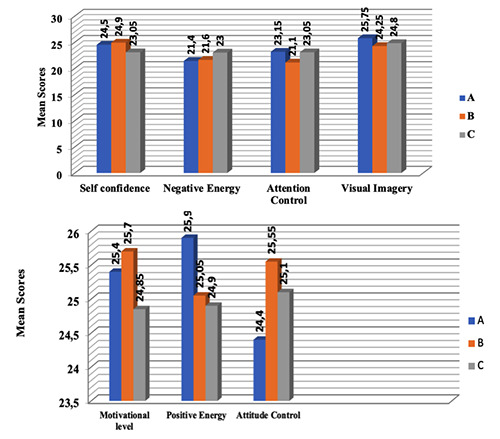
Mean scores of mental toughness variables of different age groups.
Table 2.
Comparative statistics of psychological variables of official mental toughness.
| ANOVA Table | Sum of Squares | df | Mean Square | F | Sig. | |
|---|---|---|---|---|---|---|
| Self Confidence | Between Groups | 37.90 | 2 | 18.95 | 2.14 | 0.13 |
| Within Groups | 505.75 | 57 | 8.87 | |||
| Negative Energy | Between Groups | 30.40 | 2 | 15.20 | 1.07 | 0.35 |
| Within Groups | 807.60 | 57 | 14.17 | |||
| Attention Control | Between Groups | 53.43 | 2 | 26.72 | 2.42 | 0.10 |
| Within Groups | 629.30 | 57 | 11.04 | |||
| Visual Imagery | Between Groups | 23.03 | 2 | 11.52 | 1.48 | 0.24 |
| Within Groups | 442.70 | 57 | 7.77 | |||
| Motivational level | Between Groups | 7.43 | 2 | 3.72 | 0.40 | 0.67 |
| Within Groups | 529.55 | 57 | 9.29 | |||
| Positive Energy | Between Groups | 11.63 | 2 | 5.82 | 0.67 | 0.52 |
| Within Groups | 498.55 | 57 | 8.75 | |||
| Attitude Control | Between Groups | 13.43 | 2 | 6.72 | 0.83 | 0.44 |
| Within Groups | 461.55 | 57 | 8.10 |
Based on the suggestions obtained during the study, the following suggestions have been provided: Female volunteers may be included in future studies to compare and analyze the level of various psychological characteristics. Other key psychological factors for performance could be researched in order to establish a comprehensive fostering development for psychological reviews. It may be possible to undertake research studies using elite players who also participate on an international level, with the results helping to understand the pattern of psychological skills progression as the standard of competition grows. Various psychological intervention (i.e., positive self-talk, CBT) and yogic interventions like mindfulness, vinyasa, breathing practices should be a part of their training schedule.30 Various Future studies could incorporate psychological skill training that focus on the official’s individual talent deficiencies.
One of the primary drawbacks of the current study is the sample size. The study could be undertaken with a better control over the extraneous variables and with better experimental conditions which must consider a very reliable method of monitoring the mental toughness and self-confidence levels. Only male officials were included as subjects in the current investigation. Studies should be undertaken to analyze the psychological variables among the referees of football, taking female subjects separately. A similar study may be undertaken on other officials of different games and sports relatively same as soccer to get a better understanding about mental toughness. Training could be imparted in the psychological responses considered in this area. It is plausible that with a longer period exposition to training area in this area of operation, more changes in psychological variables responses could be noticed. Thus, there is need of training in thus area to empower and enable investigation of how training affects the various responses and in knowing whether they are trainable or not.
Conclusions
Without the presence of officials, the competitive sports cannot take place. In order to ensure that everyone contributes to the game or event in the proper spirit, officials are essential. The laws, rules, and regulations are implemented by officials to ensure the best conduct possible. Officials remain under constant physiological and psychological pressures while conducting the match. These pressures include requirements for physical fitness, verbal abuse, and pressure to make numerous wise decisions throughout a match.
The environment where officials must perform is without a doubt one of the hardest and most demanding pieces of their activity. The idea of the match itself, (for example, a derby or crucial match) can regularly make a profoundly pressurized circumstance. Some antagonistic fans (and players) and the weight of media presentation and the potential worry for the official is obvious. This is probably going to affect upon the mental condition of the officials which thus will in all likelihood add to the viability of their making of decisions.
Funding Statement
Funding: None.
References
- 1.Gucciardi DF, Gordon S, Dimmock JA. Development and preliminary validation of a mental toughness inventory for Australian football. Psychology of Sport and Exercise 2009;10:201-209. [Google Scholar]
- 2.MacMahon C, Helsen WF, Starkes JL, Weston M. Decision-making skills and deliberate practice in elite association football referees. Journal of Sports Sciences 2007;25:65–78. [DOI] [PubMed] [Google Scholar]
- 3.MacNamara Á, Button A, Collins D. The role of psychological characteristics in facilitating the pathway to elite performance. Part 1: identifying mental skills and behaviours. Journal of Sport Psychology 2010;24:52–73. [Google Scholar]
- 4.Crust L. A review and conceptual reexamination of mental toughness: Implications for future researchers. Personality and Individual Differences 2008;45:576–583. [Google Scholar]
- 5.Tuero C, Tabernero B, Marquez S, Guillen F. Analysis of the factors affecting the practice of refereeing. Sociedade Capixaba de Psicologia do Esporte 2002;1:7–16. [Google Scholar]
- 6.Anderson KJ, Pierce DA. Officiating bias: the effect of foul differential on foul calls in NCAA basketball. J. Sports Sci. 2009;27:687–694. [DOI] [PubMed] [Google Scholar]
- 7.Cruz J. Asesoramiento psicológico en el arbitraje y juicio deportivo. In Cruz J. (Ed.), Psicología del deporte Madrid: Síntesis 1997;245-269. [Google Scholar]
- 8.Singh V, Singh MK, Bhutia TN. Self- Esteem: A Study on Elite Para- Throwers of India. Asian Pacific Journal of Health Sciences 2022;9(4):162–164. [Google Scholar]
- 9.Slack LA, Maynard IW, Butt J, Olusoga P. Factors underpinning football officiating excellence: Perceptions of English Premier League referees. Journal of Applied Sport Psychology 2012 Advance online publication. [Google Scholar]
- 10.Thelwell RC, Weston NJV, Greenlees IA. Defining and understanding mental toughness within soccer. Journal of Applied Sport Psychology 2005;17:326-332. [Google Scholar]
- 11.Golby J, Wood P. The Effects of Psychological Skills Training on Mental Toughness and Psychological Well-Being of Student-Athletes. Psychology 2016;7:901-913. [Google Scholar]
- 12.Jones G, Hanton S, Connaughton D. What is this thing called mental toughness? An investigation with elite performers. Journal of Applied Sport Psychology 2002;14:211–224. [Google Scholar]
- 13.Slack L. A., Maynard I. W., Butt J., Olusoga P. (2013). Factors underpinning football officiating excellence: perceptions of English Premier League referees. Journal of Applied Sport Psychology, 25(3), 298-315. [Google Scholar]
- 14.Slack LA, Butt J, Maynard IW, Olusoga P. Understanding mental toughness in elite football officiating: perceptions of English premier league officials. Sport & Exercise Psychology Review 2014;10: 4-24. [Google Scholar]
- 15.Guillén F, Feltz DL. A conceptual model of referee efficacy. Frontiers in Psychology 2011;2(25):1–5. [DOI] [PMC free article] [PubMed] [Google Scholar]
- 16.Bülent Okan M, Hayrettin G, Uğur Ödek, Özkan B. Comparative Study of Sport Mental Toughness between Soccer Officials. Universal Journal of Educational Research 2017;5(11):1970-76. [Google Scholar]
- 17.Nazarudin MN, Abdullah MR, Omar Fauzee MS, Abdullah NM, Noordin H, Suppiah PK. Psychological skills assessment and referee rugby sevens performance. Journal of Educational Thinkers 2014;5:165–184. [Google Scholar]
- 18.McCarrick D, Wolfson S, Neave N. Personality characteristics of UK Association Football officilas. Journal of Sport Behavior 2019;42(4):493-508. [Google Scholar]
- 19.Mary Quinton. Football Referees: Performers in Their Own Right – Believe Perform - The UK's Leading Sports Psychology BelievePerform 2019; Accessed on. 2019, 12 September from https://believeperform.com/football-referees-performers-in-their-ownright [Google Scholar]
- 20.Crust L. A review and conceptual reexamination of mental toughness: Implications for future researchers. Personality and individual differences 2008;45(7):576-583. [Google Scholar]
- 21.Anderson KJ, Pierce DA. Officiating bias: The effect of foul differential on foul calls in NCAA basketball. Journal of sports sciences 2009;27(7):687-694. [DOI] [PubMed] [Google Scholar]
- 22.Thelwell R, Weston N, Greenlees I. Defining and understanding mental toughness within soccer. Journal of applied sport psychology 2005;17(4):326-332. [Google Scholar]
- 23.Golby J, Wood P. The effects of psychological skills training on mental toughness and psychological well-being of student-athletes. Psychology 2016;7 (06):901. [Google Scholar]
- 24.Guillén F, Feltz DL. A conceptual model of referee efficacy. Frontiers in psychology 2011;2: 25. [DOI] [PMC free article] [PubMed] [Google Scholar]
- 25.Miçoogullari BO, Gümüsdag H, Ödek U, Beyaz Ö. Comparative Study of Sport Mental Toughness between Soccer Officials. Universal Journal of Educational Research 2017;5(11):1970-1976. [Google Scholar]
- 26.Gucciardi DF, Gordon S, Dimmock JA. Towards an understanding of mental toughness in Australian football. Journal of Applied Sport Psychology 2008;20(3):261–281. [Google Scholar]
- 27.Clough P, Earle K, Sewell D. Mental toughness: The concept and its measurement. In Cockerill I. (Ed.), Solutions in sport psychology 2002;32–43. London: Thomson Learning. [Google Scholar]
- 28.Crust L, Clough PJ. Relationship between mental toughness and physical endurance. Perceptual and Motor Skills, 2005;100(1):192–194. https://doi.org /10.2466/pms.100.1.192–194. [DOI] [PubMed] [Google Scholar]
- 29.Sing V, Acharya J, Bhutia TN. Effect of 6 weeks of online vinyasa training on explosive leg strength of school children during COVID-19 – A pilot study. Journal of Physical Education and Sport 2021;21(4):2276 – 2282 [Google Scholar]
- 30.Singh V, Singh MK, Bhutia TN. Mental Toughness: An Investigation study on Paralympian and Non-Paralympian Throwers of India. Journal of Positive School Psychology 2022;6(5): 7131– 7140. [Google Scholar]